Portfolio Analysis
< BCG Matrix, GE/Mckinsey Matrix >
Prof. Eui-ho Suh (ehsuh@postech.ac.kr)
POstech Strategic Management of Information System Lab (POSMIS)
Industrial Eng, POSTECH
by Sang jun Kim
April 9, 2004
Contents
BCG Matrix
GE/Mckinsey Matrix
Advantages and Limitation of
Portfolio analysis
Portfolio Analysis
1. Portfolio Analysis
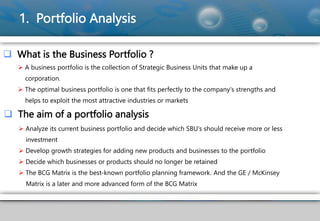
 What is the Business Portfolio ?
 A business portfolio is the collection of Strategic Business Units that make up a
corporation.
 The optimal business portfolio is one that fits perfectly to the company's strengths and
helps to exploit the most attractive industries or markets
 The aim of a portfolio analysis
 Analyze its current business portfolio and decide which SBU's should receive more or less
investment
 Develop growth strategies for adding new products and businesses to the portfolio
 Decide which businesses or products should no longer be retained
 The BCG Matrix is the best-known portfolio planning framework. And the GE / McKinsey
Matrix is a later and more advanced form of the BCG Matrix
2. BCG Matrix (1/3)
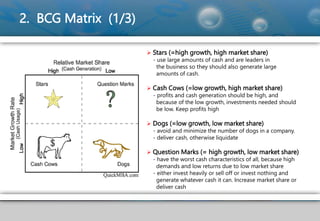
 Stars (=high growth, high market share)
- use large amounts of cash and are leaders in
the business so they should also generate large
amounts of cash.
 Cash Cows (=low growth, high market share)
- profits and cash generation should be high, and
because of the low growth, investments needed should
be low. Keep profits high
 Dogs (=low growth, low market share)
- avoid and minimize the number of dogs in a company.
- deliver cash, otherwise liquidate
 Question Marks (= high growth, low market share)
- have the worst cash characteristics of all, because high
demands and low returns due to low market share
- either invest heavily or sell off or invest nothing and
generate whatever cash it can. Increase market share or
deliver cash
2. BCG Matrix (2/3)
 Limitations of BCG Matrix
 The link between market share and profitability is questionable since increasing
market share can be very expensive
 The approach may overemphasize high growth, since it ignores the potential of
declining markets
 The model considers market growth rate to be a given. In practice the firm may be
able to grow the market
3. GE/Mckinsey Matrix (1/3)
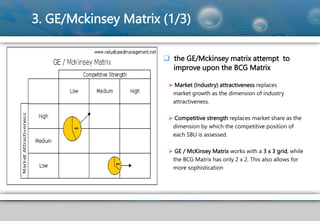
 Market (Industry) attractiveness replaces
market growth as the dimension of industry
attractiveness.
 Competitive strength replaces market share as the
dimension by which the competitive position of
each SBU is assessed.
 GE / McKinsey Matrix works with a 3 x 3 grid, while
the BCG Matrix has only 2 x 2. This also allows for
more sophistication
 the GE/Mckinsey matrix attempt to
improve upon the BCG Matrix
3. GE/Mckinsey Matrix (2/3)
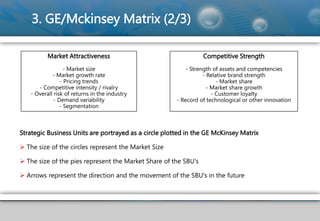
Market Attractiveness
- Market size
- Market growth rate
- Pricing trends
- Competitive intensity / rivalry
- Overall risk of returns in the industry
- Demand variability
- Segmentation
Competitive Strength
- Strength of assets and competencies
- Relative brand strength
- Market share
- Market share growth
- Customer loyalty
- Record of technological or other innovation
Strategic Business Units are portrayed as a circle plotted in the GE McKinsey Matrix
 The size of the circles represent the Market Size
 The size of the pies represent the Market Share of the SBU's
 Arrows represent the direction and the movement of the SBU's in the future
3. GE/Mckinsey Matrix (3/3)
 Limitations of GE/Mckinsey Matrix
 Core competencies are not represented
 Interactions between Strategic Business Units are not considered
4. Advantages and limitation of Portfolio analysis
 Portfolio offers certain advantages
 Portfolio have some very real limitations Matrix
 It encourages top management to evaluate each of the corporation’s businesses
individually and to set objectives and allocate resources for each
 It stimulates the use of externally oriented data to supplement management’s judgment
 It raises the issue of cash flow availability for use in expansion and growth
 Its graphic depiction facilitates communication
 It is not easy to define market segments
 It suggests the use of standard strategies that can miss opportunities or be impractical
 It provides an illusion of scientific rigor when in reality positions are based on subjective
judgments
 It is not always clear what makes an industry attractive or what stage a product is at in
its lifecycle

Portfolio Analysis - BCG Matrix, GEMckinsey Matrix.pptx

  • 1.
    Portfolio Analysis < BCGMatrix, GE/Mckinsey Matrix > Prof. Eui-ho Suh (ehsuh@postech.ac.kr) POstech Strategic Management of Information System Lab (POSMIS) Industrial Eng, POSTECH by Sang jun Kim April 9, 2004
  • 2.
    Contents BCG Matrix GE/Mckinsey Matrix Advantagesand Limitation of Portfolio analysis Portfolio Analysis
  • 3.
    1. Portfolio Analysis What is the Business Portfolio ?  A business portfolio is the collection of Strategic Business Units that make up a corporation.  The optimal business portfolio is one that fits perfectly to the company's strengths and helps to exploit the most attractive industries or markets  The aim of a portfolio analysis  Analyze its current business portfolio and decide which SBU's should receive more or less investment  Develop growth strategies for adding new products and businesses to the portfolio  Decide which businesses or products should no longer be retained  The BCG Matrix is the best-known portfolio planning framework. And the GE / McKinsey Matrix is a later and more advanced form of the BCG Matrix
  • 4.
    2. BCG Matrix(1/3)  Stars (=high growth, high market share) - use large amounts of cash and are leaders in the business so they should also generate large amounts of cash.  Cash Cows (=low growth, high market share) - profits and cash generation should be high, and because of the low growth, investments needed should be low. Keep profits high  Dogs (=low growth, low market share) - avoid and minimize the number of dogs in a company. - deliver cash, otherwise liquidate  Question Marks (= high growth, low market share) - have the worst cash characteristics of all, because high demands and low returns due to low market share - either invest heavily or sell off or invest nothing and generate whatever cash it can. Increase market share or deliver cash
  • 5.
    2. BCG Matrix(2/3)  Limitations of BCG Matrix  The link between market share and profitability is questionable since increasing market share can be very expensive  The approach may overemphasize high growth, since it ignores the potential of declining markets  The model considers market growth rate to be a given. In practice the firm may be able to grow the market
  • 6.
    3. GE/Mckinsey Matrix(1/3)  Market (Industry) attractiveness replaces market growth as the dimension of industry attractiveness.  Competitive strength replaces market share as the dimension by which the competitive position of each SBU is assessed.  GE / McKinsey Matrix works with a 3 x 3 grid, while the BCG Matrix has only 2 x 2. This also allows for more sophistication  the GE/Mckinsey matrix attempt to improve upon the BCG Matrix
  • 7.
    3. GE/Mckinsey Matrix(2/3) Market Attractiveness - Market size - Market growth rate - Pricing trends - Competitive intensity / rivalry - Overall risk of returns in the industry - Demand variability - Segmentation Competitive Strength - Strength of assets and competencies - Relative brand strength - Market share - Market share growth - Customer loyalty - Record of technological or other innovation Strategic Business Units are portrayed as a circle plotted in the GE McKinsey Matrix  The size of the circles represent the Market Size  The size of the pies represent the Market Share of the SBU's  Arrows represent the direction and the movement of the SBU's in the future
  • 8.
    3. GE/Mckinsey Matrix(3/3)  Limitations of GE/Mckinsey Matrix  Core competencies are not represented  Interactions between Strategic Business Units are not considered
  • 9.
    4. Advantages andlimitation of Portfolio analysis  Portfolio offers certain advantages  Portfolio have some very real limitations Matrix  It encourages top management to evaluate each of the corporation’s businesses individually and to set objectives and allocate resources for each  It stimulates the use of externally oriented data to supplement management’s judgment  It raises the issue of cash flow availability for use in expansion and growth  Its graphic depiction facilitates communication  It is not easy to define market segments  It suggests the use of standard strategies that can miss opportunities or be impractical  It provides an illusion of scientific rigor when in reality positions are based on subjective judgments  It is not always clear what makes an industry attractive or what stage a product is at in its lifecycle