Defensive Strategies for Market
                 Success

                            NAUMAN RAFIQUE
                             L1F09MBBF0018

Wednesday, April 18, 2012
Introduction
• Competition forces companies to constantly
  engage in offensive and defensive marketing
  strategies.
• Rivalry occurs because one or more competitors
  either feels the pressure or sees an opportunity
  to enter an industry or to improve its position
  within an industry.
• Companies respond to competitor challenges by
  counterattacking with increasing advertising
  expenditures,     cutting    prices,  increasing
  innovation, and introducing new products.
Defensive Strategies
• The purpose of DS is to make a possible attack
  unattractive and discourage potential challengers from
  attacking another firm.
• Incumbents try to shape the challenger’s expectations
  about the industry’s profitability and convince them
  that the return on their investment will be so low.
• Incumbent needs to take timely action to discourage a
  challenger from making any substantial commitment.
• Marketing managers and business strategists have
  developed a number of defensive marketing strategies.
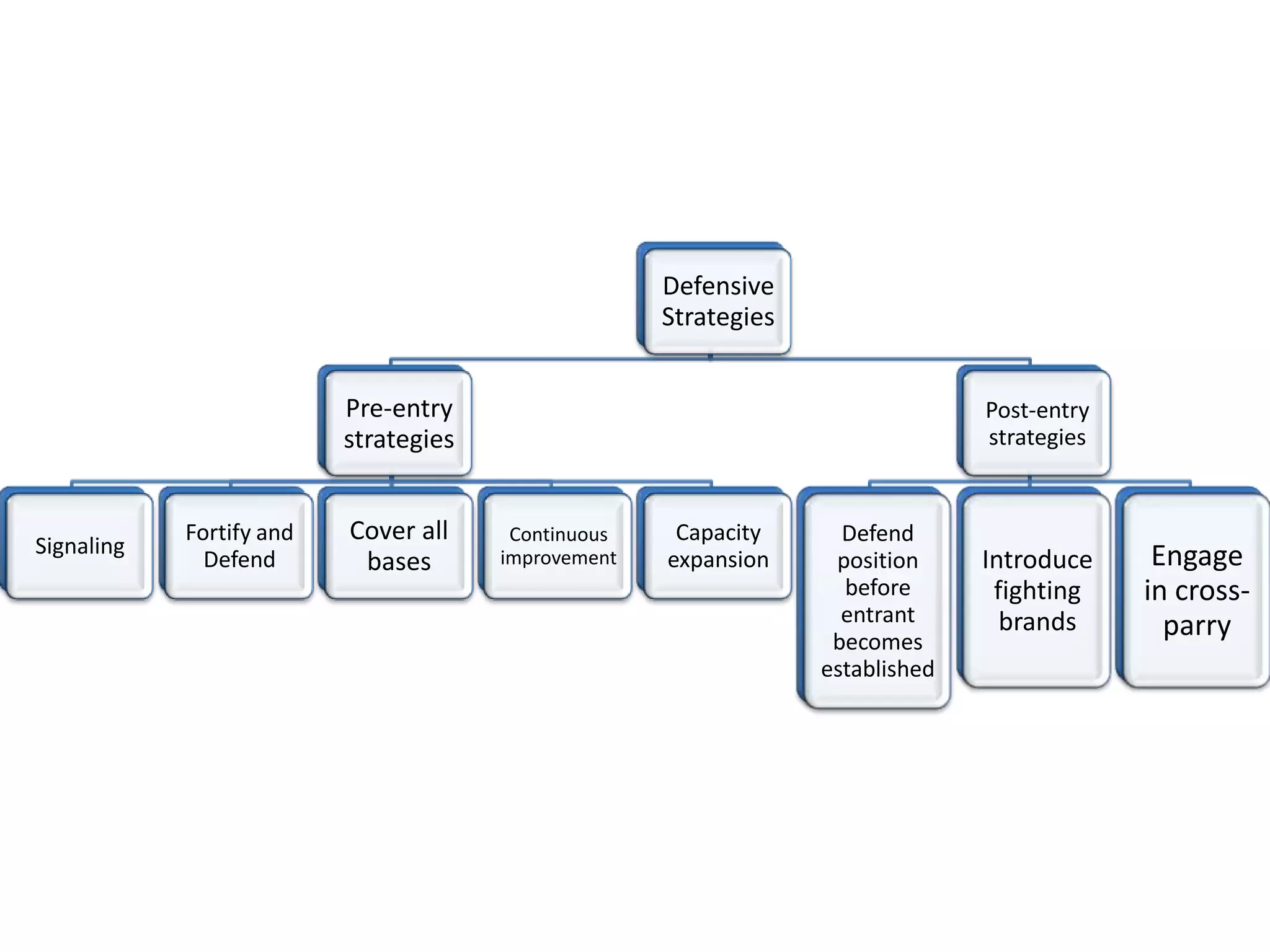
Defensive
                                                     Strategies


                          Pre-entry                                             Post-entry
                          strategies                                            strategies


            Fortify and   Cover all     Continuous    Capacity      Defend
Signaling                                                                                     Engage
              Defend       bases       improvement   expansion     position     Introduce
                                                                    before       fighting    in cross-
                                                                    entrant       brands
                                                                   becomes
                                                                                               parry
                                                                  established
Signaling
• Companies often use signaling to announce their
  intention to take an action.
• Announcements can be made through interviews
  with the press, press releases, speeches, trade
  journals, newspapers, and other means.
• A defending firm can effectively keep potential
  entrants out of the industry by using the threat of
  retaliation.
• The higher the perceived probability of retaliation
  and its degree of severity, the lower the
  probability of attack by a challenger.
Fortify and Defend
• Higher the profits earned by incumbent firms, the higher
  the motivation to enter.
• The inducement to attack can be lowered by reducing the
  profit expectations of the entrant.
• The most common barriers to entry include:
    Economies of scale
    Product differentiation
    Capital requirements
    Switching costs
    Experience curve cost reductions
    Proprietary technology or patents
    Access to raw materials and other inputs
    Access to distribution channels
    Location
Cover All Bases
• It involve introducing multiple versions of a
  product in terms of models or product types.
• Many firms carry full product lines to block
  access to the industry by new entrants.
• This strategy is also used by chain stores when
  they rush to expand rapidly and keep
  competitors out of the market.
Continuous Improvement
• A continuous improvement strategy calls for a
  relentless pursuit of improvements in
   Costs
   Product quality
   New product development
   Manufacturing processes
   Distribution
• Through       a       continuous      improvement
  strategy, firms try to stay one step ahead of their
  competitors and help protect their competitive
  position from hostile challengers.
Capacity Expansion
• Manufacturing firms may build excess capacity
  as an entry deterrent strategy.
• When a potential entrant realizes that the
  industry has excess capacity and its own entry
  will only add to the volume of unutilized
  industry capacity, it will be reluctant to enter.
• Capacity expansion is a credible deterrent
  strategy if capacity costs are very high.
Defend Position Before Entrant
        Becomes Established
• Upstarts are especially dangerous if they enter
  the market by breaking the rules of the game
  with radically new products, or innovations in
  pricing, distribution,   delivery, service, and
  positioning.
• Incumbents often defend themselves by
  embracing and improving the intruder's
  technology, attacking the upstart’s reputation as
  a product reliable source of supply, and hiring
  some of the best people of the attacking firm.
Introduce Fighting Brands
• Introduced by organizations to fight a
  competitor’s brand that threatens one of their
  major brands.
• Competing brands are typically lower priced
  versions of the firm’s premium brands that claim
  equal quality at a much lower price.
• It can be an appealing strategy because they help
  fight off a price-cutting brand that is threatening
  the core brand of the firm while preserving its
  premium image and profit margins.
Engage in Cross-Parry
• The degree of multimarket contact between two firms
  affects the intensity of rivalry and the extent of retaliation
  amongst these firms.
• Competitors interacting in multiple markets are less
  motivated to compete aggressively because of the
  possibility of retaliation across various markets.
• Competitors have an incentive to cooperate since they
  stand to gain if they allow their rivals to dominate certain
  markets in exchange for similar treatment in the markets in
  which they are dominant.
• Cross-parry is used when a firm that is challenged by a
  competitor in one area chooses to challenge this
  competitor in another area.
THANK YOU

Defensive and offensive strategies

  • 1.
    Defensive Strategies forMarket Success NAUMAN RAFIQUE L1F09MBBF0018 Wednesday, April 18, 2012
  • 2.
    Introduction • Competition forcescompanies to constantly engage in offensive and defensive marketing strategies. • Rivalry occurs because one or more competitors either feels the pressure or sees an opportunity to enter an industry or to improve its position within an industry. • Companies respond to competitor challenges by counterattacking with increasing advertising expenditures, cutting prices, increasing innovation, and introducing new products.
  • 3.
    Defensive Strategies • Thepurpose of DS is to make a possible attack unattractive and discourage potential challengers from attacking another firm. • Incumbents try to shape the challenger’s expectations about the industry’s profitability and convince them that the return on their investment will be so low. • Incumbent needs to take timely action to discourage a challenger from making any substantial commitment. • Marketing managers and business strategists have developed a number of defensive marketing strategies.
  • 4.
    Defensive Strategies Pre-entry Post-entry strategies strategies Fortify and Cover all Continuous Capacity Defend Signaling Engage Defend bases improvement expansion position Introduce before fighting in cross- entrant brands becomes parry established
  • 5.
    Signaling • Companies oftenuse signaling to announce their intention to take an action. • Announcements can be made through interviews with the press, press releases, speeches, trade journals, newspapers, and other means. • A defending firm can effectively keep potential entrants out of the industry by using the threat of retaliation. • The higher the perceived probability of retaliation and its degree of severity, the lower the probability of attack by a challenger.
  • 6.
    Fortify and Defend •Higher the profits earned by incumbent firms, the higher the motivation to enter. • The inducement to attack can be lowered by reducing the profit expectations of the entrant. • The most common barriers to entry include:  Economies of scale  Product differentiation  Capital requirements  Switching costs  Experience curve cost reductions  Proprietary technology or patents  Access to raw materials and other inputs  Access to distribution channels  Location
  • 7.
    Cover All Bases •It involve introducing multiple versions of a product in terms of models or product types. • Many firms carry full product lines to block access to the industry by new entrants. • This strategy is also used by chain stores when they rush to expand rapidly and keep competitors out of the market.
  • 8.
    Continuous Improvement • Acontinuous improvement strategy calls for a relentless pursuit of improvements in Costs Product quality New product development Manufacturing processes Distribution • Through a continuous improvement strategy, firms try to stay one step ahead of their competitors and help protect their competitive position from hostile challengers.
  • 9.
    Capacity Expansion • Manufacturingfirms may build excess capacity as an entry deterrent strategy. • When a potential entrant realizes that the industry has excess capacity and its own entry will only add to the volume of unutilized industry capacity, it will be reluctant to enter. • Capacity expansion is a credible deterrent strategy if capacity costs are very high.
  • 10.
    Defend Position BeforeEntrant Becomes Established • Upstarts are especially dangerous if they enter the market by breaking the rules of the game with radically new products, or innovations in pricing, distribution, delivery, service, and positioning. • Incumbents often defend themselves by embracing and improving the intruder's technology, attacking the upstart’s reputation as a product reliable source of supply, and hiring some of the best people of the attacking firm.
  • 11.
    Introduce Fighting Brands •Introduced by organizations to fight a competitor’s brand that threatens one of their major brands. • Competing brands are typically lower priced versions of the firm’s premium brands that claim equal quality at a much lower price. • It can be an appealing strategy because they help fight off a price-cutting brand that is threatening the core brand of the firm while preserving its premium image and profit margins.
  • 12.
    Engage in Cross-Parry •The degree of multimarket contact between two firms affects the intensity of rivalry and the extent of retaliation amongst these firms. • Competitors interacting in multiple markets are less motivated to compete aggressively because of the possibility of retaliation across various markets. • Competitors have an incentive to cooperate since they stand to gain if they allow their rivals to dominate certain markets in exchange for similar treatment in the markets in which they are dominant. • Cross-parry is used when a firm that is challenged by a competitor in one area chooses to challenge this competitor in another area.
  • 13.