




Level 4
David Mullich
Game Design 1
The Los Angeles Film School
How To Start Your Game Narrative
Extra Credits: How To Start Your Game Narrative
Take-Away
Don’t start planning designing a new game by
creating the game’s story.
Start with defining the experience you want the player
to have, and then create a story that will provide that
experience.
DRAMATIC ELEMENTS
 Challenge
 Theme
 Premise
 Character
 Story
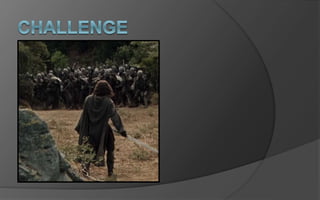
Challenge
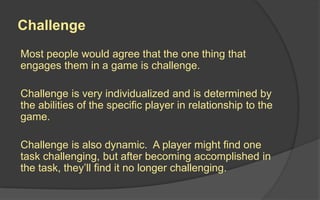
Most people would agree that the one thing that
engages them in a game is challenge.
Challenge is very individualized and is determined by
the abilities of the specific player in relationship to the
game.
Challenge is also dynamic. A player might find one
task challenging, but after becoming accomplished in
the task, they’ll find it no longer challenging.
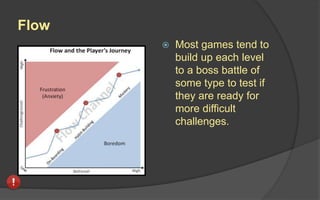
Flow
 Most games tend to
build up each level
to a boss battle of
some type to test if
they are ready for
more difficult
challenges.
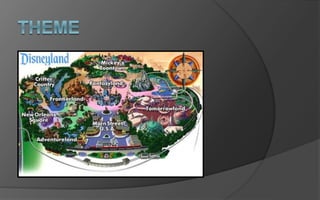
Theme
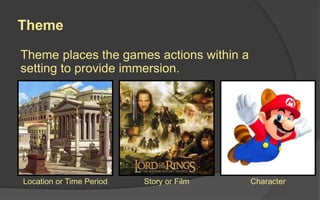
Theme places the games actions within a
setting to provide immersion.
Location or Time Period Story or Film Character
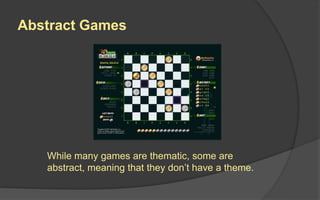
Abstract Games
While many games are thematic, some are
abstract, meaning that they don’t have a theme.
Pro Tips
 Have every detail in your game support the theme.
Premise
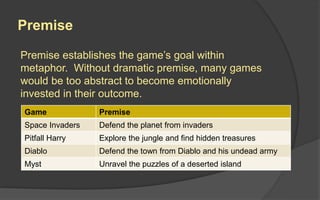
Premise establishes the game’s goal within
metaphor. Without dramatic premise, many games
would be too abstract to become emotionally
invested in their outcome.
Game Premise
Space Invaders Defend the planet from invaders
Pitfall Harry Explore the jungle and find hidden treasures
Diablo Defend the town from Diablo and his undead army
Myst Unravel the puzzles of a deserted island
Tasks of the Premise
 Makes the experience richer for the player
 Unifies the game’s structure and theme
 Make a game’s mechanics more playable for the
user
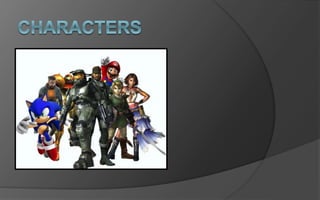
Characters
Characters are the agents through whose actions a drama
is told.
 Protagonist: The main character, whose engagement
with the premise creates the conflict that drives the
story
 Antagonist: A person or some other force that works
against the Protagonist
 Major Characters: Have a significant impact on the
story’s outcome
 Minor Characters: Have a minor impact on the story’s
outcome
Methods of Characterization
Characters are defined by:
 What they do
 What they say
 What others say about them
Round Characters: A character with well-defined traits and a
realistic personality or undergoes a significant change of
personality during the story
Flat Characters: Show little or no change in personality, and they
are often used as foils to show off elements of another character
Agency vs. Empathy
What is unique to game characters:
 Agency: The practical function of a character to
serve as a representation of the player in a game
 Empathy: The potential for players to develop an
emotional attachment to the character, to identify
with their goals, and consequently, with the game’s
objectives.
Characters vs. Avatars
 Predesigned Characters: Backstories, motivations
 Player-Created Characters (Avatars): Role-
playing, growth, customization
Both have potential for empathy; the question is
which is best for the game’s design and player
experience goals.
Free Will vs. Player Control
 AI-Controlled Characters:
Characters exhibiting “free will”
by having their own personality
and inner thought process
 Player-Controlled Characters:
Player assumes agency for the
character’s actions
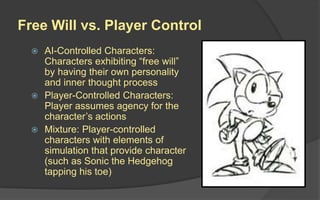
 Mixture: Player-controlled
characters with elements of
simulation that provide character
(such as Sonic the Hedgehog
tapping his toe)
Pro Tips
 Characters should have iconic qualities
that the players can identify with or aspire
to.
 Character traits should manifest
themselves in the character’s words,
actions, and appearance.
 Characters should change in ways that are
interesting and surprising, yet believable.
STORY
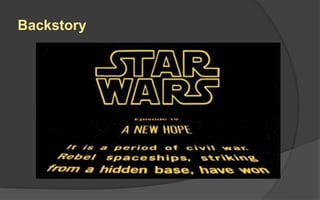
Backstory
In many games, story is limited to backstory, an
elaborate version of the premise.
The backstory gives a setting and context for the
game’s conflict, and it can create motivation for the
character, but its progression is not affected by
gameplay.
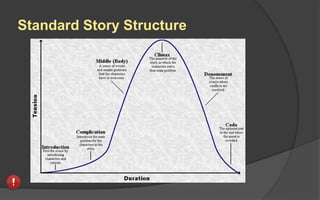
Standard Story Structure
Backstory
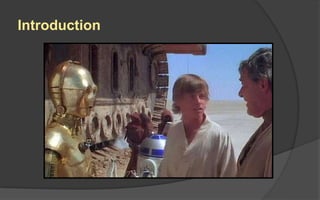
Introduction
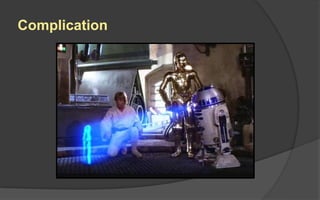
Complication
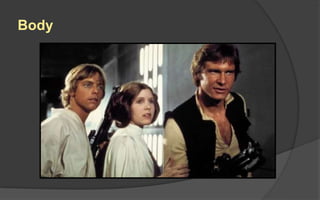
Body
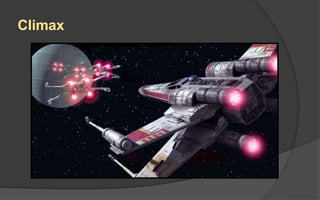
Climax
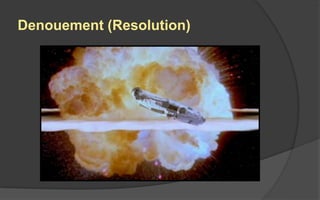
Denouement (Resolution)
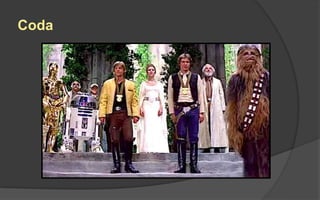
Coda
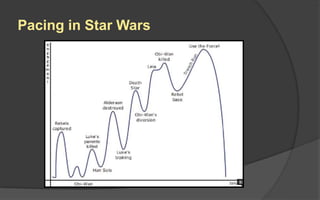
Pacing in Star Wars
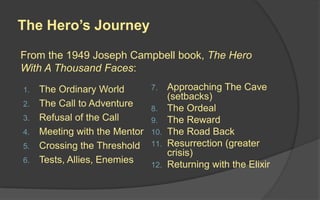
The Hero’s Journey
From the 1949 Joseph Campbell book, The Hero
With A Thousand Faces:
1. The Ordinary World
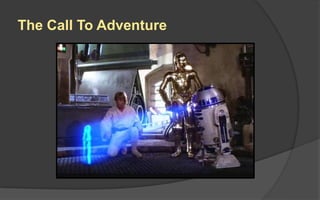
2. The Call to Adventure
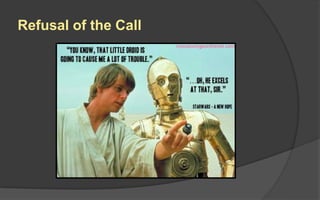
3. Refusal of the Call
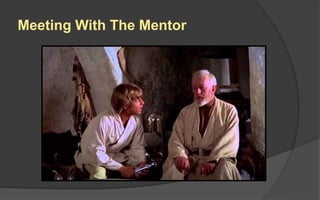
4. Meeting with the Mentor
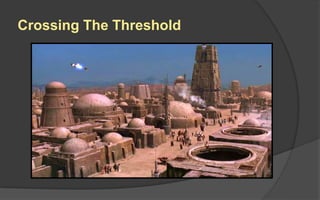
5. Crossing the Threshold
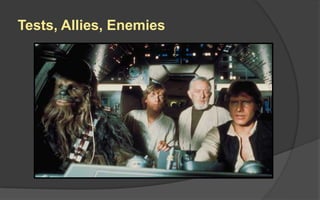
6. Tests, Allies, Enemies
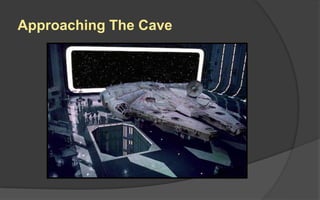
7. Approaching The Cave
(setbacks)
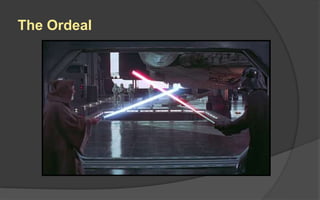
8. The Ordeal
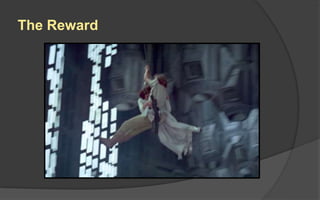
9. The Reward
10. The Road Back
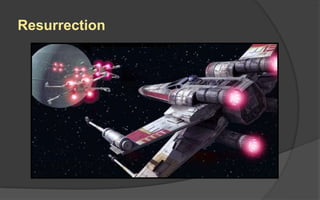
11. Resurrection (greater
crisis)
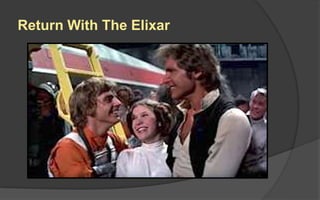
12. Returning with the Elixir
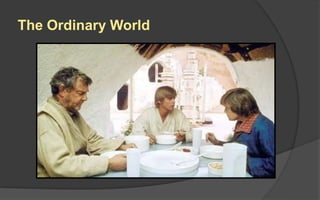
The Ordinary World
The Call To Adventure
Refusal of the Call
Meeting With The Mentor
Crossing The Threshold
Tests, Allies, Enemies
Approaching The Cave
The Ordeal
The Reward
The Road Back
Resurrection
Return With The Elixar
Outcome
The outcome of a game must be uncertain. The
same is true of a story.
However, the outcome of a story is resolved by the
author, while the outcome of a game is resolved by
the player.
Because of this, it is difficult to integrate traditional
storytelling methods into games.
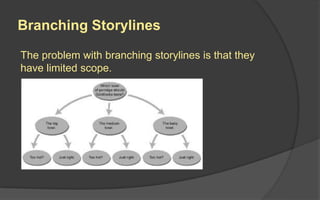
Branching Storylines
The problem with branching storylines is that they
have limited scope.
Emergent Storylines
The story emerges from gameplay rather than from a
predetermined structure.
 The Sims: Players can take snapshots of
gameplay and arrange them in a captioned
scrapbook
 Black & White: Combines elements of simulation
with strategy and gameplay
 Half-Life: Story sequences are triggered by
character actions
Pro Tips
 The aesthetics, technology and gameplay
should support the story and vice-versa.
 Don’t have your story match the Hero’s
Journey so closely that it feels backward.
 Avoid lengthy “dialog dumps” to tell your
backstory and other story elements.
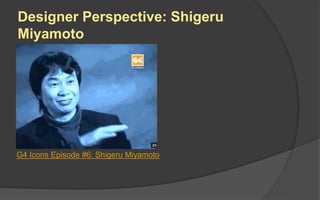
Designer Perspective: Shigeru
Miyamoto
G4 Icons Episode #6: Shigeru Miyamoto
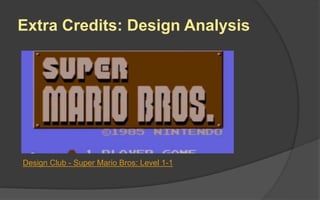
Extra Credits: Design Analysis
Design Club - Super Mario Bros: Level 1-1
1. Download GD1 4 Resources from the
LAFS GD1 website Session 4 page
2. Create a Platform game
LAFS Game Design 1 - Dramatic Elements

LAFS Game Design 1 - Dramatic Elements

  • 1.
    Level 4 David Mullich GameDesign 1 The Los Angeles Film School
  • 2.
    How To StartYour Game Narrative Extra Credits: How To Start Your Game Narrative
  • 3.
    Take-Away Don’t start planningdesigning a new game by creating the game’s story. Start with defining the experience you want the player to have, and then create a story that will provide that experience.
  • 4.
    DRAMATIC ELEMENTS  Challenge Theme  Premise  Character  Story
  • 6.
    Challenge Most people wouldagree that the one thing that engages them in a game is challenge. Challenge is very individualized and is determined by the abilities of the specific player in relationship to the game. Challenge is also dynamic. A player might find one task challenging, but after becoming accomplished in the task, they’ll find it no longer challenging.
  • 7.
    Flow  Most gamestend to build up each level to a boss battle of some type to test if they are ready for more difficult challenges.
  • 9.
    Theme Theme places thegames actions within a setting to provide immersion. Location or Time Period Story or Film Character
  • 10.
    Abstract Games While manygames are thematic, some are abstract, meaning that they don’t have a theme.
  • 11.
    Pro Tips  Haveevery detail in your game support the theme.
  • 13.
    Premise Premise establishes thegame’s goal within metaphor. Without dramatic premise, many games would be too abstract to become emotionally invested in their outcome. Game Premise Space Invaders Defend the planet from invaders Pitfall Harry Explore the jungle and find hidden treasures Diablo Defend the town from Diablo and his undead army Myst Unravel the puzzles of a deserted island
  • 14.
    Tasks of thePremise  Makes the experience richer for the player  Unifies the game’s structure and theme  Make a game’s mechanics more playable for the user
  • 16.
    Characters Characters are theagents through whose actions a drama is told.  Protagonist: The main character, whose engagement with the premise creates the conflict that drives the story  Antagonist: A person or some other force that works against the Protagonist  Major Characters: Have a significant impact on the story’s outcome  Minor Characters: Have a minor impact on the story’s outcome
  • 17.
    Methods of Characterization Charactersare defined by:  What they do  What they say  What others say about them Round Characters: A character with well-defined traits and a realistic personality or undergoes a significant change of personality during the story Flat Characters: Show little or no change in personality, and they are often used as foils to show off elements of another character
  • 18.
    Agency vs. Empathy Whatis unique to game characters:  Agency: The practical function of a character to serve as a representation of the player in a game  Empathy: The potential for players to develop an emotional attachment to the character, to identify with their goals, and consequently, with the game’s objectives.
  • 19.
    Characters vs. Avatars Predesigned Characters: Backstories, motivations  Player-Created Characters (Avatars): Role- playing, growth, customization Both have potential for empathy; the question is which is best for the game’s design and player experience goals.
  • 20.
    Free Will vs.Player Control  AI-Controlled Characters: Characters exhibiting “free will” by having their own personality and inner thought process  Player-Controlled Characters: Player assumes agency for the character’s actions  Mixture: Player-controlled characters with elements of simulation that provide character (such as Sonic the Hedgehog tapping his toe)
  • 21.
    Pro Tips  Charactersshould have iconic qualities that the players can identify with or aspire to.  Character traits should manifest themselves in the character’s words, actions, and appearance.  Characters should change in ways that are interesting and surprising, yet believable.
  • 22.
  • 23.
    Backstory In many games,story is limited to backstory, an elaborate version of the premise. The backstory gives a setting and context for the game’s conflict, and it can create motivation for the character, but its progression is not affected by gameplay.
  • 24.
  • 25.
  • 26.
  • 27.
  • 28.
  • 29.
  • 30.
  • 31.
  • 32.
  • 33.
    The Hero’s Journey Fromthe 1949 Joseph Campbell book, The Hero With A Thousand Faces: 1. The Ordinary World 2. The Call to Adventure 3. Refusal of the Call 4. Meeting with the Mentor 5. Crossing the Threshold 6. Tests, Allies, Enemies 7. Approaching The Cave (setbacks) 8. The Ordeal 9. The Reward 10. The Road Back 11. Resurrection (greater crisis) 12. Returning with the Elixir
  • 34.
  • 35.
    The Call ToAdventure
  • 36.
  • 37.
  • 38.
  • 39.
  • 40.
  • 41.
  • 42.
  • 43.
  • 44.
  • 45.
  • 46.
    Outcome The outcome ofa game must be uncertain. The same is true of a story. However, the outcome of a story is resolved by the author, while the outcome of a game is resolved by the player. Because of this, it is difficult to integrate traditional storytelling methods into games.
  • 47.
    Branching Storylines The problemwith branching storylines is that they have limited scope.
  • 48.
    Emergent Storylines The storyemerges from gameplay rather than from a predetermined structure.  The Sims: Players can take snapshots of gameplay and arrange them in a captioned scrapbook  Black & White: Combines elements of simulation with strategy and gameplay  Half-Life: Story sequences are triggered by character actions
  • 49.
    Pro Tips  Theaesthetics, technology and gameplay should support the story and vice-versa.  Don’t have your story match the Hero’s Journey so closely that it feels backward.  Avoid lengthy “dialog dumps” to tell your backstory and other story elements.
  • 51.
    Designer Perspective: Shigeru Miyamoto G4Icons Episode #6: Shigeru Miyamoto
  • 52.
    Extra Credits: DesignAnalysis Design Club - Super Mario Bros: Level 1-1
  • 53.
    1. Download GD14 Resources from the LAFS GD1 website Session 4 page 2. Create a Platform game

Editor's Notes

  • #17 By identifying with a character and the outcome of their goals, the audience internalizes the story’s events and empathizes with its movement toward the resolution.
  • #33 Star Wares: A New hope instantly grabs the viewer’s attention with the opening scene of the Rebel ship being capture. The engagement sequence then progresses in a series of hills and valleys, building higher and higher until the climactic destruction of the Death Star. Virtually all good entertainment has a similar pacing curve.
  • #52 How ere games his destiny? Made puppet shows, drew comic strips Became obsessed with heroic characters like superheroes. Shock and surprise. First job? Industrial designer of board games at Nintendo. Then got reassigned to computer games. First game? Radar scope. Failed. Tried to get Popeye license, but failed. First successful game? Donkey Kong. First character-based arcade game. Premise: rescue girlfriend from gorilla. Smash success for Nintendo. First console game? Super Mario Bros. for NES. Mario character is expressive in his action. Drew inspiration from his childhood – cool caves he explored as a boy. Nintendo becomes most profitable company in Japan. Legend of Zelda: RPG game. Oceana of Time: Mirrors fairy tales.