Level 9
David Mullich
Game Mechanics
The Los Angeles Film School
What Is Game Balance?
Game Balance
 Single Player Games: The game’s difficulty
is matched to the player’s skill level
throughout the entire game.
 Multiplayer Games: All players have an
equal opportunity to win regardless of their
starting position, resources, goals, or skill
level.
Complexity vs. Difficulty
Difficulty: The skill required to successfully
reach a goal.
Complexity: The number of actions required
to successfully reach a game goal.
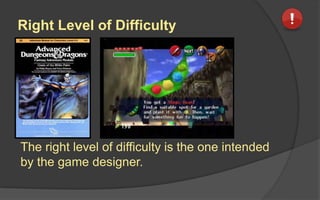
Right Level of Difficulty
The right level of difficulty is the one intended
by the game designer.
Why Designers Want Right Level of
Difficulty
 If challenges are too easy, players will become
Bored
 If they are too difficult, players will become
Frustrated
Other reasons:
 Provide Smooth Learning Curves
 Combine Tension and Empowerment
 Promote Game Mastery
Difficulty Level Design
Considerations
 Which challenges should be made easier?
 Which challenges should be made harder?
 Which challenges should occur at another
point in the game?
Balancing Difficulty
Less Difficulty:
 Clues about solving Challenge
 Make actions easier to perform
 Selectable Goals
 Varied Gameplay
Harder:
 More Obstacles and Enemies
 Make Actions harder to perform
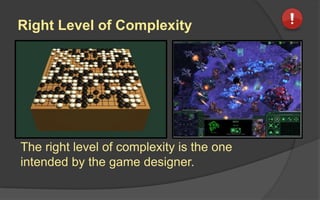
Right Level of Complexity
The right level of complexity is the one
intended by the game designer.
Why Designers Want Right Level of
Complexity
• Influences Level of Difficulty
• Makes Game Mastery easier to Achieve
• Supports Experimenting
• Promotes Constructive Play
Warning! Can lead to:
 Analysis Paralysis
Complexity Design Considerations
 Does the game have rhythm-based
actions?
 How many game elements does the player
need to interact with?
 How many relationships do these elements
have with each other?
 How complex is the narrative structure?
Balancing Complexity
Less Complex
 Ability Losses
More Complex
 Attention Swapping
 Indirect Control
 Producer-Consumer Chains
 Resource Consumers
 Red Herrings
 Role Reversals
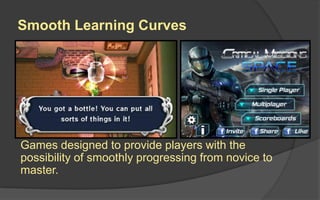
Smooth Learning Curves
Games designed to provide players with the
possibility of smoothly progressing from novice to
master.
Requirements
 Right Level of Difficulty
 Right Level of Complexity
 Consistent Reality Logic
Why Designers Want Smooth Learning
Curves
Allows:
 Immersion
 Game Mastery
Supports:
 Illusion of Influence
 Perceived Chance to Succeed
Smooth Learning Curves Design
Considerations
 What information can be provided to
players for overcoming challenges?
 How can challenge difficulty be adjusted to
the player’s skill?
 How can players adjust challenge
difficulty?
Balancing Smooth Learning Curves
More Smooth:
 Easy Challenges Sooner
 Harder Challenges Later
 Limited Foresight
 Save-Load Cycles
 Luck
Balancing For Skill In Multiplayer
Games
Extra Credits: The Link from Optimal Power to Strategy
What Was The Main Message Of This
Video?
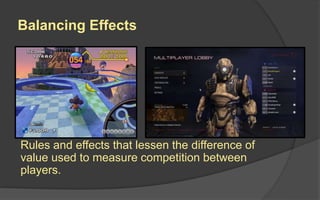
Balancing Effects
Rules and effects that lessen the difference of
value used to measure competition between
players.
Pre-Emptive Balancing Effects
• Handicaps
• Making Extended Actions into Interruptible
Actions
• Delayed Effects
• Selectable Set of Goals
• Diminishing Returns
Correcting Balancing Effects
Favoring Disadvantaged Players through:
 Better Rewards for Completing Goals
 New/Improved Abilities
 Shared Rewards
 Spawning
 Turn Taking
Handicapping Advantaged Players through:
 Worse Penalties for Failing Goals
 Lost/Decreased Abilities
Why Designers Use Balancing Effects
Allows:
 Smooth Learning Curves
 Right Level of Difficulty
 Perceived Chance to Succeed
 High-Level Closures
Also:
 Maintains Tension
 Minimizes differences in Asymmetric Abilities
Balancing Effects Design
Considerations
 Is the balancing effect designed to be pre-
emptive or correcting?
 Is limited foresight used to mask an
imbalance?
 Are there more than two players or teams
competing?
Symmetry
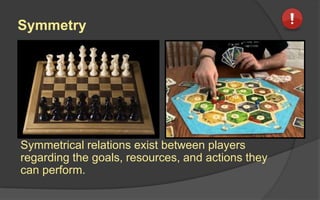
Symmetrical relations exist between players
regarding the goals, resources, and actions they
can perform.
Why Designers Use Symmetry
Allows:
 Player Balance (set-up only)
 Team Balance (set-up only)
Supports:
 Game Mastery
Symmetry Design Considerations
 Do players have the same abilities?
 Do players have symmetric goals?
 Are resources distributed symmetrically?
 Do teams have symmetry?
Balancing Symmetry
Less Symmetrical:
 Asymmetric Abilities
 Asymmetric Goals
 Asymmetric Resource Distribution
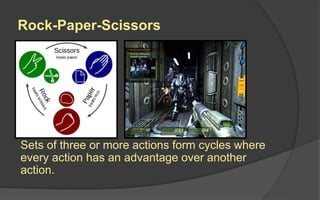
Rock-Paper-Scissors
Sets of three or more actions form cycles where
every action has an advantage over another
action.
Rock-Paper-Scissors in Quick Games
 Choices tend to have immediate
consequences
 Played repeated so that a Metagame
evolves of gaining knowledge of
opponent’s strategies
Rock-Paper-Scissors in Long-Term
Games
 Investments gain Asymmetric Abilities
 Players gain information about other
players by
 Public Information
 Sending Units into Fog of War
Why Designers Use Rock-Paper-
Scissors
Provides:
 Symmetry between actions or tactics
Promotes:
 Tension about chosen action/tactic
Supports:
 Game Mastery through knowledge of
successful actions/tactics
Rock-Paper-Scissors Design
Considerations
 What is the set of elements in which each
element have an advantage over another
one?
 Is the game quick or long-term?
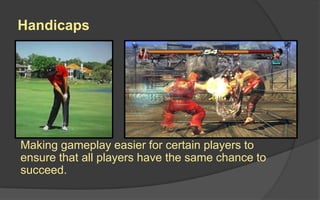
Handicaps
Making gameplay easier for certain players to
ensure that all players have the same chance to
succeed.
How Handicaps Are Provided
 Asymmetric Abilities
 Asymmetric Resource Distribution
 Asymmetric Goals
 Reversible Actions For Novices
 Reconfigurable Game Worlds
Why Designers Use Handicaps
Provides:
 Right Level of Difficulty in Multiplayer
Games
 Player or Team Balance
 Trans-Game Information
Warning! Conflicts with:
 Symmetry
Handicaps Design Considerations
 Can players set individual levels of difficulty?
 Can players set individual resources or abilities?
 Can players set individual negative consequences to
be limited or ignored?
 Can players set different thresholds for evaluation
functions?
 Can players set individual bonuses to score values?
 Can players set individual starting locations or skill
advantages?
 Can player take back actions and perform other
actions?
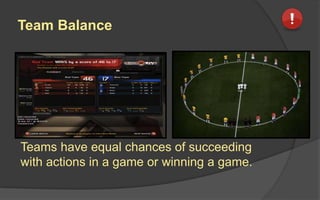
Team Balance
Teams have equal chances of succeeding
with actions in a game or winning a game.
Ways To Provide Team Balance
Before Game:
 Team Configuration with Player Balance
 Symmetric Competency Areas and
Privileged Abilities
 Starting Positions
During Game:
 Handicaps
 Spawning
Why Designers Want Team Balance
 Gives players a Perceived Chance of
Winning
 Encourages Team Play and therefore
Social Status
 Players feel Empowerment
Team Balance Design Considerations
 Is there total player balance between all
players?
 How can teams’ starting positions be
balanced?
 What privileged abilities need to be mitigated?
 What handicaps need to be applied?
 What other balancing effects need to be
applied during gameplay?
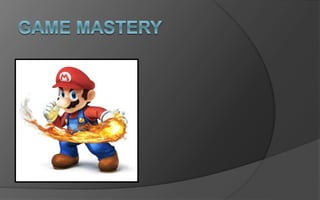
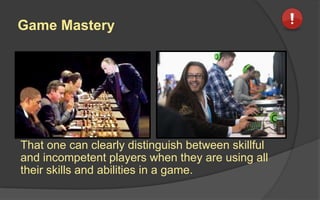
Game Mastery
That one can clearly distinguish between skillful
and incompetent players when they are using all
their skills and abilities in a game.
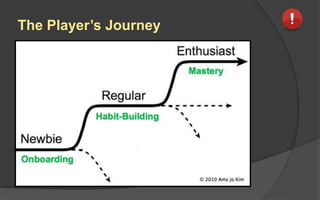
The Player’s Journey
Allowing For Game Mastery
Requires:
 Right Level of Difficulty
 Smooth Learning Curves with Right Levels
of Difficulty
Nullified by:
 Randomness
 Balancing
Why Designers Promote Game
Mastery
 Empowerment
 Emotional Immersion
 Replayablity
 Varied Gameplay
 Competency Areas
 Strategic Knowledge
 Risk-Reward Trade-offs
 Trans-Game Information
 Social Statuses
 Investments in Gameplay
Game Mastery Design Considerations
 What dexterity-based skills can a player train
and develop?
 What mental-based skills can a player train
and develop?
 What social-based skills can a player train and
develop?
 How is mastery revealed?
 How can mastery be maintained past game
sessions?
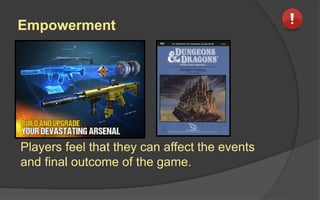
Empowerment
Players feel that they can affect the events
and final outcome of the game.
Ways To Provide Empowerment
 Right Level of Difficulty
 Privileged/New/Improved Abilities
 Producers & Converters
 Strategic Planning & Knowledge
 Freedom of Choice
 Player-Decided Results
 Creative Control
 Social Status
 Game Mastery
Why Designers Provide
Empowerment
 Emotional Immersion
 Competence Areas
 Higher Level Closures as Gameplay
Progresses
Warning! Can conflict with:
 Player Balance
 Team Balance
Empowerment Design Considerations
 How empowered does the player feel at
the beginning of the game?
 Does the empowerment increase
incrementally?
 What opportunities does the player have
for creative control?
 Do the players vote on anything?
 Can the player construct the game world?
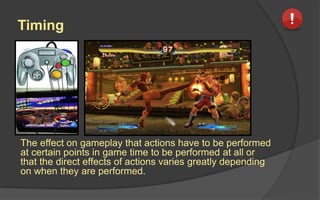
Timing
The effect on gameplay that actions have to be performed
at certain points in game time to be performed at all or
that the direct effects of actions varies greatly depending
on when they are performed.
Timing In Real-Time Games
 Maneuvering and Deadly Traps
 Combat through Aim & Shoot with
Overcome Goals
 Aim & Shoot for Capture and Configuration
Goals
Timing in Turn-Based Games
 Privileged Abilities with Delayed Effects
 Geometric Rewards for Investments
Why Designers Use Timing
 Allows Rhythm-Based Actions
 Encourages Game Mastery
Timing Design Considerations
 Is the game turn-based or real-time?
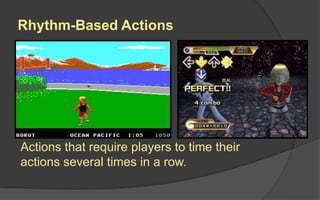
Rhythm-Based Actions
Actions that require players to time their
actions several times in a row.
Implementation of Rhythm-Based
Actions
 Extended Actions
 Combos
 Moveable Tiles
 Deadly Traps
Why Designers Use Rhythm-Based
Actions
 Sensory-Motoric Immersion
 Game Mastery
Rhythm-Based Action Design
Considerations
 What is the extended action to be
performed?
 How long should it be performed?
 What feedback is provided to the player?
 What rewards or penalties are associated
with performing the action?
Balancing Rhythm-Based Actions
• Level of Difficulty based on Tempo
• Level of Complexity based on Actions
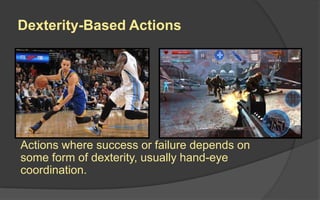
Dexterity-Based Actions
Actions where success or failure depends on
some form of dexterity, usually hand-eye
coordination.
Implementation of Dexterity-Based
Actions
 Real-Time Game with Timing
 Maneuvering to avoid Obstacles
 Combat, especially Aim & Shoot
 Extended Actions
Why Designers Use Dexterity-Based
Actions
 Sensory-Motoric Immersion
 Spatial Immersion
 Game Mastery
Dexterity-Based Action Design
Considerations
 What is the action to be performed?
 How fast is the response time, if it is a
digital game?

LAFS Game Mechanics - Balancing

  • 1.
    Level 9 David Mullich GameMechanics The Los Angeles Film School
  • 2.
    What Is GameBalance?
  • 3.
    Game Balance  SinglePlayer Games: The game’s difficulty is matched to the player’s skill level throughout the entire game.  Multiplayer Games: All players have an equal opportunity to win regardless of their starting position, resources, goals, or skill level.
  • 5.
    Complexity vs. Difficulty Difficulty:The skill required to successfully reach a goal. Complexity: The number of actions required to successfully reach a game goal.
  • 6.
    Right Level ofDifficulty The right level of difficulty is the one intended by the game designer.
  • 7.
    Why Designers WantRight Level of Difficulty  If challenges are too easy, players will become Bored  If they are too difficult, players will become Frustrated Other reasons:  Provide Smooth Learning Curves  Combine Tension and Empowerment  Promote Game Mastery
  • 8.
    Difficulty Level Design Considerations Which challenges should be made easier?  Which challenges should be made harder?  Which challenges should occur at another point in the game?
  • 9.
    Balancing Difficulty Less Difficulty: Clues about solving Challenge  Make actions easier to perform  Selectable Goals  Varied Gameplay Harder:  More Obstacles and Enemies  Make Actions harder to perform
  • 10.
    Right Level ofComplexity The right level of complexity is the one intended by the game designer.
  • 11.
    Why Designers WantRight Level of Complexity • Influences Level of Difficulty • Makes Game Mastery easier to Achieve • Supports Experimenting • Promotes Constructive Play Warning! Can lead to:  Analysis Paralysis
  • 12.
    Complexity Design Considerations Does the game have rhythm-based actions?  How many game elements does the player need to interact with?  How many relationships do these elements have with each other?  How complex is the narrative structure?
  • 13.
    Balancing Complexity Less Complex Ability Losses More Complex  Attention Swapping  Indirect Control  Producer-Consumer Chains  Resource Consumers  Red Herrings  Role Reversals
  • 14.
    Smooth Learning Curves Gamesdesigned to provide players with the possibility of smoothly progressing from novice to master.
  • 15.
    Requirements  Right Levelof Difficulty  Right Level of Complexity  Consistent Reality Logic
  • 16.
    Why Designers WantSmooth Learning Curves Allows:  Immersion  Game Mastery Supports:  Illusion of Influence  Perceived Chance to Succeed
  • 17.
    Smooth Learning CurvesDesign Considerations  What information can be provided to players for overcoming challenges?  How can challenge difficulty be adjusted to the player’s skill?  How can players adjust challenge difficulty?
  • 18.
    Balancing Smooth LearningCurves More Smooth:  Easy Challenges Sooner  Harder Challenges Later  Limited Foresight  Save-Load Cycles  Luck
  • 20.
    Balancing For SkillIn Multiplayer Games Extra Credits: The Link from Optimal Power to Strategy
  • 21.
    What Was TheMain Message Of This Video?
  • 22.
    Balancing Effects Rules andeffects that lessen the difference of value used to measure competition between players.
  • 23.
    Pre-Emptive Balancing Effects •Handicaps • Making Extended Actions into Interruptible Actions • Delayed Effects • Selectable Set of Goals • Diminishing Returns
  • 24.
    Correcting Balancing Effects FavoringDisadvantaged Players through:  Better Rewards for Completing Goals  New/Improved Abilities  Shared Rewards  Spawning  Turn Taking Handicapping Advantaged Players through:  Worse Penalties for Failing Goals  Lost/Decreased Abilities
  • 25.
    Why Designers UseBalancing Effects Allows:  Smooth Learning Curves  Right Level of Difficulty  Perceived Chance to Succeed  High-Level Closures Also:  Maintains Tension  Minimizes differences in Asymmetric Abilities
  • 26.
    Balancing Effects Design Considerations Is the balancing effect designed to be pre- emptive or correcting?  Is limited foresight used to mask an imbalance?  Are there more than two players or teams competing?
  • 27.
    Symmetry Symmetrical relations existbetween players regarding the goals, resources, and actions they can perform.
  • 28.
    Why Designers UseSymmetry Allows:  Player Balance (set-up only)  Team Balance (set-up only) Supports:  Game Mastery
  • 29.
    Symmetry Design Considerations Do players have the same abilities?  Do players have symmetric goals?  Are resources distributed symmetrically?  Do teams have symmetry?
  • 30.
    Balancing Symmetry Less Symmetrical: Asymmetric Abilities  Asymmetric Goals  Asymmetric Resource Distribution
  • 31.
    Rock-Paper-Scissors Sets of threeor more actions form cycles where every action has an advantage over another action.
  • 32.
    Rock-Paper-Scissors in QuickGames  Choices tend to have immediate consequences  Played repeated so that a Metagame evolves of gaining knowledge of opponent’s strategies
  • 33.
    Rock-Paper-Scissors in Long-Term Games Investments gain Asymmetric Abilities  Players gain information about other players by  Public Information  Sending Units into Fog of War
  • 34.
    Why Designers UseRock-Paper- Scissors Provides:  Symmetry between actions or tactics Promotes:  Tension about chosen action/tactic Supports:  Game Mastery through knowledge of successful actions/tactics
  • 35.
    Rock-Paper-Scissors Design Considerations  Whatis the set of elements in which each element have an advantage over another one?  Is the game quick or long-term?
  • 36.
    Handicaps Making gameplay easierfor certain players to ensure that all players have the same chance to succeed.
  • 37.
    How Handicaps AreProvided  Asymmetric Abilities  Asymmetric Resource Distribution  Asymmetric Goals  Reversible Actions For Novices  Reconfigurable Game Worlds
  • 38.
    Why Designers UseHandicaps Provides:  Right Level of Difficulty in Multiplayer Games  Player or Team Balance  Trans-Game Information Warning! Conflicts with:  Symmetry
  • 39.
    Handicaps Design Considerations Can players set individual levels of difficulty?  Can players set individual resources or abilities?  Can players set individual negative consequences to be limited or ignored?  Can players set different thresholds for evaluation functions?  Can players set individual bonuses to score values?  Can players set individual starting locations or skill advantages?  Can player take back actions and perform other actions?
  • 40.
    Team Balance Teams haveequal chances of succeeding with actions in a game or winning a game.
  • 41.
    Ways To ProvideTeam Balance Before Game:  Team Configuration with Player Balance  Symmetric Competency Areas and Privileged Abilities  Starting Positions During Game:  Handicaps  Spawning
  • 42.
    Why Designers WantTeam Balance  Gives players a Perceived Chance of Winning  Encourages Team Play and therefore Social Status  Players feel Empowerment
  • 43.
    Team Balance DesignConsiderations  Is there total player balance between all players?  How can teams’ starting positions be balanced?  What privileged abilities need to be mitigated?  What handicaps need to be applied?  What other balancing effects need to be applied during gameplay?
  • 45.
    Game Mastery That onecan clearly distinguish between skillful and incompetent players when they are using all their skills and abilities in a game.
  • 46.
  • 47.
    Allowing For GameMastery Requires:  Right Level of Difficulty  Smooth Learning Curves with Right Levels of Difficulty Nullified by:  Randomness  Balancing
  • 48.
    Why Designers PromoteGame Mastery  Empowerment  Emotional Immersion  Replayablity  Varied Gameplay  Competency Areas  Strategic Knowledge  Risk-Reward Trade-offs  Trans-Game Information  Social Statuses  Investments in Gameplay
  • 49.
    Game Mastery DesignConsiderations  What dexterity-based skills can a player train and develop?  What mental-based skills can a player train and develop?  What social-based skills can a player train and develop?  How is mastery revealed?  How can mastery be maintained past game sessions?
  • 50.
    Empowerment Players feel thatthey can affect the events and final outcome of the game.
  • 51.
    Ways To ProvideEmpowerment  Right Level of Difficulty  Privileged/New/Improved Abilities  Producers & Converters  Strategic Planning & Knowledge  Freedom of Choice  Player-Decided Results  Creative Control  Social Status  Game Mastery
  • 52.
    Why Designers Provide Empowerment Emotional Immersion  Competence Areas  Higher Level Closures as Gameplay Progresses Warning! Can conflict with:  Player Balance  Team Balance
  • 53.
    Empowerment Design Considerations How empowered does the player feel at the beginning of the game?  Does the empowerment increase incrementally?  What opportunities does the player have for creative control?  Do the players vote on anything?  Can the player construct the game world?
  • 54.
    Timing The effect ongameplay that actions have to be performed at certain points in game time to be performed at all or that the direct effects of actions varies greatly depending on when they are performed.
  • 55.
    Timing In Real-TimeGames  Maneuvering and Deadly Traps  Combat through Aim & Shoot with Overcome Goals  Aim & Shoot for Capture and Configuration Goals
  • 56.
    Timing in Turn-BasedGames  Privileged Abilities with Delayed Effects  Geometric Rewards for Investments
  • 57.
    Why Designers UseTiming  Allows Rhythm-Based Actions  Encourages Game Mastery
  • 58.
    Timing Design Considerations Is the game turn-based or real-time?
  • 59.
    Rhythm-Based Actions Actions thatrequire players to time their actions several times in a row.
  • 60.
    Implementation of Rhythm-Based Actions Extended Actions  Combos  Moveable Tiles  Deadly Traps
  • 61.
    Why Designers UseRhythm-Based Actions  Sensory-Motoric Immersion  Game Mastery
  • 62.
    Rhythm-Based Action Design Considerations What is the extended action to be performed?  How long should it be performed?  What feedback is provided to the player?  What rewards or penalties are associated with performing the action?
  • 63.
    Balancing Rhythm-Based Actions •Level of Difficulty based on Tempo • Level of Complexity based on Actions
  • 64.
    Dexterity-Based Actions Actions wheresuccess or failure depends on some form of dexterity, usually hand-eye coordination.
  • 65.
    Implementation of Dexterity-Based Actions Real-Time Game with Timing  Maneuvering to avoid Obstacles  Combat, especially Aim & Shoot  Extended Actions
  • 66.
    Why Designers UseDexterity-Based Actions  Sensory-Motoric Immersion  Spatial Immersion  Game Mastery
  • 67.
    Dexterity-Based Action Design Considerations What is the action to be performed?  How fast is the response time, if it is a digital game?

Editor's Notes

  • #7 EXAMPLES: D&D Scenarios are categorized by Player Level Number. ZELDA: THE OCARINA OF TIME starts with easy quests and moves on to more challenging ones.
  • #8 Players feel both TENSION and EMPOWERMENT, due to PERCEIVED CHANCE TO SUCCEED and ILLUSION OF INFLUENCE..
  • #10 Complexity has to do with the understanding of rules, the consequences of immediate actions in the long run, and planning of many actions ahead. EXAMPLE: The size of a GO board determine the number of possible combinations in a single game session. Real-time strategy games like STARCRAFT can have many rules associated with them.
  • #11 With SMOOTH LEARNING CURVE, makes GAME MASTERY easier to achieve. With LIMITED FORESIGHT and PREDICTABLE CONSEQUENCES, supports EXPERIMENTING and promotes CONSTRUCTCTIVE PLAY.: *STIMULATED PLANNING may lead to ANALYSIS PARALYSIS and DOWNTIME
  • #12 RHYTHM-BASED ACTIONS: TEMPO and NUMBER OF ACTIONS. COMBOS GAME ELEMENTS: Main way of adjusting COMPLEXITY RELATIONSHIPS
  • #13 When learning the skill to play a game is actually a part of the gameplay and an enjoyable experience in itself, the game is said to have a SMOOTH LEARGNING CURVE. EXAMPLES: LEGEND OF ZELDA provides signs and characters that give players hints about what they can do. FIRST PERSON SHOOTERS: Single-player mode can be seen as preparation for playing multiplayer.
  • #14 RIGHT LEVEL OF DIFFICULTY based on the Player's Skill Level.
  • #16 INFORMATION: Allows players to build STRATEGIC INFORMATION and LIMITED FORESIIGHT. EXTRA-GAME INFORMATION provided as CLUES or HELPERS CONSISTENT REALITY LOGIC
  • #18 https://youtu.be/GiOA_CS25Kw
  • #20 Balancing Effects serve to make all players more likely to feel that they have a chance to win over their opponents. EXAMPLES: Power-ups in SUPER MONKEY BALL 2 give speed boosters only to players not leading in the race. (Further balancing effects can be added by players through the option that makes the leader have lower maximum speed than the other players.) Multiplayer online first-person shooters may arrange teams based on numbers or even experience. .
  • #21 PRE_EMPTIVE: Maintain Player Balance so that imbalances do not occur. SELECTABLE SET OF GOALS so players can choose ones that best fit their abilities. DIMINISHING RETURNS to prevent players from becoming clear leaders. Warning: If these effects are DIRECT, can RUIN ILLUSION OF INFLUENCE. INDIRECT METHODS include BUGETED ACTION POINTS and CHARACTER DEVELOPMENT.
  • #22 CORRECTING: Correct imbalances once they have occurred. Arrange TURN TAKING so Disadvantaged Players are in most advantageous positions. SPAWNING, so that disadvantaged players are at STRATEGIC LOCATIONS. .
  • #24 LIMITED FORESIGHT: Players can not see too far ahead of the game, giving them a PERCEIVED CHANCE TO SUCCEED, although it may only be an ILLUSION OF INFLUENCE. MORE THAN 2: Corrective balancing as teams may enter into an UNCOMMITTED ALLIANCE against the leader. (GAME STATE OVERVIEWS and PUBLIC SCORES are necessary so that players can pinpoint the leader).
  • #25 A common feature in games to ensure that players have equal opportunities. In these cases, the outcome of games is either dependent on players’ SKILLS or RANDOMNESS, since the game system does not put any player in a favorable position. EXAMPLES: In CHESS, the players have the same pieces and set-up. In SETTLERS OF CATAN, the player who is first to place the first settlement is the last to place the second, while the last to place the first settlement is the first to place the second.
  • #26 Provides basis for showing GAME MASTERY when there is little RANDOMNESS Create OUTSTANDING FEATURES in the Game World.
  • #28 https://youtu.be/GiOA_CS25Kw
  • #30 EXAMPLE: Classic children’s game. In QUAKE, the relations between Weapons and Monsters.
  • #32 Often implemented as INVESTMENT to gain ASSYMETRIC ABILITIES, through UNITS or CHARACTER DEVELOPMENT.
  • #33 Introduces a form of RANDOMNESSS and limited PREDICTABLE CONEQUENCE unless players either gain knowledge of other player’s current activities or keep a record of their behavior.
  • #35 When player are aware of differences in their playing skills, they may agree on HANDICAPSS to make the outcome as uncertain as possible within the game world. EXAMPLES: GOLF is one of the most well-known sports using HANDICAPS. It not only ensures equal gameplay, but is a measure of mastery of the sport. Fighting games like TEKKEN allow players to choose starting health by percentage, for example 80% to 140%.
  • #37 Provides TRANS-GAME INFORMATION which can be a form of SCORE in a META GAME.
  • #38 INDIVIDUAL LEVELS OF DIFFICULTY RESOURCES or ABILITIES * ASSYMETRIC RESOURCE DISTRIBUTION and ABILITIES or PRIVILEGED ABILITIES can give BALANCING EFFECTS, as players may not have as much FREEDOM OF CHOICE. * Changing resources in the GAME WORLD make the game one with a RECONFIGURABLE GAME WORLD. NEGATIVE CONSEQUENCES. EVALUATON FUNCTIONSS BONUS START LOCATION / SKILL ADVANTAGES REVERSIBILITY
  • #39 Games with teams are usually balanced the same way as games where players play against each other. EXAMPLE: Some MULTIPLAYER ONLINE FPS have systems for automatically arranging teams based on kills or experience points. Teams changing sides during half time in SOCCER minimizes the influence of variations in the field or the direction of the sun.
  • #42 PLAYER BALANCE: * Doesn’t need to be if there is still SYMMETRY between teams. * Unless more than two teams are playing PLAYER DECIDED RESULTS cannot work as votes, etc. become draws. STARTING POSITION: Doesn’t need to be if there is SYMMETRY between teams. PRVILEGED ABILITIES: Doesn’t need to be if there is SYMMETRY between teams. BALANCING Lessened by: TEAM DEVELOPMENT
  • #43 How players can their skills and abilities in playing the game, and how to balance the gameplay for players with different skill levels.
  • #44 Player skill Is achieved when players feel they have an understanding of the game or a possibility to perform actions in a game that a previously not possible. When the skill is sufficiently far from the initial level, players can feel that they have gained Game Mastery. EXAMPLES: In CHESS:, the differences between novice and experts is so large, novices have no chance to win against an expert player. In FIRST-PERSON SHOOTERS, there can be a wide range of mastery. ILLUSIONARY REWARD WARNING: * RANDOMNESS and BALANCING EFFECTS can make MASTERY hard to perceive or even achieve.
  • #46 Best done through LEVELS, where the appropriate difficulty of challenges can be set.
  • #47 Games that support use of different skills for solving challenges promote VARIED GAMEPLAY. ASSYMMETRIC ABILITIES may allow different types of Game Mastery in the same game. This promotes REPLAYABILITY, but in multiplayer games requires COMPETENCY AREAS. Knowing when to perform actions is also part of Game Mastery. Development of STRATEGIC KNOWLEDGE may be due to required RISK/REWARD choices or TRADEOFFS. Passed on as TRANS-GAME INFORMATION between instances, making playing the game a form of INVESTMENT. And knowing when to perform EXTENDED ACTIONS, and the long-term consequences of PENALTIES and REWARDS.
  • #48 DEXTERITY: Coordination-based and timing-based actions. MENTAL: Memorizing, Puzzle Solving, Experimenting, Determined by the level of COGNITIVE IMMERSION or SPATIAL IMMERSION. Games involving RANDOMNESS can also support Game Mastery, but usually through Strategic Knowledge about Probabilities. SOCIAL: Negotiation, Storytelling, Betting. REVEALED: Most commonly in OVERCOME goals, PERCEIVABLE MARGINES or GAME STATE OVERIVEW. MAINTAINED: TOURNAMENTS HIGH SCORE LISTS with HANDLES SOCIAL STATUS, especially if game supports SPECTATORS.
  • #49 Games let players make choices that can affect the final outcome of the game. The possibility to have an influence over what happens is a form of power and gives players a feeling of EMPOWERMENT simply by playing games. Playing a game can be seen as an agreement among all the players to give each other clearly defined powers. But this Empowerment is bounded by the rule of the game. The level of Empowerment depend upon the design of the game and upon the other players. EXAMPLE: Gaining new weapons in FPS games. In RPGs, scenarios are made for the highest level characters.
  • #52 BEGINNING INCREMENTAL IMPROVED/NEW ABILITIES, especially PRIVILEGED, by giving them COMPETENCE AREAS Choose how to uses PRODUCERS or CONVERTERS, by giving them FREEDOM OF CHOICE CREATIVE CONTROL VOTING CONSTRUCTING WORLDS BALANCING * Lessened by TIME LIMITS, ROLE REVERSALS, and ganging up.
  • #53 EXAMPLE: SUPER MARIO SUNSHINE: Special variations of actions are possible if the Timing between two button presses on the game controller is correct. Fighting games like TEKKEN place emphasis on Timing to successfully attack and parry against opponents.
  • #55 ACHIEVED by SIMULATED PLANNING
  • #58 In Rhythm-based Games, timing and stability can be as important as performing the right action. They are basically EXTENDED ACTIONS that require TIMING in REAL-TIME GAMES. EXAMPLE: Early computer sports games like CALIFORNIA GAMES required players to make long sequences of rhythm based actions. DANCE DANCE REVOLUTION requires players to hit various buttons in certain combinations while following certain rhythms.
  • #61 EXTENDED ACTION TIMING FEEDBACK PROGRESS INDICATOR ILLUSORY REWARD REWARD/PENALTY Failure to keep rhythm usually ends the Extended Action with no penalties, especially with OVERCOME goals or COMBAT actions. Failure while performing movement-related Combos, penalties are often associated with DEADLY TRAPS
  • #62 Actions whose effects are determined by how the player physically performs them. The effects of the actions do not have to be directly connected to what the player is physically manipulating for the actions to be dexterous. EXAMPLE: Most sports requires skillful DEXTERITY-BASED ACTIONS as part of GAME MASTERY. Moving Avatars in FPS can be seen as a Dexterity-Based Action since players get feedback quickly enough to feel immersed in the virtual environment, even though the control is INDIRECT and the Action is MEDIATED by the Game System.
  • #65 ACTION RESPONSE TIME If response time is too long, they do not seem to the Player to be DEXTERITY-BASED ACTIONS. This can be mitigated with games with few SURPRISES and either using TIMING for single-actions with PROGRESS INDICATORS, or RHYTHM-BASED GAME where delays can be ignored.