

Level 2
David Mullich
Game Mechanics
The Los Angeles Film School
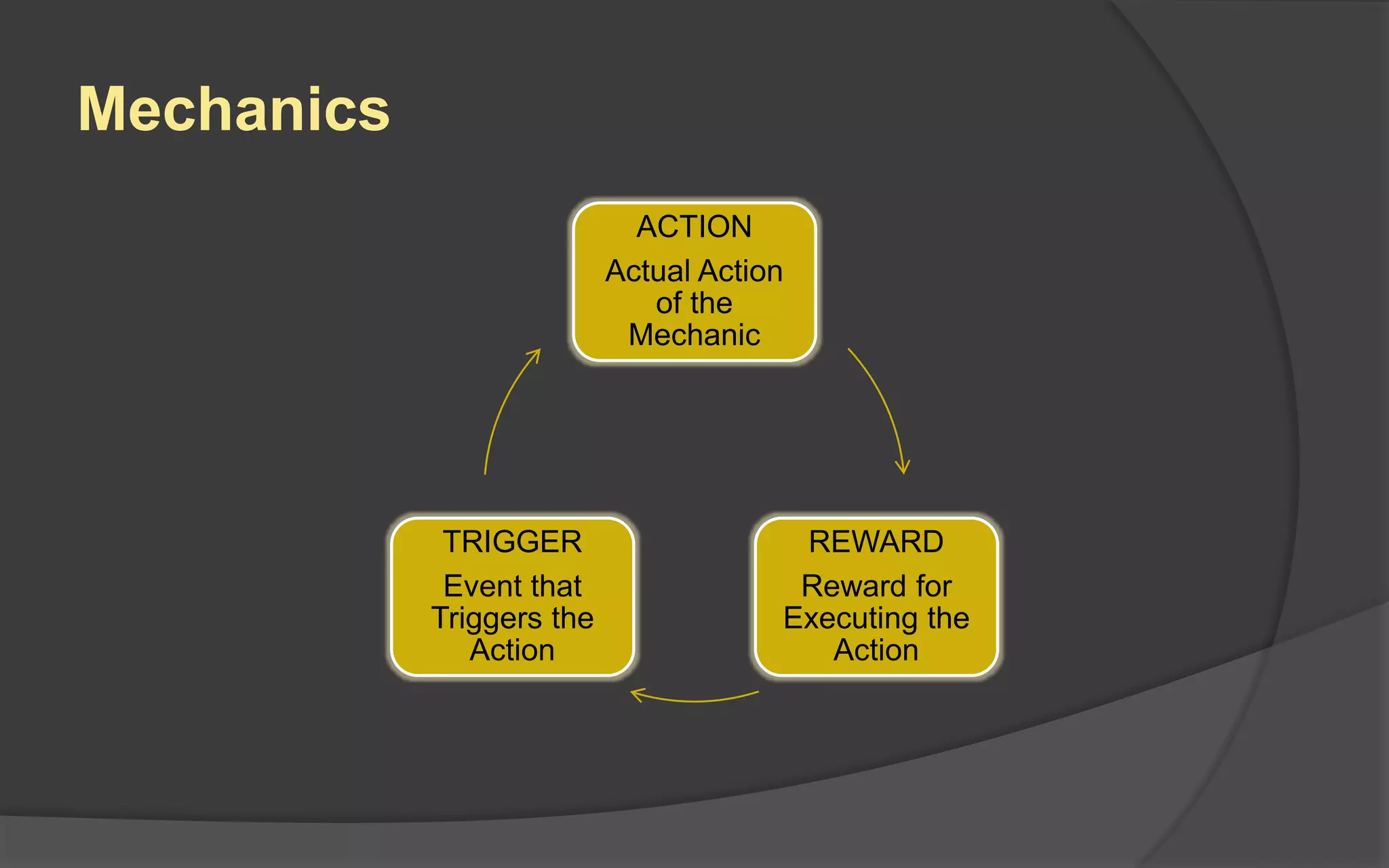
Mechanics
ACTION
Actual Action
of the
Mechanic
REWARD
Reward for
Executing the
Action
TRIGGER
Event that
Triggers the
Action
Extrinsic Rewards
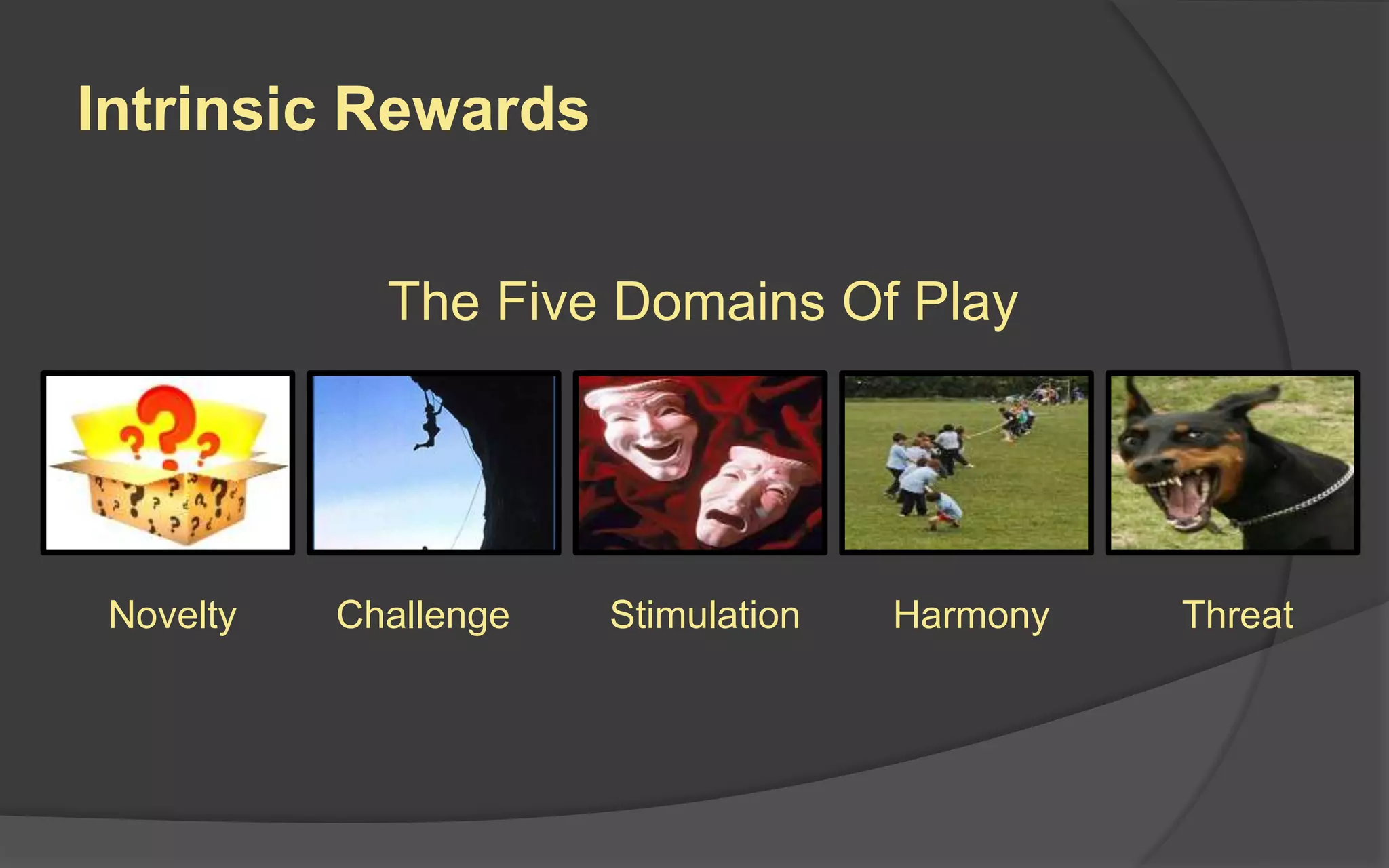
Intrinsic Rewards
Novelty
The Five Domains Of Play
Challenge Stimulation Harmony Threat
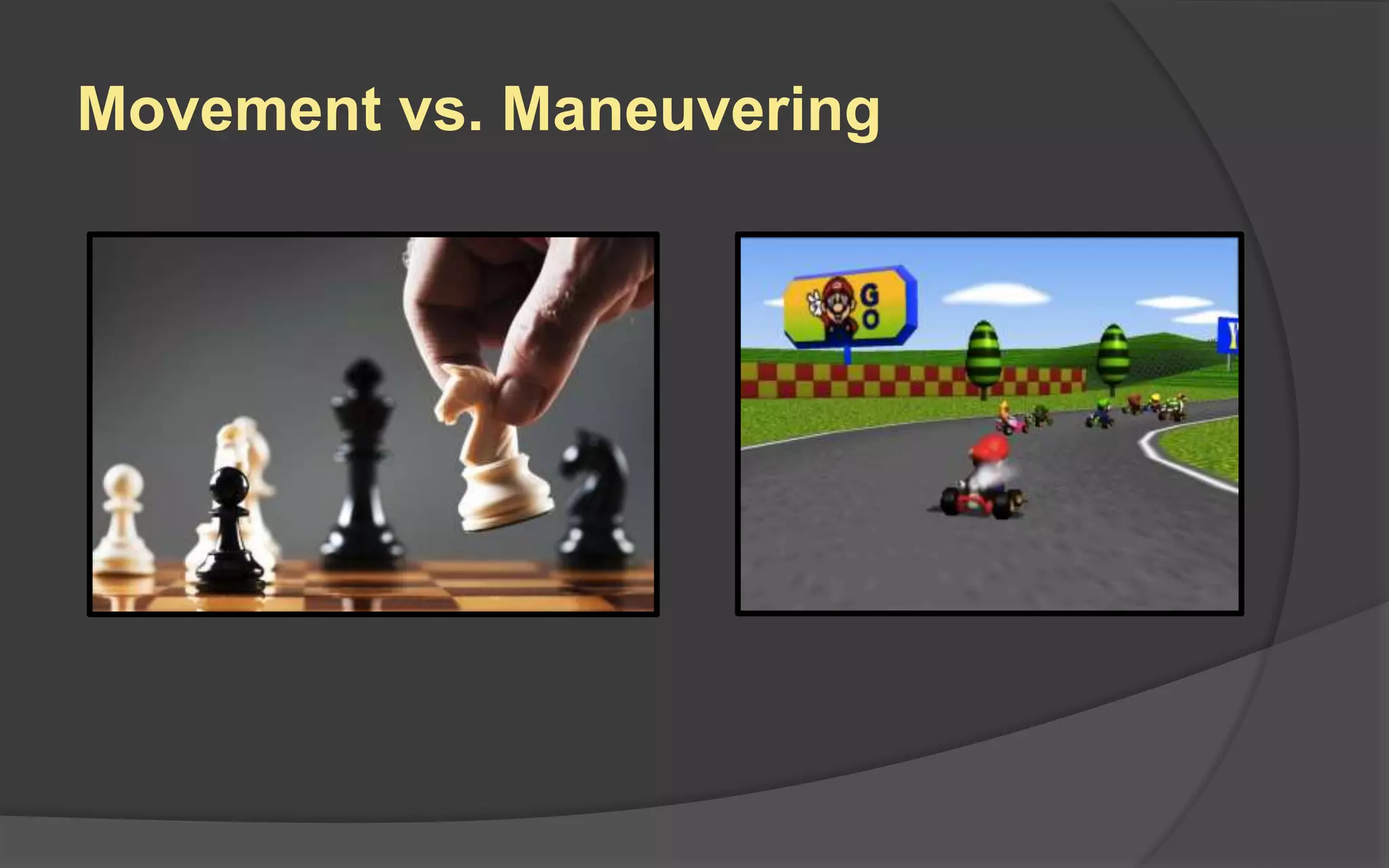
Movement vs. Maneuvering
Movement Limitations
 Obstacles
 Deadly Traps
 Inaccessible Areas
 Privileged Abilities
 Budgeted Action Points
What Are Progression Mechanics?
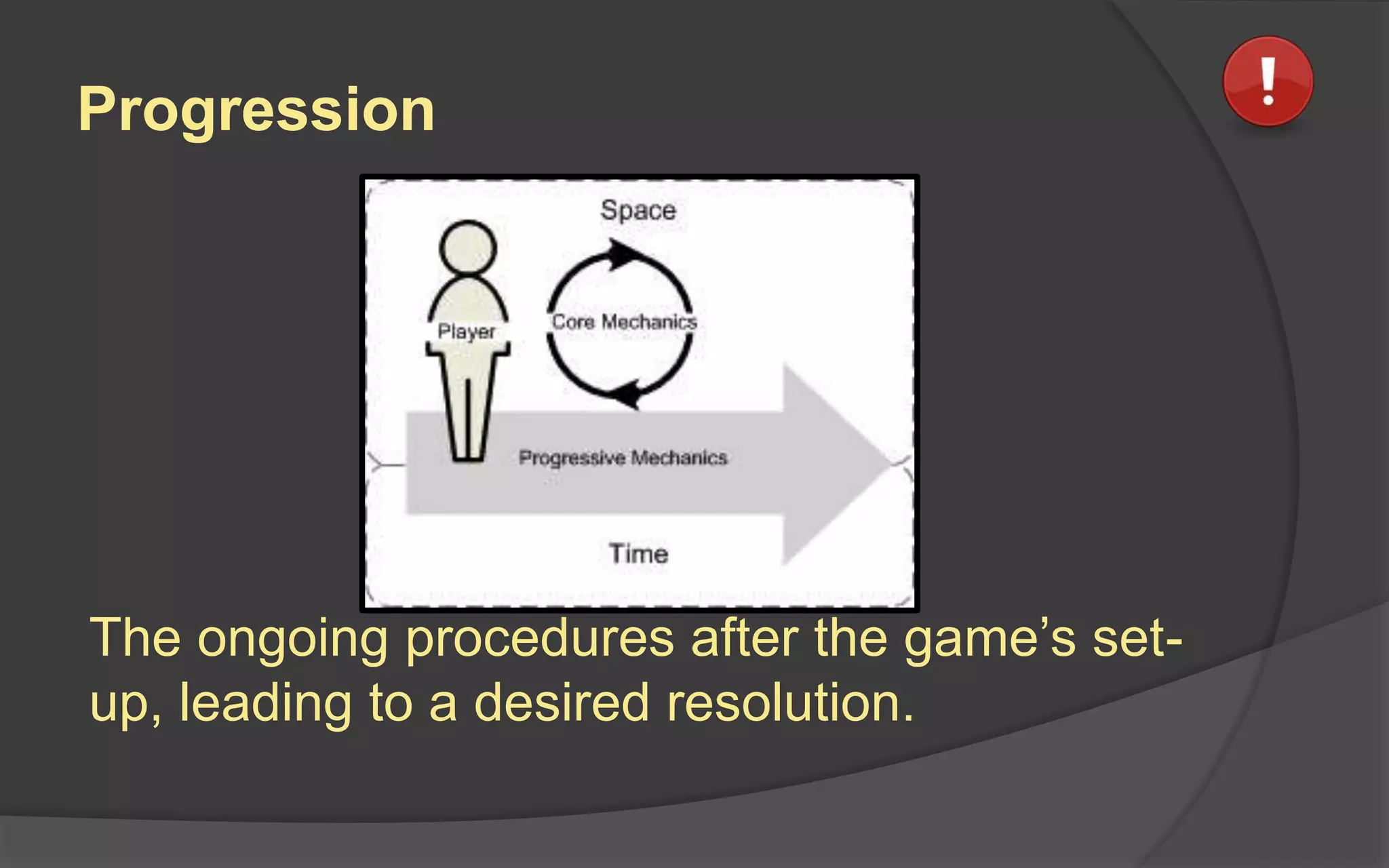
Progression
The ongoing procedures after the game’s set-
up, leading to a desired resolution.
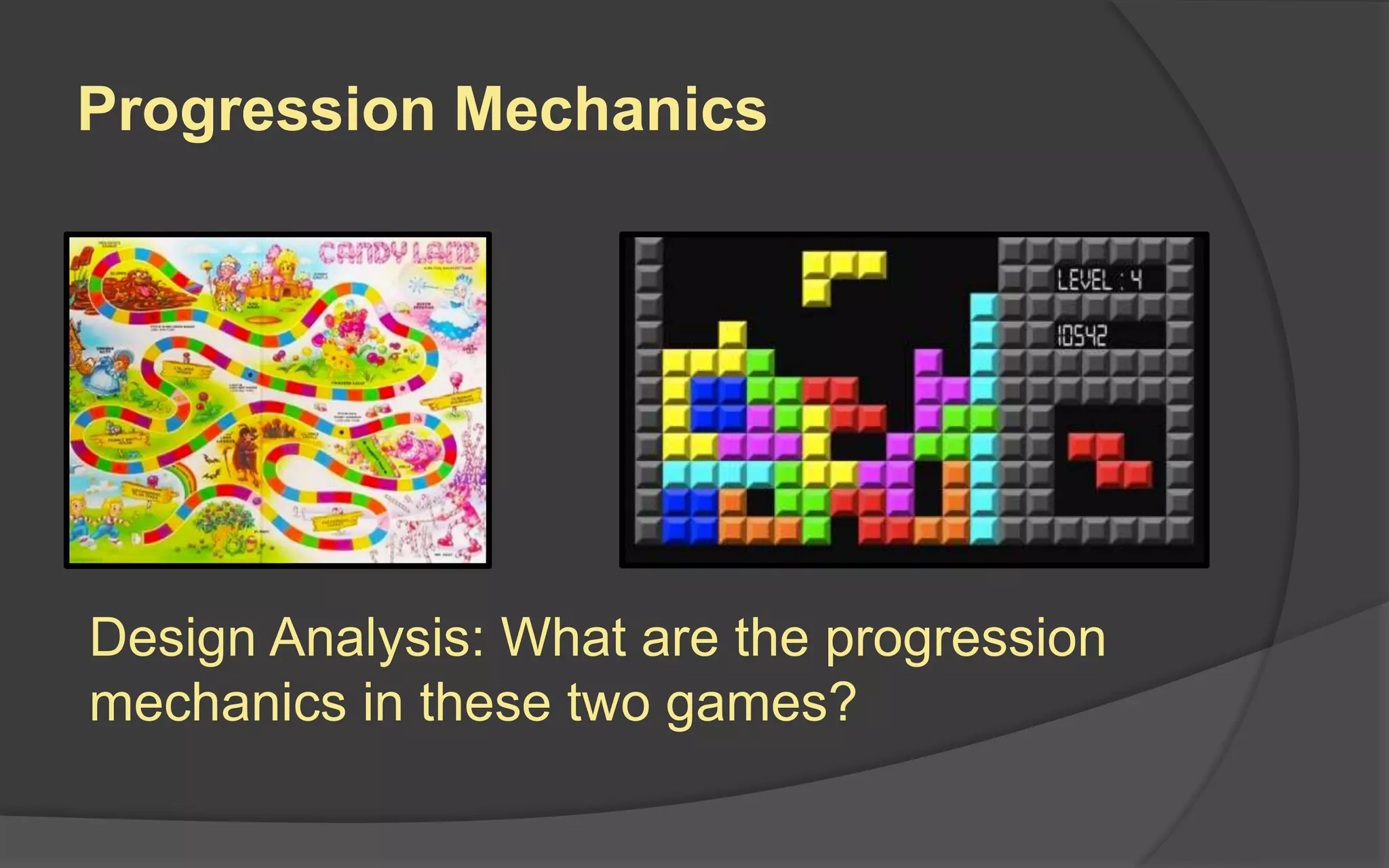
Progression Mechanics
Design Analysis: What are the progression
mechanics in these two games?
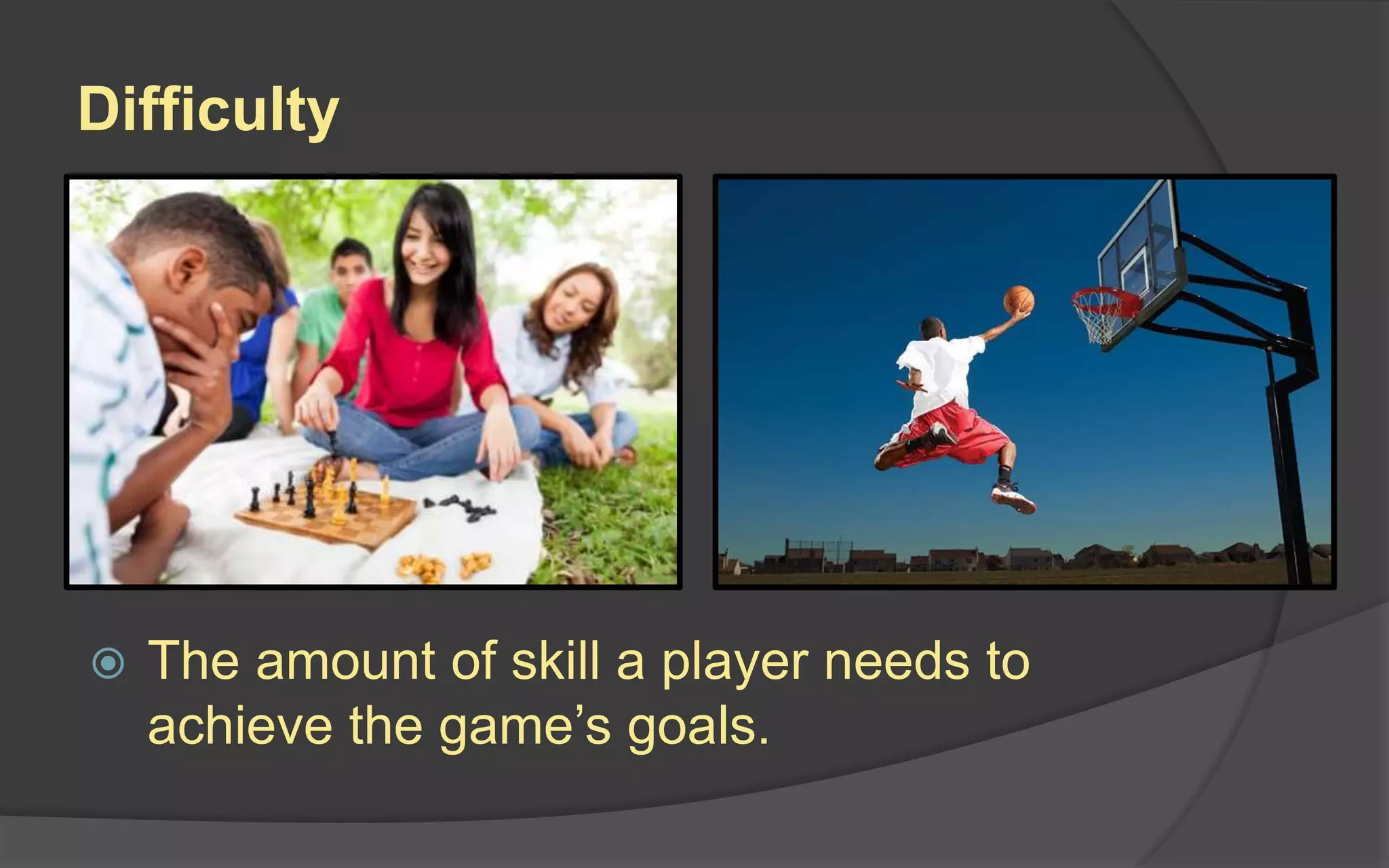
Difficulty
 The amount of skill a player needs to
achieve the game’s goals.
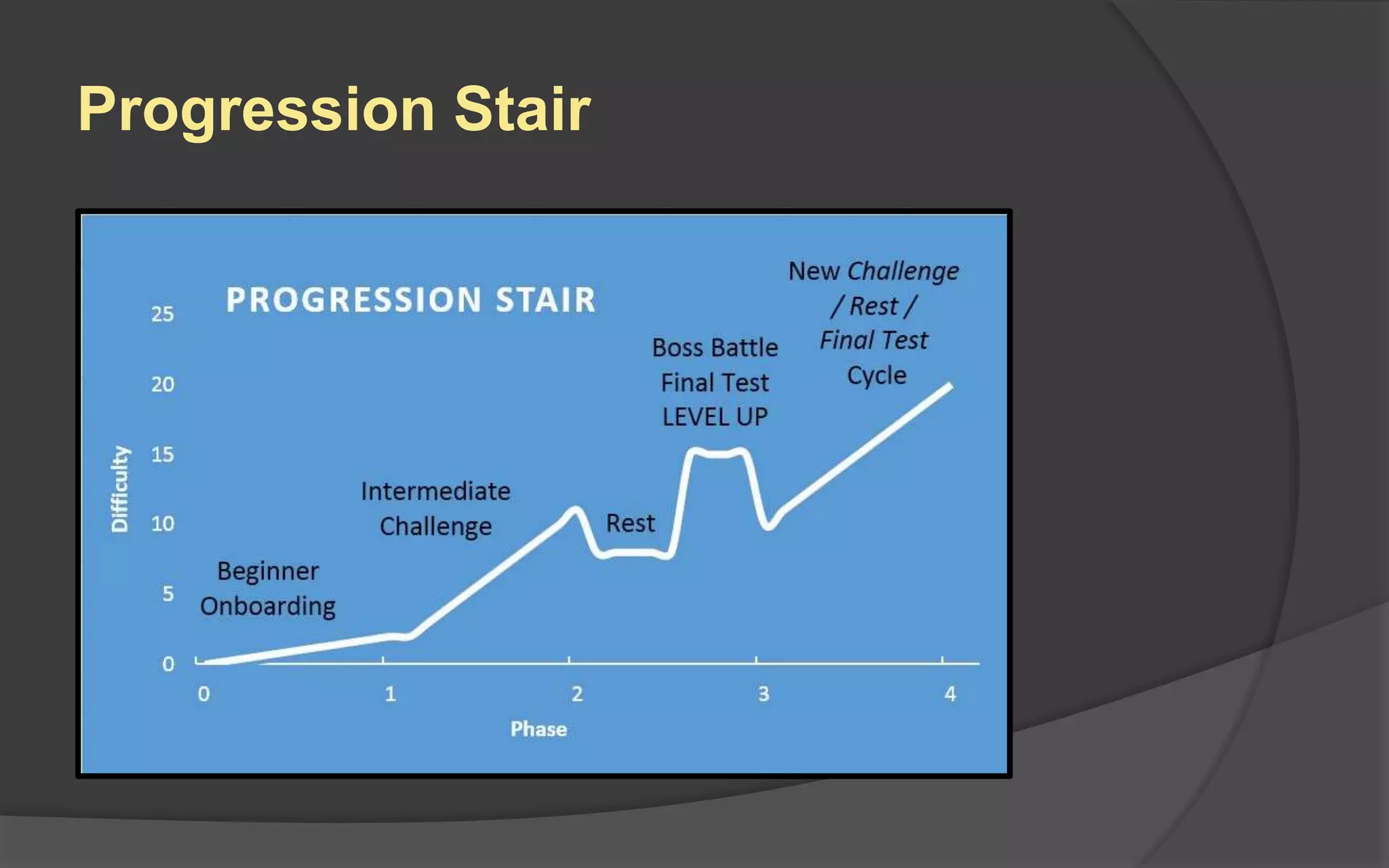
Progression Stair
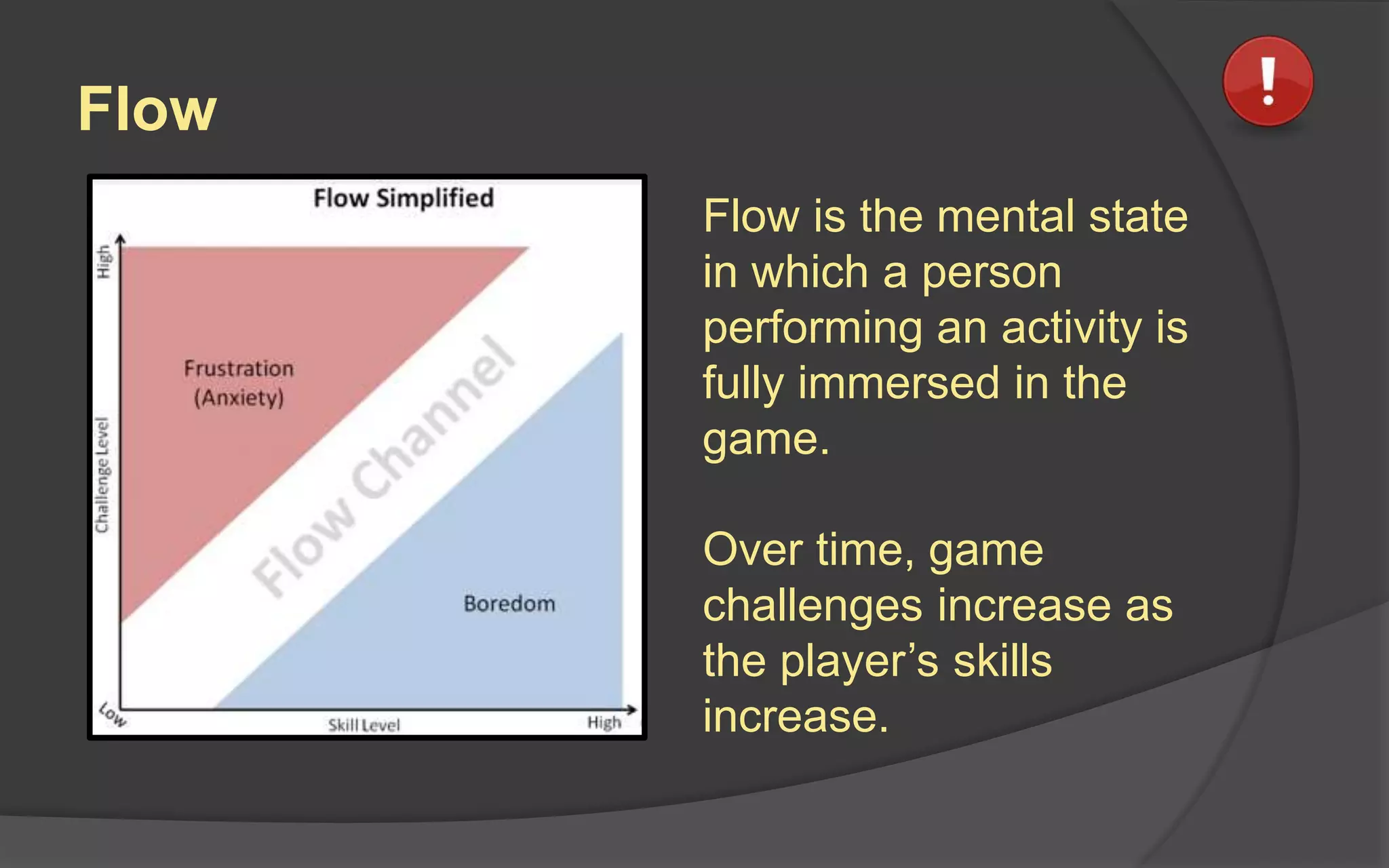
Flow
Flow is the mental state
in which a person
performing an activity is
fully immersed in the
game.
Over time, game
challenges increase as
the player’s skills
increase.
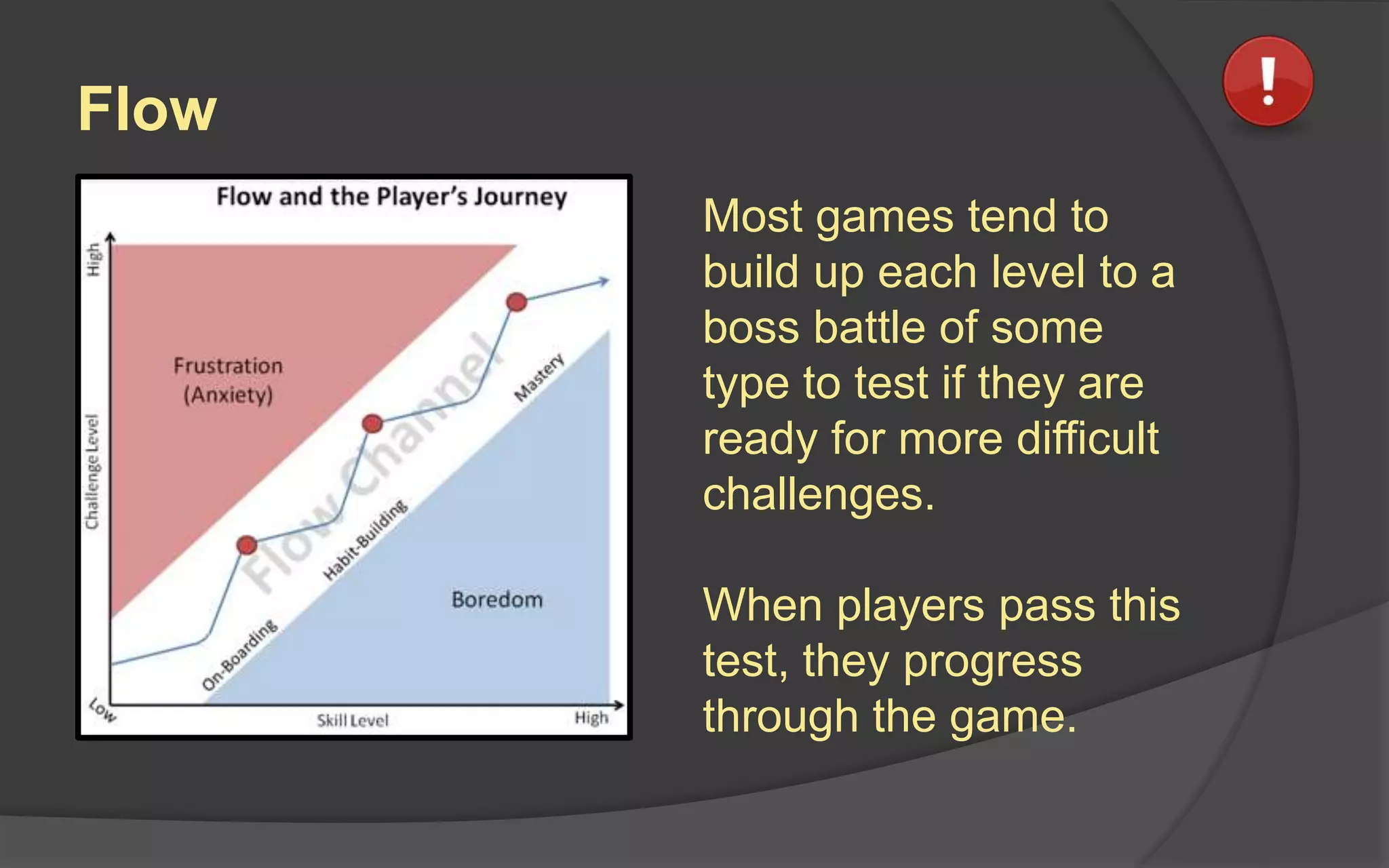
Flow
Most games tend to
build up each level to a
boss battle of some
type to test if they are
ready for more difficult
challenges.
When players pass this
test, they progress
through the game.
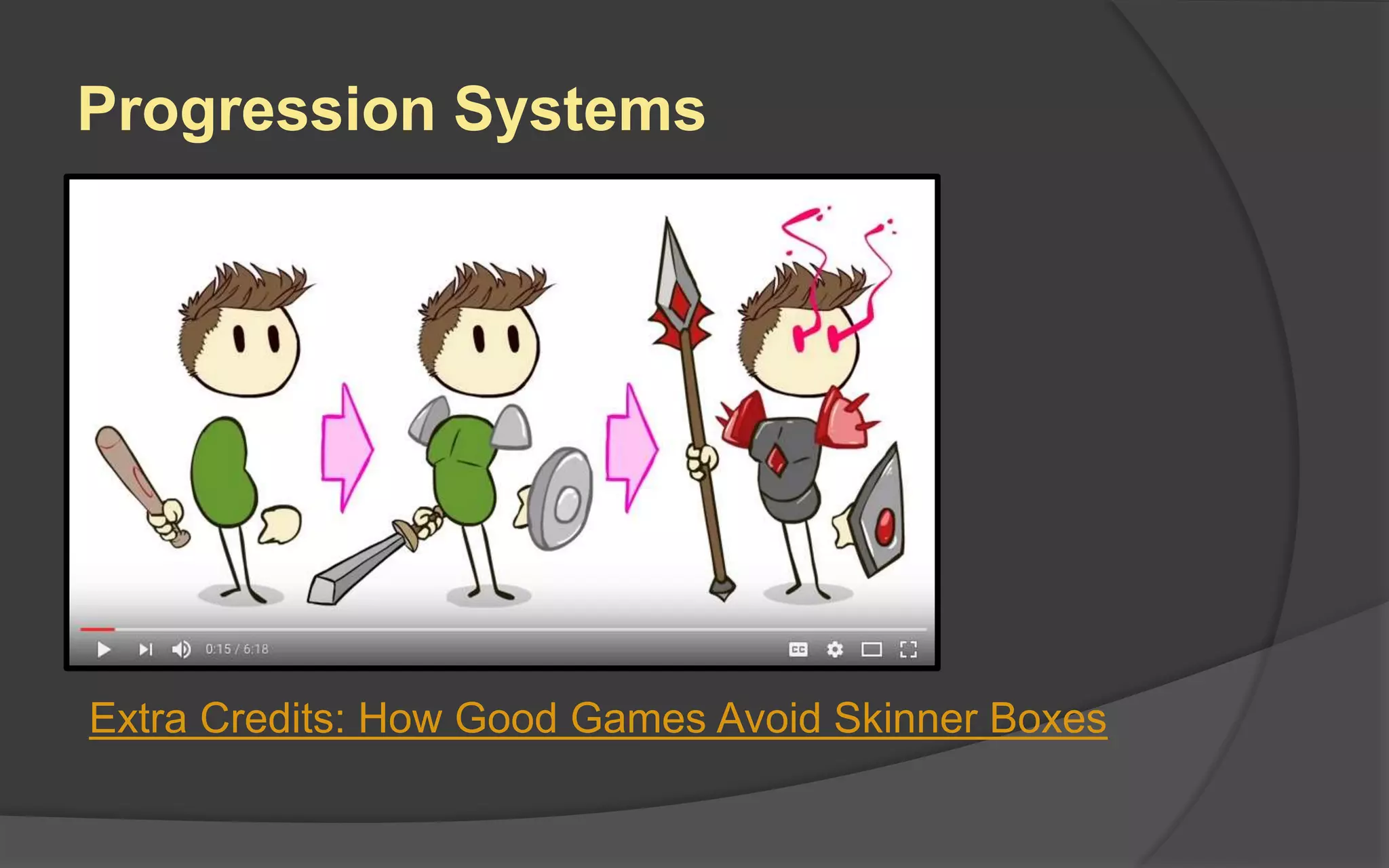
Progression Systems
Extra Credits: How Good Games Avoid Skinner Boxes
What Was The Main Message Of This
Video?
Making Progression More Meaningful
 Add a Strategic Component
 Shaping Learning Curve
 Reward Most Engaging Way To Play
 Enhance Narrative and Character
Development
 Provide Cohesion and Consistency
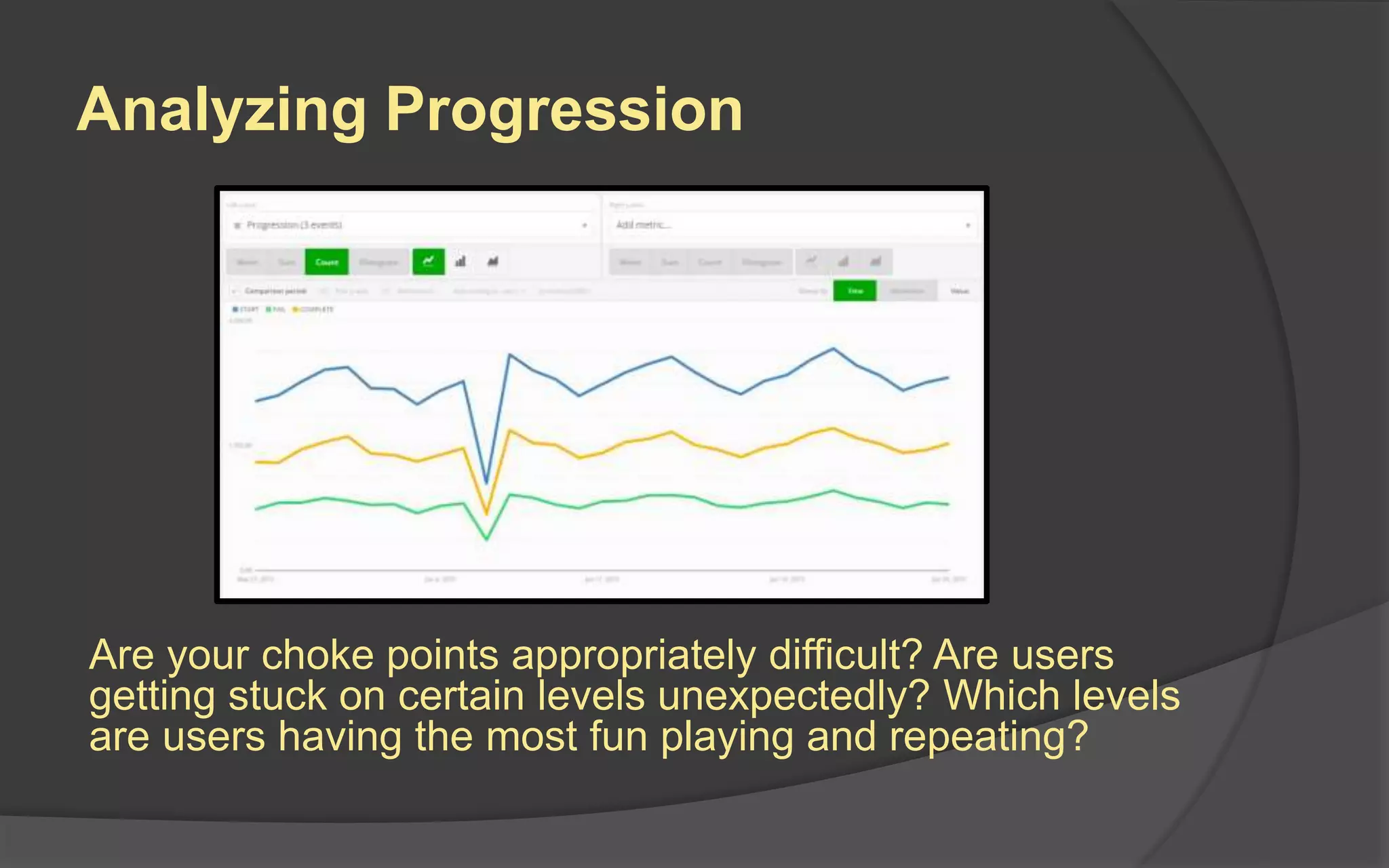
Analyzing Progression
Are your choke points appropriately difficult? Are users
getting stuck on certain levels unexpectedly? Which levels
are users having the most fun playing and repeating?
Score
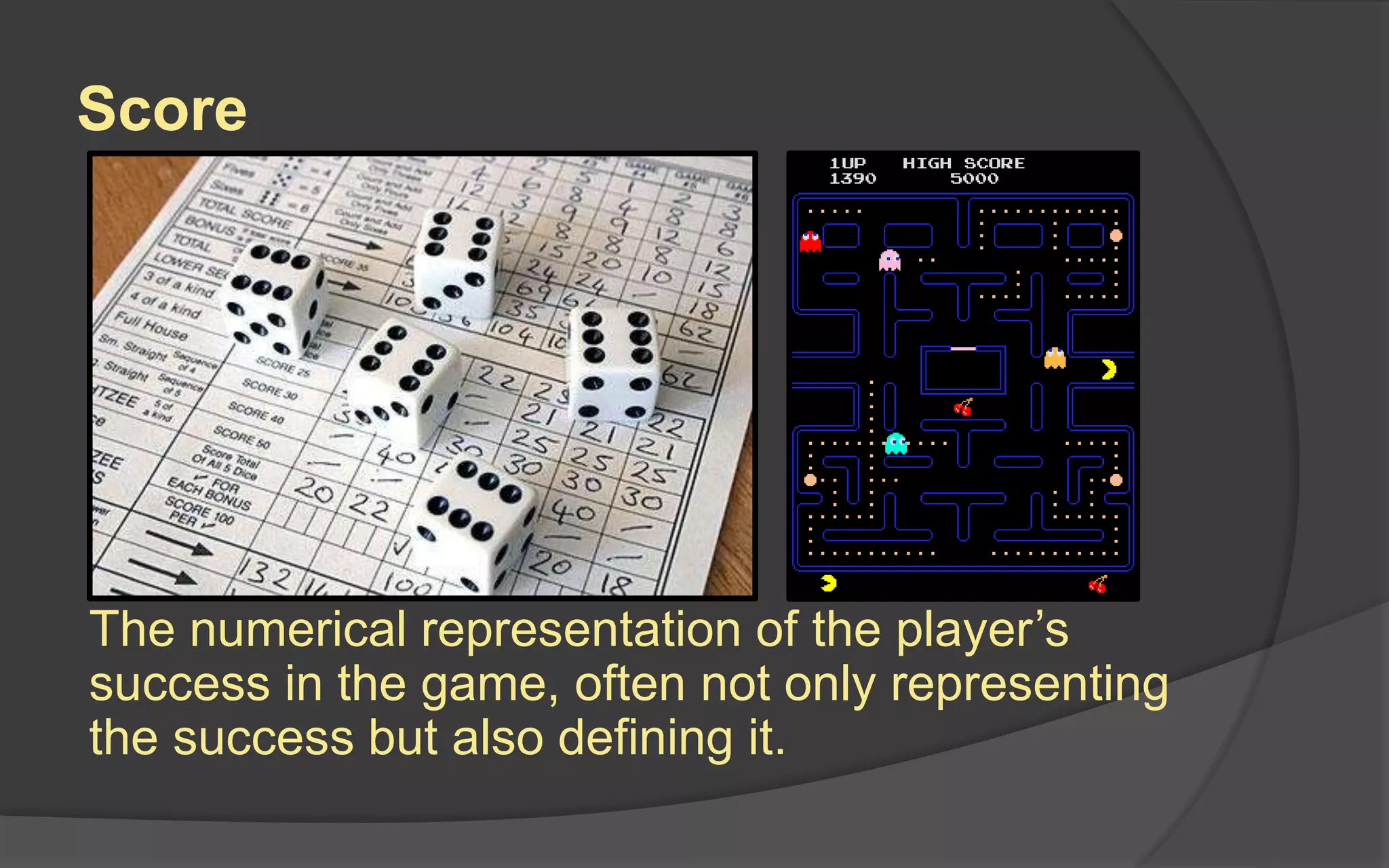
The numerical representation of the player’s
success in the game, often not only representing
the success but also defining it.
Score Design Considerations
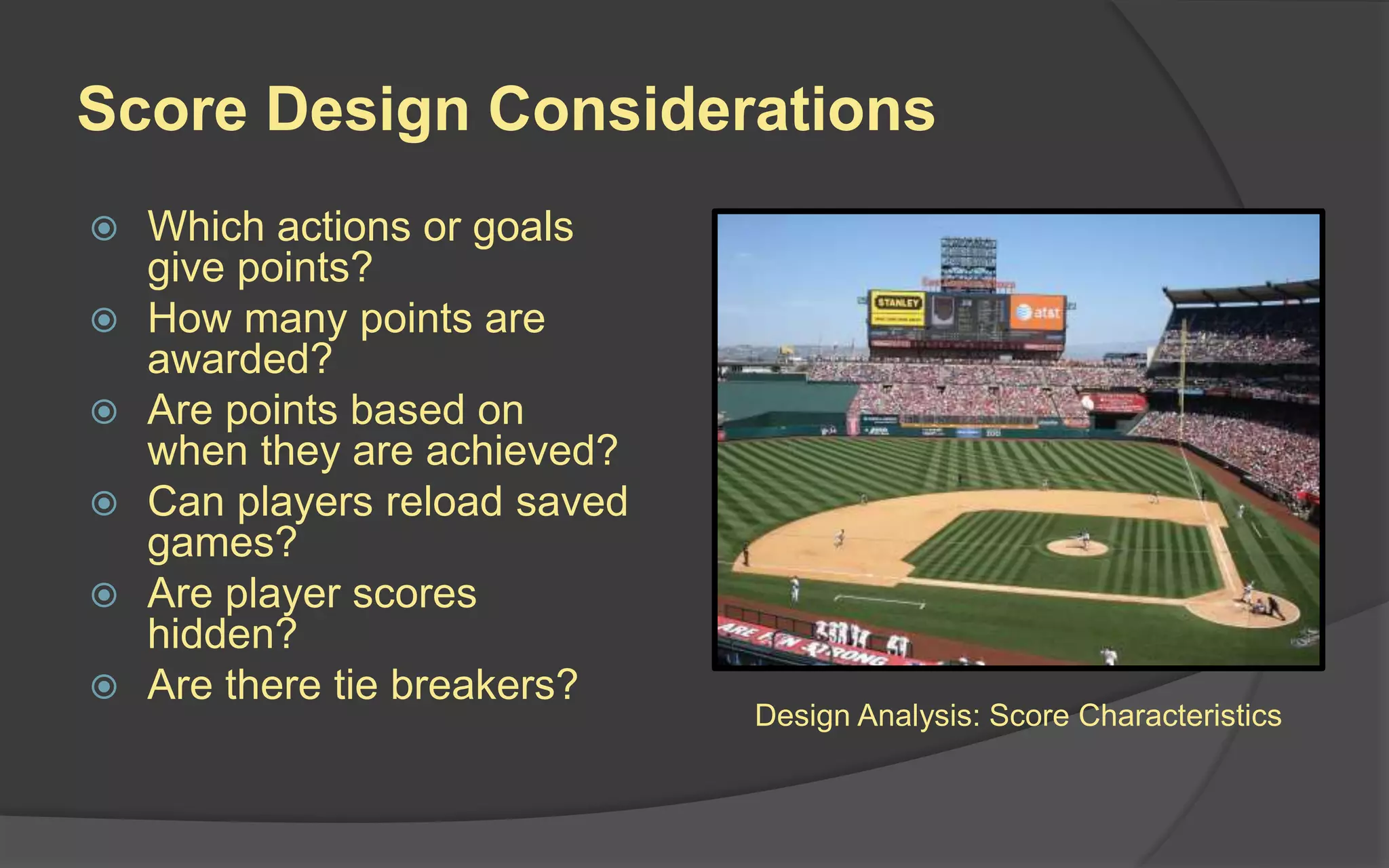
 Which actions or goals
give points?
 How many points are
awarded?
 Are points based on
when they are achieved?
 Can players reload saved
games?
 Are player scores
hidden?
 Are there tie breakers?
Design Analysis: Score Characteristics
Why Designers Use Scores
 Progress Indicator
 Supports Race Goal
High Score Lists
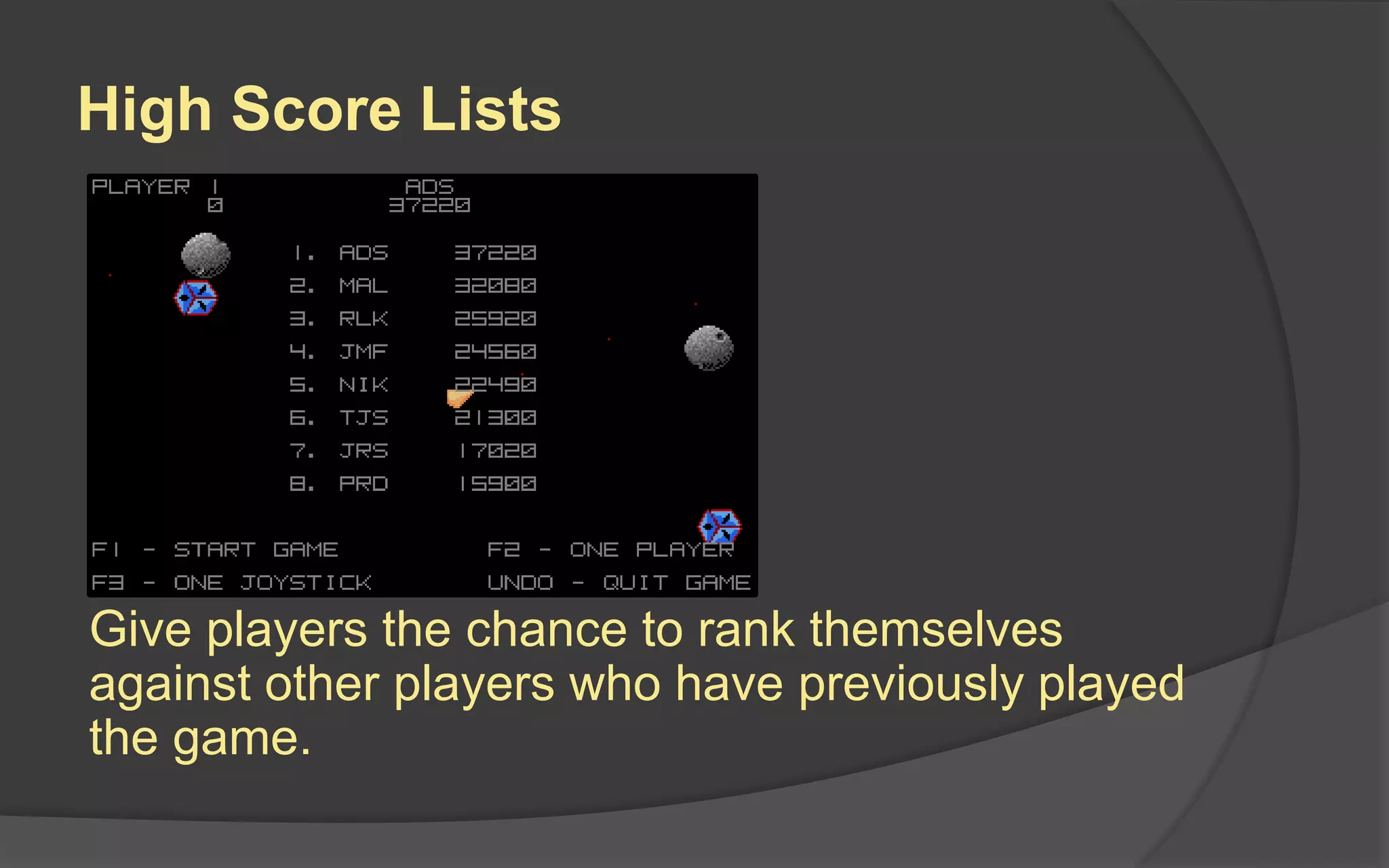
Give players the chance to rank themselves
against other players who have previously played
the game.
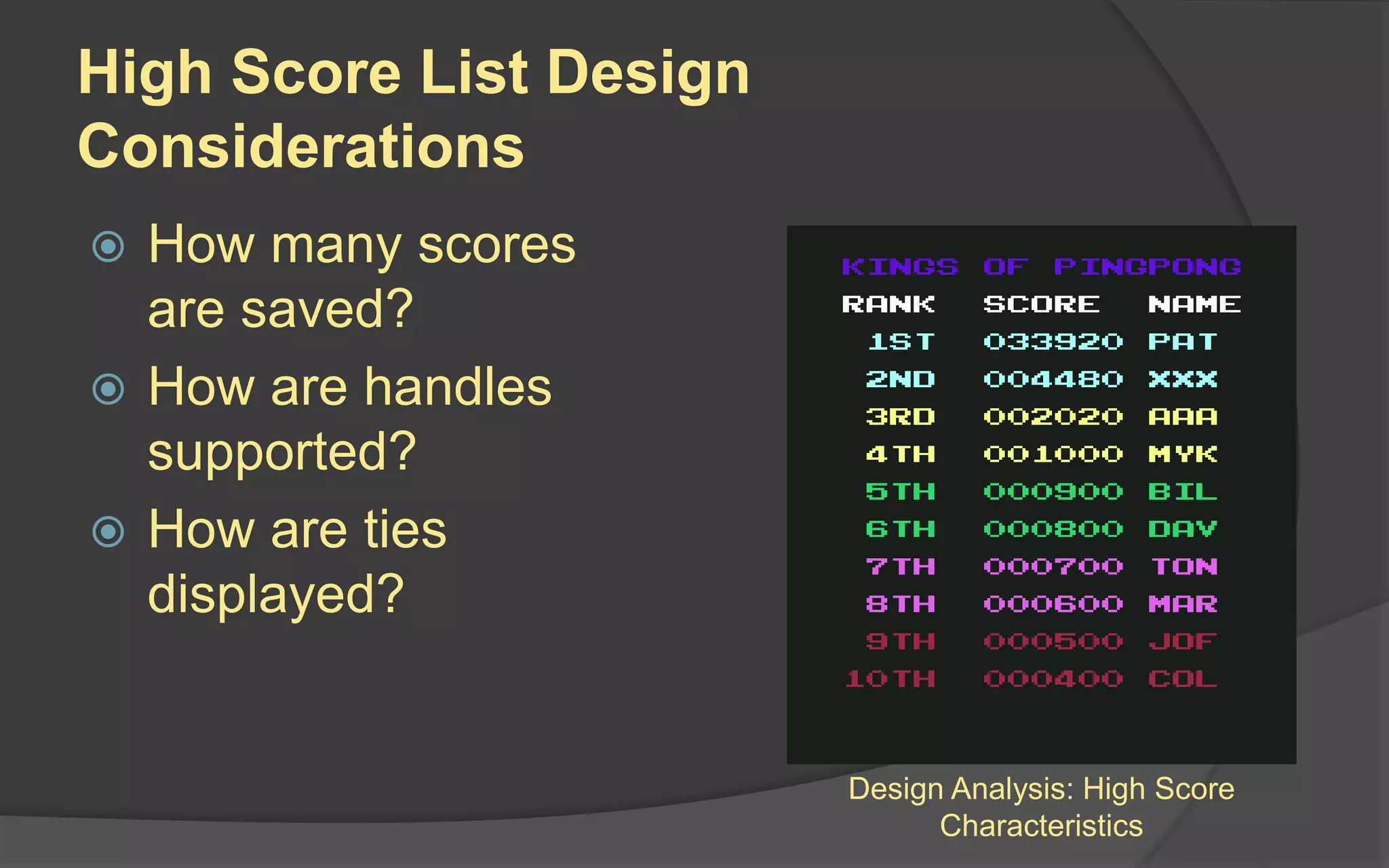
High Score List Design
Considerations
 How many scores
are saved?
 How are handles
supported?
 How are ties
displayed?
Design Analysis: High Score
Characteristics
Why Designers Use High Score Lists
 Replayability
 Competition in Single-Player Games
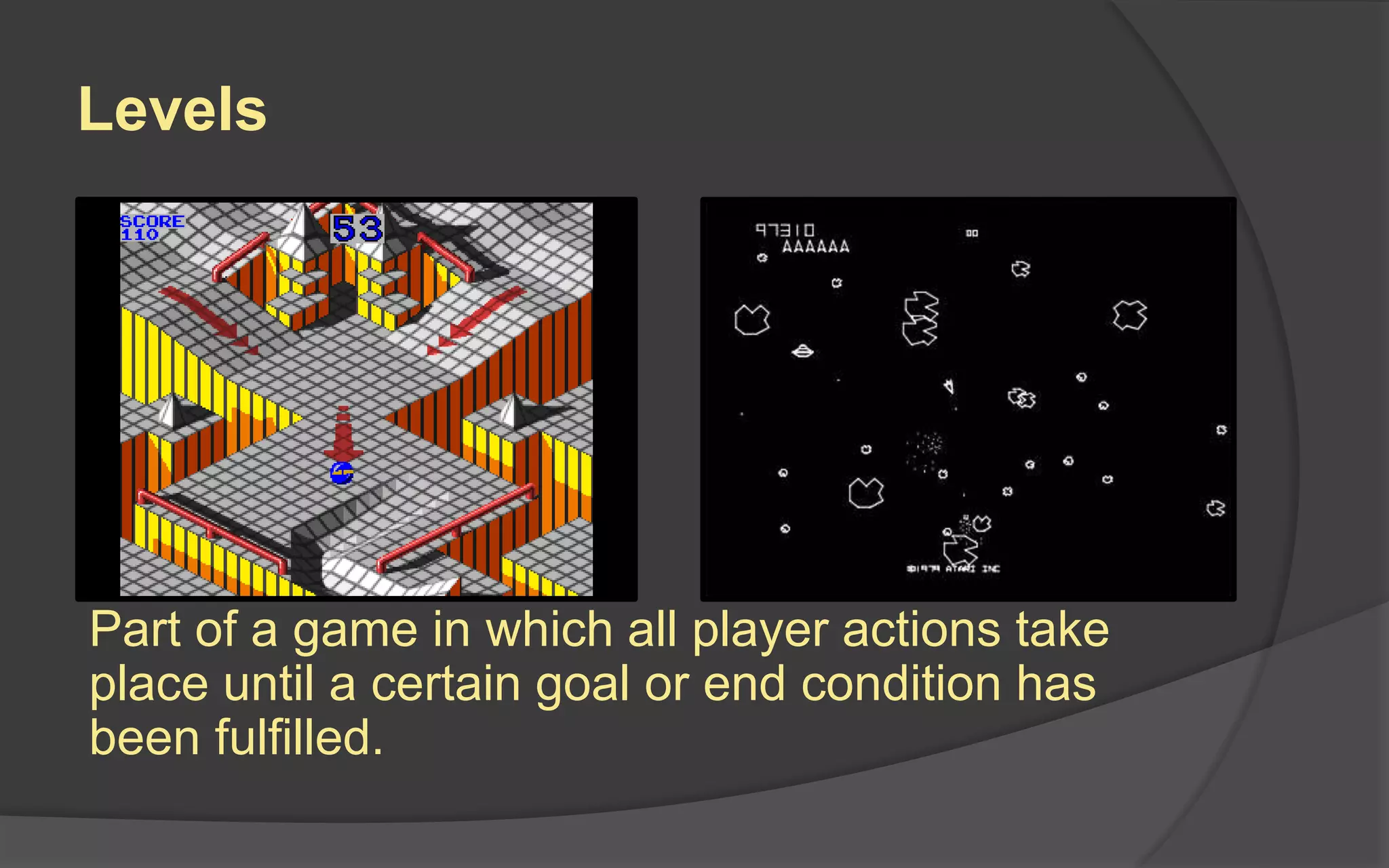
Levels
Part of a game in which all player actions take
place until a certain goal or end condition has
been fulfilled.
Level Design Considerations
 How many levels in the game?
 How do they relate to each other?
 How are they different?
 How are they completed?
Why Designers Use Levels
 Progress Indicator
 Game World Boundary
 Closure Point
 Narrative Structure
 Promotes Exploration
 Balances Complexity and Difficulty
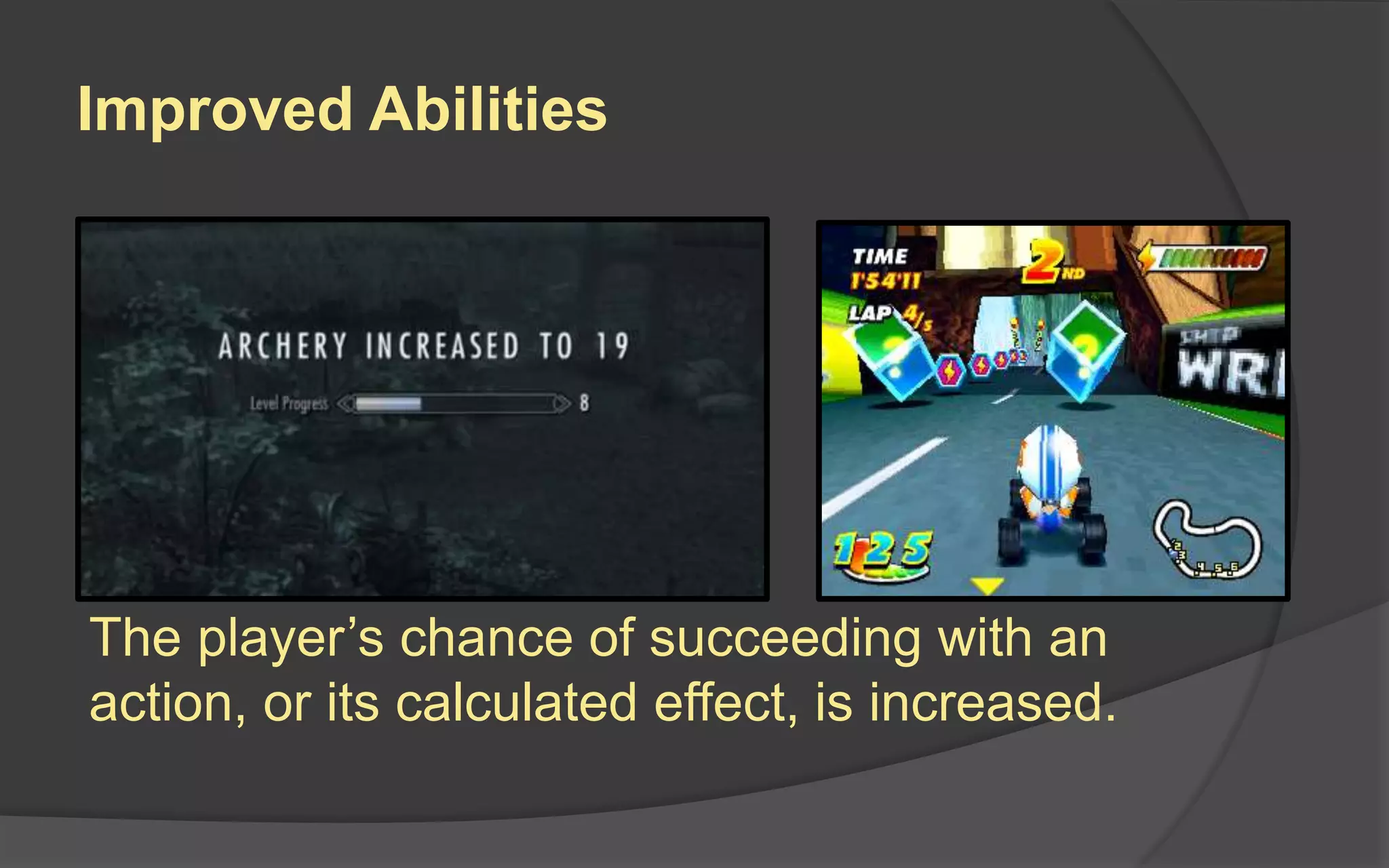
Improved Abilities
The player’s chance of succeeding with an
action, or its calculated effect, is increased.
Improved Abilities Design
Considerations
 What ability is
improved?
 How is it improved?
 Is the chance to
succeed improved?
 Is the effect
improved?
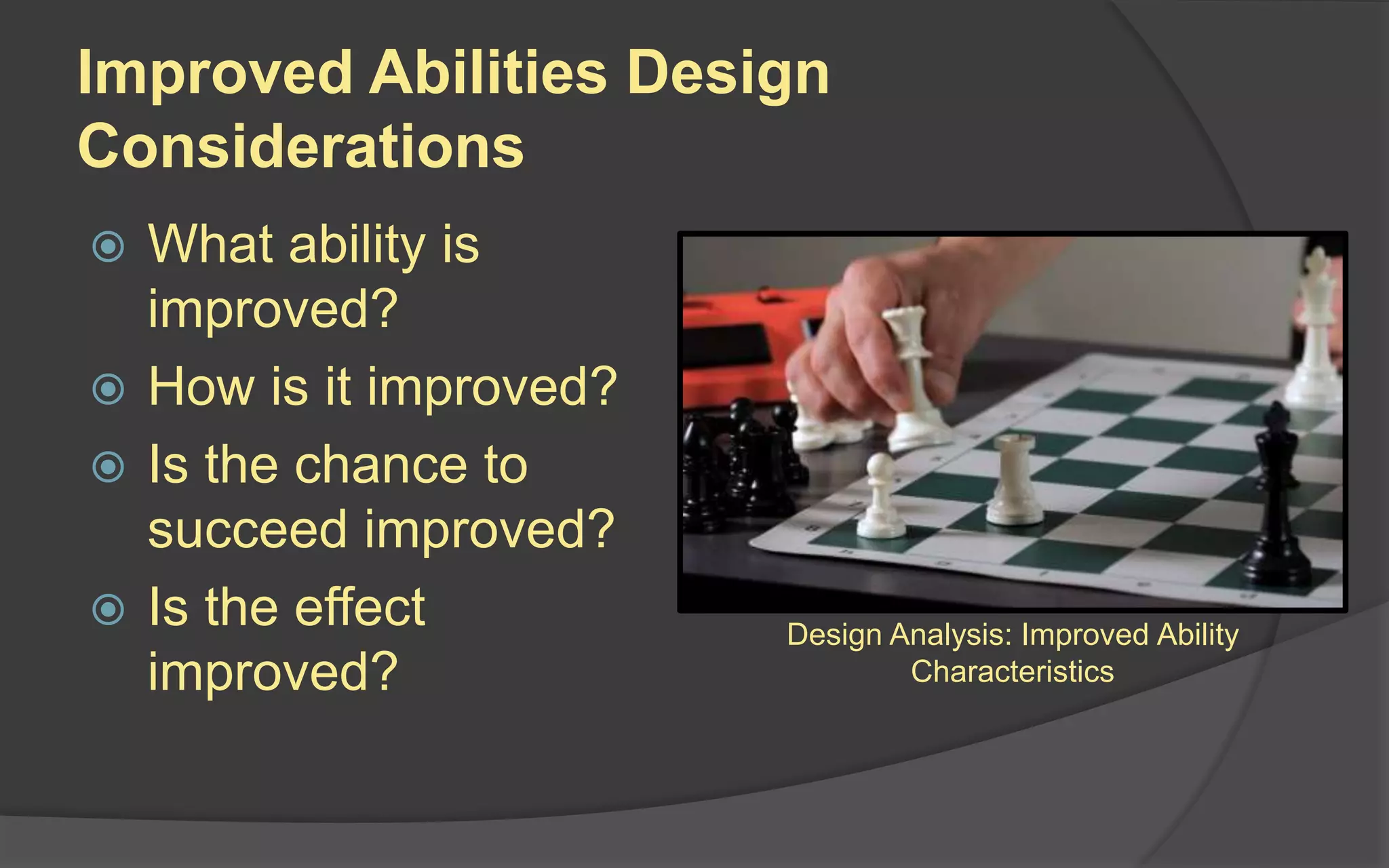
Design Analysis: Improved Ability
Characteristics
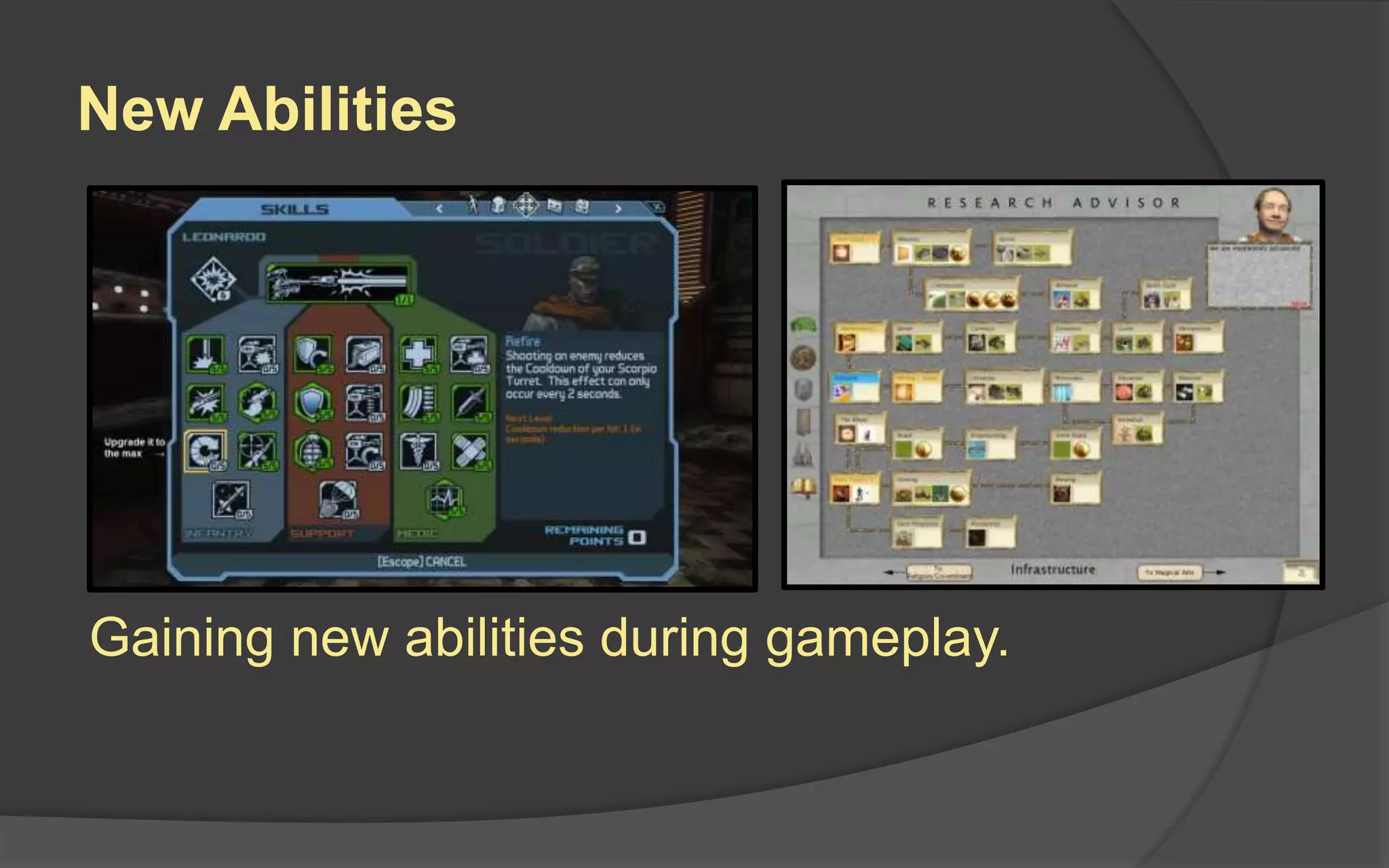
New Abilities
Gaining new abilities during gameplay.
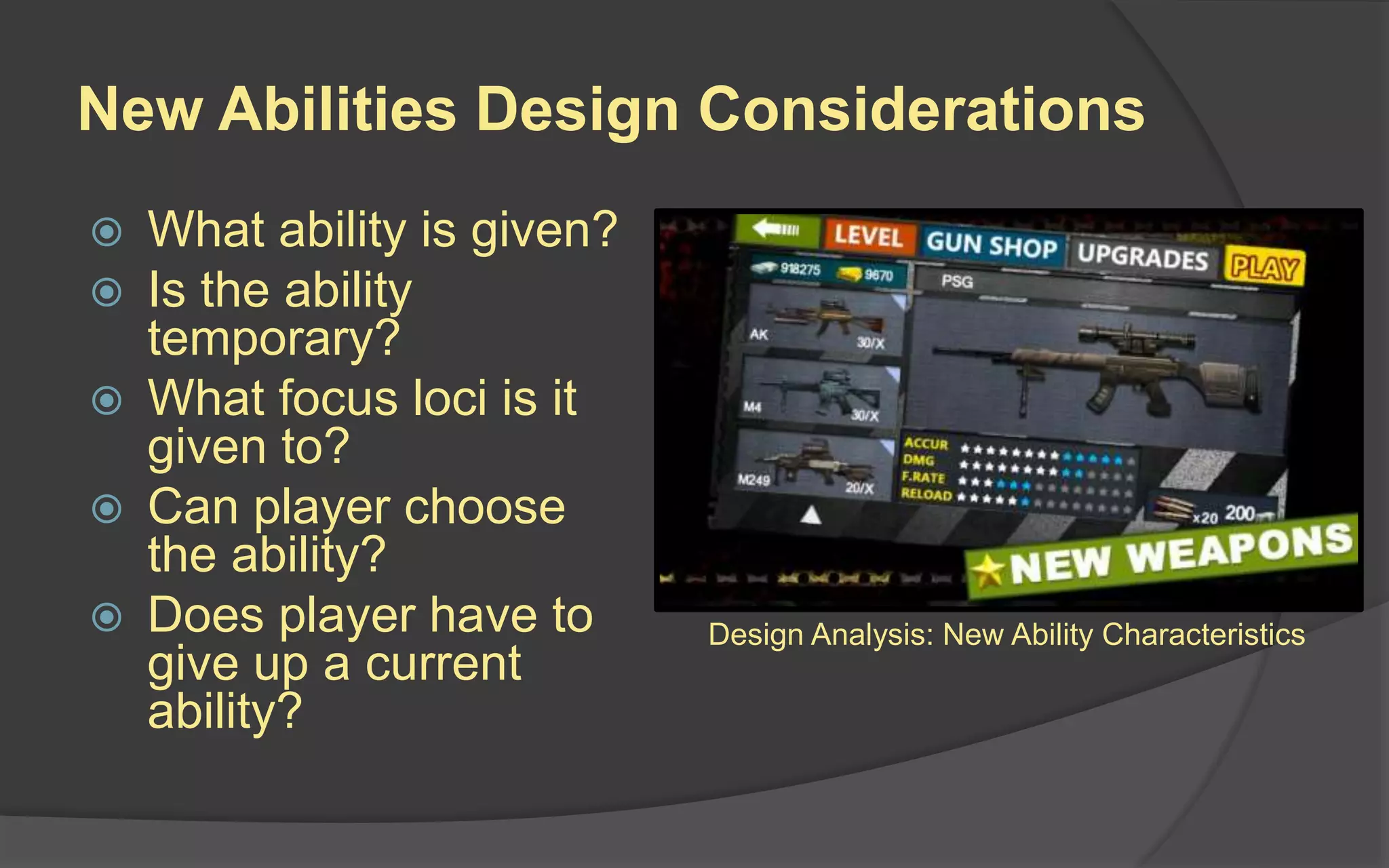
New Abilities Design Considerations
 What ability is given?
 Is the ability
temporary?
 What focus loci is it
given to?
 Can player choose
the ability?
 Does player have to
give up a current
ability?
Design Analysis: New Ability Characteristics
Why Designers Use New and Improved
Abilities
 Intrinsic Reward
 Empowerment
 Smooth Learning Curves
 Varied Gameplay
 Character and Team Development
 Progression for Gain Competence Goal
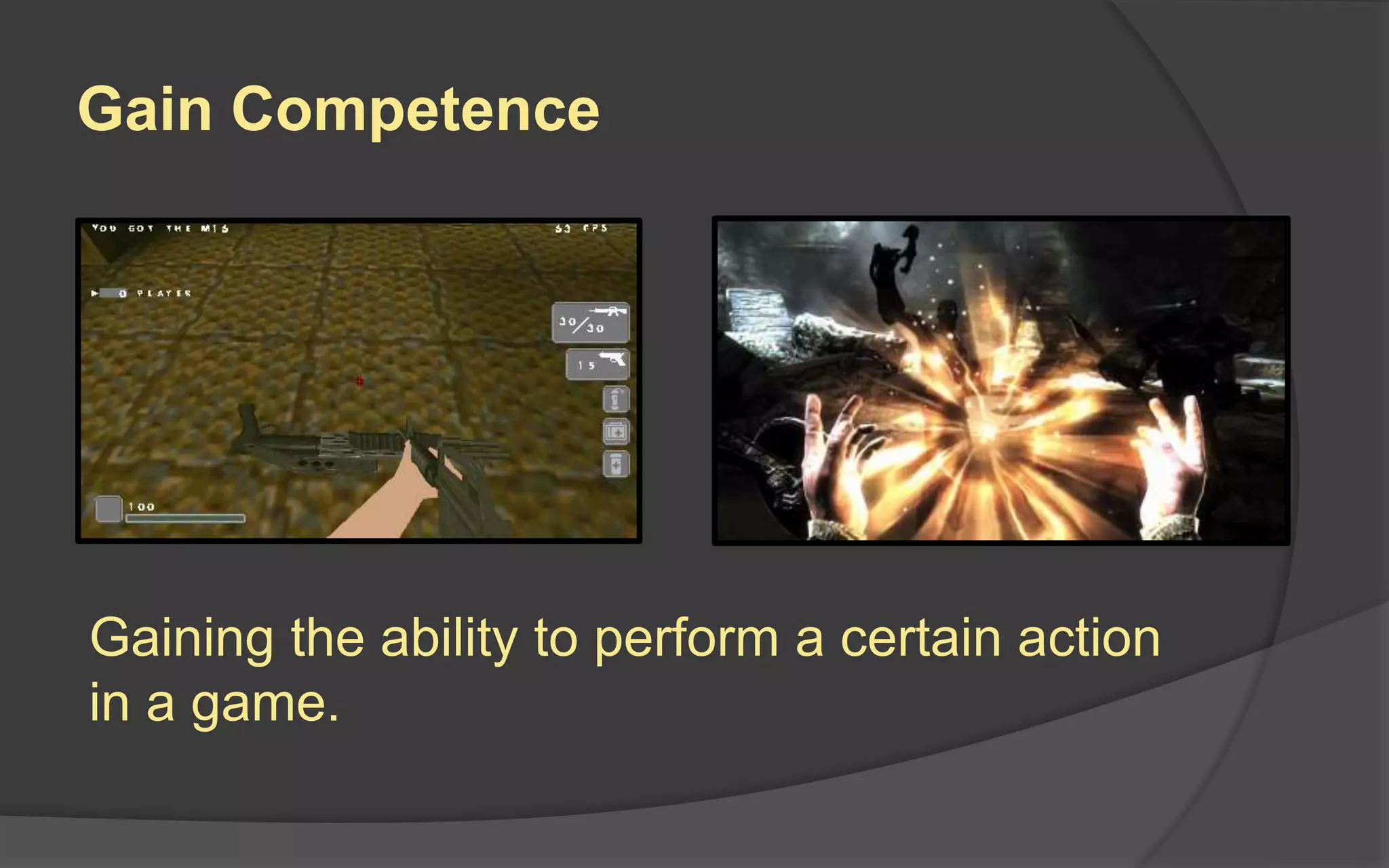
Gain Competence
Gaining the ability to perform a certain action
in a game.
Why Designers Use Gain Competence
Goals
 Intrinsic Reward
 Smooth Learning Curve
 Varied Gameplay
 Character Development
Gain Competence Considerations
 What is the action obtained?
 How is the action obtained?
 Is the action limited?
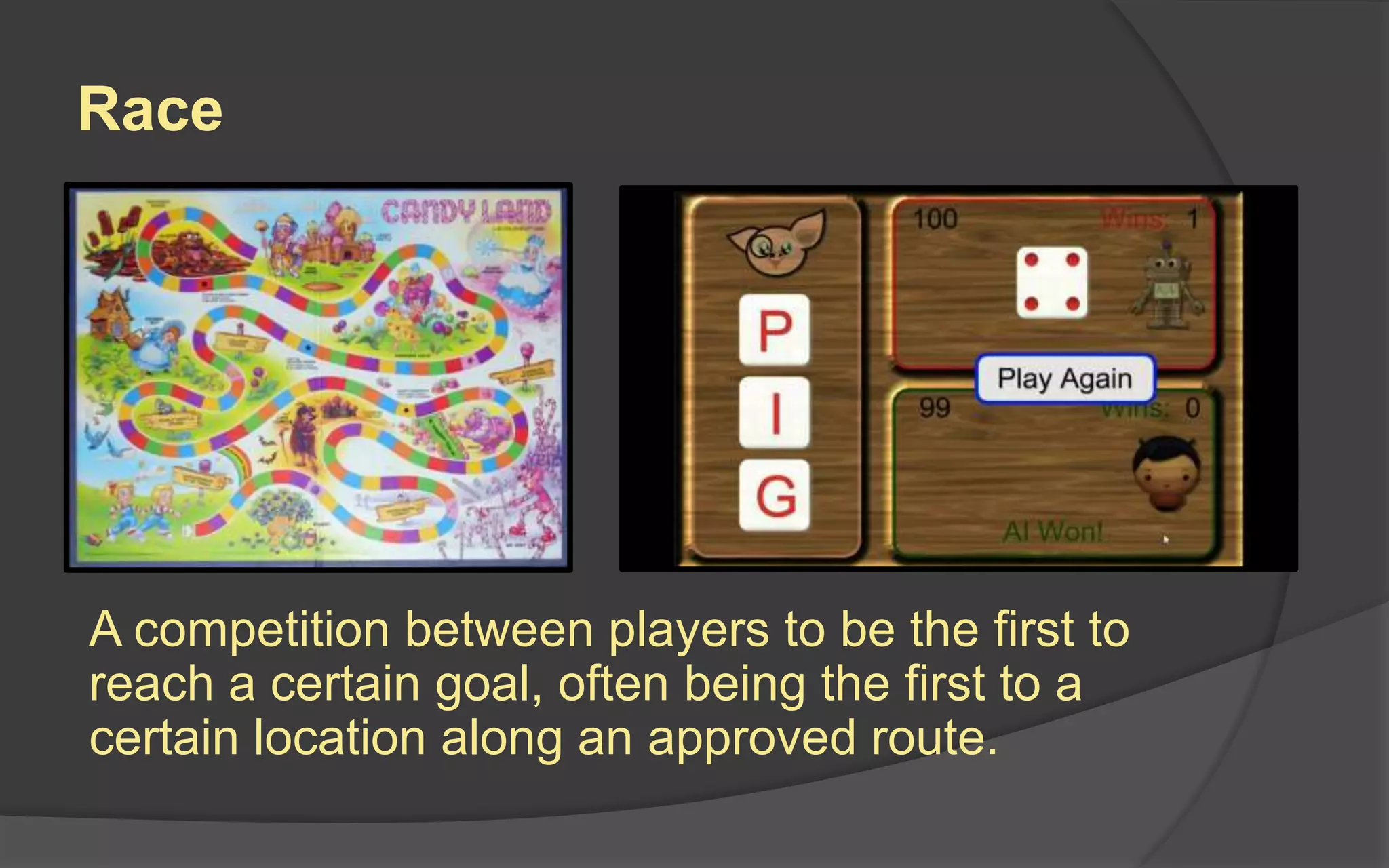
Race
A competition between players to be the first to
reach a certain goal, often being the first to a
certain location along an approved route.
Race Considerations
 Is this the single goal of the game?
 Which game elements are racing?
 How many players are competing?
 Does each player start at the same time?
 Are there movement limitations?
 Do players’ know each other’s position?
 Can players interfere with each other?
 Are there chargers or pick-ups?
 Are trailing players given advantages?
 How is the end determined?
 Is there a time limit?
Why Designers Use Race Goals
 Conflict and Competition
 Supports Delivery, Stealth and Rescue
Goals
 Prevents Eliminate and other goals
Choose one of the following games to play:
GAIN COMPETANCY
 Eno (2-5p, 60m)
 Power Grid:First Sparks (2-6p, 60m)
 Thunderstone (2-5p, 45m)
RACE
 Around World 80 Days (3-6p, 50-70m)
 Aton (2p, 30m)
 Ave Ceasar (3-6p, 30-60m)
 Can’t Stop (2-4p, 30-40m)
 Citadels (2-7p, 20-60m)
 Hey, That’s My Fish! (2-4p, 20m)
 Snowtails (2-5p, 45m)
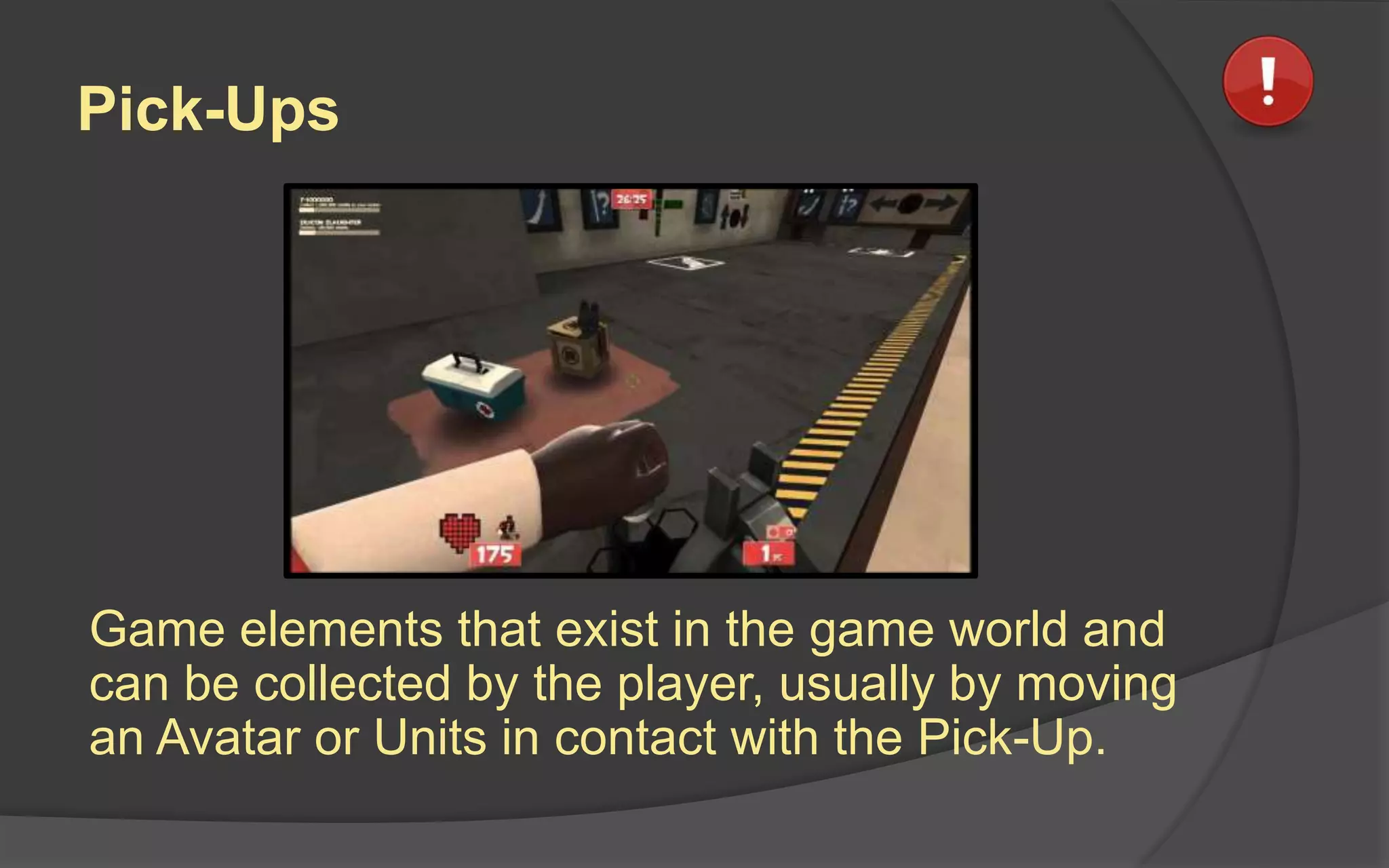
Pick-Ups
Game elements that exist in the game world and
can be collected by the player, usually by moving
an Avatar or Units in contact with the Pick-Up.
Pick-Up Design Considerations
 What does it do?
 Where is it located?
 How is it produced?
 How limited is it?
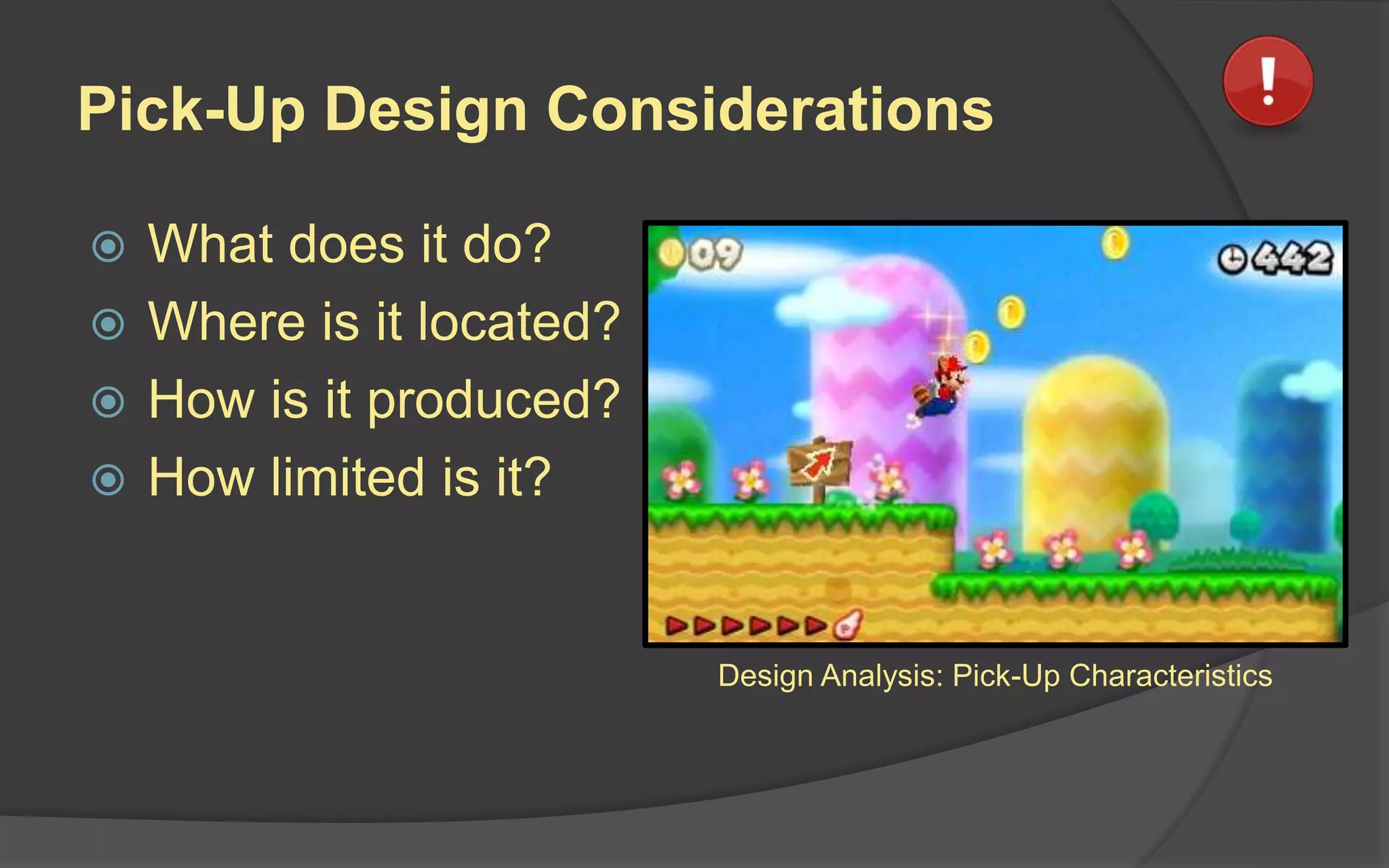
Design Analysis: Pick-Up Characteristics
Why Designers Use Pick-Ups
 Progression for Collecting Goals
 Promotes Maneuvering and Races to Get
Tool
 Resources for Actions
Tools
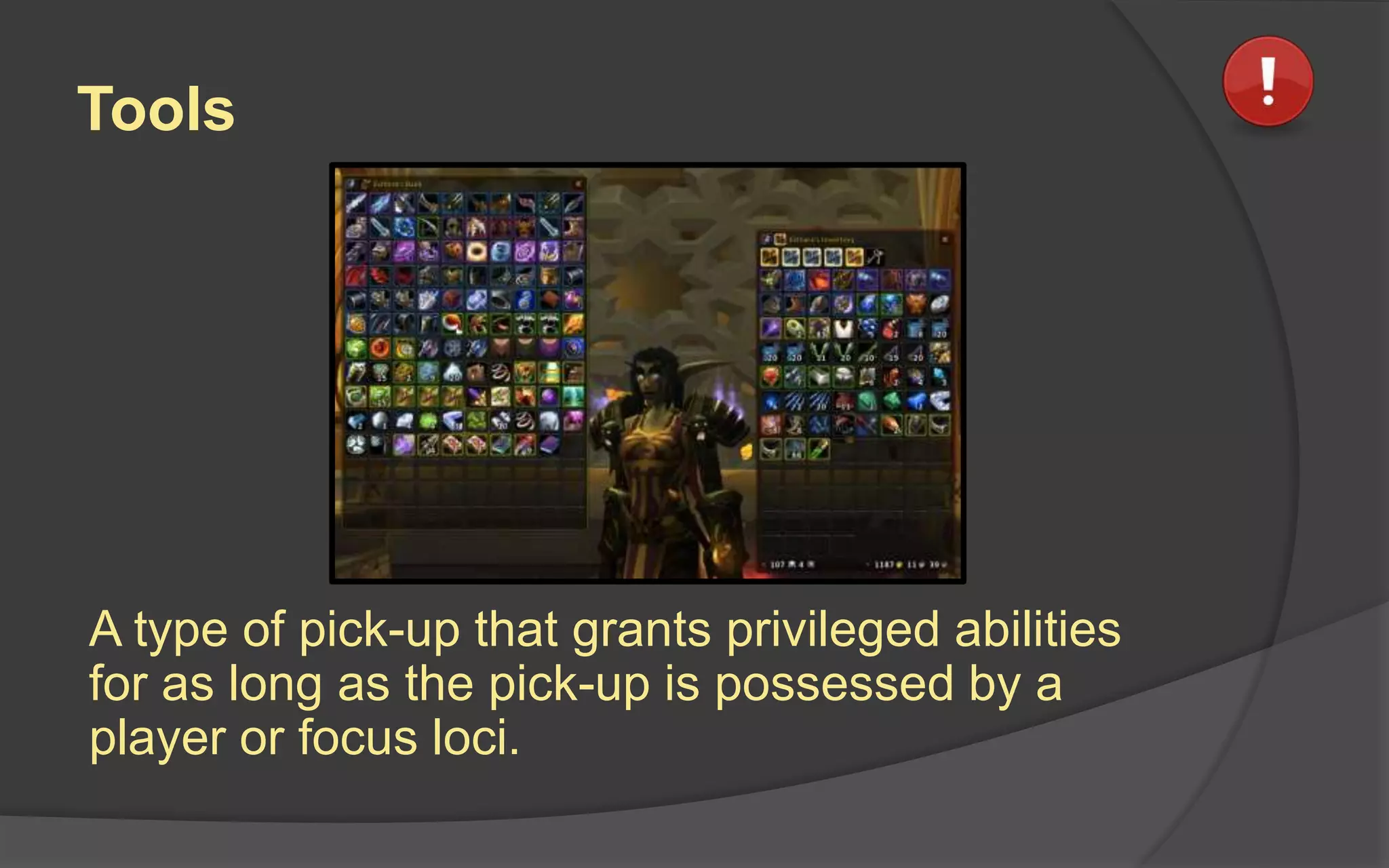
A type of pick-up that grants privileged abilities
for as long as the pick-up is possessed by a
player or focus loci.
Tool Design Considerations
 What new, improved
or privileged abilities
does it give?
 What avatars or units
can use it?
 What skills/resources
are required to use
it?
 Can it be combined
with other tools?
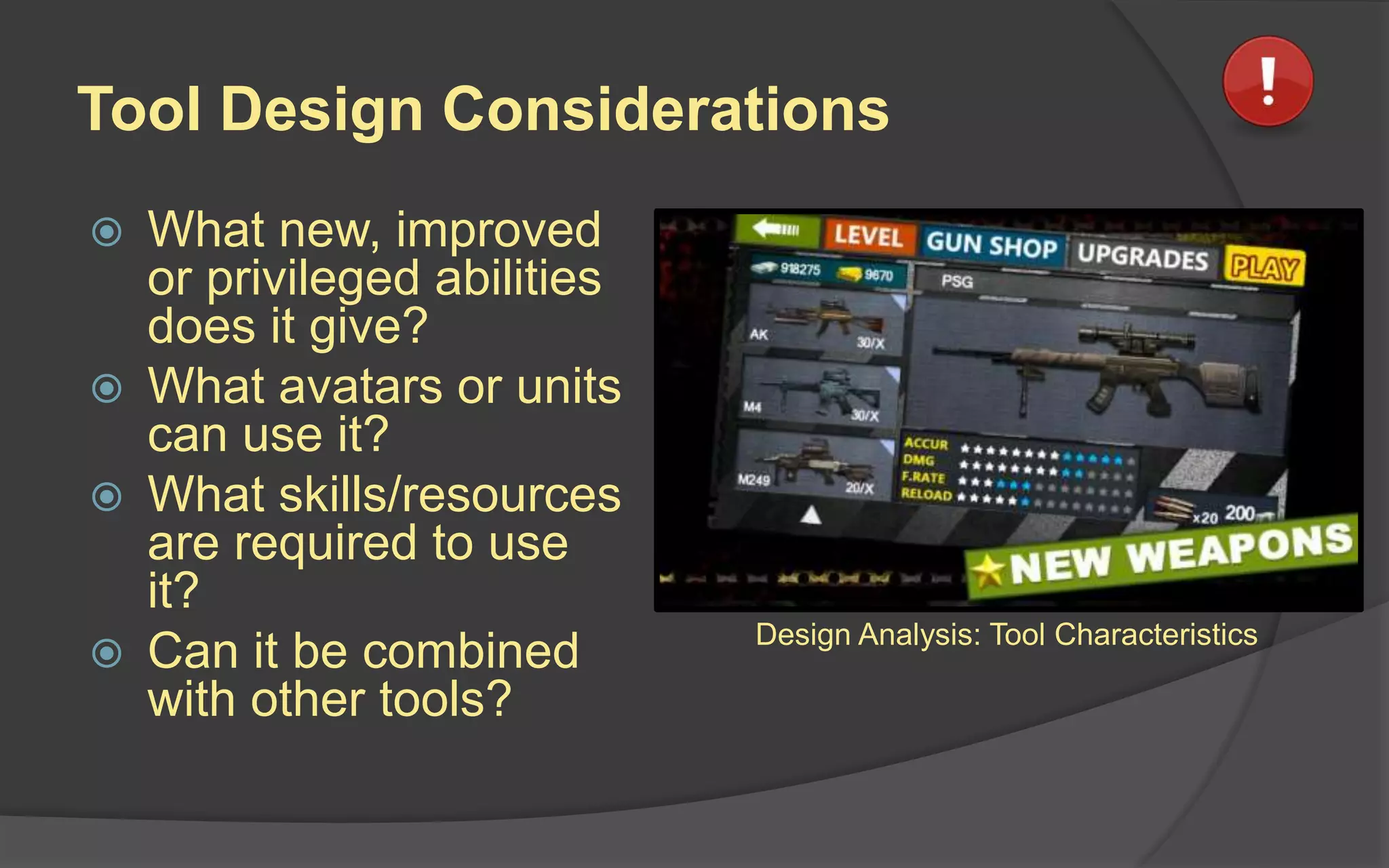
Design Analysis: Tool Characteristics
Why Designers Use Tools
 New, Improved and Privileged Abilities
 Progression for Gain Competence Goals
 Balances Players, Avatars and Units
Power-Ups
Game elements that give limited-time
advantages to the player that picks them up.
Power-Up Design Considerations
 What advantage does it give?
 How long does its effect last?
 Where is it located?
 How is it produced?
 Can players trade it? Design Analysis: Power-Ups
Characteristics
Why Designers Use Power-Ups
 New, Improved and Privileged Abilities
 Empowerment
 Tension
 Promotes Strategic Locations
 Balances Skills
 Promotes Races and Competition to Get
Power-Up
 Supports Collecting, Maneuvering, Gain
Ownership and Gain Competence Goals
How Are Tools and Power-Ups
Different?
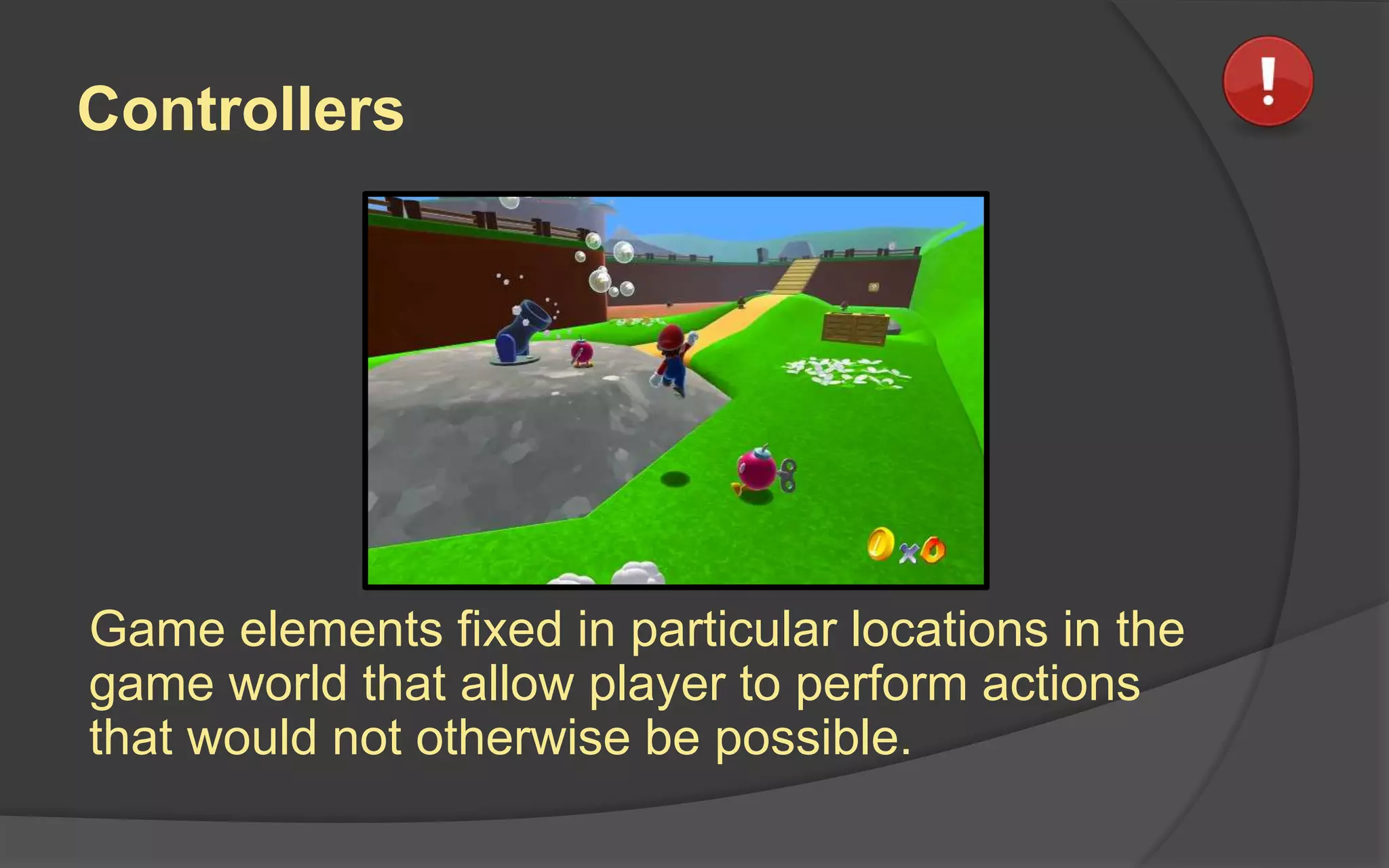
Controllers
Game elements fixed in particular locations in the
game world that allow player to perform actions
that would not otherwise be possible.
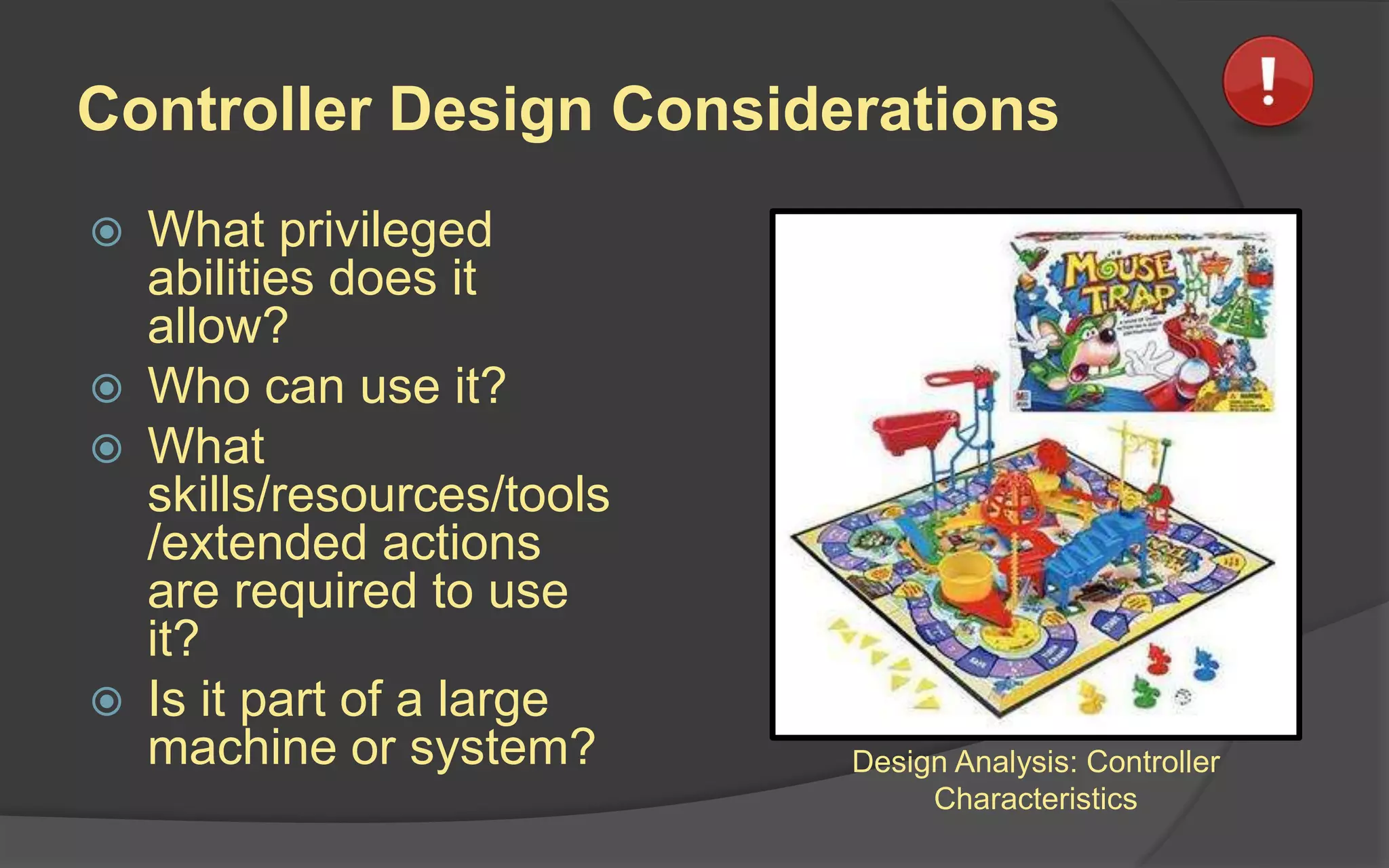
Controller Design Considerations
 What privileged
abilities does it
allow?
 Who can use it?
 What
skills/resources/tools
/extended actions
are required to use
it?
 Is it part of a large
machine or system? Design Analysis: Controller
Characteristics
Why Designers Use Controllers
 Obstacle
 Level Completion
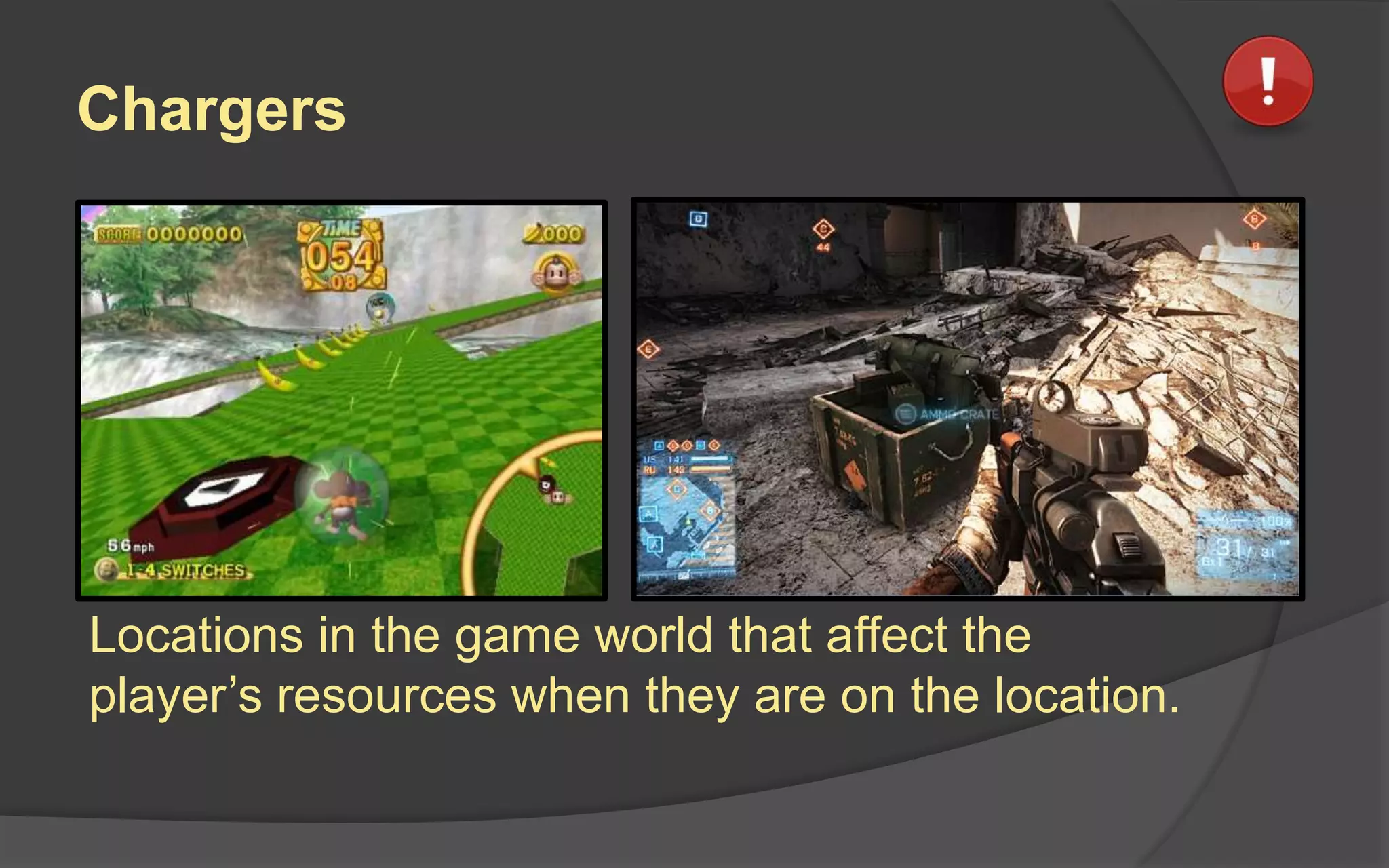
Chargers
Locations in the game world that affect the
player’s resources when they are on the location.
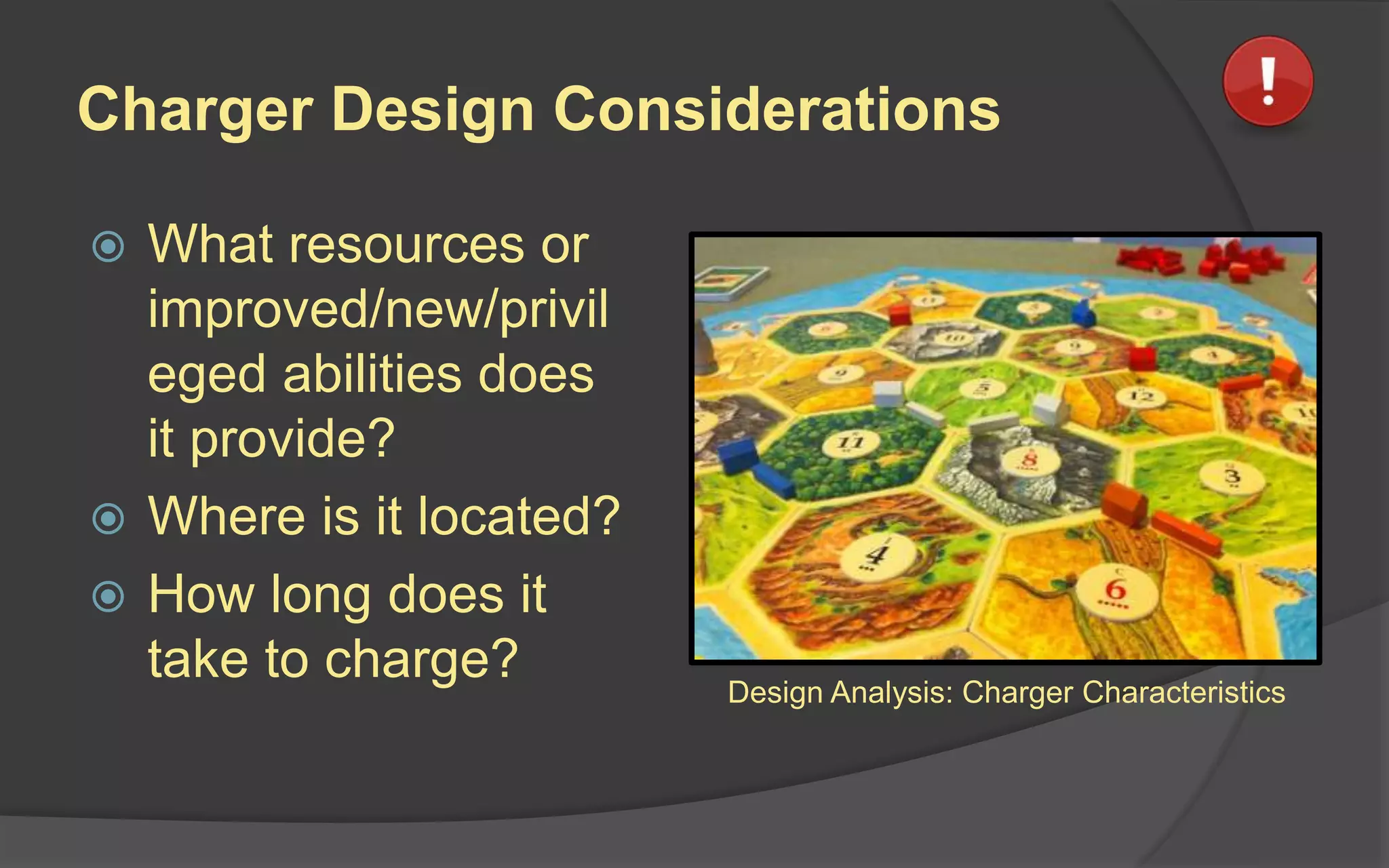
Charger Design Considerations
 What resources or
improved/new/privil
eged abilities does
it provide?
 Where is it located?
 How long does it
take to charge? Design Analysis: Charger Characteristics
Why Designers Use Chargers
 Resource Generator for fueling Actions
 Supports Gain Competence, Traverse and
Race Goals
How Are Controllers and Chargers
Different?
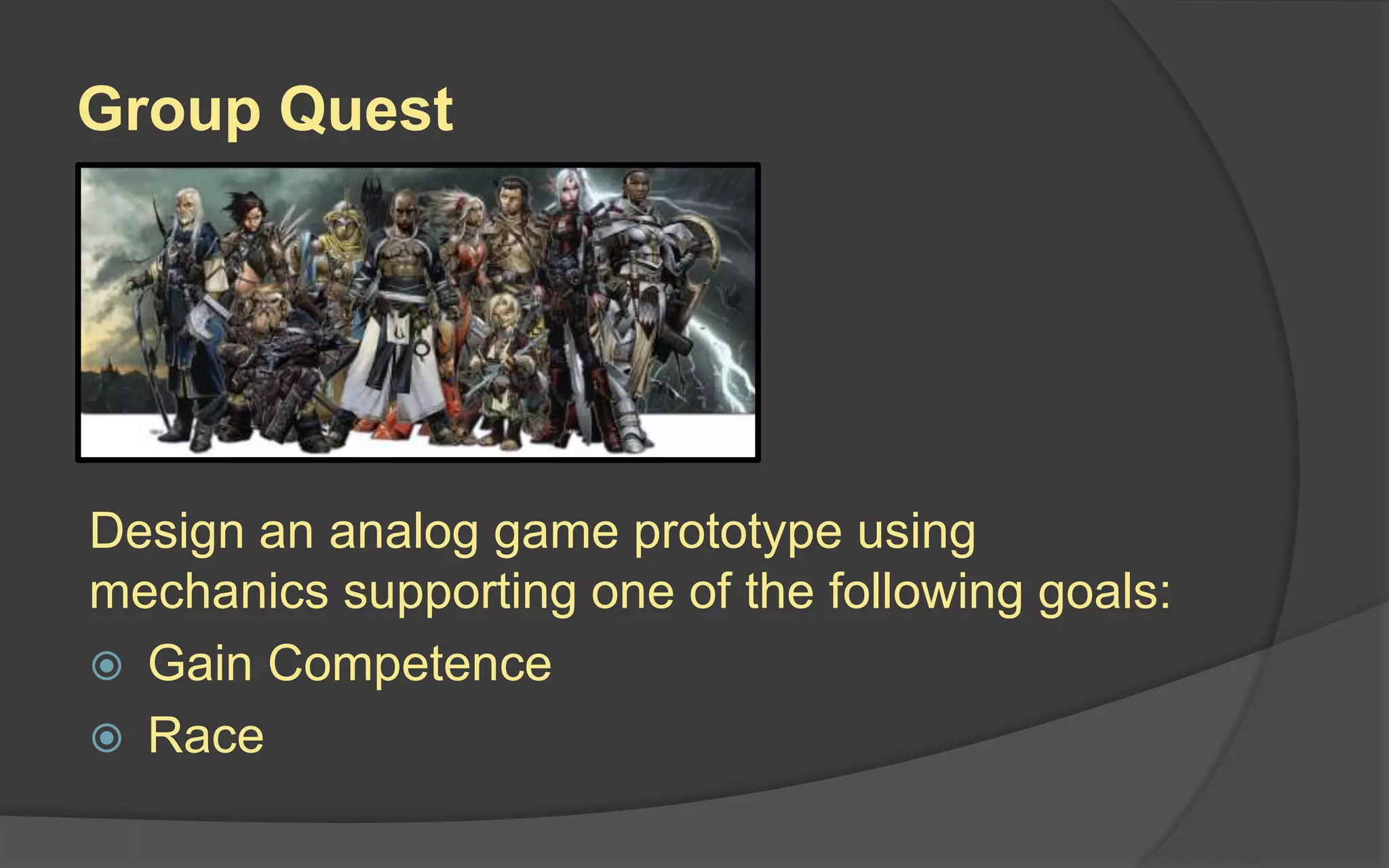
Group Quest
Design an analog game prototype using
mechanics supporting one of the following goals:
 Gain Competence
 Race
Research and use the LMS to report on
games using progression tracking elements
discussed in class.
LAFS Game Mechanics - Progression Mechanics

LAFS Game Mechanics - Progression Mechanics

  • 1.
    Level 2 David Mullich GameMechanics The Los Angeles Film School
  • 3.
    Mechanics ACTION Actual Action of the Mechanic REWARD Rewardfor Executing the Action TRIGGER Event that Triggers the Action
  • 4.
  • 5.
    Intrinsic Rewards Novelty The FiveDomains Of Play Challenge Stimulation Harmony Threat
  • 6.
  • 7.
    Movement Limitations  Obstacles Deadly Traps  Inaccessible Areas  Privileged Abilities  Budgeted Action Points
  • 9.
  • 10.
    Progression The ongoing proceduresafter the game’s set- up, leading to a desired resolution.
  • 11.
    Progression Mechanics Design Analysis:What are the progression mechanics in these two games?
  • 12.
    Difficulty  The amountof skill a player needs to achieve the game’s goals.
  • 13.
  • 14.
    Flow Flow is themental state in which a person performing an activity is fully immersed in the game. Over time, game challenges increase as the player’s skills increase.
  • 15.
    Flow Most games tendto build up each level to a boss battle of some type to test if they are ready for more difficult challenges. When players pass this test, they progress through the game.
  • 16.
    Progression Systems Extra Credits:How Good Games Avoid Skinner Boxes
  • 17.
    What Was TheMain Message Of This Video?
  • 18.
    Making Progression MoreMeaningful  Add a Strategic Component  Shaping Learning Curve  Reward Most Engaging Way To Play  Enhance Narrative and Character Development  Provide Cohesion and Consistency
  • 19.
    Analyzing Progression Are yourchoke points appropriately difficult? Are users getting stuck on certain levels unexpectedly? Which levels are users having the most fun playing and repeating?
  • 21.
    Score The numerical representationof the player’s success in the game, often not only representing the success but also defining it.
  • 22.
    Score Design Considerations Which actions or goals give points?  How many points are awarded?  Are points based on when they are achieved?  Can players reload saved games?  Are player scores hidden?  Are there tie breakers? Design Analysis: Score Characteristics
  • 23.
    Why Designers UseScores  Progress Indicator  Supports Race Goal
  • 24.
    High Score Lists Giveplayers the chance to rank themselves against other players who have previously played the game.
  • 25.
    High Score ListDesign Considerations  How many scores are saved?  How are handles supported?  How are ties displayed? Design Analysis: High Score Characteristics
  • 26.
    Why Designers UseHigh Score Lists  Replayability  Competition in Single-Player Games
  • 27.
    Levels Part of agame in which all player actions take place until a certain goal or end condition has been fulfilled.
  • 28.
    Level Design Considerations How many levels in the game?  How do they relate to each other?  How are they different?  How are they completed?
  • 29.
    Why Designers UseLevels  Progress Indicator  Game World Boundary  Closure Point  Narrative Structure  Promotes Exploration  Balances Complexity and Difficulty
  • 31.
    Improved Abilities The player’schance of succeeding with an action, or its calculated effect, is increased.
  • 32.
    Improved Abilities Design Considerations What ability is improved?  How is it improved?  Is the chance to succeed improved?  Is the effect improved? Design Analysis: Improved Ability Characteristics
  • 33.
    New Abilities Gaining newabilities during gameplay.
  • 34.
    New Abilities DesignConsiderations  What ability is given?  Is the ability temporary?  What focus loci is it given to?  Can player choose the ability?  Does player have to give up a current ability? Design Analysis: New Ability Characteristics
  • 35.
    Why Designers UseNew and Improved Abilities  Intrinsic Reward  Empowerment  Smooth Learning Curves  Varied Gameplay  Character and Team Development  Progression for Gain Competence Goal
  • 37.
    Gain Competence Gaining theability to perform a certain action in a game.
  • 38.
    Why Designers UseGain Competence Goals  Intrinsic Reward  Smooth Learning Curve  Varied Gameplay  Character Development
  • 39.
    Gain Competence Considerations What is the action obtained?  How is the action obtained?  Is the action limited?
  • 40.
    Race A competition betweenplayers to be the first to reach a certain goal, often being the first to a certain location along an approved route.
  • 41.
    Race Considerations  Isthis the single goal of the game?  Which game elements are racing?  How many players are competing?  Does each player start at the same time?  Are there movement limitations?  Do players’ know each other’s position?  Can players interfere with each other?  Are there chargers or pick-ups?  Are trailing players given advantages?  How is the end determined?  Is there a time limit?
  • 42.
    Why Designers UseRace Goals  Conflict and Competition  Supports Delivery, Stealth and Rescue Goals  Prevents Eliminate and other goals
  • 43.
    Choose one ofthe following games to play: GAIN COMPETANCY  Eno (2-5p, 60m)  Power Grid:First Sparks (2-6p, 60m)  Thunderstone (2-5p, 45m) RACE  Around World 80 Days (3-6p, 50-70m)  Aton (2p, 30m)  Ave Ceasar (3-6p, 30-60m)  Can’t Stop (2-4p, 30-40m)  Citadels (2-7p, 20-60m)  Hey, That’s My Fish! (2-4p, 20m)  Snowtails (2-5p, 45m)
  • 45.
    Pick-Ups Game elements thatexist in the game world and can be collected by the player, usually by moving an Avatar or Units in contact with the Pick-Up.
  • 46.
    Pick-Up Design Considerations What does it do?  Where is it located?  How is it produced?  How limited is it? Design Analysis: Pick-Up Characteristics
  • 47.
    Why Designers UsePick-Ups  Progression for Collecting Goals  Promotes Maneuvering and Races to Get Tool  Resources for Actions
  • 48.
    Tools A type ofpick-up that grants privileged abilities for as long as the pick-up is possessed by a player or focus loci.
  • 49.
    Tool Design Considerations What new, improved or privileged abilities does it give?  What avatars or units can use it?  What skills/resources are required to use it?  Can it be combined with other tools? Design Analysis: Tool Characteristics
  • 50.
    Why Designers UseTools  New, Improved and Privileged Abilities  Progression for Gain Competence Goals  Balances Players, Avatars and Units
  • 51.
    Power-Ups Game elements thatgive limited-time advantages to the player that picks them up.
  • 52.
    Power-Up Design Considerations What advantage does it give?  How long does its effect last?  Where is it located?  How is it produced?  Can players trade it? Design Analysis: Power-Ups Characteristics
  • 53.
    Why Designers UsePower-Ups  New, Improved and Privileged Abilities  Empowerment  Tension  Promotes Strategic Locations  Balances Skills  Promotes Races and Competition to Get Power-Up  Supports Collecting, Maneuvering, Gain Ownership and Gain Competence Goals
  • 54.
    How Are Toolsand Power-Ups Different?
  • 55.
    Controllers Game elements fixedin particular locations in the game world that allow player to perform actions that would not otherwise be possible.
  • 56.
    Controller Design Considerations What privileged abilities does it allow?  Who can use it?  What skills/resources/tools /extended actions are required to use it?  Is it part of a large machine or system? Design Analysis: Controller Characteristics
  • 57.
    Why Designers UseControllers  Obstacle  Level Completion
  • 58.
    Chargers Locations in thegame world that affect the player’s resources when they are on the location.
  • 59.
    Charger Design Considerations What resources or improved/new/privil eged abilities does it provide?  Where is it located?  How long does it take to charge? Design Analysis: Charger Characteristics
  • 60.
    Why Designers UseChargers  Resource Generator for fueling Actions  Supports Gain Competence, Traverse and Race Goals
  • 61.
    How Are Controllersand Chargers Different?
  • 62.
    Group Quest Design ananalog game prototype using mechanics supporting one of the following goals:  Gain Competence  Race
  • 63.
    Research and usethe LMS to report on games using progression tracking elements discussed in class.

Editor's Notes

  • #10 The mechanics that directly lead to the game’s successful resolution.
  • #12 EXAMPLE: CANDYLAND EXAMPLE: TETRIS
  • #18 Progression Systems don’t have to be Skinner Boxes as long as they are part of the experience and not just tacked on.
  • #19 Pondering on a decision about strategic path. Reducing the game’s complexity Encourage Players to Master New Mechanics Personality grows or changes with progression Turn individual battles into campaigns
  • #22 EXAMPLE: PAC-MAN provides three different ways to earn points: eating pills, capturing ghosts or collecting bonus objects. Having a score value for EACH PLAYER allows them to easily determine the LEADER or WINNER in a game.
  • #23 DIFFERENT WAYS to Earn Score promotes different TACTICS and allows for STIMULATED PLANNING, VARIED GAMPLAY and REPLAYABILITY. Reaching a Pick-Up first,, completing a Dexterity or Time Based Action. More complex Score calculation might include Resource Management HOW MANY WHEN: You may want to give DIFFERENT POINTS for the SAME ACHIEVEMENTS based on WHEN in the game they are achieved to ensure FLOW. RELOAD: May make scores irrelevant, as players repeat parts of game until they achieve a score they are happy with. HIDDEN: If KNOWN, give rise to DYNAMIC ALLIANCE in which players work together to DEFEAT THE LEADER but can lead to ANALYSIS PARALYSIS. If HIDDEN, provide TENSION and SURPRISE about who Is the leader. TIE BREAKERS: Require Procedures for breaking ties.
  • #24 GOALS: Race (first player to reach a certain score). Also Gain Information and Collection. TRANS-GAME INFORMATION (comparing scores of different games) EXTRA-GAME CONSEQUENCES (Tournaments and High Score Lists)
  • #25 EXAMPLE: The first game to have High Score Lists was ASTEROIDS. META GAMING: Trans-Game Information allows for PLAYER DEFINED GOALS of ranking themselves against previous achievements and gaining GAME MASTERY.
  • #26 HOW MANY: HANDLES: Allow players to IDENTIFY with their own scores and know that other players will RECOGNIZE them, promoting SOCIAL STATUS. TIES: Unless there are TIE BREAKERS, need to show that players with TIED RESULTS are EQUALS.
  • #27 REPLAYABILY: Goal of performing better than in the previous game.
  • #28 Levels may vary by content and/or aesthetics. EXAMPLES: MARBLE MADNESS has different routes, obstacles and color schemes. EXAMPLE: ASTEROIDS has faster and more numerous asteroids.
  • #29 HOW MANY RELATE: Should all adhere to the same CONSISTENT REALITY LOGIC but some LOCAL VARIATION. DIFFERENCES: Themes, End Conditions, Primary Activities, Goals, allowing for VARIED GAMEPLAY. COMPLETION: Typically TRAVERSE to a GOAL POINT, such as a CONTROLLER or BOSS MONSTER .
  • #32 Players can PROGRESS in games when the chances of effect of actions are improved. Note that this does NOT have to do with the physical or mental abilities of PLAYERS. EXAMPLE: SKYRIM gives improved abilities to character classes when they LEVEL UP.. EXAMPLE: Racing games have POWER-UPS and CHARGERS.
  • #33 WHAT: HOW: CHARGERS or POWER-UPS with TIME LIMITS. TOOLS give PERMANENT improvements as long as they are carried. Balanced by LIMITED RESOURCES. CHANCE TO SUCCEED/EFFECT IMPROVEMENTS
  • #34 Additional actions players can perform AFTER they have STARTED playing. Difference between IMPROVED ABILITIES is more SCALE or PERSPECTIVE. EXAMPLE: Role-playing games give new abilities to character classes when they LEVEL UP.. EXAMPLE: Strategy games provide new units with new abilities.
  • #35 WHAT: Does it affect the same parts of the GAME STATE as existing Abilities? How does the Ability fit into the ALTERNATE REALITY? Does it give PRIVILEGED ABILITIES? TEMPORARY: CHARGERS or POWER-UPS with TIME LIMITS. FOCUS LOCI: AVATARS are like PLAYERS, unless it is LOST with LIFE. UNITS can be made MORE VALUABLE and allows for UNIT DIFFERENTIATION. CHOOSE: If Player can choose, gives FREEDOM OF CHOICE and makes PLANNED CHARACTER DEVELOPMENT possible. GIVE UP: ABILITY LOSS forcing player to choose RISK/REWARD, .
  • #36 INTRINSIC REWARD: EWPOSERMENT: PERCEIVED CHANCE TO SUCCEED and ILLUSION OF INFLUENCE Also Gain Ownership Goals Balances Avatars, Skills, Competence Areas COMPETENCE AREAS. Form of CHARACTER DEVELOPMENT and TEAM DEVELOPMENT. Balances Characters, Units and Team Members
  • #38 Either by enabling a Game Element to perform an action or by gaining control of a game element that can perform that action, NOT for a Player to perform an action skillfully. EXAMPLE: QUAKE goals that are linked to acquiring weapons. EXAMPLE: SKYRIM ability to cast Spells. : .
  • #39 Promote Tactics Supports Gain Ownership, Overcome, Race
  • #40 WHAT: HOW: Through PRIVILEDGED or NEW ABILITIES through pick-ups or leveling up. LIMITED: Is there a time limit or number of uses? Used to BALANCE the Competency.
  • #41 EXAMPLE: Candy Land, first to reach CANDY CASTLE. EXAMPLE: PIG, the first person to get a specified number of points. EXAMPLE: GOLF is a form of RACE, with time measured by FEWEST STROKES. .
  • #42 SINGLE GOAL: High-Level Goal requiring the use of underlying goals: TRAVERSE. WHICH ELEMENTS: HOW MANY: START: Starting conditions and goals should be equivalent for all players, otherwise BALANCING with HANDICAPS? MOVEMENT LIMITATIONS: Balancing DIFFICULTY POSTIION: Affects feeling of PARTICIPATION and TENSION. PROGRESS INDICATORS show progress in meeting GOAL, STATUS INDICATORS used for CONTINUOUS GOALS. INTERFERENCE: Promotes MANEUVERING CHARGERS and PICK-UPS: Forces RISK/REWARD Decisions and STRATEGIC KNOWLEDGE TRAILING PLAYER ADVANTAGES: Balancing with HANDICAPS END: 1) Completion of GOAL (Traverse). 2) TIME LIMITS make it a matter of DISTANCE rather than SPEED. If TWO OR MORE Win, is there a TIEBREAKER? TIME LIMIT: it can be applied to almost any type of game by introducing TIME as a determining factor of the OUTCOME.
  • #47 USE: - Affect Avatar/Units Attributes (Cut-Off Limits or Diminishing Returns for Balance) - Gain advantages in actions against opponents - Increase chances of winning - Several uses: Trade-Offs LOCATION: Design of pick-up is linked to design of resource location. Fixed (Strategic)/Random? PRODUCTION? Used once? Renewable Resource? Fixed//Random? Tied to a Resource Generator? LIMITED?
  • #48 Risk/Reward Decisions Promotes Strategic Locations Promotes Gain Ownership and Delivery Goals.
  • #49 Tools and the game elements that use them are separate entities, and they can exist independently of each others, so that they can be picked up, dropped, destroyed, traded, etc. USES: IMPROVED and NEW ABILITIES, REWARDS
  • #50 ABILITIES: Modify Aim & Shoot? Allow Controllers to be Used? Exploit Enemy’s Achilles Heel? AVATARS/UNITS: SKILL/RESOURCES: How many can be carried? How many times used? COMBINED: Increases DIFFICULTY and COMPLEXITY
  • #51 EMPOWERMENT: ILLUSION OF INFLUENCE and PERCEIVED CHANCE TO SUCCEED REWARDS SUPPORTS GAIN OWNERSHIP AND COLLECTING GOALS
  • #52 Power-ups are a type of Pick-Up. PAC-MAN: Power pill in Pac-Man allows Pac-Man to hunt ghosts for a limited amount of time. QUAKE: Quad damage in Quake quadruples the amount of damage caused by player’s weapons for a limtied amount of time.
  • #53 ADVANTAGE: The main difference is that Power-Ups give the player’s NEW ABILITIES OR PRIVILEDGE ABILITIES. They can IMPROVE ABILITIES such ass raising Skills. TIME EFFECT: Can increase TENSION if the usefulness depends on other goals, such as locating and avoiding enemies first. LOCATION: Design of pick-up is linked to design of resource location. Fixed (Strategic)/Random? They give an advantage without a disadvantage, so BALANCING is most of an issue than with Pick-Ups PRODUCTION: Used once? Renewable Resource? Fixed//Random? Tied to a Resource Generator? TRADING: Trading BALANCES power-ups.
  • #55 Tools effects last for as long as you possess them, but Power-Ups last for a limited amount of time.
  • #57 ABILITIES: WHO: Generally any Avatar or Unit REQUIREMENTS: Do they need constant activation of a player? Balances its uss. SYSTEM: Outside the usual reach of an Avatar’s or Unit’s actions.
  • #58 Resource Location Strategic Location Area Control Ultra-Powerful Event Supports Gain Ownership Goals
  • #59 Allows Players to get ABILITIES or RENEWABLE RESOURCES. It can also been seen as a POWER-UP that gives PRIVILEGED ABILITIES EXAMPLE: Speed booster in Super Monkey Ball II: Monkey Race. EXAMPLE: Medicine cabinets and ammunition boxes in Battlefield 1942
  • #60 PROVIDES: Some may also supply Privileged Abilities. LOCATION: Balanced by OUTSTANDING FEATURES RECHARGE TIME: RISK/REWARD TRADEOFF because FREEDOM OF CHOICE is limited for MOVEMENT.
  • #61 They are both RESOURCE LOCATIONS and RESOURCE GENERATORS but do not produce any resources unless PLAYER IS IN AREA. Balance Complexity Risk/Reward Decisions Supports Resource Gathering, Gain Competence, Traverse, and Gain Ownership Goals
  • #62 Controllers allow player to perform a privledged action at that location. Chargers give player resources or abilities they can use away from the location.