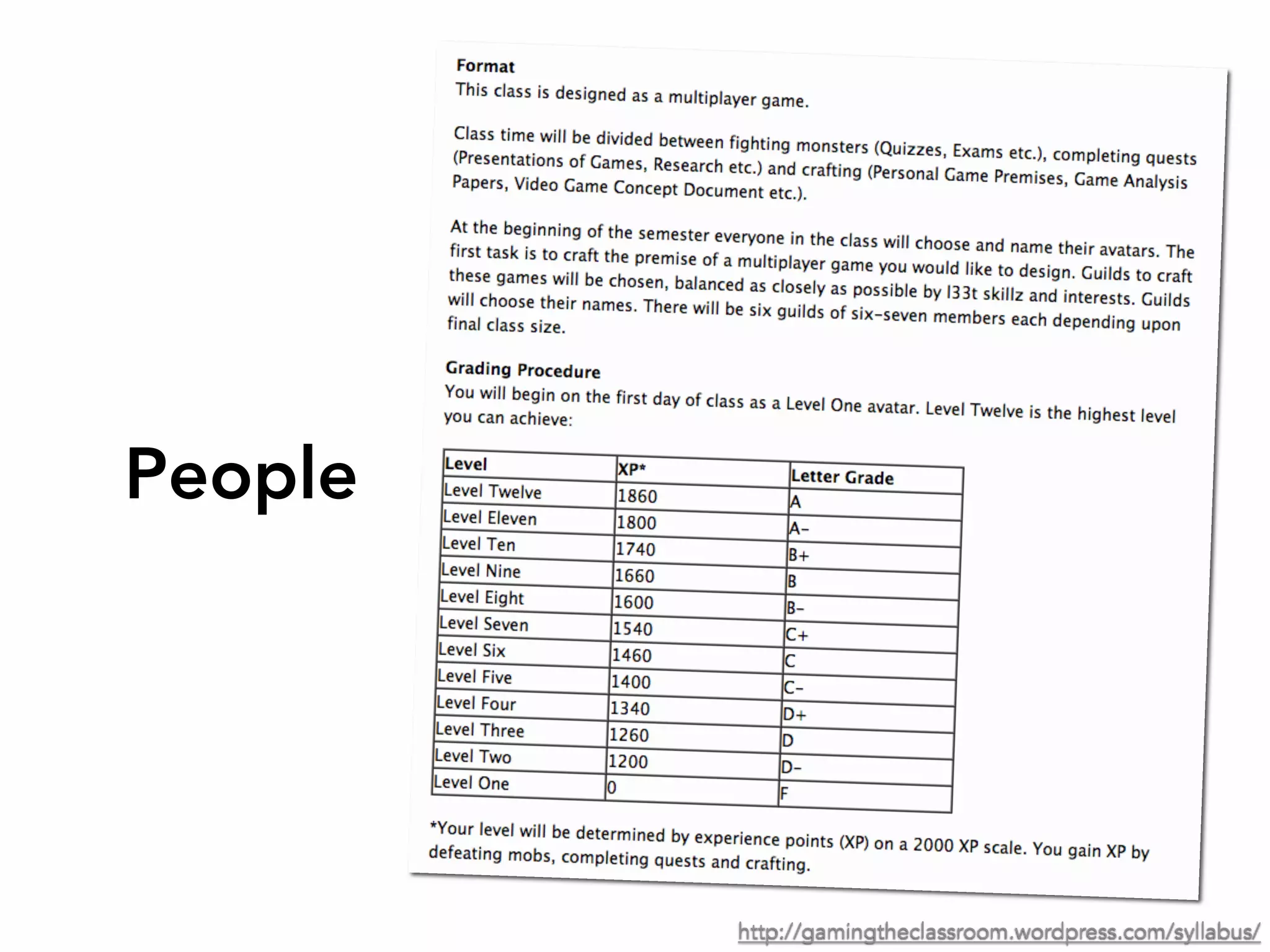
The document explores the concept of gamification, defining it as the application of game elements to engage users in non-game contexts, and discusses its growing importance since its rise in popularity around 2011. It emphasizes the need for effective design in gamification to overcome common pitfalls and improve user engagement and motivation by incorporating principles such as clear goals, feedback, and challenge. Additionally, the document addresses potential risks associated with gamification, including user boredom and cheating, and encourages careful design to create meaningful experiences.
Overview of the presentation and goals, defining gamification and design aspects.
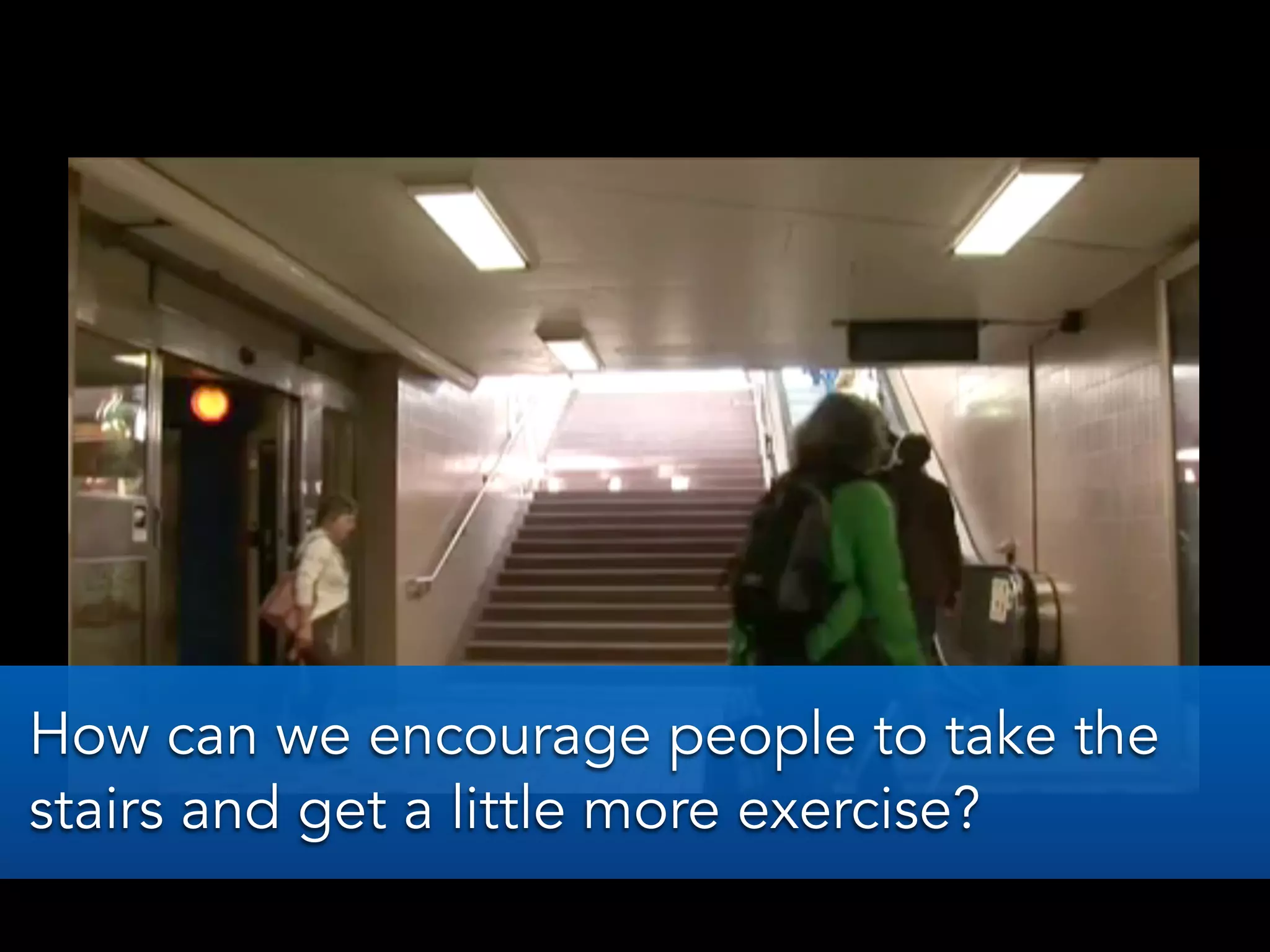
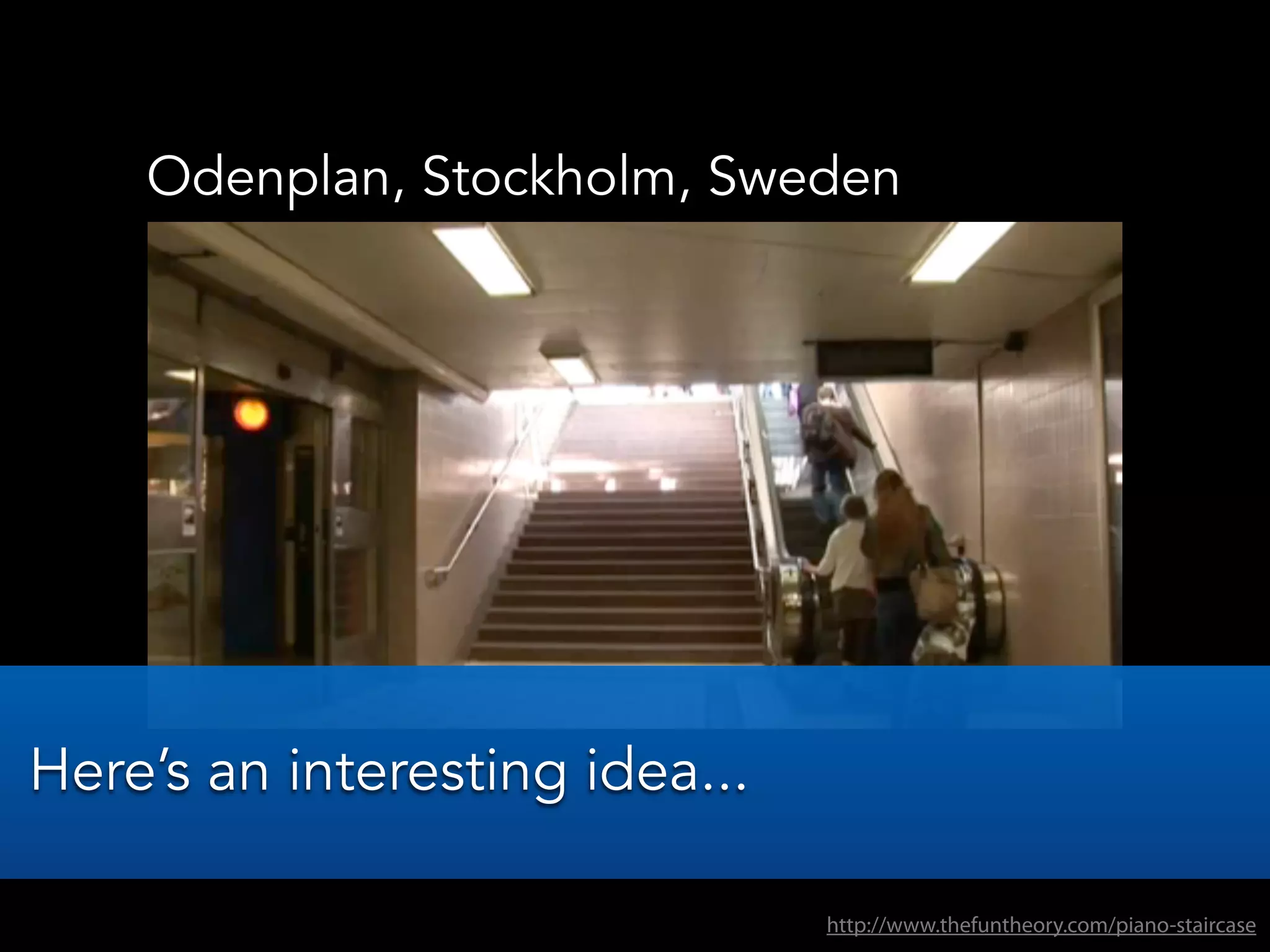
Real-life scenario to encourage people to take the stairs using gamification ideas.
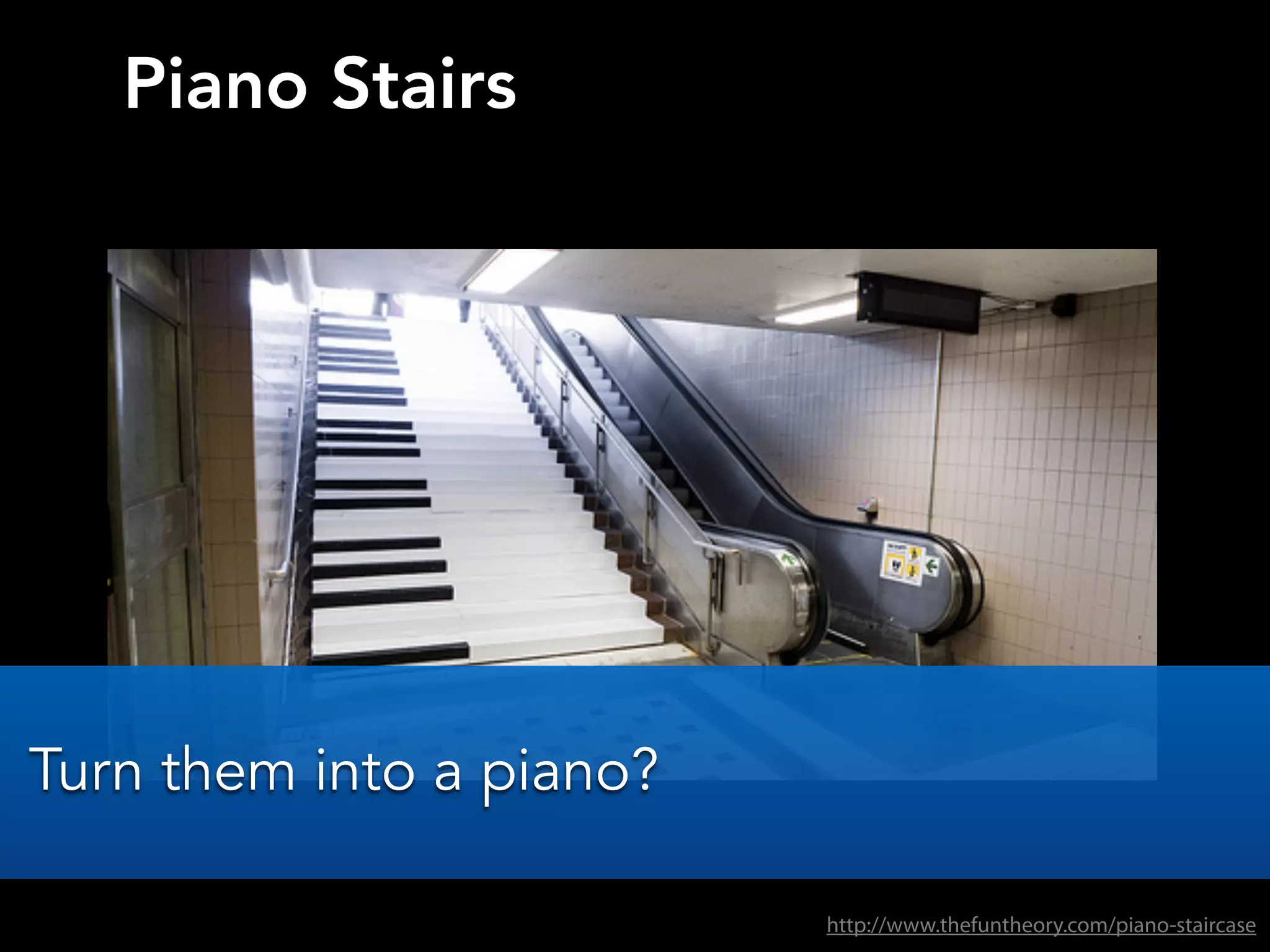
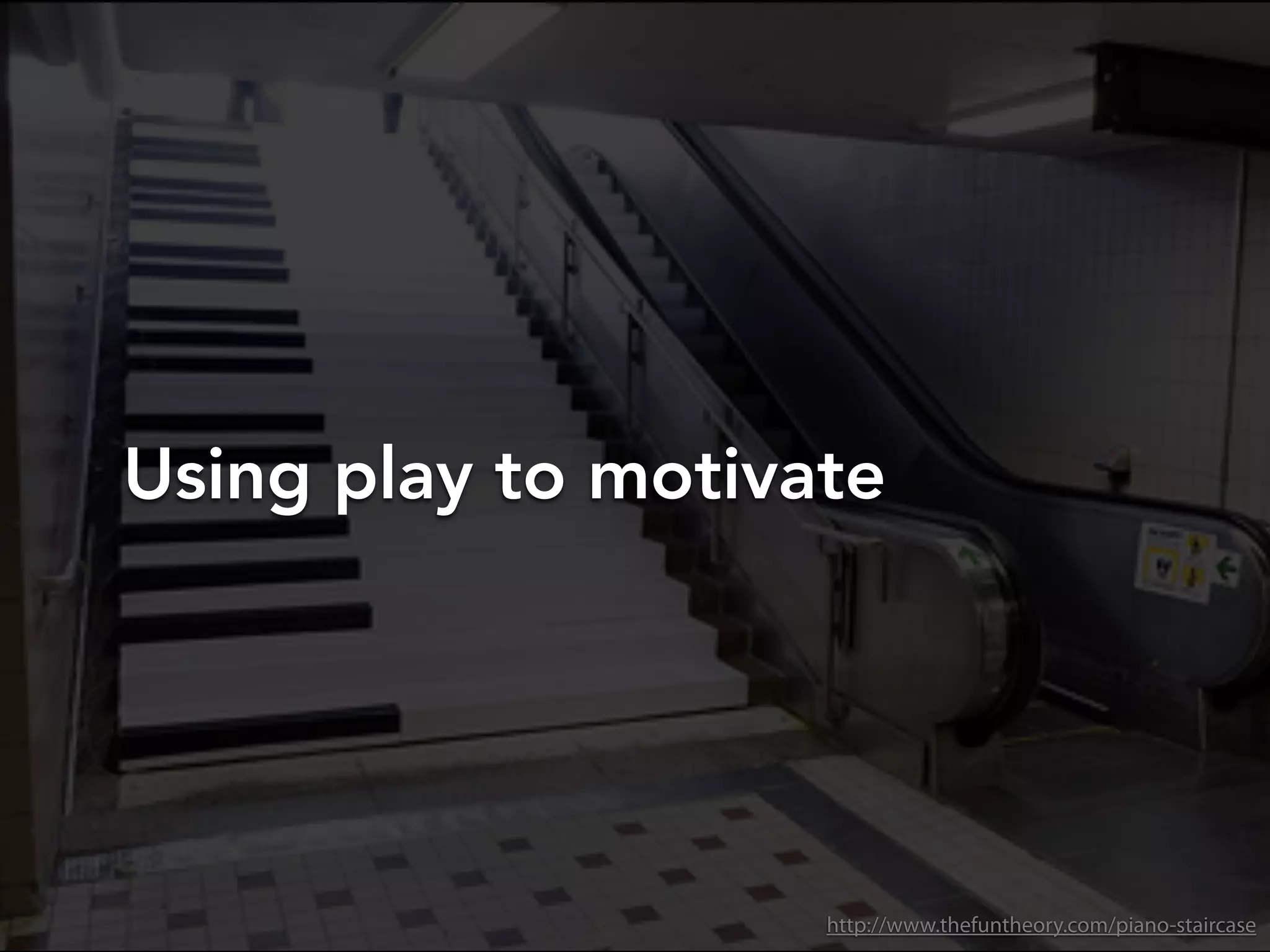
Introduction of Piano Stairs as an interesting gamified solution to encourage physical activity.
Explanations of gamification, its roots, and the emergence as a concept in recent years.
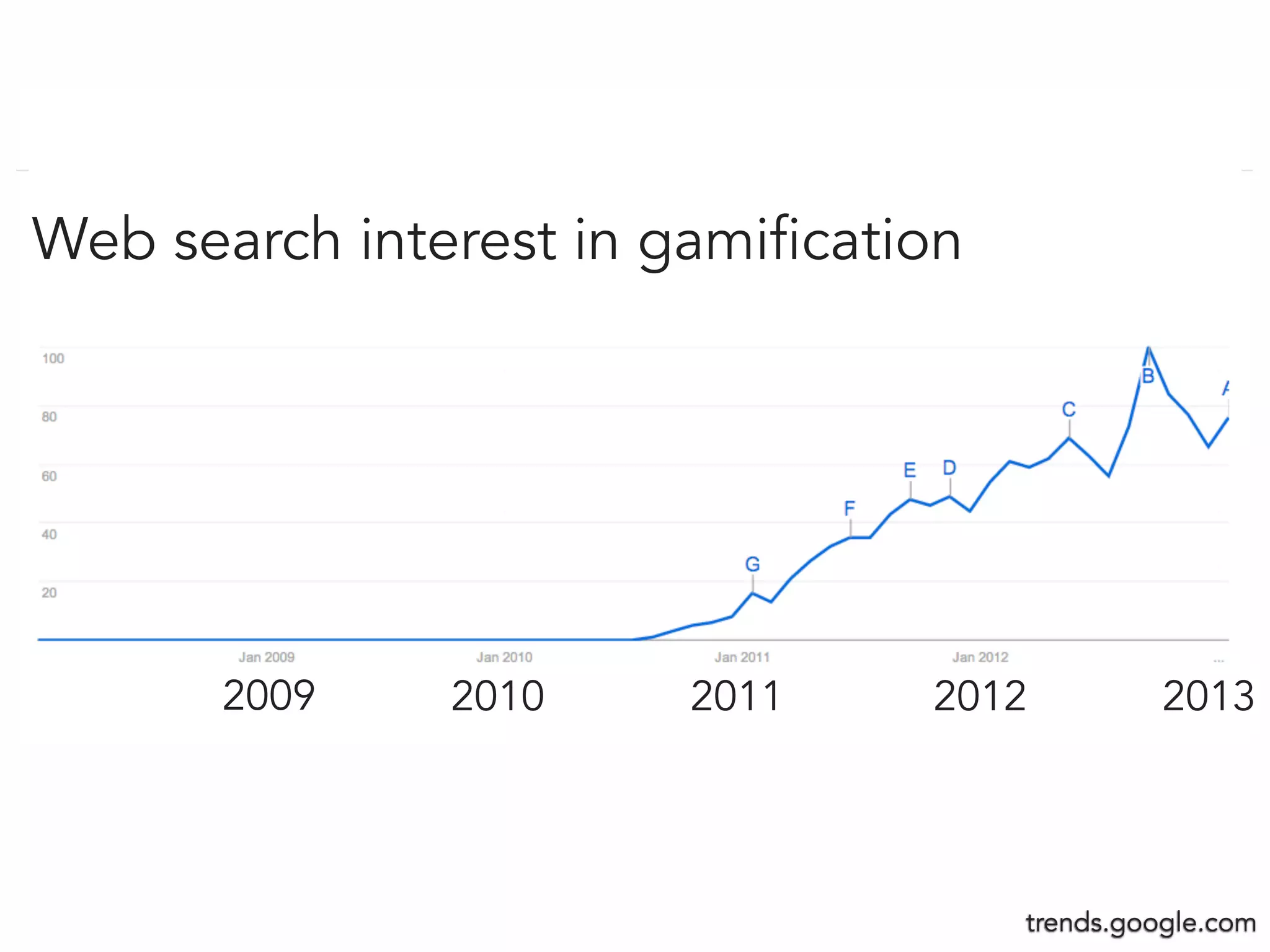
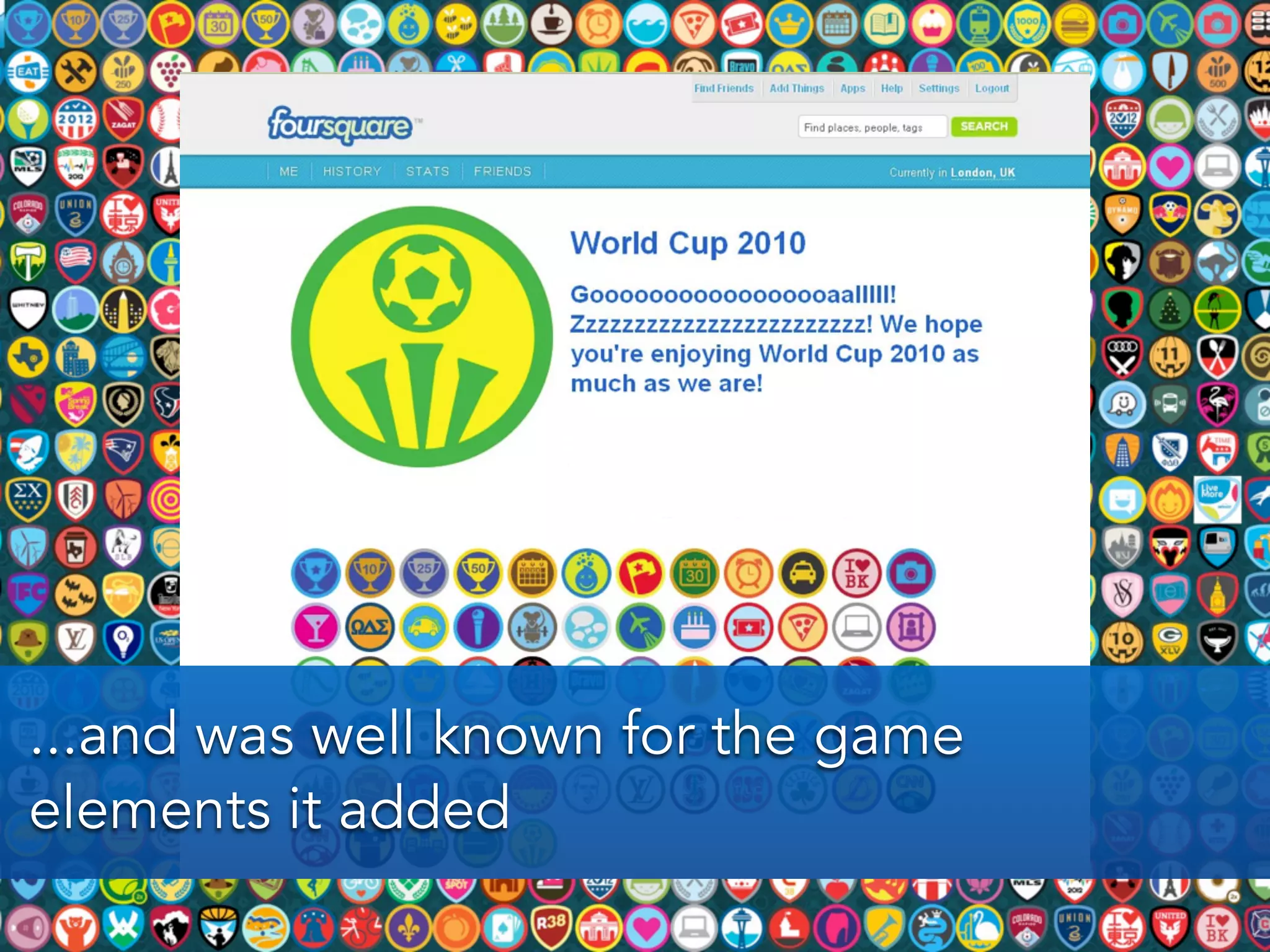
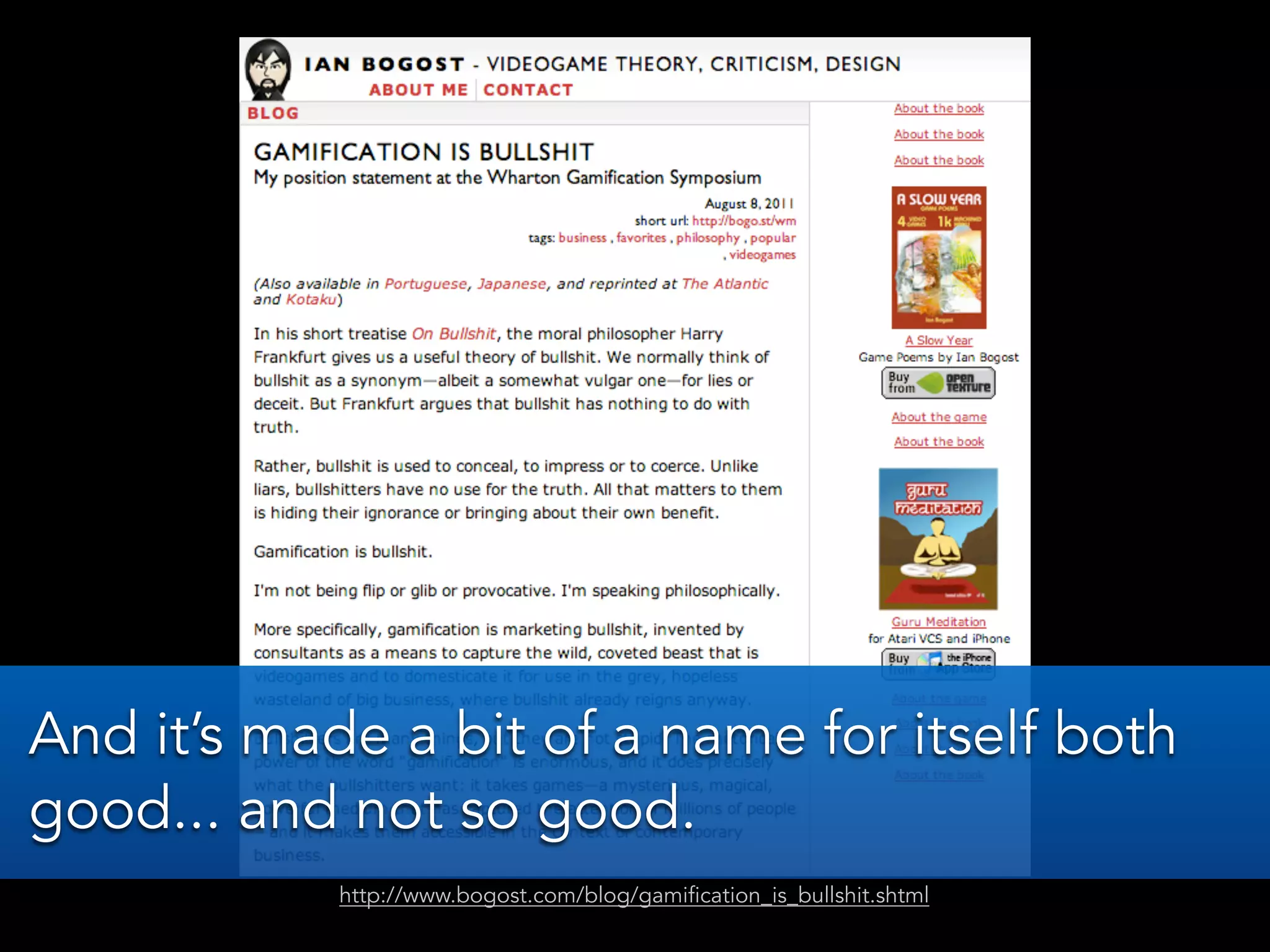
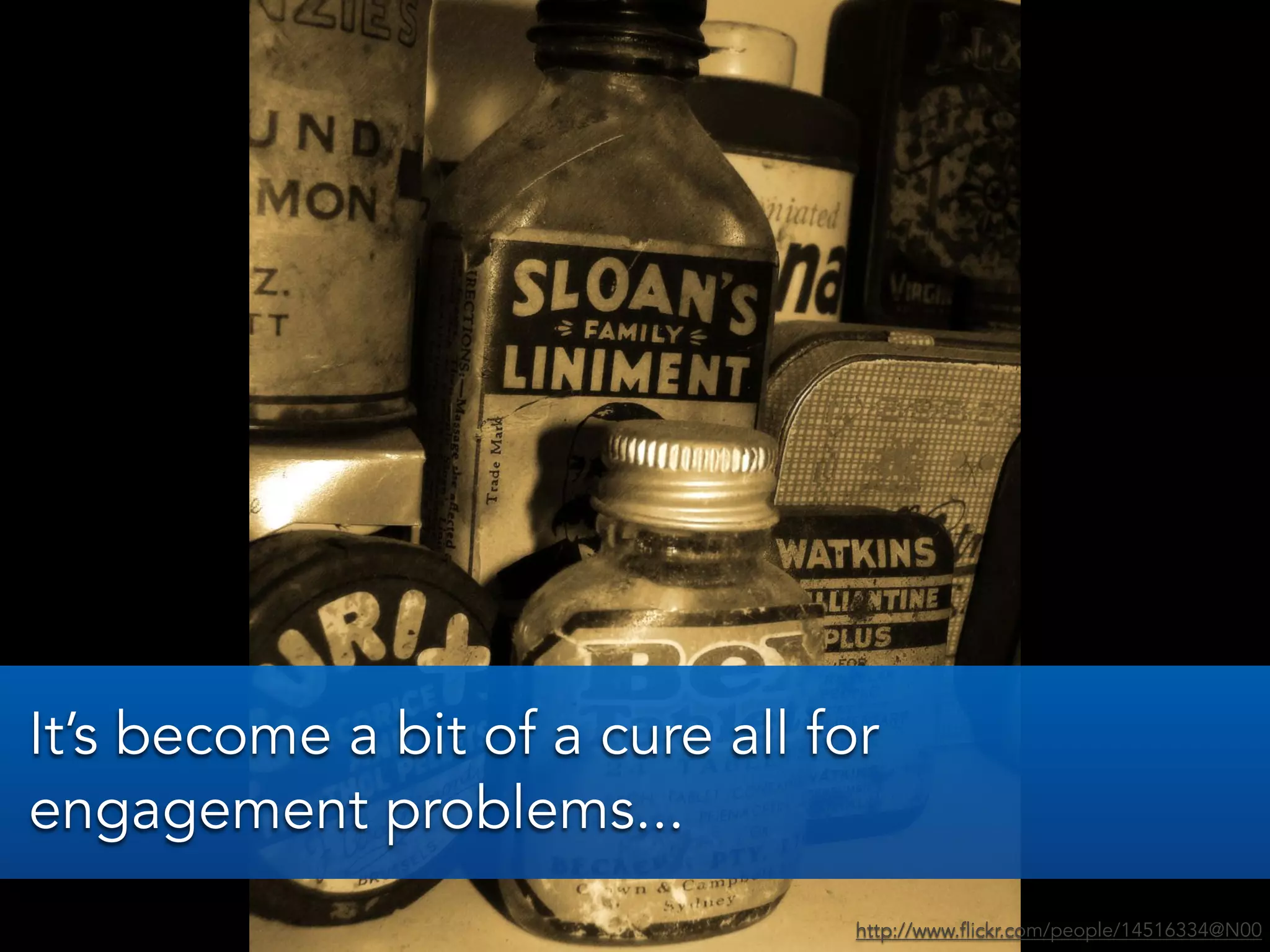
Data on gamification trends, including its rise in application and critical perspectives.
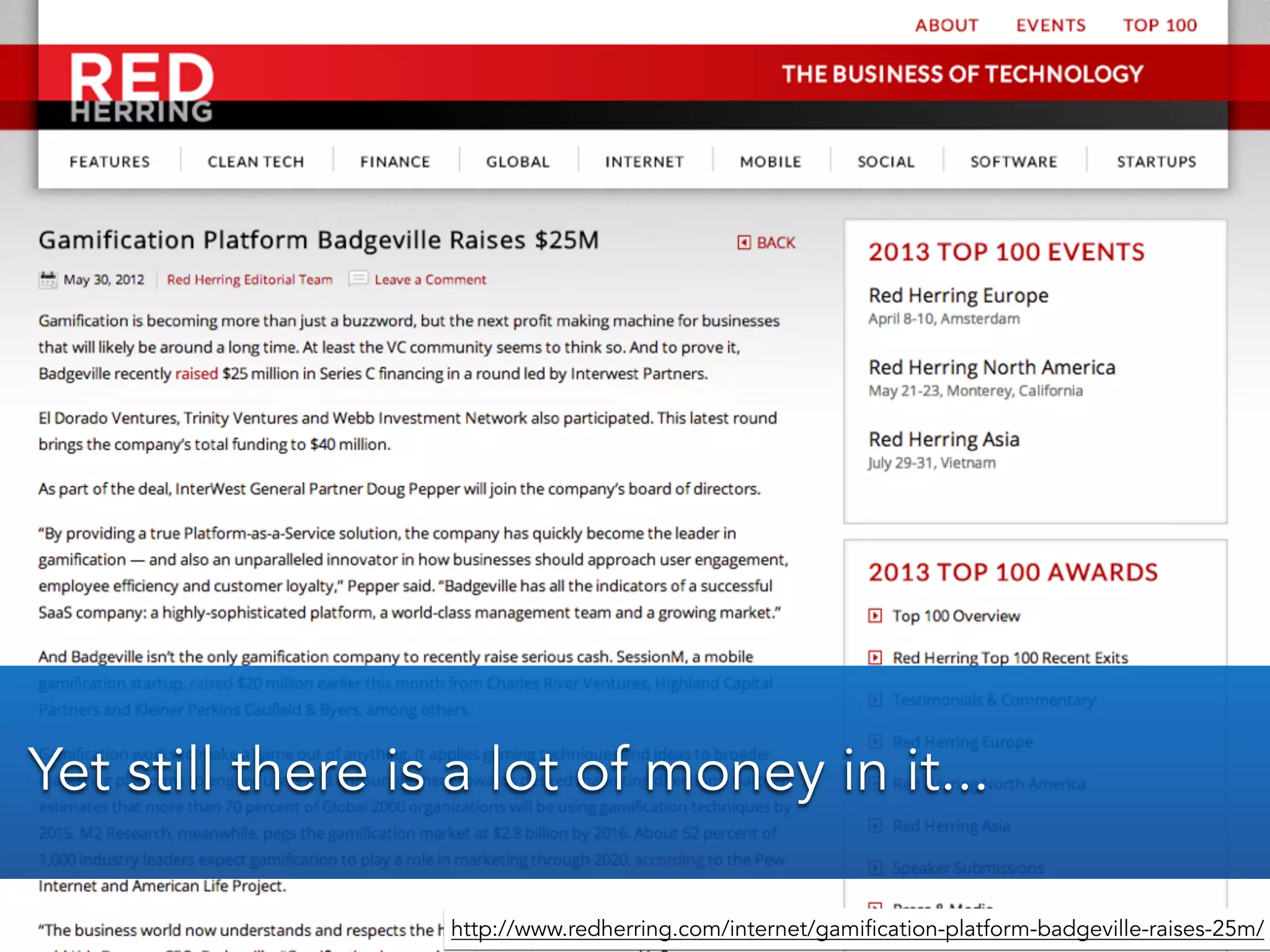
Challenges and financial prospects within gamification as highlighted by Gartner.
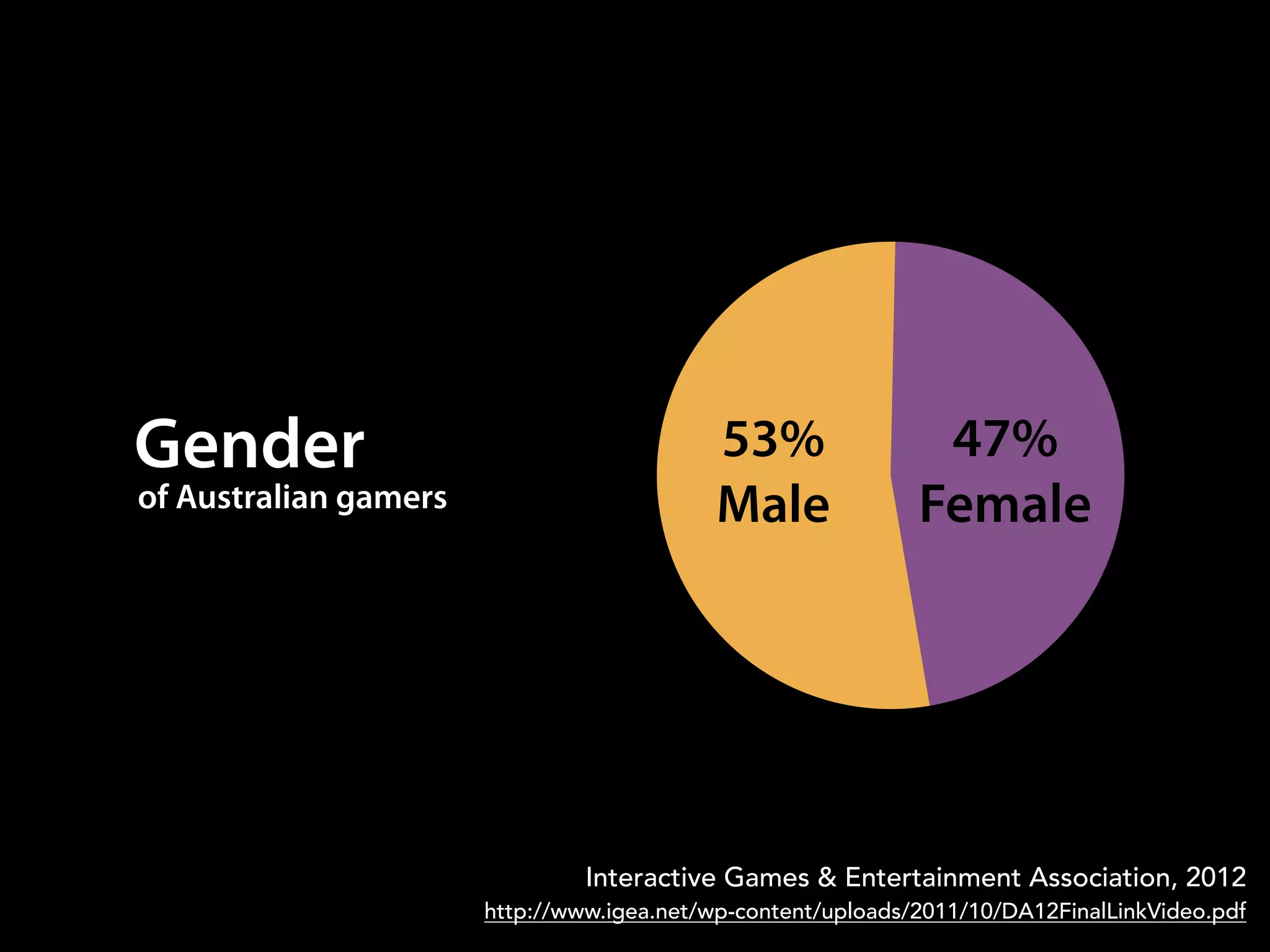
Statistics on the demographic and economic growth of the gaming industry.
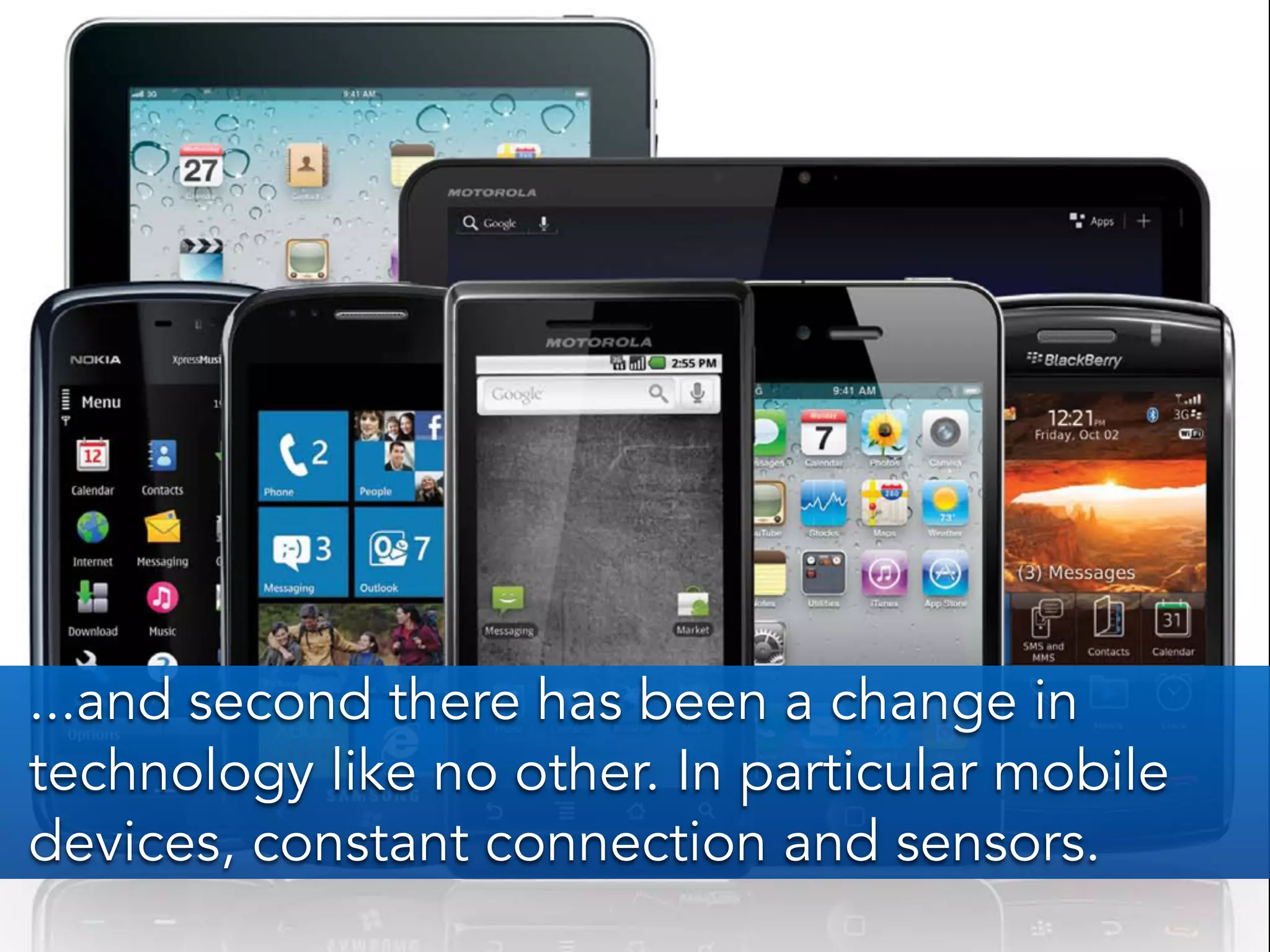
The growth of social gaming and the increase of mobile devices for gaming.
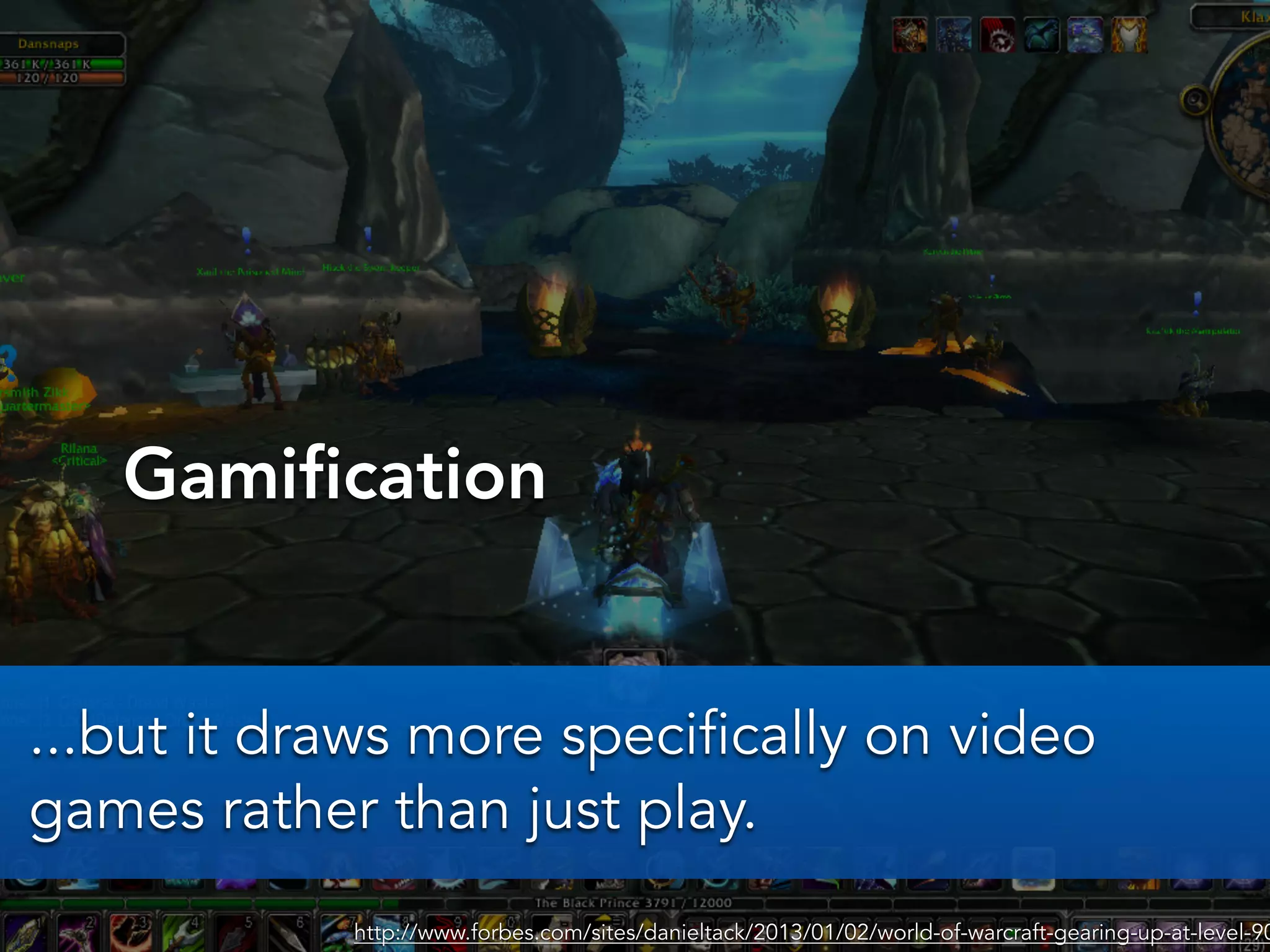
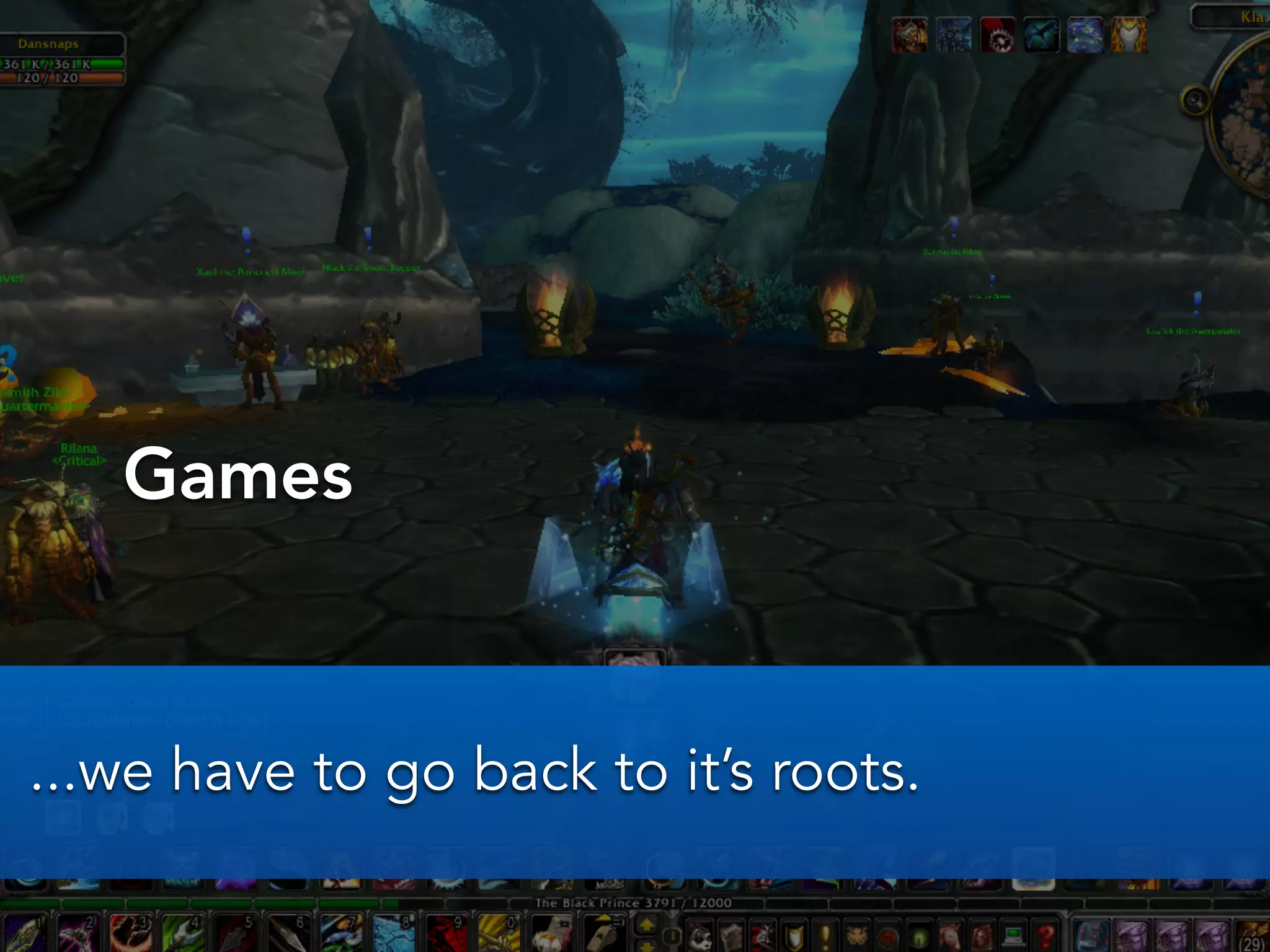
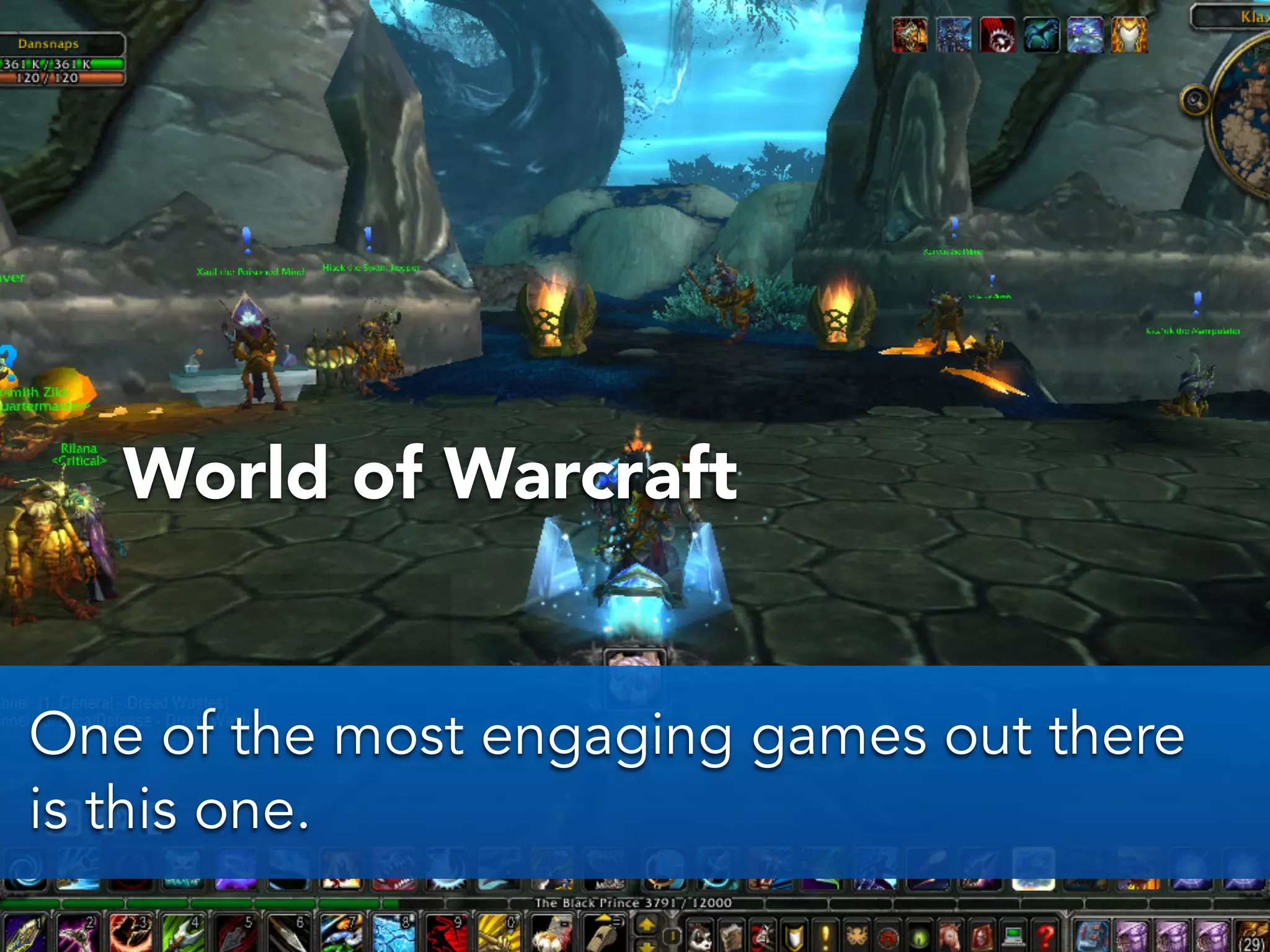
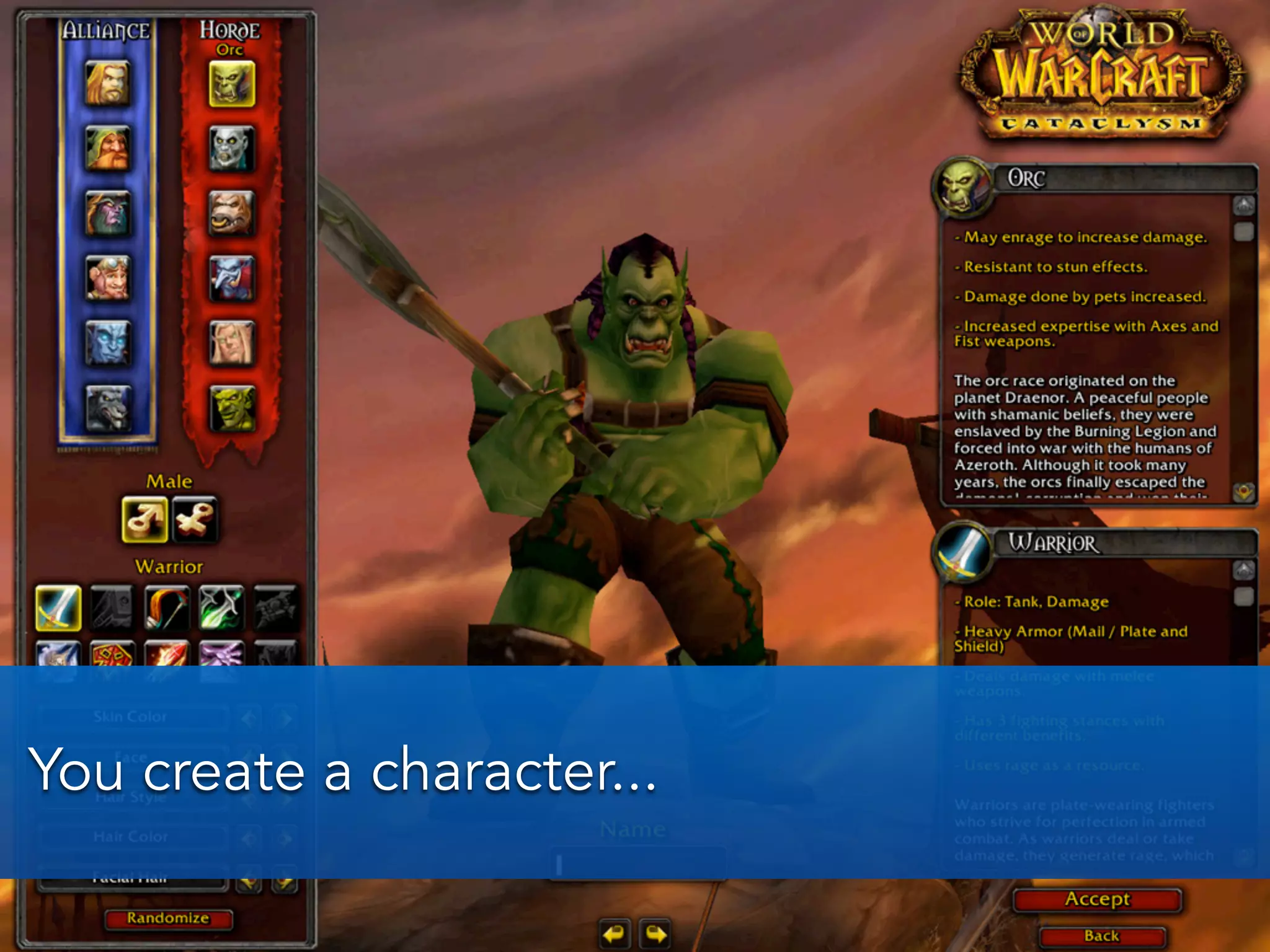
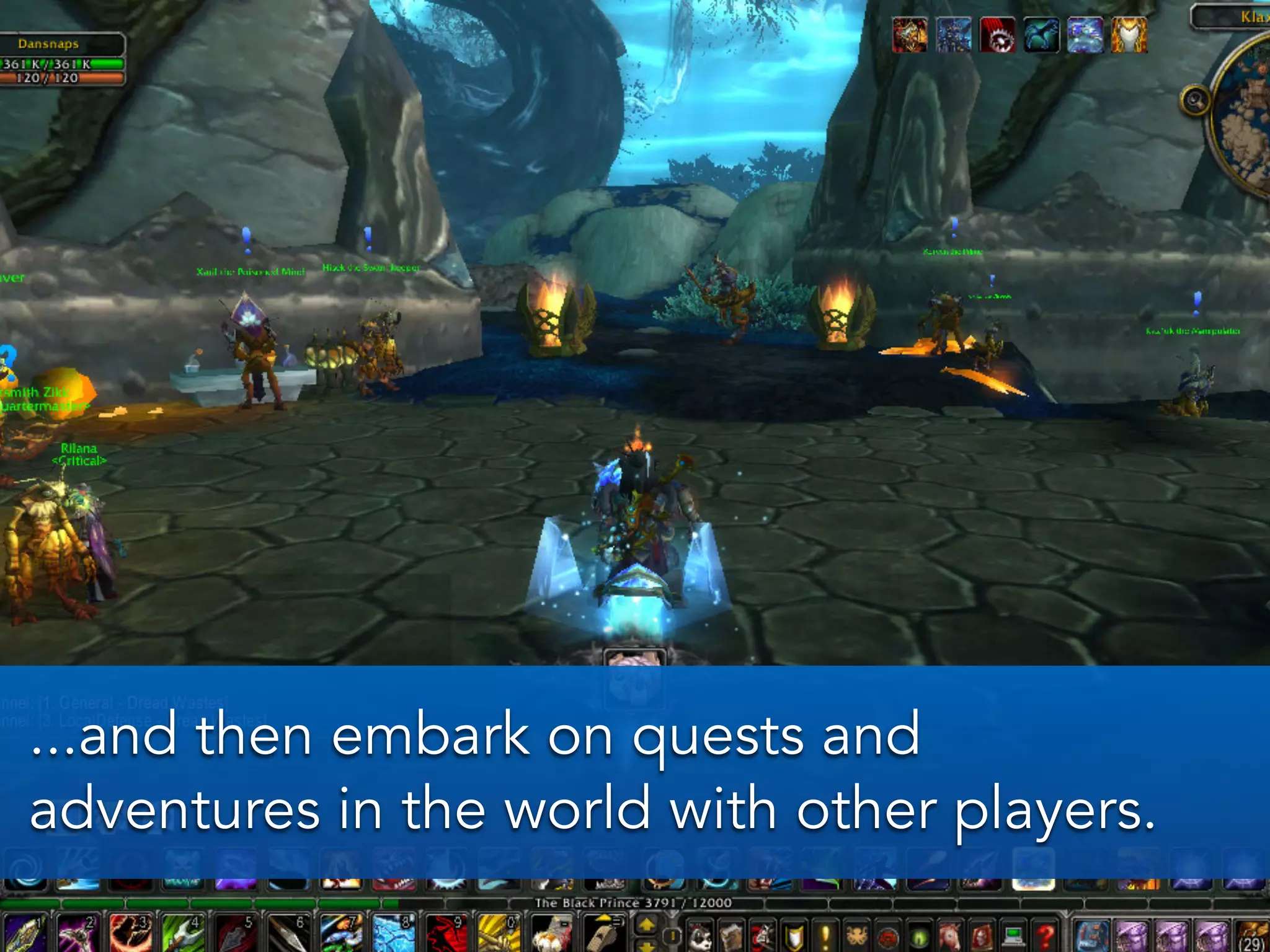
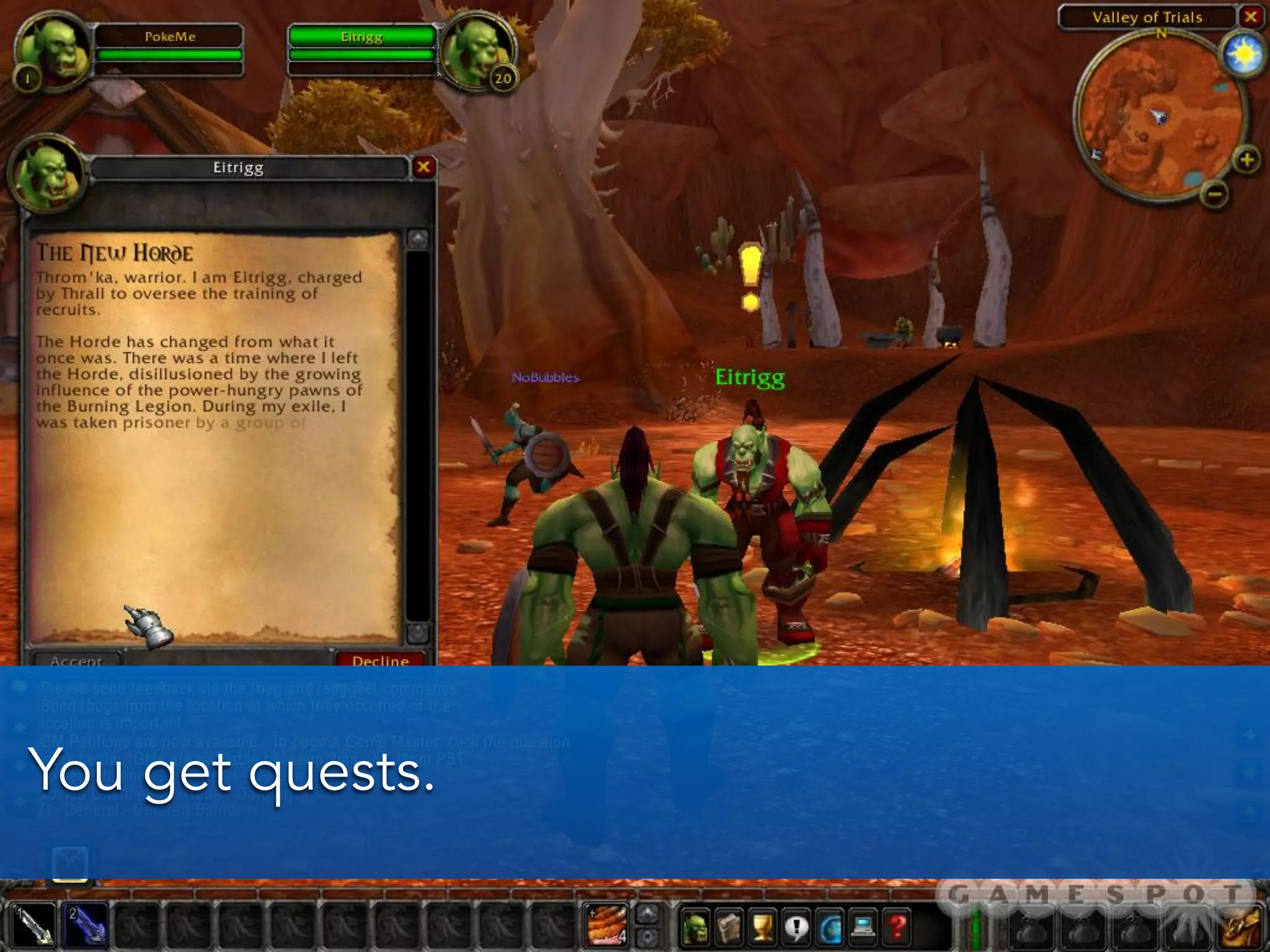
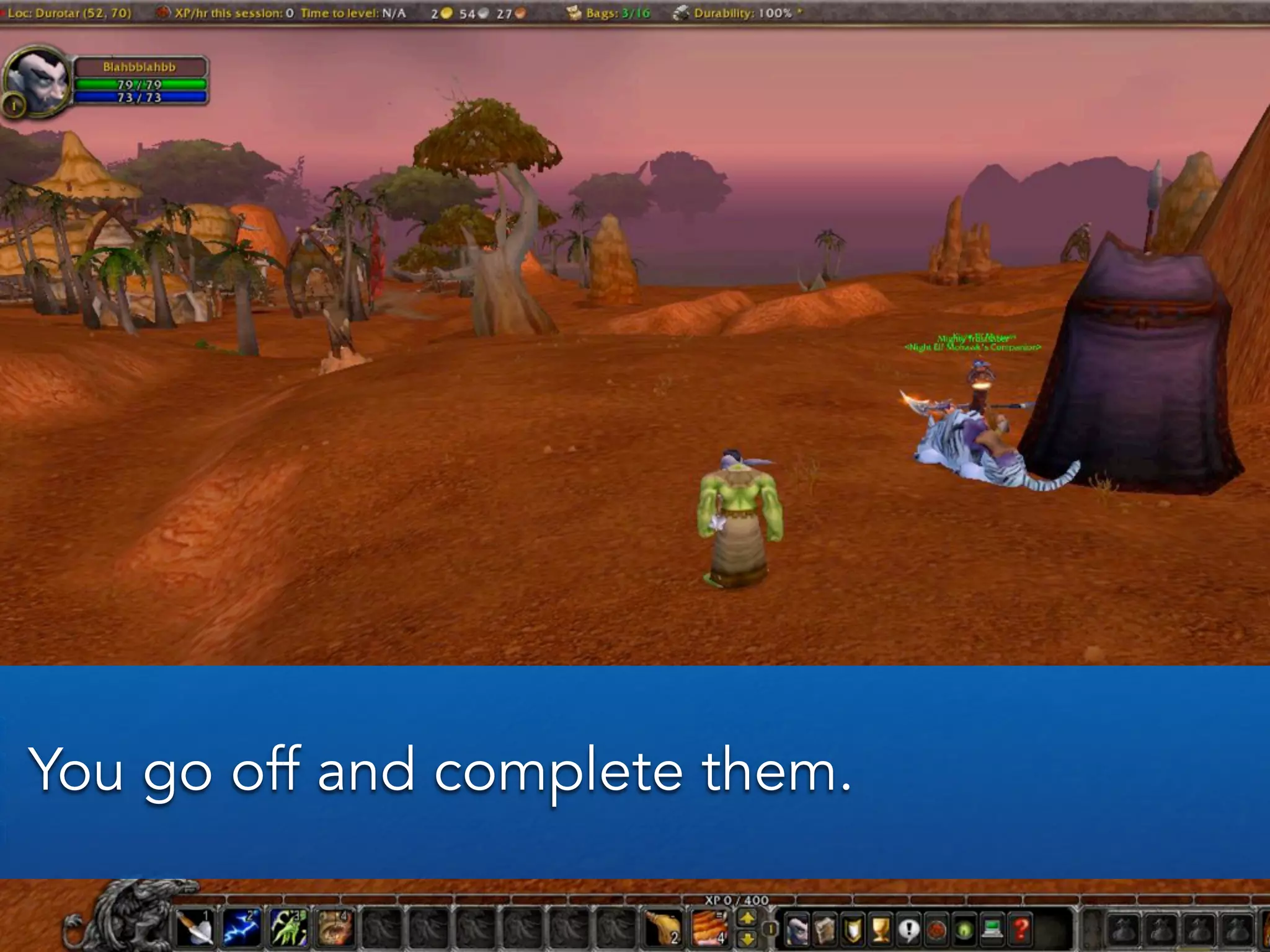
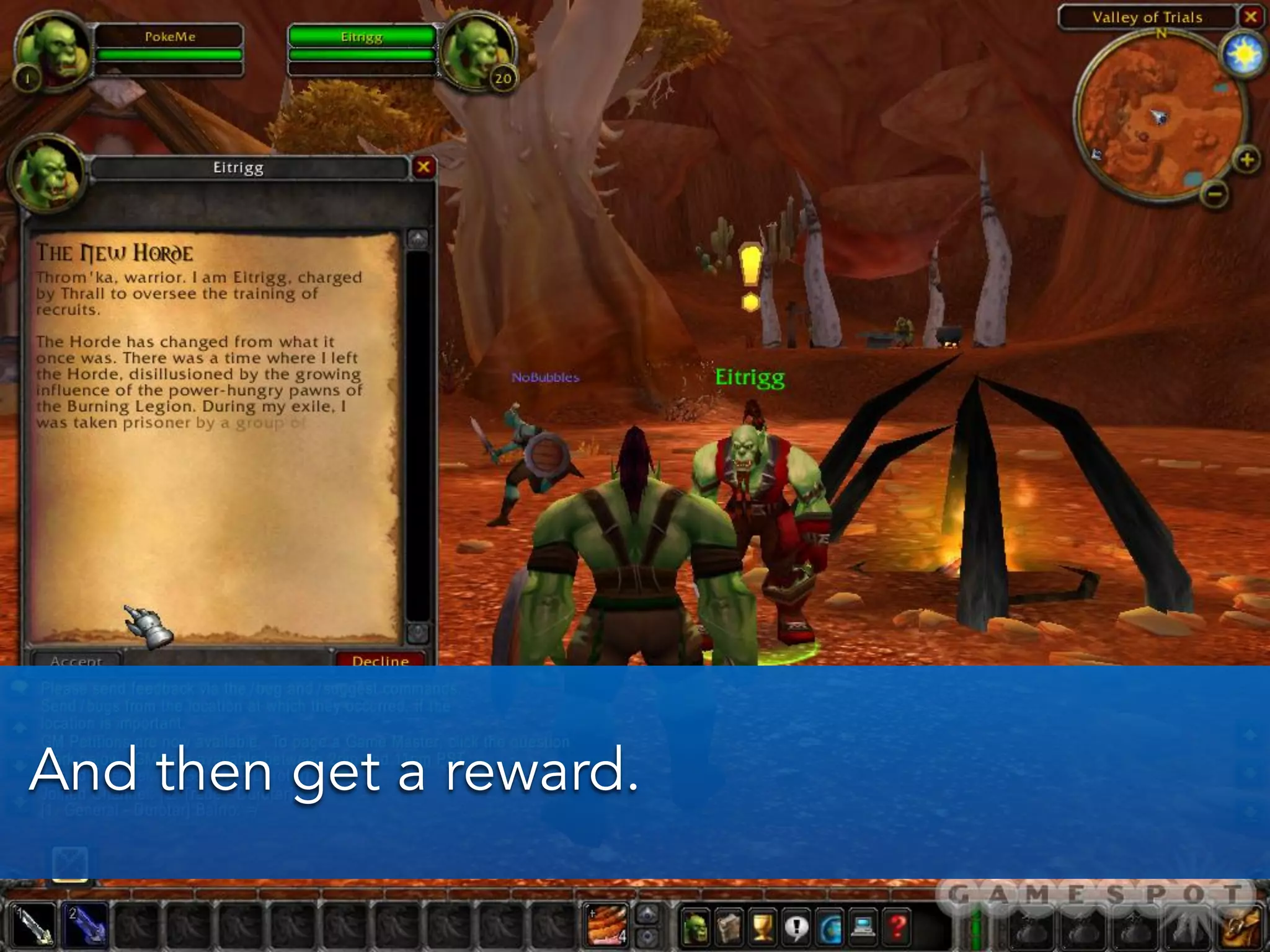
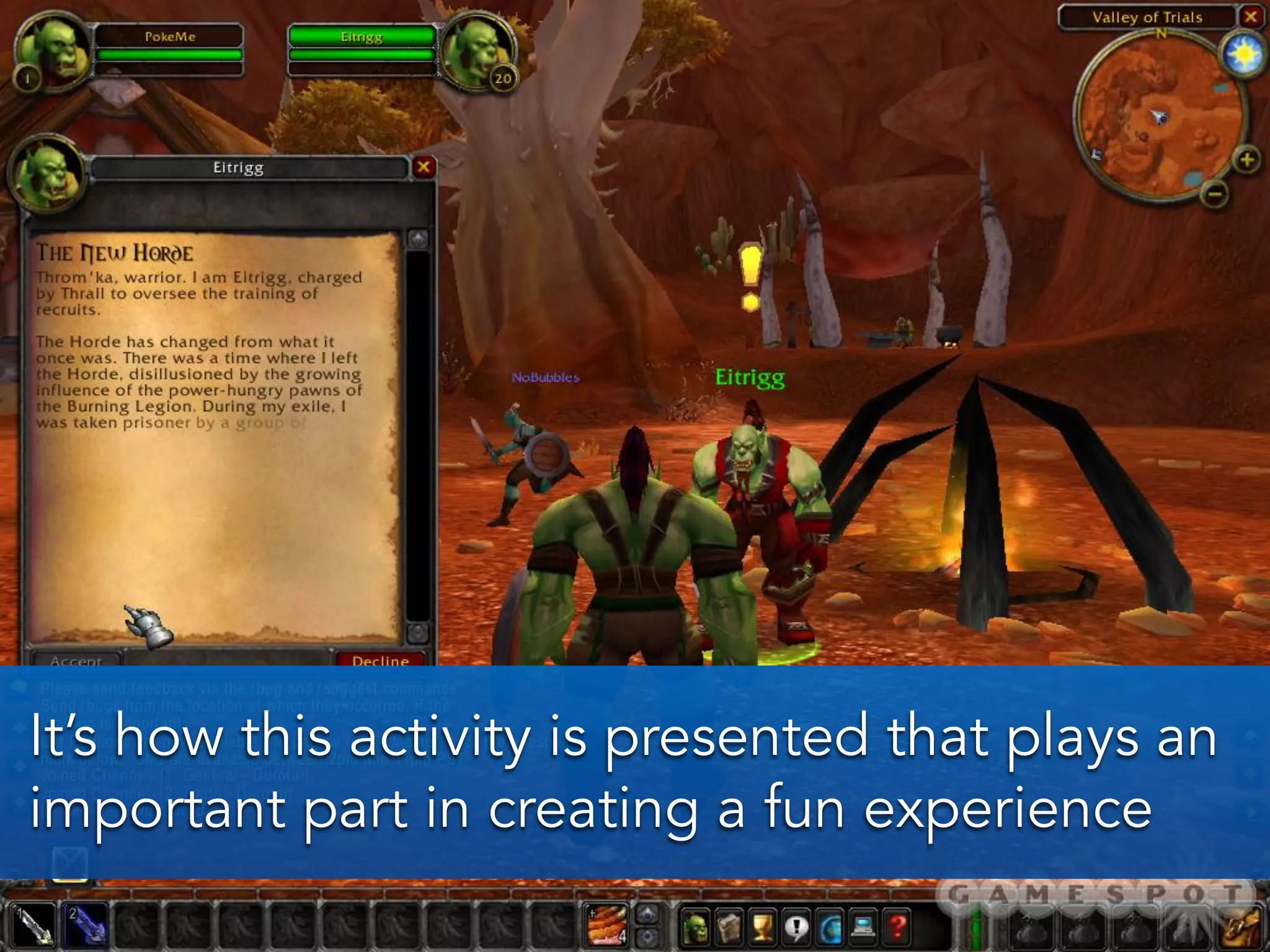
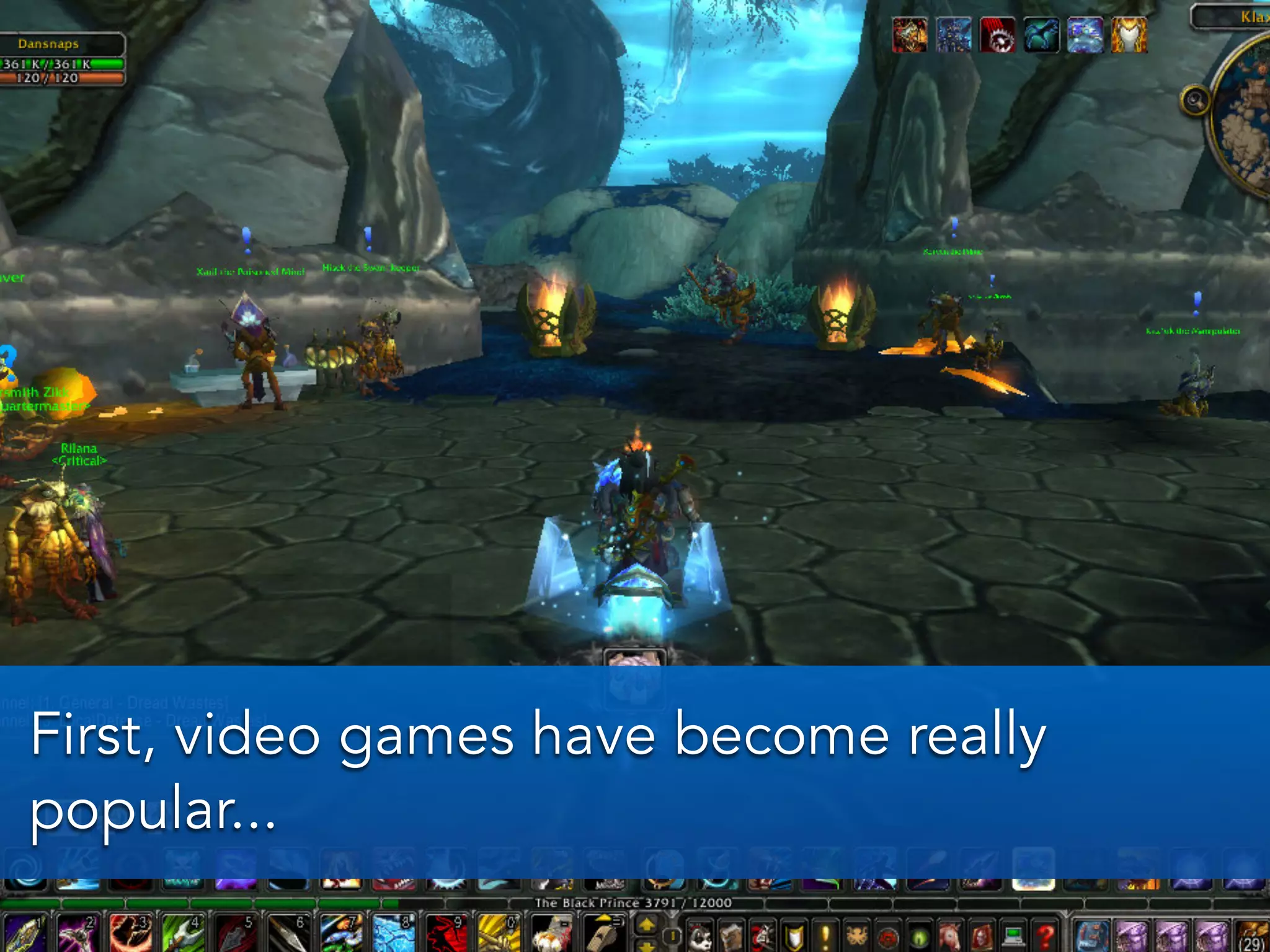
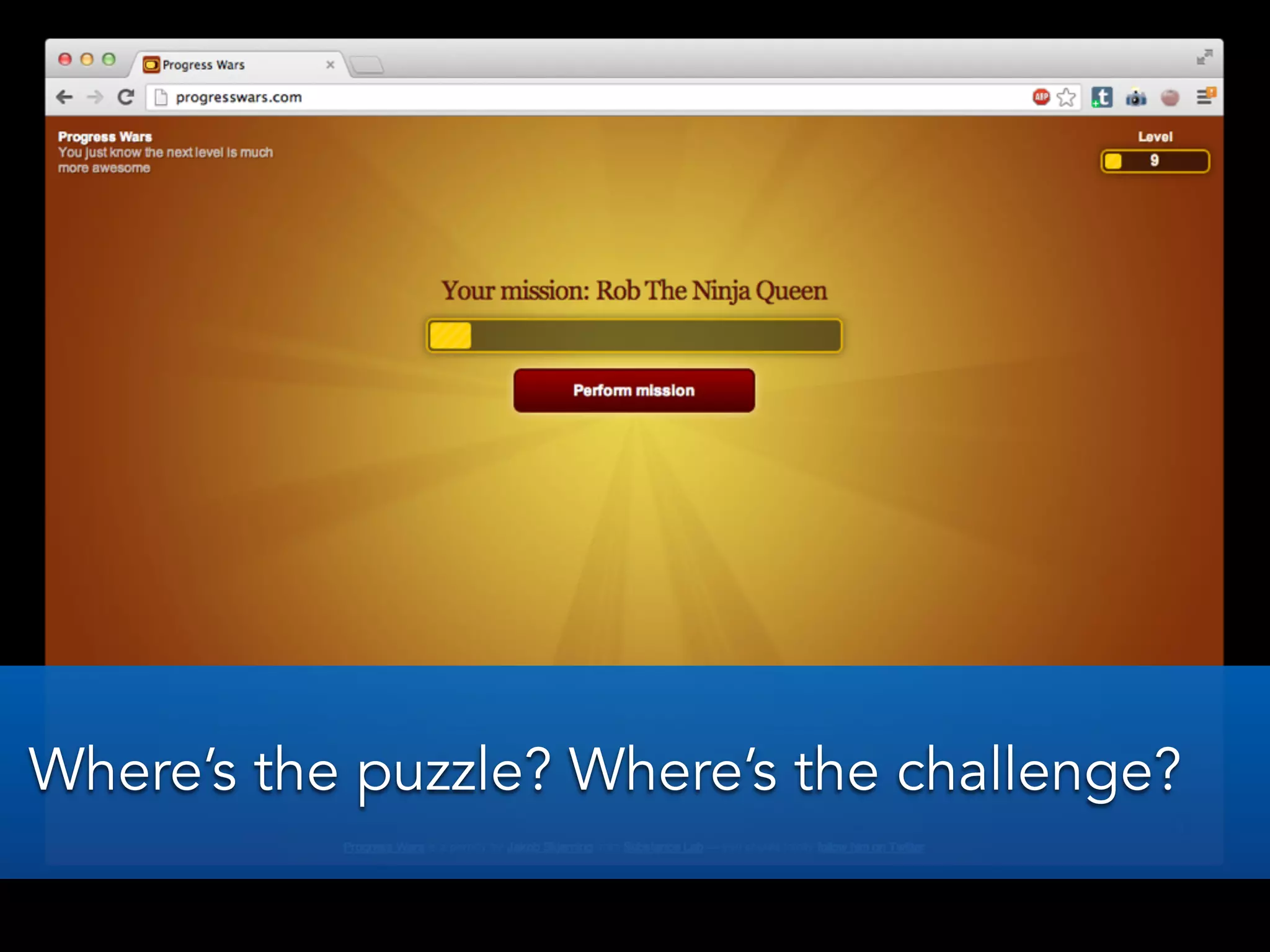
Discussion on engaging games like World of Warcraft, comparing them to work.
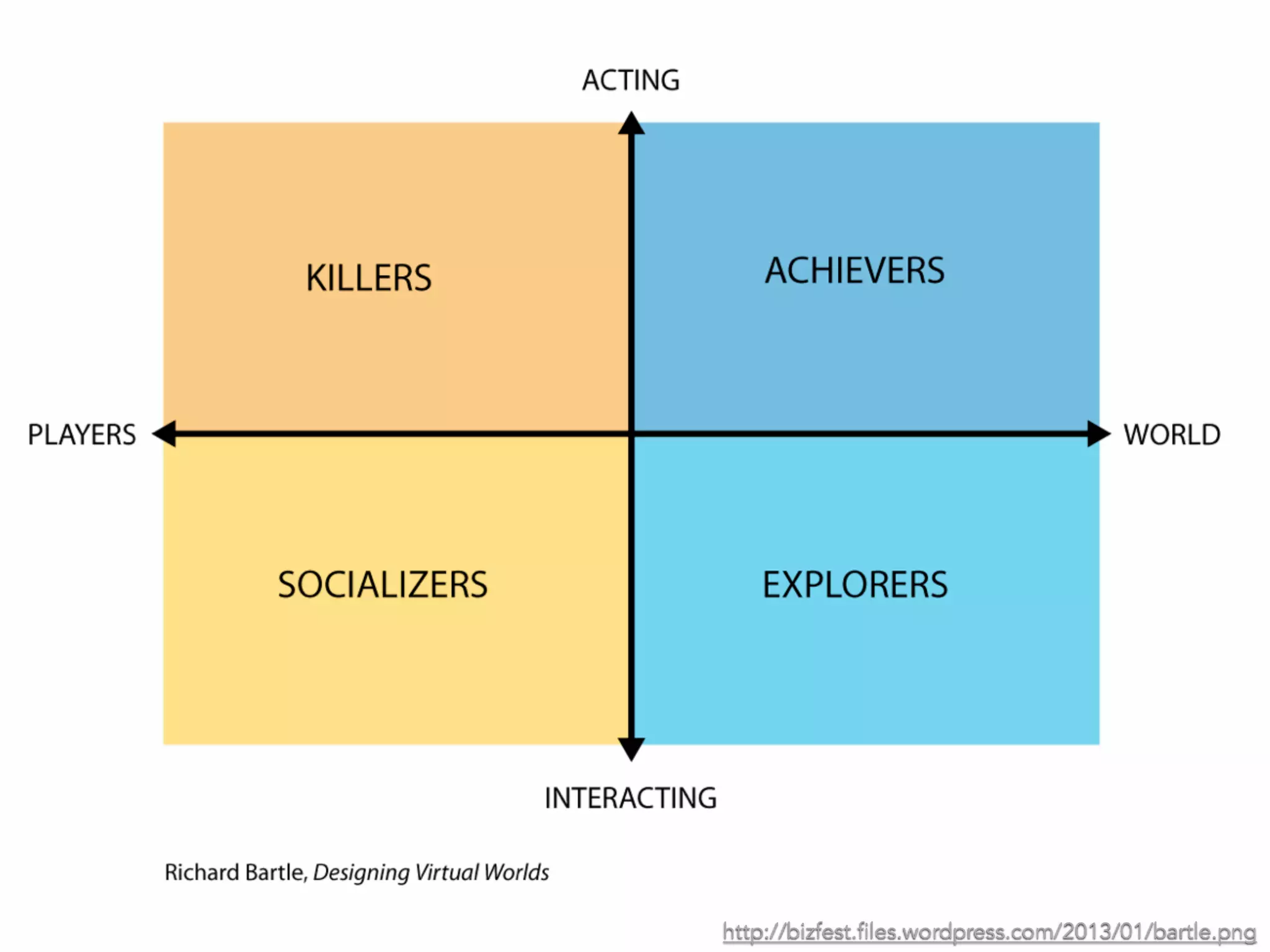
Analyzing the common elements of games, focusing on challenges and rewards.
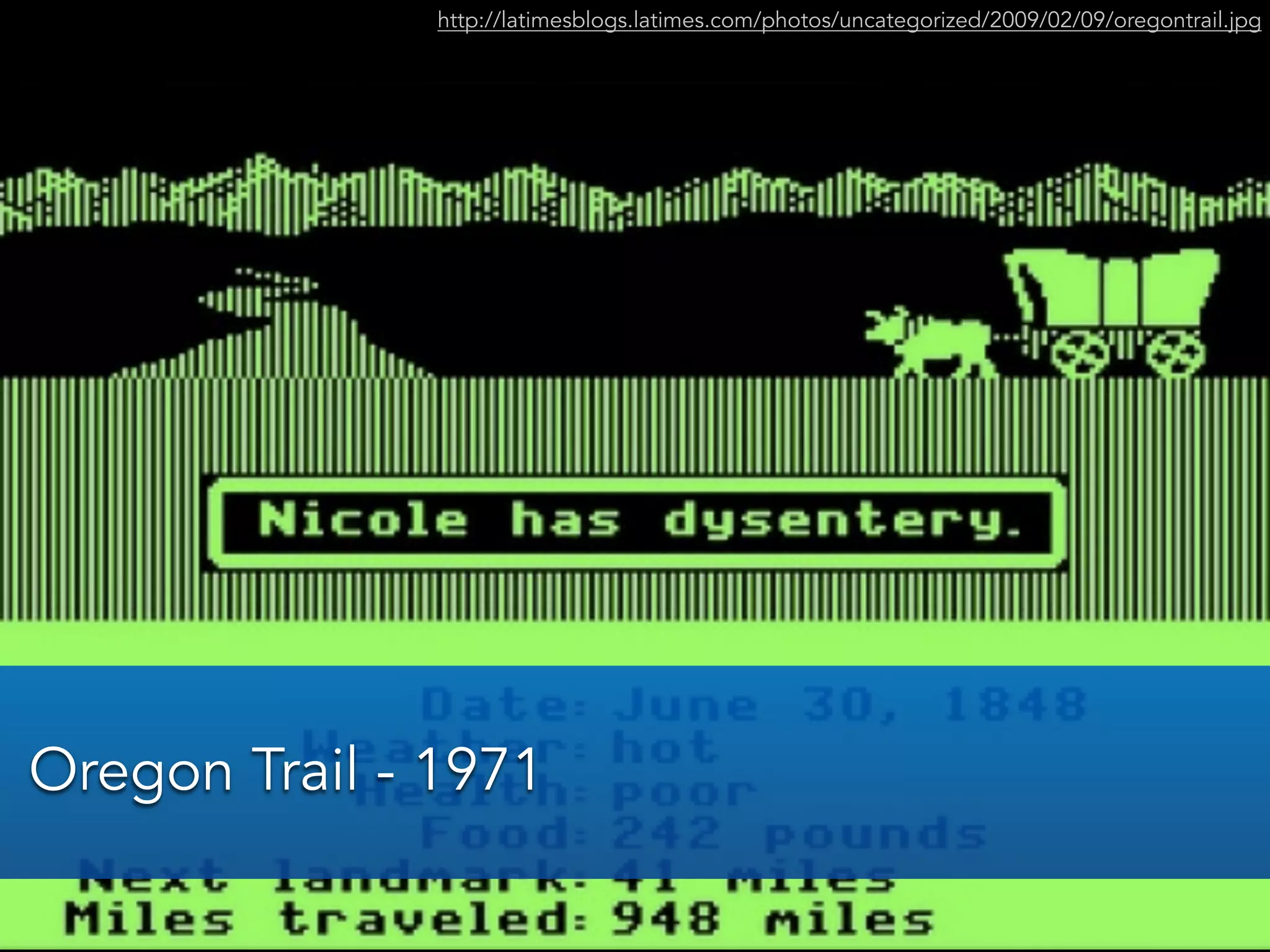
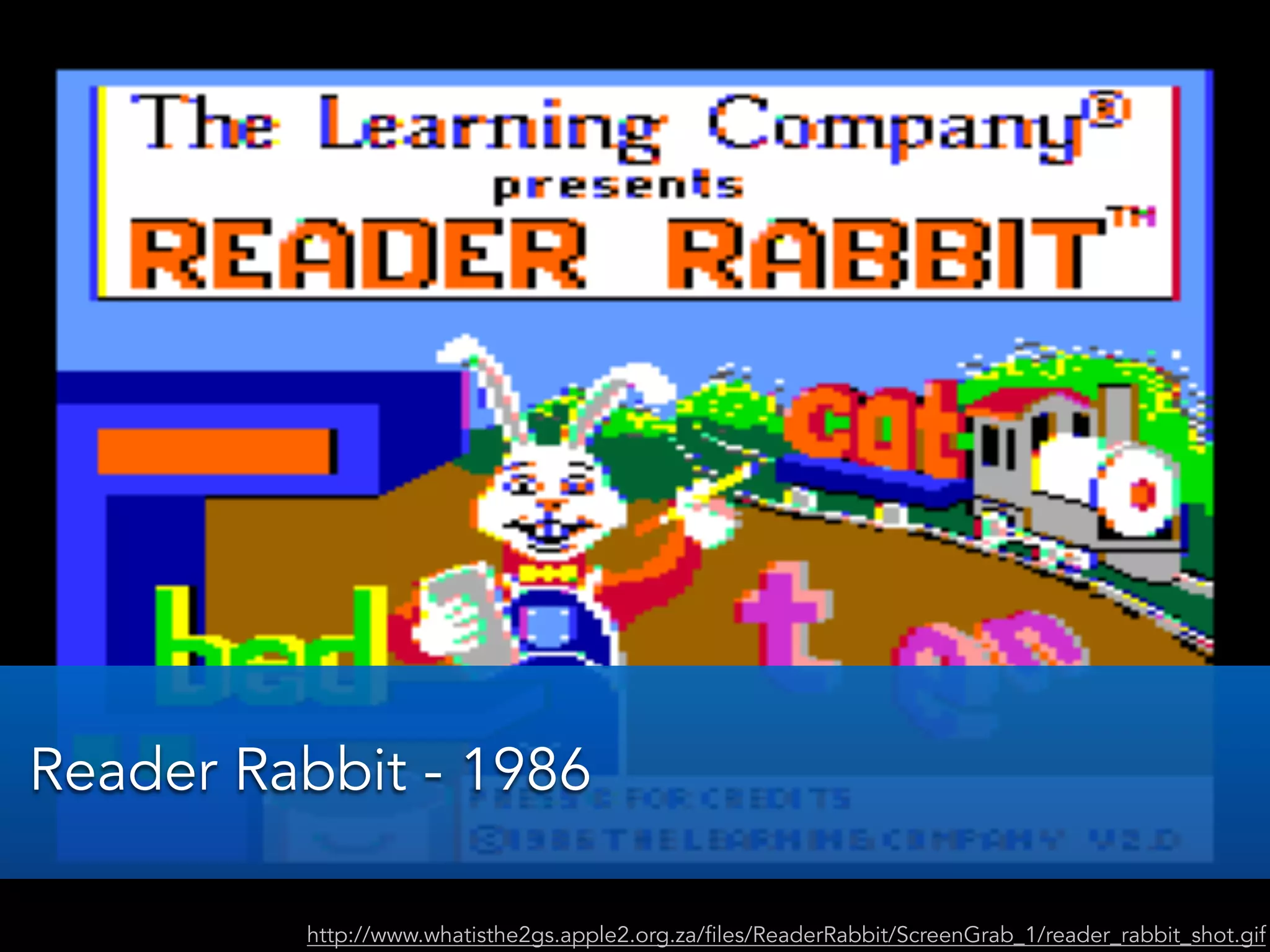
Tracing the origins of gamification and its historical antecedents in serious games.
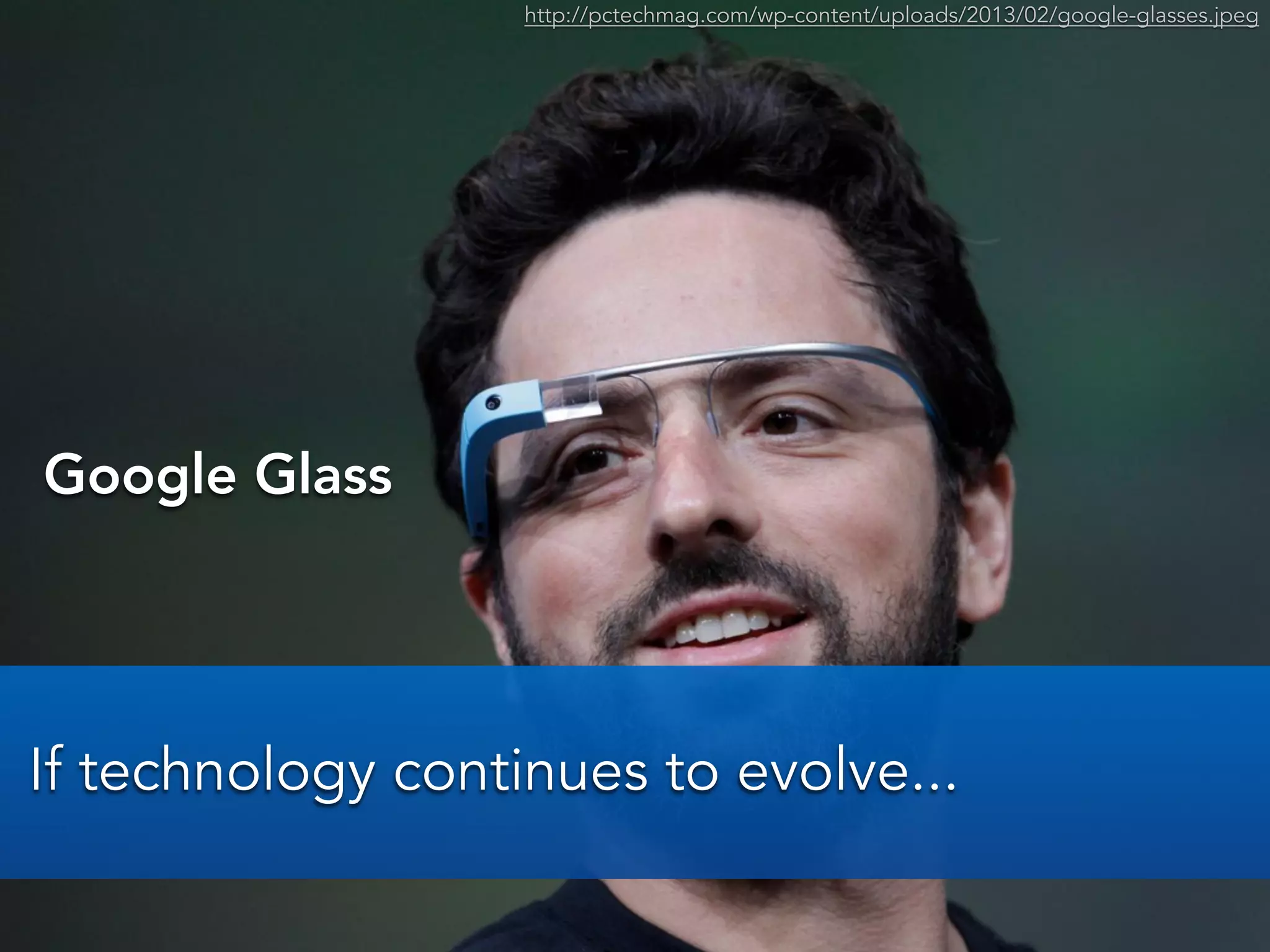
Reasons for the rise of gamification including technology changes and societal engagement.
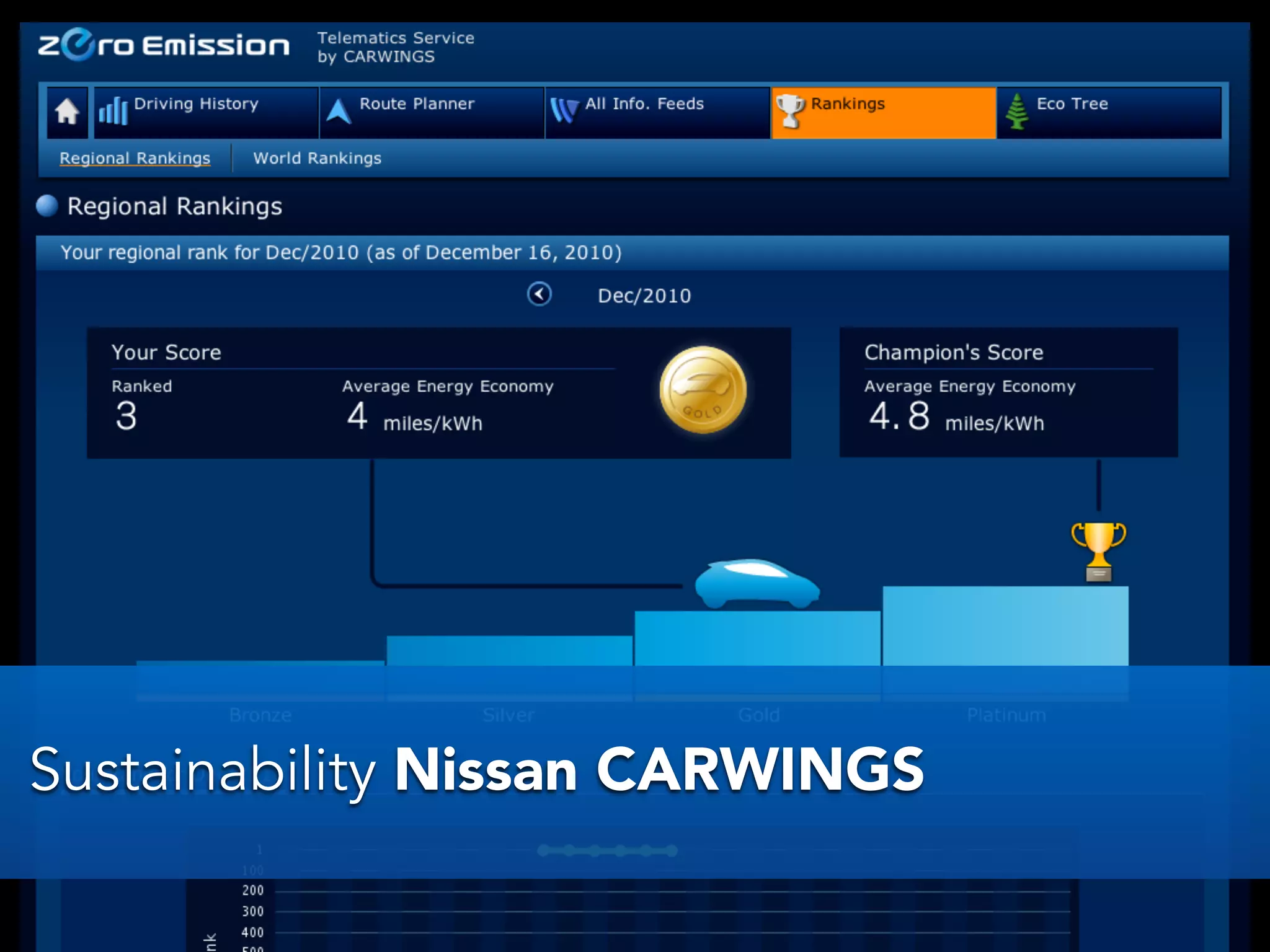
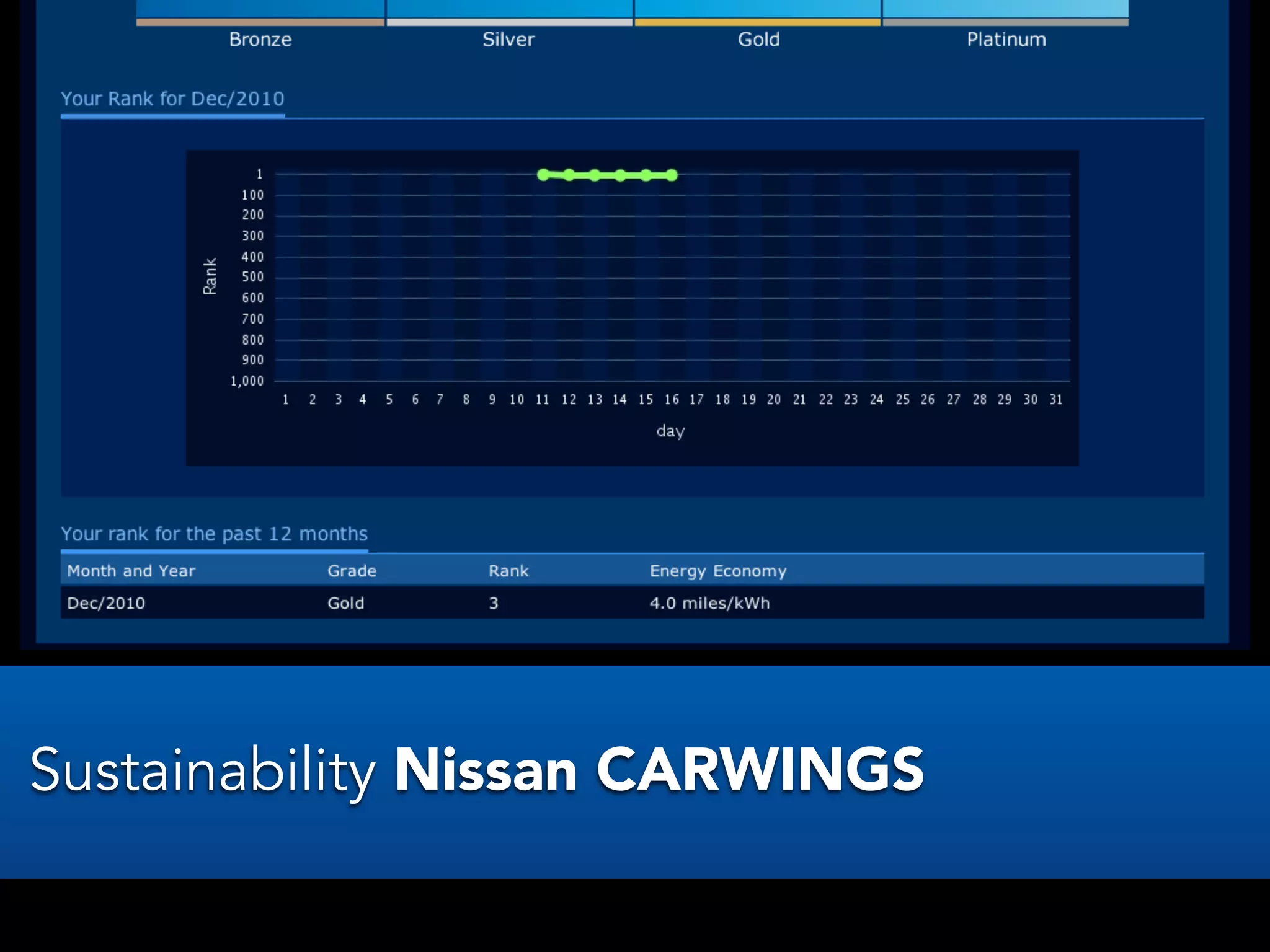
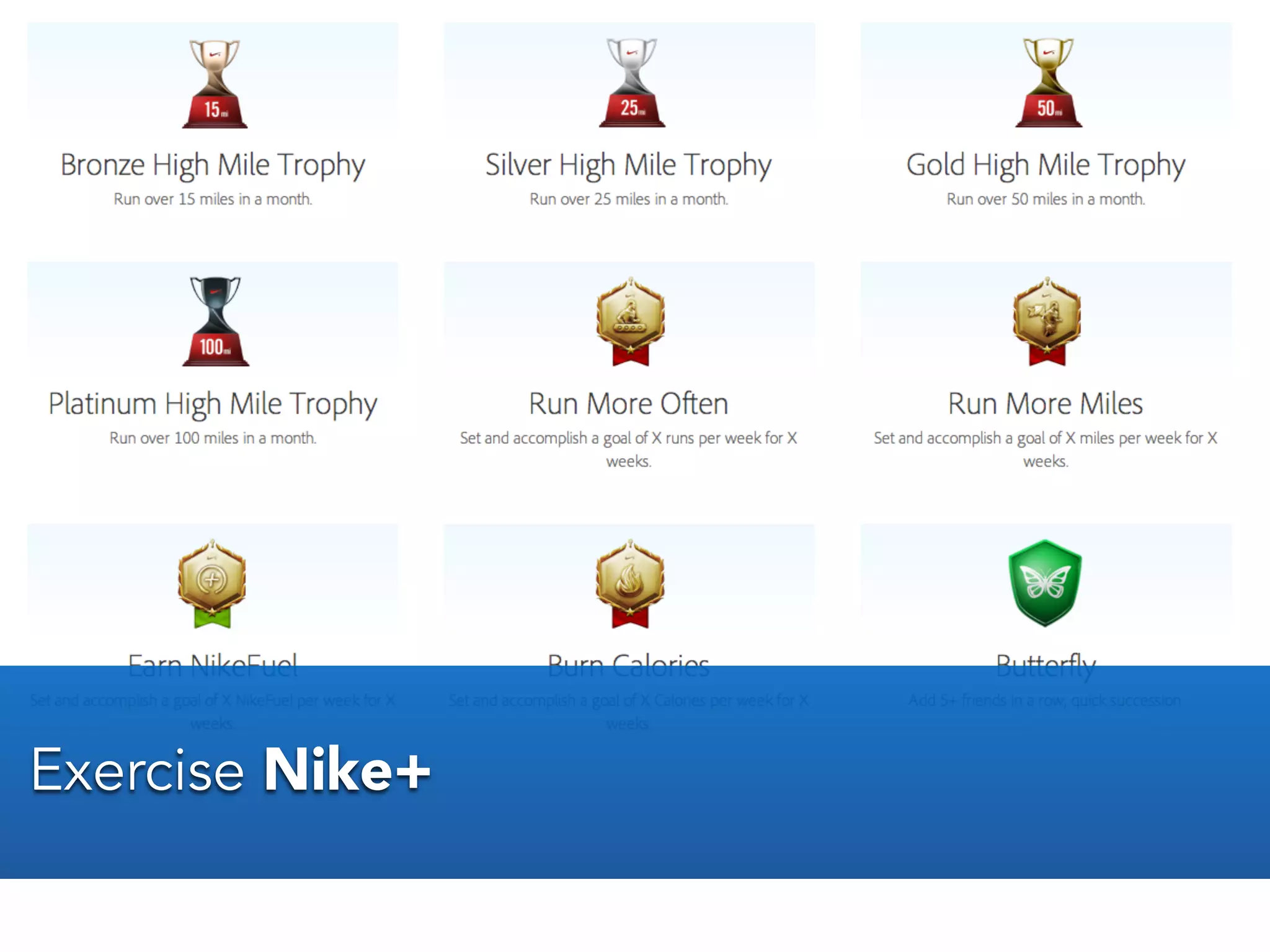
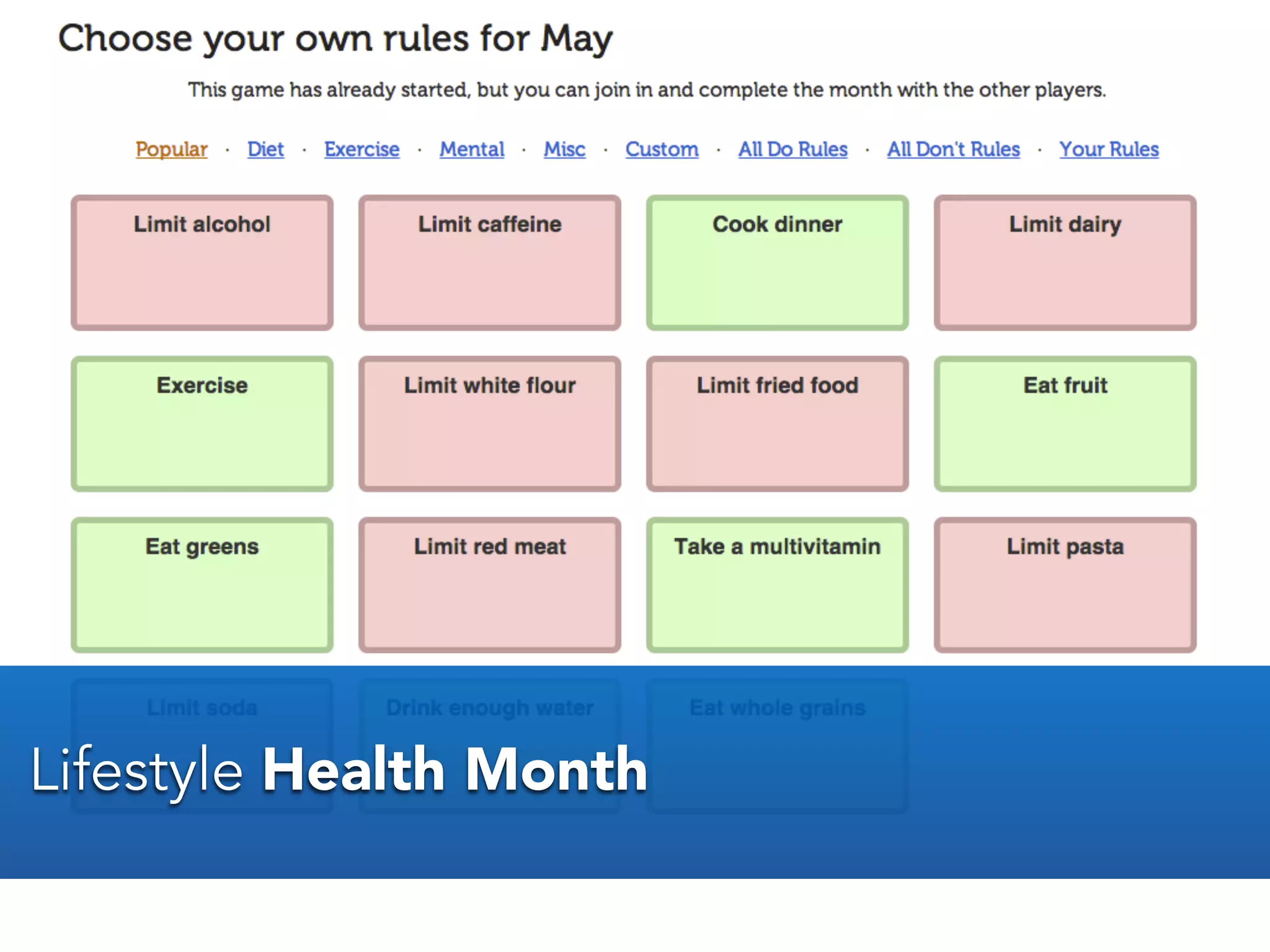
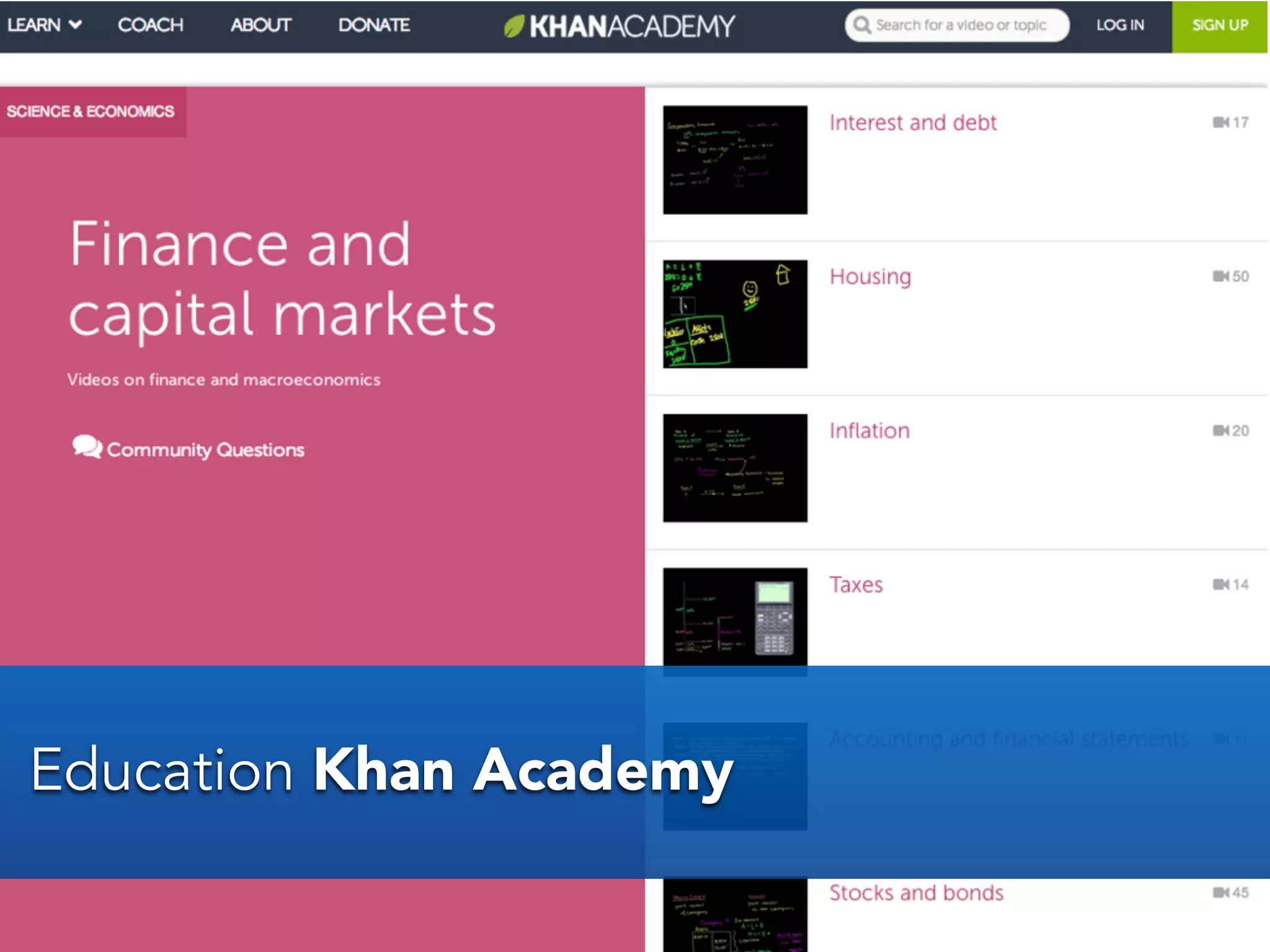
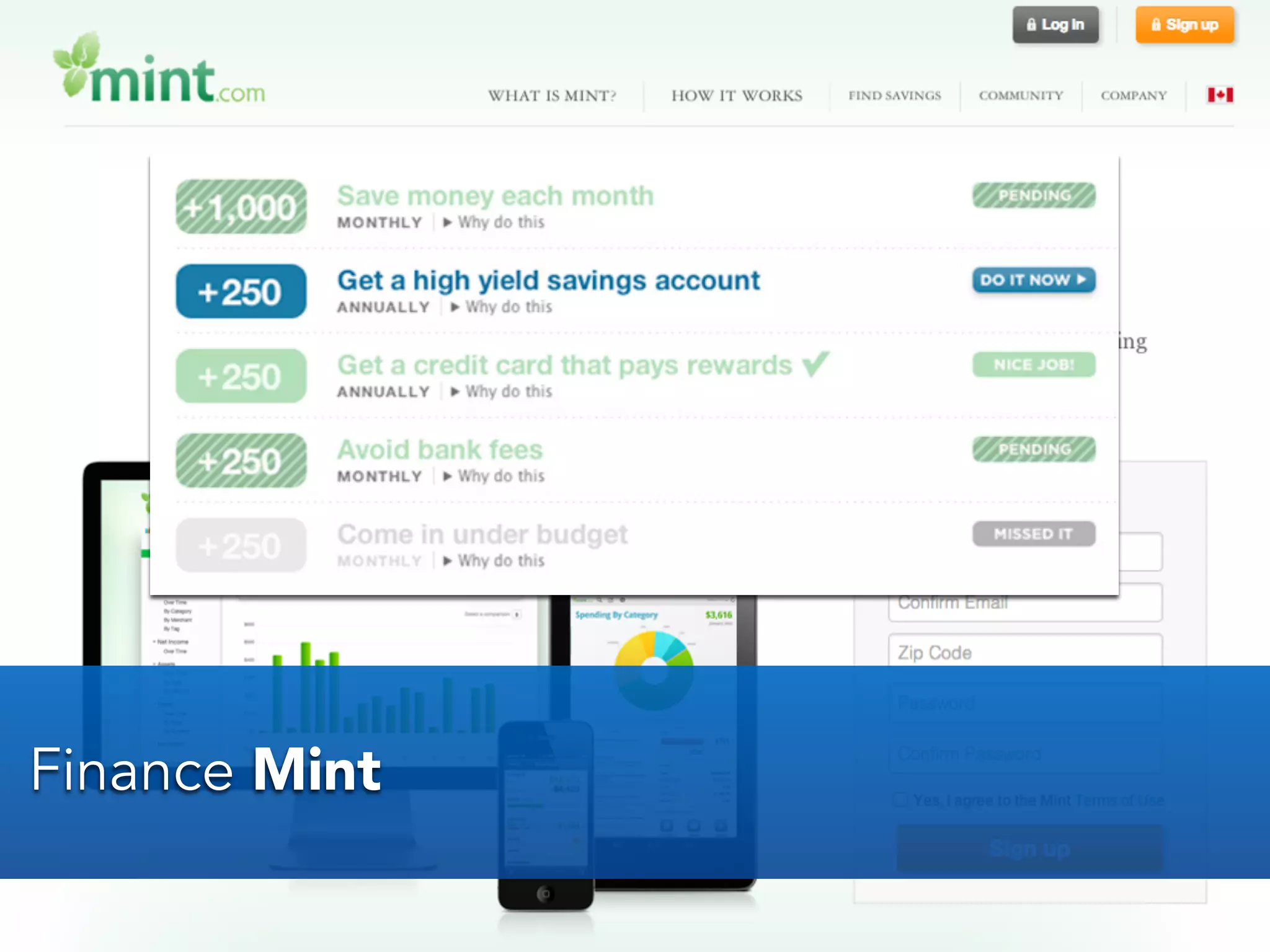
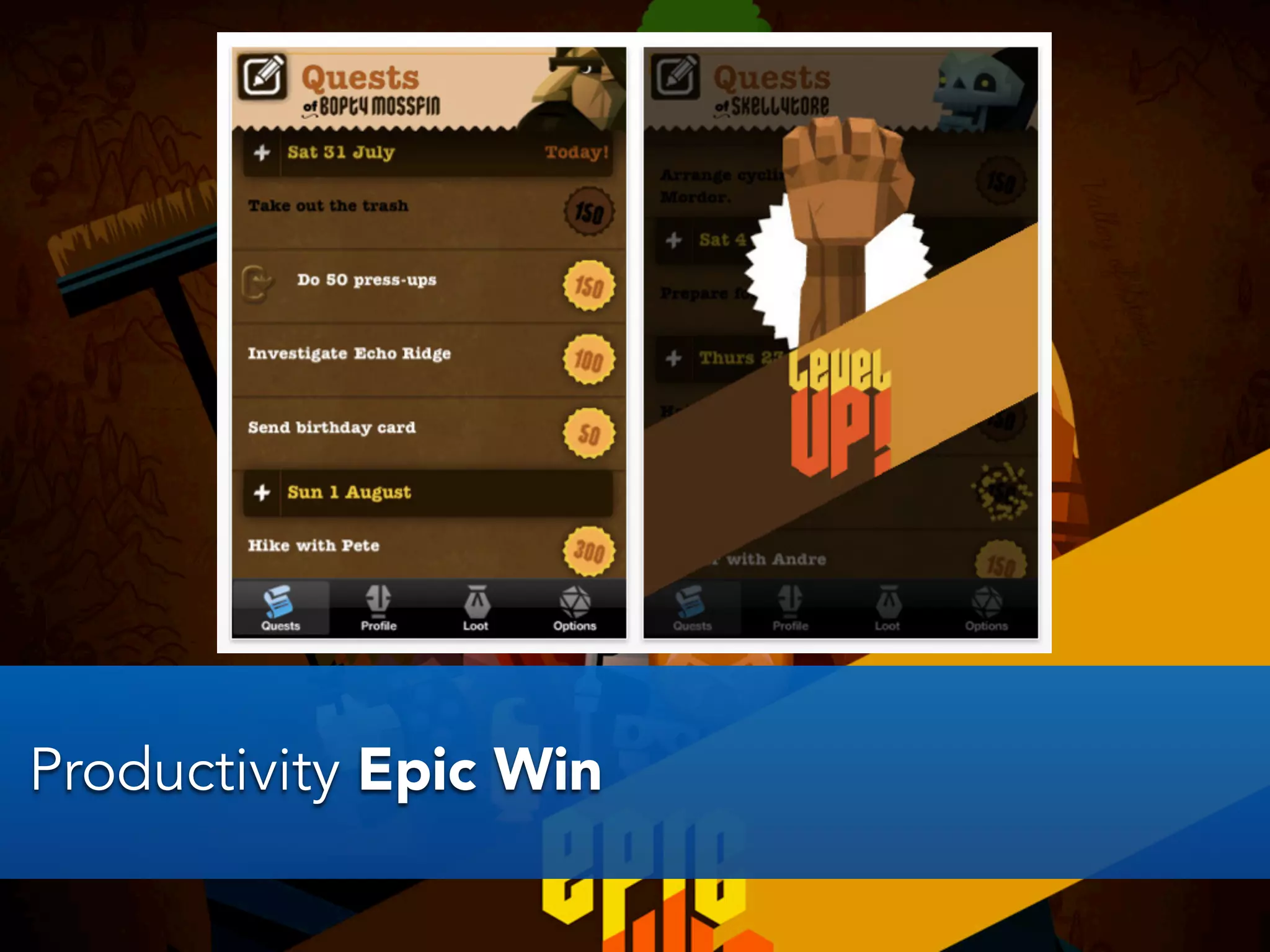
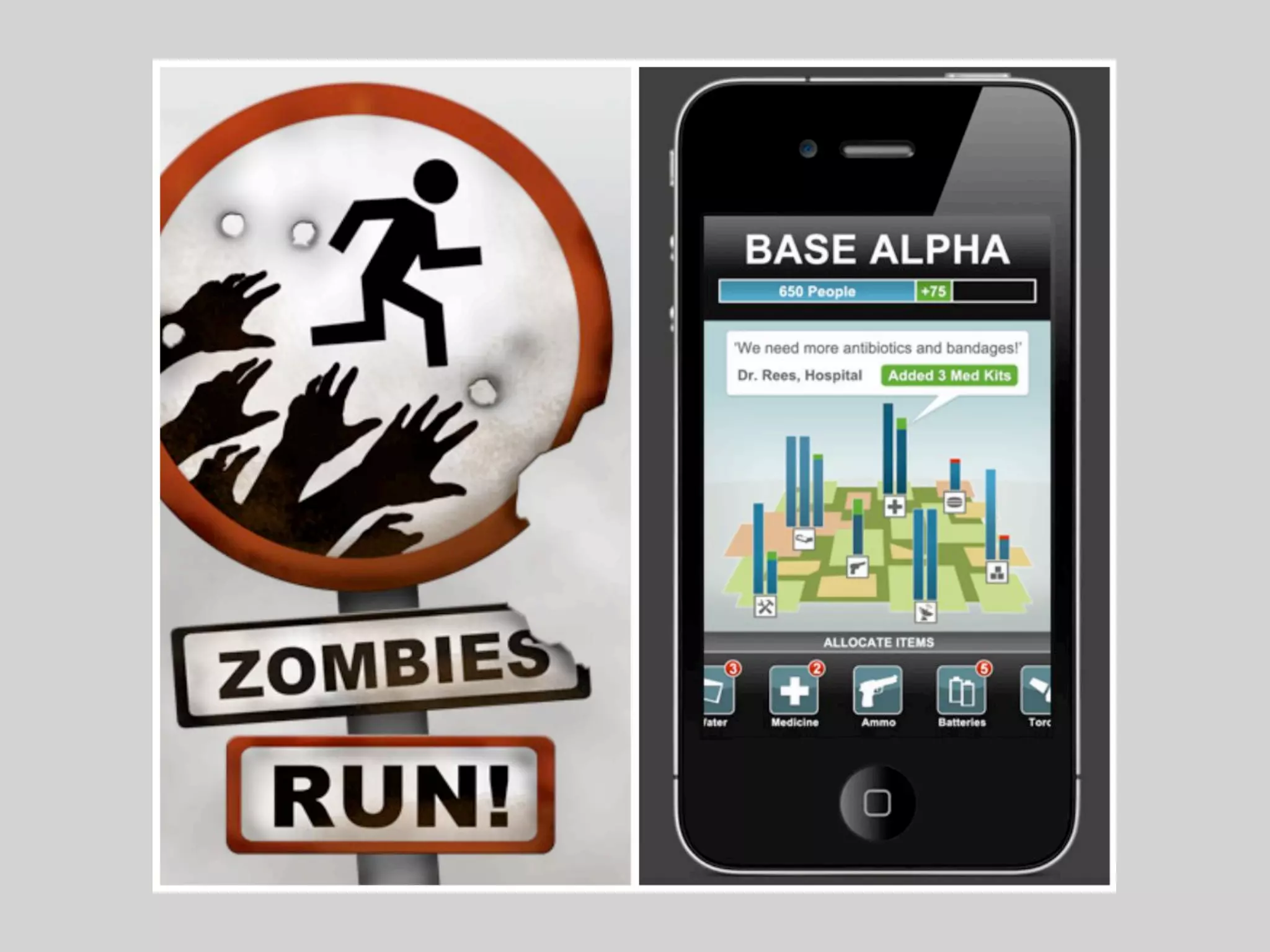
Examples of gamification in various fields such as sustainability, health, education, and finance.
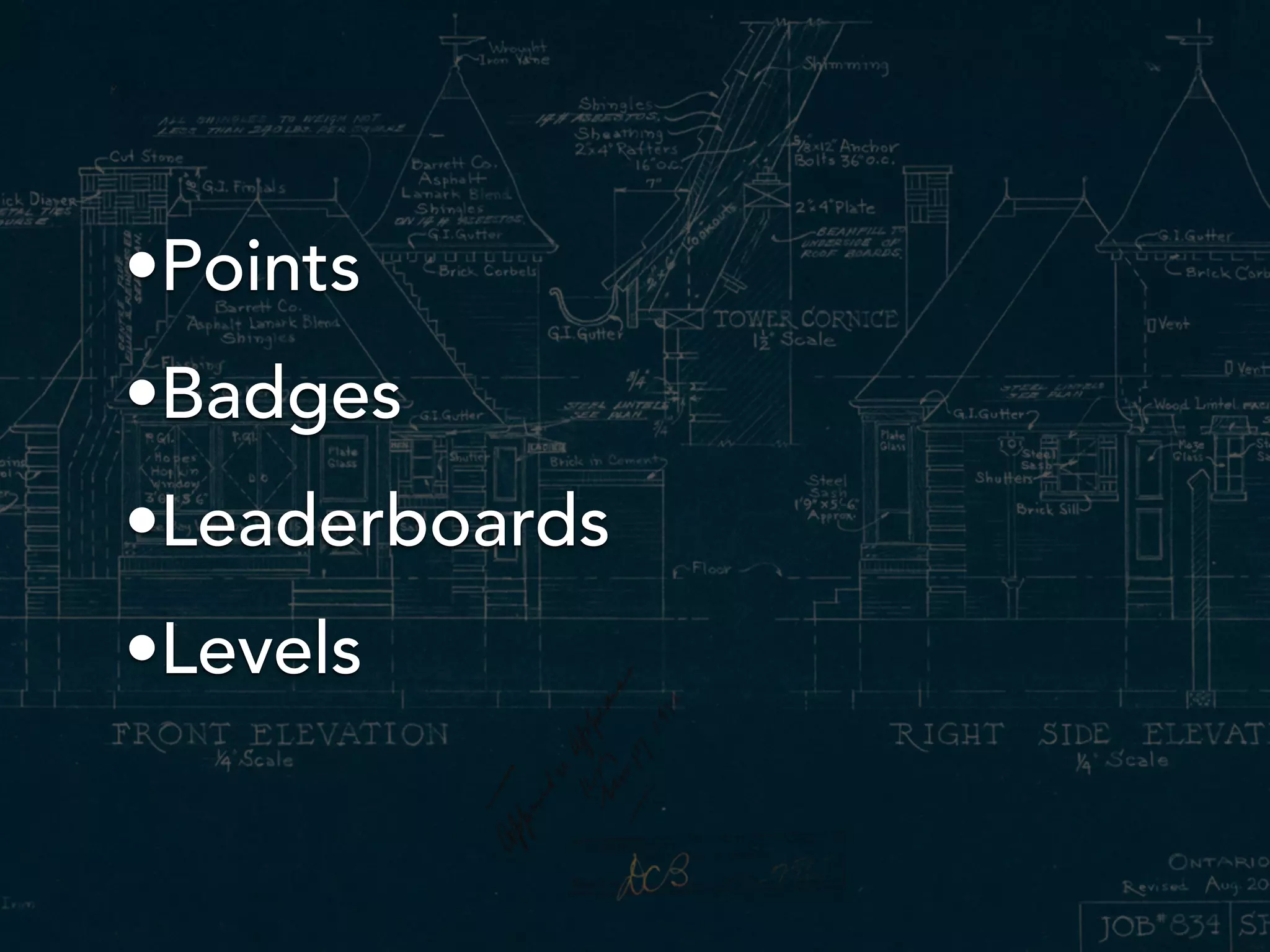
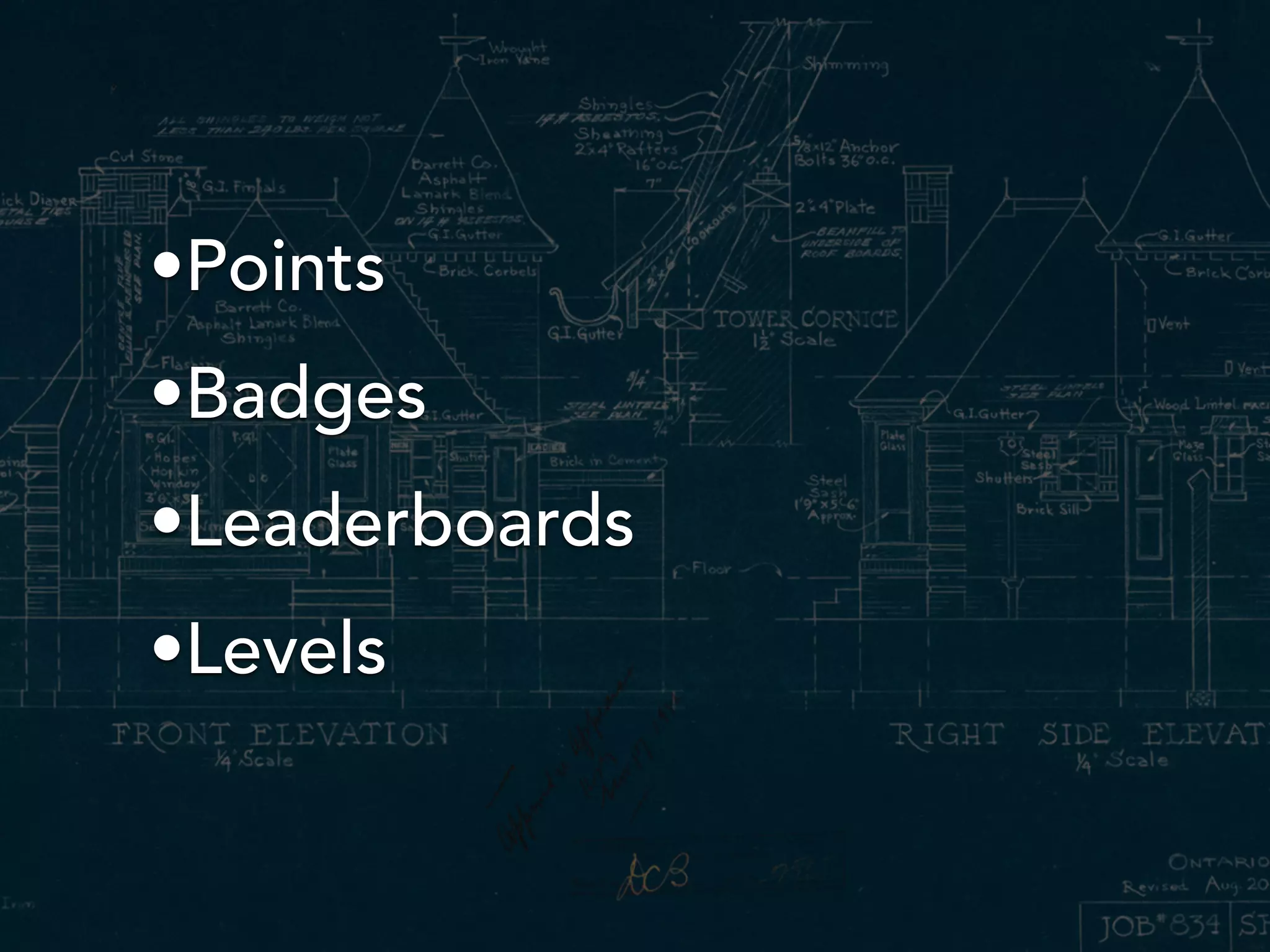
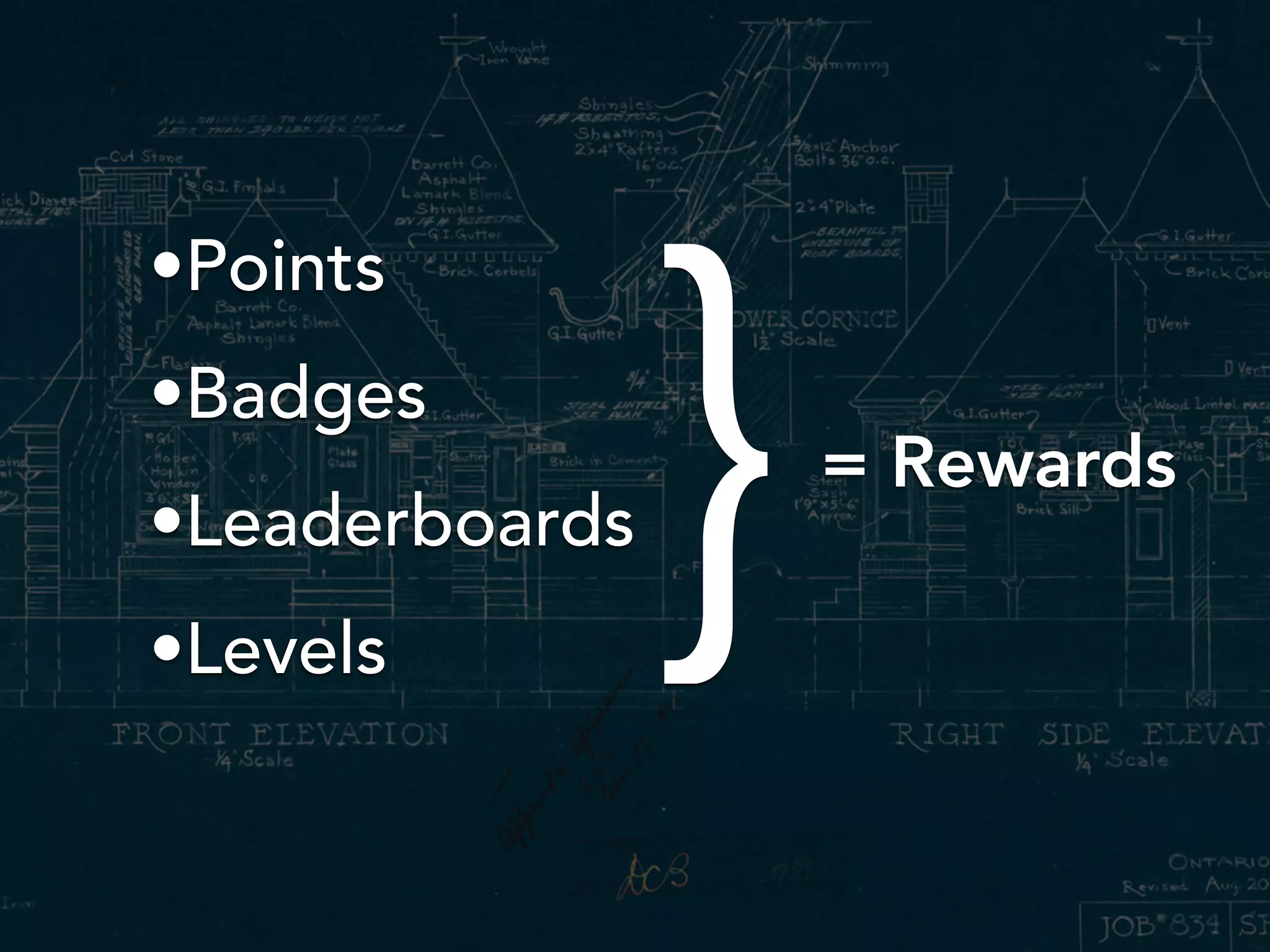
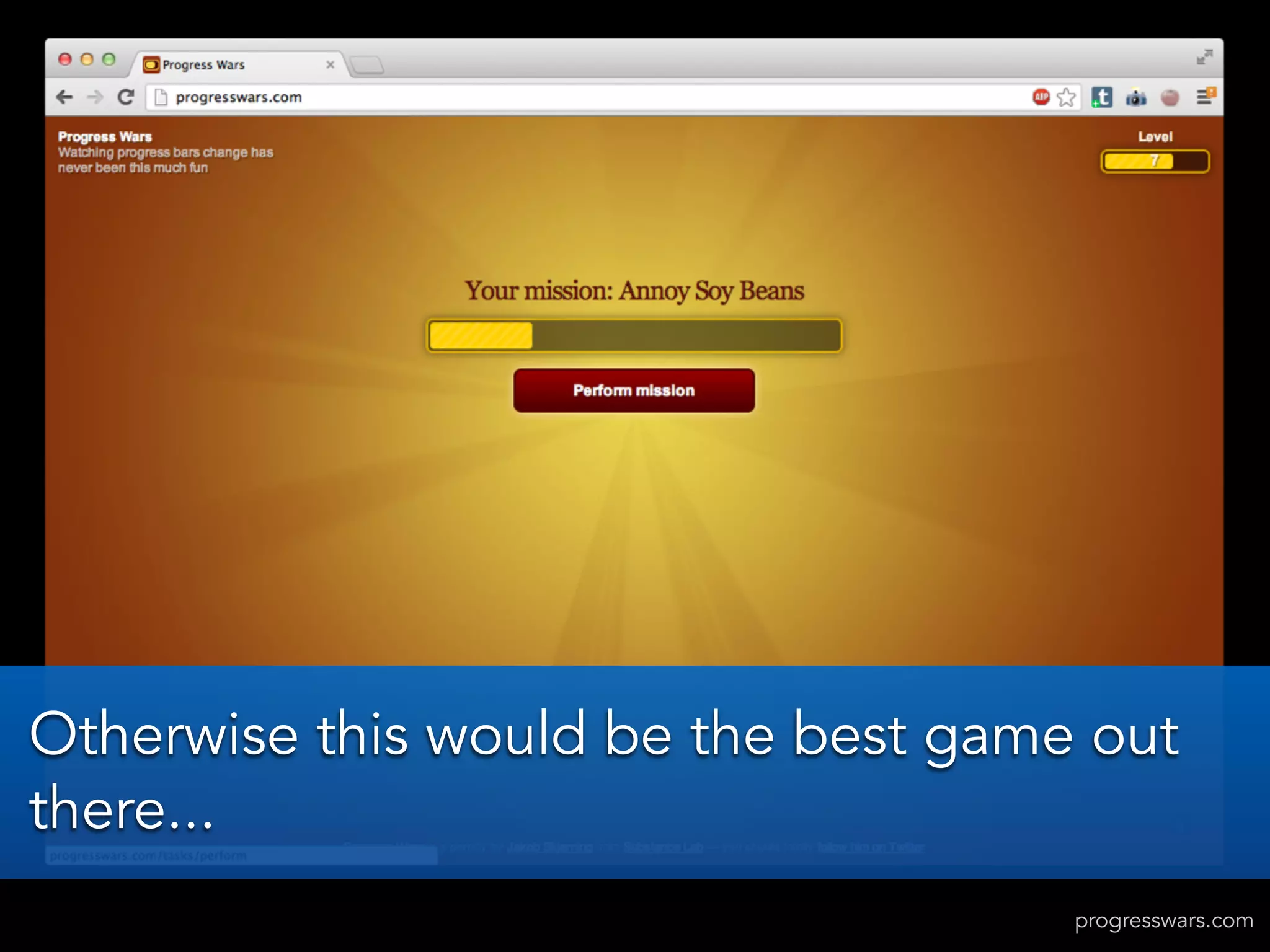
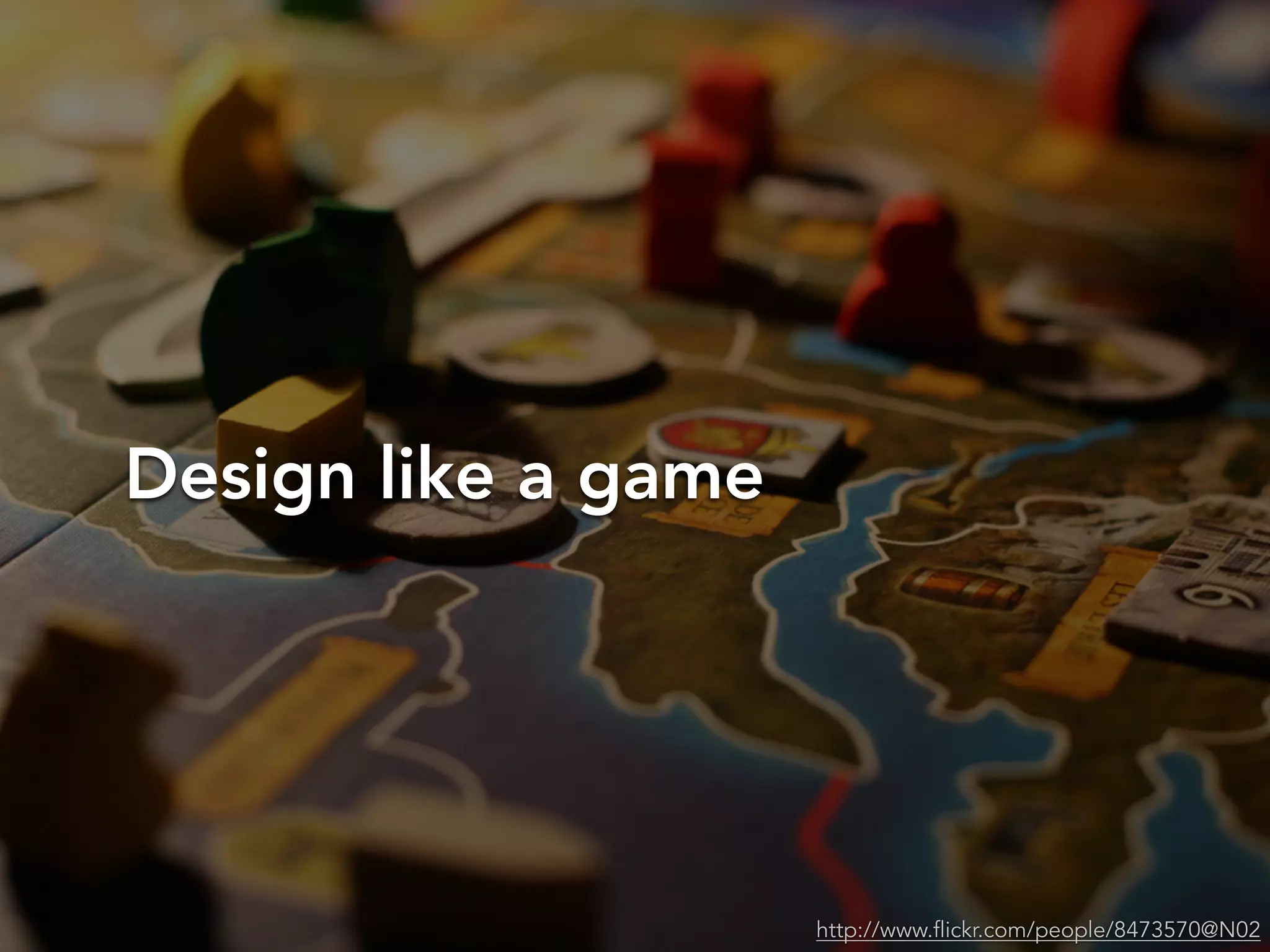
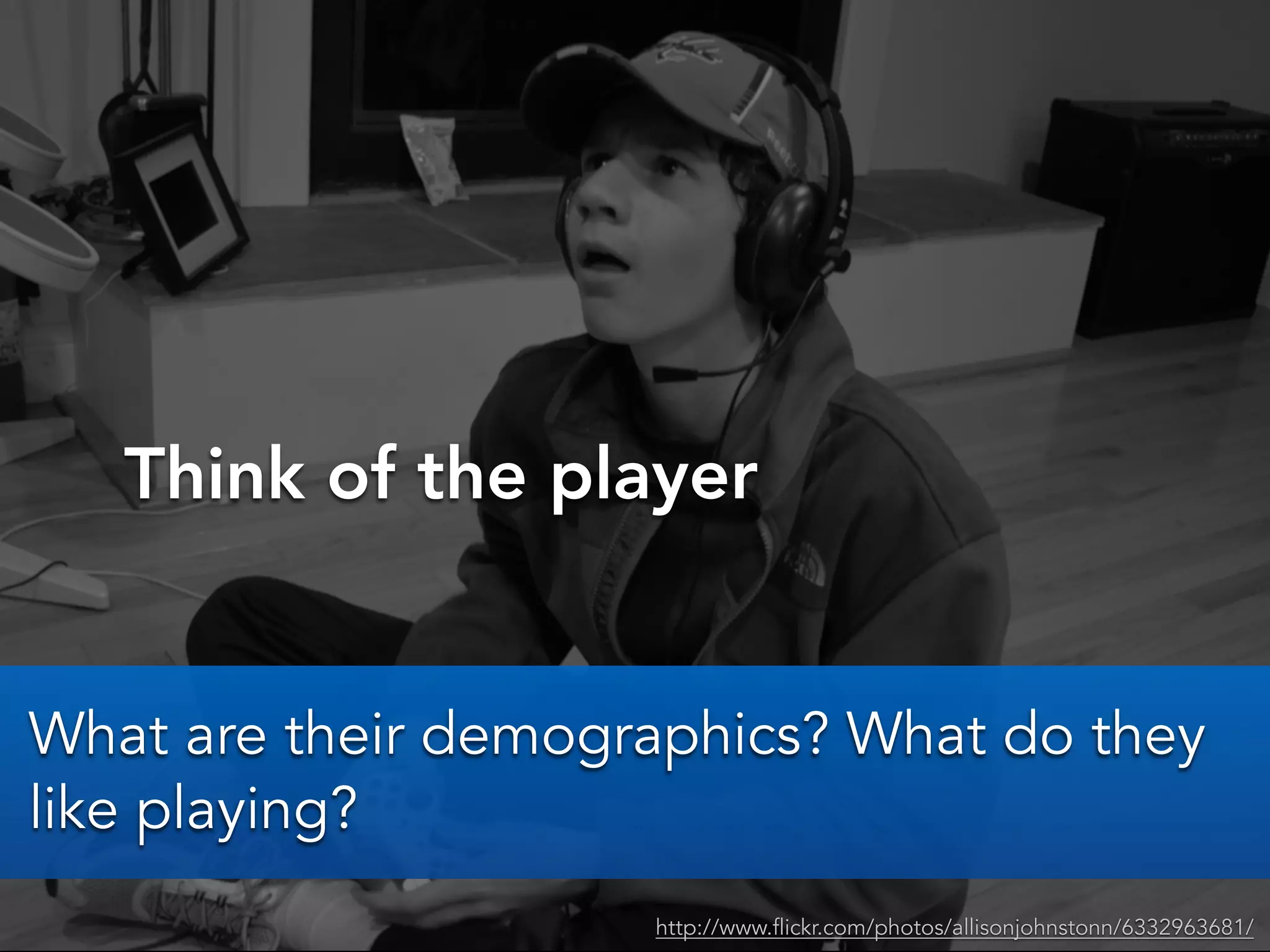
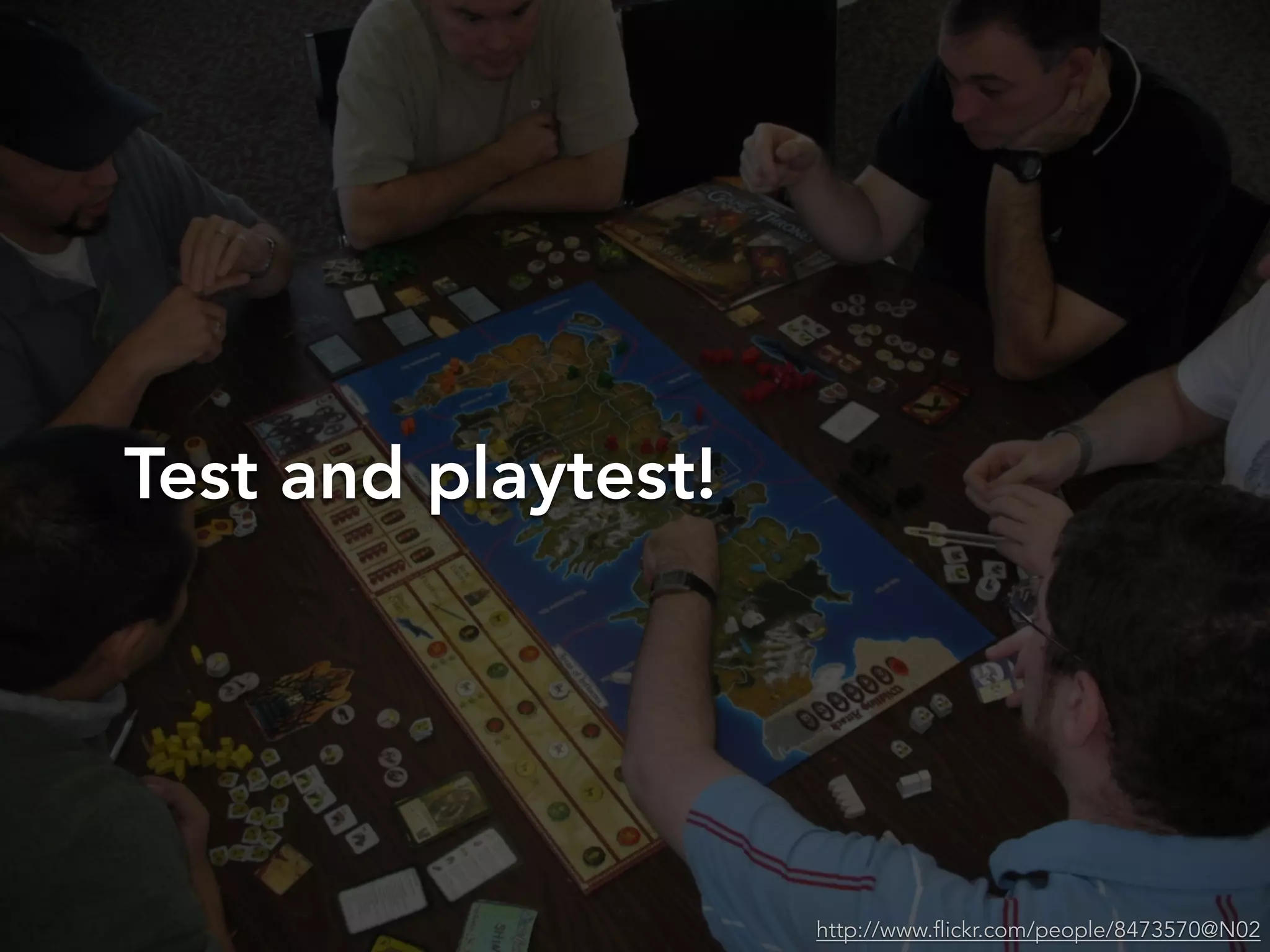
Blueprint for designing gamification including points, badges, rewards, and engaging experiences. Framework for starting gamification design, emphasizing user demographics and playtesting.
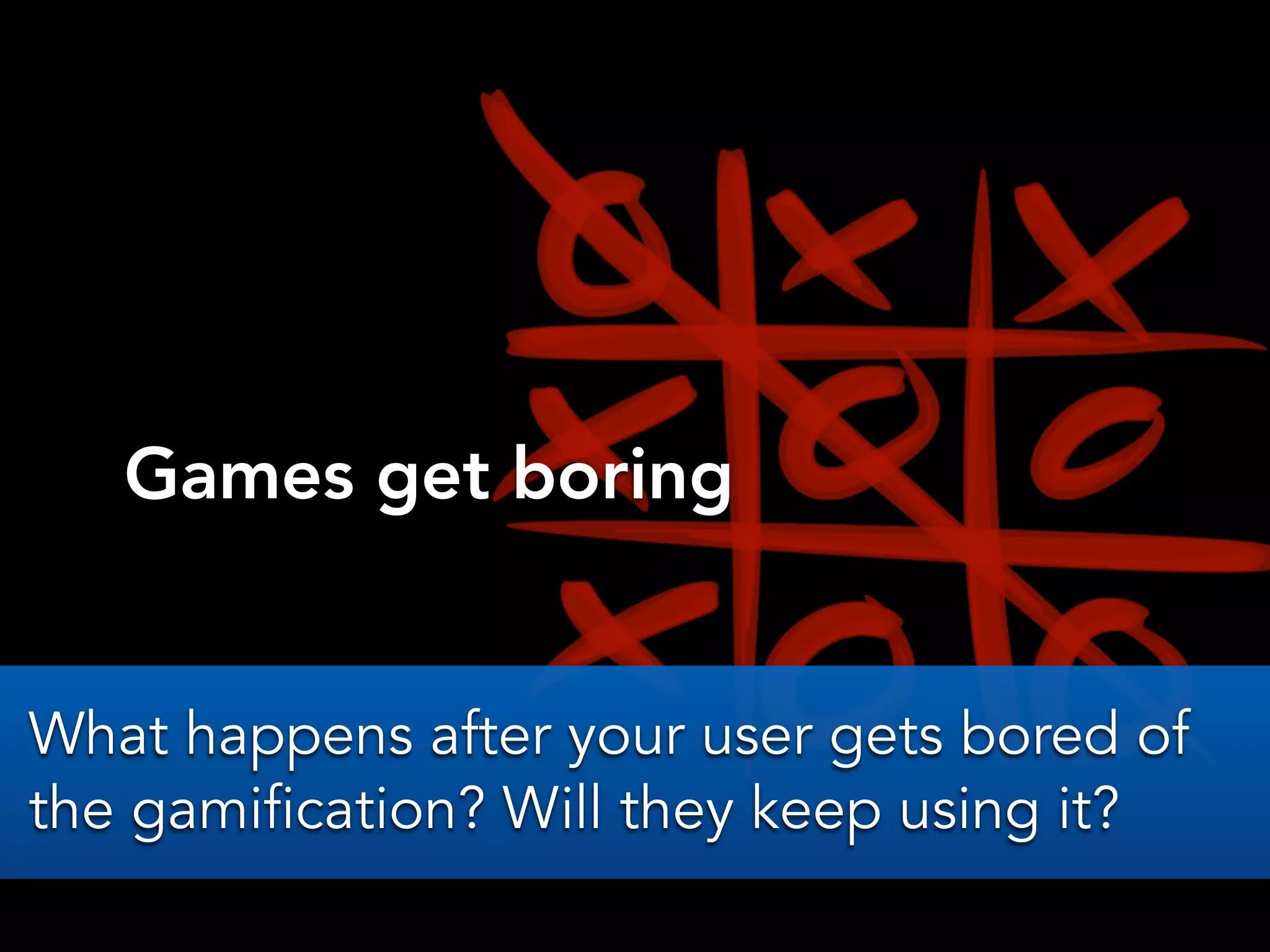
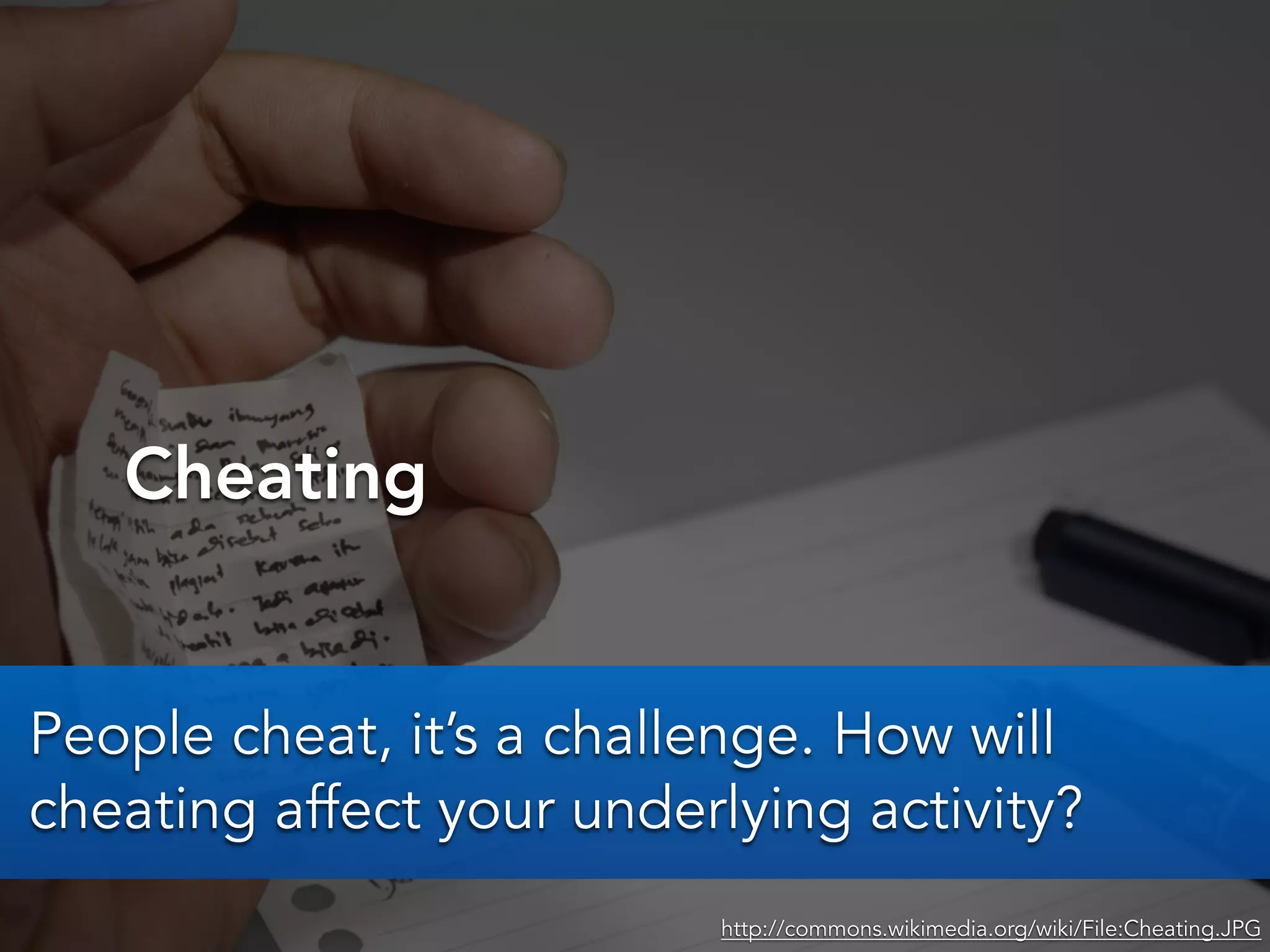
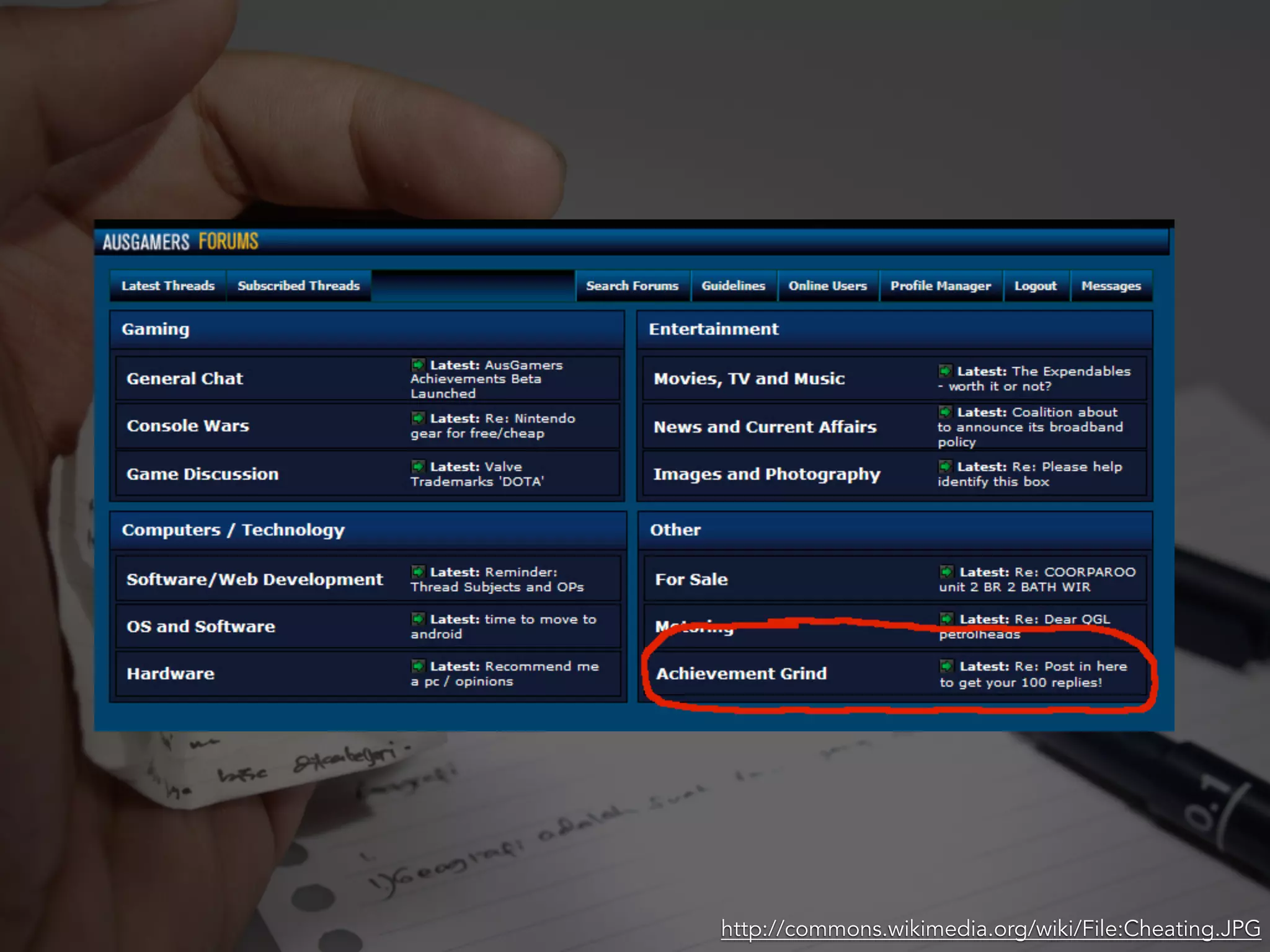
Risks and challenges in gamification including user disengagement, cheating, and real-life implications.
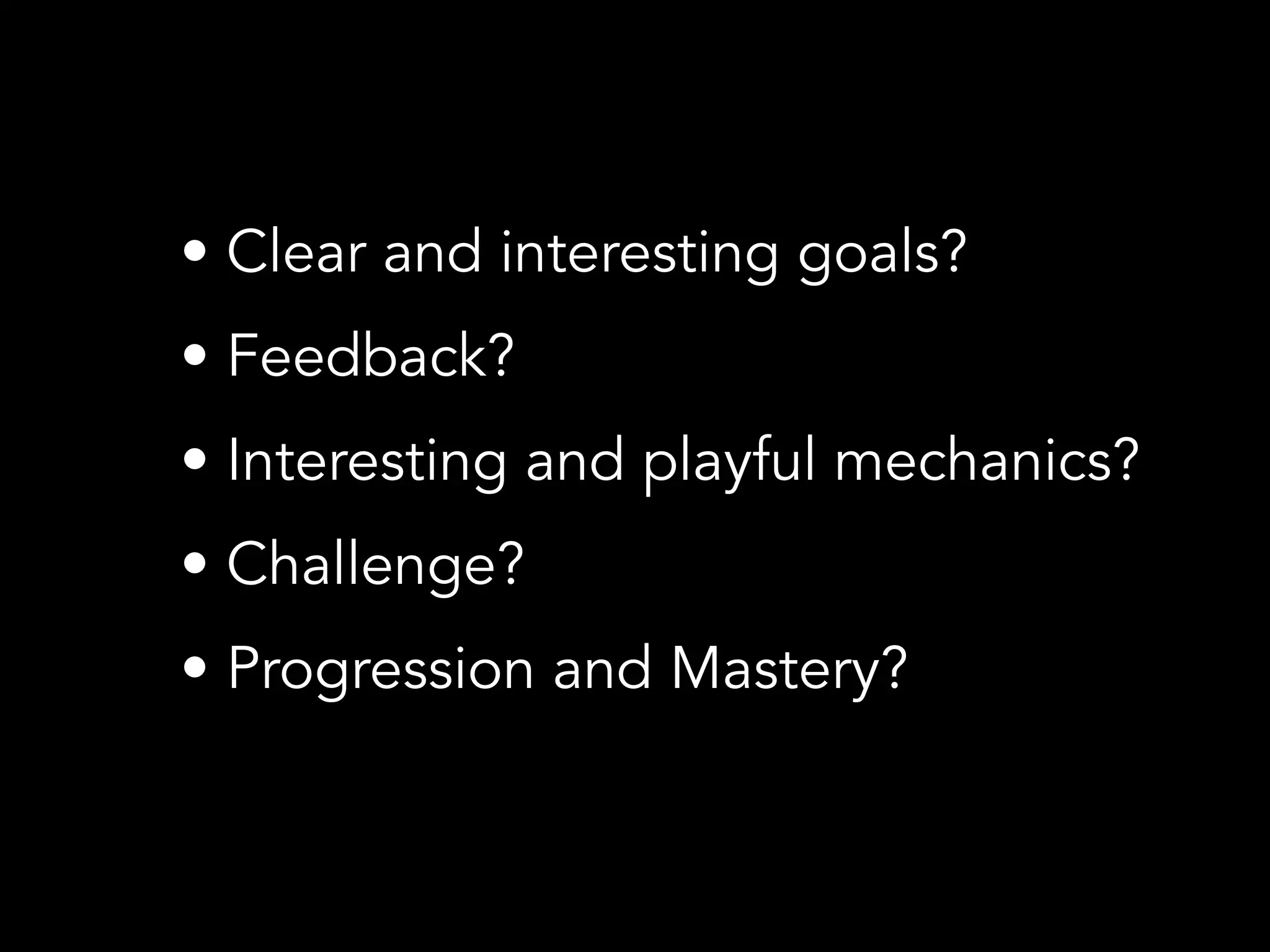
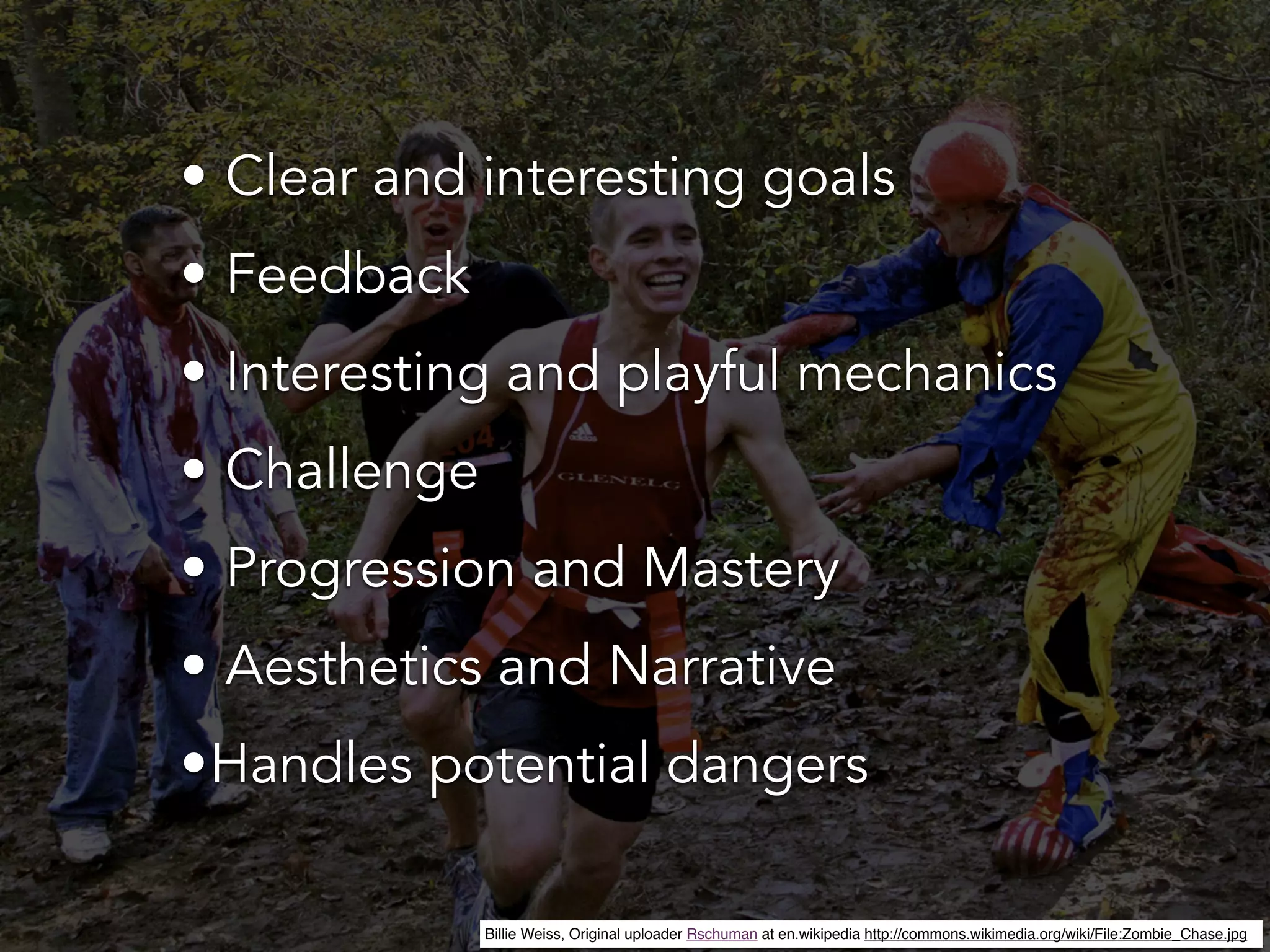
Summary of necessary features for good gamification design including goals, feedback, and challenges.
Final thoughts on gamification's potential and encouragement to implement gamification strategies.
Information on Zac Fitz-Walter, including contact details and background.
Gamification - defining,designing and using it
Zachary Fitz-Walter
Mobile Innovation Lab, QUT
http://www.flickr.com/people/8473570@N02
http://zefcan.com
“By 2015, Morethan 50 percent of organizations that
manage innovation processes will gamify those processes”
Gartner Press Release - 2011
http://www.gartner.com/it/page.jsp?id=1629214
Gartner released this statement in 2011
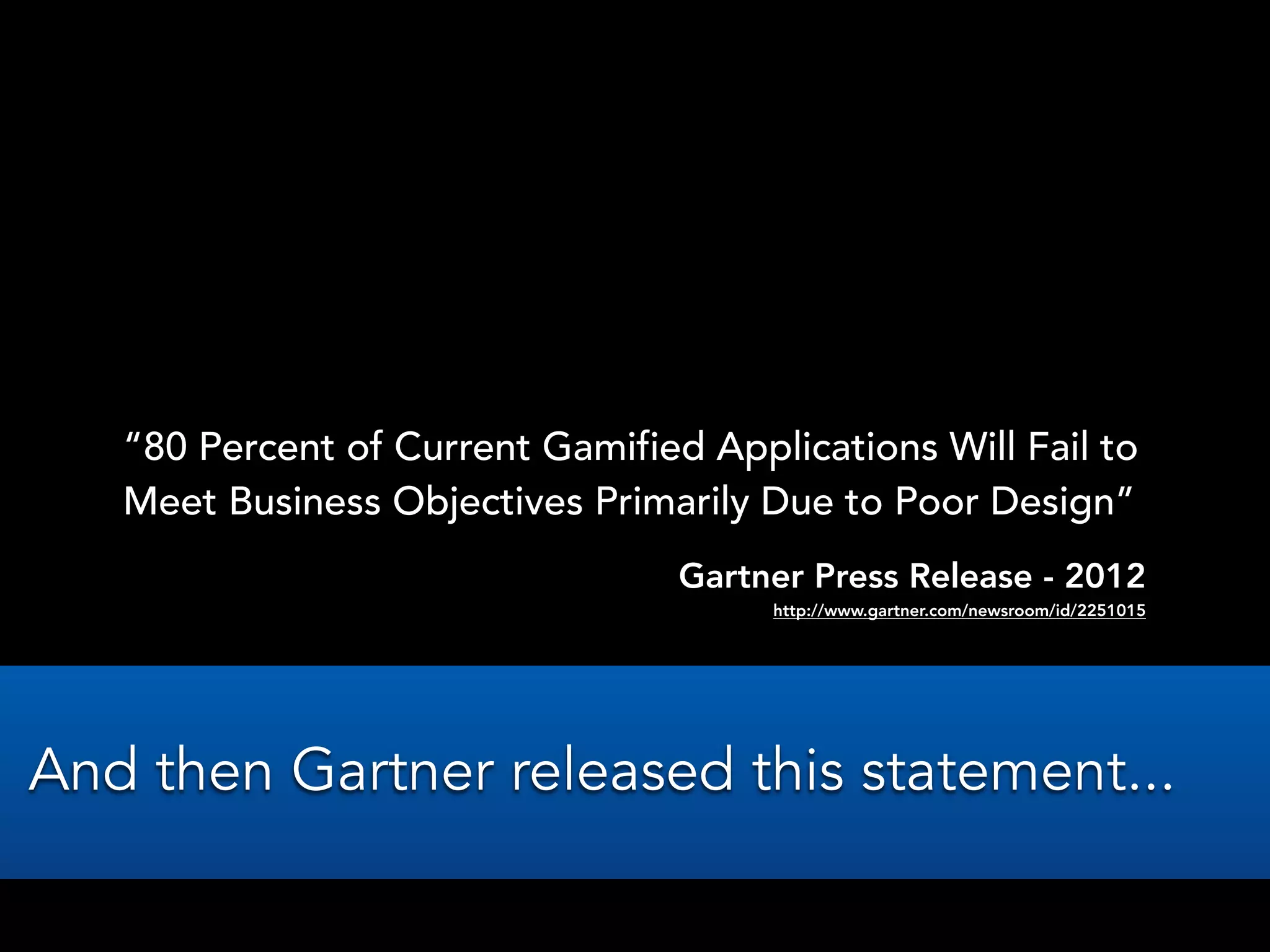
“80 Percent ofCurrent Gamified Applications Will Fail to
Meet Business Objectives Primarily Due to Poor Design”
Gartner Press Release - 2012
http://www.gartner.com/newsroom/id/2251015
And then Gartner released this statement...
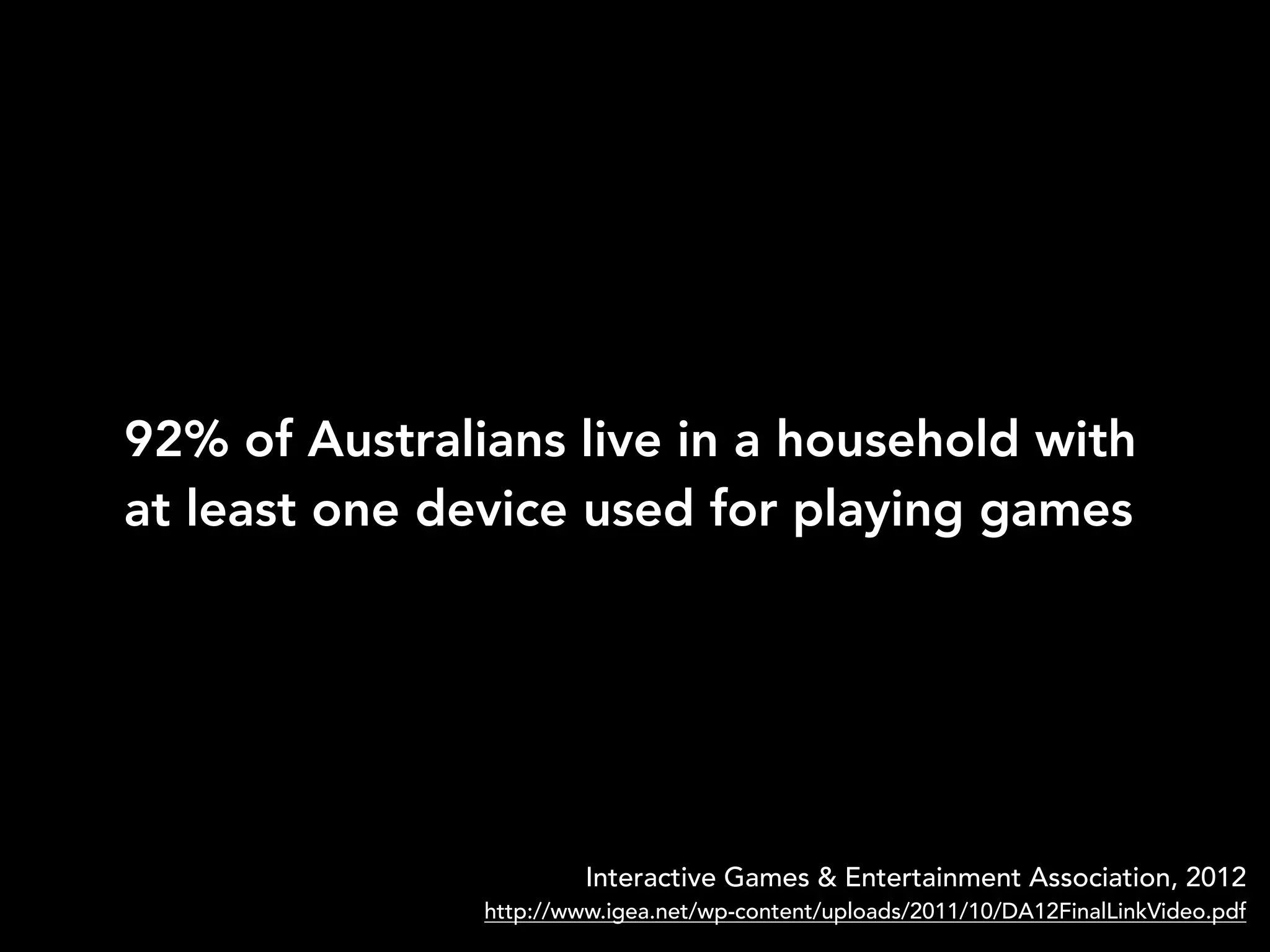
92% of Australianslive in a household with
at least one device used for playing games
Interactive Games & Entertainment Association, 2012
http://www.igea.net/wp-content/uploads/2011/10/DA12FinalLinkVideo.pdf
30.
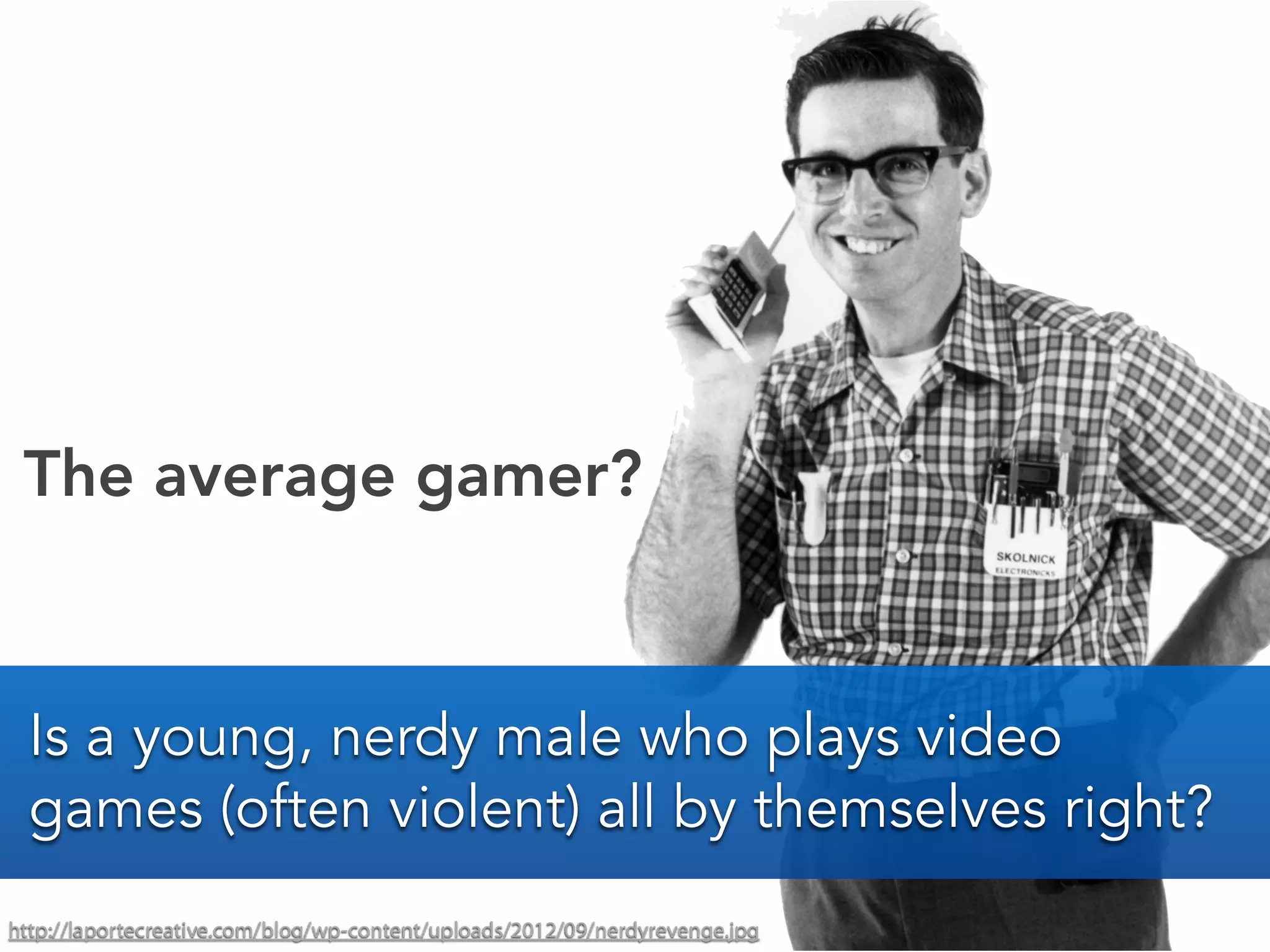
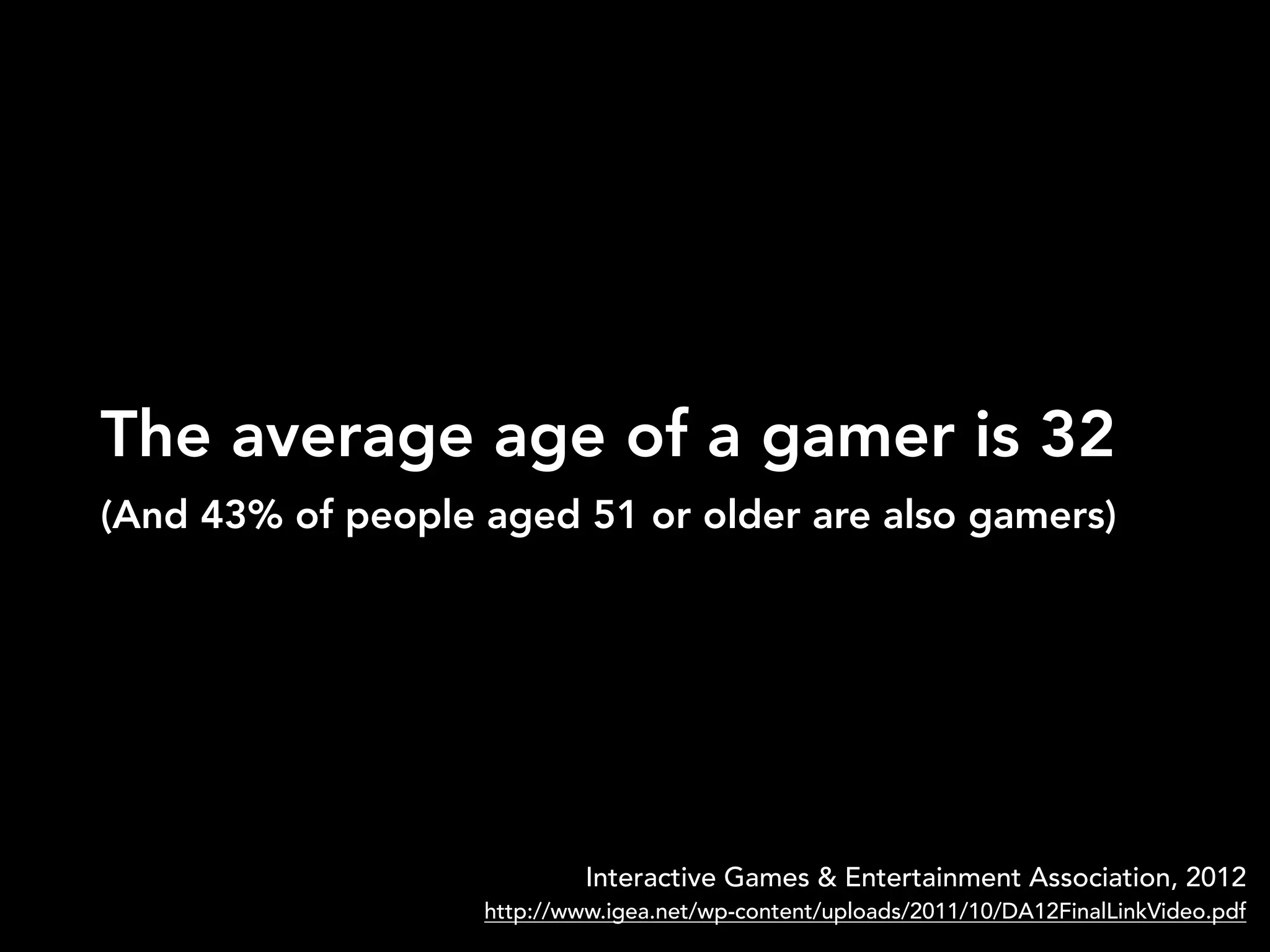
The average ageof a gamer is 32
Interactive Games & Entertainment Association, 2012
http://www.igea.net/wp-content/uploads/2011/10/DA12FinalLinkVideo.pdf
(And 43% of people aged 51 or older are also gamers)
The video gameindustry in Australia
netted $1.161 billion in revenue last year
Interactive Games & Entertainment Association, 2012
http://www.igea.net
34.
In the USconsumers spent $24.75 billion on
video games, hardware and accessories in 2011.
Entertainment Software Association, 2011 - http://www.theesa.com/facts/index.asp
The Numbers, 2011 - http://www.the-numbers.com/market/
Mobile phones areused to play games in 43%
of game households, tablet computers in 13%
Interactive Games & Entertainment Association, 2012
http://www.igea.net/wp-content/uploads/2011/10/DA12FinalLinkVideo.pdf
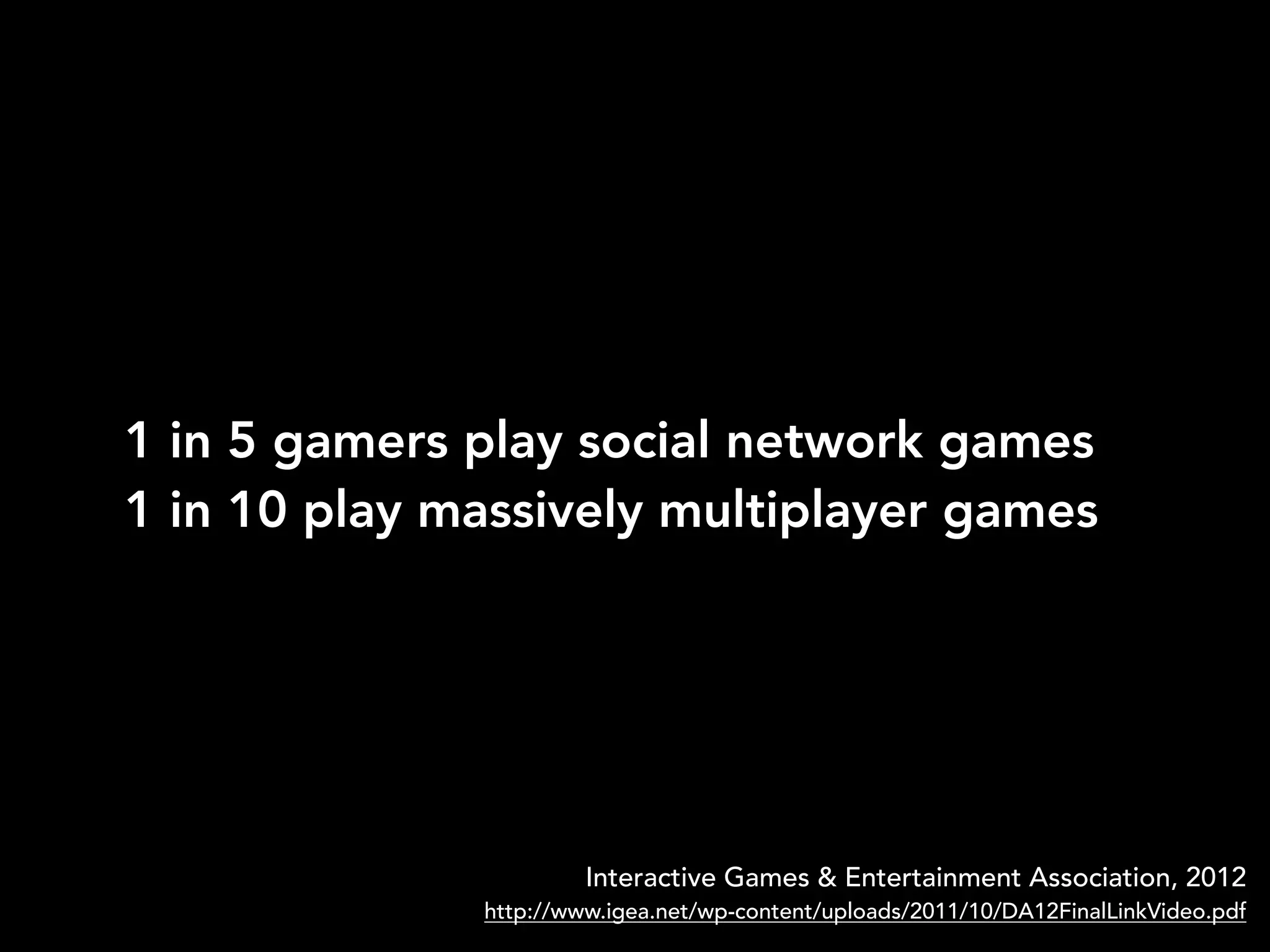
1 in 5gamers play social network games
1 in 10 play massively multiplayer games
Interactive Games & Entertainment Association, 2012
http://www.igea.net/wp-content/uploads/2011/10/DA12FinalLinkVideo.pdf
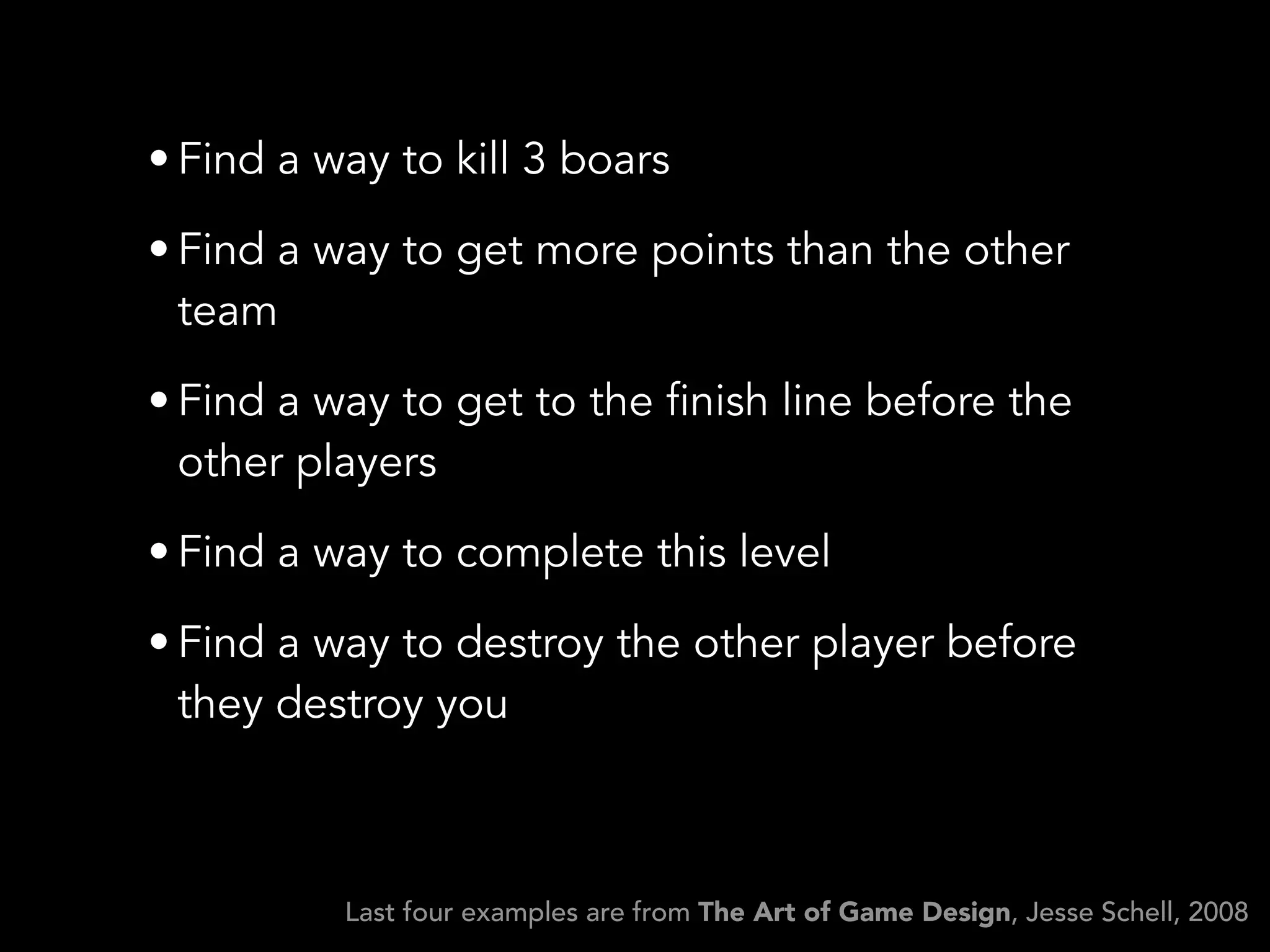
• Find away to kill 3 boars
• Find a way to get more points than the other
team
• Find a way to get to the finish line before the
other players
• Find a way to complete this level
• Find a way to destroy the other player before
they destroy you
Last four examples are from The Art of Game Design, Jesse Schell, 2008
53.
It’s how thisactivity is presented that plays an
important part in creating a fun experience
54.
"Fun from gamesarises out of mastery. It arises out of
comprehension. It is the act of solving puzzles that makes
games fun. In other words, with games, learning is the drug”
- Raph Koster
A Theory of Fun, 2005
"Fun from gamesarises out of mastery. It arises out of
comprehension. It is the act of solving puzzles that makes
games fun. In other words, with games, learning is the drug”
- Raph Koster
A Theory of Fun, 2005
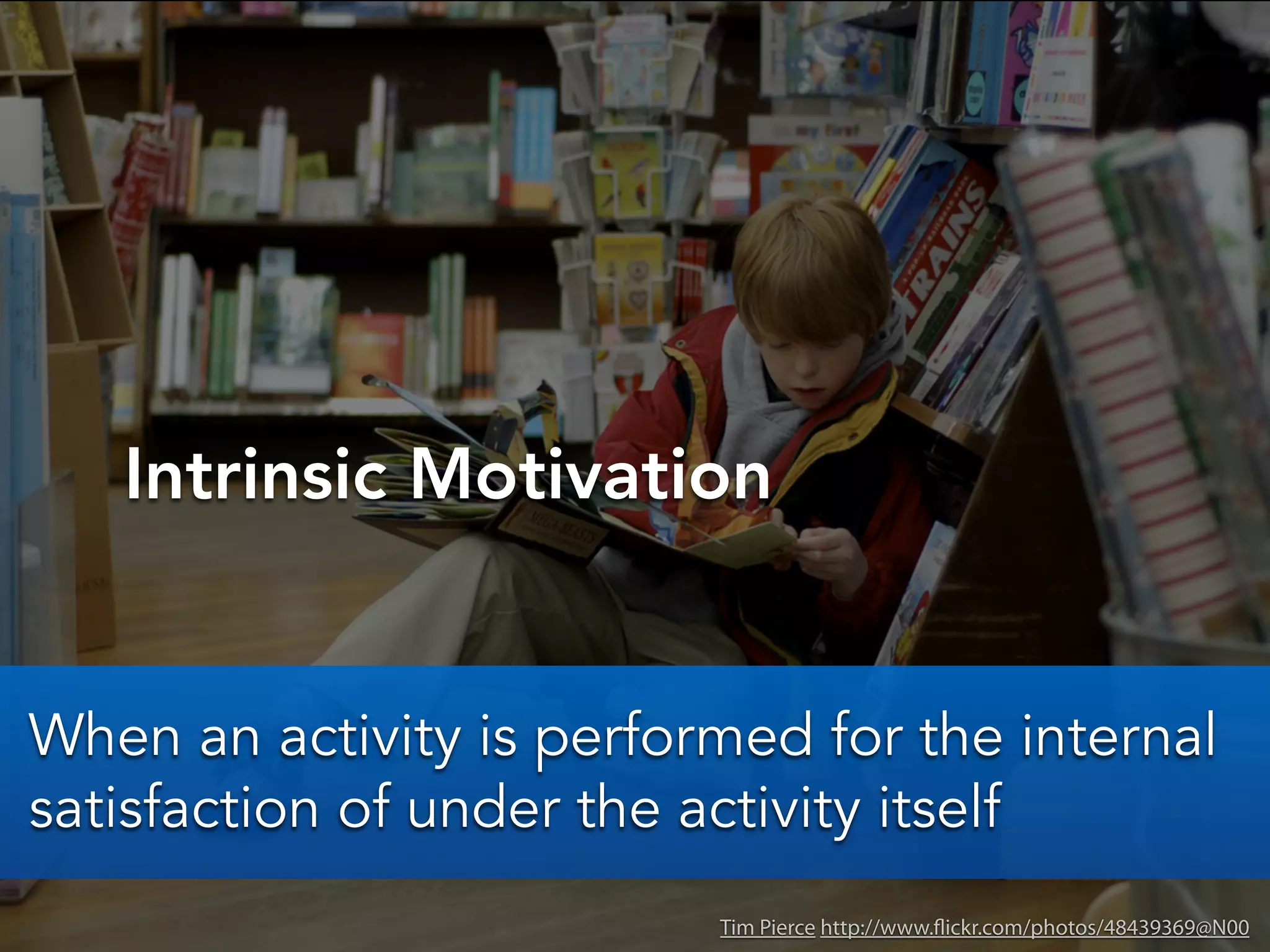
Intrinsic Motivation
Tim Piercehttp://www.flickr.com/photos/48439369@N00
When an activity is performed for the internal
satisfaction of under the activity itself
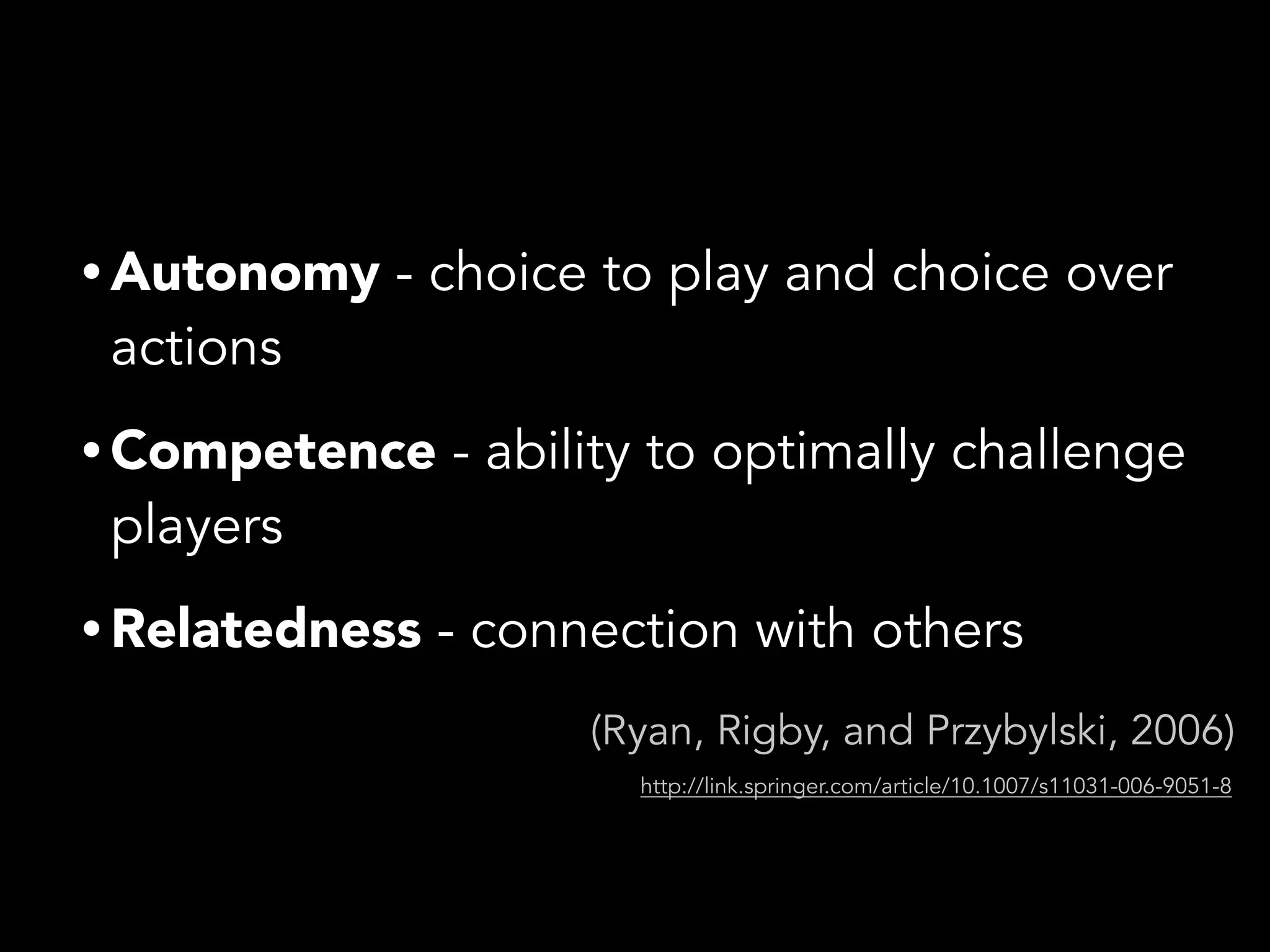
• Autonomy -choice to play and choice over
actions
• Competence - ability to optimally challenge
players
• Relatedness - connection with others
(Ryan, Rigby, and Przybylski, 2006)
http://link.springer.com/article/10.1007/s11031-006-9051-8
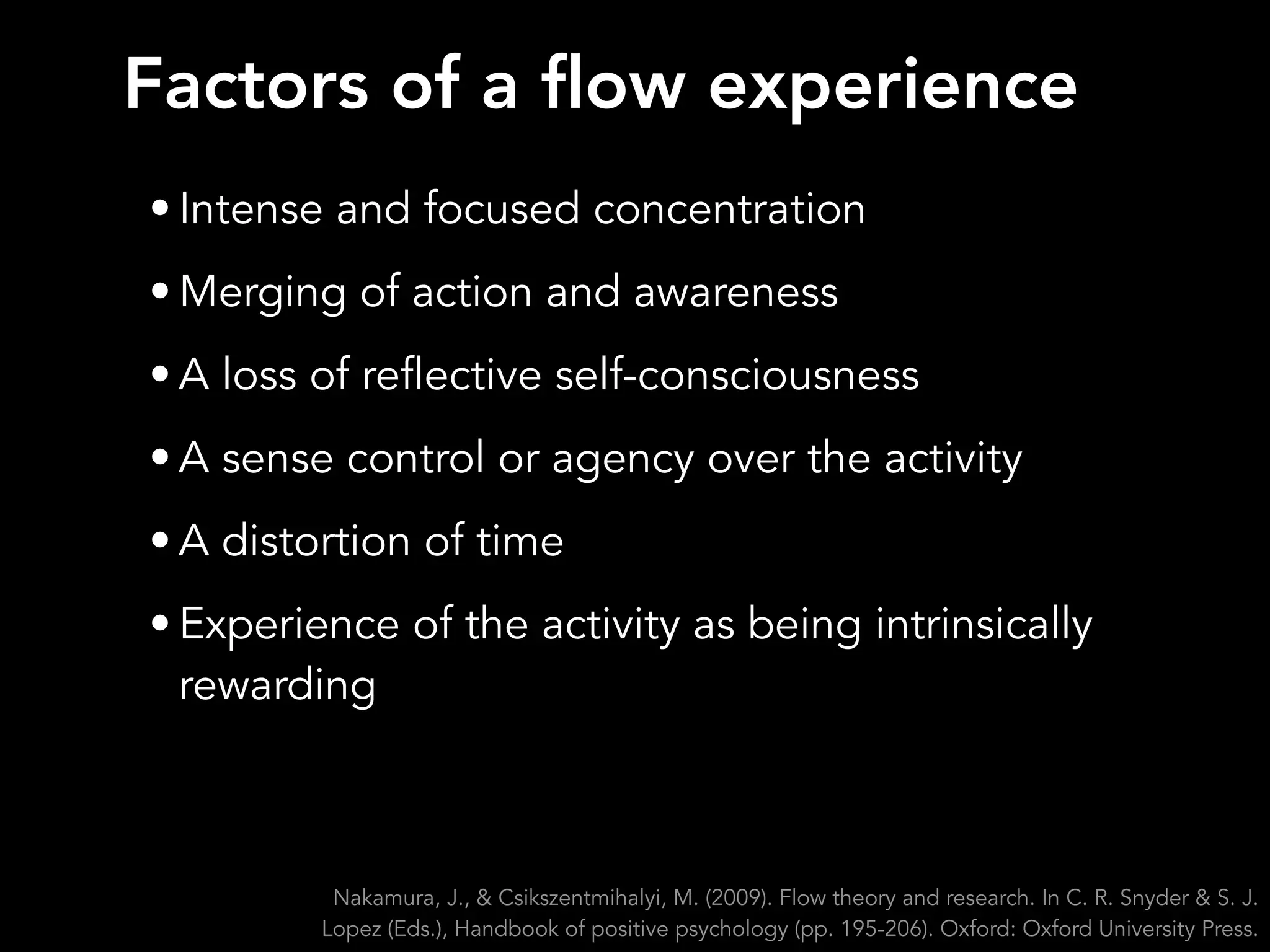
• Intense andfocused concentration
• Merging of action and awareness
• A loss of reflective self-consciousness
• A sense control or agency over the activity
• A distortion of time
• Experience of the activity as being intrinsically
rewarding
Nakamura, J., & Csikszentmihalyi, M. (2009). Flow theory and research. In C. R. Snyder & S. J.
Lopez (Eds.), Handbook of positive psychology (pp. 195-206). Oxford: Oxford University Press.
Factors of a flow experience
104.
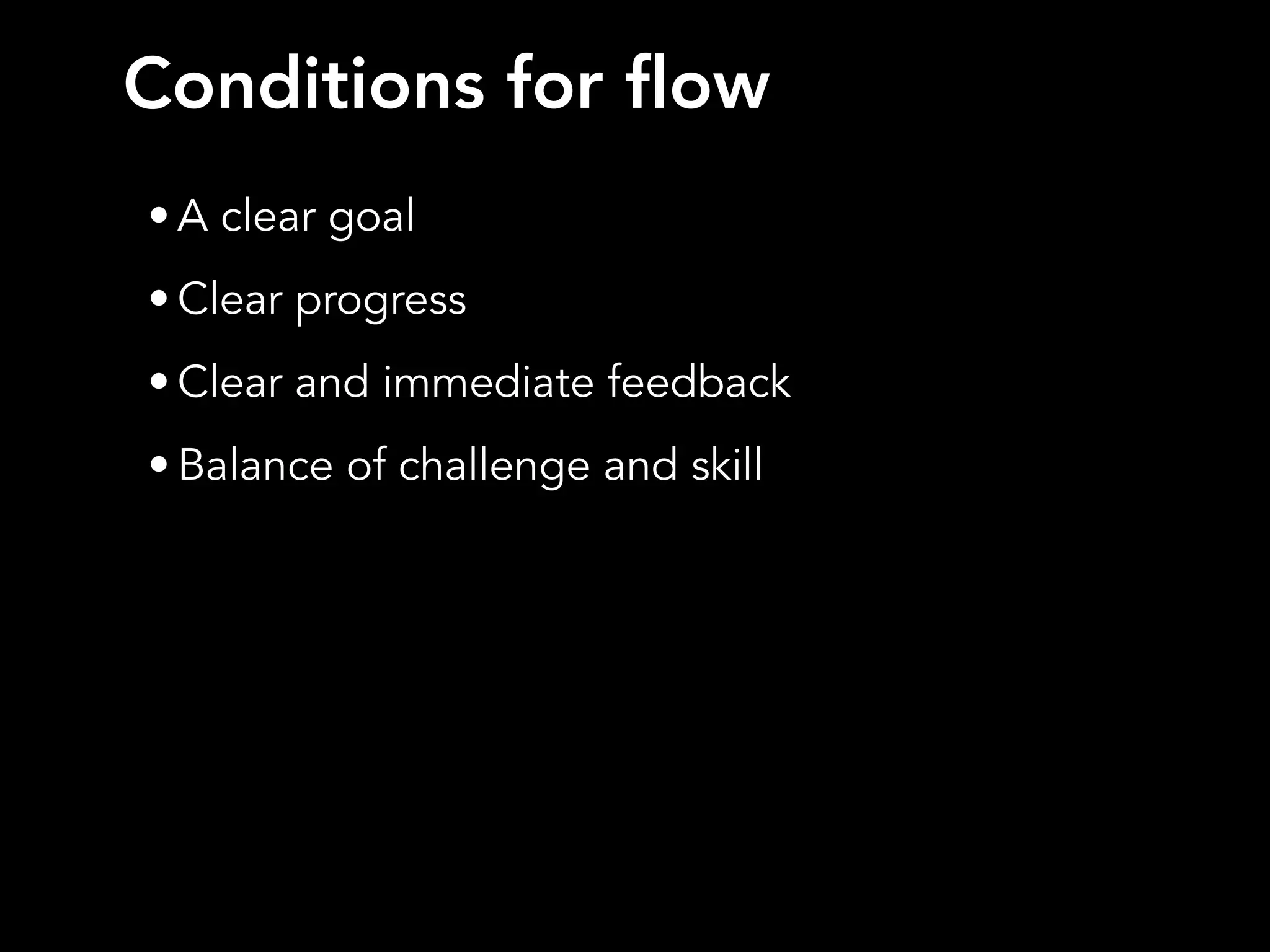
• A cleargoal
• Clear progress
• Clear and immediate feedback
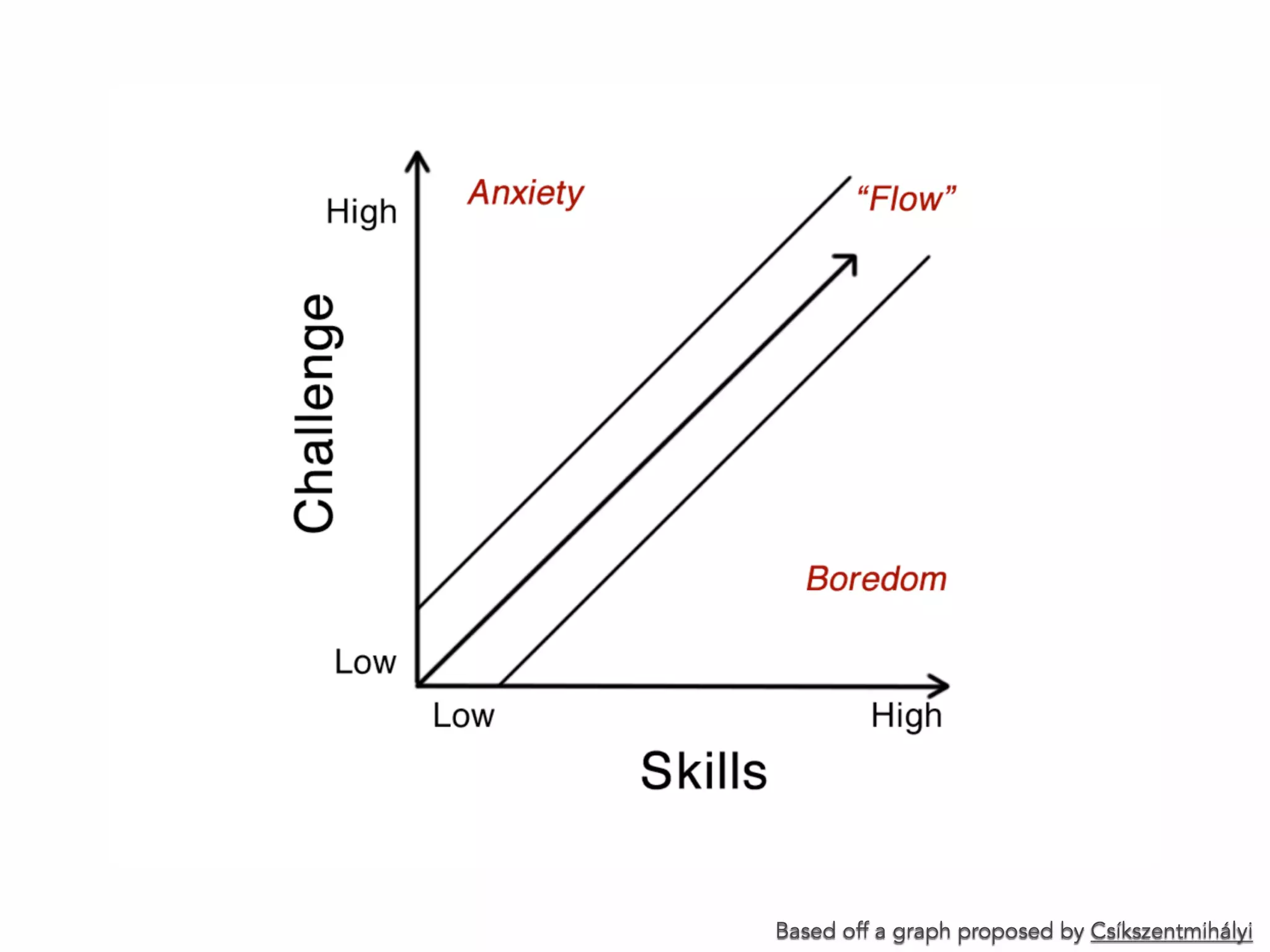
• Balance of challenge and skill
Conditions for flow
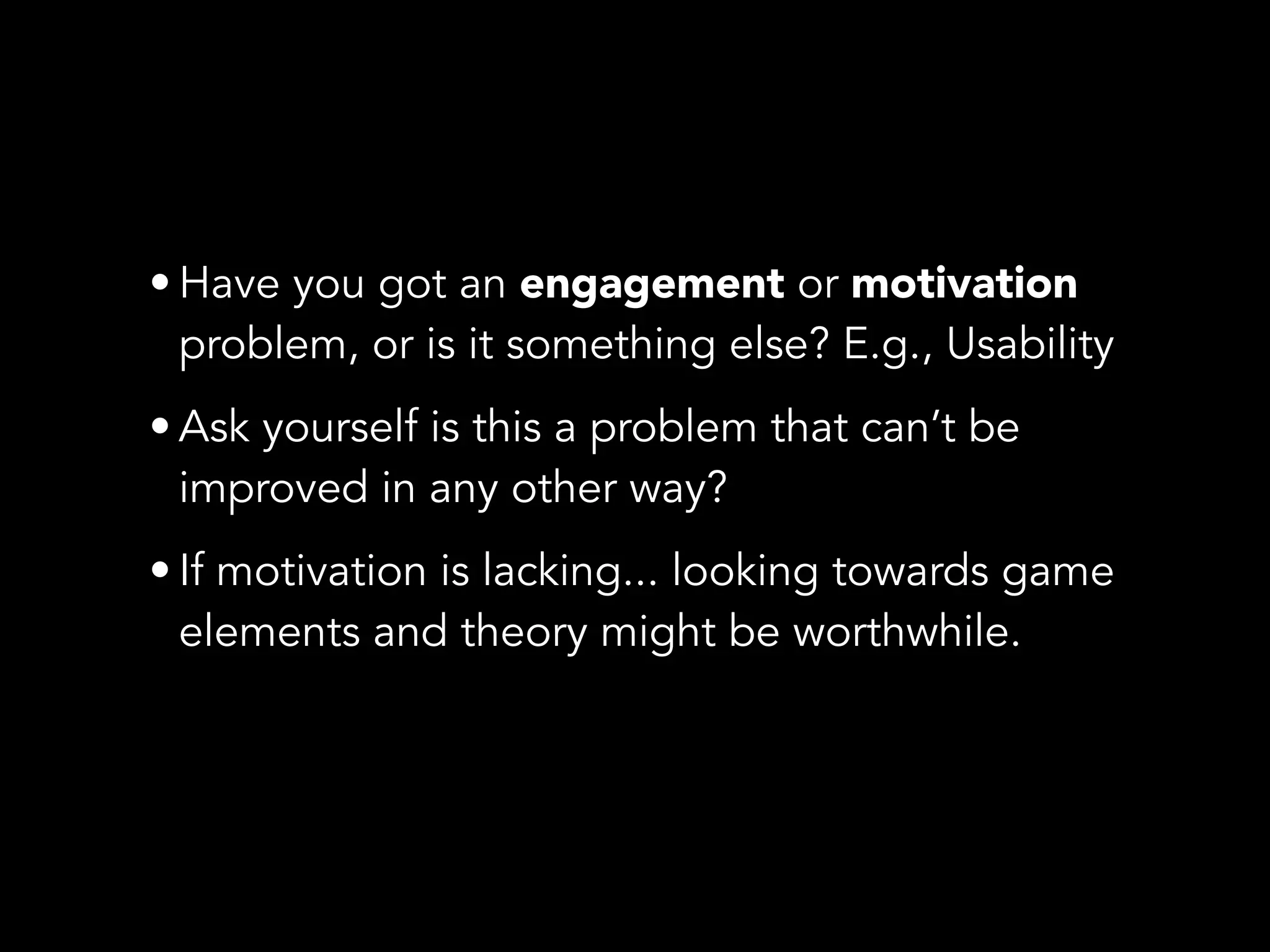
• Have yougot an engagement or motivation
problem, or is it something else? E.g., Usability
• Ask yourself is this a problem that can’t be
improved in any other way?
• If motivation is lacking... looking towards game
elements and theory might be worthwhile.