POSTCOLONIALISM THEORY
What puts the “post” in Postcolonialism? Considering  “post”  is a prefix meaning after, we need to first discuss the history behind colonialism . What is colonialism? ¤  An extension of a nations rule over territory beyond its borders ¤  a population that is subjected to the political domination of another population
Two sides of colonialism The militaristic side ( the physical conquest and occupation of territories) The civilizational side (the conquest and occupation of minds, selves and cultures) -- Colonialism does not end with the end of colonial occupation -- Resistance begins before the end of colonial occupation
¤  the historical whereby the “West” attempts systematically to cancel or negate the cultural difference and value of the “non-West” (Leela Gandhi,1998) * colonial critique  – deals with imperialistic views * post-colonial criticism  – examines the effects of imperialistic views in postcolonial societies
Post colonial Criticism? ¤  A set of theoretical and critical strategies used to examine the culture, literature, politics, history, of former colonies ¤  Post-colonial theory deals with the reading and writing of literature written in previously or currently colonized countries, or literature written in colonizing countries which deals with colonization or colonized peoples  - it embraces no single method or school
Postcolonialism Questions the effect of empire Raises issues such as racism and exploitation Assesses the position of the colonial or post-colonial subject Offers a counter-narrative to the long tradition of European imperial narratives
Why were people colonized? Social Darwinism * Eurocentrism * Universalism * Colonialism is nature White Man’s Burden * What was thought to be an obligation to “civilize” non-European people
How long did it last and why did it end? ¤  15 th  century to 20th century (arguably, it is still going on) ¤  WWII * right to sovereignty * lack of resources * Independence movements
OK, so what is Postcolonialism? ¤  Postcolonial theory attempts to focus on the oppression of those who were ruled under colonization. ¤  Factors include: *Political oppression * Economic * Social/cultural oppression * Psychological oppression
Who are the oppressed? Those who were formerly colonized In postcolonial theory, the word colonized can mean many things: * Literal colonization * More abstract “colonization” African-American Native Americans in the United States
How was the colonized oppressed? Post colonial theorist believe that the colonizers (generally Europeans): Imposed their own values onto those colonized so that they were internalized. Social/ Cultural - Spanish language/Catholic Religion in the Carribean Political - Drew the boundaries of Africa based on European politics rather than tribal interests.
How did the oppressed escape? Post colonial theorist also analyzed the processes by which those who were colonized resisted the colonizers Examples: Haiti  South Africa India
When exactly does the postcolonial begin? “ When third world intellectuals have arrived in the first world academe” (Arif Dirlik)
Postcolonial Theorist Edward Said *  moved colonial discourse into the first world academy and into literary and cultural theory Was also very influential in third world universities (esp. in India) Coined the term  “Orientalism ” describing the binary between the Orient and the Occident
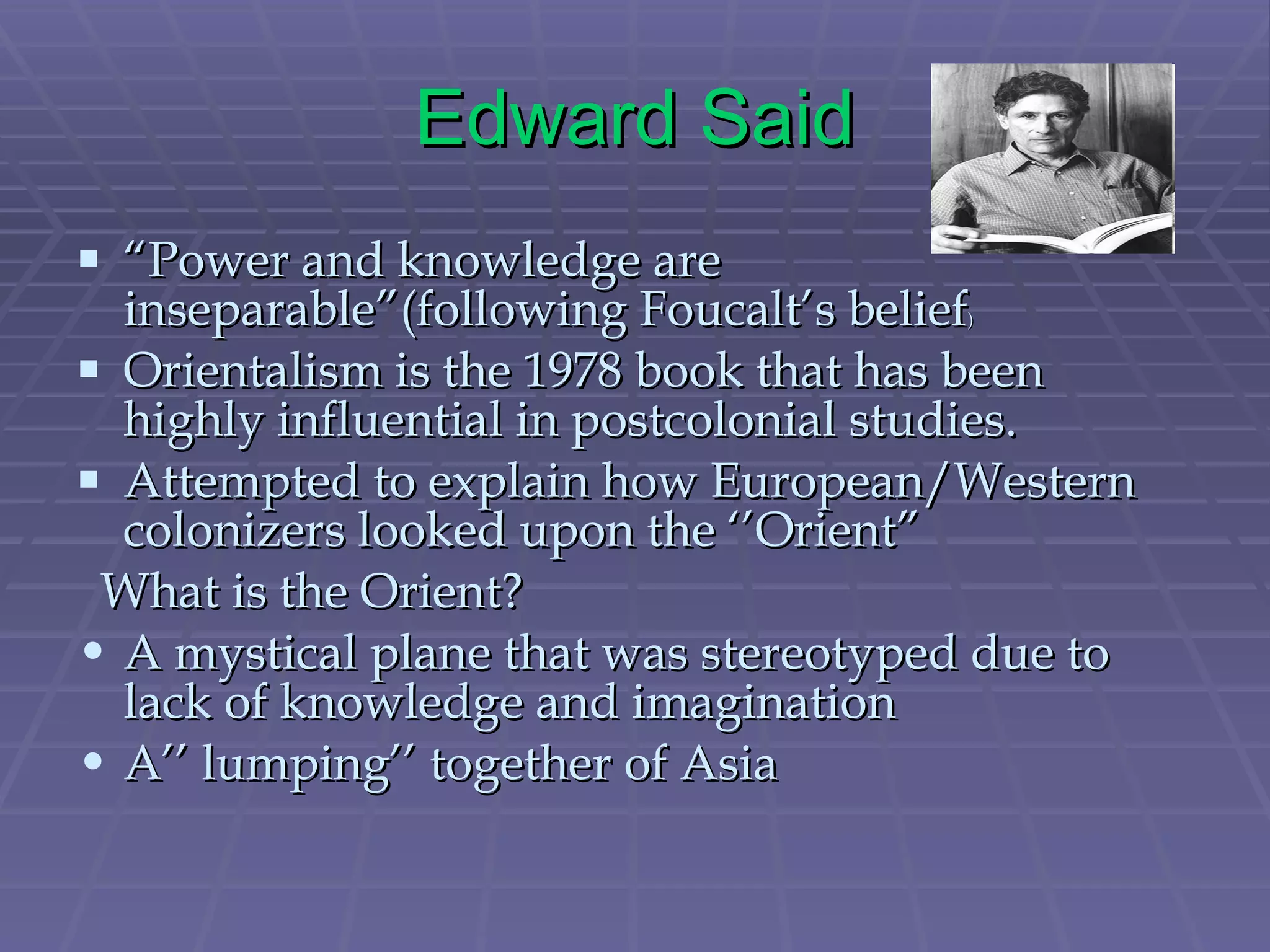
Edward Said “ Power and knowledge are inseparable”(following Foucalt’s belief ) Orientalism is the 1978 book that has been highly influential in postcolonial studies. E Attempted to explain how European/Western colonizers looked upon the ‘’Orient” What is the Orient? A mystical plane that was stereotyped due to lack of knowledge and imagination A’’ lumping’’ together of Asia
Gayatri Chakravorty Spivak   Introduced terms such as “Essentialism” and “Strategic Essentialism” Gayatri Chakravorty Spivak  (born February 24, 1942) is an  Indian   literary critic  and  theorist . She is best known for the article "Can the  Subaltern  Speak?", considered a founding text of  postcolonialism , and for her translation of  Jacques Derrida's   Of Grammatology . Spivak teaches at  Columbia University , where she was tenured as  University Professor —Columbia's highest rank—in March 2007. A prolific scholar, she travels widely and gives lectures around the world. She is also a visiting faculty member at the  Centre for Studies in Social Sciences, Calcutta .
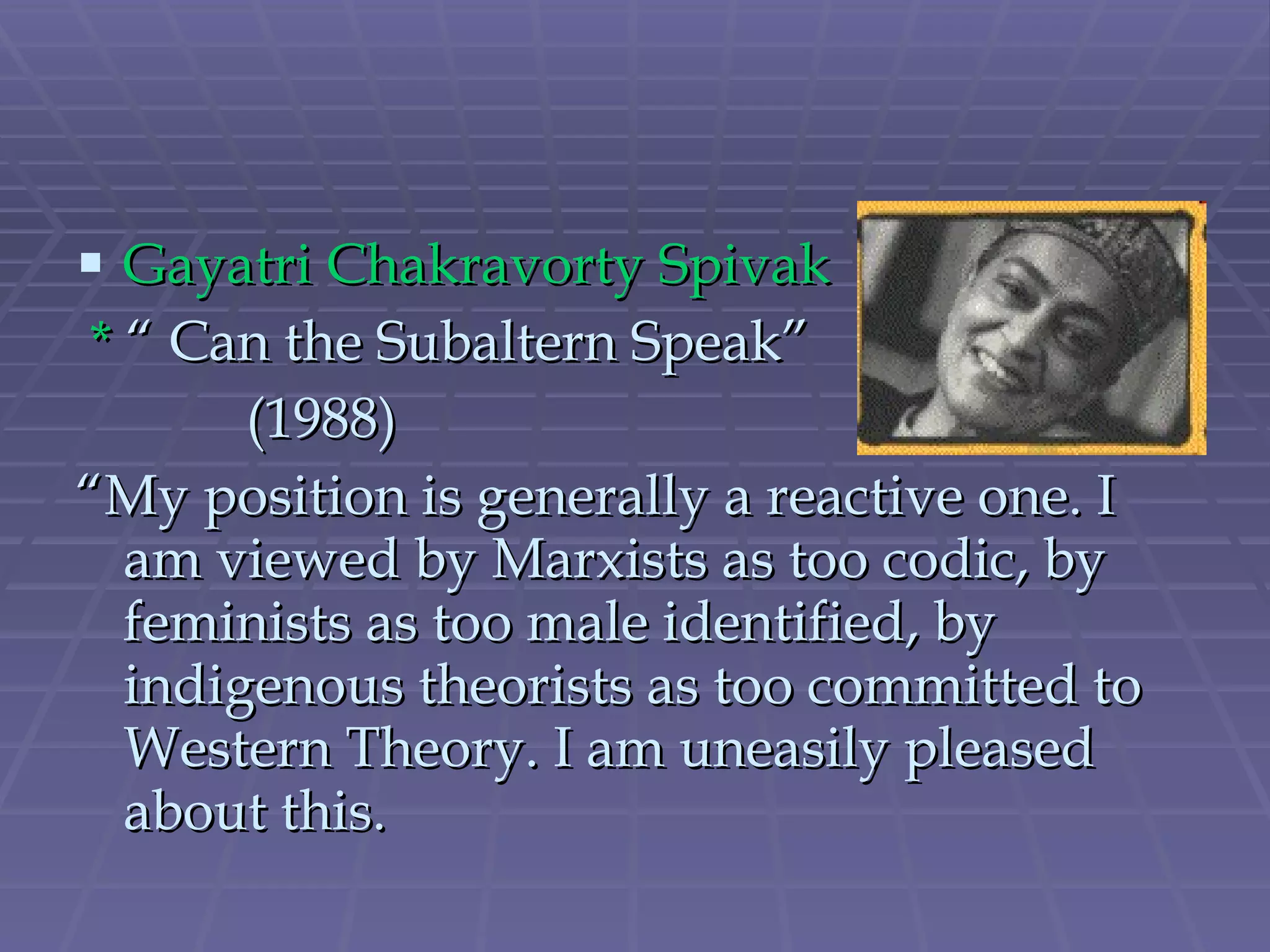
Gayatri Chakravorty Spivak *  “ Can the Subaltern Speak” (1988) “ My position is generally a reactive one. I am viewed by Marxists as too codic, by feminists as too male identified, by indigenous theorists as too committed to Western Theory. I am uneasily pleased about this.
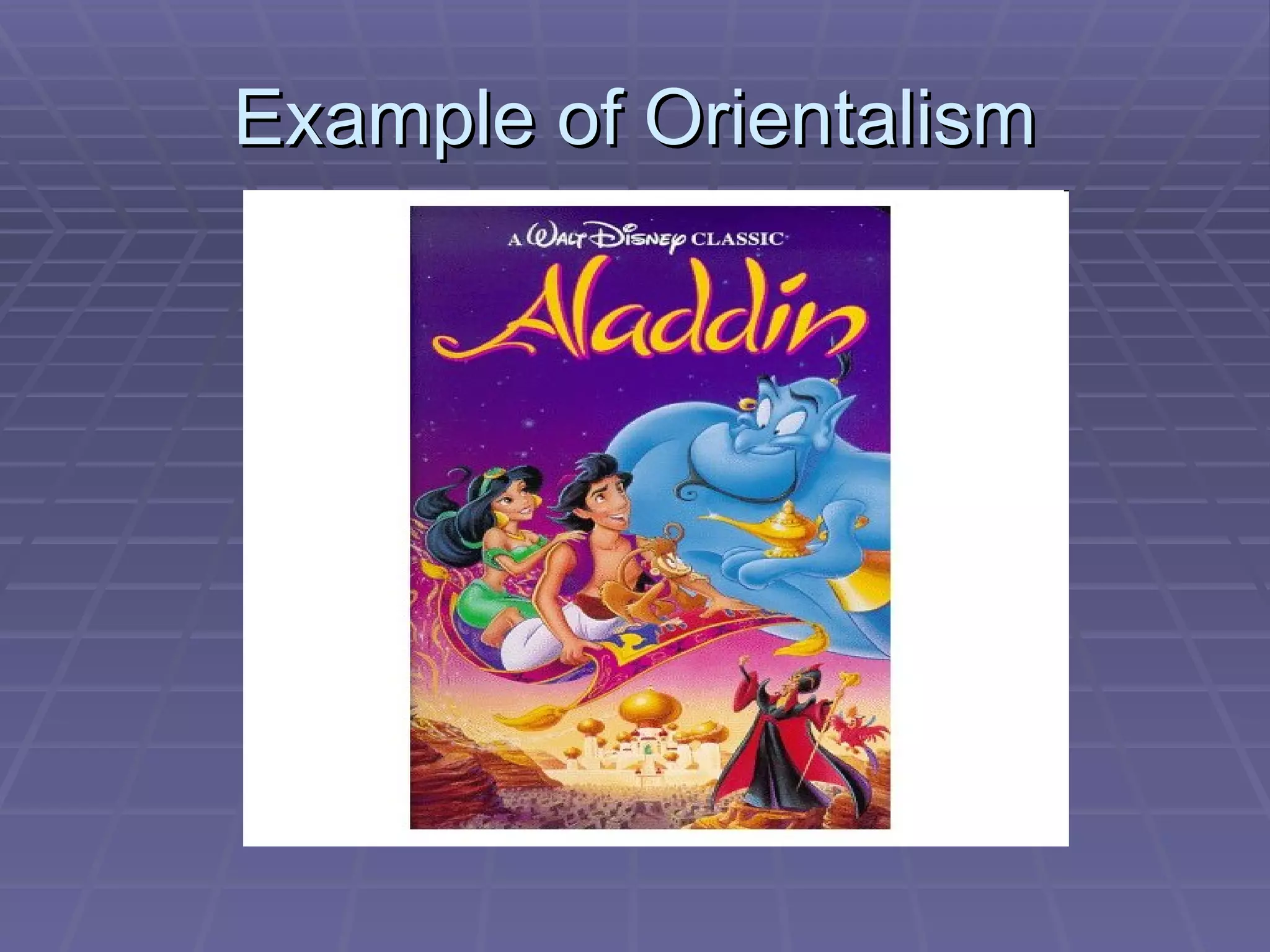
Example of Orientalism
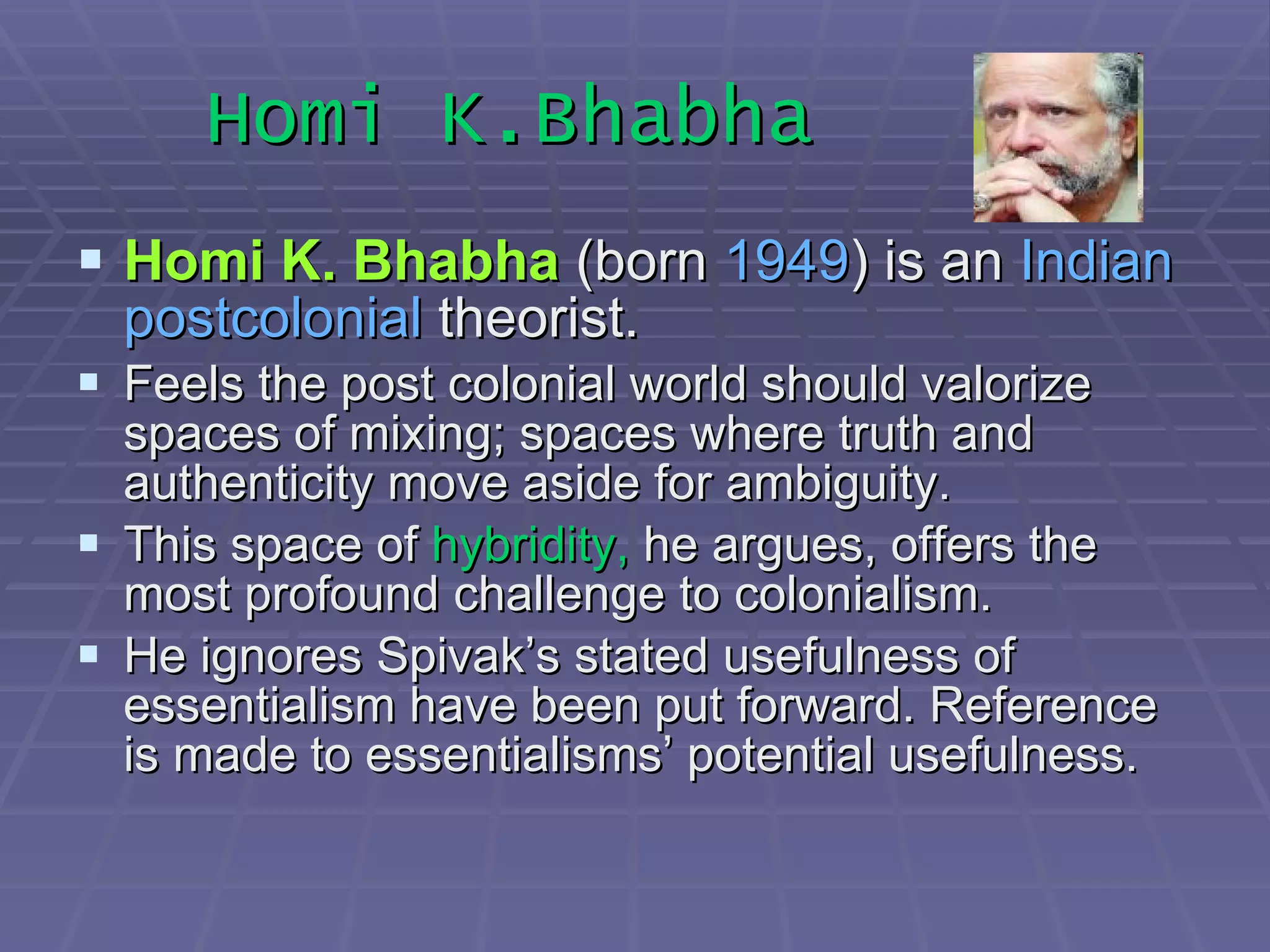
Homi K.Bhabha  Homi K. Bhabha  (born  1949 ) is an  Indian   postcolonial  theorist.  Feels the post colonial world should valorize spaces of mixing; spaces where truth and authenticity move aside for ambiguity. This space of  hybridity,  he argues, offers the most profound challenge to colonialism. He ignores Spivak’s stated usefulness of essentialism have been put forward. Reference is made to essentialisms’ potential usefulness.
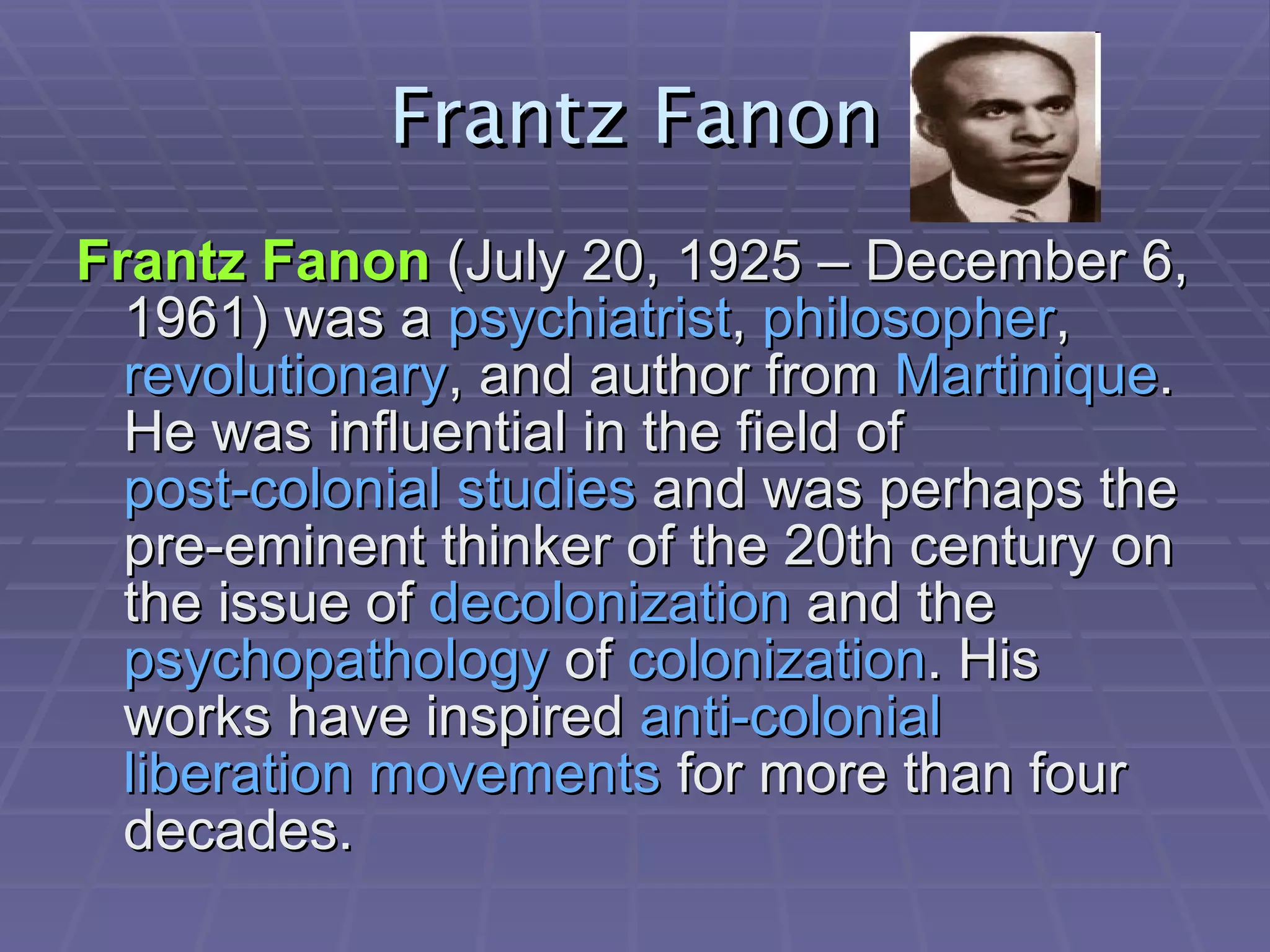
Frantz Fanon Frantz Fanon  (July 20, 1925 – December 6, 1961) was a  psychiatrist ,  philosopher ,  revolutionary , and author from  Martinique . He was influential in the field of  post-colonial studies  and was perhaps the pre-eminent thinker of the 20th century on the issue of  decolonization  and the  psychopathology  of  colonization . His works have inspired  anti-colonial   liberation movements  for more than four decades.
Frantz Fanon's relatively short life yielded two potent and influential statements of anti-colonial revolutionary thought,  Black Skin, White Masks  (1952) and  The Wretched of the Earth  (1961), works which have made Fanon a prominent contributor to postcolonial studies.
The aftermath ■  What happens after colonization? * What language do you speak? * what culture do you follow? ■  Hybridization and Double Consciousness ■  Two terms to describe the results of colonization on those colonized ■  Awareness of culture before colonized and during colonization and what emerged as a result.
¤  Unhomeliness/Exile What is home to you? - a state of limbo, without a certain or definite identity. ¤  Being caught between cultures. ¤  Being literally moved as a result of colonialism   ( On Exile- Edward Said)
Postcolonialism: The Critical Lens ► Examining colonizers/colonized relationship in literature  ■  Is the work pro/anti colonialist? Why?  ■  Does the text reinforce or resist colonialist ideology? ►   Explore the dynamics of colonization through literary works ■  How did it come about? How did it end? How does the text explain this?
Type of Questions: How does the literary text, explicitly or allegorically, represent various aspects of colonial oppression?  What does the text reveal about the problematics of post-colonial identity, including the relationship between personal and cultural identity and such issues as double consciousness and hybridity?  What person(s) or groups does the work identify as "other" or stranger? How are such persons/groups described and treated?  What does the text reveal about the politics and/or psychology of anti-colonialist resistance?
What does the text reveal about the operations of cultural difference - the ways in which race, religion, class, gender, sexual orientation, cultural beliefs, and customs combine to form individual identity - in shaping our perceptions of ourselves, others, and the world in which we live?  How does the text respond to or comment upon the characters, themes, or assumptions of a canonized (colonialist) work?
Are there meaningful similarities among the literatures of different post-colonial populations?  How does a literary text in the Western canon reinforce or undermine colonialist ideology through its representation of colonialization and/or its inappropriate silence about colonized peoples? (Tyson 378-379)
References: http://www.scribd.com/search?cat=solr&q=post+colonial+theory+presentation http://www.english.emory.edu/Bahri/Spivak.html  (retrieved January 19,2010)

Postcolonialism Theory

  • 1.
  • 2.
    What puts the“post” in Postcolonialism? Considering “post” is a prefix meaning after, we need to first discuss the history behind colonialism . What is colonialism? ¤ An extension of a nations rule over territory beyond its borders ¤ a population that is subjected to the political domination of another population
  • 3.
    Two sides ofcolonialism The militaristic side ( the physical conquest and occupation of territories) The civilizational side (the conquest and occupation of minds, selves and cultures) -- Colonialism does not end with the end of colonial occupation -- Resistance begins before the end of colonial occupation
  • 4.
    ¤ thehistorical whereby the “West” attempts systematically to cancel or negate the cultural difference and value of the “non-West” (Leela Gandhi,1998) * colonial critique – deals with imperialistic views * post-colonial criticism – examines the effects of imperialistic views in postcolonial societies
  • 5.
    Post colonial Criticism?¤ A set of theoretical and critical strategies used to examine the culture, literature, politics, history, of former colonies ¤ Post-colonial theory deals with the reading and writing of literature written in previously or currently colonized countries, or literature written in colonizing countries which deals with colonization or colonized peoples - it embraces no single method or school
  • 6.
    Postcolonialism Questions theeffect of empire Raises issues such as racism and exploitation Assesses the position of the colonial or post-colonial subject Offers a counter-narrative to the long tradition of European imperial narratives
  • 7.
    Why were peoplecolonized? Social Darwinism * Eurocentrism * Universalism * Colonialism is nature White Man’s Burden * What was thought to be an obligation to “civilize” non-European people
  • 8.
    How long didit last and why did it end? ¤ 15 th century to 20th century (arguably, it is still going on) ¤ WWII * right to sovereignty * lack of resources * Independence movements
  • 9.
    OK, so whatis Postcolonialism? ¤ Postcolonial theory attempts to focus on the oppression of those who were ruled under colonization. ¤ Factors include: *Political oppression * Economic * Social/cultural oppression * Psychological oppression
  • 10.
    Who are theoppressed? Those who were formerly colonized In postcolonial theory, the word colonized can mean many things: * Literal colonization * More abstract “colonization” African-American Native Americans in the United States
  • 11.
    How was thecolonized oppressed? Post colonial theorist believe that the colonizers (generally Europeans): Imposed their own values onto those colonized so that they were internalized. Social/ Cultural - Spanish language/Catholic Religion in the Carribean Political - Drew the boundaries of Africa based on European politics rather than tribal interests.
  • 12.
    How did theoppressed escape? Post colonial theorist also analyzed the processes by which those who were colonized resisted the colonizers Examples: Haiti South Africa India
  • 13.
    When exactly doesthe postcolonial begin? “ When third world intellectuals have arrived in the first world academe” (Arif Dirlik)
  • 14.
    Postcolonial Theorist EdwardSaid * moved colonial discourse into the first world academy and into literary and cultural theory Was also very influential in third world universities (esp. in India) Coined the term “Orientalism ” describing the binary between the Orient and the Occident
  • 15.
    Edward Said “Power and knowledge are inseparable”(following Foucalt’s belief ) Orientalism is the 1978 book that has been highly influential in postcolonial studies. E Attempted to explain how European/Western colonizers looked upon the ‘’Orient” What is the Orient? A mystical plane that was stereotyped due to lack of knowledge and imagination A’’ lumping’’ together of Asia
  • 16.
    Gayatri Chakravorty Spivak Introduced terms such as “Essentialism” and “Strategic Essentialism” Gayatri Chakravorty Spivak (born February 24, 1942) is an Indian literary critic and theorist . She is best known for the article "Can the Subaltern Speak?", considered a founding text of postcolonialism , and for her translation of Jacques Derrida's Of Grammatology . Spivak teaches at Columbia University , where she was tenured as University Professor —Columbia's highest rank—in March 2007. A prolific scholar, she travels widely and gives lectures around the world. She is also a visiting faculty member at the Centre for Studies in Social Sciences, Calcutta .
  • 17.
    Gayatri Chakravorty Spivak* “ Can the Subaltern Speak” (1988) “ My position is generally a reactive one. I am viewed by Marxists as too codic, by feminists as too male identified, by indigenous theorists as too committed to Western Theory. I am uneasily pleased about this.
  • 18.
  • 19.
    Homi K.Bhabha Homi K. Bhabha (born 1949 ) is an Indian postcolonial theorist. Feels the post colonial world should valorize spaces of mixing; spaces where truth and authenticity move aside for ambiguity. This space of hybridity, he argues, offers the most profound challenge to colonialism. He ignores Spivak’s stated usefulness of essentialism have been put forward. Reference is made to essentialisms’ potential usefulness.
  • 20.
    Frantz Fanon FrantzFanon (July 20, 1925 – December 6, 1961) was a psychiatrist , philosopher , revolutionary , and author from Martinique . He was influential in the field of post-colonial studies and was perhaps the pre-eminent thinker of the 20th century on the issue of decolonization and the psychopathology of colonization . His works have inspired anti-colonial liberation movements for more than four decades.
  • 21.
    Frantz Fanon's relativelyshort life yielded two potent and influential statements of anti-colonial revolutionary thought, Black Skin, White Masks (1952) and The Wretched of the Earth (1961), works which have made Fanon a prominent contributor to postcolonial studies.
  • 22.
    The aftermath ■ What happens after colonization? * What language do you speak? * what culture do you follow? ■ Hybridization and Double Consciousness ■ Two terms to describe the results of colonization on those colonized ■ Awareness of culture before colonized and during colonization and what emerged as a result.
  • 23.
    ¤ Unhomeliness/ExileWhat is home to you? - a state of limbo, without a certain or definite identity. ¤ Being caught between cultures. ¤ Being literally moved as a result of colonialism ( On Exile- Edward Said)
  • 24.
    Postcolonialism: The CriticalLens ► Examining colonizers/colonized relationship in literature ■ Is the work pro/anti colonialist? Why? ■ Does the text reinforce or resist colonialist ideology? ► Explore the dynamics of colonization through literary works ■ How did it come about? How did it end? How does the text explain this?
  • 25.
    Type of Questions:How does the literary text, explicitly or allegorically, represent various aspects of colonial oppression? What does the text reveal about the problematics of post-colonial identity, including the relationship between personal and cultural identity and such issues as double consciousness and hybridity? What person(s) or groups does the work identify as "other" or stranger? How are such persons/groups described and treated? What does the text reveal about the politics and/or psychology of anti-colonialist resistance?
  • 26.
    What does thetext reveal about the operations of cultural difference - the ways in which race, religion, class, gender, sexual orientation, cultural beliefs, and customs combine to form individual identity - in shaping our perceptions of ourselves, others, and the world in which we live? How does the text respond to or comment upon the characters, themes, or assumptions of a canonized (colonialist) work?
  • 27.
    Are there meaningfulsimilarities among the literatures of different post-colonial populations? How does a literary text in the Western canon reinforce or undermine colonialist ideology through its representation of colonialization and/or its inappropriate silence about colonized peoples? (Tyson 378-379)
  • 28.