Game Writing and
Narrative Design
Roles, skills, responsibilities
Game Writing and
Narrative Design
• They share an interest in “the
story” as a deliverable

• They share the same goal: to
make a great game and story.

• The game is a reflection of the
relationship between writing
and design

• Work together, but different
skills and responsibilities
Molly Maloney and Eric Stirpe, GDC Talk
Why do games need
narrative designers?
Games are unique storytelling
medium because they involve
player choice. 

Telling a structured story is thus
a paradox. 

Stories have to be incorporated
into gameplay
Game Writing vs. Narrative Design
Writing is
responsible for
the
characters
Design is
responsible for
the
player
What is the primary difference?
Molly Maloney and Eric Stirpe, GDC Talk
Game Writing: Goals and Responsibilities
• Writing is responsible for the characters
• dialogue, character arcs, themes and tone
• Writer’s goal is to make a compelling story
• Writer’s write content (often hired after story architecture
is complete)
• Writer uses words to tell stories
Narrative Design: Goals and Responsibilities
• Design is responsible for the player
• choices/consequences, branching, mechanics
• Design’s goal is to make the story playable (How will the player
interact with the story?)
• Narrative designers create a pathway or architecture for story
• Narrative designers use game’s feature set to tell stories.
• mechanics, combat, game design, progression, music,
voice over, audio, level design, cinematics, UI and UX, etc.
Narrative designers have greater specialization
• In addition to writing scripts, dialogue, etc., narrative designers also:
• Create the story architecture
• Identify the vehicles that delivery story
• Design the rule-sets for these vehicles are triggered in game
• Enrich core mechanics with narrative content
• Plan and itemize the numerous story variations influenced by player
choice
• Prevent ludo-narrative dissonance (moments when the story and the
player’s experience contradict each other)
Narrative design is…
• “creating a pathway for story, to be revealed one bit at a time, once
conditions have been met, within or in between gameplay moments.” 

• How to parcel our bits of narrative throughout the game experience?

• Where are moments when narrative is intertwined with gameplay?

• What mechanisms reveal the story? 

• What triggers those mechanisms?
“the key is creating a reactive and proactive storyline
that affects gameplay (proactive) and is affected by
gameplay (reactive)” (Ross Berger, 15)
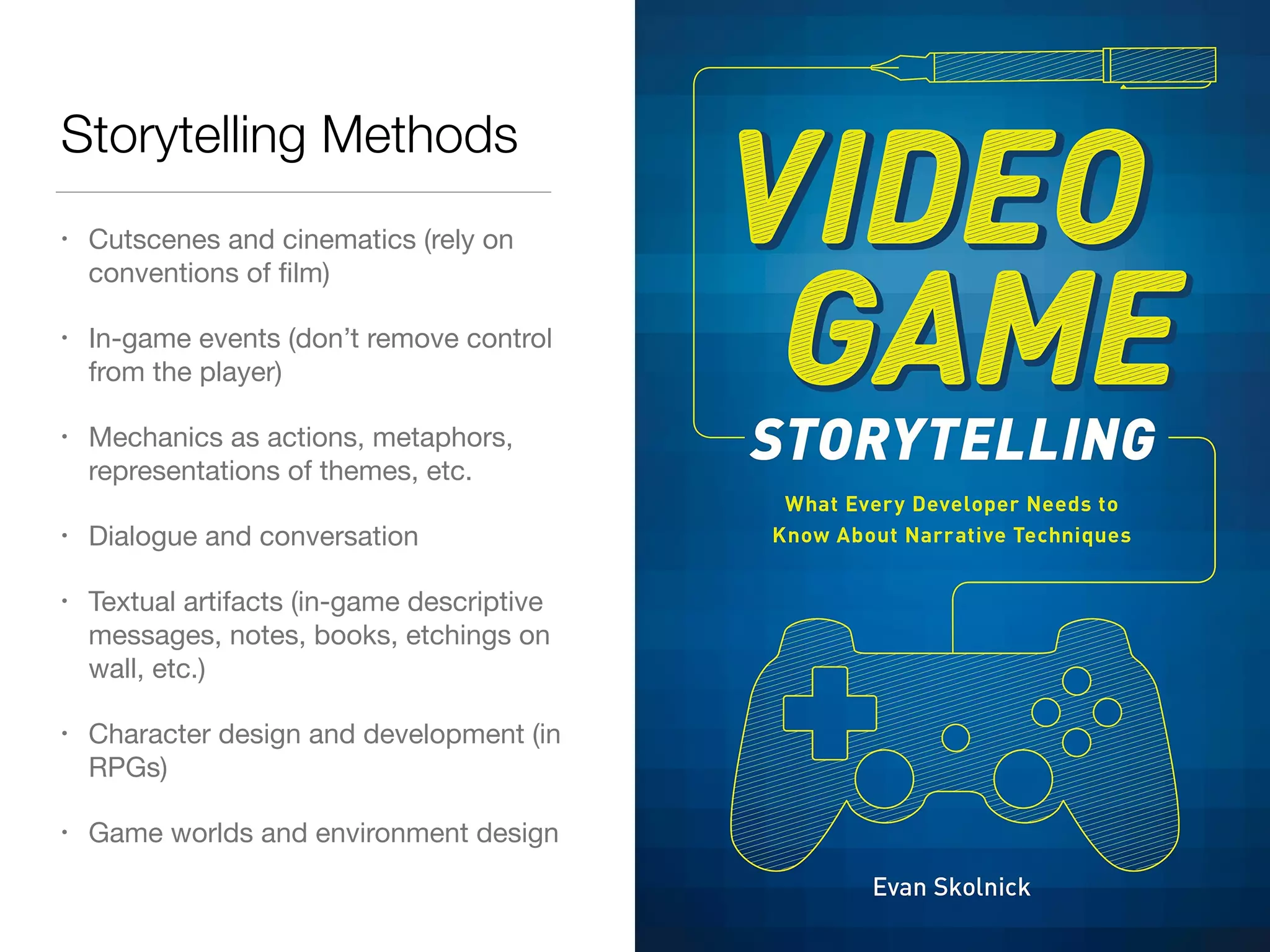
Storytelling Methods
• Cutscenes and cinematics (rely on
conventions of film)

• In-game events (don’t remove control
from the player)

• Mechanics as actions, metaphors,
representations of themes, etc.

• Dialogue and conversation

• Textual artifacts (in-game descriptive
messages, notes, books, etchings on
wall, etc.)

• Character design and development (in
RPGs)

• Game worlds and environment design
Coming soon…
Story Models, Plot Guides, and
Branching Narratives

Game Writing & Narrative Design

  • 1.
    Game Writing and NarrativeDesign Roles, skills, responsibilities
  • 2.
    Game Writing and NarrativeDesign • They share an interest in “the story” as a deliverable • They share the same goal: to make a great game and story. • The game is a reflection of the relationship between writing and design • Work together, but different skills and responsibilities Molly Maloney and Eric Stirpe, GDC Talk
  • 3.
    Why do gamesneed narrative designers? Games are unique storytelling medium because they involve player choice. Telling a structured story is thus a paradox. Stories have to be incorporated into gameplay
  • 4.
    Game Writing vs.Narrative Design Writing is responsible for the characters Design is responsible for the player What is the primary difference? Molly Maloney and Eric Stirpe, GDC Talk
  • 5.
    Game Writing: Goalsand Responsibilities • Writing is responsible for the characters • dialogue, character arcs, themes and tone • Writer’s goal is to make a compelling story • Writer’s write content (often hired after story architecture is complete) • Writer uses words to tell stories
  • 6.
    Narrative Design: Goalsand Responsibilities • Design is responsible for the player • choices/consequences, branching, mechanics • Design’s goal is to make the story playable (How will the player interact with the story?) • Narrative designers create a pathway or architecture for story • Narrative designers use game’s feature set to tell stories. • mechanics, combat, game design, progression, music, voice over, audio, level design, cinematics, UI and UX, etc.
  • 7.
    Narrative designers havegreater specialization • In addition to writing scripts, dialogue, etc., narrative designers also: • Create the story architecture • Identify the vehicles that delivery story • Design the rule-sets for these vehicles are triggered in game • Enrich core mechanics with narrative content • Plan and itemize the numerous story variations influenced by player choice • Prevent ludo-narrative dissonance (moments when the story and the player’s experience contradict each other)
  • 8.
    Narrative design is… •“creating a pathway for story, to be revealed one bit at a time, once conditions have been met, within or in between gameplay moments.” • How to parcel our bits of narrative throughout the game experience? • Where are moments when narrative is intertwined with gameplay? • What mechanisms reveal the story? • What triggers those mechanisms? “the key is creating a reactive and proactive storyline that affects gameplay (proactive) and is affected by gameplay (reactive)” (Ross Berger, 15)
  • 9.
    Storytelling Methods • Cutscenesand cinematics (rely on conventions of film) • In-game events (don’t remove control from the player) • Mechanics as actions, metaphors, representations of themes, etc. • Dialogue and conversation • Textual artifacts (in-game descriptive messages, notes, books, etchings on wall, etc.) • Character design and development (in RPGs) • Game worlds and environment design
  • 11.
    Coming soon… Story Models,Plot Guides, and Branching Narratives