Level 1
David Mullich
Game Mechanics
The Los Angeles Film School
Class Topics
1. Core Mechanics
2. Progression Mechanics
3. Tactical Mechanics
4. Resource Management Mechanics
5. Social Mechanics
6. Information and Game Mechanics
7. Randomness and Game Mechanics
8. Narrative and Game Mechanics
9. Balancing Game Mechanics
10. Replayability and Game Mechanics
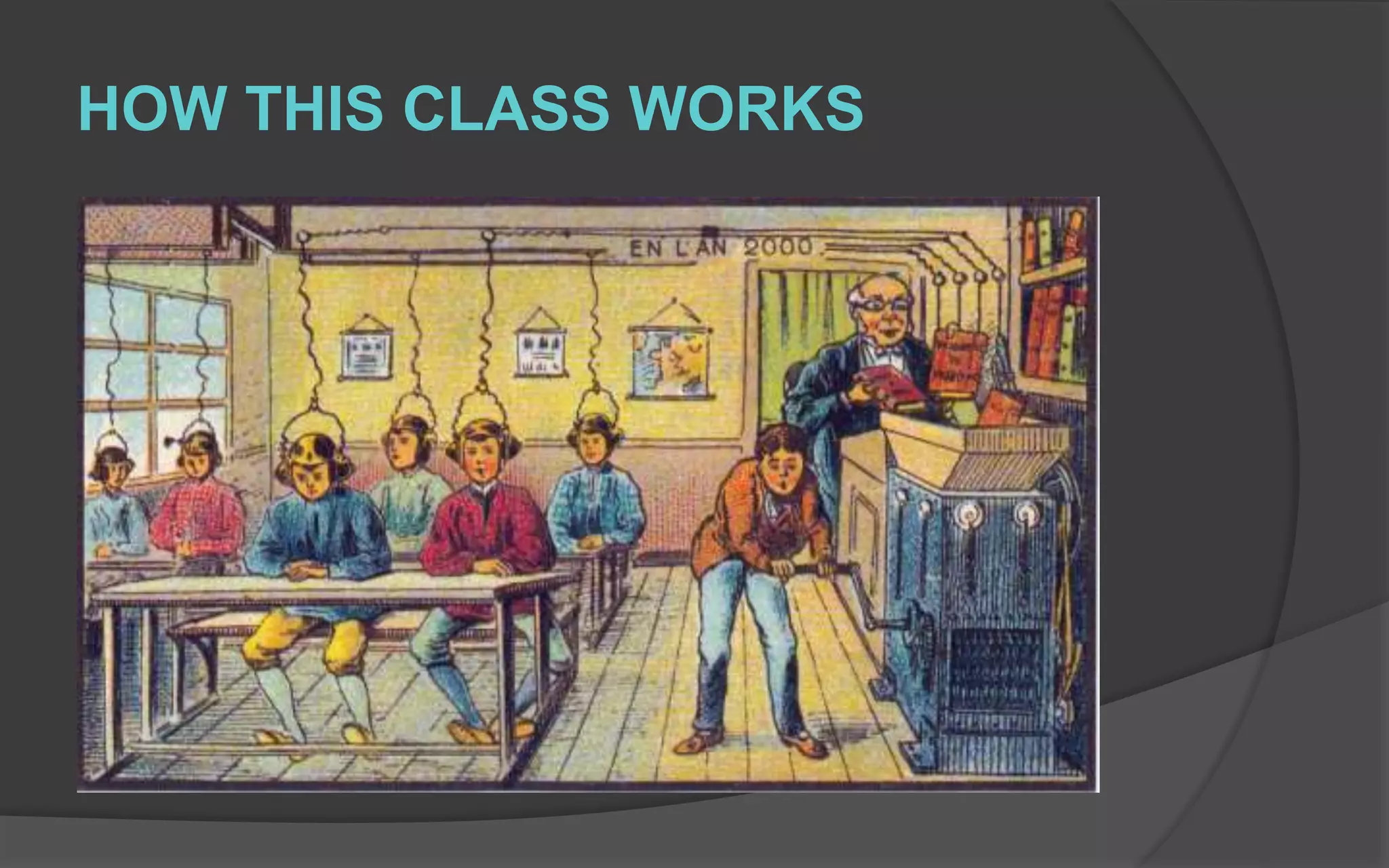
HOW THIS CLASS WORKS
Class Grading
 20%: 10 Labs
 30%: 10 Assignments
 30%: 3 Tests
 20%: Professionalism*
2% Extra Credit for playtesting Game Fair games
* 35%+ absences is an automatic fail.
Labs
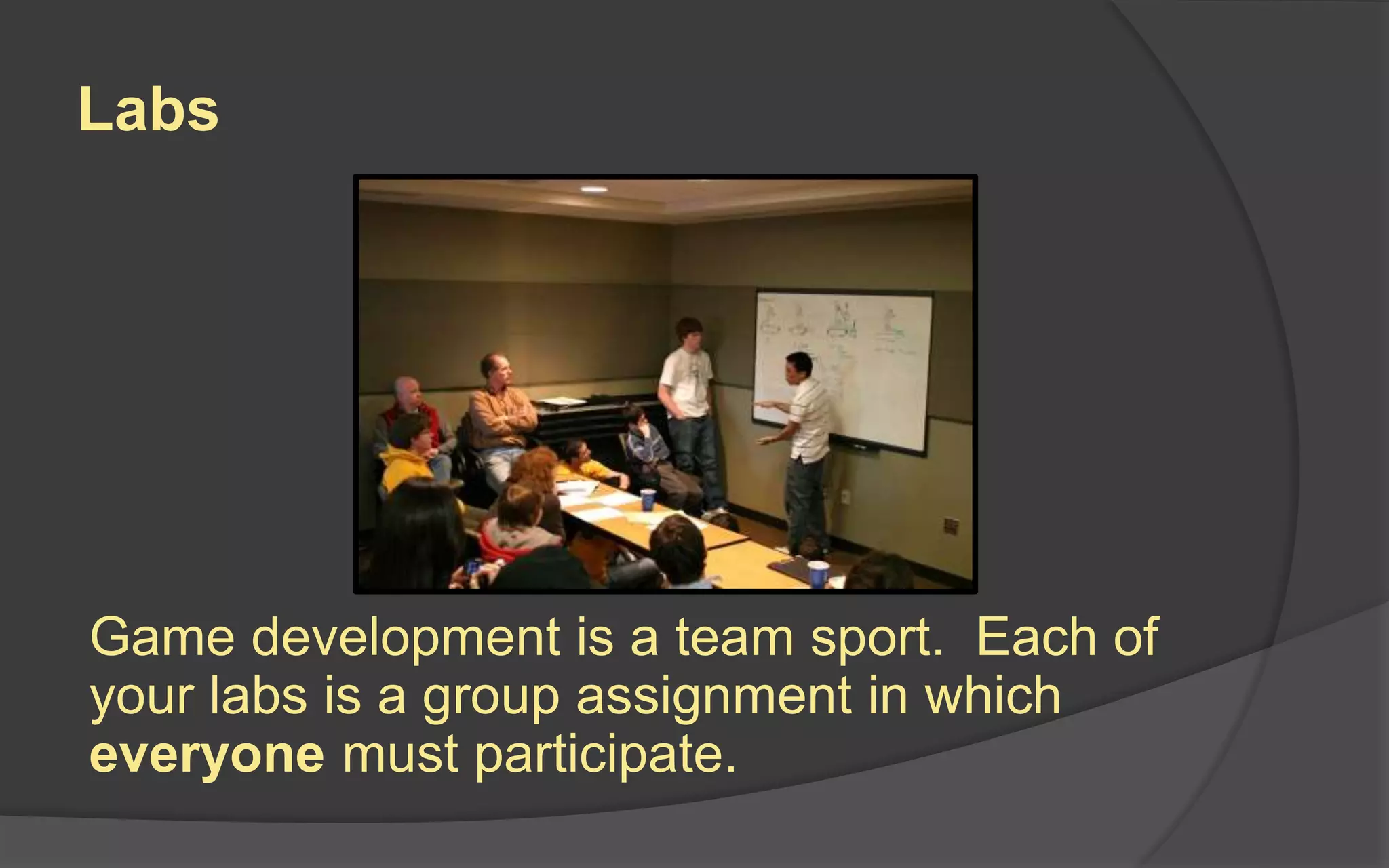
Game development is a team sport. Each of
your labs is a group assignment in which
everyone must participate.
Come Prepared
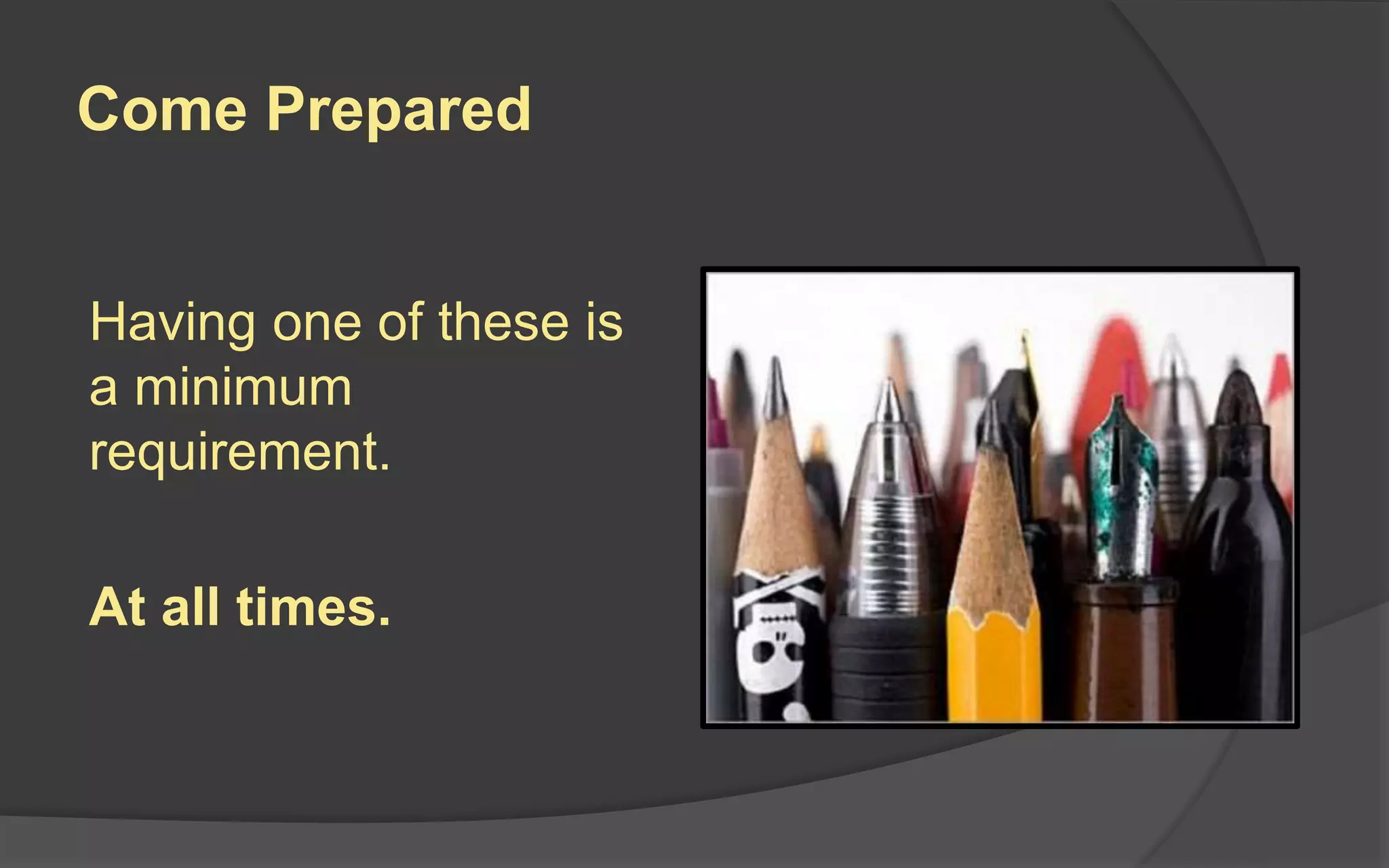
Having one of these is
a minimum
requirement.
At all times.
Assignments
Do your homework assignments on the LMS
(Learning Management System).
Word Counts
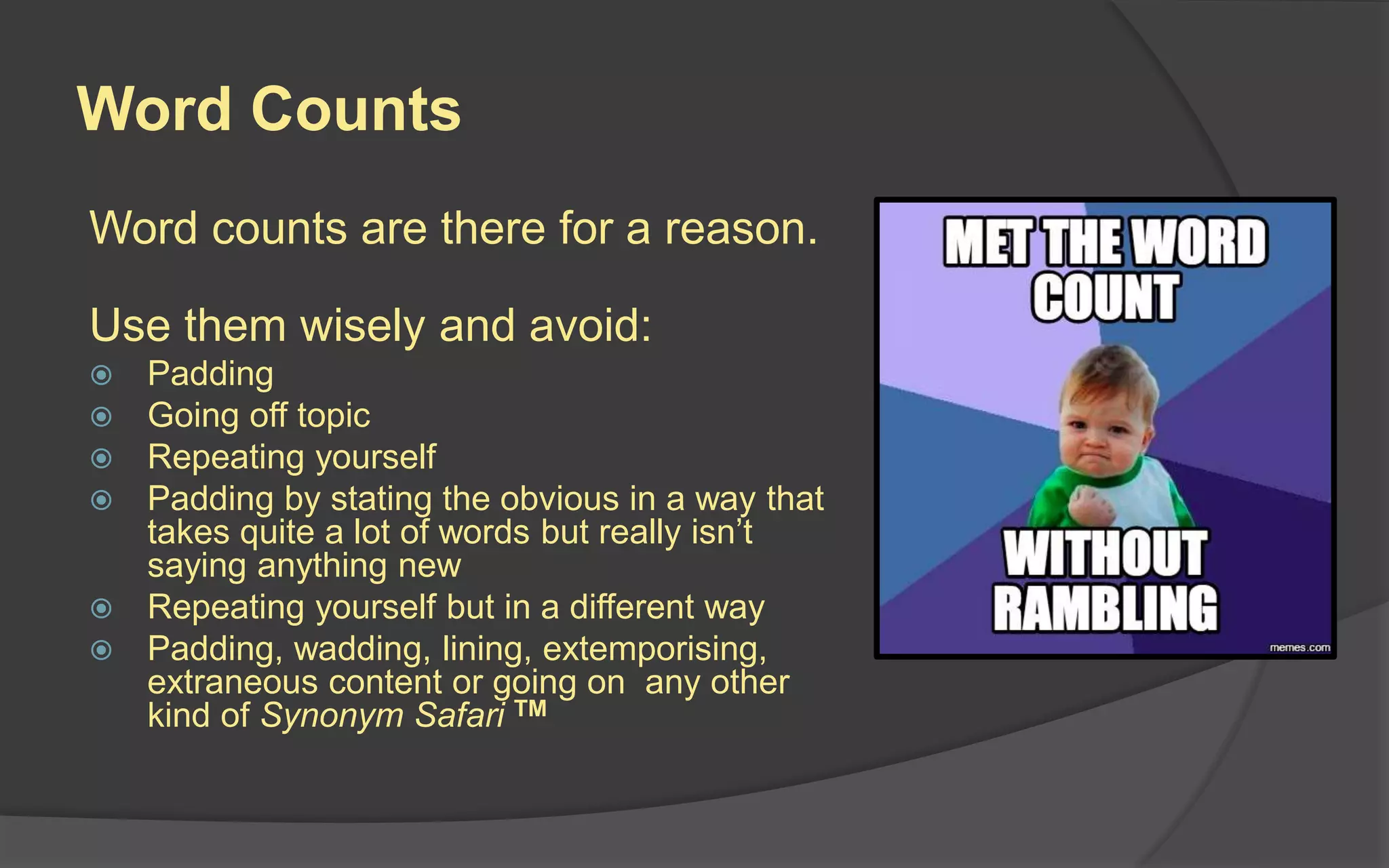
Word counts are there for a reason.
Use them wisely and avoid:
 Padding
 Going off topic
 Repeating yourself
 Padding by stating the obvious in a way that
takes quite a lot of words but really isn’t
saying anything new
 Repeating yourself but in a different way
 Padding, wadding, lining, extemporising,
extraneous content or going on any other
kind of Synonym Safari TM
Deliver Work On Time
Develop a habit of delivering work
on time.
In the game industry, when work is
late, people don’t get paid.
Pssst....Sometimes developers make false
internal deadlines to avoid calamity such
as missed milestone payments. Maybe you
could do the same if graduation is at
stake?
Tests
 Study for your tests! Refer to the
slides.
 If you see on a slide, it will
probably be on the test.
 If you don’t know the answer to a test
question, guess!
 There are no points deducted for wrong
answers on multiple-choice questions
 I will award some points for clever or
knowledgeable answers on short-answer
questions, even if they weren’t the answer
I was looking for.
First Rule of Success: Show Up
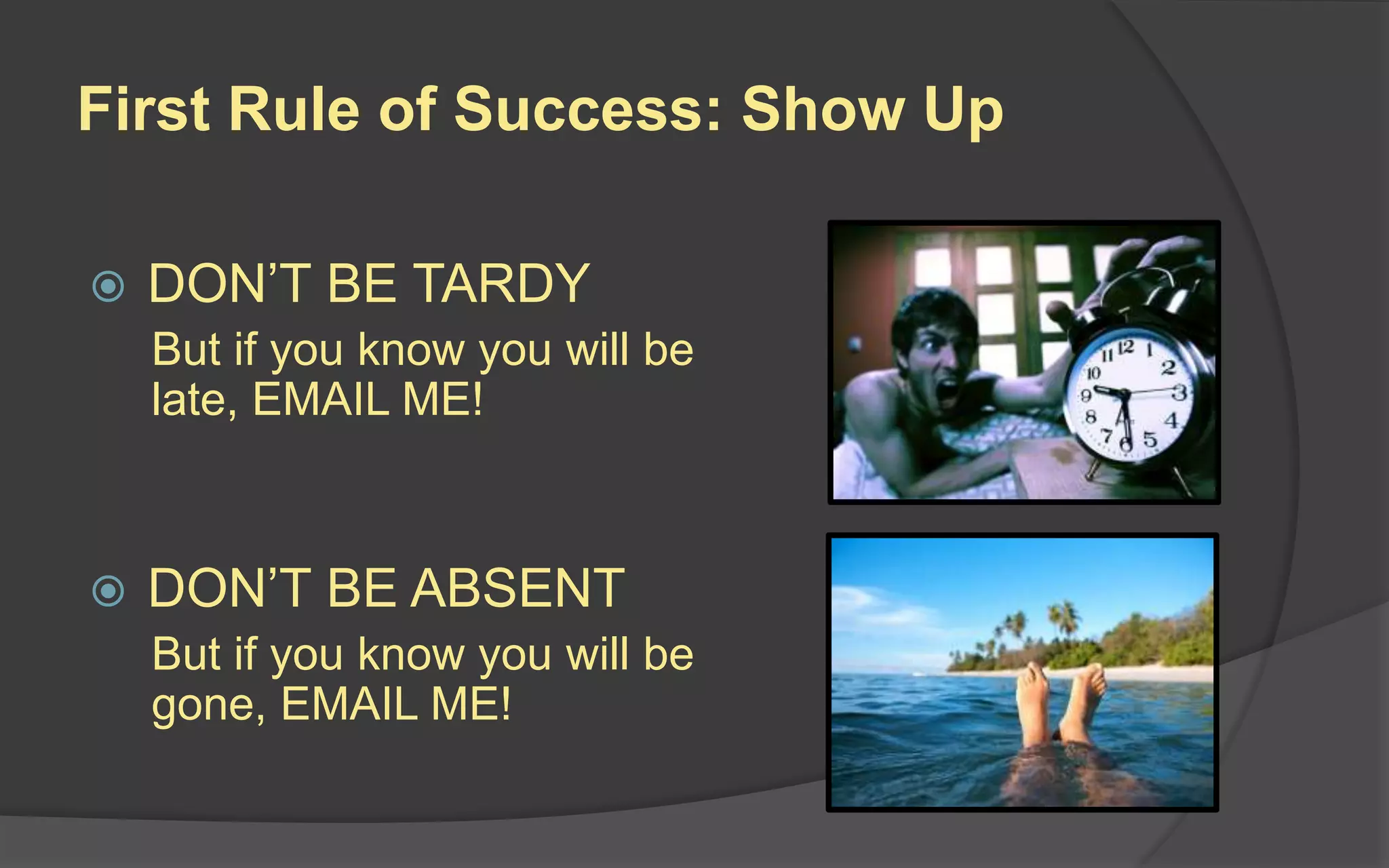
 DON’T BE TARDY
But if you know you will be
late, EMAIL ME!
 DON’T BE ABSENT
But if you know you will be
gone, EMAIL ME!
School Is Your Job
Yes, these are important:
 Part-time work
 Family
 Friends
 Fun
But don’t neglect your school work!
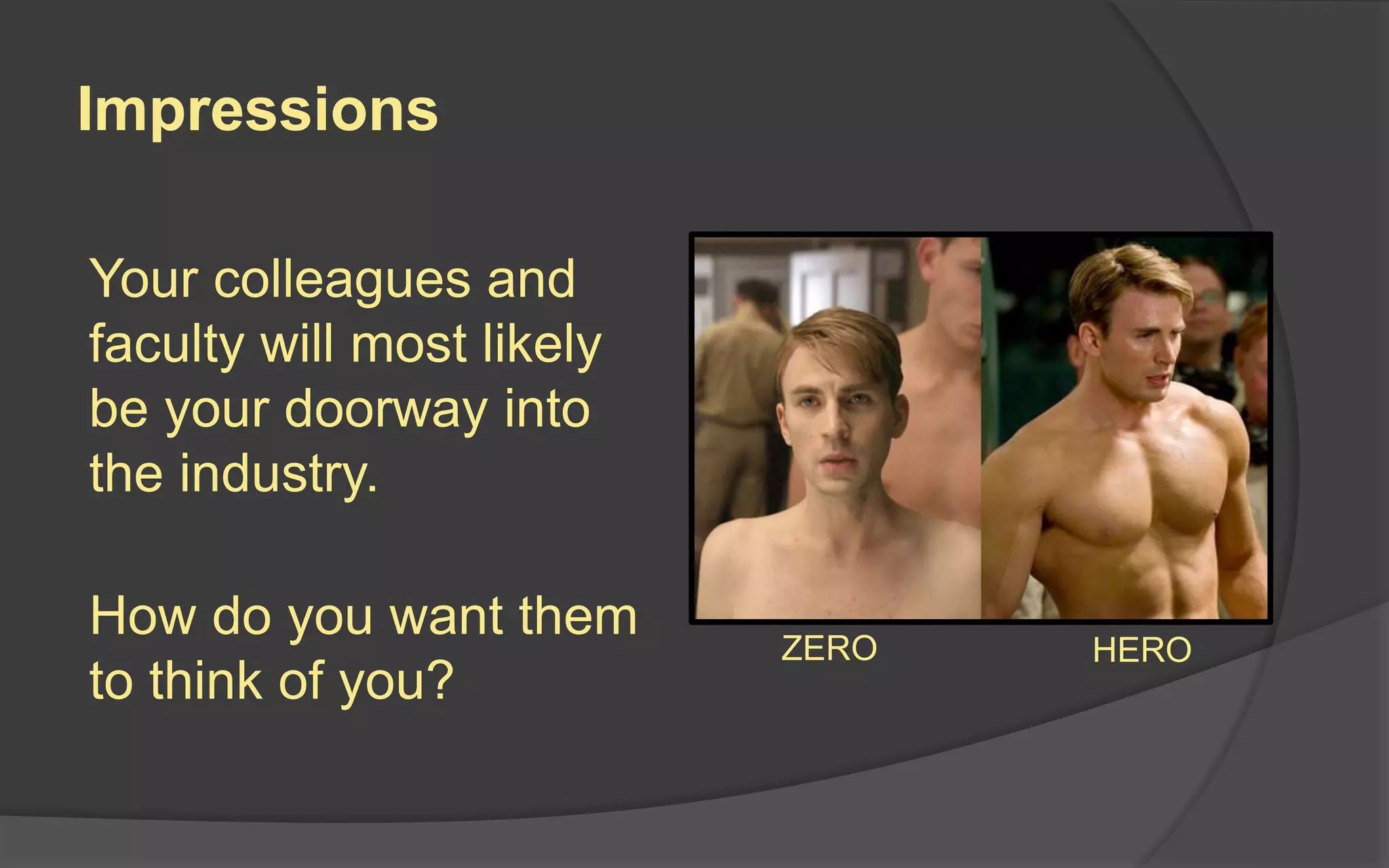
Impressions
Your colleagues and
faculty will most likely
be your doorway into
the industry.
How do you want them
to think of you?
ZERO HERO
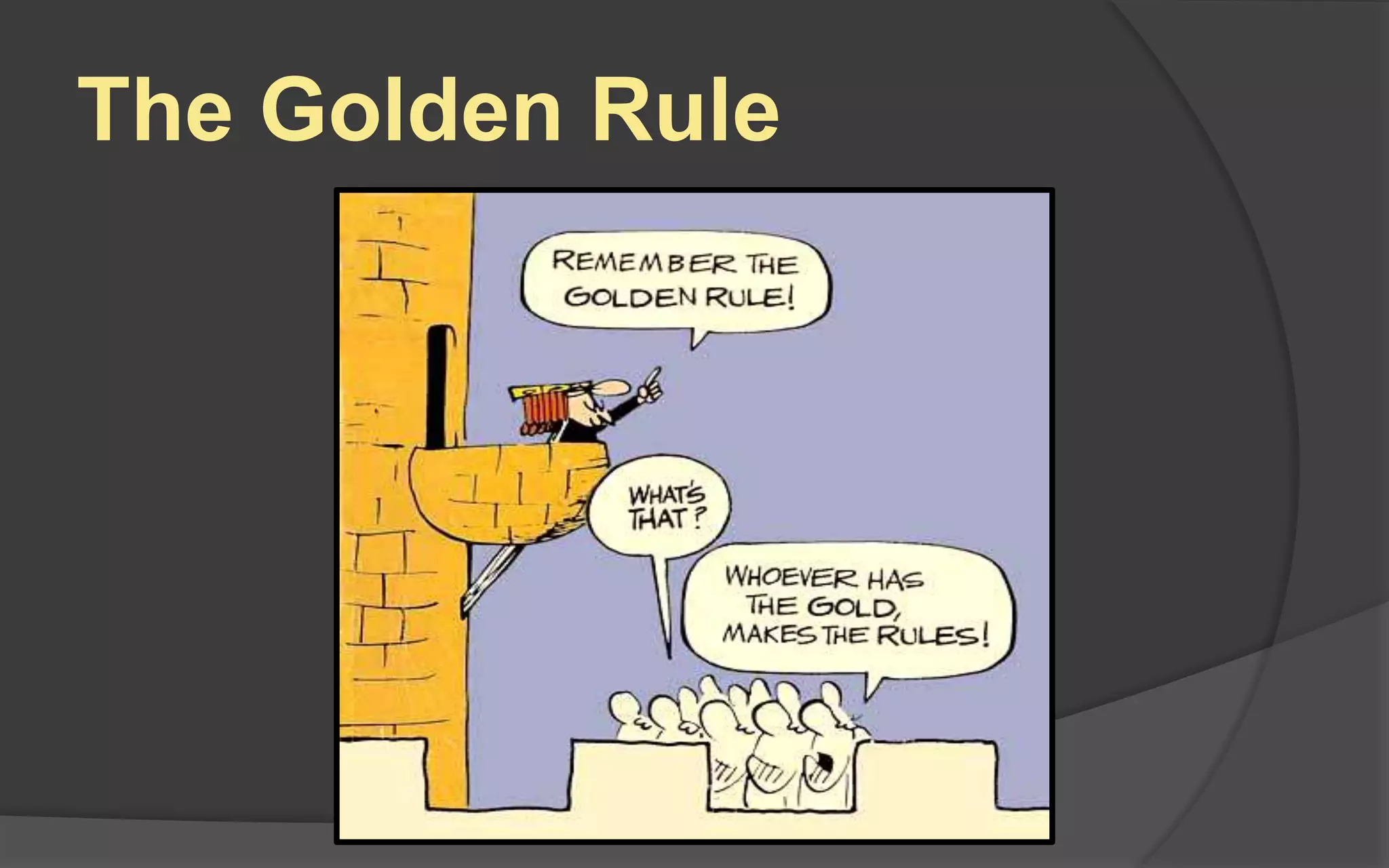
The Golden Rule
What Is A Game Mechanic?
Game Mechanic
 Action: What players actually do in the
game
 Purpose: The reason why players are
doing it
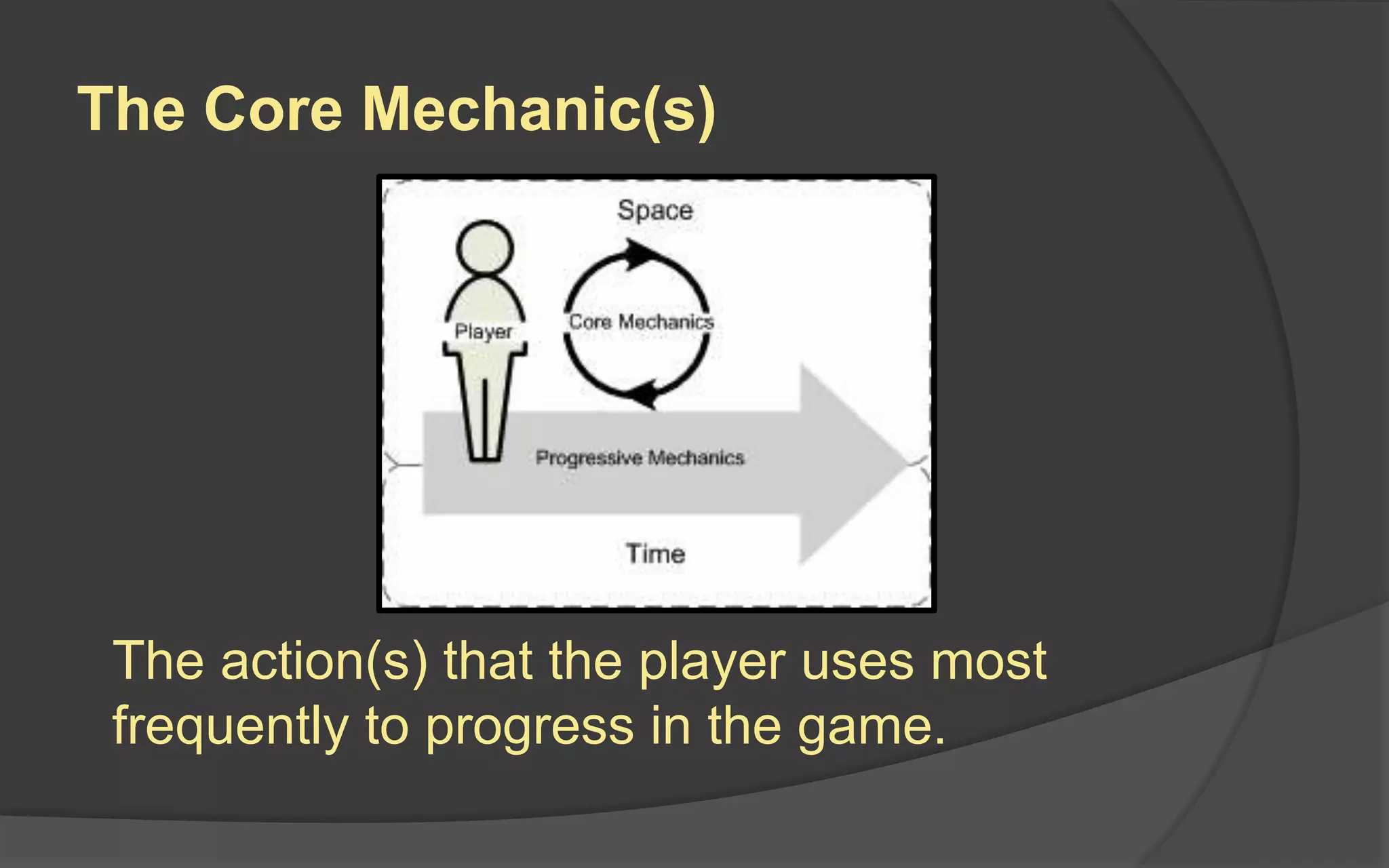
The Core Mechanic(s)
The action(s) that the player uses most
frequently to progress in the game.
Examples of Core Mechanics
Game Core Action Core Purpose
Chess Position pieces to capture opponent’s pieces
Candy Crush Match 3 pieces to destroy them
Tetris Rotate pieces to create lines
Super Smash Bros Attack to knock opponent back
Doom Run and shoot to kill enemies
World of Warcraft Kill to earn experience
 Write down an activity of any kind – related
to work, school, fun, chores, anything.
 Come up with a verb, based on this activity,
that you think would make a good basis for
a game.
 Identify:
 Core Action
 Core Purpose
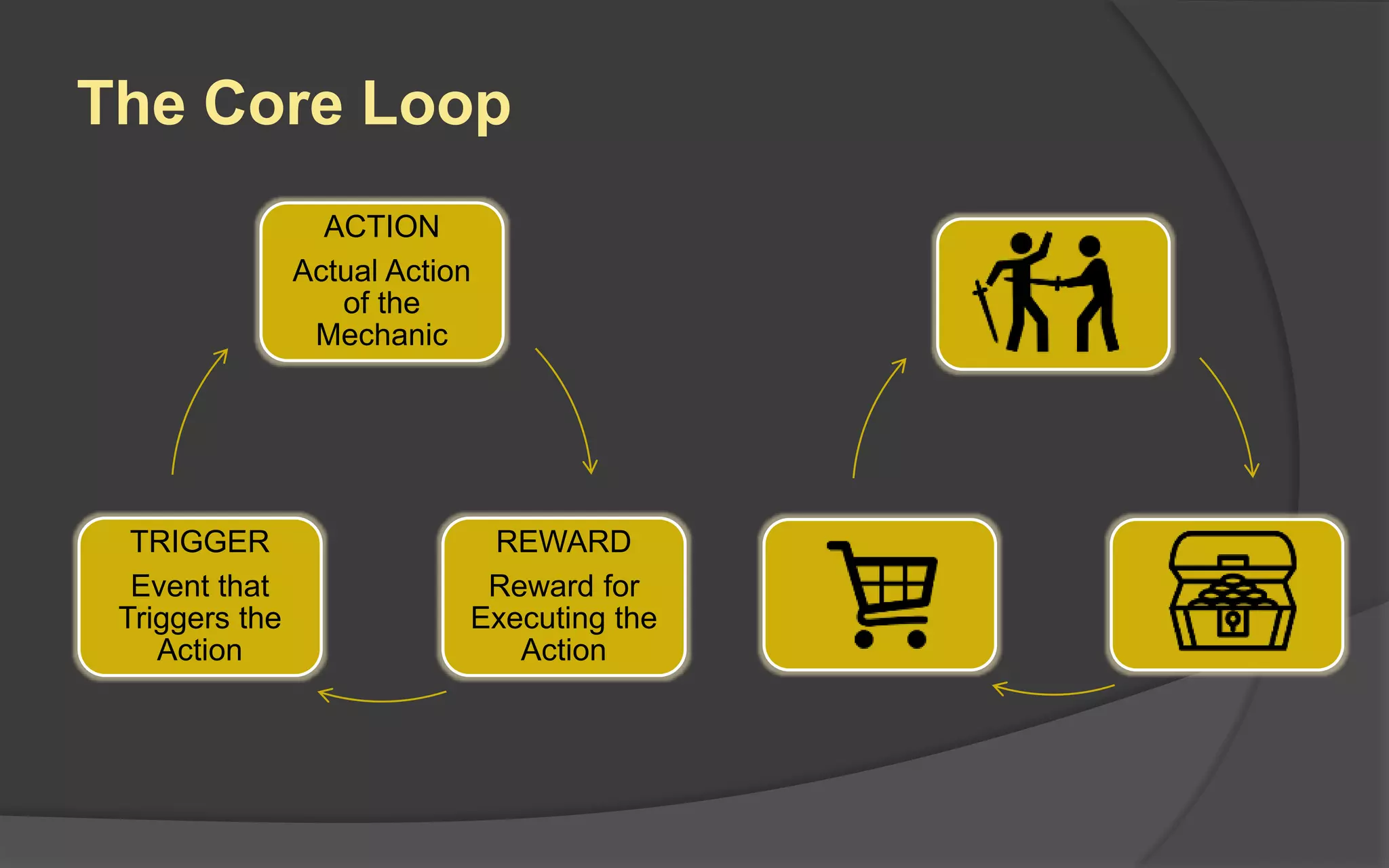
The Core Loop
ACTION
Actual Action
of the
Mechanic
REWARD
Reward for
Executing the
Action
TRIGGER
Event that
Triggers the
Action
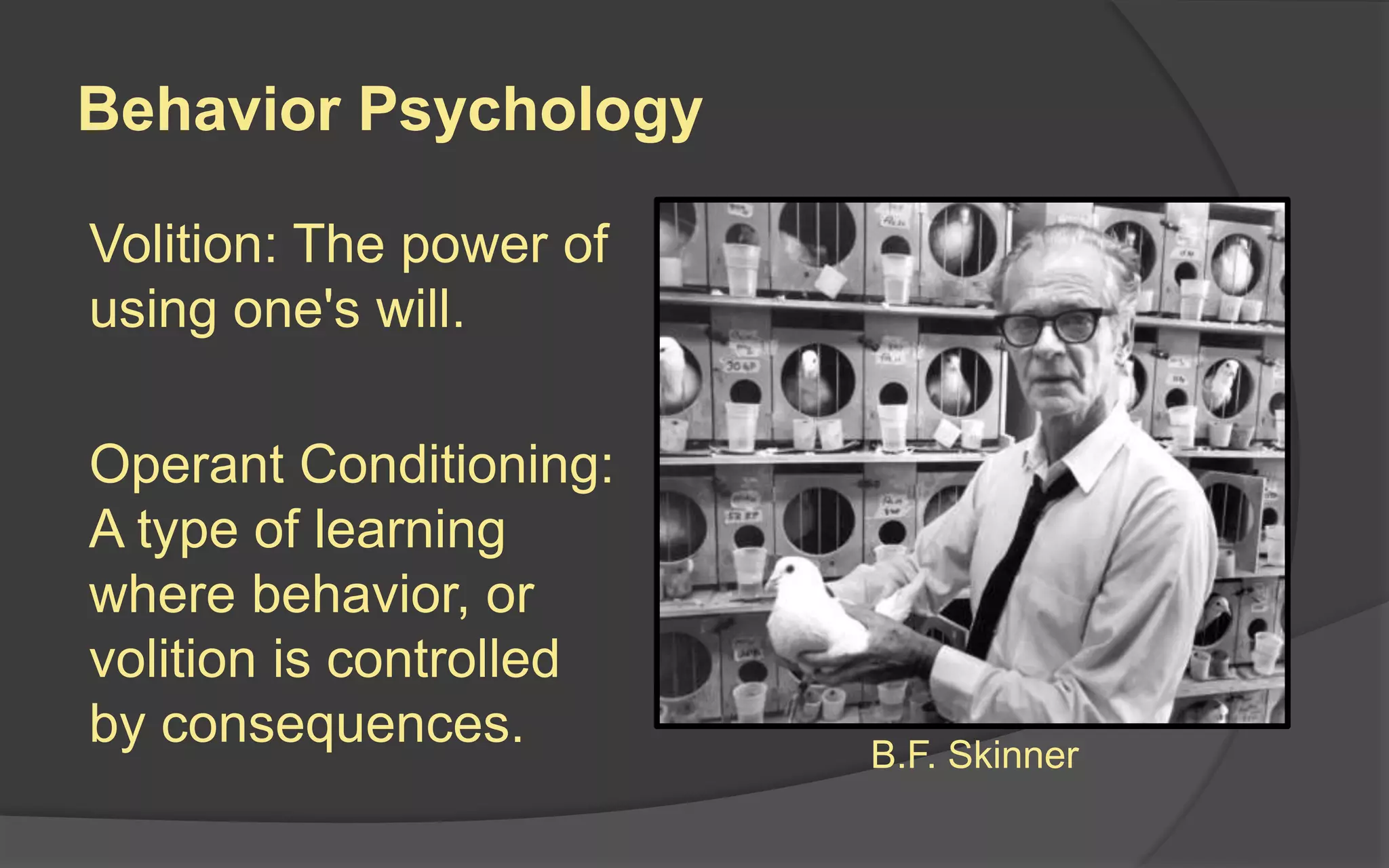
Behavior Psychology
Volition: The power of
using one's will.
Operant Conditioning:
A type of learning
where behavior, or
volition is controlled
by consequences. B.F. Skinner
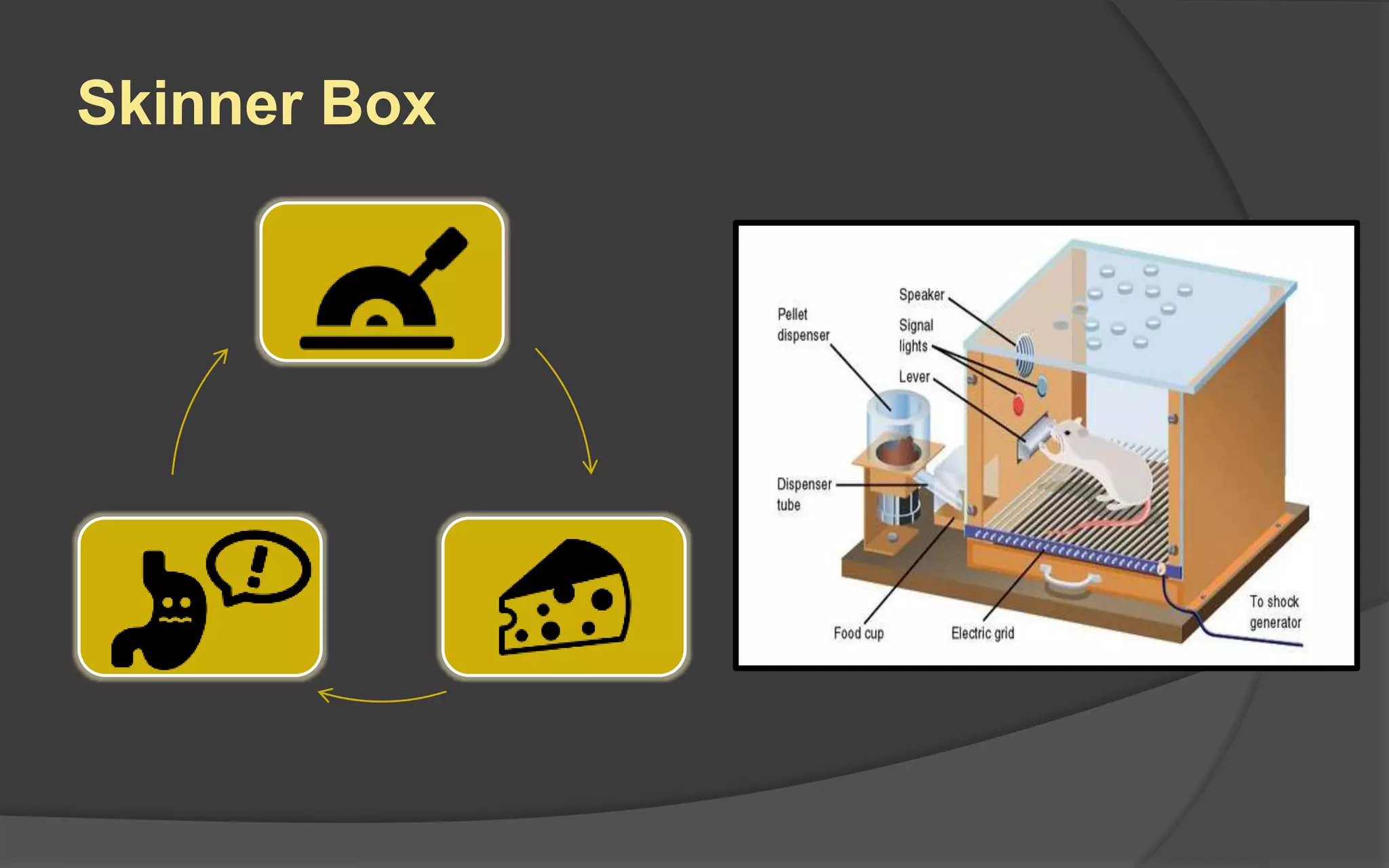
Skinner Box
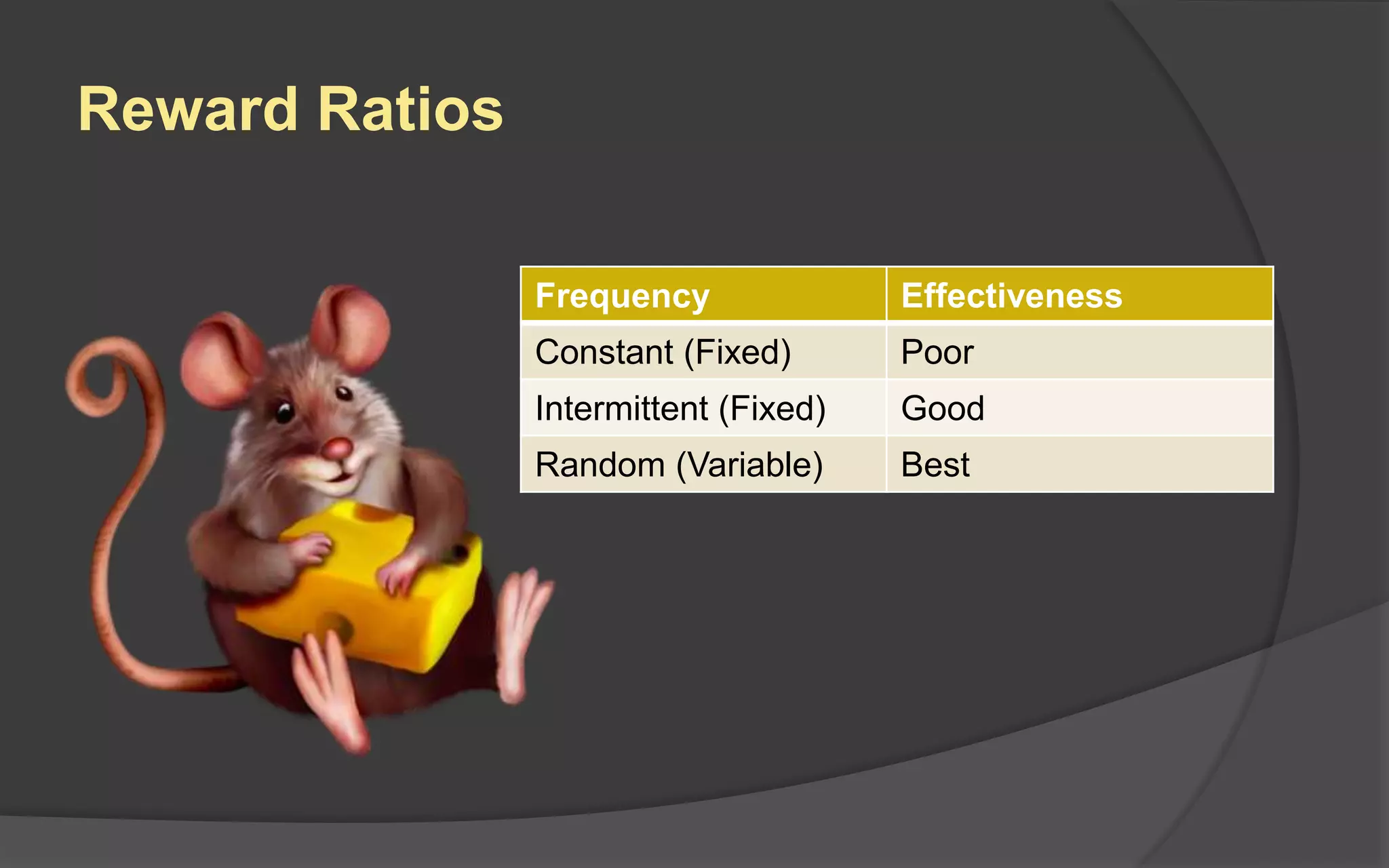
Reward Ratios
Frequency Effectiveness
Constant (Fixed) Poor
Intermittent (Fixed) Good
Random (Variable) Best
Does a fixed reward or a variable reward
produce the highest rate of activity?
Does Behavioral Conditioning Work On
People?
Reward Ratios In Games
A player must shoot down approximately 20
enemy fighters to gain an extra ship, but the
precise number is randomly generated each
time.
Reinforcement with Extrinsic
Rewards
 Primary Conditioners:
A reward that satisfies
a biological need.
 Secondary
Conditioners: A
reward associated
with a primary reward.
What Would Be A Primary And Secondary
Conditioner In Games?
Chain Schedule
What happens if there are multiple stages to
the reward?
Example: Kill 10 orcs and take each one’s loot
before entering the dragon’s cave, where it is
guarding a treasure.
Extinction
What happens if you stop providing the
reward?
Example: The player suddenly stops
receiving gold for killing orcs.
Avoidance
What happens if the reward is to keep bad
things from happening?
 Ultima Online: Visit house to prevent
decay.
 Farmville: Harvest crops before they wither.
Behavioral Contrast
What happens if expectations change?
 Player receives 1 gold coin for killing orcs, and
then later starts receiving 10 gold cold coins.
 Reward is then switched back from 10 gold coins
to 1 gold coin.
The Skinner Box
Extra Credits: How Games Condition Us To Play More
What Was The Main Message Of This
Video?
What Are Better Ways Of Fostering
Engagement in Games?
Intrinsic Rewards
 Flow
 Mental Challenge
 Mastery
 Mystery
 Narrative
 Novelty
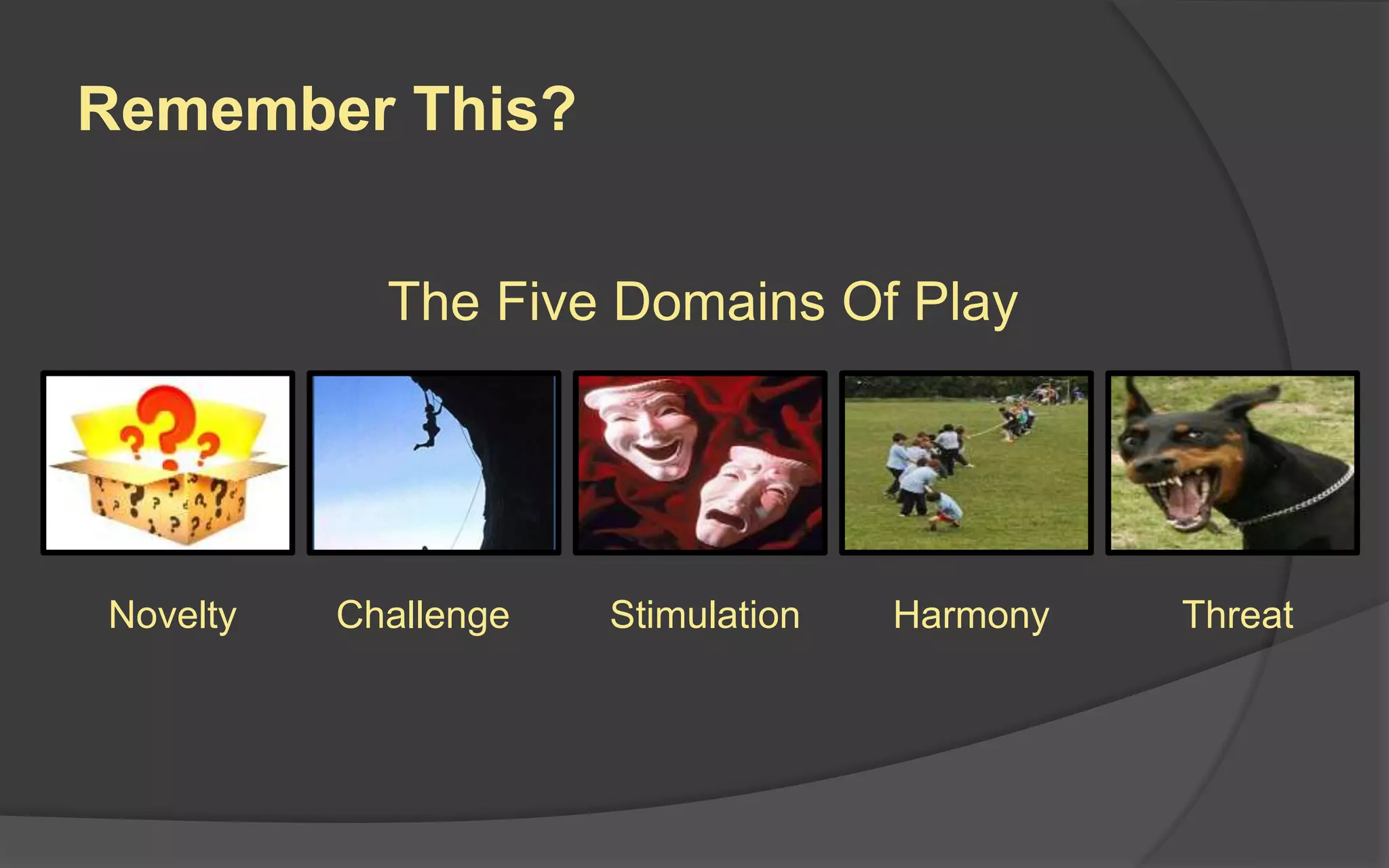
Remember This?
Novelty
The Five Domains Of Play
Challenge Stimulation Harmony Threat
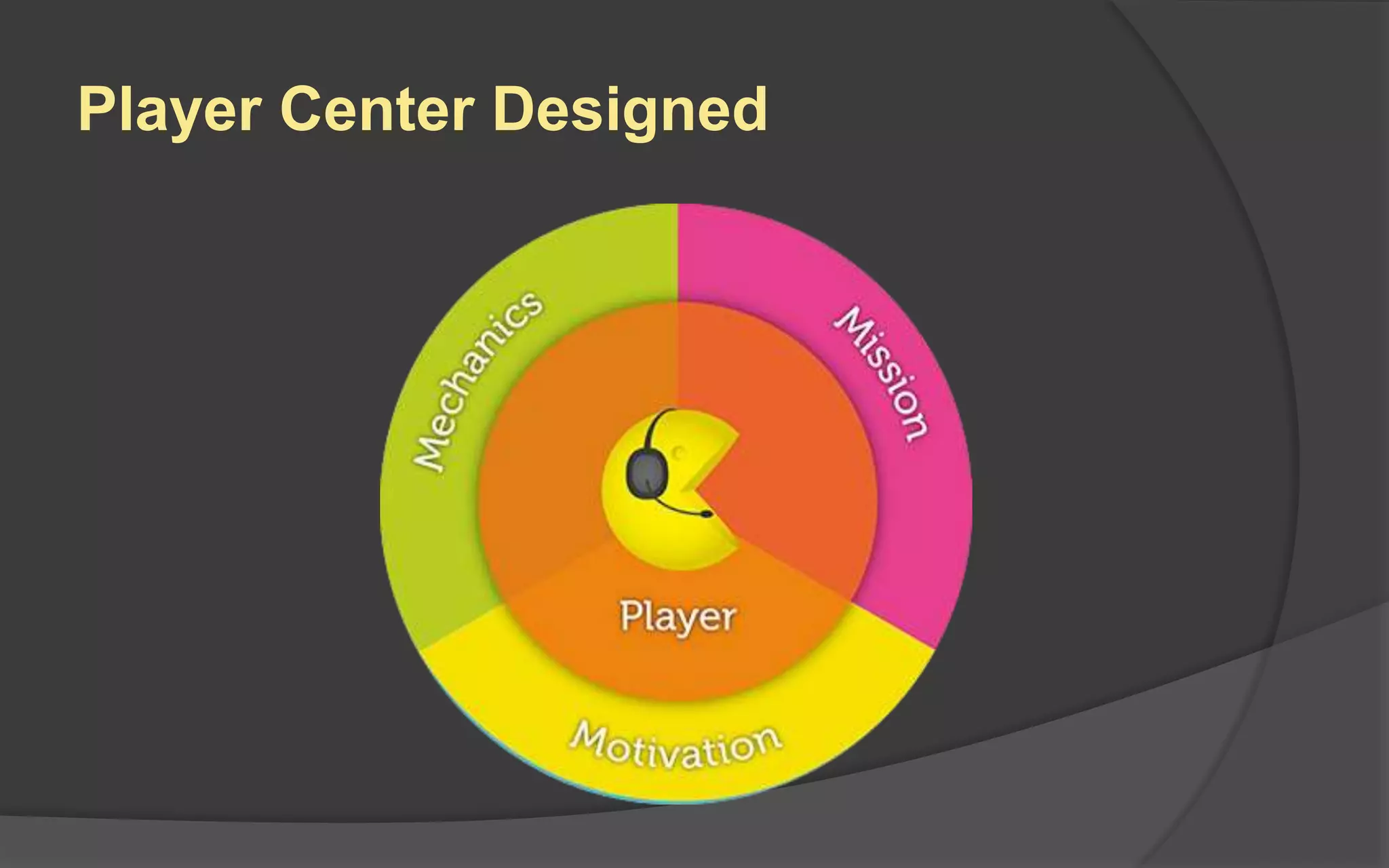
Player Center Designed
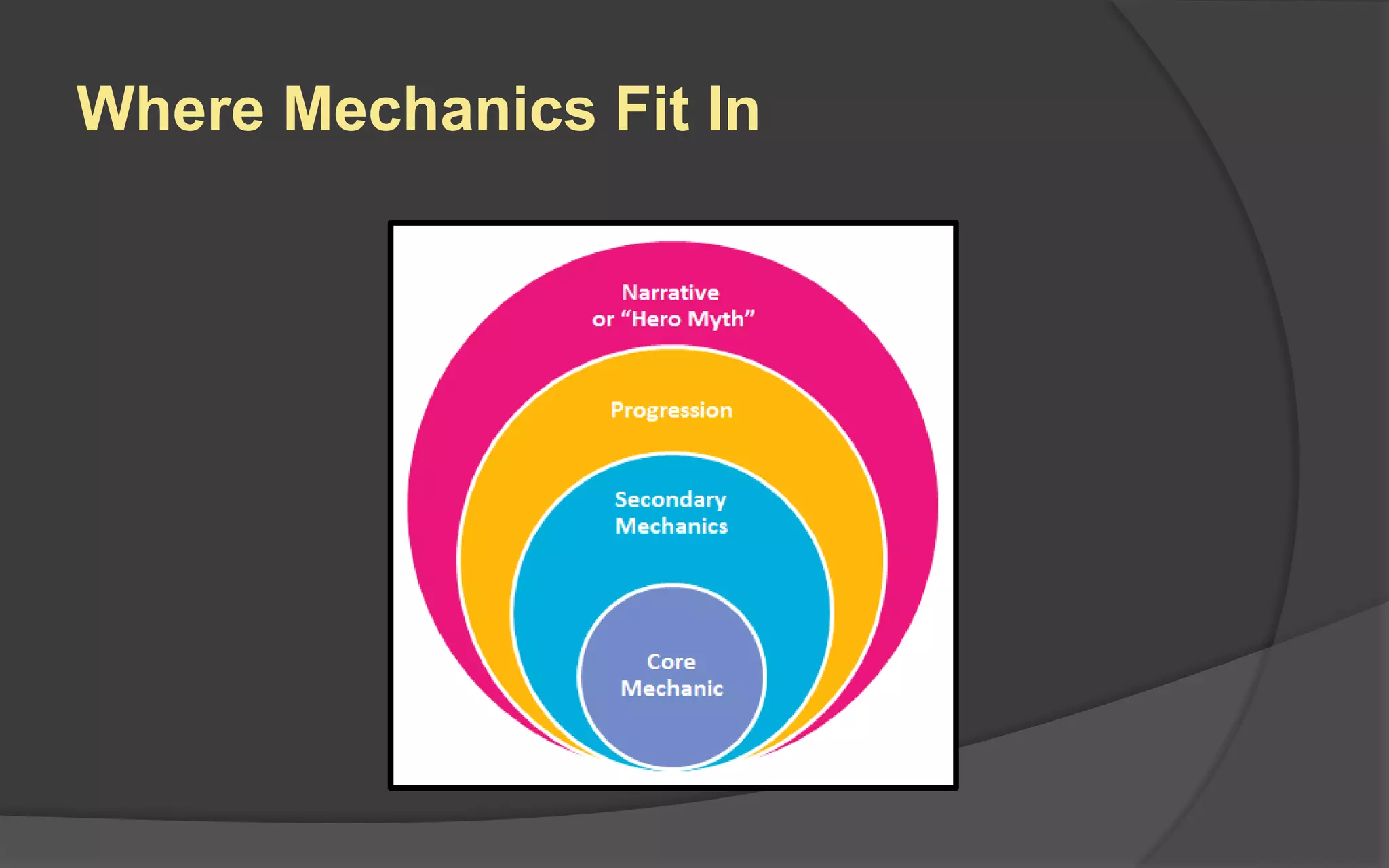
Where Mechanics Fit In
Mechanics and Structure Elements
Mechanics:
 Allowed by Procedures
 Follow Rules
 Consume or Produce Resources
 Impeded by Challenge
 Occur within Boundaries
Procedures
 Starting Action
 Progression of Action
 Special Actions
 Resolving Actions
Rules Affect Procedures
Rules Limit Actions
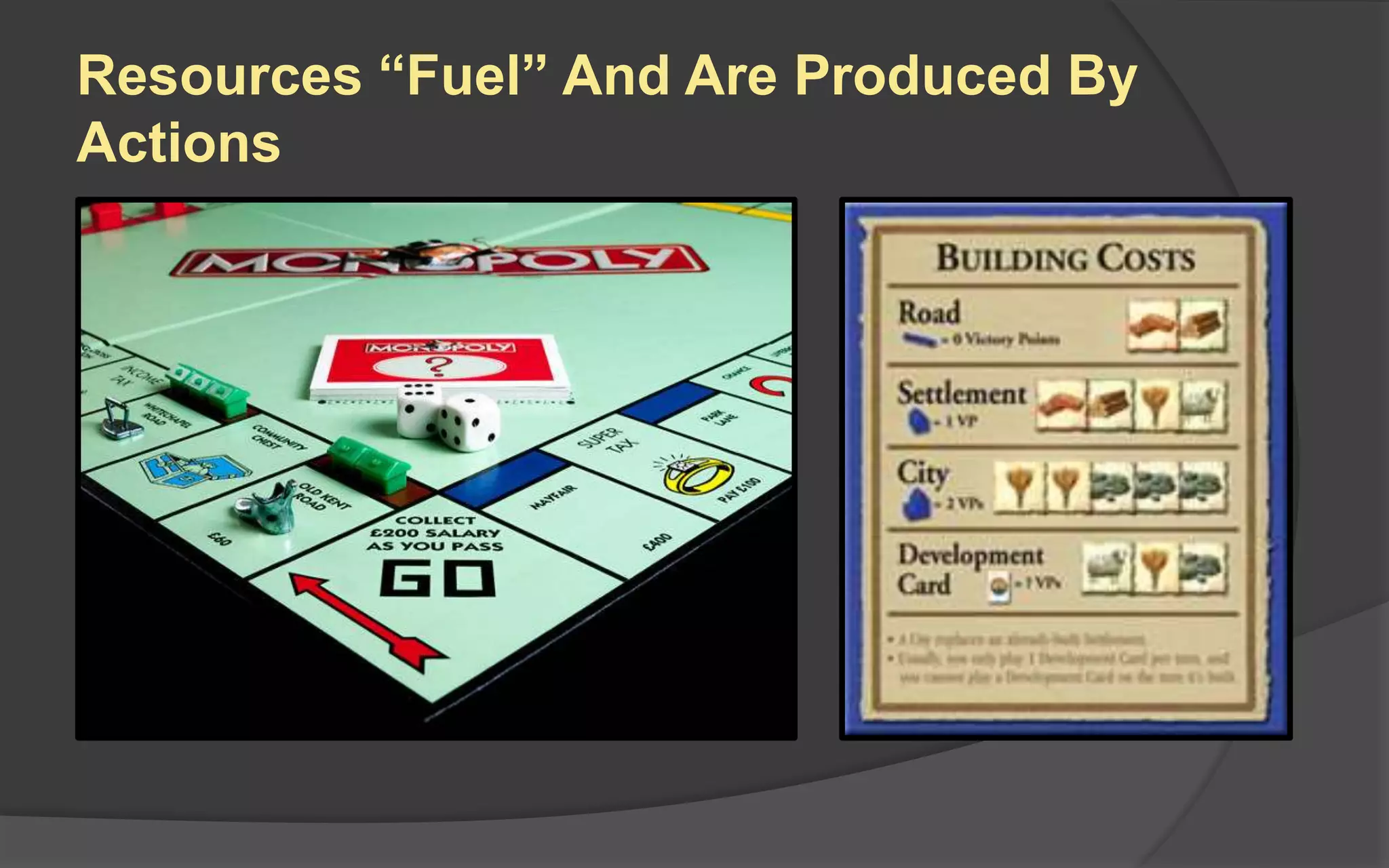
Resources “Fuel” And Are Produced By
Actions
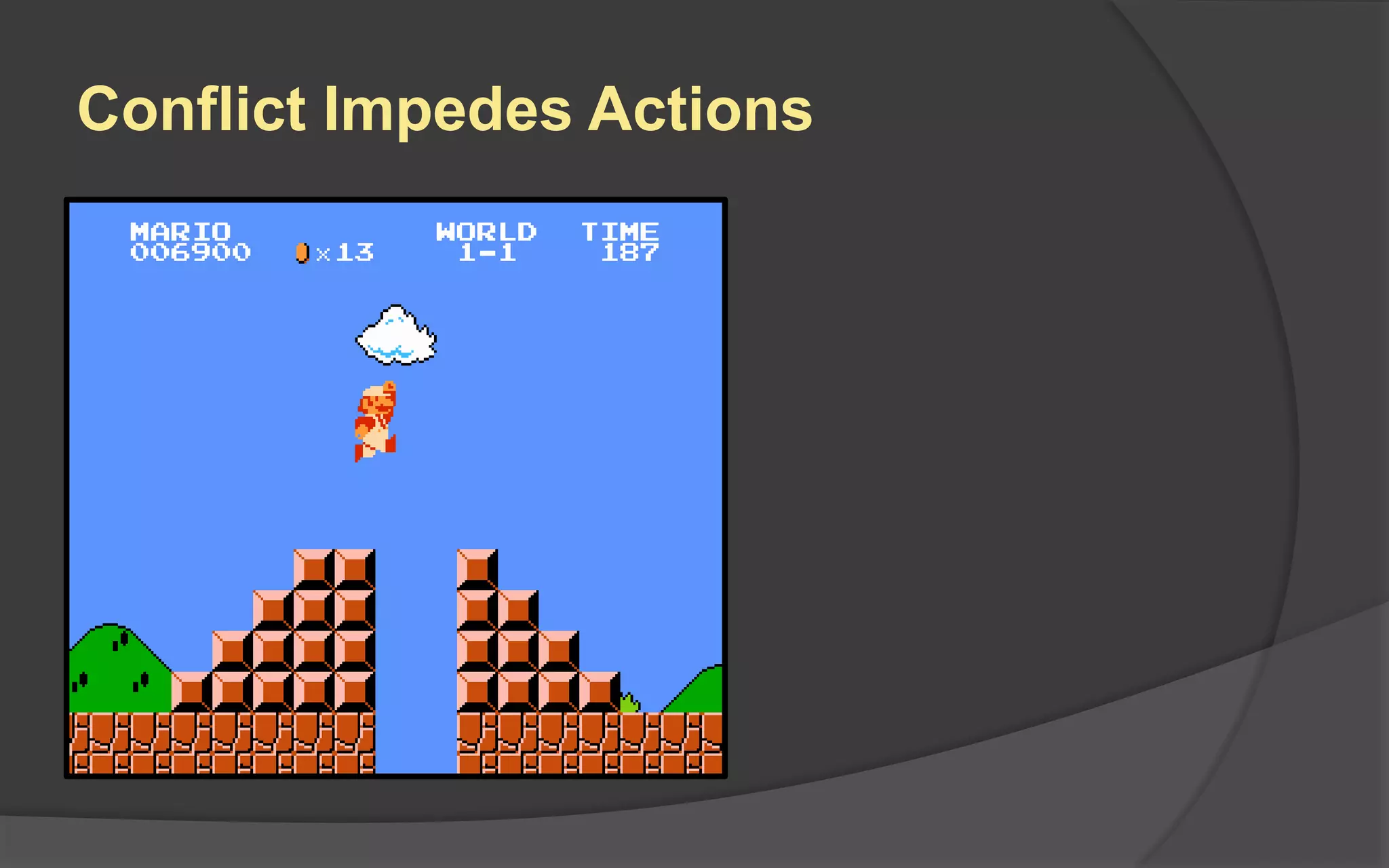
Conflict Impedes Actions
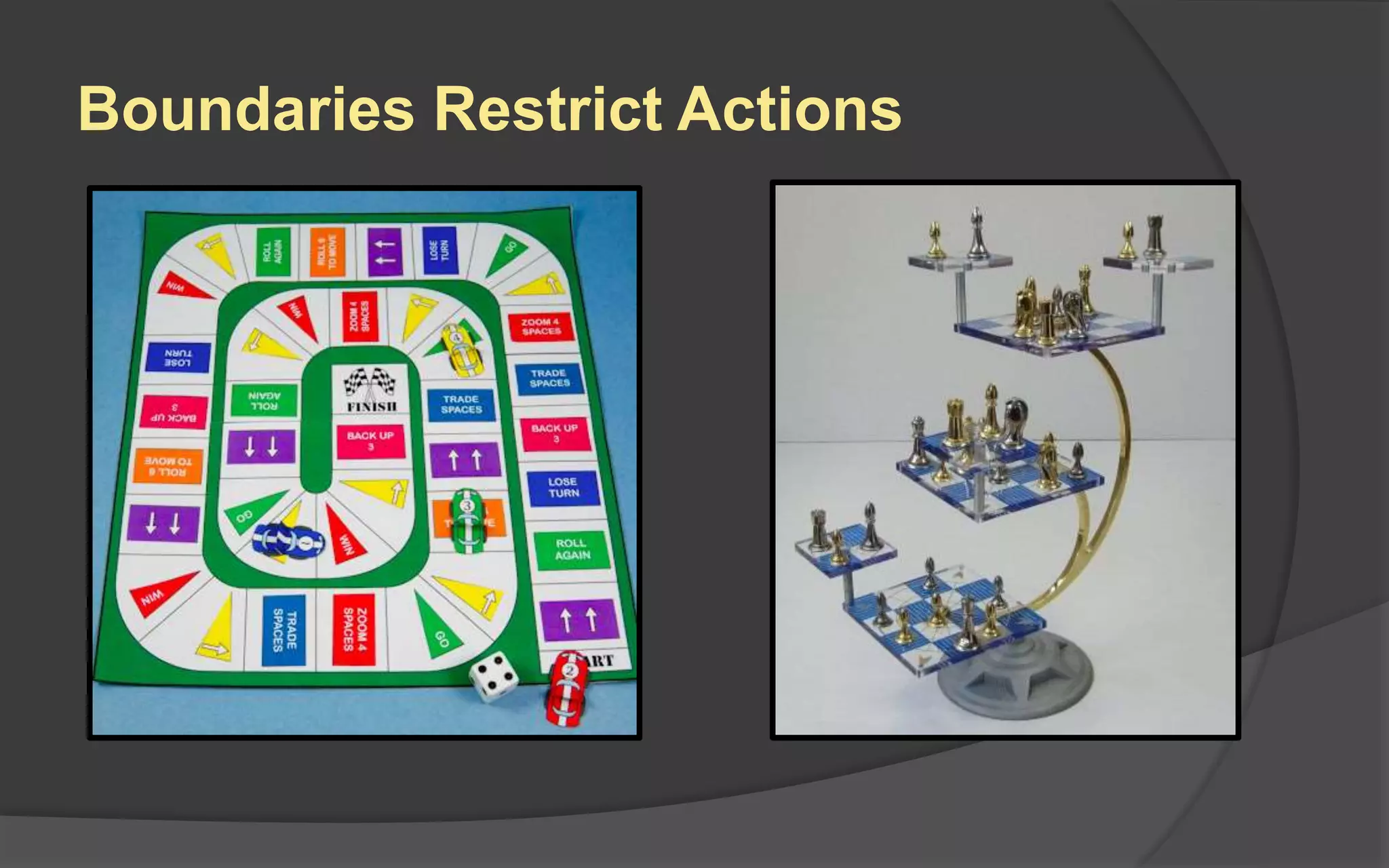
Boundaries Restrict Actions
Movement
The action of moving game elements within
the game boundaries.
Why Designers Use Movement
 Game World Navigation
 Progress Indicator
 Dexterity-Based Actions
 Puzzle Solving
 Supports Race, Capture, Stealth, Herd,
Delivery, Traverse, Collection goals
Movement Design Characteristics
 What Can Move?
 How Does It Move?
 What Can Enhance
Movement?
 What Can Limit
Movement?
Design Analysis: Movement Characteristics
Focus Loci
The game elements through which the
player’s actions are taken.
In-World
Avatars
In-World
Units
Beyond
World
God’s
Finger
Physical
Component
s
Cards, Dice
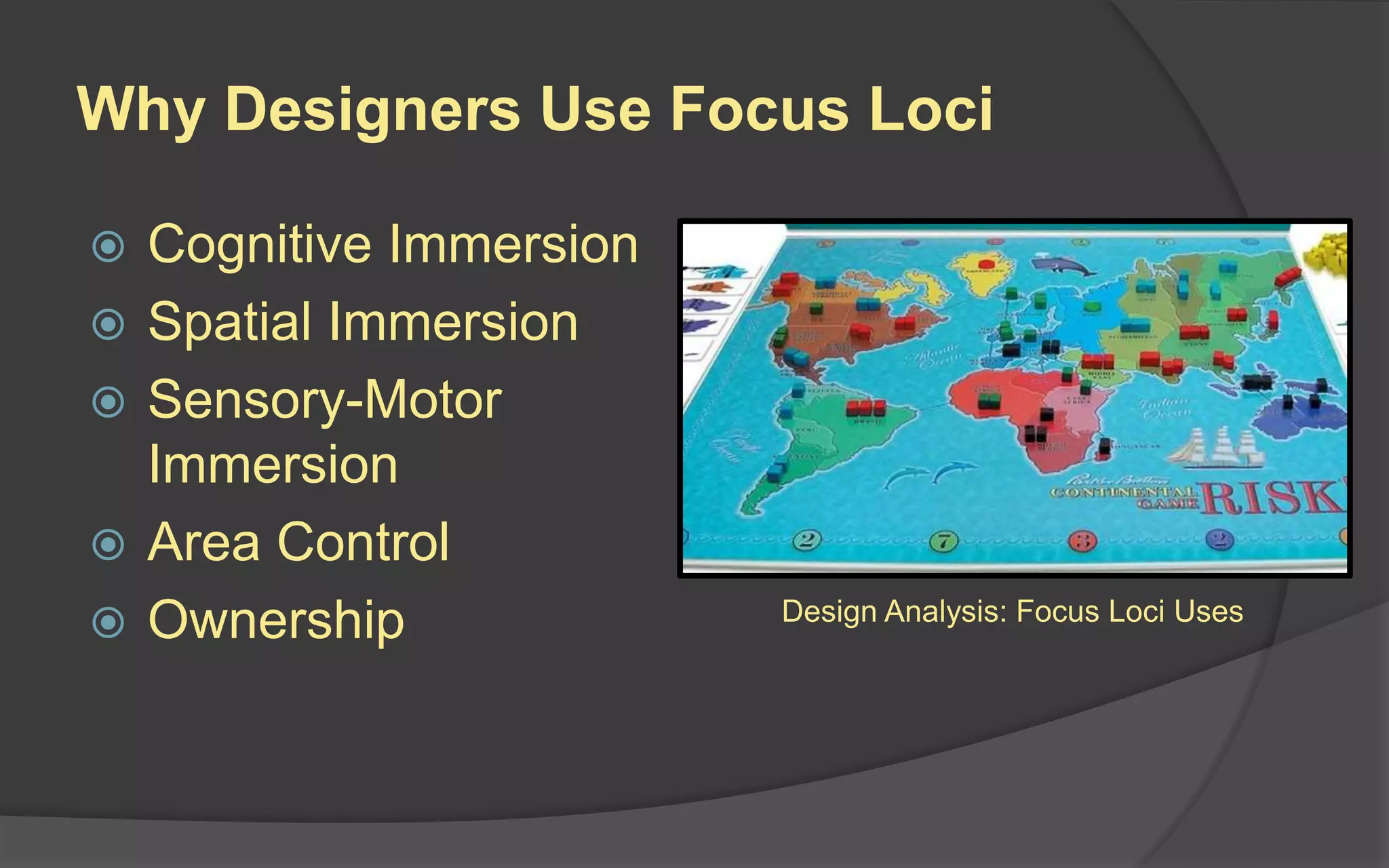
Why Designers Use Focus Loci
 Cognitive Immersion
 Spatial Immersion
 Sensory-Motor
Immersion
 Area Control
 Ownership Design Analysis: Focus Loci Uses
Focus Loci Design Characteristics
 In/Beyond World
 Number
 Actions
 Attributes
 Persistence
 Camera Perspective
(Avatars)
 Personality (Avatars)
Design Analysis: Focus Loci
Characteristics
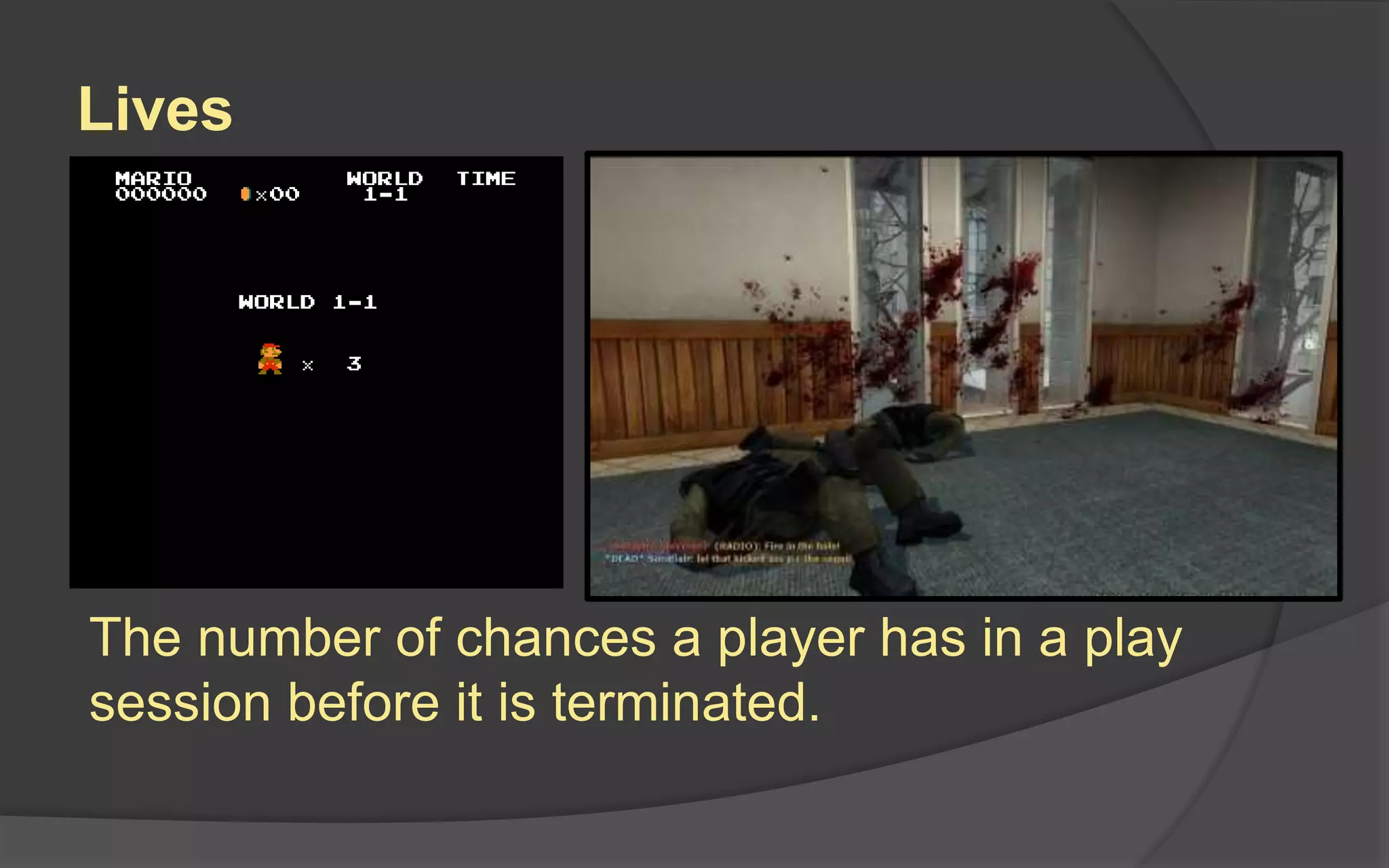
Lives
The number of chances a player has in a play
session before it is terminated.
Why Designers Use Lives
 Balance Game Elements:
 Threat
 Combat
 Session Length
 Balance Game Goals:
 Survival
 Last Man Standing
 King of the Hill (with elimination)
Life Design Characteristics
 Causes for Loss
 Consequences
 Number of Lives
 Replenishment
Design Analysis: Lives Characteristics
Obstacles
Game elements that hinder players from
taking the shortest route in the game.
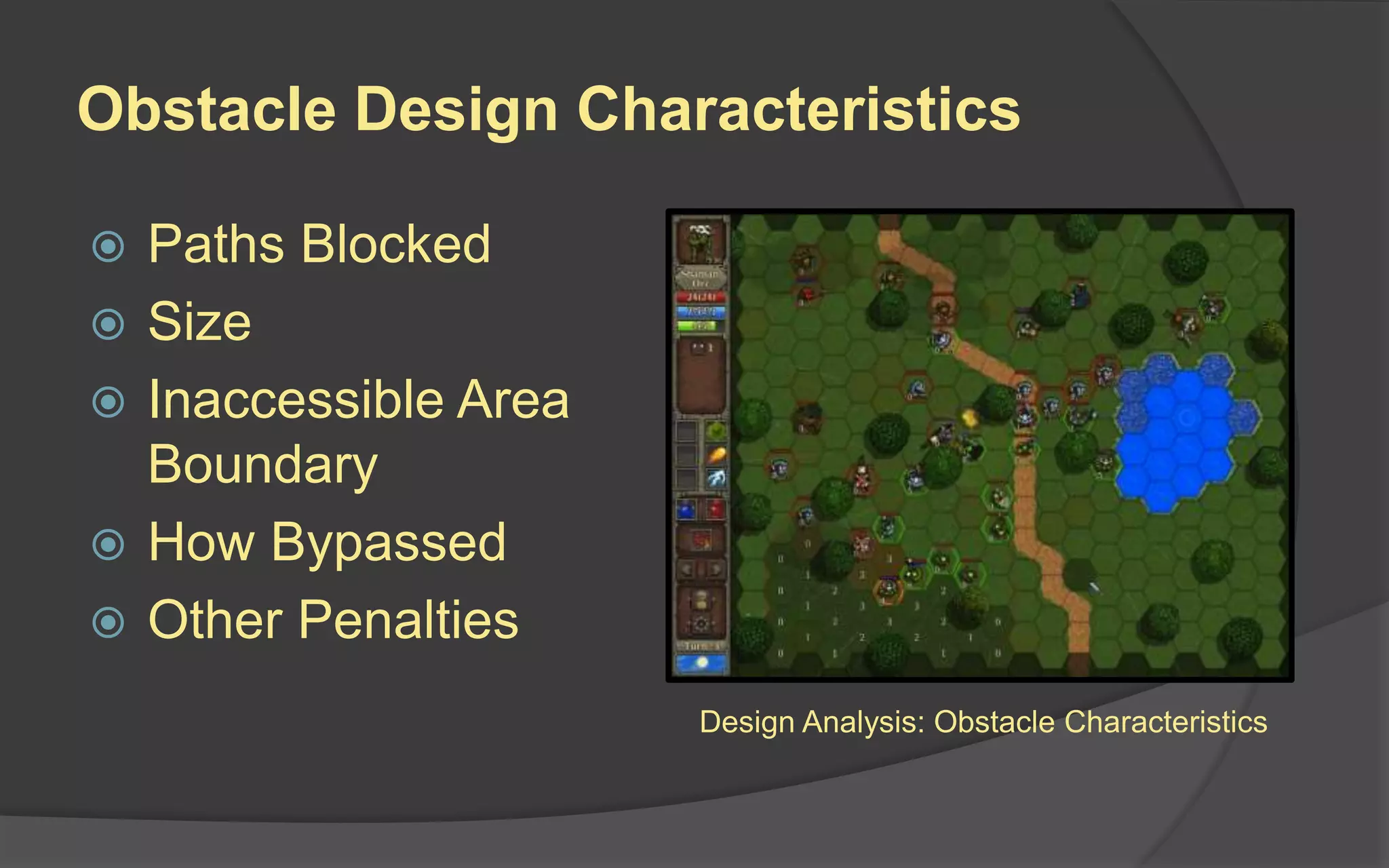
Obstacle Design Characteristics
 Paths Blocked
 Size
 Inaccessible Area
Boundary
 How Bypassed
 Other Penalties
Design Analysis: Obstacle Characteristics
Why Designers Use Obstacles
 Game World Navigation Paths
 Non-Deadly Movement Limitations
Deadly Traps
Game events that kill avatars and units if they
are within the trap’s area of effect.
Deadly Trap Design Characteristics
 Effects
 Time Delay
 Detection
 Trap is visible and effects are
clear
 Trap and effects can be
detected by examination
 Trap and effects can’t be
detected before activation
Design Analysis: Deadly Trap
Characteristics
Why Designers Use Deadly Traps
 Deadly Movement Limitations
 Inaccessible Area Limitations
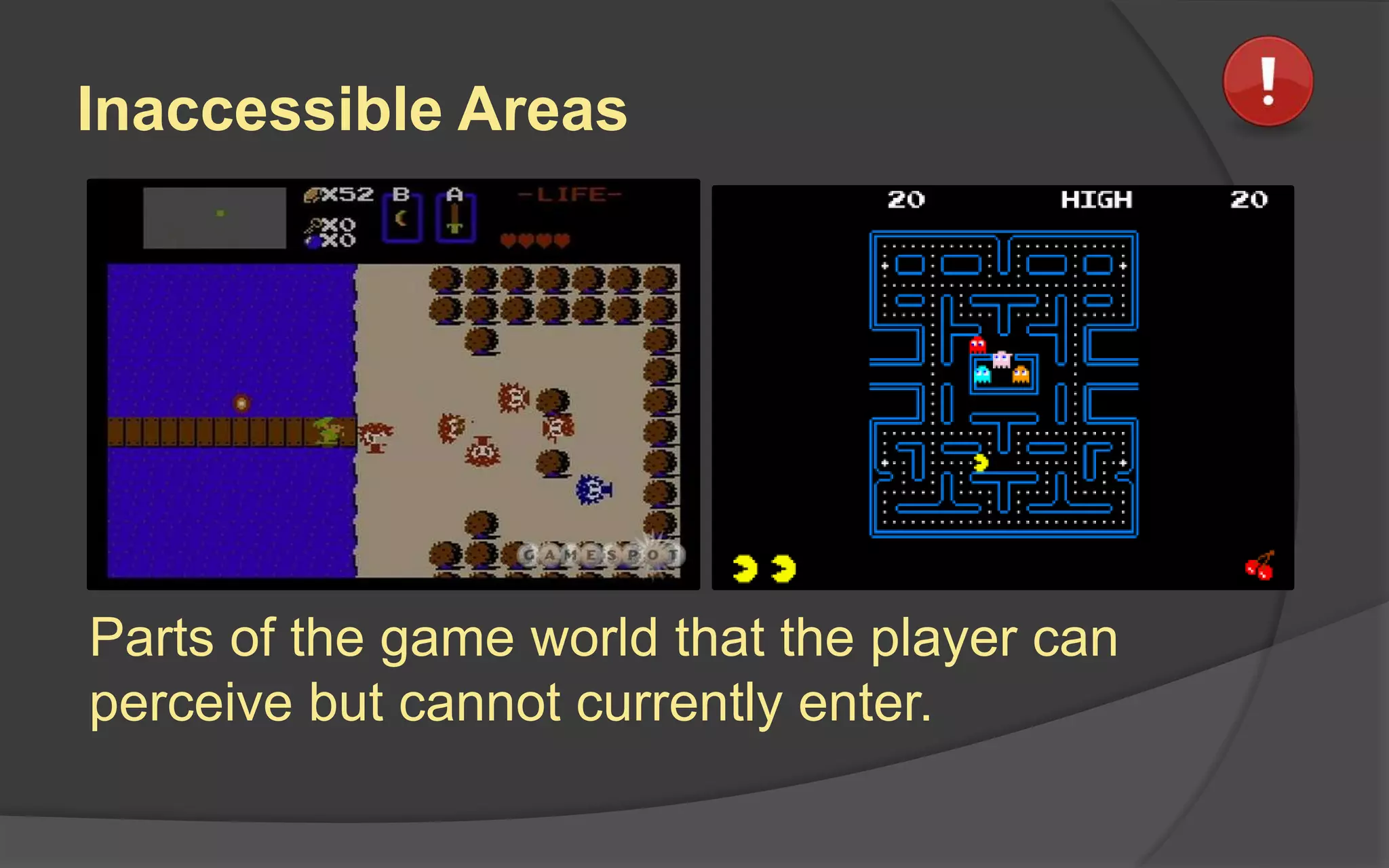
Inaccessible Areas
Parts of the game world that the player can
perceive but cannot currently enter.
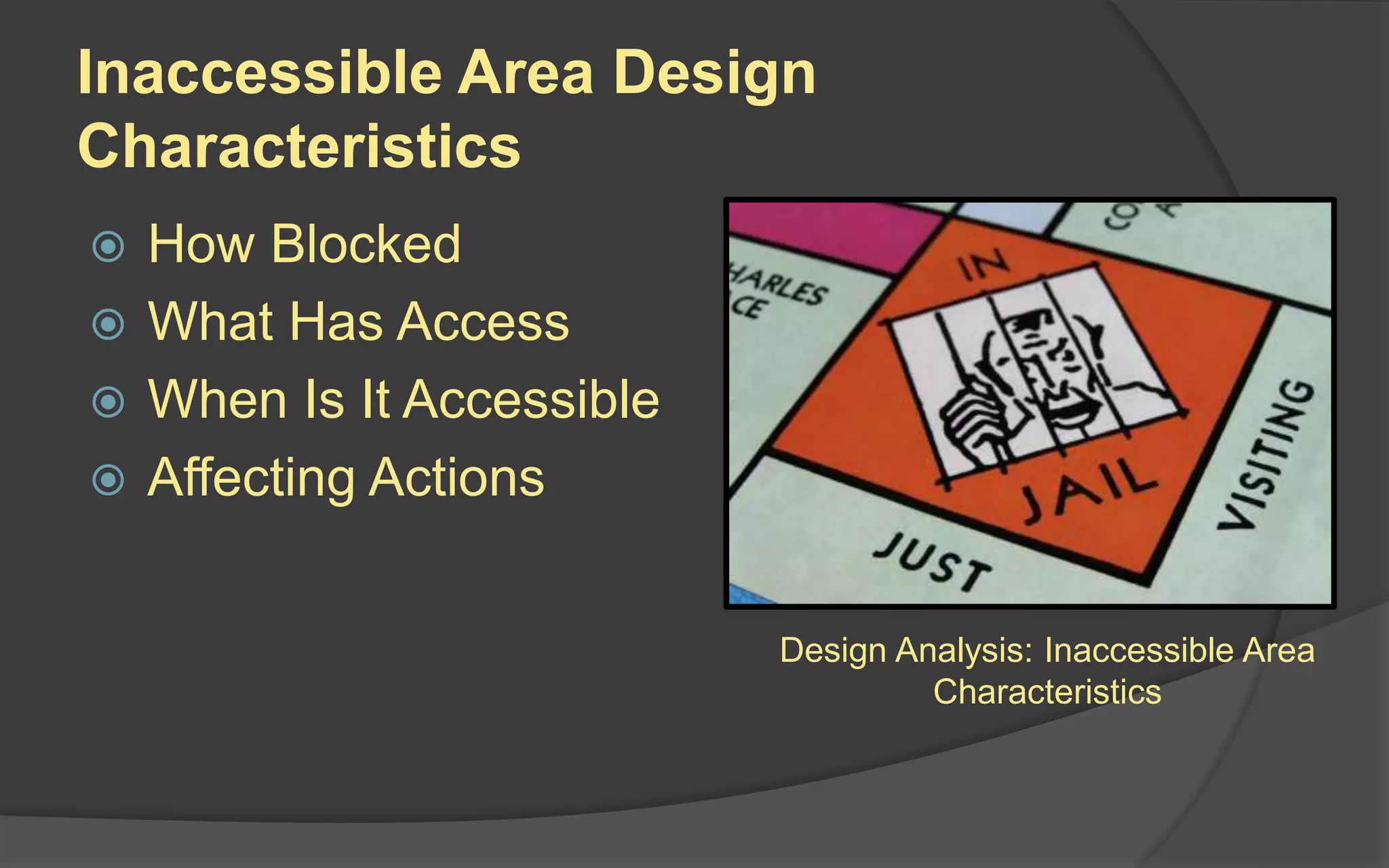
Inaccessible Area Design
Characteristics
 How Blocked
 What Has Access
 When Is It Accessible
 Affecting Actions
Design Analysis: Inaccessible Area
Characteristics
Why Designers Use Inaccessible
Areas
 Movement Limitations
 Enlarge Game World
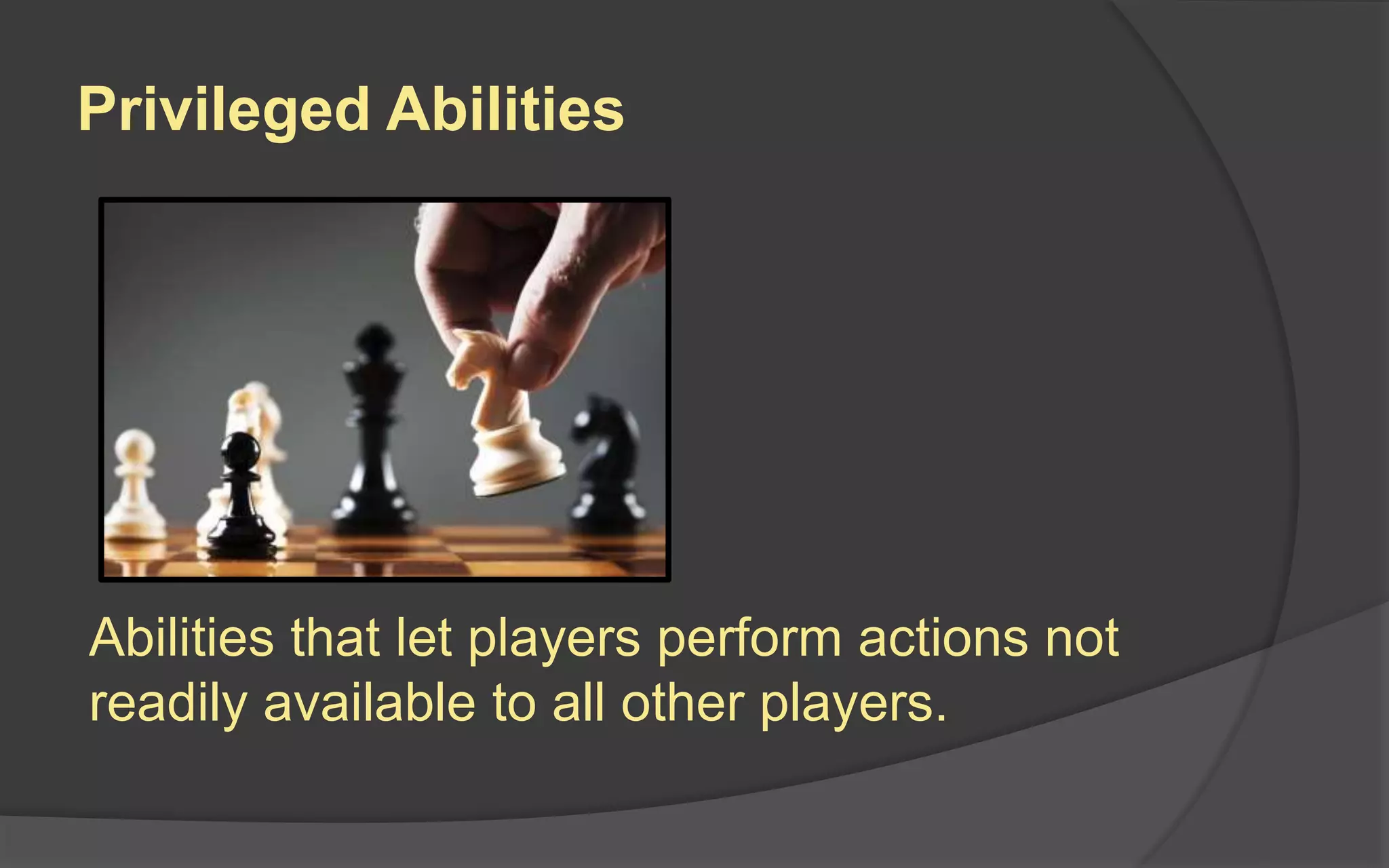
Privileged Abilities
Abilities that let players perform actions not
readily available to all other players.
Timing of Privileged Actions
 Beginning of Game or Turn
 During Game or Turn
 During Particular Time Intervals
 With Power-Ups and Other Game
Elements
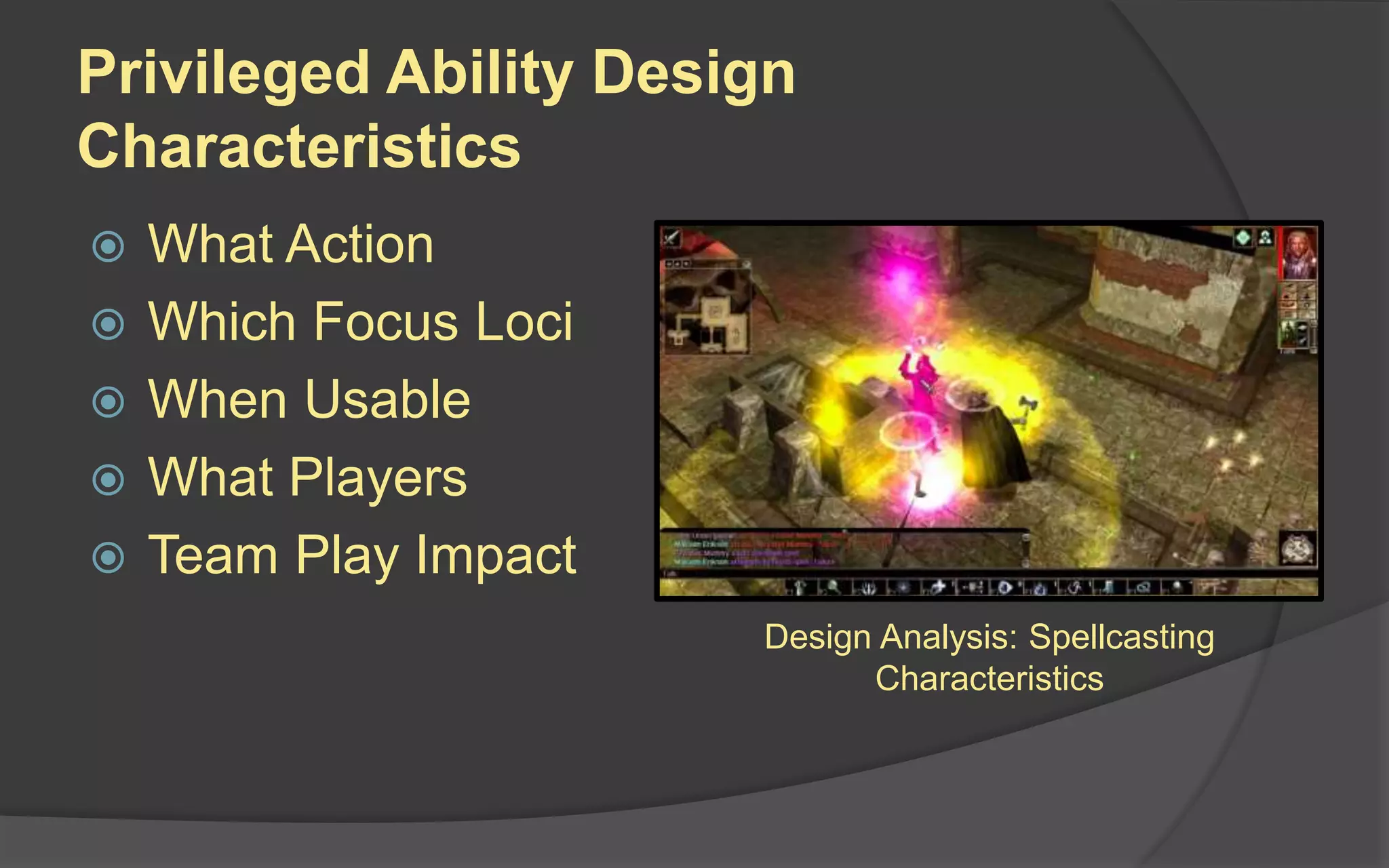
Privileged Ability Design
Characteristics
 What Action
 Which Focus Loci
 When Usable
 What Players
 Team Play Impact
Design Analysis: Spellcasting
Characteristics
Why Designers Use Privileged
Abilities
 Balances Movement, Combat, and
Construction
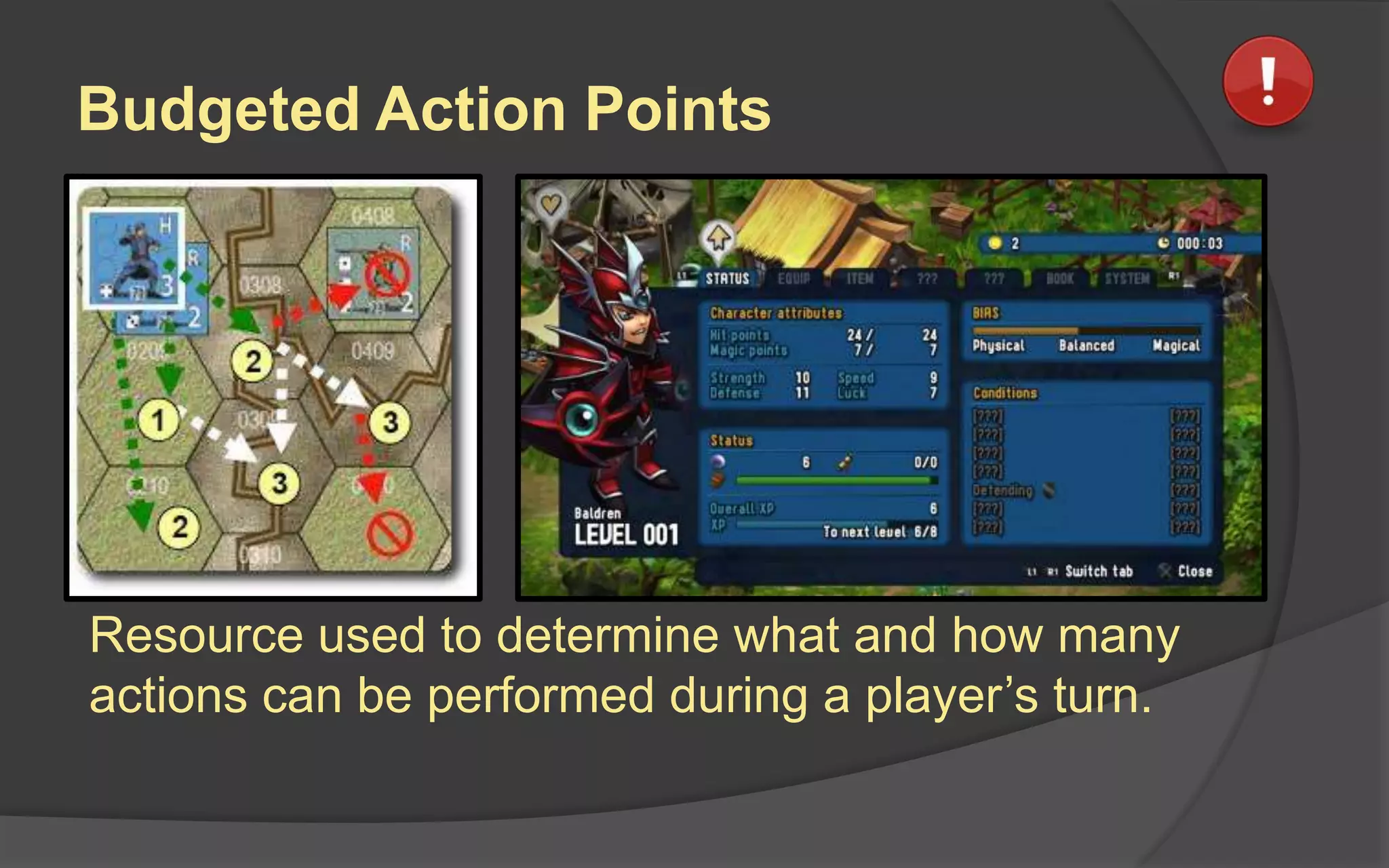
Budgeted Action Points
Resource used to determine what and how many
actions can be performed during a player’s turn.
Budgeted Action Points Design
Characteristics
 Actions
 How Budgeted
Design Analysis: Budget Action Points
Characteristics
Why Designers Use Budgeted Action
Points
 Balance Movement
 Balance Privileged Abilities
Survive
Trying to avoid being killed by the actions of
other players and events in the game.
Survive Goal Characteristics
 Surviving Elements
 Danger
 Avoidance
 Consequences of Death
 Lives Design Analysis: Survival
Characteristics
Traverse
The goal to try to move a game element from
one position in the game to another.
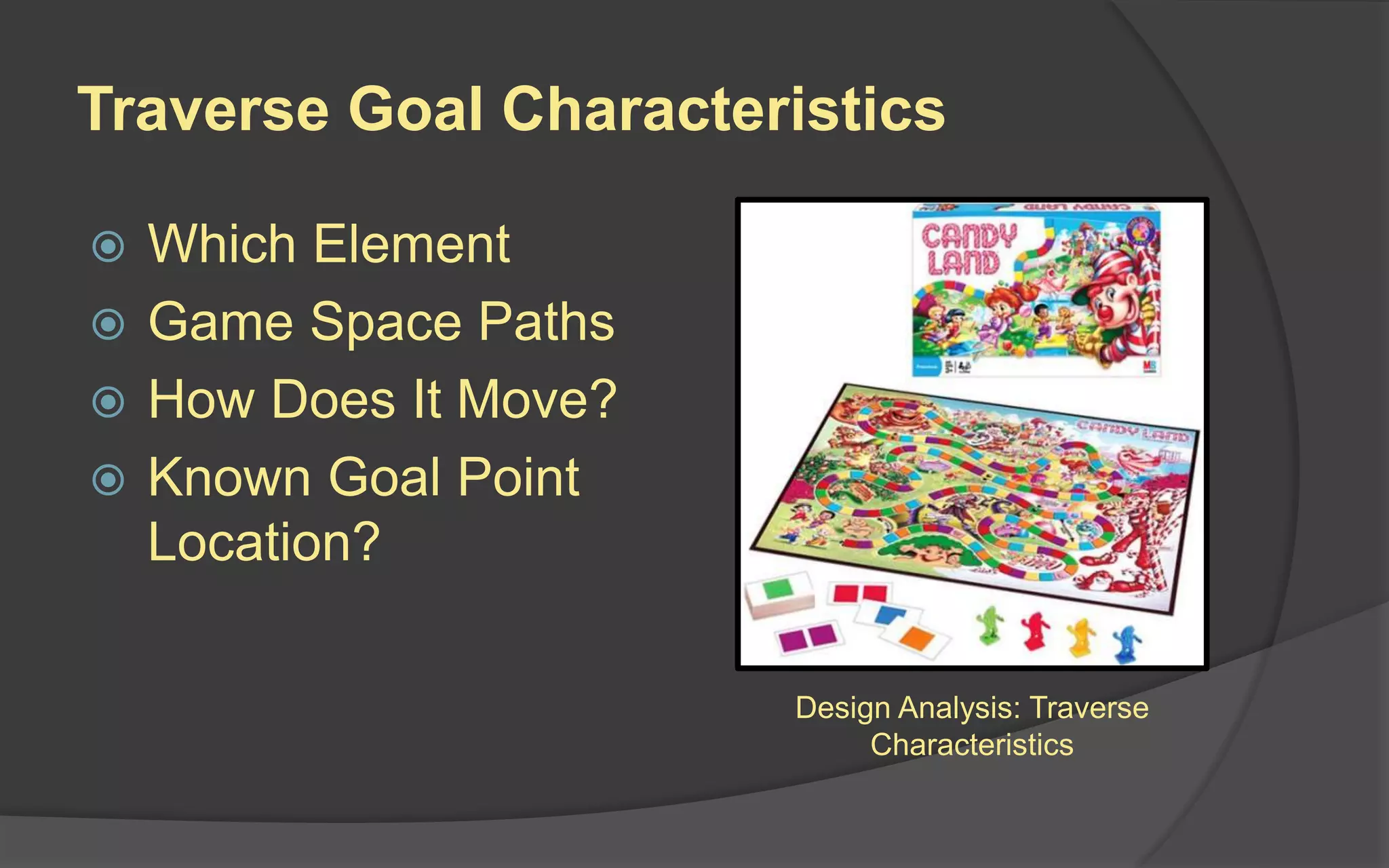
Traverse Goal Characteristics
 Which Element
 Game Space Paths
 How Does It Move?
 Known Goal Point
Location?
Design Analysis: Traverse
Characteristics
Choose one of the following games to play:
 En Garde (2p, 20-30m)
 Forbidden Desert (2-5p, 45m) *
 Hey, That’s My Fish! (2-4p, 20m)
 Lost Cities (2-6p, 30-60m)
 Space Alert (1-5p, 30m)
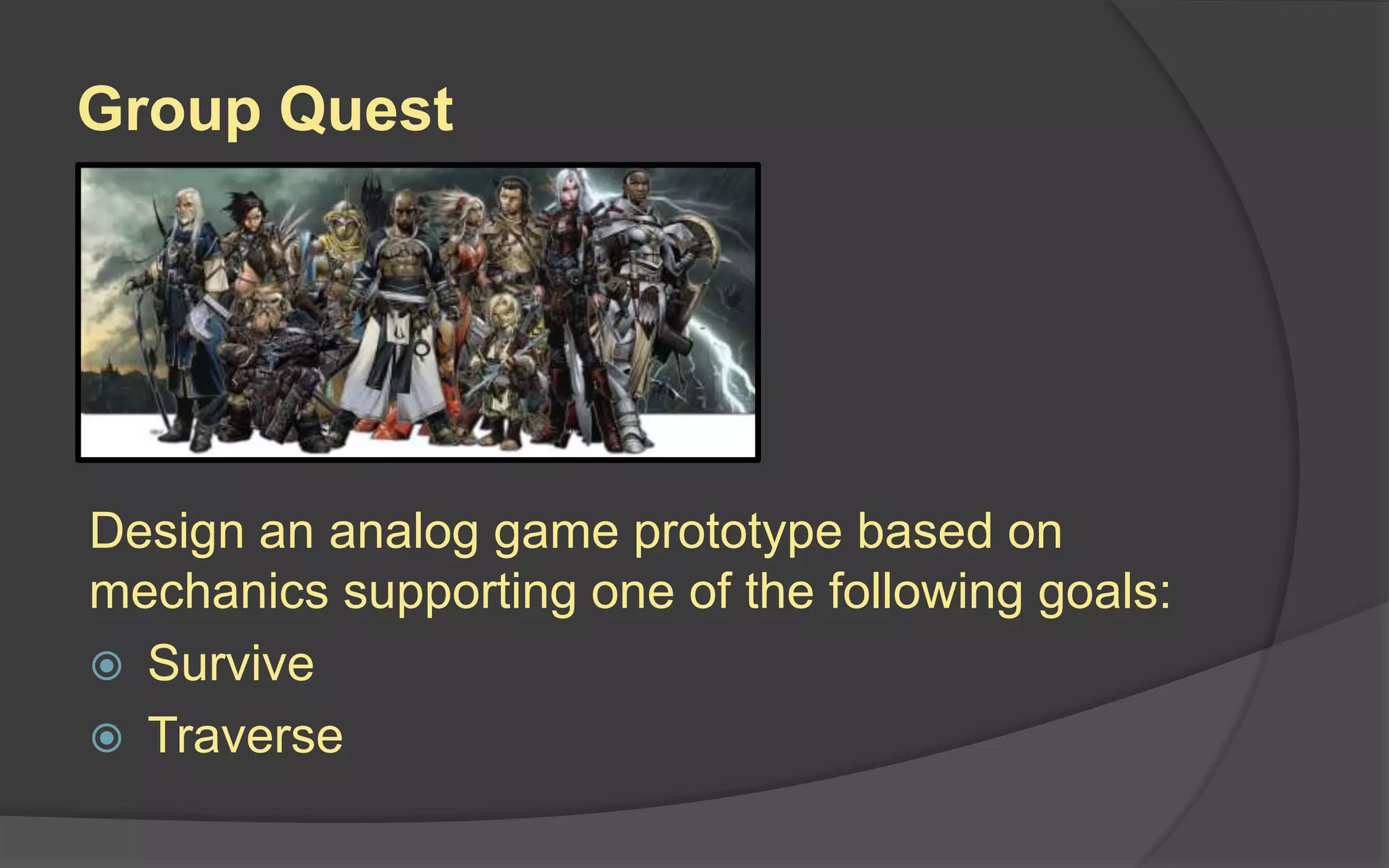
Group Quest
Design an analog game prototype based on
mechanics supporting one of the following goals:
 Survive
 Traverse
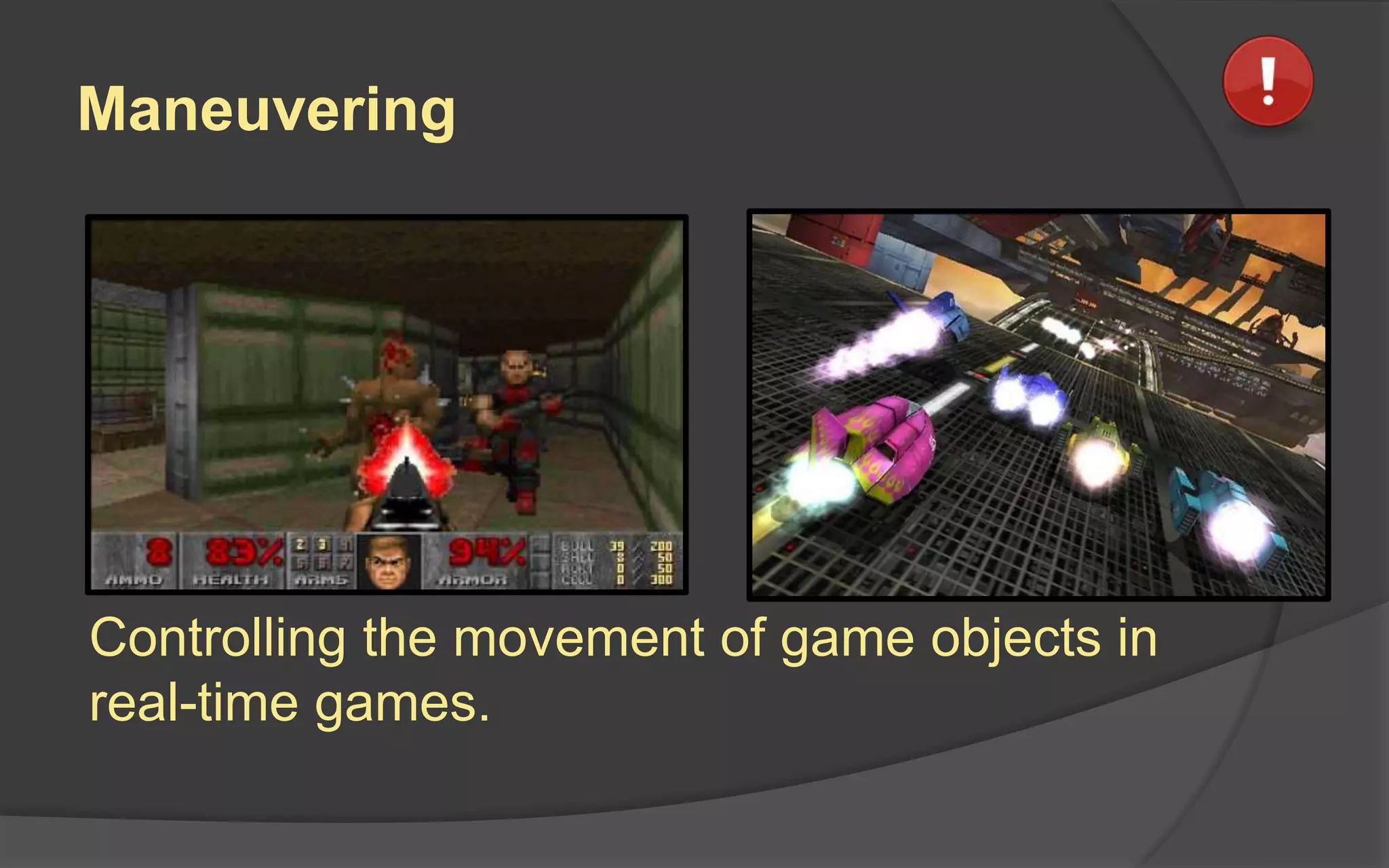
Maneuvering
Controlling the movement of game objects in
real-time games.
Maneuvering Design Characteristics
 Obstacles or Pick-Ups
 Speed
 Number
Design Analysis: Meneuvering
Characteristics
What Is The Difference Between Moving
And Maneuvering?
Why Designers Use Maneuvering
 Game World Navigation
 Dexterity-Based Actions
 Spatial Immersion
The Mechanics of Movement
Game Maker’s Toolkit
Design a maneuvering mechanic on the LMS.
LAFS Game Mechanics - The Core Mechanic

LAFS Game Mechanics - The Core Mechanic

  • 1.
    Level 1 David Mullich GameMechanics The Los Angeles Film School
  • 2.
    Class Topics 1. CoreMechanics 2. Progression Mechanics 3. Tactical Mechanics 4. Resource Management Mechanics 5. Social Mechanics 6. Information and Game Mechanics 7. Randomness and Game Mechanics 8. Narrative and Game Mechanics 9. Balancing Game Mechanics 10. Replayability and Game Mechanics
  • 3.
  • 4.
    Class Grading  20%:10 Labs  30%: 10 Assignments  30%: 3 Tests  20%: Professionalism* 2% Extra Credit for playtesting Game Fair games * 35%+ absences is an automatic fail.
  • 5.
    Labs Game development isa team sport. Each of your labs is a group assignment in which everyone must participate.
  • 6.
    Come Prepared Having oneof these is a minimum requirement. At all times.
  • 7.
    Assignments Do your homeworkassignments on the LMS (Learning Management System).
  • 8.
    Word Counts Word countsare there for a reason. Use them wisely and avoid:  Padding  Going off topic  Repeating yourself  Padding by stating the obvious in a way that takes quite a lot of words but really isn’t saying anything new  Repeating yourself but in a different way  Padding, wadding, lining, extemporising, extraneous content or going on any other kind of Synonym Safari TM
  • 9.
    Deliver Work OnTime Develop a habit of delivering work on time. In the game industry, when work is late, people don’t get paid. Pssst....Sometimes developers make false internal deadlines to avoid calamity such as missed milestone payments. Maybe you could do the same if graduation is at stake?
  • 10.
    Tests  Study foryour tests! Refer to the slides.  If you see on a slide, it will probably be on the test.  If you don’t know the answer to a test question, guess!  There are no points deducted for wrong answers on multiple-choice questions  I will award some points for clever or knowledgeable answers on short-answer questions, even if they weren’t the answer I was looking for.
  • 11.
    First Rule ofSuccess: Show Up  DON’T BE TARDY But if you know you will be late, EMAIL ME!  DON’T BE ABSENT But if you know you will be gone, EMAIL ME!
  • 12.
    School Is YourJob Yes, these are important:  Part-time work  Family  Friends  Fun But don’t neglect your school work!
  • 13.
    Impressions Your colleagues and facultywill most likely be your doorway into the industry. How do you want them to think of you? ZERO HERO
  • 14.
  • 16.
    What Is AGame Mechanic?
  • 17.
    Game Mechanic  Action:What players actually do in the game  Purpose: The reason why players are doing it
  • 18.
    The Core Mechanic(s) Theaction(s) that the player uses most frequently to progress in the game.
  • 19.
    Examples of CoreMechanics Game Core Action Core Purpose Chess Position pieces to capture opponent’s pieces Candy Crush Match 3 pieces to destroy them Tetris Rotate pieces to create lines Super Smash Bros Attack to knock opponent back Doom Run and shoot to kill enemies World of Warcraft Kill to earn experience
  • 20.
     Write downan activity of any kind – related to work, school, fun, chores, anything.  Come up with a verb, based on this activity, that you think would make a good basis for a game.  Identify:  Core Action  Core Purpose
  • 21.
    The Core Loop ACTION ActualAction of the Mechanic REWARD Reward for Executing the Action TRIGGER Event that Triggers the Action
  • 22.
    Behavior Psychology Volition: Thepower of using one's will. Operant Conditioning: A type of learning where behavior, or volition is controlled by consequences. B.F. Skinner
  • 23.
  • 24.
    Reward Ratios Frequency Effectiveness Constant(Fixed) Poor Intermittent (Fixed) Good Random (Variable) Best
  • 25.
    Does a fixedreward or a variable reward produce the highest rate of activity?
  • 26.
  • 27.
    Reward Ratios InGames A player must shoot down approximately 20 enemy fighters to gain an extra ship, but the precise number is randomly generated each time.
  • 28.
    Reinforcement with Extrinsic Rewards Primary Conditioners: A reward that satisfies a biological need.  Secondary Conditioners: A reward associated with a primary reward.
  • 29.
    What Would BeA Primary And Secondary Conditioner In Games?
  • 30.
    Chain Schedule What happensif there are multiple stages to the reward? Example: Kill 10 orcs and take each one’s loot before entering the dragon’s cave, where it is guarding a treasure.
  • 31.
    Extinction What happens ifyou stop providing the reward? Example: The player suddenly stops receiving gold for killing orcs.
  • 32.
    Avoidance What happens ifthe reward is to keep bad things from happening?  Ultima Online: Visit house to prevent decay.  Farmville: Harvest crops before they wither.
  • 33.
    Behavioral Contrast What happensif expectations change?  Player receives 1 gold coin for killing orcs, and then later starts receiving 10 gold cold coins.  Reward is then switched back from 10 gold coins to 1 gold coin.
  • 34.
    The Skinner Box ExtraCredits: How Games Condition Us To Play More
  • 35.
    What Was TheMain Message Of This Video?
  • 36.
    What Are BetterWays Of Fostering Engagement in Games?
  • 37.
    Intrinsic Rewards  Flow Mental Challenge  Mastery  Mystery  Narrative  Novelty
  • 38.
    Remember This? Novelty The FiveDomains Of Play Challenge Stimulation Harmony Threat
  • 39.
  • 41.
  • 42.
    Mechanics and StructureElements Mechanics:  Allowed by Procedures  Follow Rules  Consume or Produce Resources  Impeded by Challenge  Occur within Boundaries
  • 43.
    Procedures  Starting Action Progression of Action  Special Actions  Resolving Actions
  • 44.
  • 45.
  • 46.
    Resources “Fuel” AndAre Produced By Actions
  • 47.
  • 48.
  • 50.
    Movement The action ofmoving game elements within the game boundaries.
  • 51.
    Why Designers UseMovement  Game World Navigation  Progress Indicator  Dexterity-Based Actions  Puzzle Solving  Supports Race, Capture, Stealth, Herd, Delivery, Traverse, Collection goals
  • 52.
    Movement Design Characteristics What Can Move?  How Does It Move?  What Can Enhance Movement?  What Can Limit Movement? Design Analysis: Movement Characteristics
  • 54.
    Focus Loci The gameelements through which the player’s actions are taken. In-World Avatars In-World Units Beyond World God’s Finger Physical Component s Cards, Dice
  • 55.
    Why Designers UseFocus Loci  Cognitive Immersion  Spatial Immersion  Sensory-Motor Immersion  Area Control  Ownership Design Analysis: Focus Loci Uses
  • 56.
    Focus Loci DesignCharacteristics  In/Beyond World  Number  Actions  Attributes  Persistence  Camera Perspective (Avatars)  Personality (Avatars) Design Analysis: Focus Loci Characteristics
  • 57.
    Lives The number ofchances a player has in a play session before it is terminated.
  • 58.
    Why Designers UseLives  Balance Game Elements:  Threat  Combat  Session Length  Balance Game Goals:  Survival  Last Man Standing  King of the Hill (with elimination)
  • 59.
    Life Design Characteristics Causes for Loss  Consequences  Number of Lives  Replenishment Design Analysis: Lives Characteristics
  • 60.
    Obstacles Game elements thathinder players from taking the shortest route in the game.
  • 61.
    Obstacle Design Characteristics Paths Blocked  Size  Inaccessible Area Boundary  How Bypassed  Other Penalties Design Analysis: Obstacle Characteristics
  • 62.
    Why Designers UseObstacles  Game World Navigation Paths  Non-Deadly Movement Limitations
  • 63.
    Deadly Traps Game eventsthat kill avatars and units if they are within the trap’s area of effect.
  • 64.
    Deadly Trap DesignCharacteristics  Effects  Time Delay  Detection  Trap is visible and effects are clear  Trap and effects can be detected by examination  Trap and effects can’t be detected before activation Design Analysis: Deadly Trap Characteristics
  • 65.
    Why Designers UseDeadly Traps  Deadly Movement Limitations  Inaccessible Area Limitations
  • 66.
    Inaccessible Areas Parts ofthe game world that the player can perceive but cannot currently enter.
  • 67.
    Inaccessible Area Design Characteristics How Blocked  What Has Access  When Is It Accessible  Affecting Actions Design Analysis: Inaccessible Area Characteristics
  • 68.
    Why Designers UseInaccessible Areas  Movement Limitations  Enlarge Game World
  • 70.
    Privileged Abilities Abilities thatlet players perform actions not readily available to all other players.
  • 71.
    Timing of PrivilegedActions  Beginning of Game or Turn  During Game or Turn  During Particular Time Intervals  With Power-Ups and Other Game Elements
  • 72.
    Privileged Ability Design Characteristics What Action  Which Focus Loci  When Usable  What Players  Team Play Impact Design Analysis: Spellcasting Characteristics
  • 73.
    Why Designers UsePrivileged Abilities  Balances Movement, Combat, and Construction
  • 74.
    Budgeted Action Points Resourceused to determine what and how many actions can be performed during a player’s turn.
  • 75.
    Budgeted Action PointsDesign Characteristics  Actions  How Budgeted Design Analysis: Budget Action Points Characteristics
  • 76.
    Why Designers UseBudgeted Action Points  Balance Movement  Balance Privileged Abilities
  • 78.
    Survive Trying to avoidbeing killed by the actions of other players and events in the game.
  • 79.
    Survive Goal Characteristics Surviving Elements  Danger  Avoidance  Consequences of Death  Lives Design Analysis: Survival Characteristics
  • 80.
    Traverse The goal totry to move a game element from one position in the game to another.
  • 81.
    Traverse Goal Characteristics Which Element  Game Space Paths  How Does It Move?  Known Goal Point Location? Design Analysis: Traverse Characteristics
  • 82.
    Choose one ofthe following games to play:  En Garde (2p, 20-30m)  Forbidden Desert (2-5p, 45m) *  Hey, That’s My Fish! (2-4p, 20m)  Lost Cities (2-6p, 30-60m)  Space Alert (1-5p, 30m)
  • 83.
    Group Quest Design ananalog game prototype based on mechanics supporting one of the following goals:  Survive  Traverse
  • 85.
    Maneuvering Controlling the movementof game objects in real-time games.
  • 86.
    Maneuvering Design Characteristics Obstacles or Pick-Ups  Speed  Number Design Analysis: Meneuvering Characteristics
  • 87.
    What Is TheDifference Between Moving And Maneuvering?
  • 88.
    Why Designers UseManeuvering  Game World Navigation  Dexterity-Based Actions  Spatial Immersion
  • 89.
    The Mechanics ofMovement Game Maker’s Toolkit
  • 90.
    Design a maneuveringmechanic on the LMS.

Editor's Notes

  • #13 Think: Thinking allows beings to make sense of or model the world in different ways, and to represent or interpret it in ways that are significant to them, or which accord with their needs, attachments, objectives, plans, commitments, ends and desires. Understand: Understanding implies abilities and dispositions with respect to an object of knowledge sufficient to support intelligent behavior. Reflect and Connect: Arguably, the most important aspects of education is to provide students with knowledge that they can transfer in meaningful ways to other aspects of their present or future lives. For example, we do not teach history simply so students can pass a quiz, but so that they can reason better about the world around them.
  • #14 Leave a professional and lasting impression. They’re your first referees, either on paper or via word of mouth.
  • #15 He who has the gold makes the rules!
  • #19 A core mechanic encapsulates what the spirit of a game is really about at its heart. Usually it is the action that the player uses most frequently in the game and the foundation upon which the other game elements are built. If this basic action is hard to perform, unintuitive, or just not enjoyable, the player might stop playing the game altogether.
  • #25 A variable ratio reward ratio will produce the highest rate of activity than a fixed ratio.
  • #26 Variable
  • #27 Yes!
  • #30 Primary Reward: Sword Secondary Reward: High Score or Quest Reward
  • #31 The player will treat the final stage as the actual reward.
  • #32 The player will continue to do the activity for a long period of time before gradually tapering off.
  • #33 Still very effective. Experiments on rats show that avoiding shock by pressing a lever shows quick learning to avoid shock.
  • #34 Players will start boycotting your game.
  • #36 Using Skinner Box techniques to make a game compelling is a lazy way to make it engaging.
  • #37 Intrinsic Reards
  • #44 Starting Action: How to put the game into play Progression of Action: Ongoing procedures after starting the game. Special Actions: Conditional to other elements or game state. Resolving actions: Bring gameplay to a close.
  • #45 JEOPARDY: When a player can’t answer question correctly, other players have a chance to answer. Used for gameplay variation. WAYPOINTS: When the players run out of health, return them to the nearest waypoint. Used to get the game back on track.
  • #46 Rules restriction actions can fix LOOPHOLES in a game.
  • #48 Conflict keeps players from achieving their goals directly through rules, procedures, situations, and obstacles. Conflict makes a game more enjoyable by creating a sense of competition or achievement.
  • #49 Boundaries separate the game from everything that is not that game. Physical or conceptual Discrete or continuous 2D or 3D Have subspaces
  • #51 Common action in games that have a Game World or a board. Allows players to try and move game objects into favorable positions or try to control or explore a game area. EXAMPLE: Movement is the primary action in MARIO KART. EXAMPLE: Movement abilities distinguish different different types of pieces in CHESS..
  • #55 The game elements that can AFFECT the GAME STATE. The most obvious elements are ones that can be moved by the player. EXAMPLE: CHESS pieces. EXAMPLE: ASSASSIN’S CREED AVATAR
  • #57 NUMBER: Several allows for TEAM PLAY but requires ATTENTION SWAPPING and STATUS INDICATORS. Provides RISK/REWARD TRADE-OFFS ACTION: Dictates which game elements players have INDIRECT CONTROL over. Persistence ATTRIBUTES: Difficulty, Complexity, Character Development PERSISTANCE: Attributes or tools (Between Sessions): Emotional Immersion in Game World, Ownership CAMERA: Focus Loci, First vs. Third Person Perspective, Spatial Immersion PERSONALITY: Emotional Immersion, Freedom of Choice vs. Illusion of Influence
  • #58 A form of RESOURCE that allow the player to remain in the game for as long as there is at least one life left. Gives players a clear CONTINUOUS GOAL to SURVIVE. Lives are usually associated with AVATARS (increasing EMOTIONAL IMMERSION), but UNITS can also use them, Usually also associated with some NEGATIVE EFFECTS in the game. EXAMPLE: SUPER MARIO BROS losing all lives causes you to restart the game. EXAMPLE: COUNTER-STRIKE is regarded as the first multiplayer FPS that made explicit use of Lives. Killed Avatars did not respawn, and the player had to wait until the next level stated, giving the player one Life.
  • #60 CAUSE: Deadly traps, enemies, other players, not meeting time limits. CONSEQUENCES: Always a PENALTY of some kind. Loss of Score, Tools, Abilities. DOWNTIME NUMBER OF LIVES: Amount determines THREAT. A static number limits the game session time. REPLENSIHMENT OF LIVES Through pick-ups or a minimum score. Provides SHORT-TERM GOALS
  • #61 BLOCK or SLOW Player’s PROGRESS until they have been MOVED, DESTROYED OR AVOIDED. EXAMPLE: WARGAMES have Hexes that BLOCK or SLOW. EXAMPLE:: LOCKED DOOR that can only be opened with a correct key, such as in Legend of Zelda: Wind Walker.
  • #62 PATHS BLOCK: Balanced PRIVILEGED ABILITIES and PRIVILEGED MOVEMENT SIZE: It can be an entire AREA. Or it can be an OUTSTANDING FEATURE of the Game World. INACCESSIBLE AREAS: If not, then there might be LONGER PATHS one can take. HOW BYPASSED: Ones needing a specific RESOURCE or TOOL may involved RESOURCE MANAGEMENT. Those requiring TIMING may involve DEXTERITY-BASED SKILLS. OTHER PENALTIES: Penalties include SLOWING, DAMAGE, LOSS OF LIFE.
  • #63 Leaps of Faith Decisions Narrative Structure Hindering Aim & Shoot Actions Balancing Traverse or Exploration Goals
  • #64 EXAMPLE: PITS in Super Mario Brothers. EXAMPLES Falling blocks, Lava, Fire, Machinery, Fast-Moving Vehicles, Falling Bridges.
  • #65 EFFECT: Balanced by the amount of damage TIME DELAY: Is there a time delay between setting the trap and it going off? DETECT Trap and Effects: Trap is VISIBILE and Effects are CLEAR: Usually allow Player to BYPASS the trap by TIMING or RHYTHM-BASED actions. OUTSTANDING FEATURES can warn player. Noticeable by EXAMINATION of Surrounding Area. Require Player to observe OUTSTANDING FEATURES in the environment. Can’t be detected before ACTIVATED. Creates SUPRISES and promotes MEMORIZATION. The last two usually don’t kill the player instantly but give a TIME LIMIT to react, providing TENSION in the game.
  • #66 Rhythm-Based Actions and Maneuvering Memorization Surprises Narrative Structure Supports Rescue and Survive Goals (without opponents) Balances Evade, Exploration, Reconnaissance Goals
  • #67 Player’s perception of the area depends on their LOCATION and knowledge about GOALS and DANGERS. EXAMPLE: Ghost Generator in PAC-MAN, EXAMPLE: Areas of LEGEND OF ZELDA that are behind boulders, locked doors, or other obstacles.
  • #68 HOW BLOCKED: May be blocked by an OBSTACLE or it may itself be one big DEADLY TRAP. ACCESS: If Water blocks access, then only BOATS may be able to access it. If Enemies can’t enter, it may be a SAFE HAVEN. WHEN: Might be accessible at start of game, but not later, such as to protect SPAWN POINTS. Or, players may be to COMPLETE GOALS first. WHAT ACTIONS (BESIDES MOVEMENT) CAN AFFECT IT?: Can you shoot inside it?
  • #69 ENLARGE GAME WORLD: Balances GAME WORLD NAVIGATION EASTER EGGS: Increases REPLAYABILITY SMOOTH LEARNING CURVES: If Satisfying Goals is necessary to enter MOVEMENT LIMITATIONS: Balances GAME WORLD NAVIGATION (while RESTRICING FREEDOM OF CHOICE) PROTECTION: Spawn Points, Enemies, Resources
  • #71 They create ASSEMETRIC ABILITIES which can affect PLAYER BALANCE and TEAM BALANCE. EXAMPLE: Different movement abilities of CHESS pieces EXAMPLE: Different character classes in an RPG.
  • #72 BEGINNING: PLANNING STRATEGY DURING: PLANNED CHARACTER DEVELOPMENT, TEAM DEVELOPMENT DURING CERTAIN TIMES: TIMING WITH POWER-UPS, AREA CONTROL, CHARGERS; STRATEGIC LOCATIONS
  • #73 WHAT IS THE NATURE OF THE ACTION: Move differently, avoid penalty effects, allow special actions in Combat, create resources,, being able to pick up cards form a discard pile or look at other player’s cards. Even the ability to take no action. If too powerful, can be balanced by BUDGETED ACTION POINTS or TIMING WHICH FOCUS LOCI HAS ACCESS TO THE ACTION: ORTHOGANAL UNIT DIFFERENTIATION. (Rock-Paper-Scissors). Affects ABILITY LOSS when teamed with a TIME LIMIT. WHICH PLAYERS HAVE ACCESS TO THE ACTION: If Tools or Units have the ability, allows for TRANSFER OF CONTROL through stealing or capture. TEAM PLAY: Cooperation in ASSYEMTRIC Competence Areas, but in Team vs. Teams, balancing may be difficult with Asymmetric Abilities. Can be mitigated by BUDGETED ACTION POINTS or by deciding when players have access to certain abilities.
  • #74 When tied to AVATARS or CHARACTERS:, allow for CHARACTER DEVELOPMENT. Can affect TEAM DEVELOPMENT and SOCIAL STATUS, as well as SOCIAL INTERACTION for coordinating abilities. GOALS: When combined with NEW ABILITIES, allows for GAIN COMPETENCE Goals. Empowerment Planning Character Development Team Development and Social Status Balances Movement, Combat, and Construction Investments in Competence Areas Supports Gain Competence Goals
  • #75 EXAMPLE: WARGAME UNITS allocate movement points to units. EXAMPLE: RPG;s may have MANA POINTS for CASTING SPELLS
  • #76 ACTIONS What actions are budgets? HOW ARE ACTIONS BUDGETS: Limited Resources
  • #79 EXAMPLE: SPACE INVADERS.TETRIS, the goal is to survive as long as possible. .
  • #80 WHAT GAME ELEMENT SHOULD SURVIVE?: Usually the AVATAR, but it can also be a CERTAIN PERCENTAGE OF UNITS surviving (LEMMINGS). WHAT DANGER EXISTS: Deadly Traps, Enemies. Finding out the dangers can be SUPPORTING GOALS for STIMULATED PLANNING. WHAT ACTIONS AVOID THE DANGER DEFENSIVE (more Hit Points or Concealment), PREMPTIVE ATTACKS DEATH: PLAYER ELIMINATION, Lost LIFE, RESPAWNING LIVES: Balancing
  • #81 EXAMPLE: Moving a pawn to the opposite side of the board in Chess. EXAMPLE: Moving Mario from the beginning of the level to the end. .
  • #82 WHAT ELEMENT MOVES WHAT GAME SPACE DOES THE ELEMENT MOVE THROUGH: ONE PATH or DIFFERENT PATHS? The latter involves STRATEGIC LOCATIONS as well as ENEMIES/OBSTACLES. IN WHAT WAYS DOES IT MOVE?: Can be linked to RISK/REWARD tradeoffs. Balanced by PRIVILEDGED MOVEMENT and CHARGERS IS THE GOAL POINT LOCATION KNOWN: If yes, then FREEDOM OF CHOICE
  • #86 Games in which the players controls vehicles or characters that move in real-time often have OBSTACLES or ENEMIES to avoid. Requires maneuvering of game objects. EXAMPLE: Maneuver AVATAR in FIRST-PERSON SHOOTER to avoid enemies. EXAMPLE: Maneuver vehicle and obstacles around enemies and obstacles.
  • #87 WHAT OBJECTS MUST BE COLLECTED OR AVOIDED: SPEED: Controlling the SPEED (Dexterity-Based Actions has balancing effects.) NUMBER: A large number may require ATTENTION SWAPPING
  • #89 SPATIAL IMMERSION requires either a 1st or 3rd person view. Moving Obstacles and Deadly Traps may cause EVADE goals, while Pick-Ups could invoke COLLECTING goals. Puzzle Solving Spatial Immersion Balancing Aim & Shoot Actions Supports Evade and Collection Goals