Fundamentals of Game Design
Story Telling & Narrative
Sayed Ahmed
BSc. Eng. in CSc. & Eng. (BUET)
MSc. in CSc. (U of Manitoba)
http://sayed.justetc.net
http://www.justETC.net
Just E.T.C for Business, Education, and Technology Solutions
Topics
 Focus on story oriented games
 How to weave a story into a game
 Examine what makes a good story
 How to keep the story from overwhelming the game play
 Define interactive story and narrative
 Discuss linear and non-linear storytelling and
mechanism
 Scripted conversations
 To participate in dialog with non-player characters
 Discuss episodic story telling
Why stories in Games?
 Some players want stories along with the game play
 Some games require one
 Adventure Games
 Action Adventure
 Role-Playing Games
 Will story improve a game?
 Depends on the genre of the game
 How good is the story
 How you tell the story
 Four reasons to have stories in Games
 Add significantly to the entertainment that a game offers
 Stories attract a wider audience
Why stories in Games?
 Stories help keep players interested in long games
 Bejeweled, Checkers, Tic-tac-toe
 http://www.youtube.com/watch?v=zAOA7TYtXTs
 http://www.youtube.com/watch?v=QVlm2tuf_kg
 http://www.youtube.com/watch?v=ZbLFPl4A4fE
 Stories offer novelty
 A long game need variety
 Compelling story provides the variety
 Stories help to sell the game
 Marketing
 What is good storytelling?
 Read creative writing books
Why stories in Games?
 How stories can be incorporated into games
 How interactive stories differ from traditional ones
 What kind of entertainment experience you want to provide to the players
 What kind of players you want to serve
 Space invader – one line of story
 Dreamfall and Discworld Noir – incorporates stories like a novel
 Storytelling offers half the entertainment
 http://www.youtube.com/watch?v=8XrkGztFr-0
 http://www.youtube.com/watch?v=BGDHlRalQFE
 Game play comes first than story
 In some games, the story overwhelmed the game play
 The initial games derived from movie or book franchise
 Build player centric game
 If it helps include, otherwise do not include..
how much story a game should include
 Factors that affect
 Length
 Characters
 Degree of realism
 Ms. Pac-Man
 http://www.youtube.com/watch?v=EOMa8i9w7-Q
 http://en.wikipedia.org/wiki/Pac-Man
 Emotional richness
 Want to inspire greater variety of emotions – include a story
 Single player gameplay seldom inspire any rich emotion
 Other than
 Pleasure in success, frustration at failure
 Deeper emotions come only when the player identifies himself
 With characters and problems – happens in well written story
 Half-Life
Key Concepts
 Story
 Is an account of a series of events either historical or fictitious
 Credible
 Coherent
 Dramatically Meaningful
 Credible
 People can believe the story
 Coherent
 Story must not be irrelevant
 Must harmonize to create a pleasing whole
 Dramatically Meaningful
 Must involve something or someone the listener/reader cares about
Key Concepts
 Interactive Stories
 Stories are usually written in the past
 Interactive stories are written in present
 Game story are in present
 Includes three kinds of events
 Player events
 Game events
 Narrative Events
 Player Events
 Actions taken by the player as part of the Game Play
 Actions involved to overcome the challenges
 If the players’ actions can affect the plot and change it’s future – they are called dramatic
actions
 Game Events
 Initiated by the core mechanics
 Can be response to the players’ actions
 The user may be able to affect how these occur
Key Concepts
 Narrative Events
 Events whose content the player cannot change
 May be able to control whether such events occur or not
 Narrates some actions or story to the player
 Players may not interact with this
 Interactive Story
 A story may be interactive even the players’ actions do not
change the game plot
 Agency
 The power to change the direction of the plot – future events
Key Concepts
 Narrative
 The text or the discourse produced by the act of Narration
 In an interactive story
 Narrative is the part of the story that as a designer you narrate to the players
 Not the actions that the players take
 Nor the events created by core mechanics
 The Role of Narrative
 Present events over which the player has no control
 Usually – events that happen to the avatar that the player cannot
control/prevent
 Events that happen when the avatar is not present
 But we still want the player to know about the events
 Scenes depicting success or failure are usually narrative events
Key Concepts
 Role of Narrative
 Show the prolog to the game or the current level
 Introduces the player to the situation in the game
 Create a background
 Players who don’t like stories in Games can ignore
them
 But many players enjoy them a lot
Commonly Used Narrative Blocks
 As an opening sequence to introduce the story at the
beginning
 As an ending sequence
 To wrap up the story when the player completes the
game
 As an inter-level sequence
 A briefing about the next level events
 In the form of cut scenes – short non – interactive
sequences
 Presented during play that interrupt the game
momentarily
Examples
 Half-life
 http://www.youtube.com/watch?v=3x3wQ7Opltg
 The player’s avatar takes a tram ride through the research complex…
 A voice explains why he is there
 This opening sequence introduces the game world
 Sets the stage for the experience to follow
 Narrative blocks presented between levels usually
 Last for 30 seconds to 4-5 minutes
 Beginning and ending blocks can be longer
 Provide important narrative bookends to the entire experience
 Halo-2 the introductory scene is more than 5 minutes
 http://www.youtube.com/watch?v=4P3Sry-SvGA
Narrative Blocks
 Cut-scenes during play – should be shorter
 As they interrupt the flow and rhythm of the player’s
actions
 Fast-moving game players are annoyed (real time strategy
games, action adventure games)
 Slower moving game players may like them
 Adventure games
 Role playing games
Forms of Narratives
 A pre-rendered movie
 A cut scene displayed by the graphics engine
 Scrolling text that introduces a mission
 Voice over commentary that explains the back
story of the game
 Long monolog by a character
 Individual lines of dialog are not narratives
 Long interactive dialog between NPCs qualifies
as narrative
Balancing Narrative and Gameplay
 Remember
 The more narrative you include, the more the player
has to sit doing nothing
 Games must find appropriate balance
 Designer’s need to narrate and players need to act
 Too much narrative = bad value of money for the
players
 Players pay to act in a fantasy
 Computer game is about interactivity
 Provide enough narrative to enrich the game world
Dramatic Tension and Game Play Tension
 Dramatic tension
 What will happen next
 Game Play tension
 Desire to overcome a challenge
 False analogy
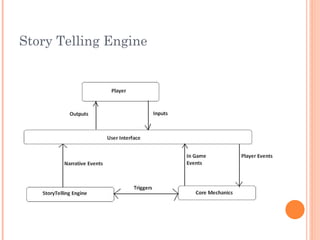
Story Telling Engine
 Game with story
 Interrupt the story to introduce narratives/stories
 Narrative events must be interspersed among the game play events
 Storytelling engine does the weaving
 Weaves narrative events to Gameplay
 Core Mechanics
 Oversee the players’ progress through the challenges
 Storytelling Engine
 Oversees progress through the story
 They must work together to create a single seamless experience
 Core Mechanics Manages
 Player Events
 In Game Events
 Storytelling Engine
 Manages the narrative events
 Keeps track of the progress of the story
 Determines what part of the plot should come next
 Determine the story has reached a critical point and trigger the core mechanics to cause change to the internal
economy of the game
Storytelling Engine
 Level designers are also involved
 Triggering the cut scene
 And the transfer of the Avatar’s property
Linear Story
 Agency
 Let the player change the game plot and also change the
outcome
 Stories that player cannot change – linear
 Stories that player can change – non-linear
 Linear
 Interactive but interactions are limited to contributing
actions
 Half Life
 Star Craft
 http://www.youtube.com/watch?v=1ipBCEZwbM0
Linear Story
 Require less content
 Storytelling engine is simpler
 Less prone to bugs and absurdities
 Deny the player agency
 Are capable of greater emotional power
Nonlinear Stories
 Branching Stories
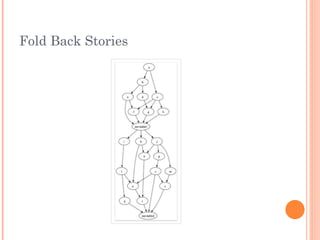
 Fold Back Stories
 Emergent Narrative
Nonlinear Story
 Branching
 Player have a different experience each time he plays the game
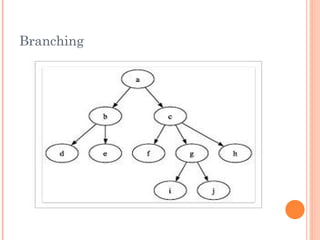
 Offers many plots – that split from each other at different points
 Responsibility of designers
 What are the plots
 How do they relate to each other
 Storytelling engine keeps track what is the current plot
 Core mechanics will send triggers to inform the next possible plots
 Immediate, Deferred, and Cumulative Influence
 Immediate: The event cause a branching immediately
 Deferred: Early decision influences later events – deferred
 Cumulative: Some decisions together defines the branching at a later point
Branching
Disadvantages of Branching
 Extremely expensive to implement
 Player must play the game repeatedly to see all
the content
 Every critical event has to branch to it’s own
unique section of the tree
 Plan out the structure in the concept stage
 Resource requirements expand very rapidly
Fold back Stories
 Compromise between Branching and linear
stories
Fold Back Stories
Emergent Narrative
 Research problem
 Does not contain narrative blocks created by the
writer
 The story emerges from the act of playing games
 Sims can create emergent narrative
 The core-mechanics should be able to generate
coherent credible dramatic story
 AI Research Field: Automated Storytelling
Game Story Endings
 The ending of a story is one of the most critical
emotional moments in a game
 Craft the endings to evoke specific feelings
 How many endings should your story have?
Challenges and Choices
 Games that include a lot of decision making esp.
moral choices, which feel dramatically important
 Should be non-linear
 Offer multiple endings
 Choice and actions should reflect the endings
 Good acts should result to positive endings
When to Use Multiple Endings
 Each one should be dramatically meaningful and
Emotionally consistent
 If not much dramatic freedom – multiple endings
not required
Granularity
 Frequency with which the game presents elements of the
narrative
 Star craft
 Tells a long story
 Presents narratives only between missions
 Coarse Granularity
 Coarse
 Fine
 Infinitesimal granularity is the target
 Avatar and his actions (half life)
 No sitting and watch – but play where stories also evolve consistently
 Granularity is Relative
Mechanisms for Advancing the Plot
 The story as a series of challenges and choices
 The story as a Journey
 The Story as a Drama
 Challenges and choices
 Advance only when the player meet challenges or make
decisions
 Plot change and Game story movement
 Wing Commander - leads to different story
 Story as a journey
 Avatar’s movement trigger the storytelling engine to
advance the plot
Story as a Journey
 Benefits
 Provides novelty
 Continuously sees new things
 Experience fresh and interesting
 Allows the player to control the pace
 But can be time limited
 One way door concept
 Role playing games
 Stories as journeys
 But highly non-linear stories
Story as a Drama
 Advances with the passage of time itself
 Story takes place in real time
 No trigger from the core mechanics to the
storytelling engine
 Night Trap operates as a drama
 Protecting teenagers from monsters
 Facade
Emotional Limits of Interactive Stories
 Story less Games
 Don’t try to arouse complex emotions
 Thrill of victory
 Agony of defeat
 Frustration of repeated failure
 With story, you can create
 Create characters that the players care about
 Subtle relationships among these characters
 Betrayal by a lover
 Satisfaction at justice done
 Protective instinct for a child
Emotional Limits of Nonlinear Stories
 May not always lead to most powerful emotional
experience
 Non-linear stories sometimes restrict the ending
to a single or multiple emotionally meaningful
endings
Emotional Limits of Avatar Based Games
 The Avatar must be alive until the end of the game
 But player can reload the game if the avatar dies
 No emotional experience at the death of the Avatar – the
story ends
 If you want to affect the player’s feelings with the death of
a character your game can kill a side character
 Avatar’s friend
 Planet Fall: Sidekick
 Final Fantasy Vii: The player’s allay
 Party based games
 Provide more freedom to kill off members
 Other characters can take the story forward
Character Archetypes
 Allies
 Those that help the hero
 Shadow
 The main enemy that must be defeated
 The ultimate evil
 Does not have to be a character
 Sometimes more important than the hero
 Can be very present or hidden until the end
Scripted Conversations and Dialog Trees
 A scripted conversation
 Allows the player to engage in conversations with
non-player characters – storytelling games
 Special mode
 All other activities are unavailable
 Chooses a line of dialog
 Never winter Nights 2
Structure of a Dialog Tree
 The Dialog Tree Data Structure
 Same sentences with different emotions
 As a designer you should provide the dialog tree
as well
Design Issues for Dialog Trees
 Conditional branches and exchanges
 Another approach
 Flexible list of options
Benefits of Scripted Conversations
 It produces a sequence of plausible remarks and replies
 Illustrate the personality of the Avatar and the NPCs
 Wise guy – Phrase Monkey Island Games
 Guybrush
 It’s a real part of the story
 The player’s choices can have effect on the story
as well
When to Write the Story
 Story should be written in the elaboration stage
 Not in the concept stage
 Concept stage
 Define the player’s role
 The kind of game play he will experience
 A list of levels or episodes that you may want to
include in the game
Other Considerations
 Frustrated Author Syndrome
 Giving the player no freedom
 Episodic Delivery
 Selling Player’s entertainment a few hours at a time rather
than a long story
 Unlimited Series
 A set of episodes
 Each consisting of a self-contained story
 The plot is introduced and solved
 A single theme or context runs through the entire series
 Stories exist so independently that you can play each episode in any
order and still makes a sense
 A through introduction…
Serials
 Infinite sequence of episodes
 Episodes are not self contained
 Ends at a critical event to create a strong desire
to see/play the next episode
 Get players hooked in a story and pay episode
after episode
Limited Series
 Features from both unlimited and serial
 Single episode introduces and solves one plot
 But with other plot lines it can be carried over to
the next episode
Potential and Limits of Episodic Delivery
 Industry already makes games in the unlimited
series
 It may start to make games in the limited series
 And encourage to buy the whole set
 Harry Potter series of games
 May work well with the internet models
 PC or console games
 Do not leave the story unfinished
Summary
 Most video games will benefit from a coherent and dramatic
story
 Designer should remember the interactivity
 Do not write novels
 Linear, no-linear, multiple ending
 Will depend on the genre
 And Game play
 For more engaging, deeper emotional response, greater
satisfaction
 Designer should maintain Good story that maintains player interests,
shows character growth, balances narrative elements, remains
enjoyable to play
References
 Fundamentals of Game Design, 2nd Edition,
Ernest Adams, Prentice Hall, 2006, ISBN-10:
0131687476. ISBN-13: 978-0131687479
 http://computer.justetc.net

Story telling and_narrative

  • 1.
    Fundamentals of GameDesign Story Telling & Narrative Sayed Ahmed BSc. Eng. in CSc. & Eng. (BUET) MSc. in CSc. (U of Manitoba) http://sayed.justetc.net http://www.justETC.net Just E.T.C for Business, Education, and Technology Solutions
  • 2.
    Topics  Focus onstory oriented games  How to weave a story into a game  Examine what makes a good story  How to keep the story from overwhelming the game play  Define interactive story and narrative  Discuss linear and non-linear storytelling and mechanism  Scripted conversations  To participate in dialog with non-player characters  Discuss episodic story telling
  • 3.
    Why stories inGames?  Some players want stories along with the game play  Some games require one  Adventure Games  Action Adventure  Role-Playing Games  Will story improve a game?  Depends on the genre of the game  How good is the story  How you tell the story  Four reasons to have stories in Games  Add significantly to the entertainment that a game offers  Stories attract a wider audience
  • 4.
    Why stories inGames?  Stories help keep players interested in long games  Bejeweled, Checkers, Tic-tac-toe  http://www.youtube.com/watch?v=zAOA7TYtXTs  http://www.youtube.com/watch?v=QVlm2tuf_kg  http://www.youtube.com/watch?v=ZbLFPl4A4fE  Stories offer novelty  A long game need variety  Compelling story provides the variety  Stories help to sell the game  Marketing  What is good storytelling?  Read creative writing books
  • 5.
    Why stories inGames?  How stories can be incorporated into games  How interactive stories differ from traditional ones  What kind of entertainment experience you want to provide to the players  What kind of players you want to serve  Space invader – one line of story  Dreamfall and Discworld Noir – incorporates stories like a novel  Storytelling offers half the entertainment  http://www.youtube.com/watch?v=8XrkGztFr-0  http://www.youtube.com/watch?v=BGDHlRalQFE  Game play comes first than story  In some games, the story overwhelmed the game play  The initial games derived from movie or book franchise  Build player centric game  If it helps include, otherwise do not include..
  • 6.
    how much storya game should include  Factors that affect  Length  Characters  Degree of realism  Ms. Pac-Man  http://www.youtube.com/watch?v=EOMa8i9w7-Q  http://en.wikipedia.org/wiki/Pac-Man  Emotional richness  Want to inspire greater variety of emotions – include a story  Single player gameplay seldom inspire any rich emotion  Other than  Pleasure in success, frustration at failure  Deeper emotions come only when the player identifies himself  With characters and problems – happens in well written story  Half-Life
  • 7.
    Key Concepts  Story Is an account of a series of events either historical or fictitious  Credible  Coherent  Dramatically Meaningful  Credible  People can believe the story  Coherent  Story must not be irrelevant  Must harmonize to create a pleasing whole  Dramatically Meaningful  Must involve something or someone the listener/reader cares about
  • 8.
    Key Concepts  InteractiveStories  Stories are usually written in the past  Interactive stories are written in present  Game story are in present  Includes three kinds of events  Player events  Game events  Narrative Events  Player Events  Actions taken by the player as part of the Game Play  Actions involved to overcome the challenges  If the players’ actions can affect the plot and change it’s future – they are called dramatic actions  Game Events  Initiated by the core mechanics  Can be response to the players’ actions  The user may be able to affect how these occur
  • 9.
    Key Concepts  NarrativeEvents  Events whose content the player cannot change  May be able to control whether such events occur or not  Narrates some actions or story to the player  Players may not interact with this  Interactive Story  A story may be interactive even the players’ actions do not change the game plot  Agency  The power to change the direction of the plot – future events
  • 10.
    Key Concepts  Narrative The text or the discourse produced by the act of Narration  In an interactive story  Narrative is the part of the story that as a designer you narrate to the players  Not the actions that the players take  Nor the events created by core mechanics  The Role of Narrative  Present events over which the player has no control  Usually – events that happen to the avatar that the player cannot control/prevent  Events that happen when the avatar is not present  But we still want the player to know about the events  Scenes depicting success or failure are usually narrative events
  • 11.
    Key Concepts  Roleof Narrative  Show the prolog to the game or the current level  Introduces the player to the situation in the game  Create a background  Players who don’t like stories in Games can ignore them  But many players enjoy them a lot
  • 12.
    Commonly Used NarrativeBlocks  As an opening sequence to introduce the story at the beginning  As an ending sequence  To wrap up the story when the player completes the game  As an inter-level sequence  A briefing about the next level events  In the form of cut scenes – short non – interactive sequences  Presented during play that interrupt the game momentarily
  • 13.
    Examples  Half-life  http://www.youtube.com/watch?v=3x3wQ7Opltg The player’s avatar takes a tram ride through the research complex…  A voice explains why he is there  This opening sequence introduces the game world  Sets the stage for the experience to follow  Narrative blocks presented between levels usually  Last for 30 seconds to 4-5 minutes  Beginning and ending blocks can be longer  Provide important narrative bookends to the entire experience  Halo-2 the introductory scene is more than 5 minutes  http://www.youtube.com/watch?v=4P3Sry-SvGA
  • 14.
    Narrative Blocks  Cut-scenesduring play – should be shorter  As they interrupt the flow and rhythm of the player’s actions  Fast-moving game players are annoyed (real time strategy games, action adventure games)  Slower moving game players may like them  Adventure games  Role playing games
  • 15.
    Forms of Narratives A pre-rendered movie  A cut scene displayed by the graphics engine  Scrolling text that introduces a mission  Voice over commentary that explains the back story of the game  Long monolog by a character  Individual lines of dialog are not narratives  Long interactive dialog between NPCs qualifies as narrative
  • 16.
    Balancing Narrative andGameplay  Remember  The more narrative you include, the more the player has to sit doing nothing  Games must find appropriate balance  Designer’s need to narrate and players need to act  Too much narrative = bad value of money for the players  Players pay to act in a fantasy  Computer game is about interactivity  Provide enough narrative to enrich the game world
  • 17.
    Dramatic Tension andGame Play Tension  Dramatic tension  What will happen next  Game Play tension  Desire to overcome a challenge  False analogy
  • 18.
  • 19.
    Story Telling Engine Game with story  Interrupt the story to introduce narratives/stories  Narrative events must be interspersed among the game play events  Storytelling engine does the weaving  Weaves narrative events to Gameplay  Core Mechanics  Oversee the players’ progress through the challenges  Storytelling Engine  Oversees progress through the story  They must work together to create a single seamless experience  Core Mechanics Manages  Player Events  In Game Events  Storytelling Engine  Manages the narrative events  Keeps track of the progress of the story  Determines what part of the plot should come next  Determine the story has reached a critical point and trigger the core mechanics to cause change to the internal economy of the game
  • 20.
    Storytelling Engine  Leveldesigners are also involved  Triggering the cut scene  And the transfer of the Avatar’s property
  • 21.
    Linear Story  Agency Let the player change the game plot and also change the outcome  Stories that player cannot change – linear  Stories that player can change – non-linear  Linear  Interactive but interactions are limited to contributing actions  Half Life  Star Craft  http://www.youtube.com/watch?v=1ipBCEZwbM0
  • 22.
    Linear Story  Requireless content  Storytelling engine is simpler  Less prone to bugs and absurdities  Deny the player agency  Are capable of greater emotional power
  • 23.
    Nonlinear Stories  BranchingStories  Fold Back Stories  Emergent Narrative
  • 24.
    Nonlinear Story  Branching Player have a different experience each time he plays the game  Offers many plots – that split from each other at different points  Responsibility of designers  What are the plots  How do they relate to each other  Storytelling engine keeps track what is the current plot  Core mechanics will send triggers to inform the next possible plots  Immediate, Deferred, and Cumulative Influence  Immediate: The event cause a branching immediately  Deferred: Early decision influences later events – deferred  Cumulative: Some decisions together defines the branching at a later point
  • 25.
  • 26.
    Disadvantages of Branching Extremely expensive to implement  Player must play the game repeatedly to see all the content  Every critical event has to branch to it’s own unique section of the tree  Plan out the structure in the concept stage  Resource requirements expand very rapidly
  • 27.
    Fold back Stories Compromise between Branching and linear stories
  • 28.
  • 29.
    Emergent Narrative  Researchproblem  Does not contain narrative blocks created by the writer  The story emerges from the act of playing games  Sims can create emergent narrative  The core-mechanics should be able to generate coherent credible dramatic story  AI Research Field: Automated Storytelling
  • 30.
    Game Story Endings The ending of a story is one of the most critical emotional moments in a game  Craft the endings to evoke specific feelings  How many endings should your story have?
  • 31.
    Challenges and Choices Games that include a lot of decision making esp. moral choices, which feel dramatically important  Should be non-linear  Offer multiple endings  Choice and actions should reflect the endings  Good acts should result to positive endings
  • 32.
    When to UseMultiple Endings  Each one should be dramatically meaningful and Emotionally consistent  If not much dramatic freedom – multiple endings not required
  • 33.
    Granularity  Frequency withwhich the game presents elements of the narrative  Star craft  Tells a long story  Presents narratives only between missions  Coarse Granularity  Coarse  Fine  Infinitesimal granularity is the target  Avatar and his actions (half life)  No sitting and watch – but play where stories also evolve consistently  Granularity is Relative
  • 34.
    Mechanisms for Advancingthe Plot  The story as a series of challenges and choices  The story as a Journey  The Story as a Drama  Challenges and choices  Advance only when the player meet challenges or make decisions  Plot change and Game story movement  Wing Commander - leads to different story  Story as a journey  Avatar’s movement trigger the storytelling engine to advance the plot
  • 35.
    Story as aJourney  Benefits  Provides novelty  Continuously sees new things  Experience fresh and interesting  Allows the player to control the pace  But can be time limited  One way door concept  Role playing games  Stories as journeys  But highly non-linear stories
  • 36.
    Story as aDrama  Advances with the passage of time itself  Story takes place in real time  No trigger from the core mechanics to the storytelling engine  Night Trap operates as a drama  Protecting teenagers from monsters  Facade
  • 37.
    Emotional Limits ofInteractive Stories  Story less Games  Don’t try to arouse complex emotions  Thrill of victory  Agony of defeat  Frustration of repeated failure  With story, you can create  Create characters that the players care about  Subtle relationships among these characters  Betrayal by a lover  Satisfaction at justice done  Protective instinct for a child
  • 38.
    Emotional Limits ofNonlinear Stories  May not always lead to most powerful emotional experience  Non-linear stories sometimes restrict the ending to a single or multiple emotionally meaningful endings
  • 39.
    Emotional Limits ofAvatar Based Games  The Avatar must be alive until the end of the game  But player can reload the game if the avatar dies  No emotional experience at the death of the Avatar – the story ends  If you want to affect the player’s feelings with the death of a character your game can kill a side character  Avatar’s friend  Planet Fall: Sidekick  Final Fantasy Vii: The player’s allay  Party based games  Provide more freedom to kill off members  Other characters can take the story forward
  • 40.
    Character Archetypes  Allies Those that help the hero  Shadow  The main enemy that must be defeated  The ultimate evil  Does not have to be a character  Sometimes more important than the hero  Can be very present or hidden until the end
  • 41.
    Scripted Conversations andDialog Trees  A scripted conversation  Allows the player to engage in conversations with non-player characters – storytelling games  Special mode  All other activities are unavailable  Chooses a line of dialog  Never winter Nights 2
  • 42.
    Structure of aDialog Tree  The Dialog Tree Data Structure  Same sentences with different emotions  As a designer you should provide the dialog tree as well
  • 43.
    Design Issues forDialog Trees  Conditional branches and exchanges  Another approach  Flexible list of options
  • 44.
    Benefits of ScriptedConversations  It produces a sequence of plausible remarks and replies  Illustrate the personality of the Avatar and the NPCs  Wise guy – Phrase Monkey Island Games  Guybrush  It’s a real part of the story  The player’s choices can have effect on the story as well
  • 45.
    When to Writethe Story  Story should be written in the elaboration stage  Not in the concept stage  Concept stage  Define the player’s role  The kind of game play he will experience  A list of levels or episodes that you may want to include in the game
  • 46.
    Other Considerations  FrustratedAuthor Syndrome  Giving the player no freedom  Episodic Delivery  Selling Player’s entertainment a few hours at a time rather than a long story  Unlimited Series  A set of episodes  Each consisting of a self-contained story  The plot is introduced and solved  A single theme or context runs through the entire series  Stories exist so independently that you can play each episode in any order and still makes a sense  A through introduction…
  • 47.
    Serials  Infinite sequenceof episodes  Episodes are not self contained  Ends at a critical event to create a strong desire to see/play the next episode  Get players hooked in a story and pay episode after episode
  • 48.
    Limited Series  Featuresfrom both unlimited and serial  Single episode introduces and solves one plot  But with other plot lines it can be carried over to the next episode
  • 49.
    Potential and Limitsof Episodic Delivery  Industry already makes games in the unlimited series  It may start to make games in the limited series  And encourage to buy the whole set  Harry Potter series of games  May work well with the internet models  PC or console games  Do not leave the story unfinished
  • 50.
    Summary  Most videogames will benefit from a coherent and dramatic story  Designer should remember the interactivity  Do not write novels  Linear, no-linear, multiple ending  Will depend on the genre  And Game play  For more engaging, deeper emotional response, greater satisfaction  Designer should maintain Good story that maintains player interests, shows character growth, balances narrative elements, remains enjoyable to play
  • 51.
    References  Fundamentals ofGame Design, 2nd Edition, Ernest Adams, Prentice Hall, 2006, ISBN-10: 0131687476. ISBN-13: 978-0131687479  http://computer.justetc.net

Editor's Notes

  • #2 <number>
  • #3 <number>
  • #4 <number>
  • #5 <number>
  • #6 <number>
  • #7 <number>
  • #8 <number>
  • #9 <number>
  • #10 <number>
  • #11 <number>
  • #12 <number>
  • #13 <number>
  • #14 <number>
  • #15 <number>
  • #16 <number>
  • #17 <number>
  • #18 <number>
  • #19 <number>
  • #20 <number>
  • #21 <number>
  • #22 <number>
  • #23 <number>
  • #24 <number>
  • #25 <number>
  • #26 <number>
  • #27 <number>
  • #28 <number>
  • #29 <number>
  • #30 <number>
  • #31 <number>
  • #32 <number>
  • #33 <number>
  • #34 <number>
  • #35 <number>
  • #36 <number>
  • #37 <number>
  • #38 <number>
  • #39 <number>
  • #40 <number>
  • #41 <number>
  • #42 <number>
  • #43 <number>
  • #44 <number>
  • #45 <number>
  • #46 <number>
  • #47 <number>
  • #48 <number>
  • #49 <number>
  • #50 <number>
  • #51 <number>
  • #52 <number>