5.2 Gauss-Seidel and SOR (Successive Over Relaxation)

        As motivation return to the example of the last section:

                                            −ui −1 + 3ui −ui +1 = f i .

                Jacobi:                                  uim +1 = ( f i + uim 1 + uim 1 ) / 3
                                                                            −       +             i = 1,2,...,n.

Since ui-1 m+1 has already been computed and may be closer to the solution, we should

consider using it in place of ui-1 m. This is the Gauss-Seidel method

                Gauss-Seidel:                            uim +1 = ( f i + uim 1 1 + uim 1 ) / 3
                                                                            −
                                                                              +
                                                                                      +           i = 1,2,...,n.

For the Gauss-Seidel scheme and the given example, the iterates one and two are
                    0          1/3               13/27 
                    0  , u1 =  4 / 9  and u 2 =  53/81  .
               u = 
                0
                                                          
                    0 
                              13/27 
                                                  124/243 
                                                            

Gauss-Seidel exhibits faster convergence.


SOR Algorithm (0 < ω < 2)

        Note, ω = 1.0 is Gauss-Seidel, ω > 1.0 is over-relaxation, and ω < 1.0 is

        under-relaxation. Consider Ax = d or in component form

                ∑a
                 j< i
                        i, j   x j + ai ,i xi + ∑ ai , j x j = di .
                                                j> i


        for m = 0, maxm

                for i = 1, n

                                 xim +1 / 2 = ( di − ∑ ai , j x m +1 − ∑ ai , j x m ) / ai , i
                                                                j                 j
                                                       j< i               j >i


                                 xim +1 = (1 − ω ) xim + ω xim +1 / 2

                test for convergence.
2


        Most applications are sparse (many aij = 0). Gauss-Seidel would not be used on

dense matrices because of the number of calculations required for the lower and upper

sums.


Notes: (i)       If A SPD and 0 < ω < 2, then we will show that SOR converges.

        (ii)     ω > 1.0 is used to significantly accelerate convergence

                 (The choice of ω could be a problem for some application).

        (iii)    ω =1.0 (for G-S) is much faster than Jacobi.


        SOR may be viewed as a matrix FOFD iteration

                                 *                 0   0   0  0     0    0          0  0   *   *   *
                                 0                 *   0   0  *     0    0          0  0   0   *   *
                  A = D − L −U =                             −                        −             
                                 0                 0   *   0  *     *    0          0  0   0   0   *
                                                                                                    
                                 0                 0   0   *  *     *    *          0  0   0   0   0

Then    xim +1 = (1 − ω ) xim + ω (di − ∑ ai , j x m +1 −∑ ai , j x m ) / ai ,i
                                                   j                j
                                             j <i            j >i

                  a x    m +1
                    i, i i      = (1 − ω )a x + ω (di − ∑ ai , j x m +1 −∑ ai , j x m )
                                                m
                                           i, i i                  j                j
                                                               j <i             j >i

The matrix form is

                  Dx m +1 = (1− ω ) Dx m + ω (d + Lxm +1 + Ux m )

                  ( D − ω L) x m +1 = (1 − ω ) Dx m + ωUx m + ω d

                  ( D − ω L ) x m +1 / ω = (1 − ω) Dx m / ω + Ux m + d

                  x m +1 = [( D − ω L) / ω] −1[(1 − ω ) D / ω + U ] x m + [( D − ω L) / ω ]−1 d

                  x m +1 = Hω x m + [( D − ω L ) / ω ]−1 d
3


We need || Hω || < 1 to qualify as a convergent FOFD. Moreover, we want ϖ such that

|| Hϖ || ≤ || Hω || so that the convergence will be fast.


Example.         Two dimensional, point SOR for -∆u = f.

        Unknowns are uij ≅ u(ih,jh)                  h = ∆x = ∆y.

        Use the five point finite difference method:

                 −ui −1, j −ui , j −1 + 4ui , j −ui +1, j − ui , j +1 = h 2 f i , j .

                 (lower sum           + ai,i xi + upper sum)

        In order to cast this problem in the form of Ax = d, make the following

        identifications:

                 i → i,j pair ,

                 xi → ui,j ,

                 ai,i = 4 ,

                 aij = -1 for j identified with the grid pairs (i+1,j), (i-1,j),(i,j+1) and (i,j-1),

                 n → (N-1)2 and

                 d → h2 fi,j with h = 1/N.

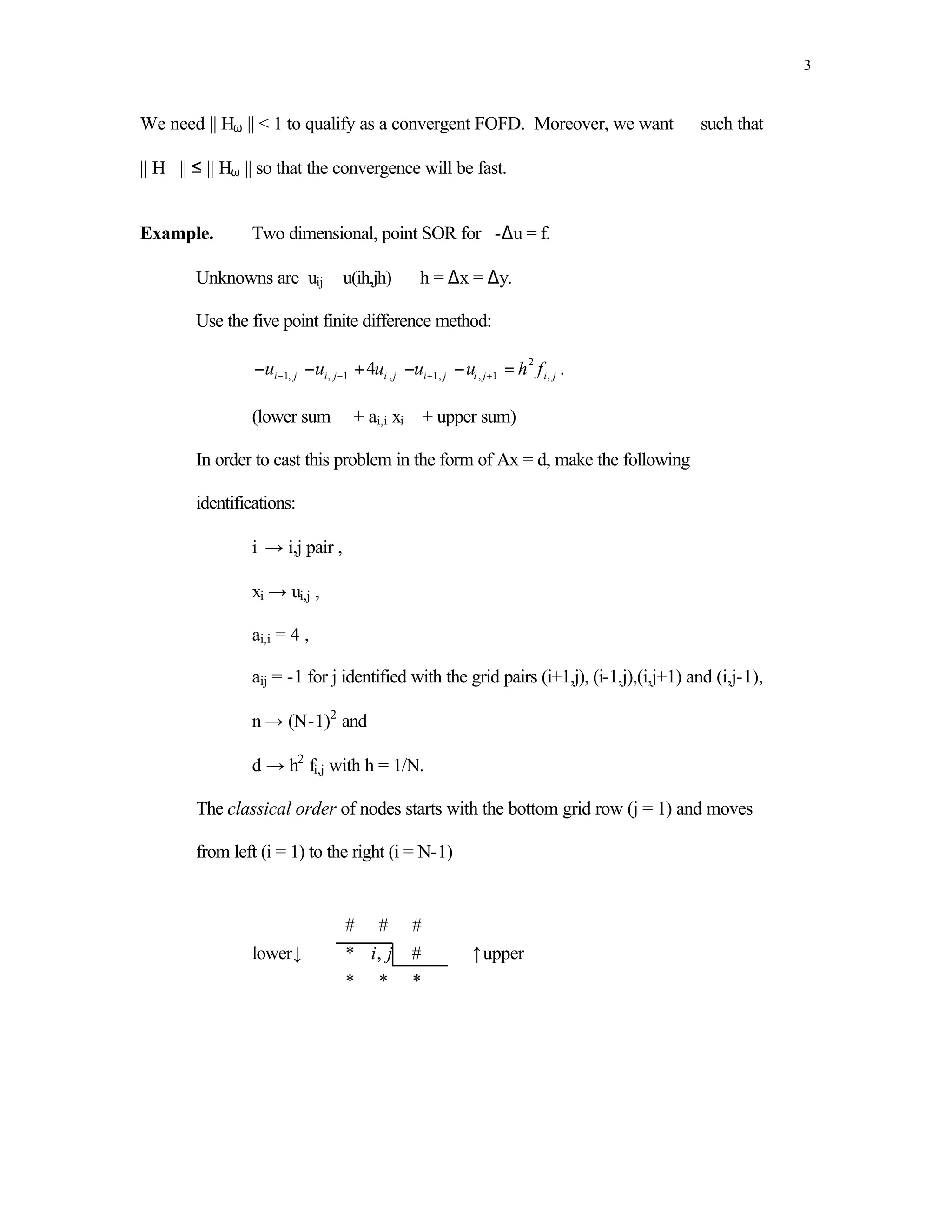
        The classical order of nodes starts with the bottom grid row (j = 1) and moves

        from left (i = 1) to the right (i = N-1)

                                                          
                                   # #            #       
                                                          
                 lower↓            * i, j         #        ↑upper
                                                          
                                   * *            *       
                        
                                                          
                                                           
4


      Point SOR with u(i,j) Overwritten.


      for m = 0, maxm

               numi = 0

               for j = 1, N-1

                         for i = 1, N-1

                                   utemp = [h*h*fij +u(i-1,j)+u(i,j-1)+u(i+1,j)+u(i,j+1)]*0.25

                                   utemp = (1-ω)*u(i,j) + ω*utemp

                                   error = u(i,j) - utemp

                                   if abs(error) < ε   numi = numi + 1

                                   u(i,j) = utemp

               if numi = (N-1)*(N-1) break


      See MA402 chapters 3,4 for MATLAB and Fortran 90 implementations.


Example.       Two dimensional block SOR.

          B       −I         U1       F1 
      A =  −I                U  = h2  F 
                  B      −I  2        2
          
                  −I     B  U 3 
                                       F3 
                                          

          4 −1                         u11 
          −1 4 −1 ,
      B =                        U1 =  u21  ,
                                                  I3x3
         
             −1 4 
                                        u31 
                                         

      −U i −1 + BU i − U i +1 = h 2 Fi .

      Here i represents the i grid row (an abuse of notation)

      Block component form iss A = [Aij] where A is (N-1)x(N-1) block matrix.
5


                           AX = F

                           ∑A X
                            j< i
                                    ij    j   + Aii X i + ∑ Aij X j = Fi where Aii are tridiagonal matrices.
                                                              j> i


      Block G-S algorithm.

              for m = 1, maxm

                           for i = 1,N-1

                                         Solve Aii X im +1 = Fi − ∑ Aij X m +1 − ∑ Aij X m
                                                                          j              j
                                                                             j< i                   j> i

                           test for convergence.


Example.      Three dimensional point SOR for -∆u = f.

      This is similar to the 2D point SOR with an additional loop in z direction.

      The 7 point finite difference equation is

              −ui −1, j , l −ui , j− 1,l −ui , j ,l −1 + 6ui , j ,l −ui +1, j ,l − ui , j+ 1,l − ui , j ,l + 1 = h 2 f i ,j ,l .

      The point SOR scheme will now have three inner nested loops. The coefficient

      matrix will be block tridiagonal with the diagonal blocks having a similar

      structure as the 2D coefficient matrix.

Gaussseidelsor

  • 1.
    5.2 Gauss-Seidel andSOR (Successive Over Relaxation) As motivation return to the example of the last section: −ui −1 + 3ui −ui +1 = f i . Jacobi: uim +1 = ( f i + uim 1 + uim 1 ) / 3 − + i = 1,2,...,n. Since ui-1 m+1 has already been computed and may be closer to the solution, we should consider using it in place of ui-1 m. This is the Gauss-Seidel method Gauss-Seidel: uim +1 = ( f i + uim 1 1 + uim 1 ) / 3 − + + i = 1,2,...,n. For the Gauss-Seidel scheme and the given example, the iterates one and two are 0   1/3   13/27  0  , u1 =  4 / 9  and u 2 =  53/81  . u =  0     0    13/27    124/243    Gauss-Seidel exhibits faster convergence. SOR Algorithm (0 < ω < 2) Note, ω = 1.0 is Gauss-Seidel, ω > 1.0 is over-relaxation, and ω < 1.0 is under-relaxation. Consider Ax = d or in component form ∑a j< i i, j x j + ai ,i xi + ∑ ai , j x j = di . j> i for m = 0, maxm for i = 1, n xim +1 / 2 = ( di − ∑ ai , j x m +1 − ∑ ai , j x m ) / ai , i j j j< i j >i xim +1 = (1 − ω ) xim + ω xim +1 / 2 test for convergence.
  • 2.
    2 Most applications are sparse (many aij = 0). Gauss-Seidel would not be used on dense matrices because of the number of calculations required for the lower and upper sums. Notes: (i) If A SPD and 0 < ω < 2, then we will show that SOR converges. (ii) ω > 1.0 is used to significantly accelerate convergence (The choice of ω could be a problem for some application). (iii) ω =1.0 (for G-S) is much faster than Jacobi. SOR may be viewed as a matrix FOFD iteration * 0 0 0  0 0 0 0  0 * * * 0 * 0 0  * 0 0 0  0 0 * * A = D − L −U =  −  −   0 0 * 0  * * 0 0  0 0 0 *       0 0 0 *  * * * 0  0 0 0 0 Then xim +1 = (1 − ω ) xim + ω (di − ∑ ai , j x m +1 −∑ ai , j x m ) / ai ,i j j j <i j >i a x m +1 i, i i = (1 − ω )a x + ω (di − ∑ ai , j x m +1 −∑ ai , j x m ) m i, i i j j j <i j >i The matrix form is Dx m +1 = (1− ω ) Dx m + ω (d + Lxm +1 + Ux m ) ( D − ω L) x m +1 = (1 − ω ) Dx m + ωUx m + ω d ( D − ω L ) x m +1 / ω = (1 − ω) Dx m / ω + Ux m + d x m +1 = [( D − ω L) / ω] −1[(1 − ω ) D / ω + U ] x m + [( D − ω L) / ω ]−1 d x m +1 = Hω x m + [( D − ω L ) / ω ]−1 d
  • 3.
    3 We need ||Hω || < 1 to qualify as a convergent FOFD. Moreover, we want ϖ such that || Hϖ || ≤ || Hω || so that the convergence will be fast. Example. Two dimensional, point SOR for -∆u = f. Unknowns are uij ≅ u(ih,jh) h = ∆x = ∆y. Use the five point finite difference method: −ui −1, j −ui , j −1 + 4ui , j −ui +1, j − ui , j +1 = h 2 f i , j . (lower sum + ai,i xi + upper sum) In order to cast this problem in the form of Ax = d, make the following identifications: i → i,j pair , xi → ui,j , ai,i = 4 , aij = -1 for j identified with the grid pairs (i+1,j), (i-1,j),(i,j+1) and (i,j-1), n → (N-1)2 and d → h2 fi,j with h = 1/N. The classical order of nodes starts with the bottom grid row (j = 1) and moves from left (i = 1) to the right (i = N-1)    # # #    lower↓  * i, j #  ↑upper    * * *     
  • 4.
    4 Point SOR with u(i,j) Overwritten. for m = 0, maxm numi = 0 for j = 1, N-1 for i = 1, N-1 utemp = [h*h*fij +u(i-1,j)+u(i,j-1)+u(i+1,j)+u(i,j+1)]*0.25 utemp = (1-ω)*u(i,j) + ω*utemp error = u(i,j) - utemp if abs(error) < ε numi = numi + 1 u(i,j) = utemp if numi = (N-1)*(N-1) break See MA402 chapters 3,4 for MATLAB and Fortran 90 implementations. Example. Two dimensional block SOR. B −I   U1   F1  A =  −I   U  = h2  F   B −I  2   2   −I B  U 3     F3     4 −1   u11   −1 4 −1 , B =  U1 =  u21  ,   I3x3   −1 4    u31    −U i −1 + BU i − U i +1 = h 2 Fi . Here i represents the i grid row (an abuse of notation) Block component form iss A = [Aij] where A is (N-1)x(N-1) block matrix.
  • 5.
    5 AX = F ∑A X j< i ij j + Aii X i + ∑ Aij X j = Fi where Aii are tridiagonal matrices. j> i Block G-S algorithm. for m = 1, maxm for i = 1,N-1 Solve Aii X im +1 = Fi − ∑ Aij X m +1 − ∑ Aij X m j j j< i j> i test for convergence. Example. Three dimensional point SOR for -∆u = f. This is similar to the 2D point SOR with an additional loop in z direction. The 7 point finite difference equation is −ui −1, j , l −ui , j− 1,l −ui , j ,l −1 + 6ui , j ,l −ui +1, j ,l − ui , j+ 1,l − ui , j ,l + 1 = h 2 f i ,j ,l . The point SOR scheme will now have three inner nested loops. The coefficient matrix will be block tridiagonal with the diagonal blocks having a similar structure as the 2D coefficient matrix.