 Named after Joseph Louis Lagrange.
 Lagrange multipliers provides a strategy for finding
the maxima and minima of a function subject
to constraints.
 One of the most common problems in calculus is that
of finding maxima or minima of a function.
 Difficulties often arise when one wishes to maximize
or minimize a function subject to fixed outside
conditions or constraints.
 The method of Lagrange multipliers is a powerful tool
for solving this class of problems.
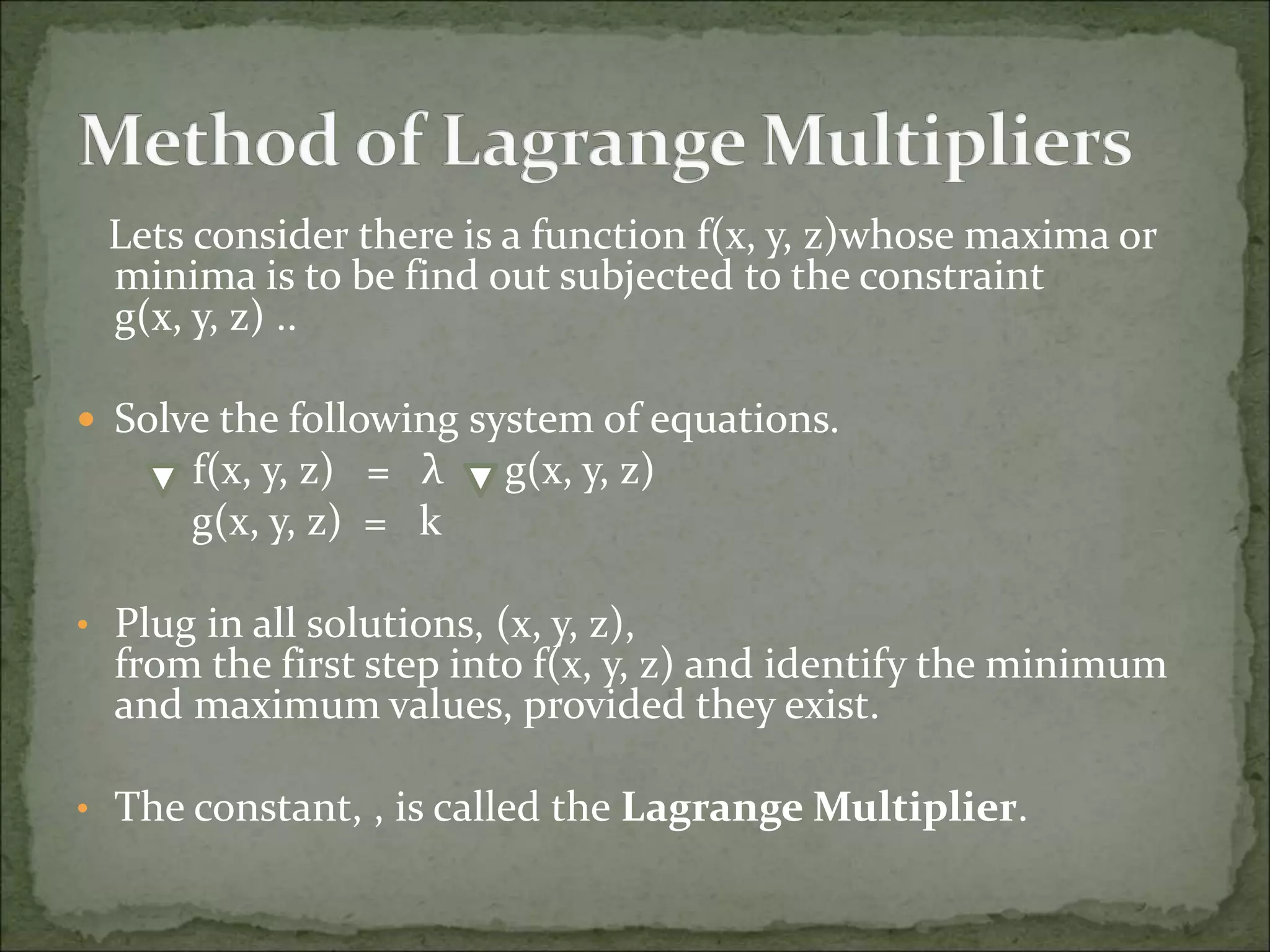
Lets consider there is a function f(x, y, z)whose maxima or
minima is to be find out subjected to the constraint
g(x, y, z) ..
 Solve the following system of equations.
f(x, y, z) = λ g(x, y, z)
g(x, y, z) = k
• Plug in all solutions, (x, y, z),
from the first step into f(x, y, z) and identify the minimum
and maximum values, provided they exist.
• The constant, , is called the Lagrange Multiplier.
 Here,
f(x, y) = 5x – 3y
constraint
g(x, y) = x² + y²-136
Thus,
δf(x, y)/δx = 5
δ f(x, y)/δy = -3
δg(x, y)/δx = 2 x
δg(x, y)/δy = 2 y
• Now, applying
δf(x, y)/δx = λ δg(x, y)/δx
δf(x, y)/δy = λ δg(x, y)/δy
We get following set of equations ..
5 = 2 λx
-3 = 2 λy
x² + y²=136 (constraint)
Solving these equations
x = 5/2 λ
y = -3/2 λ
Plugging these into the constraint we get
λ = ± ¼
If λ = ¼ then, x=10 and y=-6
if λ=-1/4 then, x=-10 and y= 6
To determine if we have maximums or minimums we just need to plug these
into the function.
Here are the minimum and maximum values of the function.
f(-10,6) = -68 Minimum at(-10,6)
f(10,-6) = 68 Maximum at(10,-6)
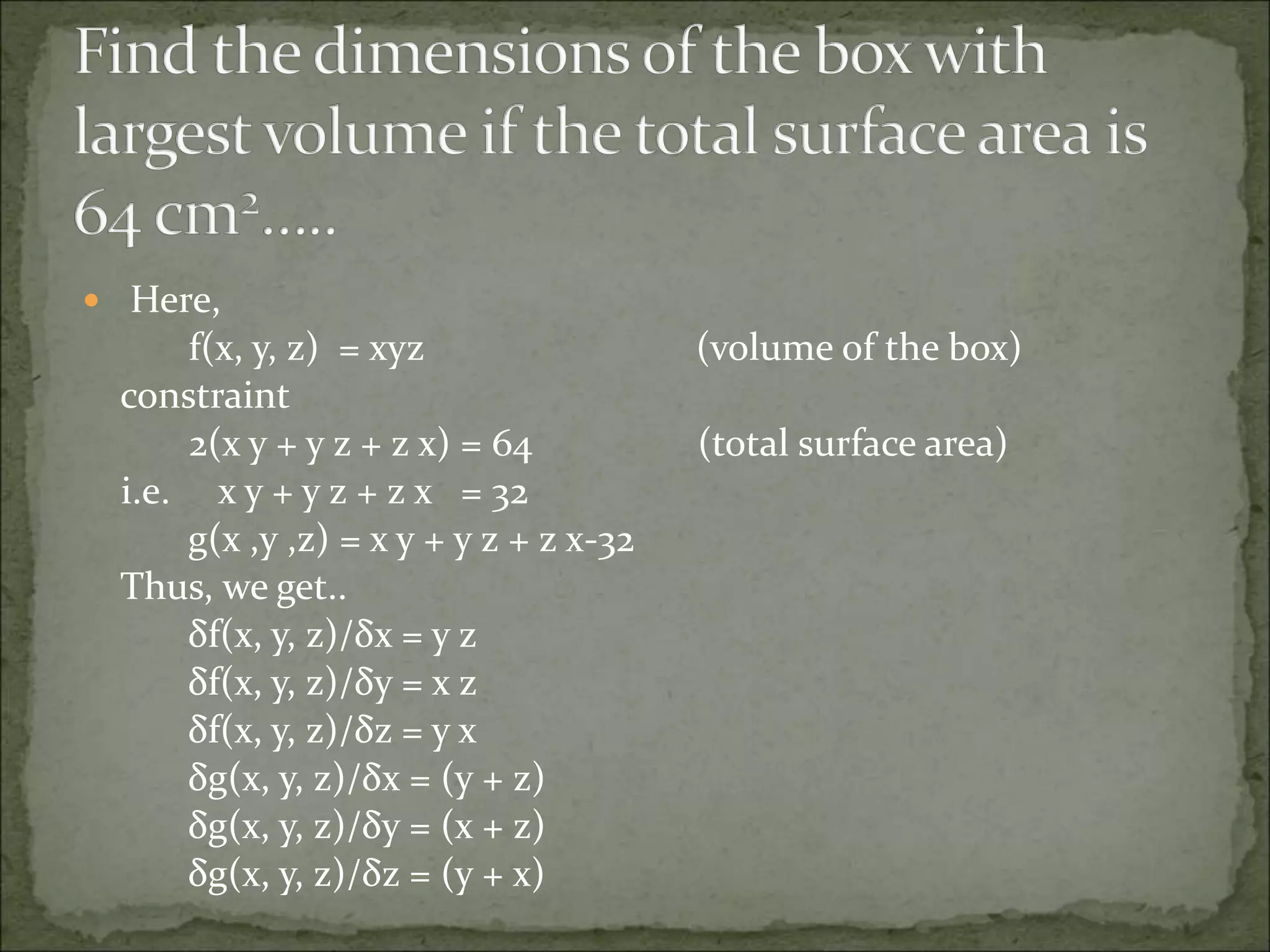
 Here,
f(x, y, z) = xyz (volume of the box)
constraint
2(x y + y z + z x) = 64 (total surface area)
i.e. x y + y z + z x = 32
g(x ,y ,z) = x y + y z + z x-32
Thus, we get..
δf(x, y, z)/δx = y z
δf(x, y, z)/δy = x z
δf(x, y, z)/δz = y x
δg(x, y, z)/δx = (y + z)
δg(x, y, z)/δy = (x + z)
δg(x, y, z)/δz = (y + x)
 Now, applying
δf(x, y, z)/δx = λ δg(x, y, z)/δx
δf(x, y, z)/δy = λ δg(x, y, z)/δy
δf(x, y, z)/δz = λ δg(x, y, z)/δz
We get following set of equations ..
y z = λ (y + z)
x z = λ (x + z)
y x = λ (y + x)
x y + y z + z x = 32 (constraint)
Applying either elimination or substitution method we now
solve the set of equations thus obtained..
Thus, x = y = z = 3.266
We can say that we will get a maximum volume if the dimensions
are
x = y = z = 3.266
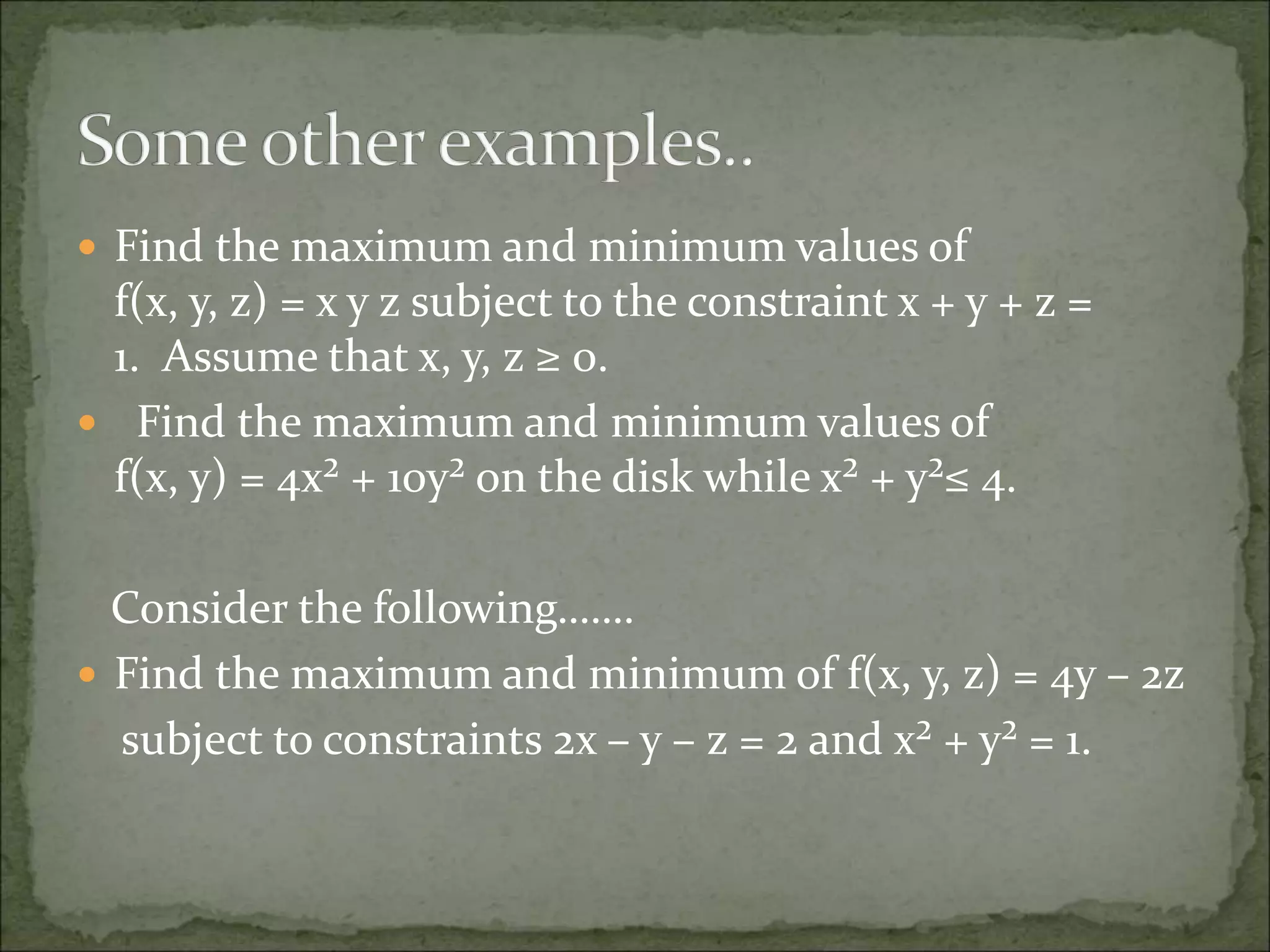
 Find the maximum and minimum values of
f(x, y, z) = x y z subject to the constraint x + y + z =
1. Assume that x, y, z ≥ 0.
 Find the maximum and minimum values of
f(x, y) = 4x² + 10y² on the disk while x² + y²≤ 4.
Consider the following…….
 Find the maximum and minimum of f(x, y, z) = 4y – 2z
subject to constraints 2x – y – z = 2 and x² + y² = 1.
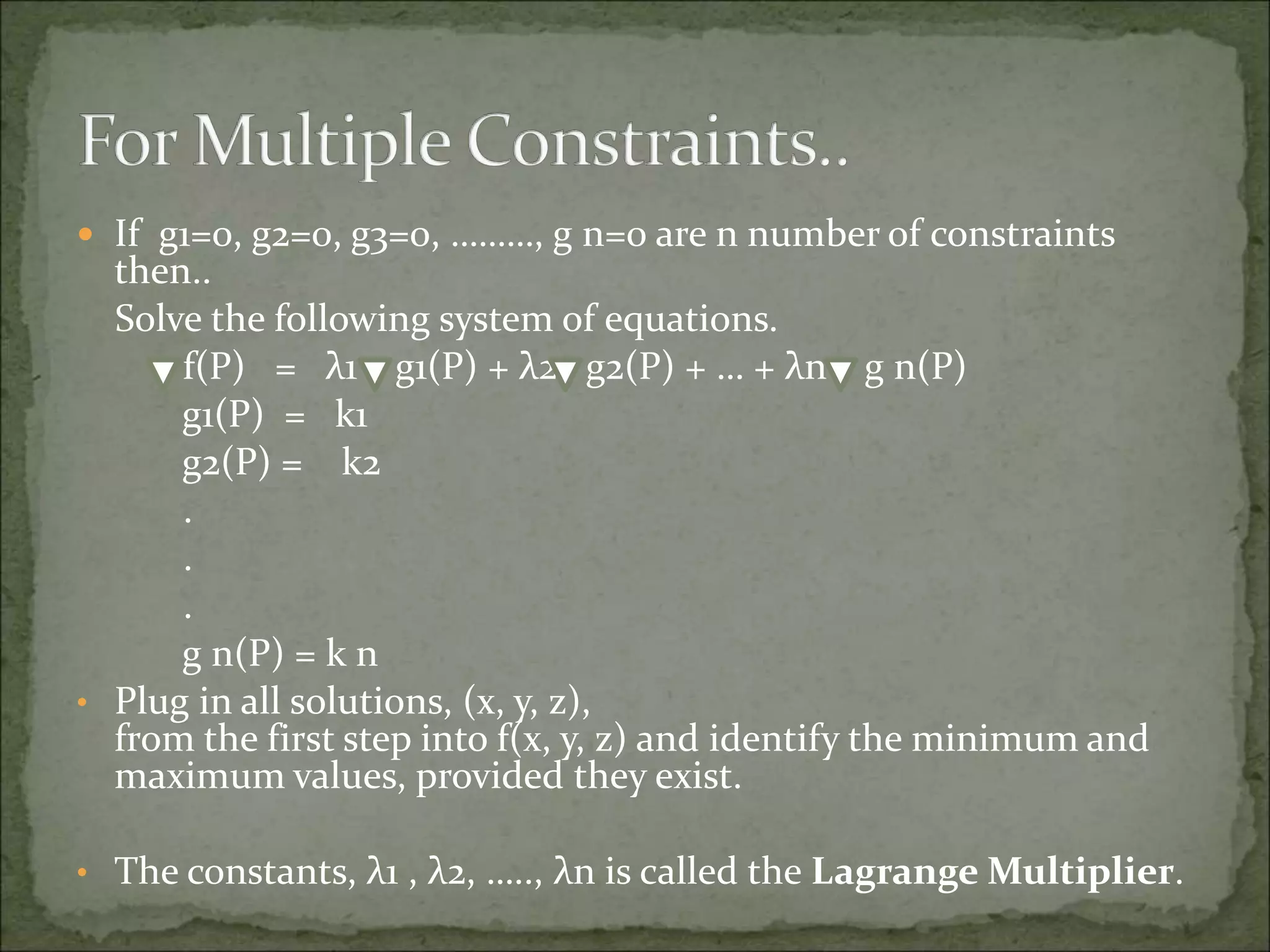
 If g1=0, g2=0, g3=0, ………, g n=0 are n number of constraints
then..
Solve the following system of equations.
f(P) = λ1 g1(P) + λ2 g2(P) + … + λn g n(P)
g1(P) = k1
g2(P) = k2
.
.
.
g n(P) = k n
• Plug in all solutions, (x, y, z),
from the first step into f(x, y, z) and identify the minimum and
maximum values, provided they exist.
• The constants, λ1 , λ2, ….., λn is called the Lagrange Multiplier.
Here,
f(x1,x2,x3,x4,x5)= x1
2+x2
2+x3
2+x4
2+x5
2
Constraints
g1(x1,x2,x3,x4,x5)=x1+2x2+x3-1
g2(x1,x2,x3,x4,x5)=x3-2x4+x5-6
Thus,
δf(x1,x2,x3,x4,x5)/δx1 =2x1
δf(x1,x2,x3,x4,x5)/δx2 =2x2
δf(x1,x2,x3,x4,x5)/δx3 =2x3
δf(x1,x2,x3,x4,x5)/δx4 =2x4
δf(x1,x2,x3,x4,x5)/δx5 =2x5
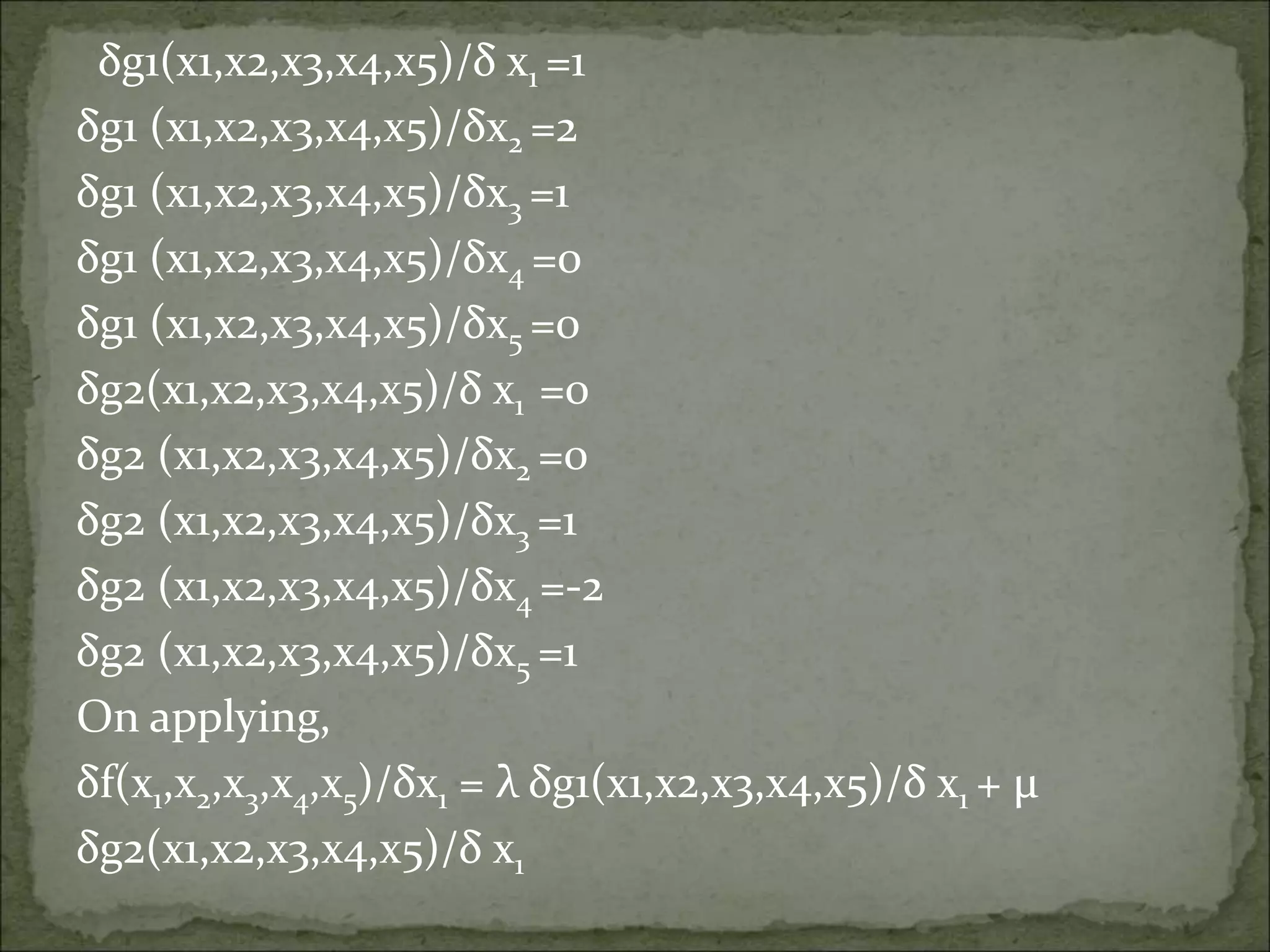
δg1(x1,x2,x3,x4,x5)/δ x1 =1
δg1 (x1,x2,x3,x4,x5)/δx2 =2
δg1 (x1,x2,x3,x4,x5)/δx3 =1
δg1 (x1,x2,x3,x4,x5)/δx4 =0
δg1 (x1,x2,x3,x4,x5)/δx5 =0
δg2(x1,x2,x3,x4,x5)/δ x1 =0
δg2 (x1,x2,x3,x4,x5)/δx2 =0
δg2 (x1,x2,x3,x4,x5)/δx3 =1
δg2 (x1,x2,x3,x4,x5)/δx4 =-2
δg2 (x1,x2,x3,x4,x5)/δx5 =1
On applying,
δf(x1,x2,x3,x4,x5)/δx1 = λ δg1(x1,x2,x3,x4,x5)/δ x1 + µ
δg2(x1,x2,x3,x4,x5)/δ x1
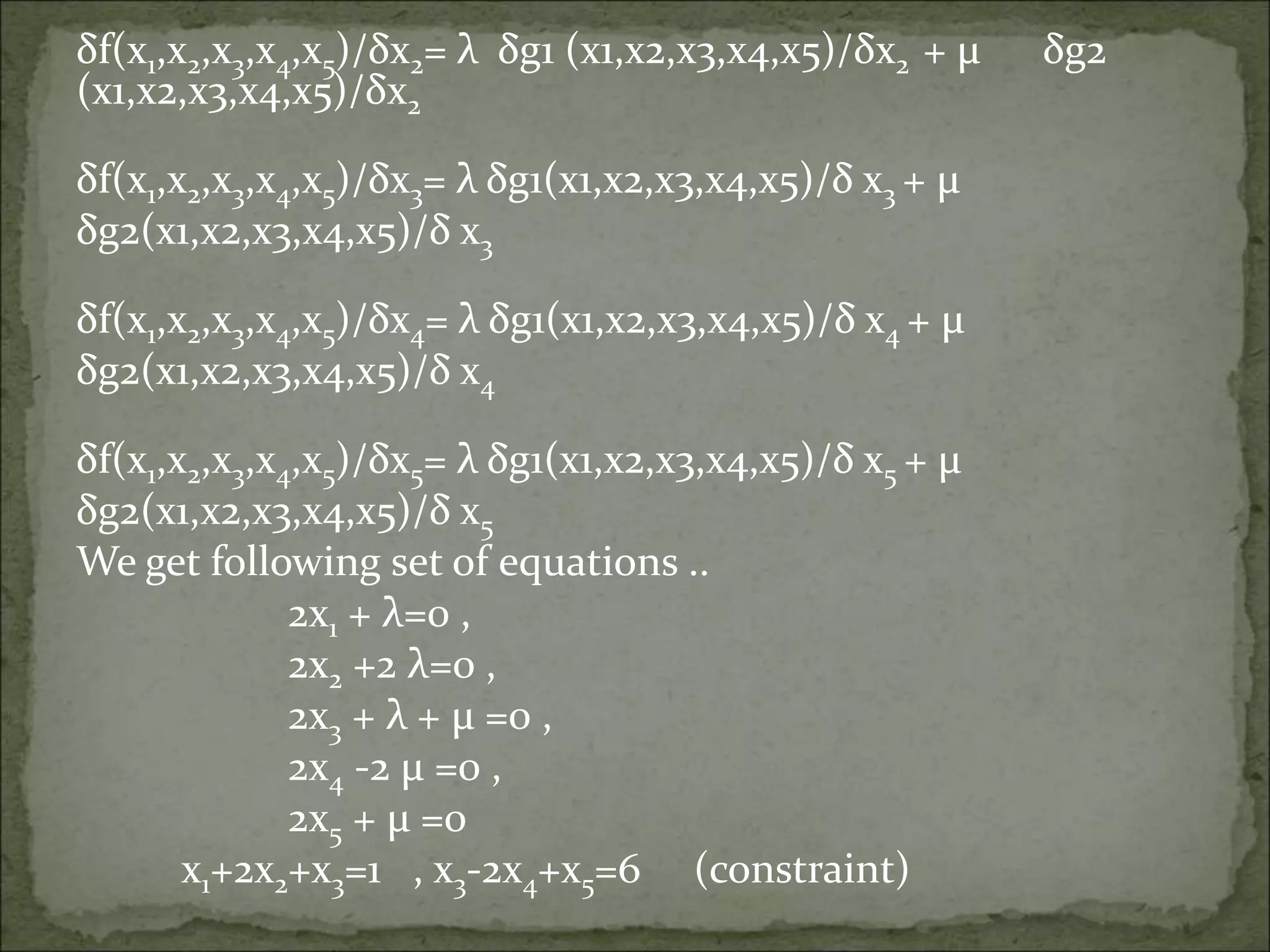
δf(x1,x2,x3,x4,x5)/δx2= λ δg1 (x1,x2,x3,x4,x5)/δx2 + µ δg2
(x1,x2,x3,x4,x5)/δx2
δf(x1,x2,x3,x4,x5)/δx3= λ δg1(x1,x2,x3,x4,x5)/δ x3 + µ
δg2(x1,x2,x3,x4,x5)/δ x3
δf(x1,x2,x3,x4,x5)/δx4= λ δg1(x1,x2,x3,x4,x5)/δ x4 + µ
δg2(x1,x2,x3,x4,x5)/δ x4
δf(x1,x2,x3,x4,x5)/δx5= λ δg1(x1,x2,x3,x4,x5)/δ x5 + µ
δg2(x1,x2,x3,x4,x5)/δ x5
We get following set of equations ..
2x1 + λ=0 ,
2x2 +2 λ=0 ,
2x3 + λ + µ =0 ,
2x4 -2 µ =0 ,
2x5 + µ =0
x1+2x2+x3=1 , x3-2x4+x5=6 (constraint)
On Solving these equations
µ=-2, λ=0
Plugging these into the equations we get
x1=x2=0, x3=x5=1 and x4=-2
To determine minimums we just need to plug these into
the function.
Here ,the minimum values of the function.
f(0,0,1,-2,1)=6.
Here,
f(x , y , z)=4y-2z
Constraint,
g1(x ,y ,z)=2x-y-z-2
g2(x ,y ,z)= x² + y² -1
Thus,
δf(x ,y ,z)/δx =0
δf(x ,y ,z)/δy =4
δf(x ,y ,z)/δz =-2
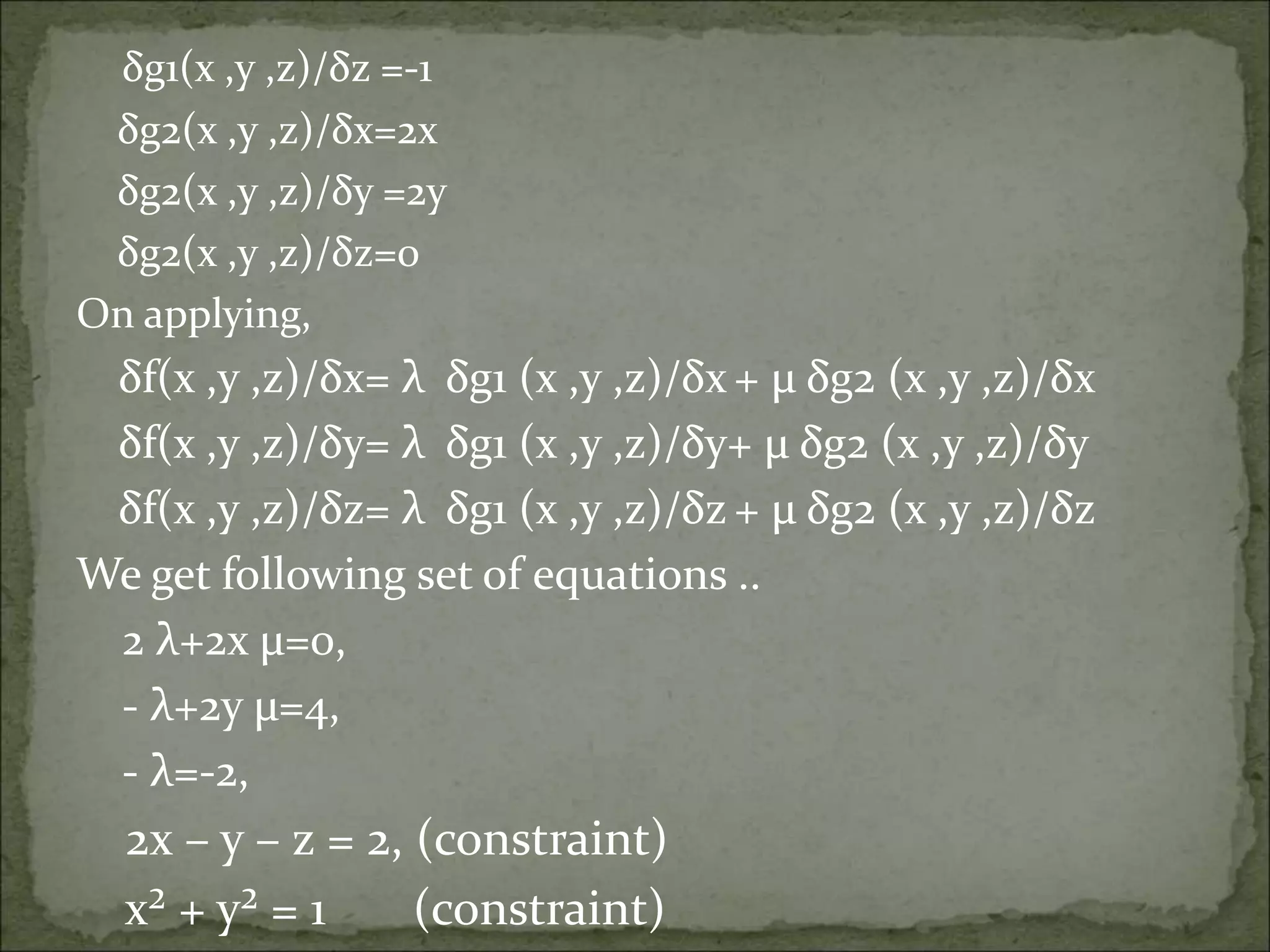
δg1(x ,y ,z)/δx =2
δg1(x ,y ,z)/δy =-1
δg1(x ,y ,z)/δz =-1
δg2(x ,y ,z)/δx=2x
δg2(x ,y ,z)/δy =2y
δg2(x ,y ,z)/δz=0
On applying,
δf(x ,y ,z)/δx= λ δg1 (x ,y ,z)/δx + µ δg2 (x ,y ,z)/δx
δf(x ,y ,z)/δy= λ δg1 (x ,y ,z)/δy+ µ δg2 (x ,y ,z)/δy
δf(x ,y ,z)/δz= λ δg1 (x ,y ,z)/δz + µ δg2 (x ,y ,z)/δz
We get following set of equations ..
2 λ+2x µ=0,
- λ+2y µ=4,
- λ=-2,
2x – y – z = 2, (constraint)
x² + y² = 1 (constraint)
On Solving these equations…
λ=2, µ=+5,-5
Plugging these into the equations we get
If µ=+5 ,then x=0.8,y=-0.6,z=0.2 and
If µ=-5 ,then x=-0.8,y=0.6,z=-4.2
To determine if we have maximums or minimums we
just need to plug these into the function.
Here are the minimum and maximum values of the
function.
f(0.8,-0.6,0.2)=-2.8 minimum at(0.8,-0.6,0.2)
f(-0.8,0.6,-4.2)=10.8 maximum at(-0.8,0.6,-4.2)

LAGRANGE_MULTIPLIER.ppt

  • 2.
     Named afterJoseph Louis Lagrange.  Lagrange multipliers provides a strategy for finding the maxima and minima of a function subject to constraints.
  • 3.
     One ofthe most common problems in calculus is that of finding maxima or minima of a function.  Difficulties often arise when one wishes to maximize or minimize a function subject to fixed outside conditions or constraints.  The method of Lagrange multipliers is a powerful tool for solving this class of problems.
  • 4.
    Lets consider thereis a function f(x, y, z)whose maxima or minima is to be find out subjected to the constraint g(x, y, z) ..  Solve the following system of equations. f(x, y, z) = λ g(x, y, z) g(x, y, z) = k • Plug in all solutions, (x, y, z), from the first step into f(x, y, z) and identify the minimum and maximum values, provided they exist. • The constant, , is called the Lagrange Multiplier.
  • 6.
     Here, f(x, y)= 5x – 3y constraint g(x, y) = x² + y²-136 Thus, δf(x, y)/δx = 5 δ f(x, y)/δy = -3 δg(x, y)/δx = 2 x δg(x, y)/δy = 2 y
  • 7.
    • Now, applying δf(x,y)/δx = λ δg(x, y)/δx δf(x, y)/δy = λ δg(x, y)/δy We get following set of equations .. 5 = 2 λx -3 = 2 λy x² + y²=136 (constraint) Solving these equations x = 5/2 λ y = -3/2 λ Plugging these into the constraint we get λ = ± ¼ If λ = ¼ then, x=10 and y=-6 if λ=-1/4 then, x=-10 and y= 6 To determine if we have maximums or minimums we just need to plug these into the function. Here are the minimum and maximum values of the function. f(-10,6) = -68 Minimum at(-10,6) f(10,-6) = 68 Maximum at(10,-6)
  • 8.
     Here, f(x, y,z) = xyz (volume of the box) constraint 2(x y + y z + z x) = 64 (total surface area) i.e. x y + y z + z x = 32 g(x ,y ,z) = x y + y z + z x-32 Thus, we get.. δf(x, y, z)/δx = y z δf(x, y, z)/δy = x z δf(x, y, z)/δz = y x δg(x, y, z)/δx = (y + z) δg(x, y, z)/δy = (x + z) δg(x, y, z)/δz = (y + x)
  • 9.
     Now, applying δf(x,y, z)/δx = λ δg(x, y, z)/δx δf(x, y, z)/δy = λ δg(x, y, z)/δy δf(x, y, z)/δz = λ δg(x, y, z)/δz We get following set of equations .. y z = λ (y + z) x z = λ (x + z) y x = λ (y + x) x y + y z + z x = 32 (constraint) Applying either elimination or substitution method we now solve the set of equations thus obtained.. Thus, x = y = z = 3.266 We can say that we will get a maximum volume if the dimensions are x = y = z = 3.266
  • 10.
     Find themaximum and minimum values of f(x, y, z) = x y z subject to the constraint x + y + z = 1. Assume that x, y, z ≥ 0.  Find the maximum and minimum values of f(x, y) = 4x² + 10y² on the disk while x² + y²≤ 4. Consider the following…….  Find the maximum and minimum of f(x, y, z) = 4y – 2z subject to constraints 2x – y – z = 2 and x² + y² = 1.
  • 11.
     If g1=0,g2=0, g3=0, ………, g n=0 are n number of constraints then.. Solve the following system of equations. f(P) = λ1 g1(P) + λ2 g2(P) + … + λn g n(P) g1(P) = k1 g2(P) = k2 . . . g n(P) = k n • Plug in all solutions, (x, y, z), from the first step into f(x, y, z) and identify the minimum and maximum values, provided they exist. • The constants, λ1 , λ2, ….., λn is called the Lagrange Multiplier.
  • 12.
  • 13.
    δg1(x1,x2,x3,x4,x5)/δ x1 =1 δg1(x1,x2,x3,x4,x5)/δx2 =2 δg1 (x1,x2,x3,x4,x5)/δx3 =1 δg1 (x1,x2,x3,x4,x5)/δx4 =0 δg1 (x1,x2,x3,x4,x5)/δx5 =0 δg2(x1,x2,x3,x4,x5)/δ x1 =0 δg2 (x1,x2,x3,x4,x5)/δx2 =0 δg2 (x1,x2,x3,x4,x5)/δx3 =1 δg2 (x1,x2,x3,x4,x5)/δx4 =-2 δg2 (x1,x2,x3,x4,x5)/δx5 =1 On applying, δf(x1,x2,x3,x4,x5)/δx1 = λ δg1(x1,x2,x3,x4,x5)/δ x1 + µ δg2(x1,x2,x3,x4,x5)/δ x1
  • 14.
    δf(x1,x2,x3,x4,x5)/δx2= λ δg1(x1,x2,x3,x4,x5)/δx2 + µ δg2 (x1,x2,x3,x4,x5)/δx2 δf(x1,x2,x3,x4,x5)/δx3= λ δg1(x1,x2,x3,x4,x5)/δ x3 + µ δg2(x1,x2,x3,x4,x5)/δ x3 δf(x1,x2,x3,x4,x5)/δx4= λ δg1(x1,x2,x3,x4,x5)/δ x4 + µ δg2(x1,x2,x3,x4,x5)/δ x4 δf(x1,x2,x3,x4,x5)/δx5= λ δg1(x1,x2,x3,x4,x5)/δ x5 + µ δg2(x1,x2,x3,x4,x5)/δ x5 We get following set of equations .. 2x1 + λ=0 , 2x2 +2 λ=0 , 2x3 + λ + µ =0 , 2x4 -2 µ =0 , 2x5 + µ =0 x1+2x2+x3=1 , x3-2x4+x5=6 (constraint)
  • 15.
    On Solving theseequations µ=-2, λ=0 Plugging these into the equations we get x1=x2=0, x3=x5=1 and x4=-2 To determine minimums we just need to plug these into the function. Here ,the minimum values of the function. f(0,0,1,-2,1)=6.
  • 16.
    Here, f(x , y, z)=4y-2z Constraint, g1(x ,y ,z)=2x-y-z-2 g2(x ,y ,z)= x² + y² -1 Thus, δf(x ,y ,z)/δx =0 δf(x ,y ,z)/δy =4 δf(x ,y ,z)/δz =-2 δg1(x ,y ,z)/δx =2 δg1(x ,y ,z)/δy =-1
  • 17.
    δg1(x ,y ,z)/δz=-1 δg2(x ,y ,z)/δx=2x δg2(x ,y ,z)/δy =2y δg2(x ,y ,z)/δz=0 On applying, δf(x ,y ,z)/δx= λ δg1 (x ,y ,z)/δx + µ δg2 (x ,y ,z)/δx δf(x ,y ,z)/δy= λ δg1 (x ,y ,z)/δy+ µ δg2 (x ,y ,z)/δy δf(x ,y ,z)/δz= λ δg1 (x ,y ,z)/δz + µ δg2 (x ,y ,z)/δz We get following set of equations .. 2 λ+2x µ=0, - λ+2y µ=4, - λ=-2, 2x – y – z = 2, (constraint) x² + y² = 1 (constraint)
  • 18.
    On Solving theseequations… λ=2, µ=+5,-5 Plugging these into the equations we get If µ=+5 ,then x=0.8,y=-0.6,z=0.2 and If µ=-5 ,then x=-0.8,y=0.6,z=-4.2 To determine if we have maximums or minimums we just need to plug these into the function. Here are the minimum and maximum values of the function. f(0.8,-0.6,0.2)=-2.8 minimum at(0.8,-0.6,0.2) f(-0.8,0.6,-4.2)=10.8 maximum at(-0.8,0.6,-4.2)