SECTION 1.2

INTEGRALS AS GENERAL AND PARTICULAR SOLUTIONS

This section introduces general solutions and particular solutions in the very simplest situation
— a differential equation of the form y′ = f ( x) — where only direct integration and evaluation
of the constant of integration are involved. Students should review carefully the elementary
concepts of velocity and acceleration, as well as the fps and mks unit systems.

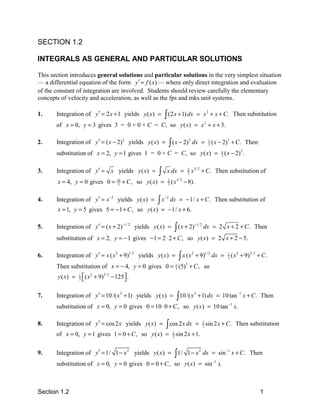
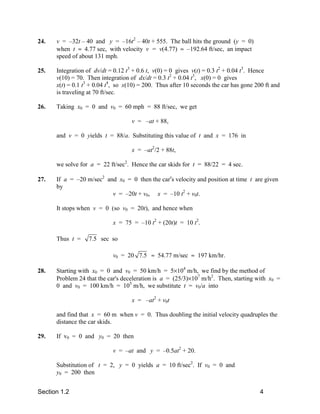
1.     Integration of y′ = 2 x + 1 yields y ( x ) =      ∫ (2 x + 1) dx             = x 2 + x + C. Then substitution
       of x = 0, y = 3 gives 3 = 0 + 0 + C = C, so y ( x) = x 2 + x + 3.

       Integration of y′ = ( x − 2) 2 yields y ( x ) =        ∫ ( x − 2)       dx =                 ( x − 2)3 + C. Then
                                                                           2                    1
2.                                                                                              3

       substitution of x = 2, y = 1 gives 1 = 0 + C = C, so y ( x) =                                    1
                                                                                                        3   ( x − 2)3 .

3.     Integration of y′ = x yields y ( x ) =       ∫     x dx =         2
                                                                         3     x 3/ 2 + C. Then substitution of
       x = 4, y = 0 gives 0 = 16 + C , so y ( x ) =
                               3
                                                          2
                                                          3    ( x 3/ 2 − 8).

       Integration of y′ = x −2 yields y ( x) =     ∫x
                                                         −2
4.                                                            dx = − 1/ x + C. Then substitution of
       x = 1, y = 5 gives 5 = − 1 + C , so y ( x ) = − 1/ x + 6.

       Integration of y′ = ( x + 2) −1/ 2 yields y ( x ) =         ∫ ( x + 2)
                                                                                   −1/ 2
5.                                                                                         dx = 2 x + 2 + C . Then
       substitution of x = 2, y = − 1 gives −1 = 2 ⋅ 2 + C , so y ( x ) = 2 x + 2 − 5.

       Integration of y′ = x ( x 2 + 9)1/ 2 yields y ( x ) =         ∫ x (x        + 9)1/ 2 dx =                 ( x 2 + 9)3/ 2 + C.
                                                                               2                             1
6.                                                                                                           3

       Then substitution of x = − 4, y = 0 gives 0 = 1 (5)3 + C , so
                                                     3

        y ( x) =   1
                   3
                        ( x 2 + 9)3/ 2 − 125 .
                                            

7.     Integration of y′ = 10 /( x 2 + 1) yields y ( x ) = ∫ 10 /( x 2 + 1) dx = 10 tan −1 x + C . Then
       substitution of x = 0, y = 0 gives 0 = 10 ⋅ 0 + C , so y ( x ) = 10 tan −1 x.

8.     Integration of y′ = cos 2 x yields y ( x) =       ∫ cos 2 x dx              =       1
                                                                                           2   sin 2 x + C. Then substitution
       of x = 0, y = 1 gives 1 = 0 + C , so y ( x) =           1
                                                               2   sin 2 x + 1.

9.     Integration of y′ = 1/ 1 − x 2 yields y ( x ) = ∫ 1/ 1 − x 2 dx = sin −1 x + C. Then
       substitution of x = 0, y = 0 gives 0 = 0 + C , so y ( x) = sin −1 x.


Section 1.2                                                                                                                     1
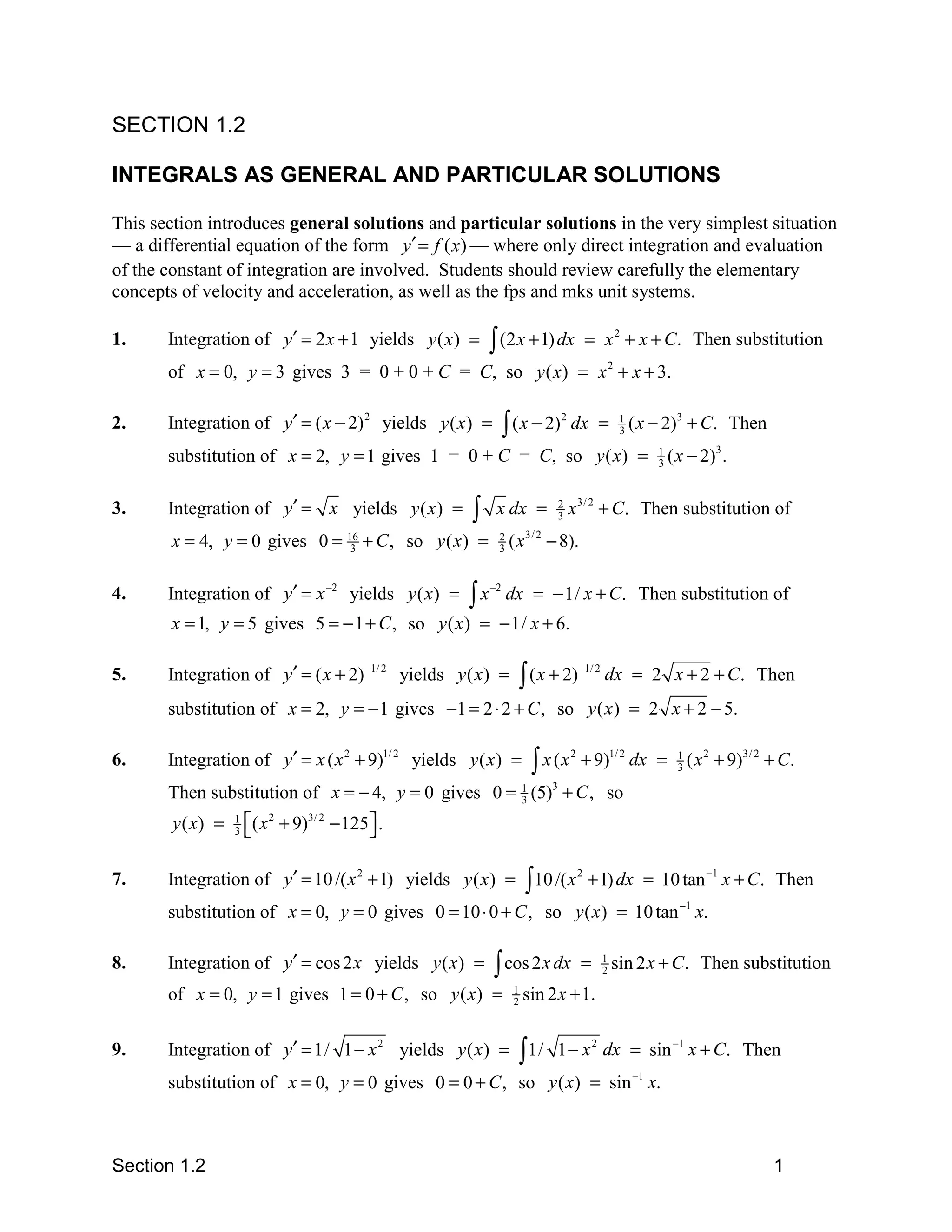
10.   Integration of y′ = x e− x yields


                         ∫ xe                    ∫ue
                                    −x
               y( x) =                   dx =          u
                                                           du = (u − 1)eu = − ( x + 1) e − x + C

      (when we substitute u = − x and apply Formula #46 inside the back cover to the
      textbook). Then substitution of x = 0, y = 1 gives 1 = − 1 + C , so
       y ( x ) = − ( x + 1) e − x + 2.

11.   If a(t ) = 50 then v(t ) =                ∫ 50 dt     = 50 t + v0 = 50 t + 10. Hence

               x(t ) =   ∫ (50 t + 10) dt =          25 t 2 + 10 t + x0 = 25 t 2 + 10 t + 10.

12.   If a (t ) = − 20 then v(t ) =               ∫ (−20) dt           = − 20 t + v0 = − 20 t − 15. Hence

               x(t ) =   ∫ (−20 t − 15) dt =              − 10 t 2 − 15 t + x0 = − 10 t 2 − 15 t + 5.

13.   If a (t ) = 3 t then v(t ) =              ∫ 3t dt    =      t + v0 =
                                                                 3 2
                                                                 2
                                                                               3 2
                                                                               2   t + 5. Hence

               x(t ) =   ∫(     t + 5) dt =
                              3 2
                              2                      t + 5 t + x0 =
                                                    1 3
                                                    2                         t + 5 t.
                                                                             1 3
                                                                             2


14.   If a (t ) = 2 t + 1 then v(t ) =             ∫ (2 t + 1) dt        = t 2 + t + v0 = t 2 + t − 7. Hence

               x(t ) =   ∫ (t       + t − 7) dt =          t + 1 t − 7t + x0 =        t + 1 t − 7t + 4.
                                2                     1 3                            1 3
                                                      3        2                     3    2


15.   If a (t ) = 2 t + 1 then v(t ) =             ∫ (2 t + 1) dt        = t 2 + t + v0 = t 2 + t − 7. Hence

               x(t ) =   ∫ (t       + t − 7) dt =          t + 1 t − 7t + x0 =        t + 1 t − 7t + 4.
                                2                     1 3                            1 3
                                                      3        2                     3    2


16.   If a(t ) = 1/ t + 4 then v(t ) = ∫ 1/ t + 4 dt = 2 t + 4 + C = 2 t + 4 − 5 (taking
      C = –5 so that v(0) = –1). Hence

               x(t ) =   ∫ (2       t + 4 − 5) dt =         4
                                                            3   (t + 4)3/ 2 − 5 t + C =    4
                                                                                           3   (t + 4)3/ 2 − 5 t − 29
                                                                                                                    3


      (taking C = − 29 / 3 so that x(0) = 1 ).

      If a(t ) = (t + 1) −3 then v(t ) =              ∫ (t + 1)
                                                                   −3
17.                                                                     dt = − 1 (t + 1) −2 + C = − 1 (t + 1) −2 + 1 (taking
                                                                               2                    2              2

      C=   1
           2   so that v(0) = 0). Hence


Section 1.2                                                                                                             2
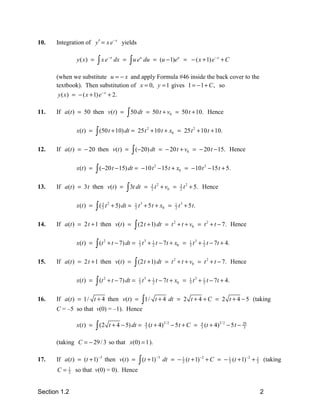
x(t ) =   ∫ −
                          
                               1
                               2   (t + 1)−2 + 1  dt =
                                               2
                                                          1
                                                          2   (t + 1)−1 + 1 t + C =
                                                                          2
                                                                                      1
                                                                                      2
                                                                                          (t + 1)−1 + t − 1
                                                                                                           

      (taking C = − 1 so that x(0) = 0 ).
                    2


18.   If a (t ) = 50sin 5t then v(t ) =          ∫ 50sin 5t dt       = − 10 cos 5t + C = − 10 cos 5t (taking
      C = 0 so that v(0) = –10). Hence

              x(t ) =   ∫ (−10 cos 5t ) dt =      − 2 sin 5t + C = − 2sin 5t + 10

      (taking C = − 10 so that x(0) = 8 ).

19.   v = –9.8t + 49, so the ball reaches its maximum height (v = 0) after t = 5 seconds. Its
      maximum height then is y(5) = –4.9(5)2 + 49(5) = 122.5 meters.

20.   v = –32t and y = –16t2 + 400, so the ball hits the ground (y = 0) when
      t = 5 sec, and then v = –32(5) = –160 ft/sec.

21.   a = –10 m/s2 and v0 = 100 km/h ≈ 27.78 m/s, so v = –10t + 27.78, and hence
      x(t) = –5t2 + 27.78t. The car stops when v = 0, t ≈ 2.78, and thus the distance
      traveled before stopping is x(2.78) ≈ 38.59 meters.

22.   v = –9.8t + 100 and y = –4.9t2 + 100t + 20.

      (a)    v = 0 when t = 100/9.8 so the projectile's maximum height is
      y(100/9.8) = –4.9(100/9.8)2 + 100(100/9.8) + 20 ≈ 530 meters.

      (b)    It passes the top of the building when y(t) = –4.9t2 + 100t + 20 = 20,
      and hence after t = 100/4.9 ≈ 20.41 seconds.

      (c)    The roots of the quadratic equation y(t) = –4.9t2 + 100t + 20 = 0 are
      t = –0.20, 20.61. Hence the projectile is in the air 20.61 seconds.

23.   a = –9.8 m/s2 so v = –9.8 t – 10 and

                                             y = –4.9 t2 – 10 t + y0.

      The ball hits the ground when y = 0 and

                                            v = –9.8 t – 10 = –60,
      so t ≈ 5.10 s. Hence

                                    y0 = 4.9(5.10)2 + 10(5.10) ≈ 178.57 m.


Section 1.2                                                                                                     3
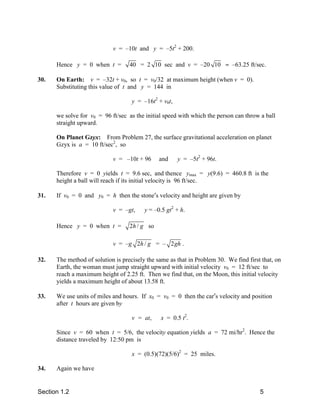
24.   v = –32t – 40 and y = –16t2 – 40t + 555. The ball hits the ground (y = 0)
      when t ≈ 4.77 sec, with velocity v = v(4.77) ≈ –192.64 ft/sec, an impact
      speed of about 131 mph.

25.   Integration of dv/dt = 0.12 t3 + 0.6 t, v(0) = 0 gives v(t) = 0.3 t2 + 0.04 t3. Hence
      v(10) = 70. Then integration of dx/dt = 0.3 t2 + 0.04 t3, x(0) = 0 gives
      x(t) = 0.1 t3 + 0.04 t4, so x(10) = 200. Thus after 10 seconds the car has gone 200 ft and
      is traveling at 70 ft/sec.

26.   Taking x0 = 0 and v0 = 60 mph = 88 ft/sec, we get

                                    v = –at + 88,

      and v = 0 yields t = 88/a. Substituting this value of t and x = 176 in

                                    x = –at2/2 + 88t,

      we solve for a = 22 ft/sec2. Hence the car skids for t = 88/22 = 4 sec.

27.   If a = –20 m/sec2 and x0 = 0 then the car′s velocity and position at time t are given
      by
                          v = –20t + v0, x = –10 t2 + v0t.

      It stops when v = 0 (so v0 = 20t), and hence when

                            x = 75 = –10 t2 + (20t)t = 10 t2.

      Thus t =     7.5 sec so

                            v0 = 20 7.5 ≈ 54.77 m/sec ≈ 197 km/hr.

28.   Starting with x0 = 0 and v0 = 50 km/h = 5×10⁴ m/h, we find by the method of
      Problem 24 that the car's deceleration is a = (25/3)×107 m/h2. Then, starting with x0 =
      0 and v0 = 100 km/h = 105 m/h, we substitute t = v0/a into

                                    x = –at2 + v0t

      and find that x = 60 m when v = 0. Thus doubling the initial velocity quadruples the
      distance the car skids.

29.   If v0 = 0 and y0 = 20 then

                            v = –at and y = –0.5at2 + 20.

      Substitution of t = 2, y = 0 yields a = 10 ft/sec2. If v0 = 0 and
      y0 = 200 then


Section 1.2                                                                             4
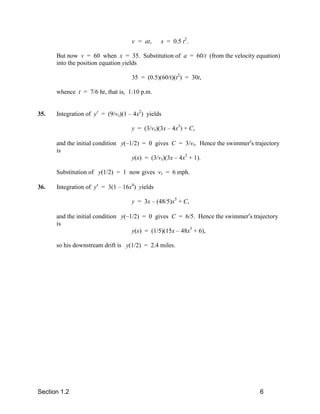
v = –10t and y = –5t2 + 200.

      Hence y = 0 when t =         40 = 2 10 sec and v = –20 10 ≈ –63.25 ft/sec.

30.   On Earth: v = –32t + v0, so t = v0/32 at maximum height (when v = 0).
      Substituting this value of t and y = 144 in

                                    y = –16t2 + v0t,

      we solve for v0 = 96 ft/sec as the initial speed with which the person can throw a ball
      straight upward.

      On Planet Gzyx: From Problem 27, the surface gravitational acceleration on planet
      Gzyx is a = 10 ft/sec2, so

                            v = –10t + 96      and     y = –5t2 + 96t.

      Therefore v = 0 yields t = 9.6 sec, and thence ymax = y(9.6) = 460.8 ft is the
      height a ball will reach if its initial velocity is 96 ft/sec.

31.   If v0 = 0 and y0 = h then the stone′s velocity and height are given by

                            v = –gt,     y = –0.5 gt2 + h.

      Hence y = 0 when t =         2h / g so

                            v = –g 2h / g = – 2gh .

32.   The method of solution is precisely the same as that in Problem 30. We find first that, on
      Earth, the woman must jump straight upward with initial velocity v0 = 12 ft/sec to
      reach a maximum height of 2.25 ft. Then we find that, on the Moon, this initial velocity
      yields a maximum height of about 13.58 ft.

33.   We use units of miles and hours. If x0 = v0 = 0 then the car′s velocity and position
      after t hours are given by

                                    v = at,    x = 0.5 t2.

      Since v = 60 when t = 5/6, the velocity equation yields a = 72 mi/hr2. Hence the
      distance traveled by 12:50 pm is

                                    x = (0.5)(72)(5/6)2 = 25 miles.

34.   Again we have


Section 1.2                                                                            5
v = at,    x = 0.5 t2.

      But now v = 60 when x = 35. Substitution of a = 60/t (from the velocity equation)
      into the position equation yields

                                    35 = (0.5)(60/t)(t2) = 30t,

      whence t = 7/6 hr, that is, 1:10 p.m.


35.   Integration of y′ = (9/vS)(1 – 4x2) yields

                                    y = (3/vS)(3x – 4x3) + C,

      and the initial condition y(–1/2) = 0 gives C = 3/vS. Hence the swimmer′s trajectory
      is
                                    y(x) = (3/vS)(3x – 4x3 + 1).

      Substitution of y(1/2) = 1 now gives vS = 6 mph.

36.   Integration of y′ = 3(1 – 16x4) yields

                                    y = 3x – (48/5)x5 + C,

      and the initial condition y(–1/2) = 0 gives C = 6/5. Hence the swimmer′s trajectory
      is
                                    y(x) = (1/5)(15x – 48x5 + 6),

      so his downstream drift is y(1/2) = 2.4 miles.


Section 1.2                                                                       6

Sect1 2

  • 1.
    SECTION 1.2 INTEGRALS ASGENERAL AND PARTICULAR SOLUTIONS This section introduces general solutions and particular solutions in the very simplest situation — a differential equation of the form y′ = f ( x) — where only direct integration and evaluation of the constant of integration are involved. Students should review carefully the elementary concepts of velocity and acceleration, as well as the fps and mks unit systems. 1. Integration of y′ = 2 x + 1 yields y ( x ) = ∫ (2 x + 1) dx = x 2 + x + C. Then substitution of x = 0, y = 3 gives 3 = 0 + 0 + C = C, so y ( x) = x 2 + x + 3. Integration of y′ = ( x − 2) 2 yields y ( x ) = ∫ ( x − 2) dx = ( x − 2)3 + C. Then 2 1 2. 3 substitution of x = 2, y = 1 gives 1 = 0 + C = C, so y ( x) = 1 3 ( x − 2)3 . 3. Integration of y′ = x yields y ( x ) = ∫ x dx = 2 3 x 3/ 2 + C. Then substitution of x = 4, y = 0 gives 0 = 16 + C , so y ( x ) = 3 2 3 ( x 3/ 2 − 8). Integration of y′ = x −2 yields y ( x) = ∫x −2 4. dx = − 1/ x + C. Then substitution of x = 1, y = 5 gives 5 = − 1 + C , so y ( x ) = − 1/ x + 6. Integration of y′ = ( x + 2) −1/ 2 yields y ( x ) = ∫ ( x + 2) −1/ 2 5. dx = 2 x + 2 + C . Then substitution of x = 2, y = − 1 gives −1 = 2 ⋅ 2 + C , so y ( x ) = 2 x + 2 − 5. Integration of y′ = x ( x 2 + 9)1/ 2 yields y ( x ) = ∫ x (x + 9)1/ 2 dx = ( x 2 + 9)3/ 2 + C. 2 1 6. 3 Then substitution of x = − 4, y = 0 gives 0 = 1 (5)3 + C , so 3 y ( x) = 1 3  ( x 2 + 9)3/ 2 − 125 .   7. Integration of y′ = 10 /( x 2 + 1) yields y ( x ) = ∫ 10 /( x 2 + 1) dx = 10 tan −1 x + C . Then substitution of x = 0, y = 0 gives 0 = 10 ⋅ 0 + C , so y ( x ) = 10 tan −1 x. 8. Integration of y′ = cos 2 x yields y ( x) = ∫ cos 2 x dx = 1 2 sin 2 x + C. Then substitution of x = 0, y = 1 gives 1 = 0 + C , so y ( x) = 1 2 sin 2 x + 1. 9. Integration of y′ = 1/ 1 − x 2 yields y ( x ) = ∫ 1/ 1 − x 2 dx = sin −1 x + C. Then substitution of x = 0, y = 0 gives 0 = 0 + C , so y ( x) = sin −1 x. Section 1.2 1
  • 2.
    10. Integration of y′ = x e− x yields ∫ xe ∫ue −x y( x) = dx = u du = (u − 1)eu = − ( x + 1) e − x + C (when we substitute u = − x and apply Formula #46 inside the back cover to the textbook). Then substitution of x = 0, y = 1 gives 1 = − 1 + C , so y ( x ) = − ( x + 1) e − x + 2. 11. If a(t ) = 50 then v(t ) = ∫ 50 dt = 50 t + v0 = 50 t + 10. Hence x(t ) = ∫ (50 t + 10) dt = 25 t 2 + 10 t + x0 = 25 t 2 + 10 t + 10. 12. If a (t ) = − 20 then v(t ) = ∫ (−20) dt = − 20 t + v0 = − 20 t − 15. Hence x(t ) = ∫ (−20 t − 15) dt = − 10 t 2 − 15 t + x0 = − 10 t 2 − 15 t + 5. 13. If a (t ) = 3 t then v(t ) = ∫ 3t dt = t + v0 = 3 2 2 3 2 2 t + 5. Hence x(t ) = ∫( t + 5) dt = 3 2 2 t + 5 t + x0 = 1 3 2 t + 5 t. 1 3 2 14. If a (t ) = 2 t + 1 then v(t ) = ∫ (2 t + 1) dt = t 2 + t + v0 = t 2 + t − 7. Hence x(t ) = ∫ (t + t − 7) dt = t + 1 t − 7t + x0 = t + 1 t − 7t + 4. 2 1 3 1 3 3 2 3 2 15. If a (t ) = 2 t + 1 then v(t ) = ∫ (2 t + 1) dt = t 2 + t + v0 = t 2 + t − 7. Hence x(t ) = ∫ (t + t − 7) dt = t + 1 t − 7t + x0 = t + 1 t − 7t + 4. 2 1 3 1 3 3 2 3 2 16. If a(t ) = 1/ t + 4 then v(t ) = ∫ 1/ t + 4 dt = 2 t + 4 + C = 2 t + 4 − 5 (taking C = –5 so that v(0) = –1). Hence x(t ) = ∫ (2 t + 4 − 5) dt = 4 3 (t + 4)3/ 2 − 5 t + C = 4 3 (t + 4)3/ 2 − 5 t − 29 3 (taking C = − 29 / 3 so that x(0) = 1 ). If a(t ) = (t + 1) −3 then v(t ) = ∫ (t + 1) −3 17. dt = − 1 (t + 1) −2 + C = − 1 (t + 1) −2 + 1 (taking 2 2 2 C= 1 2 so that v(0) = 0). Hence Section 1.2 2
  • 3.
    x(t ) = ∫ −  1 2 (t + 1)−2 + 1  dt = 2 1 2 (t + 1)−1 + 1 t + C = 2 1 2 (t + 1)−1 + t − 1   (taking C = − 1 so that x(0) = 0 ). 2 18. If a (t ) = 50sin 5t then v(t ) = ∫ 50sin 5t dt = − 10 cos 5t + C = − 10 cos 5t (taking C = 0 so that v(0) = –10). Hence x(t ) = ∫ (−10 cos 5t ) dt = − 2 sin 5t + C = − 2sin 5t + 10 (taking C = − 10 so that x(0) = 8 ). 19. v = –9.8t + 49, so the ball reaches its maximum height (v = 0) after t = 5 seconds. Its maximum height then is y(5) = –4.9(5)2 + 49(5) = 122.5 meters. 20. v = –32t and y = –16t2 + 400, so the ball hits the ground (y = 0) when t = 5 sec, and then v = –32(5) = –160 ft/sec. 21. a = –10 m/s2 and v0 = 100 km/h ≈ 27.78 m/s, so v = –10t + 27.78, and hence x(t) = –5t2 + 27.78t. The car stops when v = 0, t ≈ 2.78, and thus the distance traveled before stopping is x(2.78) ≈ 38.59 meters. 22. v = –9.8t + 100 and y = –4.9t2 + 100t + 20. (a) v = 0 when t = 100/9.8 so the projectile's maximum height is y(100/9.8) = –4.9(100/9.8)2 + 100(100/9.8) + 20 ≈ 530 meters. (b) It passes the top of the building when y(t) = –4.9t2 + 100t + 20 = 20, and hence after t = 100/4.9 ≈ 20.41 seconds. (c) The roots of the quadratic equation y(t) = –4.9t2 + 100t + 20 = 0 are t = –0.20, 20.61. Hence the projectile is in the air 20.61 seconds. 23. a = –9.8 m/s2 so v = –9.8 t – 10 and y = –4.9 t2 – 10 t + y0. The ball hits the ground when y = 0 and v = –9.8 t – 10 = –60, so t ≈ 5.10 s. Hence y0 = 4.9(5.10)2 + 10(5.10) ≈ 178.57 m. Section 1.2 3
  • 4.
    24. v = –32t – 40 and y = –16t2 – 40t + 555. The ball hits the ground (y = 0) when t ≈ 4.77 sec, with velocity v = v(4.77) ≈ –192.64 ft/sec, an impact speed of about 131 mph. 25. Integration of dv/dt = 0.12 t3 + 0.6 t, v(0) = 0 gives v(t) = 0.3 t2 + 0.04 t3. Hence v(10) = 70. Then integration of dx/dt = 0.3 t2 + 0.04 t3, x(0) = 0 gives x(t) = 0.1 t3 + 0.04 t4, so x(10) = 200. Thus after 10 seconds the car has gone 200 ft and is traveling at 70 ft/sec. 26. Taking x0 = 0 and v0 = 60 mph = 88 ft/sec, we get v = –at + 88, and v = 0 yields t = 88/a. Substituting this value of t and x = 176 in x = –at2/2 + 88t, we solve for a = 22 ft/sec2. Hence the car skids for t = 88/22 = 4 sec. 27. If a = –20 m/sec2 and x0 = 0 then the car′s velocity and position at time t are given by v = –20t + v0, x = –10 t2 + v0t. It stops when v = 0 (so v0 = 20t), and hence when x = 75 = –10 t2 + (20t)t = 10 t2. Thus t = 7.5 sec so v0 = 20 7.5 ≈ 54.77 m/sec ≈ 197 km/hr. 28. Starting with x0 = 0 and v0 = 50 km/h = 5×10⁴ m/h, we find by the method of Problem 24 that the car's deceleration is a = (25/3)×107 m/h2. Then, starting with x0 = 0 and v0 = 100 km/h = 105 m/h, we substitute t = v0/a into x = –at2 + v0t and find that x = 60 m when v = 0. Thus doubling the initial velocity quadruples the distance the car skids. 29. If v0 = 0 and y0 = 20 then v = –at and y = –0.5at2 + 20. Substitution of t = 2, y = 0 yields a = 10 ft/sec2. If v0 = 0 and y0 = 200 then Section 1.2 4
  • 5.
    v = –10tand y = –5t2 + 200. Hence y = 0 when t = 40 = 2 10 sec and v = –20 10 ≈ –63.25 ft/sec. 30. On Earth: v = –32t + v0, so t = v0/32 at maximum height (when v = 0). Substituting this value of t and y = 144 in y = –16t2 + v0t, we solve for v0 = 96 ft/sec as the initial speed with which the person can throw a ball straight upward. On Planet Gzyx: From Problem 27, the surface gravitational acceleration on planet Gzyx is a = 10 ft/sec2, so v = –10t + 96 and y = –5t2 + 96t. Therefore v = 0 yields t = 9.6 sec, and thence ymax = y(9.6) = 460.8 ft is the height a ball will reach if its initial velocity is 96 ft/sec. 31. If v0 = 0 and y0 = h then the stone′s velocity and height are given by v = –gt, y = –0.5 gt2 + h. Hence y = 0 when t = 2h / g so v = –g 2h / g = – 2gh . 32. The method of solution is precisely the same as that in Problem 30. We find first that, on Earth, the woman must jump straight upward with initial velocity v0 = 12 ft/sec to reach a maximum height of 2.25 ft. Then we find that, on the Moon, this initial velocity yields a maximum height of about 13.58 ft. 33. We use units of miles and hours. If x0 = v0 = 0 then the car′s velocity and position after t hours are given by v = at, x = 0.5 t2. Since v = 60 when t = 5/6, the velocity equation yields a = 72 mi/hr2. Hence the distance traveled by 12:50 pm is x = (0.5)(72)(5/6)2 = 25 miles. 34. Again we have Section 1.2 5
  • 6.
    v = at, x = 0.5 t2. But now v = 60 when x = 35. Substitution of a = 60/t (from the velocity equation) into the position equation yields 35 = (0.5)(60/t)(t2) = 30t, whence t = 7/6 hr, that is, 1:10 p.m. 35. Integration of y′ = (9/vS)(1 – 4x2) yields y = (3/vS)(3x – 4x3) + C, and the initial condition y(–1/2) = 0 gives C = 3/vS. Hence the swimmer′s trajectory is y(x) = (3/vS)(3x – 4x3 + 1). Substitution of y(1/2) = 1 now gives vS = 6 mph. 36. Integration of y′ = 3(1 – 16x4) yields y = 3x – (48/5)x5 + C, and the initial condition y(–1/2) = 0 gives C = 6/5. Hence the swimmer′s trajectory is y(x) = (1/5)(15x – 48x5 + 6), so his downstream drift is y(1/2) = 2.4 miles. Section 1.2 6