Homework #5 Solutions
Math 128, Fall 2013
Instructor: Dr. Doreen De Leon
1 p. 81: 1 (b), (c)
1. Show that u(x, y) is harmonic in some domain and find a harmonic conjugate v(x, y).
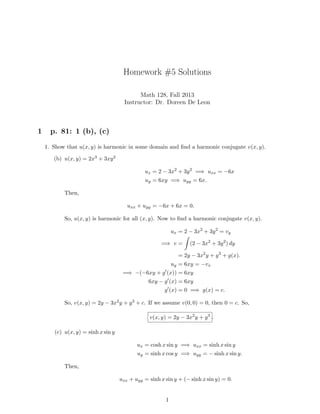
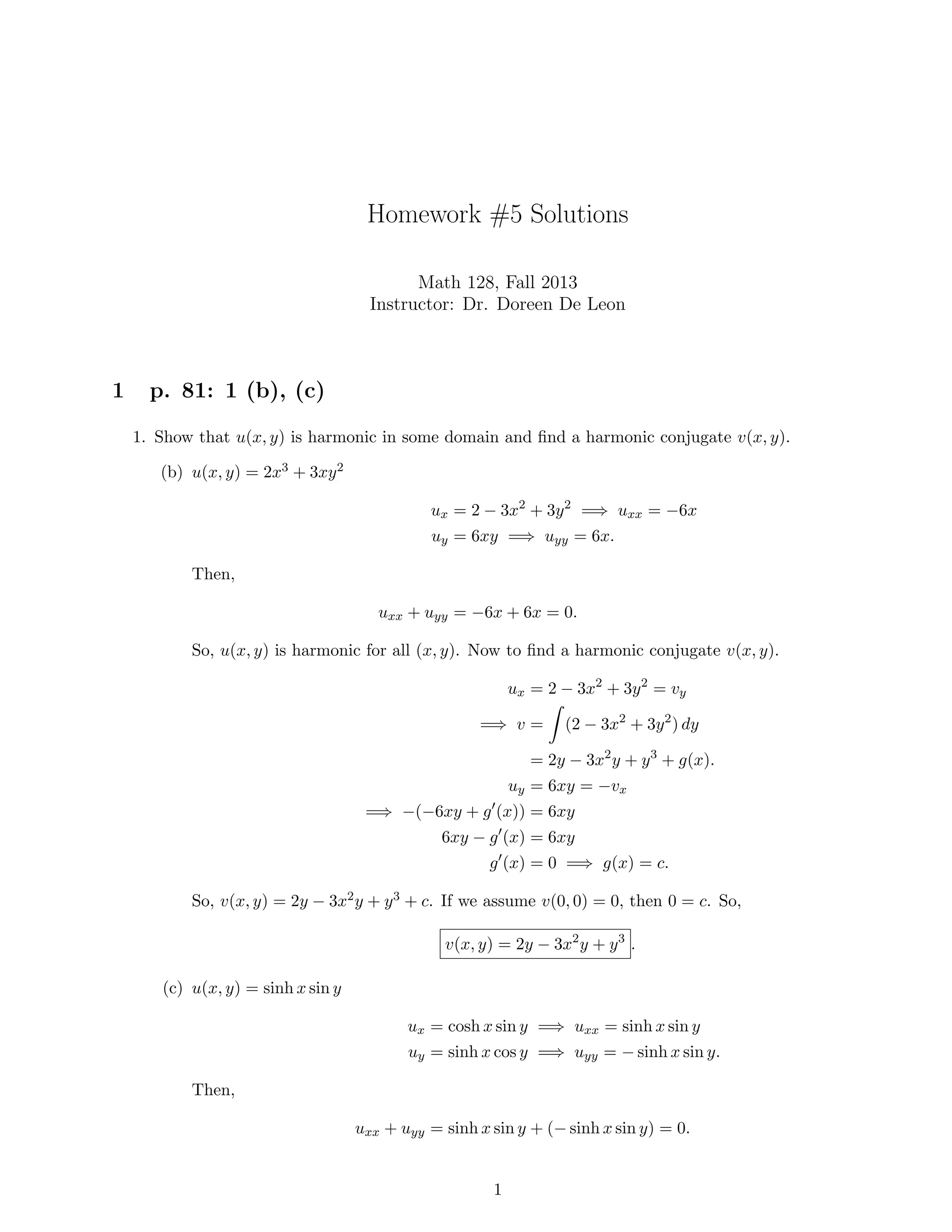
(b) u(x, y) = 2x3 + 3xy2
ux = 2 − 3x2
+ 3y2
=⇒ uxx = −6x
uy = 6xy =⇒ uyy = 6x.
Then,
uxx + uyy = −6x + 6x = 0.
So, u(x, y) is harmonic for all (x, y). Now to find a harmonic conjugate v(x, y).
ux = 2 − 3x2
+ 3y2
= vy
=⇒ v = (2 − 3x2
+ 3y2
) dy
= 2y − 3x2
y + y3
+ g(x).
uy = 6xy = −vx
=⇒ −(−6xy + g (x)) = 6xy
6xy − g (x) = 6xy
g (x) = 0 =⇒ g(x) = c.
So, v(x, y) = 2y − 3x2y + y3 + c. If we assume v(0, 0) = 0, then 0 = c. So,
v(x, y) = 2y − 3x2
y + y3
.
(c) u(x, y) = sinh x sin y
ux = cosh x sin y =⇒ uxx = sinh x sin y
uy = sinh x cos y =⇒ uyy = − sinh x sin y.
Then,
uxx + uyy = sinh x sin y + (− sinh x sin y) = 0.
1
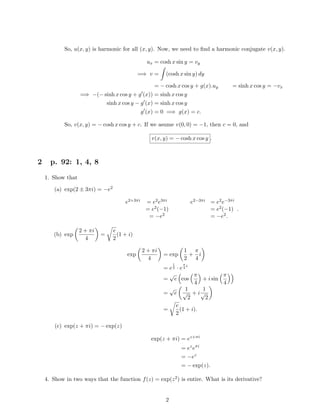
So, u(x, y) is harmonic for all (x, y). Now, we need to find a harmonic conjugate v(x, y).
ux = cosh x sin y = vy
=⇒ v = (cosh x sin y) dy
= − cosh x cos y + g(x).uy = sinh x cos y = −vx
=⇒ −(− sinh x cos y + g (x)) = sinh x cos y
sinh x cos y − g (x) = sinh x cos y
g (x) = 0 =⇒ g(x) = c.
So, v(x, y) = − cosh x cos y + c. If we asume v(0, 0) = −1, then c = 0, and
v(x, y) = − cosh x cos y .
2 p. 92: 1, 4, 8
1. Show that
(a) exp(2 ± 3πi) = −e2
e2+3πi = e2e3πi e2−3πi = e2e−3πi
= e2(−1) = e2(−1)
= −e2 = −e2.
.
(b) exp
2 + πi
4
=
e
2
(1 + i)
exp
2 + πi
4
= exp
1
2
+
π
4
i
= e
1
2 · e
π
4
i
=
√
e cos
π
4
+ i sin
π
4
=
√
e
1
√
2
+ i
1
√
2
=
e
2
(1 + i).
(c) exp(z + πi) = − exp(z)
exp(z + πi) = ez+πi
= ez
eπi
= −ez
= − exp(z).
4. Show in two ways that the function f(z) = exp(z2) is entire. What is its derivative?
2
(I) Let g(z) = ez
and h(z) = z2. g and h are both entire. Therefore, (g ◦ h)(z) is entire.
Therefore, f(z) = (g ◦ h)(z) is entire.
(II)
f(z) = ez2
= e(x+iy)2
= e(x2−y2)+i(2xy)
= ex2−y2
· ei(2xy)
= ex2−y2
(cos(2xy) + i sin(2xy))
= ex2−y2
cos(2xy) + iex2−y2
sin(2xy).
u(x, y) = ex2−y2
cos(2xy) v(x, y) = ex2−y2
sin(2xy)
ux = 2xex2−y2
cos(2xy) − 2yex2−y2
sin(2xy)
uy = −2yex2−y2
cos(2xy) − 2xex2−y2
sin(2xy)
vx = 2xex2−y2
sin(2xy) + 2yex2−y2
cos(2xy)
vy = −2yex2−y2
sin(2xy) + 2xex2−y2
cos(2xy)



exist and continuous for all z.
It is clear that ux = vy and uy = −vx, so the Cauchy-Riemann equations are satisfied for all
z. Therefore, f(z) is differentiable everywhere and, thus, f(z) is entire.
Then,
f (z) =
d
dz
ez2
= 2zez2
.
8. Find all values of z such that
(a) ez = −2
First, exeiy = 2eiπ. So,
ex
= 2 and y = π + 2nπ, n ∈ Z
x = ln 2 and y = π(2n + 1), n ∈ Z.
So, z = ln 2 + (2n + 1)πi, n ∈ Z.
(b) ez = 1 +
√
3i
1 +
√
3i = reiθ
where r = 12 + (
√
3)2 = 2, θ = tan−1
√
3
1
=
π
3
.
So,
ex
eiy
= 2eiπ
3
=⇒ ex
= 2 and y =
π
3
+ 2nπ, n ∈ Z
=⇒ x = ln 2.
So, z = ln 2 +
π
3
+ 2nπ i, n ∈ Z.
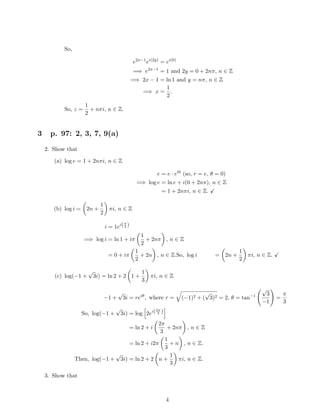
(c) exp(2z − 1) = 1
1 = 1ei0
exp(2z − 1) = exp(2(x + iy) − 1)
= exp[(2x − 1) + i(2y)]
= e2x−1
ei(2y)
.
3
So,
e2x−1
ei(2y)
= ei(0)
=⇒ e2x−1
= 1 and 2y = 0 + 2nπ, n ∈ Z
=⇒ 2x − 1 = ln 1 and y = nπ, n ∈ Z
=⇒ x =
1
2
.
So, z =
1
2
+ nπi, n ∈ Z.
3 p. 97: 2, 3, 7, 9(a)
2. Show that
(a) log e = 1 + 2nπi, n ∈ Z
e = e · ei0
(so, r = e, θ = 0)
=⇒ log e = ln e + i(0 + 2nπ), n ∈ Z
= 1 + 2nπi, n ∈ Z.
(b) log i = 2n +
1
2
πi, n ∈ Z
i = 1ei(π
2 )
=⇒ log i = ln 1 + iπ
1
2
+ 2nπ , n ∈ Z
= 0 + iπ
1
2
+ 2n , n ∈ Z.So, log i = 2n +
1
2
πi, n ∈ Z.
(c) log(−1 +
√
3i) = ln 2 + 2 1 +
1
3
πi, n ∈ Z
−1 +
√
3i = reiθ
, where r = (−1)2 + (
√
3)2 = 2, θ = tan−1
√
3
−1
=
π
3
So, log(−1 +
√
3i) = log 2ei(2π
3 )
= ln 2 + i
2π
3
+ 2nπ , n ∈ Z
= ln 2 + i2π
1
3
+ n , n ∈ Z.
Then, log(−1 +
√
3i) = ln 2 + 2 n +
1
3
πi, n ∈ Z.
3. Show that
4
(a) Log (1 + i)2 = 2Log (1 + i)
Log (1 + i) = Log
√
2ei π
4
= ln
√
2 + i
π
4
=
1
2
ln 2 +
π
4
i.So, 2Log (1 + i) = ln 2 +
π
2
i.
(1 + i)2
= 2i and
Log (2i) = Log 2ei π
2
= ln 2 +
π
2
i = 2Log (1 + i).
(b) Log (−1 + i)2 = 2Log (−1 + i)
Log (−1 + i) = Log
√
2ei(3π
4 )
= ln
√
2 + i
3π
4
=
1
2
ln 2 +
3π
4
i.So, 2Log (−1 + i) = ln 2 +
3π
2
i.
But, Log (−1 + i)2
= Log (−2i)
= Log 2ei(−π
2 )
= ln 2 −
π
2
i = 2Log (−1 + i).
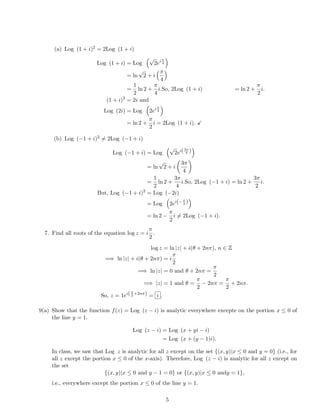
7. Find all roots of the equation log z = i
π
2
.
log z = ln |z| + i(θ + 2nπ), n ∈ Z
=⇒ ln |z| + i(θ + 2nπ) = i
π
2
=⇒ ln |z| = 0 and θ + 2nπ =
π
2
=⇒ |z| = 1 and θ =
π
2
− 2nπ =
π
2
+ 2nπ.
So, z = 1ei(π
2
+2nπ) = i .
9(a) Show that the function f(z) = Log (z − i) is analytic everywhere excepte on the portion x ≤ 0 of
the line y = 1.
Log (z − i) = Log (x + yi − i)
= Log (x + (y − 1)i).
In class, we saw that Log z is analytic for all z except on the set {(x, y)|x ≤ 0 and y = 0} (i.e., for
all z except the portion x ≤ 0 of the x-axis). Therefore, Log (z − i) is analytic for all z except on
the set
{(x, y)|x ≤ 0 and y − 1 = 0} or {(x, y)|x ≤ 0 andy = 1},
i.e., everywhere except the portion x ≤ 0 of the line y = 1.
5
4 p. 100: 2
2. Show that for any two nonzero complex numbers z1 and z2
Log (z1z2) = Log z1 + Log z2 + 2Nπi,
where N has one of the values 0, ± 1.
Let z1 = r1eiθ1
and z2 = r2eiθ2
, where θ1 = Arg z1 and θ2 = Arg z2. Then, z1z2 = r1r2ei(θ1+θ2)
. So,
Arg (z1z2) =



θ1 + θ2 if − π < θ1 + θ2 ≤ π
θ1 + θ2 − 2π if θ1 + θ2 > π
θ1 + θ2 + 2π if θ1 + θ2 ≤ −π
.
=⇒ Arg (z1z2) = θ1 + θ2 + 2Nπ, N ∈ {0, ±1}
= Arg z1 + Arg z2 + 2Nπ, N ∈ {0, ±1}.
So,
Log (z1z2) = Log r1r2ei(Arg (z1z2))
= ln(r1r2) + iArg (z1z2)
= ln r1 + ln r2 + i(Arg z1 + Arg z2 + 2Nπ), N ∈ {0, ±1}
= (ln r1 + Arg z1) + (ln r2 + Arg z2) + 2Nπ, N ∈ {0, ±1}
= Log z1 + Log z2 + 2Nπ, N ∈ {0, ±1}.
5 p. 104: 1, 2
1. Show that
(a) (1 + i)i
= exp −
π
4
+ 2nπ exp i
ln 2
2
, n ∈ Z
(1 + i)i
= ei log(1+i)
.
log(1 + i) = log(
√
2ei π
4 )
= ln
√
2 + i
π
4
+ 2nπ , n ∈ Z
=
1
2
ln 2 + i
π
4
+ 2nπ , n ∈ Z.
So, (1 + i)i
= ei[1
2
ln 2+i(π
4
+2nπ)], n ∈ Z
= ei1
2
ln 2−(π
4
+2nπ), n ∈ Z
= e−π
4
−2nπ
ei(ln 2
2 ), n ∈ Z
= e−π
4
−2nπ
ei(ln 2
2 ), n ∈ Z.
6
(b) (−1)
1
π = e(2n+1)i
, n ∈ Z
(−1)
1
π = e
1
π
log(−1)
.
log(−1) = log(1eiπ
)
= ln 1 + i(π + 2nπ), n ∈ Z
= (2n + 1)πi, n ∈ Z.
So, (−1)
1
π = e
1
π
(2n+1)πi
, n ∈ Z
= e(2n+1)i
, n ∈ Z.
2. Find the principal value of
(a) ii
ii
= eiLog i
.
Log i = Log (eiπ
2 )
= ln 1 + i
π
2
= i
π
2
.
So, ii
= ei(i π
2 )
= e−π
2 .
(b)
e
2
(−1 −
√
3i)
3πi
−1 −
√
3i = reiθ
, −π < θ ≤ π.
r = (−1)2 + (
√
3)2 = 2,
θ = tan−1 −
√
3
−1
= −
2π
3
.
So, − 1 −
√
3i = 2e−i(2π
3 ).
e
2
(−1 −
√
3i) =
e
2
e−i(2π
3 )
= e · e−i(2π
3 ).
Log
e
2
(−1 −
√
3i) = Log e · e−i(2π
3 )
= ln e −
2π
3
i
= 1 −
2π
3
i.
So,
e
2
(−1 −
√
3i)
3πi
= exp 3πi 1 −
2π
3
= exp[3πi + 2π2
]
= −e2π2
.
7
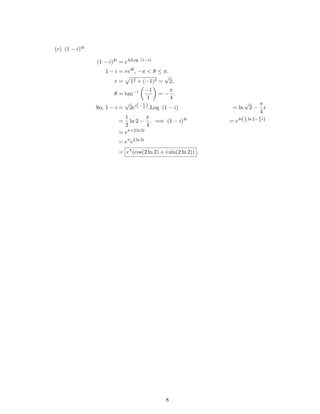
(c) (1 − i)4i
(1 − i)4i
= e4iLog (1−i)
1 − i = reiθ
, −π < θ ≤ π.
r = 12 + (−1)2 =
√
2,
θ = tan−1 −1
1
= −
π
4
.
So, 1 − i =
√
2ei(−π
4 ).Log (1 − i) = ln
√
2 −
π
4
i
=
1
2
ln 2 −
π
4
. =⇒ (1 − i)4i
= e4i(1
2
ln 2−π
4
i)
= eπ+2 ln 2i
= eπ
e2 ln 2i
= eπ
(cos(2 ln 2) + i sin(2 ln 2)) .
8

Hw5sols

  • 1.
    Homework #5 Solutions Math128, Fall 2013 Instructor: Dr. Doreen De Leon 1 p. 81: 1 (b), (c) 1. Show that u(x, y) is harmonic in some domain and find a harmonic conjugate v(x, y). (b) u(x, y) = 2x3 + 3xy2 ux = 2 − 3x2 + 3y2 =⇒ uxx = −6x uy = 6xy =⇒ uyy = 6x. Then, uxx + uyy = −6x + 6x = 0. So, u(x, y) is harmonic for all (x, y). Now to find a harmonic conjugate v(x, y). ux = 2 − 3x2 + 3y2 = vy =⇒ v = (2 − 3x2 + 3y2 ) dy = 2y − 3x2 y + y3 + g(x). uy = 6xy = −vx =⇒ −(−6xy + g (x)) = 6xy 6xy − g (x) = 6xy g (x) = 0 =⇒ g(x) = c. So, v(x, y) = 2y − 3x2y + y3 + c. If we assume v(0, 0) = 0, then 0 = c. So, v(x, y) = 2y − 3x2 y + y3 . (c) u(x, y) = sinh x sin y ux = cosh x sin y =⇒ uxx = sinh x sin y uy = sinh x cos y =⇒ uyy = − sinh x sin y. Then, uxx + uyy = sinh x sin y + (− sinh x sin y) = 0. 1
  • 2.
    So, u(x, y)is harmonic for all (x, y). Now, we need to find a harmonic conjugate v(x, y). ux = cosh x sin y = vy =⇒ v = (cosh x sin y) dy = − cosh x cos y + g(x).uy = sinh x cos y = −vx =⇒ −(− sinh x cos y + g (x)) = sinh x cos y sinh x cos y − g (x) = sinh x cos y g (x) = 0 =⇒ g(x) = c. So, v(x, y) = − cosh x cos y + c. If we asume v(0, 0) = −1, then c = 0, and v(x, y) = − cosh x cos y . 2 p. 92: 1, 4, 8 1. Show that (a) exp(2 ± 3πi) = −e2 e2+3πi = e2e3πi e2−3πi = e2e−3πi = e2(−1) = e2(−1) = −e2 = −e2. . (b) exp 2 + πi 4 = e 2 (1 + i) exp 2 + πi 4 = exp 1 2 + π 4 i = e 1 2 · e π 4 i = √ e cos π 4 + i sin π 4 = √ e 1 √ 2 + i 1 √ 2 = e 2 (1 + i). (c) exp(z + πi) = − exp(z) exp(z + πi) = ez+πi = ez eπi = −ez = − exp(z). 4. Show in two ways that the function f(z) = exp(z2) is entire. What is its derivative? 2
  • 3.
    (I) Let g(z)= ez and h(z) = z2. g and h are both entire. Therefore, (g ◦ h)(z) is entire. Therefore, f(z) = (g ◦ h)(z) is entire. (II) f(z) = ez2 = e(x+iy)2 = e(x2−y2)+i(2xy) = ex2−y2 · ei(2xy) = ex2−y2 (cos(2xy) + i sin(2xy)) = ex2−y2 cos(2xy) + iex2−y2 sin(2xy). u(x, y) = ex2−y2 cos(2xy) v(x, y) = ex2−y2 sin(2xy) ux = 2xex2−y2 cos(2xy) − 2yex2−y2 sin(2xy) uy = −2yex2−y2 cos(2xy) − 2xex2−y2 sin(2xy) vx = 2xex2−y2 sin(2xy) + 2yex2−y2 cos(2xy) vy = −2yex2−y2 sin(2xy) + 2xex2−y2 cos(2xy)    exist and continuous for all z. It is clear that ux = vy and uy = −vx, so the Cauchy-Riemann equations are satisfied for all z. Therefore, f(z) is differentiable everywhere and, thus, f(z) is entire. Then, f (z) = d dz ez2 = 2zez2 . 8. Find all values of z such that (a) ez = −2 First, exeiy = 2eiπ. So, ex = 2 and y = π + 2nπ, n ∈ Z x = ln 2 and y = π(2n + 1), n ∈ Z. So, z = ln 2 + (2n + 1)πi, n ∈ Z. (b) ez = 1 + √ 3i 1 + √ 3i = reiθ where r = 12 + ( √ 3)2 = 2, θ = tan−1 √ 3 1 = π 3 . So, ex eiy = 2eiπ 3 =⇒ ex = 2 and y = π 3 + 2nπ, n ∈ Z =⇒ x = ln 2. So, z = ln 2 + π 3 + 2nπ i, n ∈ Z. (c) exp(2z − 1) = 1 1 = 1ei0 exp(2z − 1) = exp(2(x + iy) − 1) = exp[(2x − 1) + i(2y)] = e2x−1 ei(2y) . 3
  • 4.
    So, e2x−1 ei(2y) = ei(0) =⇒ e2x−1 =1 and 2y = 0 + 2nπ, n ∈ Z =⇒ 2x − 1 = ln 1 and y = nπ, n ∈ Z =⇒ x = 1 2 . So, z = 1 2 + nπi, n ∈ Z. 3 p. 97: 2, 3, 7, 9(a) 2. Show that (a) log e = 1 + 2nπi, n ∈ Z e = e · ei0 (so, r = e, θ = 0) =⇒ log e = ln e + i(0 + 2nπ), n ∈ Z = 1 + 2nπi, n ∈ Z. (b) log i = 2n + 1 2 πi, n ∈ Z i = 1ei(π 2 ) =⇒ log i = ln 1 + iπ 1 2 + 2nπ , n ∈ Z = 0 + iπ 1 2 + 2n , n ∈ Z.So, log i = 2n + 1 2 πi, n ∈ Z. (c) log(−1 + √ 3i) = ln 2 + 2 1 + 1 3 πi, n ∈ Z −1 + √ 3i = reiθ , where r = (−1)2 + ( √ 3)2 = 2, θ = tan−1 √ 3 −1 = π 3 So, log(−1 + √ 3i) = log 2ei(2π 3 ) = ln 2 + i 2π 3 + 2nπ , n ∈ Z = ln 2 + i2π 1 3 + n , n ∈ Z. Then, log(−1 + √ 3i) = ln 2 + 2 n + 1 3 πi, n ∈ Z. 3. Show that 4
  • 5.
    (a) Log (1+ i)2 = 2Log (1 + i) Log (1 + i) = Log √ 2ei π 4 = ln √ 2 + i π 4 = 1 2 ln 2 + π 4 i.So, 2Log (1 + i) = ln 2 + π 2 i. (1 + i)2 = 2i and Log (2i) = Log 2ei π 2 = ln 2 + π 2 i = 2Log (1 + i). (b) Log (−1 + i)2 = 2Log (−1 + i) Log (−1 + i) = Log √ 2ei(3π 4 ) = ln √ 2 + i 3π 4 = 1 2 ln 2 + 3π 4 i.So, 2Log (−1 + i) = ln 2 + 3π 2 i. But, Log (−1 + i)2 = Log (−2i) = Log 2ei(−π 2 ) = ln 2 − π 2 i = 2Log (−1 + i). 7. Find all roots of the equation log z = i π 2 . log z = ln |z| + i(θ + 2nπ), n ∈ Z =⇒ ln |z| + i(θ + 2nπ) = i π 2 =⇒ ln |z| = 0 and θ + 2nπ = π 2 =⇒ |z| = 1 and θ = π 2 − 2nπ = π 2 + 2nπ. So, z = 1ei(π 2 +2nπ) = i . 9(a) Show that the function f(z) = Log (z − i) is analytic everywhere excepte on the portion x ≤ 0 of the line y = 1. Log (z − i) = Log (x + yi − i) = Log (x + (y − 1)i). In class, we saw that Log z is analytic for all z except on the set {(x, y)|x ≤ 0 and y = 0} (i.e., for all z except the portion x ≤ 0 of the x-axis). Therefore, Log (z − i) is analytic for all z except on the set {(x, y)|x ≤ 0 and y − 1 = 0} or {(x, y)|x ≤ 0 andy = 1}, i.e., everywhere except the portion x ≤ 0 of the line y = 1. 5
  • 6.
    4 p. 100:2 2. Show that for any two nonzero complex numbers z1 and z2 Log (z1z2) = Log z1 + Log z2 + 2Nπi, where N has one of the values 0, ± 1. Let z1 = r1eiθ1 and z2 = r2eiθ2 , where θ1 = Arg z1 and θ2 = Arg z2. Then, z1z2 = r1r2ei(θ1+θ2) . So, Arg (z1z2) =    θ1 + θ2 if − π < θ1 + θ2 ≤ π θ1 + θ2 − 2π if θ1 + θ2 > π θ1 + θ2 + 2π if θ1 + θ2 ≤ −π . =⇒ Arg (z1z2) = θ1 + θ2 + 2Nπ, N ∈ {0, ±1} = Arg z1 + Arg z2 + 2Nπ, N ∈ {0, ±1}. So, Log (z1z2) = Log r1r2ei(Arg (z1z2)) = ln(r1r2) + iArg (z1z2) = ln r1 + ln r2 + i(Arg z1 + Arg z2 + 2Nπ), N ∈ {0, ±1} = (ln r1 + Arg z1) + (ln r2 + Arg z2) + 2Nπ, N ∈ {0, ±1} = Log z1 + Log z2 + 2Nπ, N ∈ {0, ±1}. 5 p. 104: 1, 2 1. Show that (a) (1 + i)i = exp − π 4 + 2nπ exp i ln 2 2 , n ∈ Z (1 + i)i = ei log(1+i) . log(1 + i) = log( √ 2ei π 4 ) = ln √ 2 + i π 4 + 2nπ , n ∈ Z = 1 2 ln 2 + i π 4 + 2nπ , n ∈ Z. So, (1 + i)i = ei[1 2 ln 2+i(π 4 +2nπ)], n ∈ Z = ei1 2 ln 2−(π 4 +2nπ), n ∈ Z = e−π 4 −2nπ ei(ln 2 2 ), n ∈ Z = e−π 4 −2nπ ei(ln 2 2 ), n ∈ Z. 6
  • 7.
    (b) (−1) 1 π =e(2n+1)i , n ∈ Z (−1) 1 π = e 1 π log(−1) . log(−1) = log(1eiπ ) = ln 1 + i(π + 2nπ), n ∈ Z = (2n + 1)πi, n ∈ Z. So, (−1) 1 π = e 1 π (2n+1)πi , n ∈ Z = e(2n+1)i , n ∈ Z. 2. Find the principal value of (a) ii ii = eiLog i . Log i = Log (eiπ 2 ) = ln 1 + i π 2 = i π 2 . So, ii = ei(i π 2 ) = e−π 2 . (b) e 2 (−1 − √ 3i) 3πi −1 − √ 3i = reiθ , −π < θ ≤ π. r = (−1)2 + ( √ 3)2 = 2, θ = tan−1 − √ 3 −1 = − 2π 3 . So, − 1 − √ 3i = 2e−i(2π 3 ). e 2 (−1 − √ 3i) = e 2 e−i(2π 3 ) = e · e−i(2π 3 ). Log e 2 (−1 − √ 3i) = Log e · e−i(2π 3 ) = ln e − 2π 3 i = 1 − 2π 3 i. So, e 2 (−1 − √ 3i) 3πi = exp 3πi 1 − 2π 3 = exp[3πi + 2π2 ] = −e2π2 . 7
  • 8.
    (c) (1 −i)4i (1 − i)4i = e4iLog (1−i) 1 − i = reiθ , −π < θ ≤ π. r = 12 + (−1)2 = √ 2, θ = tan−1 −1 1 = − π 4 . So, 1 − i = √ 2ei(−π 4 ).Log (1 − i) = ln √ 2 − π 4 i = 1 2 ln 2 − π 4 . =⇒ (1 − i)4i = e4i(1 2 ln 2−π 4 i) = eπ+2 ln 2i = eπ e2 ln 2i = eπ (cos(2 ln 2) + i sin(2 ln 2)) . 8