Introduction         Elliptic problem       Parabolic problem   Proposed Work   Conclusion


               Optimal Finite Difference Grids for Elliptic and
                    Parabolic PDEs with Applications

                                   Oleksiy Varfolomiyev
                                Advisor Prof. Michael Siegel
                               Co-Advisor Prof. Michael Booty


                                        NJIT, May 15, 2012
Introduction           Elliptic problem   Parabolic problem   Proposed Work   Conclusion


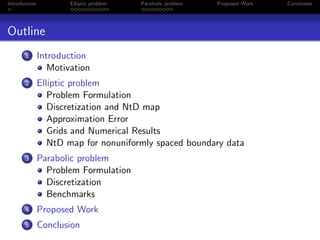
Outline
       1       Introduction
                  Motivation
       2       Elliptic problem
                  Problem Formulation
                  Discretization and NtD map
                  Approximation Error
                  Grids and Numerical Results
                  NtD map for nonuniformly spaced boundary data
       3       Parabolic problem
                 Problem Formulation
                 Discretization
                 Benchmarks
       4       Proposed Work
       5       Conclusion
Introduction           Elliptic problem   Parabolic problem   Proposed Work    Conclusion

Motivation


Motivation


       Problem
       Accurate and efficient computation of the DtN (NtD) maps

       Applications of interest
             1   Water waves: DtN map is used to compute the normal
                 interface speed
             2   Crystal growth: DtN map is used to track the crystal-melt
                 interface
             3   Surface with soluble surfactant: DtN map is used to resolve
                 surfactant concentration gradient
Introduction   Elliptic problem   Parabolic problem   Proposed Work   Conclusion


                        Elliptic Problem
Introduction               Elliptic problem      Parabolic problem        Proposed Work     Conclusion

Problem Formulation

                                                                     1
Model Elliptic Problem Formulation


                                Laplace equation on a semi-infinite strip


                   ∂ 2 w (x, y ) ∂ 2 w (x, y )
          −                     −              = 0,       (x, y ) ∈ [0, ∞) × [0, 1],       (1)
                       ∂y 2          ∂x 2
                                               ∂w
                                                   (0, y ) = −ϕ(y ), y ∈ [0, 1],           (2)
                                                ∂x
                                                                       w |x=∞ = 0,         (3)
                                     w (x, 0) = 0,        w (x, 1) = 0,      x ∈ [0, ∞).   (4)


               1
                   V. Druskin
Introduction               Elliptic problem      Parabolic problem        Proposed Work     Conclusion

Problem Formulation

                                                                     1
Model Elliptic Problem Formulation


                                Laplace equation on a semi-infinite strip


                   ∂ 2 w (x, y ) ∂ 2 w (x, y )
          −                     −              = 0,       (x, y ) ∈ [0, ∞) × [0, 1],       (1)
                       ∂y 2          ∂x 2
                                               ∂w
                                                   (0, y ) = −ϕ(y ), y ∈ [0, 1],           (2)
                                                ∂x
                                                                       w |x=∞ = 0,         (3)
                                     w (x, 0) = 0,        w (x, 1) = 0,      x ∈ [0, ∞).   (4)

       Our goal is to accurately resolve the Dirichlet data w (0, y )


               1
                   V. Druskin
Introduction          Elliptic problem            Parabolic problem          Proposed Work    Conclusion

Problem Formulation


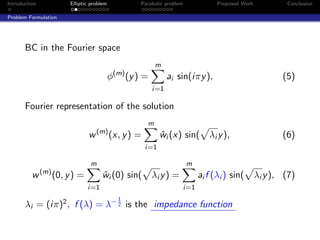
       BC in the Fourier space
                                                        m
                                         φ(m) (y ) =         ai sin(iπy ),                   (5)
                                                       i=1

       Fourier representation of the solution
                                                    m
                              w (m) (x, y ) =            wi (x) sin(
                                                         ˆ               λi y ),             (6)
                                                   i=1
Introduction              Elliptic problem            Parabolic problem             Proposed Work           Conclusion

Problem Formulation


       BC in the Fourier space
                                                            m
                                             φ(m) (y ) =         ai sin(iπy ),                             (5)
                                                           i=1

       Fourier representation of the solution
                                                        m
                                  w (m) (x, y ) =            wi (x) sin(
                                                             ˆ                   λi y ),                   (6)
                                                       i=1

                                  m                                       m
               (m)
          w          (0, y ) =         wi (0) sin(
                                       ˆ                   λi y ) =           ai f (λi ) sin(       λi y ), (7)
                                 i=1                                  i=1
                                               1
       λi = (iπ)2 , f (λ) = λ− 2 is the impedance function
Introduction            Elliptic problem       Parabolic problem             Proposed Work    Conclusion

Discretization and NtD map


Discretization

       Fourier transform (1) in y

                                       ∂ 2 wk (x)
                                           ˆ
                      λk wk (x) −
                         ˆ                        = 0,             k = 1, . . . , m          (8)
                                          ∂x 2
                                    ∂ wk (0)
                                      ˆ
                                              = −ϕk ,
                                                  ˆ                k = 1, . . . , m,         (9)
                                       ∂x
       where λk = (kπ)2 .
Introduction            Elliptic problem       Parabolic problem             Proposed Work         Conclusion

Discretization and NtD map


Discretization

       Fourier transform (1) in y

                                       ∂ 2 wk (x)
                                           ˆ
                      λk wk (x) −
                         ˆ                        = 0,             k = 1, . . . , m               (8)
                                          ∂x 2
                                    ∂ wk (0)
                                      ˆ
                                              = −ϕk ,
                                                  ˆ                k = 1, . . . , m,              (9)
                                       ∂x
       where λk = (kπ)2 .
       Discretize in x
                   1         wi+1 − wi   wi − wi−1
         λwi −                         −            = 0,                      i = 2, . . . , n, (10)
                   ˆi
                   h            hi          hi−1
                                    1 w2 − w1         1                    w1 − w0
                             λw1 −                 =−                                        = Φ (11)
                                    ˆ1
                                    h      h1         ˆ1
                                                      h                       h0

       where wi = wk (xi ), Φ = ϕk , (w1 − w0 )/h0 is set to Φ and λ = λk .
                  ˆ             ˆ
Introduction            Elliptic problem            Parabolic problem            Proposed Work     Conclusion

Discretization and NtD map


Discrete NtD map


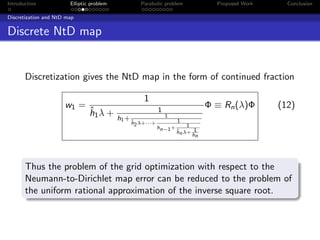
       Discretization gives the NtD map in the form of continued fraction

                                                     1
                      w1 =                                                     Φ ≡ Rn (λ)Φ       (12)
                                ˆ
                                h1 λ +                     1
                                                               1
                                           h1 + ˆ                   1
                                               h2 λ+···+                1
                                                           hn−1 +
                                                                    hn λ+ 1
                                                                    ˆ
                                                                          hn


       Thus the problem of the grid optimization with respect to the
       Neumann-to-Dirichlet map error can be reduced to the problem of
       the uniform rational approximation of the inverse square root.
Introduction            Elliptic problem           Parabolic problem           Proposed Work     Conclusion

Discretization and NtD map


        F - Fourier transform in y , F −1 - inverse Fourier transform in y

       NtD Map
                                           ∂w
       Given Neumann data                  ∂x (0, y )   = −ϕ(y ),          y ∈ [0, 1]

                                              w1 = F −1 Rn F ϕ,                                (13)

       DtN Map
       Given Dirichlet data w (0, y ) = ψ(y ),                         y ∈ [0, 1]

                                             φ = −F −1 Rn F ψ
                                                        −1
                                                                                               (14)
Introduction          Elliptic problem         Parabolic problem   Proposed Work            Conclusion

Approximation Error


Approximation Error


       L2 error of the semidiscrete solution at x = 0
                                         (n)                                                        1
       en = ||w (m) (0, y ) − w1 (y )||L2 [0,1] ≤ ||ϕ||L2 [0,1]        max           |fn (λ) − λ− 2 |
                                                                   λ∈[π 2 ,(mπ)2 ]


                                                              1
                                                                             π2 n
          En (λ) = maxλ∈[λmin ,λmax ] fn (λ) − λ− 2 = O exp                   λ
                                                                          log λ min
                                                                                   max


       The described special choice of the discretization grid steps
       provides a spectral convergence order of the solution at the
       boundary.
Introduction                                 Elliptic problem                Parabolic problem             Proposed Work          Conclusion

Approximation Error


Relative Error Plot

                                                                                                  Pk (λ)−λ−1/2
                                                     Relative error E (λ) =                           λ−1/2


                         0.01


                                                                                             4
                              4
                                                                                        10
                         10


                               6
                         10
                                                                                             7
                                                                                        10
        relative error


                               8
                         10

                                                                                             10
                                                                                        10
                              10
                         10


                                                                                             13
                         10   12
                                                                                        10


                              14
                         10
                                   0.1   1     10       100     1000   104        105
                                                        Λ                                           1      10     100      1000   104


       Figure: Relative Error in the approximation of the inverse square root,
       k = 16, λ ∈ [1, 10000] (left), λ ∈ [1, 1000] (right)
Introduction             Elliptic problem       Parabolic problem                              Proposed Work                                           Conclusion

Grids and Numerical Results


   Optimal geometric grids                                              0
                                                                       10
                                                                                                            fk(λ) − λ−1/2


                                                                        −2
                                                                       10


                                                                        −4
                                                                       10


                     √                      √                           −6

                   π/ k
                               h1 = e − kπ                             10

         α=e


                                                               error
                                        √                               −8
                                                                       10

                   i−1         π(i−k−1)/ k
    hi = h1 α            =e                                             −10
                                                                       10

                                            √
                    ˆ
                    h1 = h1 /(1 + α)                                    −12
                                                                       10


                        ˆ
                                                                        −14
                                                                       10

                        hi = hi hi−1                                         10
                                                                                 0
                                                                                     10
                                                                                          1
                                                                                              10
                                                                                                   2
                                                                                                       10
                                                                                                            3

                                                                                                                frequency
                                                                                                                            10
                                                                                                                                 4
                                                                                                                                     10
                                                                                                                                          5
                                                                                                                                              10
                                                                                                                                                   6    7
                                                                                                                                                       10


                                                                                                            fk(λ) − λ−1/2
                                                                            −3
                                                                       10


                                                                            −4
                                                                       10

   Nonoptimal geometric grids
                                                                            −5
                                                               error   10


                                                                            −6
                                                                       10


                              ˆ     hy
     h1 = O(hy )              h1 =   √                                 10
                                                                            −7


                                   1+ α
                                                                            −8
                                                                       10
                                                                                 0    1        2        3                    4        5        6        7
                                                                            10       10       10       10                   10       10       10       10
                                                                                                                frequency
Introduction                                   Elliptic problem                                                     Parabolic problem                                                           Proposed Work                                                            Conclusion

Grids and Numerical Results


Numerical Results
       We discretize second derivatives in y using a second order,
       centered finite difference scheme. The resulting system matrix is
       sparse-banded.

                                               Example with Neumann data ϕ(y ) = sin(πy )

                         −11            Abs. error in approximation of Dir BC
                     x 10                                                                                    x 10
                                                                                                                 −4               Abs. error in approximation of Dir BC                                                       Abs. error for node x2
               1.4                                                                                     0.5
                                                                                                                                                                                                0.035

               1.2                                                                                      0
                                                                                                                                                                                                 0.03
                                                                                                      −0.5
                1
                                                                                                                                                                                                0.025
                                                                                                       −1

               0.8
                                                                                                      −1.5                                                                                       0.02


               0.6                                                                                     −2
                                                                                                                                                                                                0.015

                                                                                                      −2.5
               0.4                                                                                                                                                                               0.01
                                                                                                       −3

               0.2                                                                                                                                                                              0.005
                                                                                                      −3.5


        (a)     0
                     0      0.1   0.2    0.3    0.4     0.5     0.6     0.7     0.8   0.9   1   (b)    −4
                                                                                                             0        0.1   0.2    0.3    0.4     0.5     0.6     0.7     0.8   0.9   1   (c)      0
                                                                                                                                                                                                        0   0.1   0.2   0.3    0.4     0.5     0.6     0.7   0.8   0.9   1


       Figure: (a) Error E (y ) = |w (0, y ) − F −1 Rn F ϕ(y )| ; (b) error
       E (y ) = |w (0, y ) − w1 (y )|; (c) error obtained by the standard five-point
       finite difference scheme. (n = 16)
Introduction            Elliptic problem           Parabolic problem              Proposed Work           Conclusion

NtD map for nonuniformly spaced boundary data

Proposed work: NtD map for nonuniformly spaced
boundary data

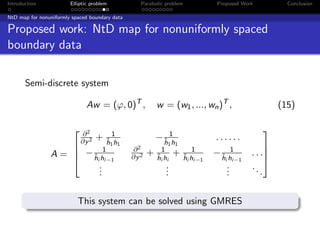
       Semi-discrete system

                               Aw = (ϕ, 0)T ,              w = (w1 , ..., wn )T ,                       (15)

                             ∂2           1
                                                           − h 1h
                                                                                                 
                             ∂y 2
                                    +   ˆ
                                        h1 h1                ˆ                   ......
                                                               1 1
                            1                   ∂2           1             1
                A =  − hi hi−1                                                  − h h1
                                                                                                   
                        ˆ                       ∂y 2
                                                       +   ˆ
                                                           hi hi
                                                                   +   ˆ
                                                                       hi hi−1     ˆi i−1     . . .
                                                                                                   
                          .
                          .                                   .
                                                              .                      .
                                                                                     .        ..
                          .                                   .                      .            .


                           This system can be solved using GMRES
Introduction              Elliptic problem           Parabolic problem        Proposed Work   Conclusion

NtD map for nonuniformly spaced boundary data

                                                                 2
Computation of the derivatives


       Assume y = y (α) and yj = y (αj ), where αj are uniformly spaced
       The derivative is computed as
                                             dw         dw          1
                                                (yj ) =    (αj ) dy
                                             dy         dα          (αj )dα

       which can be computed for α = αj by the FFT

                   This method will be applied to compute Hilbert and Riesz
                   transforms for nonuniformly spaced points in O(N log N)
                              operations, with spectral accuracy


               2
                   C. Muratov
Introduction   Elliptic problem   Parabolic problem   Proposed Work   Conclusion


                   Parabolic Problem
Introduction              Elliptic problem   Parabolic problem       Proposed Work     Conclusion

Problem Formulation

                                                                 3
Model Parabolic Problem Formulation


                                Heat equation on a semi-infinite strip


                      ∂u(x, t)   ∂ 2 u(x, t)
                               =             ,    (x, t) ∈ [0, ∞) × [0, T ],         (16)
                        ∂t           ∂x 2
                                                 u(x, 0) = 0,    x ∈ [0, ∞)          (17)
                        u(x, t)|x=∞ = 0,     u(0, t) = g (t),    t ∈ [0, T ]         (18)


               3
                   M. Booty
Introduction          Elliptic problem          Parabolic problem         Proposed Work     Conclusion

Problem Formulation


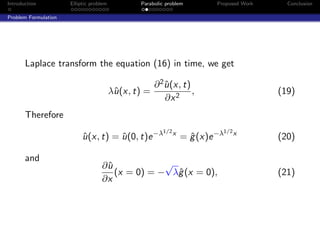
       Laplace transform the equation (16) in time, we get

                                                      ∂ 2 u (x, t)
                                                          ˆ
                                         λˆ(x, t) =
                                          u                        ,                      (19)
                                                          ∂x 2
       Therefore
                                                         1/2 x                 1/2 x
                           u (x, t) = u (0, t)e −λ
                           ˆ          ˆ                          = g (x)e −λ
                                                                   ˆ                      (20)

       and
                                   ∂ˆ
                                    u            √
                                      (x = 0) = − λˆ (x = 0),
                                                   g                                      (21)
                                   ∂x
Introduction            Elliptic problem   Parabolic problem     Proposed Work            Conclusion

Discretization


       Discretizing in real space in x
                                              u1 − u0              ∂u0
                                                      − u−1/2 − h0     =0
                                               h1/2                ∂t
           1      ui+1 − ui   ui − ui−1           ∂ui
                            −                 −       = 0,     i = 1, . . . , n − 1 (22)
           hi      hi+1/2       hi−1/2            ∂t
                                                                          un = 0


                 u0 (t), ∂u∂t are known from the Dirichlet BC and the initial
                           0 (t)

                 data ui (t = 0) are known
                 solve (22) to update ui , i = 1, . . . , n − 1 to the time t =          t
                 the process is repeated to obtain the Neumann data               n
                                                                                 u−1/2   at
                 discrete time t n = n t
Introduction       Elliptic problem       Parabolic problem          Proposed Work     Conclusion

Benchmarks


Benchmark 1: const BC


               ∂u(x, t)   ∂ 2 u(x, t)
                        =             ,       (x, t) ∈ [0, ∞) × [0, T ],             (23)
                 ∂t           ∂x 2
                                            u(x, 0) = 0,        x ∈ [0, ∞)           (24)
                    u(x, t)|x=∞ = 0,          u(0, t) = 1,          t ∈ [0, T ]      (25)

       Using the Laplace transform we get
                                                              ∞
                                          x           2                  2
                    u(x, t) = erfc        √         =√              e −u du          (26)
                                         2 t           π       x
                                                               √
                                                              2 t


                                                     1
                                      ux (0, t) = − √                                (27)
                                                      πt
Introduction        Elliptic problem                                                                  Parabolic problem                                                                                        Proposed Work                              Conclusion

Benchmarks


DtN Error
                                                 Numerical Error of ux(0,t)                                                                                                                              Numerical Error of ux(0,t)
                             −3           Mt = 1541877, Nx = 16, dt = 1.2971e−05                                                                                      −3                          Mt = 1541877, Nx = 16, dt = 1.2971e−05
                         x 10                                                                                                                                     x 10
                    12                                                                                                                                        2


                    10
                                                                                                                                                              0
                     8


                     6                                                                                                                                       −2


                     4
                                                                                                                                                             −4

                     2

                                                                                                                                                             −6
                     0


                    −2                                                                                                                                       −8

                    −4
                                                                                                                                                          −10
                    −6


                    −8                                                                                                                                    −12
                         0        2   4   6        8        10        12       14            16       18       20                                                 0             2        4        6        8        10        12      14   16   18   20


               a)                                 0.0042416 < t < 20
                                                                                                                               b)                                                                         0.0042027 < t < 20


                                                                                                                             Numerical Error of ux(0,t)
                                                                                        −3                              Mt = 5553, Nx = 16, dt = 0.0036016
                                                                                    x 10
                                                                                2


                                                                                0


                                                                              −2


                                                                              −4


                                                                              −6


                                                                              −8


                                                                              −10


                                                                              −12
                                                                                    0             2        4        6         8         10        12         14            16       18       20


                                                       c)                                                                   0.18008 < t < 19.9994


       Figure: Error of ux (0, t) for the BC u(0, t) = 1 with k = 16. a) FE in
       time with t = x 2 , b) BE in time t = x 2 , c) BE in time t = x
Introduction        Elliptic problem        Parabolic problem        Proposed Work        Conclusion

Benchmarks


Benchmark 2: harmonic BC


                  ∂u(x, t)   ∂ 2 u(x, t)
                           =             ,         (x, t) ∈ [0, ∞) × [0, T ],           (28)
                    ∂t           ∂x 2
                                                 u(x, 0) = 0,        x ∈ [0, ∞)         (29)
               u(x, t)|x=∞ = 0,         u(0, t) = b sin (ωt),        t ∈ [0, T ]        (30)


                           √ω                                                       √
                       −        x                ω          bω       ∞   e −ut sin x u
       u(x, t) = b e          2     sin ωt −       x      +                            du
                                                 2           π   0           u2 + ω2

                              ω                         b                     1
       ux (0, t) = −b           (sin (ωt) + cos (ωt))+     3 +O                5     , as t → ∞
                              2                        πωt 2                 t2
Introduction        Elliptic problem   Parabolic problem     Proposed Work         Conclusion

Benchmarks


DtN Error


               a)                             b)


                                  c)
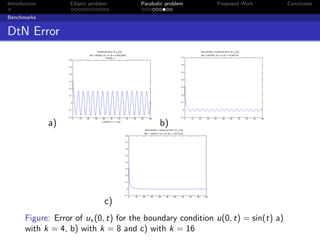
       Figure: Error of ux (0, t) for the boundary condition u(0, t) = sin(t) a)
       with k = 4, b) with k = 8 and c) with k = 16
Introduction       Elliptic problem       Parabolic problem     Proposed Work     Conclusion

Benchmarks


Benchmark 3: Diurnal Earth Heating


               ∂u(x, t)   ∂ 2 u(x, t)
                        =             ,       (x, t) ∈ [0, ∞) × [0, T ],        (31)
                 ∂t           ∂x 2
                                            u(x, 0) = 0,      x ∈ [0, ∞)        (32)
                                 u(0, t) = 1 + b sin (ωt),    t ∈ [0, T ]       (33)

                      1               ω                          b
       ux (0, t) ≈ − √ − b              (sin (ωt) + cos (ωt)) +     3 , as t → ∞
                      πt              2                         πωt 2
Introduction       Elliptic problem               Parabolic problem                      Proposed Work   Conclusion

Benchmarks


DtN Error
                                                  Numerical Error of ux(0,t)
                                           Mt = 1541877, Nx = 16, dt = 1.2971e−05
                          0


                       −0.01


                       −0.02


                       −0.03


                       −0.04


                       −0.05


                       −0.06


                       −0.07


                       −0.08


                       −0.09


                        −0.1
                               0   2   4      6      8         10      12      14   16    18   20
                                                         1.3636 < t < 20


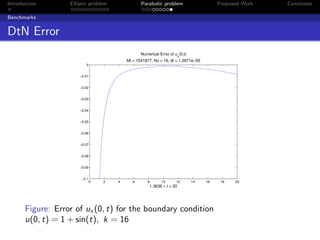
       Figure: Error of ux (0, t) for the boundary condition
       u(0, t) = 1 + sin(t), k = 16
Introduction              Elliptic problem       Parabolic problem     Proposed Work     Conclusion


Proposed work: Crystal Growth Problem4
       Infinite melt cooled below its freezing temperature. Two-phase
       flow with the moving interface separating the crystal from the
       melt. We wish to model the evolution of the crystal-melt interface.

                                Mathematical model for the problem


       The diffusion equation in the melt
                                               ∂T             2
                                                  =D              T,                   (34)
                                               ∂t
       where D is constant thermal diffusivity.
       The specified temperature in the melt far from the interface

                                             T → T∞      as y → ∞                      (35)
               4
                   M. Kunka
Introduction      Elliptic problem     Parabolic problem      Proposed Work     Conclusion


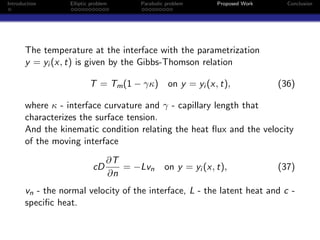
       The temperature at the interface with the parametrization
       y = yi (x, t) is given by the Gibbs-Thomson relation

                          T = Tm (1 − γκ) on y = yi (x, t),                   (36)

       where κ - interface curvature and γ - capillary length that
       characterizes the surface tension.
       And the kinematic condition relating the heat flux and the velocity
       of the moving interface
                                 ∂T
                           cD       = −Lvn      on y = yi (x, t),             (37)
                                 ∂n
       vn - the normal velocity of the interface, L - the latent heat and c -
       specific heat.
Introduction         Elliptic problem   Parabolic problem   Proposed Work     Conclusion


               We propose to investigate the crystal growth problem in the
               less well studied limit of large Peclet number. In this limit, we
               expect a boundary layer adjacent to the moving interface
               where the temperature gradients are large.
               A singular perturbation analysis will be performed to derive a
               leading order equation governing the temperature in the layer.
               We propose to efficiently solve this equation with high
               accuracy using optimal grids.
Introduction         Elliptic problem   Parabolic problem   Proposed Work   Conclusion


Conclusion


               We showed that the described special choice of the
               discretization grid steps provides a spectral convergence order
               of the solution at the boundary.
               This method of computing the Riesz transform will be applied
               to a new numerical method of Ambrose and Siegel for
               removing the stiffness from boundary integral calculations
               with surface tension.
               We propose to efficiently solve the equation for the crystal
               growth problem in the limit of large Peclet number with high
               accuracy using optimal grids.

Optimal Finite Difference Grids for Elliptic and Parabolic PDEs with Applications

  • 1.
    Introduction Elliptic problem Parabolic problem Proposed Work Conclusion Optimal Finite Difference Grids for Elliptic and Parabolic PDEs with Applications Oleksiy Varfolomiyev Advisor Prof. Michael Siegel Co-Advisor Prof. Michael Booty NJIT, May 15, 2012
  • 2.
    Introduction Elliptic problem Parabolic problem Proposed Work Conclusion Outline 1 Introduction Motivation 2 Elliptic problem Problem Formulation Discretization and NtD map Approximation Error Grids and Numerical Results NtD map for nonuniformly spaced boundary data 3 Parabolic problem Problem Formulation Discretization Benchmarks 4 Proposed Work 5 Conclusion
  • 3.
    Introduction Elliptic problem Parabolic problem Proposed Work Conclusion Motivation Motivation Problem Accurate and efficient computation of the DtN (NtD) maps Applications of interest 1 Water waves: DtN map is used to compute the normal interface speed 2 Crystal growth: DtN map is used to track the crystal-melt interface 3 Surface with soluble surfactant: DtN map is used to resolve surfactant concentration gradient
  • 4.
    Introduction Elliptic problem Parabolic problem Proposed Work Conclusion Elliptic Problem
  • 5.
    Introduction Elliptic problem Parabolic problem Proposed Work Conclusion Problem Formulation 1 Model Elliptic Problem Formulation Laplace equation on a semi-infinite strip ∂ 2 w (x, y ) ∂ 2 w (x, y ) − − = 0, (x, y ) ∈ [0, ∞) × [0, 1], (1) ∂y 2 ∂x 2 ∂w (0, y ) = −ϕ(y ), y ∈ [0, 1], (2) ∂x w |x=∞ = 0, (3) w (x, 0) = 0, w (x, 1) = 0, x ∈ [0, ∞). (4) 1 V. Druskin
  • 6.
    Introduction Elliptic problem Parabolic problem Proposed Work Conclusion Problem Formulation 1 Model Elliptic Problem Formulation Laplace equation on a semi-infinite strip ∂ 2 w (x, y ) ∂ 2 w (x, y ) − − = 0, (x, y ) ∈ [0, ∞) × [0, 1], (1) ∂y 2 ∂x 2 ∂w (0, y ) = −ϕ(y ), y ∈ [0, 1], (2) ∂x w |x=∞ = 0, (3) w (x, 0) = 0, w (x, 1) = 0, x ∈ [0, ∞). (4) Our goal is to accurately resolve the Dirichlet data w (0, y ) 1 V. Druskin
  • 7.
    Introduction Elliptic problem Parabolic problem Proposed Work Conclusion Problem Formulation BC in the Fourier space m φ(m) (y ) = ai sin(iπy ), (5) i=1 Fourier representation of the solution m w (m) (x, y ) = wi (x) sin( ˆ λi y ), (6) i=1
  • 8.
    Introduction Elliptic problem Parabolic problem Proposed Work Conclusion Problem Formulation BC in the Fourier space m φ(m) (y ) = ai sin(iπy ), (5) i=1 Fourier representation of the solution m w (m) (x, y ) = wi (x) sin( ˆ λi y ), (6) i=1 m m (m) w (0, y ) = wi (0) sin( ˆ λi y ) = ai f (λi ) sin( λi y ), (7) i=1 i=1 1 λi = (iπ)2 , f (λ) = λ− 2 is the impedance function
  • 9.
    Introduction Elliptic problem Parabolic problem Proposed Work Conclusion Discretization and NtD map Discretization Fourier transform (1) in y ∂ 2 wk (x) ˆ λk wk (x) − ˆ = 0, k = 1, . . . , m (8) ∂x 2 ∂ wk (0) ˆ = −ϕk , ˆ k = 1, . . . , m, (9) ∂x where λk = (kπ)2 .
  • 10.
    Introduction Elliptic problem Parabolic problem Proposed Work Conclusion Discretization and NtD map Discretization Fourier transform (1) in y ∂ 2 wk (x) ˆ λk wk (x) − ˆ = 0, k = 1, . . . , m (8) ∂x 2 ∂ wk (0) ˆ = −ϕk , ˆ k = 1, . . . , m, (9) ∂x where λk = (kπ)2 . Discretize in x 1 wi+1 − wi wi − wi−1 λwi − − = 0, i = 2, . . . , n, (10) ˆi h hi hi−1 1 w2 − w1 1 w1 − w0 λw1 − =− = Φ (11) ˆ1 h h1 ˆ1 h h0 where wi = wk (xi ), Φ = ϕk , (w1 − w0 )/h0 is set to Φ and λ = λk . ˆ ˆ
  • 11.
    Introduction Elliptic problem Parabolic problem Proposed Work Conclusion Discretization and NtD map Discrete NtD map Discretization gives the NtD map in the form of continued fraction 1 w1 = Φ ≡ Rn (λ)Φ (12) ˆ h1 λ + 1 1 h1 + ˆ 1 h2 λ+···+ 1 hn−1 + hn λ+ 1 ˆ hn Thus the problem of the grid optimization with respect to the Neumann-to-Dirichlet map error can be reduced to the problem of the uniform rational approximation of the inverse square root.
  • 12.
    Introduction Elliptic problem Parabolic problem Proposed Work Conclusion Discretization and NtD map F - Fourier transform in y , F −1 - inverse Fourier transform in y NtD Map ∂w Given Neumann data ∂x (0, y ) = −ϕ(y ), y ∈ [0, 1] w1 = F −1 Rn F ϕ, (13) DtN Map Given Dirichlet data w (0, y ) = ψ(y ), y ∈ [0, 1] φ = −F −1 Rn F ψ −1 (14)
  • 13.
    Introduction Elliptic problem Parabolic problem Proposed Work Conclusion Approximation Error Approximation Error L2 error of the semidiscrete solution at x = 0 (n) 1 en = ||w (m) (0, y ) − w1 (y )||L2 [0,1] ≤ ||ϕ||L2 [0,1] max |fn (λ) − λ− 2 | λ∈[π 2 ,(mπ)2 ] 1 π2 n En (λ) = maxλ∈[λmin ,λmax ] fn (λ) − λ− 2 = O exp λ log λ min max The described special choice of the discretization grid steps provides a spectral convergence order of the solution at the boundary.
  • 14.
    Introduction Elliptic problem Parabolic problem Proposed Work Conclusion Approximation Error Relative Error Plot Pk (λ)−λ−1/2 Relative error E (λ) = λ−1/2 0.01 4 4 10 10 6 10 7 10 relative error 8 10 10 10 10 10 13 10 12 10 14 10 0.1 1 10 100 1000 104 105 Λ 1 10 100 1000 104 Figure: Relative Error in the approximation of the inverse square root, k = 16, λ ∈ [1, 10000] (left), λ ∈ [1, 1000] (right)
  • 15.
    Introduction Elliptic problem Parabolic problem Proposed Work Conclusion Grids and Numerical Results Optimal geometric grids 0 10 fk(λ) − λ−1/2 −2 10 −4 10 √ √ −6 π/ k h1 = e − kπ 10 α=e error √ −8 10 i−1 π(i−k−1)/ k hi = h1 α =e −10 10 √ ˆ h1 = h1 /(1 + α) −12 10 ˆ −14 10 hi = hi hi−1 10 0 10 1 10 2 10 3 frequency 10 4 10 5 10 6 7 10 fk(λ) − λ−1/2 −3 10 −4 10 Nonoptimal geometric grids −5 error 10 −6 10 ˆ hy h1 = O(hy ) h1 = √ 10 −7 1+ α −8 10 0 1 2 3 4 5 6 7 10 10 10 10 10 10 10 10 frequency
  • 16.
    Introduction Elliptic problem Parabolic problem Proposed Work Conclusion Grids and Numerical Results Numerical Results We discretize second derivatives in y using a second order, centered finite difference scheme. The resulting system matrix is sparse-banded. Example with Neumann data ϕ(y ) = sin(πy ) −11 Abs. error in approximation of Dir BC x 10 x 10 −4 Abs. error in approximation of Dir BC Abs. error for node x2 1.4 0.5 0.035 1.2 0 0.03 −0.5 1 0.025 −1 0.8 −1.5 0.02 0.6 −2 0.015 −2.5 0.4 0.01 −3 0.2 0.005 −3.5 (a) 0 0 0.1 0.2 0.3 0.4 0.5 0.6 0.7 0.8 0.9 1 (b) −4 0 0.1 0.2 0.3 0.4 0.5 0.6 0.7 0.8 0.9 1 (c) 0 0 0.1 0.2 0.3 0.4 0.5 0.6 0.7 0.8 0.9 1 Figure: (a) Error E (y ) = |w (0, y ) − F −1 Rn F ϕ(y )| ; (b) error E (y ) = |w (0, y ) − w1 (y )|; (c) error obtained by the standard five-point finite difference scheme. (n = 16)
  • 17.
    Introduction Elliptic problem Parabolic problem Proposed Work Conclusion NtD map for nonuniformly spaced boundary data Proposed work: NtD map for nonuniformly spaced boundary data Semi-discrete system Aw = (ϕ, 0)T , w = (w1 , ..., wn )T , (15) ∂2 1 − h 1h   ∂y 2 + ˆ h1 h1 ˆ ...... 1 1 1 ∂2 1 1 A =  − hi hi−1 − h h1   ˆ ∂y 2 + ˆ hi hi + ˆ hi hi−1 ˆi i−1 . . .   . . . . . . .. . . . . This system can be solved using GMRES
  • 18.
    Introduction Elliptic problem Parabolic problem Proposed Work Conclusion NtD map for nonuniformly spaced boundary data 2 Computation of the derivatives Assume y = y (α) and yj = y (αj ), where αj are uniformly spaced The derivative is computed as dw dw 1 (yj ) = (αj ) dy dy dα (αj )dα which can be computed for α = αj by the FFT This method will be applied to compute Hilbert and Riesz transforms for nonuniformly spaced points in O(N log N) operations, with spectral accuracy 2 C. Muratov
  • 19.
    Introduction Elliptic problem Parabolic problem Proposed Work Conclusion Parabolic Problem
  • 20.
    Introduction Elliptic problem Parabolic problem Proposed Work Conclusion Problem Formulation 3 Model Parabolic Problem Formulation Heat equation on a semi-infinite strip ∂u(x, t) ∂ 2 u(x, t) = , (x, t) ∈ [0, ∞) × [0, T ], (16) ∂t ∂x 2 u(x, 0) = 0, x ∈ [0, ∞) (17) u(x, t)|x=∞ = 0, u(0, t) = g (t), t ∈ [0, T ] (18) 3 M. Booty
  • 21.
    Introduction Elliptic problem Parabolic problem Proposed Work Conclusion Problem Formulation Laplace transform the equation (16) in time, we get ∂ 2 u (x, t) ˆ λˆ(x, t) = u , (19) ∂x 2 Therefore 1/2 x 1/2 x u (x, t) = u (0, t)e −λ ˆ ˆ = g (x)e −λ ˆ (20) and ∂ˆ u √ (x = 0) = − λˆ (x = 0), g (21) ∂x
  • 22.
    Introduction Elliptic problem Parabolic problem Proposed Work Conclusion Discretization Discretizing in real space in x u1 − u0 ∂u0 − u−1/2 − h0 =0 h1/2 ∂t 1 ui+1 − ui ui − ui−1 ∂ui − − = 0, i = 1, . . . , n − 1 (22) hi hi+1/2 hi−1/2 ∂t un = 0 u0 (t), ∂u∂t are known from the Dirichlet BC and the initial 0 (t) data ui (t = 0) are known solve (22) to update ui , i = 1, . . . , n − 1 to the time t = t the process is repeated to obtain the Neumann data n u−1/2 at discrete time t n = n t
  • 23.
    Introduction Elliptic problem Parabolic problem Proposed Work Conclusion Benchmarks Benchmark 1: const BC ∂u(x, t) ∂ 2 u(x, t) = , (x, t) ∈ [0, ∞) × [0, T ], (23) ∂t ∂x 2 u(x, 0) = 0, x ∈ [0, ∞) (24) u(x, t)|x=∞ = 0, u(0, t) = 1, t ∈ [0, T ] (25) Using the Laplace transform we get ∞ x 2 2 u(x, t) = erfc √ =√ e −u du (26) 2 t π x √ 2 t 1 ux (0, t) = − √ (27) πt
  • 24.
    Introduction Elliptic problem Parabolic problem Proposed Work Conclusion Benchmarks DtN Error Numerical Error of ux(0,t) Numerical Error of ux(0,t) −3 Mt = 1541877, Nx = 16, dt = 1.2971e−05 −3 Mt = 1541877, Nx = 16, dt = 1.2971e−05 x 10 x 10 12 2 10 0 8 6 −2 4 −4 2 −6 0 −2 −8 −4 −10 −6 −8 −12 0 2 4 6 8 10 12 14 16 18 20 0 2 4 6 8 10 12 14 16 18 20 a) 0.0042416 < t < 20 b) 0.0042027 < t < 20 Numerical Error of ux(0,t) −3 Mt = 5553, Nx = 16, dt = 0.0036016 x 10 2 0 −2 −4 −6 −8 −10 −12 0 2 4 6 8 10 12 14 16 18 20 c) 0.18008 < t < 19.9994 Figure: Error of ux (0, t) for the BC u(0, t) = 1 with k = 16. a) FE in time with t = x 2 , b) BE in time t = x 2 , c) BE in time t = x
  • 25.
    Introduction Elliptic problem Parabolic problem Proposed Work Conclusion Benchmarks Benchmark 2: harmonic BC ∂u(x, t) ∂ 2 u(x, t) = , (x, t) ∈ [0, ∞) × [0, T ], (28) ∂t ∂x 2 u(x, 0) = 0, x ∈ [0, ∞) (29) u(x, t)|x=∞ = 0, u(0, t) = b sin (ωt), t ∈ [0, T ] (30) √ω √ − x ω bω ∞ e −ut sin x u u(x, t) = b e 2 sin ωt − x + du 2 π 0 u2 + ω2 ω b 1 ux (0, t) = −b (sin (ωt) + cos (ωt))+ 3 +O 5 , as t → ∞ 2 πωt 2 t2
  • 26.
    Introduction Elliptic problem Parabolic problem Proposed Work Conclusion Benchmarks DtN Error a) b) c) Figure: Error of ux (0, t) for the boundary condition u(0, t) = sin(t) a) with k = 4, b) with k = 8 and c) with k = 16
  • 27.
    Introduction Elliptic problem Parabolic problem Proposed Work Conclusion Benchmarks Benchmark 3: Diurnal Earth Heating ∂u(x, t) ∂ 2 u(x, t) = , (x, t) ∈ [0, ∞) × [0, T ], (31) ∂t ∂x 2 u(x, 0) = 0, x ∈ [0, ∞) (32) u(0, t) = 1 + b sin (ωt), t ∈ [0, T ] (33) 1 ω b ux (0, t) ≈ − √ − b (sin (ωt) + cos (ωt)) + 3 , as t → ∞ πt 2 πωt 2
  • 28.
    Introduction Elliptic problem Parabolic problem Proposed Work Conclusion Benchmarks DtN Error Numerical Error of ux(0,t) Mt = 1541877, Nx = 16, dt = 1.2971e−05 0 −0.01 −0.02 −0.03 −0.04 −0.05 −0.06 −0.07 −0.08 −0.09 −0.1 0 2 4 6 8 10 12 14 16 18 20 1.3636 < t < 20 Figure: Error of ux (0, t) for the boundary condition u(0, t) = 1 + sin(t), k = 16
  • 29.
    Introduction Elliptic problem Parabolic problem Proposed Work Conclusion Proposed work: Crystal Growth Problem4 Infinite melt cooled below its freezing temperature. Two-phase flow with the moving interface separating the crystal from the melt. We wish to model the evolution of the crystal-melt interface. Mathematical model for the problem The diffusion equation in the melt ∂T 2 =D T, (34) ∂t where D is constant thermal diffusivity. The specified temperature in the melt far from the interface T → T∞ as y → ∞ (35) 4 M. Kunka
  • 30.
    Introduction Elliptic problem Parabolic problem Proposed Work Conclusion The temperature at the interface with the parametrization y = yi (x, t) is given by the Gibbs-Thomson relation T = Tm (1 − γκ) on y = yi (x, t), (36) where κ - interface curvature and γ - capillary length that characterizes the surface tension. And the kinematic condition relating the heat flux and the velocity of the moving interface ∂T cD = −Lvn on y = yi (x, t), (37) ∂n vn - the normal velocity of the interface, L - the latent heat and c - specific heat.
  • 31.
    Introduction Elliptic problem Parabolic problem Proposed Work Conclusion We propose to investigate the crystal growth problem in the less well studied limit of large Peclet number. In this limit, we expect a boundary layer adjacent to the moving interface where the temperature gradients are large. A singular perturbation analysis will be performed to derive a leading order equation governing the temperature in the layer. We propose to efficiently solve this equation with high accuracy using optimal grids.
  • 32.
    Introduction Elliptic problem Parabolic problem Proposed Work Conclusion Conclusion We showed that the described special choice of the discretization grid steps provides a spectral convergence order of the solution at the boundary. This method of computing the Riesz transform will be applied to a new numerical method of Ambrose and Siegel for removing the stiffness from boundary integral calculations with surface tension. We propose to efficiently solve the equation for the crystal growth problem in the limit of large Peclet number with high accuracy using optimal grids.