Presented BY
NAME : ARUN KUMAR
CLASS : BSC IV SEM (C.S.)
COLLEGE : RAI SAHEB BHANWAR
SINGH COLLEGE
NASRULLAGANJ
SUBMITTED TO: GYAN RAO DHOTE
RAI SAHEB BHANWAR SINGH COLLEGE
NASRULLAGANJ 2
RAI SAHEB BHANWAR SINGH COLLEGE
NASRULLAGANJ 3
Gauss’s
Law
Basic Concepts
Electric Flux
Gauss’s Law
Applications of Gauss’s Law
Conductors in Equilibrium
Physics 24-Winter 2003-L03 5
Electric Flux
Physics 24-Winter 2003-L03 6
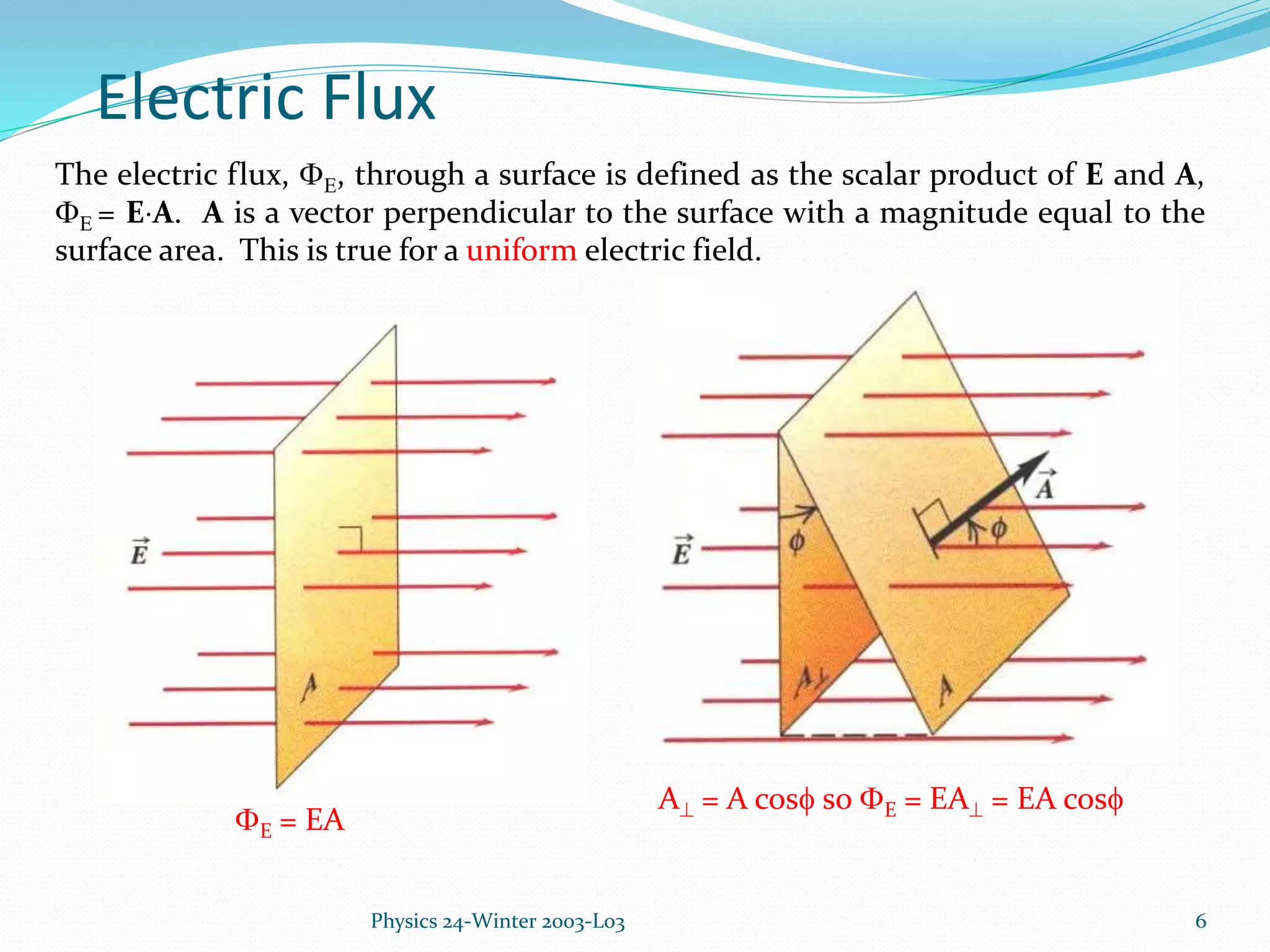
The electric flux, FE, through a surface is defined as the scalar product of E and A,
FE = EA. A is a vector perpendicular to the surface with a magnitude equal to the
surface area. This is true for a uniform electric field.
A = A cos so FE = EA = EA cos
FE = EA
Electric Flux Continued
Physics 24-Winter 2003-L03 7
What about the case when the electric field is not uniform and
the surface is not flat?
Then we divide the surface into small elements and add
the flux through each.
E i i
i
E d A E d AF     
r rr r
Worked Example 1
Physics 24-Winter 2003-L03 8
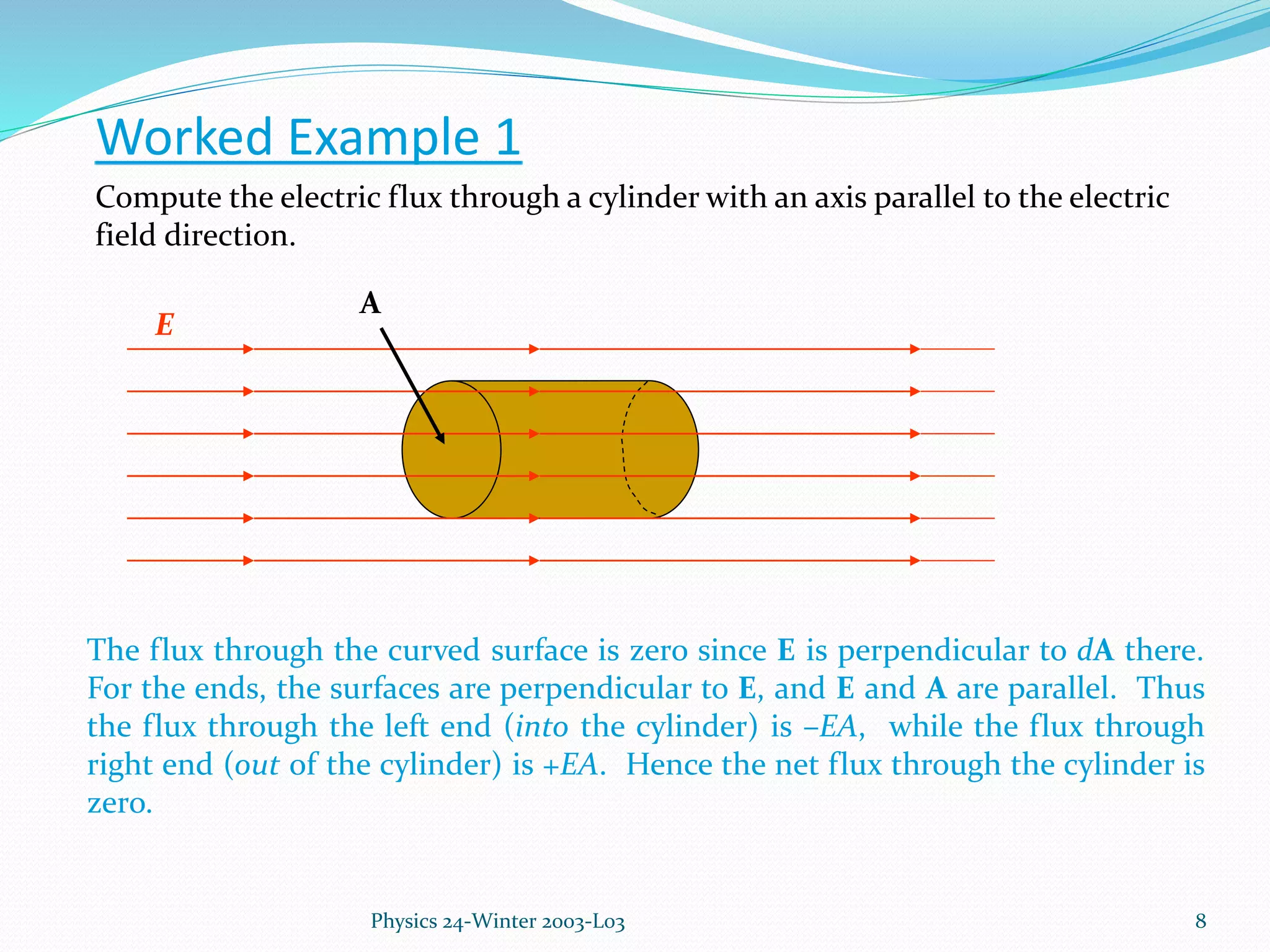
Compute the electric flux through a cylinder with an axis parallel to the electric
field direction.
E
The flux through the curved surface is zero since E is perpendicular to dA there.
For the ends, the surfaces are perpendicular to E, and E and A are parallel. Thus
the flux through the left end (into the cylinder) is –EA, while the flux through
right end (out of the cylinder) is +EA. Hence the net flux through the cylinder is
zero.
A
Gauss’s Law
Physics 24-Winter 2003-L03 9
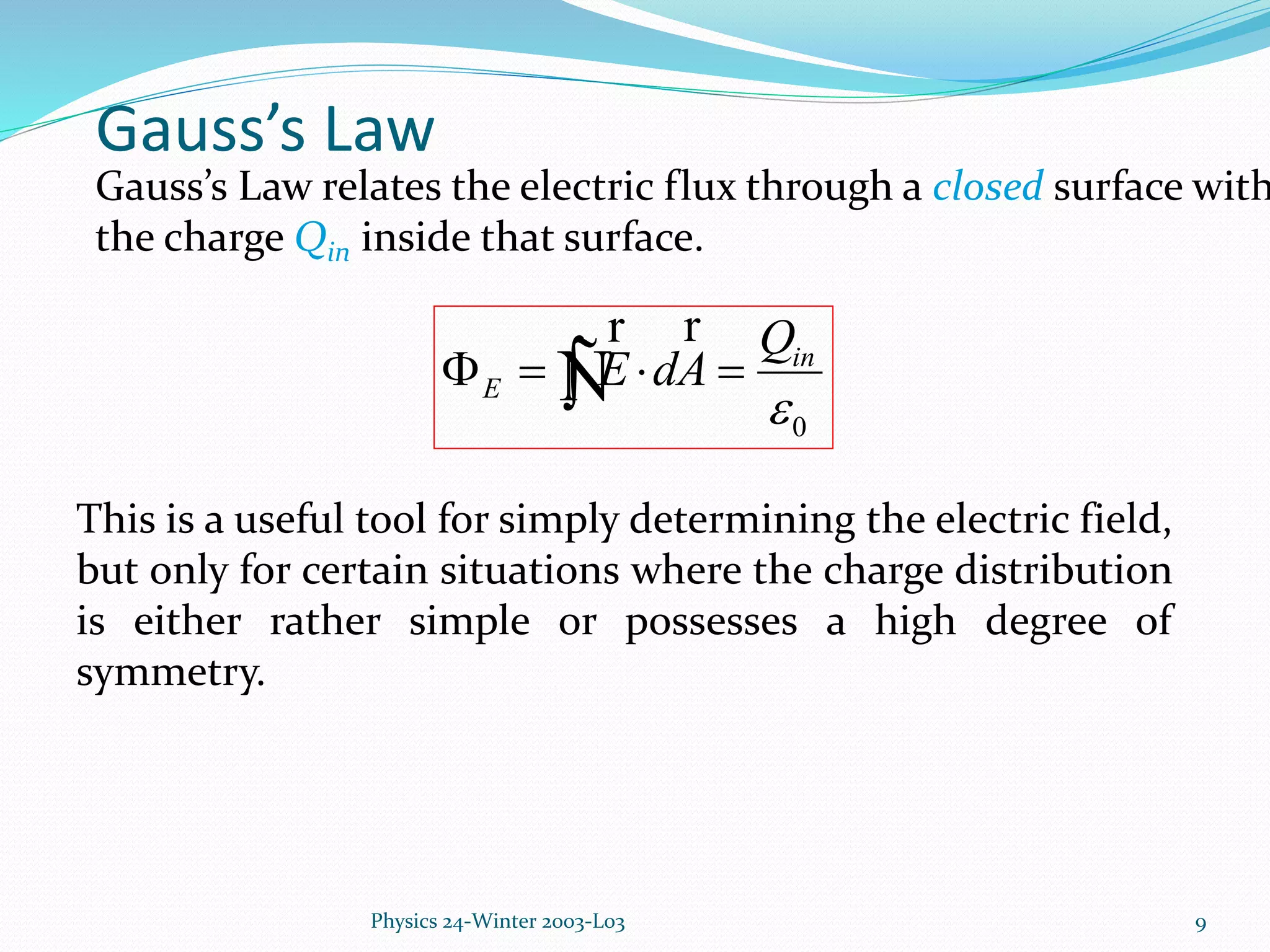
Gauss’s Law relates the electric flux through a closed surface with
the charge Qin inside that surface.
0
F   
rr
Ñ in
E
Q
E dA

This is a useful tool for simply determining the electric field,
but only for certain situations where the charge distribution
is either rather simple or possesses a high degree of
symmetry.
Problem Solving Strategies for Gauss’s
Law
Select a Gaussian surface with symmetry that
matches the charge distribution
Draw the Gaussian surface so that the electric field
is either constant or zero at all points on the
Gaussian surface
Use symmetry to determine the direction of E on
the Gaussian surface
Evaluate the surface integral (electric flux)
Determine the charge inside the Gaussian surface
Solve for E
Physics 24-Winter 2003-L03 10
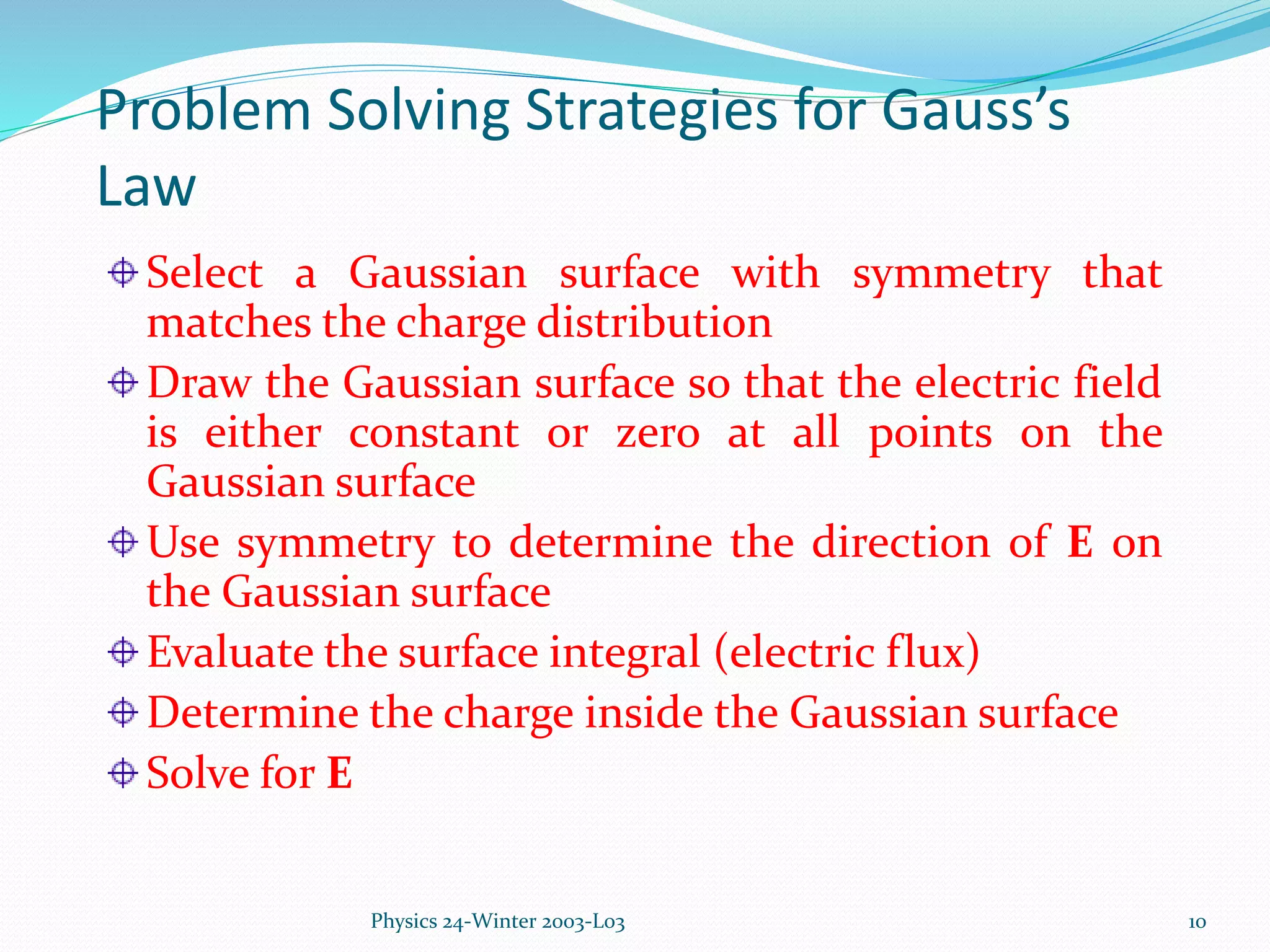
Conductors in Electrostatic Equilibrium
The electric field is zero everywhere inside the
conductor
Any net charge resides on the conductor’s surface
The electric field just outside a charged conductor
is perpendicular to the conductor’s surface
Physics 24-Winter 2003-L03 11
By electrostatic equilibrium we mean a situation where
there is no net motion of charge within the conductor
Conductors in Electrostatic Equilibrium
Physics 24-Winter 2003-L03 12
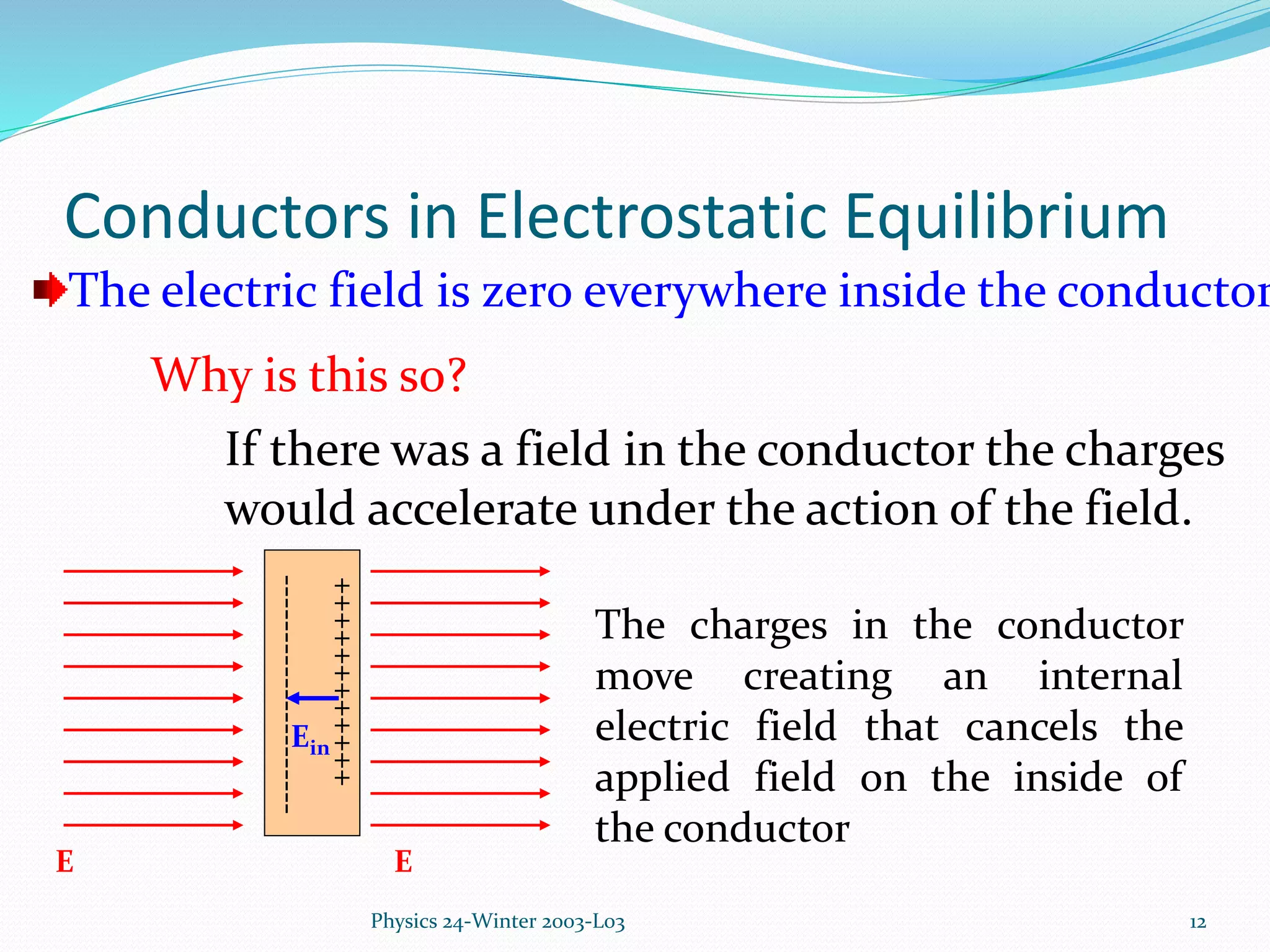
Why is this so?
If there was a field in the conductor the charges
would accelerate under the action of the field.
The electric field is zero everywhere inside the conductor
++++++++++++
---------------------
Ein
E E
The charges in the conductor
move creating an internal
electric field that cancels the
applied field on the inside of
the conductor
Worked Example 4
Physics 24-Winter 2003-L03 13
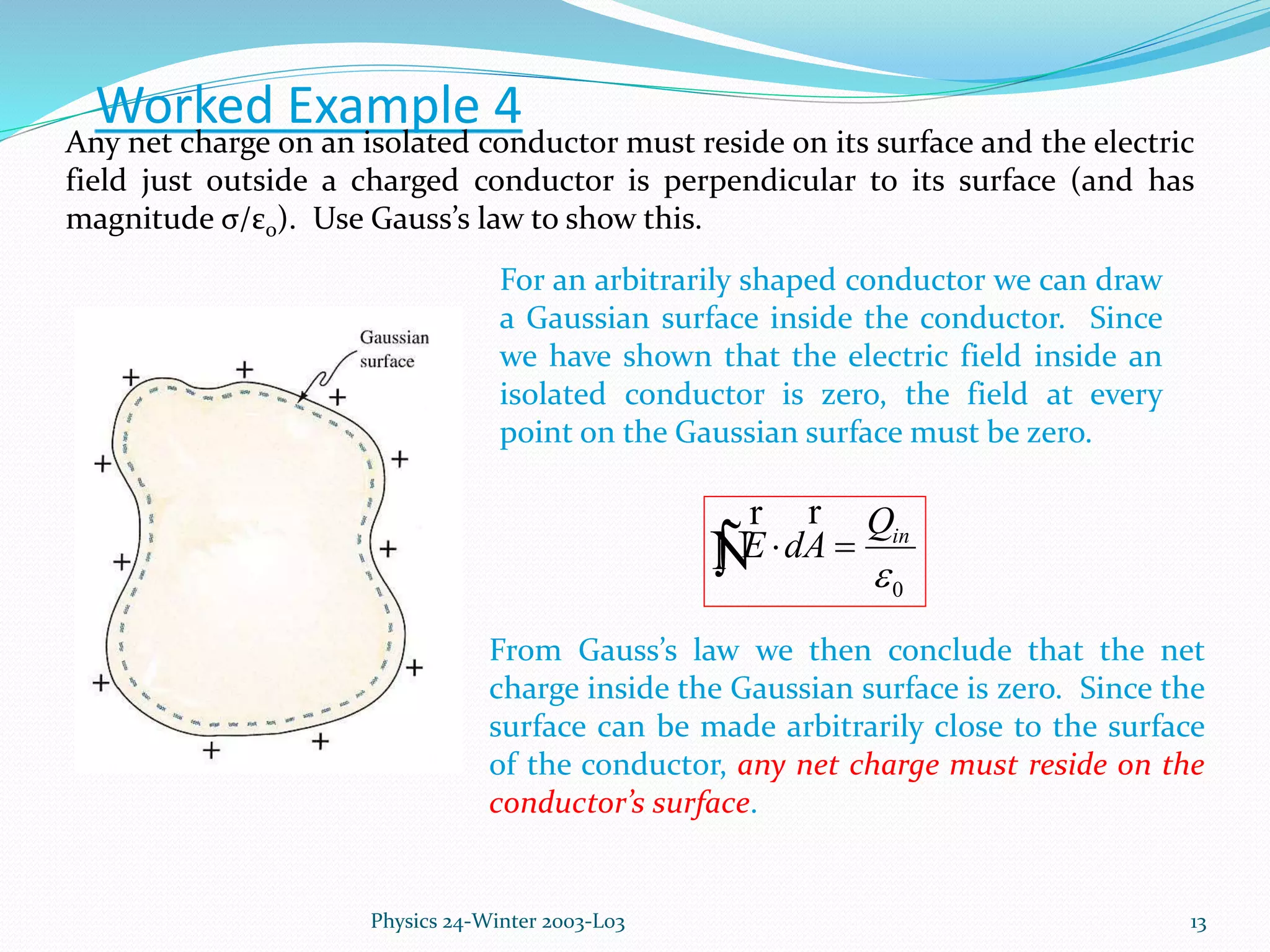
Any net charge on an isolated conductor must reside on its surface and the electric
field just outside a charged conductor is perpendicular to its surface (and has
magnitude σ/ε0). Use Gauss’s law to show this.
For an arbitrarily shaped conductor we can draw
a Gaussian surface inside the conductor. Since
we have shown that the electric field inside an
isolated conductor is zero, the field at every
point on the Gaussian surface must be zero.
From Gauss’s law we then conclude that the net
charge inside the Gaussian surface is zero. Since the
surface can be made arbitrarily close to the surface
of the conductor, any net charge must reside on the
conductor’s surface.
0
 
rr
Ñ inQ
E dA

Worked Example 4 cont’d
Physics 24-Winter 2003-L03 14
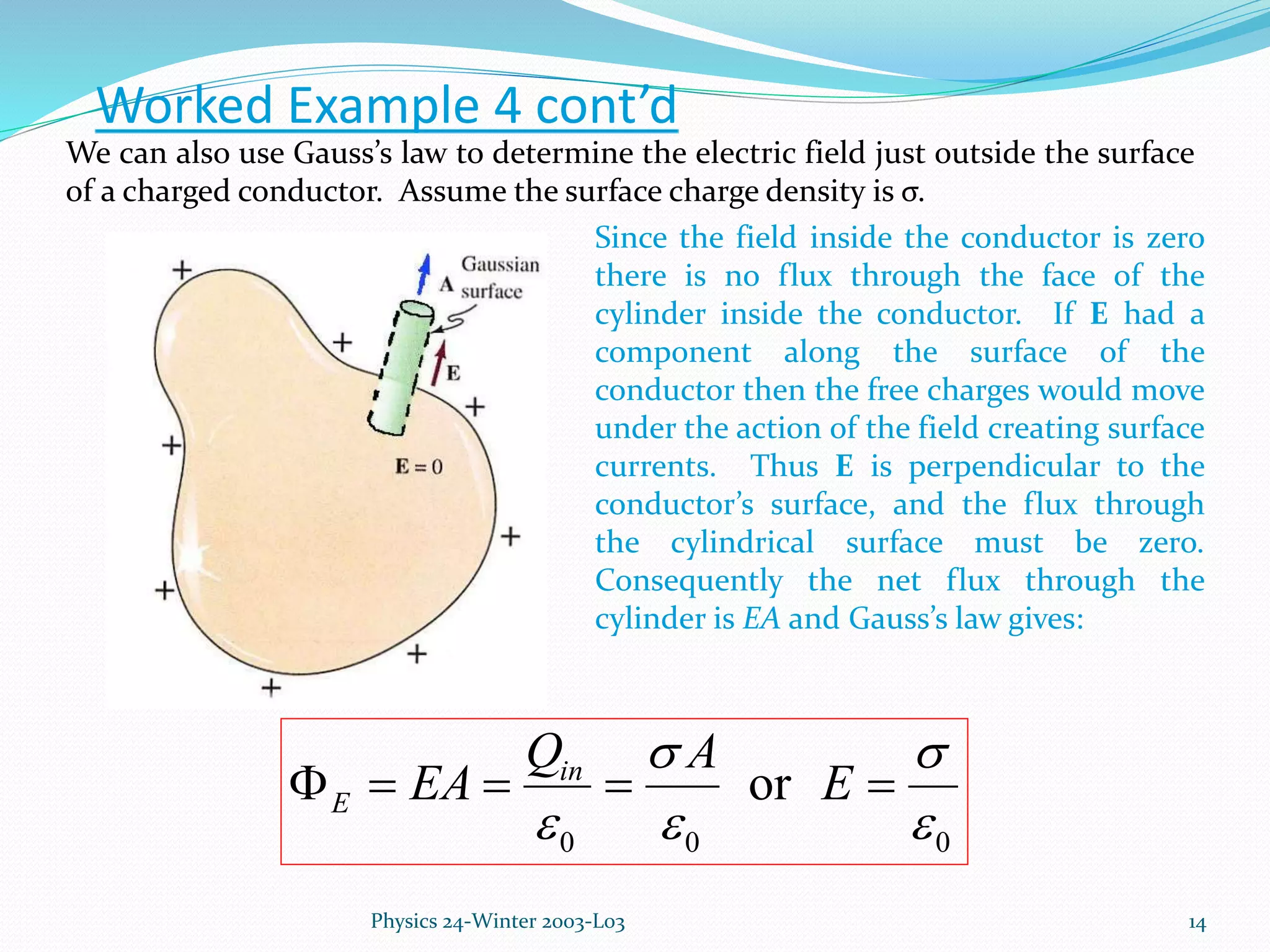
We can also use Gauss’s law to determine the electric field just outside the surface
of a charged conductor. Assume the surface charge density is σ.
Since the field inside the conductor is zero
there is no flux through the face of the
cylinder inside the conductor. If E had a
component along the surface of the
conductor then the free charges would move
under the action of the field creating surface
currents. Thus E is perpendicular to the
conductor’s surface, and the flux through
the cylindrical surface must be zero.
Consequently the net flux through the
cylinder is EA and Gauss’s law gives:
0 0 0
orin
E
Q A
EA E
 
  
F    
Worked Example 5
Physics 24-Winter 2003-L03 15
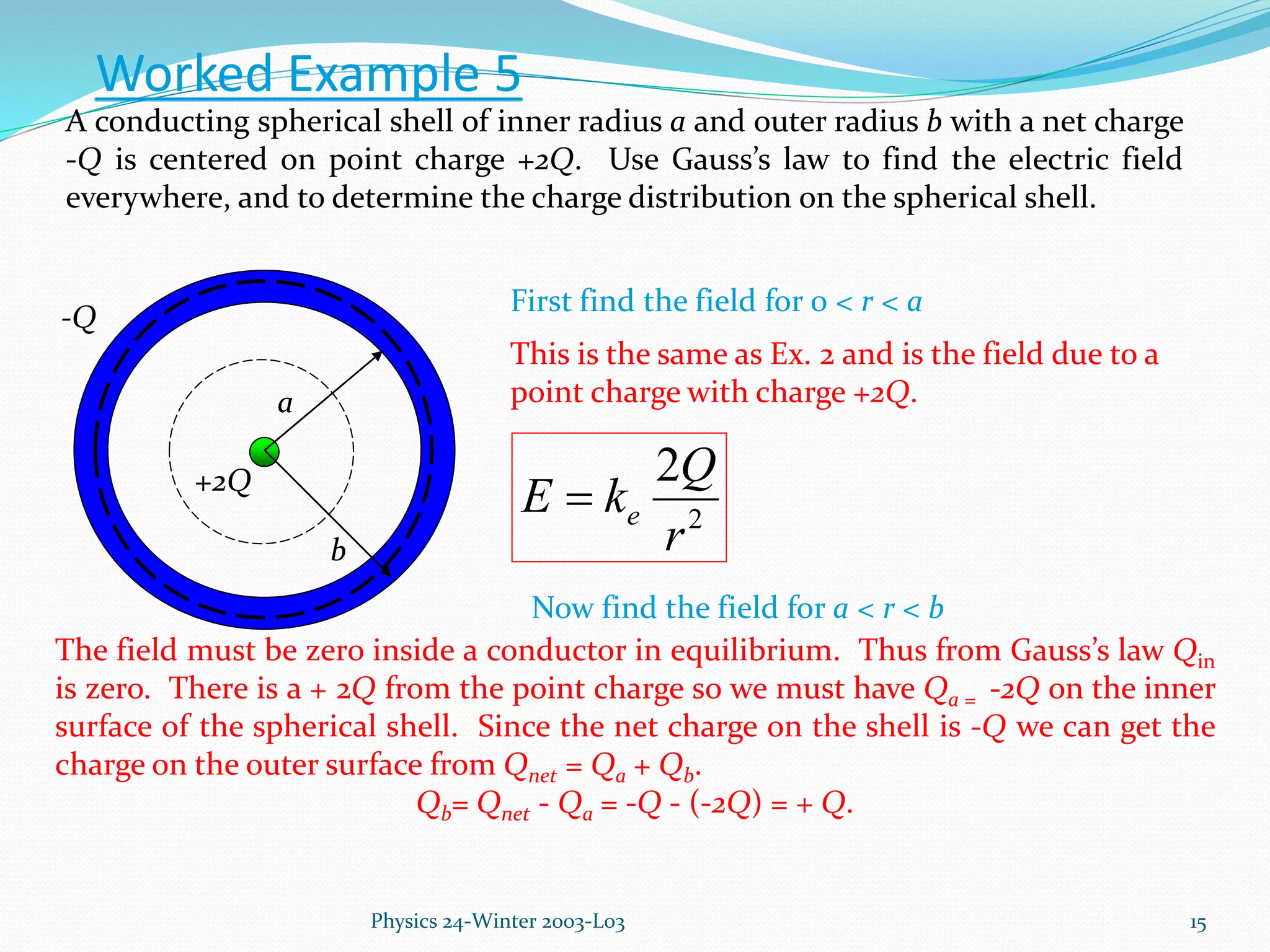
A conducting spherical shell of inner radius a and outer radius b with a net charge
-Q is centered on point charge +2Q. Use Gauss’s law to find the electric field
everywhere, and to determine the charge distribution on the spherical shell.
a
b
-Q
First find the field for 0 < r < a
This is the same as Ex. 2 and is the field due to a
point charge with charge +2Q.
2
2
e
Q
E k
r

Now find the field for a < r < b
The field must be zero inside a conductor in equilibrium. Thus from Gauss’s law Qin
is zero. There is a + 2Q from the point charge so we must have Qa = -2Q on the inner
surface of the spherical shell. Since the net charge on the shell is -Q we can get the
charge on the outer surface from Qnet = Qa + Qb.
Qb= Qnet - Qa = -Q - (-2Q) = + Q.
+2Q
Worked Example 5 cont’d
Physics 24-Winter 2003-L03 16
a
b
-Q
+2Q
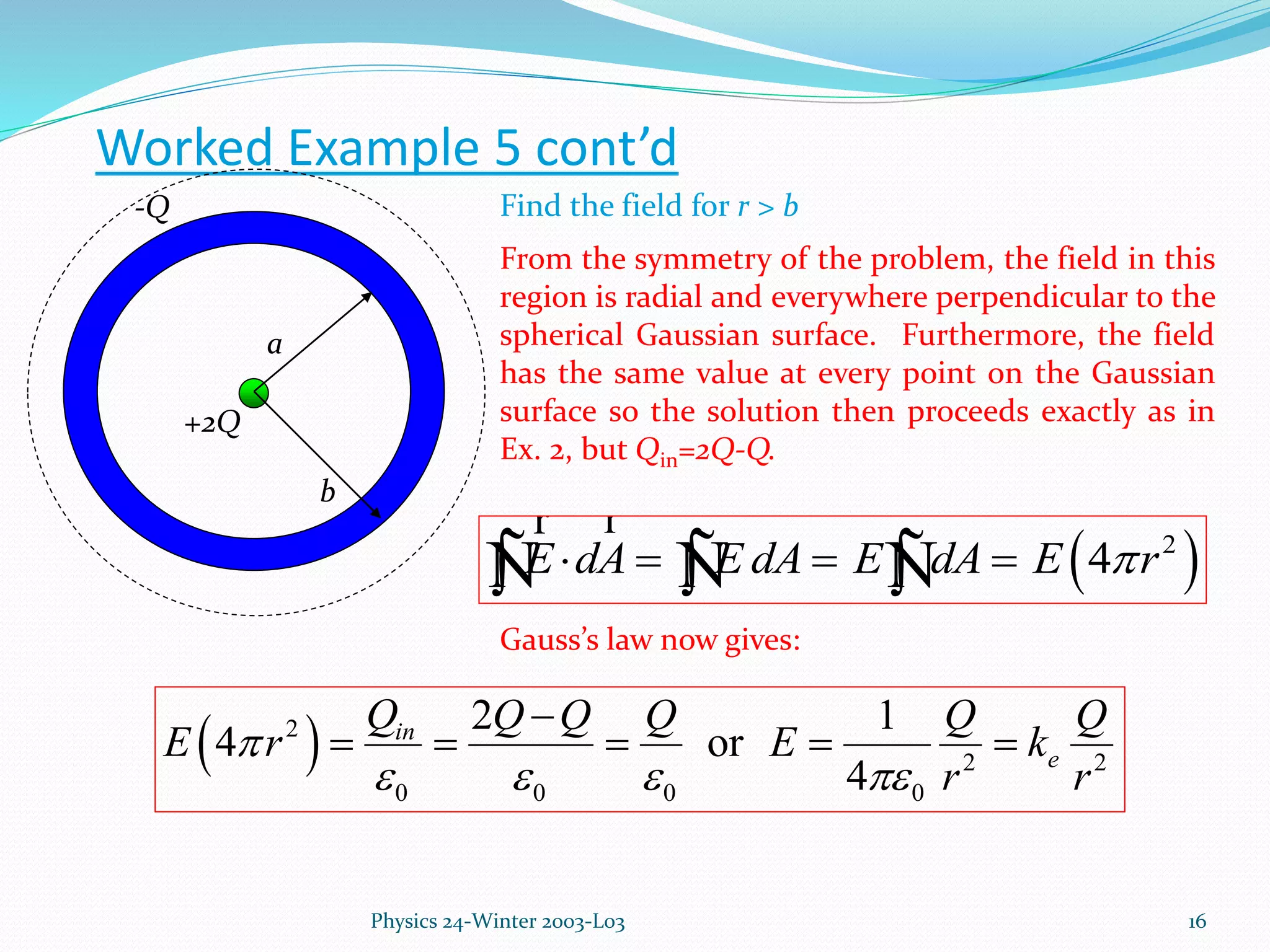
Find the field for r > b
From the symmetry of the problem, the field in this
region is radial and everywhere perpendicular to the
spherical Gaussian surface. Furthermore, the field
has the same value at every point on the Gaussian
surface so the solution then proceeds exactly as in
Ex. 2, but Qin=2Q-Q.
 2
4     
rr
Ñ Ñ ÑE dA E dA E dA E r
Gauss’s law now gives:
 2
2 2
0 0 0 0
2 1
4 or
4
in
e
Q Q Q Q Q Q
E r E k
r r

   

    
gauss law and application Arun kumar

gauss law and application Arun kumar

  • 2.
    Presented BY NAME :ARUN KUMAR CLASS : BSC IV SEM (C.S.) COLLEGE : RAI SAHEB BHANWAR SINGH COLLEGE NASRULLAGANJ SUBMITTED TO: GYAN RAO DHOTE RAI SAHEB BHANWAR SINGH COLLEGE NASRULLAGANJ 2
  • 3.
    RAI SAHEB BHANWARSINGH COLLEGE NASRULLAGANJ 3
  • 4.
  • 5.
    Basic Concepts Electric Flux Gauss’sLaw Applications of Gauss’s Law Conductors in Equilibrium Physics 24-Winter 2003-L03 5
  • 6.
    Electric Flux Physics 24-Winter2003-L03 6 The electric flux, FE, through a surface is defined as the scalar product of E and A, FE = EA. A is a vector perpendicular to the surface with a magnitude equal to the surface area. This is true for a uniform electric field. A = A cos so FE = EA = EA cos FE = EA
  • 7.
    Electric Flux Continued Physics24-Winter 2003-L03 7 What about the case when the electric field is not uniform and the surface is not flat? Then we divide the surface into small elements and add the flux through each. E i i i E d A E d AF      r rr r
  • 8.
    Worked Example 1 Physics24-Winter 2003-L03 8 Compute the electric flux through a cylinder with an axis parallel to the electric field direction. E The flux through the curved surface is zero since E is perpendicular to dA there. For the ends, the surfaces are perpendicular to E, and E and A are parallel. Thus the flux through the left end (into the cylinder) is –EA, while the flux through right end (out of the cylinder) is +EA. Hence the net flux through the cylinder is zero. A
  • 9.
    Gauss’s Law Physics 24-Winter2003-L03 9 Gauss’s Law relates the electric flux through a closed surface with the charge Qin inside that surface. 0 F    rr Ñ in E Q E dA  This is a useful tool for simply determining the electric field, but only for certain situations where the charge distribution is either rather simple or possesses a high degree of symmetry.
  • 10.
    Problem Solving Strategiesfor Gauss’s Law Select a Gaussian surface with symmetry that matches the charge distribution Draw the Gaussian surface so that the electric field is either constant or zero at all points on the Gaussian surface Use symmetry to determine the direction of E on the Gaussian surface Evaluate the surface integral (electric flux) Determine the charge inside the Gaussian surface Solve for E Physics 24-Winter 2003-L03 10
  • 11.
    Conductors in ElectrostaticEquilibrium The electric field is zero everywhere inside the conductor Any net charge resides on the conductor’s surface The electric field just outside a charged conductor is perpendicular to the conductor’s surface Physics 24-Winter 2003-L03 11 By electrostatic equilibrium we mean a situation where there is no net motion of charge within the conductor
  • 12.
    Conductors in ElectrostaticEquilibrium Physics 24-Winter 2003-L03 12 Why is this so? If there was a field in the conductor the charges would accelerate under the action of the field. The electric field is zero everywhere inside the conductor ++++++++++++ --------------------- Ein E E The charges in the conductor move creating an internal electric field that cancels the applied field on the inside of the conductor
  • 13.
    Worked Example 4 Physics24-Winter 2003-L03 13 Any net charge on an isolated conductor must reside on its surface and the electric field just outside a charged conductor is perpendicular to its surface (and has magnitude σ/ε0). Use Gauss’s law to show this. For an arbitrarily shaped conductor we can draw a Gaussian surface inside the conductor. Since we have shown that the electric field inside an isolated conductor is zero, the field at every point on the Gaussian surface must be zero. From Gauss’s law we then conclude that the net charge inside the Gaussian surface is zero. Since the surface can be made arbitrarily close to the surface of the conductor, any net charge must reside on the conductor’s surface. 0   rr Ñ inQ E dA 
  • 14.
    Worked Example 4cont’d Physics 24-Winter 2003-L03 14 We can also use Gauss’s law to determine the electric field just outside the surface of a charged conductor. Assume the surface charge density is σ. Since the field inside the conductor is zero there is no flux through the face of the cylinder inside the conductor. If E had a component along the surface of the conductor then the free charges would move under the action of the field creating surface currents. Thus E is perpendicular to the conductor’s surface, and the flux through the cylindrical surface must be zero. Consequently the net flux through the cylinder is EA and Gauss’s law gives: 0 0 0 orin E Q A EA E      F    
  • 15.
    Worked Example 5 Physics24-Winter 2003-L03 15 A conducting spherical shell of inner radius a and outer radius b with a net charge -Q is centered on point charge +2Q. Use Gauss’s law to find the electric field everywhere, and to determine the charge distribution on the spherical shell. a b -Q First find the field for 0 < r < a This is the same as Ex. 2 and is the field due to a point charge with charge +2Q. 2 2 e Q E k r  Now find the field for a < r < b The field must be zero inside a conductor in equilibrium. Thus from Gauss’s law Qin is zero. There is a + 2Q from the point charge so we must have Qa = -2Q on the inner surface of the spherical shell. Since the net charge on the shell is -Q we can get the charge on the outer surface from Qnet = Qa + Qb. Qb= Qnet - Qa = -Q - (-2Q) = + Q. +2Q
  • 16.
    Worked Example 5cont’d Physics 24-Winter 2003-L03 16 a b -Q +2Q Find the field for r > b From the symmetry of the problem, the field in this region is radial and everywhere perpendicular to the spherical Gaussian surface. Furthermore, the field has the same value at every point on the Gaussian surface so the solution then proceeds exactly as in Ex. 2, but Qin=2Q-Q.  2 4      rr Ñ Ñ ÑE dA E dA E dA E r Gauss’s law now gives:  2 2 2 0 0 0 0 2 1 4 or 4 in e Q Q Q Q Q Q E r E k r r           