







Department of Electrical & Electronic Engineering
Name: AL-AMIN
ID:16102904
Date: Sunday, September 23, 2018
1.Definition & History of Maxwell’s equations:
Gauss Law
Gauss’ Magnetism Law
Faraday’s Law
Ampere’s Law
Maxwell’s equations in-
differential form
integral form
free space
Harmonically Varying fields
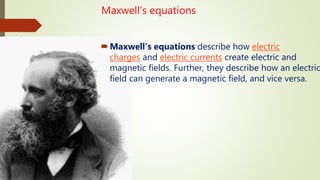
Maxwell’s equations
Maxwell's equations describe how electric
charges and electric currents create electric and
magnetic fields. Further, they describe how an electric
field can generate a magnetic field, and vice versa.
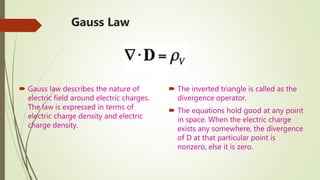
Gauss Law
 Gauss law describes the nature of
electric field around electric charges.
The law is expressed in terms of
electric charge density and electric
charge density.
 The inverted triangle is called as the
divergence operator.
 The equations hold good at any point
in space. When the electric charge
exists any somewhere, the divergence
of D at that particular point is
nonzero, else it is zero.
Gauss’ Magnetism Law
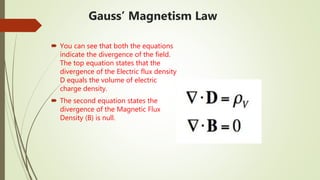
 You can see that both the equations
indicate the divergence of the field.
The top equation states that the
divergence of the Electric flux density
D equals the volume of electric
charge density.
 The second equation states the
divergence of the Magnetic Flux
Density (B) is null.
Faraday’s Law
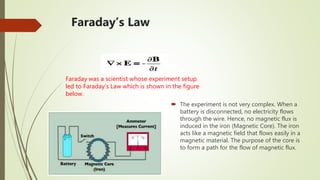
Faraday was a scientist whose experiment setup
led to Faraday’s Law which is shown in the figure
below.
 The experiment is not very complex. When a
battery is disconnected, no electricity flows
through the wire. Hence, no magnetic flux is
induced in the iron (Magnetic Core). The iron
acts like a magnetic field that flows easily in a
magnetic material. The purpose of the core is
to form a path for the flow of magnetic flux.
Ampere’s Law
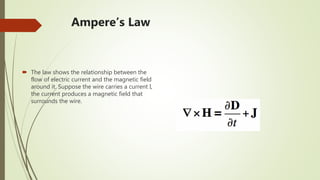
 The law shows the relationship between the
flow of electric current and the magnetic field
around it. Suppose the wire carries a current I,
the current produces a magnetic field that
surrounds the wire.
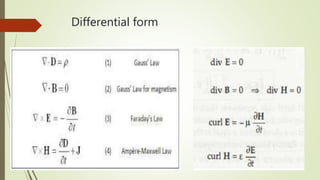
Differential form
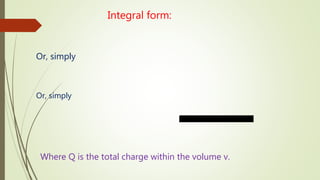
Where Q is the total charge within the volume v.
Or, simply
Or, simply
Integral form:
or
and
or
Thus ,summarizing ,we have
In Free space:
Differential Form:
Integral form:
Harmonically Varying Field:
Also,
Or,
Maxwell's equation
Maxwell's equation

Maxwell's equation

  • 1.
    Department of Electrical& Electronic Engineering Name: AL-AMIN ID:16102904 Date: Sunday, September 23, 2018
  • 2.
    1.Definition & Historyof Maxwell’s equations: Gauss Law Gauss’ Magnetism Law Faraday’s Law Ampere’s Law Maxwell’s equations in- differential form integral form free space Harmonically Varying fields
  • 3.
    Maxwell’s equations Maxwell's equationsdescribe how electric charges and electric currents create electric and magnetic fields. Further, they describe how an electric field can generate a magnetic field, and vice versa.
  • 4.
    Gauss Law  Gausslaw describes the nature of electric field around electric charges. The law is expressed in terms of electric charge density and electric charge density.  The inverted triangle is called as the divergence operator.  The equations hold good at any point in space. When the electric charge exists any somewhere, the divergence of D at that particular point is nonzero, else it is zero.
  • 5.
    Gauss’ Magnetism Law You can see that both the equations indicate the divergence of the field. The top equation states that the divergence of the Electric flux density D equals the volume of electric charge density.  The second equation states the divergence of the Magnetic Flux Density (B) is null.
  • 6.
    Faraday’s Law Faraday wasa scientist whose experiment setup led to Faraday’s Law which is shown in the figure below.  The experiment is not very complex. When a battery is disconnected, no electricity flows through the wire. Hence, no magnetic flux is induced in the iron (Magnetic Core). The iron acts like a magnetic field that flows easily in a magnetic material. The purpose of the core is to form a path for the flow of magnetic flux.
  • 7.
    Ampere’s Law  Thelaw shows the relationship between the flow of electric current and the magnetic field around it. Suppose the wire carries a current I, the current produces a magnetic field that surrounds the wire.
  • 8.
  • 10.
    Where Q isthe total charge within the volume v. Or, simply Or, simply Integral form:
  • 11.
  • 12.
  • 13.
  • 14.
  • 15.
  • 16.