Definitions
• Flux—The rate of flow through an area or volume. It can
also be viewed as the product of an area and the vector
field across the area
• Electric Flux—The rate of flow of an electric field through
an area or volume—represented by the number of E field
lines penetrating a surface
Charge and Electric Flux
Previously, we answered the question – how do we find
E-field at any point in space if we know charge distribution?
Now we will answer the opposite question – if we know E-field
distribution in space, what can we say about charge distribution?
Electric flux
Electric flux is associated with the flow of electric field through a surface
For an enclosed charge, there is a connection
between the amount of charge
and electric field flux.
2
2
1
~
~
E
r
S r
E S const

Calculating Electric Flux
dV
A
dt


Amount of fluid passing through
the rectangle of area A
cos
dV
A
dt
 

dV
A
dt

 

Calculating Electric Flux
• The flux for an electric field is
• For an arbitrary surface and nonuniform E field
• Where the area vector is a vector with magnitude of the
area A and direction normal to the plane of A
A
E





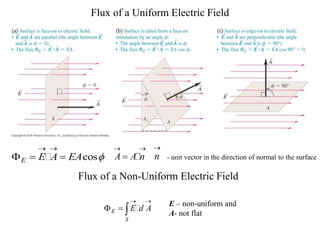
Flux of a Uniform Electric Field
cos
E E A EA 
 
   A A n
 
 n

- unit vector in the direction of normal to the surface
Flux of a Non-Uniform Electric Field
E
S
E d A
 
  
E – non-uniform and
A- not flat
Few examples on calculating the electric flux
3
2 10 [ / ]
E N C
 
Find electric flux
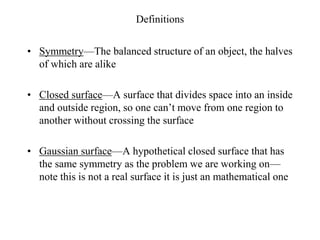
Definitions
• Symmetry—The balanced structure of an object, the halves
of which are alike
• Closed surface—A surface that divides space into an inside
and outside region, so one can’t move from one region to
another without crossing the surface
• Gaussian surface—A hypothetical closed surface that has
the same symmetry as the problem we are working on—
note this is not a real surface it is just an mathematical one
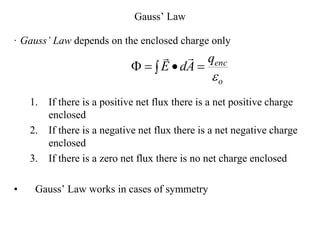
Gauss’ Law
· Gauss’ Law depends on the enclosed charge only
1. If there is a positive net flux there is a net positive charge
enclosed
2. If there is a negative net flux there is a net negative charge
enclosed
3. If there is a zero net flux there is no net charge enclosed
• Gauss’ Law works in cases of symmetry
o
enc
q
A
d
E


 




Types of Symmetry
• Cylindrical symmetry—example a can
• Spherical symmetry—example a ball
• Rectangular symmetry—example a box—rarely used
Steps to Applying Gauss’ Law
To find the E field produced by a charge distribution at a point of
distance r from the center
1. Decide which type of symmetry best complements the
problem
2. Draw a Gaussian surface (mathematical not real)
reflecting the symmetry you chose around the charge
distribution at a distance of r from the center
3. Using Gauss’s law obtain the magnitude of E
Gauss’s Law
0
i
E
q
E d A

 
  


Applications of the Gauss’s Law
If no charge is enclosed within Gaussian surface – flux is zero!
Electric flux is proportional to the algebraic number of lines leaving
the surface, outgoing lines have positive sign, incoming - negative
Remember – electric field lines must start and must end on charges!
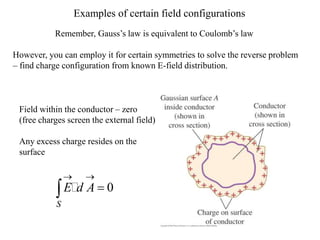
Examples of certain field configurations
Remember, Gauss’s law is equivalent to Coulomb’s law
However, you can employ it for certain symmetries to solve the reverse problem
– find charge configuration from known E-field distribution.
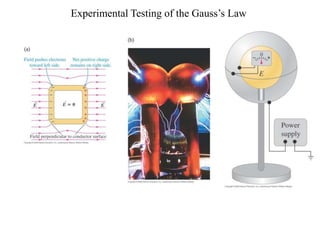
Field within the conductor – zero
(free charges screen the external field)
Any excess charge resides on the
surface
0
S
E d A
 


Field of a charged conducting sphere
Field of a thin, uniformly charged conducting wire
Field outside the wire can only point
radially outward, and, therefore, may
only depend on the distance from the wire
0
Q
E d A

 


0
2
E
r

 

- linear density of charge
Field of the uniformly charged sphere
r
E
0
3


Uniform charge within a sphere of radius r
3
' r
q Q
a
 
  
 
Q - total charge
Q
V
  - volume density of charge
Field of the infinitely large conducting plate
s- uniform surface charge density
Q
A
s 
0
2
E
s


Charged Isolated Conductors
• In a charged isolated conductor all the charge moves to the
surface
• The E field inside a conductor must be 0 otherwise a
current would be set up
• The charges do not necessarily distribute themselves
uniformly, they distribute themselves so the net force on
each other is 0.
• This means the surface charge density varies over a
nonspherical conductor
Charged Isolated Conductors cont
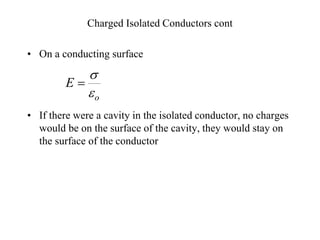
• On a conducting surface
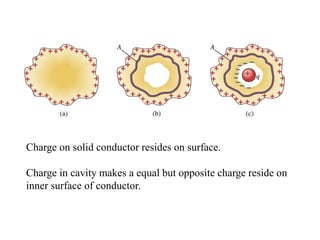
• If there were a cavity in the isolated conductor, no charges
would be on the surface of the cavity, they would stay on
the surface of the conductor
o
E

s

Charge on solid conductor resides on surface.
Charge in cavity makes a equal but opposite charge reside on
inner surface of conductor.
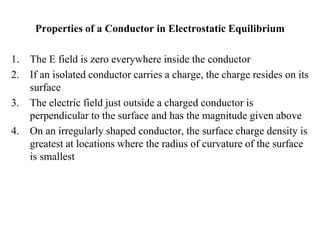
Properties of a Conductor in Electrostatic Equilibrium
1. The E field is zero everywhere inside the conductor
2. If an isolated conductor carries a charge, the charge resides on its
surface
3. The electric field just outside a charged conductor is
perpendicular to the surface and has the magnitude given above
4. On an irregularly shaped conductor, the surface charge density is
greatest at locations where the radius of curvature of the surface
is smallest
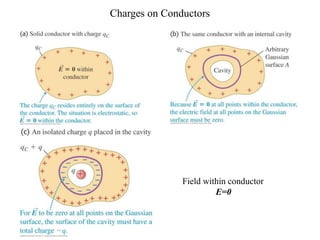
Charges on Conductors
Field within conductor
E=0
Experimental Testing of the Gauss’s Law

PHYS_2326_012209 (1).pptxxxxxxxxxxxxxxxxx

  • 1.
    Definitions • Flux—The rateof flow through an area or volume. It can also be viewed as the product of an area and the vector field across the area • Electric Flux—The rate of flow of an electric field through an area or volume—represented by the number of E field lines penetrating a surface
  • 2.
    Charge and ElectricFlux Previously, we answered the question – how do we find E-field at any point in space if we know charge distribution? Now we will answer the opposite question – if we know E-field distribution in space, what can we say about charge distribution?
  • 3.
    Electric flux Electric fluxis associated with the flow of electric field through a surface For an enclosed charge, there is a connection between the amount of charge and electric field flux. 2 2 1 ~ ~ E r S r E S const 
  • 4.
    Calculating Electric Flux dV A dt   Amountof fluid passing through the rectangle of area A cos dV A dt    dV A dt    
  • 5.
    Calculating Electric Flux •The flux for an electric field is • For an arbitrary surface and nonuniform E field • Where the area vector is a vector with magnitude of the area A and direction normal to the plane of A A E     
  • 6.
    Flux of aUniform Electric Field cos E E A EA       A A n    n  - unit vector in the direction of normal to the surface Flux of a Non-Uniform Electric Field E S E d A      E – non-uniform and A- not flat
  • 7.
    Few examples oncalculating the electric flux 3 2 10 [ / ] E N C   Find electric flux
  • 8.
    Definitions • Symmetry—The balancedstructure of an object, the halves of which are alike • Closed surface—A surface that divides space into an inside and outside region, so one can’t move from one region to another without crossing the surface • Gaussian surface—A hypothetical closed surface that has the same symmetry as the problem we are working on— note this is not a real surface it is just an mathematical one
  • 9.
    Gauss’ Law · Gauss’Law depends on the enclosed charge only 1. If there is a positive net flux there is a net positive charge enclosed 2. If there is a negative net flux there is a net negative charge enclosed 3. If there is a zero net flux there is no net charge enclosed • Gauss’ Law works in cases of symmetry o enc q A d E        
  • 10.
    Types of Symmetry •Cylindrical symmetry—example a can • Spherical symmetry—example a ball • Rectangular symmetry—example a box—rarely used
  • 11.
    Steps to ApplyingGauss’ Law To find the E field produced by a charge distribution at a point of distance r from the center 1. Decide which type of symmetry best complements the problem 2. Draw a Gaussian surface (mathematical not real) reflecting the symmetry you chose around the charge distribution at a distance of r from the center 3. Using Gauss’s law obtain the magnitude of E
  • 13.
    Gauss’s Law 0 i E q E dA        
  • 14.
    Applications of theGauss’s Law If no charge is enclosed within Gaussian surface – flux is zero! Electric flux is proportional to the algebraic number of lines leaving the surface, outgoing lines have positive sign, incoming - negative Remember – electric field lines must start and must end on charges!
  • 15.
    Examples of certainfield configurations Remember, Gauss’s law is equivalent to Coulomb’s law However, you can employ it for certain symmetries to solve the reverse problem – find charge configuration from known E-field distribution. Field within the conductor – zero (free charges screen the external field) Any excess charge resides on the surface 0 S E d A    
  • 16.
    Field of acharged conducting sphere
  • 17.
    Field of athin, uniformly charged conducting wire Field outside the wire can only point radially outward, and, therefore, may only depend on the distance from the wire 0 Q E d A      0 2 E r     - linear density of charge
  • 18.
    Field of theuniformly charged sphere r E 0 3   Uniform charge within a sphere of radius r 3 ' r q Q a        Q - total charge Q V   - volume density of charge Field of the infinitely large conducting plate s- uniform surface charge density Q A s  0 2 E s  
  • 19.
    Charged Isolated Conductors •In a charged isolated conductor all the charge moves to the surface • The E field inside a conductor must be 0 otherwise a current would be set up • The charges do not necessarily distribute themselves uniformly, they distribute themselves so the net force on each other is 0. • This means the surface charge density varies over a nonspherical conductor
  • 20.
    Charged Isolated Conductorscont • On a conducting surface • If there were a cavity in the isolated conductor, no charges would be on the surface of the cavity, they would stay on the surface of the conductor o E  s 
  • 21.
    Charge on solidconductor resides on surface. Charge in cavity makes a equal but opposite charge reside on inner surface of conductor.
  • 22.
    Properties of aConductor in Electrostatic Equilibrium 1. The E field is zero everywhere inside the conductor 2. If an isolated conductor carries a charge, the charge resides on its surface 3. The electric field just outside a charged conductor is perpendicular to the surface and has the magnitude given above 4. On an irregularly shaped conductor, the surface charge density is greatest at locations where the radius of curvature of the surface is smallest
  • 23.
    Charges on Conductors Fieldwithin conductor E=0
  • 24.
    Experimental Testing ofthe Gauss’s Law