
ELECTROSTATIC FIELD
Irfan Sultan
Instructor (Telecom.)
Govt. College ofTechnology
OBJECTIVES
 State Coulomb’s Law and Field Intensity
 Describe Electric Field due to continuous charge distribution formulas
 Discuss Electric Flux Density
 Describe Gauss’s Law and its application to a point charge
 State Electric Potential
 Describe Relationship between E &V
 Discuss Electric Dipole
 Discuss Electric Flux Lines and Equipotential Surfaces
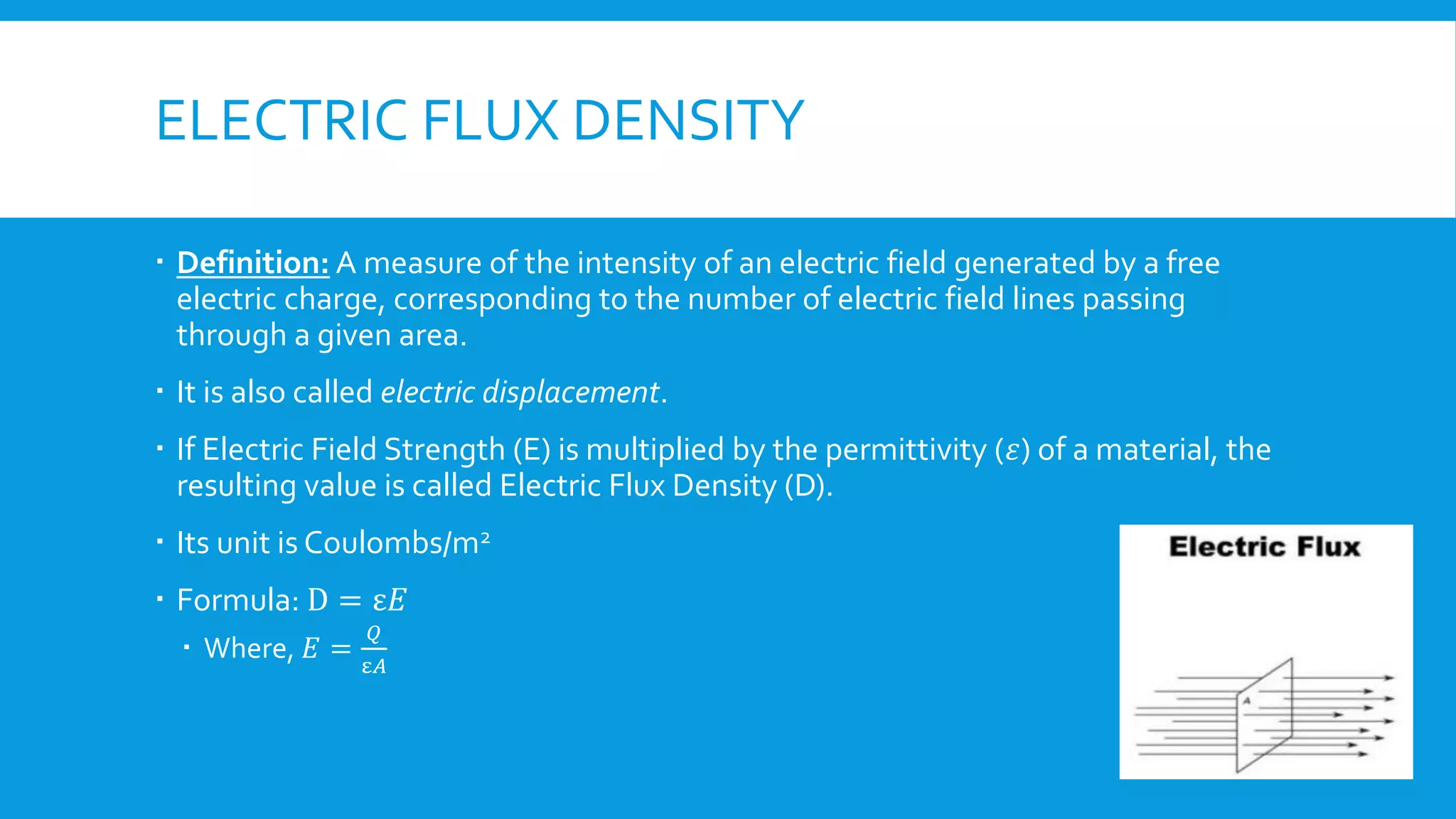
ELECTRIC FLUX DENSITY
 Definition: A measure of the intensity of an electric field generated by a free
electric charge, corresponding to the number of electric field lines passing
through a given area.
 It is also called electric displacement.
 If Electric Field Strength (E) is multiplied by the permittivity (𝜀) of a material, the
resulting value is called Electric Flux Density (D).
 Its unit is Coulombs/m2
 Formula: D = ε𝐸
 Where, 𝐸 =
𝑄
ε𝐴
DIFFERENCE B/W
ELECTRIC FLUX (𝜓) AND
ELECTRIC FLUX DENSITY (𝐷)
 The Electric Flux is a measure of the Electric Field due to some charge,
experienced over a hypothetical surface area of any magnitude. The Electric Flux
Density is a measure of the Electric Field due to some charge, experienced over a
hypothetical Unit surface area i.e. 1 square units.
GAUSS’S LAW
APPLICATIONTO A POINT CHARGE
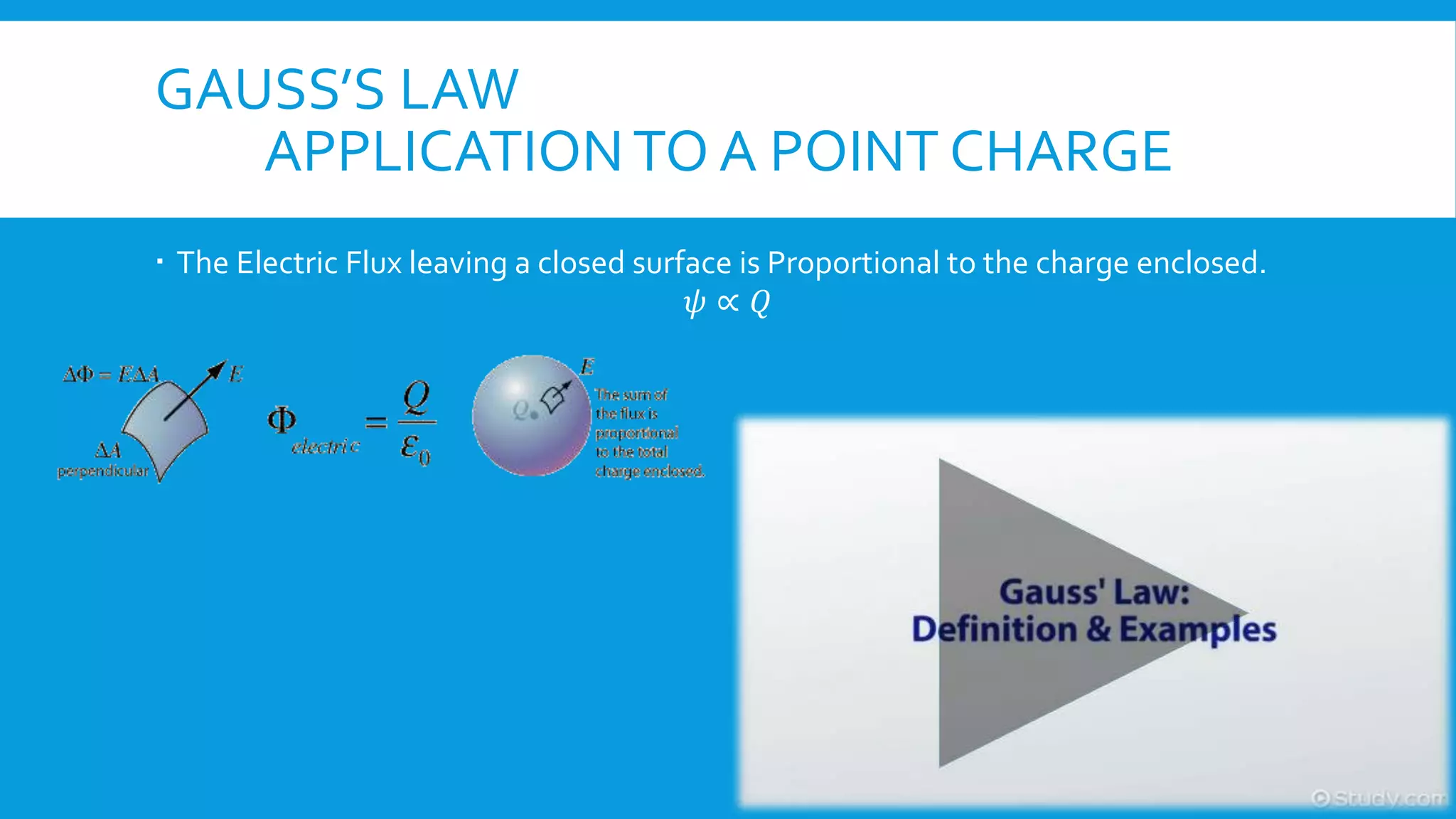
 The Electric Flux leaving a closed surface is Proportional to the charge enclosed.
𝜓 ∝ 𝑄
ELECTRIC POTENTIAL
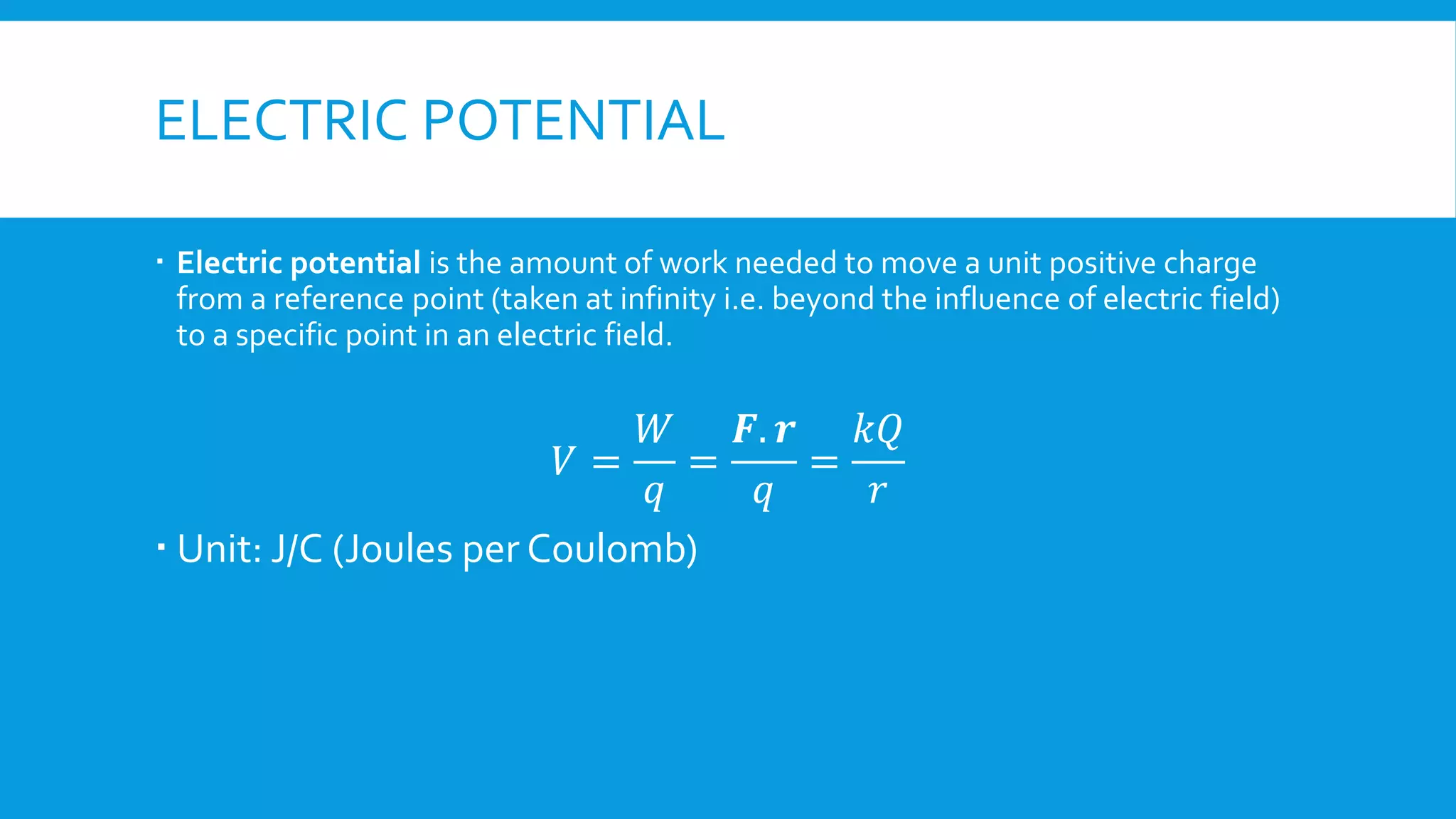
 Electric potential is the amount of work needed to move a unit positive charge
from a reference point (taken at infinity i.e. beyond the influence of electric field)
to a specific point in an electric field.
𝑉 =
𝑊
𝑞
=
𝑭. 𝒓
𝑞
=
𝑘𝑄
𝑟
 Unit: J/C (Joules per Coulomb)
ELECTRIC POTENTIAL DIFFERENCE
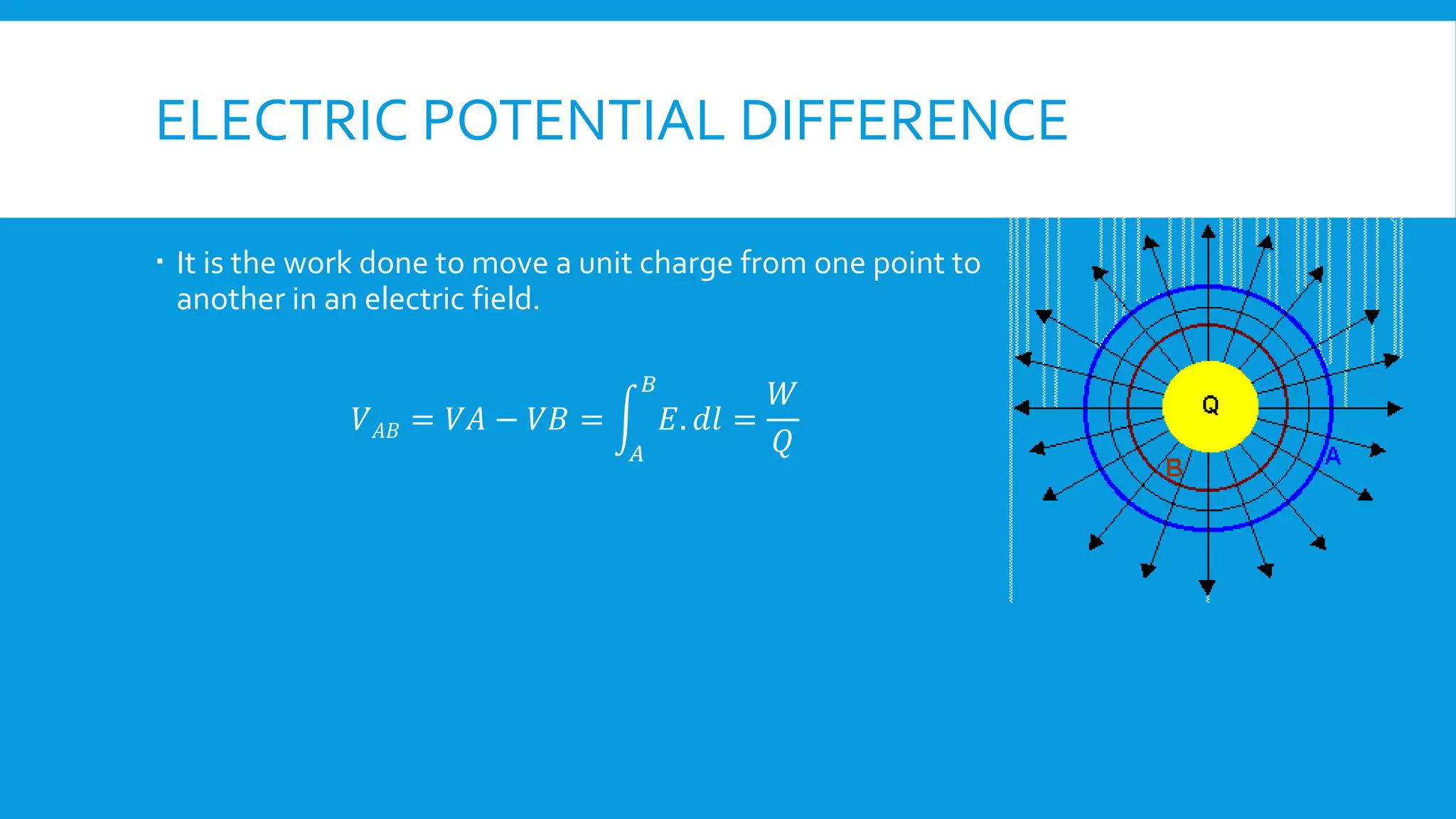
 It is the work done to move a unit charge from one point to
another in an electric field.
𝑉𝐴𝐵 = 𝑉𝐴 − 𝑉𝐵 =
𝐴
𝐵
𝐸. 𝑑𝑙 =
𝑊
𝑄
ELECTRIC DIPOLE
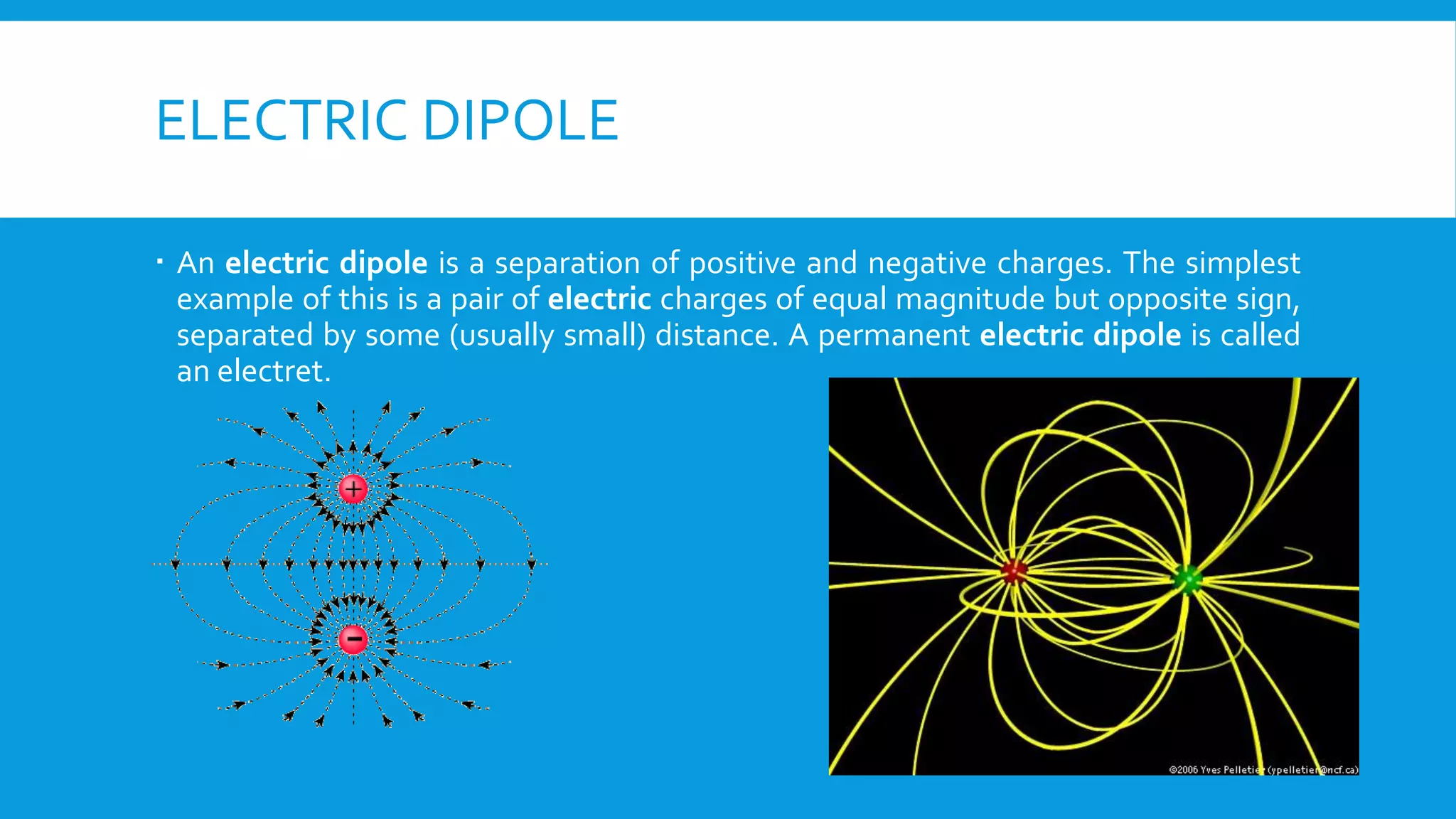
 An electric dipole is a separation of positive and negative charges. The simplest
example of this is a pair of electric charges of equal magnitude but opposite sign,
separated by some (usually small) distance. A permanent electric dipole is called
an electret.
ELECTRIC FLUX LINES
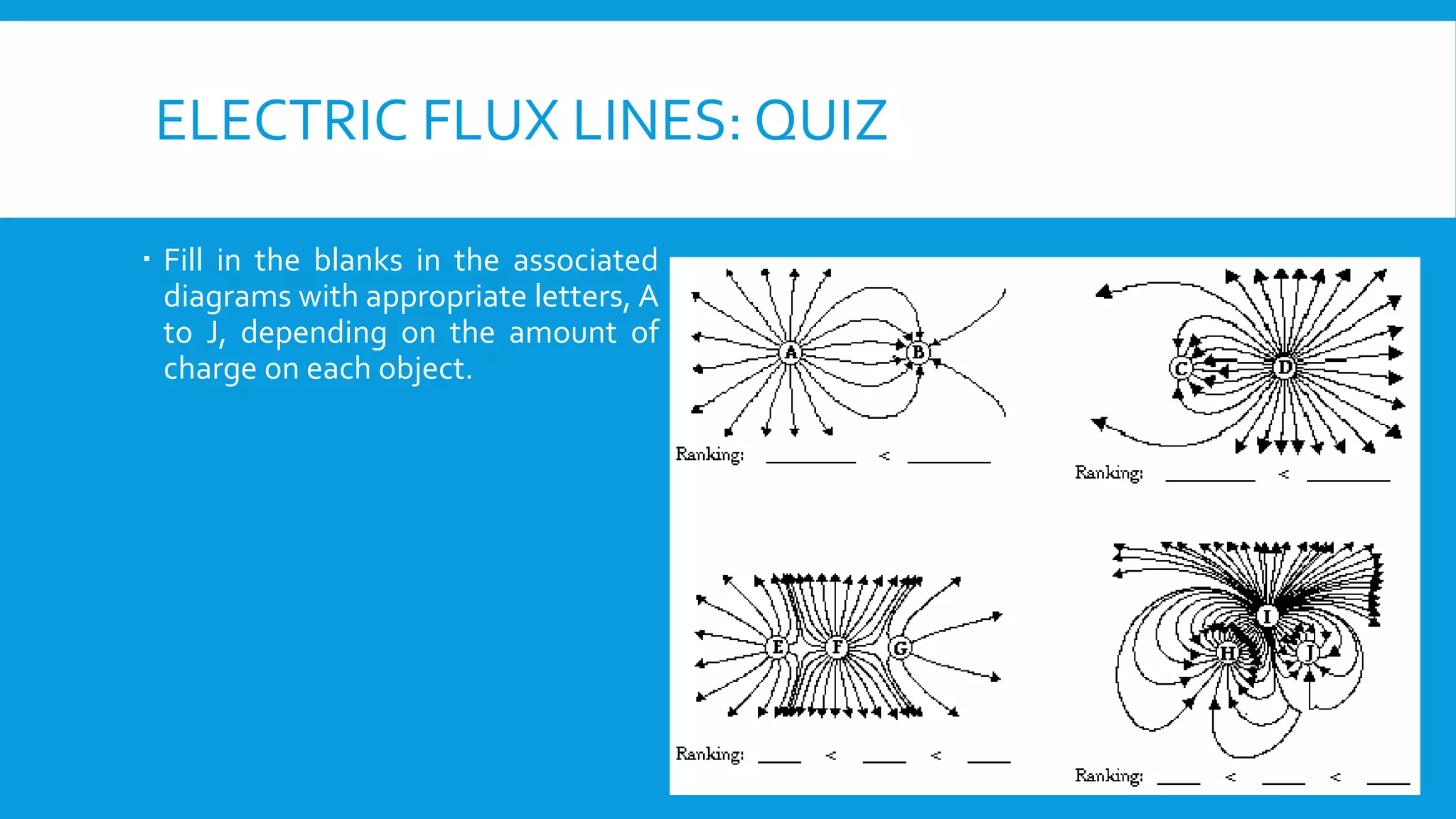
ELECTRIC FLUX LINES: QUIZ
 Fill in the blanks in the associated
diagrams with appropriate letters, A
to J, depending on the amount of
charge on each object.
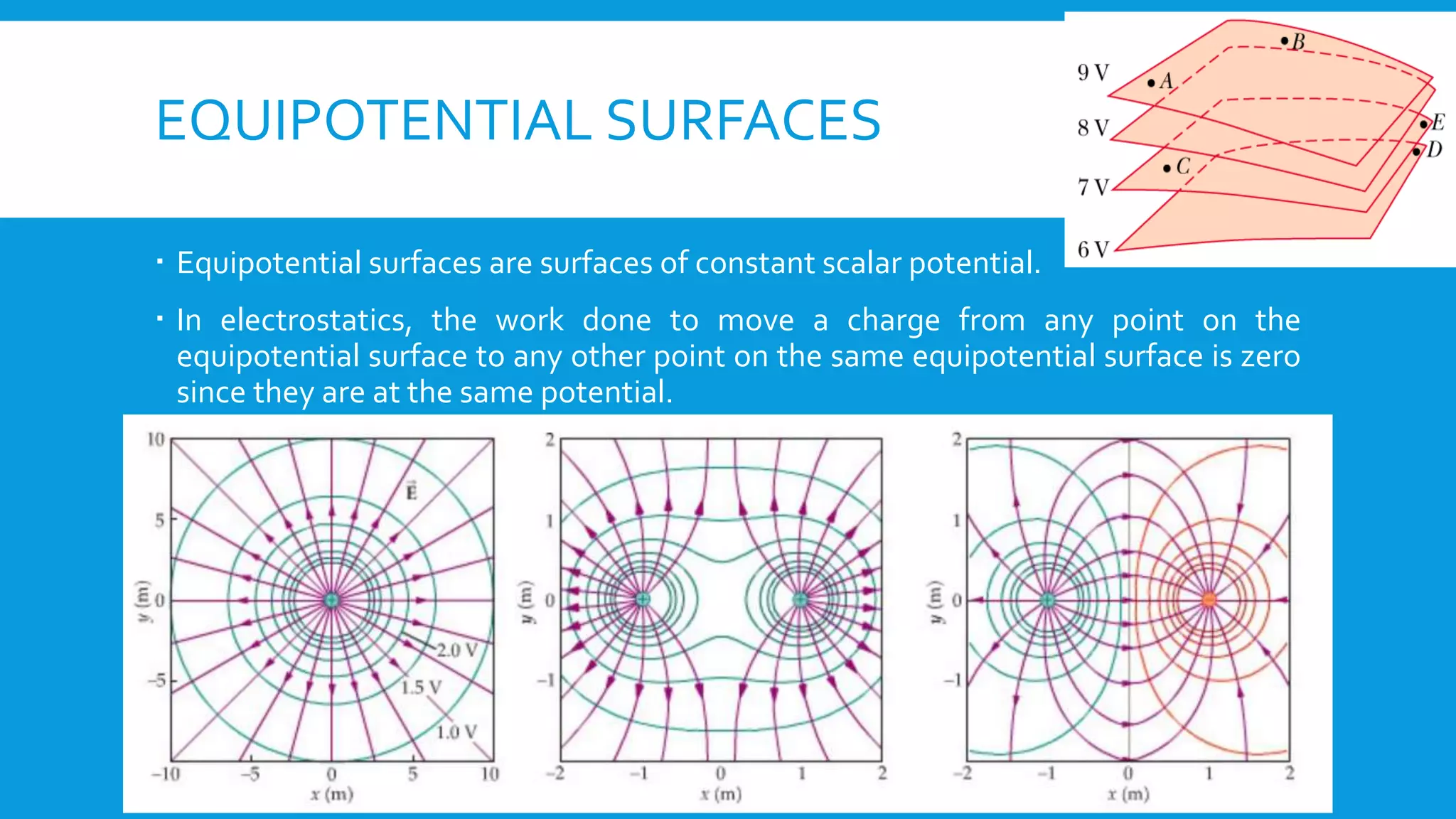
EQUIPOTENTIAL SURFACES
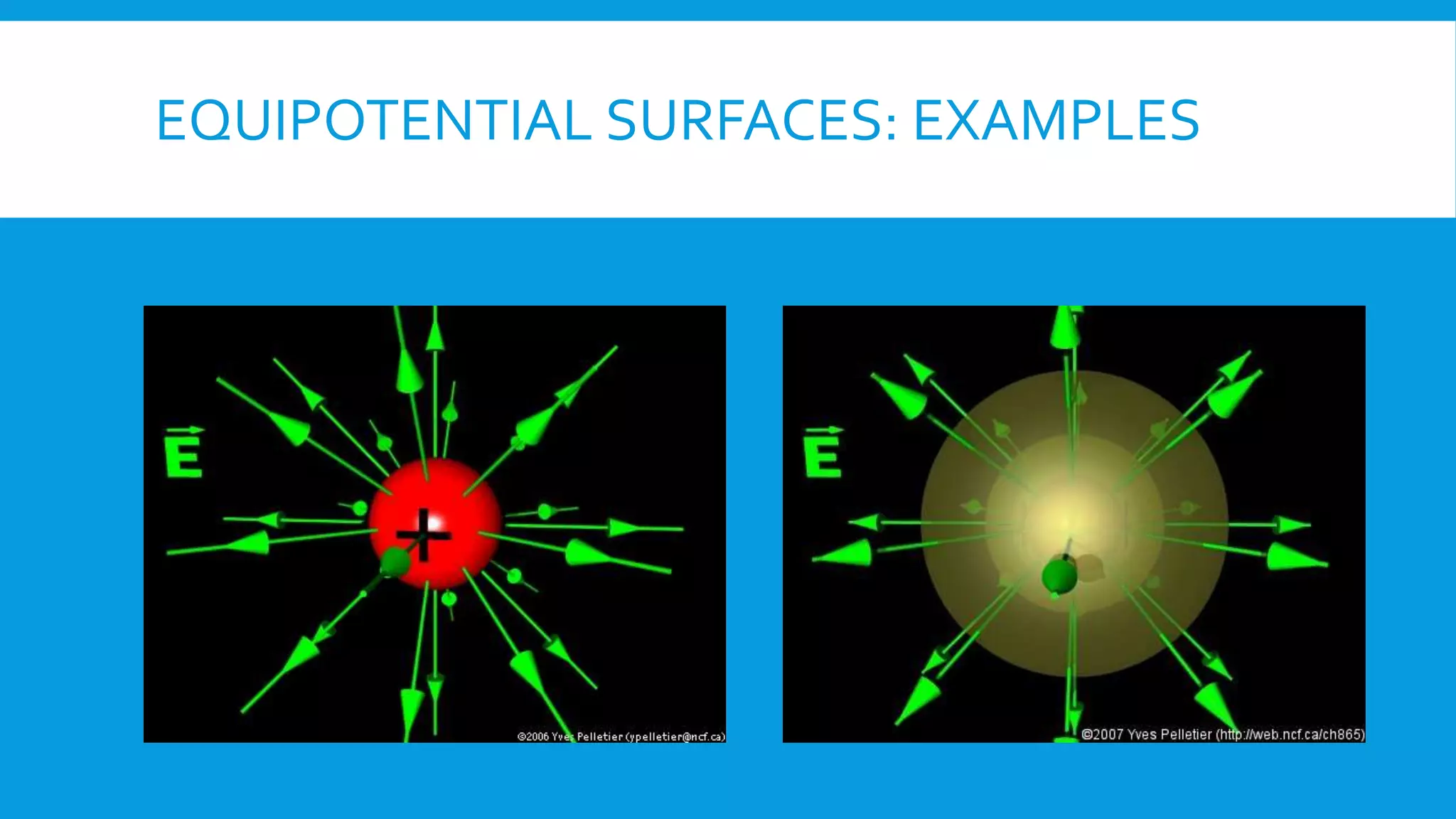
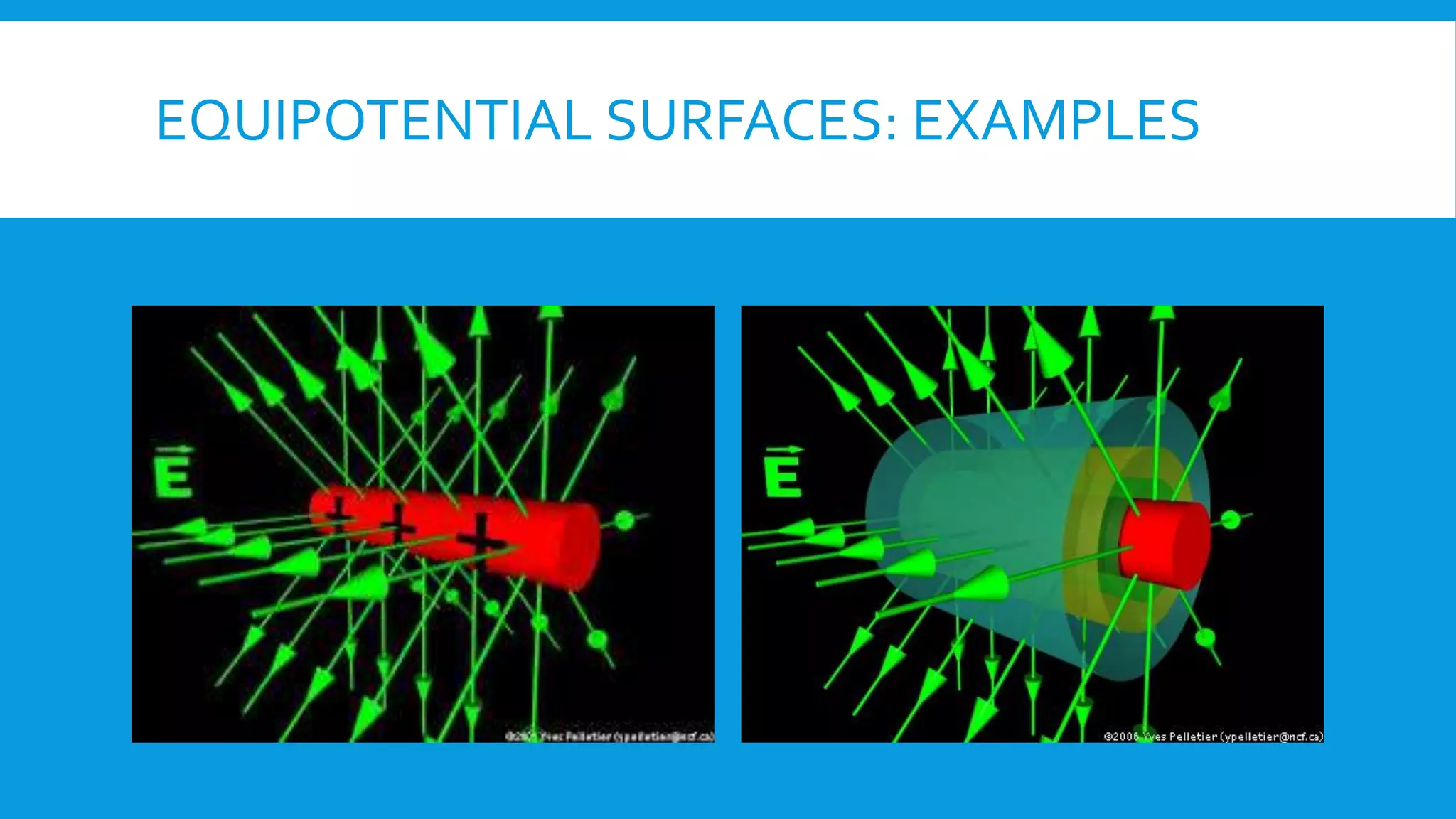
 Equipotential surfaces are surfaces of constant scalar potential.
 In electrostatics, the work done to move a charge from any point on the
equipotential surface to any other point on the same equipotential surface is zero
since they are at the same potential.
EQUIPOTENTIAL SURFACES: EXAMPLES

Electrostatic Field

  • 1.
    ELECTROSTATIC FIELD Irfan Sultan Instructor(Telecom.) Govt. College ofTechnology
  • 2.
    OBJECTIVES  State Coulomb’sLaw and Field Intensity  Describe Electric Field due to continuous charge distribution formulas  Discuss Electric Flux Density  Describe Gauss’s Law and its application to a point charge  State Electric Potential  Describe Relationship between E &V  Discuss Electric Dipole  Discuss Electric Flux Lines and Equipotential Surfaces
  • 3.
    ELECTRIC FLUX DENSITY Definition: A measure of the intensity of an electric field generated by a free electric charge, corresponding to the number of electric field lines passing through a given area.  It is also called electric displacement.  If Electric Field Strength (E) is multiplied by the permittivity (𝜀) of a material, the resulting value is called Electric Flux Density (D).  Its unit is Coulombs/m2  Formula: D = ε𝐸  Where, 𝐸 = 𝑄 ε𝐴
  • 4.
    DIFFERENCE B/W ELECTRIC FLUX(𝜓) AND ELECTRIC FLUX DENSITY (𝐷)  The Electric Flux is a measure of the Electric Field due to some charge, experienced over a hypothetical surface area of any magnitude. The Electric Flux Density is a measure of the Electric Field due to some charge, experienced over a hypothetical Unit surface area i.e. 1 square units.
  • 5.
    GAUSS’S LAW APPLICATIONTO APOINT CHARGE  The Electric Flux leaving a closed surface is Proportional to the charge enclosed. 𝜓 ∝ 𝑄
  • 6.
    ELECTRIC POTENTIAL  Electricpotential is the amount of work needed to move a unit positive charge from a reference point (taken at infinity i.e. beyond the influence of electric field) to a specific point in an electric field. 𝑉 = 𝑊 𝑞 = 𝑭. 𝒓 𝑞 = 𝑘𝑄 𝑟  Unit: J/C (Joules per Coulomb)
  • 7.
    ELECTRIC POTENTIAL DIFFERENCE It is the work done to move a unit charge from one point to another in an electric field. 𝑉𝐴𝐵 = 𝑉𝐴 − 𝑉𝐵 = 𝐴 𝐵 𝐸. 𝑑𝑙 = 𝑊 𝑄
  • 8.
    ELECTRIC DIPOLE  Anelectric dipole is a separation of positive and negative charges. The simplest example of this is a pair of electric charges of equal magnitude but opposite sign, separated by some (usually small) distance. A permanent electric dipole is called an electret.
  • 9.
  • 10.
    ELECTRIC FLUX LINES:QUIZ  Fill in the blanks in the associated diagrams with appropriate letters, A to J, depending on the amount of charge on each object.
  • 11.
    EQUIPOTENTIAL SURFACES  Equipotentialsurfaces are surfaces of constant scalar potential.  In electrostatics, the work done to move a charge from any point on the equipotential surface to any other point on the same equipotential surface is zero since they are at the same potential.
  • 12.
  • 13.