Gauss’s Law
Gauss’s Law
Coulomb’s law
Coulomb’s law
expressed differently
Carl Friedrich Gauss
Electric Field Vectors
Point charge q at origin
Vector gives E
at a point
Electric Field Lines
Connect up the vectors (arrows) to form field lines
Magnitude of field indicated by density of field lines
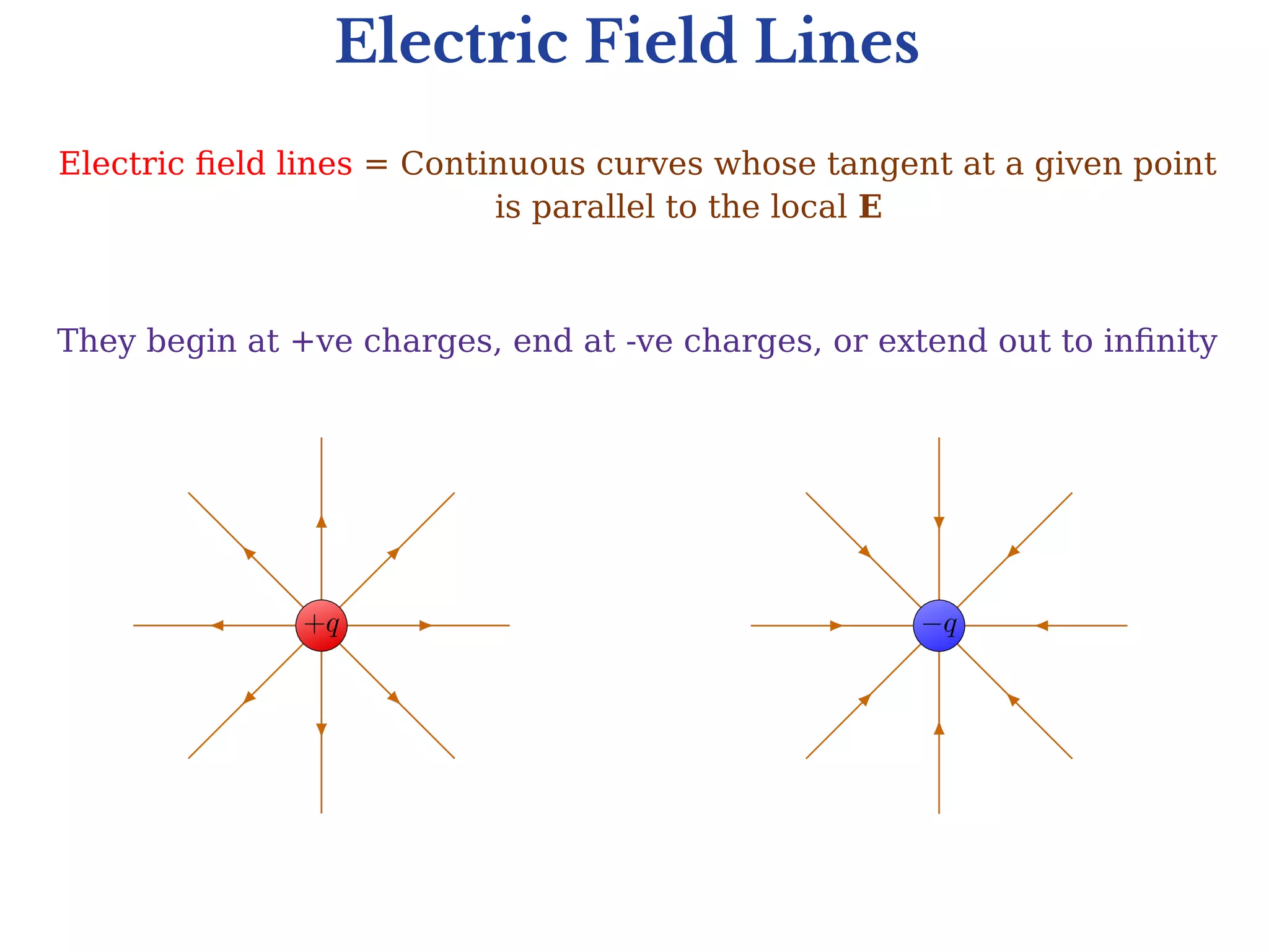
Electric field lines = Continuous curves whose tangent at a given point
is parallel to the local E
Electric Field Lines
Electric field lines = Continuous curves whose tangent at a given point
is parallel to the local E
They begin at +ve charges, end at -ve charges, or extend out to infinity
Electric Dipole
Direction of net field E
 tangent to field line
Field is stronger
where lines are denser
Field
line
Other Configurations
Electric Flux
Electric Flux measures how much electric field
cuts through some arbitrary surface area A
Measure of the "number of field lines" passing through A
Electric Flux
Uniform E
Plane perpendicular to E
Electric flux Φ = |E| A
Electric Flux
Uniform E
Plane perpendicular to E
Electric flux Φ = |E| A
depends on how
strong E is
Electric Flux
Uniform E
Plane perpendicular to E
Electric flux Φ = |E| A
depends on how
strong E is
depends on how
big area is
Electric Flux
Uniform E
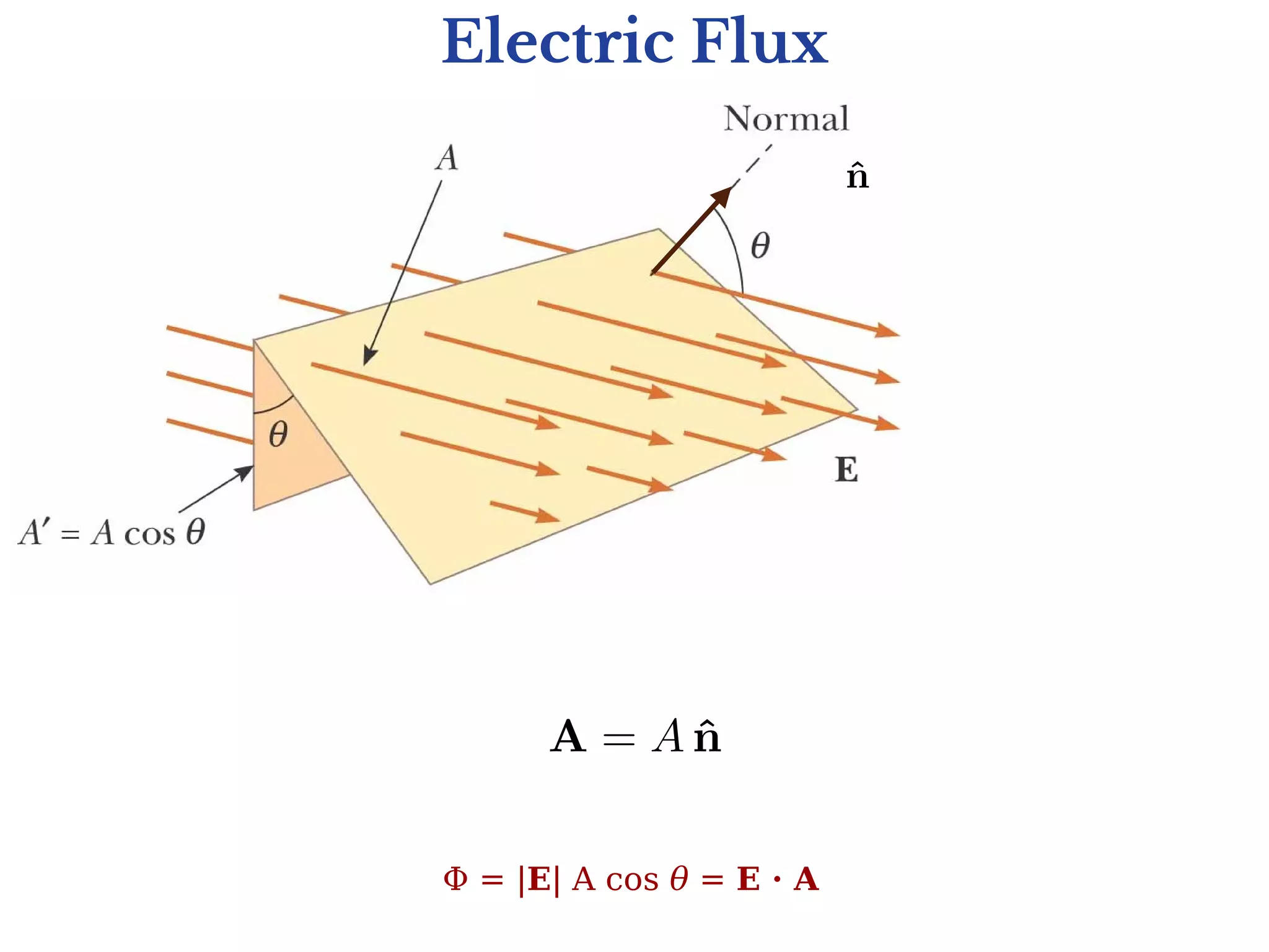
Plane makes an
angle θ with E
Electric flux Φ = |E| A cos θ
Electric Flux
Uniform E
Plane makes an
angle θ with E
depends on how
strong E is
Electric flux Φ = |E| A cos θ
depends on how
big area is
depends on orientation
of the area w.r.t. E
Area Vector
Area vector for a planar area element
 magnitude A & direction is perpendicular to plane
Electric Flux
Φ = |E| A cos θ = E · A
Quick Quiz 1
What is the flux Φ through the plane A?
Electric Flux: Generic Case
Although the surface A curves
& E varies (non-uniform)
Flux through a small enough patch
with area vector
is
Total flux through A is
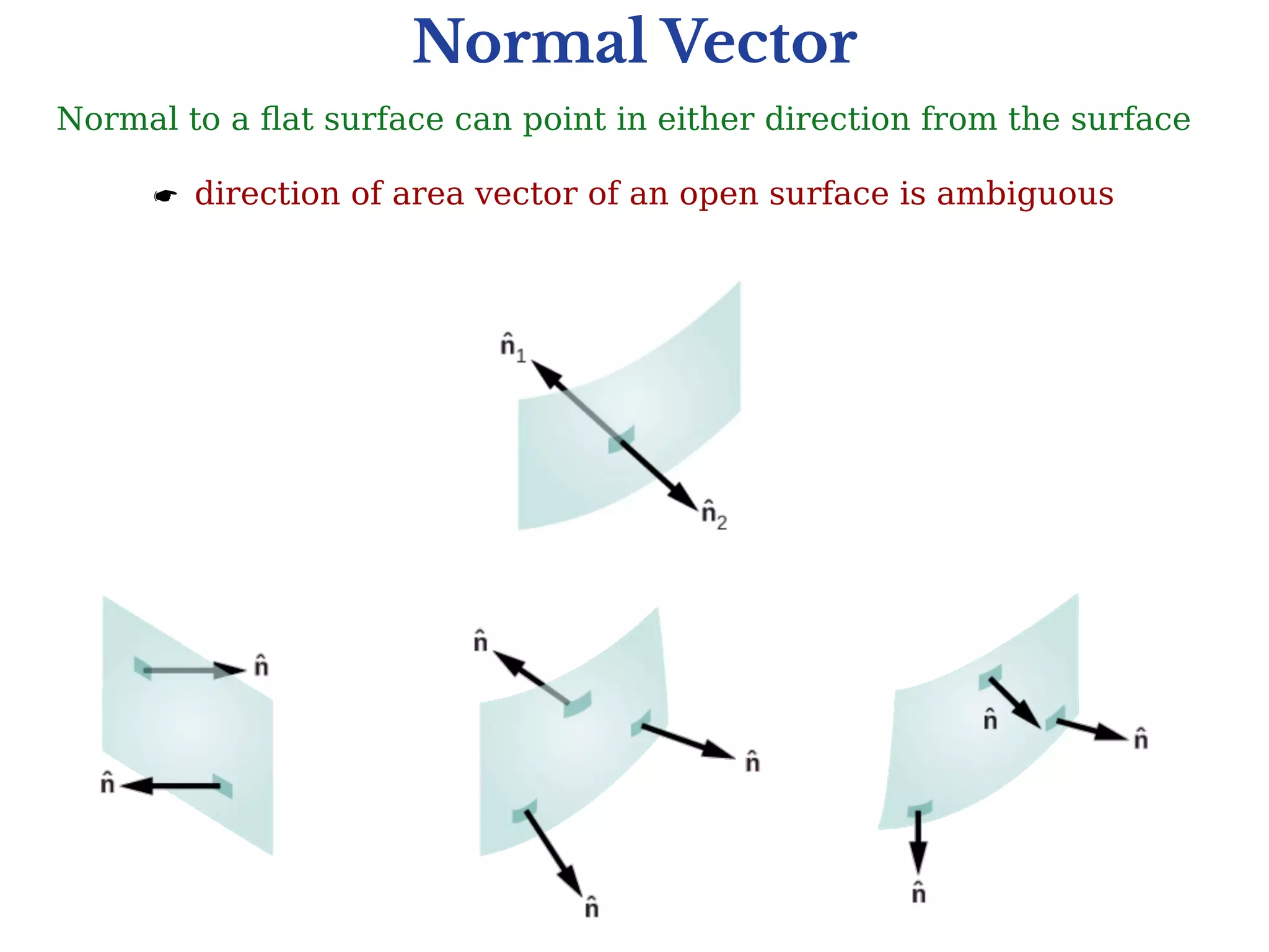
Normal Vector
Normal to a flat surface can point in either direction from the surface
 direction of area vector of an open surface is ambiguous
Normal Vector
Closed surface
 direction of normal vector at any point on the surface
can be chosen to point from inside to outside
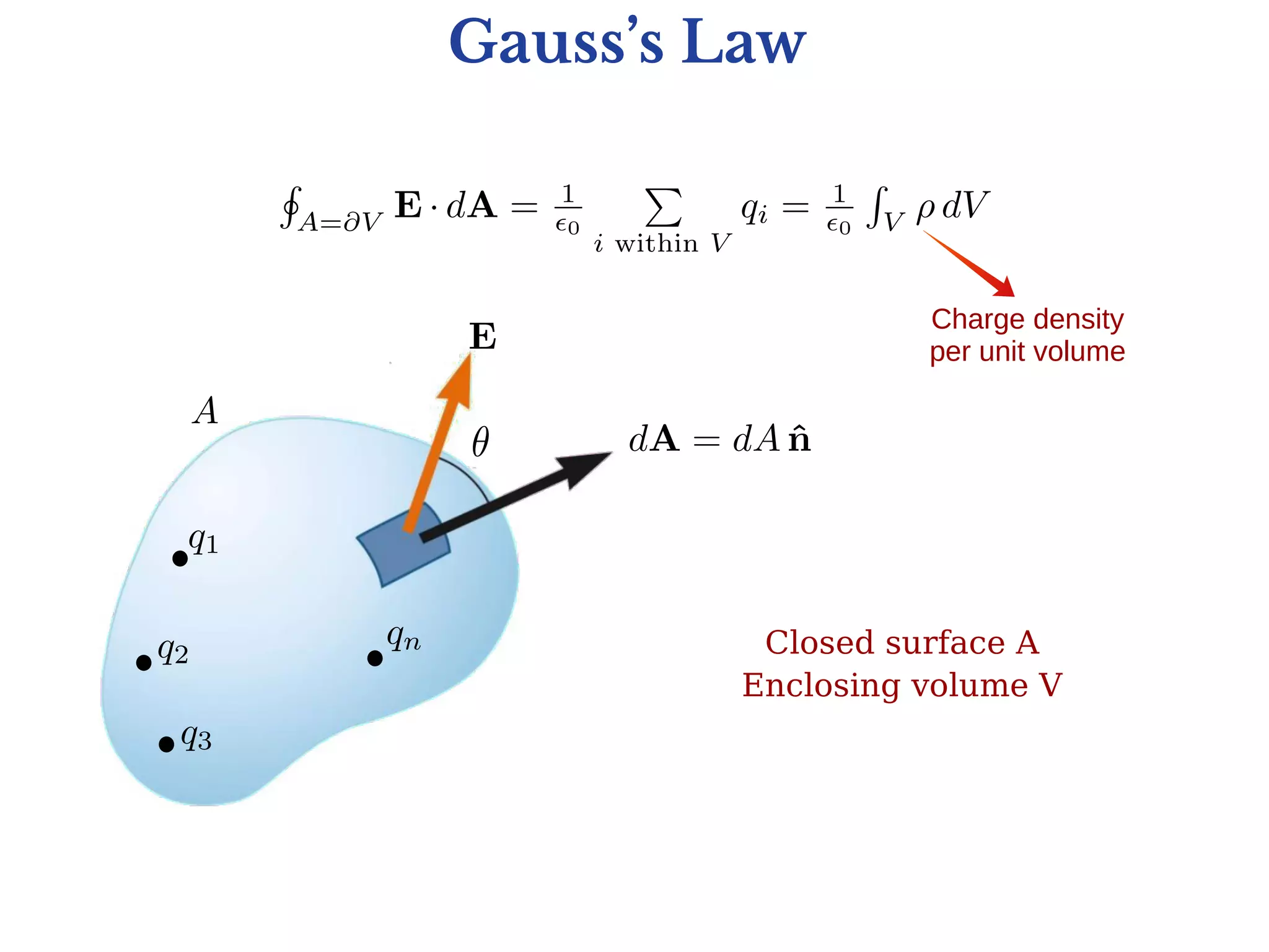
Gauss’s Law
Surround a general distribution of charges
by an imaginary closed surface A
Gauss’s law relates the electric field E at all the
points on A to the total charge enclosed within A
Gauss’s Law
Closed surface A
Enclosing volume V
Charge density
per unit volume
Point Charge at Origin
Gauss = Coulomb
Same flux passes through
each of these area elements
Gauss’s law hinges on inverse square nature of E
same number of field lines passes through
any sphere centered at origin,
regardless of size
Any Closed Surface
Normal to the surface dA
makes an angle θ with E
Each area elements projects onto
a corresponding
spherical surface element
Total flux through the irregular surface
= total flux through the sphere
Principle of Superposition
Gauss = Coulomb
Electric field
for charge qi
Flux through a surface that
encloses all charges {qi}
Quick Quiz 2
E through all points on the imaginary surface is
(a) non-zero and uniform
(b) non-zero and non-uniform
(c) zero
Field lines through the
Gaussian surface
Usefulness of Gauss’s Law
Gauss's law is always true, but not always useful
When symmetry permits, it affords
quickest + easiest way to compute E
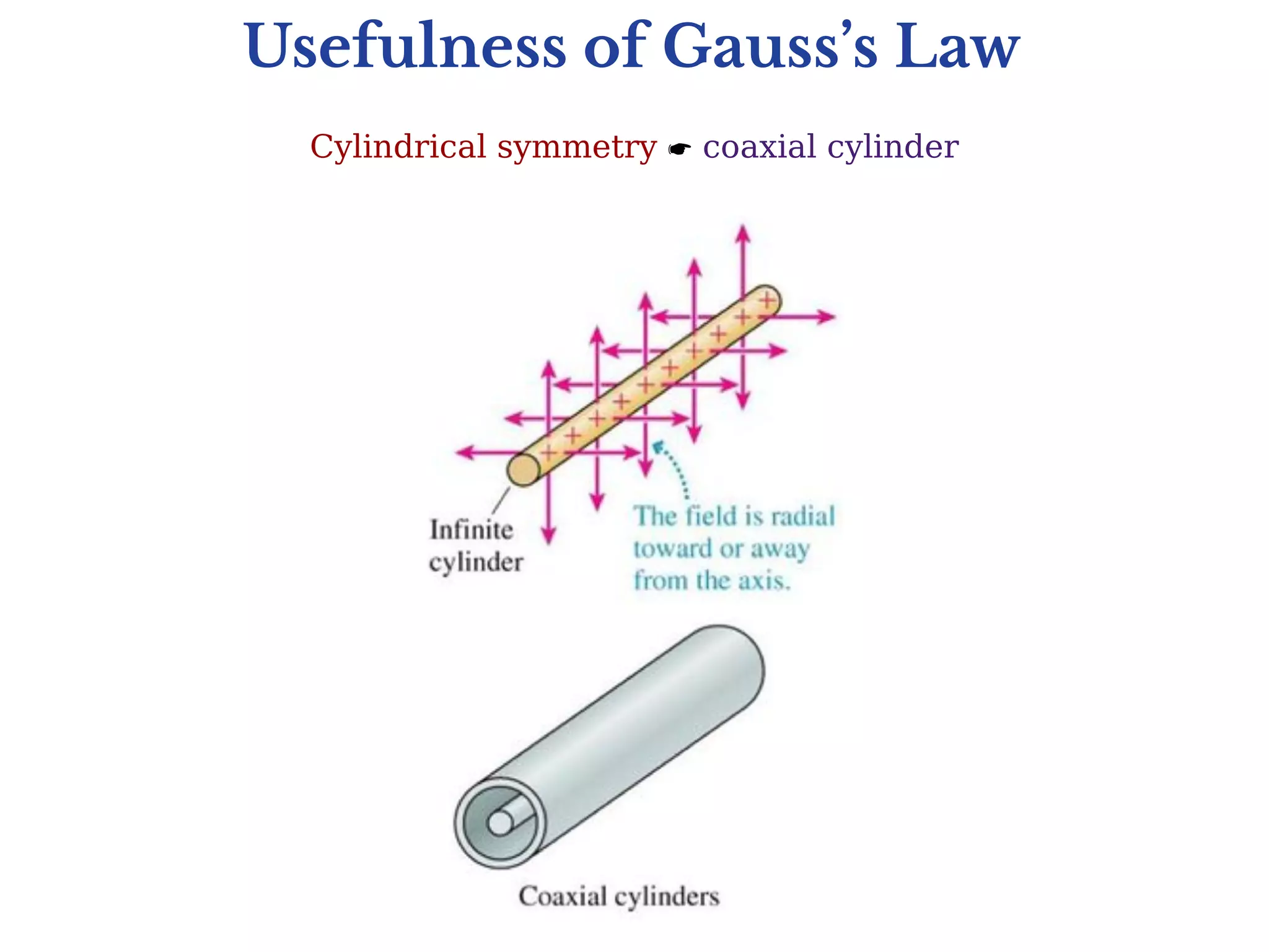
Only 3 kinds of symmetry that work
Spherical
Cylindrical
Planar
Usefulness of Gauss’s Law
Spherical symmetry  concentric sphere
Usefulness of Gauss’s Law
Cylindrical symmetry  coaxial cylinder
Usefulness of Gauss’s Law
Planar symmetry  "pillbox" straddling the surface
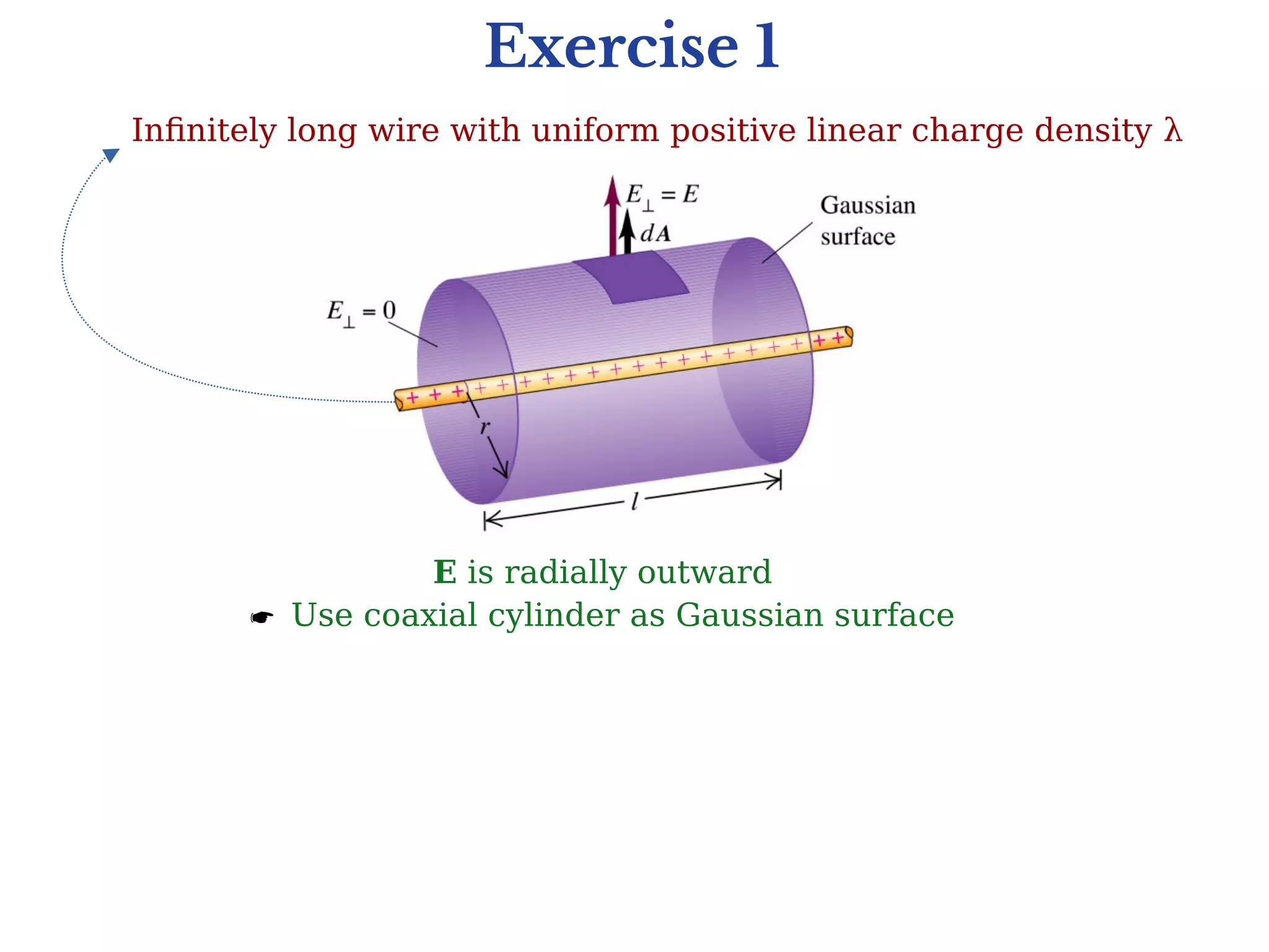
Exercise 1
E is radially outward
 Use coaxial cylinder as Gaussian surface
Infinitely long wire with uniform positive linear charge density λ
Exercise 1
Infinitely long wire with uniform positive linear charge density λ
E is radially outward
 Use coaxial cylinder as Gaussian surface
Area of cylindrical surface = 2 π r l
Flux Φ = 2 π r l |E|
Gauss’s Law  2 π r l |E| = λ l / ϵ0
⇒ |E| = λ / ( 2 π r ϵ0 )
Exercise 2
Thin flat infinite sheet with uniform positive surface charge density σ
E ⊥ sheet
 Use Gaussian pillbox
Exercise 2
Thin flat infinite sheet with uniform positive surface charge density σ
E ⊥ sheet
 Use Gaussian pillbox
Area of each flat face = A
Flux Φ = 2 |E| A
Gauss’s Law  2 |E| A = σ A / ϵ0
⇒ |E| = σ / (2 ϵ0)
References
Chapter 22, University Physics with Modern Physics
by Hugh D. Young & Roger A. Freedman
Sections 2.2.1 - 2.2.3, Introduction to Electrodynamics
by David J. Griffiths
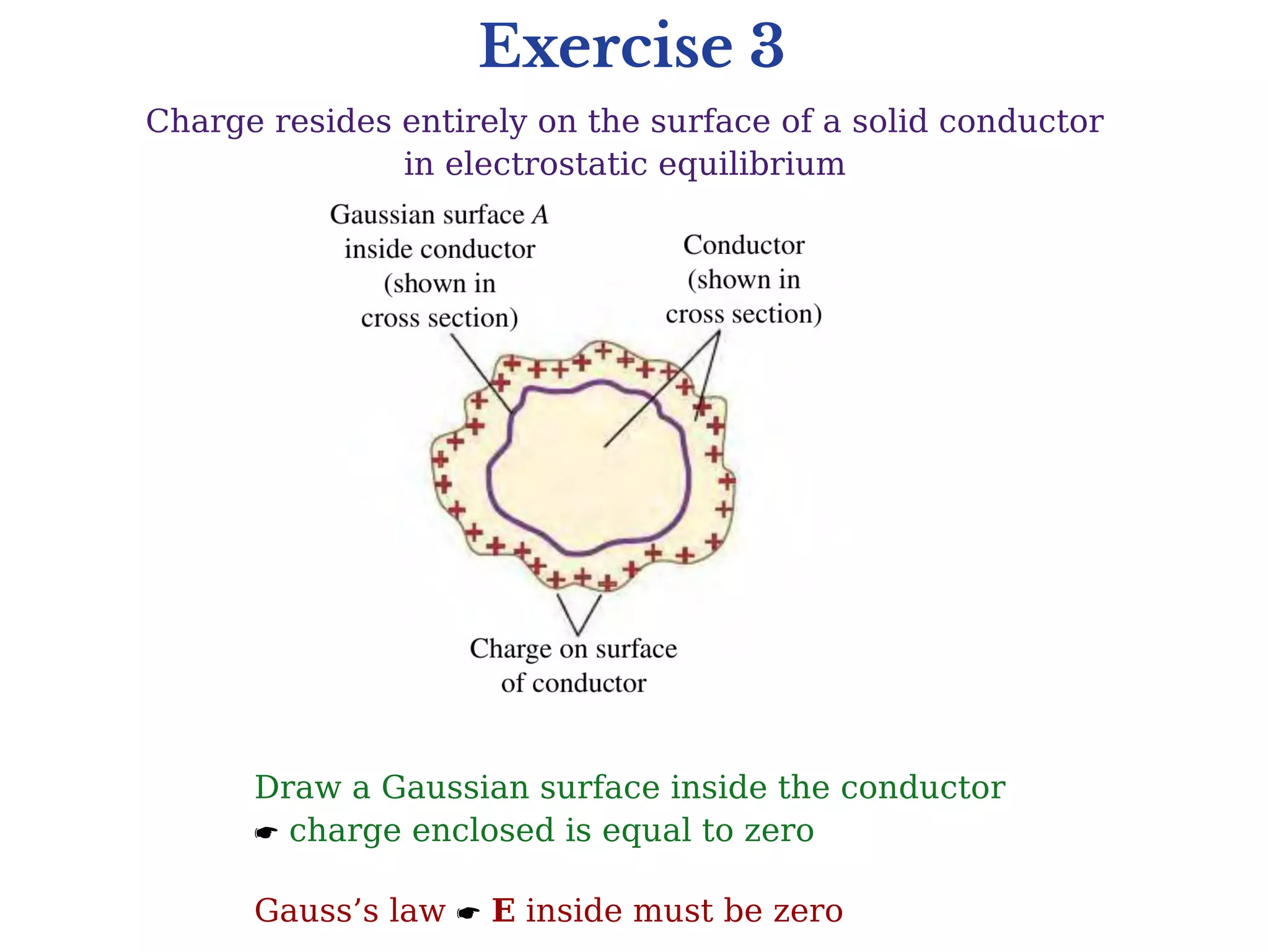
Exercise 3
Charge resides entirely on the surface of a solid conductor
in electrostatic equilibrium
Draw a Gaussian surface inside the conductor
 charge enclosed is equal to zero
Gauss’s law  E inside must be zero
Exercise 3
Conductor with an internal cavity
E = 0 at all points within the conductor
 E at all points on the Gaussian surface
must be zero
qc
Exercise 3
An isolated charge q placed in the cavity
For E to be zero at all points on the Gaussian surface
 surface of the cavity must have a total charge -q
qc+ q

gauss.pdf

  • 1.
    Gauss’s Law Gauss’s Law Coulomb’slaw Coulomb’s law expressed differently expressed differently Carl Friedrich Gauss
  • 2.
    Electric Field Vectors Pointcharge q at origin Vector gives E at a point
  • 3.
    Electric Field Lines Connectup the vectors (arrows) to form field lines Magnitude of field indicated by density of field lines Electric field lines = Continuous curves whose tangent at a given point is parallel to the local E
  • 4.
    Electric Field Lines Electricfield lines = Continuous curves whose tangent at a given point is parallel to the local E They begin at +ve charges, end at -ve charges, or extend out to infinity
  • 5.
    Electric Dipole Direction ofnet field E  tangent to field line Field is stronger where lines are denser Field line
  • 6.
  • 7.
    Electric Flux Electric Fluxmeasures how much electric field cuts through some arbitrary surface area A Measure of the "number of field lines" passing through A
  • 8.
    Electric Flux Uniform E Planeperpendicular to E Electric flux Φ = |E| A
  • 9.
    Electric Flux Uniform E Planeperpendicular to E Electric flux Φ = |E| A depends on how strong E is
  • 10.
    Electric Flux Uniform E Planeperpendicular to E Electric flux Φ = |E| A depends on how strong E is depends on how big area is
  • 11.
    Electric Flux Uniform E Planemakes an angle θ with E Electric flux Φ = |E| A cos θ
  • 12.
    Electric Flux Uniform E Planemakes an angle θ with E depends on how strong E is Electric flux Φ = |E| A cos θ depends on how big area is depends on orientation of the area w.r.t. E
  • 13.
    Area Vector Area vectorfor a planar area element  magnitude A & direction is perpendicular to plane
  • 14.
    Electric Flux Φ =|E| A cos θ = E · A
  • 15.
    Quick Quiz 1 Whatis the flux Φ through the plane A?
  • 16.
    Electric Flux: GenericCase Although the surface A curves & E varies (non-uniform) Flux through a small enough patch with area vector is Total flux through A is
  • 17.
    Normal Vector Normal toa flat surface can point in either direction from the surface  direction of area vector of an open surface is ambiguous
  • 18.
    Normal Vector Closed surface direction of normal vector at any point on the surface can be chosen to point from inside to outside
  • 19.
    Gauss’s Law Surround ageneral distribution of charges by an imaginary closed surface A Gauss’s law relates the electric field E at all the points on A to the total charge enclosed within A
  • 20.
    Gauss’s Law Closed surfaceA Enclosing volume V Charge density per unit volume
  • 21.
  • 22.
  • 23.
    Gauss = Coulomb Sameflux passes through each of these area elements Gauss’s law hinges on inverse square nature of E same number of field lines passes through any sphere centered at origin, regardless of size
  • 24.
    Any Closed Surface Normalto the surface dA makes an angle θ with E Each area elements projects onto a corresponding spherical surface element Total flux through the irregular surface = total flux through the sphere
  • 25.
    Principle of Superposition Gauss= Coulomb Electric field for charge qi Flux through a surface that encloses all charges {qi}
  • 26.
    Quick Quiz 2 Ethrough all points on the imaginary surface is (a) non-zero and uniform (b) non-zero and non-uniform (c) zero Field lines through the Gaussian surface
  • 27.
    Usefulness of Gauss’sLaw Gauss's law is always true, but not always useful When symmetry permits, it affords quickest + easiest way to compute E Only 3 kinds of symmetry that work Spherical Cylindrical Planar
  • 28.
    Usefulness of Gauss’sLaw Spherical symmetry  concentric sphere
  • 29.
    Usefulness of Gauss’sLaw Cylindrical symmetry  coaxial cylinder
  • 30.
    Usefulness of Gauss’sLaw Planar symmetry  "pillbox" straddling the surface
  • 31.
    Exercise 1 E isradially outward  Use coaxial cylinder as Gaussian surface Infinitely long wire with uniform positive linear charge density λ
  • 32.
    Exercise 1 Infinitely longwire with uniform positive linear charge density λ E is radially outward  Use coaxial cylinder as Gaussian surface Area of cylindrical surface = 2 π r l Flux Φ = 2 π r l |E| Gauss’s Law  2 π r l |E| = λ l / ϵ0 ⇒ |E| = λ / ( 2 π r ϵ0 )
  • 33.
    Exercise 2 Thin flatinfinite sheet with uniform positive surface charge density σ E ⊥ sheet  Use Gaussian pillbox
  • 34.
    Exercise 2 Thin flatinfinite sheet with uniform positive surface charge density σ E ⊥ sheet  Use Gaussian pillbox Area of each flat face = A Flux Φ = 2 |E| A Gauss’s Law  2 |E| A = σ A / ϵ0 ⇒ |E| = σ / (2 ϵ0)
  • 35.
    References Chapter 22, UniversityPhysics with Modern Physics by Hugh D. Young & Roger A. Freedman Sections 2.2.1 - 2.2.3, Introduction to Electrodynamics by David J. Griffiths
  • 36.
    Exercise 3 Charge residesentirely on the surface of a solid conductor in electrostatic equilibrium Draw a Gaussian surface inside the conductor  charge enclosed is equal to zero Gauss’s law  E inside must be zero
  • 37.
    Exercise 3 Conductor withan internal cavity E = 0 at all points within the conductor  E at all points on the Gaussian surface must be zero qc
  • 38.
    Exercise 3 An isolatedcharge q placed in the cavity For E to be zero at all points on the Gaussian surface  surface of the cavity must have a total charge -q qc+ q