K V GOPINATH M Pharm PhD,CPhT
Tirumala Tirupati Devasthanams
TIRUPATI
e-mail:gopinath.karnam@gmail.com
GAS CHROMATOGRAPHY
Introduction
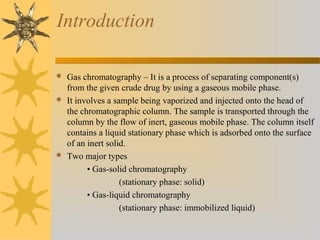
 Gas chromatography – It is a process of separating component(s)
from the given crude drug by using a gaseous mobile phase.
 It involves a sample being vaporized and injected onto the head of
the chromatographic column. The sample is transported through the
column by the flow of inert, gaseous mobile phase. The column itself
contains a liquid stationary phase which is adsorbed onto the surface
of an inert solid.
 Two major types
• Gas-solid chromatography
(stationary phase: solid)
• Gas-liquid chromatography
(stationary phase: immobilized liquid)
Advantages of Gas Chromatography
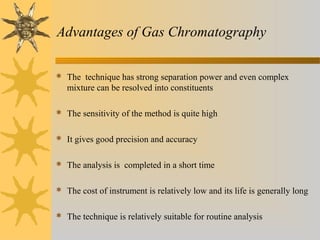
 The technique has strong separation power and even complex
mixture can be resolved into constituents
 The sensitivity of the method is quite high
 It gives good precision and accuracy
 The analysis is completed in a short time
 The cost of instrument is relatively low and its life is generally long
 The technique is relatively suitable for routine analysis
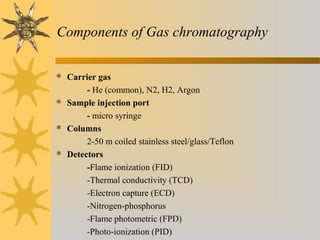
Components of Gas chromatography
 Carrier gas
- He (common), N2, H2, Argon
 Sample injection port
- micro syringe
 Columns
2-50 m coiled stainless steel/glass/Teflon
 Detectors
-Flame ionization (FID)
-Thermal conductivity (TCD)
-Electron capture (ECD)
-Nitrogen-phosphorus
-Flame photometric (FPD)
-Photo-ionization (PID)
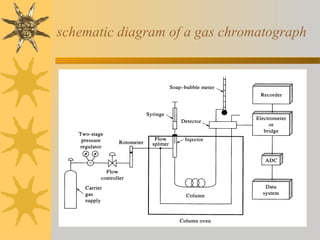
schematic diagram of a gas chromatograph
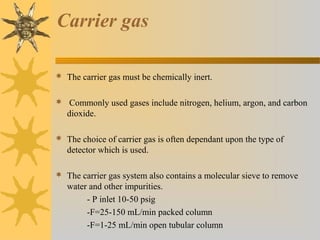
Carrier gas
 The carrier gas must be chemically inert.
 Commonly used gases include nitrogen, helium, argon, and carbon
dioxide.
 The choice of carrier gas is often dependant upon the type of
detector which is used.
 The carrier gas system also contains a molecular sieve to remove
water and other impurities.
- P inlet 10-50 psig
-F=25-150 mL/min packed column
-F=1-25 mL/min open tubular column
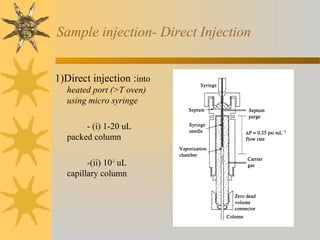
Sample injection- Direct Injection
1)Direct injection :into
heated port (>T oven)
using micro syringe
- (i) 1-20 uL
packed column
-(ii) 10-3
uL
capillary column
Sample injection- rotary sample valve with
sample loop
 Split injection: routine method
- 0.1-1 % sample to column
- remainder to waste
 Split less injection: all sample to column
- best for quantitative analysis
- only for trace analysis, low [sample]
On-column injection:
-for samples that decompose above boiling
Point ( no heated injection port)
-column at low temperature to condense
sample in narrow band
-heating of column starts chromatography
Gas Chromatography - Columns
 There are two general types of column, packed and capillary (also known
as open tubular).
 Packed columns contain a finely divided, inert, solid support material
( diatomaceous earth) coated with liquid stationary phase. Most packed
columns are 1.5 - 10m in length and have an internal diameter of 2 - 4mm.
 Capillary columns have an internal diameter of a few tenths of a
millimeter. They can be one of two types; wall-coated open
tubular (WCOT) or support-coated open tubular (SCOT).
- Wall-coated columns consist of a capillary tube whose walls are
coated with liquid stationary phase. In support-coated columns, the inner
wall of the capillary is lined with a thin layer of support material such as
diatomaceous earth, onto which the stationary phase has been adsorbed.
- SCOT columns are generally less efficient than WCOT columns.
Both types of capillary column are more efficient than packed columns.
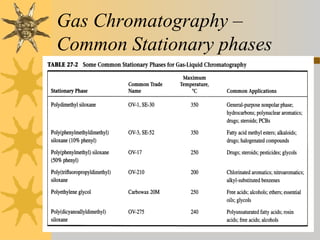
Gas Chromatography –
Common Stationary phases
G C - DETECTORS
 There are many detectors which can be used in gas chromatography.
 Different detectors will give different types of selectivity.
 Detectors can be grouped into concentration dependant
detectors and mass flow dependant detectors.
 The signal from a concentration dependant detector is related to the
concentration of solute in the detector, and does not usually destroy
the sample Dilution of with make-up gas will lower the detectors
response.
 Mass flow dependant detectors usually destroy the sample, and the
signal is related to the rate at which solute molecules enter the
detector. The response of a mass flow dependant detector is
unaffected by make-up gas
G C – IDEAL DETECTORS
 Sensitive (10-8
-10-15
g solute/s)
 Operate at high T (0-400 °C)
 Stable and reproducible
 Linear response
 Wide dynamic range
 Fast response
 Simple (reliable)
 Nondestructive
 Uniform response to all analytes
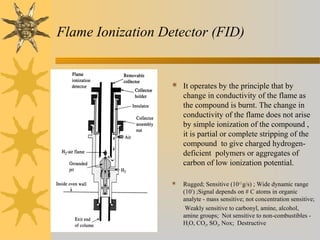
Flame Ionization Detector (FID)
 It operates by the principle that by
change in conductivity of the flame as
the compound is burnt. The change in
conductivity of the flame does not arise
by simple ionization of the compound ,
it is partial or complete stripping of the
compound to give charged hydrogen-
deficient polymers or aggregates of
carbon of low ionization potential.
 Rugged; Sensitive (10-13
g/s) ; Wide dynamic range
(107
) ;Signal depends on # C atoms in organic
analyte - mass sensitive; not concentration sensitive;
Weakly sensitive to carbonyl, amine, alcohol,
amine groups; Not sensitive to non-combustibles -
H2O, CO2, SO2, Nox; Destructive
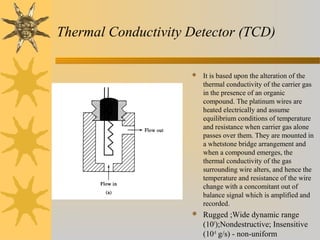
Thermal Conductivity Detector (TCD)
 It is based upon the alteration of the
thermal conductivity of the carrier gas
in the presence of an organic
compound. The platinum wires are
heated electrically and assume
equilibrium conditions of temperature
and resistance when carrier gas alone
passes over them. They are mounted in
a whetstone bridge arrangement and
when a compound emerges, the
thermal conductivity of the gas
surrounding wire alters, and hence the
temperature and resistance of the wire
change with a concomitant out of
balance signal which is amplified and
recorded.
 Rugged ;Wide dynamic range
(105
);Nondestructive; Insensitive
(10-8
g/s) - non-uniform
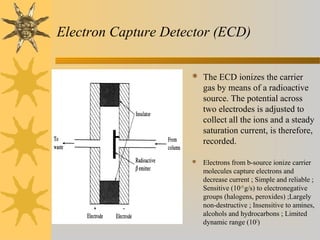
Electron Capture Detector (ECD)
 The ECD ionizes the carrier
gas by means of a radioactive
source. The potential across
two electrodes is adjusted to
collect all the ions and a steady
saturation current, is therefore,
recorded.
 Electrons from b-source ionize carrier
molecules capture electrons and
decrease current ; Simple and reliable ;
Sensitive (10-15
g/s) to electronegative
groups (halogens, peroxides) ;Largely
non-destructive ; Insensitive to amines,
alcohols and hydrocarbons ; Limited
dynamic range (102
)
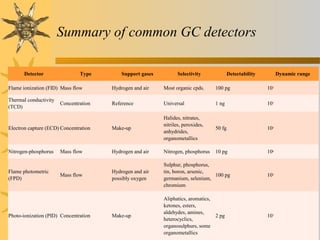
Summary of common GC detectors
Detector Type Support gases Selectivity Detectability Dynamic range
Flame ionization (FID) Mass flow Hydrogen and air Most organic cpds. 100 pg 107
Thermal conductivity
(TCD)
Concentration Reference Universal 1 ng 107
Electron capture (ECD) Concentration Make-up
Halides, nitrates,
nitriles, peroxides,
anhydrides,
organometallics
50 fg 105
Nitrogen-phosphorus Mass flow Hydrogen and air Nitrogen, phosphorus 10 pg 106
Flame photometric
(FPD)
Mass flow
Hydrogen and air
possibly oxygen
Sulphur, phosphorus,
tin, boron, arsenic,
germanium, selenium,
chromium
100 pg 103
Photo-ionization (PID) Concentration Make-up
Aliphatics, aromatics,
ketones, esters,
aldehydes, amines,
heterocyclics,
organosulphurs, some
organometallics
2 pg 107
Summary of common GC detectors
 The effluent from the column is mixed with hydrogen and air, and
ignited.
 Organic compounds burning in the flame produce ions and electrons
which can conduct electricity through the flame.
 A large electrical potential is applied at the burner tip, and a
collector electrode is located above the flame. The current resulting
from the pyrolysis of any organic compounds is measured.
 FIDs are mass sensitive rather than concentration sensitive; this gives
the advantage that changes in mobile phase flow rate do not affect
the detector's response.
 The FID is a useful general detector for the analysis of organic
compounds; it has high sensitivity, a large linear response range, and
low noise. It is also robust and easy to use, but unfortunately, it
destroys the sample
Temperature Programming
 As column temperature raised, vapor pressure analyte increases,
eluted faster
 Raise column temperature during separation – temperature
programming - separates species with wide range of polarities or
vapor pressures
Evaluation
 HETP- It is the distance on the column in which equilibrium is
attained between the solute in the gas phase and the solute in liquid
phase. Larger the number of theretical plates/ smaller the HETP, the
more efficient the column is for separation.
HETP = Length of column/n ; Where n = number of theretical plates= 16 * x2/y2
 Retention Time: Time in minute from the point of injection to the
peak maximum.
 Retention Volume: (1) VR = tR ×F (retained) (2) VM = tM ×F (non-
retained)
 average volumetric flow rate (mL/min) F can be estimated by
measuring flow rate exiting the column using soap bubble meter
(some gases dissolving in soap solution)
 But measured VR and VM depend on
- pressure inside column
Applications of Gas Chromatography
 Qualitative Analysis – by comparing the retention time or volume of
the sample to the standard / by collecting the individual components
as they emerge from the chromatograph and subsequently identifying
these compounds by other method
 Quantitative Analysis- area under a single component elution peak is
proportional to the quantity of the detected component/response
factor of the detectors.
Volatile Oils, official monograph gives chromatography profile for
some drugs. E.g. to aid distinction between anise oil from star anise
and that from Pimpinelle anisum
Separation of fatty acids derived from fixed oils
Applications of Gas Chromatography
 Miscellaneous-analysis of foods like carbohydrates, proteins, lipids,
vitamins, steroids, drug and pesticides residues, trace elements
 Pollutants like formaldehyde, carbon monoxide, benzen, DDT etc
 Dairy product analysis- rancidity
 Separation and identification of volatile materials, plastics, natural
and synthetic polymers, paints, and microbiological samples
 Inorganic compound analysis
Gas chromatography

Gas chromatography

  • 1.
    K V GOPINATHM Pharm PhD,CPhT Tirumala Tirupati Devasthanams TIRUPATI e-mail:gopinath.karnam@gmail.com GAS CHROMATOGRAPHY
  • 2.
    Introduction  Gas chromatography– It is a process of separating component(s) from the given crude drug by using a gaseous mobile phase.  It involves a sample being vaporized and injected onto the head of the chromatographic column. The sample is transported through the column by the flow of inert, gaseous mobile phase. The column itself contains a liquid stationary phase which is adsorbed onto the surface of an inert solid.  Two major types • Gas-solid chromatography (stationary phase: solid) • Gas-liquid chromatography (stationary phase: immobilized liquid)
  • 3.
    Advantages of GasChromatography  The technique has strong separation power and even complex mixture can be resolved into constituents  The sensitivity of the method is quite high  It gives good precision and accuracy  The analysis is completed in a short time  The cost of instrument is relatively low and its life is generally long  The technique is relatively suitable for routine analysis
  • 4.
    Components of Gaschromatography  Carrier gas - He (common), N2, H2, Argon  Sample injection port - micro syringe  Columns 2-50 m coiled stainless steel/glass/Teflon  Detectors -Flame ionization (FID) -Thermal conductivity (TCD) -Electron capture (ECD) -Nitrogen-phosphorus -Flame photometric (FPD) -Photo-ionization (PID)
  • 5.
    schematic diagram ofa gas chromatograph
  • 6.
    Carrier gas  Thecarrier gas must be chemically inert.  Commonly used gases include nitrogen, helium, argon, and carbon dioxide.  The choice of carrier gas is often dependant upon the type of detector which is used.  The carrier gas system also contains a molecular sieve to remove water and other impurities. - P inlet 10-50 psig -F=25-150 mL/min packed column -F=1-25 mL/min open tubular column
  • 7.
    Sample injection- DirectInjection 1)Direct injection :into heated port (>T oven) using micro syringe - (i) 1-20 uL packed column -(ii) 10-3 uL capillary column
  • 8.
    Sample injection- rotarysample valve with sample loop  Split injection: routine method - 0.1-1 % sample to column - remainder to waste  Split less injection: all sample to column - best for quantitative analysis - only for trace analysis, low [sample] On-column injection: -for samples that decompose above boiling Point ( no heated injection port) -column at low temperature to condense sample in narrow band -heating of column starts chromatography
  • 9.
    Gas Chromatography -Columns  There are two general types of column, packed and capillary (also known as open tubular).  Packed columns contain a finely divided, inert, solid support material ( diatomaceous earth) coated with liquid stationary phase. Most packed columns are 1.5 - 10m in length and have an internal diameter of 2 - 4mm.  Capillary columns have an internal diameter of a few tenths of a millimeter. They can be one of two types; wall-coated open tubular (WCOT) or support-coated open tubular (SCOT). - Wall-coated columns consist of a capillary tube whose walls are coated with liquid stationary phase. In support-coated columns, the inner wall of the capillary is lined with a thin layer of support material such as diatomaceous earth, onto which the stationary phase has been adsorbed. - SCOT columns are generally less efficient than WCOT columns. Both types of capillary column are more efficient than packed columns.
  • 10.
  • 11.
    G C -DETECTORS  There are many detectors which can be used in gas chromatography.  Different detectors will give different types of selectivity.  Detectors can be grouped into concentration dependant detectors and mass flow dependant detectors.  The signal from a concentration dependant detector is related to the concentration of solute in the detector, and does not usually destroy the sample Dilution of with make-up gas will lower the detectors response.  Mass flow dependant detectors usually destroy the sample, and the signal is related to the rate at which solute molecules enter the detector. The response of a mass flow dependant detector is unaffected by make-up gas
  • 12.
    G C –IDEAL DETECTORS  Sensitive (10-8 -10-15 g solute/s)  Operate at high T (0-400 °C)  Stable and reproducible  Linear response  Wide dynamic range  Fast response  Simple (reliable)  Nondestructive  Uniform response to all analytes
  • 13.
    Flame Ionization Detector(FID)  It operates by the principle that by change in conductivity of the flame as the compound is burnt. The change in conductivity of the flame does not arise by simple ionization of the compound , it is partial or complete stripping of the compound to give charged hydrogen- deficient polymers or aggregates of carbon of low ionization potential.  Rugged; Sensitive (10-13 g/s) ; Wide dynamic range (107 ) ;Signal depends on # C atoms in organic analyte - mass sensitive; not concentration sensitive; Weakly sensitive to carbonyl, amine, alcohol, amine groups; Not sensitive to non-combustibles - H2O, CO2, SO2, Nox; Destructive
  • 14.
    Thermal Conductivity Detector(TCD)  It is based upon the alteration of the thermal conductivity of the carrier gas in the presence of an organic compound. The platinum wires are heated electrically and assume equilibrium conditions of temperature and resistance when carrier gas alone passes over them. They are mounted in a whetstone bridge arrangement and when a compound emerges, the thermal conductivity of the gas surrounding wire alters, and hence the temperature and resistance of the wire change with a concomitant out of balance signal which is amplified and recorded.  Rugged ;Wide dynamic range (105 );Nondestructive; Insensitive (10-8 g/s) - non-uniform
  • 15.
    Electron Capture Detector(ECD)  The ECD ionizes the carrier gas by means of a radioactive source. The potential across two electrodes is adjusted to collect all the ions and a steady saturation current, is therefore, recorded.  Electrons from b-source ionize carrier molecules capture electrons and decrease current ; Simple and reliable ; Sensitive (10-15 g/s) to electronegative groups (halogens, peroxides) ;Largely non-destructive ; Insensitive to amines, alcohols and hydrocarbons ; Limited dynamic range (102 )
  • 16.
    Summary of commonGC detectors Detector Type Support gases Selectivity Detectability Dynamic range Flame ionization (FID) Mass flow Hydrogen and air Most organic cpds. 100 pg 107 Thermal conductivity (TCD) Concentration Reference Universal 1 ng 107 Electron capture (ECD) Concentration Make-up Halides, nitrates, nitriles, peroxides, anhydrides, organometallics 50 fg 105 Nitrogen-phosphorus Mass flow Hydrogen and air Nitrogen, phosphorus 10 pg 106 Flame photometric (FPD) Mass flow Hydrogen and air possibly oxygen Sulphur, phosphorus, tin, boron, arsenic, germanium, selenium, chromium 100 pg 103 Photo-ionization (PID) Concentration Make-up Aliphatics, aromatics, ketones, esters, aldehydes, amines, heterocyclics, organosulphurs, some organometallics 2 pg 107
  • 17.
    Summary of commonGC detectors  The effluent from the column is mixed with hydrogen and air, and ignited.  Organic compounds burning in the flame produce ions and electrons which can conduct electricity through the flame.  A large electrical potential is applied at the burner tip, and a collector electrode is located above the flame. The current resulting from the pyrolysis of any organic compounds is measured.  FIDs are mass sensitive rather than concentration sensitive; this gives the advantage that changes in mobile phase flow rate do not affect the detector's response.  The FID is a useful general detector for the analysis of organic compounds; it has high sensitivity, a large linear response range, and low noise. It is also robust and easy to use, but unfortunately, it destroys the sample
  • 18.
    Temperature Programming  Ascolumn temperature raised, vapor pressure analyte increases, eluted faster  Raise column temperature during separation – temperature programming - separates species with wide range of polarities or vapor pressures
  • 19.
    Evaluation  HETP- Itis the distance on the column in which equilibrium is attained between the solute in the gas phase and the solute in liquid phase. Larger the number of theretical plates/ smaller the HETP, the more efficient the column is for separation. HETP = Length of column/n ; Where n = number of theretical plates= 16 * x2/y2  Retention Time: Time in minute from the point of injection to the peak maximum.  Retention Volume: (1) VR = tR ×F (retained) (2) VM = tM ×F (non- retained)  average volumetric flow rate (mL/min) F can be estimated by measuring flow rate exiting the column using soap bubble meter (some gases dissolving in soap solution)  But measured VR and VM depend on - pressure inside column
  • 20.
    Applications of GasChromatography  Qualitative Analysis – by comparing the retention time or volume of the sample to the standard / by collecting the individual components as they emerge from the chromatograph and subsequently identifying these compounds by other method  Quantitative Analysis- area under a single component elution peak is proportional to the quantity of the detected component/response factor of the detectors. Volatile Oils, official monograph gives chromatography profile for some drugs. E.g. to aid distinction between anise oil from star anise and that from Pimpinelle anisum Separation of fatty acids derived from fixed oils
  • 21.
    Applications of GasChromatography  Miscellaneous-analysis of foods like carbohydrates, proteins, lipids, vitamins, steroids, drug and pesticides residues, trace elements  Pollutants like formaldehyde, carbon monoxide, benzen, DDT etc  Dairy product analysis- rancidity  Separation and identification of volatile materials, plastics, natural and synthetic polymers, paints, and microbiological samples  Inorganic compound analysis