CONTENTS:- 
INVENTION OF CHROMATOGRAPHY 
ABOUT CHROMATOGRAPHY 
WORKING OF CHROMATOGRAPHY 
INTRODUCTION OF GAS 
CHROMATOGRAPHY 
PRINCIPLE 
THEORETICAL PLATE 
INSTRUMENTATION 
APPLICATIONS
Invention of Chromatography 
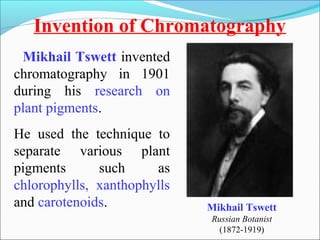
Mikhail Tswett 
Russian Botanist 
(1872-1919) 
Mikhail Tswett invented 
chromatography in 1901 
during his research on 
plant pigments. 
He used the technique to 
separate various plant 
pigments such as 
chlorophylls, xanthophylls 
and carotenoids.
Chromatography: (Greek = chroma “color” and 
graphein “writing” ) Tswett named this new technique 
chromatography based on the fact that it separated the 
components of a solution by color. 
Common Types of Chromatography 
There are now several common chromatographic 
methods. These include: 
‱Paper Chromatography 
‱Thin Layer Chromatography (TLC) 
‱Liquid Chromatography (LC) 
‱High Pressure Liquid Chromatography (HPLC) 
‱Ion Chromatography 
‱Gas Chromatography (GC)
How Does Chromatography Work? 
In all chromatographic separations, the sample is 
transported in a mobile phase. The mobile phase can be a 
gas, a liquid, or a supercritical fluid. 
The mobile phase is then forced through a stationary 
phase held in a column or on a solid surface. The stationary 
phase needs to be something that does not react with the 
mobile phase or the sample. 
The sample then has the opportunity to interact with the 
stationary phase as it moves past it. Samples that interact 
greatly, then appear to move more slowly. Samples that 
interact weakly, then appear to move more quickly. Because 
of this difference in rates, the samples can then be separated 
into their components.
Gas Chromatography 
It is based on distribution of gaseous solutes between a gas & liquid 
or solid phase thus according to the nature of stationary phase they 
are classified in two categories:- 
Gas solid chromatography(SP-solid) 
Gas liquid chromatography(SP-non volatile liquid on solid support) 
PROPERTIES:- 
 Good for volatile samples (up to about 250 oC) 
 0.1-1.0 microliter of liquid or 1-10 ml vapor 
 Can detect <1 ppm with certain detectors 
 Can be easily automated for injection and data analysis
Principle 
The organic compounds are separated 
due to differences in their partitioning 
behavior between the mobile gas phase 
and the stationary phase in the 
column.
The Theoretical Plate 
Theoretical plate is a term coined by Martin & 
Synge. 
Theoretical plates (N) measure how efficiently a 
column can separate a mixture into its components. 
This efficiency is based on the retention time of the 
components and the width of the peaks.
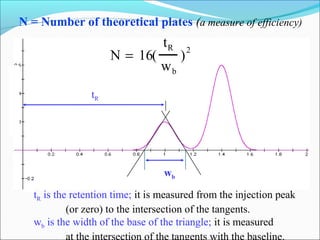
N = Number of theoretical plates (a measure of efficiency) 
wb 
tR 
N =  16( 
tR 
wb 
)2 
tR is the retention time; it is measured from the injection peak 
(or zero) to the intersection of the tangents. 
wb is the width of the base of the triangle; it is measured 
at the intersection of the tangents with the baseline.
Instrumentation of a Gas 
Chromatography 
Gas Supply: (usually N2 or He) 
Sample Injector: (syringe / septum) 
Column: 1/8” or 1/4” x 6-50’ tubing packed with 
small uniform size, inert support coated with 
thin film of nonvolatile liquid 
Detector: TC - thermal conductivity 
FID - flame ionization detector
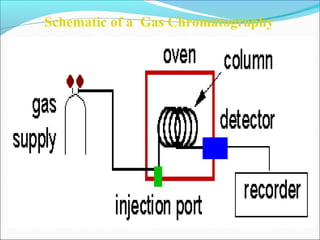
Schematic of a Gas Chromatography
Our GC System 
Carrier Gas : The main purpose of carrier gas is to 
transport sample components through the column.(H , 
He , Ar & N are common carrier gases) 
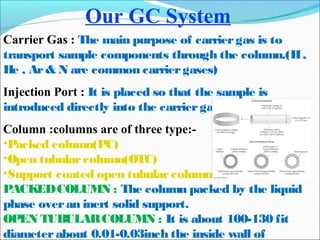
Injection Port : It is placed so that the sample is 
introduced directly into the carrier gas. 
Column :columns are of three type:- 
‱Packed column(PC) 
‱Open tubular column(OTC) 
‱Support coated open tubular column(SCOTC) 
PACKED COLUMN : The column packed by the liquid 
phase over an inert solid support. 
OPEN TUBULAR COLUMN : It is about 100-130 fit 
diameter about 0.01-0.03inch the inside wall of
in the form of thin & uniform film. 
SUPPORT COATED OPEN TUBULAR COLUMN : columns 
are made by depositing a micron size porous layer 
of support material on the inside wall of a 
capillaries columns & then coated with a thin film. 
These column are of coarse having higher sample 
capacity & yeild better resolution . 
Detector : After resolution of solutes each is vapourised 
components in turn from column & is carried into the 
detector mixed with carrier gas.The detectors receive the 
impulse from the elute of the column in the form of solute. 
The vapour is sensed by the detectors it converts this 
impulse into an electric signal proportional to the 
concentration of the solute in carrier gas . The impulse 
signal is emplified & recorded as a peak. 
Various detectors are as follows:- 
Thermal conductivity detector 
Flame ionized detector
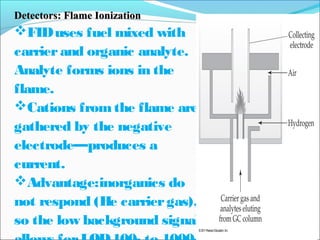
DDeetteeccttoorrss:: FFllaammee IIoonniizzaattiioonn 
FID uses fuel mixed with 
carrier and organic analyte. 
Analyte forms ions in the 
flame. 
Cations from the flame are 
gathered by the negative 
electrode—produces a 
current. 
Advantage:inorganics do 
not respond (He carrier gas), 
so the low background signal 
allows for LOD 100- to 1000-
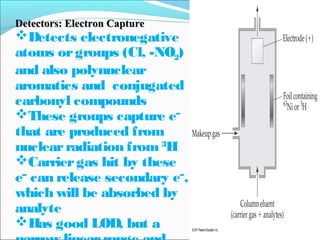
Detectors: EElleeccttrroonn CCaappttuurree 
Detects electronegative 
atoms or groups (Cl, -NO2) 
and also polynuclear 
aromatics and conjugated 
carbonyl compounds 
These groups capture e– 
that are produced from 
nuclear radiation from 3H 
Carrier gas hit by these 
e– can release secondary e–, 
which will be absorbed by 
analyte 
Has good LOD, but a 
narrow linear range and
THERMAL CONDUCTIVITY DETECTOR (TCD) 
A TCD detector consists of an electrically-heated 
wire.The temperature of the sensing 
element depends on the thermal conductivity 
of the gas flowing around it. Changes in 
thermal conductivity, such as when organic 
molecules displace some of the carrier gas, 
cause a temperature rise in the element which 
is sensed as a change in resistance. The TCD 
is not as sensitive as other detectors but it is 
non-specific and non-destructive.
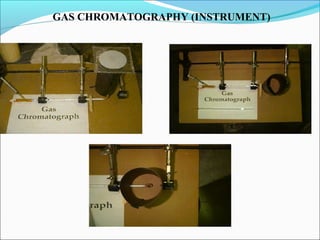
GAS CHROMATOGRAPHY (INSTRUMENT)
Applications 
There are two type of analytical methods of gas 
chromatography:- 
‱Qualitative Analysis 
‱Quantitative Analysis 
QUALITATIVE ANALYSIS:- 
This can be used to confirm identity of a suspected 
compound but it along can not establish the structure of 
unknown compound. 
To supplement identification of the unknown by retention 
data , suspected compound can be added to the suspected 
compound & to see if there is a concomitent increase in the 
peak heights.
QUANTITATIVE ANALYSIS:- 
With the help of gas chromatography qualitative 
analysis of individual component in a mixture. 
The method has advantages over titrimetry or 
spectrophotometry because both evaluations of a mixture 
can be performed simultaneously.
There are numerous advantages of GAS 
CHROMATOGRAPHY:- 
Gas chromatography plays important role in the analysis of 
pharmaceutical products & drugs. 
It is used in quality control. 
Analysis of new products. 
In monitoring metabolites & biological fluids. 
Few of application includes:- 
‱Antibiotics : penicillin 
‱Anti tuberculosis drugs : isoniazid 
‱Anti neoplastics : chlorambucil& florourasil 
‱CNS stimulants : caffine & theophyllin
chromatography Gc.ppt (1)

chromatography Gc.ppt (1)

  • 2.
    CONTENTS:- INVENTION OFCHROMATOGRAPHY ABOUT CHROMATOGRAPHY WORKING OF CHROMATOGRAPHY INTRODUCTION OF GAS CHROMATOGRAPHY PRINCIPLE THEORETICAL PLATE INSTRUMENTATION APPLICATIONS
  • 3.
    Invention of Chromatography Mikhail Tswett Russian Botanist (1872-1919) Mikhail Tswett invented chromatography in 1901 during his research on plant pigments. He used the technique to separate various plant pigments such as chlorophylls, xanthophylls and carotenoids.
  • 4.
    Chromatography: (Greek =chroma “color” and graphein “writing” ) Tswett named this new technique chromatography based on the fact that it separated the components of a solution by color. Common Types of Chromatography There are now several common chromatographic methods. These include: ‱Paper Chromatography ‱Thin Layer Chromatography (TLC) ‱Liquid Chromatography (LC) ‱High Pressure Liquid Chromatography (HPLC) ‱Ion Chromatography ‱Gas Chromatography (GC)
  • 5.
    How Does ChromatographyWork? In all chromatographic separations, the sample is transported in a mobile phase. The mobile phase can be a gas, a liquid, or a supercritical fluid. The mobile phase is then forced through a stationary phase held in a column or on a solid surface. The stationary phase needs to be something that does not react with the mobile phase or the sample. The sample then has the opportunity to interact with the stationary phase as it moves past it. Samples that interact greatly, then appear to move more slowly. Samples that interact weakly, then appear to move more quickly. Because of this difference in rates, the samples can then be separated into their components.
  • 6.
    Gas Chromatography Itis based on distribution of gaseous solutes between a gas & liquid or solid phase thus according to the nature of stationary phase they are classified in two categories:- Gas solid chromatography(SP-solid) Gas liquid chromatography(SP-non volatile liquid on solid support) PROPERTIES:-  Good for volatile samples (up to about 250 oC)  0.1-1.0 microliter of liquid or 1-10 ml vapor  Can detect <1 ppm with certain detectors  Can be easily automated for injection and data analysis
  • 7.
    Principle The organiccompounds are separated due to differences in their partitioning behavior between the mobile gas phase and the stationary phase in the column.
  • 8.
    The Theoretical Plate Theoretical plate is a term coined by Martin & Synge. Theoretical plates (N) measure how efficiently a column can separate a mixture into its components. This efficiency is based on the retention time of the components and the width of the peaks.
  • 9.
    N = Numberof theoretical plates (a measure of efficiency) wb tR N = 16( tR wb )2 tR is the retention time; it is measured from the injection peak (or zero) to the intersection of the tangents. wb is the width of the base of the triangle; it is measured at the intersection of the tangents with the baseline.
  • 10.
    Instrumentation of aGas Chromatography Gas Supply: (usually N2 or He) Sample Injector: (syringe / septum) Column: 1/8” or 1/4” x 6-50’ tubing packed with small uniform size, inert support coated with thin film of nonvolatile liquid Detector: TC - thermal conductivity FID - flame ionization detector
  • 11.
    Schematic of aGas Chromatography
  • 12.
    Our GC System Carrier Gas : The main purpose of carrier gas is to transport sample components through the column.(H , He , Ar & N are common carrier gases) Injection Port : It is placed so that the sample is introduced directly into the carrier gas. Column :columns are of three type:- ‱Packed column(PC) ‱Open tubular column(OTC) ‱Support coated open tubular column(SCOTC) PACKED COLUMN : The column packed by the liquid phase over an inert solid support. OPEN TUBULAR COLUMN : It is about 100-130 fit diameter about 0.01-0.03inch the inside wall of
  • 13.
    in the formof thin & uniform film. SUPPORT COATED OPEN TUBULAR COLUMN : columns are made by depositing a micron size porous layer of support material on the inside wall of a capillaries columns & then coated with a thin film. These column are of coarse having higher sample capacity & yeild better resolution . Detector : After resolution of solutes each is vapourised components in turn from column & is carried into the detector mixed with carrier gas.The detectors receive the impulse from the elute of the column in the form of solute. The vapour is sensed by the detectors it converts this impulse into an electric signal proportional to the concentration of the solute in carrier gas . The impulse signal is emplified & recorded as a peak. Various detectors are as follows:- Thermal conductivity detector Flame ionized detector
  • 14.
    DDeetteeccttoorrss:: FFllaammee IIoonniizzaattiioonn FID uses fuel mixed with carrier and organic analyte. Analyte forms ions in the flame. Cations from the flame are gathered by the negative electrode—produces a current. Advantage:inorganics do not respond (He carrier gas), so the low background signal allows for LOD 100- to 1000-
  • 15.
    Detectors: EElleeccttrroonn CCaappttuurree Detects electronegative atoms or groups (Cl, -NO2) and also polynuclear aromatics and conjugated carbonyl compounds These groups capture e– that are produced from nuclear radiation from 3H Carrier gas hit by these e– can release secondary e–, which will be absorbed by analyte Has good LOD, but a narrow linear range and
  • 16.
    THERMAL CONDUCTIVITY DETECTOR(TCD) A TCD detector consists of an electrically-heated wire.The temperature of the sensing element depends on the thermal conductivity of the gas flowing around it. Changes in thermal conductivity, such as when organic molecules displace some of the carrier gas, cause a temperature rise in the element which is sensed as a change in resistance. The TCD is not as sensitive as other detectors but it is non-specific and non-destructive.
  • 17.
  • 18.
    Applications There aretwo type of analytical methods of gas chromatography:- ‱Qualitative Analysis ‱Quantitative Analysis QUALITATIVE ANALYSIS:- This can be used to confirm identity of a suspected compound but it along can not establish the structure of unknown compound. To supplement identification of the unknown by retention data , suspected compound can be added to the suspected compound & to see if there is a concomitent increase in the peak heights.
  • 19.
    QUANTITATIVE ANALYSIS:- Withthe help of gas chromatography qualitative analysis of individual component in a mixture. The method has advantages over titrimetry or spectrophotometry because both evaluations of a mixture can be performed simultaneously.
  • 20.
    There are numerousadvantages of GAS CHROMATOGRAPHY:- Gas chromatography plays important role in the analysis of pharmaceutical products & drugs. It is used in quality control. Analysis of new products. In monitoring metabolites & biological fluids. Few of application includes:- ‱Antibiotics : penicillin ‱Anti tuberculosis drugs : isoniazid ‱Anti neoplastics : chlorambucil& florourasil ‱CNS stimulants : caffine & theophyllin

Editor's Notes

  • #4 http://en.wikipedia.org/wiki/Mikhail_Tsvet The method was described on 30 December 1901 at the XI Congress of Naturalists and Physicians (XI съДзЎ ДстДстĐČĐŸĐžŃĐżŃ‹Ń‚Đ°Ń‚Đ”Đ»Đ”Đč Đž ĐČрачДĐč) in St. Petersburg. The first printed description was in 1903, in the Proceedings of the Warsaw Society of Naturalists, biology section. He first used the term &amp;quot;chromatography&amp;quot; in print in 1906 in his two papers about chlorophyll in the German botanical journal, Berichte der Deutschen botanischen Gesellschaft. In 1907 he demonstrated his chromatogaph for the German Botanical Society. Tsvet&amp;apos;s work was ignored for several decades because of diverse reasons: the tragic events in Russia at the beginning of the 20th century, the fact that Tsvet originally published only in Russian (what made his results inaccessible to western scientists) and an article denying Tsvet&amp;apos;s findings. Willstater and Stoll tried to repeat Tsvet&amp;apos;s experiments but because they used an aggressive adsorbent (what destroys the chlorophyll&amp;apos;s) were not able to do so. They published their results and Tsvet&amp;apos;s chromatography method went into oblivion. It was recollected 10 years after his death thanks to German scientist Edgar Lederer and Austrian biochemist Richard Kuhn and the work of Martin and Synge.
  • #5 p.674
  • #6 page 675
  • #9 pp.681-682