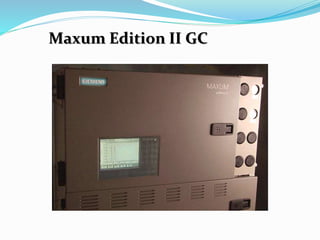
Maxum Edition II GC
An Introduction to
Chromatography
 What IS chromatography?
 The separation of a mixture by distribution of its components between
a mobile and stationary phase over time
 mobile phase = solvent
 stationary phase = column packing material
 The basis of gas chromatography is the distribution of a sample
between two phases namely stationary phase & gas phase ( mobile
phase )
 The sample being vaporized & injected into the head of
chromatographic column
An Introduction to
Chromatography
 A gas chromatograph uses a flow through a narrow tube known as
column through which different chemicals constituents of the sample
pass in a gas stream known as carrier gas or mobile phase at different
rates .
 Depending on their various chemical and physical prosperities
 Their interaction with specific column filling called stationary
phase
 The sample is transported into the column by the flow of the inert
gaseous mobile phase
Components of a Chromatographic
System
● Source of Carrier Flow (mobile phase)
 Cylinder of carrier gas or solvent bottles
● sample inlet
● Column with stationary phase
● Detector(s)
● Signal Transducers & Data Analyzers
 Recorders, integrators
 Computers for library matching
● Controllers
 Temperature controls for injectors, columns and detector
 Flow controllers and pressure regulators
System block diagram
Basic Chromatography
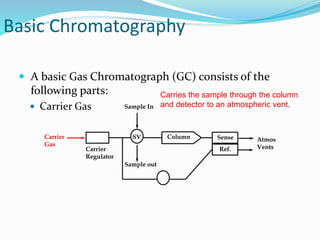
 A basic Gas Chromatograph (GC) consists of the
following parts:
 Carrier Gas
Carrier
Gas
Carrier
Regulator
Sample In
Sample out
SV Column Sense
Ref.
Atmos
Vents
Carries the sample through the column
and detector to an atmospheric vent.
Basic Chromatography
 A basic Gas Chromatograph (GC) consists of the
following parts:
 Carrier Regulator
Carrier
Gas
Carrier
Regulator
Sample In
Sample out
SV Column Sense
Ref.
Atmos
Vents
Maintains a constant pressure of carrier
gas which results in a constant carrier
flow rate.
Basic Chromatography
 A basic Gas Chromatograph (GC) consists of the
following parts:
 Sample Valve
Carrier
Gas
Carrier
Regulator
Sample In
Sample out
SV Column Sense
Ref.
Atmos
Vents
Injects a measured amount of sample.
Basic Chromatography
 A basic Gas Chromatograph (GC) consists of the
following parts:
 Column
Carrier
Gas
Carrier
Regulator
Sample In
Sample out
SV Column Sense
Ref.
Atmos
Vents
Separates the sample into individual
components.
Basic Chromatography
 A basic Gas Chromatograph (GC) consists of the
following parts:
 Detector
Carrier
Gas
Carrier
Regulator
Sample In
Sample out
SV Column Sense
Ref.
Atmos
Vents
Senses the individual components as
they elute off the column.
Carrier Gas-Supply
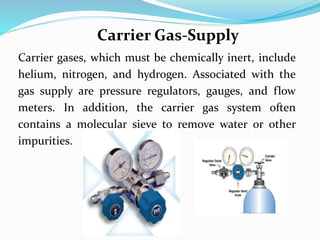
Carrier gases, which must be chemically inert, include
helium, nitrogen, and hydrogen. Associated with the
gas supply are pressure regulators, gauges, and flow
meters. In addition, the carrier gas system often
contains a molecular sieve to remove water or other
impurities.
A carrier gas should have the following properties:
1. Highly pure (> 99.9%)
2. Inert so that no reaction with stationary phase or instrumental
components can take place, especially at high temperatures.
3. When analyzing gas sample , the carrier is sometimes selected
based on the sample matrix. For example:
 When analyzing a mix. In argon an argon carrier is preferred
because the argon in the sample doesn’t show up on the
chromatogram.
4. Compatible with the detector since some detectors require the
use of a specific carrier gas.
5. A cheap and available carrier gas is an advantage.
Sample Injection System
 For quantitative work, more reproducible sample sizes
for both liquids and gases are obtained by means of a
rotary sample valve.
 Errors due to sample size can be reduced to 0.5% to 2%
relative.
 The sampling loop is filled by injection of an excess of
sample.
 Chromatographic separation involves the use of a
stationary phase and a mobile phase.
 Components of a mixture carried in the mobile phase
are differentially attracted to the stationary phase and
thus move through the stationary phase at different
rates.
Columns
 As the carrier gas sweeps the analyte molecules through the
column this motion is inhibited
 by the adsorption of the analyte molecules either into the
column wall or into packing materials in the column
 the rate at which molecules progress along the column depends
on the strength of adsorption which is depend on :
 The type of molecules
 The stationary phase material
 Since each type of molecules has a different rates of progression ,
the various components of the analyte mixture are separated as
they progress along the column and reach the end of the column
at different times ( retention time )
 Retention time
 Retention time of an analyte is defined as the time it takes
after sample injection for the analyte to elute and reach the
detector.
Columns
T=0
T=10’
T=20’
Injector Detector
Most Interaction with Stationary Phase Least
Flow of Mobile Phase
 Velocity of a compound through the column depends
upon affinity for the stationary phase
Area under curve is
______ of compound
adsorbed to stationary
phase
Gas phase concentration
Carrier gas
mass
Column Configurations
 Two general types of columns are encountered in gas
chromatography, packed and open tubular, or
capillary.
 Chromatographic columns vary in length from less
than 2 m to 50 m or more. They are constructed of
stainless steel, glass, fused silica, or Teflon. In order to
fit into an oven for thermostating, they are usually
formed as coils having diameters of 10 to 30 cm.
Packed Columns
These columns are fabricated from glass, stainless steel, copper, or other
suitable tubes.
Stainless steel is the most common tubing used with internal diameters
from 1-4 mm because it is most inert and easy to work with.
The column is packed with finely divided particles (<100-300 mm
diameter)
Capillary Columns
The most frequently used capillary column, nowadays, is the fused silica
open tubular column (FSOT), which is a WCOT column.
• Wall-coated open tubular (WCOT) <1 mm thick liquid coating on inside
of silica tube
Capillary vs. Packed Columns
 Capillary Columns:
 Higher resolution (R)
 Shorter analysis time
 Greater sensitivity
 Most common in analytical
laboratory GC instruments
 Smaller sample capacity
 Higher cost/column
 Columns more susceptible to
damage
 Packed Columns
 Greater sample capacity
 Lower cost (can make your own)
 More rugged
 Most common in process labs or
separating/determining major
components in a sample (prep GC)
 Limited lengths reduces R and N
 Not compatible with some GC
detectors
Retention Time
Sample molecules spend part of the time in the mobile phase & the
other part in the stationary phase during the passage through the
column.
 Column dead time tm
It’s the time for unretained solute to reach the detector from
the point of injection.
 Solute retention time tr
Is the time difference between sample injection and the
detector sensing the maximum of the peak
 Adjusted retention time tr’
The time solute molecules spend in the stationary
phase
Temperature and Pressure Programming
- Temperature is raised during the separation
(gradient)
- increases solute vapor pressure and decrease
retention time
Temperature gradient improves
resolution while also decreasing
retention time
Temperature and Pressure Programming
Separating components with a wide range of boiling points is
accomplished by starting at a low oven temperature and
increasing the temperature over time to elute the high-boiling
point components
Temperature and Pressure Programming
Programmed 30 to 180°
Isothermal at 145°
Isothermal at 45°
First, a temperature suitable for the separation of the first eluting
component is selected, and then the temperature is increased so that
the second component is separated and so on.
Temperature and Pressure Programming
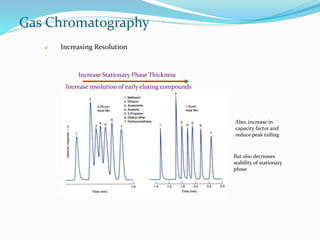
Gas Chromatography
Increase Stationary Phase Thickness
Increase resolution of early eluting compounds
Also, increase in
capacity factor and
reduce peak tailing
But also decreases
stability of stationary
phase
 Increasing Resolution
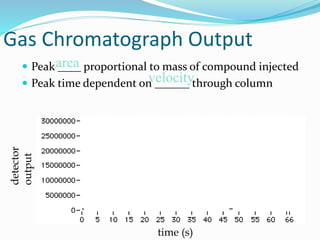
Gas Chromatograph Output
 Peak ____ proportional to mass of compound injected
 Peak time dependent on ______ through column
time (s)
detector
output
area
velocity
For capillary GC columns….
 Increased length = greater N, therefore a greater R
 expense is possible band broadening if analytes are on the column
too long!
 Increased length leads to longer separations. Do you have the time?
 Increased stationary phase thickness and column diameter
provides increased sample capacity and can provide
increased resolution
 tradeoffs are a longer analysis time and more column bleed with
thicker stationary phases
 For most analytical work, a best “compromise” column is
chosen and other variables (temp, etc.) are altered to
optimize the separation.
GC Detectors
 Separated components of the mixture must be
detected as they exit the GC column
 Thermal-conduc. (TCD) and flame ionization
(FID) detectors - two most common detectors on
commercial GCs.
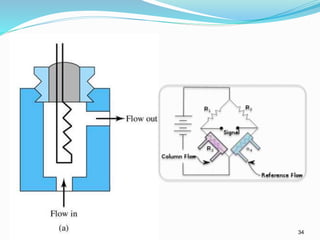
a. Thermal Conductivity Detector (TCD)
This is a nondestructive detector which is used for the
separation and collection of solutes to further
perform some other experiments on each purely
separated component.
The heart of the detector is a heated filament which is
cooled by helium carrier gas. Any solute passes across
the filament will not cool it as much as helium does
because helium has the highest thermal conductivity.
This results in an increase in the temperature of the
filament which is related to concentration.
The detector is simple, nondestructive, and universal
but is not very sensitive and is flow rate sensitive.
33
34
35
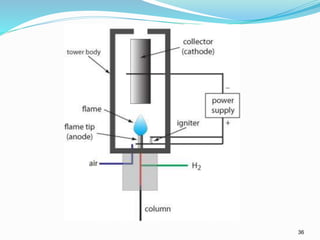
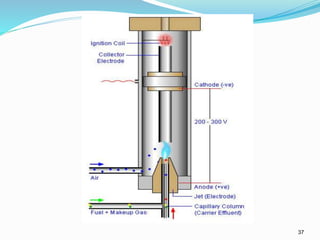
b. Flame Ionization Detector (FID)
This is one of the most sensitive and reliable
destructive detectors. Separate two gas
cylinders, one for fuel and the other for O2 or
air are used in the ignition of the flame of the
FID. The fuel is usually hydrogen gas. The
flow rate of air and hydrogen should be
carefully adjusted in order to successfully
ignite the flame.
36
37
38
The FID detector is a mass sensitive detector where
solutes are ionized in the flame and electrons
emitted are attracted by a positive electrode,
where a current is obtained.
Remember that FID characteristics include:
• Rugged
• Signal depends on number of carbon atoms in organic
analytes which is referred to as mass sensitive rather
than concentration sensitive
• Not sensitive to non-combustibles – H2O, CO2, SO2,
NOx
• Destructive
Siemens: Systems Integration
 Systems Integration Package
 Features may include:
 sun & rain protection
 light & receptacle
 120 or 480 VAC power circuits
 cylinder rack
 ventilation fan
 electric heat or A/C
 hazardous area classification
What is the method?
What is the Data file?
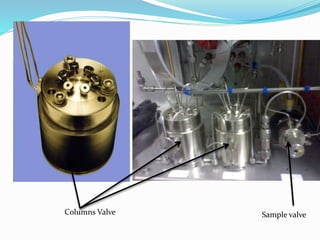
Operational block
Columns Valve Sample valve
FID oven
EPCM
Gas chromatograph analyzer

Gas chromatograph analyzer

  • 1.
  • 2.
    An Introduction to Chromatography What IS chromatography?  The separation of a mixture by distribution of its components between a mobile and stationary phase over time  mobile phase = solvent  stationary phase = column packing material  The basis of gas chromatography is the distribution of a sample between two phases namely stationary phase & gas phase ( mobile phase )  The sample being vaporized & injected into the head of chromatographic column
  • 3.
    An Introduction to Chromatography A gas chromatograph uses a flow through a narrow tube known as column through which different chemicals constituents of the sample pass in a gas stream known as carrier gas or mobile phase at different rates .  Depending on their various chemical and physical prosperities  Their interaction with specific column filling called stationary phase  The sample is transported into the column by the flow of the inert gaseous mobile phase
  • 4.
    Components of aChromatographic System ● Source of Carrier Flow (mobile phase)  Cylinder of carrier gas or solvent bottles ● sample inlet ● Column with stationary phase ● Detector(s) ● Signal Transducers & Data Analyzers  Recorders, integrators  Computers for library matching ● Controllers  Temperature controls for injectors, columns and detector  Flow controllers and pressure regulators
  • 5.
  • 6.
    Basic Chromatography  Abasic Gas Chromatograph (GC) consists of the following parts:  Carrier Gas Carrier Gas Carrier Regulator Sample In Sample out SV Column Sense Ref. Atmos Vents Carries the sample through the column and detector to an atmospheric vent.
  • 7.
    Basic Chromatography  Abasic Gas Chromatograph (GC) consists of the following parts:  Carrier Regulator Carrier Gas Carrier Regulator Sample In Sample out SV Column Sense Ref. Atmos Vents Maintains a constant pressure of carrier gas which results in a constant carrier flow rate.
  • 8.
    Basic Chromatography  Abasic Gas Chromatograph (GC) consists of the following parts:  Sample Valve Carrier Gas Carrier Regulator Sample In Sample out SV Column Sense Ref. Atmos Vents Injects a measured amount of sample.
  • 9.
    Basic Chromatography  Abasic Gas Chromatograph (GC) consists of the following parts:  Column Carrier Gas Carrier Regulator Sample In Sample out SV Column Sense Ref. Atmos Vents Separates the sample into individual components.
  • 10.
    Basic Chromatography  Abasic Gas Chromatograph (GC) consists of the following parts:  Detector Carrier Gas Carrier Regulator Sample In Sample out SV Column Sense Ref. Atmos Vents Senses the individual components as they elute off the column.
  • 11.
    Carrier Gas-Supply Carrier gases,which must be chemically inert, include helium, nitrogen, and hydrogen. Associated with the gas supply are pressure regulators, gauges, and flow meters. In addition, the carrier gas system often contains a molecular sieve to remove water or other impurities.
  • 12.
    A carrier gasshould have the following properties: 1. Highly pure (> 99.9%) 2. Inert so that no reaction with stationary phase or instrumental components can take place, especially at high temperatures. 3. When analyzing gas sample , the carrier is sometimes selected based on the sample matrix. For example:  When analyzing a mix. In argon an argon carrier is preferred because the argon in the sample doesn’t show up on the chromatogram. 4. Compatible with the detector since some detectors require the use of a specific carrier gas. 5. A cheap and available carrier gas is an advantage.
  • 13.
    Sample Injection System For quantitative work, more reproducible sample sizes for both liquids and gases are obtained by means of a rotary sample valve.  Errors due to sample size can be reduced to 0.5% to 2% relative.  The sampling loop is filled by injection of an excess of sample.
  • 15.
     Chromatographic separationinvolves the use of a stationary phase and a mobile phase.  Components of a mixture carried in the mobile phase are differentially attracted to the stationary phase and thus move through the stationary phase at different rates. Columns
  • 16.
     As thecarrier gas sweeps the analyte molecules through the column this motion is inhibited  by the adsorption of the analyte molecules either into the column wall or into packing materials in the column  the rate at which molecules progress along the column depends on the strength of adsorption which is depend on :  The type of molecules  The stationary phase material  Since each type of molecules has a different rates of progression , the various components of the analyte mixture are separated as they progress along the column and reach the end of the column at different times ( retention time )  Retention time  Retention time of an analyte is defined as the time it takes after sample injection for the analyte to elute and reach the detector. Columns
  • 17.
    T=0 T=10’ T=20’ Injector Detector Most Interactionwith Stationary Phase Least Flow of Mobile Phase
  • 18.
     Velocity ofa compound through the column depends upon affinity for the stationary phase Area under curve is ______ of compound adsorbed to stationary phase Gas phase concentration Carrier gas mass
  • 19.
    Column Configurations  Twogeneral types of columns are encountered in gas chromatography, packed and open tubular, or capillary.  Chromatographic columns vary in length from less than 2 m to 50 m or more. They are constructed of stainless steel, glass, fused silica, or Teflon. In order to fit into an oven for thermostating, they are usually formed as coils having diameters of 10 to 30 cm.
  • 20.
    Packed Columns These columnsare fabricated from glass, stainless steel, copper, or other suitable tubes. Stainless steel is the most common tubing used with internal diameters from 1-4 mm because it is most inert and easy to work with. The column is packed with finely divided particles (<100-300 mm diameter)
  • 21.
    Capillary Columns The mostfrequently used capillary column, nowadays, is the fused silica open tubular column (FSOT), which is a WCOT column. • Wall-coated open tubular (WCOT) <1 mm thick liquid coating on inside of silica tube
  • 22.
    Capillary vs. PackedColumns  Capillary Columns:  Higher resolution (R)  Shorter analysis time  Greater sensitivity  Most common in analytical laboratory GC instruments  Smaller sample capacity  Higher cost/column  Columns more susceptible to damage  Packed Columns  Greater sample capacity  Lower cost (can make your own)  More rugged  Most common in process labs or separating/determining major components in a sample (prep GC)  Limited lengths reduces R and N  Not compatible with some GC detectors
  • 23.
    Retention Time Sample moleculesspend part of the time in the mobile phase & the other part in the stationary phase during the passage through the column.  Column dead time tm It’s the time for unretained solute to reach the detector from the point of injection.  Solute retention time tr Is the time difference between sample injection and the detector sensing the maximum of the peak  Adjusted retention time tr’ The time solute molecules spend in the stationary phase
  • 24.
    Temperature and PressureProgramming - Temperature is raised during the separation (gradient) - increases solute vapor pressure and decrease retention time Temperature gradient improves resolution while also decreasing retention time
  • 25.
    Temperature and PressureProgramming Separating components with a wide range of boiling points is accomplished by starting at a low oven temperature and increasing the temperature over time to elute the high-boiling point components
  • 26.
    Temperature and PressureProgramming Programmed 30 to 180° Isothermal at 145° Isothermal at 45° First, a temperature suitable for the separation of the first eluting component is selected, and then the temperature is increased so that the second component is separated and so on.
  • 27.
  • 28.
    Gas Chromatography Increase StationaryPhase Thickness Increase resolution of early eluting compounds Also, increase in capacity factor and reduce peak tailing But also decreases stability of stationary phase  Increasing Resolution
  • 29.
    Gas Chromatograph Output Peak ____ proportional to mass of compound injected  Peak time dependent on ______ through column time (s) detector output area velocity
  • 30.
    For capillary GCcolumns….  Increased length = greater N, therefore a greater R  expense is possible band broadening if analytes are on the column too long!  Increased length leads to longer separations. Do you have the time?  Increased stationary phase thickness and column diameter provides increased sample capacity and can provide increased resolution  tradeoffs are a longer analysis time and more column bleed with thicker stationary phases  For most analytical work, a best “compromise” column is chosen and other variables (temp, etc.) are altered to optimize the separation.
  • 31.
    GC Detectors  Separatedcomponents of the mixture must be detected as they exit the GC column  Thermal-conduc. (TCD) and flame ionization (FID) detectors - two most common detectors on commercial GCs.
  • 32.
    a. Thermal ConductivityDetector (TCD) This is a nondestructive detector which is used for the separation and collection of solutes to further perform some other experiments on each purely separated component. The heart of the detector is a heated filament which is cooled by helium carrier gas. Any solute passes across the filament will not cool it as much as helium does because helium has the highest thermal conductivity. This results in an increase in the temperature of the filament which is related to concentration. The detector is simple, nondestructive, and universal but is not very sensitive and is flow rate sensitive.
  • 33.
  • 34.
  • 35.
    35 b. Flame IonizationDetector (FID) This is one of the most sensitive and reliable destructive detectors. Separate two gas cylinders, one for fuel and the other for O2 or air are used in the ignition of the flame of the FID. The fuel is usually hydrogen gas. The flow rate of air and hydrogen should be carefully adjusted in order to successfully ignite the flame.
  • 36.
  • 37.
  • 38.
    38 The FID detectoris a mass sensitive detector where solutes are ionized in the flame and electrons emitted are attracted by a positive electrode, where a current is obtained. Remember that FID characteristics include: • Rugged • Signal depends on number of carbon atoms in organic analytes which is referred to as mass sensitive rather than concentration sensitive • Not sensitive to non-combustibles – H2O, CO2, SO2, NOx • Destructive
  • 40.
    Siemens: Systems Integration Systems Integration Package  Features may include:  sun & rain protection  light & receptacle  120 or 480 VAC power circuits  cylinder rack  ventilation fan  electric heat or A/C  hazardous area classification
  • 41.
    What is themethod? What is the Data file?
  • 42.
  • 44.
  • 45.