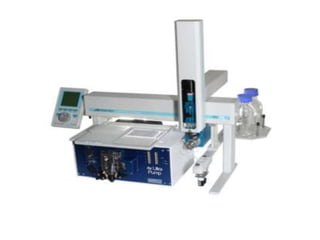

Chromatography 
(Gas Chromatography) 
Presented By:- 
Ruta Satoskar 
& 
Suman Muthu
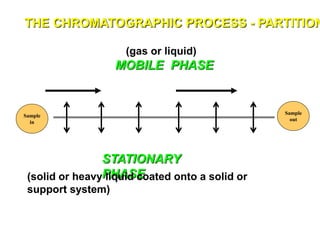
THE CHROMATOGRAPHIC PROCESS - PARTITIONING 
(gas or liquid) 
MOBILE PHASE 
STATIONARY 
PHASE 
Sample 
out 
Sample 
in 
(solid or heavy liquid coated onto a solid or 
support system)
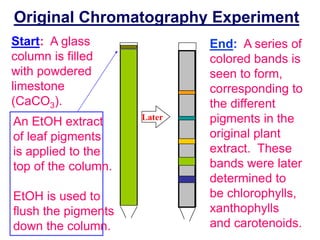
Original Chromatography Experiment 
Later 
Start: A glass 
column is filled 
with powdered 
limestone 
(CaCO3). 
End: A series of 
colored bands is 
seen to form, 
corresponding to 
the different 
pigments in the 
original plant 
extract. These 
bands were later 
determined to 
be chlorophylls, 
xanthophylls 
and carotenoids. 
An EtOH extract 
of leaf pigments 
is applied to the 
top of the column. 
EtOH is used to 
flush the pigments 
down the column.
Chromatography: (Greek = chroma “color” 
and graphein “writing” ) Tswett named this new 
technique chromatography based on the fact that it 
separated the components of a solution by color. 
Common Types of Chromatography 
Tswett’s technique is based on Liquid 
Chromatography. There are now several common 
chromatographic methods. These include: 
1. Paper Chromatography 
2. Thin Layer Chromatography (TLC) 
3. Liquid Chromatography (LC) 
4. High Pressure Liquid Chromatography (HPLC) 
5. Ion Chromatography 
6. Gas Chromatography (GC)
How Does Chromatography Work? 
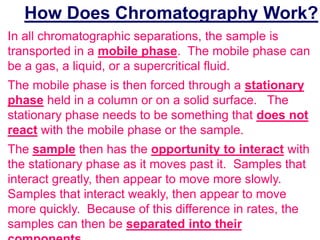
In all chromatographic separations, the sample is 
transported in a mobile phase. The mobile phase can 
be a gas, a liquid, or a supercritical fluid. 
The mobile phase is then forced through a stationary 
phase held in a column or on a solid surface. The 
stationary phase needs to be something that does not 
react with the mobile phase or the sample. 
The sample then has the opportunity to interact with 
the stationary phase as it moves past it. Samples that 
interact greatly, then appear to move more slowly. 
Samples that interact weakly, then appear to move 
more quickly. Because of this difference in rates, the 
samples can then be separated into their 
components.
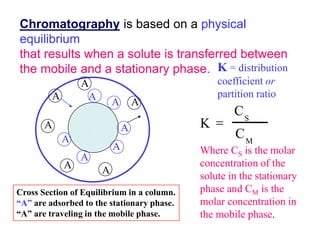
Chromatography is based on a physical 
equilibrium 
that results when a solute is transferred between 
the mobile and a stationary phase. 
A 
A 
A 
A 
A 
A 
A 
A 
A 
A 
A 
A 
K = distribution 
coefficient or 
partition ratio 
K = 
C 
S 
C 
M 
Where CS is the molar 
concentration of the 
solute in the stationary 
phase and CM is the 
molar concentration in 
the mobile phase. 
Cross Section of Equilibrium in a column. 
“A” are adsorbed to the stationary phase. 
“A” are traveling in the mobile phase.
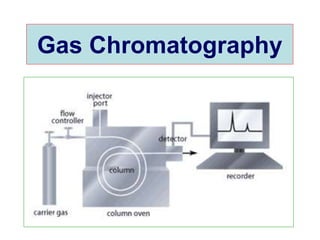
Gas Chromatography 
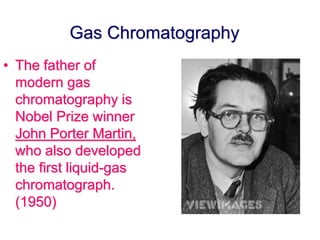
• The father of 
modern gas 
chromatography is 
Nobel Prize winner 
John Porter Martin, 
who also developed 
the first liquid-gas 
chromatograph. 
(1950)
Gas Chromatography
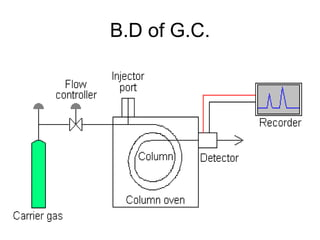
B.D of G.C.
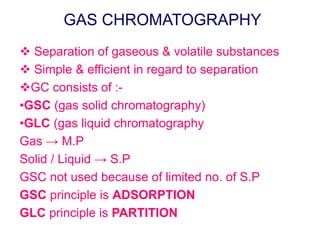
GAS CHROMATOGRAPHY 
 Separation of gaseous & volatile substances 
 Simple & efficient in regard to separation 
GC consists of :- 
•GSC (gas solid chromatography) 
•GLC (gas liquid chromatography 
Gas → M.P 
Solid / Liquid → S.P 
GSC not used because of limited no. of S.P 
GSC principle is ADSORPTION 
GLC principle is PARTITION
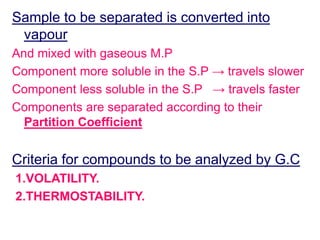
Sample to be separated is converted into 
vapour 
And mixed with gaseous M.P 
Component more soluble in the S.P → travels slower 
Component less soluble in the S.P → travels faster 
Components are separated according to their 
Partition Coefficient 
Criteria for compounds to be analyzed by G.C 
1.VOLATILITY. 
2.THERMOSTABILITY.
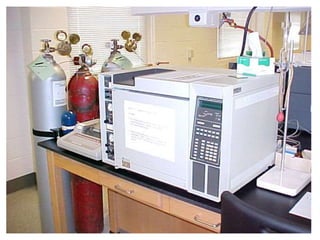
How a Gas Chromatography 
Machine Works 
– First, a vaporized sample is injected onto 
the chromatographic column. 
– Second, the sample moves through the 
column through the flow of inert gas. 
– Third, the components are recorded as a 
sequence of peaks as they leave the 
column.
Chromatographic Separation 
-Deals with both the stationary 
phase and the mobile phase. 
• Mobile – inert gas used as 
carrier. 
• Stationary – liquid coated on a 
solid or a solid within a column.
Chromatographic Separation 
• Chromatographic Separation 
– In the mobile phase, components of the 
sample are uniquely drawn to the 
stationary phase and thus, enter this 
phase at different times. 
– The parts of the sample are separated 
within the column. 
–Compounds used at the stationary 
phase reach the detector at unique 
times and produce a series of peaks 
along a time sequence.
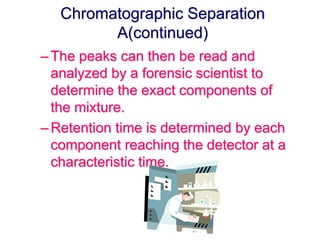
Chromatographic Separation 
A(continued) 
– The peaks can then be read and 
analyzed by a forensic scientist to 
determine the exact components of 
the mixture. 
– Retention time is determined by each 
component reaching the detector at a 
characteristic time.
Chromatographic Analysis 
– The number of components in a sample 
is determined by the number of peaks. 
– The amount of a given component in a 
sample is determined by the area under 
the peaks. 
– The identity of components can be 
determined by the given retention times.
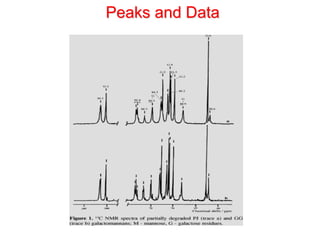
Peaks and Data
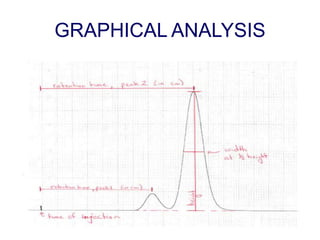
GRAPHICAL ANALYSIS
PRACTICAL REQUIREMENTS 
• Carrier gas 
• Flow regulators & Flow meters 
• Injection devices 
• Columns 
• Temperature control devices 
• Detectors 
• Recorders & Integrators
CARRIER GAS 
» Hydrogen 
• Better thermal conductivity 
• Disadvantage: it reacts with unsaturated 
compounds & inflammable 
» Helium 
• Excellent thermal conductivity 
• It is expensive 
» Nitrogen 
• Reduced sensitivity 
• It is inexpensive
Requirements of a carrier gas 
 Inertness 
 Suitable for the detector 
 High purity 
 Easily available 
 Cheap 
 Should not cause the risk of fire 
 Should give best column 
performance
ADVANTAGES OF G.C 
1. Very high resolution power, complex 
mixtures can be resolved into its 
components by this method. 
2. Very high sensitivity with TCD, detect down 
to 100 ppm 
3. It is a micro method, small sample size is 
required 
4. Fast analysis is possible, gas as moving 
phase- rapid equilibrium 
5. Relatively good precision & accuracy 
6. Qualitative & quantitative analysis is 
possible
Disadvantages of G.C. 
• The samples analysed are limited to 
those that are volatile or can be made 
volatile. 
• The samples must be thermally stable to 
prevent degradation when heated. 
• Cannot be used to prepare samples for 
further analysis once separated. 
• Problems can be encountered when 
injecting the sample
Applications of G.C 
• G.C is capable of separating, detecting & 
partially characterizing the organic 
compounds , particularly when present in 
small quantities. 
1, Qualitative analysis 
Rt & RV are used for the identification & 
separation 
2, Checking the purity of a compound 
Compare the chromatogram of the std. & that 
of the sample
Applications of G.C 
3, Quantitative analysis 
It is necessary to measure the peak area 
or peak height of each component 
4, Used for analysis of drugs & their 
metabolites.
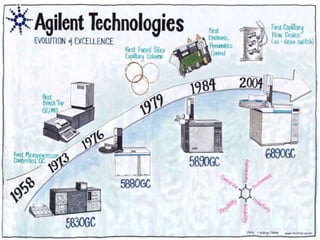
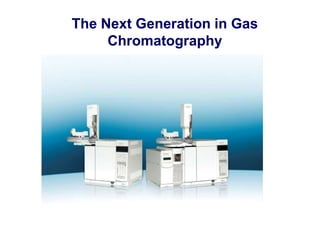
The Next Generation in Gas 
Chromatography
Gas chromatography print this

Gas chromatography print this

  • 1.
    Chromatography (Gas Chromatography) Presented By:- Ruta Satoskar & Suman Muthu
  • 2.
    THE CHROMATOGRAPHIC PROCESS- PARTITIONING (gas or liquid) MOBILE PHASE STATIONARY PHASE Sample out Sample in (solid or heavy liquid coated onto a solid or support system)
  • 3.
    Original Chromatography Experiment Later Start: A glass column is filled with powdered limestone (CaCO3). End: A series of colored bands is seen to form, corresponding to the different pigments in the original plant extract. These bands were later determined to be chlorophylls, xanthophylls and carotenoids. An EtOH extract of leaf pigments is applied to the top of the column. EtOH is used to flush the pigments down the column.
  • 4.
    Chromatography: (Greek =chroma “color” and graphein “writing” ) Tswett named this new technique chromatography based on the fact that it separated the components of a solution by color. Common Types of Chromatography Tswett’s technique is based on Liquid Chromatography. There are now several common chromatographic methods. These include: 1. Paper Chromatography 2. Thin Layer Chromatography (TLC) 3. Liquid Chromatography (LC) 4. High Pressure Liquid Chromatography (HPLC) 5. Ion Chromatography 6. Gas Chromatography (GC)
  • 5.
    How Does ChromatographyWork? In all chromatographic separations, the sample is transported in a mobile phase. The mobile phase can be a gas, a liquid, or a supercritical fluid. The mobile phase is then forced through a stationary phase held in a column or on a solid surface. The stationary phase needs to be something that does not react with the mobile phase or the sample. The sample then has the opportunity to interact with the stationary phase as it moves past it. Samples that interact greatly, then appear to move more slowly. Samples that interact weakly, then appear to move more quickly. Because of this difference in rates, the samples can then be separated into their components.
  • 6.
    Chromatography is basedon a physical equilibrium that results when a solute is transferred between the mobile and a stationary phase. A A A A A A A A A A A A K = distribution coefficient or partition ratio K = C S C M Where CS is the molar concentration of the solute in the stationary phase and CM is the molar concentration in the mobile phase. Cross Section of Equilibrium in a column. “A” are adsorbed to the stationary phase. “A” are traveling in the mobile phase.
  • 8.
    Gas Chromatography •The father of modern gas chromatography is Nobel Prize winner John Porter Martin, who also developed the first liquid-gas chromatograph. (1950)
  • 9.
  • 10.
  • 11.
    GAS CHROMATOGRAPHY Separation of gaseous & volatile substances  Simple & efficient in regard to separation GC consists of :- •GSC (gas solid chromatography) •GLC (gas liquid chromatography Gas → M.P Solid / Liquid → S.P GSC not used because of limited no. of S.P GSC principle is ADSORPTION GLC principle is PARTITION
  • 12.
    Sample to beseparated is converted into vapour And mixed with gaseous M.P Component more soluble in the S.P → travels slower Component less soluble in the S.P → travels faster Components are separated according to their Partition Coefficient Criteria for compounds to be analyzed by G.C 1.VOLATILITY. 2.THERMOSTABILITY.
  • 13.
    How a GasChromatography Machine Works – First, a vaporized sample is injected onto the chromatographic column. – Second, the sample moves through the column through the flow of inert gas. – Third, the components are recorded as a sequence of peaks as they leave the column.
  • 14.
    Chromatographic Separation -Dealswith both the stationary phase and the mobile phase. • Mobile – inert gas used as carrier. • Stationary – liquid coated on a solid or a solid within a column.
  • 15.
    Chromatographic Separation •Chromatographic Separation – In the mobile phase, components of the sample are uniquely drawn to the stationary phase and thus, enter this phase at different times. – The parts of the sample are separated within the column. –Compounds used at the stationary phase reach the detector at unique times and produce a series of peaks along a time sequence.
  • 16.
    Chromatographic Separation A(continued) – The peaks can then be read and analyzed by a forensic scientist to determine the exact components of the mixture. – Retention time is determined by each component reaching the detector at a characteristic time.
  • 17.
    Chromatographic Analysis –The number of components in a sample is determined by the number of peaks. – The amount of a given component in a sample is determined by the area under the peaks. – The identity of components can be determined by the given retention times.
  • 18.
  • 19.
  • 20.
    PRACTICAL REQUIREMENTS •Carrier gas • Flow regulators & Flow meters • Injection devices • Columns • Temperature control devices • Detectors • Recorders & Integrators
  • 21.
    CARRIER GAS »Hydrogen • Better thermal conductivity • Disadvantage: it reacts with unsaturated compounds & inflammable » Helium • Excellent thermal conductivity • It is expensive » Nitrogen • Reduced sensitivity • It is inexpensive
  • 22.
    Requirements of acarrier gas  Inertness  Suitable for the detector  High purity  Easily available  Cheap  Should not cause the risk of fire  Should give best column performance
  • 23.
    ADVANTAGES OF G.C 1. Very high resolution power, complex mixtures can be resolved into its components by this method. 2. Very high sensitivity with TCD, detect down to 100 ppm 3. It is a micro method, small sample size is required 4. Fast analysis is possible, gas as moving phase- rapid equilibrium 5. Relatively good precision & accuracy 6. Qualitative & quantitative analysis is possible
  • 24.
    Disadvantages of G.C. • The samples analysed are limited to those that are volatile or can be made volatile. • The samples must be thermally stable to prevent degradation when heated. • Cannot be used to prepare samples for further analysis once separated. • Problems can be encountered when injecting the sample
  • 25.
    Applications of G.C • G.C is capable of separating, detecting & partially characterizing the organic compounds , particularly when present in small quantities. 1, Qualitative analysis Rt & RV are used for the identification & separation 2, Checking the purity of a compound Compare the chromatogram of the std. & that of the sample
  • 26.
    Applications of G.C 3, Quantitative analysis It is necessary to measure the peak area or peak height of each component 4, Used for analysis of drugs & their metabolites.
  • 27.
    The Next Generationin Gas Chromatography

Editor's Notes