Twitter:@kkapp
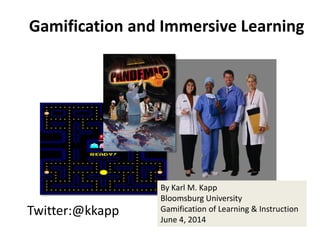
Gamification and Immersive Learning
By Karl M. Kapp
Bloomsburg University
Gamification of Learning & Instruction
June 4, 2014
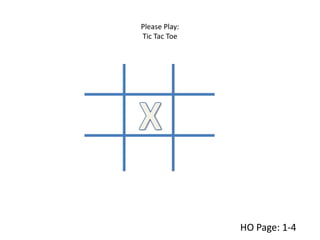
Please Play:
Tic Tac Toe
HO Page: 1-4
Please Play:
Hangman
HO Page: 1-4
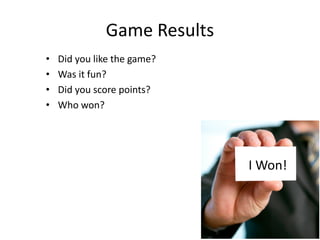
Game Results
• Did you like the game?
• Was it fun?
• Did you score points?
• Who won?
I Won!
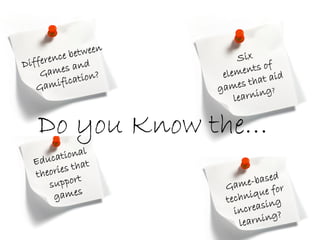
Do you Know the…
Personnel Learning
Objective?
HO Page: 1-5
Brief history of…
The World
We’ve learned and struggled for a few
years here figuring out how to make a
decent phone. PC guys are not going
to just figure this out.
They’re not going to just walk in.
--Palm CEO Ed Colligan, 16 Nov 2006
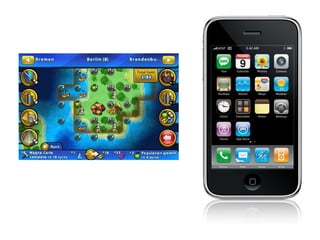
This is our best iPhone launch yet — more than
9 million new iPhones sold — a new record for
first weekend sales—Tim Cook, 2013.
Palm sold to HP in 2010, by 2011
Palm was done.
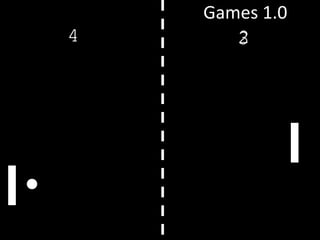
4 2
Games 1.0
3
4
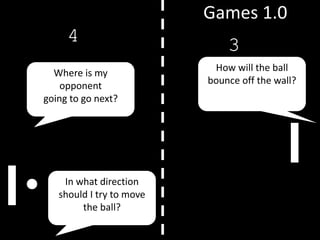
Games 1.0
3
Where is my
opponent
going to go next?
In what direction
should I try to move
the ball?
How will the ball
bounce off the wall?
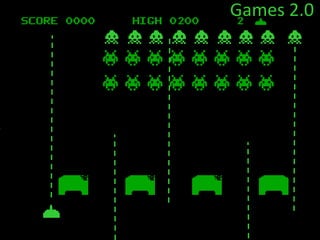
Games 2.0
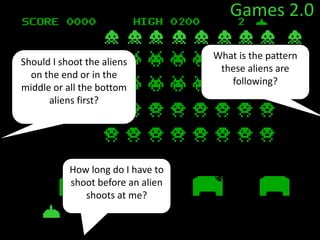
Games 2.0
Should I shoot the aliens
on the end or in the
middle or all the bottom
aliens first?
How long do I have to
shoot before an alien
shoots at me?
What is the pattern
these aliens are
following?
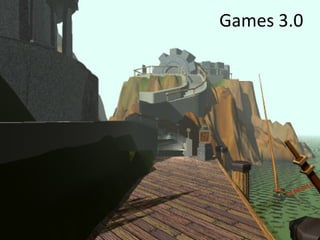
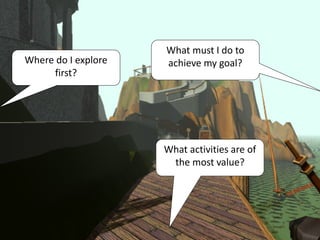
Games 3.0
Where do I explore
first?
What activities are of
the most value?
What must I do to
achieve my goal?
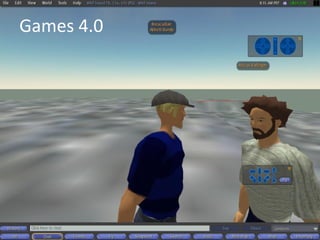
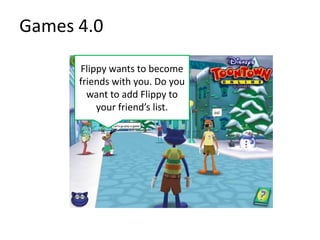
Games 4.0
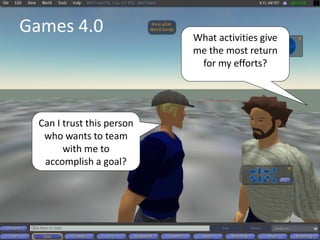
Games 4.0 What activities give
me the most return
for my efforts?
Can I trust this person
who wants to team
with me to
accomplish a goal?
Flippy wants to become
friends with you. Do you
want to add Flippy to
your friend’s list.
Games 4.0
I am going to
need more
coffee.
Not another
online
lecture.
Sorry, had you
on mute, could
you repeat the
question.
New
Instructional
Approaches
are Needed
Let’s Play
Fact or Fishy…
Rules
• A statement is presented
– Choose the best response
• Text Keyword Response:
– To 37607
Take out
your text-
machines
Standard Texting Fees
Apply!
Two Teams
teama teamb
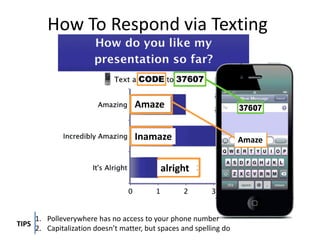
How To Respond via Texting
1. Polleverywhere has no access to your phone number
2. Capitalization doesn’t matter, but spaces and spelling do
TIPS
Amaze
Inamaze
alright
Amaze
Lectures involve…
Attempting to solve
problems or synthesis or
inter-relate content for only
1% of the time.
Is that Fact or Fishy?
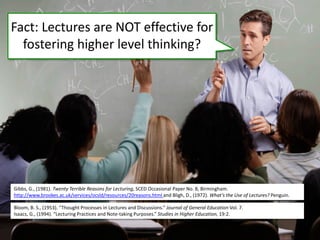
Fact: Lectures are NOT effective for
fostering higher level thinking?
Gibbs, G., (1981). Twenty Terrible Reasons for Lecturing, SCED Occasional Paper No. 8, Birmingham.
http://www.brookes.ac.uk/services/ocsld/resources/20reasons.html and Bligh, D., (1972). What’s the Use of Lectures? Penguin.
Bloom, B. S., (1953). “Thought Processes in Lectures and Discussions.” Journal of General Education Vol. 7.
Isaacs, G., (1994). “Lecturing Practices and Note-taking Purposes.” Studies in Higher Education, 19:2.
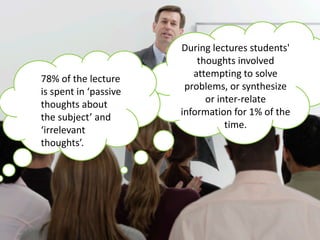
During lectures students'
thoughts involved
attempting to solve
problems, or synthesize
or inter-relate
information for 1% of the
time.
78% of the lecture
is spent in ‘passive
thoughts about
the subject’ and
‘irrelevant
thoughts’.
21 studies found
lecturing to be less
effective than:
discussion, reading
and individual work in
class.
Active learning increases student performance in science, engineering, and mathematics
Scott Freemana,1, Sarah L. Eddya, Miles McDonougha, Michelle K. Smithb, Nnadozie Okoroafora, Hannah Jordta,
and Mary Pat Wenderotha. PNAS Early Edition (Proceedings of the National Academy of Sciences) Approved April 15, 2014
The average child plays
over 10,000 hours worth of
games before graduating
high school.
Is that Fact or Fishy?
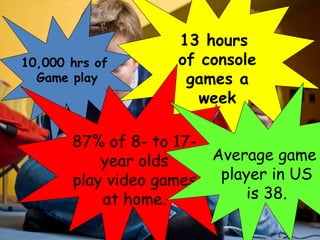
10,000 hrs of
Game play
13 hours
of console
games a
week
Digital divisions. Report by the Pew /Internet: Pew Internet & American Life.
US Department of Commerce
87% of 8- to 17-
year olds
play video games
at home.
Average game
player in US
is 38.
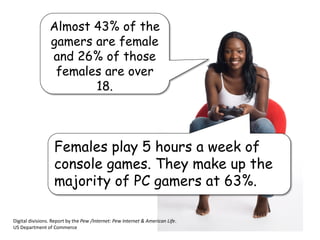
Females play 5 hours a week of
console games. They make up the
majority of PC gamers at 63%.
Almost 43% of the
gamers are female
and 26% of those
females are over
18.
Digital divisions. Report by the Pew /Internet: Pew Internet & American Life.
US Department of Commerce
“Games” and “Gamification”
are the same thing.
Is that Fact or Fishy?
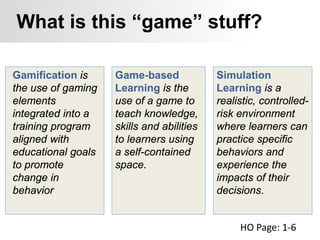
Gamification is
the use of gaming
elements
integrated into a
training program
aligned with
educational goals
to promote
change in
behavior
Game-based
Learning is the
use of a game to
teach knowledge,
skills and abilities
to learners using
a self-contained
space.
What is this “game” stuff?
Simulation
Learning is a
realistic, controlled-
risk environment
where learners can
practice specific
behaviors and
experience the
impacts of their
decisions.
HO Page: 1-6
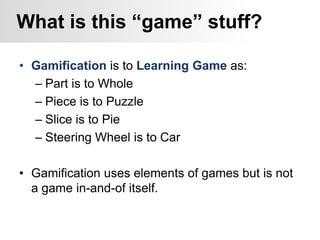
• Gamification is to Learning Game as:
– Part is to Whole
– Piece is to Puzzle
– Slice is to Pie
– Steering Wheel is to Car
• Gamification uses elements of games but is not
a game in-and-of itself.
What is this “game” stuff?
Gamification + Simulation = Learning Game
What is this “game” stuff?
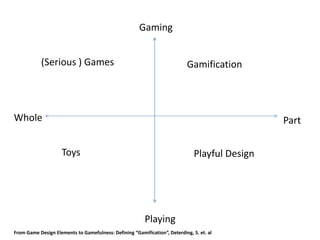
Whole Part
Gaming
Playing
(Serious ) Games Gamification
Toys Playful Design
From Game Design Elements to Gamefulness: Defining “Gamification”, Deterding, S. et. al
Gartner Group predicts by 2015, 40 percent
of Global 1000 organizations will use
gamification as the primary mechanism to
transform business operations.
Gamification as a term was coined in “2002”
Adding points, badges and
leaderboard to any training
makes it awesome!
Is that Fact or Fishy?
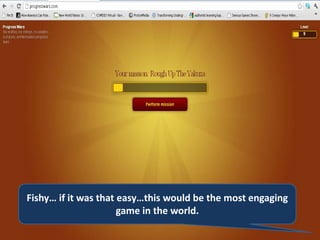
Fishy… if it was that easy…this would be the most engaging
game in the world.
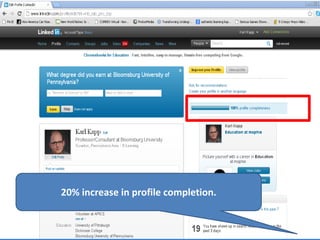
20% increase in profile completion.
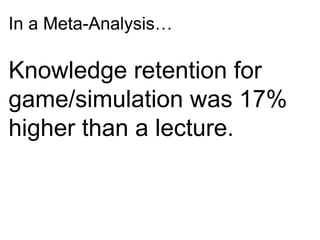
In a Meta-Analysis…
Knowledge retention for
game/simulation was 17%
higher than a lecture.
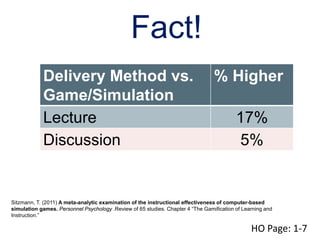
Fact!
Delivery Method vs.
Game/Simulation
% Higher
Lecture 17%
Discussion 5%
Sitzmann, T. (2011) A meta-analytic examination of the instructional effectiveness of computer-based
simulation games. Personnel Psychology .Review of 65 studies. Chapter 4 “The Gamification of Learning and
Instruction.”
HO Page: 1-7
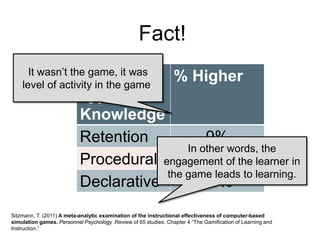
Retention
Type of
Knowledge
% Higher
Retention 9%
Procedural 14%
Declarative 11%
Fact!
It wasn’t the game, it was
level of activity in the game.
In other words, the
engagement of the learner in
the game leads to learning.
Sitzmann, T. (2011) A meta-analytic examination of the instructional effectiveness of computer-based
simulation games. Personnel Psychology .Review of 65 studies. Chapter 4 “The Gamification of Learning and
Instruction.”
Two Types of
Gamification
Structural
Content
HO Page: 1-8
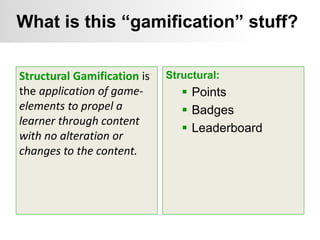
Structural Gamification is
the application of game-
elements to propel a
learner through content
with no alteration or
changes to the content.
Structural:
 Points
 Badges
 Leaderboard
What is this “gamification” stuff?
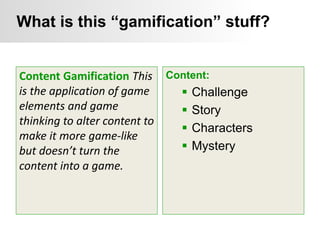
Content Gamification This
is the application of game
elements and game
thinking to alter content to
make it more game-like
but doesn’t turn the
content into a game.
Content:
 Challenge
 Story
 Characters
 Mystery
What is this “gamification” stuff?
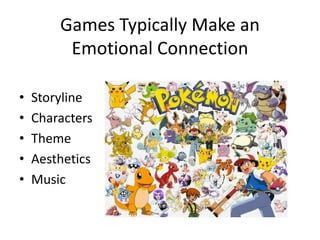
Games Typically Make an
Emotional Connection
• Storyline
• Characters
• Theme
• Aesthetics
• Music
Case Studies Illustrating the
Effectiveness Gamification for
Learning
• Lawley Insurance
– Looking for a strategy to convince the sales team of the
value of salesforce.com and encourage them to use it on a
more consistent basis.
Case: Sales Activity
Lawley Insurance, headquartered in Buffalo, NY is a
independent regional firm of insurance professionals
specializing in property and casualty, employee
benefits, and risk management consulting. Recently,
Lawley was ranked #1 in Business First’s article “The
List” of Western New York Insurance agencies.
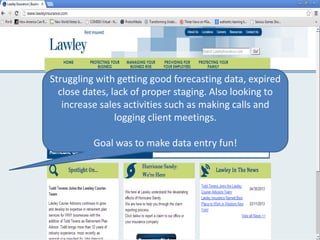
Struggling with getting good forecasting data, expired
close dates, lack of proper staging. Also looking to
increase sales activities such as making calls and
logging client meetings.
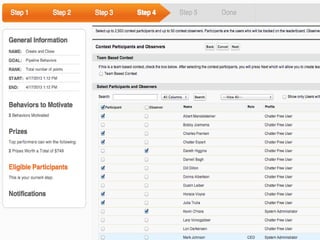
Goal was to make data entry fun!
VENDOR
http://leveleleven.com/
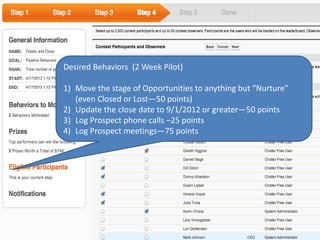
Desired Behaviors (2 Week Pilot)
1) Move the stage of Opportunities to anything but “Nurture”
(even Closed or Lost—50 points)
2) Update the close date to 9/1/2012 or greater—50 points
3) Log Prospect phone calls –25 points
4) Log Prospect meetings—75 points
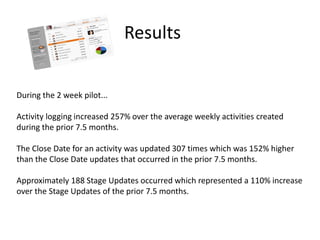
Results
During the 2 week pilot...
Activity logging increased 257% over the average weekly activities created
during the prior 7.5 months.
The Close Date for an activity was updated 307 times which was 152% higher
than the Close Date updates that occurred in the prior 7.5 months.
Approximately 188 Stage Updates occurred which represented a 110% increase
over the Stage Updates of the prior 7.5 months.
References
• Gamifying Activity Logging and Opportunity
Management
– http://www.slideshare.net/leveleleven/lawley-pipeline-and-actvty-
log-contest-presentation
• Top 3 Mistakes in Sales Gamification
– http://www.slideshare.net/leveleleven/lawley-pipeline-and-actvty-
log-contest-presentation
• Make an already successful sales training and
certification program even better with increased
usage, better utilization of existing resources, and by
encouraging informal and formal learning.
Case: Professional Performance
Program (p2p)
Ford of Canada employs over 23,000 individuals in the fields of finance,
sales and marketing, information technology, manufacturing and
engineering, and human resources. This diverse workforce is
responsible for the manufacturing and assembly operations that bring
320,000 vehicles and 425,000 engines to market.
Ford introduced a program themed around professional motor racing
that motivates sales and service representatives to learn more by
browsing the p2p portal, watching informational videos, downloading
and consuming the latest product information, and taking web courses.
VENDOR
http://www.bunchball.com/
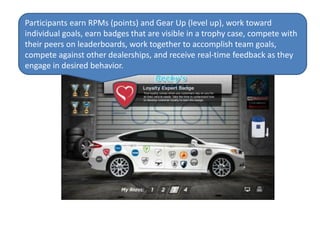
Participants earn RPMs (points) and Gear Up (level up), work toward
individual goals, earn badges that are visible in a trophy case, compete with
their peers on leaderboards, work together to accomplish team goals,
compete against other dealerships, and receive real-time feedback as they
engage in desired behavior.
Site Results
Received a 417% increase in site usage vs. the same period the previous year
Within the first three months of the program the site exceeded the traffic
volume of the entire previous year
15% more unique visitors and a 30% increase in unique visits vs. the same
period the previous year
An increase in volunteer learning –participants completing courses above and
beyond what they were required to do for their annual certification
requirements
A positive correlation between engagement in the Ford p2p Cup and key
performance measures including sales and customer satisfaction
• Engage busy executives in a training program
spanning more than 150 countries.
Case: Deloitte Leadership Academy
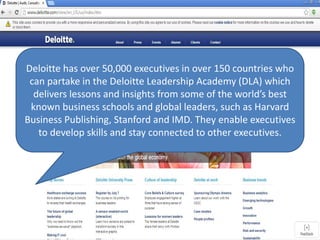
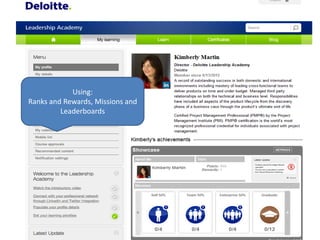
Deloitte has over 50,000 executives in over 150 countries who
can partake in the Deloitte Leadership Academy (DLA) which
delivers lessons and insights from some of the world’s best
known business schools and global leaders, such as Harvard
Business Publishing, Stanford and IMD. They enable executives
to develop skills and stay connected to other executives.
Challenge was how to get executives to take valuable time
out of their busy schedules to actually sit down and fully
engage with the content.
VENDOR
http://badgeville.com/
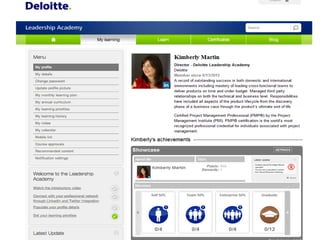
Using:
Ranks and Rewards, Missions and
Leaderboards
Site Results
+46.6% users return daily
+36.3% of users return weekly
Active users had an average of 3 achievements unlocked in first 3 months
Top users earned as many as 30 achievements in first 3 months
The Quest for
Learner
Engagement
Design Takeaway Challenge
Rules
• A statement is presented
– Type in “Code word”
• Text Response:
Take out
your text-
machines
Standard Texting Fees
Apply!
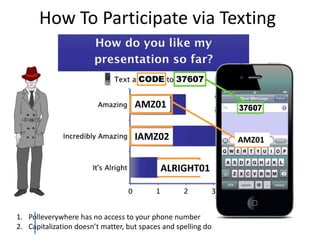
How To Participate via Texting
1. Polleverywhere has no access to your phone number
2. Capitalization doesn’t matter, but spaces and spelling do
AMZ01
IAMZ02
ALRIGHT01
AMZ01
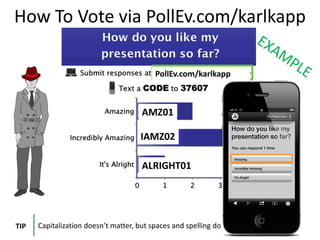
How To Vote via PollEv.com/karlkapp
Capitalization doesn’t matter, but spaces and spelling doTIP
AMZ01
IAMZ02
ALRIGHT01
PollEv.com/karlkapp
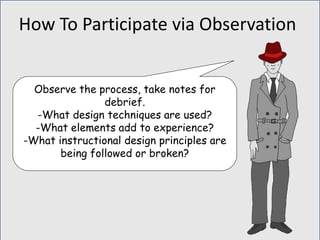
Observe the process, take notes for
debrief.
-What design techniques are used?
-What elements add to experience?
-What instructional design principles are
being followed or broken?
How To Participate via Observation
Summer Theatre
and
Karl M. Kapp
Present:
The Quest
for:
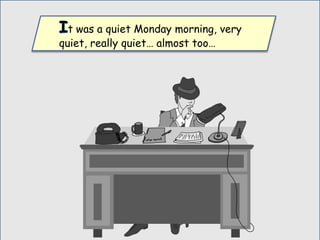
t was a quiet Monday morning, very
quiet, really quiet… almost too…
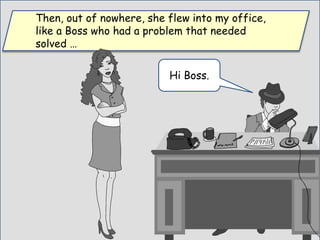
Then, out of nowhere, she flew into my office,
like a Boss who had a problem that needed
solved …
Hi Boss.
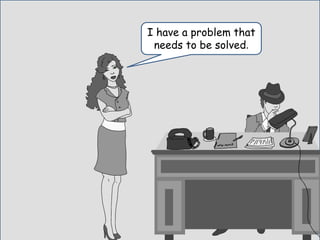
I have a problem that
needs to be solved.
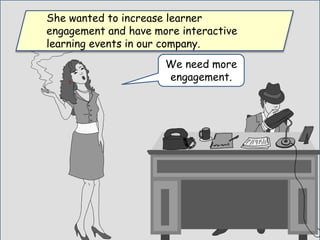
We need more
engagement.
She wanted to increase learner
engagement and have more interactive
learning events in our company.
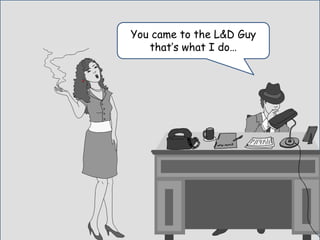
You came to the L&D Guy
that’s what I do…
Yeah, I know…that’s
why I hired you. Ugh..
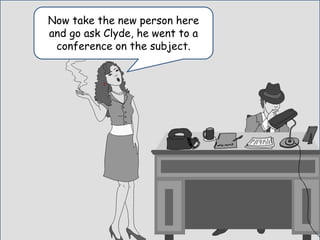
Now take the new person here
and go ask Clyde, he went to a
conference on the subject.
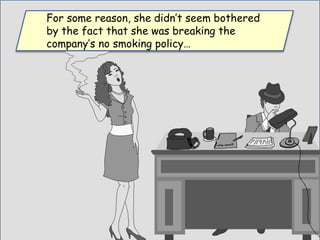
For some reason, she didn’t seem bothered
by the fact that she was breaking the
company’s no smoking policy…
Here’s where you come in. Help me figure
out the clues …and fast.
Choose your disguise…
Stakes are high……
First stop…Clyde’s office…look for clues
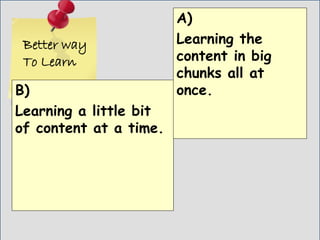
Better way
To Learn
B)
Learning a little bit
of content at a time.
A)
Learning the
content in big
chunks all at
once.
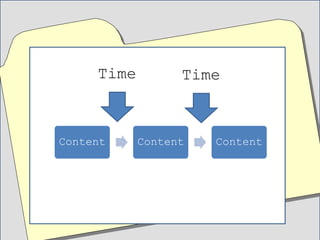
Content Content Content
Time Time
Space learning out in small chunks
over time, 24 hours is the optimal
spacing. Break up content in
classroom every 8-10 minutes.
Some call it “drip learning.”
A study using a randomized control group
conducted a trial between Aug 10, 2009, and Nov
30, 2012, at ten sites in southeast India with
over 500 subjects.
Working Indian men (aged 35—55 years) with
impaired glucose tolerance were randomly
assigned to either a mobile phone messaging
intervention or standard care..
Ramachandran, A. et. al. Effectiveness of mobile phone messaging in prevention of type 2 diabetes by lifestyle modification in men in
India: a prospective, parallel-group, randomised controlled trial The Lancet Diabetes & Endocrinology, Early Online Publication, 11
September 2013 doi:10.1016/S2213-8587(13)70067-6
Ramachandran, A., et. al.., Effectiveness of mobile phone messaging in prevention of type 2 diabetes by lifestyle modification in men in
India: a prospective, parallel-group, randomised controlled trial The Lancet Diabetes & Endocrinology, Early Online Publication, 11
September 2013 doi:10.1016/S2213-8587(13)70067-6
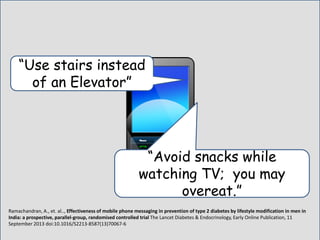
“Avoid snacks while
watching TV; you may
overeat.”
“Use stairs instead
of an Elevator”
Lowered risk of developing
Type 2 diabetes by 36%.
Ramachandran, A., et. al.., Effectiveness of mobile phone messaging in prevention of type 2 diabetes by lifestyle modification in men in
India: a prospective, parallel-group, randomised controlled trial The Lancet Diabetes & Endocrinology, Early Online Publication, 11
September 2013 doi:10.1016/S2213-8587(13)70067-6
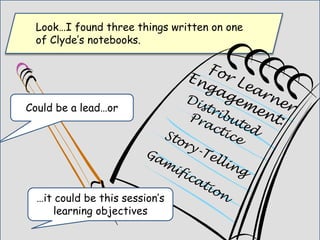
Look…I found three things written on one
of Clyde’s notebooks.
Could be a lead…or
…it could be this session’s
learning objectives
Let’s get going.
Now we need to find Ivan…the Informant...
I knew one of his old haunts.
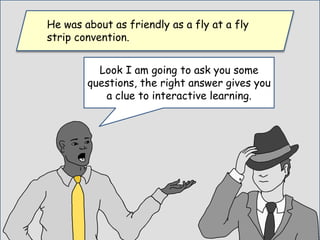
He was about as friendly as a fly at a fly
strip convention.
Hello, Clueless…
Look I am going to ask you some
questions, the right answer gives you
a clue to interactive learning.
He was about as friendly as a fly at a fly
strip convention.
What do you and your lackies here have to
say about this?
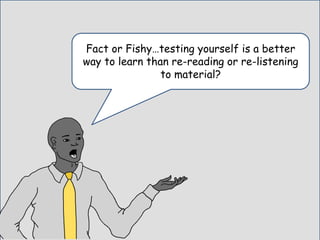
Fact or Fishy…testing yourself is a better
way to learn than re-reading or re-listening
to material?
Enter Question Text
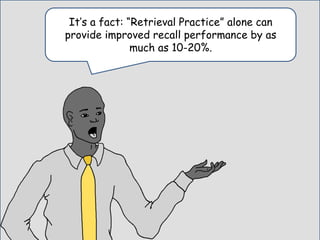
It’s a fact: “Retrieval Practice” alone can
provide improved recall performance by as
much as 10-20%.
Require students to recall content
to enhance learning.
In other words, use testing to
reinforce learning—not just for
evaluation.
Combining Spaced Retrieval and
Retrieval Practice is really
powerful.
One study in the subject of Anatomy and
Physiology revealed retention benefits of
between 35% and 61% with average of
41%.
Dobson, J. L. (2013) Retrieval practice is an efficient method of enhancing the retention of anatomy
and physiology information Advances in Physiology Education 37: 184–191, 2013;
doi:10.1152/advan.00174.2012
Ivan then grabbed his computer to show me an
example.
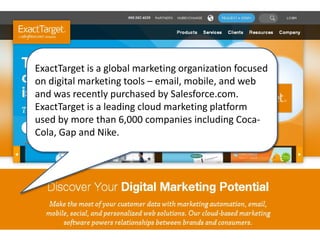
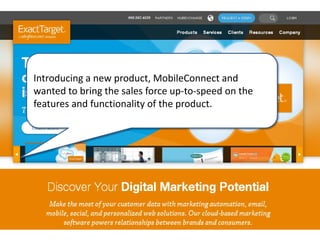
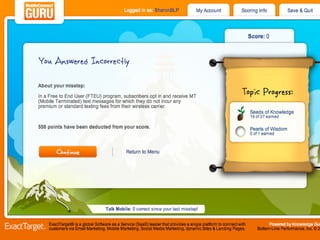
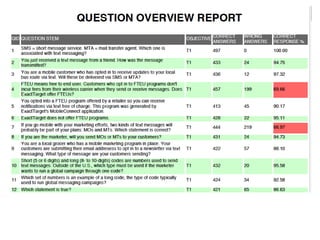
ExactTarget is a global marketing organization focused
on digital marketing tools – email, mobile, and web
and was recently purchased by Salesforce.com.
ExactTarget is a leading cloud marketing platform
used by more than 6,000 companies including Coca-
Cola, Gap and Nike.
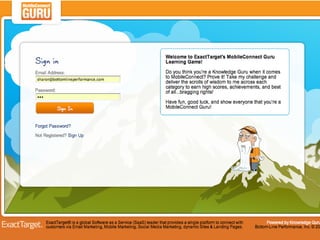
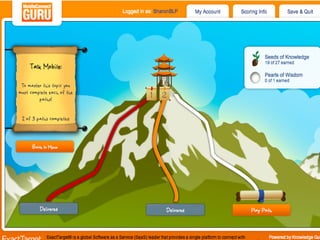
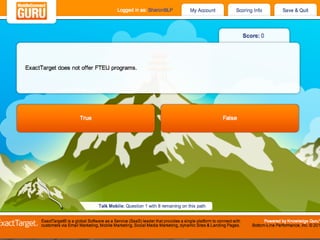
Introducing a new product, MobileConnect and
wanted to bring the sales force up-to-speed on the
features and functionality of the product.
VENDOR
http://www.theknowledgeguru.com/
Screen captures courtesy of The Knowledge
Guru…Bottom Line Performance
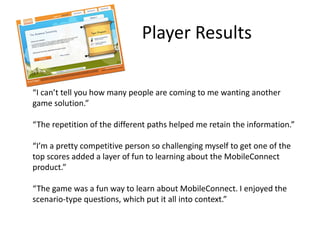
“I can’t tell you how many people are coming to me wanting another
game solution.”
“The repetition of the different paths helped me retain the information.”
“I’m a pretty competitive person so challenging myself to get one of the
top scores added a layer of fun to learning about the MobileConnect
product.”
“The game was a fun way to learn about MobileConnect. I enjoyed the
scenario-type questions, which put it all into context.”
Player Results
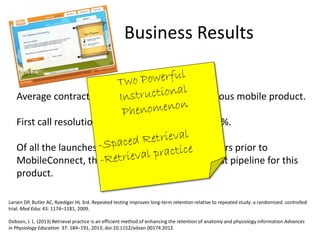
Business Results
Average contract value 2x higher than for previous mobile product.
First call resolution ($35 a call/average) is up 45%.
Of all the launches done in the previous two years prior to
MobileConnect, the sales team built the quickest pipeline for this
product.
Business Results
Average contract value 2x higher than for previous mobile product.
First call resolution ($35 a call/average) is up 45%.
Of all the launches done in the previous two years prior to
MobileConnect, the sales team built the quickest pipeline for this
product.
Larsen DP, Butler AC, Roediger HL 3rd. Repeated testing improves long-term retention relative to repeated study: a randomized controlled
trial. Med Educ 43: 1174–1181, 2009.
Dobson, J. L. (2013) Retrieval practice is an efficient method of enhancing the retention of anatomy and physiology information Advances
in Physiology Education 37: 184–191, 2013; doi:10.1152/advan.00174.2012.
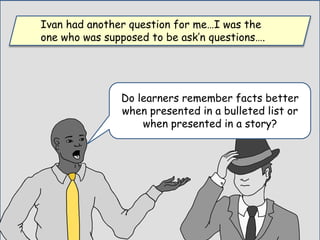
Ivan had another question for me…I was the
one who was supposed to be ask’n questions….
Do learners remember facts better
when presented in a bulleted list or
when presented in a story?
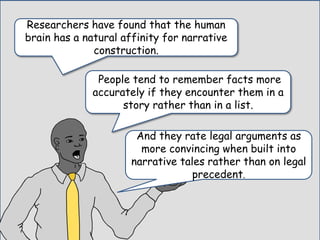
Researchers have found that the human
brain has a natural affinity for narrative
construction.
People tend to remember facts more
accurately if they encounter them in a
story rather than in a list.
And they rate legal arguments as
more convincing when built into
narrative tales rather than on legal
precedent.
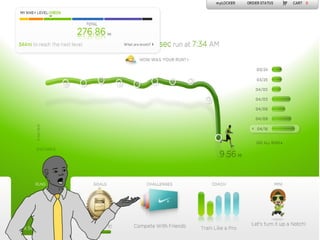
Again with the computer….
Thanks, Ivan.One more thing…
Add character’s to your
learning designs…
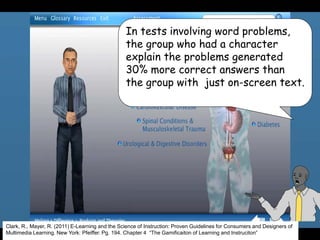
In tests involving word problems,
the group who had a character
explain the problems generated
30% more correct answers than
the group with just on-screen text.
Clark, R., Mayer, R. (2011) E-Learning and the Science of Instruction: Proven Guidelines for Consumers and Designers of
Multimedia Learning. New York: Pfeiffer. Pg. 194. Chapter 4 “The Gamificaiton of Learning and Instruciton”
Clark, R., Mayer, R. (2011) E-Learning and the Science of Instruction: Proven Guidelines for Consumers and Designers of
Multimedia Learning. New York: Pfeiffer. Pg. 194. Chapter 4 “The Gamificaiton of Learning and Instruciton”
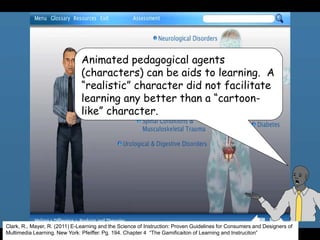
Animated pedagogical agents
(characters) can be aids to learning. A
“realistic” character did not facilitate
learning any better than a “cartoon-
like” character.
This mystery of interactive learning was
starting to take shape…
Let’s brief the boss on what we know so far…
So what have we
learned?
So far, so good. Follow the next clue on the
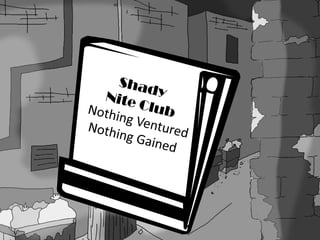
matchbook I found in my desk drawer….
I arrived at the place on the matchbook, as
shady as a clump of oaks caught in an eclipse…
Enter Question TextHmm… What could this location and clue mean???
Tell me. Does engaging instruction start with:
Action draws in the learner and
encourages further engagement.
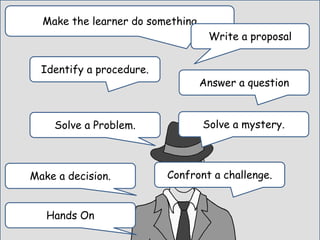
Make the learner do something
Answer a question
Identify a procedure.
Make a decision.
Solve a mystery.
Confront a challenge.
Solve a Problem.
Write a proposal
Hands On
Law &
Order
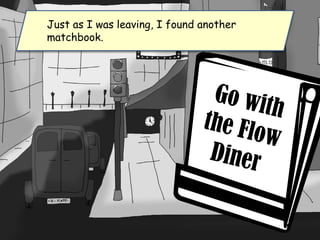
Just as I was leaving, I found another
matchbook.
Seems like a clue…should
Learning be easy so we don’t discourage the
learners?
or
Challenging where some learners will struggle?
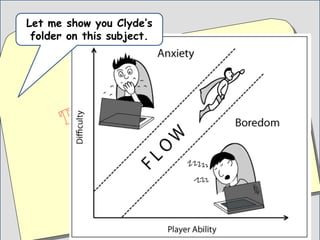
Look! Things that are too easy or too difficult will
not pique a learner’s interest because they lead to
boredom or frustration.
Let me show you Clyde’s
folder on this subject.
Do you know what
elements contribute to
flow?
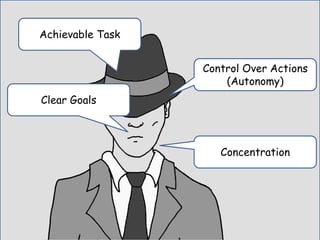
Achievable Task
Clear Goals
Control Over Actions
(Autonomy)
Concentration
You can also add elements such as …
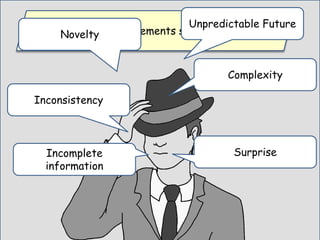
You can also add elements such as …Novelty
Inconsistency
Complexity
SurpriseIncomplete
information
Unpredictable Future
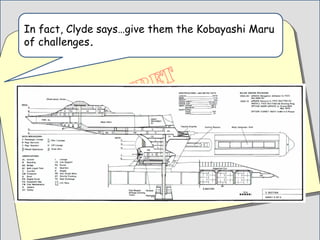
In fact, Clyde says…give them the Kobayashi Maru
of challenges.
Suddenly, a voice appeared out of
nowhere…the mysterious Learning Lady
I saw her eyes in the shadows of the alley and
she simply said…
Consider the use of fantasy in
constructing learning events….
Ya’h sure about this
“fantasy” thing? This
make believe stuff?
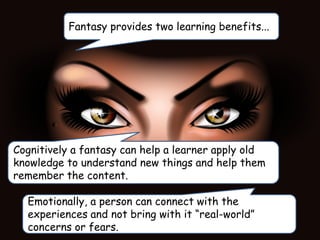
Fantasy provides two learning benefits...
Cognitively a fantasy can help a learner apply old
knowledge to understand new things and help them
remember the content.
Emotionally, a person can connect with the
experiences and not bring with it “real-world”
concerns or fears.
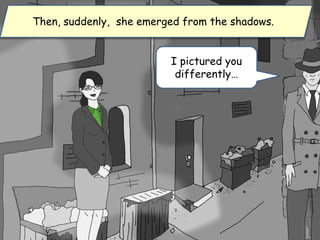
Then, suddenly, she emerged from the shadows.
I pictured you
differently…
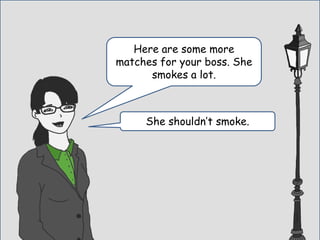
Here are some more
matches for your boss. She
smokes a lot.
She shouldn’t smoke.
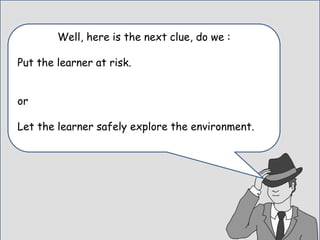
Well, here is the next clue, do we :
Put the learner at risk.
or
Let the learner safely explore the environment.
No risk, or danger equal no skin in the
game.
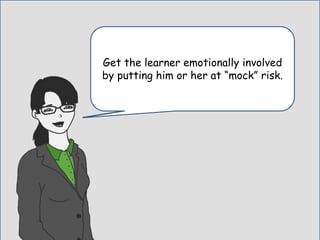
Get the learner emotionally involved
by putting him or her at “mock” risk.
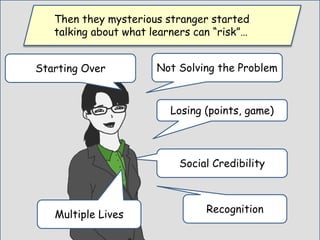
Losing (points, game)
Not Solving the Problem
Social Credibility
Recognition
Then they mysterious stranger started
talking about what learners can “risk”…
Starting Over
Multiple Lives
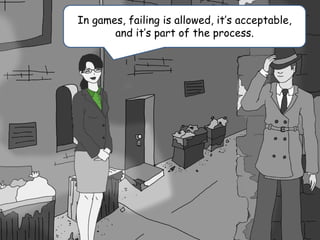
In games, failing is allowed, it’s acceptable,
and it’s part of the process.
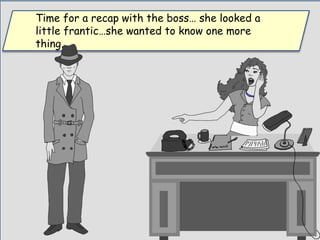
Time for a recap with the boss… she looked a
little frantic…she wanted to know one more
thing.
I want to know one more
thing.
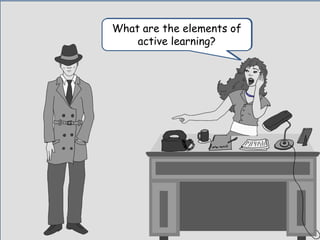
What are the elements of
active learning?
What are some active learning
practices that can engage
learners?
Any Others?
Great stuff, you folks really seemed to have
cracked the case as to what makes engaging
learning.
Mystery solved, just in time for the
weekend. I was anxious to get some rest…
But…to my surprise as the Boss was driving
away, she threw another matchbook….
Unfortunately, we’ll have to leave that
mystery for later….
The End
Design Takeaway
Challenge.
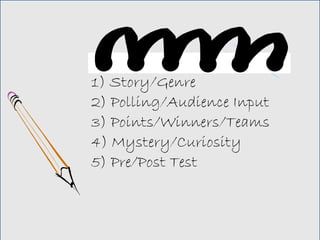
1) Story/Genre
2) Polling/Audience Input
3) Points/Winners/Teams
4) Mystery/Curiosity
5) Pre/Post Test
QUESTIONS?
Credits:
Detective Artwork Courtesy of Vanessa Bailey
Flow Diagram by Kristin Bittner
Typewriter and Mysterious Eyes are Clip Art
Audience Response by Poll Everywhere
Demo of Gamification Software by MindTickle
Covert Takeaways
• Learning should be engaging.
• Stories provide a context for learning.
• It is ok for a learner to struggle.
• Simply adding points, badges and
leaderboards does not make learning
effective.
Game Dynamics Exercise
Sample Dynamic
• Strategy Games (Type of Game Category)
– Examples: Stratego (analog)
– Civilization V (digital)
• Game Dynamic?
– Outwit Opponent
Sample Dynamic
• Strategy Games (Type of Game Category)
– Examples:
• Game Dynamic?
Sample Dynamic (Your Turn)
• Type of Game Category
– Examples: (analog)
– Examples: (digital)
• Game Dynamic?
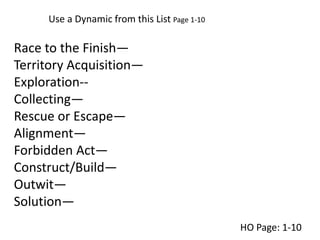
Race to the Finish—
Territory Acquisition—
Exploration--
Collecting—
Rescue or Escape—
Alignment—
Forbidden Act—
Construct/Build—
Outwit—
Solution—
Use a Dynamic from this List Page 1-10
HO Page: 1-10
Twitter:@kkapp
Gamification of Learning and Instruction
Session Five
1
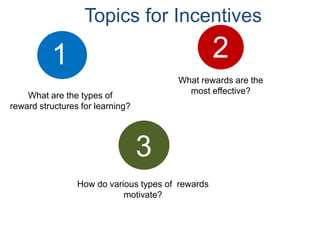
Topics for Incentives
What rewards are the
most effective?
What are the types of
reward structures for learning?
2
3
How do various types of rewards
motivate?
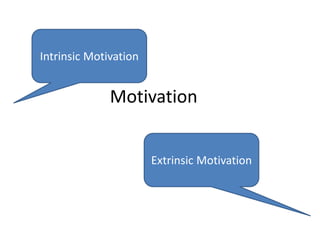
Motivation
Intrinsic Motivation
Extrinsic Motivation
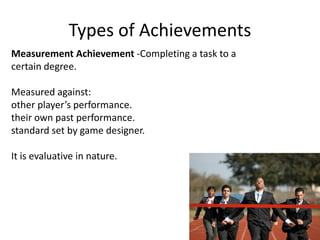
Types of Achievements
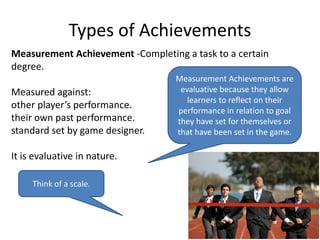
Measurement Achievement -Completing a task to a
certain degree.
Measured against:
other player’s performance.
their own past performance.
standard set by game designer.
It is evaluative in nature.
Types of Achievements
Measurement Achievement -Completing a task to a certain
degree.
Measured against:
other player’s performance.
their own past performance.
standard set by game designer.
It is evaluative in nature.
Measurement Achievements are
evaluative because they allow
learners to reflect on their
performance in relation to goal
they have set for themselves or
that have been set in the game.
Think of a scale.
Types of Achievements
Completion Achievement -Completing a task.
Does not tell a learner how well they have done.
Primarily binary—you’ve completed a task or you haven’t
Best Practice
Use measurement achievements instead
of completion achievements to increase
Intrinsic motivation through feedback.
Types of Task
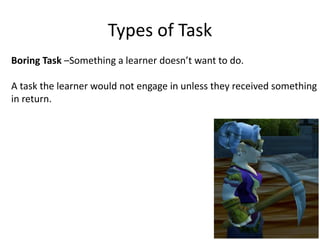
Boring Task –Something a learner doesn’t want to do.
A task the learner would not engage in unless they received something
in return.
Type of Task
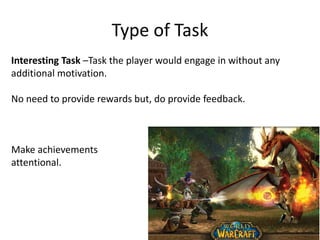
Interesting Task –Task the player would engage in without any
additional motivation.
No need to provide rewards but, do provide feedback.
Make achievements
attentional.
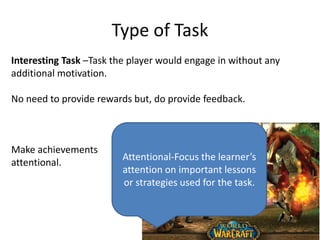
Type of Task
Interesting Task –Task the player would engage in without any
additional motivation.
No need to provide rewards but, do provide feedback.
Make achievements
attentional.
Attentional-Focus the learner’s
attention on important lessons
or strategies used for the task.
Best Practice
Reward players for boring tasks and give
them feedback for interesting tasks.
Make achievements for interesting tasks
attentional.
www.gadgetsgamesandgizmos.
com
© Karl M. Kapp 2007
Feel free to use but please site source and
book
Yes, you picked
correctly, you recive
the X-Ray Award
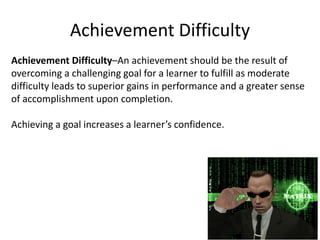
Achievement Difficulty
Achievement Difficulty–An achievement should be the result of
overcoming a challenging goal for a learner to fulfill as moderate
difficulty leads to superior gains in performance and a greater sense
of accomplishment upon completion.
Achieving a goal increases a learner’s confidence.
Achievement Difficulty
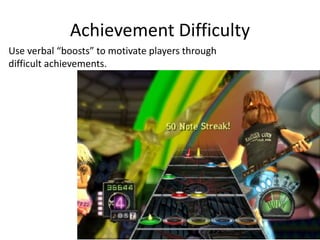
Use verbal “boosts” to motivate players through
difficult achievements.
Best Practice
Make achievements challenging for the
greatest returns in learner performance
and learning. Phrase achievements and
design interaction to increase player
confidence and reflection on task.
Goal Orientation
Performance Orientation – Learners who favor performance
orientation are concerned with other people’s assessment of
their competence.
These are direct goals like time and points earned.
This tends to result in less risk-taking and less in-game
exploration.
When individuals are given performance-oriented goals, they
typically perform better only with simple, non-complex tasks.
Goal Orientation
Mastery Orientation – Learners who favor mastery orientation are
concerned with improving their proficiency.
Learner’s with this mindset will accept errors and seek challenging
task that provide them with an opportunity to develop their
competences.
Goal Orientation
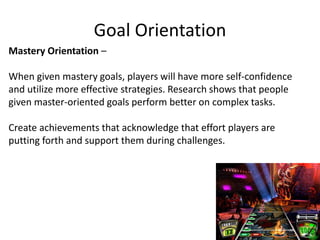
Mastery Orientation –
When given mastery goals, players will have more self-confidence
and utilize more effective strategies. Research shows that people
given master-oriented goals perform better on complex tasks.
Create achievements that acknowledge that effort players are
putting forth and support them during challenges.
Best Practice
For learning tasks requiring creativity or
complicated strategies, instill mastery
orientation.
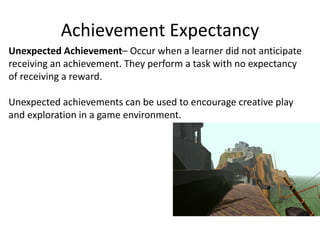
Achievement Expectancy
Unexpected Achievement– Occur when a learner did not anticipate
receiving an achievement. They perform a task with no expectancy
of receiving a reward.
Unexpected achievements can be used to encourage creative play
and exploration in a game environment.
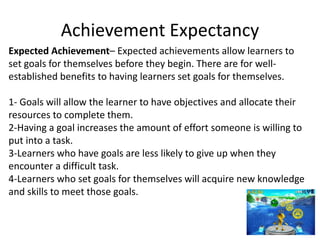
Achievement Expectancy
Expected Achievement– Expected achievements allow learners to
set goals for themselves before they begin. There are for well-
established benefits to having learners set goals for themselves.
1- Goals will allow the learner to have objectives and allocate their
resources to complete them.
2-Having a goal increases the amount of effort someone is willing to
put into a task.
3-Learners who have goals are less likely to give up when they
encounter a difficult task.
4-Learners who set goals for themselves will acquire new knowledge
and skills to meet those goals.
Best Practice
Primarily use expected achievements so players
can establish goals for themselves and create a
schema of the game (information to be learned).
Make sure achievement descriptions accurately
reflect what needs to be done by the player and
what is important.
Negative Achievements
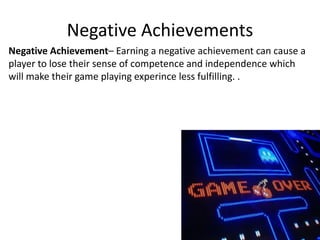
Negative Achievement– Earning a negative achievement can cause a
player to lose their sense of competence and independence which
will make their game playing experince less fulfilling. .
Best Practice
Don’t use negative achievements as a
punishment for failure. Provide feedback
within the system that can assist
struggling players.
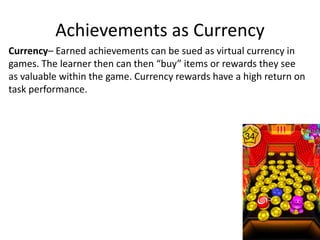
Achievements as Currency
Currency– Earned achievements can be sued as virtual currency in
games. The learner then can then “buy” items or rewards they see
as valuable within the game. Currency rewards have a high return on
task performance.
Best Practice
Offer players currency for completing
tasks instead of rewards to give them a
greater sense of control. Use a currency
system to enhance a game, but be
careful that currency acquisition doesn’t
become the main reason the learners
play the game.
Incremental & Meta Achievements
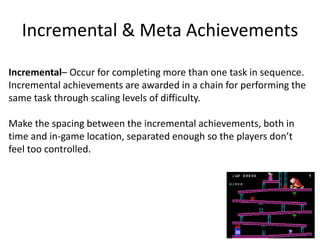
Incremental– Occur for completing more than one task in sequence.
Incremental achievements are awarded in a chain for performing the
same task through scaling levels of difficulty.
Make the spacing between the incremental achievements, both in
time and in-game location, separated enough so the players don’t
feel too controlled.
Incremental & Meta Achievements
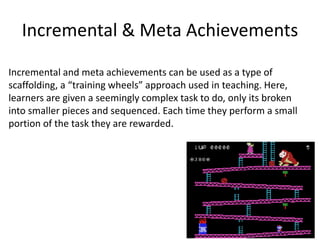
Incremental and meta achievements can be used as a type of
scaffolding, a “training wheels” approach used in teaching. Here,
learners are given a seemingly complex task to do, only its broken
into smaller pieces and sequenced. Each time they perform a small
portion of the task they are rewarded.
Best Practice
Use incremental and meta achievements
to hold the learner’s interest for longer
period of time and guide them to related
activities.
Cooperative Achievements
Cooperative Achievements – Earned by learners working toward a
goal together. Cooperative environments have been associated with
academic achievement increased self-esteem and higher positivity
when evaluating peers.
A good way to do this is to encourage experienced learners to help
novices within the game.
Cooperative Achievements
The metrics used for earning achievements should assess individual
performances within the group setting.
The groups should be kept relatively small to decrease social loafing
and process loss.
Best Practice
To foster a cooperative environment,
offering achievements for more
advanced learners to assist less
experienced learners should be
considered as an option. Keep groups
small.
Summary
• Type of Achievement,
• Achievement Difficulty
• Goal Orientation
• Expected or Unexpected
• Achievement as Currency,
• Don’t Use Negative Achievements,
• Incremental and Meta-achievement
• Cooperative Achievements.

Gamification and Immersive Learning

  • 1.
    Twitter:@kkapp Gamification and ImmersiveLearning By Karl M. Kapp Bloomsburg University Gamification of Learning & Instruction June 4, 2014
  • 2.
    Please Play: Tic TacToe HO Page: 1-4
  • 3.
  • 4.
    Game Results • Didyou like the game? • Was it fun? • Did you score points? • Who won? I Won!
  • 5.
  • 6.
  • 7.
  • 11.
    We’ve learned andstruggled for a few years here figuring out how to make a decent phone. PC guys are not going to just figure this out. They’re not going to just walk in. --Palm CEO Ed Colligan, 16 Nov 2006
  • 12.
    This is ourbest iPhone launch yet — more than 9 million new iPhones sold — a new record for first weekend sales—Tim Cook, 2013. Palm sold to HP in 2010, by 2011 Palm was done.
  • 13.
  • 14.
    4 Games 1.0 3 Where ismy opponent going to go next? In what direction should I try to move the ball? How will the ball bounce off the wall?
  • 15.
  • 16.
    Games 2.0 Should Ishoot the aliens on the end or in the middle or all the bottom aliens first? How long do I have to shoot before an alien shoots at me? What is the pattern these aliens are following?
  • 17.
  • 19.
    Where do Iexplore first? What activities are of the most value? What must I do to achieve my goal?
  • 20.
  • 21.
    Games 4.0 Whatactivities give me the most return for my efforts? Can I trust this person who wants to team with me to accomplish a goal?
  • 22.
    Flippy wants tobecome friends with you. Do you want to add Flippy to your friend’s list. Games 4.0
  • 26.
    I am goingto need more coffee.
  • 27.
  • 28.
    Sorry, had you onmute, could you repeat the question.
  • 29.
  • 30.
  • 31.
    Rules • A statementis presented – Choose the best response • Text Keyword Response: – To 37607 Take out your text- machines Standard Texting Fees Apply!
  • 32.
  • 33.
    How To Respondvia Texting 1. Polleverywhere has no access to your phone number 2. Capitalization doesn’t matter, but spaces and spelling do TIPS Amaze Inamaze alright Amaze
  • 34.
    Lectures involve… Attempting tosolve problems or synthesis or inter-relate content for only 1% of the time. Is that Fact or Fishy?
  • 35.
    Fact: Lectures areNOT effective for fostering higher level thinking? Gibbs, G., (1981). Twenty Terrible Reasons for Lecturing, SCED Occasional Paper No. 8, Birmingham. http://www.brookes.ac.uk/services/ocsld/resources/20reasons.html and Bligh, D., (1972). What’s the Use of Lectures? Penguin. Bloom, B. S., (1953). “Thought Processes in Lectures and Discussions.” Journal of General Education Vol. 7. Isaacs, G., (1994). “Lecturing Practices and Note-taking Purposes.” Studies in Higher Education, 19:2.
  • 36.
    During lectures students' thoughtsinvolved attempting to solve problems, or synthesize or inter-relate information for 1% of the time. 78% of the lecture is spent in ‘passive thoughts about the subject’ and ‘irrelevant thoughts’.
  • 37.
    21 studies found lecturingto be less effective than: discussion, reading and individual work in class.
  • 38.
    Active learning increasesstudent performance in science, engineering, and mathematics Scott Freemana,1, Sarah L. Eddya, Miles McDonougha, Michelle K. Smithb, Nnadozie Okoroafora, Hannah Jordta, and Mary Pat Wenderotha. PNAS Early Edition (Proceedings of the National Academy of Sciences) Approved April 15, 2014
  • 39.
    The average childplays over 10,000 hours worth of games before graduating high school. Is that Fact or Fishy?
  • 40.
    10,000 hrs of Gameplay 13 hours of console games a week Digital divisions. Report by the Pew /Internet: Pew Internet & American Life. US Department of Commerce 87% of 8- to 17- year olds play video games at home. Average game player in US is 38.
  • 41.
    Females play 5hours a week of console games. They make up the majority of PC gamers at 63%. Almost 43% of the gamers are female and 26% of those females are over 18. Digital divisions. Report by the Pew /Internet: Pew Internet & American Life. US Department of Commerce
  • 42.
    “Games” and “Gamification” arethe same thing. Is that Fact or Fishy?
  • 44.
    Gamification is the useof gaming elements integrated into a training program aligned with educational goals to promote change in behavior Game-based Learning is the use of a game to teach knowledge, skills and abilities to learners using a self-contained space. What is this “game” stuff? Simulation Learning is a realistic, controlled- risk environment where learners can practice specific behaviors and experience the impacts of their decisions. HO Page: 1-6
  • 45.
    • Gamification isto Learning Game as: – Part is to Whole – Piece is to Puzzle – Slice is to Pie – Steering Wheel is to Car • Gamification uses elements of games but is not a game in-and-of itself. What is this “game” stuff?
  • 46.
    Gamification + Simulation= Learning Game What is this “game” stuff?
  • 47.
    Whole Part Gaming Playing (Serious )Games Gamification Toys Playful Design From Game Design Elements to Gamefulness: Defining “Gamification”, Deterding, S. et. al
  • 48.
    Gartner Group predictsby 2015, 40 percent of Global 1000 organizations will use gamification as the primary mechanism to transform business operations. Gamification as a term was coined in “2002”
  • 49.
    Adding points, badgesand leaderboard to any training makes it awesome! Is that Fact or Fishy?
  • 50.
    Fishy… if itwas that easy…this would be the most engaging game in the world.
  • 51.
    20% increase inprofile completion.
  • 52.
    In a Meta-Analysis… Knowledgeretention for game/simulation was 17% higher than a lecture.
  • 53.
    Fact! Delivery Method vs. Game/Simulation %Higher Lecture 17% Discussion 5% Sitzmann, T. (2011) A meta-analytic examination of the instructional effectiveness of computer-based simulation games. Personnel Psychology .Review of 65 studies. Chapter 4 “The Gamification of Learning and Instruction.” HO Page: 1-7
  • 54.
    Retention Type of Knowledge % Higher Retention9% Procedural 14% Declarative 11% Fact! It wasn’t the game, it was level of activity in the game. In other words, the engagement of the learner in the game leads to learning. Sitzmann, T. (2011) A meta-analytic examination of the instructional effectiveness of computer-based simulation games. Personnel Psychology .Review of 65 studies. Chapter 4 “The Gamification of Learning and Instruction.”
  • 55.
  • 56.
    Structural Gamification is theapplication of game- elements to propel a learner through content with no alteration or changes to the content. Structural:  Points  Badges  Leaderboard What is this “gamification” stuff?
  • 57.
    Content Gamification This isthe application of game elements and game thinking to alter content to make it more game-like but doesn’t turn the content into a game. Content:  Challenge  Story  Characters  Mystery What is this “gamification” stuff?
  • 58.
    Games Typically Makean Emotional Connection • Storyline • Characters • Theme • Aesthetics • Music
  • 59.
    Case Studies Illustratingthe Effectiveness Gamification for Learning
  • 60.
    • Lawley Insurance –Looking for a strategy to convince the sales team of the value of salesforce.com and encourage them to use it on a more consistent basis. Case: Sales Activity
  • 62.
    Lawley Insurance, headquarteredin Buffalo, NY is a independent regional firm of insurance professionals specializing in property and casualty, employee benefits, and risk management consulting. Recently, Lawley was ranked #1 in Business First’s article “The List” of Western New York Insurance agencies.
  • 63.
    Struggling with gettinggood forecasting data, expired close dates, lack of proper staging. Also looking to increase sales activities such as making calls and logging client meetings. Goal was to make data entry fun!
  • 64.
  • 66.
    Desired Behaviors (2Week Pilot) 1) Move the stage of Opportunities to anything but “Nurture” (even Closed or Lost—50 points) 2) Update the close date to 9/1/2012 or greater—50 points 3) Log Prospect phone calls –25 points 4) Log Prospect meetings—75 points
  • 68.
    Results During the 2week pilot... Activity logging increased 257% over the average weekly activities created during the prior 7.5 months. The Close Date for an activity was updated 307 times which was 152% higher than the Close Date updates that occurred in the prior 7.5 months. Approximately 188 Stage Updates occurred which represented a 110% increase over the Stage Updates of the prior 7.5 months.
  • 69.
    References • Gamifying ActivityLogging and Opportunity Management – http://www.slideshare.net/leveleleven/lawley-pipeline-and-actvty- log-contest-presentation • Top 3 Mistakes in Sales Gamification – http://www.slideshare.net/leveleleven/lawley-pipeline-and-actvty- log-contest-presentation
  • 70.
    • Make analready successful sales training and certification program even better with increased usage, better utilization of existing resources, and by encouraging informal and formal learning. Case: Professional Performance Program (p2p)
  • 72.
    Ford of Canadaemploys over 23,000 individuals in the fields of finance, sales and marketing, information technology, manufacturing and engineering, and human resources. This diverse workforce is responsible for the manufacturing and assembly operations that bring 320,000 vehicles and 425,000 engines to market.
  • 73.
    Ford introduced aprogram themed around professional motor racing that motivates sales and service representatives to learn more by browsing the p2p portal, watching informational videos, downloading and consuming the latest product information, and taking web courses.
  • 74.
  • 75.
    Participants earn RPMs(points) and Gear Up (level up), work toward individual goals, earn badges that are visible in a trophy case, compete with their peers on leaderboards, work together to accomplish team goals, compete against other dealerships, and receive real-time feedback as they engage in desired behavior.
  • 77.
    Site Results Received a417% increase in site usage vs. the same period the previous year Within the first three months of the program the site exceeded the traffic volume of the entire previous year 15% more unique visitors and a 30% increase in unique visits vs. the same period the previous year An increase in volunteer learning –participants completing courses above and beyond what they were required to do for their annual certification requirements A positive correlation between engagement in the Ford p2p Cup and key performance measures including sales and customer satisfaction
  • 78.
    • Engage busyexecutives in a training program spanning more than 150 countries. Case: Deloitte Leadership Academy
  • 80.
    Deloitte has over50,000 executives in over 150 countries who can partake in the Deloitte Leadership Academy (DLA) which delivers lessons and insights from some of the world’s best known business schools and global leaders, such as Harvard Business Publishing, Stanford and IMD. They enable executives to develop skills and stay connected to other executives.
  • 81.
    Challenge was howto get executives to take valuable time out of their busy schedules to actually sit down and fully engage with the content.
  • 82.
  • 84.
    Using: Ranks and Rewards,Missions and Leaderboards
  • 85.
    Site Results +46.6% usersreturn daily +36.3% of users return weekly Active users had an average of 3 achievements unlocked in first 3 months Top users earned as many as 30 achievements in first 3 months
  • 86.
  • 87.
  • 88.
    Rules • A statementis presented – Type in “Code word” • Text Response: Take out your text- machines Standard Texting Fees Apply!
  • 89.
    How To Participatevia Texting 1. Polleverywhere has no access to your phone number 2. Capitalization doesn’t matter, but spaces and spelling do AMZ01 IAMZ02 ALRIGHT01 AMZ01
  • 90.
    How To Votevia PollEv.com/karlkapp Capitalization doesn’t matter, but spaces and spelling doTIP AMZ01 IAMZ02 ALRIGHT01 PollEv.com/karlkapp
  • 91.
    Observe the process,take notes for debrief. -What design techniques are used? -What elements add to experience? -What instructional design principles are being followed or broken? How To Participate via Observation
  • 92.
  • 93.
  • 94.
    t was aquiet Monday morning, very quiet, really quiet… almost too…
  • 95.
    Then, out ofnowhere, she flew into my office, like a Boss who had a problem that needed solved … Hi Boss.
  • 96.
    I have aproblem that needs to be solved.
  • 97.
    We need more engagement. Shewanted to increase learner engagement and have more interactive learning events in our company.
  • 98.
    You came tothe L&D Guy that’s what I do…
  • 99.
    Yeah, I know…that’s whyI hired you. Ugh.. Now take the new person here and go ask Clyde, he went to a conference on the subject.
  • 100.
    For some reason,she didn’t seem bothered by the fact that she was breaking the company’s no smoking policy…
  • 101.
    Here’s where youcome in. Help me figure out the clues …and fast.
  • 102.
  • 103.
  • 104.
  • 105.
    Better way To Learn B) Learninga little bit of content at a time. A) Learning the content in big chunks all at once.
  • 106.
  • 108.
    Space learning outin small chunks over time, 24 hours is the optimal spacing. Break up content in classroom every 8-10 minutes. Some call it “drip learning.”
  • 109.
    A study usinga randomized control group conducted a trial between Aug 10, 2009, and Nov 30, 2012, at ten sites in southeast India with over 500 subjects. Working Indian men (aged 35—55 years) with impaired glucose tolerance were randomly assigned to either a mobile phone messaging intervention or standard care.. Ramachandran, A. et. al. Effectiveness of mobile phone messaging in prevention of type 2 diabetes by lifestyle modification in men in India: a prospective, parallel-group, randomised controlled trial The Lancet Diabetes & Endocrinology, Early Online Publication, 11 September 2013 doi:10.1016/S2213-8587(13)70067-6
  • 110.
    Ramachandran, A., et.al.., Effectiveness of mobile phone messaging in prevention of type 2 diabetes by lifestyle modification in men in India: a prospective, parallel-group, randomised controlled trial The Lancet Diabetes & Endocrinology, Early Online Publication, 11 September 2013 doi:10.1016/S2213-8587(13)70067-6 “Avoid snacks while watching TV; you may overeat.” “Use stairs instead of an Elevator”
  • 111.
    Lowered risk ofdeveloping Type 2 diabetes by 36%. Ramachandran, A., et. al.., Effectiveness of mobile phone messaging in prevention of type 2 diabetes by lifestyle modification in men in India: a prospective, parallel-group, randomised controlled trial The Lancet Diabetes & Endocrinology, Early Online Publication, 11 September 2013 doi:10.1016/S2213-8587(13)70067-6
  • 112.
    Look…I found threethings written on one of Clyde’s notebooks. Could be a lead…or …it could be this session’s learning objectives
  • 113.
  • 114.
    Now we needto find Ivan…the Informant... I knew one of his old haunts.
  • 115.
    He was aboutas friendly as a fly at a fly strip convention. Hello, Clueless…
  • 116.
    Look I amgoing to ask you some questions, the right answer gives you a clue to interactive learning. He was about as friendly as a fly at a fly strip convention.
  • 117.
    What do youand your lackies here have to say about this?
  • 118.
    Fact or Fishy…testingyourself is a better way to learn than re-reading or re-listening to material?
  • 119.
    Enter Question Text It’sa fact: “Retrieval Practice” alone can provide improved recall performance by as much as 10-20%.
  • 120.
    Require students torecall content to enhance learning. In other words, use testing to reinforce learning—not just for evaluation.
  • 121.
    Combining Spaced Retrievaland Retrieval Practice is really powerful. One study in the subject of Anatomy and Physiology revealed retention benefits of between 35% and 61% with average of 41%. Dobson, J. L. (2013) Retrieval practice is an efficient method of enhancing the retention of anatomy and physiology information Advances in Physiology Education 37: 184–191, 2013; doi:10.1152/advan.00174.2012
  • 122.
    Ivan then grabbedhis computer to show me an example.
  • 124.
    ExactTarget is aglobal marketing organization focused on digital marketing tools – email, mobile, and web and was recently purchased by Salesforce.com. ExactTarget is a leading cloud marketing platform used by more than 6,000 companies including Coca- Cola, Gap and Nike.
  • 125.
    Introducing a newproduct, MobileConnect and wanted to bring the sales force up-to-speed on the features and functionality of the product.
  • 126.
    VENDOR http://www.theknowledgeguru.com/ Screen captures courtesyof The Knowledge Guru…Bottom Line Performance
  • 133.
    “I can’t tellyou how many people are coming to me wanting another game solution.” “The repetition of the different paths helped me retain the information.” “I’m a pretty competitive person so challenging myself to get one of the top scores added a layer of fun to learning about the MobileConnect product.” “The game was a fun way to learn about MobileConnect. I enjoyed the scenario-type questions, which put it all into context.” Player Results
  • 134.
    Business Results Average contractvalue 2x higher than for previous mobile product. First call resolution ($35 a call/average) is up 45%. Of all the launches done in the previous two years prior to MobileConnect, the sales team built the quickest pipeline for this product.
  • 135.
    Business Results Average contractvalue 2x higher than for previous mobile product. First call resolution ($35 a call/average) is up 45%. Of all the launches done in the previous two years prior to MobileConnect, the sales team built the quickest pipeline for this product. Larsen DP, Butler AC, Roediger HL 3rd. Repeated testing improves long-term retention relative to repeated study: a randomized controlled trial. Med Educ 43: 1174–1181, 2009. Dobson, J. L. (2013) Retrieval practice is an efficient method of enhancing the retention of anatomy and physiology information Advances in Physiology Education 37: 184–191, 2013; doi:10.1152/advan.00174.2012.
  • 136.
    Ivan had anotherquestion for me…I was the one who was supposed to be ask’n questions…. Do learners remember facts better when presented in a bulleted list or when presented in a story?
  • 137.
    Researchers have foundthat the human brain has a natural affinity for narrative construction. People tend to remember facts more accurately if they encounter them in a story rather than in a list. And they rate legal arguments as more convincing when built into narrative tales rather than on legal precedent.
  • 138.
    Again with thecomputer….
  • 141.
  • 142.
    Add character’s toyour learning designs…
  • 143.
    In tests involvingword problems, the group who had a character explain the problems generated 30% more correct answers than the group with just on-screen text. Clark, R., Mayer, R. (2011) E-Learning and the Science of Instruction: Proven Guidelines for Consumers and Designers of Multimedia Learning. New York: Pfeiffer. Pg. 194. Chapter 4 “The Gamificaiton of Learning and Instruciton”
  • 144.
    Clark, R., Mayer,R. (2011) E-Learning and the Science of Instruction: Proven Guidelines for Consumers and Designers of Multimedia Learning. New York: Pfeiffer. Pg. 194. Chapter 4 “The Gamificaiton of Learning and Instruciton” Animated pedagogical agents (characters) can be aids to learning. A “realistic” character did not facilitate learning any better than a “cartoon- like” character.
  • 145.
    This mystery ofinteractive learning was starting to take shape…
  • 146.
    Let’s brief theboss on what we know so far…
  • 147.
    So what havewe learned?
  • 148.
    So far, sogood. Follow the next clue on the matchbook I found in my desk drawer….
  • 150.
    I arrived atthe place on the matchbook, as shady as a clump of oaks caught in an eclipse…
  • 151.
    Enter Question TextHmm…What could this location and clue mean??? Tell me. Does engaging instruction start with:
  • 152.
    Action draws inthe learner and encourages further engagement.
  • 153.
    Make the learnerdo something Answer a question Identify a procedure. Make a decision. Solve a mystery. Confront a challenge. Solve a Problem. Write a proposal Hands On
  • 154.
  • 155.
    Just as Iwas leaving, I found another matchbook.
  • 156.
    Seems like aclue…should Learning be easy so we don’t discourage the learners? or Challenging where some learners will struggle?
  • 157.
    Look! Things thatare too easy or too difficult will not pique a learner’s interest because they lead to boredom or frustration.
  • 158.
    Let me showyou Clyde’s folder on this subject.
  • 159.
    Do you knowwhat elements contribute to flow?
  • 160.
    Achievable Task Clear Goals ControlOver Actions (Autonomy) Concentration
  • 161.
    You can alsoadd elements such as …
  • 162.
    You can alsoadd elements such as …Novelty Inconsistency Complexity SurpriseIncomplete information Unpredictable Future
  • 163.
    In fact, Clydesays…give them the Kobayashi Maru of challenges.
  • 164.
    Suddenly, a voiceappeared out of nowhere…the mysterious Learning Lady
  • 165.
    I saw hereyes in the shadows of the alley and she simply said… Consider the use of fantasy in constructing learning events….
  • 166.
    Ya’h sure aboutthis “fantasy” thing? This make believe stuff?
  • 167.
    Fantasy provides twolearning benefits... Cognitively a fantasy can help a learner apply old knowledge to understand new things and help them remember the content. Emotionally, a person can connect with the experiences and not bring with it “real-world” concerns or fears.
  • 168.
    Then, suddenly, sheemerged from the shadows. I pictured you differently…
  • 169.
    Here are somemore matches for your boss. She smokes a lot. She shouldn’t smoke.
  • 171.
    Well, here isthe next clue, do we : Put the learner at risk. or Let the learner safely explore the environment.
  • 172.
    No risk, ordanger equal no skin in the game. Get the learner emotionally involved by putting him or her at “mock” risk.
  • 173.
    Losing (points, game) NotSolving the Problem Social Credibility Recognition Then they mysterious stranger started talking about what learners can “risk”… Starting Over Multiple Lives
  • 174.
    In games, failingis allowed, it’s acceptable, and it’s part of the process.
  • 175.
    Time for arecap with the boss… she looked a little frantic…she wanted to know one more thing.
  • 176.
    I want toknow one more thing. What are the elements of active learning?
  • 177.
    What are someactive learning practices that can engage learners?
  • 178.
  • 179.
    Great stuff, youfolks really seemed to have cracked the case as to what makes engaging learning.
  • 180.
    Mystery solved, justin time for the weekend. I was anxious to get some rest…
  • 181.
    But…to my surpriseas the Boss was driving away, she threw another matchbook….
  • 182.
    Unfortunately, we’ll haveto leave that mystery for later….
  • 183.
  • 184.
  • 186.
    1) Story/Genre 2) Polling/AudienceInput 3) Points/Winners/Teams 4) Mystery/Curiosity 5) Pre/Post Test
  • 187.
  • 188.
    Credits: Detective Artwork Courtesyof Vanessa Bailey Flow Diagram by Kristin Bittner Typewriter and Mysterious Eyes are Clip Art Audience Response by Poll Everywhere Demo of Gamification Software by MindTickle
  • 189.
    Covert Takeaways • Learningshould be engaging. • Stories provide a context for learning. • It is ok for a learner to struggle. • Simply adding points, badges and leaderboards does not make learning effective.
  • 190.
  • 191.
    Sample Dynamic • StrategyGames (Type of Game Category) – Examples: Stratego (analog) – Civilization V (digital) • Game Dynamic? – Outwit Opponent
  • 192.
    Sample Dynamic • StrategyGames (Type of Game Category) – Examples: • Game Dynamic?
  • 193.
    Sample Dynamic (YourTurn) • Type of Game Category – Examples: (analog) – Examples: (digital) • Game Dynamic?
  • 194.
    Race to theFinish— Territory Acquisition— Exploration-- Collecting— Rescue or Escape— Alignment— Forbidden Act— Construct/Build— Outwit— Solution— Use a Dynamic from this List Page 1-10 HO Page: 1-10
  • 195.
    Twitter:@kkapp Gamification of Learningand Instruction Session Five
  • 196.
    1 Topics for Incentives Whatrewards are the most effective? What are the types of reward structures for learning? 2 3 How do various types of rewards motivate?
  • 197.
  • 198.
    Types of Achievements MeasurementAchievement -Completing a task to a certain degree. Measured against: other player’s performance. their own past performance. standard set by game designer. It is evaluative in nature.
  • 199.
    Types of Achievements MeasurementAchievement -Completing a task to a certain degree. Measured against: other player’s performance. their own past performance. standard set by game designer. It is evaluative in nature. Measurement Achievements are evaluative because they allow learners to reflect on their performance in relation to goal they have set for themselves or that have been set in the game. Think of a scale.
  • 200.
    Types of Achievements CompletionAchievement -Completing a task. Does not tell a learner how well they have done. Primarily binary—you’ve completed a task or you haven’t
  • 201.
    Best Practice Use measurementachievements instead of completion achievements to increase Intrinsic motivation through feedback.
  • 203.
    Types of Task BoringTask –Something a learner doesn’t want to do. A task the learner would not engage in unless they received something in return.
  • 204.
    Type of Task InterestingTask –Task the player would engage in without any additional motivation. No need to provide rewards but, do provide feedback. Make achievements attentional.
  • 205.
    Type of Task InterestingTask –Task the player would engage in without any additional motivation. No need to provide rewards but, do provide feedback. Make achievements attentional. Attentional-Focus the learner’s attention on important lessons or strategies used for the task.
  • 206.
    Best Practice Reward playersfor boring tasks and give them feedback for interesting tasks. Make achievements for interesting tasks attentional.
  • 207.
    www.gadgetsgamesandgizmos. com © Karl M.Kapp 2007 Feel free to use but please site source and book Yes, you picked correctly, you recive the X-Ray Award
  • 208.
    Achievement Difficulty Achievement Difficulty–Anachievement should be the result of overcoming a challenging goal for a learner to fulfill as moderate difficulty leads to superior gains in performance and a greater sense of accomplishment upon completion. Achieving a goal increases a learner’s confidence.
  • 209.
    Achievement Difficulty Use verbal“boosts” to motivate players through difficult achievements.
  • 210.
    Best Practice Make achievementschallenging for the greatest returns in learner performance and learning. Phrase achievements and design interaction to increase player confidence and reflection on task.
  • 211.
    Goal Orientation Performance Orientation– Learners who favor performance orientation are concerned with other people’s assessment of their competence. These are direct goals like time and points earned. This tends to result in less risk-taking and less in-game exploration. When individuals are given performance-oriented goals, they typically perform better only with simple, non-complex tasks.
  • 212.
    Goal Orientation Mastery Orientation– Learners who favor mastery orientation are concerned with improving their proficiency. Learner’s with this mindset will accept errors and seek challenging task that provide them with an opportunity to develop their competences.
  • 213.
    Goal Orientation Mastery Orientation– When given mastery goals, players will have more self-confidence and utilize more effective strategies. Research shows that people given master-oriented goals perform better on complex tasks. Create achievements that acknowledge that effort players are putting forth and support them during challenges.
  • 214.
    Best Practice For learningtasks requiring creativity or complicated strategies, instill mastery orientation.
  • 215.
    Achievement Expectancy Unexpected Achievement–Occur when a learner did not anticipate receiving an achievement. They perform a task with no expectancy of receiving a reward. Unexpected achievements can be used to encourage creative play and exploration in a game environment.
  • 216.
    Achievement Expectancy Expected Achievement–Expected achievements allow learners to set goals for themselves before they begin. There are for well- established benefits to having learners set goals for themselves. 1- Goals will allow the learner to have objectives and allocate their resources to complete them. 2-Having a goal increases the amount of effort someone is willing to put into a task. 3-Learners who have goals are less likely to give up when they encounter a difficult task. 4-Learners who set goals for themselves will acquire new knowledge and skills to meet those goals.
  • 217.
    Best Practice Primarily useexpected achievements so players can establish goals for themselves and create a schema of the game (information to be learned). Make sure achievement descriptions accurately reflect what needs to be done by the player and what is important.
  • 218.
    Negative Achievements Negative Achievement–Earning a negative achievement can cause a player to lose their sense of competence and independence which will make their game playing experince less fulfilling. .
  • 219.
    Best Practice Don’t usenegative achievements as a punishment for failure. Provide feedback within the system that can assist struggling players.
  • 220.
    Achievements as Currency Currency–Earned achievements can be sued as virtual currency in games. The learner then can then “buy” items or rewards they see as valuable within the game. Currency rewards have a high return on task performance.
  • 221.
    Best Practice Offer playerscurrency for completing tasks instead of rewards to give them a greater sense of control. Use a currency system to enhance a game, but be careful that currency acquisition doesn’t become the main reason the learners play the game.
  • 222.
    Incremental & MetaAchievements Incremental– Occur for completing more than one task in sequence. Incremental achievements are awarded in a chain for performing the same task through scaling levels of difficulty. Make the spacing between the incremental achievements, both in time and in-game location, separated enough so the players don’t feel too controlled.
  • 223.
    Incremental & MetaAchievements Incremental and meta achievements can be used as a type of scaffolding, a “training wheels” approach used in teaching. Here, learners are given a seemingly complex task to do, only its broken into smaller pieces and sequenced. Each time they perform a small portion of the task they are rewarded.
  • 224.
    Best Practice Use incrementaland meta achievements to hold the learner’s interest for longer period of time and guide them to related activities.
  • 225.
    Cooperative Achievements Cooperative Achievements– Earned by learners working toward a goal together. Cooperative environments have been associated with academic achievement increased self-esteem and higher positivity when evaluating peers. A good way to do this is to encourage experienced learners to help novices within the game.
  • 226.
    Cooperative Achievements The metricsused for earning achievements should assess individual performances within the group setting. The groups should be kept relatively small to decrease social loafing and process loss.
  • 227.
    Best Practice To fostera cooperative environment, offering achievements for more advanced learners to assist less experienced learners should be considered as an option. Keep groups small.
  • 228.
    Summary • Type ofAchievement, • Achievement Difficulty • Goal Orientation • Expected or Unexpected • Achievement as Currency, • Don’t Use Negative Achievements, • Incremental and Meta-achievement • Cooperative Achievements.