Gamification 101
Sarah Teubner
Grand Prairie Fine Arts Academy
Grand Prairie ISD
Who is this describing?
• This group “regularly exhibits persistence, risk-taking, attention to detail, and
problem-solving…”
• Full quote: “Game players regularly exhibit persistence, risk-taking, attention
to detail, and problem-solving, all behaviors that ideally would be regularly
demonstrated in school.” – The Education Arcade at MIT
Things to consider
• 28 million people harvest their crops on Farmville every day.
• Over 5 million people play an average of 45 hours a week of games
• As a planet, we spend 3 billion hours a week playing video and computer
games.
• In the US, 9 out of 10 kids play electronic games.
• On-line gaming market is worth more than $15 billion
• 58% male; 42% female
• 65% of US households play video games
What is gamification?
• The process of using game thinking
and game mechanics to engage
• Use of gaming principles in the field of
education in order to get students
students involved, engaged, and
excited about learning
• Introduces concepts like badges,
levels, achievements, and game points
• Students are rewarded with these
concepts when they succeed, but are
not penalized when they don’t.
• students are not afraid to step outside of
their comfort zone and fail
• Gabe Zichermann video
Why Gamification?
• “Game design is the art of enjoying the hard part. It’s the art of making goals
more difficult to achieve, for no good reason, other than the fact that we have
more fun that way” – JM
• “Studies showed that, on average, using academic games in the classroom is
associated with a 20 percentile point gain in student achievement.
• “Helping students navigate and fully participate in this new media landscape,
however, requires more than simply allowing mobile devices into schools.
Instead, it requires developing learning experiences that allow students to use
and develop the multi-literacy practices associated with mobile media.”
How is the brain affected by
gamification?
• “When an animal, be it fish or human, wins
a contest, there is a large release of
testosterone and dopamine into their
brain. Over time this changes their brains
structure and chemical makeup, making
them smarter, more confident and able to
take on larger challenges than
before. Cognitive neuroscientist Ian
Robertson explains that “success and
failure shapes us more powerfully than
powerfully than genetics and drugs.”
drugs.” Nurture changes nature.”
http://www.gamification.co/2014/02/21/the-winner-effect/
• Strengthens brain cell connections
underlying memory and learning
• Improves ability to reason and solve new
problems independently of previously
acquired knowledge.
• Can improve peripheral vision, way-finding
skills, hand-eye coordination and mental
rotation.
Planning Gamification
Types of fun
• People fun
• Friendship
• Amusement from competition and
cooperation
• Easy fun
• Novelty
• Curiosity from exploration, role play,
and creativity
• Hard fun
• Challenge
• Fiero, the epic win, from achieving a
difficult goal
• Serious fun
• Meaning
• Excitement from changing the player
and their world
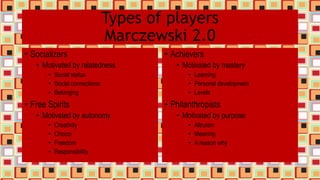
Types of players
Marczewski 2.0
• Socializers
• Motivated by relatedness
• Social status
• Social connections
• Belonging
• Free Spirits
• Motivated by autonomy
• Creativity
• Choice
• Freedom
• Responsibility
• Achievers
• Motivated by mastery
• Learning
• Personal development
• Levels
• Philanthropists
• Motivated by purpose
• Altruism
• Meaning
• A reason why
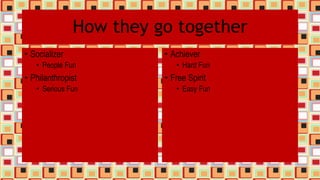
How they go together
• Socializer
• People Fun
• Philanthropist
• Serious Fun
• Achiever
• Hard Fun
• Free Spirit
• Easy Fun
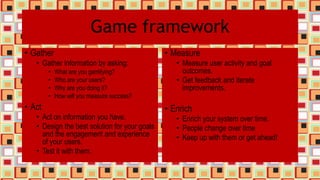
Game framework
• Gather
• Gather information by asking:
• What are you gamifying?
• Who are your users?
• Why are you doing it?
• How will you measure success?
• Act
• Act on information you have.
• Design the best solution for your goals
and the engagement and experience
of your users.
• Test it with them.
• Measure
• Measure user activity and goal
outcomes.
• Get feedback and iterate
improvements.
• Enrich
• Enrich your system over time.
• People change over time
• Keep up with them or get ahead!
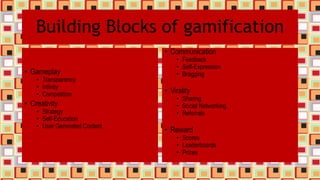
Building Blocks of gamification
• Gameplay
• Transparency
• Infinity
• Competition
• Creativity
• Strategy
• Self-Education
• User Generated Content
• Communication
• Feedback
• Self-Expression
• Bragging
• Virality
• Sharing
• Social Networking
• Referrals
• Reward
• Scores
• Leaderboards
• Prizes
Names to Know
Jane Mcgonigal
• Author
• Reality is Broken
• Using games to save the world
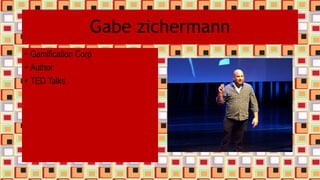
Gabe zichermann
• Gamification Corp
• Author
• TED Talks
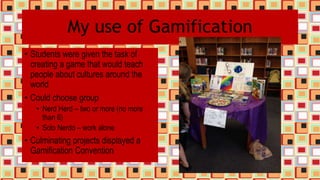
My use of Gamification
• Students were given the task of
creating a game that would teach
people about cultures around the
world
• Could choose group
• Nerd Herd – two or more (no more
than 6)
• Solo Nerdo – work alone
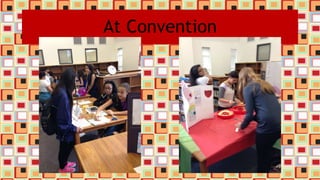
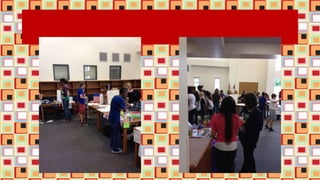
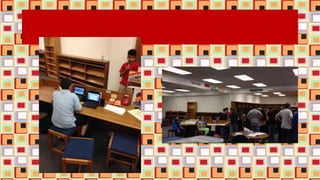
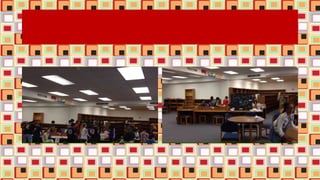
• Culminating projects displayed a
Gamification Convention
At Convention
Ways to Implement
Existing Technology
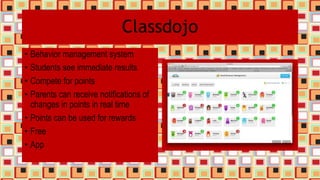
Classdojo
• Behavior management system
• Students see immediate results
• Compete for points
• Parents can receive notifications of
changes in points in real time
• Points can be used for rewards
• Free
• App
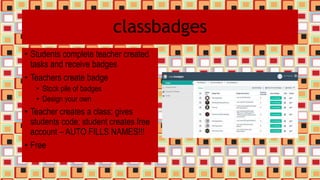
classbadges
• Students complete teacher created
tasks and receive badges
• Teachers create badge
• Stock pile of badges
• Design your own
• Teacher creates a class; gives
students code; student creates free
account – AUTO FILLS NAMES!!!
• Free
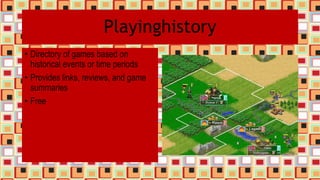
Playinghistory
• Directory of games based on
historical events or time periods
• Provides links, reviews, and game
summaries
• Free
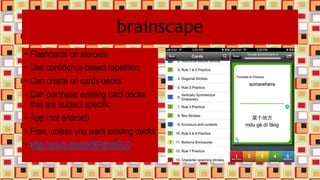
brainscape
• Flashcards on steroids
• Use confidence based repetition
• Can create on cards decks
• Can purchase existing card decks
that are subject specific
• App (not android)
• Free, unless you want existing decks
• http://youtu.be/eHi9PdmhEL0
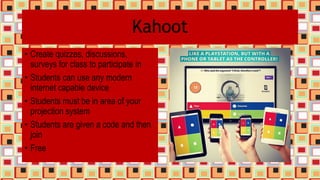
Kahoot
• Create quizzes, discussions,
surveys for class to participate in
• Students can use any modern
internet capable device
• Students must be in area of your
projection system
• Students are given a code and then
join
• Free
GeoGuesser
• Players are given a photo to analyze
• Can change point of view
• Have to guess where the picture
was taken
• Free
• Online
Ways to Implement
Existing Technology
Classroom
• Use gaming grading with levels
besides alphabets or percentages
• Award students with badges for
completing tasks
• Integrate educational video games
into your curriculum
• Create competition between classes
• Gamify homework
• Make students co-designers
• Allow for second and third chances
• Provide instant feedback
• Make progress visible
• Embrace failure; Emphasize practice
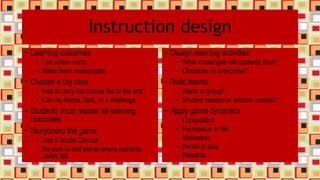
Instruction design
• Learning outcomes
• Use action verbs
• Make them measurable
• Choose a big idea
• Has to carry the course the to the end
• Can be theme, idea, or a challenge
• Students must master all learning
outcomes
• Storyboard the game
• Use a Model Canvas
• Be sure to add points where students
safely fail
• Design learning activities
• What challenges will students face?
• Obstacles to overcome?
• Build teams
• Alone or group?
• Student created or teacher created?
• Apply game dynamics
• Competition
• Permission to fail
• Motivation
• Sense of play
• Rewards
Information sources
Websites
• http://www.gamified.co.uk/ - 4 User Types & planning resources
• http://www.gamification.co/ - Gabe Zichermann; getting started resources
• http://janemcgonigal.com/ - Jane McGonical website; research info
• http://www.pinterest.com/steubner/gamification/
Sources used
• http://youtu.be/O2N-5maKZ9Q
• http://blog.demandmetric.com/wp-content/uploads/2013/06/Gamification-Infographic.png
• http://calvinayre.com/wp-content/uploads/2012/11/gamification-gaming-industry.jpg
• http://media-cache-ak0.pinimg.com/originals/70/b9/af/70b9afc379370bf44716bb6fce68a88d.jpg
• http://www.slideshare.net/zaid/gamify-classroom-learning
• http://www.arturogoga.com/wp-content/uploads/2012/03/Optimized-Neurology-of-Gaming-800.jpg
• http://elearningindustry.com/the-gamification-guide-for-teachers
• http://www.slideshare.net/zaid/gamify-classroom-learning
• http://www.teachthought.com/wp-content/uploads/2014/01/how-to-gamify-your-classroom.jpg
• http://thingsigrab.wordpress.com/2013/05/29/how-to-gamify-your-classroom-in-6-easy-steps-
edudemic/?utm_source=feedly

Gamification 101

  • 2.
    Gamification 101 Sarah Teubner GrandPrairie Fine Arts Academy Grand Prairie ISD
  • 3.
    Who is thisdescribing? • This group “regularly exhibits persistence, risk-taking, attention to detail, and problem-solving…” • Full quote: “Game players regularly exhibit persistence, risk-taking, attention to detail, and problem-solving, all behaviors that ideally would be regularly demonstrated in school.” – The Education Arcade at MIT
  • 4.
    Things to consider •28 million people harvest their crops on Farmville every day. • Over 5 million people play an average of 45 hours a week of games • As a planet, we spend 3 billion hours a week playing video and computer games. • In the US, 9 out of 10 kids play electronic games. • On-line gaming market is worth more than $15 billion • 58% male; 42% female • 65% of US households play video games
  • 5.
    What is gamification? •The process of using game thinking and game mechanics to engage • Use of gaming principles in the field of education in order to get students students involved, engaged, and excited about learning • Introduces concepts like badges, levels, achievements, and game points • Students are rewarded with these concepts when they succeed, but are not penalized when they don’t. • students are not afraid to step outside of their comfort zone and fail • Gabe Zichermann video
  • 6.
    Why Gamification? • “Gamedesign is the art of enjoying the hard part. It’s the art of making goals more difficult to achieve, for no good reason, other than the fact that we have more fun that way” – JM • “Studies showed that, on average, using academic games in the classroom is associated with a 20 percentile point gain in student achievement. • “Helping students navigate and fully participate in this new media landscape, however, requires more than simply allowing mobile devices into schools. Instead, it requires developing learning experiences that allow students to use and develop the multi-literacy practices associated with mobile media.”
  • 7.
    How is thebrain affected by gamification? • “When an animal, be it fish or human, wins a contest, there is a large release of testosterone and dopamine into their brain. Over time this changes their brains structure and chemical makeup, making them smarter, more confident and able to take on larger challenges than before. Cognitive neuroscientist Ian Robertson explains that “success and failure shapes us more powerfully than powerfully than genetics and drugs.” drugs.” Nurture changes nature.” http://www.gamification.co/2014/02/21/the-winner-effect/ • Strengthens brain cell connections underlying memory and learning • Improves ability to reason and solve new problems independently of previously acquired knowledge. • Can improve peripheral vision, way-finding skills, hand-eye coordination and mental rotation.
  • 8.
  • 9.
    Types of fun •People fun • Friendship • Amusement from competition and cooperation • Easy fun • Novelty • Curiosity from exploration, role play, and creativity • Hard fun • Challenge • Fiero, the epic win, from achieving a difficult goal • Serious fun • Meaning • Excitement from changing the player and their world
  • 10.
    Types of players Marczewski2.0 • Socializers • Motivated by relatedness • Social status • Social connections • Belonging • Free Spirits • Motivated by autonomy • Creativity • Choice • Freedom • Responsibility • Achievers • Motivated by mastery • Learning • Personal development • Levels • Philanthropists • Motivated by purpose • Altruism • Meaning • A reason why
  • 11.
    How they gotogether • Socializer • People Fun • Philanthropist • Serious Fun • Achiever • Hard Fun • Free Spirit • Easy Fun
  • 12.
    Game framework • Gather •Gather information by asking: • What are you gamifying? • Who are your users? • Why are you doing it? • How will you measure success? • Act • Act on information you have. • Design the best solution for your goals and the engagement and experience of your users. • Test it with them. • Measure • Measure user activity and goal outcomes. • Get feedback and iterate improvements. • Enrich • Enrich your system over time. • People change over time • Keep up with them or get ahead!
  • 13.
    Building Blocks ofgamification • Gameplay • Transparency • Infinity • Competition • Creativity • Strategy • Self-Education • User Generated Content • Communication • Feedback • Self-Expression • Bragging • Virality • Sharing • Social Networking • Referrals • Reward • Scores • Leaderboards • Prizes
  • 14.
  • 15.
    Jane Mcgonigal • Author •Reality is Broken • Using games to save the world
  • 16.
    Gabe zichermann • GamificationCorp • Author • TED Talks
  • 17.
    My use ofGamification • Students were given the task of creating a game that would teach people about cultures around the world • Could choose group • Nerd Herd – two or more (no more than 6) • Solo Nerdo – work alone • Culminating projects displayed a Gamification Convention
  • 18.
  • 22.
  • 23.
    Classdojo • Behavior managementsystem • Students see immediate results • Compete for points • Parents can receive notifications of changes in points in real time • Points can be used for rewards • Free • App
  • 24.
    classbadges • Students completeteacher created tasks and receive badges • Teachers create badge • Stock pile of badges • Design your own • Teacher creates a class; gives students code; student creates free account – AUTO FILLS NAMES!!! • Free
  • 25.
    Playinghistory • Directory ofgames based on historical events or time periods • Provides links, reviews, and game summaries • Free
  • 26.
    brainscape • Flashcards onsteroids • Use confidence based repetition • Can create on cards decks • Can purchase existing card decks that are subject specific • App (not android) • Free, unless you want existing decks • http://youtu.be/eHi9PdmhEL0
  • 27.
    Kahoot • Create quizzes,discussions, surveys for class to participate in • Students can use any modern internet capable device • Students must be in area of your projection system • Students are given a code and then join • Free
  • 28.
    GeoGuesser • Players aregiven a photo to analyze • Can change point of view • Have to guess where the picture was taken • Free • Online
  • 29.
  • 30.
    Classroom • Use gaminggrading with levels besides alphabets or percentages • Award students with badges for completing tasks • Integrate educational video games into your curriculum • Create competition between classes • Gamify homework • Make students co-designers • Allow for second and third chances • Provide instant feedback • Make progress visible • Embrace failure; Emphasize practice
  • 31.
    Instruction design • Learningoutcomes • Use action verbs • Make them measurable • Choose a big idea • Has to carry the course the to the end • Can be theme, idea, or a challenge • Students must master all learning outcomes • Storyboard the game • Use a Model Canvas • Be sure to add points where students safely fail • Design learning activities • What challenges will students face? • Obstacles to overcome? • Build teams • Alone or group? • Student created or teacher created? • Apply game dynamics • Competition • Permission to fail • Motivation • Sense of play • Rewards
  • 32.
  • 33.
    Websites • http://www.gamified.co.uk/ -4 User Types & planning resources • http://www.gamification.co/ - Gabe Zichermann; getting started resources • http://janemcgonigal.com/ - Jane McGonical website; research info • http://www.pinterest.com/steubner/gamification/
  • 34.
    Sources used • http://youtu.be/O2N-5maKZ9Q •http://youtu.be/O2N-5maKZ9Q • http://blog.demandmetric.com/wp-content/uploads/2013/06/Gamification-Infographic.png • http://calvinayre.com/wp-content/uploads/2012/11/gamification-gaming-industry.jpg • http://media-cache-ak0.pinimg.com/originals/70/b9/af/70b9afc379370bf44716bb6fce68a88d.jpg • http://www.slideshare.net/zaid/gamify-classroom-learning • http://www.arturogoga.com/wp-content/uploads/2012/03/Optimized-Neurology-of-Gaming-800.jpg • http://elearningindustry.com/the-gamification-guide-for-teachers • http://www.slideshare.net/zaid/gamify-classroom-learning • http://www.teachthought.com/wp-content/uploads/2014/01/how-to-gamify-your-classroom.jpg • http://thingsigrab.wordpress.com/2013/05/29/how-to-gamify-your-classroom-in-6-easy-steps- edudemic/?utm_source=feedly