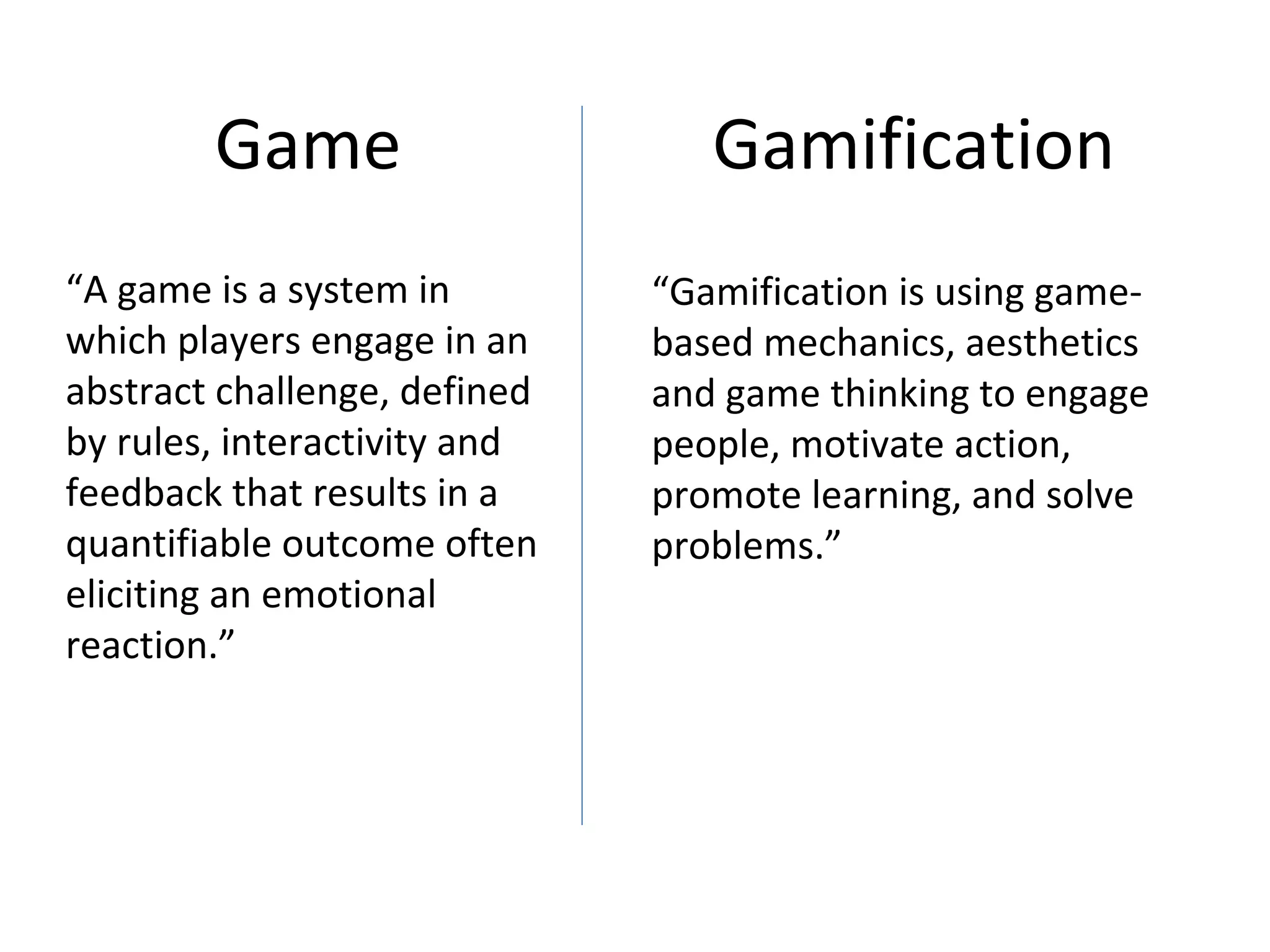


Game                     Gamification
“A game is a system in        “Gamification is using game-
which players engage in an    based mechanics, aesthetics
abstract challenge, defined   and game thinking to engage
by rules, interactivity and   people, motivate action,
feedback that results in a    promote learning, and solve
quantifiable outcome often    problems.”
eliciting an emotional
reaction.”
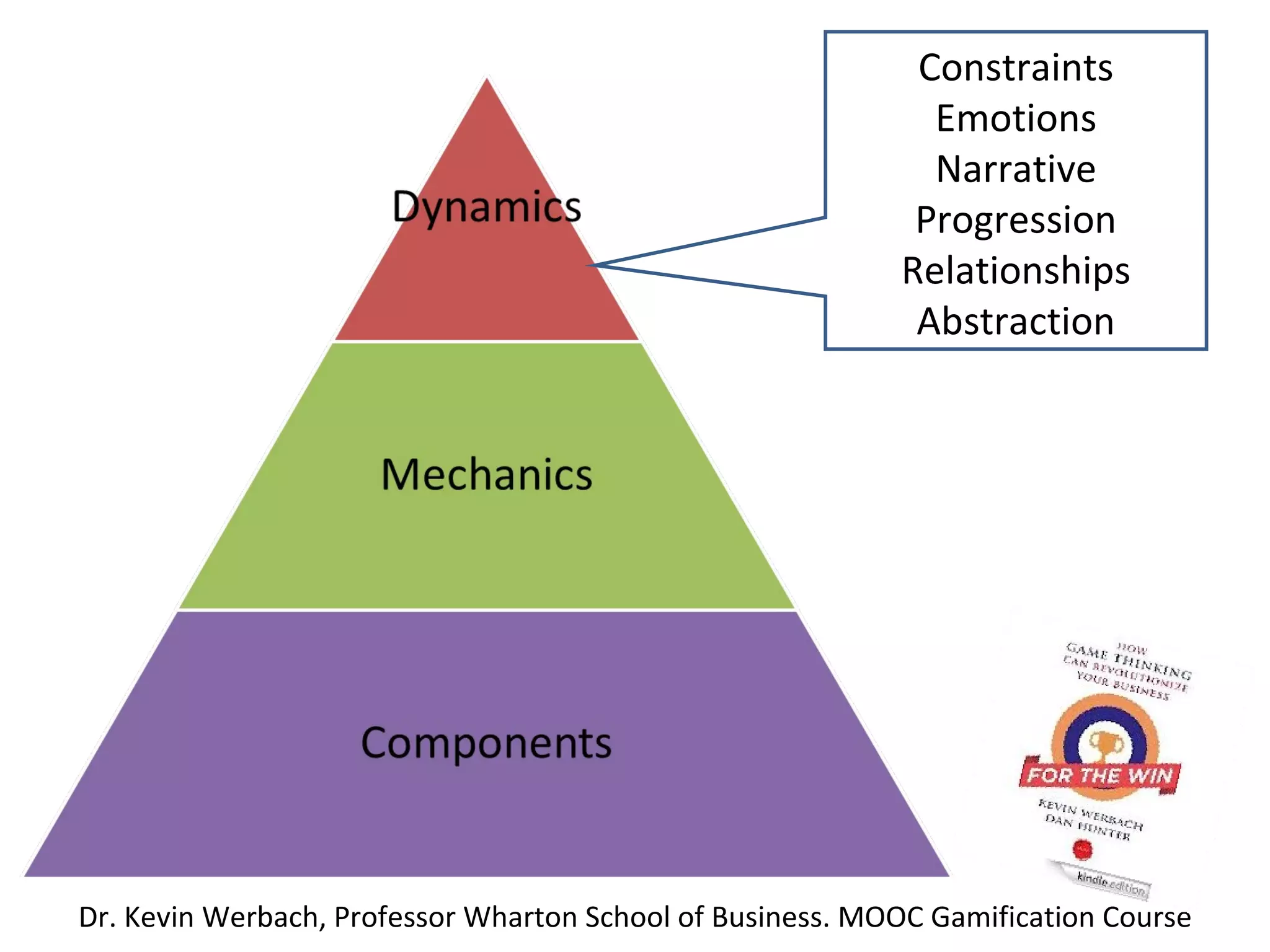
Constraints
                                                             Emotions
                                                             Narrative
                                                            Progression
                                                           Relationships
                                                            Abstraction


Dr. Kevin Werbach, Professor Wharton School of Business. MOOC Gamification Course
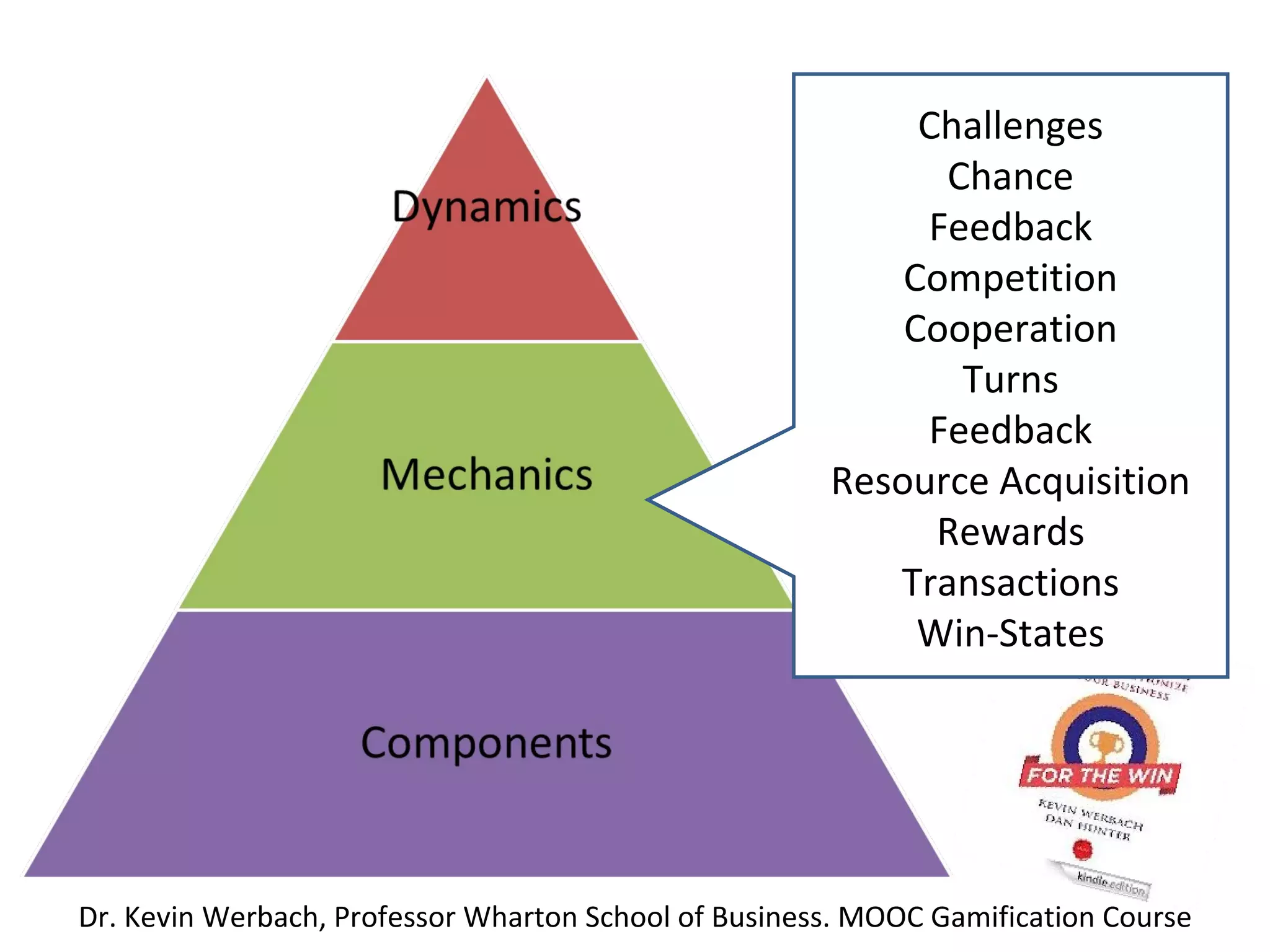
Challenges
                                                            Chance
                                                           Feedback
                                                          Competition
                                                          Cooperation
                                                             Turns
                                                           Feedback
                                                      Resource Acquisition
                                                            Rewards
                                                         Transactions
                                                           Win-States


Dr. Kevin Werbach, Professor Wharton School of Business. MOOC Gamification Course
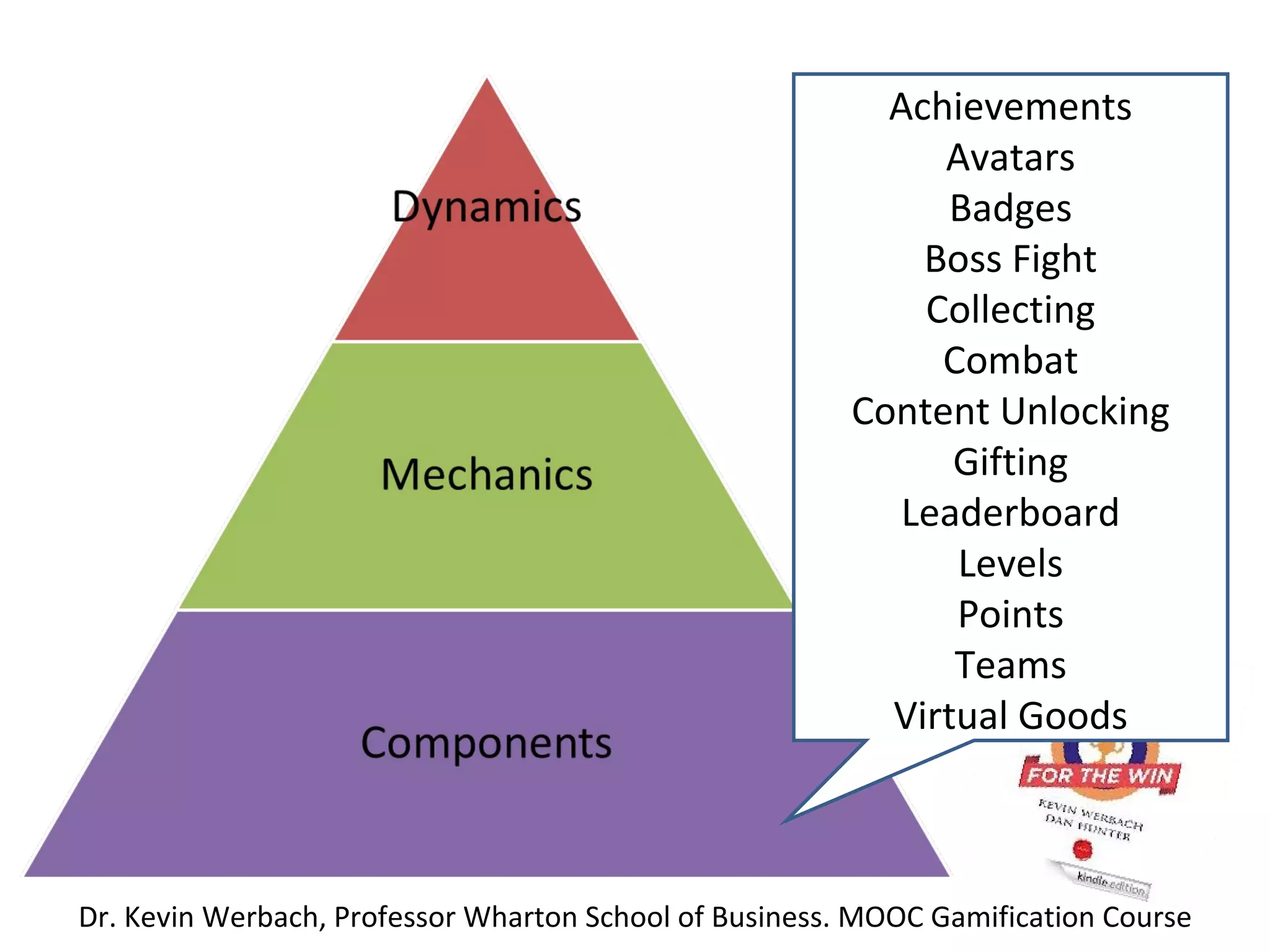
Achievements
                                                             Avatars
                                                              Badges
                                                            Boss Fight
                                                            Collecting
                                                             Combat
                                                        Content Unlocking
                                                              Gifting
                                                           Leaderboard
                                                              Levels
                                                              Points
                                                              Teams
                                                          Virtual Goods


Dr. Kevin Werbach, Professor Wharton School of Business. MOOC Gamification Course
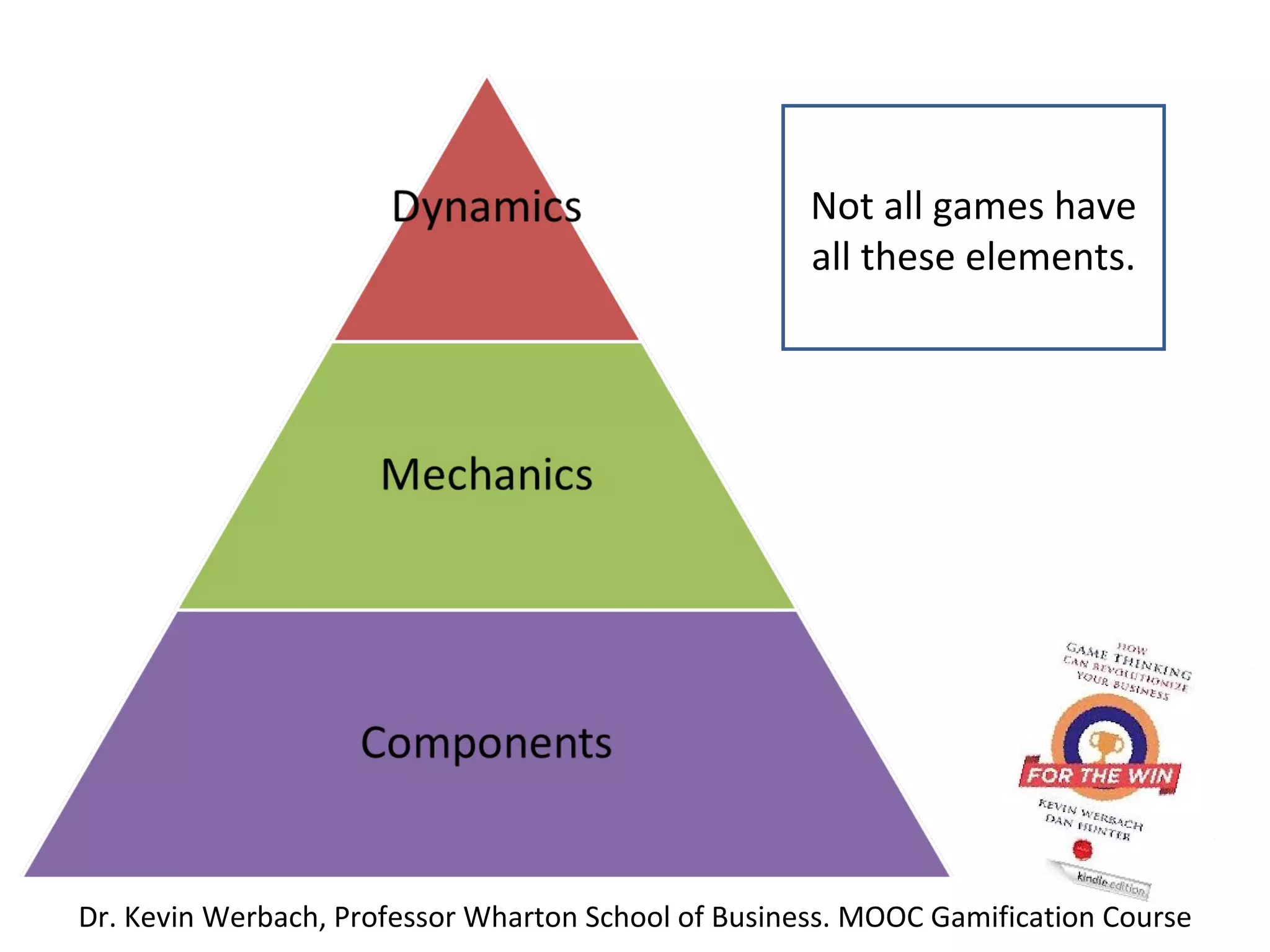
Not all games have
                                                     all these elements.


Dr. Kevin Werbach, Professor Wharton School of Business. MOOC Gamification Course
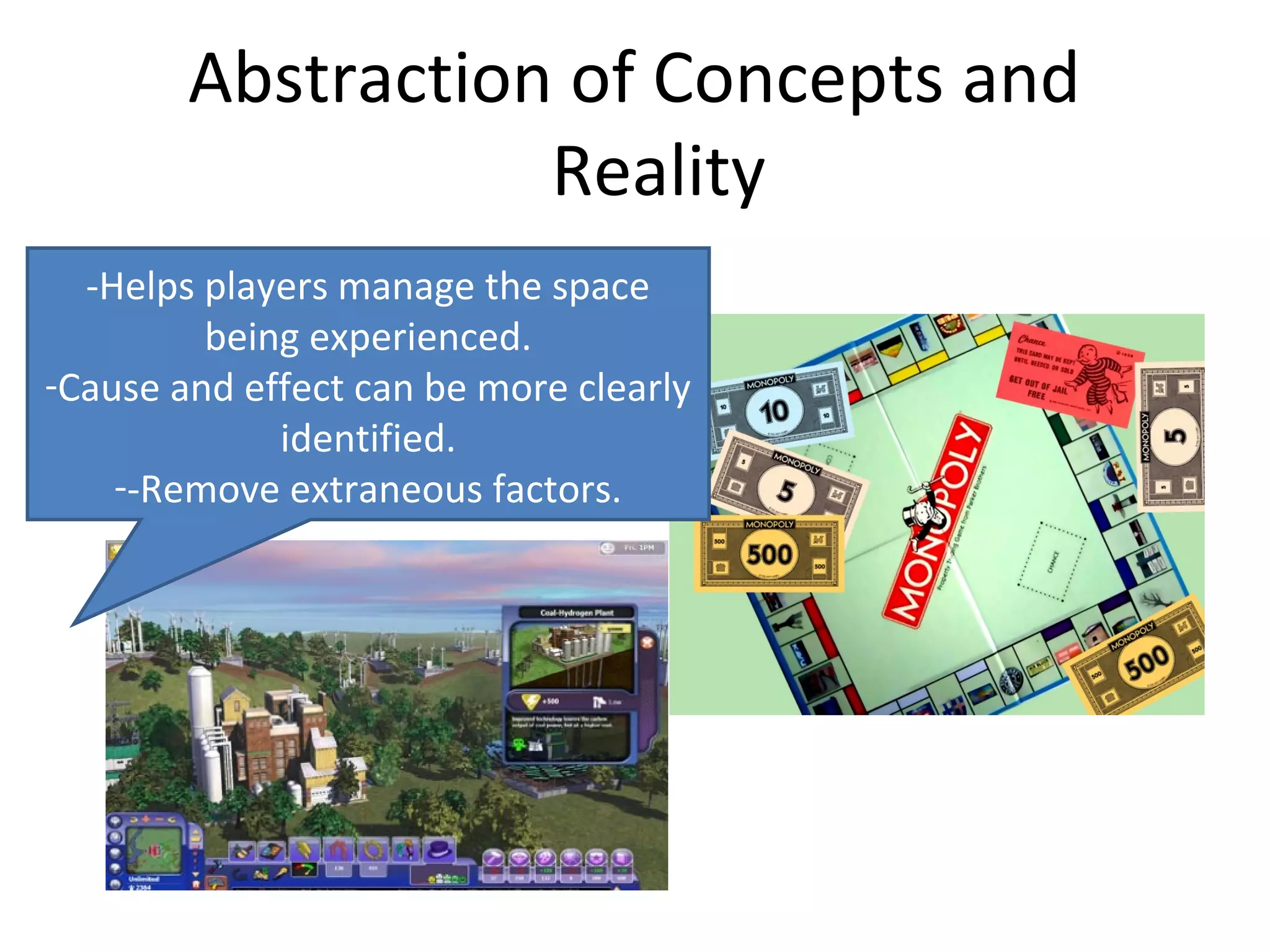
Abstraction of Concepts and
                   Reality
  -Helps players manage the space
         being experienced.
-Cause and effect can be more clearly
             identified.
    --Remove extraneous factors.
Role Play
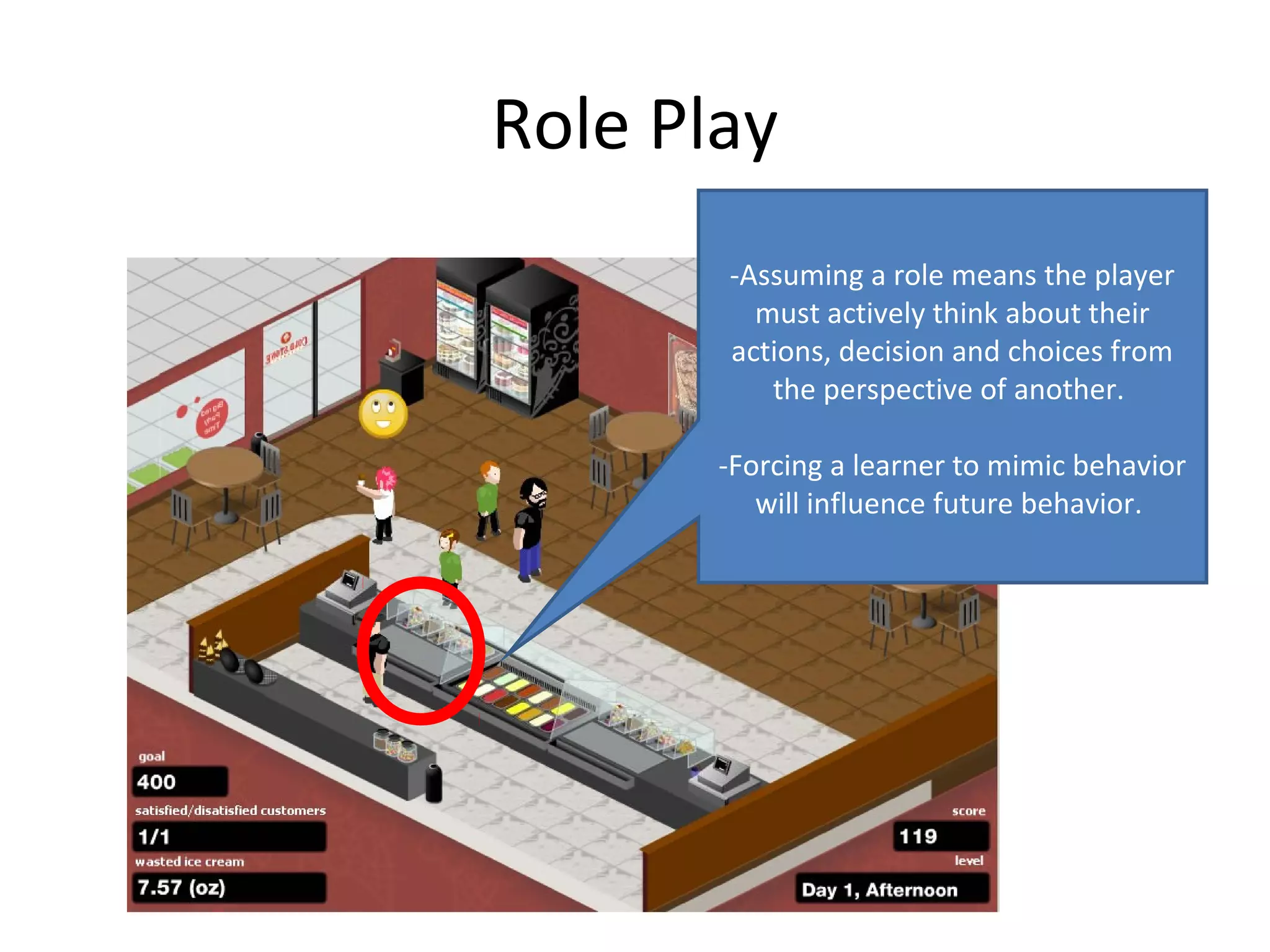
       -Assuming a role means the player
         must actively think about their
       actions, decision and choices from
          the perspective of another.

       -Forcing a learner to mimic behavior
          will influence future behavior.
Multiplayer


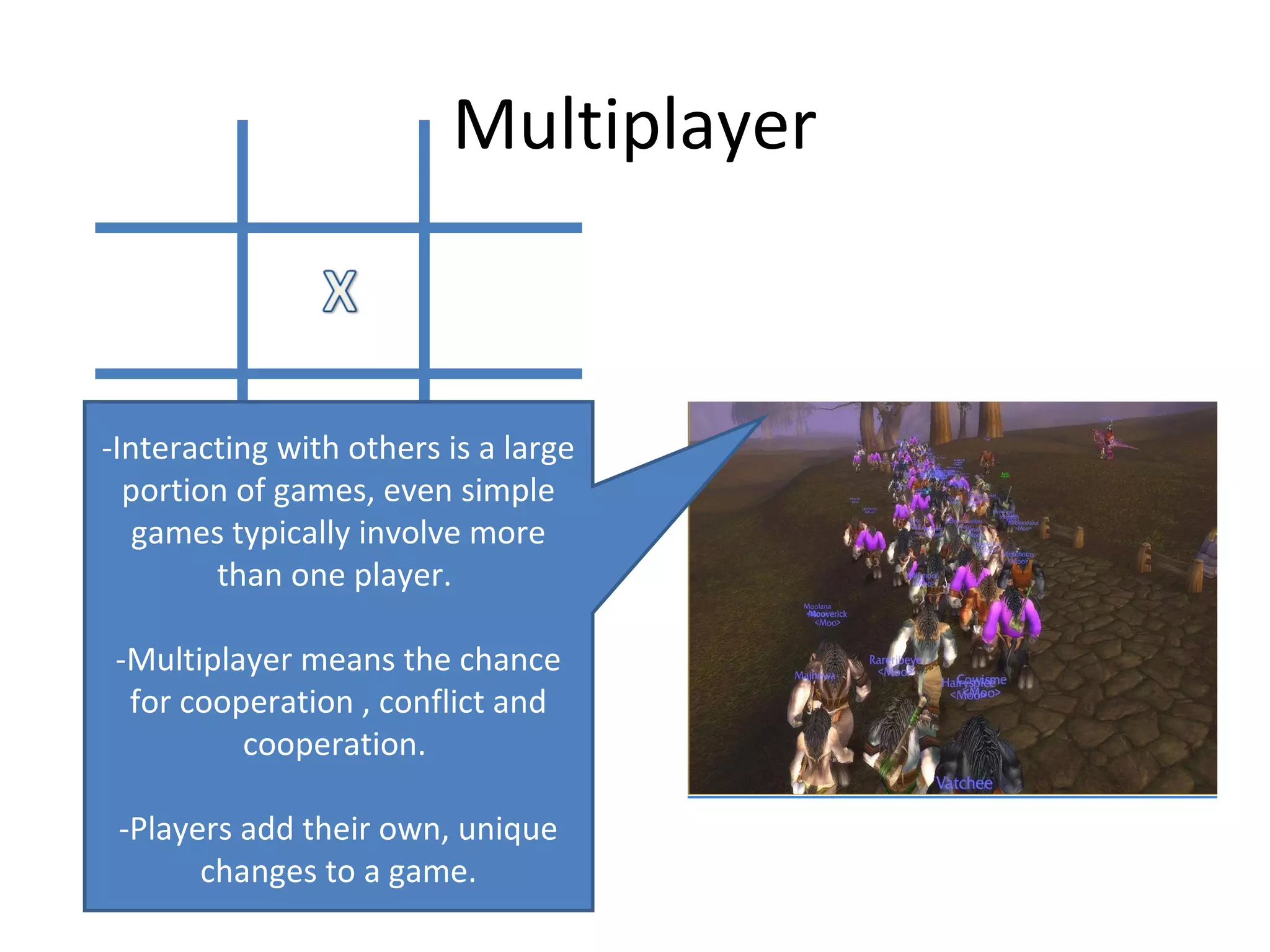
-Interacting with others is a large
  portion of games, even simple
   games typically involve more
        than one player.

 -Multiplayer means the chance
  for cooperation , conflict and
          cooperation.

 -Players add their own, unique
       changes to a game.
Social Aspects
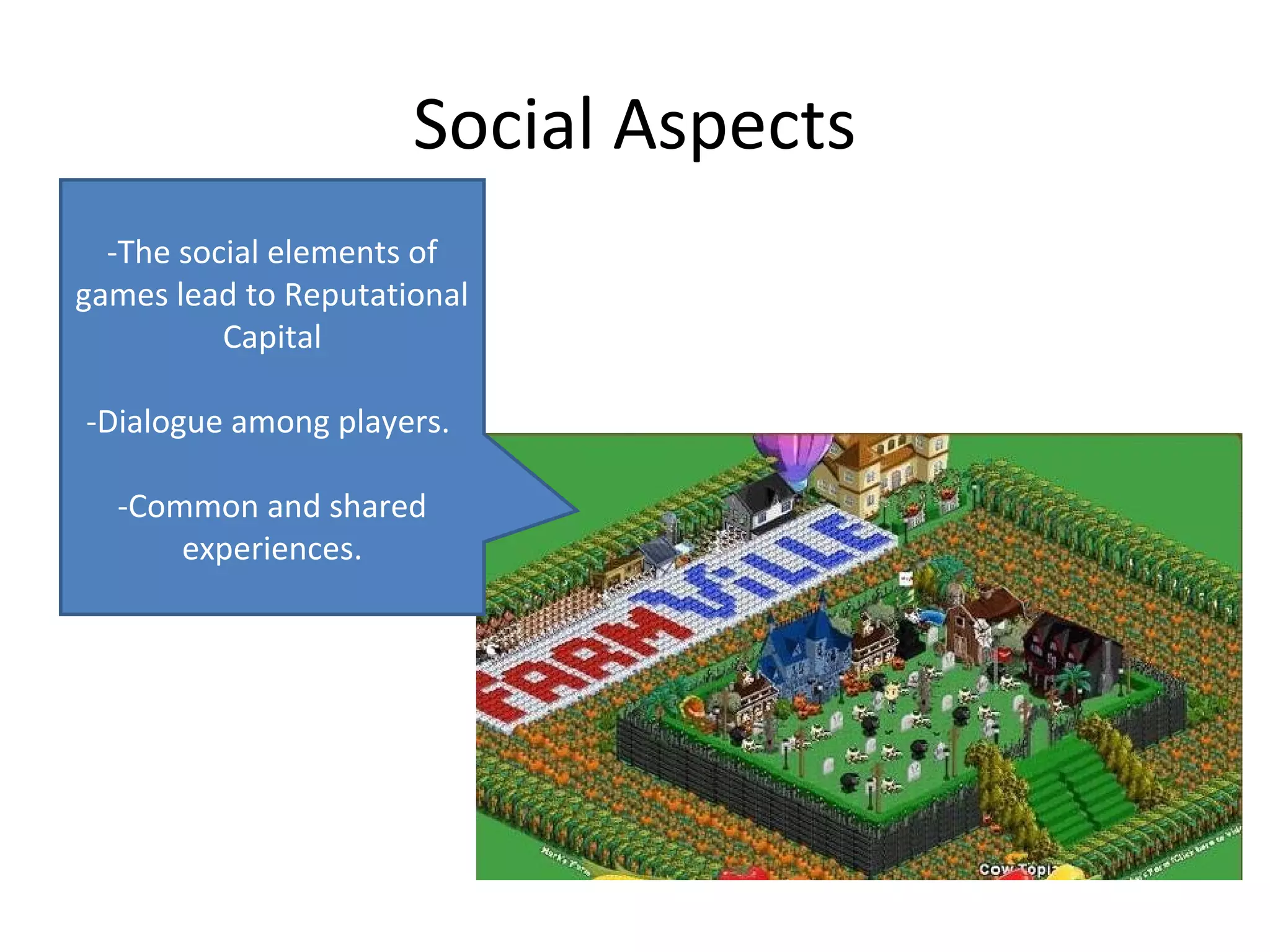
  -The social elements of
games lead to Reputational
          Capital

-Dialogue among players.

  -Common and shared
      experiences.
Rules
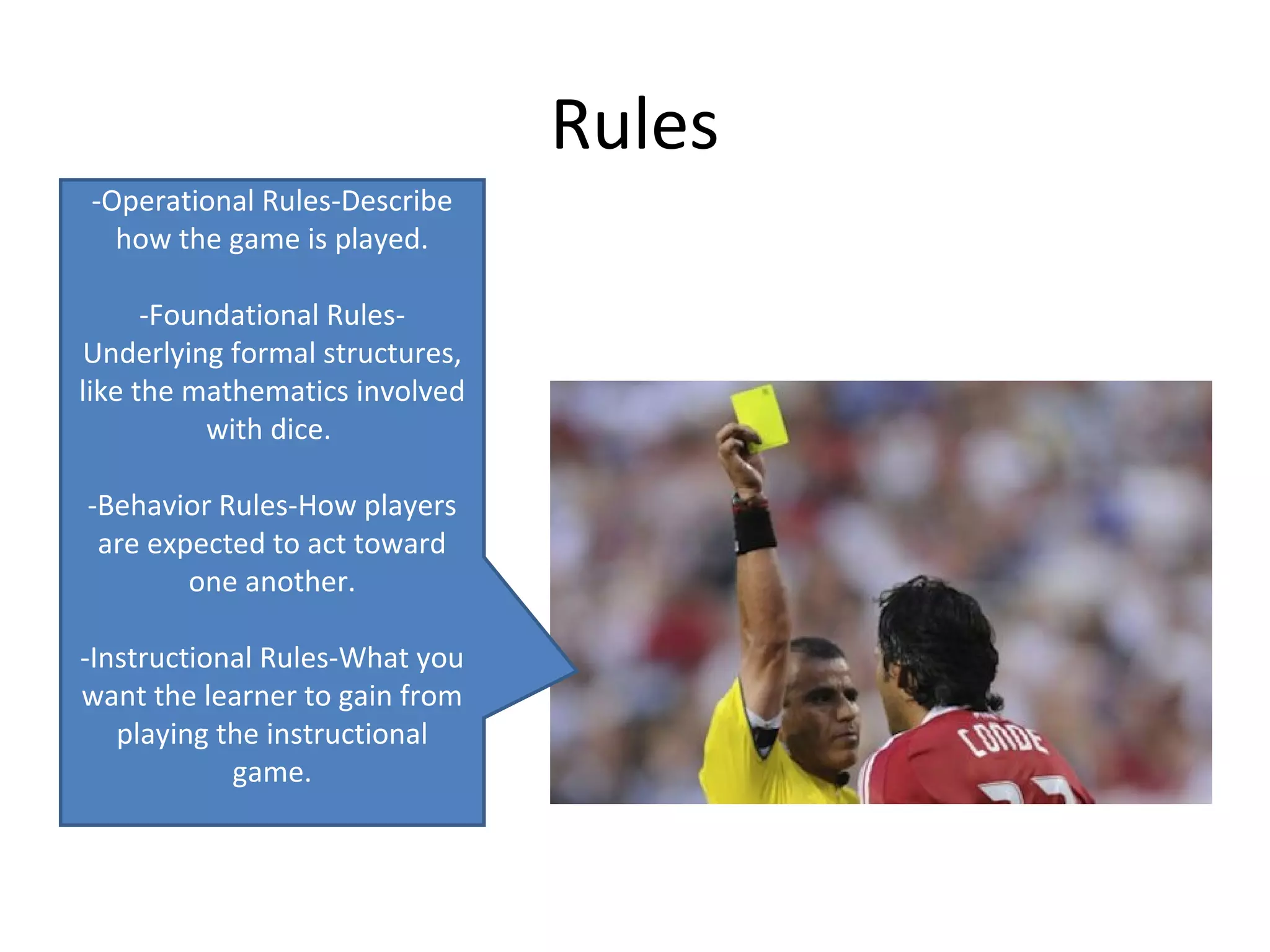
-Operational Rules-Describe
  how the game is played.

      -Foundational Rules-
Underlying formal structures,
like the mathematics involved
           with dice.

-Behavior Rules-How players
 are expected to act toward
        one another.

-Instructional Rules-What you
want the learner to gain from
   playing the instructional
            game.
Objectives
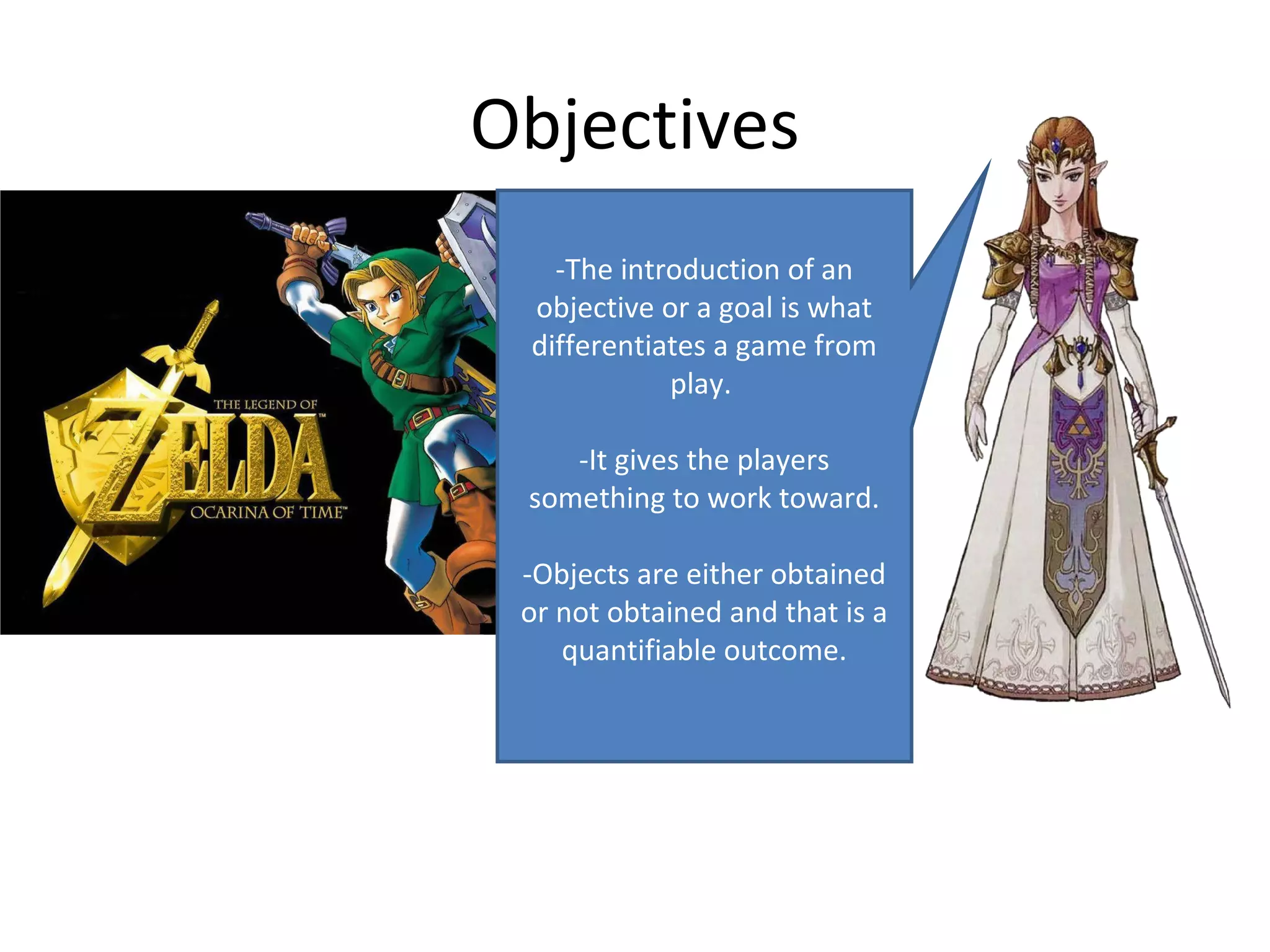
   -The introduction of an
 objective or a goal is what
 differentiates a game from
            play.

    -It gives the players
 something to work toward.

 -Objects are either obtained
 or not obtained and that is a
    quantifiable outcome.
Story
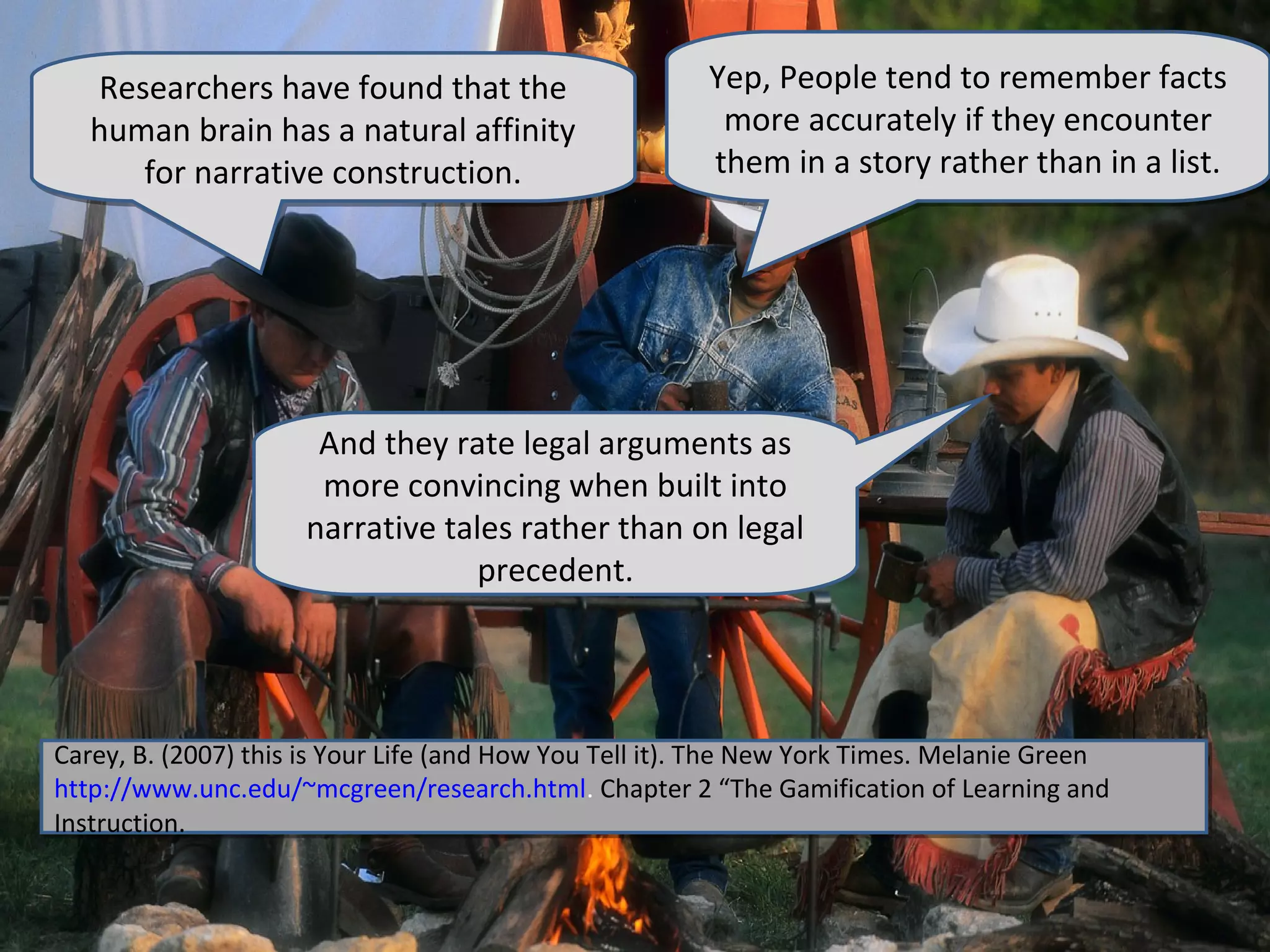
Researchers have found that the
    Researchers have found that the                     Yep, People tend to remember facts
                                                        Yep, People tend to remember facts
   human brain has a natural affinity
   human brain has a natural affinity                    more accurately if they encounter
                                                          more accurately if they encounter
      for narrative construction.
       for narrative construction.                      them in a story rather than in a list.
                                                         them in a story rather than in a list.


                      And they rate legal arguments as
                      more convincing when built into
                     narrative tales rather than on legal
                                  precedent.


Carey, B. (2007) this is Your Life (and How You Tell it). The New York Times. Melanie Green
 Carey, B. (2007) this is Your Life (and How You Tell it). The New York Times. Melanie Green
http://www.unc.edu/~mcgreen/research.html. Chapter 2 “The Gamification of Learning and
 http://www.unc.edu/~mcgreen/research.html. Chapter 2 “The Gamification of Learning and
Instruction.
 Instruction.
Stories provide, context,
 meaning and purpose
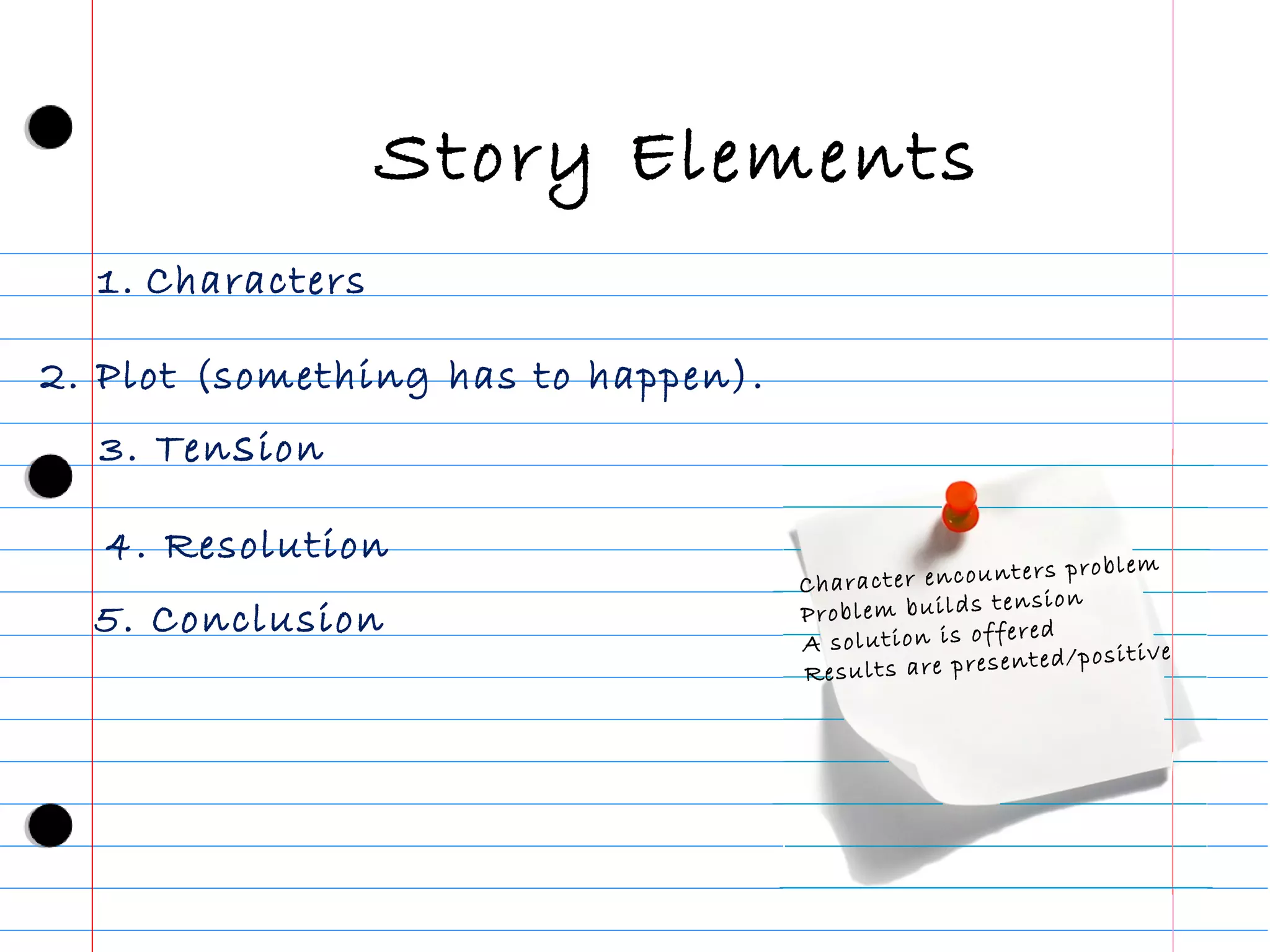
Story Elements
  1. Characters

2. Plot (something has to happen).
  3. Ten s ion

   4. Resolution
                                                             te rs pr ob le m
                                     C ha ra ct er en co u n
                                                             n si on
  5. Conclusion                      Pr ob le m bu il ds te
                                                              re d
                                     A so lu ti on is of fe
                                                               te d /p os it iv e
                                     R es u lt s ar e pr es en
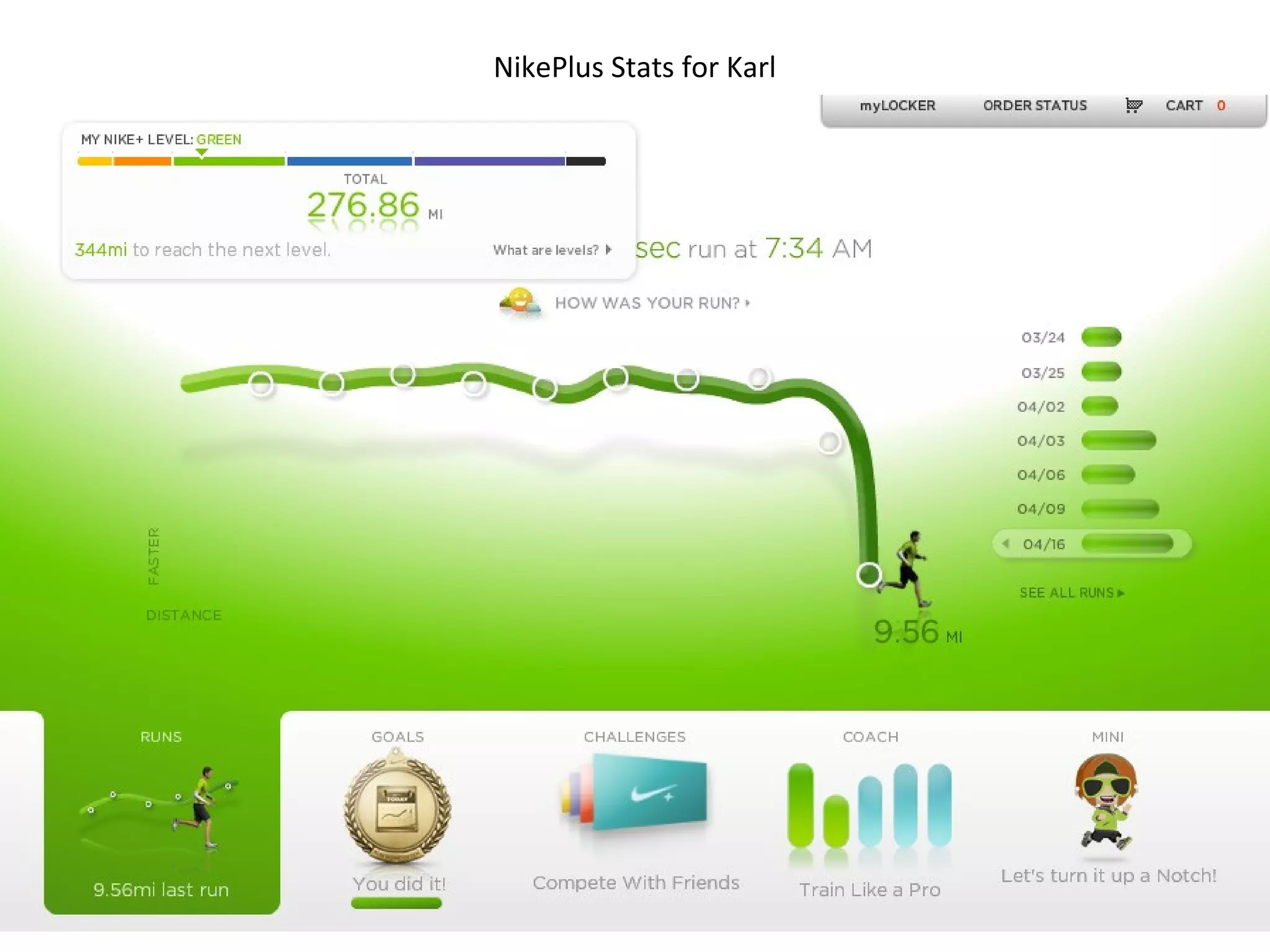
NikePlus Stats for Karl
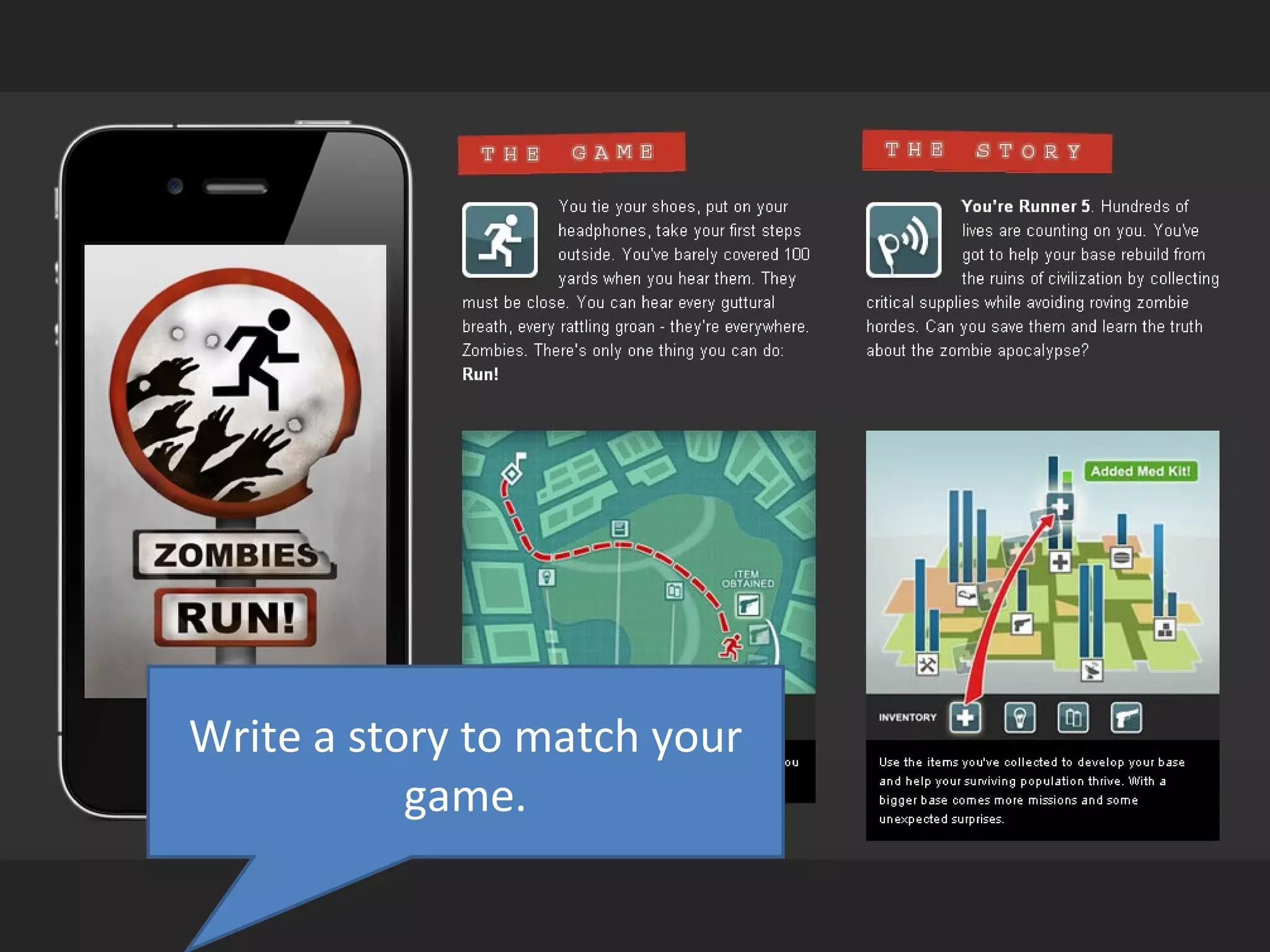
Write a story to match your
           game.
Provide a challenge

Jones, B., Valdez, G., Norakowski, J., & Rasmussen, C. (1994). Designing learning and technology
for educational reform. North Central Regional Educational Laboratory. [Online]. Available:
http://www.ncrtec.org/capacity/profile/profwww.htm and Schlechty, P. C. (1997). Inventing
better schools: An action plan for educational reform. San Francisco, CA: Jossey-Bass. Chapter 2
“The Gamification of Learning and Instruction.”
Re-design the Instruction to
   Start with a Challenge
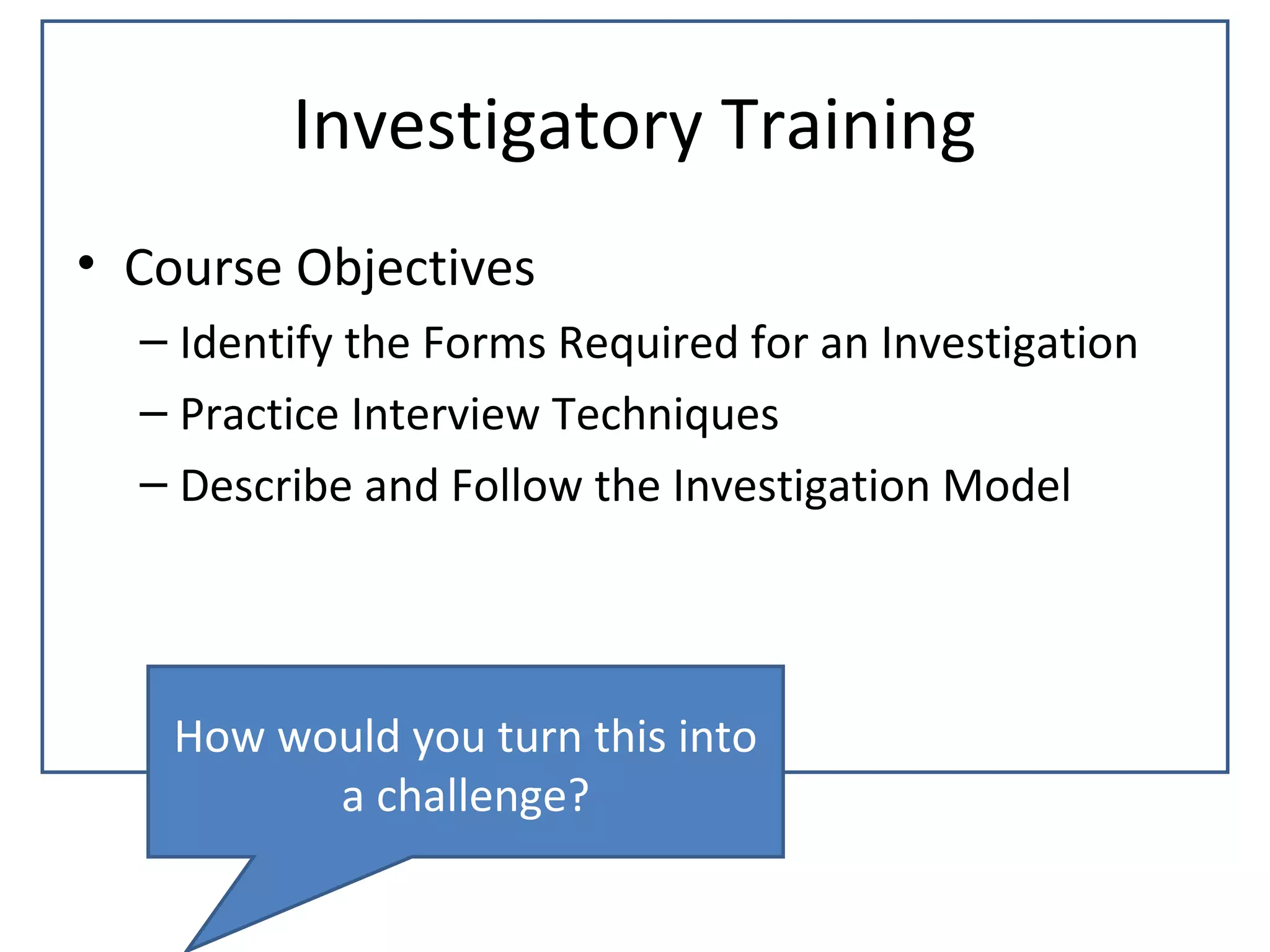
Investigatory Training
• Course Objectives
  – Identify the Forms Required for an Investigation
  – Practice Interview Techniques
  – Describe and Follow the Investigation Model


    How would you turn this into
          a challenge?
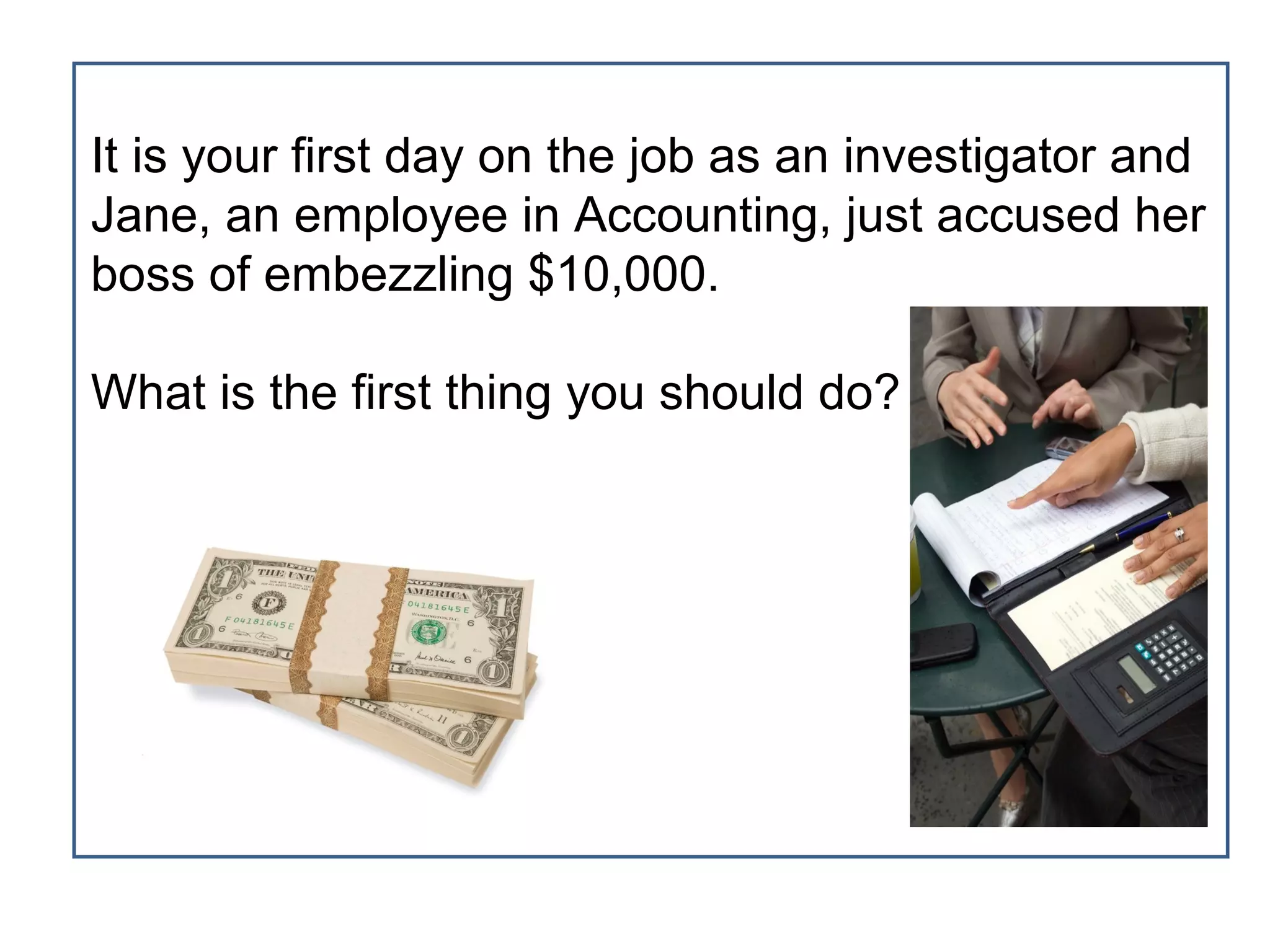
It is your first day on the job as an investigator and
Jane, an employee in Accounting, just accused her
boss of embezzling $10,000.

What is the first thing you should do?
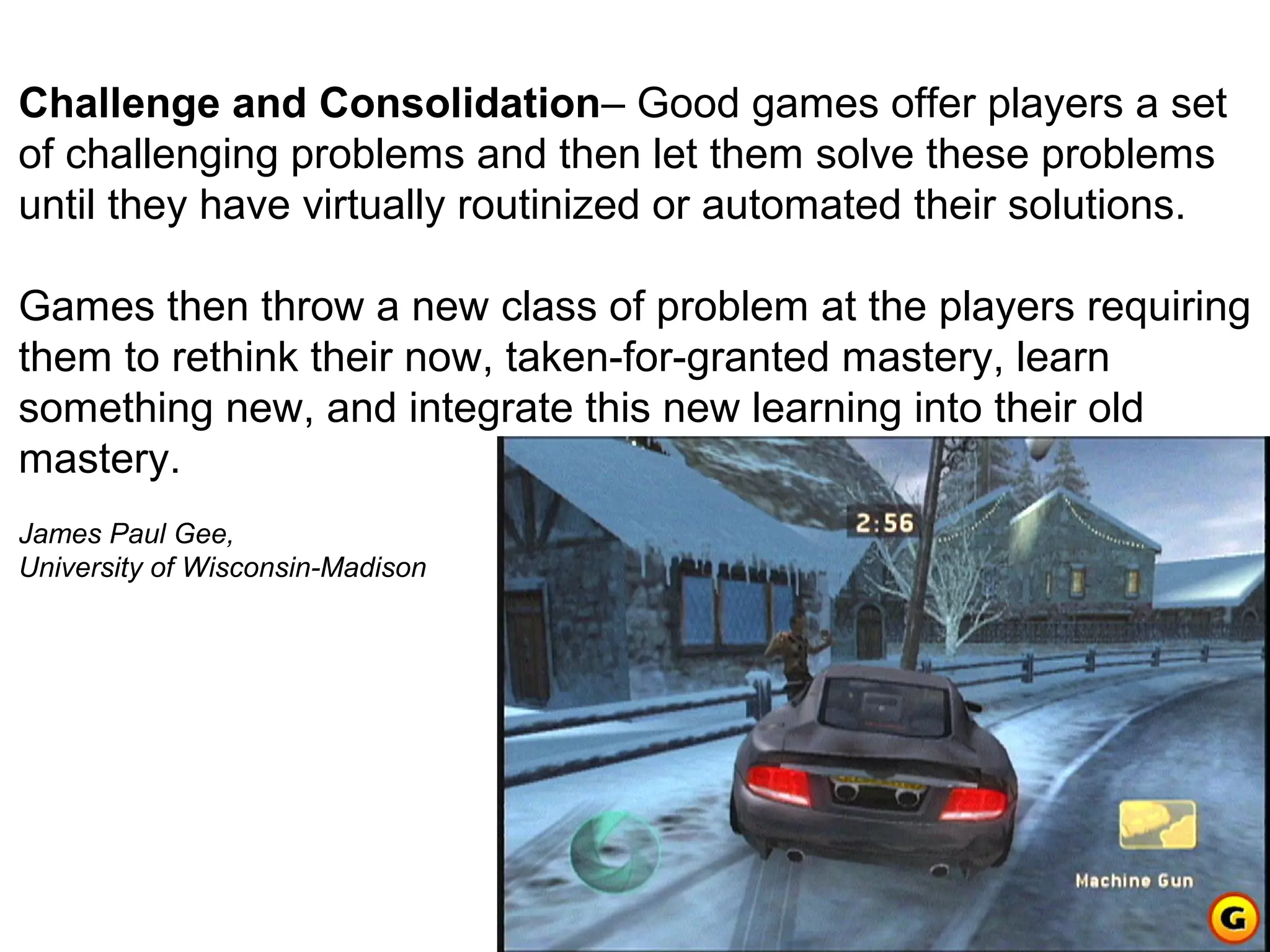
Challenge and Consolidation– Good games offer players a set
of challenging problems and then let them solve these problems
until they have virtually routinized or automated their solutions.

Games then throw a new class of problem at the players requiring
them to rethink their now, taken-for-granted mastery, learn
something new, and integrate this new learning into their old
mastery.
James Paul Gee,
University of Wisconsin-Madison
Recommendations
• Embed facts to be learned in the context of stories.

• Start the learning process by providing a challenge to
  the learner.

• Provide a progression from simple to more difficult
  tasks.

• Use stories that are related to the context of the
  desired learning outcome.
Feedback
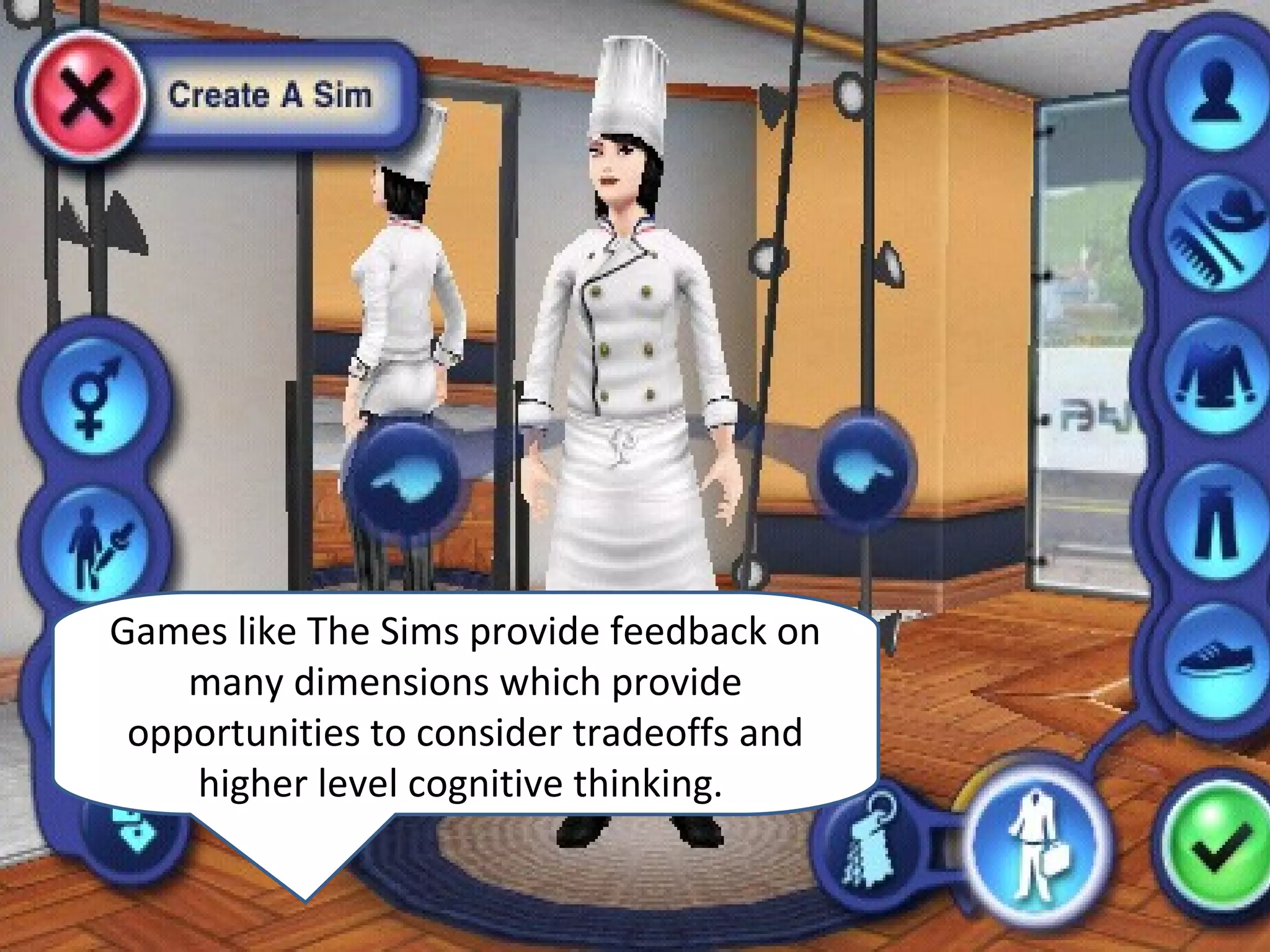
Games like The Sims provide feedback on
    many dimensions which provide
 opportunities to consider tradeoffs and
    higher level cognitive thinking.
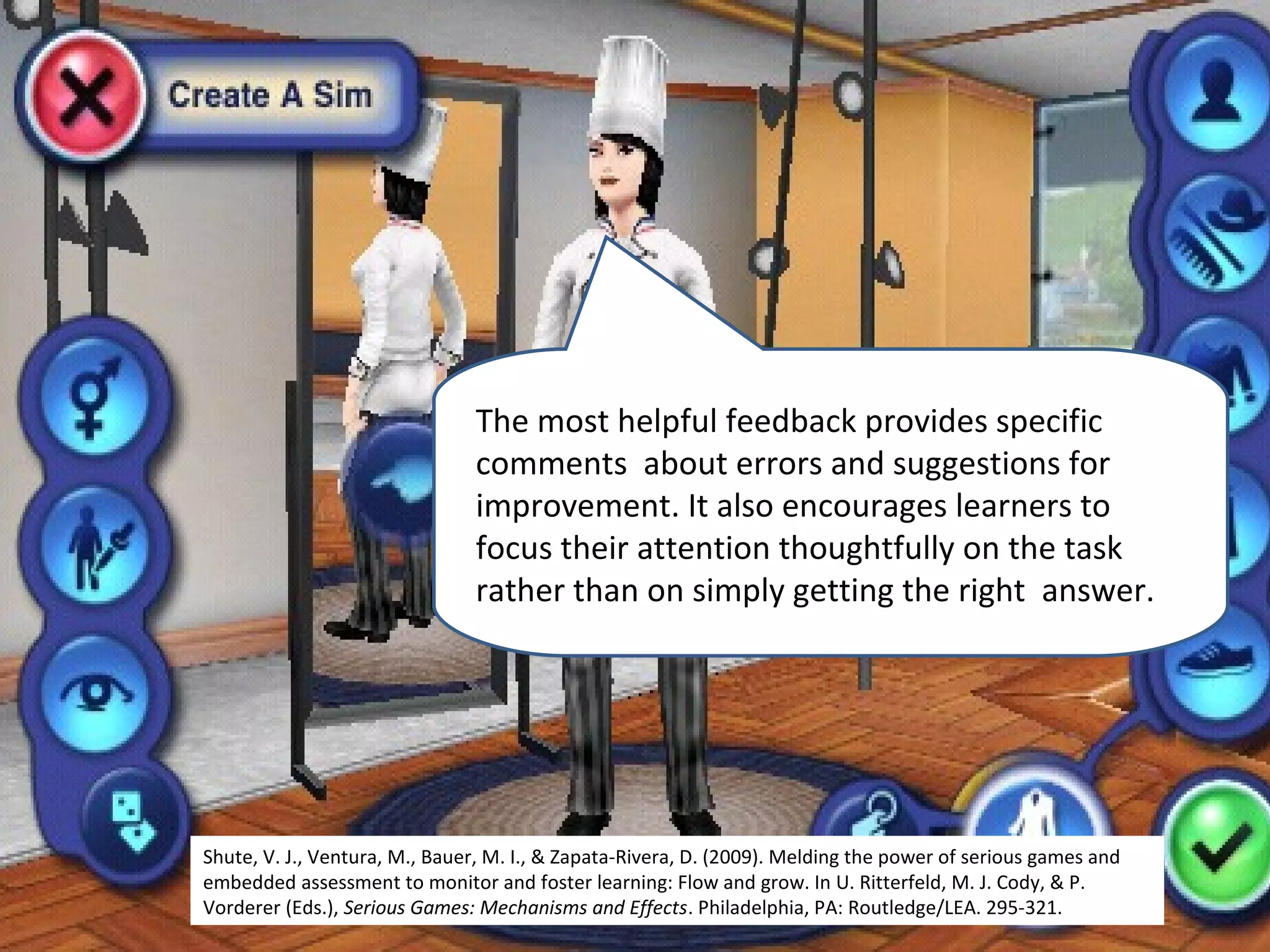
The most helpful feedback provides specific
                               comments about errors and suggestions for
                               improvement. It also encourages learners to
                               focus their attention thoughtfully on the task
                               rather than on simply getting the right answer.


Shute, V. J., Ventura, M., Bauer, M. I., & Zapata-Rivera, D. (2009). Melding the power of serious games and
embedded assessment to monitor and foster learning: Flow and grow. In U. Ritterfeld, M. J. Cody, & P.
Vorderer (Eds.), Serious Games: Mechanisms and Effects. Philadelphia, PA: Routledge/LEA. 295-321.
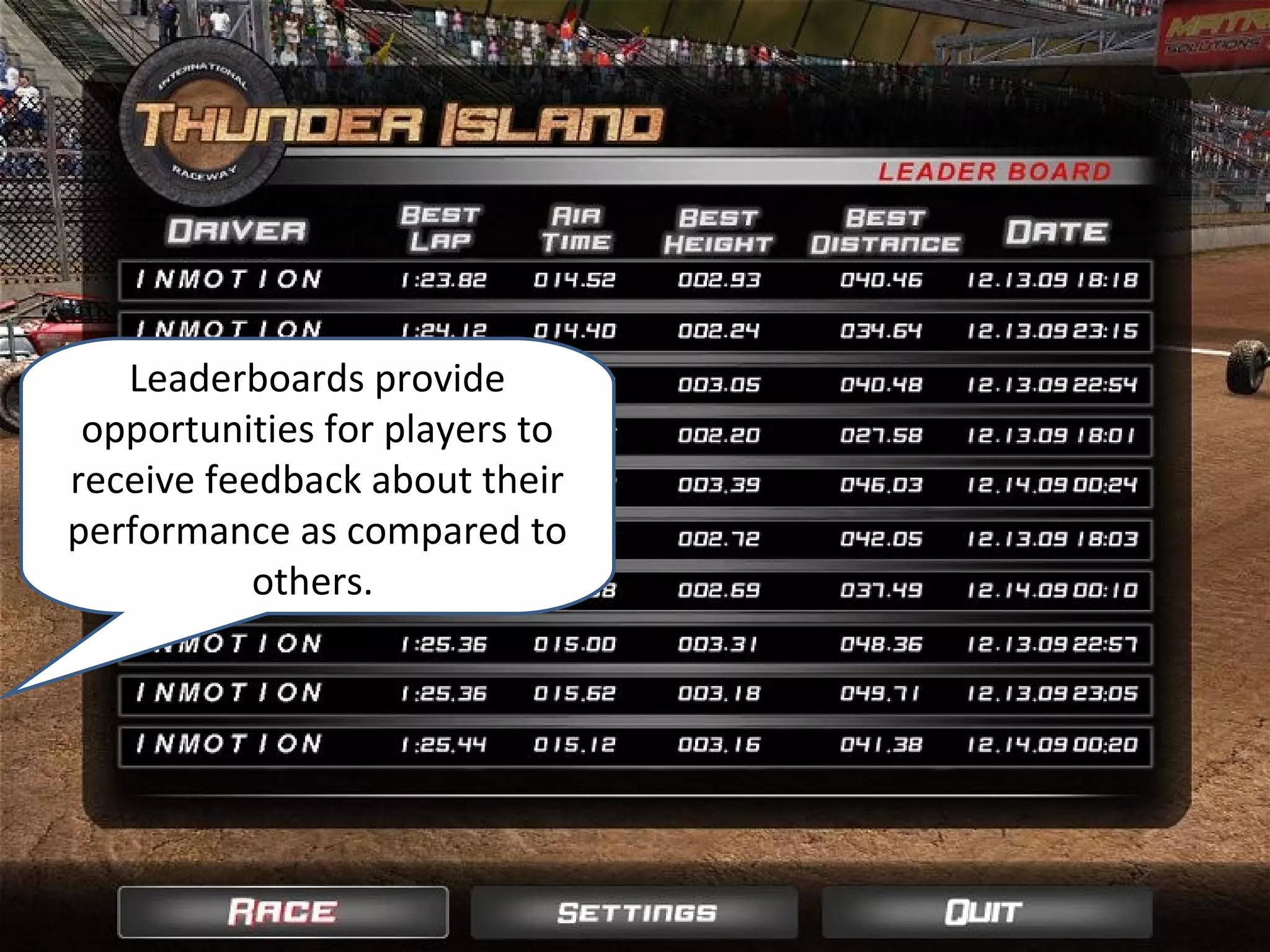
Leaderboards provide
 opportunities for players to
receive feedback about their
performance as compared to
           others.
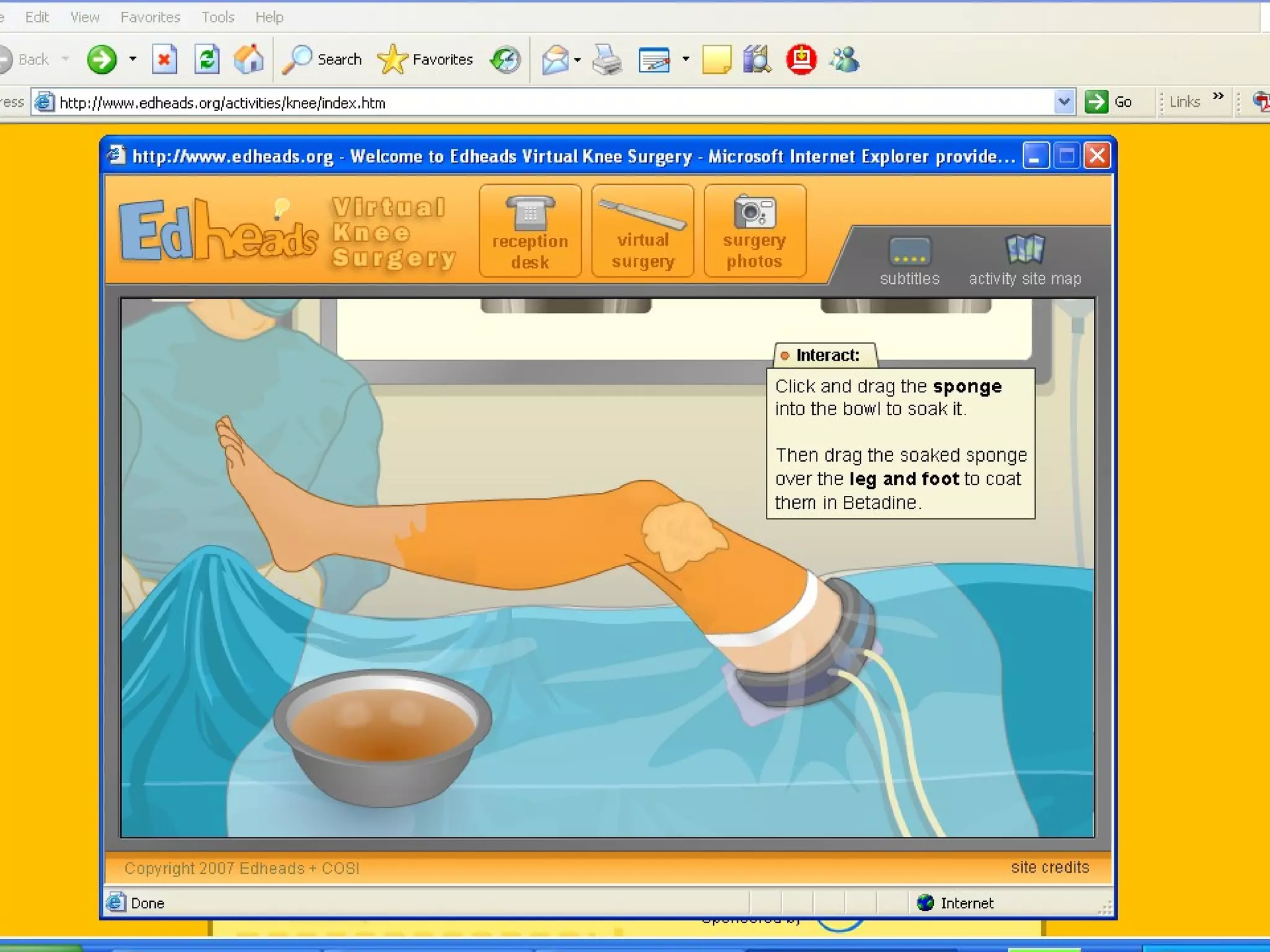
Authentic Feedback
 provides realistic
feedback based on
  player actions.
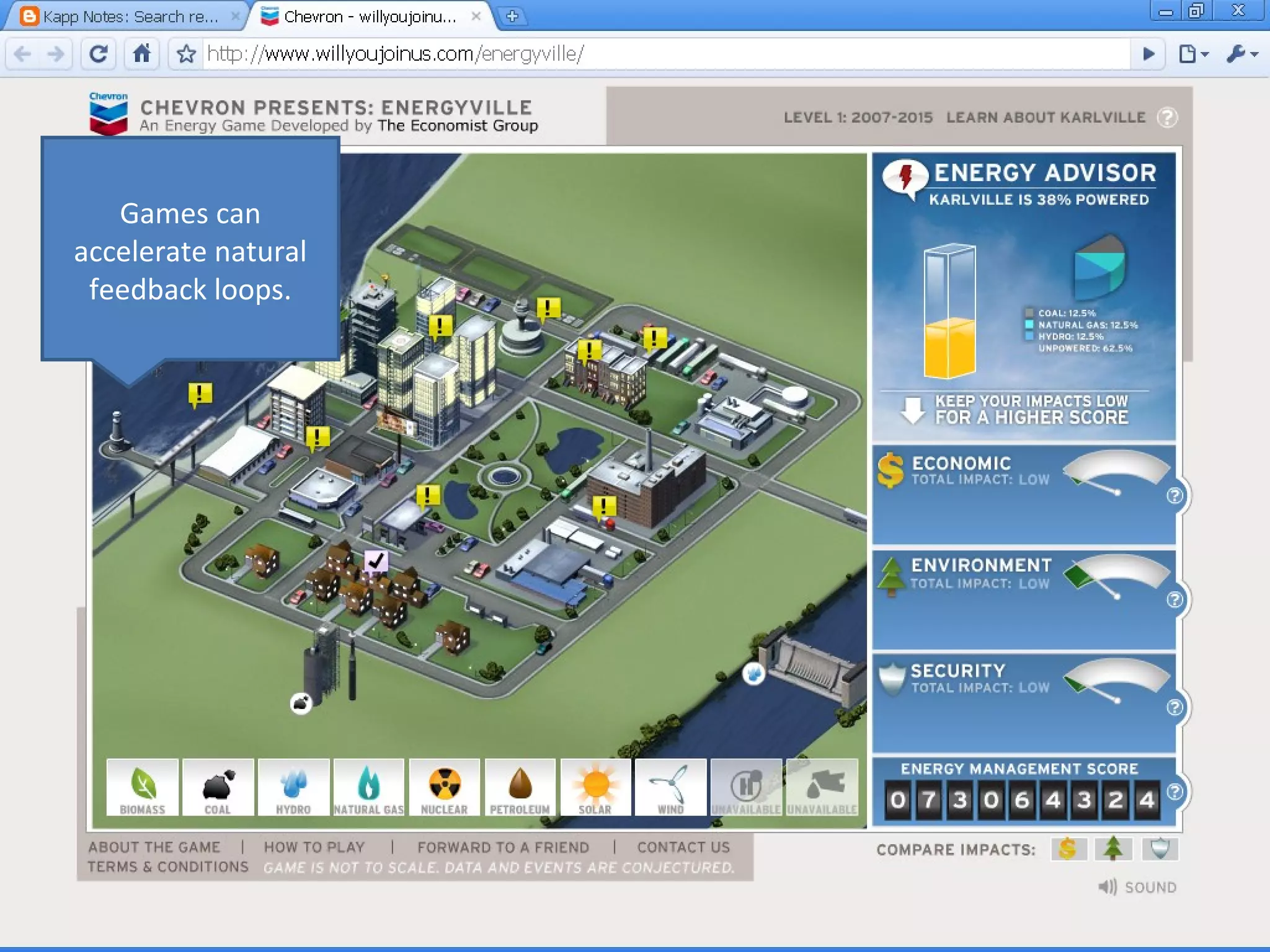
Games can
accelerate natural
 feedback loops.
Recommendations
• Provide authentic and realistic feedback.

• Feedback should be continuous through out
  the learning.

• Feedback should be instructional and provide
  knowledge of learner’s performance.

• Allow learners to create their own social
  “leaderboard” of friends.
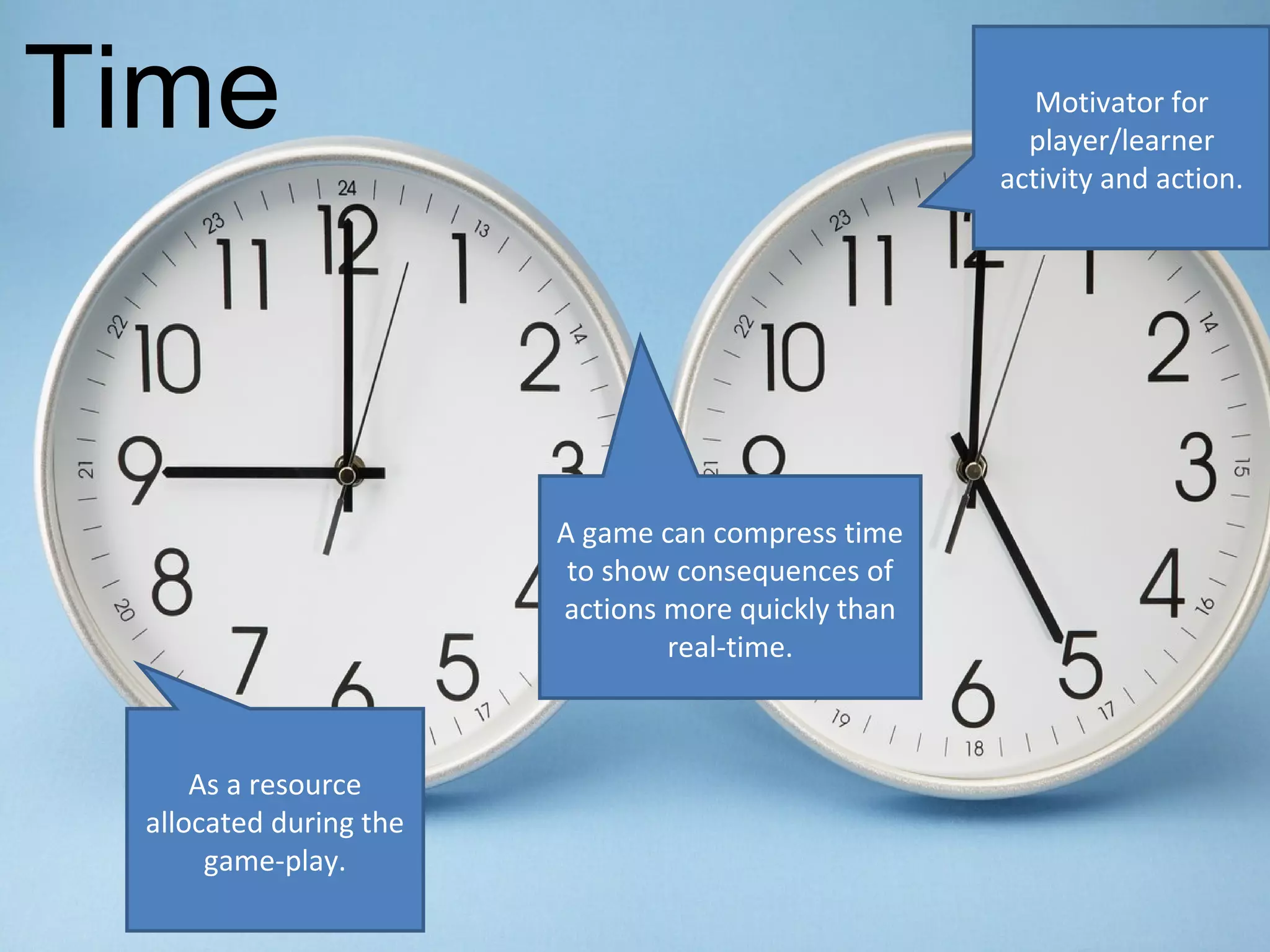
Time                                                   Motivator for
                                                      player/learner
                                                    activity and action.


                        A game can compress time
                         to show consequences of
                        actions more quickly than
                                real-time.


     As a resource
 allocated during the
      game-play.
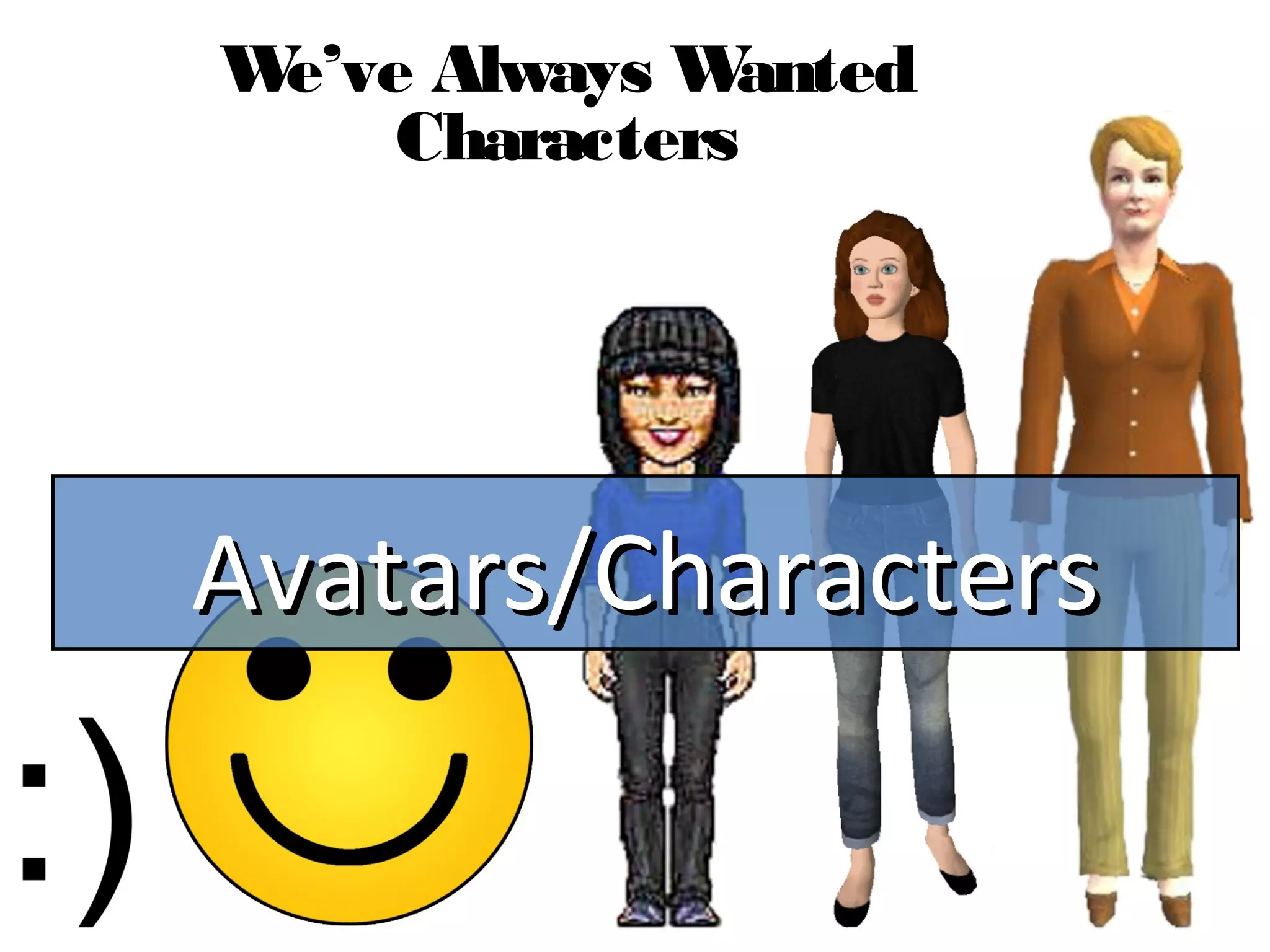
We’ve Always W anted
     Characters


Avatars/Characters
Identity– no deep learning takes place unless an
extended commitment of self is made for the long haul.

Good gamification captures players through identify.

Players either inherit a strongly formed and
appealing character or they get to build a character
from the ground up.

Players become committed to the game space in which
they will learn and act.

Based on work from James Paul Gee, University of Wisconsin-Madison
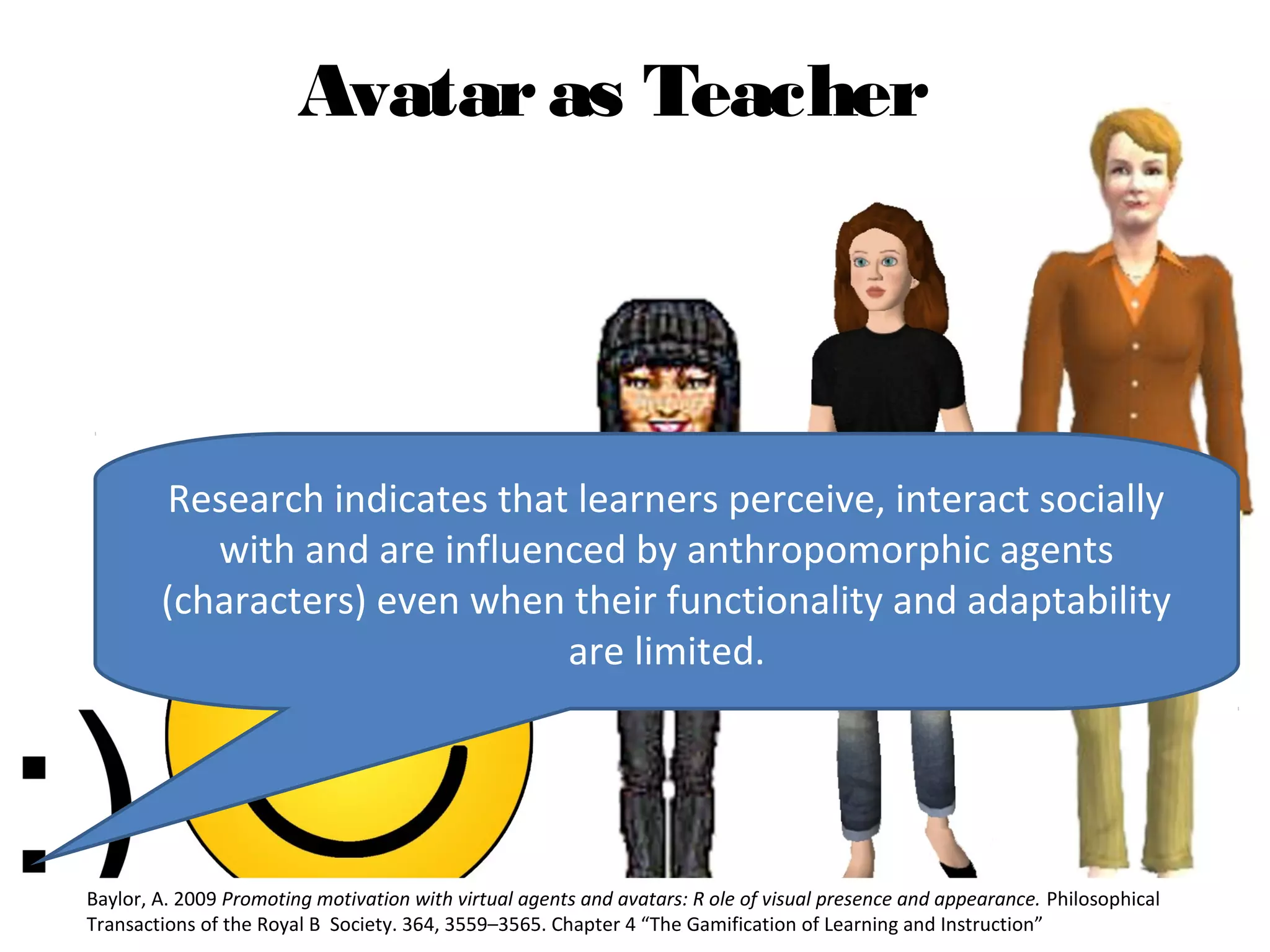
Avatar as Teacher


        Research indicates that learners perceive, interact socially
           with and are influenced by anthropomorphic agents
        (characters) even when their functionality and adaptability
                               are limited.


Baylor, A. 2009 Promoting motivation with virtual agents and avatars: R ole of visual presence and appearance. Philosophical
Transactions of the Royal B Society. 364, 3559–3565. Chapter 4 “The Gamification of Learning and Instruction”
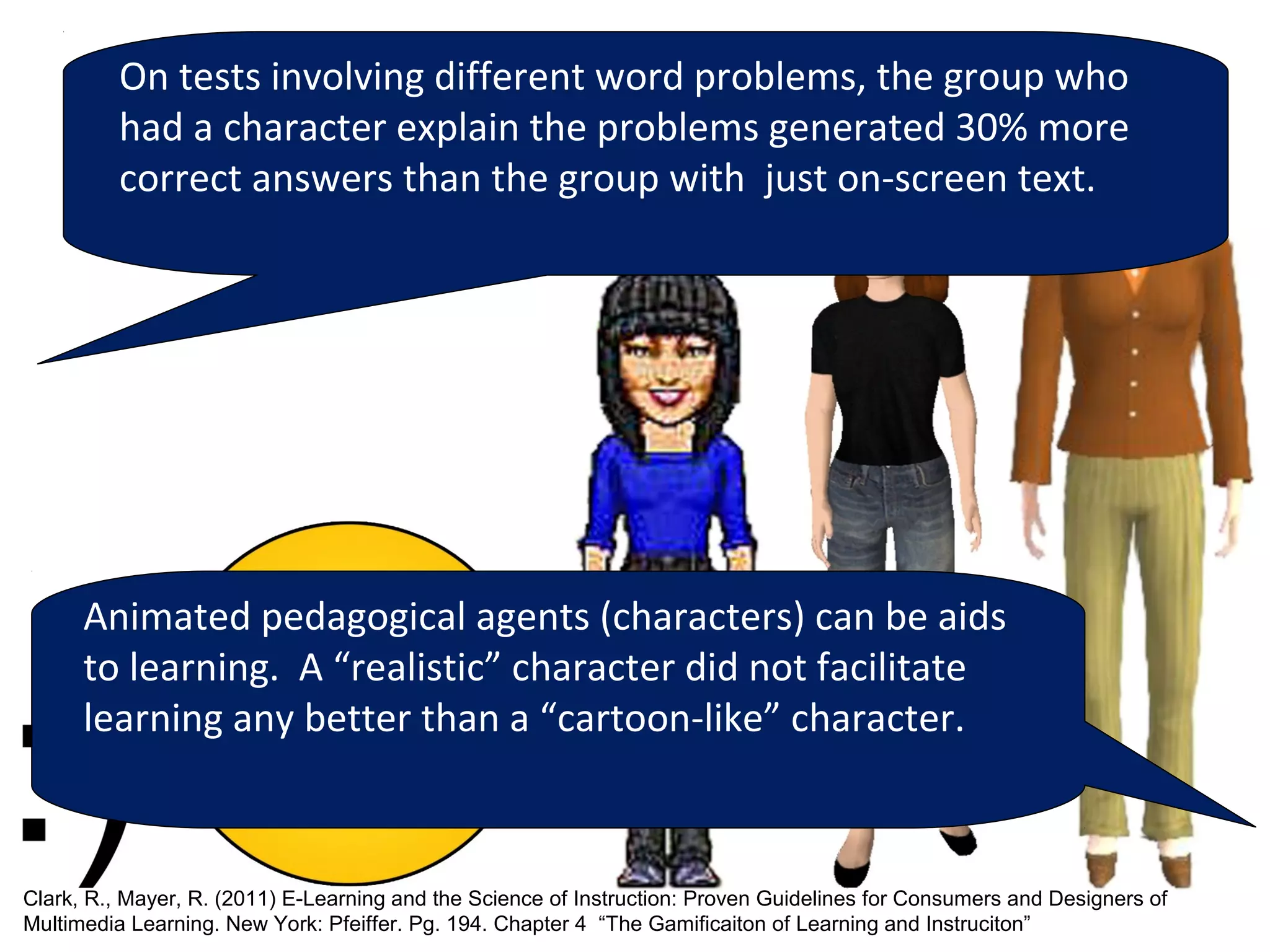
On tests involving different word problems, the group who
         had a character explain the problems generated 30% more
         correct answers than the group with just on-screen text.


      Animated pedagogical agents (characters) can be aids
      to learning. A “realistic” character did not facilitate
      learning any better than a “cartoon-like” character.


Clark, R., Mayer, R. (2011) E-Learning and the Science of Instruction: Proven Guidelines for Consumers and Designers of
Multimedia Learning. New York: Pfeiffer. Pg. 194. Chapter 4 “The Gamificaiton of Learning and Instruciton”
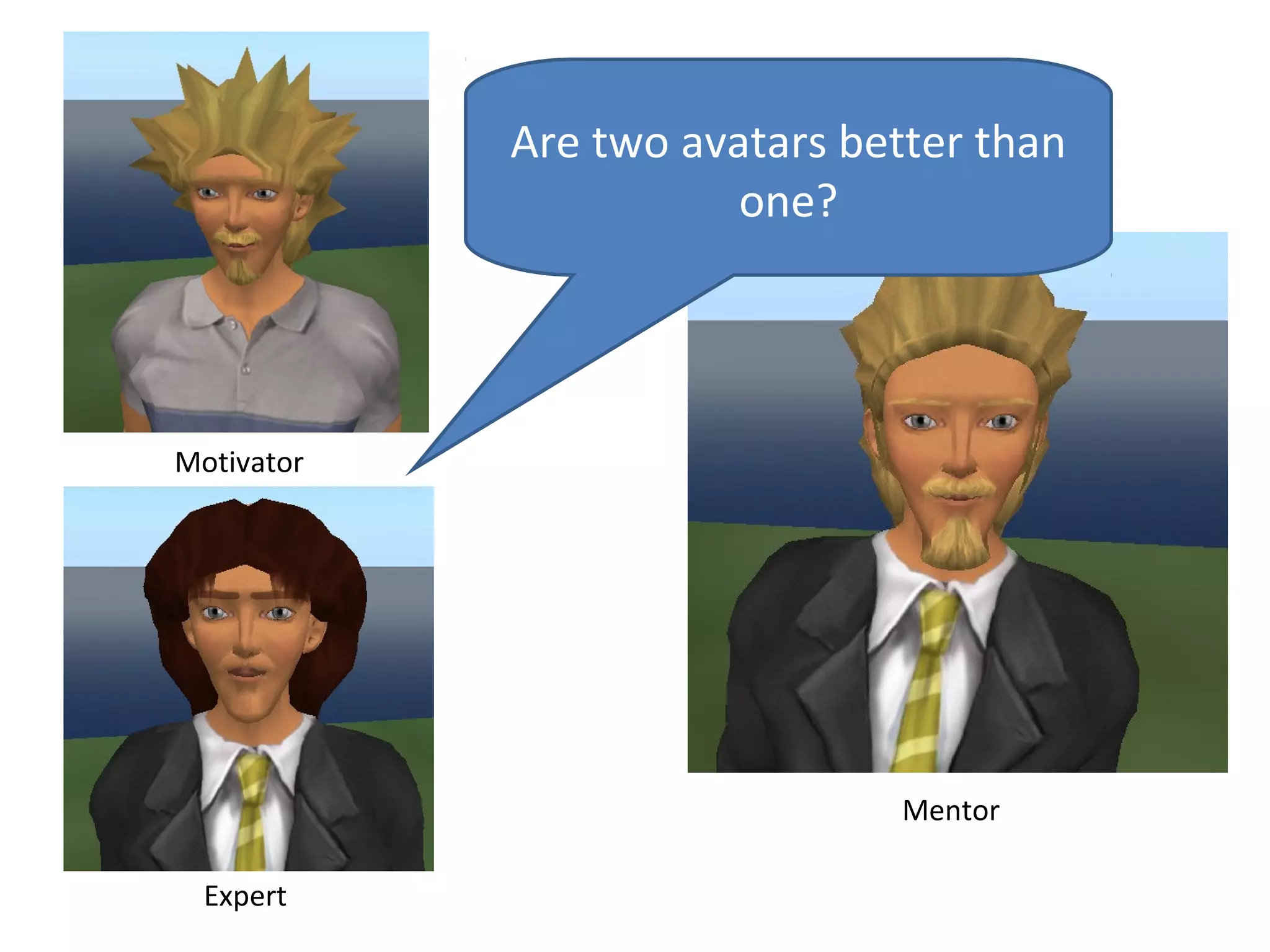
Are two avatars better than
                       one?


Motivator


                               Mentor

  Expert
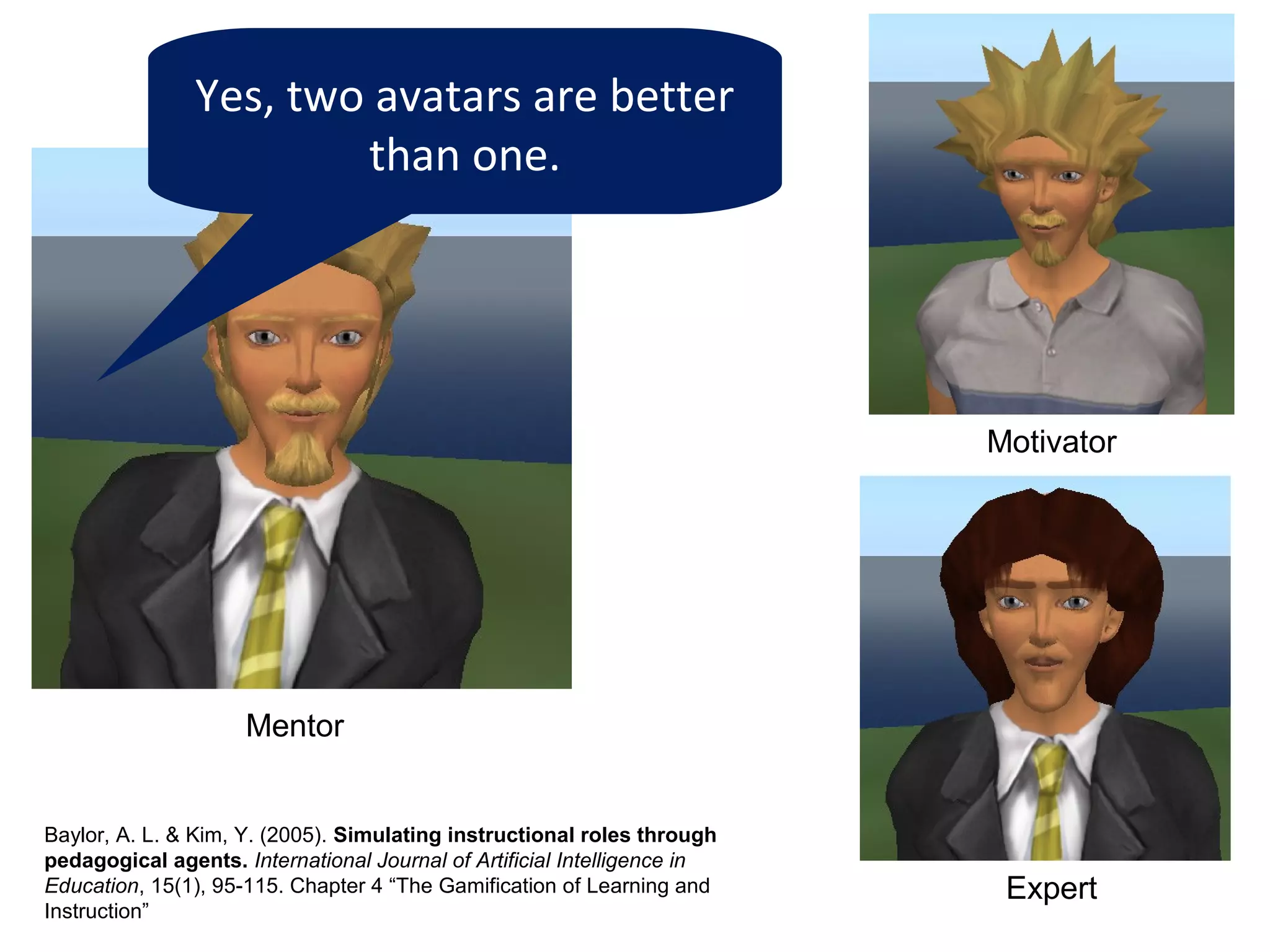
Yes, two avatars are better
                       than one.


                                                                          Motivator


                     Mentor


Baylor, A. L. & Kim, Y. (2005). Simulating instructional roles through
pedagogical agents. International Journal of Artificial Intelligence in
Education, 15(1), 95-115. Chapter 4 “The Gamification of Learning and      Expert
Instruction”
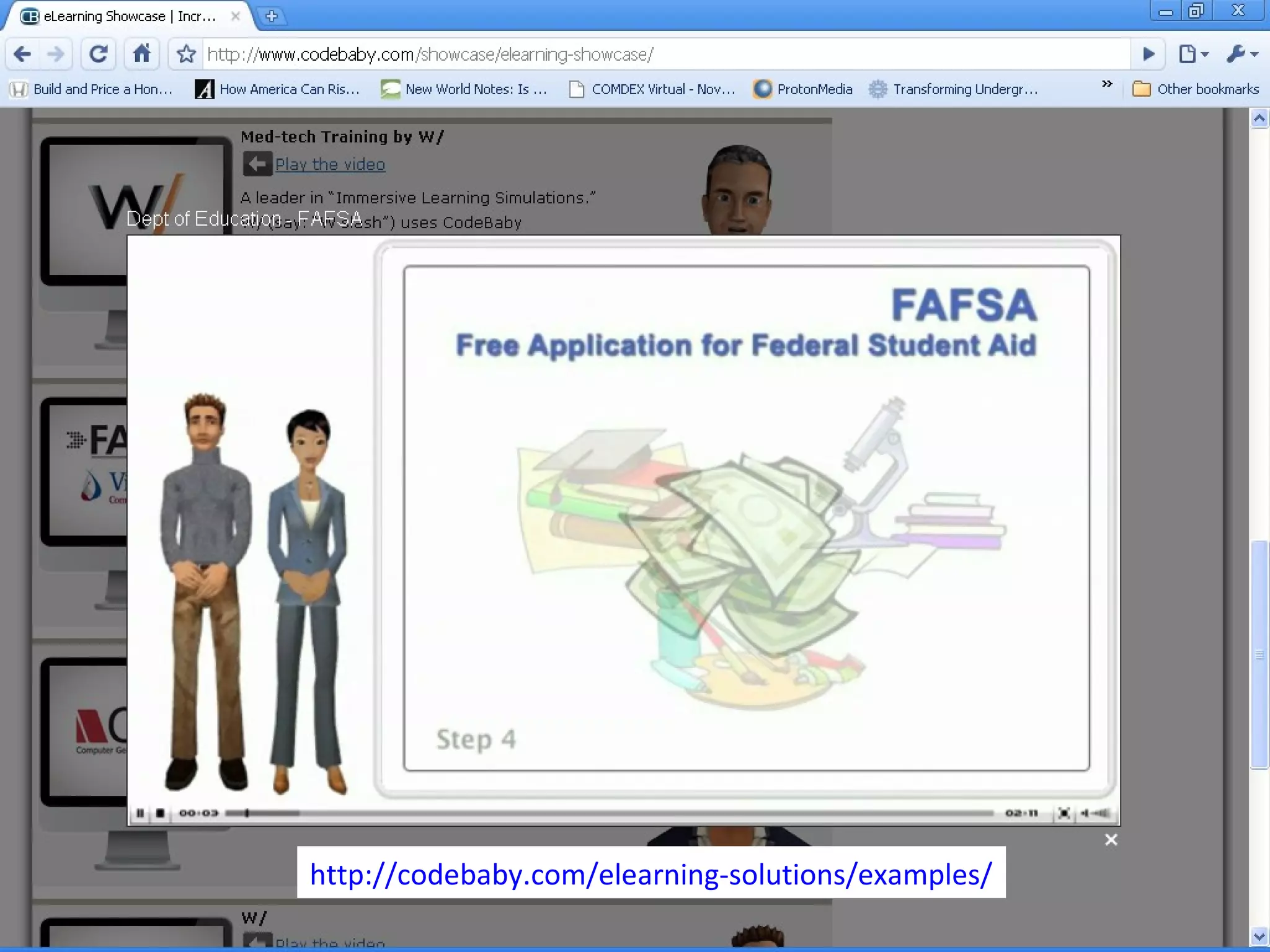
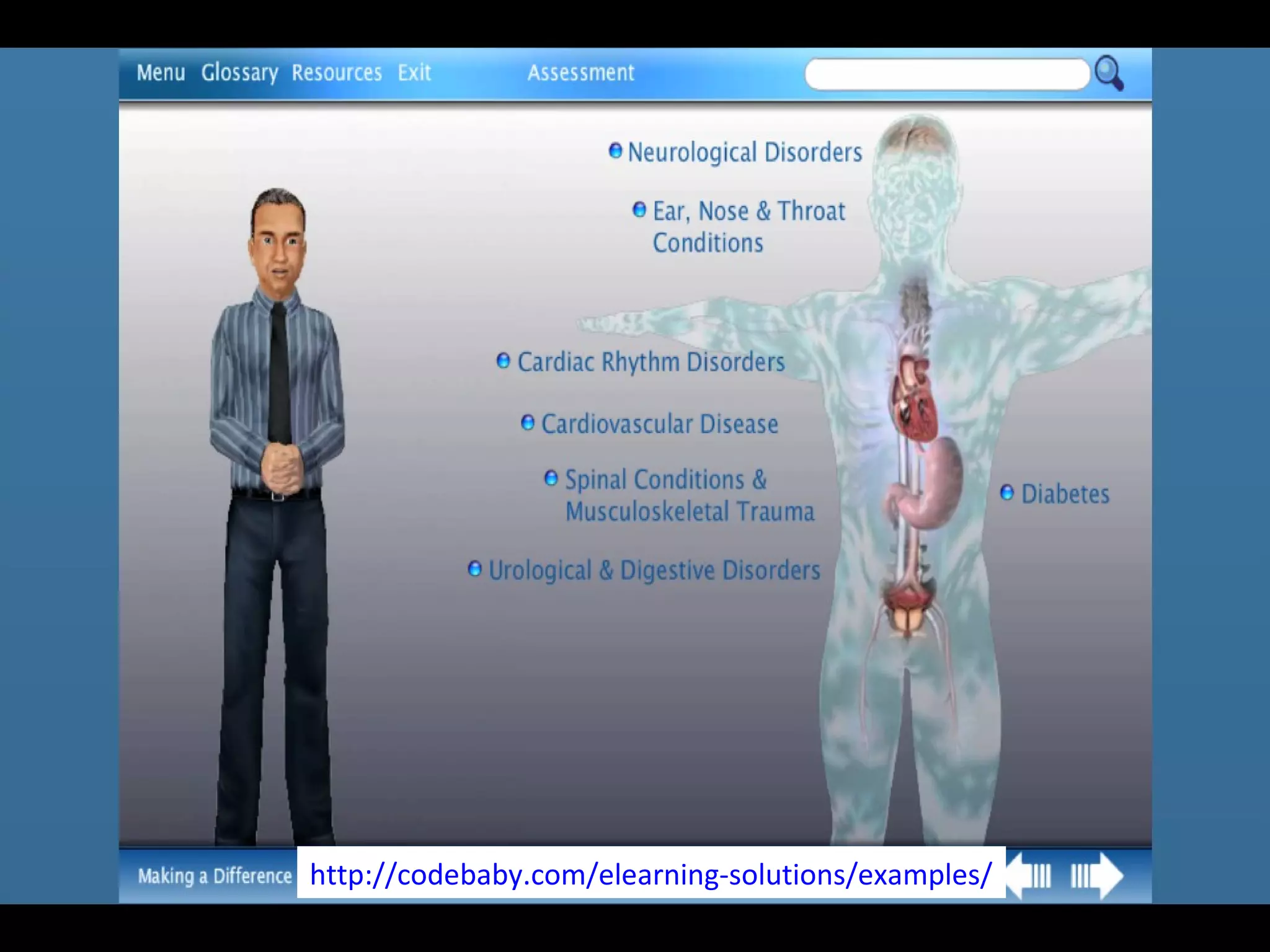
http://codebaby.com/elearning-solutions/examples/
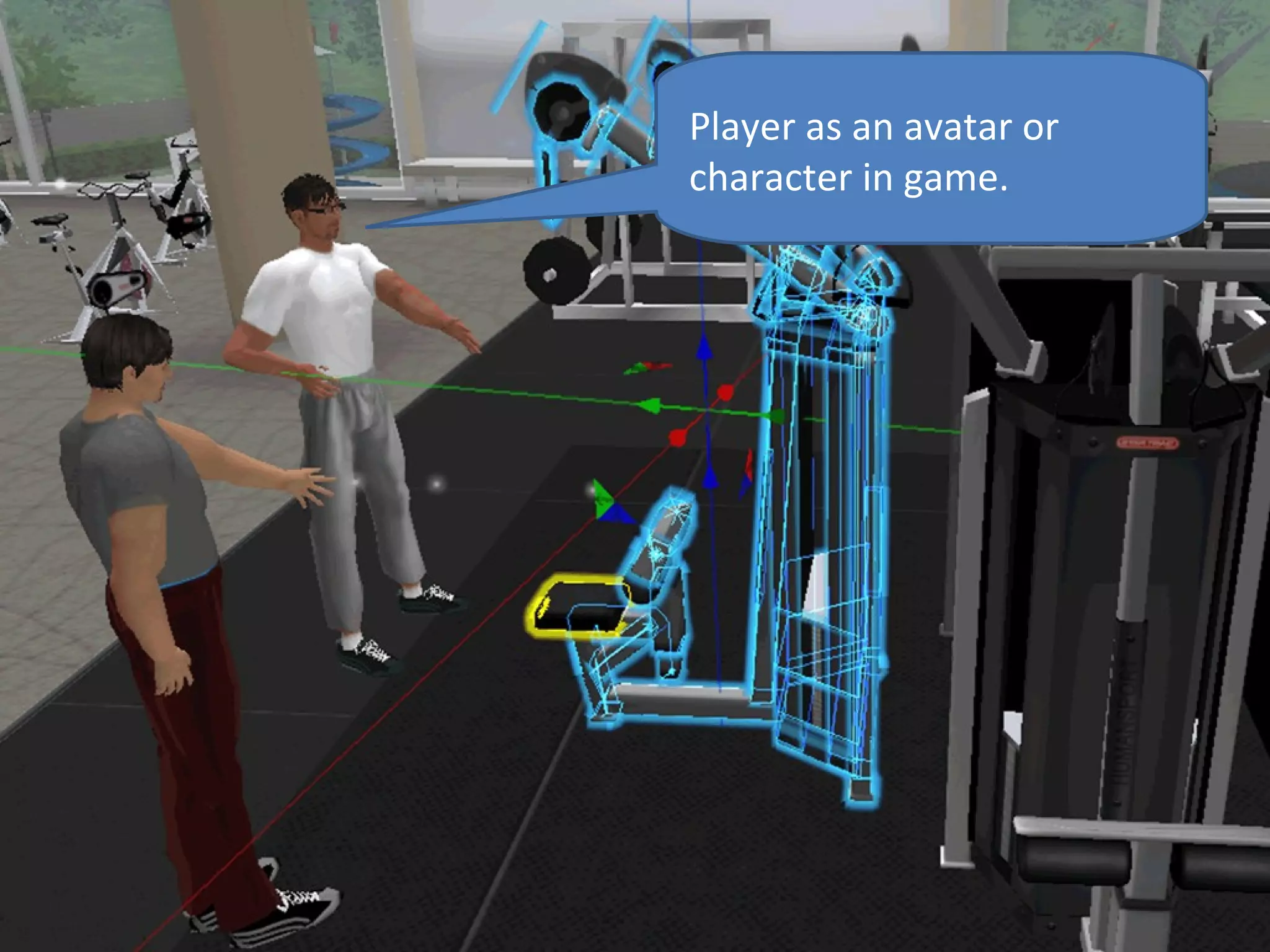
Player as an avatar or
character in game.
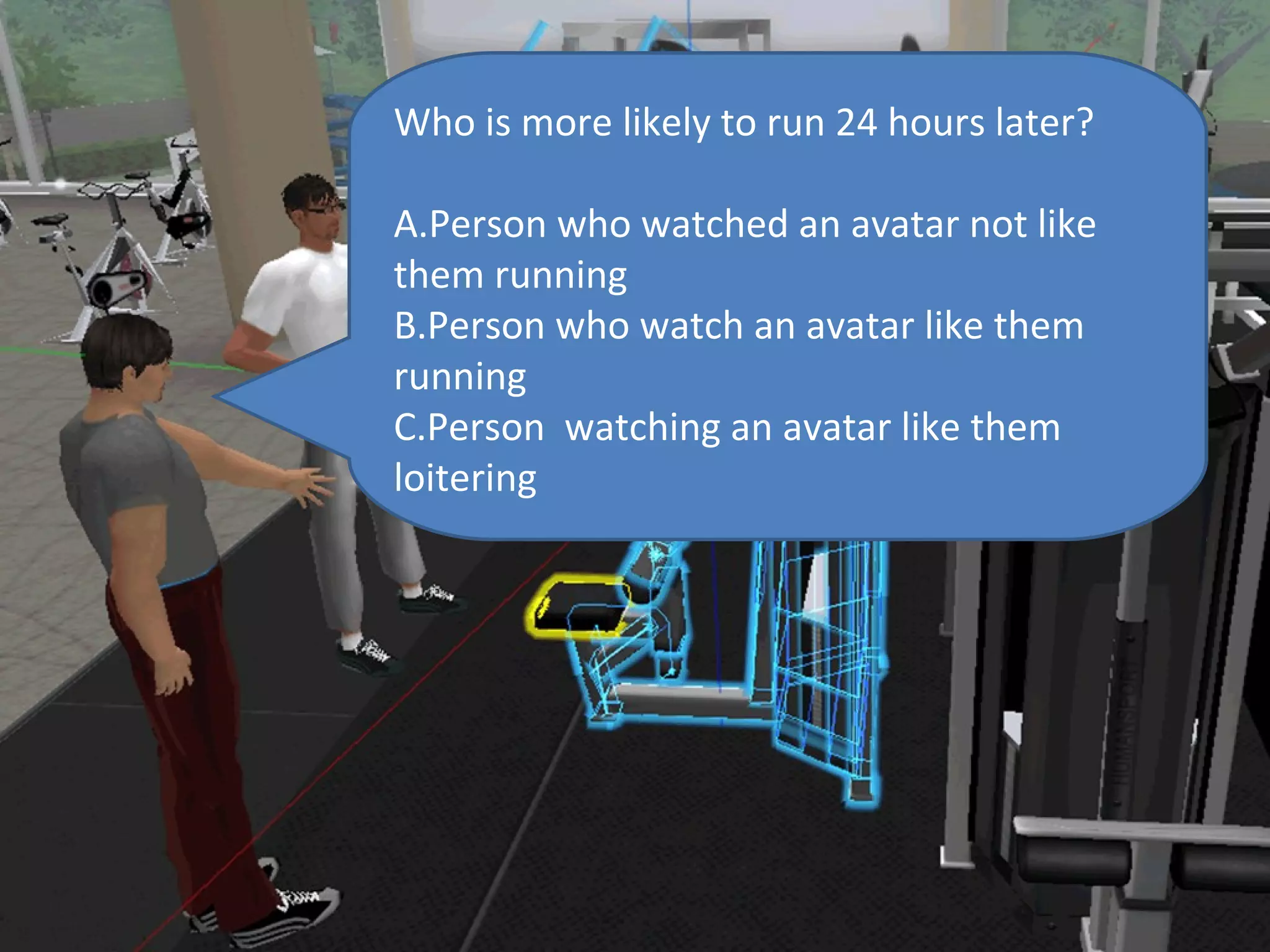
Who is more likely to run 24 hours later?

A.Person who watched an avatar not like
them running
B.Person who watch an avatar like them
running
C.Person watching an avatar like them
loitering
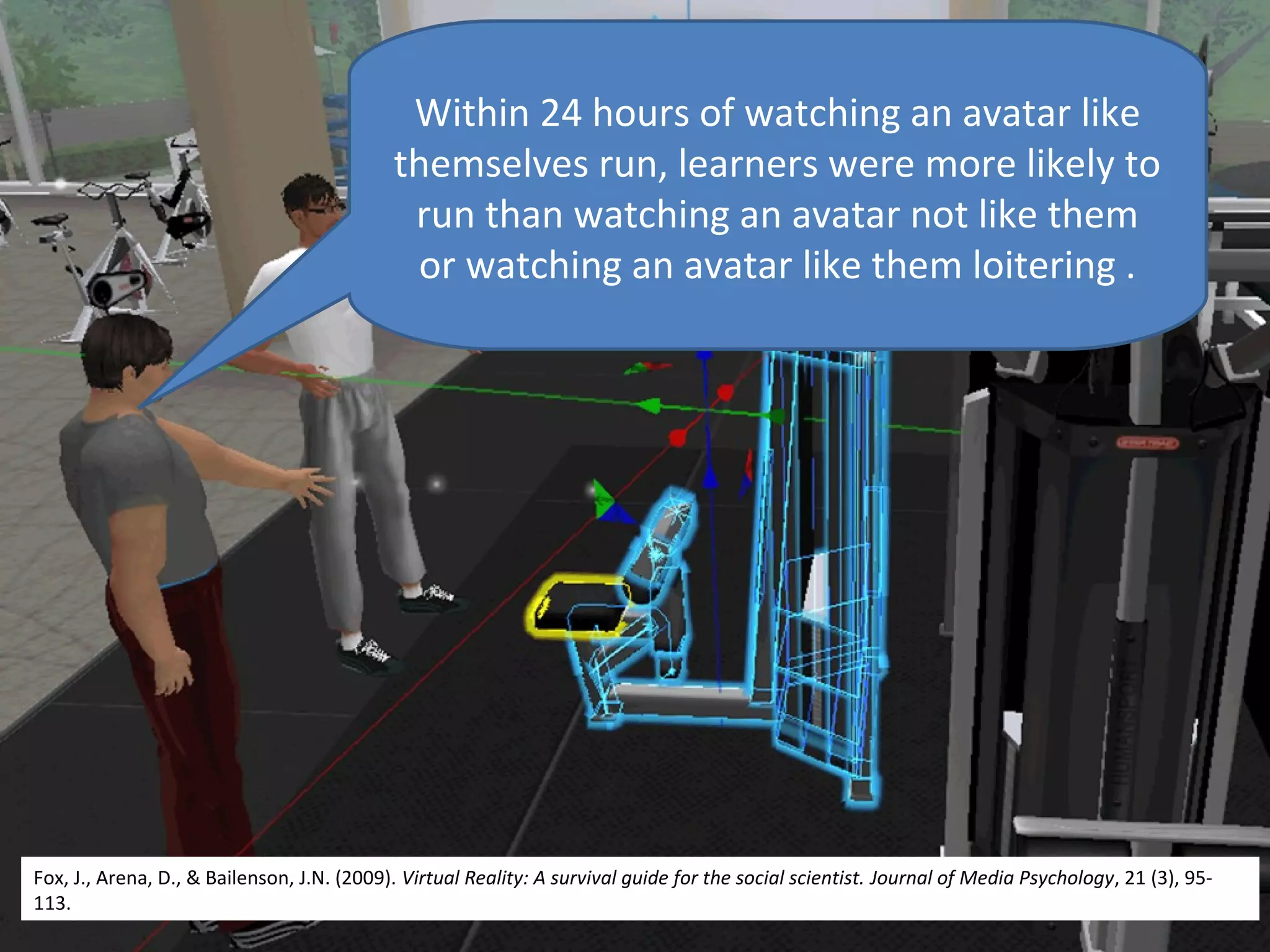
Within 24 hours of watching an avatar like
                                            themselves run, learners were more likely to
                                             run than watching an avatar not like them
                                             or watching an avatar like them loitering .


Fox, J., Arena, D., & Bailenson, J.N. (2009). Virtual Reality: A survival guide for the social scientist. Journal of Media Psychology, 21 (3), 95-
113.
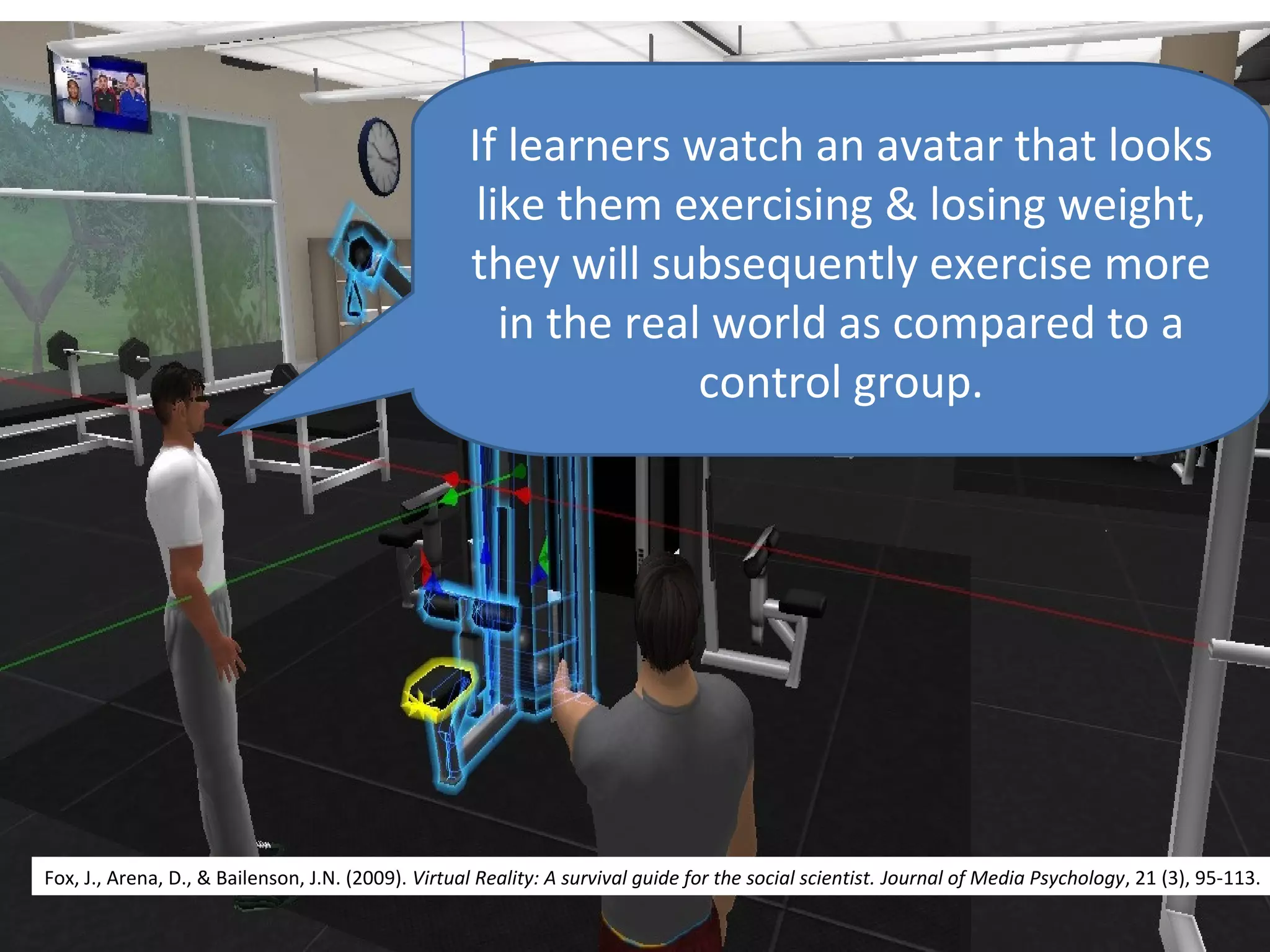
If learners watch an avatar that looks
                                                     like them exercising & losing weight,
                                                    they will subsequently exercise more
                                                       in the real world as compared to a
                                                                  control group.


Fox, J., Arena, D., & Bailenson, J.N. (2009). Virtual Reality: A survival guide for the social scientist. Journal of Media Psychology, 21 (3), 95-113.
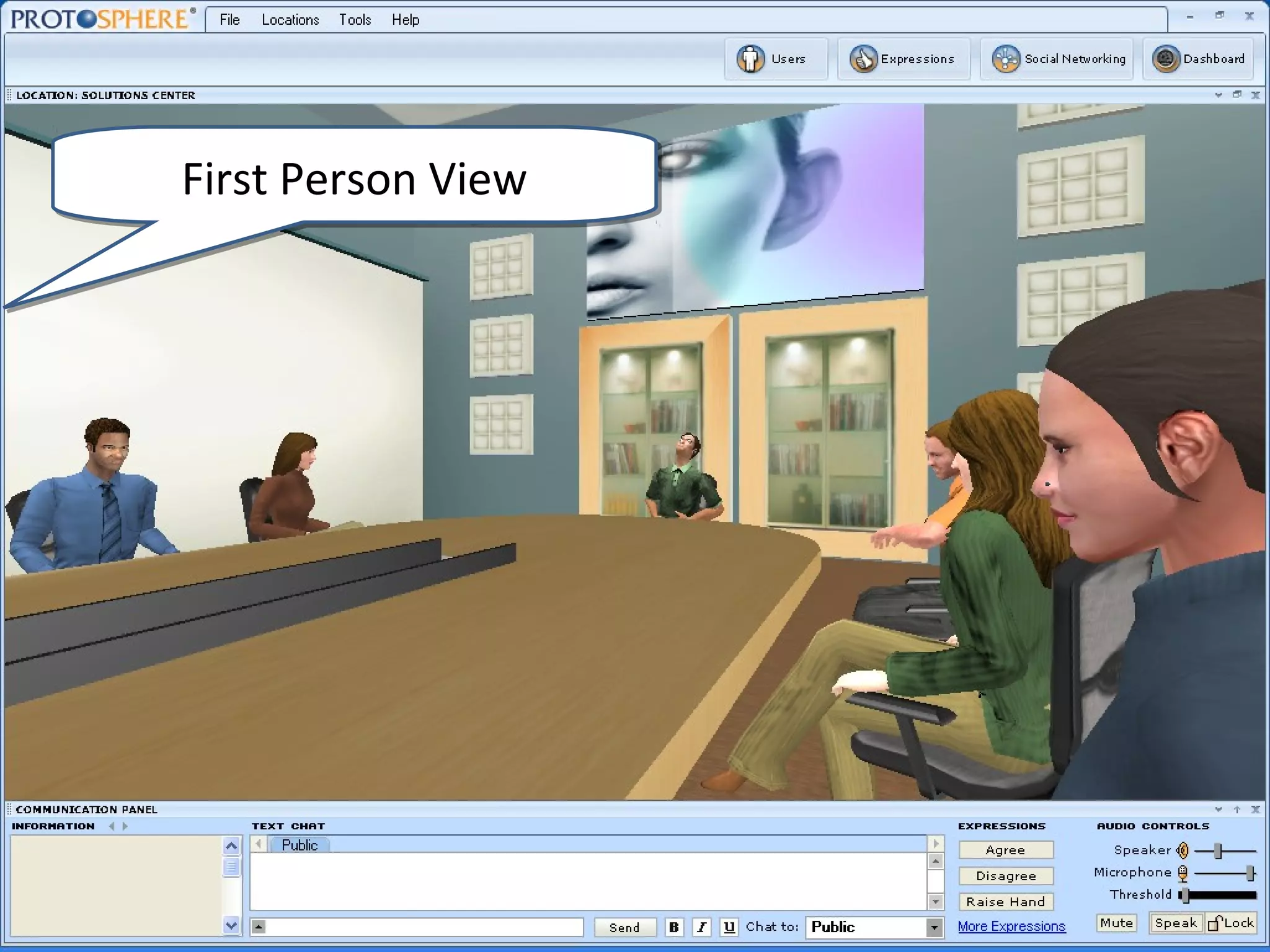
First Person View
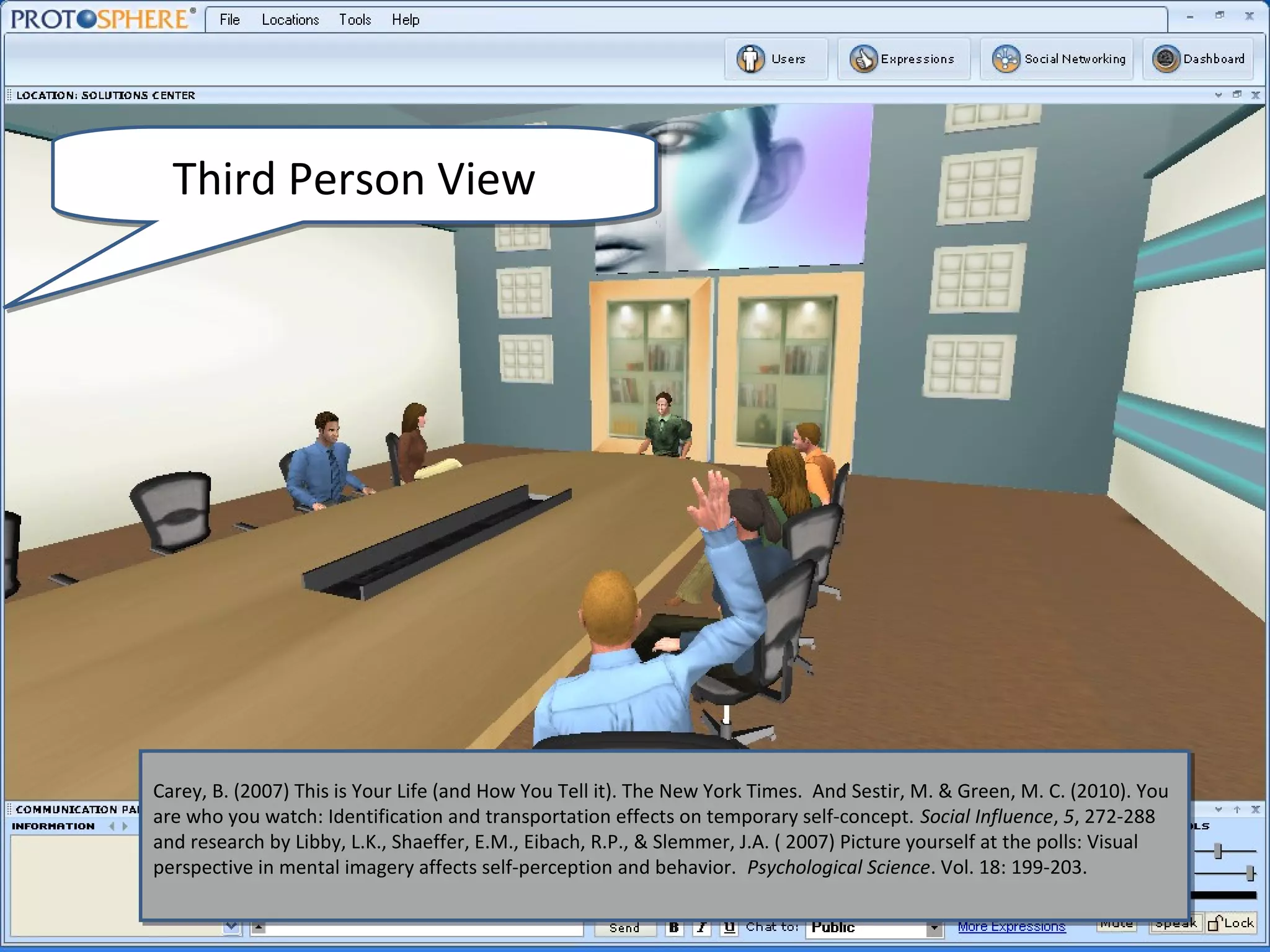
Third Person View


Carey, B. (2007) This is Your Life (and How You Tell it). The New York Times. And Sestir, M. & Green, M. C. (2010). You
are who you watch: Identification and transportation effects on temporary self-concept. Social Influence, 5, 272-288
and research by Libby, L.K., Shaeffer, E.M., Eibach, R.P., & Slemmer, J.A. (( 2007) Picture yourself at the polls: Visual
and research by Libby, L.K., Shaeffer, E.M., Eibach, R.P., & Slemmer, J.A. 2007) Picture yourself at the polls: Visual
perspective in mental imagery affects self-perception and behavior. Psychological Science. Vol. 18: 199-203.
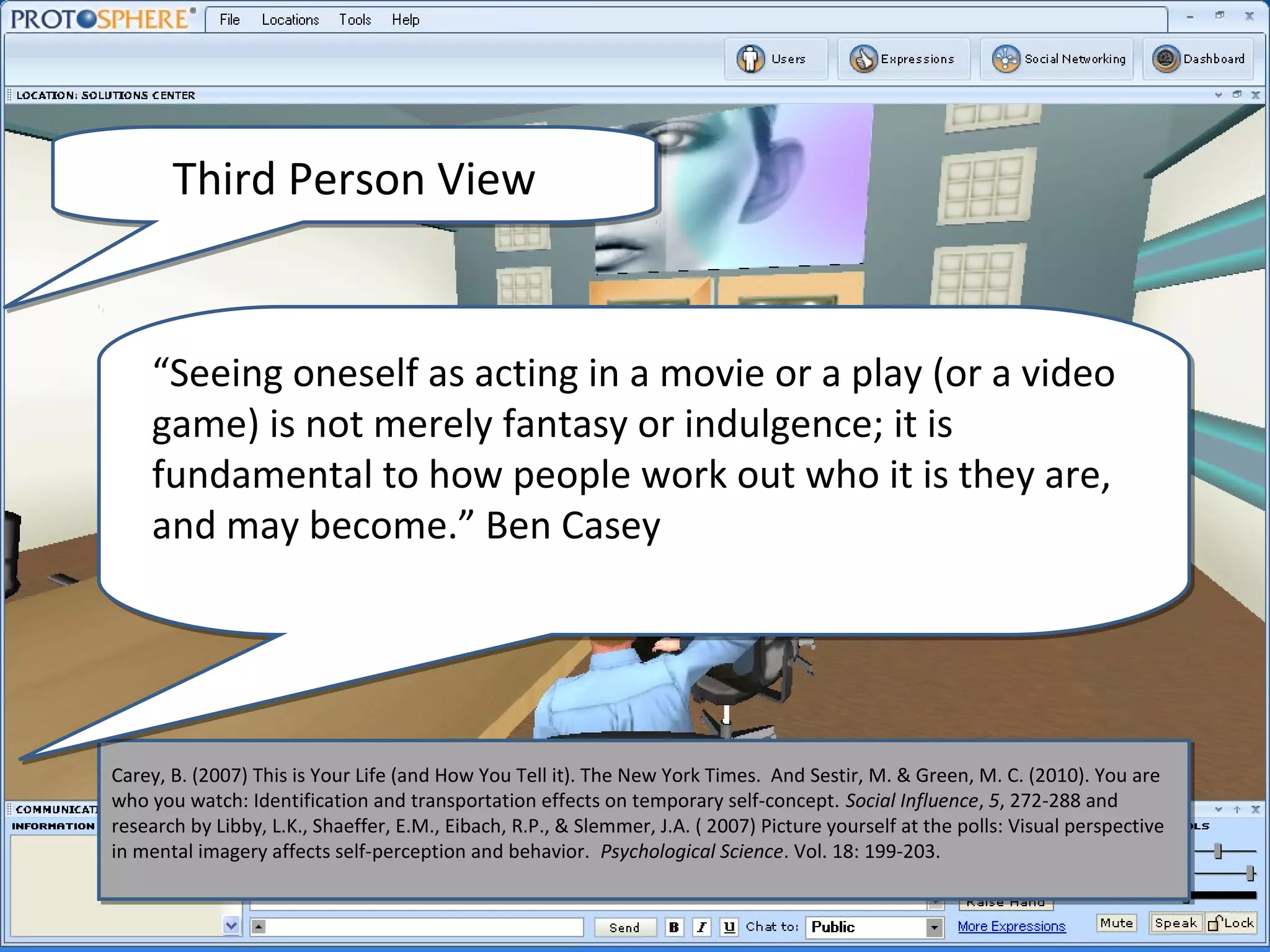
Third Person View


    “Seeing oneself as acting in a movie or a play (or a video
    game) is not merely fantasy or indulgence; it is
    fundamental to how people work out who it is they are,
    and may become.” Ben Casey


Carey, B. (2007) This is Your Life (and How You Tell it). The New York Times. And Sestir, M. & Green, M. C. (2010). You are
 Carey, B. (2007) This is Your Life (and How You Tell it). The New York Times. And Sestir, M. & Green, M. C. (2010). You are
who you watch: Identification and transportation effects on temporary self-concept. Social Influence, 5, 272-288 and
 who you watch: Identification and transportation effects on temporary self-concept. Social Influence, 5, 272-288 and
research by Libby, L.K., Shaeffer, E.M., Eibach, R.P., & Slemmer, J.A. (( 2007) Picture yourself at the polls: Visual perspective
 research by Libby, L.K., Shaeffer, E.M., Eibach, R.P., & Slemmer, J.A. 2007) Picture yourself at the polls: Visual perspective
in mental imagery affects self-perception and behavior. Psychological Science. Vol. 18: 199-203.
 in mental imagery affects self-perception and behavior. Psychological Science. Vol. 18: 199-203.
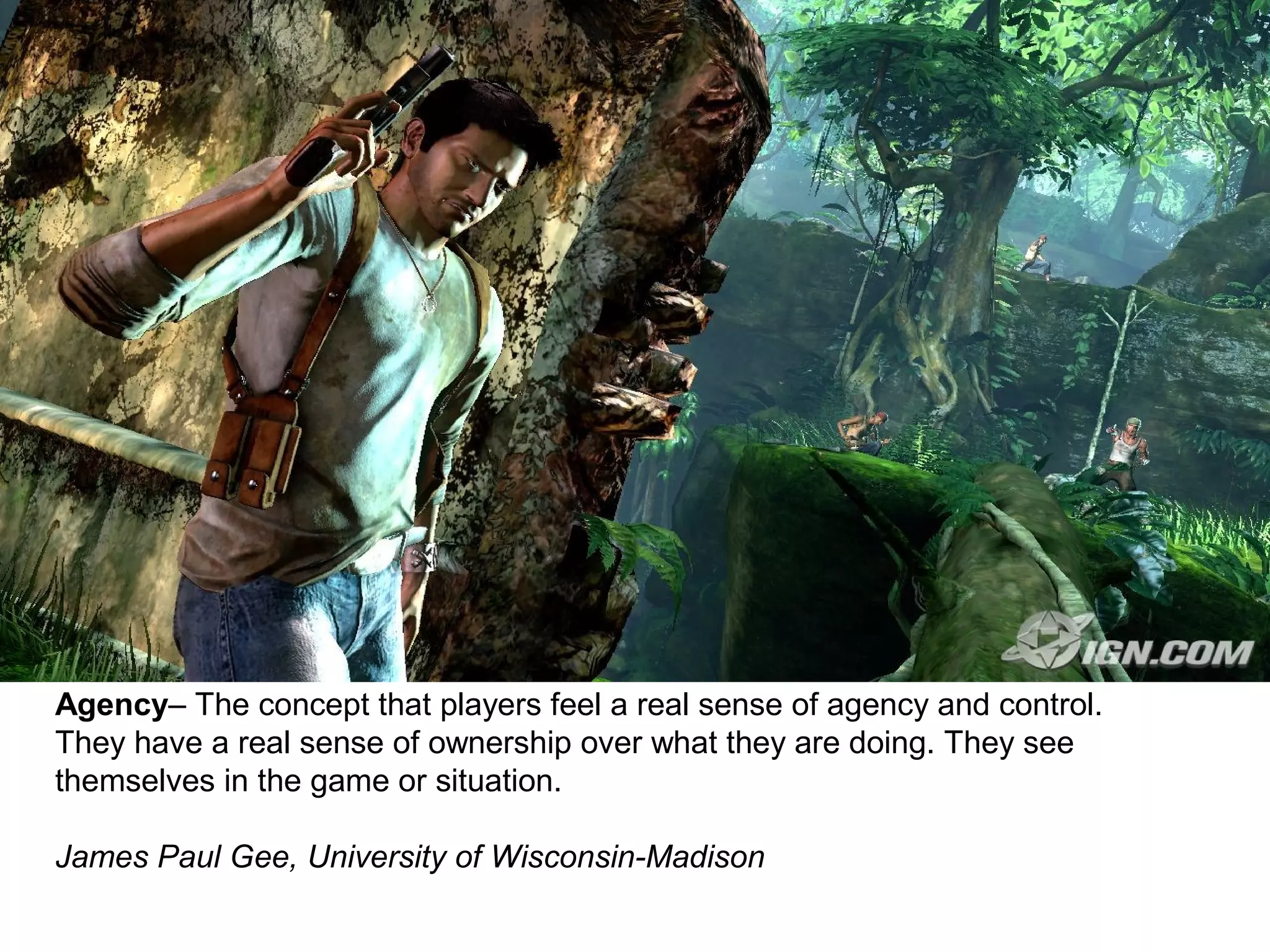
Agency– The concept that players feel a real sense of agency and control.
They have a real sense of ownership over what they are doing. They see
themselves in the game or situation.

James Paul Gee, University of Wisconsin-Madison
Recommendations
• Use characters/agents to model desired behavior.

• Use characters/agents to provide feedback and instruction
  to learners.

• Characters should speak in a natural, conversational tone.

• Use two characters, one for coaching and one for expertise is
  better than just having one character trying to do both.

• User third-person rather than first person to show activities.
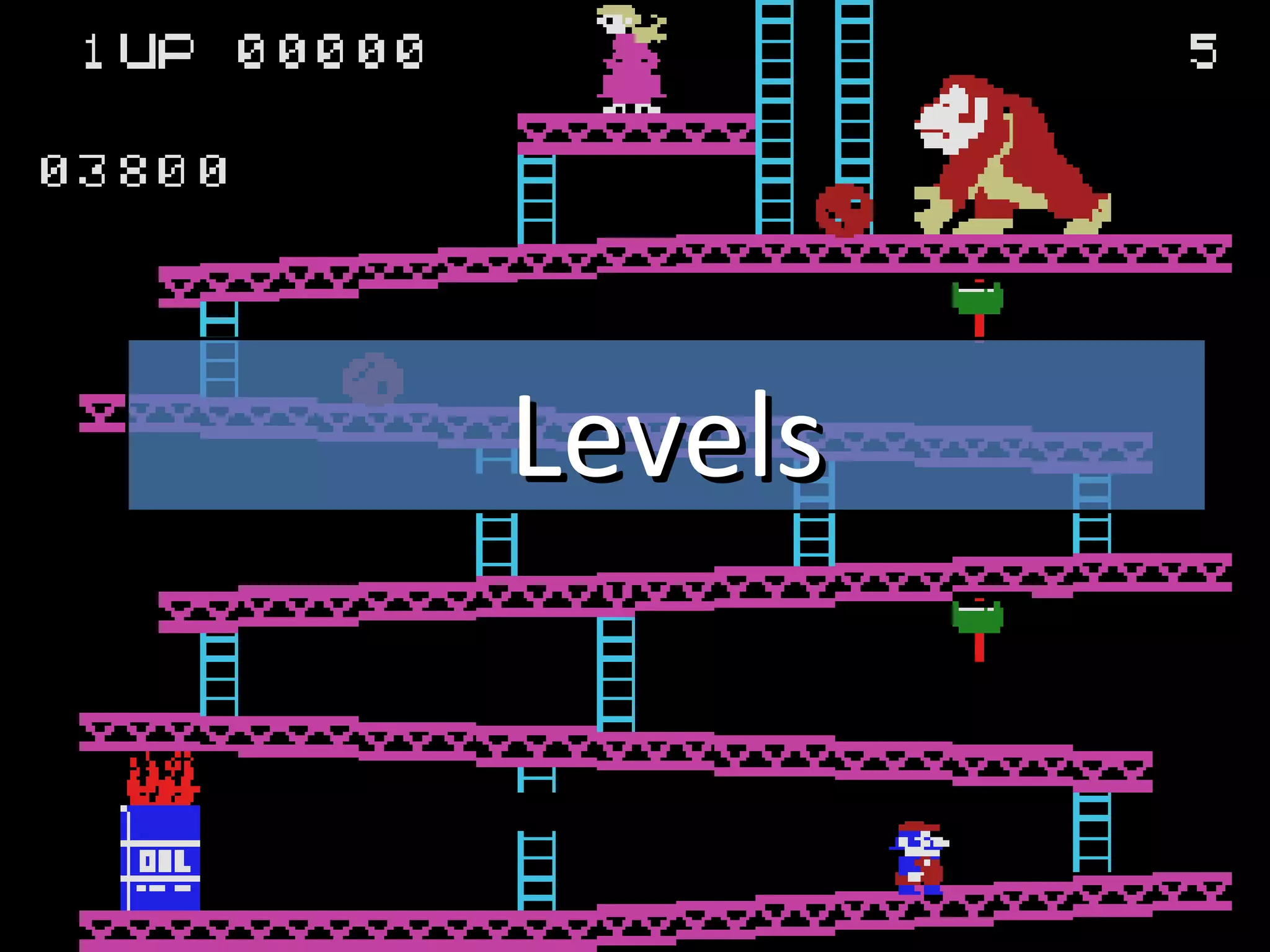
Levels
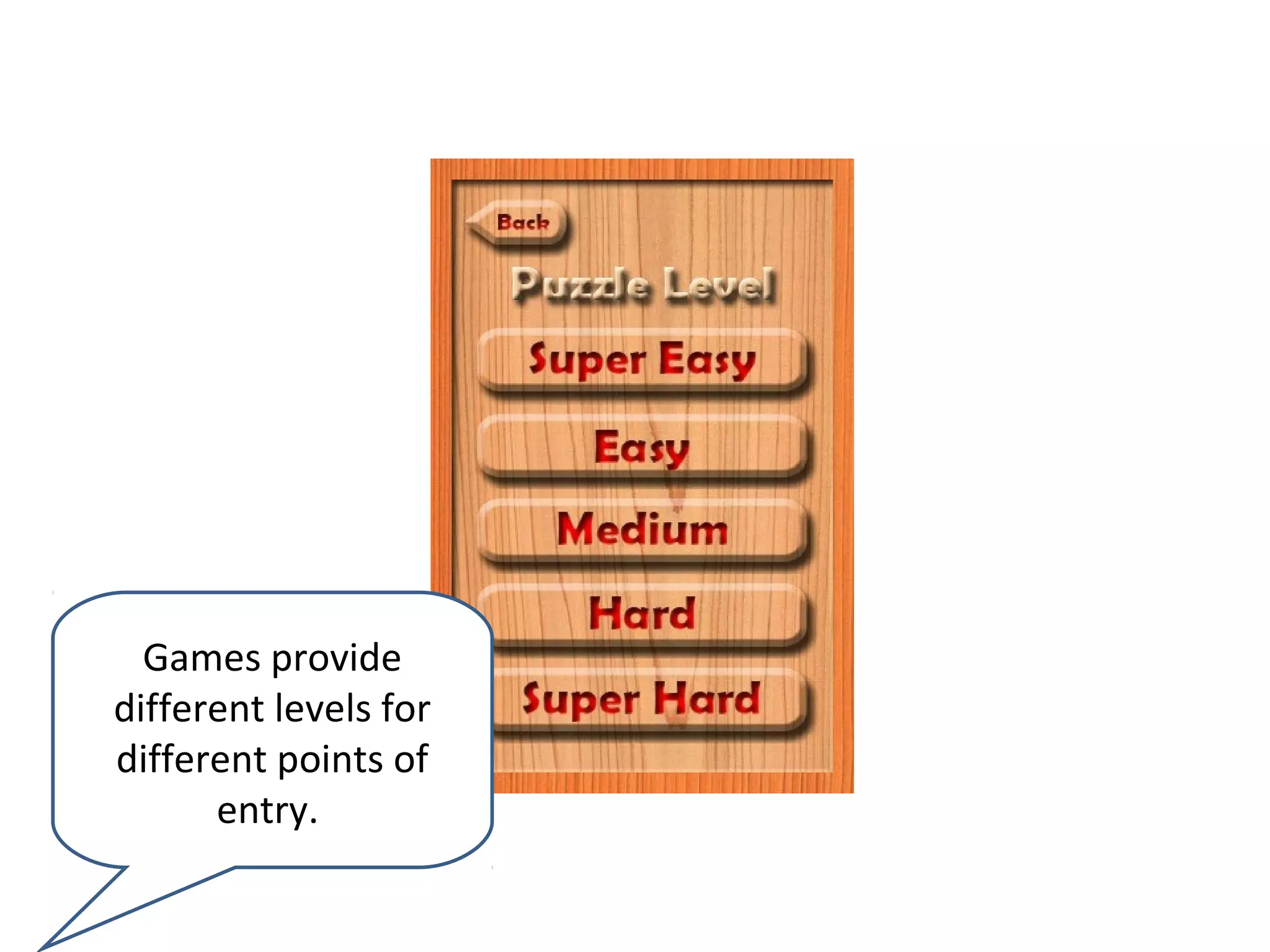
Games provide
different levels for
different points of
      entry.
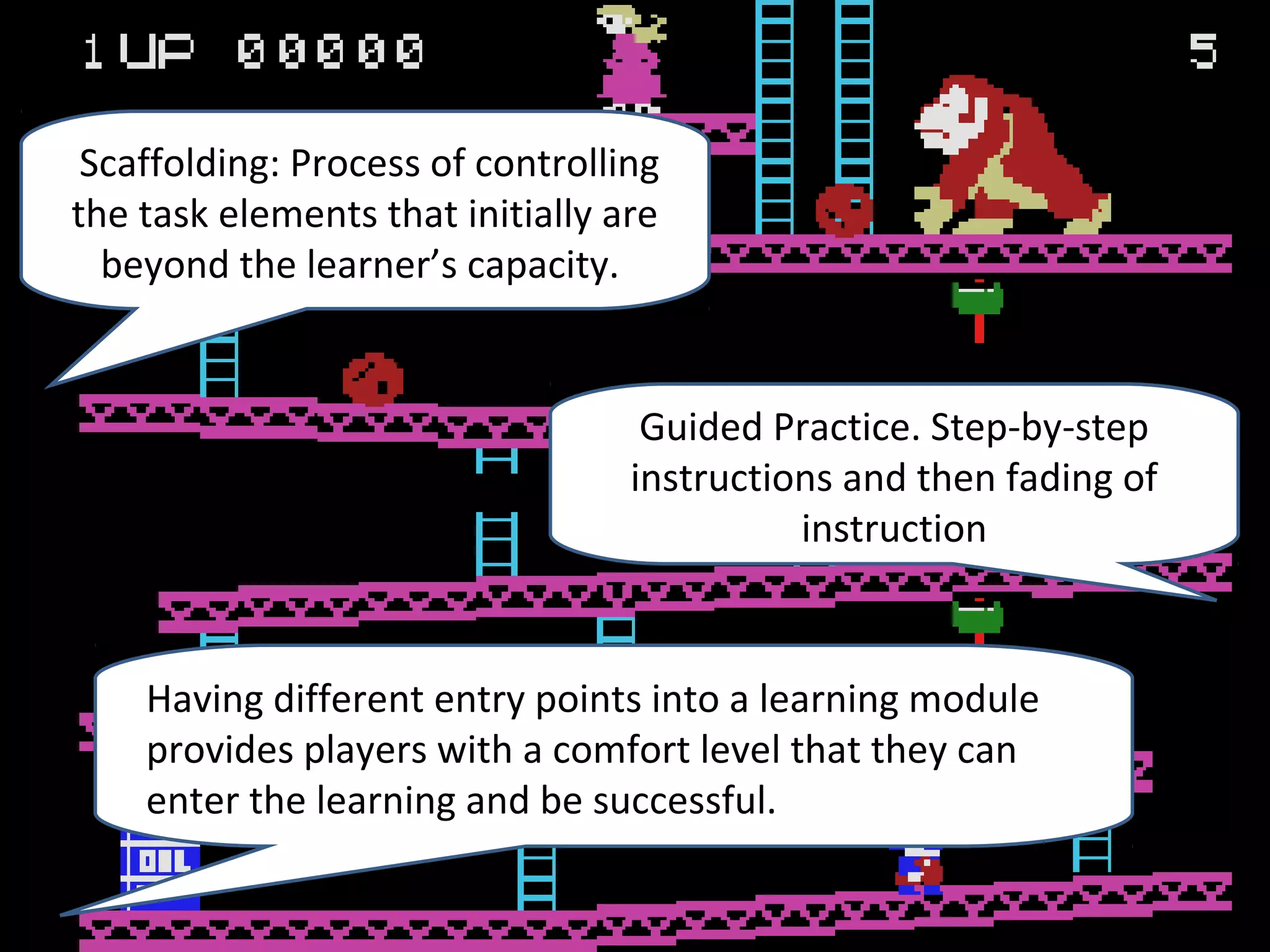
Scaffolding: Process of controlling
the task elements that initially are
  beyond the learner’s capacity.


                                   Guided Practice. Step-by-step
                                  instructions and then fading of
                                            instruction


    Having different entry points into a learning module
    provides players with a comfort level that they can
    enter the learning and be successful.
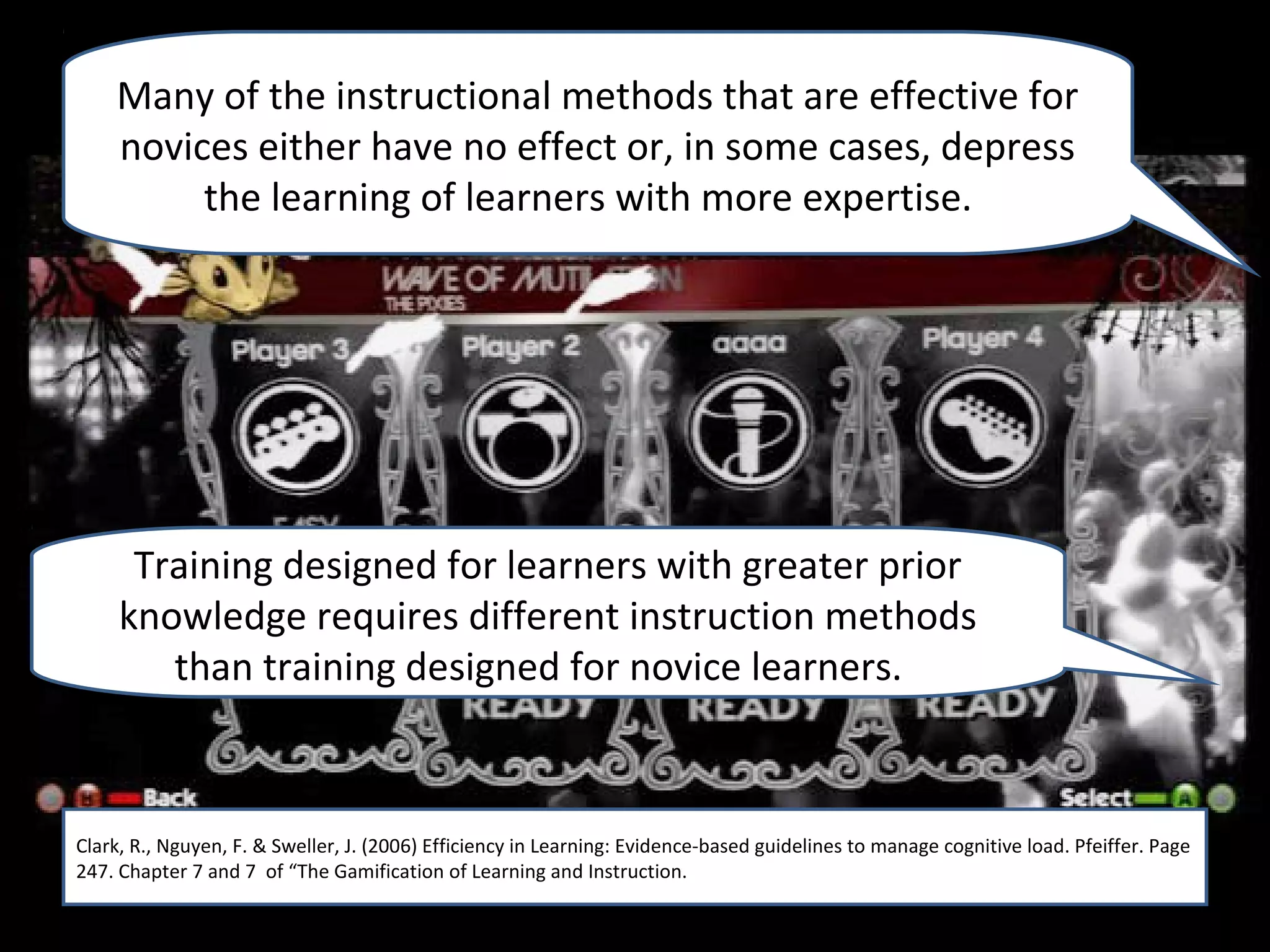
Many of the instructional methods that are effective for
    novices either have no effect or, in some cases, depress
         the learning of learners with more expertise.


      Training designed for learners with greater prior
     knowledge requires different instruction methods
        than training designed for novice learners.


Clark, R., Nguyen, F. & Sweller, J. (2006) Efficiency in Learning: Evidence-based guidelines to manage cognitive load. Pfeiffer. Page
247. Chapter 7 and 7 of “The Gamification of Learning and Instruction.
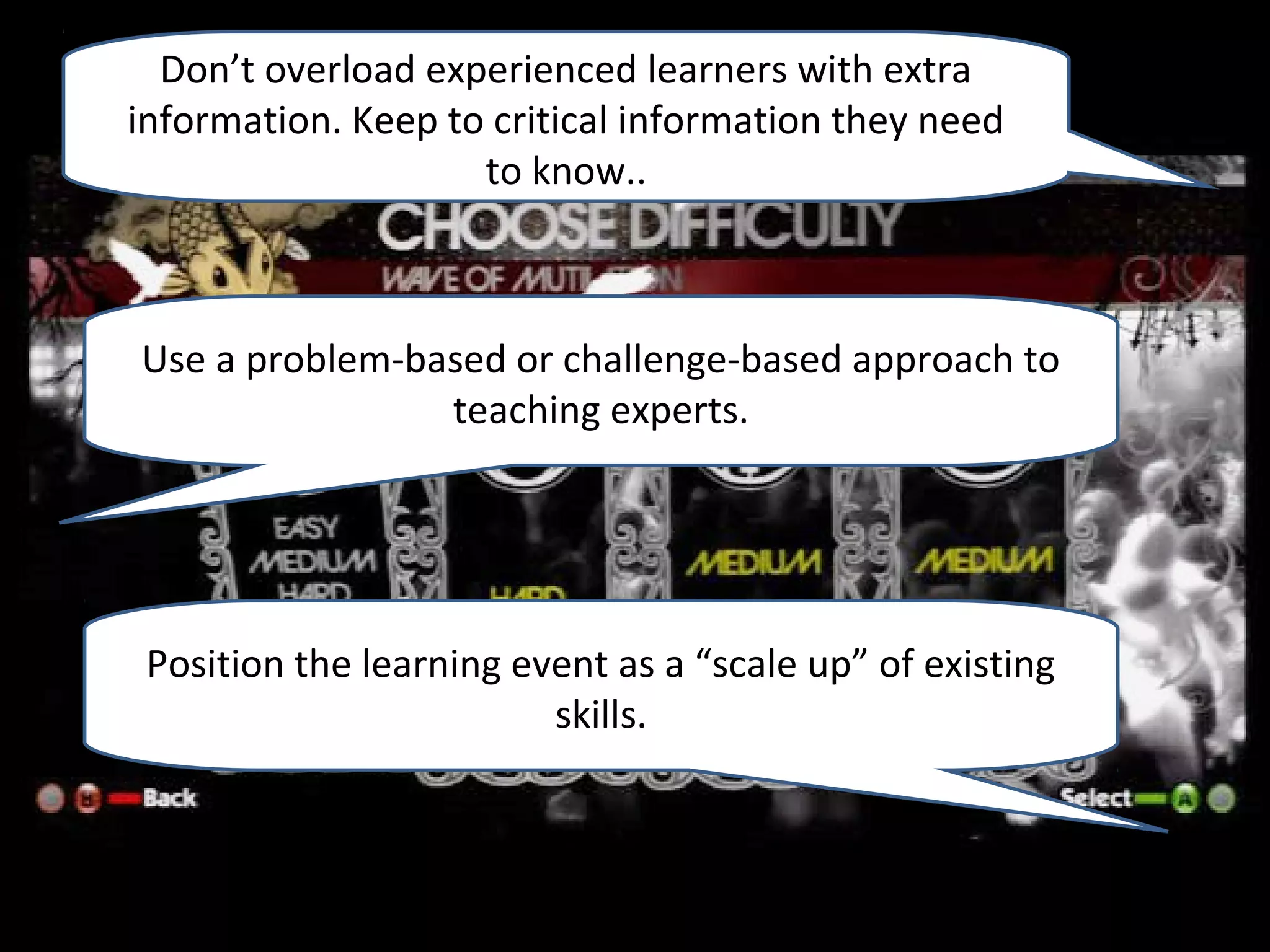
Don’t overload experienced learners with extra
information. Keep to critical information they need
                    to know..


Use a problem-based or challenge-based approach to
                teaching experts.


 Position the learning event as a “scale up” of existing
                         skills.
Recommendations
• Provide different entry points into the
  instruction.

• Provide different learner experiences within
  the same e-learning module.

• Consider “leveling up” learner challenges.
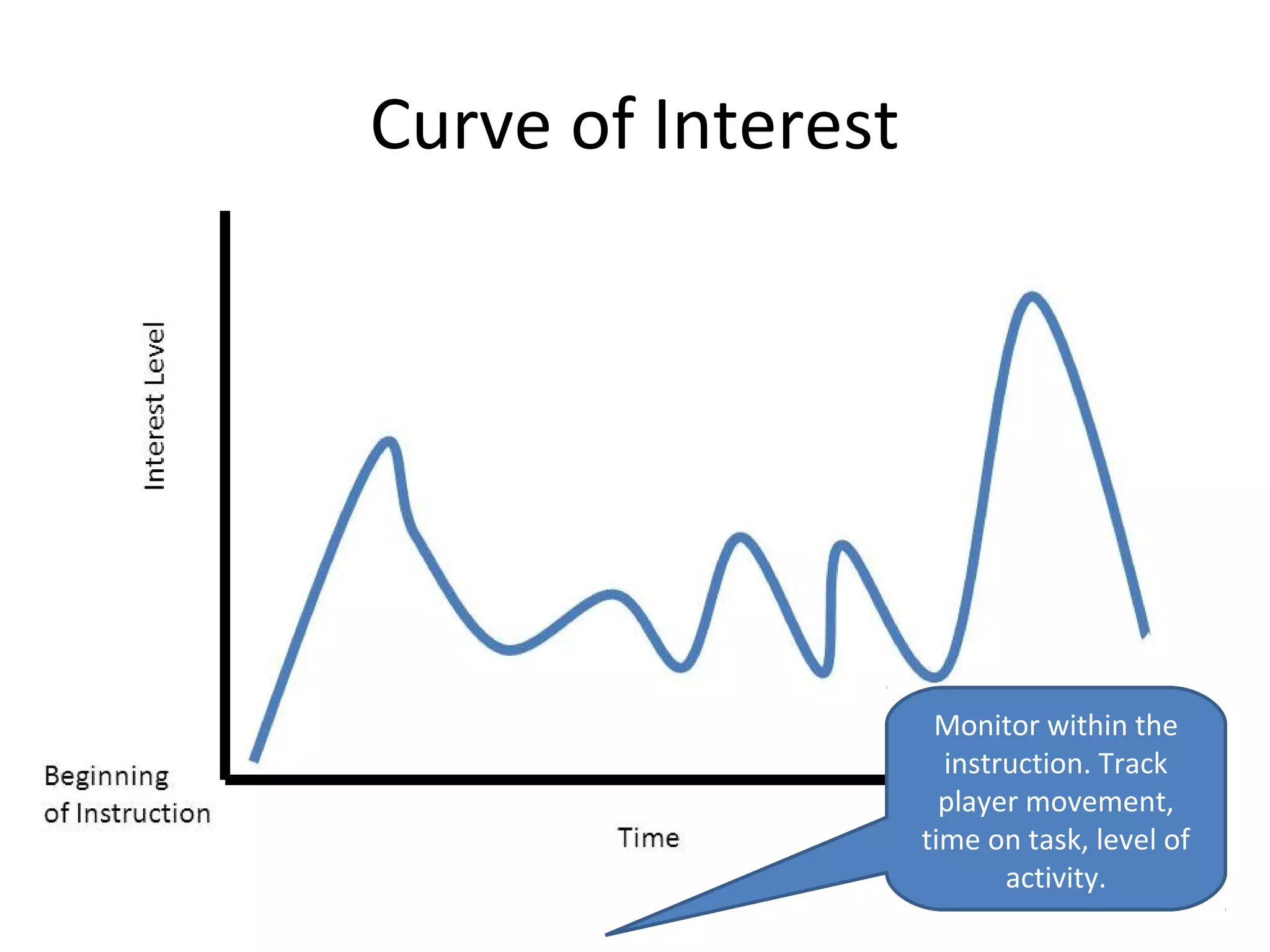
Curve of Interest


                     Monitor within the
                      instruction. Track
                      player movement,
                    time on task, level of
                           activity.
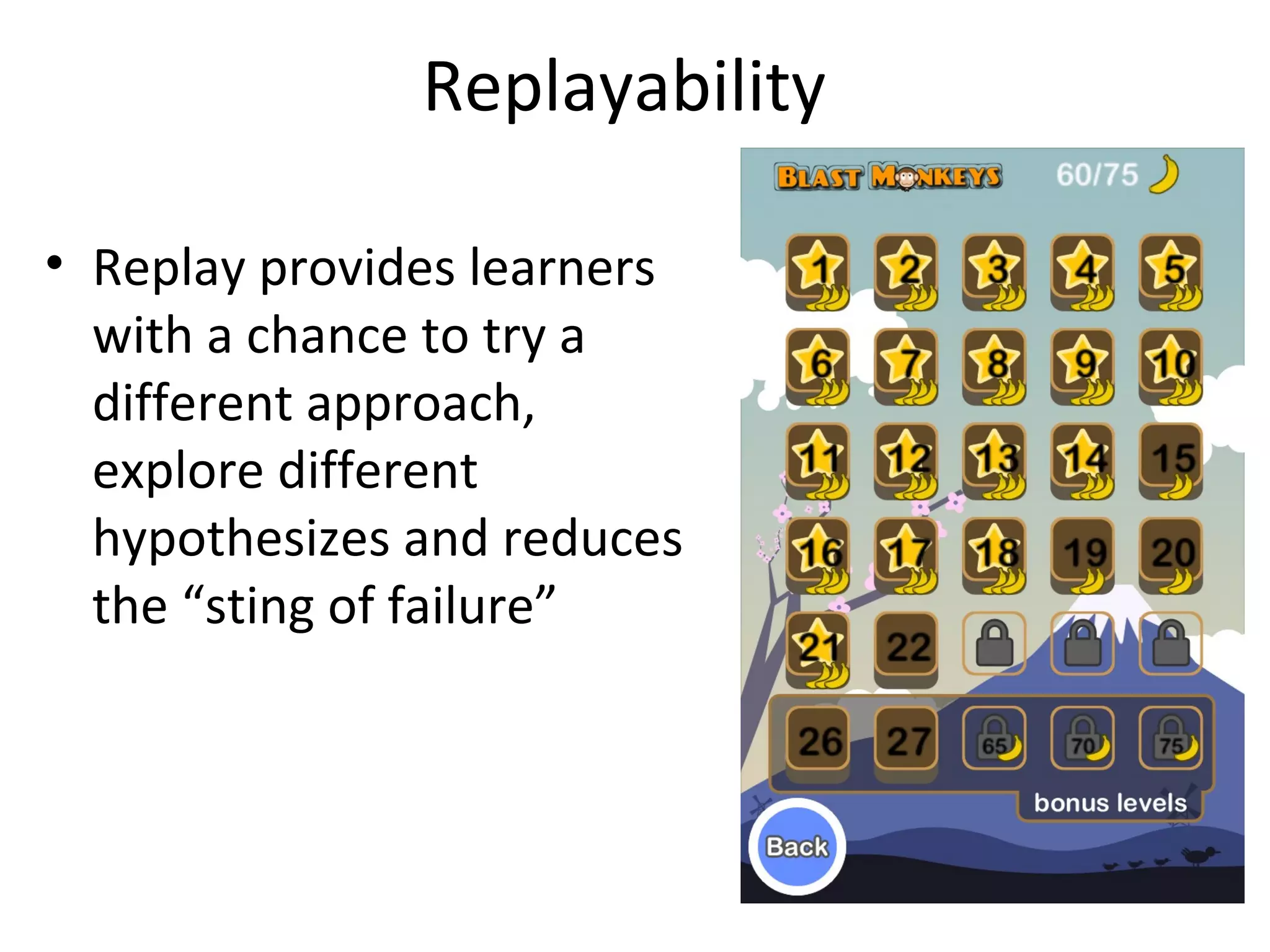
Replayability

• Replay provides learners
  with a chance to try a
  different approach,
  explore different
  hypothesizes and reduces
  the “sting of failure”
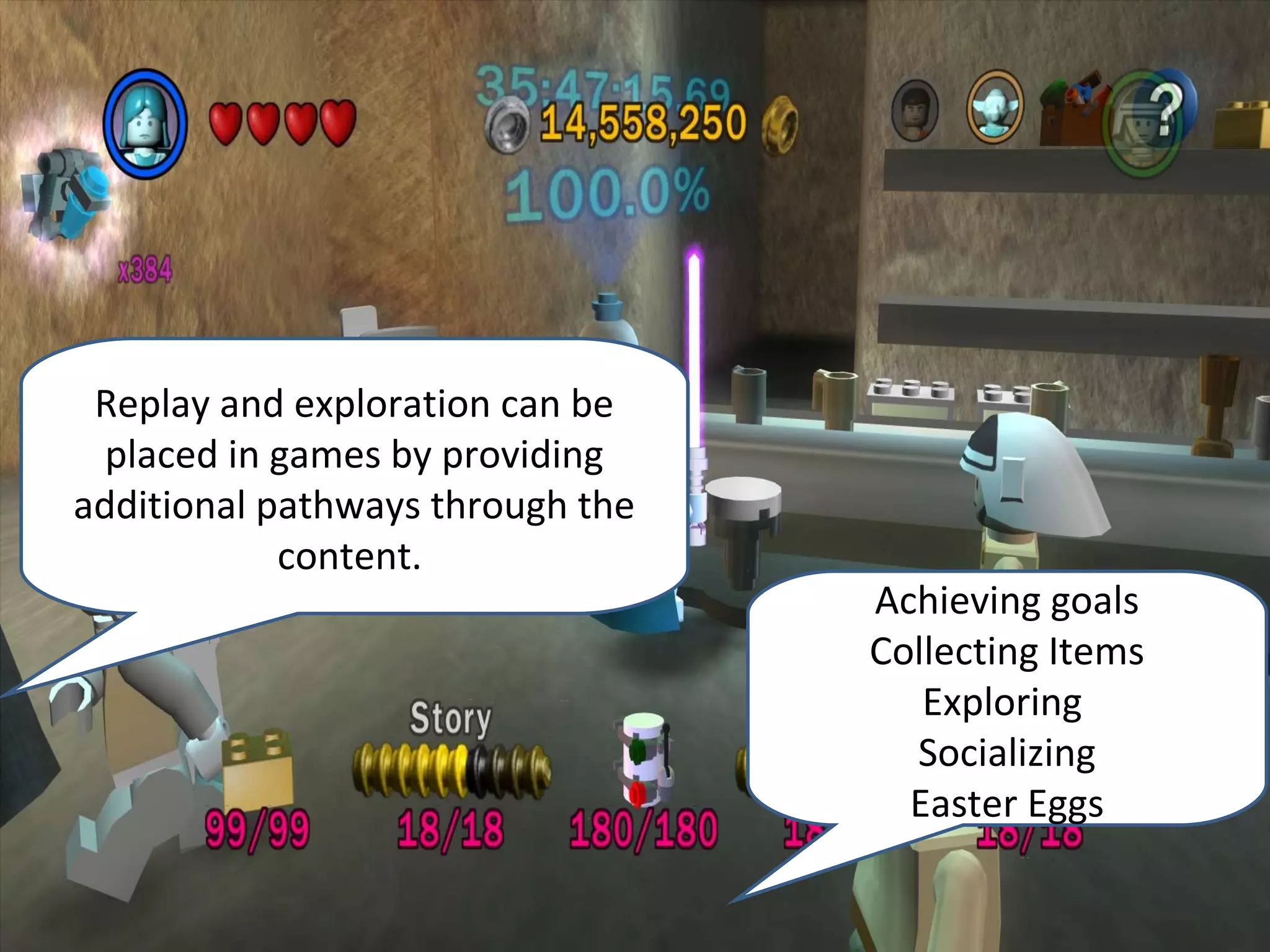
Replay and exploration can be
  placed in games by providing
additional pathways through the
            content.
                                  Achieving goals
                                  Collecting Items
                                     Exploring
                                    Socializing
                                    Easter Eggs
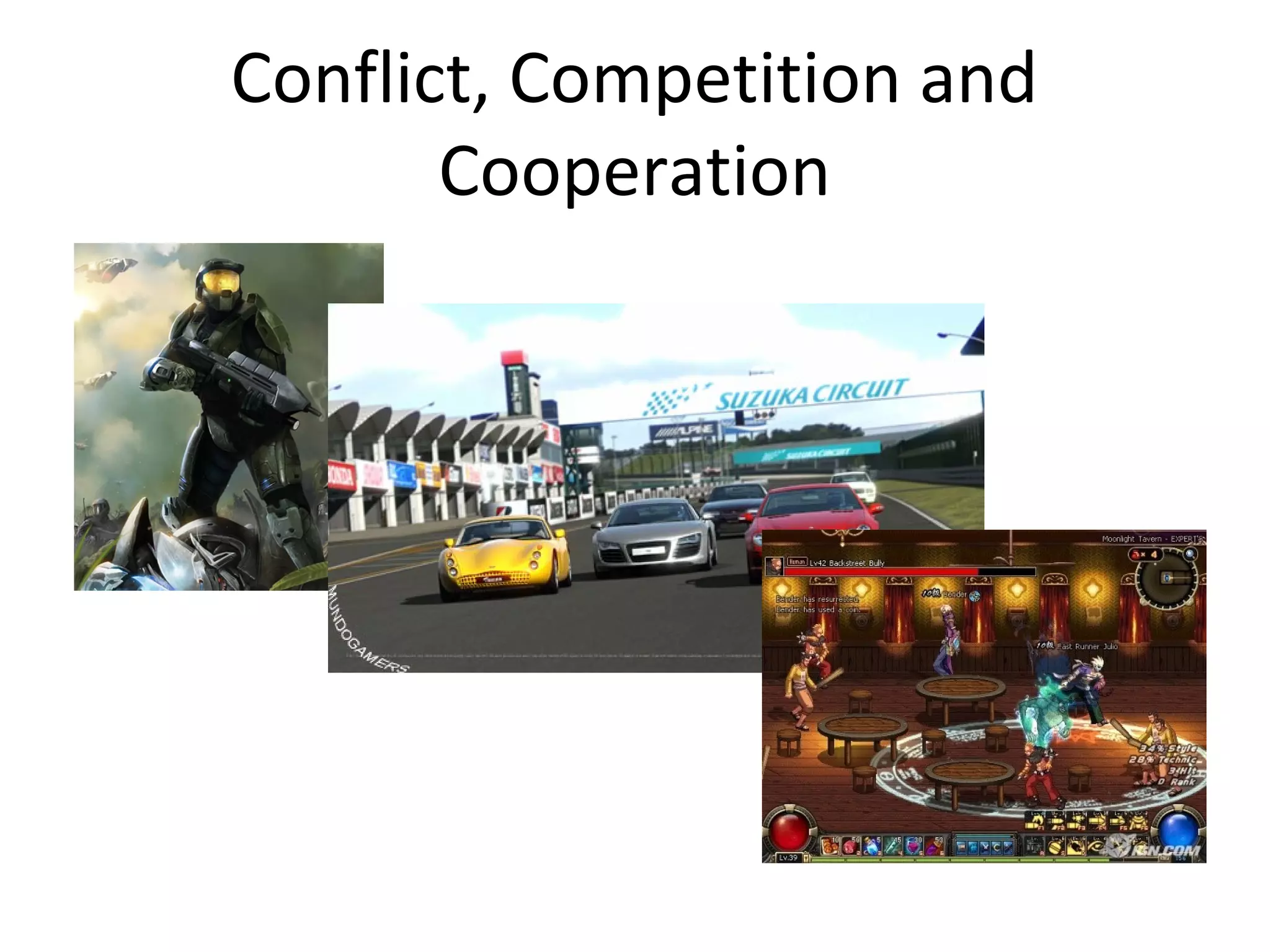
Conflict, Competition and
       Cooperation
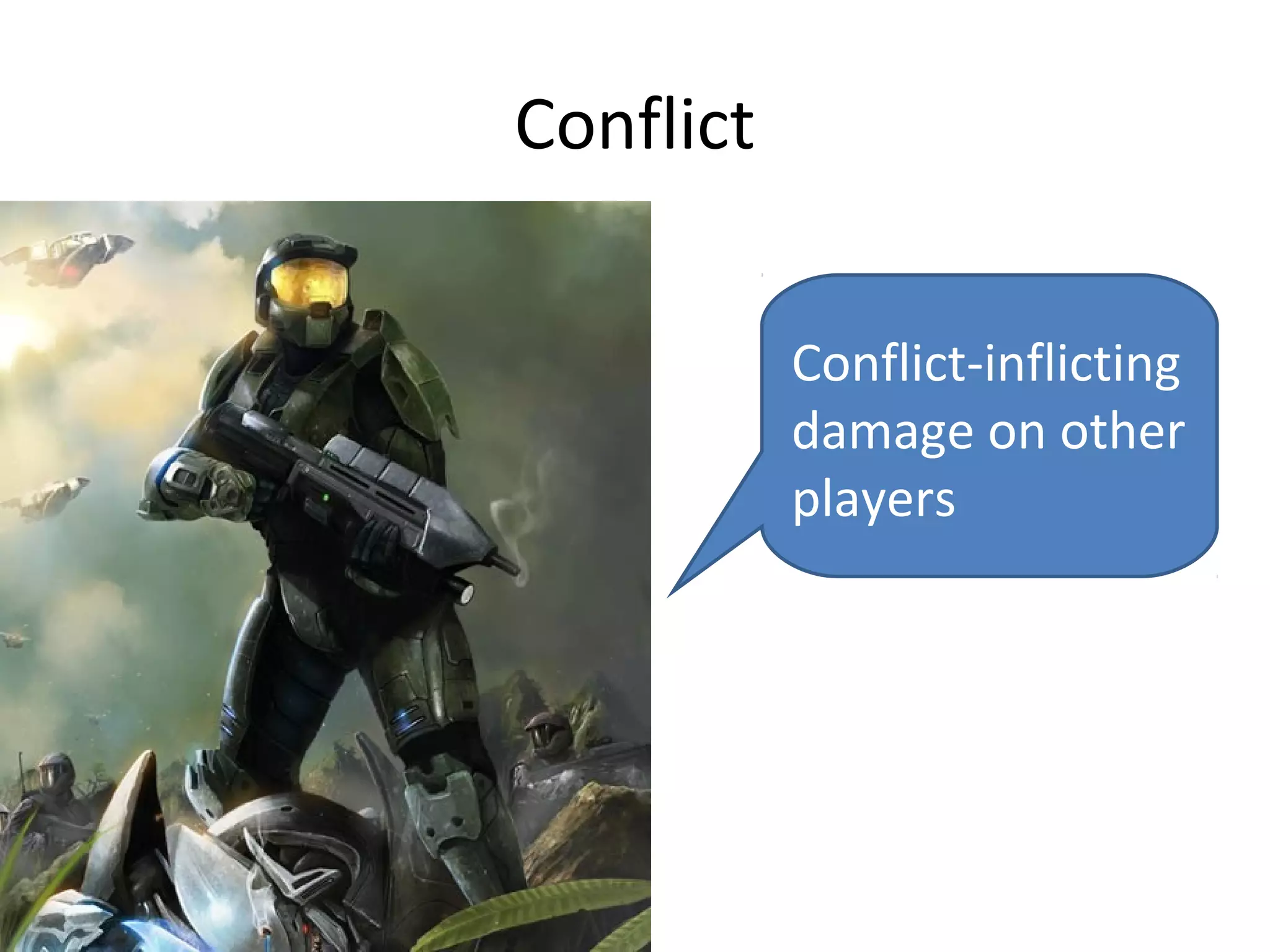
Conflict

           Conflict-inflicting
           damage on other
           players
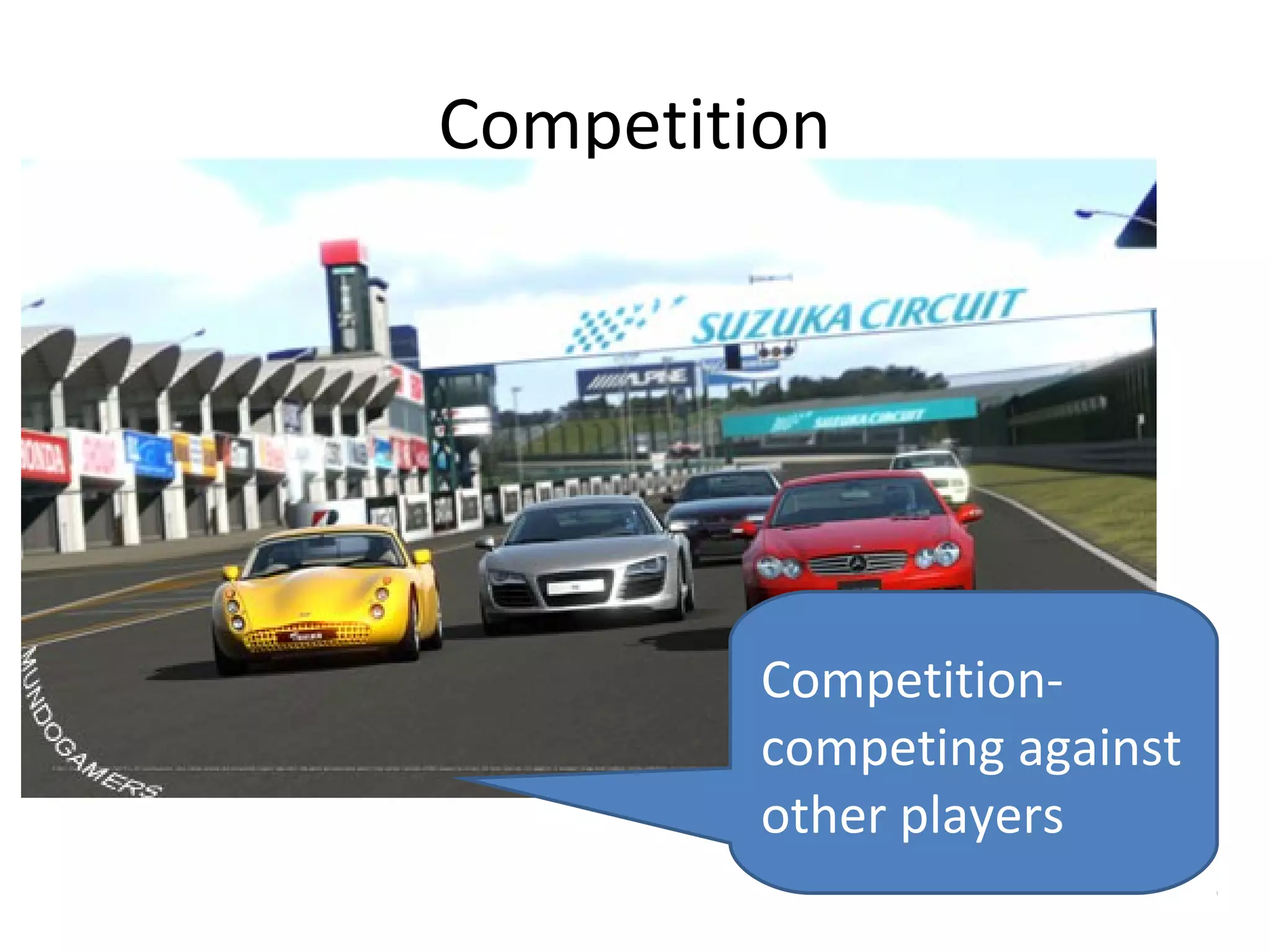
Competition


         Competition-
         competing against
         other players
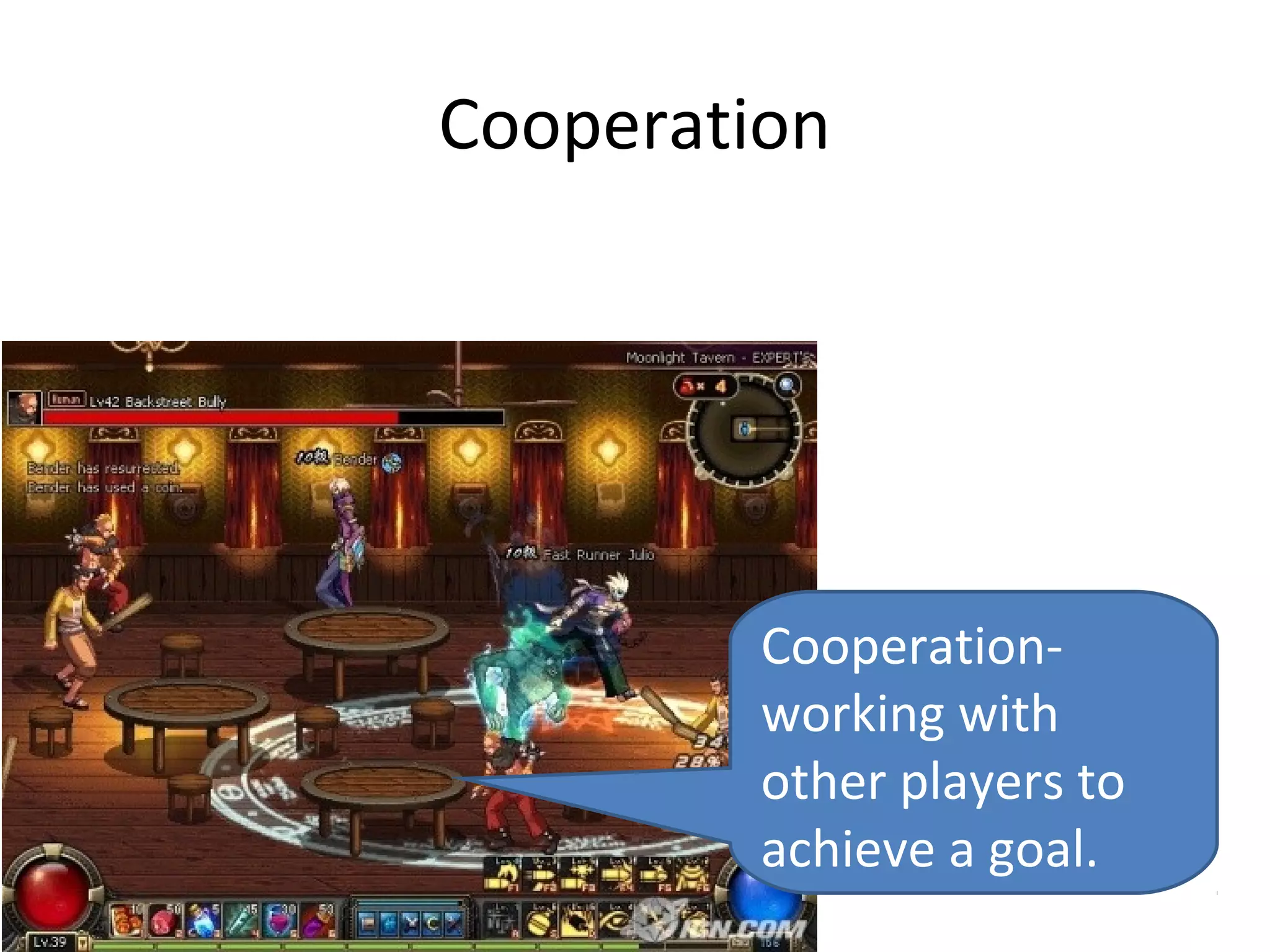
Cooperation


         Cooperation-
         working with
         other players to
         achieve a goal.
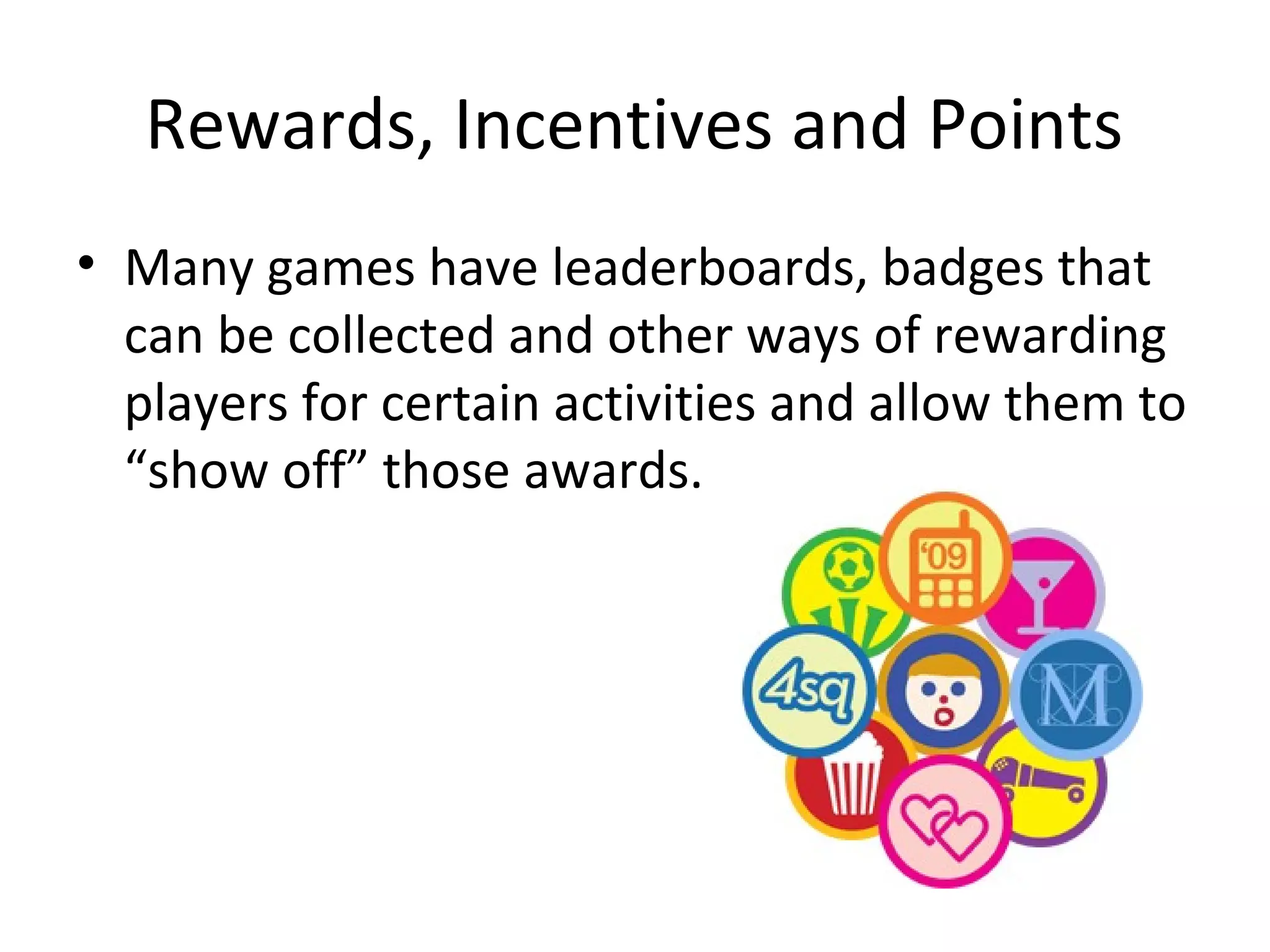
Rewards, Incentives and Points
• Many games have leaderboards, badges that
  can be collected and other ways of rewarding
  players for certain activities and allow them to
  “show off” those awards.
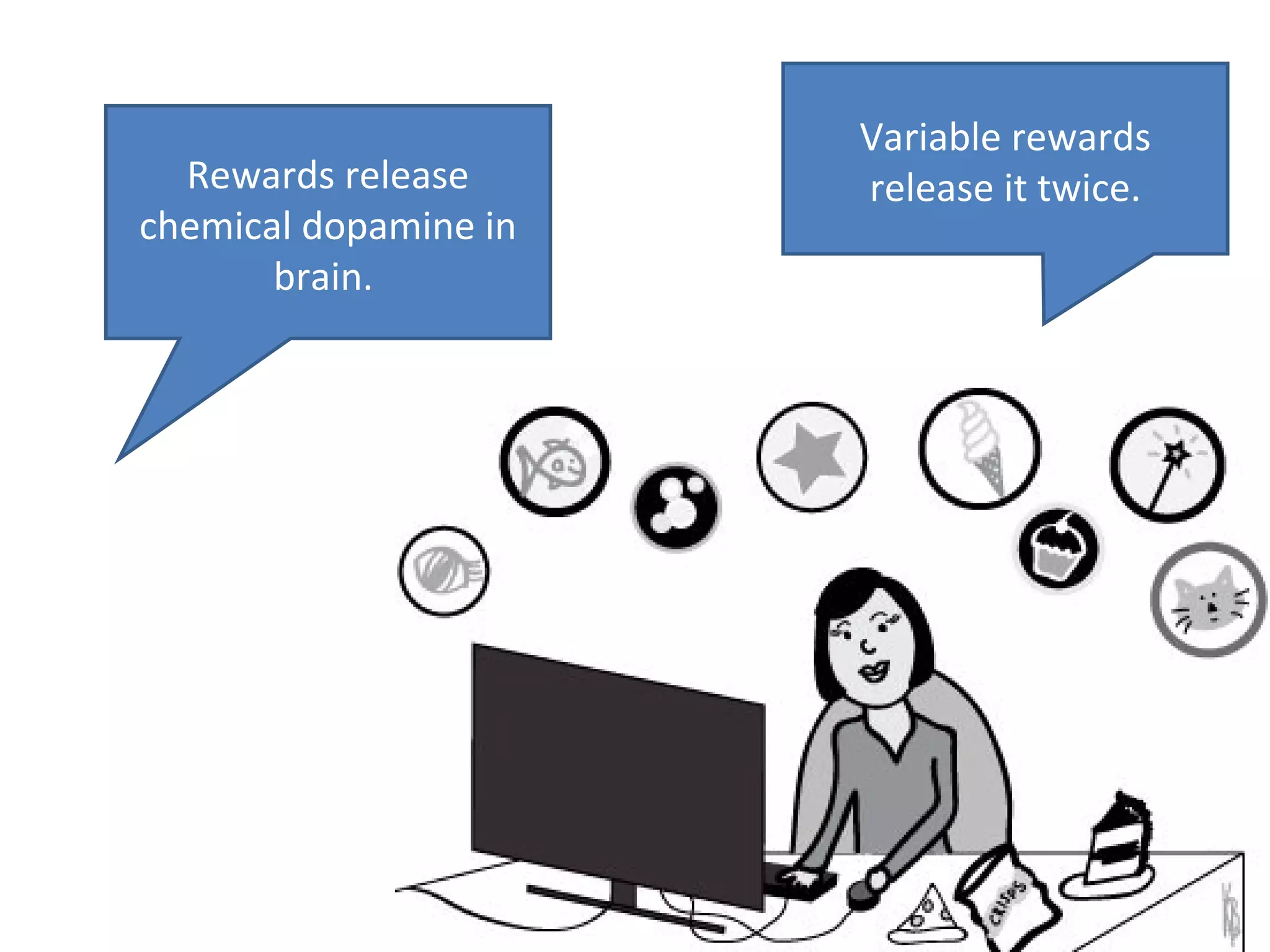
Variable rewards
  Rewards release      release it twice.
chemical dopamine in
       brain.
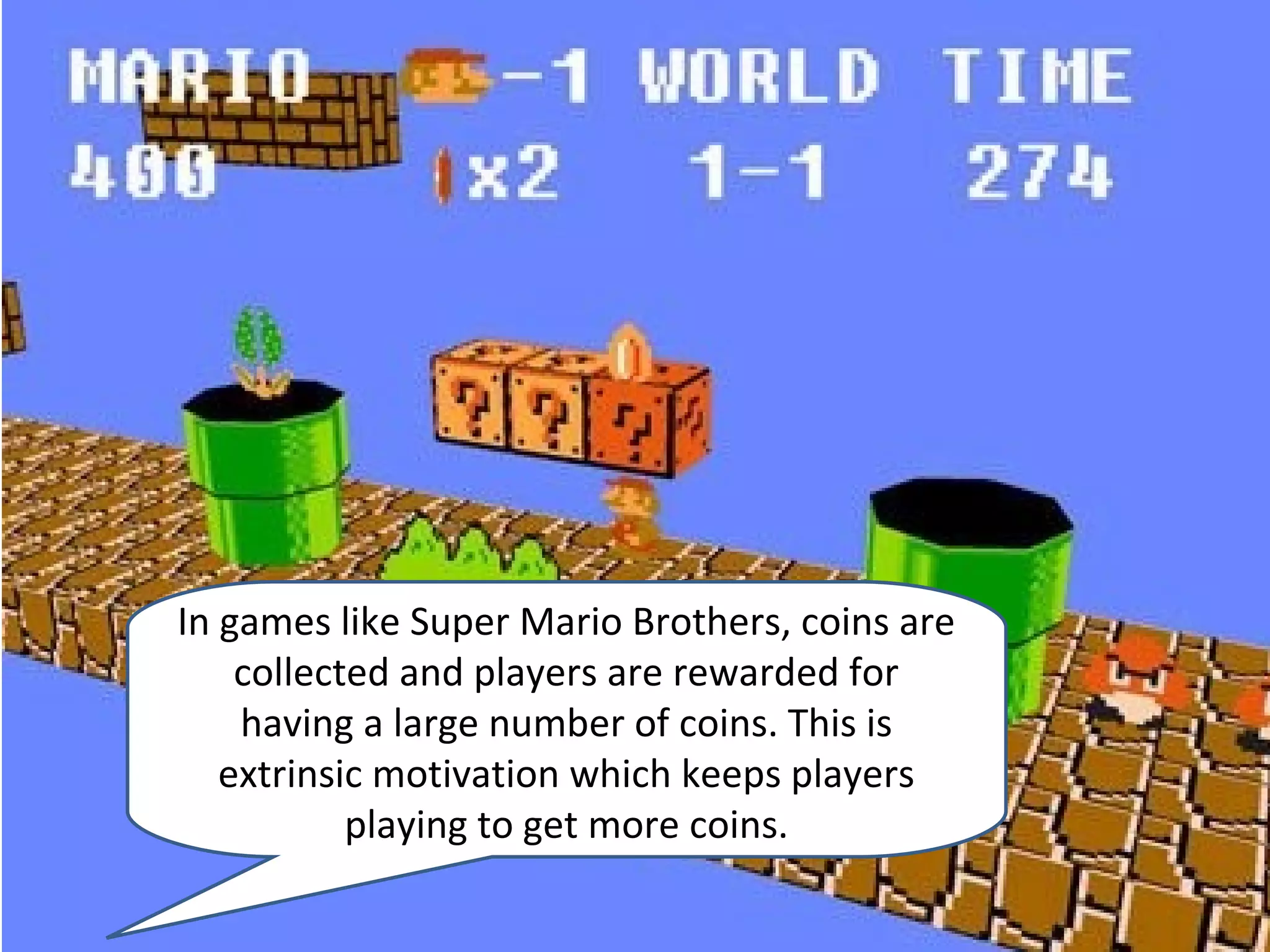
In games like Super Mario Brothers, coins are
    collected and players are rewarded for
    having a large number of coins. This is
   extrinsic motivation which keeps players
           playing to get more coins.
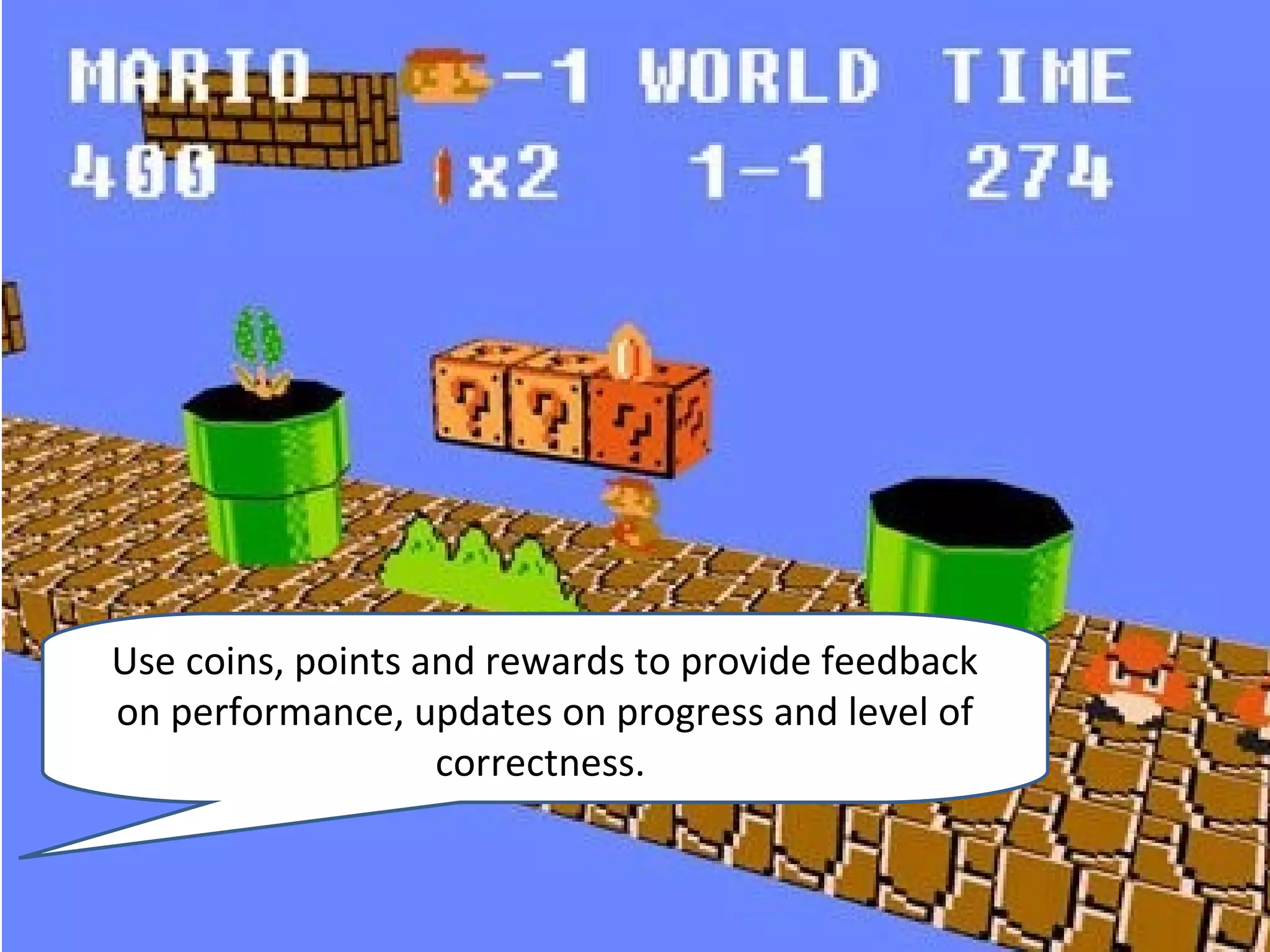
Use coins, points and rewards to provide feedback
on performance, updates on progress and level of
                   correctness.
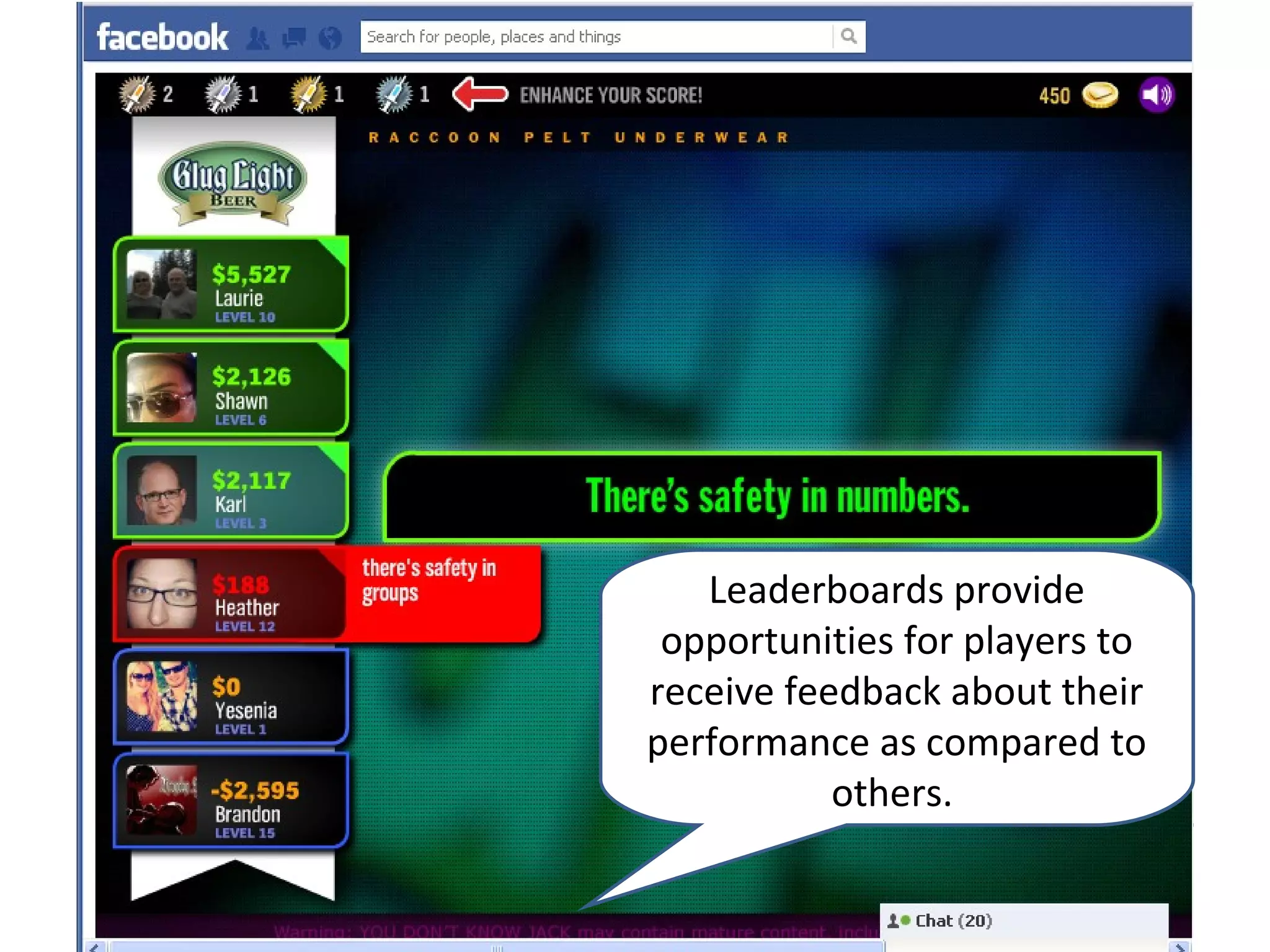
Leaderboards provide
 opportunities for players to
receive feedback about their
performance as compared to
           others.
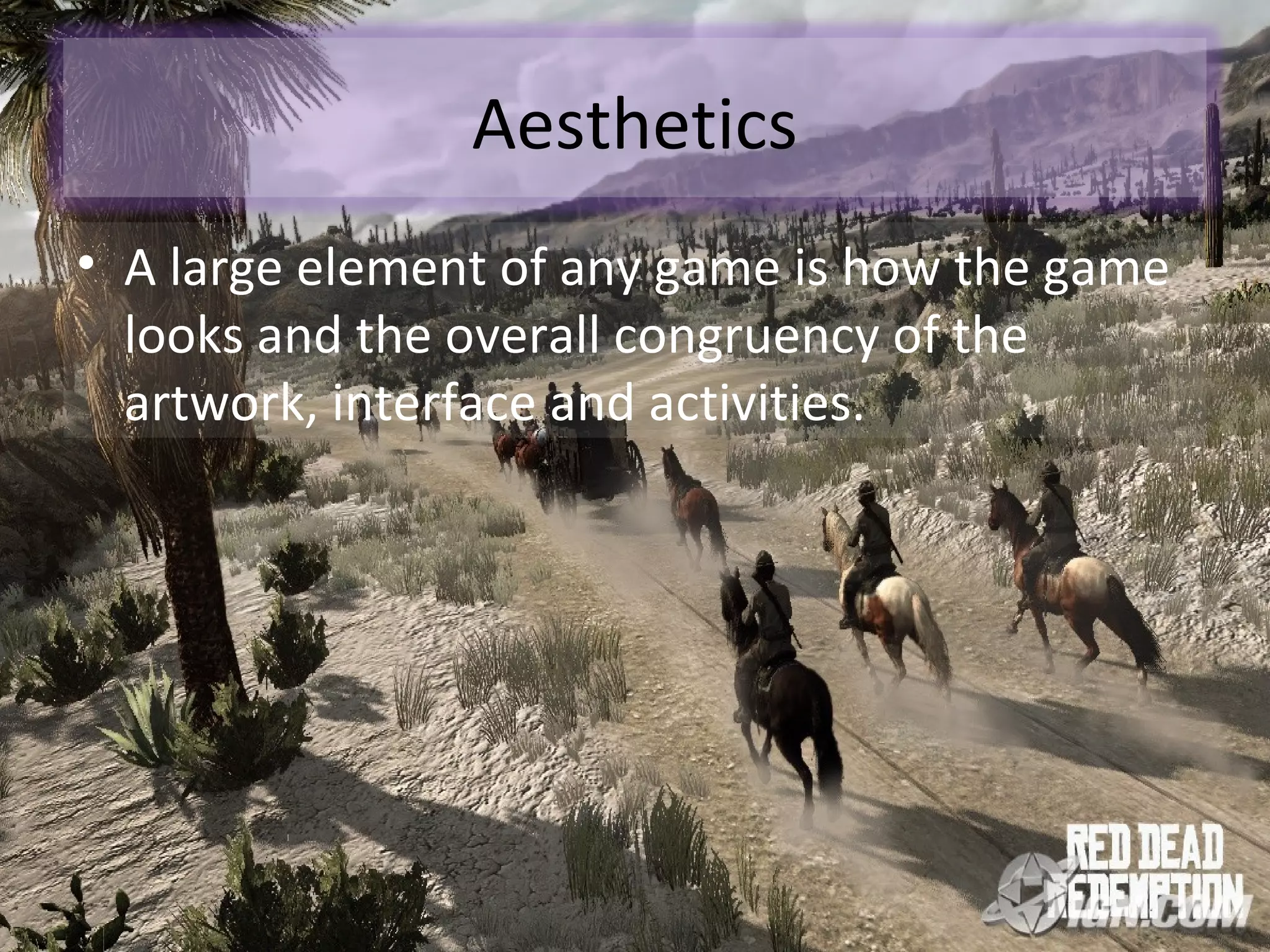
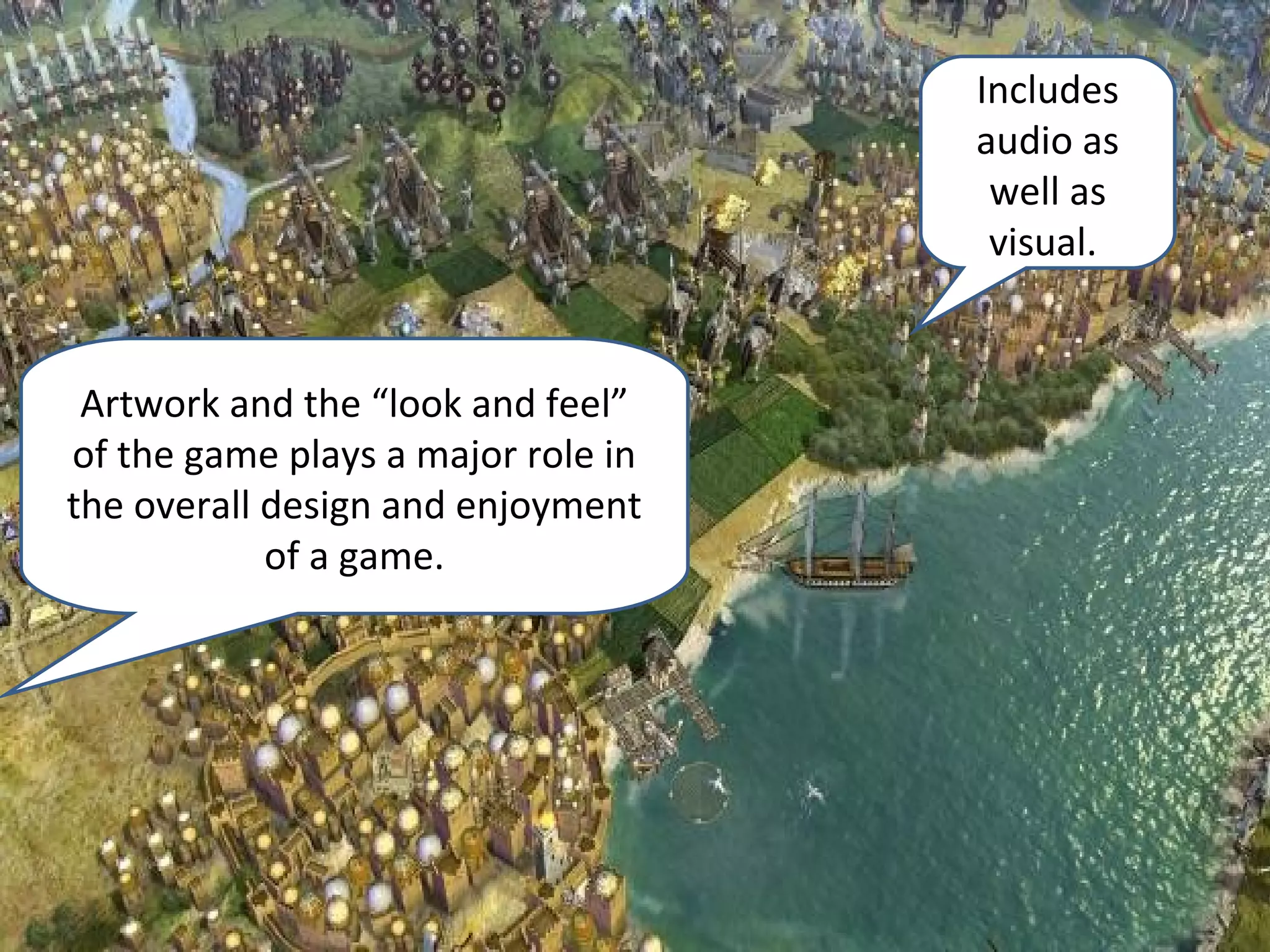
Aesthetics
• A large element of any game is how the game
  looks and the overall congruency of the
  artwork, interface and activities.
Includes
                                    audio as
                                     well as
                                     visual.


 Artwork and the “look and feel”
of the game plays a major role in
the overall design and enjoyment
            of a game.
Chance
• Chance and luck are two key elements in
  games, the randomness of events and
  unpredictability of outcome is what keeps
  players engaged.
  – 50/50 chance is best level of chance in a game.
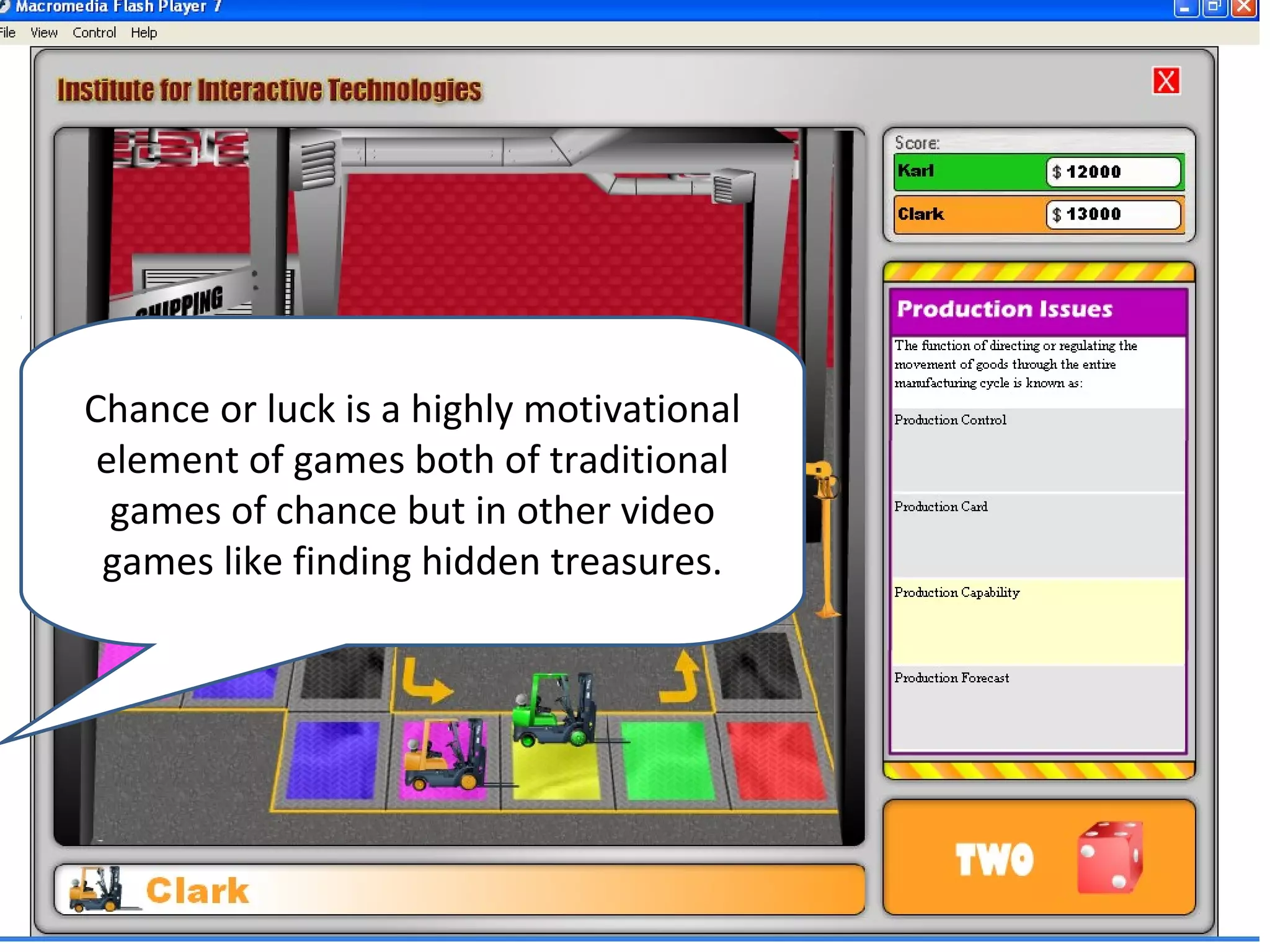
Chance or luck is a highly motivational
 element of games both of traditional
  games of chance but in other video
 games like finding hidden treasures.
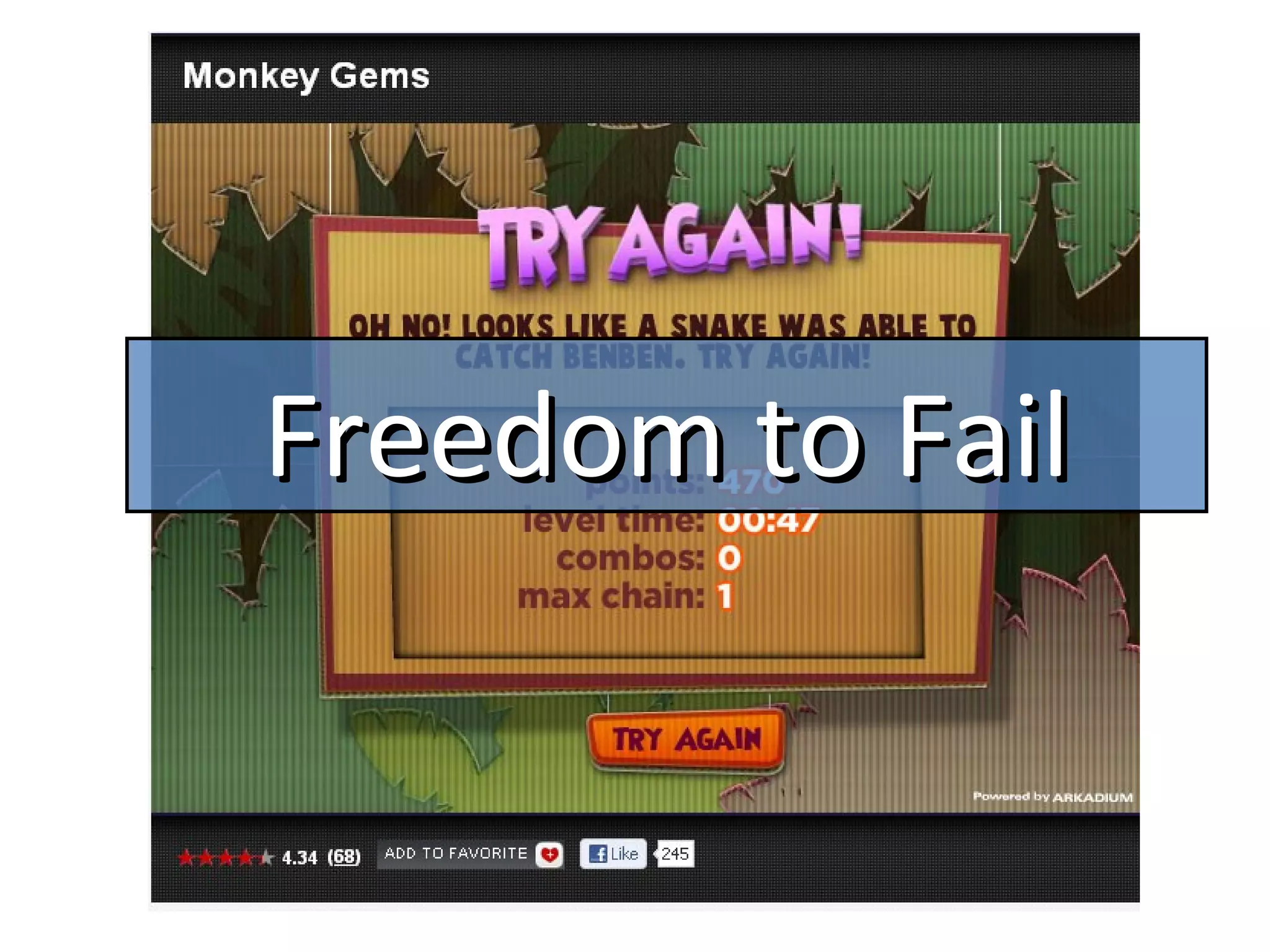
Freedom to Fail
Recommendations
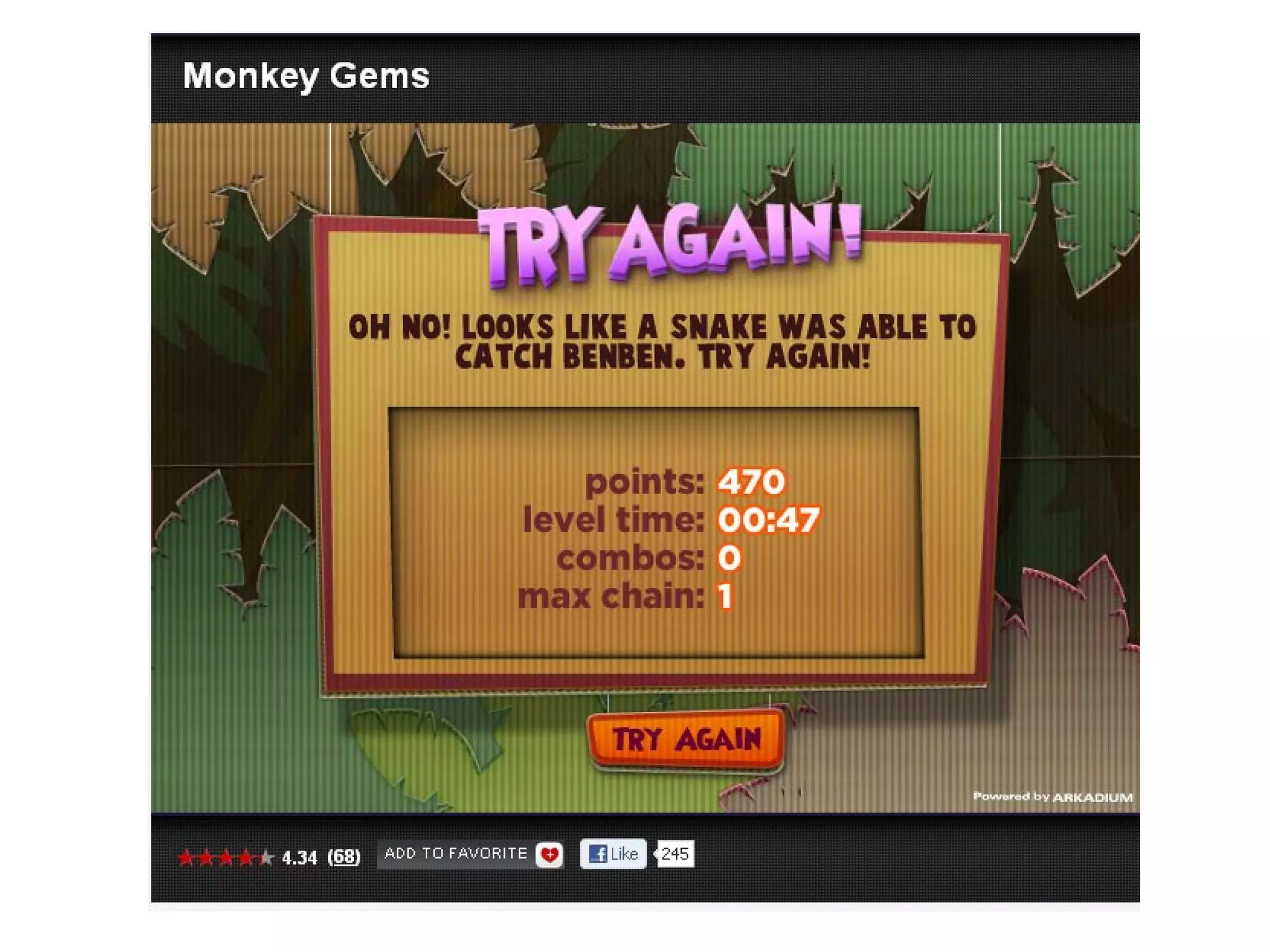
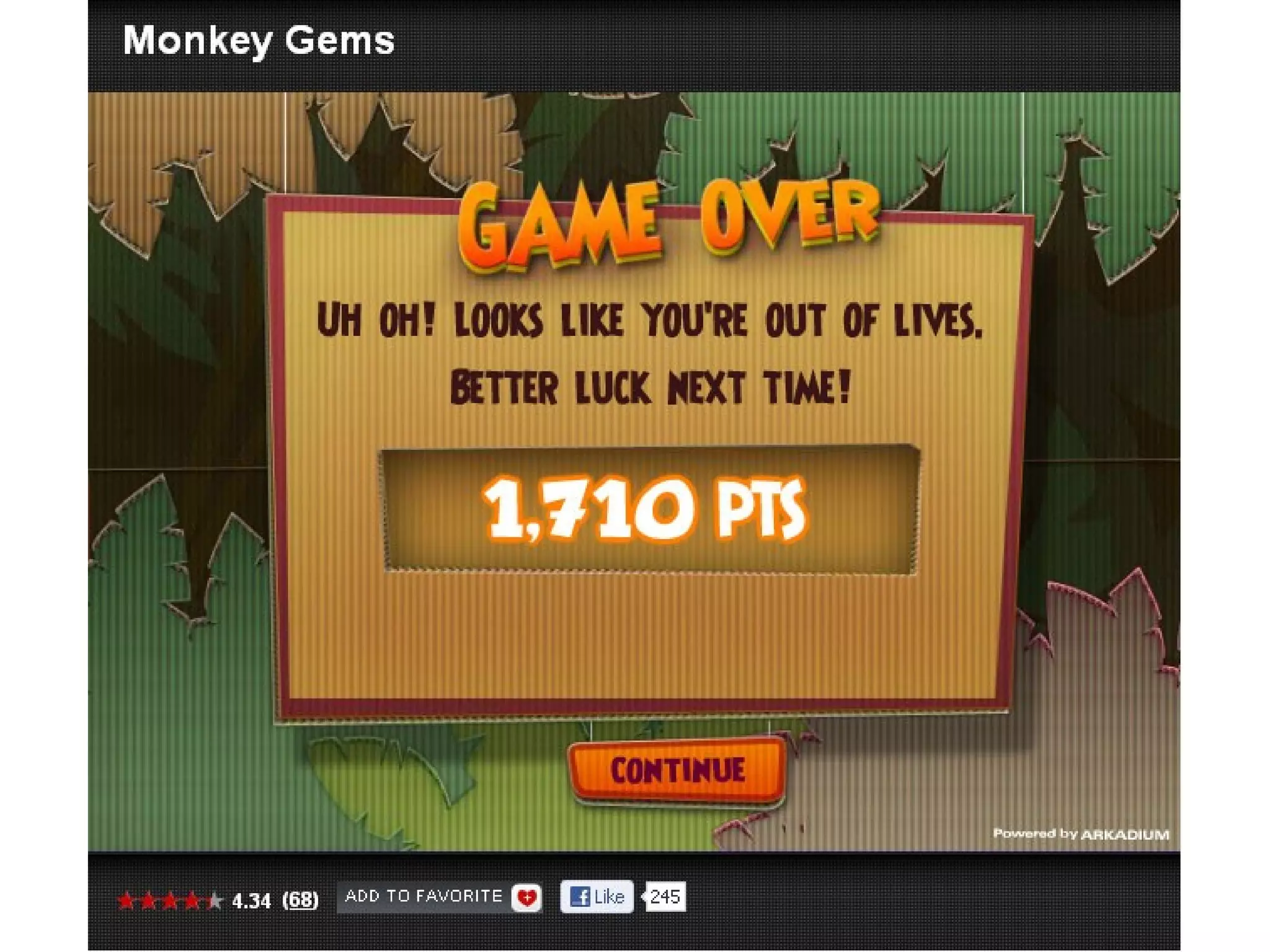
• Allow failure.

• Provide for multiple attempts.

• Focus on learning from mistakes and failure.

Game Elements

  • 1.
    Game Gamification “A game is a system in “Gamification is using game- which players engage in an based mechanics, aesthetics abstract challenge, defined and game thinking to engage by rules, interactivity and people, motivate action, feedback that results in a promote learning, and solve quantifiable outcome often problems.” eliciting an emotional reaction.”
  • 2.
    Constraints Emotions Narrative Progression Relationships Abstraction Dr. Kevin Werbach, Professor Wharton School of Business. MOOC Gamification Course
  • 3.
    Challenges Chance Feedback Competition Cooperation Turns Feedback Resource Acquisition Rewards Transactions Win-States Dr. Kevin Werbach, Professor Wharton School of Business. MOOC Gamification Course
  • 4.
    Achievements Avatars Badges Boss Fight Collecting Combat Content Unlocking Gifting Leaderboard Levels Points Teams Virtual Goods Dr. Kevin Werbach, Professor Wharton School of Business. MOOC Gamification Course
  • 5.
    Not all gameshave all these elements. Dr. Kevin Werbach, Professor Wharton School of Business. MOOC Gamification Course
  • 6.
    Abstraction of Conceptsand Reality -Helps players manage the space being experienced. -Cause and effect can be more clearly identified. --Remove extraneous factors.
  • 7.
    Role Play -Assuming a role means the player must actively think about their actions, decision and choices from the perspective of another. -Forcing a learner to mimic behavior will influence future behavior.
  • 8.
    Multiplayer -Interacting with othersis a large portion of games, even simple games typically involve more than one player. -Multiplayer means the chance for cooperation , conflict and cooperation. -Players add their own, unique changes to a game.
  • 9.
    Social Aspects -The social elements of games lead to Reputational Capital -Dialogue among players. -Common and shared experiences.
  • 10.
    Rules -Operational Rules-Describe how the game is played. -Foundational Rules- Underlying formal structures, like the mathematics involved with dice. -Behavior Rules-How players are expected to act toward one another. -Instructional Rules-What you want the learner to gain from playing the instructional game.
  • 11.
    Objectives -The introduction of an objective or a goal is what differentiates a game from play. -It gives the players something to work toward. -Objects are either obtained or not obtained and that is a quantifiable outcome.
  • 12.
  • 13.
    Researchers have foundthat the Researchers have found that the Yep, People tend to remember facts Yep, People tend to remember facts human brain has a natural affinity human brain has a natural affinity more accurately if they encounter more accurately if they encounter for narrative construction. for narrative construction. them in a story rather than in a list. them in a story rather than in a list. And they rate legal arguments as more convincing when built into narrative tales rather than on legal precedent. Carey, B. (2007) this is Your Life (and How You Tell it). The New York Times. Melanie Green Carey, B. (2007) this is Your Life (and How You Tell it). The New York Times. Melanie Green http://www.unc.edu/~mcgreen/research.html. Chapter 2 “The Gamification of Learning and http://www.unc.edu/~mcgreen/research.html. Chapter 2 “The Gamification of Learning and Instruction. Instruction.
  • 14.
    Stories provide, context, meaning and purpose
  • 15.
    Story Elements 1. Characters 2. Plot (something has to happen). 3. Ten s ion 4. Resolution te rs pr ob le m C ha ra ct er en co u n n si on 5. Conclusion Pr ob le m bu il ds te re d A so lu ti on is of fe te d /p os it iv e R es u lt s ar e pr es en
  • 16.
  • 17.
    Write a storyto match your game.
  • 18.
    Provide a challenge Jones,B., Valdez, G., Norakowski, J., & Rasmussen, C. (1994). Designing learning and technology Jones, B., Valdez, G., Norakowski, J., & Rasmussen, C. (1994). Designing learning and technology for educational reform. North Central Regional Educational Laboratory. [Online]. Available: for educational reform. North Central Regional Educational Laboratory. [Online]. Available: http://www.ncrtec.org/capacity/profile/profwww.htm and Schlechty, P. C. (1997). Inventing http://www.ncrtec.org/capacity/profile/profwww.htm and Schlechty, P. C. (1997). Inventing better schools: An action plan for educational reform. San Francisco, CA: Jossey-Bass. Chapter 2 better schools: An action plan for educational reform. San Francisco, CA: Jossey-Bass. Chapter 2 “The Gamification of Learning and Instruction.” “The Gamification of Learning and Instruction.”
  • 19.
    Re-design the Instructionto Start with a Challenge
  • 20.
    Investigatory Training • CourseObjectives – Identify the Forms Required for an Investigation – Practice Interview Techniques – Describe and Follow the Investigation Model How would you turn this into a challenge?
  • 21.
    It is yourfirst day on the job as an investigator and Jane, an employee in Accounting, just accused her boss of embezzling $10,000. What is the first thing you should do?
  • 22.
    Challenge and Consolidation–Good games offer players a set of challenging problems and then let them solve these problems until they have virtually routinized or automated their solutions. Games then throw a new class of problem at the players requiring them to rethink their now, taken-for-granted mastery, learn something new, and integrate this new learning into their old mastery. James Paul Gee, University of Wisconsin-Madison
  • 23.
    Recommendations • Embed factsto be learned in the context of stories. • Start the learning process by providing a challenge to the learner. • Provide a progression from simple to more difficult tasks. • Use stories that are related to the context of the desired learning outcome.
  • 24.
  • 26.
    Games like TheSims provide feedback on many dimensions which provide opportunities to consider tradeoffs and higher level cognitive thinking.
  • 27.
    The most helpfulfeedback provides specific comments about errors and suggestions for improvement. It also encourages learners to focus their attention thoughtfully on the task rather than on simply getting the right answer. Shute, V. J., Ventura, M., Bauer, M. I., & Zapata-Rivera, D. (2009). Melding the power of serious games and embedded assessment to monitor and foster learning: Flow and grow. In U. Ritterfeld, M. J. Cody, & P. Vorderer (Eds.), Serious Games: Mechanisms and Effects. Philadelphia, PA: Routledge/LEA. 295-321.
  • 30.
    Leaderboards provide opportunitiesfor players to receive feedback about their performance as compared to others.
  • 31.
    Authentic Feedback providesrealistic feedback based on player actions.
  • 33.
  • 34.
    Recommendations • Provide authenticand realistic feedback. • Feedback should be continuous through out the learning. • Feedback should be instructional and provide knowledge of learner’s performance. • Allow learners to create their own social “leaderboard” of friends.
  • 35.
    Time Motivator for player/learner activity and action. A game can compress time to show consequences of actions more quickly than real-time. As a resource allocated during the game-play.
  • 36.
    We’ve Always Wanted Characters Avatars/Characters
  • 37.
    Identity– no deeplearning takes place unless an extended commitment of self is made for the long haul. Good gamification captures players through identify. Players either inherit a strongly formed and appealing character or they get to build a character from the ground up. Players become committed to the game space in which they will learn and act. Based on work from James Paul Gee, University of Wisconsin-Madison
  • 38.
    Avatar as Teacher Research indicates that learners perceive, interact socially with and are influenced by anthropomorphic agents (characters) even when their functionality and adaptability are limited. Baylor, A. 2009 Promoting motivation with virtual agents and avatars: R ole of visual presence and appearance. Philosophical Transactions of the Royal B Society. 364, 3559–3565. Chapter 4 “The Gamification of Learning and Instruction”
  • 39.
    On tests involvingdifferent word problems, the group who had a character explain the problems generated 30% more correct answers than the group with just on-screen text. Animated pedagogical agents (characters) can be aids to learning. A “realistic” character did not facilitate learning any better than a “cartoon-like” character. Clark, R., Mayer, R. (2011) E-Learning and the Science of Instruction: Proven Guidelines for Consumers and Designers of Multimedia Learning. New York: Pfeiffer. Pg. 194. Chapter 4 “The Gamificaiton of Learning and Instruciton”
  • 40.
    Are two avatarsbetter than one? Motivator Mentor Expert
  • 41.
    Yes, two avatarsare better than one. Motivator Mentor Baylor, A. L. & Kim, Y. (2005). Simulating instructional roles through pedagogical agents. International Journal of Artificial Intelligence in Education, 15(1), 95-115. Chapter 4 “The Gamification of Learning and Expert Instruction”
  • 42.
  • 43.
  • 44.
    Player as anavatar or character in game.
  • 45.
    Who is morelikely to run 24 hours later? A.Person who watched an avatar not like them running B.Person who watch an avatar like them running C.Person watching an avatar like them loitering
  • 46.
    Within 24 hoursof watching an avatar like themselves run, learners were more likely to run than watching an avatar not like them or watching an avatar like them loitering . Fox, J., Arena, D., & Bailenson, J.N. (2009). Virtual Reality: A survival guide for the social scientist. Journal of Media Psychology, 21 (3), 95- 113.
  • 47.
    If learners watchan avatar that looks like them exercising & losing weight, they will subsequently exercise more in the real world as compared to a control group. Fox, J., Arena, D., & Bailenson, J.N. (2009). Virtual Reality: A survival guide for the social scientist. Journal of Media Psychology, 21 (3), 95-113.
  • 48.
  • 49.
    Third Person View Carey,B. (2007) This is Your Life (and How You Tell it). The New York Times. And Sestir, M. & Green, M. C. (2010). You Carey, B. (2007) This is Your Life (and How You Tell it). The New York Times. And Sestir, M. & Green, M. C. (2010). You are who you watch: Identification and transportation effects on temporary self-concept. Social Influence, 5, 272-288 are who you watch: Identification and transportation effects on temporary self-concept. Social Influence, 5, 272-288 and research by Libby, L.K., Shaeffer, E.M., Eibach, R.P., & Slemmer, J.A. (( 2007) Picture yourself at the polls: Visual and research by Libby, L.K., Shaeffer, E.M., Eibach, R.P., & Slemmer, J.A. 2007) Picture yourself at the polls: Visual perspective in mental imagery affects self-perception and behavior. Psychological Science. Vol. 18: 199-203. perspective in mental imagery affects self-perception and behavior. Psychological Science. Vol. 18: 199-203.
  • 50.
    Third Person View “Seeing oneself as acting in a movie or a play (or a video game) is not merely fantasy or indulgence; it is fundamental to how people work out who it is they are, and may become.” Ben Casey Carey, B. (2007) This is Your Life (and How You Tell it). The New York Times. And Sestir, M. & Green, M. C. (2010). You are Carey, B. (2007) This is Your Life (and How You Tell it). The New York Times. And Sestir, M. & Green, M. C. (2010). You are who you watch: Identification and transportation effects on temporary self-concept. Social Influence, 5, 272-288 and who you watch: Identification and transportation effects on temporary self-concept. Social Influence, 5, 272-288 and research by Libby, L.K., Shaeffer, E.M., Eibach, R.P., & Slemmer, J.A. (( 2007) Picture yourself at the polls: Visual perspective research by Libby, L.K., Shaeffer, E.M., Eibach, R.P., & Slemmer, J.A. 2007) Picture yourself at the polls: Visual perspective in mental imagery affects self-perception and behavior. Psychological Science. Vol. 18: 199-203. in mental imagery affects self-perception and behavior. Psychological Science. Vol. 18: 199-203.
  • 51.
    Agency– The conceptthat players feel a real sense of agency and control. They have a real sense of ownership over what they are doing. They see themselves in the game or situation. James Paul Gee, University of Wisconsin-Madison
  • 52.
    Recommendations • Use characters/agentsto model desired behavior. • Use characters/agents to provide feedback and instruction to learners. • Characters should speak in a natural, conversational tone. • Use two characters, one for coaching and one for expertise is better than just having one character trying to do both. • User third-person rather than first person to show activities.
  • 53.
  • 54.
    Games provide different levelsfor different points of entry.
  • 55.
    Scaffolding: Process ofcontrolling the task elements that initially are beyond the learner’s capacity. Guided Practice. Step-by-step instructions and then fading of instruction Having different entry points into a learning module provides players with a comfort level that they can enter the learning and be successful.
  • 56.
    Many of theinstructional methods that are effective for novices either have no effect or, in some cases, depress the learning of learners with more expertise. Training designed for learners with greater prior knowledge requires different instruction methods than training designed for novice learners. Clark, R., Nguyen, F. & Sweller, J. (2006) Efficiency in Learning: Evidence-based guidelines to manage cognitive load. Pfeiffer. Page Clark, R., Nguyen, F. & Sweller, J. (2006) Efficiency in Learning: Evidence-based guidelines to manage cognitive load. Pfeiffer. Page 247. Chapter 7 and 7 of “The Gamification of Learning and Instruction. 247. Chapter 7 and 7 of “The Gamification of Learning and Instruction.
  • 57.
    Don’t overload experiencedlearners with extra information. Keep to critical information they need to know.. Use a problem-based or challenge-based approach to teaching experts. Position the learning event as a “scale up” of existing skills.
  • 58.
    Recommendations • Provide differententry points into the instruction. • Provide different learner experiences within the same e-learning module. • Consider “leveling up” learner challenges.
  • 59.
    Curve of Interest Monitor within the instruction. Track player movement, time on task, level of activity.
  • 60.
    Replayability • Replay provideslearners with a chance to try a different approach, explore different hypothesizes and reduces the “sting of failure”
  • 61.
    Replay and explorationcan be placed in games by providing additional pathways through the content. Achieving goals Collecting Items Exploring Socializing Easter Eggs
  • 62.
  • 63.
    Conflict Conflict-inflicting damage on other players
  • 64.
    Competition Competition- competing against other players
  • 65.
    Cooperation Cooperation- working with other players to achieve a goal.
  • 66.
    Rewards, Incentives andPoints • Many games have leaderboards, badges that can be collected and other ways of rewarding players for certain activities and allow them to “show off” those awards.
  • 67.
    Variable rewards Rewards release release it twice. chemical dopamine in brain.
  • 68.
    In games likeSuper Mario Brothers, coins are collected and players are rewarded for having a large number of coins. This is extrinsic motivation which keeps players playing to get more coins.
  • 69.
    Use coins, pointsand rewards to provide feedback on performance, updates on progress and level of correctness.
  • 70.
    Leaderboards provide opportunitiesfor players to receive feedback about their performance as compared to others.
  • 71.
    Aesthetics • A largeelement of any game is how the game looks and the overall congruency of the artwork, interface and activities.
  • 72.
    Includes audio as well as visual. Artwork and the “look and feel” of the game plays a major role in the overall design and enjoyment of a game.
  • 73.
    Chance • Chance andluck are two key elements in games, the randomness of events and unpredictability of outcome is what keeps players engaged. – 50/50 chance is best level of chance in a game.
  • 74.
    Chance or luckis a highly motivational element of games both of traditional games of chance but in other video games like finding hidden treasures.
  • 75.
  • 79.
    Recommendations • Allow failure. •Provide for multiple attempts. • Focus on learning from mistakes and failure.

Editor's Notes

  • #2 “ A game is a system in which players engage in an abstract challenge, defined by rules, interactivity and feedback that results in a quantifiable outcome often eliciting an emotional reaction.” “ Gamification is using game-based mechanics, aesthetics and game thinking to engage people, motivate action, promote learning, and solve problems.”
  • #19 One element of engaged learning is challenging tasks. Jones, B., Valdez, G., Norakowski, J., & Rasmussen, C. (1994). Designing learning and technology for educational reform. North Central Regional ducational Laboratory. [Online]. Available: http://www.ncrtec.org/capacity/profile/profwww.htm and Schlechty, P. C. (1997). Inventing better schools: An action plan for educational reform. San Francisco, CA: Jossey-Bass .
  • #50 This study is a demonstration that fiction can influence our self-perceptions, implying that our identification with characters can change the way we see ourselves. Sestir, M. & Green, M. C. (2010). You are who you watch: Identification and transportation effects on temporary self-concept.  Social Influence ,  5 , 272-288. Libby, L.K., Shaeffer, E.M., Eibach, R.P., & Slemmer, J.A. ( 2007) Picture yourself at the polls: Visual perspective in mental imagery affects self-perception and behavior.   Psychological Science . Vol. 18: 199-203.
  • #51 This study is a demonstration that fiction can influence our self-perceptions, implying that our identification with characters can change the way we see ourselves. Sestir, M. & Green, M. C. (2010). You are who you watch: Identification and transportation effects on temporary self-concept.  Social Influence ,  5 , 272-288. Libby, L.K., Shaeffer, E.M., Eibach, R.P., & Slemmer, J.A. ( 2007) Picture yourself at the polls: Visual perspective in mental imagery affects self-perception and behavior.   Psychological Science . Vol. 18: 199-203.
  • #63 Conflict-inflicting damage on other players Competition-competing against other players Cooperation-working with other players to achieve a goal.
  • #64 Conflict-inflicting damage on other players Competition-competing against other players Cooperation-working with other players to achieve a goal.
  • #65 Conflict-inflicting damage on other players Competition-competing against other players Cooperation-working with other players to achieve a goal.
  • #66 Conflict-inflicting damage on other players Competition-competing against other players Cooperation-working with other players to achieve a goal.