Mission Possible: Create Learner Engagement
Presented by: Karl M. Kapp
Twitter @kkapp
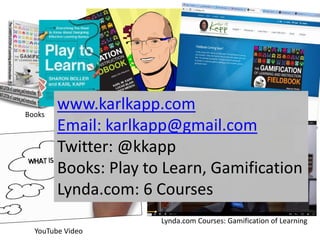
Lynda.com Courses: Gamification of Learning
YouTube Video
Web Site:www.karlkapp.com
Books
www.karlkapp.com
Email: karlkapp@gmail.com
Twitter: @kkapp
Books: Play to Learn, Gamification
Lynda.com: 6 Courses
Design takeaway
challenge.
If it’s not too
late already.
We need some
helpers…
Yes?
Yes?
We are going to need
more help than that…
We need some agents
with fancy gadgets and
gizmos.
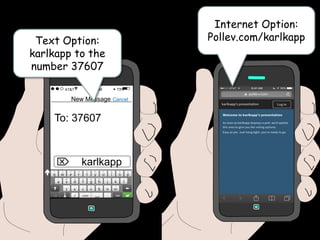
New Message
To: 37607
 karlkapp

Cancel
AT&T 9:37 AM  73%
Text Option:
karlkapp to the
number 37607
Internet Option:
Pollev.com/karlkapp
We need two search
parties. First team that
finds the professor wins.
XX
X
X
X
X
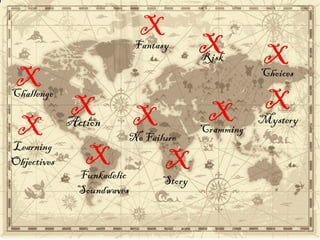
XChallenge
Action
Fantasy
Funkadelic
Soundwaves
No Failure
Learning
Objectives
Cramming
X
X
X
X XX X
X
X
Story
X
XRisk
X XChoices
X
X
Mystery
X
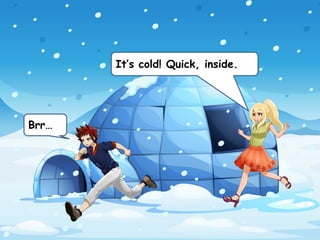
Brr…
It’s cold! Quick, inside.
Look, there is a clue
written on the wall. Let me
see what is says.
Wow, it’s a lot bigger in
inside than it looks from
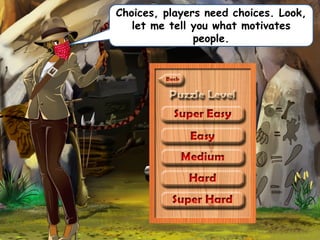
outside.
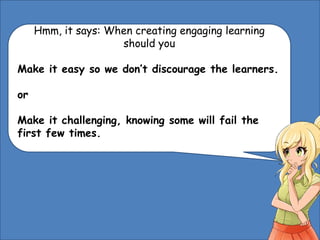
Hmm, it says: When creating engaging learning
should you
Make it easy so we don’t discourage the learners.
or
Make it challenging, knowing some will fail the
first few times.
Jones, B., Valdez, G., Norakowski, J., & Rasmussen, C. (1994). Designing learning and technology
for educational reform. North Central Regional Educational Laboratory. [Online]. Available:
http://www.ncrtec.org/capacity/profile/profwww.htm and Schlechty, P. C. (1997). Inventing
better schools: An action plan for educational reform. San Francisco, CA: Jossey-Bass. Chapter 2
“The Gamification of Learning and Instruction.”
It needs to be challenging.
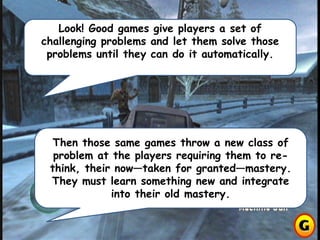
Look! Good games give players a set of
challenging problems and let them solve those
problems until they can do it automatically.
Then those same games throw a new class of
problem at the players requiring them to re-
think, their now—taken for granted—mastery.
They must learn something new and integrate
into their old mastery.
Well said!
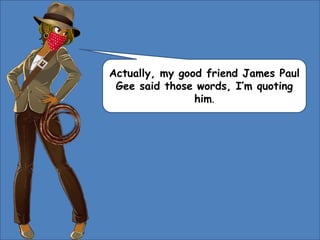
Actually, my good friend James Paul
Gee said those words, I’m quoting
him.
Always good to cite
sources!
And who are you?
Carolina Jane, a world
explorer, I’ll help you solve
this mystery.
And, help you learn about
creating engaging instruction.
So, keep in mind things that are too easy or too
difficult will not pique a learner’s interest
because they lead to boredom or frustration.
Research has shown that challenge is
correlated with both intrinsic motivation
and motivation related to the desire to
seek competence and self confidence.
White, R.W. (1959) Motivation reconsidered: The concept of competence. Psychological Review, 66, 297-333.
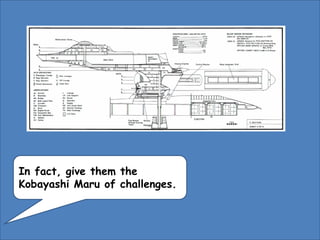
In fact, give them the
Kobayashi Maru of challenges.
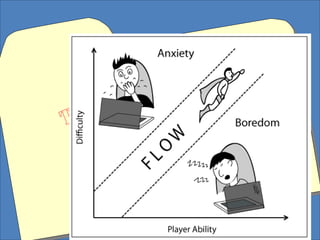
Do you know what
elements contribute to
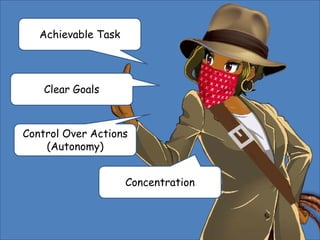
flow?
Achievable Task
Clear Goals
Control Over Actions
(Autonomy)
Concentration
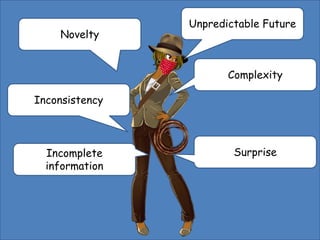
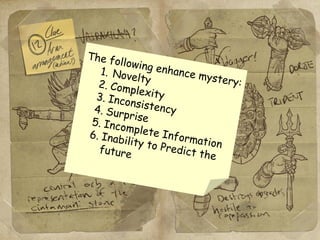
Novelty
Inconsistency
Complexity
SurpriseIncomplete
information
Unpredictable Future
Let’s get out of
here, it’s freezing.
Feels like Cincinnati
in May.
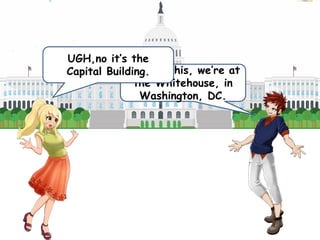
Look at this, we’re at
the Whitehouse, in
Washington, DC.
UGH,no it’s the
Capital Building.
Whatever, let’s go inside
and look for a clue. We’ll
take the tour.
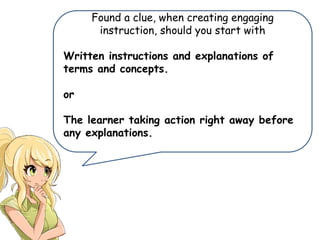
Found a clue, when creating engaging
instruction, should you start with
Written instructions and explanations of
terms and concepts.
or
The learner taking action right away before
any explanations.
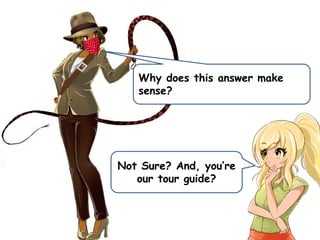
Not Sure? And, you’re
our tour guide?
Why does this answer make
sense?
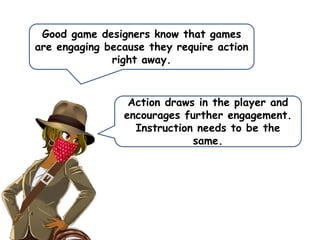
Good game designers know that games
are engaging because they require action
right away.
Action draws in the player and
encourages further engagement.
Instruction needs to be the
same.
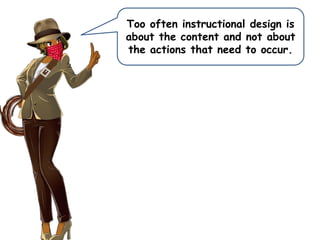
Too often instructional design is
about the content and not about
the actions that need to occur.
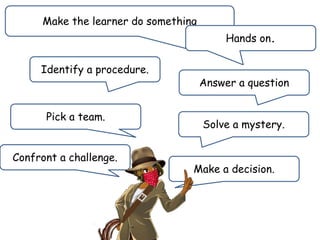
Make the learner do something
Answer a question
Identify a procedure.
Solve a mystery.
Confront a challenge.
Pick a team.
Make a decision.
Hands on.
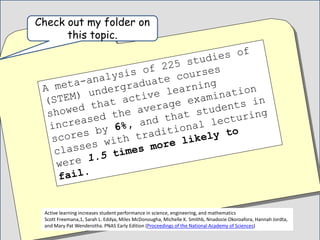
Active learning increases student performance in science, engineering, and mathematics
Scott Freemana,1, Sarah L. Eddya, Miles McDonougha, Michelle K. Smithb, Nnadozie Okoroafora, Hannah Jordta,
and Mary Pat Wenderotha. PNAS Early Edition (Proceedings of the National Academy of Sciences)
Check out my folder on
this topic.
OK, back to our travels.
We need more clues.
Wow look at this
place.
Come in here, I
found a clue.
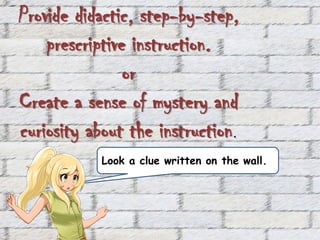
Look a clue written on the wall.
Provide didactic, step-by-step,
prescriptive instruction.
or
Create a sense of mystery and
curiosity about the instruction.
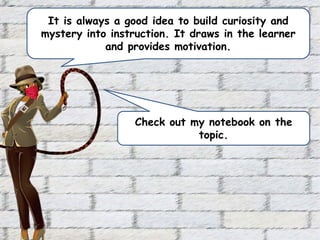
Check out my notebook on the
topic.
It is always a good idea to build curiosity and
mystery into instruction. It draws in the learner
and provides motivation.
Wait, where did you come from?
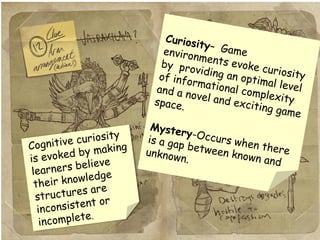
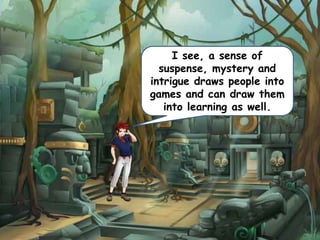
I see, a sense of
suspense, mystery and
intrigue draws people into
games and can draw them
into learning as well.
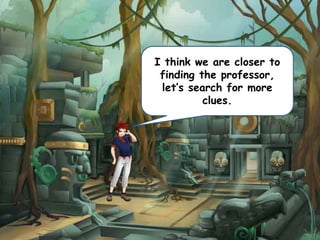
I think we are closer to
finding the professor,
let’s search for more
clues.
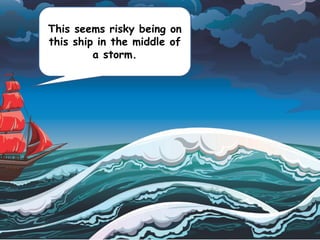
This seems risky being on
this ship in the middle of
a storm.
Yes, but there’s a
clue below deck.
It says, when creating a game should you…
Put the player at risk, they could die at any
moment.
or
Let the player safely explore the environment.
Oh, brother, considering where
we are…the player needs to be
at risk.
No risk, or danger equal no skin in
the game.
Get the player emotionally involved
by putting him or her at “mock”
risk.
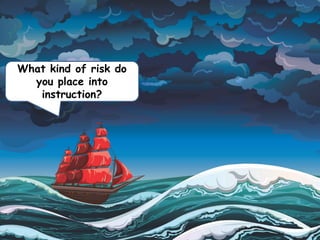
What kind of risk do
you place into
instruction?
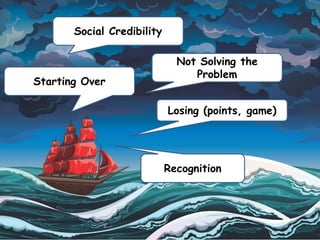
Losing (points, game)
Not Solving the
Problem
Social Credibility
Recognition
Starting Over
Now can we get out of
here?
We are in some type
of ancient Pyramid.
Yes and there are some
interesting hieroglyphics on
the wall.
Aah, I don’t see
any.
They are over
here, genius.
They are over
here, genius.
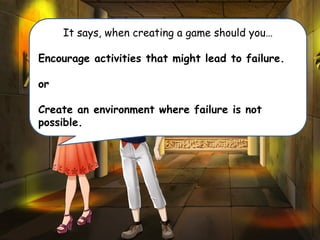
It says, when creating a game should you…
Encourage activities that might lead to failure.
or
Create an environment where failure is not
possible.
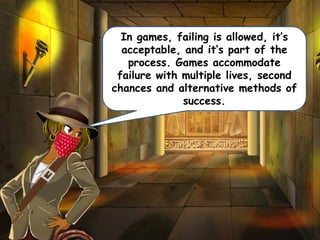
In games, failing is allowed, it’s
acceptable, and it’s part of the
process. Games accommodate
failure with multiple lives, second
chances and alternative methods of
success.
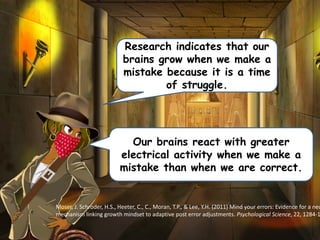
Research indicates that our
brains grow when we make a
mistake because it is a time
of struggle.
Our brains react with greater
electrical activity when we make a
mistake than when we are correct.
Moser, J. Schroder, H.S., Heeter, C., C., Moran, T.P., & Lee, Y.H. (2011) Mind your errors: Evidence for a neu
mechanism linking growth mindset to adaptive post error adjustments. Psychological Science, 22, 1284-1
Do you punish failure in your
learning design or do you allow and
encourage the freedom to fail?
Hey, we’re in some kind
of dark cave here at
the top of the world.
Yeah, I can’t see a
thing, did you bring a
torch?
No, I thought you did.
Wait, do you hear
something?
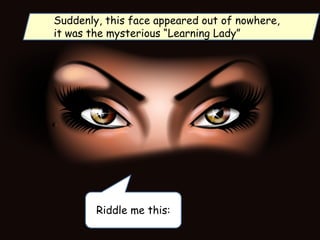
Suddenly, this face appeared out of nowhere,
it was the mysterious “Learning Lady”
Riddle me this:
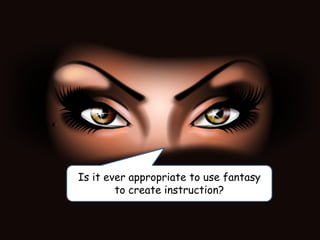
Is it ever appropriate to use fantasy
to create instruction?
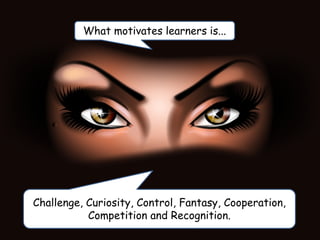
Challenge, Curiosity, Control, Fantasy, Cooperation,
Competition and Recognition.
What motivates learners is...
Hey, I know that’s Malone’s
Theory of Intrinsically
Motivating Instruction.
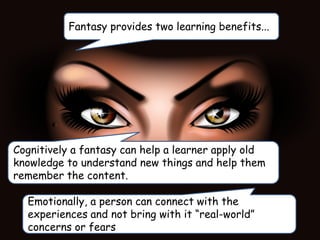
Fantasy provides two learning benefits...
Cognitively a fantasy can help a learner apply old
knowledge to understand new things and help them
remember the content.
Emotionally, a person can connect with the
experiences and not bring with it “real-world”
concerns or fears
You are now one step closer to finding
your professor and solving the case of
what makes engaging instruction.
Neat, check out this cool
cave.
I don’t like it here.
Let’s leave!
First, let me read this clue
on the tablet.
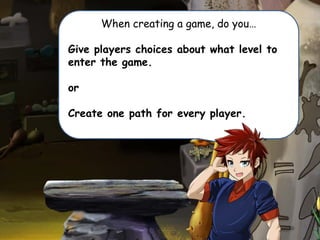
When creating a game, do you…
Give players choices about what level to
enter the game.
or
Create one path for every player.
Choices, players need choices. Look,
let me tell you what motivates
people.
People are motivated when they have
autonomy, mastery and relatedness.
Hey, isn’t that the Self-Determination Theory
and is that a whip?
Why, yes…yes it is.
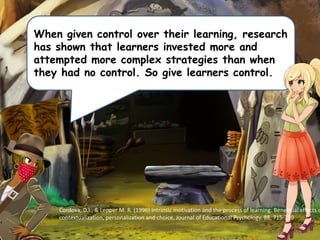
When given control over their learning, research
has shown that learners invested more and
attempted more complex strategies than when
they had no control. So give learners control.
Cordova, D.I., & Lepper M. R. (1996) Intrinsic motivation and the process of learning: Beneficial effects o
contextualization, personalization and choice. Journal of Educational Psychology, 88, 715-730
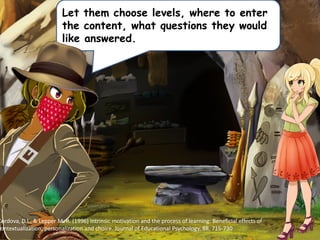
Let them choose levels, where to enter
the content, what questions they would
like answered.
Cordova, D.I., & Lepper M. R. (1996) Intrinsic motivation and the process of learning: Beneficial effects of
contextualization, personalization and choice. Journal of Educational Psychology, 88, 715-730
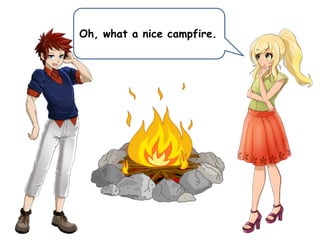
Oh, what a nice campfire.
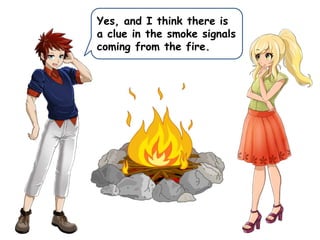
Yes, and I think there is
a clue in the smoke signals
coming from the fire.
So what does it say,
what’s the question to
solve?
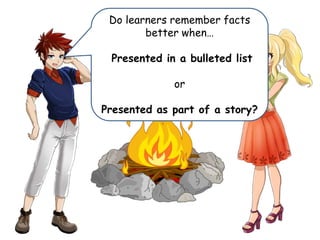
Do learners remember facts
better when…
Presented in a bulleted list
or
Presented as part of a story?
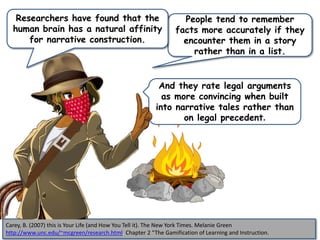
People tend to remember
facts more accurately if they
encounter them in a story
rather than in a list.
Carey, B. (2007) this is Your Life (and How You Tell it). The New York Times. Melanie Green
http://www.unc.edu/~mcgreen/research.html. Chapter 2 “The Gamification of Learning and Instruction.
And they rate legal arguments
as more convincing when built
into narrative tales rather than
on legal precedent.
Researchers have found that the
human brain has a natural affinity
for narrative construction.
Speer, N. K., Reynolds, J. R., Swallow, K. M., & Zacks, J. M. (2009). Reading Stories Activates Neural
Representations of Visual and Motor Experiences.Psychological Science, 20(8), 989–999. doi:10.1111/j.1467-
9280.2009.02397.x
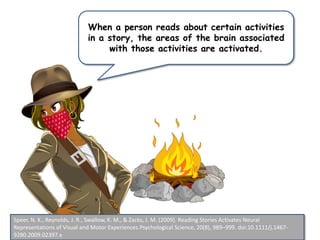
When a person reads about certain activities
in a story, the areas of the brain associated
with those activities are activated.
Speer, N. K., Reynolds, J. R., Swallow, K. M., & Zacks, J. M. (2009). Reading Stories Activates Neural
Representations of Visual and Motor Experiences.Psychological Science, 20(8), 989–999.
doi:10.1111/j.1467-9280.2009.02397.x
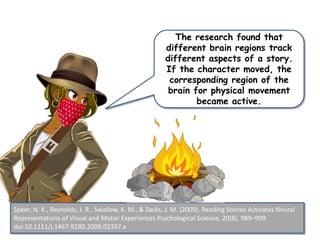
The research found that
different brain regions track
different aspects of a story.
If the character moved, the
corresponding region of the
brain for physical movement
became active.
How does she
keep showing
up like that?
Hmm, yes, I
wonder?
Wow, we are at
the Taj Mahl.
So we are in
India.
Yes.
So, look what I found
on the plane.
It’s a research report conducted in
India. With the words “spaced
repetition” and “retrieval practice”
written in the margins.
Before I tell you about the research,
let me ask you a question.
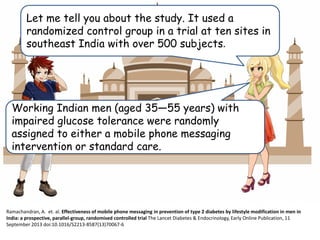
Let me tell you about the study. It used a
randomized control group in a trial at ten sites in
southeast India with over 500 subjects.
Working Indian men (aged 35—55 years) with
impaired glucose tolerance were randomly
assigned to either a mobile phone messaging
intervention or standard care..
Ramachandran, A. et. al. Effectiveness of mobile phone messaging in prevention of type 2 diabetes by lifestyle modification in men in
India: a prospective, parallel-group, randomised controlled trial The Lancet Diabetes & Endocrinology, Early Online Publication, 11
September 2013 doi:10.1016/S2213-8587(13)70067-6
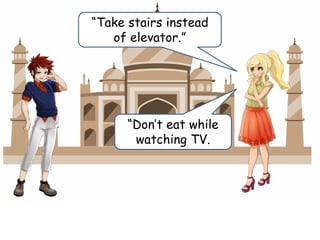
“Take stairs instead
of elevator.”
“Don’t eat while
watching TV.
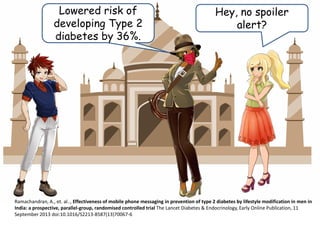
Lowered risk of
developing Type 2
diabetes by 36%.
Ramachandran, A., et. al.., Effectiveness of mobile phone messaging in prevention of type 2 diabetes by lifestyle modification in men in
India: a prospective, parallel-group, randomised controlled trial The Lancet Diabetes & Endocrinology, Early Online Publication, 11
September 2013 doi:10.1016/S2213-8587(13)70067-6
Hey, no spoiler
alert?
Where did you
come from.
Ramachandran, A., et. al.., Effectiveness of mobile phone messaging in prevention of type 2 diabetes by lifestyle modification in men in
India: a prospective, parallel-group, randomised controlled trial The Lancet Diabetes & Endocrinology, Early Online Publication, 11
September 2013 doi:10.1016/S2213-8587(13)70067-6
I know, it’s called
Spaced Repetition.
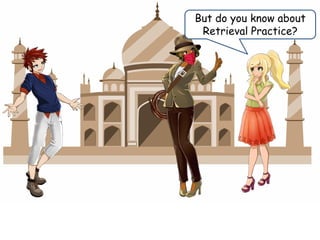
But do you know about
Retrieval Practice?
Maybe, tell me about it.
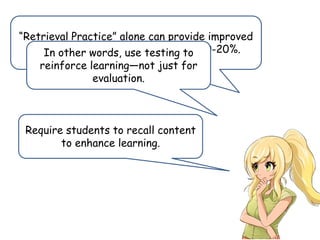
“Retrieval Practice” alone can provide improved
recall performance by as much as 10-20%.
Require students to recall content
to enhance learning.
In other words, use testing to
reinforce learning—not just for
evaluation.
Hey, I have an idea, can
you combine the two?
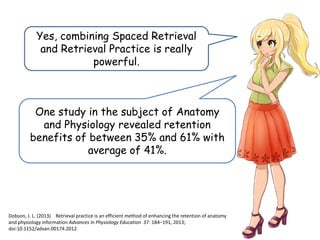
Yes, combining Spaced Retrieval
and Retrieval Practice is really
powerful.
One study in the subject of Anatomy
and Physiology revealed retention
benefits of between 35% and 61% with
average of 41%.
Dobson, J. L. (2013) Retrieval practice is an efficient method of enhancing the retention of anatomy
and physiology information Advances in Physiology Education 37: 184–191, 2013;
doi:10.1152/advan.00174.2012
In fact, most gamification
platforms use both “Spaced
Repetition” and “Retrieval
Practice” to reinforce learning.
That sounds like
engaging learning.
Yep, hey, where did she
go?
I don’t know but those
are some good clues.
Come on, Funkadelic
Sound Waves!
That is so…not a clue.
With a search party like
that…the poor professor’s
in trouble.
What is that
audience thinking?
Now, get back to work
you crazy #LUC2017
attendees.
Ah, this is a creepy
place.
There is a clue on the back
of this…ah…grave.
What does it say?
Never, mind, let me read it.
To focus the learner’s attention when
starting instruction is it better to use…
Behaviorally defined objectives
or
Questions posed to the learner
I’m cracking the whip on this
one…don’t use behaviorally
defined instructional objectives
to begin instruction.
What?
Instead, think of my
favorite show.
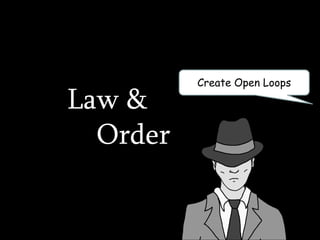
Create Open Loops
Law &
Order
Got it,
thanks.
Hey where
did she go?
I don’t know but we’ve
got to get back. .
So what did you learn today
about engaging instruction?
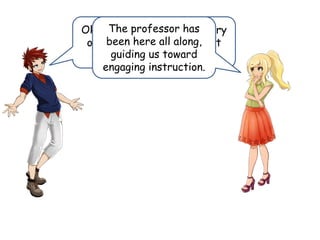
Ok, so we solved the mystery
of engaging instruction but
where is the professor?
The professor has
been here all along,
guiding us toward
engaging instruction.
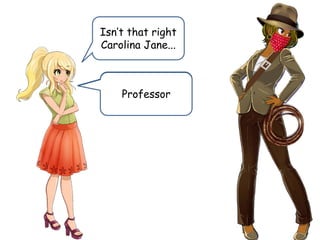
Isn’t that right
Carolina Jane...
Or should I
say…
Professor
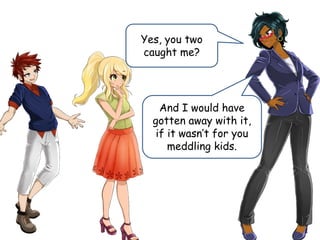
Yes, you two
caught me?
And I would have
gotten away with it,
if it wasn’t for you
meddling kids.
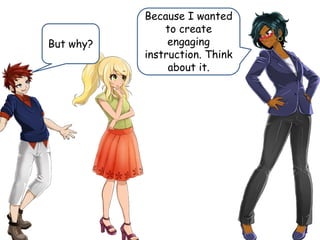
But why?
Because I wanted
to create
engaging
instruction. Think
about it.
Let’s see if my little scheme
worked. Let’s review what
you learned.
Design takeaway
challenge.
What game elements and
tools of engagement are used
in this presentation?
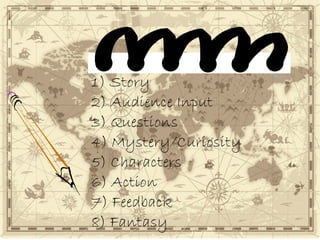
1) Story
2) Audience Input
3) Questions
4) Mystery/Curiosity
5) Characters
6) Action
7) Feedback
8) Fantasy
Questions?
Lynda.com Courses: Gamification of Learning
YouTube Video
Web Site:www.karlkapp.com
Books
www.karlkapp.com
Email: karlkapp@gmail.com
Twitter: @kkapp
Books: Play to Learn, Gamification
Lynda.com: 6 Courses

Mission Possible: Creating Learner Engagement

  • 1.
    Mission Possible: CreateLearner Engagement Presented by: Karl M. Kapp Twitter @kkapp
  • 2.
    Lynda.com Courses: Gamificationof Learning YouTube Video Web Site:www.karlkapp.com Books www.karlkapp.com Email: karlkapp@gmail.com Twitter: @kkapp Books: Play to Learn, Gamification Lynda.com: 6 Courses
  • 3.
  • 4.
    If it’s nottoo late already.
  • 5.
  • 6.
  • 7.
    We are goingto need more help than that…
  • 8.
    We need someagents with fancy gadgets and gizmos.
  • 9.
    New Message To: 37607 karlkapp  Cancel AT&T 9:37 AM  73% Text Option: karlkapp to the number 37607 Internet Option: Pollev.com/karlkapp
  • 10.
    We need twosearch parties. First team that finds the professor wins.
  • 11.
  • 12.
  • 13.
    Look, there isa clue written on the wall. Let me see what is says. Wow, it’s a lot bigger in inside than it looks from outside.
  • 14.
    Hmm, it says:When creating engaging learning should you Make it easy so we don’t discourage the learners. or Make it challenging, knowing some will fail the first few times.
  • 15.
    Jones, B., Valdez,G., Norakowski, J., & Rasmussen, C. (1994). Designing learning and technology for educational reform. North Central Regional Educational Laboratory. [Online]. Available: http://www.ncrtec.org/capacity/profile/profwww.htm and Schlechty, P. C. (1997). Inventing better schools: An action plan for educational reform. San Francisco, CA: Jossey-Bass. Chapter 2 “The Gamification of Learning and Instruction.” It needs to be challenging.
  • 16.
    Look! Good gamesgive players a set of challenging problems and let them solve those problems until they can do it automatically. Then those same games throw a new class of problem at the players requiring them to re- think, their now—taken for granted—mastery. They must learn something new and integrate into their old mastery.
  • 17.
  • 18.
    Actually, my goodfriend James Paul Gee said those words, I’m quoting him.
  • 19.
    Always good tocite sources!
  • 20.
  • 21.
    Carolina Jane, aworld explorer, I’ll help you solve this mystery. And, help you learn about creating engaging instruction.
  • 22.
    So, keep inmind things that are too easy or too difficult will not pique a learner’s interest because they lead to boredom or frustration. Research has shown that challenge is correlated with both intrinsic motivation and motivation related to the desire to seek competence and self confidence. White, R.W. (1959) Motivation reconsidered: The concept of competence. Psychological Review, 66, 297-333.
  • 23.
    In fact, givethem the Kobayashi Maru of challenges.
  • 25.
    Do you knowwhat elements contribute to flow?
  • 26.
    Achievable Task Clear Goals ControlOver Actions (Autonomy) Concentration
  • 27.
  • 28.
    Let’s get outof here, it’s freezing. Feels like Cincinnati in May.
  • 29.
    Look at this,we’re at the Whitehouse, in Washington, DC. UGH,no it’s the Capital Building.
  • 30.
    Whatever, let’s goinside and look for a clue. We’ll take the tour.
  • 31.
    Found a clue,when creating engaging instruction, should you start with Written instructions and explanations of terms and concepts. or The learner taking action right away before any explanations.
  • 32.
    Not Sure? And,you’re our tour guide? Why does this answer make sense?
  • 33.
    Good game designersknow that games are engaging because they require action right away. Action draws in the player and encourages further engagement. Instruction needs to be the same.
  • 34.
    Too often instructionaldesign is about the content and not about the actions that need to occur.
  • 35.
    Make the learnerdo something Answer a question Identify a procedure. Solve a mystery. Confront a challenge. Pick a team. Make a decision. Hands on.
  • 36.
    Active learning increasesstudent performance in science, engineering, and mathematics Scott Freemana,1, Sarah L. Eddya, Miles McDonougha, Michelle K. Smithb, Nnadozie Okoroafora, Hannah Jordta, and Mary Pat Wenderotha. PNAS Early Edition (Proceedings of the National Academy of Sciences) Check out my folder on this topic.
  • 37.
    OK, back toour travels. We need more clues.
  • 38.
    Wow look atthis place. Come in here, I found a clue.
  • 39.
    Look a cluewritten on the wall. Provide didactic, step-by-step, prescriptive instruction. or Create a sense of mystery and curiosity about the instruction.
  • 40.
    Check out mynotebook on the topic. It is always a good idea to build curiosity and mystery into instruction. It draws in the learner and provides motivation.
  • 41.
    Wait, where didyou come from?
  • 44.
    I see, asense of suspense, mystery and intrigue draws people into games and can draw them into learning as well.
  • 45.
    I think weare closer to finding the professor, let’s search for more clues.
  • 46.
    This seems riskybeing on this ship in the middle of a storm.
  • 47.
    Yes, but there’sa clue below deck.
  • 48.
    It says, whencreating a game should you… Put the player at risk, they could die at any moment. or Let the player safely explore the environment.
  • 49.
    Oh, brother, consideringwhere we are…the player needs to be at risk.
  • 50.
    No risk, ordanger equal no skin in the game. Get the player emotionally involved by putting him or her at “mock” risk.
  • 51.
    What kind ofrisk do you place into instruction?
  • 52.
    Losing (points, game) NotSolving the Problem Social Credibility Recognition Starting Over
  • 53.
    Now can weget out of here?
  • 54.
    We are insome type of ancient Pyramid.
  • 55.
    Yes and thereare some interesting hieroglyphics on the wall.
  • 56.
  • 57.
  • 58.
    They are over here,genius. It says, when creating a game should you… Encourage activities that might lead to failure. or Create an environment where failure is not possible.
  • 59.
    In games, failingis allowed, it’s acceptable, and it’s part of the process. Games accommodate failure with multiple lives, second chances and alternative methods of success.
  • 60.
    Research indicates thatour brains grow when we make a mistake because it is a time of struggle. Our brains react with greater electrical activity when we make a mistake than when we are correct. Moser, J. Schroder, H.S., Heeter, C., C., Moran, T.P., & Lee, Y.H. (2011) Mind your errors: Evidence for a neu mechanism linking growth mindset to adaptive post error adjustments. Psychological Science, 22, 1284-1
  • 61.
    Do you punishfailure in your learning design or do you allow and encourage the freedom to fail?
  • 62.
    Hey, we’re insome kind of dark cave here at the top of the world.
  • 63.
    Yeah, I can’tsee a thing, did you bring a torch?
  • 64.
    No, I thoughtyou did. Wait, do you hear something?
  • 65.
    Suddenly, this faceappeared out of nowhere, it was the mysterious “Learning Lady” Riddle me this:
  • 66.
    Is it everappropriate to use fantasy to create instruction?
  • 67.
    Challenge, Curiosity, Control,Fantasy, Cooperation, Competition and Recognition. What motivates learners is...
  • 68.
    Hey, I knowthat’s Malone’s Theory of Intrinsically Motivating Instruction.
  • 69.
    Fantasy provides twolearning benefits... Cognitively a fantasy can help a learner apply old knowledge to understand new things and help them remember the content. Emotionally, a person can connect with the experiences and not bring with it “real-world” concerns or fears
  • 70.
    You are nowone step closer to finding your professor and solving the case of what makes engaging instruction.
  • 71.
    Neat, check outthis cool cave.
  • 72.
    I don’t likeit here. Let’s leave!
  • 73.
    First, let meread this clue on the tablet.
  • 74.
    When creating agame, do you… Give players choices about what level to enter the game. or Create one path for every player.
  • 75.
    Choices, players needchoices. Look, let me tell you what motivates people.
  • 76.
    People are motivatedwhen they have autonomy, mastery and relatedness.
  • 77.
    Hey, isn’t thatthe Self-Determination Theory and is that a whip?
  • 78.
  • 79.
    When given controlover their learning, research has shown that learners invested more and attempted more complex strategies than when they had no control. So give learners control. Cordova, D.I., & Lepper M. R. (1996) Intrinsic motivation and the process of learning: Beneficial effects o contextualization, personalization and choice. Journal of Educational Psychology, 88, 715-730
  • 80.
    Let them chooselevels, where to enter the content, what questions they would like answered. Cordova, D.I., & Lepper M. R. (1996) Intrinsic motivation and the process of learning: Beneficial effects of contextualization, personalization and choice. Journal of Educational Psychology, 88, 715-730
  • 81.
    Oh, what anice campfire.
  • 82.
    Yes, and Ithink there is a clue in the smoke signals coming from the fire.
  • 83.
    So what doesit say, what’s the question to solve?
  • 84.
    Do learners rememberfacts better when… Presented in a bulleted list or Presented as part of a story?
  • 85.
    People tend toremember facts more accurately if they encounter them in a story rather than in a list. Carey, B. (2007) this is Your Life (and How You Tell it). The New York Times. Melanie Green http://www.unc.edu/~mcgreen/research.html. Chapter 2 “The Gamification of Learning and Instruction. And they rate legal arguments as more convincing when built into narrative tales rather than on legal precedent. Researchers have found that the human brain has a natural affinity for narrative construction.
  • 86.
    Speer, N. K.,Reynolds, J. R., Swallow, K. M., & Zacks, J. M. (2009). Reading Stories Activates Neural Representations of Visual and Motor Experiences.Psychological Science, 20(8), 989–999. doi:10.1111/j.1467- 9280.2009.02397.x When a person reads about certain activities in a story, the areas of the brain associated with those activities are activated.
  • 87.
    Speer, N. K.,Reynolds, J. R., Swallow, K. M., & Zacks, J. M. (2009). Reading Stories Activates Neural Representations of Visual and Motor Experiences.Psychological Science, 20(8), 989–999. doi:10.1111/j.1467-9280.2009.02397.x The research found that different brain regions track different aspects of a story. If the character moved, the corresponding region of the brain for physical movement became active.
  • 88.
    How does she keepshowing up like that? Hmm, yes, I wonder?
  • 90.
    Wow, we areat the Taj Mahl. So we are in India.
  • 91.
    Yes. So, look whatI found on the plane.
  • 92.
    It’s a researchreport conducted in India. With the words “spaced repetition” and “retrieval practice” written in the margins.
  • 93.
    Before I tellyou about the research, let me ask you a question.
  • 94.
    Let me tellyou about the study. It used a randomized control group in a trial at ten sites in southeast India with over 500 subjects. Working Indian men (aged 35—55 years) with impaired glucose tolerance were randomly assigned to either a mobile phone messaging intervention or standard care.. Ramachandran, A. et. al. Effectiveness of mobile phone messaging in prevention of type 2 diabetes by lifestyle modification in men in India: a prospective, parallel-group, randomised controlled trial The Lancet Diabetes & Endocrinology, Early Online Publication, 11 September 2013 doi:10.1016/S2213-8587(13)70067-6
  • 95.
    “Take stairs instead ofelevator.” “Don’t eat while watching TV.
  • 96.
    Lowered risk of developingType 2 diabetes by 36%. Ramachandran, A., et. al.., Effectiveness of mobile phone messaging in prevention of type 2 diabetes by lifestyle modification in men in India: a prospective, parallel-group, randomised controlled trial The Lancet Diabetes & Endocrinology, Early Online Publication, 11 September 2013 doi:10.1016/S2213-8587(13)70067-6 Hey, no spoiler alert?
  • 97.
    Where did you comefrom. Ramachandran, A., et. al.., Effectiveness of mobile phone messaging in prevention of type 2 diabetes by lifestyle modification in men in India: a prospective, parallel-group, randomised controlled trial The Lancet Diabetes & Endocrinology, Early Online Publication, 11 September 2013 doi:10.1016/S2213-8587(13)70067-6 I know, it’s called Spaced Repetition.
  • 98.
    But do youknow about Retrieval Practice?
  • 99.
    Maybe, tell meabout it.
  • 100.
    “Retrieval Practice” alonecan provide improved recall performance by as much as 10-20%. Require students to recall content to enhance learning. In other words, use testing to reinforce learning—not just for evaluation.
  • 101.
    Hey, I havean idea, can you combine the two?
  • 102.
    Yes, combining SpacedRetrieval and Retrieval Practice is really powerful. One study in the subject of Anatomy and Physiology revealed retention benefits of between 35% and 61% with average of 41%. Dobson, J. L. (2013) Retrieval practice is an efficient method of enhancing the retention of anatomy and physiology information Advances in Physiology Education 37: 184–191, 2013; doi:10.1152/advan.00174.2012
  • 103.
    In fact, mostgamification platforms use both “Spaced Repetition” and “Retrieval Practice” to reinforce learning.
  • 104.
  • 105.
    Yep, hey, wheredid she go?
  • 106.
    I don’t knowbut those are some good clues.
  • 107.
  • 108.
  • 109.
    With a searchparty like that…the poor professor’s in trouble. What is that audience thinking?
  • 110.
    Now, get backto work you crazy #LUC2017 attendees.
  • 112.
    Ah, this isa creepy place.
  • 113.
    There is aclue on the back of this…ah…grave.
  • 114.
  • 115.
    Never, mind, letme read it. To focus the learner’s attention when starting instruction is it better to use… Behaviorally defined objectives or Questions posed to the learner
  • 116.
    I’m cracking thewhip on this one…don’t use behaviorally defined instructional objectives to begin instruction. What?
  • 117.
    Instead, think ofmy favorite show.
  • 118.
  • 119.
  • 120.
    I don’t knowbut we’ve got to get back. .
  • 121.
    So what didyou learn today about engaging instruction?
  • 123.
    Ok, so wesolved the mystery of engaging instruction but where is the professor? The professor has been here all along, guiding us toward engaging instruction.
  • 124.
    Isn’t that right CarolinaJane... Or should I say… Professor
  • 125.
    Yes, you two caughtme? And I would have gotten away with it, if it wasn’t for you meddling kids.
  • 126.
    But why? Because Iwanted to create engaging instruction. Think about it.
  • 127.
    Let’s see ifmy little scheme worked. Let’s review what you learned.
  • 128.
  • 129.
    What game elementsand tools of engagement are used in this presentation?
  • 130.
    1) Story 2) AudienceInput 3) Questions 4) Mystery/Curiosity 5) Characters 6) Action 7) Feedback 8) Fantasy
  • 131.
  • 132.
    Lynda.com Courses: Gamificationof Learning YouTube Video Web Site:www.karlkapp.com Books www.karlkapp.com Email: karlkapp@gmail.com Twitter: @kkapp Books: Play to Learn, Gamification Lynda.com: 6 Courses