You can listen to today’s webinar using your computer’s
speakers or you may dial into the teleconference.
If you would like to join the teleconference,
please dial 1.650.479.3208 and enter access code: 923 279 304 #.
You will be on hold until the seminar begins.
#CLOwebinar
#CLOwebinar
Speakers: Bryan Austin
Chief Game Changer
Game On! Learning
Karl Kapp, Ed.D.
CFPIM
CIRM
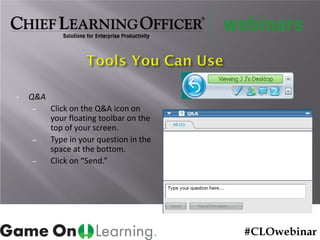
• Q&A
– Click on the Q&A icon on
your floating toolbar on the
top of your screen.
– Type in your question in the
space at the bottom.
– Click on “Send.”
#CLOwebinar
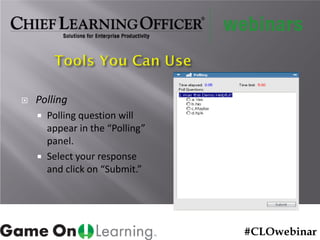
 Polling
 Polling question will
appear in the “Polling”
panel.
 Select your response
and click on “Submit.”
#CLOwebinar
1. Will I receive a copy of the slides after the webinar?
YES
2. Will I receive a copy of the webinar recording?
YES
Please allow up to 2 business days to receive these materials.
#CLOwebinar
Can Game-Based Learning More
Effectively Improve Performance?
© 2013 Game On! Learning – all rights reserved
7
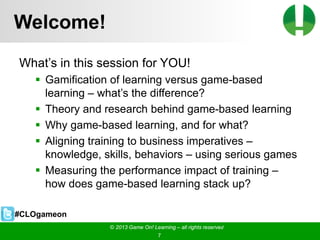
Welcome!
What’s in this session for YOU!
 Gamification of learning versus game-based
learning – what’s the difference?
 Theory and research behind game-based learning
 Why game-based learning, and for what?
 Aligning training to business imperatives –
knowledge, skills, behaviors – using serious games
 Measuring the performance impact of training –
how does game-based learning stack up?
© 2013 Game On! Learning – all rights reserved
7
#CLOgameon
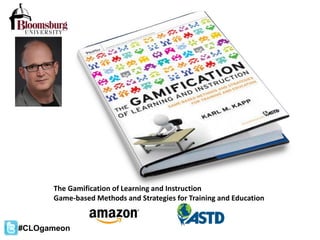
The Gamification of Learning and Instruction
Game-based Methods and Strategies for Training and Education
#CLOgameon
25-Year Citizen of the
Corporate Training Industry
#CLOgameon
© 2013 Game On! Learning – all rights reserved
10
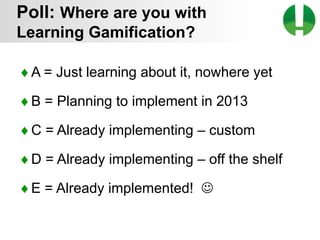
♦A = Just learning about it, nowhere yet
♦B = Planning to implement in 2013
♦C = Already implementing – custom
♦D = Already implementing – off the shelf
♦E = Already implemented! 
Poll: Where are you with
Learning Gamification?
Learning
Gamification or
Game-Based
Learning – what’s
the diff?
© 2013 Game On! Learning – all rights reserved
11
#CLOgameon
© 2013 Game On! Learning – all rights reserved
12
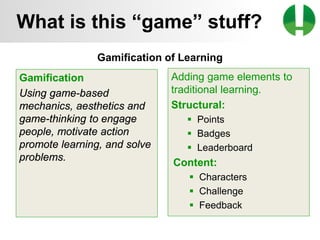
Gamification of Learning
Adding game elements to
traditional learning.
Structural:
 Points
 Badges
 Leaderboard
Content:
 Characters
 Challenge
 Feedback
Gamification
Using game-based
mechanics, aesthetics and
game-thinking to engage
people, motivate action
promote learning, and solve
problems.
What is this “game” stuff?
© 2013 Game On! Learning – all rights reserved
13
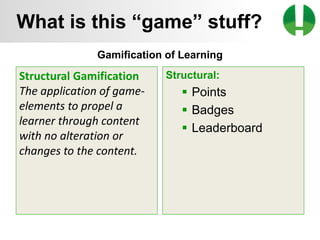
Gamification of Learning
Structural Gamification
The application of game-
elements to propel a
learner through content
with no alteration or
changes to the content.
Structural:
 Points
 Badges
 Leaderboard
What is this “game” stuff?
© 2013 Game On! Learning – all rights reserved
14
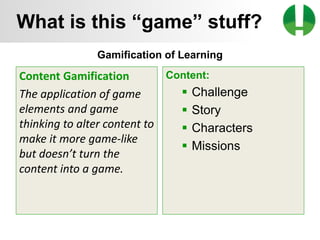
Gamification of Learning
Content Gamification
The application of game
elements and game
thinking to alter content to
make it more game-like
but doesn’t turn the
content into a game.
Content:
 Challenge
 Story
 Characters
 Missions
What is this “game” stuff?
© 2013 Game On! Learning – all rights reserved
15
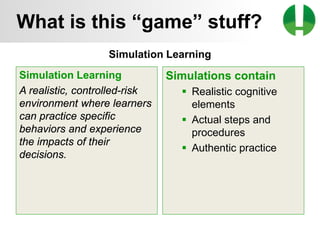
Simulation Learning
A realistic, controlled-risk
environment where learners
can practice specific
behaviors and experience
the impacts of their
decisions.
Simulation Learning
Simulations contain
 Realistic cognitive
elements
 Actual steps and
procedures
 Authentic practice
What is this “game” stuff?
© 2013 Game On! Learning – all rights reserved
16
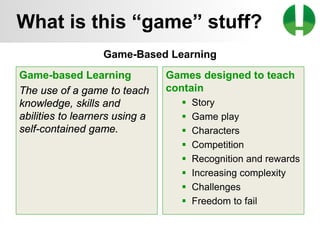
Game-based Learning
The use of a game to teach
knowledge, skills and
abilities to learners using a
self-contained game.
Game-Based Learning
Games designed to teach
contain
 Story
 Game play
 Characters
 Competition
 Recognition and rewards
 Increasing complexity
 Challenges
 Freedom to fail
What is this “game” stuff?
© 2013 Game On! Learning – all rights reserved
17
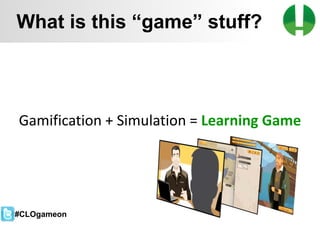
Gamification + Simulation = Learning Game
What is this “game” stuff?
#CLOgameon
© 2013 Game On! Learning – all rights reserved
18
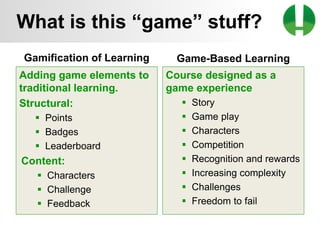
Gamification of Learning
Adding game elements to
traditional learning.
Structural:
 Points
 Badges
 Leaderboard
Content:
 Characters
 Challenge
 Feedback
Game-Based Learning
Course designed as a
game experience
 Story
 Game play
 Characters
 Competition
 Recognition and rewards
 Increasing complexity
 Challenges
 Freedom to fail
What is this “game” stuff?
© 2013 Game On! Learning – all rights reserved
19
• Gamification is to Learning Game as:
– Part is to Whole
– Piece is to Puzzle
– Slice is to Pie
– Steering Wheel is to Car
• Gamification uses parts of games but is not a
game in-and-of itself.
What is this “game” stuff?
#CLOgameon
© 2013 Game On! Learning – all rights reserved
20
Gamification is
using game-based
mechanics,
aesthetics and
game-thinking to
engage people,
motivate action
promote learning,
and solve
problems.
Game-based
Learning is the
use of a game to
teach knowledge,
skills and abilities
to learners using
a self-contained
game.
What is this “game” stuff?
Simulation
Learning is a
realistic, controlled-
risk environment
where learners can
practice specific
behaviors and
experience the
impacts of their
decisions.
The Theory and
Research Behind
Game-Based
Learning
© 2013 Game On! Learning – all rights reserved
21
#CLOgameon
© 2013 Game On! Learning – all rights reserved
22
Lectures are NOT effective for
fostering higher level
thoughts and information
processing
Gibbs, G., (1981). Twenty Terrible Reasons for Lecturing, SCED Occasional Paper No. 8, Birmingham.
http://www.brookes.ac.uk/services/ocsld/resources/20reasons.html and Bligh, D., (1972). What’s the Use of Lectures? Penguin.
Bloom, B. S., (1953). “Thought Processes in Lectures and Discussions.” Journal of General Education Vol. 7.
Isaacs, G., (1994). “Lecturing Practices and Note-taking Purposes.” Studies in Higher Education, 19:2.
© 2013 Game On! Learning – all rights reserved
23
• Researchers could not track down a single
study which found lecturing to be more
effective than another method for the
promotion of thought:
– 21 studies found lecturing to be less effective
than: discussion, reading and individual work in
class.
– The evidence on the weakness of lectures to
promote thought is devastating.
Lecture-Based Learning
Research
#CLOgameon
© 2013 Game On! Learning – all rights reserved
24
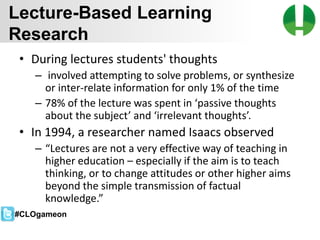
• During lectures students' thoughts
– involved attempting to solve problems, or synthesize
or inter-relate information for only 1% of the time
– 78% of the lecture was spent in ‘passive thoughts
about the subject’ and ‘irrelevant thoughts’.
• In 1994, a researcher named Isaacs observed
– “Lectures are not a very effective way of teaching in
higher education – especially if the aim is to teach
thinking, or to change attitudes or other higher aims
beyond the simple transmission of factual
knowledge.”
Lecture-Based Learning
Research
#CLOgameon
© 2013 Game On! Learning – all rights reserved
25
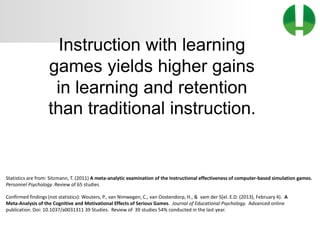
Instruction with learning
games yields higher gains
in learning and retention
than traditional instruction.
Statistics are from: Sitzmann, T. (2011) A meta-analytic examination of the instructional effectiveness of computer-based simulation games.
Personnel Psychology .Review of 65 studies
Confirmed findings (not statistics): Wouters, P., van Nimwegen, C., van Oostendorp, H., & vam der S[el. E.D. (2013), February 4). A
Meta-Analysis of the Cognitive and Motivational Effects of Serious Games. Journal of Educational Psychology. Advanced online
publication. Doi: 10.1037/a0031311 39 Studies. Review of 39 studies 54% conducted in the last year.
© 2013 Game On! Learning – all rights reserved
26
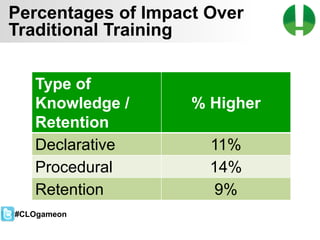
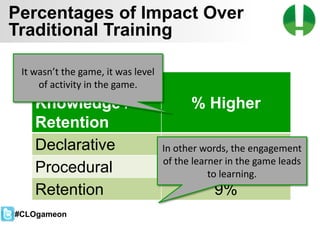
Type of
Knowledge /
Retention
% Higher
Declarative 11%
Procedural 14%
Retention 9%
#CLOgameon
Percentages of Impact Over
Traditional Training
© 2013 Game On! Learning – all rights reserved
27
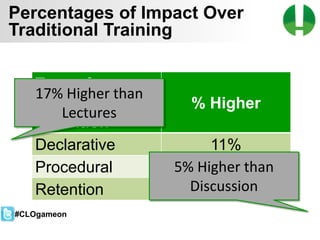
Type of
Knowledge /
Retention
% Higher
Declarative 11%
Procedural 14%
Retention 9%
17% Higher than
Lectures
5% Higher than
Discussion
#CLOgameon
Percentages of Impact Over
Traditional Training
© 2013 Game On! Learning – all rights reserved
28
Type of
Knowledge /
Retention
% Higher
Declarative 11%
Procedural 14%
Retention 9%
It wasn’t the game, it was level
of activity in the game.
In other words, the engagement
of the learner in the game leads
to learning.
#CLOgameon
Percentages of Impact Over
Traditional Training
© 2013 Game On! Learning – all rights reserved
29
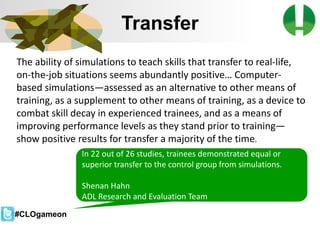
Transfer
The ability of simulations to teach skills that transfer to real-life,
on-the-job situations seems abundantly positive… Computer-
based simulations—assessed as an alternative to other means of
training, as a supplement to other means of training, as a device to
combat skill decay in experienced trainees, and as a means of
improving performance levels as they stand prior to training—
show positive results for transfer a majority of the time.
In 22 out of 26 studies, trainees demonstrated equal or
superior transfer to the control group from simulations.
Shenan Hahn
ADL Research and Evaluation Team
#CLOgameon
© 2013 Game On! Learning – all rights reserved
30
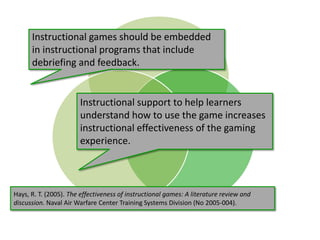
Engagement
PedagogyGame
Educational
Simulation
Instructional games should be embedded
in instructional programs that include
debriefing and feedback.
Instructional support to help learners
understand how to use the game increases
instructional effectiveness of the gaming
experience.
Hays, R. T. (2005). The effectiveness of instructional games: A literature review and
discussion. Naval Air Warfare Center Training Systems Division (No 2005-004).
© 2013 Game On! Learning – all rights reserved
31
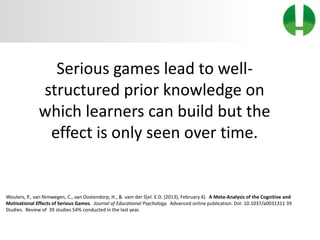
Serious games lead to well-
structured prior knowledge on
which learners can build but the
effect is only seen over time.
Wouters, P., van Nimwegen, C., van Oostendorp, H., & vam der S[el. E.D. (2013), February 4). A Meta-Analysis of the Cognitive and
Motivational Effects of Serious Games. Journal of Educational Psychology. Advanced online publication. Doi: 10.1037/a0031311 39
Studies. Review of 39 studies 54% conducted in the last year.
© 2013 Game On! Learning – all rights reserved
32
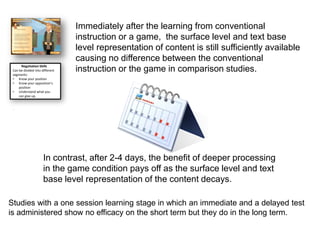
Negotiation Skills
Can be divided into different
segments:
• Know your position
• Know your opposition’s
position
• Understand what you
can give up.
.
Immediately after the learning from conventional
instruction or a game, the surface level and text base
level representation of content is still sufficiently available
causing no difference between the conventional
instruction or the game in comparison studies.
In contrast, after 2-4 days, the benefit of deeper processing
in the game condition pays off as the surface level and text
base level representation of the content decays.
Studies with a one session learning stage in which an immediate and a delayed test
is administered show no efficacy on the short term but they do in the long term.
© 2013 Game On! Learning – all rights reserved
33
What motivates learners?
Malone, T. (1981) Toward a theory of intrinsically motivating instruction. Cognitive Science, 4. pp. 333-369.
#CLOgameon
© 2013 Game On! Learning – all rights reserved
34
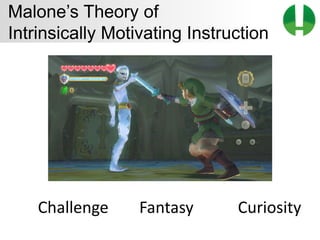
Malone’s Theory of
Intrinsically Motivating Instruction
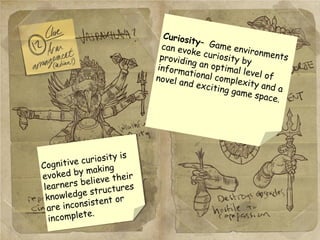
Challenge Fantasy Curiosity
Challenge
Jones, B., Valdez, G., Norakowski, J., & Rasmussen, C. (1994). Designing learning and technology
for educational reform. North Central Regional Educational Laboratory. [Online]. Available:
http://www.ncrtec.org/capacity/profile/profwww.htm and Schlechty, P. C. (1997). Inventing
better schools: An action plan for educational reform. San Francisco, CA: Jossey-Bass. Chapter 2
“The Gamification of Learning and Instruction.”
© 2013 Game On! Learning – all rights reserved
36
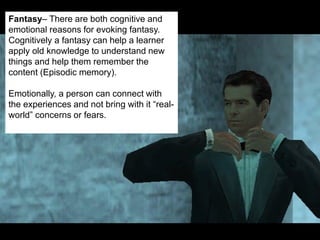
Fantasy– There are both cognitive and
emotional reasons for evoking fantasy.
Cognitively a fantasy can help a learner
apply old knowledge to understand new
things and help them remember the
content (Episodic memory).
Emotionally, a person can connect with
the experiences and not bring with it “real-
world” concerns or fears.
© 2013 Game On! Learning – all rights reserved
37
Why Game-Based
Learning in
Corporate
Workforce
Development?
© 2013 Game On! Learning – all rights reserved
38
#CLOgameon
© 2013 Game On! Learning – all rights reserved
39
A Common Theme
#CLOgameon
© 2013 Game On! Learning – all rights reserved
40
Another Common Theme
© 2013 Game On! Learning – all rights reserved
41
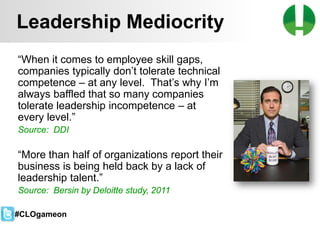
“When it comes to employee skill gaps,
companies typically don’t tolerate technical
competence – at any level. That’s why I’m
always baffled that so many companies
tolerate leadership incompetence – at
every level.”
Source: DDI
“More than half of organizations report their
business is being held back by a lack of
leadership talent.”
Source: Bersin by Deloitte study, 2011
Leadership Mediocrity
#CLOgameon
© 2013 Game On! Learning – all rights reserved
42
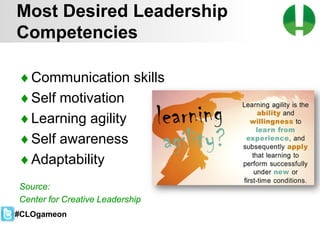
♦Communication skills
♦Self motivation
♦Learning agility
♦Self awareness
♦Adaptability
Source:
Center for Creative Leadership
Most Desired Leadership
Competencies
#CLOgameon
© 2013 Game On! Learning – all rights reserved
43
The Corporate Lattice
Cathleen Benco and Molly Anderson
♦ Build a portfolio of
career-enhancing skills
and experiences
♦ Develop transferable
skills
♦ Be an agile learner
♦ Choose companies
wisely
© 2013 Game On! Learning – all rights reserved
44
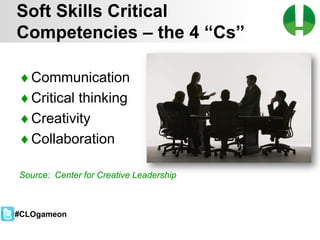
♦Communication
♦Critical thinking
♦Creativity
♦Collaboration
Source: Center for Creative Leadership
Soft Skills Critical
Competencies – the 4 “Cs”
#CLOgameon
© 2013 Game On! Learning – all rights reserved
45
Business professions often have the
business, technical or product knowledge.
The question is whether they also have the
communication skills and the ability to work
effectively with people as they build
credibility with clients and/or their own staff.
Communication
“People now spend over 40% of their time at
work engaged in non-sales selling – persuading,
influencing, and convincing others. We spend
24 minutes of every hour devoted to moving
others. This aspect of work is crucial to our
professional and organizational success.”
© 2013 Game On! Learning – all rights reserved
46
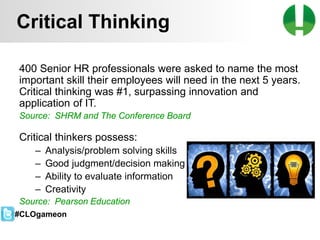
400 Senior HR professionals were asked to name the most
important skill their employees will need in the next 5 years.
Critical thinking was #1, surpassing innovation and
application of IT.
Source: SHRM and The Conference Board
Critical thinkers possess:
– Analysis/problem solving skills
– Good judgment/decision making
– Ability to evaluate information
– Creativity
Source: Pearson Education
Critical Thinking
#CLOgameon
© 2013 Game On! Learning – all rights reserved
47
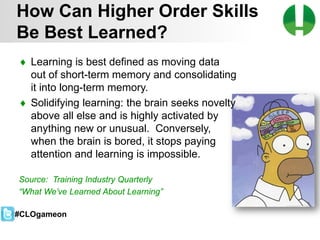
♦ Learning is best defined as moving data
out of short-term memory and consolidating
it into long-term memory.
♦ Solidifying learning: the brain seeks novelty
above all else and is highly activated by
anything new or unusual. Conversely,
when the brain is bored, it stops paying
attention and learning is impossible.
Source: Training Industry Quarterly
“What We’ve Learned About Learning”
How Can Higher Order Skills
Be Best Learned?
#CLOgameon
© 2013 Game On! Learning – all rights reserved
48
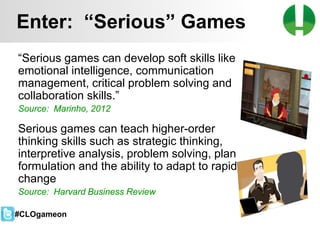
“Serious games can develop soft skills like
emotional intelligence, communication
management, critical problem solving and
collaboration skills.”
Source: Marinho, 2012
Serious games can teach higher-order
thinking skills such as strategic thinking,
interpretive analysis, problem solving, plan
formulation and the ability to adapt to rapid
change
Source: Harvard Business Review
Enter: “Serious” Games
#CLOgameon
© 2013 Game On! Learning – all rights reserved
49
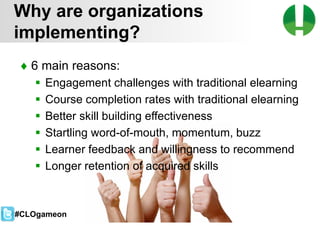
♦ 6 main reasons:
 Engagement challenges with traditional elearning
 Course completion rates with traditional elearning
 Better skill building effectiveness
 Startling word-of-mouth, momentum, buzz
 Learner feedback and willingness to recommend
 Longer retention of acquired skills
Why are organizations
implementing?
#CLOgameon
© 2013 Game On! Learning – all rights reserved
50
Engagement
“Intuitive, didactic and somewhat addictive. A spectacular course!”
“Completely interesting, both in terms of your desire to do it, and your
retention of the concepts, as they are based on practical cases.”
“The online experience is like nothing I’ve seen. It is a very enriching course
presented in a very enjoyable way.”
“The best training course that I’ve seen, useful and above all educational.”
“I’ve finished the course, what a shame! The most entertaining, interesting
and useful course that I have done.”
“The best elearning course I have ever seen.”
“I didn’t want it to end! I completely recommend it.”
© 2013 Game On! Learning – all rights reserved
51
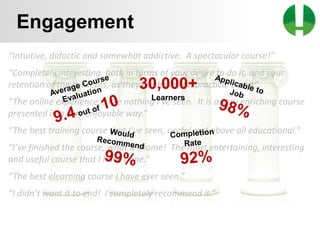
“Intuitive, didactic and somewhat addictive. A spectacular course!”
“Completely interesting, both in terms of your desire to do it, and your
retention of the concepts, as they are based on practical cases.”
“The online experience is like nothing I’ve seen. It is a very enriching course
presented in a very enjoyable way.”
“The best training course that I’ve seen, useful and above all educational.”
“I’ve finished the course, what a shame! The most entertaining, interesting
and useful course that I have done.”
“The best elearning course I have ever seen.”
“I didn’t want it to end! I completely recommend it.”
30,000+
Learners
Engagement
© 2013 Game On! Learning – all rights reserved
52
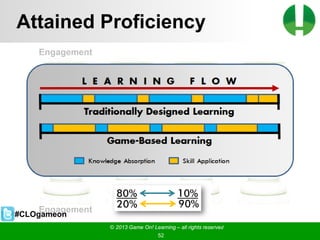
Attained Proficiency
Engagement
Engagement#CLOgameon
© 2013 Game On! Learning – all rights reserved
53
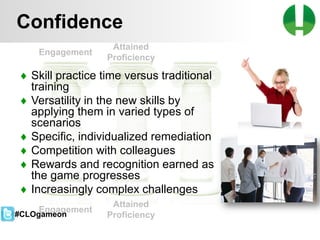
Confidence
♦ Skill practice time versus traditional
training
♦ Versatility in the new skills by
applying them in varied types of
scenarios
♦ Specific, individualized remediation
♦ Competition with colleagues
♦ Rewards and recognition earned as
the game progresses
♦ Increasingly complex challenges
Engagement
Engagement
Attained
Proficiency
Attained
Proficiency#CLOgameon
© 2013 Game On! Learning – all rights reserved
54
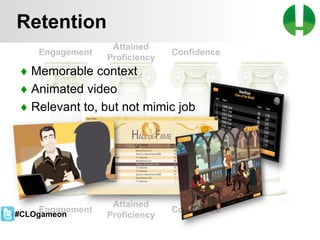
Retention
♦ Memorable context
♦ Animated video
♦ Relevant to, but not mimic job
Engagement
Engagement
Attained
Proficiency
Attained
Proficiency
Confidence
Confidence#CLOgameon
© 2013 Game On! Learning – all rights reserved
55
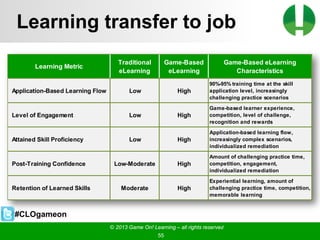
Learning transfer to job
Learning Metric
Traditional
eLearning
Game-Based
eLearning
Game-Based eLearning
Characteristics
Application-Based Learning Flow Low High
90%-95% training time at the skill
application level, increasingly
challenging practice scenarios
Level of Engagement Low High
Game-based learner experience,
competition, level of challenge,
recognition and rewards
Attained Skill Proficiency Low High
Application-based learning flow,
increasingly complex scenarios,
individualized remediation
Post-Training Confidence Low-Moderate High
Amount of challenging practice time,
competition, engagement,
individualized remediation
Retention of Learned Skills Moderate High
Experiential learning, amount of
challenging practice time, competition,
memorable learning
#CLOgameon
Measuring
Performance
Impact – Do
Serious Games
Stack Up?
© 2013 Game On! Learning – all rights reserved
56
#CLOgameon
© 2013 Game On! Learning – all rights reserved
57
♦Would your organization make a good
research partner?
– Co-present research findings
– Skill area: negotiation/persuasive communication
skills
– Participants: sales professionals
– Existing focus and infrastructure on learning
analytics and measurement
– Key sales competencies already defined
♦Let us know of your interest!
Ready to Start?
#CLOgameon
Questions?
Next Steps?
Bryan Austin bryan@gameonlearning.com (352) 366-1001
http://www.gameonlearning.com/blog
Karl Kapp kkapp@bloomu.edu (570) 389-4849
http://www.uleduneering.com/kappnotes
© 2013 Game On! Learning – all rights reserved
58
Join Our Next CLO Webinar
Carpe Diem – Seizing the Opportunity to Build an
Agile Organization Today
Thursday, May 9, 2013
TM Webinars start at 2 p.m. Eastern / 11 a.m. Pacific
Register for upcoming CLO Webinars at
www.clomedia.com/webinars
Join the Chief Learning Officer magazine Network
http://network.clomedia.com/
#CLOwebinar

Can Game-Based Learning Improve Learning Impact?

  • 1.
    You can listento today’s webinar using your computer’s speakers or you may dial into the teleconference. If you would like to join the teleconference, please dial 1.650.479.3208 and enter access code: 923 279 304 #. You will be on hold until the seminar begins. #CLOwebinar
  • 2.
    #CLOwebinar Speakers: Bryan Austin ChiefGame Changer Game On! Learning Karl Kapp, Ed.D. CFPIM CIRM
  • 3.
    • Q&A – Clickon the Q&A icon on your floating toolbar on the top of your screen. – Type in your question in the space at the bottom. – Click on “Send.” #CLOwebinar
  • 4.
     Polling  Pollingquestion will appear in the “Polling” panel.  Select your response and click on “Submit.” #CLOwebinar
  • 5.
    1. Will Ireceive a copy of the slides after the webinar? YES 2. Will I receive a copy of the webinar recording? YES Please allow up to 2 business days to receive these materials. #CLOwebinar
  • 6.
    Can Game-Based LearningMore Effectively Improve Performance?
  • 7.
    © 2013 GameOn! Learning – all rights reserved 7 Welcome! What’s in this session for YOU!  Gamification of learning versus game-based learning – what’s the difference?  Theory and research behind game-based learning  Why game-based learning, and for what?  Aligning training to business imperatives – knowledge, skills, behaviors – using serious games  Measuring the performance impact of training – how does game-based learning stack up? © 2013 Game On! Learning – all rights reserved 7 #CLOgameon
  • 8.
    The Gamification ofLearning and Instruction Game-based Methods and Strategies for Training and Education #CLOgameon
  • 9.
    25-Year Citizen ofthe Corporate Training Industry #CLOgameon
  • 10.
    © 2013 GameOn! Learning – all rights reserved 10 ♦A = Just learning about it, nowhere yet ♦B = Planning to implement in 2013 ♦C = Already implementing – custom ♦D = Already implementing – off the shelf ♦E = Already implemented!  Poll: Where are you with Learning Gamification?
  • 11.
    Learning Gamification or Game-Based Learning –what’s the diff? © 2013 Game On! Learning – all rights reserved 11 #CLOgameon
  • 12.
    © 2013 GameOn! Learning – all rights reserved 12 Gamification of Learning Adding game elements to traditional learning. Structural:  Points  Badges  Leaderboard Content:  Characters  Challenge  Feedback Gamification Using game-based mechanics, aesthetics and game-thinking to engage people, motivate action promote learning, and solve problems. What is this “game” stuff?
  • 13.
    © 2013 GameOn! Learning – all rights reserved 13 Gamification of Learning Structural Gamification The application of game- elements to propel a learner through content with no alteration or changes to the content. Structural:  Points  Badges  Leaderboard What is this “game” stuff?
  • 14.
    © 2013 GameOn! Learning – all rights reserved 14 Gamification of Learning Content Gamification The application of game elements and game thinking to alter content to make it more game-like but doesn’t turn the content into a game. Content:  Challenge  Story  Characters  Missions What is this “game” stuff?
  • 15.
    © 2013 GameOn! Learning – all rights reserved 15 Simulation Learning A realistic, controlled-risk environment where learners can practice specific behaviors and experience the impacts of their decisions. Simulation Learning Simulations contain  Realistic cognitive elements  Actual steps and procedures  Authentic practice What is this “game” stuff?
  • 16.
    © 2013 GameOn! Learning – all rights reserved 16 Game-based Learning The use of a game to teach knowledge, skills and abilities to learners using a self-contained game. Game-Based Learning Games designed to teach contain  Story  Game play  Characters  Competition  Recognition and rewards  Increasing complexity  Challenges  Freedom to fail What is this “game” stuff?
  • 17.
    © 2013 GameOn! Learning – all rights reserved 17 Gamification + Simulation = Learning Game What is this “game” stuff? #CLOgameon
  • 18.
    © 2013 GameOn! Learning – all rights reserved 18 Gamification of Learning Adding game elements to traditional learning. Structural:  Points  Badges  Leaderboard Content:  Characters  Challenge  Feedback Game-Based Learning Course designed as a game experience  Story  Game play  Characters  Competition  Recognition and rewards  Increasing complexity  Challenges  Freedom to fail What is this “game” stuff?
  • 19.
    © 2013 GameOn! Learning – all rights reserved 19 • Gamification is to Learning Game as: – Part is to Whole – Piece is to Puzzle – Slice is to Pie – Steering Wheel is to Car • Gamification uses parts of games but is not a game in-and-of itself. What is this “game” stuff? #CLOgameon
  • 20.
    © 2013 GameOn! Learning – all rights reserved 20 Gamification is using game-based mechanics, aesthetics and game-thinking to engage people, motivate action promote learning, and solve problems. Game-based Learning is the use of a game to teach knowledge, skills and abilities to learners using a self-contained game. What is this “game” stuff? Simulation Learning is a realistic, controlled- risk environment where learners can practice specific behaviors and experience the impacts of their decisions.
  • 21.
    The Theory and ResearchBehind Game-Based Learning © 2013 Game On! Learning – all rights reserved 21 #CLOgameon
  • 22.
    © 2013 GameOn! Learning – all rights reserved 22 Lectures are NOT effective for fostering higher level thoughts and information processing Gibbs, G., (1981). Twenty Terrible Reasons for Lecturing, SCED Occasional Paper No. 8, Birmingham. http://www.brookes.ac.uk/services/ocsld/resources/20reasons.html and Bligh, D., (1972). What’s the Use of Lectures? Penguin. Bloom, B. S., (1953). “Thought Processes in Lectures and Discussions.” Journal of General Education Vol. 7. Isaacs, G., (1994). “Lecturing Practices and Note-taking Purposes.” Studies in Higher Education, 19:2.
  • 23.
    © 2013 GameOn! Learning – all rights reserved 23 • Researchers could not track down a single study which found lecturing to be more effective than another method for the promotion of thought: – 21 studies found lecturing to be less effective than: discussion, reading and individual work in class. – The evidence on the weakness of lectures to promote thought is devastating. Lecture-Based Learning Research #CLOgameon
  • 24.
    © 2013 GameOn! Learning – all rights reserved 24 • During lectures students' thoughts – involved attempting to solve problems, or synthesize or inter-relate information for only 1% of the time – 78% of the lecture was spent in ‘passive thoughts about the subject’ and ‘irrelevant thoughts’. • In 1994, a researcher named Isaacs observed – “Lectures are not a very effective way of teaching in higher education – especially if the aim is to teach thinking, or to change attitudes or other higher aims beyond the simple transmission of factual knowledge.” Lecture-Based Learning Research #CLOgameon
  • 25.
    © 2013 GameOn! Learning – all rights reserved 25 Instruction with learning games yields higher gains in learning and retention than traditional instruction. Statistics are from: Sitzmann, T. (2011) A meta-analytic examination of the instructional effectiveness of computer-based simulation games. Personnel Psychology .Review of 65 studies Confirmed findings (not statistics): Wouters, P., van Nimwegen, C., van Oostendorp, H., & vam der S[el. E.D. (2013), February 4). A Meta-Analysis of the Cognitive and Motivational Effects of Serious Games. Journal of Educational Psychology. Advanced online publication. Doi: 10.1037/a0031311 39 Studies. Review of 39 studies 54% conducted in the last year.
  • 26.
    © 2013 GameOn! Learning – all rights reserved 26 Type of Knowledge / Retention % Higher Declarative 11% Procedural 14% Retention 9% #CLOgameon Percentages of Impact Over Traditional Training
  • 27.
    © 2013 GameOn! Learning – all rights reserved 27 Type of Knowledge / Retention % Higher Declarative 11% Procedural 14% Retention 9% 17% Higher than Lectures 5% Higher than Discussion #CLOgameon Percentages of Impact Over Traditional Training
  • 28.
    © 2013 GameOn! Learning – all rights reserved 28 Type of Knowledge / Retention % Higher Declarative 11% Procedural 14% Retention 9% It wasn’t the game, it was level of activity in the game. In other words, the engagement of the learner in the game leads to learning. #CLOgameon Percentages of Impact Over Traditional Training
  • 29.
    © 2013 GameOn! Learning – all rights reserved 29 Transfer The ability of simulations to teach skills that transfer to real-life, on-the-job situations seems abundantly positive… Computer- based simulations—assessed as an alternative to other means of training, as a supplement to other means of training, as a device to combat skill decay in experienced trainees, and as a means of improving performance levels as they stand prior to training— show positive results for transfer a majority of the time. In 22 out of 26 studies, trainees demonstrated equal or superior transfer to the control group from simulations. Shenan Hahn ADL Research and Evaluation Team #CLOgameon
  • 30.
    © 2013 GameOn! Learning – all rights reserved 30 Engagement PedagogyGame Educational Simulation Instructional games should be embedded in instructional programs that include debriefing and feedback. Instructional support to help learners understand how to use the game increases instructional effectiveness of the gaming experience. Hays, R. T. (2005). The effectiveness of instructional games: A literature review and discussion. Naval Air Warfare Center Training Systems Division (No 2005-004).
  • 31.
    © 2013 GameOn! Learning – all rights reserved 31 Serious games lead to well- structured prior knowledge on which learners can build but the effect is only seen over time. Wouters, P., van Nimwegen, C., van Oostendorp, H., & vam der S[el. E.D. (2013), February 4). A Meta-Analysis of the Cognitive and Motivational Effects of Serious Games. Journal of Educational Psychology. Advanced online publication. Doi: 10.1037/a0031311 39 Studies. Review of 39 studies 54% conducted in the last year.
  • 32.
    © 2013 GameOn! Learning – all rights reserved 32 Negotiation Skills Can be divided into different segments: • Know your position • Know your opposition’s position • Understand what you can give up. . Immediately after the learning from conventional instruction or a game, the surface level and text base level representation of content is still sufficiently available causing no difference between the conventional instruction or the game in comparison studies. In contrast, after 2-4 days, the benefit of deeper processing in the game condition pays off as the surface level and text base level representation of the content decays. Studies with a one session learning stage in which an immediate and a delayed test is administered show no efficacy on the short term but they do in the long term.
  • 33.
    © 2013 GameOn! Learning – all rights reserved 33 What motivates learners? Malone, T. (1981) Toward a theory of intrinsically motivating instruction. Cognitive Science, 4. pp. 333-369. #CLOgameon
  • 34.
    © 2013 GameOn! Learning – all rights reserved 34 Malone’s Theory of Intrinsically Motivating Instruction Challenge Fantasy Curiosity
  • 35.
    Challenge Jones, B., Valdez,G., Norakowski, J., & Rasmussen, C. (1994). Designing learning and technology for educational reform. North Central Regional Educational Laboratory. [Online]. Available: http://www.ncrtec.org/capacity/profile/profwww.htm and Schlechty, P. C. (1997). Inventing better schools: An action plan for educational reform. San Francisco, CA: Jossey-Bass. Chapter 2 “The Gamification of Learning and Instruction.”
  • 36.
    © 2013 GameOn! Learning – all rights reserved 36 Fantasy– There are both cognitive and emotional reasons for evoking fantasy. Cognitively a fantasy can help a learner apply old knowledge to understand new things and help them remember the content (Episodic memory). Emotionally, a person can connect with the experiences and not bring with it “real- world” concerns or fears.
  • 37.
    © 2013 GameOn! Learning – all rights reserved 37
  • 38.
    Why Game-Based Learning in Corporate Workforce Development? ©2013 Game On! Learning – all rights reserved 38 #CLOgameon
  • 39.
    © 2013 GameOn! Learning – all rights reserved 39 A Common Theme #CLOgameon
  • 40.
    © 2013 GameOn! Learning – all rights reserved 40 Another Common Theme
  • 41.
    © 2013 GameOn! Learning – all rights reserved 41 “When it comes to employee skill gaps, companies typically don’t tolerate technical competence – at any level. That’s why I’m always baffled that so many companies tolerate leadership incompetence – at every level.” Source: DDI “More than half of organizations report their business is being held back by a lack of leadership talent.” Source: Bersin by Deloitte study, 2011 Leadership Mediocrity #CLOgameon
  • 42.
    © 2013 GameOn! Learning – all rights reserved 42 ♦Communication skills ♦Self motivation ♦Learning agility ♦Self awareness ♦Adaptability Source: Center for Creative Leadership Most Desired Leadership Competencies #CLOgameon
  • 43.
    © 2013 GameOn! Learning – all rights reserved 43 The Corporate Lattice Cathleen Benco and Molly Anderson ♦ Build a portfolio of career-enhancing skills and experiences ♦ Develop transferable skills ♦ Be an agile learner ♦ Choose companies wisely
  • 44.
    © 2013 GameOn! Learning – all rights reserved 44 ♦Communication ♦Critical thinking ♦Creativity ♦Collaboration Source: Center for Creative Leadership Soft Skills Critical Competencies – the 4 “Cs” #CLOgameon
  • 45.
    © 2013 GameOn! Learning – all rights reserved 45 Business professions often have the business, technical or product knowledge. The question is whether they also have the communication skills and the ability to work effectively with people as they build credibility with clients and/or their own staff. Communication “People now spend over 40% of their time at work engaged in non-sales selling – persuading, influencing, and convincing others. We spend 24 minutes of every hour devoted to moving others. This aspect of work is crucial to our professional and organizational success.”
  • 46.
    © 2013 GameOn! Learning – all rights reserved 46 400 Senior HR professionals were asked to name the most important skill their employees will need in the next 5 years. Critical thinking was #1, surpassing innovation and application of IT. Source: SHRM and The Conference Board Critical thinkers possess: – Analysis/problem solving skills – Good judgment/decision making – Ability to evaluate information – Creativity Source: Pearson Education Critical Thinking #CLOgameon
  • 47.
    © 2013 GameOn! Learning – all rights reserved 47 ♦ Learning is best defined as moving data out of short-term memory and consolidating it into long-term memory. ♦ Solidifying learning: the brain seeks novelty above all else and is highly activated by anything new or unusual. Conversely, when the brain is bored, it stops paying attention and learning is impossible. Source: Training Industry Quarterly “What We’ve Learned About Learning” How Can Higher Order Skills Be Best Learned? #CLOgameon
  • 48.
    © 2013 GameOn! Learning – all rights reserved 48 “Serious games can develop soft skills like emotional intelligence, communication management, critical problem solving and collaboration skills.” Source: Marinho, 2012 Serious games can teach higher-order thinking skills such as strategic thinking, interpretive analysis, problem solving, plan formulation and the ability to adapt to rapid change Source: Harvard Business Review Enter: “Serious” Games #CLOgameon
  • 49.
    © 2013 GameOn! Learning – all rights reserved 49 ♦ 6 main reasons:  Engagement challenges with traditional elearning  Course completion rates with traditional elearning  Better skill building effectiveness  Startling word-of-mouth, momentum, buzz  Learner feedback and willingness to recommend  Longer retention of acquired skills Why are organizations implementing? #CLOgameon
  • 50.
    © 2013 GameOn! Learning – all rights reserved 50 Engagement “Intuitive, didactic and somewhat addictive. A spectacular course!” “Completely interesting, both in terms of your desire to do it, and your retention of the concepts, as they are based on practical cases.” “The online experience is like nothing I’ve seen. It is a very enriching course presented in a very enjoyable way.” “The best training course that I’ve seen, useful and above all educational.” “I’ve finished the course, what a shame! The most entertaining, interesting and useful course that I have done.” “The best elearning course I have ever seen.” “I didn’t want it to end! I completely recommend it.”
  • 51.
    © 2013 GameOn! Learning – all rights reserved 51 “Intuitive, didactic and somewhat addictive. A spectacular course!” “Completely interesting, both in terms of your desire to do it, and your retention of the concepts, as they are based on practical cases.” “The online experience is like nothing I’ve seen. It is a very enriching course presented in a very enjoyable way.” “The best training course that I’ve seen, useful and above all educational.” “I’ve finished the course, what a shame! The most entertaining, interesting and useful course that I have done.” “The best elearning course I have ever seen.” “I didn’t want it to end! I completely recommend it.” 30,000+ Learners Engagement
  • 52.
    © 2013 GameOn! Learning – all rights reserved 52 Attained Proficiency Engagement Engagement#CLOgameon
  • 53.
    © 2013 GameOn! Learning – all rights reserved 53 Confidence ♦ Skill practice time versus traditional training ♦ Versatility in the new skills by applying them in varied types of scenarios ♦ Specific, individualized remediation ♦ Competition with colleagues ♦ Rewards and recognition earned as the game progresses ♦ Increasingly complex challenges Engagement Engagement Attained Proficiency Attained Proficiency#CLOgameon
  • 54.
    © 2013 GameOn! Learning – all rights reserved 54 Retention ♦ Memorable context ♦ Animated video ♦ Relevant to, but not mimic job Engagement Engagement Attained Proficiency Attained Proficiency Confidence Confidence#CLOgameon
  • 55.
    © 2013 GameOn! Learning – all rights reserved 55 Learning transfer to job Learning Metric Traditional eLearning Game-Based eLearning Game-Based eLearning Characteristics Application-Based Learning Flow Low High 90%-95% training time at the skill application level, increasingly challenging practice scenarios Level of Engagement Low High Game-based learner experience, competition, level of challenge, recognition and rewards Attained Skill Proficiency Low High Application-based learning flow, increasingly complex scenarios, individualized remediation Post-Training Confidence Low-Moderate High Amount of challenging practice time, competition, engagement, individualized remediation Retention of Learned Skills Moderate High Experiential learning, amount of challenging practice time, competition, memorable learning #CLOgameon
  • 56.
    Measuring Performance Impact – Do SeriousGames Stack Up? © 2013 Game On! Learning – all rights reserved 56 #CLOgameon
  • 57.
    © 2013 GameOn! Learning – all rights reserved 57 ♦Would your organization make a good research partner? – Co-present research findings – Skill area: negotiation/persuasive communication skills – Participants: sales professionals – Existing focus and infrastructure on learning analytics and measurement – Key sales competencies already defined ♦Let us know of your interest! Ready to Start? #CLOgameon
  • 58.
    Questions? Next Steps? Bryan Austinbryan@gameonlearning.com (352) 366-1001 http://www.gameonlearning.com/blog Karl Kapp kkapp@bloomu.edu (570) 389-4849 http://www.uleduneering.com/kappnotes © 2013 Game On! Learning – all rights reserved 58
  • 59.
    Join Our NextCLO Webinar Carpe Diem – Seizing the Opportunity to Build an Agile Organization Today Thursday, May 9, 2013 TM Webinars start at 2 p.m. Eastern / 11 a.m. Pacific Register for upcoming CLO Webinars at www.clomedia.com/webinars Join the Chief Learning Officer magazine Network http://network.clomedia.com/ #CLOwebinar