QuickTime™ and a
                  GIF decompressor
          are needed to see this picture.


  Gamification
Can you speak the language?

       Rick Raymer                          Twitter: @trickyraymer
Rick Raymer
Senior Emerging Technologies Learning Architect
          Richard.Raymer@serco-na.com
What’s In a Name?


• Game
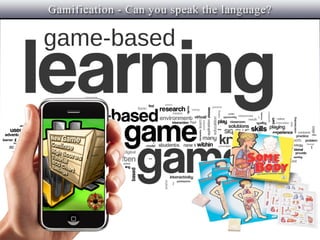
• Game-Based Learning
• Gamification
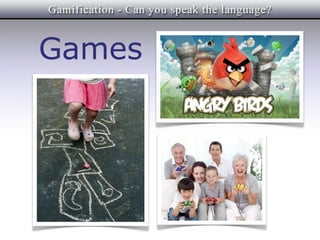
Games
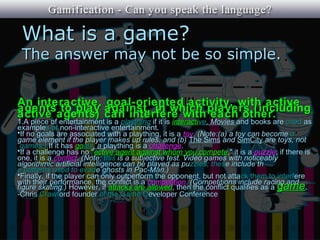
What is a game?
 The answer may not be so simple.


An interactive, goal-oriented activity, with active
agents to play against, in which players (including
active agents) can interfere with each other.
1.A piece of entertainment is a plaything if it is interactive. Movies and books are cited as
examples of non-interactive entertainment.
•If no goals are associated with a plaything, it is a toy. (Note:(a) a toy can become a
game element if the player makes up rules, and (b) The Sims and SimCity are toys, not
 games.) If it has goals, a plaything is a challenge.
•If a challenge has no "active agent against whom you compete," it is a puzzle; if there is
one, it is a conflict. (Note: this is a subjective test. Video games with noticeably
algorithmic artificial intelligence can be played as puzzles; these include th
e patterns used to evade ghosts in Pac-Man.)
•Finally, if the player can only outperform the opponent, but not atta ck them to interfere
with their performance, the conflict is a competition. (Competitions include racing and
figure skating.) However, if attacks are allowed, then the conflict qualifies as a game.
-Chris Crawford founder of the Game Developer Conference
What is a game?
 The answer may not be so simple.

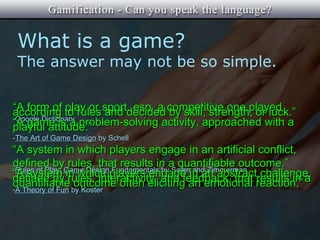
“A form of to rules sport, esp. a competitive one played
according      play or and decided by skill, strength, or luck.”
-Google Dictionary
“A game is a problem-solving activity, approached with a
playful attitude.”
-The Art of Game Design by Schell
“A system in which players engage in an artificial conflict,
defined by rules, that results in a quantifiable outcome.”
-Rules of Play: Game Design Fundamentals by Salen and Zimmerman
“A system in which players engage in an abstractresults in a
defined by rules, interactivity, and feedback, that reaction.”  challenge,
quantifiable outcome often eliciting an emotional
-A Theory of Fun by Koster
What is a game?
The answer may not be so simple.
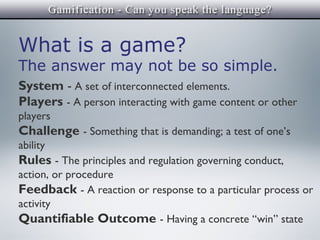
System - A set of interconnected elements.
Players - A person interacting with game content or other
players
Challenge - Something that is demanding; a test of one’s
ability
Rules - The principles and regulation governing conduct,
action, or procedure
Feedback - A reaction or response to a particular process or
activity
Quantifiable Outcome - Having a concrete “win” state
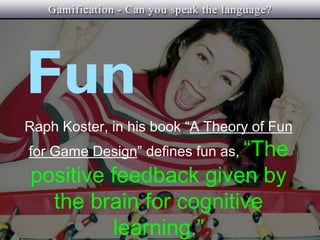
Fun
Raph Koster, in his book “A Theory of Fun
for Game Design” defines fun as, “The
positive feedback given by
  the brain for cognitive
         learning.”
game-based
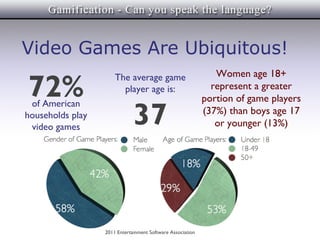
Video Games Are Ubiquitous!
                                                               Women age 18+
72%
                      The average game
                        player age is:                        represent a greater
                                                            portion of game players

                              37
 of American
households play                                             (37%) than boys age 17
 video games                                                   or younger (13%)


                  2011 Entertainment Software Association
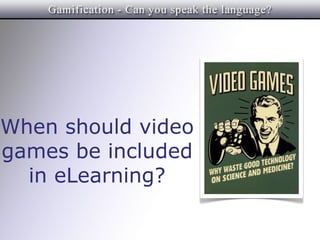
When should video
games be included
  in eLearning?
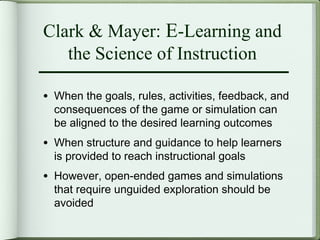
Clark & Mayer: E-Learning and
   the Science of Instruction

• When the goals, rules, activities, feedback, and
  consequences of the game or simulation can
  be aligned to the desired learning outcomes
• When structure and guidance to help learners
  is provided to reach instructional goals
• However, open-ended games and simulations
  that require unguided exploration should be
  avoided
SUMMARY
Only use games if they directly support
        your education goals.

 Make learning essential to the game.
Make learning essential to the game.
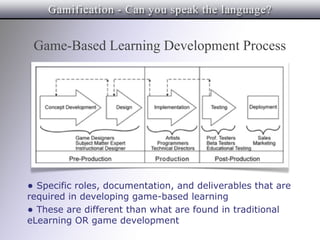
Game-Based Learning Development Process


• Specific roles, documentation, and deliverables that are
required in developing game-based learning
• These are different than what are found in traditional
eLearning OR game development
What is
  Gamification?
 The use of game mechanics,
   game design techniques,
aesthetics, and game-thinking
  to non-game applications.
In the context of
    learning:
  Gamification is meant to
 engage learners, motivate
action, promote learning, and
       solve problems.
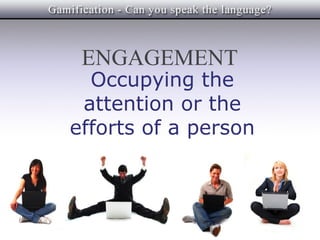
ENGAGEMENT
  Occupying the
 attention or the
efforts of a person
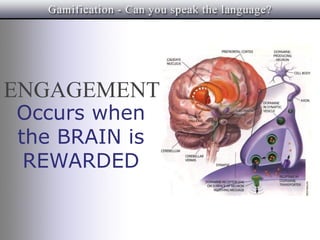
ENGAGEMENT
Occurs when
the BRAIN is
 REWARDED
Rewards must evoke
EMOTION from the learner!
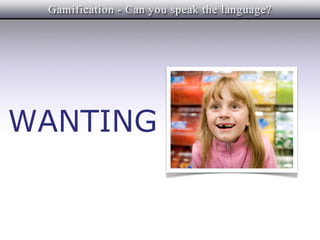
WANTING
LIKING
WANTING+LIKING=REWARDING
Dr. Kent Berridge
• University of Michigan
  Neuroscientist

• Researches the causes of
  addiction

• Has found wanting and liking
  to occur in two different part
  of the brain
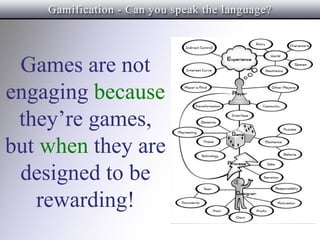
Games are not
engaging because
 they’re games,
but when they are
 designed to be
   rewarding!
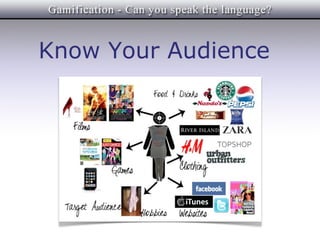
Know Your Audience
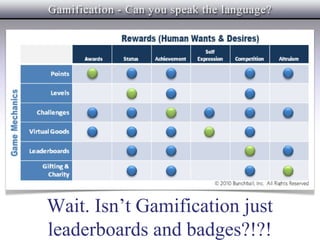
Game Mechanics
 The construct of rules
 that encourage users
  to explore and learn
 the properties of their
    possibility space
   through the use of
feedback mechanisms.
Wait. Isn’t Gamification just
leaderboards and badges?!?!
Set Goals and Objectives
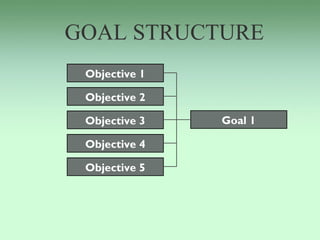
GOAL STRUCTURE
 Objective 1

 Objective 2

 Objective 3   Goal 1

 Objective 4

 Objective 5
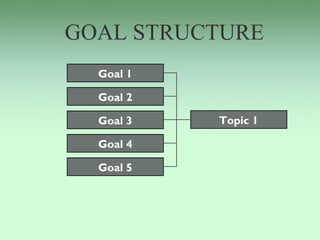
GOAL STRUCTURE
  Goal 1

  Goal 2

  Goal 3   Topic 1

  Goal 4

  Goal 5
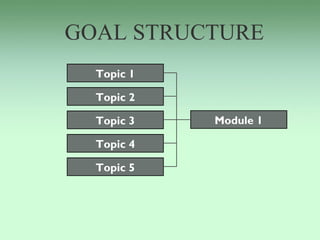
GOAL STRUCTURE
  Topic 1

  Topic 2

  Topic 3   Module 1

  Topic 4

  Topic 5
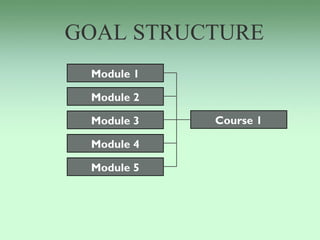
GOAL STRUCTURE
 Module 1

 Module 2

 Module 3   Course 1

 Module 4

 Module 5
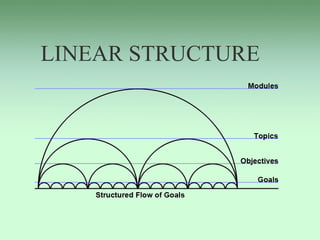
LINEAR STRUCTURE
HUB SYSTEMS
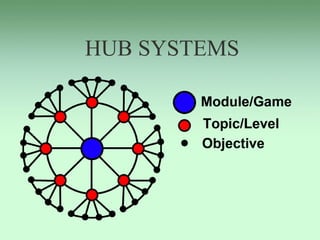
HUB SYSTEMS
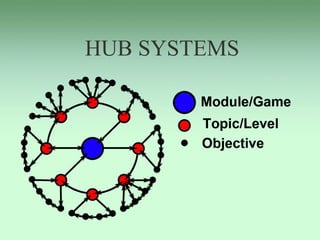
HUB SYSTEMS
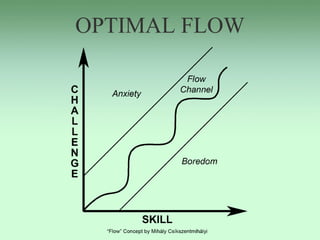
OPTIMAL FLOW
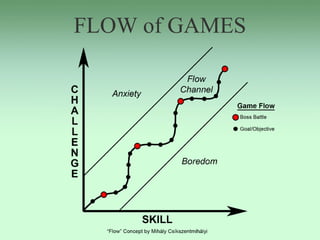
FLOW of GAMES
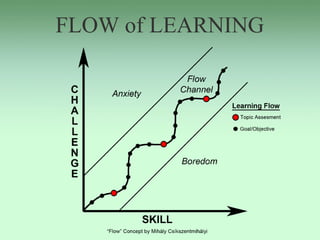
FLOW of LEARNING
Set Goals and Objectives
 - Give the Learner Choices
Set Goals and Objectives
 - Give the Learner Choices
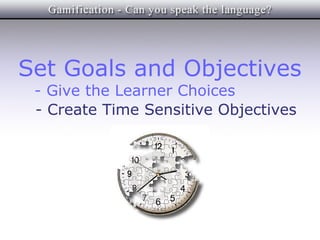
 - Create Time Sensitive Objectives
Frequent Feedback
Frequent Feedback


As a designer, one of your
most important jobs is to
 MAKE YOUR LEARNERS
      FEEL CLEVER.
Frequent Feedback
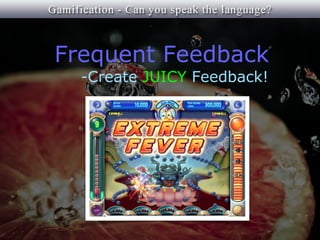
  -Create JUICY Feedback!
Before we continue...
   Let’s take a
moment to discuss
 the Tin Can API.
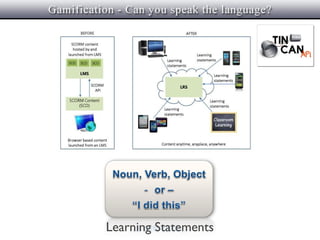
Learning Statements
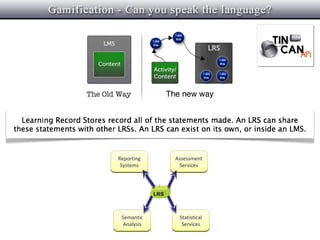
Reporting    Assessment
 Systems      Services


 Semantic     Statistical
  Analysis     Services
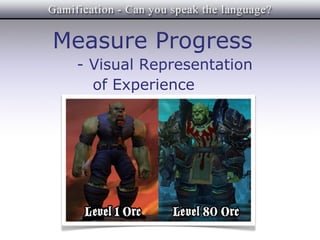
Measure Progress
Measure Progress
 - Visual Representation
   of Experience
Reward Effort
Reward Effort
- Incremental Rewards
Reward Effort
- Incremental Rewards
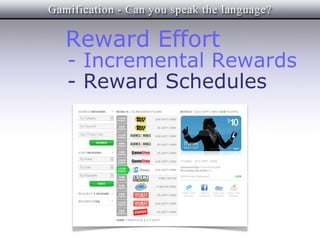
- Reward Schedules
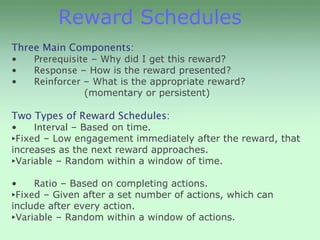
Reward Schedules
Three Main Components:
•   Prerequisite – Why did I get this reward?
•   Response – How is the reward presented?
•   Reinforcer – What is the appropriate reward?
               (momentary or persistent)

Two Types of Reward Schedules:
•    Interval – Based on time.
‣Fixed – Low engagement immediately after the reward, that
increases as the next reward approaches.
‣Variable – Random within a window of time.
•    Ratio – Based on completing actions.
‣Fixed – Given after a set number of actions, which can
include after every action.
‣Variable – Random within a window of actions.
Reward Effort
- Incremental Rewards
- Reward Schedules
- Probability and Danger
Reward Effort
-   Incremental Rewards
-   Reward Schedules
-   Probability and Danger
-   Adaptive Systems
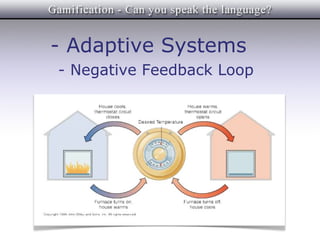
- Adaptive Systems
- Negative Feedback Loop
Elements of Chance


              QuickTime™ and a
              GIF decompressor
      are needed to see this picture.
Surprise and Delight
Moments of Intense
   Attention
Peer Motivation
Let’s take a break to
 play some games!
  Pay attention to game mechanics
  and what makes them engaging
What were your
 observations about
game mechanics and
   engagement?
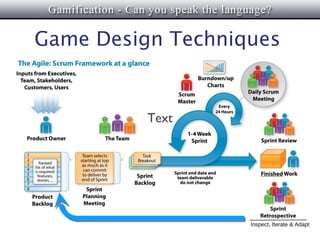
Game Design Techniques


          Text


                   Inspect, Iterate & Adapt
Suggestions for
Specific Project
    Phases
Pre-Concept Phase
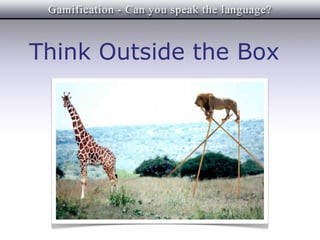
Think Outside the Box
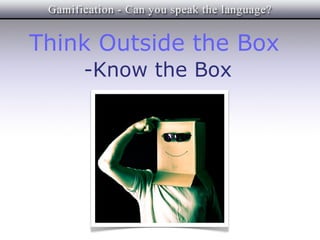
    -Know the Box
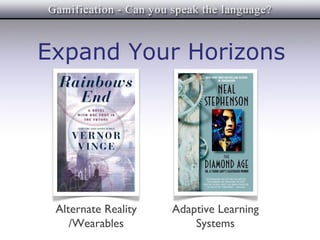
Expand Your Horizons


 Alternate Reality   Adaptive Learning
    /Wearables           Systems
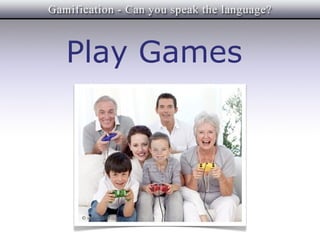
Play Games
Brainstorm
- Individually & In Groups
Brainstorm
 -Never dismiss ideas as too silly
 -Concentrate on generating ideas
 and not concepts (that comes later)
The Well Is Deep
Concept Phase
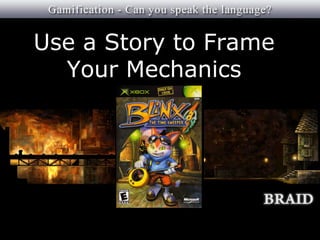
Use a Story to Frame
  Your Mechanics
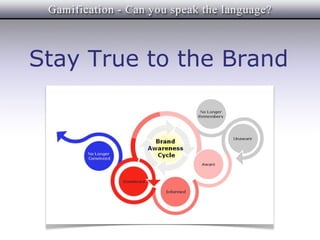
Stay True to the Brand
Have a Hook
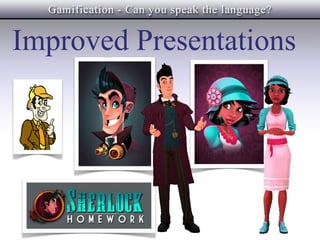
Improved Presentations
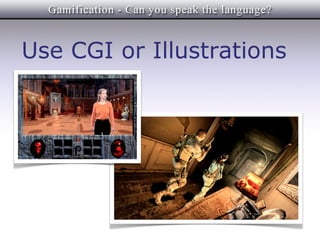
Use CGI or Illustrations
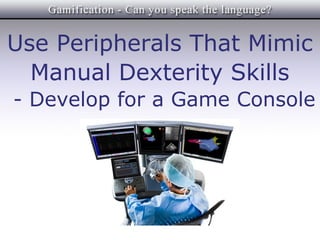
Use Peripherals That Mimic
  Manual Dexterity Skills
- Develop for a Game Console
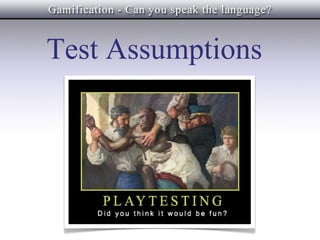
Test Assumptions
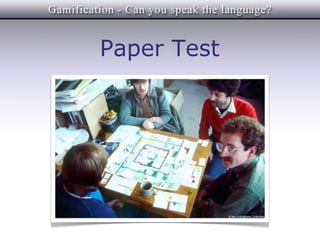
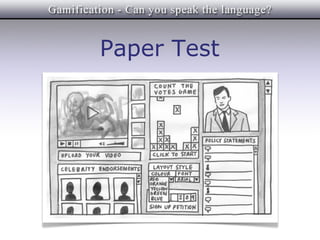
Paper Test
Paper Test
Test Early & Often
Summary
• Increase engagement by rewarding
 learners(wanting+liking=rewarding)
 • Know your audience and brand
• Provide juicy feedback and show progress on clearly
 stated goals and objectives
 • Reward effort, not just successes
• Gain attention with surprise and delight
   • Build systems that allow peer interaction
• Improve your presentations with better art and
 technology
 • Use an iterative development method
 • Test assumptions early and often
RICK RAYMER
Senior Emerging Technologies Learning Architect
          Richard.Raymer@serco-na.com
                  (919)599-1426

Gamification - ASTD RTA

  • 1.
    QuickTime™ and a GIF decompressor are needed to see this picture. Gamification Can you speak the language? Rick Raymer Twitter: @trickyraymer
  • 2.
    Rick Raymer Senior EmergingTechnologies Learning Architect Richard.Raymer@serco-na.com
  • 3.
    What’s In aName? • Game • Game-Based Learning • Gamification
  • 4.
  • 5.
    What is agame? The answer may not be so simple. An interactive, goal-oriented activity, with active agents to play against, in which players (including active agents) can interfere with each other. 1.A piece of entertainment is a plaything if it is interactive. Movies and books are cited as examples of non-interactive entertainment. •If no goals are associated with a plaything, it is a toy. (Note:(a) a toy can become a game element if the player makes up rules, and (b) The Sims and SimCity are toys, not games.) If it has goals, a plaything is a challenge. •If a challenge has no "active agent against whom you compete," it is a puzzle; if there is one, it is a conflict. (Note: this is a subjective test. Video games with noticeably algorithmic artificial intelligence can be played as puzzles; these include th e patterns used to evade ghosts in Pac-Man.) •Finally, if the player can only outperform the opponent, but not atta ck them to interfere with their performance, the conflict is a competition. (Competitions include racing and figure skating.) However, if attacks are allowed, then the conflict qualifies as a game. -Chris Crawford founder of the Game Developer Conference
  • 6.
    What is agame? The answer may not be so simple. “A form of to rules sport, esp. a competitive one played according play or and decided by skill, strength, or luck.” -Google Dictionary “A game is a problem-solving activity, approached with a playful attitude.” -The Art of Game Design by Schell “A system in which players engage in an artificial conflict, defined by rules, that results in a quantifiable outcome.” -Rules of Play: Game Design Fundamentals by Salen and Zimmerman “A system in which players engage in an abstractresults in a defined by rules, interactivity, and feedback, that reaction.” challenge, quantifiable outcome often eliciting an emotional -A Theory of Fun by Koster
  • 7.
    What is agame? The answer may not be so simple. System - A set of interconnected elements. Players - A person interacting with game content or other players Challenge - Something that is demanding; a test of one’s ability Rules - The principles and regulation governing conduct, action, or procedure Feedback - A reaction or response to a particular process or activity Quantifiable Outcome - Having a concrete “win” state
  • 8.
    Fun Raph Koster, inhis book “A Theory of Fun for Game Design” defines fun as, “The positive feedback given by the brain for cognitive learning.”
  • 9.
  • 10.
    Video Games AreUbiquitous! Women age 18+ 72% The average game player age is: represent a greater portion of game players 37 of American households play (37%) than boys age 17 video games or younger (13%) 2011 Entertainment Software Association
  • 11.
    When should video gamesbe included in eLearning?
  • 13.
    Clark & Mayer:E-Learning and the Science of Instruction • When the goals, rules, activities, feedback, and consequences of the game or simulation can be aligned to the desired learning outcomes • When structure and guidance to help learners is provided to reach instructional goals • However, open-ended games and simulations that require unguided exploration should be avoided
  • 14.
    SUMMARY Only use gamesif they directly support your education goals. Make learning essential to the game. Make learning essential to the game. Make learning essential to the game.
  • 15.
    Game-Based Learning DevelopmentProcess • Specific roles, documentation, and deliverables that are required in developing game-based learning • These are different than what are found in traditional eLearning OR game development
  • 16.
    What is Gamification? The use of game mechanics, game design techniques, aesthetics, and game-thinking to non-game applications.
  • 17.
    In the contextof learning: Gamification is meant to engage learners, motivate action, promote learning, and solve problems.
  • 18.
    ENGAGEMENT Occupyingthe attention or the efforts of a person
  • 19.
  • 20.
    Rewards must evoke EMOTIONfrom the learner!
  • 21.
  • 22.
  • 23.
  • 24.
    Dr. Kent Berridge •University of Michigan Neuroscientist • Researches the causes of addiction • Has found wanting and liking to occur in two different part of the brain
  • 25.
    Games are not engagingbecause they’re games, but when they are designed to be rewarding!
  • 26.
  • 27.
    Game Mechanics Theconstruct of rules that encourage users to explore and learn the properties of their possibility space through the use of feedback mechanisms.
  • 28.
    Wait. Isn’t Gamificationjust leaderboards and badges?!?!
  • 29.
    Set Goals andObjectives
  • 30.
    Set Goals andObjectives
  • 31.
    GOAL STRUCTURE Objective1 Objective 2 Objective 3 Goal 1 Objective 4 Objective 5
  • 32.
    GOAL STRUCTURE Goal 1 Goal 2 Goal 3 Topic 1 Goal 4 Goal 5
  • 33.
    GOAL STRUCTURE Topic 1 Topic 2 Topic 3 Module 1 Topic 4 Topic 5
  • 34.
    GOAL STRUCTURE Module1 Module 2 Module 3 Course 1 Module 4 Module 5
  • 35.
  • 36.
  • 37.
  • 38.
  • 39.
  • 40.
  • 41.
  • 42.
    Set Goals andObjectives - Give the Learner Choices
  • 43.
    Set Goals andObjectives - Give the Learner Choices - Create Time Sensitive Objectives
  • 44.
  • 45.
    Frequent Feedback As adesigner, one of your most important jobs is to MAKE YOUR LEARNERS FEEL CLEVER.
  • 46.
    Frequent Feedback -Create JUICY Feedback!
  • 47.
    Before we continue... Let’s take a moment to discuss the Tin Can API.
  • 49.
  • 50.
    Reporting Assessment Systems Services Semantic Statistical Analysis Services
  • 51.
  • 52.
    Measure Progress -Visual Representation of Experience
  • 53.
  • 54.
  • 55.
    Reward Effort - IncrementalRewards - Reward Schedules
  • 56.
    Reward Schedules Three MainComponents: • Prerequisite – Why did I get this reward? • Response – How is the reward presented? • Reinforcer – What is the appropriate reward? (momentary or persistent) Two Types of Reward Schedules: • Interval – Based on time. ‣Fixed – Low engagement immediately after the reward, that increases as the next reward approaches. ‣Variable – Random within a window of time. • Ratio – Based on completing actions. ‣Fixed – Given after a set number of actions, which can include after every action. ‣Variable – Random within a window of actions.
  • 57.
    Reward Effort - IncrementalRewards - Reward Schedules - Probability and Danger
  • 58.
    Reward Effort - Incremental Rewards - Reward Schedules - Probability and Danger - Adaptive Systems
  • 59.
    - Adaptive Systems -Negative Feedback Loop
  • 66.
    Elements of Chance QuickTime™ and a GIF decompressor are needed to see this picture.
  • 67.
  • 68.
  • 69.
  • 70.
    Let’s take abreak to play some games! Pay attention to game mechanics and what makes them engaging
  • 71.
    What were your observations about game mechanics and engagement?
  • 72.
    Game Design Techniques Text Inspect, Iterate & Adapt
  • 73.
  • 74.
  • 75.
  • 76.
    Think Outside theBox -Know the Box
  • 77.
  • 78.
    Expand Your Horizons Alternate Reality Adaptive Learning /Wearables Systems
  • 79.
  • 80.
  • 81.
    Brainstorm -Never dismissideas as too silly -Concentrate on generating ideas and not concepts (that comes later)
  • 82.
  • 83.
  • 84.
    Use a Storyto Frame Your Mechanics
  • 85.
    Stay True tothe Brand
  • 86.
  • 87.
  • 89.
    Use CGI orIllustrations
  • 90.
    Use Peripherals ThatMimic Manual Dexterity Skills - Develop for a Game Console
  • 91.
  • 92.
  • 93.
  • 94.
  • 95.
    Summary • Increase engagementby rewarding learners(wanting+liking=rewarding) • Know your audience and brand • Provide juicy feedback and show progress on clearly stated goals and objectives • Reward effort, not just successes • Gain attention with surprise and delight • Build systems that allow peer interaction • Improve your presentations with better art and technology • Use an iterative development method • Test assumptions early and often
  • 96.
    RICK RAYMER Senior EmergingTechnologies Learning Architect Richard.Raymer@serco-na.com (919)599-1426

Editor's Notes

  • #2 So... Let’s get started.
  • #3 Name, title, twitter So, one way that I could describe myself is that on a WOW scale, my career attributes (not character attributes), are... Level 76 Game Designer Level 43 Project Manager Level 36 Instructional Designer Does anybody know what I mean when I say a WOW scale? In WOW, the maximum character level is an 85. It started out at 60, and as in real life, what defines the elite players keeps increasing. Here’s my “Career” Avatar!
  • #5 Let’s first discuss games, and what a game is. Then answer may not be as straightforward as you think.
  • #6 This is a very complete definition of a game, but I think it goes a bit too far, because it excludes a lot of activities that most people consider games. For example, trivia games, Angry Birds, Tetris, etc.
  • #7 So, let’s take a look at more inclusive definitions. I find it interesting that by some of these definitions, there’s a lot of eLearning that I’ve seen that could possibly qualify as a game, or at the very least, perhaps you can see why gamification is such a good fit for eLearning.
  • #8 These are the elements of these definitions that I think are most important to consider when applying them to eLearning.
  • #9 I also want to mention this, mostly because when people think of games, they have an expectation that they’ll be fun. What I find interesting about this, is that game designers recognize that the basis of fun, is learning.
  • #10 So, I think it’s only natural that as an extension of learning being fun, that we discuss how we can use games as a learning tool. I also want to point out this product (Ammo Storage Compatibility), that as part of this game, we built in performance support tools that are not only used in the game, but can be easily accessed in the field for reference.
  • #11 For the purpose of this presentation, and because we’re discussing eLearning, I am mostly referring to tools that are used in building video games.
  • #12 *”Has anybody here ever used a game in their eLearning material? Let’s see a raise of hands.” (If hands are raised…) *”Of those that have their hands raised, did you see a measurable educational benefit to using games in your eLearning material?”
  • #16 If you do decide to make a full-blown learning-game, you should be aware that you’ll need to make some changes to your development process. Most notably, you should use a game designer on your team, or at the very least, an instructional designer that knows A LOT about video games.
  • #19 So, how do we do this? How do we engage learners? I believe the answer boils down to the exact same reason why video games are so popular… engaging e-learning and engaging video games reward the brain.
  • #20 So, let’s first talk about Rewards. What is a reward?
  • #21 In order for rewards to have meaning they must induce emotion from the learner. Now, this obviously does not mean that anything that evokes emotion in a game or in eLearning material is rewarding, even if it is positive. So, let’s break this down a little further to find out exactly must be encompassed in a reward to induce engagement.
  • #22 Something that people will have AMBITION and DRIVE to obtain.
  • #23 There needs to be PLEASURE or ENJOYMENT in attaining it, if it will be truly rewarding to somebody.
  • #24 So, is it even possible to want something, but not like it? Or, like something, but not want it? I think the answer to this can be intensely personal and depend on a person’s circumstances. How about a job? A person may want their job, but not really like it. Or, perhaps they may want additional job training, but not like the training material. In these instances, a person won’t find their job or training material rewarding. How about liking something, but not wanting it? This one’s a little more difficult.
  • #26 I hope you can see by this example, that rewards are personal and circumstantial.
  • #27 Build Personas
  • #28 Gamification-a combination of game design techniques, Aesthetics, Game thinking, and MOST importantly, Game Mechanics
  • #29 This table shows some of the game mechanics that we use in gaming, and along the top here, you can see some of the ways that these mechanics reward the brain. Banana BREAD Analogy
  • #30 If you’re going to reward a learner, let them know it. Set very specific goals and objectives for the learner. Set a broad goal for the user, and break it into several narrow, precise objectives. This may seem obvious, but break large concepts into smaller and smaller tasks.
  • #31 If you’re going to reward a learner, let them know it. Set very specific goals and objectives for the learner. Set a broad goal for the user, and break it into several narrow, precise objectives. This may seem obvious, but break large concepts into smaller and smaller tasks.
  • #36 So, if we were to map out how this might look, this is how your eLearning could look. Cognitive Load BUT... this isn’t how the goal structure of most games would be illustrated.
  • #37 Most games use what’s called a hub system to accommodate non-linear flow.
  • #38 In this illustration, each of the lines represents a choice that a user has in navigating a game, or your eLearning. For the purpose of this illustration, I left in all of the lines, or choices, but in application, any of these lines could be removed, as long as each node is connected in some way. Also, any of these lines could have direction, so the user can only move through each choice in one direction.
  • #39 When it comes to the rules of a game, there are the rules of the game that define how the game is intended to be played, AND the rules of the game that define how the game is allowed to be played.
  • #40 This diagram shows optimal flow through an interactive product. What this illustrates, is that as challenge and skill rises, to stay in this flow channel between anxiety and boredom, it’s best to vary the amount of challenge throughout your product, to give your user a chance to practice their skills.
  • #43 When you break goals up into multiple objectives, allow learners to complete these objectives in parallel. As long as you carefully manage the number of simultaneous goals and objectives that you are asking the user to complete, learners will be more engaged if they can choose the order in which they complete tasks. I’d suggest keeping this to less than five parallel objectives - seven at the most. As you increase the number of simultaneous objectives, you can create extraneous cognitive load on the learner, and this can actually become a distraction. Another word of caution, from a development standpoint, developing a non-linear, or branching, E-Learning products, is much more difficult. But, when learners are given choices, these types of products are much more engaging.
  • #44 This suggestion is used to great affect in games to enhance engagement. If it would seem natural to put a timer on the goals and objectives in your E-Learning material so they need to be completed in a timely manner, I encourage you to do so. A word of warning however, there is some 508 compliance issues with this. If a timer is used, the user must be alerted, and given sufficient time to indicate if more time is required. The main point here is that by giving the learner a sense of urgency, you will stimulate their brain by increasing dopamine, which subsequently creates a “learning window” that we’ll talk about later.
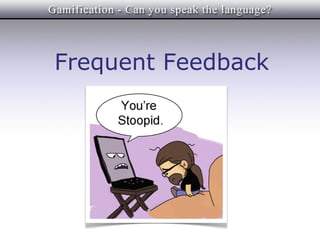
  • #45 If learners get confused, it makes them feel stupid. Make people feel clever and smart. Rapid, frequent clear feedback - linking consequences to actions Provide explanatory feedback for correct and incorrect answers—Feedback Principle
  • #46 -Ruth Clark-Provide explanatory feedback for correct and incorrect answers—Feedback Principle
  • #53 TROPHY ROOMS
  • #54 e.g. on a leaderboard, don’t tell people they were 98th of 100. Tell them “Congratulation, you made it to the leaderboard!”
  • #55 100 small rewards are better than one big reward
  • #57 Fixed Interval – E.g. the sunflowers produce sun pick-ups every 24 seconds in PvZ. Variable Interval – the marigolds in PvZ produce a coin, either gold or silver, on average every 24 seconds, at variable time periods. Fixed Ratio - in PvZ every fifth level is a bonus level that unlocks a mini-game upon completion. Variable Ratio - Slot machine that gives one of nine reward types each time it’s used
  • #58 Is jeopardy really jeopardy without double jeopardy or final jeopardy?
  • #60 Simply put, when a user is doing poorly, the system will adjust to an easier difficulty level. And, when a user is doing well, it increases the difficulty level.
  • #61 mention green goose
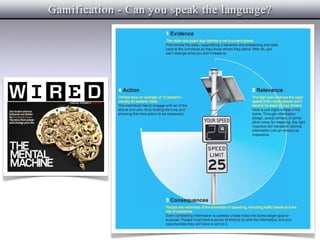
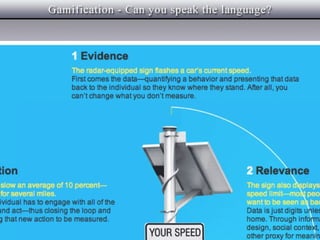
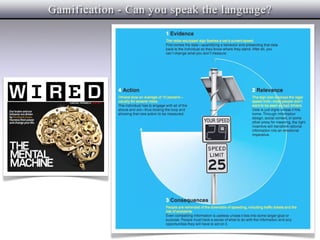
  • #62 Firstly - Evidence. A behavior must be measured, captured, and data stored.
  • #63 Secondly - Relevance. The information must be relayed to the individual, not in the raw-data form in which it was captured but in a context that makes it emotionally relevant.
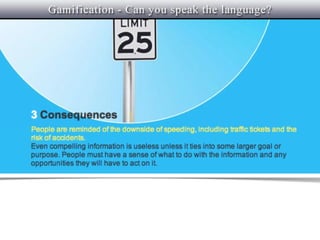
  • #64 Thirdly - Consequence. The information must illuminate one or more paths ahead.
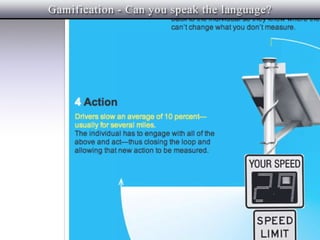
  • #65 Fourthly - Action. There must be a clear moment when the individual can recalibrate a behavior, make a choice, and act.
  • #66 Then that action is measured, and the feedback loop can run once more, every action stimulating new behaviors that inch the individual closer to their goals.
  • #71 If you’re going to reward a learner, let them know it. Set very specific goals and objectives for the learner. Set a broad goal for the user, and break it into several narrow, precise objectives. This may seem obvious, but break large concepts into smaller and smaller tasks.
  • #72 If you’re going to reward a learner, let them know it. Set very specific goals and objectives for the learner. Set a broad goal for the user, and break it into several narrow, precise objectives. This may seem obvious, but break large concepts into smaller and smaller tasks.
  • #88 “ Studies show that the addition of a virtual character (an Avatar) to Web-based courses impacts knowledge retention, course completion, and recall of content. By interacting with a character in a virtual world, students become more engaged in the subject matter, helping them learn more effectively.”
  • #90 Phantasmagoria 1995 Resident Evil 5 2009
  • #96 Questions.