The Role of Games and Simulations in LearningBy Karl M. KappBloomsburg University www.learningin3d.infoTwitter:@kkappHashtag #lrn3d
Google “Kapp Notes”2012 New Book:“The Gamification of Learning and Instruction”July 2011 T&D ArticleMatching the Right Instruction to the Right Content
AgendaIs the use of 3D avatars appropriate?Which is better for learning? First Person Perspective or Third Person Perspective?Do simulation games make a difference in learning?Are simulation games better/worse than traditional instructional methods? Are simulation games better because they are simulation games or is it something else?
Identity– no deep learning takes place unless an extended commitment of self is made for the long haul.Good video games capture players through identify.Players either inherit a strongly formed and appealing character or they get to build a characterfrom the ground up.Players become committed to the new virtual world in which they will learn and act.James Paul Gee, University of Wisconsin-Madison
We’ve Always Wanted Characters
Why be a Character at All?Research indicates that human social models influence behavior, beliefs and attitudes. Bandura, A. 1986 Social foundations of thought and action: a social cognitive theory. Englewood Cliffs, NJ, USA: Prentice-Hall.
Avatar as TeacherResearch also indicates that learners perceive, interact socially with and are influenced by anthropomorphic agents (avatars) even when their functionality and adaptability are limited.Baylor, A. 2009 Promoting motivation with virtual agents and avatars: Role of visual presence and appearance. Philosophical Transactions of the Royal B  Society. 364, 3559–3565
First Person View
Third Person View
Can an experience as an avatar change a person's real life perceptions?If yes, how?If no, why not?
An experience as an avatar can change a person's real life perceptions. In a study conducted by Yee and Bailenson (2006), it was found that negative stereotyping of the elderly was significantly reduced when participants were placed in avatars of old people compared with those participants placed in avatars of young people.Yee, N. & Bailenson, J.N. (2006).  Walk A Mile in Digital Shoes: The Impact of Embodied Perspective-Taking on TheReduction of Negative Stereotyping in Immersive Virtual Environments..Proceedings of PRESENCE 2006: The 9th Annual International Workshop on Presence. August 24 – 26, Cleveland, Ohio, USA
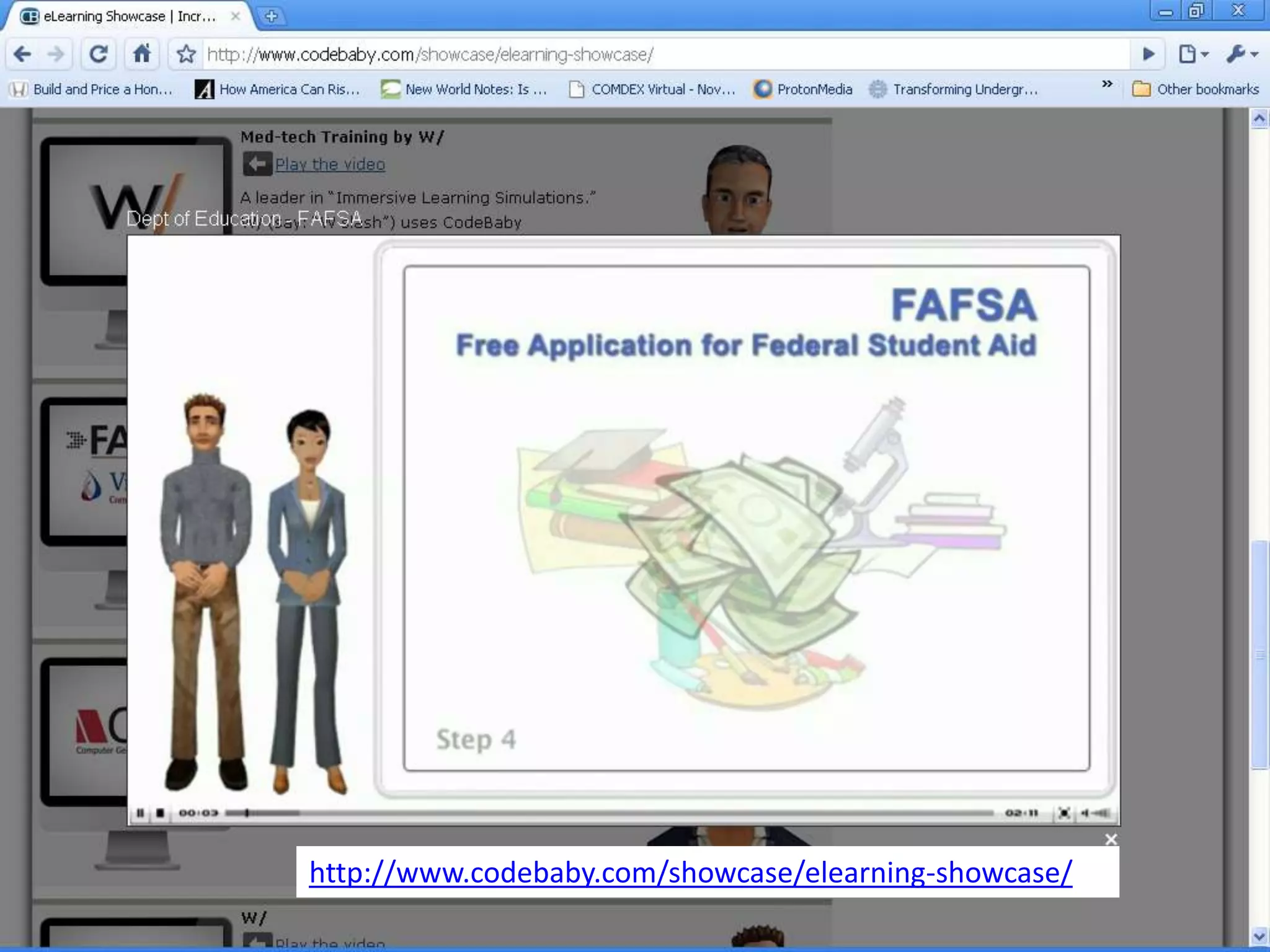
Are two avatars better than one?MotivatorMentorExpert
MotivatorYes, two avatars are better than one.MentorBaylor, A. L. & Kim, Y. (2005). Simulating instructional roles through pedagogical agents. International Journal of Artificial Intelligence in Education, 15(1), 95-115.Expert
http://www.codebaby.com/showcase/elearning-showcase/
Three groups: Which is more likely to exercise within the next 24 hours?Group 1 watches an avatar that looks like them loiteringGroup 2 watches an avatar that does not look like themselves exercising.Group 3 watches an avatar that looks like themselves exercising.
If learners watch an avatar that looks like them exercising & losing weight, they will subsequently exercise more in the real world as compared to a control group.Fox, J., Arena, D., & Bailenson, J.N. (2009). Virtual Reality: A survival guide for the social scientist. Journal of Media Psychology, 21 (3), 95-113.
Within 24 hours of watching an avatar like themselves run, learners were more likely to run than watching an avatar not like them or watching an avatar like them loitering .Fox, J., Arena, D., & Bailenson, J.N. (2009). Virtual Reality: A survival guide for the social scientist. Journal of Media Psychology, 21 (3), 95-113.
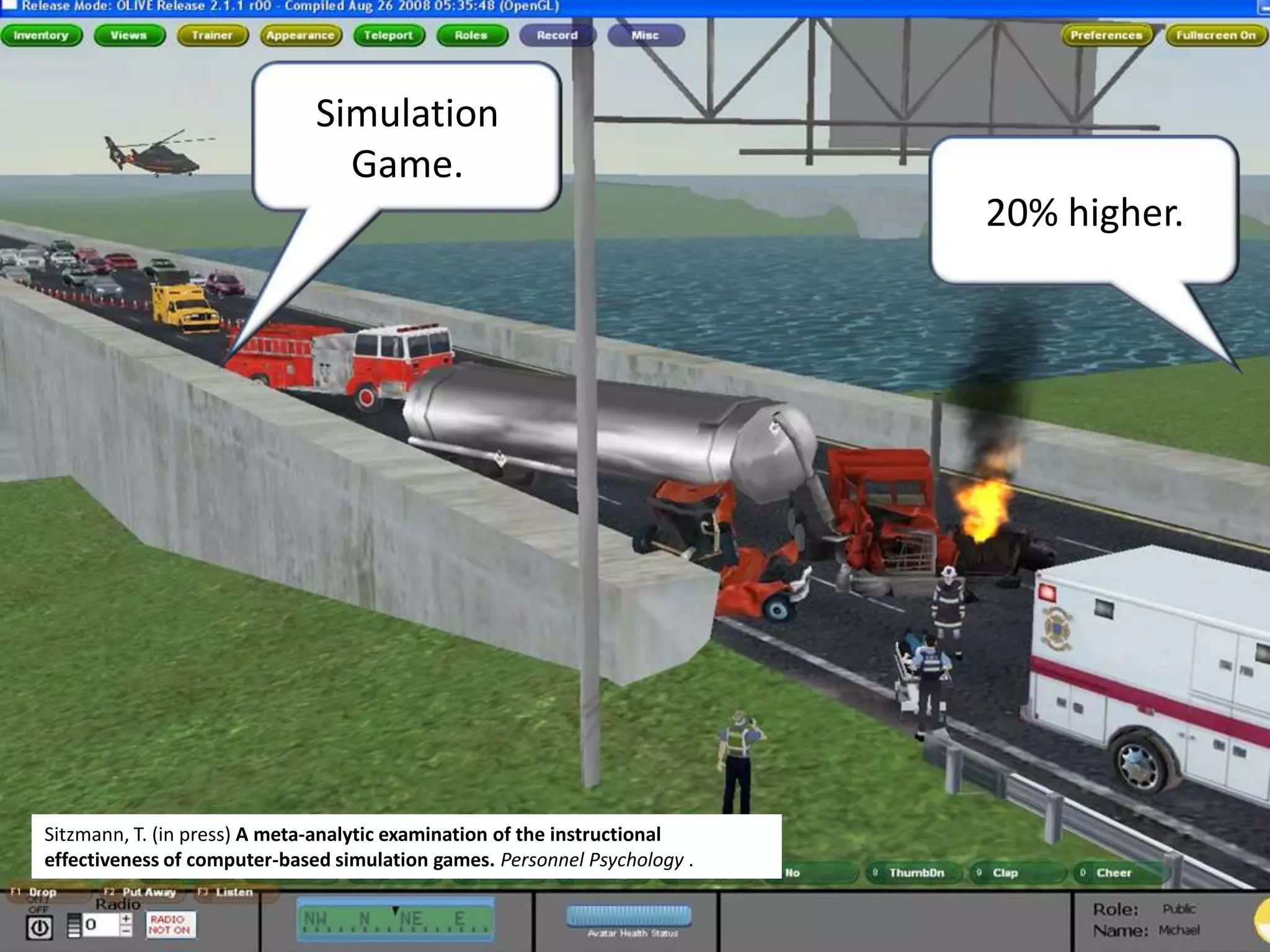
Which builds more confidence for on the job application of learned knowledge?Class room instruction.Simulation Game.
Simulation Game.20% higher.Sitzmann, T. (in press) A meta-analytic examination of the instructional effectiveness of computer-based simulation games. Personnel Psychology.
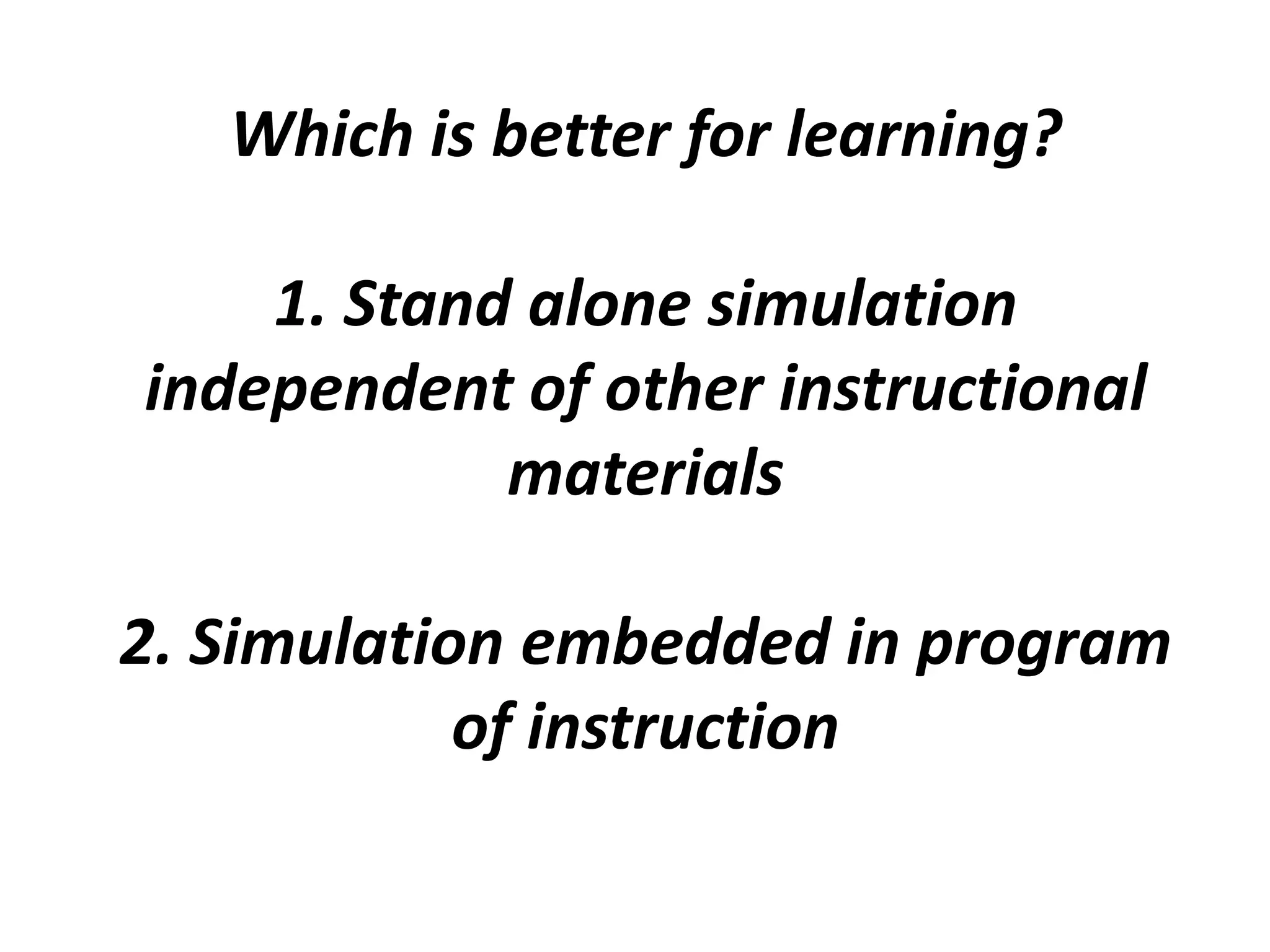
Which is better for learning?1. Stand alone simulation independent of other instructional materials2. Simulation embedded in program of instruction
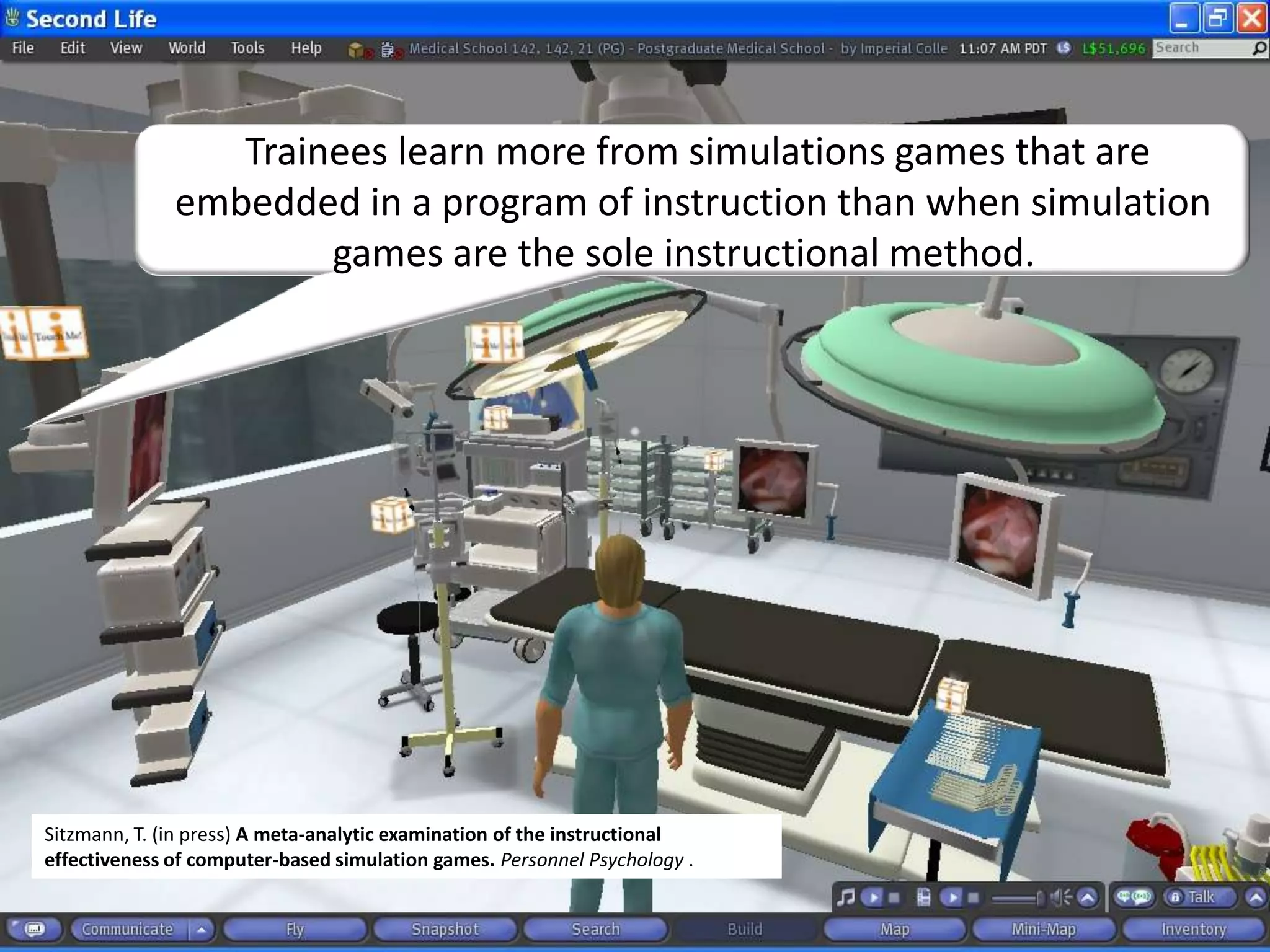
 Trainees learn more from simulations games that are embedded in a program of instruction than when simulation games are the sole instructional method. Sitzmann, T. (in press) A meta-analytic examination of the instructional effectiveness of computer-based simulation games. Personnel Psychology .
Do simulations have to be entertaining to be educational?
NOSitzmann, T. (in press) A meta-analytic examination of the instructional effectiveness of computer-based simulation games. Personnel Psychology .
True or False?When the majority of the instruction in a simulation game was passive, the comparison group learned more than the simulation game group.
TRUEIn other words, simulations aren’t good just because they are simulations.Sitzmann, T. (in press) A meta-analytic examination of the instructional effectiveness of computer-based simulation games. Personnel Psychology .
Name the Percentage
Name the PercentageSitzmann, T. (in press) A meta-analytic examination of the instructional effectiveness of computer-based simulation games. Personnel Psychology .
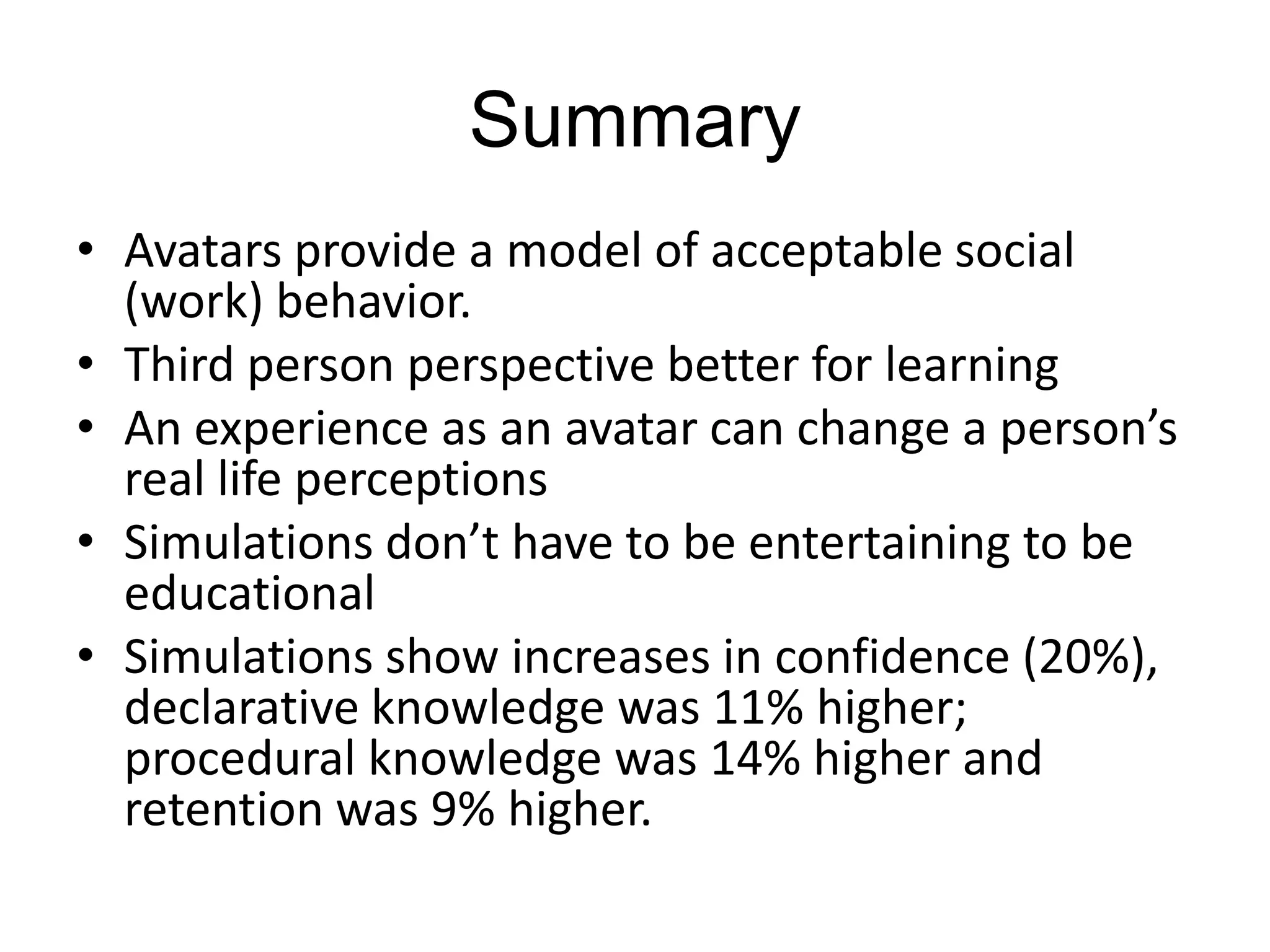
SummaryAvatars provide a model of acceptable social (work) behavior. Third person perspective better for learningAn experience as an avatar can change a person’s real life perceptionsSimulations don’t have to be entertaining to be educationalSimulations show increases in confidence (20%), declarative knowledge was 11% higher; procedural knowledge was 14% higher and retention was 9% higher.
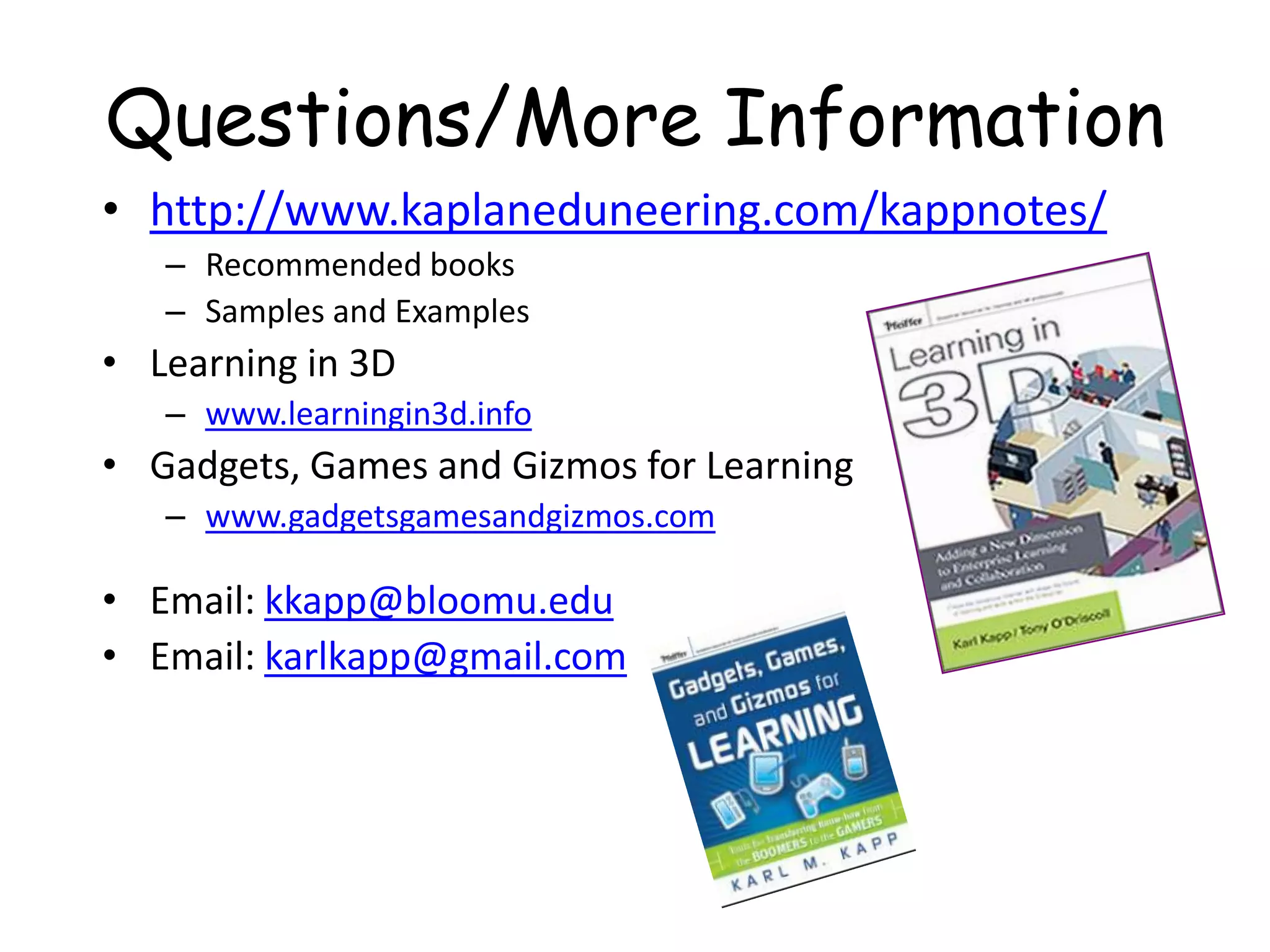
Questions/More Informationhttp://www.kaplaneduneering.com/kappnotes/Recommended booksSamples and ExamplesLearning in 3Dwww.learningin3d.infoGadgets, Games and Gizmos for Learningwww.gadgetsgamesandgizmos.comEmail: kkapp@bloomu.eduEmail: karlkapp@gmail.com

The Role of Games and Simulations in Learning

  • 1.
     The Role ofGames and Simulations in LearningBy Karl M. KappBloomsburg University www.learningin3d.infoTwitter:@kkappHashtag #lrn3d
  • 2.
    Google “Kapp Notes”2012New Book:“The Gamification of Learning and Instruction”July 2011 T&D ArticleMatching the Right Instruction to the Right Content
  • 3.
    AgendaIs the useof 3D avatars appropriate?Which is better for learning? First Person Perspective or Third Person Perspective?Do simulation games make a difference in learning?Are simulation games better/worse than traditional instructional methods? Are simulation games better because they are simulation games or is it something else?
  • 4.
    Identity– no deeplearning takes place unless an extended commitment of self is made for the long haul.Good video games capture players through identify.Players either inherit a strongly formed and appealing character or they get to build a characterfrom the ground up.Players become committed to the new virtual world in which they will learn and act.James Paul Gee, University of Wisconsin-Madison
  • 5.
  • 6.
    Why be aCharacter at All?Research indicates that human social models influence behavior, beliefs and attitudes. Bandura, A. 1986 Social foundations of thought and action: a social cognitive theory. Englewood Cliffs, NJ, USA: Prentice-Hall.
  • 7.
    Avatar as TeacherResearchalso indicates that learners perceive, interact socially with and are influenced by anthropomorphic agents (avatars) even when their functionality and adaptability are limited.Baylor, A. 2009 Promoting motivation with virtual agents and avatars: Role of visual presence and appearance. Philosophical Transactions of the Royal B Society. 364, 3559–3565
  • 8.
  • 9.
  • 10.
    Can an experienceas an avatar change a person's real life perceptions?If yes, how?If no, why not?
  • 11.
    An experience asan avatar can change a person's real life perceptions. In a study conducted by Yee and Bailenson (2006), it was found that negative stereotyping of the elderly was significantly reduced when participants were placed in avatars of old people compared with those participants placed in avatars of young people.Yee, N. & Bailenson, J.N. (2006).  Walk A Mile in Digital Shoes: The Impact of Embodied Perspective-Taking on TheReduction of Negative Stereotyping in Immersive Virtual Environments..Proceedings of PRESENCE 2006: The 9th Annual International Workshop on Presence. August 24 – 26, Cleveland, Ohio, USA
  • 12.
    Are two avatarsbetter than one?MotivatorMentorExpert
  • 13.
    MotivatorYes, two avatarsare better than one.MentorBaylor, A. L. & Kim, Y. (2005). Simulating instructional roles through pedagogical agents. International Journal of Artificial Intelligence in Education, 15(1), 95-115.Expert
  • 14.
  • 15.
    Three groups: Whichis more likely to exercise within the next 24 hours?Group 1 watches an avatar that looks like them loiteringGroup 2 watches an avatar that does not look like themselves exercising.Group 3 watches an avatar that looks like themselves exercising.
  • 16.
    If learners watchan avatar that looks like them exercising & losing weight, they will subsequently exercise more in the real world as compared to a control group.Fox, J., Arena, D., & Bailenson, J.N. (2009). Virtual Reality: A survival guide for the social scientist. Journal of Media Psychology, 21 (3), 95-113.
  • 17.
    Within 24 hoursof watching an avatar like themselves run, learners were more likely to run than watching an avatar not like them or watching an avatar like them loitering .Fox, J., Arena, D., & Bailenson, J.N. (2009). Virtual Reality: A survival guide for the social scientist. Journal of Media Psychology, 21 (3), 95-113.
  • 18.
    Which builds moreconfidence for on the job application of learned knowledge?Class room instruction.Simulation Game.
  • 19.
    Simulation Game.20% higher.Sitzmann,T. (in press) A meta-analytic examination of the instructional effectiveness of computer-based simulation games. Personnel Psychology.
  • 20.
    Which is betterfor learning?1. Stand alone simulation independent of other instructional materials2. Simulation embedded in program of instruction
  • 21.
     Trainees learn morefrom simulations games that are embedded in a program of instruction than when simulation games are the sole instructional method. Sitzmann, T. (in press) A meta-analytic examination of the instructional effectiveness of computer-based simulation games. Personnel Psychology .
  • 22.
    Do simulations haveto be entertaining to be educational?
  • 23.
    NOSitzmann, T. (inpress) A meta-analytic examination of the instructional effectiveness of computer-based simulation games. Personnel Psychology .
  • 24.
    True or False?Whenthe majority of the instruction in a simulation game was passive, the comparison group learned more than the simulation game group.
  • 25.
    TRUEIn other words,simulations aren’t good just because they are simulations.Sitzmann, T. (in press) A meta-analytic examination of the instructional effectiveness of computer-based simulation games. Personnel Psychology .
  • 26.
  • 27.
    Name the PercentageSitzmann,T. (in press) A meta-analytic examination of the instructional effectiveness of computer-based simulation games. Personnel Psychology .
  • 28.
    SummaryAvatars provide amodel of acceptable social (work) behavior. Third person perspective better for learningAn experience as an avatar can change a person’s real life perceptionsSimulations don’t have to be entertaining to be educationalSimulations show increases in confidence (20%), declarative knowledge was 11% higher; procedural knowledge was 14% higher and retention was 9% higher.
  • 29.
    Questions/More Informationhttp://www.kaplaneduneering.com/kappnotes/Recommended booksSamplesand ExamplesLearning in 3Dwww.learningin3d.infoGadgets, Games and Gizmos for Learningwww.gadgetsgamesandgizmos.comEmail: kkapp@bloomu.eduEmail: karlkapp@gmail.com