Understanding the Value of Games and 
  Gamification for Serious Learning


                 By Karl M. Kapp
                 Bloomsburg University
                 Gamification of Learning and Instruction 
                 October 31, 2012
Twitter:@kkapp
                 gamify01
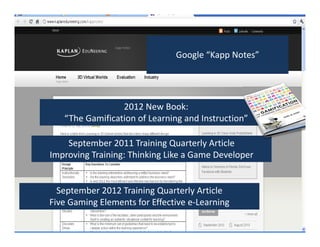
Google “Kapp Notes”


                 2012 New Book:
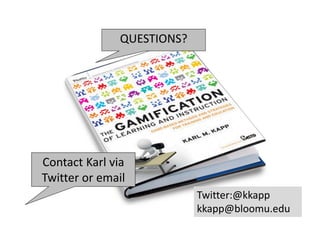
   “The Gamification of Learning and Instruction”

    September 2011 Training Quarterly Article
Improving Training: Thinking Like a Game Developer


  September 2012 Training Quarterly Article
Five Gaming Elements for Effective e‐Learning
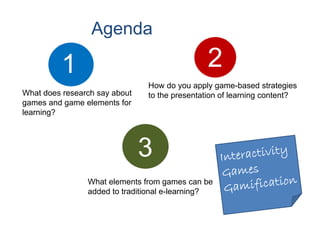
Agenda

          1                                   2
                               How do you apply game-based strategies
What does research say about   to the presentation of learning content?
games and game elements for
learning?


                               3
                What elements from games can be
                added to traditional e-learning?
Are games/simulations 
effective for learning?

   How does Gamification fit 
       into all of this?
Simulation/games have to be fun to be educational?  


Sitzmann, T. (2011) A meta-analytic examination of the instructional effectiveness of computer-based
simulation games. Personnel Psychology .Review of 65 studies. Chapter 4 “The Gamification of Learning and
Instruction.”
FISHY!


Sitzmann, T. (2011) A meta-analytic examination of the instructional effectiveness of computer-based simulation games.
Personnel Psychology .Review of 65 studies. Chapter 4 “The Gamification of Learning and Instruction.”
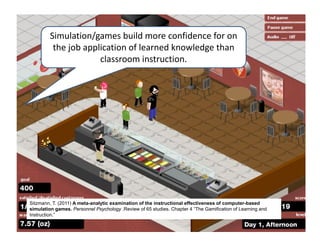
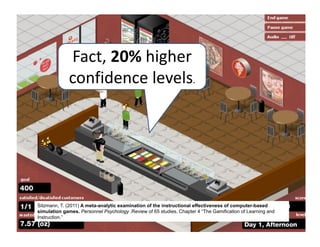
Simulation/games build more confidence for on 
          the job application of learned knowledge than 
                      classroom instruction.


Sitzmann, T. (2011) A meta-analytic examination of the instructional effectiveness of computer-based
simulation games. Personnel Psychology .Review of 65 studies. Chapter 4 “The Gamification of Learning and
Instruction.”
Fact, 20% higher 
             confidence levels.


Sitzmann, T. (2011) A meta-analytic examination of the instructional effectiveness of computer-based
simulation games. Personnel Psychology .Review of 65 studies. Chapter 4 “The Gamification of Learning and
Instruction.”
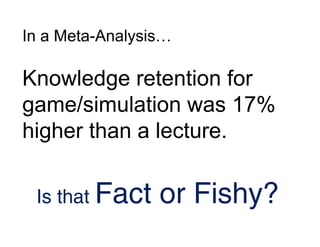
In a Meta-Analysis…

Knowledge retention for
game/simulation was 17%
higher than a lecture.

 Is that Fact    or Fishy?
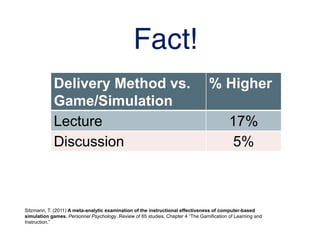
Fact!
            Delivery Method vs.                                                  % Higher
            Game/Simulation
            Lecture                                                                       17%
            Discussion                                                                     5%


Sitzmann, T. (2011) A meta-analytic examination of the instructional effectiveness of computer-based
simulation games. Personnel Psychology .Review of 65 studies. Chapter 4 “The Gamification of Learning and
Instruction.”
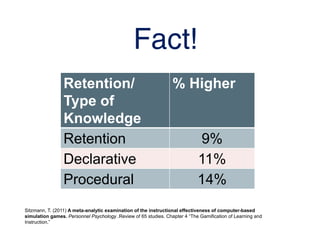
Fact!
                 Retention/                                      % Higher
                 Type of
                 Knowledge
                 Retention                                                   9%
                 Declarative                                                11%
                 Procedural                                                 14%
Sitzmann, T. (2011) A meta-analytic examination of the instructional effectiveness of computer-based
simulation games. Personnel Psychology .Review of 65 studies. Chapter 4 “The Gamification of Learning and
Instruction.”
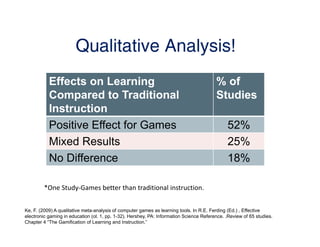
Qualitative Analysis!
           Effects on Learning                                                           % of
           Compared to Traditional                                                       Studies
           Instruction
           Positive Effect for Games                                                          52%
           Mixed Results                                                                      25%
           No Difference                                                                      18%

         *One Study‐Games better than traditional instruction. 


Ke, F. (2009) A qualitative meta-analysis of computer games as learning tools. In R.E. Ferding (Ed.) , Effective
electronic gaming in education (ol. 1, pp. 1-32). Hershey, PA: Information Science Reference. .Review of 65 studies.
Chapter 4 “The Gamification of Learning and Instruction.”
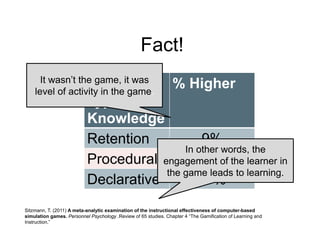
Fact!
      It wasn’t the game, it was
                  Retention
    level of activity in the game.
                                                                 % Higher
                           Type of
                           Knowledge
                           Retention           9%
                                           In other words, the
                           Procedural engagement of the learner in
                                              14%
                                       the game leads to learning.
                           Declarative        11%
Sitzmann, T. (2011) A meta-analytic examination of the instructional effectiveness of computer-based
simulation games. Personnel Psychology .Review of 65 studies. Chapter 4 “The Gamification of Learning and
Instruction.”
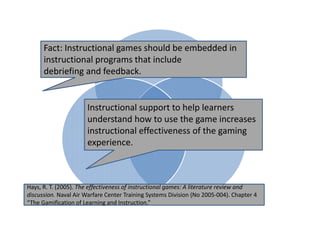
Fact: Instructional games should be embedded in 
      instructional programs that include 
      debriefing and feedback. 
                             Engagement


                      Instructional support to help learners 
                                  Educational
                      understand how to use the game increases 
                                  Simulation
                      instructional effectiveness of the gaming 
                         Game
                      experience.                Pedagogy


Hays, R. T. (2005). The effectiveness of instructional games: A literature review and
discussion. Naval Air Warfare Center Training Systems Division (No 2005‐004). Chapter 4 
“The Gamification of Learning and Instruction.”
                               g
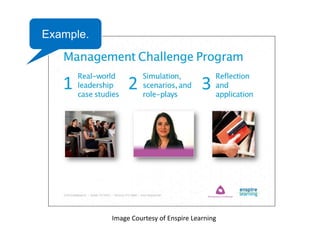
Example.


           Image Courtesy of Enspire Learning
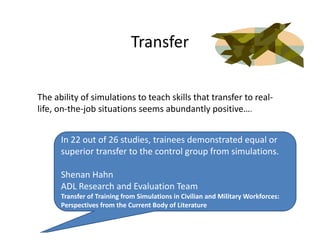
Transfer

The ability of simulations to teach skills that transfer to real‐
life, on‐the‐job situations seems abundantly positive….


      In 22 out of 26 studies, trainees demonstrated equal or 
      superior transfer to the control group from simulations.

      Shenan Hahn
      ADL Research and Evaluation Team 
      Transfer of Training from Simulations in Civilian and Military Workforces:
      Perspectives from the Current Body of Literature
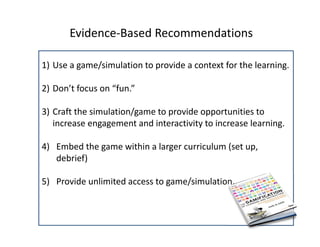
Evidence‐Based Recommendations 

1) Use a game/simulation to provide a context for the learning. 

2) Don’t focus on “fun.” 

3) Craft the simulation/game to provide opportunities to 
   increase engagement and interactivity to increase learning.

4) Embed the game within a larger curriculum (set up, 
   debrief)

5) Provide unlimited access to game/simulation. 
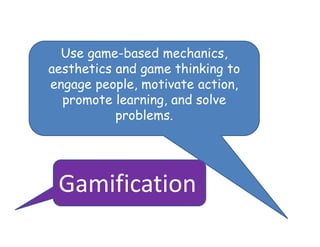
Use game-based mechanics,
aesthetics and game thinking to
engage people, motivate action,
  promote learning, and solve
           problems.


 Gamification
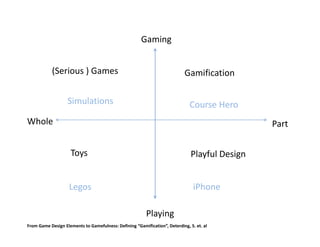
Gaming


            (Serious ) Games                                                Gamification

                   Simulations                                                Course Hero
Whole                                                                                           Part

                     Toys                                                      Playful Design


                    Legos                                                       iPhone

                                                         Playing
From Game Design Elements to Gamefulness: Defining “Gamification”, Deterding, S. et. al
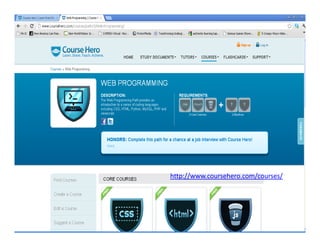
http://www.coursehero.com/courses/
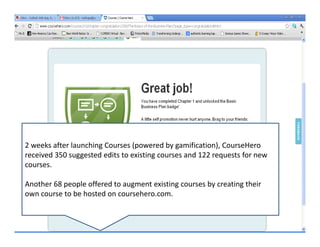
2 weeks after launching Courses (powered by gamification), CourseHero
received 350 suggested edits to existing courses and 122 requests for new 
courses. 

Another 68 people offered to augment existing courses by creating their 
own course to be hosted on coursehero.com.
For Gamified courses, the time on site for the Courses are nearly 
three times as long as time onsite for all of coursehero.com.

Social sharing of achievements increased nearly 400 percent in  
three months.
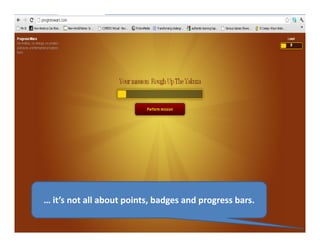
… it’s not all about points, badges and progress bars.
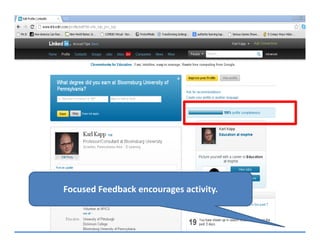
20% increase in profile completion.
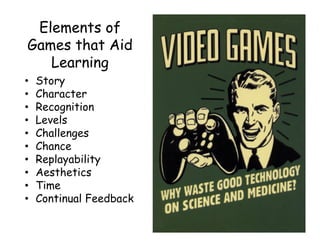
Elements of
Games that Aid
   Learning
•   Story
•   Character
•   Recognition
•   Levels
•   Challenges
•   Chance
•   Replayability
•   Aesthetics
•   Time
•   Continual Feedback
Elements of
Games that Aid
   Learning
•   Story
•   Character
•   Recognition
•     NOT Enough Time 
    Levels
•   Challenges
•   Chance
•   Replayability
•   Aesthetics
•   Time
•   Continual Feedback
Elements of
Games that Aid
   Learning

1. Feedback
2. Story
3. Characters
4. Fantasy
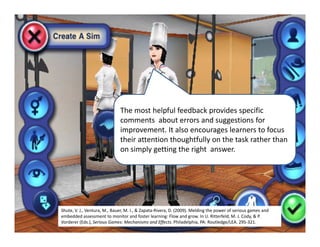
Feedback
The most helpful feedback provides specific 
                              comments  about errors and suggestions for 
                              improvement. It also encourages learners to focus 
                              their attention thoughtfully on the task rather than 
                              on simply getting the right  answer.


Shute, V. J., Ventura, M., Bauer, M. I., & Zapata‐Rivera, D. (2009). Melding the power of serious games and 
embedded assessment to monitor and foster learning: Flow and grow. In U. Ritterfeld, M. J. Cody, & P. 
Vorderer (Eds.), Serious Games: Mechanisms and Effects. Philadelphia, PA: Routledge/LEA. 295‐321.
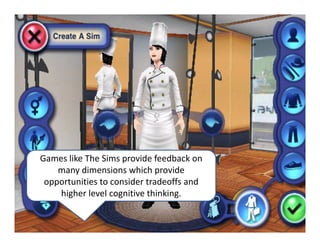
Games like The Sims provide feedback on 
    many dimensions which provide 
 opportunities to consider tradeoffs and 
    higher level cognitive thinking. 
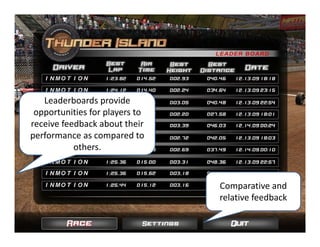
Leaderboards provide 
 opportunities for players to 
receive feedback about their 
performance as compared to 
           others. 


                                 Comparative and 
                                 relative feedback
Focused Feedback encourages activity.
Story
Learners remember facts better…

When presented in a bulleted
list as opposed to when
presented in a story.


Is that Fact   or Fishy?
FISHY: Researchers have found that the                   Yep, People tend to remember facts 
 human brain has a natural affinity for                   more accurately if they encounter 
        narrative construction.                          them in a story rather than in a list.


                   And they rate legal arguments as more 
                    convincing when built into narrative 
                    tales rather than on legal precedent.


Carey, B. (2007) this is Your Life (and How You Tell it). The New York Times. Melanie Green 
http://www.unc.edu/~mcgreen/research.html. Chapter 2 “The Gamification of Learning and 
Instruction. 
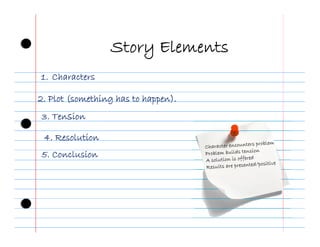
Story Elements
1. Characters

2. Plot (something has to happen).
3. Tension

 4. Resolution
5. Conclusion
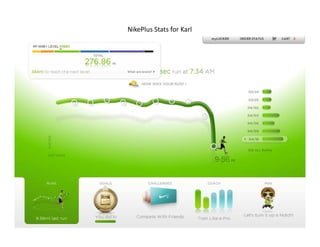
NikePlus Stats for Karl
Recommendations 
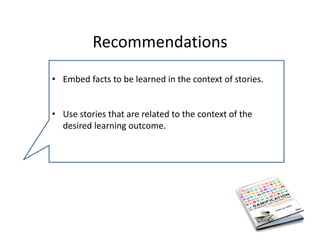
• Embed facts to be learned in the context of stories.


• Use stories that are related to the context of the 
  desired learning outcome. 
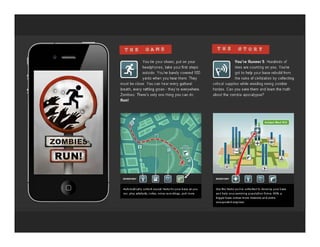
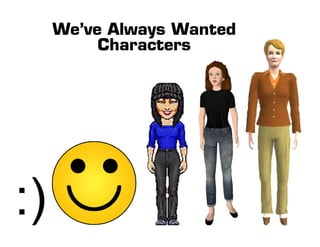
We’ve Always Wanted
     Characters
An on-screen character is
distracting to the learner..


Is that Fact    or Fishy?
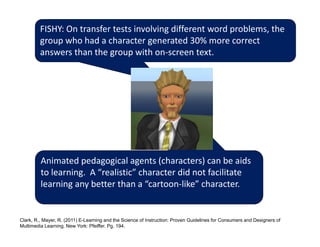
FISHY: On transfer tests involving different word problems, the 
         group who had a character generated 30% more correct 
         answers than the group with on‐screen text.


         Animated pedagogical agents (characters) can be aids 
         to learning.  A “realistic” character did not facilitate 
         learning any better than a “cartoon‐like” character.


Clark, R., Mayer, R. (2011) E-Learning and the Science of Instruction: Proven Guidelines for Consumers and Designers of
Multimedia Learning. New York: Pfeiffer. Pg. 194.
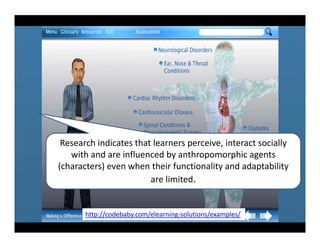
Research indicates that learners perceive, interact socially 
   with and are influenced by anthropomorphic agents 
(characters) even when their functionality and adaptability 
                        are limited.


       http://codebaby.com/elearning‐solutions/examples/
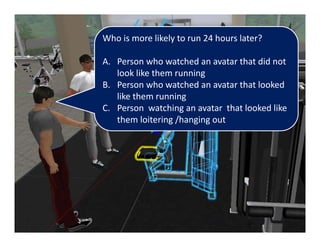
Who is more likely to run 24 hours later?

A. Person who watched an avatar that did not 
   look like them running
B. Person who watched an avatar that looked 
   like them running
C. Person  watching an avatar  that looked like 
   them loitering /hanging out
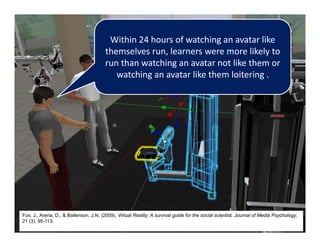
Within 24 hours of watching an avatar like 
                                        themselves run, learners were more likely to 
                                        run than watching an avatar not like them or 
                                           watching an avatar like them loitering .


Fox, J., Arena, D., & Bailenson, J.N. (2009). Virtual Reality: A survival guide for the social scientist. Journal of Media Psychology,
21 (3), 95-113.
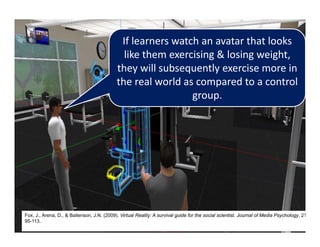
If learners watch an avatar that looks 
                                              like them exercising & losing weight, 
                                            they will subsequently exercise more in 
                                            the real world as compared to a control 
                                                             group.


Fox, J., Arena, D., & Bailenson, J.N. (2009). Virtual Reality: A survival guide for the social scientist. Journal of Media Psychology, 21
95-113.
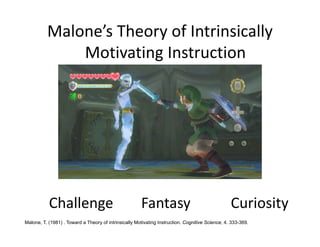
Malone’s Theory of Intrinsically 
              Motivating Instruction 


           Challenge                                   Fantasy                                    Curiosity
Malone, T. (1981) . Toward a Theory of intrinsically Motivating Instruction. Cognitive Science, 4. 333-369.
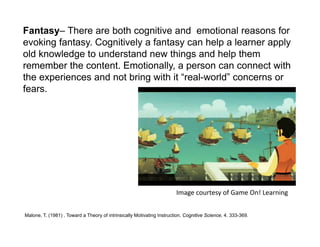
Fantasy– There are both cognitive and emotional reasons for
evoking fantasy. Cognitively a fantasy can help a learner apply
old knowledge to understand new things and help them
remember the content. Emotionally, a person can connect with
the experiences and not bring with it “real-world” concerns or
fears.


                                                                        Image courtesy of Game On! Learning


Malone, T. (1981) . Toward a Theory of intrinsically Motivating Instruction. Cognitive Science, 4. 333-369.
Provide a challenge

Jones, B., Valdez, G., Norakowski, J., & Rasmussen, C. (1994). Designing learning and technology 
for educational reform. North Central Regional  Educational Laboratory. [Online]. Available: 
http://www.ncrtec.org/capacity/profile/profwww.htm and Schlechty, P. C. (1997). Inventing 
better schools: An action plan for educational reform. San Francisco, CA: Jossey‐Bass. Chapter 2 
“The Gamification of Learning and Instruction.”
                             g
Re‐design the Instruction to 
   Start with a Challenge
Investigatory Training
• Course Objectives
  – Identify the Forms Required for an Investigation
  – Practice Interview Techniques
  – Describe and Follow the Investigation Model 


    How would you turn this into 
          a challenge?
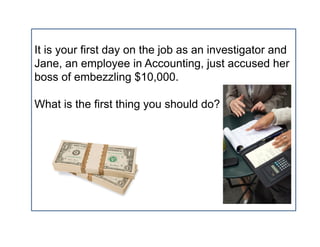
It is your first day on the job as an investigator and
Jane, an employee in Accounting, just accused her
boss of embezzling $10,000.

What is the first thing you should do?
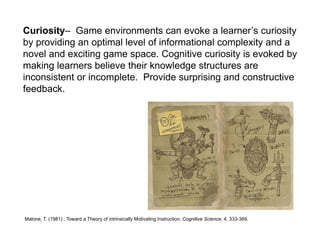
Curiosity– Game environments can evoke a learner’s curiosity
by providing an optimal level of informational complexity and a
novel and exciting game space. Cognitive curiosity is evoked by
making learners believe their knowledge structures are
inconsistent or incomplete. Provide surprising and constructive
feedback.


Malone, T. (1981) . Toward a Theory of intrinsically Motivating Instruction. Cognitive Science, 4. 333-369.
Evidence‐Based Recommendations 

• Use “Challenge” to engagement learners.

• Fantasy is an acceptable and positive element for 
  instructional games
Games can influence
people to behave in a
positive manner.


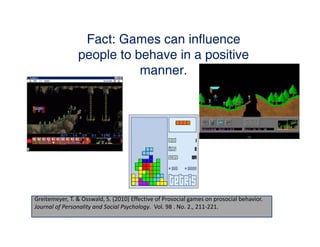
Is that Fact   or Fishy?
Fact: Games can influence
                people to behave in a positive
                           manner.


Greitemeyer, T. & Osswald, S. (2010) Effective of Prosocial games on prosocial behavior. 
Journal of Personality and Social Psychology.  Vol. 98 . No. 2., 211‐221.
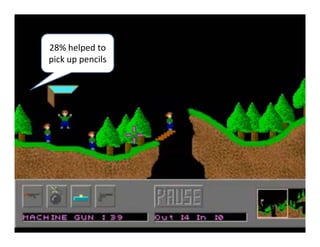
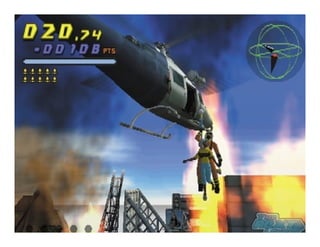
28% helped to 
pick up pencils
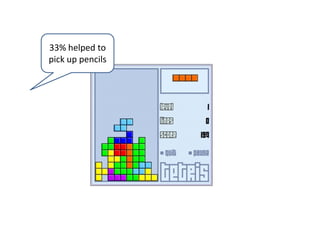
33% helped to 
pick up pencils
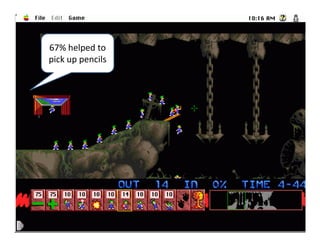
67% helped to 
pick up pencils
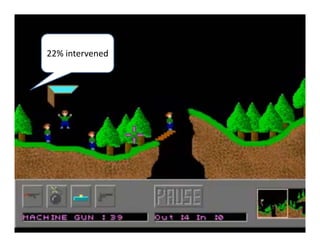
22% intervened
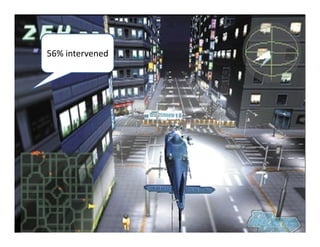
56% intervened
1) Use a game/simulation to provide a context for the learning. 

2) Don’t focus on “entertainment.” 

3) Carefully craft the simulation/game to provide opportunities to increase 
   engagement and interactivity to increase learning.

4) Embed the game /simulation into the curriculum. Provide “set‐up,” game‐
   time and debrief.

5) Embed facts to be learned in the context of stories.

6) Use stories that are related to the context of the desired outcome.

7) Use characters/agents to model desired behavior. 

8) Use characters/agents to provide feedback and instruction to learners.
QUESTIONS?


Contact Karl via 
Twitter or email
                            Twitter:@kkapp
                            kkapp@bloomu.edu

Understanding Games and Gamification for Learning