












Future of Learning: Games and
             Gamification


                 By Karl M. Kapp
                 Bloomsburg University
Twitter:@kkapp   Gamification of Learning and Instruction
                 September 6, 2012
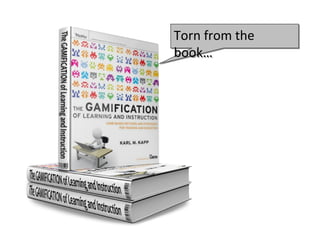
Torn from the
book…
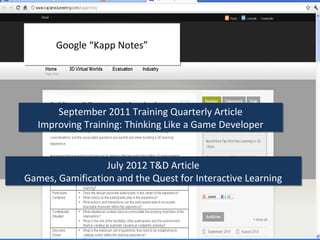
Google “Kapp Notes”


       September 2011 Training Quarterly Article
   Improving Training: Thinking Like a Game Developer


                  July 2012 T&D Article
Games, Gamification and the Quest for Interactive Learning
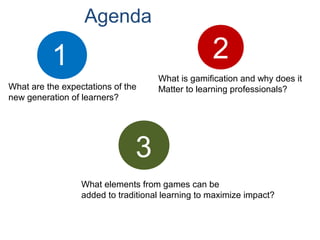
Agenda

          1                                        2
                                     What is gamification and why does it
What are the expectations of the     Matter to learning professionals?
new generation of learners?


                               3
                  What elements from games can be
                  added to traditional learning to maximize impact?
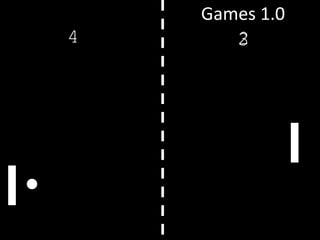
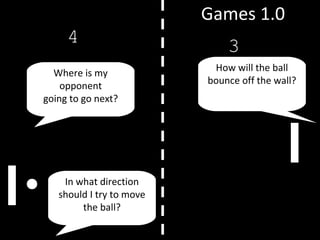
Games 1.0
4      2
       3
Games 1.0
     4                        3
                           How will the ball
  Where is my
                          bounce off the wall?
    opponent
going to go next?


    In what direction
   should I try to move
        the ball?
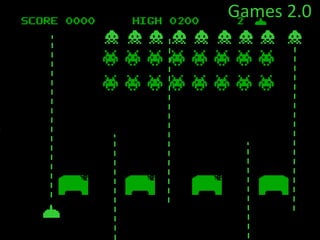
Games 2.0
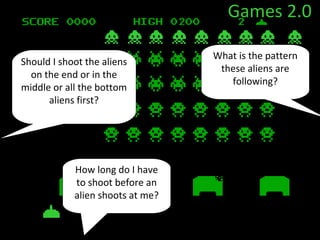
Games 2.0

                                  What is the pattern
Should I shoot the aliens
                                   these aliens are
  on the end or in the
                                     following?
middle or all the bottom
      aliens first?


            How long do I have
            to shoot before an
            alien shoots at me?
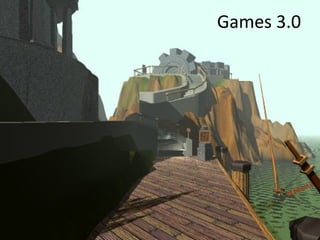
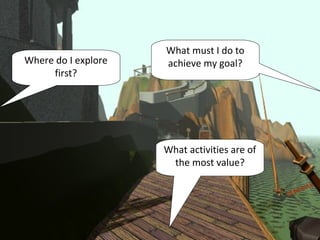
Games 3.0
What must I do to
Where do I explore   achieve my goal?
     first?


                     What activities are of
                      the most value?
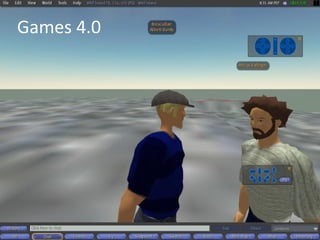
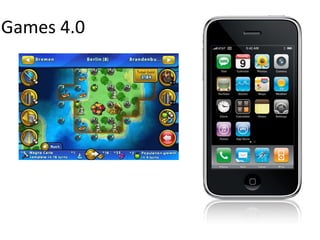
Games 4.0
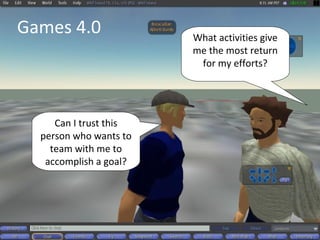
Games 4.0               What activities give
                        me the most return
                         for my efforts?


     Can I trust this
  person who wants to
    team with me to
   accomplish a goal?
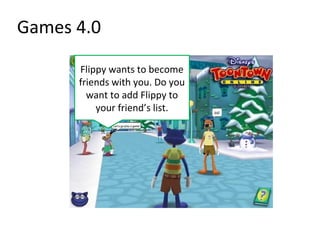
Games 4.0

      Flippy wants to become
      friends with you. Do you
        want to add Flippy to
          your friend’s list.
Games 4.0
Games 4.0
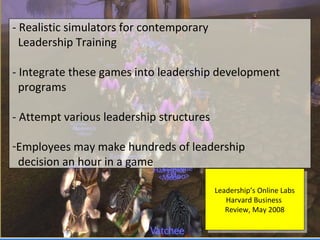
- Realistic simulators for contemporary
  Leadership Training

- Integrate these games into leadership development
  programs

- Attempt various leadership structures

-Employees may make hundreds of leadership
 decision an hour in a game

                                          Leadership’s Online Labs
                                           Leadership’s Online Labs
                                             Harvard Business
                                              Harvard Business
                                             Review, May 2008
                                              Review, May 2008
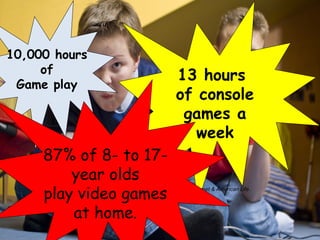
10,000 hours
     of
                                                     13 hours
 Game play
                                                     of console
                                                      games a
                                                        week
     87% of 8- to 17-
         year olds
     play video games
         Digital divisions. Report by the Pew /Internet: Pew Internet & American Life.
         US Department of Commerce


         at home.
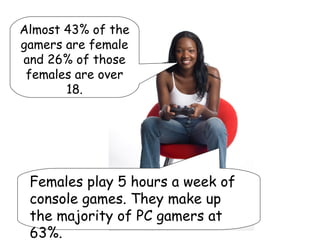
Almost 43% of the
gamers are female
and 26% of those
 females are over
       18.


 Females play 5 hours a week of
 console games. They make up
 the majority of PC gamers at
 63%.
Are games effective for
      learning?
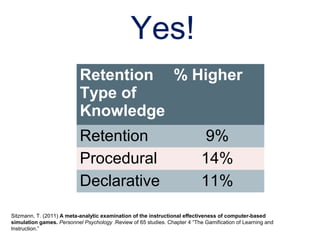
Yes!
                           Retention % Higher
                           Type of
                           Knowledge
                           Retention                                         9%
                           Procedural                                       14%
                           Declarative                                      11%
Sitzmann, T. (2011) A meta-analytic examination of the instructional effectiveness of computer-based
simulation games. Personnel Psychology .Review of 65 studies. Chapter 4 “The Gamification of Learning and
Instruction.”
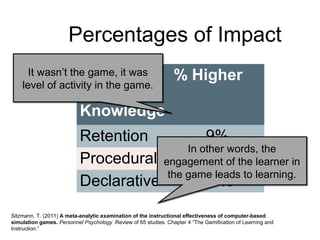
Percentages of Impact
                  Retention
      It wasn’t the game, it was                                 % Higher
    level of activity in the game.
                           Type of
                           Knowledge
                           Retention           9%
                                           In other words, the
                           Procedural engagement of the learner in
                                              14%
                                       the game leads to learning.
                           Declarative        11%
Sitzmann, T. (2011) A meta-analytic examination of the instructional effectiveness of computer-based
simulation games. Personnel Psychology .Review of 65 studies. Chapter 4 “The Gamification of Learning and
Instruction.”
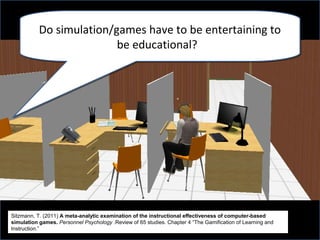
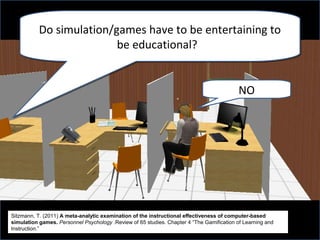
Do simulation/games have to be entertaining to
                          be educational?


Sitzmann, T. (2011) A meta-analytic examination of the instructional effectiveness of computer-based
simulation games. Personnel Psychology .Review of 65 studies. Chapter 4 “The Gamification of Learning and
Instruction.”
Do simulation/games have to be entertaining to
                          be educational?


                                                                                           NO


Sitzmann, T. (2011) A meta-analytic examination of the instructional effectiveness of computer-based
simulation games. Personnel Psychology .Review of 65 studies. Chapter 4 “The Gamification of Learning and
Instruction.”
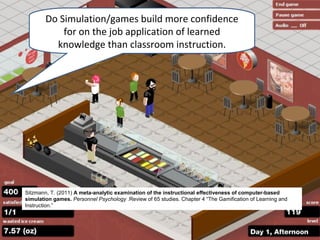
Do Simulation/games build more confidence
            for on the job application of learned
          knowledge than classroom instruction.


Sitzmann, T. (2011) A meta-analytic examination of the instructional effectiveness of computer-based
simulation games. Personnel Psychology .Review of 65 studies. Chapter 4 “The Gamification of Learning and
Instruction.”
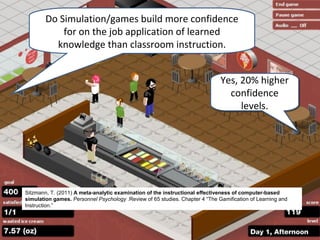
Do Simulation/games build more confidence
            for on the job application of learned
          knowledge than classroom instruction.


                                                                              Yes, 20% higher
                                                                                confidence
                                                                                   levels.


Sitzmann, T. (2011) A meta-analytic examination of the instructional effectiveness of computer-based
simulation games. Personnel Psychology .Review of 65 studies. Chapter 4 “The Gamification of Learning and
Instruction.”
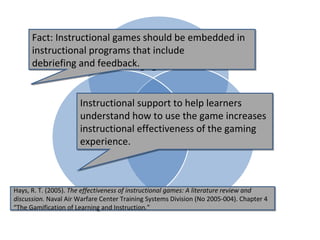
Fact: Instructional games should be embedded in
      instructional programs that include
      debriefing and feedback.
                             Engagement


                      Instructional support to help learners
                      understandEducational the game increases
                                   how to use
                      instructionalSimulation
                                    effectiveness of the gaming
                         Game
                      experience.                Pedagogy


Hays, R. T. (2005). The effectiveness of instructional games: A literature review and
discussion. Naval Air Warfare Center Training Systems Division (No 2005-004). Chapter 4
“The Gamification of Learning and Instruction.”
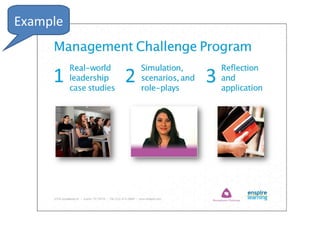
Example
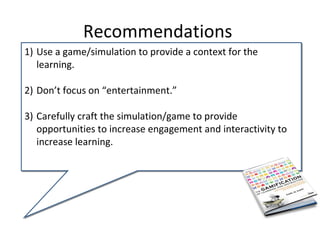
Recommendations
1) Use a game/simulation to provide a context for the
   learning.

2) Don’t focus on “entertainment.”

3) Carefully craft the simulation/game to provide
   opportunities to increase engagement and interactivity to
   increase learning.
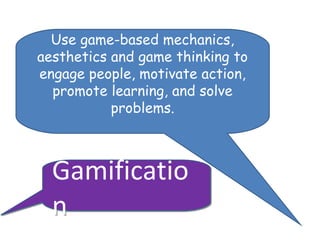
Use game-based mechanics,
aesthetics and game thinking to
engage people, motivate action,
  promote learning, and solve
           problems.


  Gamificatio
  n
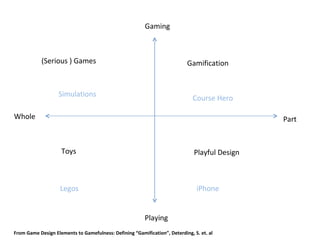
Gaming


            (Serious ) Games                                               Gamification


                   Simulations
                                                                              Course Hero

Whole                                                                                          Part


                    Toys                                                      Playful Design


                    Legos                                                      iPhone


                                                         Playing
From Game Design Elements to Gamefulness: Defining “Gamification”, Deterding, S. et. al
http://success.adobe.com/microsites/levelup/index.html
Use measurement achievements
                instead of completion achievements to
                 increase intrinsic motivation through
                               feedback.


Locke, E.A., & Latham, G.P. (2002) Building a practially useful theory of goal setting and
task motivation: A 35-year Odyssey. American Psychologist, 57(9), 705-717 Chapter 11:
                    “The Gamification of Learning and Instruction”
Primarily use expected achievements so
                                      players can establish goals for themselves
                                         and create a schema of the learning
                                                    environment.


                                                             http://www.coursehero.com/courses/


 Schooler, L.J., & Anderson (1990) The disruptive potential of immediate feedback. The proceedings of the Twelfth
Annual Conference of the Cognitive Science Society, Cambridge, MA. Chapter 11: “The Gamification of Learning and
                                                    Instruction”
2 weeks after launching Courses (powered by gamification),
CourseHero received 350 suggested edits to existing courses and
122 requests for new courses.

Another 68 people offered to augment existing courses by creating
their own course to be hosted on coursehero.com.
• Since the implementation of gamification elements, time
  on site overall has increased around 5 percent.
• For Gamified courses, the time on site for the Courses are
  nearly three times as long as time onsite for all of
  coursehero.com.
• Social sharing of achievements increased nearly 400 percent
  in three months.
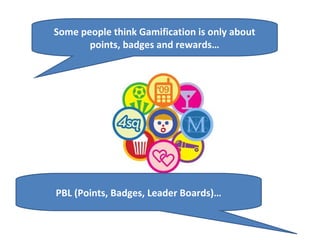
Some people think Gamification is only about
       points, badges and rewards…


PBL (Points, Badges, Leader Boards)…
… if it was, this would be the most engaging game in
                      the world.
… but the possibilities of “gamification” are far
   larger than points, badges and rewards.
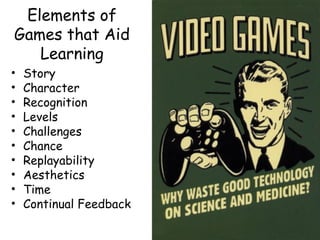
Elements of
Games that Aid
   Learning
•   Story
•   Character
•   Recognition
•   Levels
•   Challenges
•   Chance
•   Replayability
•   Aesthetics
•   Time
•   Continual Feedback
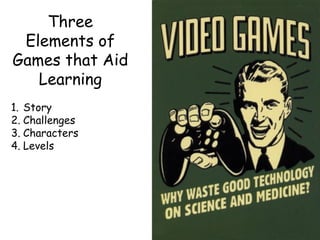
Three
 Elements of
Games that Aid
   Learning
1. Story
2. Challenges
3. Characters
4. Levels
Story
Researchers have found that the
    Researchers have found that the                     Yep, People tend to remember facts
                                                        Yep, People tend to remember facts
   human brain has a natural affinity
   human brain has a natural affinity                    more accurately if they encounter
                                                          more accurately if they encounter
      for narrative construction.
       for narrative construction.                      them in a story rather than in a list.
                                                         them in a story rather than in a list.


                      And they rate legal arguments as
                      more convincing when built into
                     narrative tales rather than on legal
                                  precedent.


Carey, B. (2007) this is Your Life (and How You Tell it). The New York Times. Melanie Green
 Carey, B. (2007) this is Your Life (and How You Tell it). The New York Times. Melanie Green
http://www.unc.edu/~mcgreen/research.html. Chapter 2 “The Gamification of Learning and
 http://www.unc.edu/~mcgreen/research.html. Chapter 2 “The Gamification of Learning and
Instruction.
 Instruction.
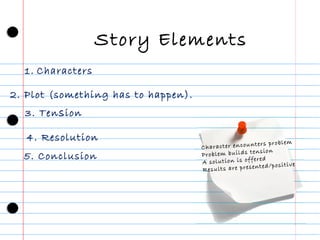
Story Elements
  1. Characters

2. Plot (something has to happen).
  3. Ten s ion

   4. Resolution
                                                             te rs pr ob le m
                                     C ha ra ct er en co u n
                                                             n si on
  5. Conclusion                      Pr ob le m bu il ds te
                                                              re d
                                     A so lu ti on is of fe
                                                               te d /p os it iv e
                                     R es u lt s ar e pr es en
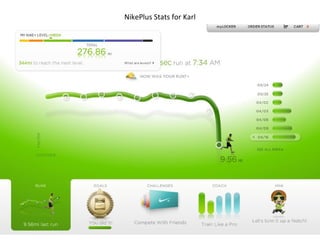
NikePlus Stats for Karl
Provide a challenge

Jones, B., Valdez, G., Norakowski, J., & Rasmussen, C. (1994). Designing learning and technology
for educational reform. North Central Regional Educational Laboratory. [Online]. Available:
http://www.ncrtec.org/capacity/profile/profwww.htm and Schlechty, P. C. (1997). Inventing
better schools: An action plan for educational reform. San Francisco, CA: Jossey-Bass. Chapter 2
“The Gamification of Learning and Instruction.”
Re-design the Instruction to
   Start with a Challenge
Investigatory Training
• Course Objectives
  – Identify the Forms Required for an Investigation
  – Practice Interview Techniques
  – Describe and Follow the Investigation Model
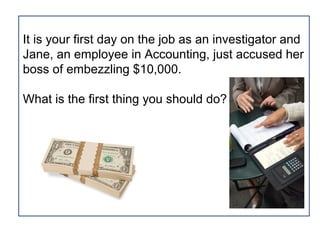
It is your first day on the job as an investigator and
Jane, an employee in Accounting, just accused her
boss of embezzling $10,000.

What is the first thing you should do?
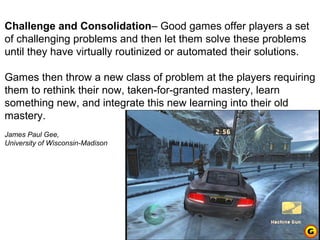
Challenge and Consolidation– Good games offer players a set
of challenging problems and then let them solve these problems
until they have virtually routinized or automated their solutions.

Games then throw a new class of problem at the players requiring
them to rethink their now, taken-for-granted mastery, learn
something new, and integrate this new learning into their old
mastery.
James Paul Gee,
University of Wisconsin-Madison
Recommendations
• Embed facts to be learned in the context of stories.

• Start the learning process by providing a challenge to
  the learner.

• Provide a progression from simple to more difficult
  tasks.

• Use stories that are related to the context of the
  desired learning outcome.
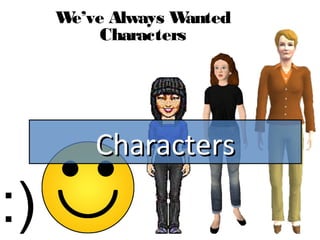
We’ve Always W anted
     Characters


    Characters
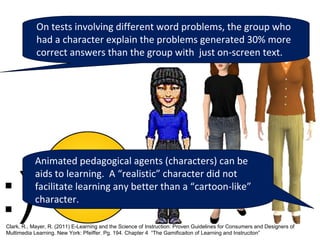
On tests involving different word problems, the group who
            had a character explain the problems generated 30% more
            correct answers than the group with just on-screen text.


           Animated pedagogical agents (characters) can be
           aids to learning. A “realistic” character did not
           facilitate learning any better than a “cartoon-like”
           character.

Clark, R., Mayer, R. (2011) E-Learning and the Science of Instruction: Proven Guidelines for Consumers and Designers of
Multimedia Learning. New York: Pfeiffer. Pg. 194. Chapter 4 “The Gamificaiton of Learning and Instruciton”
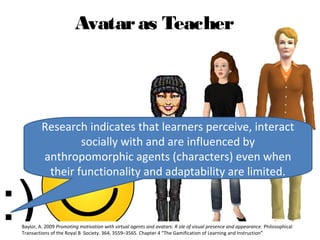
Avatar as Teacher


         Research indicates that learners perceive, interact
                 socially with and are influenced by
         anthropomorphic agents (characters) even when
          their functionality and adaptability are limited.


Baylor, A. 2009 Promoting motivation with virtual agents and avatars: R ole of visual presence and appearance. Philosophical
Transactions of the Royal B Society. 364, 3559–3565. Chapter 4 “The Gamification of Learning and Instruction”
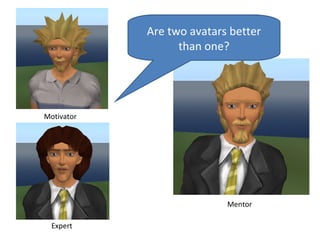
Are two avatars better
                  than one?


Motivator


                           Mentor

  Expert
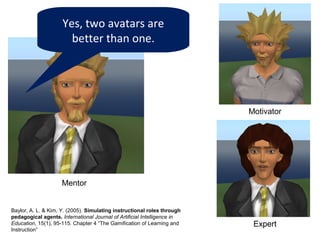
Yes, two avatars are
                       better than one.


                                                                          Motivator


                     Mentor


Baylor, A. L. & Kim, Y. (2005). Simulating instructional roles through
pedagogical agents. International Journal of Artificial Intelligence in
Education, 15(1), 95-115. Chapter 4 “The Gamification of Learning and      Expert
Instruction”
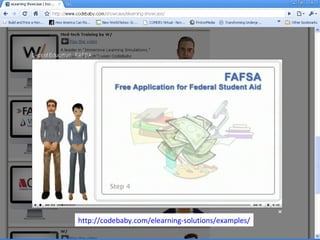
http://codebaby.com/elearning-solutions/examples/
Recommendations
• Use characters/agents to model desired behavior.

• Use characters/agents to provide feedback and
  instruction to learners.

• Characters should speak in a natural, conversational
  tone.

• Use two characters, one for coaching and one for
  expertise is better than just having one character trying
  to do both.
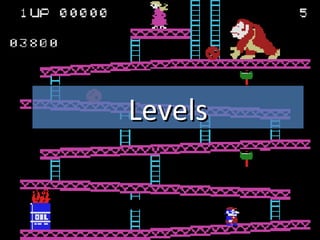
Levels
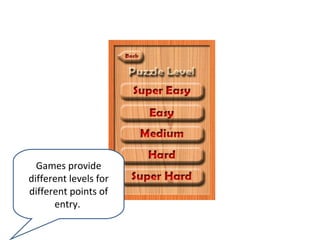
Games provide
different levels for
different points of
      entry.
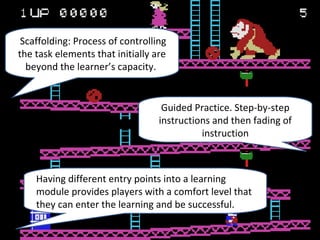
Scaffolding: Process of controlling
the task elements that initially are
  beyond the learner’s capacity.


                                   Guided Practice. Step-by-step
                                  instructions and then fading of
                                            instruction


    Having different entry points into a learning
    module provides players with a comfort level that
    they can enter the learning and be successful.
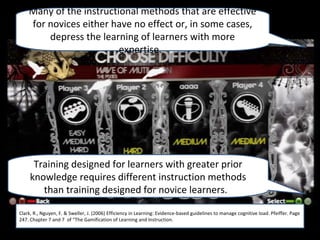
Many of the instructional methods that are effective
    for novices either have no effect or, in some cases,
        depress the learning of learners with more
                         expertise.


      Training designed for learners with greater prior
     knowledge requires different instruction methods
        than training designed for novice learners.

Clark, R., Nguyen, F. & Sweller, J. (2006) Efficiency in Learning: Evidence-based guidelines to manage cognitive load. Pfeiffer. Page
247. Chapter 7 and 7 of “The Gamification of Learning and Instruction.
Recommendations
Fact


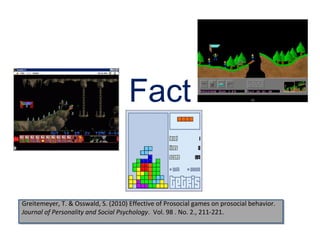
Greitemeyer, T. & Osswald, S. (2010) Effective of Prosocial games on prosocial behavior.
Journal of Personality and Social Psychology. Vol. 98 .. No. 2., 211-221.
Journal of Personality and Social Psychology. Vol. 98 No. 2., 211-221.
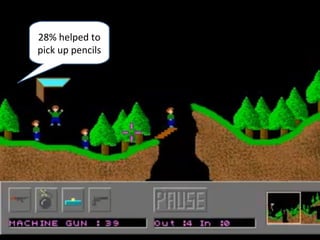
28% helped to
pick up pencils
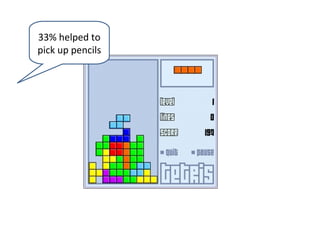
33% helped to
pick up pencils
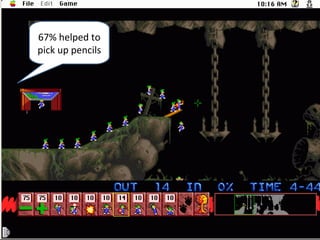
67% helped to
pick up pencils
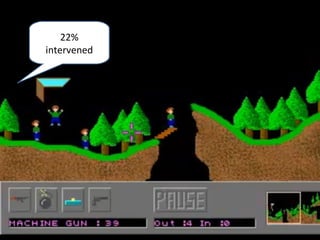
22%
intervened
56%
intervened
Take-Away
1) Interactivity of games leads to higher knowledge retention
    for declarative and procedural knowledge.
2) Embed facts to be learned in the context of stories.
3) Games/Simulations do not need to be fun to be educational.
4) On screen characters can enhance e-learning.
5) Two on screen characters (mentor and expert) are better
    then one.
6) Use stories rather than bulleted lists to present facts.
7) Present learners with a difficult challenge to engage and
    motivate them.
8) Use stories that are related to the context of the desired
    learning outcome.
9) Allow different entry points/levels into the instruction.
10) Games can be more influential than reading about a subject.
Questions?


 Twitter:@kkapp
 kkapp@bloomu.edu

Future of Learning: Games and Gamification

  • 1.
    Future of Learning:Games and Gamification By Karl M. Kapp Bloomsburg University Twitter:@kkapp Gamification of Learning and Instruction September 6, 2012
  • 2.
  • 3.
    Google “Kapp Notes” September 2011 Training Quarterly Article Improving Training: Thinking Like a Game Developer July 2012 T&D Article Games, Gamification and the Quest for Interactive Learning
  • 4.
    Agenda 1 2 What is gamification and why does it What are the expectations of the Matter to learning professionals? new generation of learners? 3 What elements from games can be added to traditional learning to maximize impact?
  • 5.
  • 6.
    Games 1.0 4 3 How will the ball Where is my bounce off the wall? opponent going to go next? In what direction should I try to move the ball?
  • 7.
  • 8.
    Games 2.0 What is the pattern Should I shoot the aliens these aliens are on the end or in the following? middle or all the bottom aliens first? How long do I have to shoot before an alien shoots at me?
  • 9.
  • 11.
    What must Ido to Where do I explore achieve my goal? first? What activities are of the most value?
  • 12.
  • 13.
    Games 4.0 What activities give me the most return for my efforts? Can I trust this person who wants to team with me to accomplish a goal?
  • 14.
    Games 4.0 Flippy wants to become friends with you. Do you want to add Flippy to your friend’s list.
  • 15.
  • 16.
  • 17.
    - Realistic simulatorsfor contemporary Leadership Training - Integrate these games into leadership development programs - Attempt various leadership structures -Employees may make hundreds of leadership decision an hour in a game Leadership’s Online Labs Leadership’s Online Labs Harvard Business Harvard Business Review, May 2008 Review, May 2008
  • 18.
    10,000 hours of 13 hours Game play of console games a week 87% of 8- to 17- year olds play video games Digital divisions. Report by the Pew /Internet: Pew Internet & American Life. US Department of Commerce at home.
  • 19.
    Almost 43% ofthe gamers are female and 26% of those females are over 18. Females play 5 hours a week of console games. They make up the majority of PC gamers at 63%.
  • 20.
    Are games effectivefor learning?
  • 21.
    Yes! Retention % Higher Type of Knowledge Retention 9% Procedural 14% Declarative 11% Sitzmann, T. (2011) A meta-analytic examination of the instructional effectiveness of computer-based simulation games. Personnel Psychology .Review of 65 studies. Chapter 4 “The Gamification of Learning and Instruction.”
  • 22.
    Percentages of Impact Retention It wasn’t the game, it was % Higher level of activity in the game. Type of Knowledge Retention 9% In other words, the Procedural engagement of the learner in 14% the game leads to learning. Declarative 11% Sitzmann, T. (2011) A meta-analytic examination of the instructional effectiveness of computer-based simulation games. Personnel Psychology .Review of 65 studies. Chapter 4 “The Gamification of Learning and Instruction.”
  • 23.
    Do simulation/games haveto be entertaining to be educational? Sitzmann, T. (2011) A meta-analytic examination of the instructional effectiveness of computer-based simulation games. Personnel Psychology .Review of 65 studies. Chapter 4 “The Gamification of Learning and Instruction.”
  • 24.
    Do simulation/games haveto be entertaining to be educational? NO Sitzmann, T. (2011) A meta-analytic examination of the instructional effectiveness of computer-based simulation games. Personnel Psychology .Review of 65 studies. Chapter 4 “The Gamification of Learning and Instruction.”
  • 25.
    Do Simulation/games buildmore confidence for on the job application of learned knowledge than classroom instruction. Sitzmann, T. (2011) A meta-analytic examination of the instructional effectiveness of computer-based simulation games. Personnel Psychology .Review of 65 studies. Chapter 4 “The Gamification of Learning and Instruction.”
  • 26.
    Do Simulation/games buildmore confidence for on the job application of learned knowledge than classroom instruction. Yes, 20% higher confidence levels. Sitzmann, T. (2011) A meta-analytic examination of the instructional effectiveness of computer-based simulation games. Personnel Psychology .Review of 65 studies. Chapter 4 “The Gamification of Learning and Instruction.”
  • 27.
    Fact: Instructional gamesshould be embedded in instructional programs that include debriefing and feedback. Engagement Instructional support to help learners understandEducational the game increases how to use instructionalSimulation effectiveness of the gaming Game experience. Pedagogy Hays, R. T. (2005). The effectiveness of instructional games: A literature review and Hays, R. T. (2005). The effectiveness of instructional games: A literature review and discussion. Naval Air Warfare Center Training Systems Division (No 2005-004). Chapter 4 discussion. Naval Air Warfare Center Training Systems Division (No 2005-004). Chapter 4 “The Gamification of Learning and Instruction.” “The Gamification of Learning and Instruction.”
  • 28.
  • 29.
    Recommendations 1) Use agame/simulation to provide a context for the learning. 2) Don’t focus on “entertainment.” 3) Carefully craft the simulation/game to provide opportunities to increase engagement and interactivity to increase learning.
  • 30.
    Use game-based mechanics, aestheticsand game thinking to engage people, motivate action, promote learning, and solve problems. Gamificatio n
  • 31.
    Gaming (Serious ) Games Gamification Simulations Course Hero Whole Part Toys Playful Design Legos iPhone Playing From Game Design Elements to Gamefulness: Defining “Gamification”, Deterding, S. et. al
  • 33.
  • 35.
    Use measurement achievements instead of completion achievements to increase intrinsic motivation through feedback. Locke, E.A., & Latham, G.P. (2002) Building a practially useful theory of goal setting and task motivation: A 35-year Odyssey. American Psychologist, 57(9), 705-717 Chapter 11: “The Gamification of Learning and Instruction”
  • 36.
    Primarily use expectedachievements so players can establish goals for themselves and create a schema of the learning environment. http://www.coursehero.com/courses/ Schooler, L.J., & Anderson (1990) The disruptive potential of immediate feedback. The proceedings of the Twelfth Annual Conference of the Cognitive Science Society, Cambridge, MA. Chapter 11: “The Gamification of Learning and Instruction”
  • 37.
    2 weeks afterlaunching Courses (powered by gamification), CourseHero received 350 suggested edits to existing courses and 122 requests for new courses. Another 68 people offered to augment existing courses by creating their own course to be hosted on coursehero.com.
  • 38.
    • Since theimplementation of gamification elements, time on site overall has increased around 5 percent.
  • 39.
    • For Gamifiedcourses, the time on site for the Courses are nearly three times as long as time onsite for all of coursehero.com. • Social sharing of achievements increased nearly 400 percent in three months.
  • 40.
    Some people thinkGamification is only about points, badges and rewards… PBL (Points, Badges, Leader Boards)…
  • 41.
    … if itwas, this would be the most engaging game in the world.
  • 42.
    … but thepossibilities of “gamification” are far larger than points, badges and rewards.
  • 43.
    Elements of Games thatAid Learning • Story • Character • Recognition • Levels • Challenges • Chance • Replayability • Aesthetics • Time • Continual Feedback
  • 44.
    Three Elements of Gamesthat Aid Learning 1. Story 2. Challenges 3. Characters 4. Levels
  • 45.
  • 46.
    Researchers have foundthat the Researchers have found that the Yep, People tend to remember facts Yep, People tend to remember facts human brain has a natural affinity human brain has a natural affinity more accurately if they encounter more accurately if they encounter for narrative construction. for narrative construction. them in a story rather than in a list. them in a story rather than in a list. And they rate legal arguments as more convincing when built into narrative tales rather than on legal precedent. Carey, B. (2007) this is Your Life (and How You Tell it). The New York Times. Melanie Green Carey, B. (2007) this is Your Life (and How You Tell it). The New York Times. Melanie Green http://www.unc.edu/~mcgreen/research.html. Chapter 2 “The Gamification of Learning and http://www.unc.edu/~mcgreen/research.html. Chapter 2 “The Gamification of Learning and Instruction. Instruction.
  • 47.
    Story Elements 1. Characters 2. Plot (something has to happen). 3. Ten s ion 4. Resolution te rs pr ob le m C ha ra ct er en co u n n si on 5. Conclusion Pr ob le m bu il ds te re d A so lu ti on is of fe te d /p os it iv e R es u lt s ar e pr es en
  • 48.
  • 50.
    Provide a challenge Jones,B., Valdez, G., Norakowski, J., & Rasmussen, C. (1994). Designing learning and technology Jones, B., Valdez, G., Norakowski, J., & Rasmussen, C. (1994). Designing learning and technology for educational reform. North Central Regional Educational Laboratory. [Online]. Available: for educational reform. North Central Regional Educational Laboratory. [Online]. Available: http://www.ncrtec.org/capacity/profile/profwww.htm and Schlechty, P. C. (1997). Inventing http://www.ncrtec.org/capacity/profile/profwww.htm and Schlechty, P. C. (1997). Inventing better schools: An action plan for educational reform. San Francisco, CA: Jossey-Bass. Chapter 2 better schools: An action plan for educational reform. San Francisco, CA: Jossey-Bass. Chapter 2 “The Gamification of Learning and Instruction.” “The Gamification of Learning and Instruction.”
  • 51.
    Re-design the Instructionto Start with a Challenge
  • 52.
    Investigatory Training • CourseObjectives – Identify the Forms Required for an Investigation – Practice Interview Techniques – Describe and Follow the Investigation Model
  • 53.
    It is yourfirst day on the job as an investigator and Jane, an employee in Accounting, just accused her boss of embezzling $10,000. What is the first thing you should do?
  • 54.
    Challenge and Consolidation–Good games offer players a set of challenging problems and then let them solve these problems until they have virtually routinized or automated their solutions. Games then throw a new class of problem at the players requiring them to rethink their now, taken-for-granted mastery, learn something new, and integrate this new learning into their old mastery. James Paul Gee, University of Wisconsin-Madison
  • 55.
    Recommendations • Embed factsto be learned in the context of stories. • Start the learning process by providing a challenge to the learner. • Provide a progression from simple to more difficult tasks. • Use stories that are related to the context of the desired learning outcome.
  • 56.
    We’ve Always Wanted Characters Characters
  • 57.
    On tests involvingdifferent word problems, the group who had a character explain the problems generated 30% more correct answers than the group with just on-screen text. Animated pedagogical agents (characters) can be aids to learning. A “realistic” character did not facilitate learning any better than a “cartoon-like” character. Clark, R., Mayer, R. (2011) E-Learning and the Science of Instruction: Proven Guidelines for Consumers and Designers of Multimedia Learning. New York: Pfeiffer. Pg. 194. Chapter 4 “The Gamificaiton of Learning and Instruciton”
  • 58.
    Avatar as Teacher Research indicates that learners perceive, interact socially with and are influenced by anthropomorphic agents (characters) even when their functionality and adaptability are limited. Baylor, A. 2009 Promoting motivation with virtual agents and avatars: R ole of visual presence and appearance. Philosophical Transactions of the Royal B Society. 364, 3559–3565. Chapter 4 “The Gamification of Learning and Instruction”
  • 59.
    Are two avatarsbetter than one? Motivator Mentor Expert
  • 60.
    Yes, two avatarsare better than one. Motivator Mentor Baylor, A. L. & Kim, Y. (2005). Simulating instructional roles through pedagogical agents. International Journal of Artificial Intelligence in Education, 15(1), 95-115. Chapter 4 “The Gamification of Learning and Expert Instruction”
  • 61.
  • 62.
  • 63.
    Recommendations • Use characters/agentsto model desired behavior. • Use characters/agents to provide feedback and instruction to learners. • Characters should speak in a natural, conversational tone. • Use two characters, one for coaching and one for expertise is better than just having one character trying to do both.
  • 64.
  • 65.
    Games provide different levelsfor different points of entry.
  • 66.
    Scaffolding: Process ofcontrolling the task elements that initially are beyond the learner’s capacity. Guided Practice. Step-by-step instructions and then fading of instruction Having different entry points into a learning module provides players with a comfort level that they can enter the learning and be successful.
  • 67.
    Many of theinstructional methods that are effective for novices either have no effect or, in some cases, depress the learning of learners with more expertise. Training designed for learners with greater prior knowledge requires different instruction methods than training designed for novice learners. Clark, R., Nguyen, F. & Sweller, J. (2006) Efficiency in Learning: Evidence-based guidelines to manage cognitive load. Pfeiffer. Page Clark, R., Nguyen, F. & Sweller, J. (2006) Efficiency in Learning: Evidence-based guidelines to manage cognitive load. Pfeiffer. Page 247. Chapter 7 and 7 of “The Gamification of Learning and Instruction. 247. Chapter 7 and 7 of “The Gamification of Learning and Instruction.
  • 68.
  • 69.
    Fact Greitemeyer, T. &Osswald, S. (2010) Effective of Prosocial games on prosocial behavior. Greitemeyer, T. & Osswald, S. (2010) Effective of Prosocial games on prosocial behavior. Journal of Personality and Social Psychology. Vol. 98 .. No. 2., 211-221. Journal of Personality and Social Psychology. Vol. 98 No. 2., 211-221.
  • 70.
  • 71.
  • 72.
  • 74.
  • 75.
  • 76.
    Take-Away 1) Interactivity ofgames leads to higher knowledge retention for declarative and procedural knowledge. 2) Embed facts to be learned in the context of stories. 3) Games/Simulations do not need to be fun to be educational. 4) On screen characters can enhance e-learning. 5) Two on screen characters (mentor and expert) are better then one. 6) Use stories rather than bulleted lists to present facts. 7) Present learners with a difficult challenge to engage and motivate them. 8) Use stories that are related to the context of the desired learning outcome. 9) Allow different entry points/levels into the instruction. 10) Games can be more influential than reading about a subject.
  • 77.

Editor's Notes

  • #6 Various games and the problems the gamers had to solve.
  • #42 First introduced to me by Sebastian Deterding
  • #51 One element of engaged learning is challenging tasks. Jones, B., Valdez, G., Norakowski, J., & Rasmussen, C. (1994). Designing learning and technology for educational reform. North Central Regional ducational Laboratory. [Online]. Available: http://www.ncrtec.org/capacity/profile/profwww.htm and Schlechty, P. C. (1997). Inventing better schools: An action plan for educational reform. San Francisco, CA: Jossey-Bass .
  • #70 Cognitive, Behavioral, Affective