FUZZY LOGIC
•1
Index
 Brief History
 What is fuzzy logic?
 Fuzzy Vs Crisp Set
 Membership Functions
 Fuzzy Logic Vs Probability
 Why use Fuzzy Logic?
 Fuzzy Linguistic Variables
 Operations on Fuzzy Set
 Fuzzy Applications
 Drawbacks
 Conclusion
•2
Brief History
 Classical logic of Aristotle: Law of Bivalence “Every
proposition is either True or False(no middle)”. Also known
as “Law of excluded middle.”
 Jan Lukasiewicz proposed three-valued logic : True,
False and Possible
 Finally Lofti A. Zadeh in 1965 published his paper on
fuzzy logic-a part of set theory that operated over the
range [0.0-1.0]
•3
What is Fuzzy Logic?
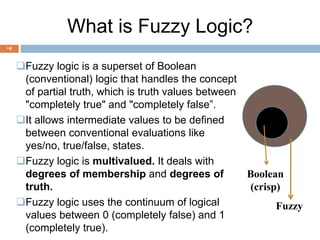
Fuzzy logic is a superset of Boolean
(conventional) logic that handles the concept
of partial truth, which is truth values between
"completely true" and "completely false”.
It allows intermediate values to be defined
between conventional evaluations like
yes/no, true/false, states.
Fuzzy logic is multivalued. It deals with
degrees of membership and degrees of
truth.
Fuzzy logic uses the continuum of logical
values between 0 (completely false) and 1
(completely true).
Boolean
(crisp)
Fuzzy
•4
•5
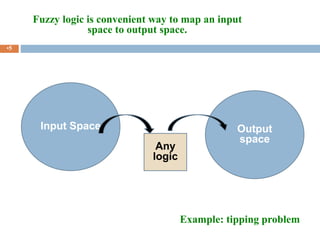
Input Space Output
space
Any
logic
Fuzzy logic is convenient way to map an input
space to output space.
Example: tipping problem
For example, let a 100 ml glass contain 30
ml of water. Then we may consider two
concepts: Empty and Full.
In boolean logic there are two options for
answer i.e. either the glass is half full or
glass is half empty.
100 ml
30 ml
In fuzzy concept one might define the
glass as being 0.7 empty and 0.3 full.
•6
Crisp Set and Fuzzy Set
•7
μ a(x)={ 1 if element x belongs to the set A
0 otherwise
}
•Classical set theory enumerates all element using
A={a1,a2,a3,a4…,an}
Set A can be represented by Characteristic function
A fuzzy set can be represented by:
A={{ x, A(x) }}
where, A(x) is the membership grade of a element x in fuzzy set
SMALL={{1,1},{2,1},{3,0.9},{4,0.6},{5,0.4},{6,0.3},{7,0.2},{8,0.1},
{9,0},{10,0},{11,0},{12,0}}
•In fuzzy set theory elements have varying degrees of membership
Example: Consider space X consisting of natural number<=12
Prime={x contained in X | x is prime number={2,3,5,7,11}
Fuzzy Vs. Crisp Set
A A’
•a •a
•b •b
•c
Fuzzy setCrisp set
•a: member of crisp
set A
•b: not a member of
set A
•a: full member of fuzzy set A’
•b: not a member of set A’
•c:partial member of set A’
•8
Example: weekend problem
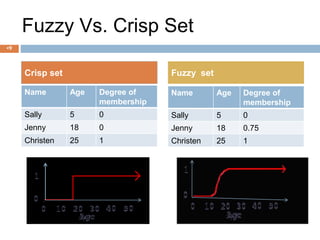
Crisp set
Fuzzy Vs. Crisp Set
Name Age Degree of
membership
Sally 5 0
Jenny 18 0
Christen 25 1
Name Age Degree of
membership
Sally 5 0
Jenny 18 0.75
Christen 25 1
Fuzzy set
•9
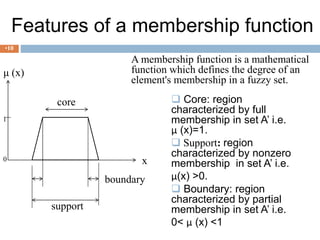
Features of a membership function
core
support
boundary
1
0
μ (x)
x
 Core: region
characterized by full
membership in set A’ i.e.
μ (x)=1.
 Support: region
characterized by nonzero
membership in set A’ i.e.
μ(x) >0.
 Boundary: region
characterized by partial
membership in set A’ i.e.
0< μ (x) <1
•10
A membership function is a mathematical
function which defines the degree of an
element's membership in a fuzzy set.
Fuzzy Logic Vs Probability
 Both operate over the same numeric range and at first
glance both have similar values:0.0 representing false(or
non-membership) and 1.0 representing true.
 In terms of probability, the natural language statement
would be ”there is an 80% chance that Jane is old.”
 While the fuzzy terminology corresponds to “Jane’s
degree of membership within the set of old people is 0.80.’
 Fuzzy logic uses truth degrees as a mathematical
model of the vagueness phenomenon while probability is
a mathematical model of ignorance.
•11
Why use Fuzzy Logic?
 Fuzzy logic is flexible.
Fuzzy logic is conceptually easy to understand.
 Fuzzy logic is tolerant of imprecise data.
 Fuzzy logic is based on natural language.
•12
Fuzzy Linguistic Variables
 Fuzzy Linguistic Variables are used to represent qualities
spanning a particular spectrum
 Temp: {Freezing, Cool, Warm, Hot}
50 70 90 1103010
Temp. (F°)
Freezing Cool Warm Hot
0
1
•13
Operation of Fuzzy System
Crisp Input
Fuzzy Input
Fuzzy Output
Crisp Output
Fuzzification
Rule Evaluation
Defuzzification
Input Membership
Functions
Rules / Inferences
Output Membership
Functions
Operations on Fuzzy Set
A B
μA μB
A= {1/2 + .5/3 + .3/4 + .2/5} B= {.5/2 + .7/3 + .2/4 + .4/5}
Consider:
>Fuzzy set (A)
>Fuzzy set (B)
>Resulting operation of fuzzy sets
•15
INTERSECTION
(A ^ B)
UNION
(A v B)
COMPLEMENT
(¬A)
μA ∩ B
μA U
μA ‘
μA∩ B = min (μA(x), μB(x))
{.5/2 + .5/3 + .2/4 + .2/5}
μAUB = max (μA(x), μB(x))
{1/2 + .7/3 + .3/4 + .4/5}
μA’ = 1-μA(x)
{1/1 + 0/2 + .5/3 + .7/4 + .8/5}
•16
Input:
50 70 90 1103010
Temp. (F°)
Freezing Cool Warm Hot
0
1
Temp: {Freezing, Cool, Warm, Hot}
40 60 80 100200
Cloud Cover (%)
OvercastPartly CloudySunny
0
1
Cover: {Sunny, Partly cloudy,
Overcast}
Output:
50 75 100250
Speed (mph)
Slow Fast
0
1
Speed: {Slow, Fast}
•17
 If it's Sunny and Warm, drive Fast
Sunny(Cover)Warm(Temp) Fast(Speed)
 If it's Cloudy and Cool, drive Slow
Cloudy(Cover)Cool(Temp) Slow(Speed)
 Driving Speed is the combination of output of these
rules...
Rules
•18
Fuzzy Applications
 Automobile and other vehicle subsystems : used to control
the speed of vehicles, in Anti Braking System.
 Temperature controllers : Air conditioners, Refrigerators
 Cameras : for auto-focus
 Home appliances: Rice cookers , Dishwashers , Washing
machines and others
•19
 Fuzzy logic is not always accurate. The results are perceived as
a guess, so it may not be as widely trusted .
Requires tuning of membership functions which is difficult to
estimate.
 Fuzzy Logic control may not scale well to large or complex
problems
 Fuzzy logic can be easily confused with probability theory, and
the terms used interchangeably. While they are similar concepts,
they do not say the same things.
Drawbacks
•20
 Fuzzy Logic provides way to calculate with imprecision and
vagueness.
 Fuzzy Logic can be used to represent some kinds of human
expertise .
 The control stability, reliability, efficiency, and durability of fuzzy
logic makes it popular.
 The speed and complexity of application production would not be
possible without systems like fuzzy logic.
Conclusion
•21

Fuzzy logic

  • 1.
  • 2.
    Index  Brief History What is fuzzy logic?  Fuzzy Vs Crisp Set  Membership Functions  Fuzzy Logic Vs Probability  Why use Fuzzy Logic?  Fuzzy Linguistic Variables  Operations on Fuzzy Set  Fuzzy Applications  Drawbacks  Conclusion •2
  • 3.
    Brief History  Classicallogic of Aristotle: Law of Bivalence “Every proposition is either True or False(no middle)”. Also known as “Law of excluded middle.”  Jan Lukasiewicz proposed three-valued logic : True, False and Possible  Finally Lofti A. Zadeh in 1965 published his paper on fuzzy logic-a part of set theory that operated over the range [0.0-1.0] •3
  • 4.
    What is FuzzyLogic? Fuzzy logic is a superset of Boolean (conventional) logic that handles the concept of partial truth, which is truth values between "completely true" and "completely false”. It allows intermediate values to be defined between conventional evaluations like yes/no, true/false, states. Fuzzy logic is multivalued. It deals with degrees of membership and degrees of truth. Fuzzy logic uses the continuum of logical values between 0 (completely false) and 1 (completely true). Boolean (crisp) Fuzzy •4
  • 5.
    •5 Input Space Output space Any logic Fuzzylogic is convenient way to map an input space to output space. Example: tipping problem
  • 6.
    For example, leta 100 ml glass contain 30 ml of water. Then we may consider two concepts: Empty and Full. In boolean logic there are two options for answer i.e. either the glass is half full or glass is half empty. 100 ml 30 ml In fuzzy concept one might define the glass as being 0.7 empty and 0.3 full. •6
  • 7.
    Crisp Set andFuzzy Set •7 μ a(x)={ 1 if element x belongs to the set A 0 otherwise } •Classical set theory enumerates all element using A={a1,a2,a3,a4…,an} Set A can be represented by Characteristic function A fuzzy set can be represented by: A={{ x, A(x) }} where, A(x) is the membership grade of a element x in fuzzy set SMALL={{1,1},{2,1},{3,0.9},{4,0.6},{5,0.4},{6,0.3},{7,0.2},{8,0.1}, {9,0},{10,0},{11,0},{12,0}} •In fuzzy set theory elements have varying degrees of membership Example: Consider space X consisting of natural number<=12 Prime={x contained in X | x is prime number={2,3,5,7,11}
  • 8.
    Fuzzy Vs. CrispSet A A’ •a •a •b •b •c Fuzzy setCrisp set •a: member of crisp set A •b: not a member of set A •a: full member of fuzzy set A’ •b: not a member of set A’ •c:partial member of set A’ •8 Example: weekend problem
  • 9.
    Crisp set Fuzzy Vs.Crisp Set Name Age Degree of membership Sally 5 0 Jenny 18 0 Christen 25 1 Name Age Degree of membership Sally 5 0 Jenny 18 0.75 Christen 25 1 Fuzzy set •9
  • 10.
    Features of amembership function core support boundary 1 0 μ (x) x  Core: region characterized by full membership in set A’ i.e. μ (x)=1.  Support: region characterized by nonzero membership in set A’ i.e. μ(x) >0.  Boundary: region characterized by partial membership in set A’ i.e. 0< μ (x) <1 •10 A membership function is a mathematical function which defines the degree of an element's membership in a fuzzy set.
  • 11.
    Fuzzy Logic VsProbability  Both operate over the same numeric range and at first glance both have similar values:0.0 representing false(or non-membership) and 1.0 representing true.  In terms of probability, the natural language statement would be ”there is an 80% chance that Jane is old.”  While the fuzzy terminology corresponds to “Jane’s degree of membership within the set of old people is 0.80.’  Fuzzy logic uses truth degrees as a mathematical model of the vagueness phenomenon while probability is a mathematical model of ignorance. •11
  • 12.
    Why use FuzzyLogic?  Fuzzy logic is flexible. Fuzzy logic is conceptually easy to understand.  Fuzzy logic is tolerant of imprecise data.  Fuzzy logic is based on natural language. •12
  • 13.
    Fuzzy Linguistic Variables Fuzzy Linguistic Variables are used to represent qualities spanning a particular spectrum  Temp: {Freezing, Cool, Warm, Hot} 50 70 90 1103010 Temp. (F°) Freezing Cool Warm Hot 0 1 •13
  • 14.
    Operation of FuzzySystem Crisp Input Fuzzy Input Fuzzy Output Crisp Output Fuzzification Rule Evaluation Defuzzification Input Membership Functions Rules / Inferences Output Membership Functions
  • 15.
    Operations on FuzzySet A B μA μB A= {1/2 + .5/3 + .3/4 + .2/5} B= {.5/2 + .7/3 + .2/4 + .4/5} Consider: >Fuzzy set (A) >Fuzzy set (B) >Resulting operation of fuzzy sets •15
  • 16.
    INTERSECTION (A ^ B) UNION (Av B) COMPLEMENT (¬A) μA ∩ B μA U μA ‘ μA∩ B = min (μA(x), μB(x)) {.5/2 + .5/3 + .2/4 + .2/5} μAUB = max (μA(x), μB(x)) {1/2 + .7/3 + .3/4 + .4/5} μA’ = 1-μA(x) {1/1 + 0/2 + .5/3 + .7/4 + .8/5} •16
  • 17.
    Input: 50 70 901103010 Temp. (F°) Freezing Cool Warm Hot 0 1 Temp: {Freezing, Cool, Warm, Hot} 40 60 80 100200 Cloud Cover (%) OvercastPartly CloudySunny 0 1 Cover: {Sunny, Partly cloudy, Overcast} Output: 50 75 100250 Speed (mph) Slow Fast 0 1 Speed: {Slow, Fast} •17
  • 18.
     If it'sSunny and Warm, drive Fast Sunny(Cover)Warm(Temp) Fast(Speed)  If it's Cloudy and Cool, drive Slow Cloudy(Cover)Cool(Temp) Slow(Speed)  Driving Speed is the combination of output of these rules... Rules •18
  • 19.
    Fuzzy Applications  Automobileand other vehicle subsystems : used to control the speed of vehicles, in Anti Braking System.  Temperature controllers : Air conditioners, Refrigerators  Cameras : for auto-focus  Home appliances: Rice cookers , Dishwashers , Washing machines and others •19
  • 20.
     Fuzzy logicis not always accurate. The results are perceived as a guess, so it may not be as widely trusted . Requires tuning of membership functions which is difficult to estimate.  Fuzzy Logic control may not scale well to large or complex problems  Fuzzy logic can be easily confused with probability theory, and the terms used interchangeably. While they are similar concepts, they do not say the same things. Drawbacks •20
  • 21.
     Fuzzy Logicprovides way to calculate with imprecision and vagueness.  Fuzzy Logic can be used to represent some kinds of human expertise .  The control stability, reliability, efficiency, and durability of fuzzy logic makes it popular.  The speed and complexity of application production would not be possible without systems like fuzzy logic. Conclusion •21