1 of 38
FUZZY LOGIC
Menoufia University
Faculty of Electronic Engineering
11/2019
2 of 38
Agenda
Introduction to Fuzzy01
Fuzzification Methods02
Defuzzification Methods03
References04
3 of 38
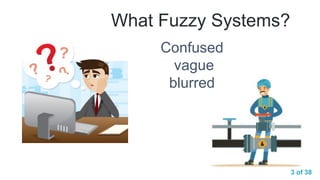
What Fuzzy Systems?
Confused
vague
blurred
4 of 38
Human
knowledge-based
Rule-based
Fuzzy
IF AND
THEN
distance
speed
acceleration
small
speed is declining
maintain
IF distance perfect AND
speed is declining
THEN increase acceleration
speed [m/s]
5 of 38
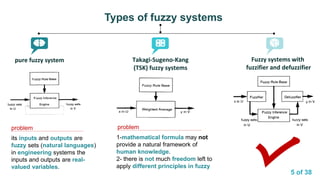
Types of fuzzy systems
Fuzzy systems with
fuzzifier and defuzzifier
pure fuzzy system
its inputs and outputs are
fuzzy sets (natural languages)
in engineering systems the
inputs and outputs are real-
valued variables.
problem
Takagi-Sugeno-Kang
(TSK) fuzzy systems
problem
1-mathematical formula may not
provide a natural framework of
human knowledge.
2- there is not much freedom left to
apply different principles in fuzzy
6 of 38
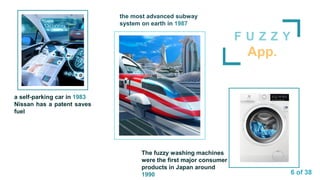
a self-parking car in 1983
Nissan has a patent saves
fuel
F U Z Z Y
App.
The fuzzy washing machines
were the first major consumer
products in Japan around
1990
the most advanced subway
system on earth in 1987
7 of 38
Fuzzy Logic
Controller
Sensor
Fuzzification
Fuzzy
Inference
System
to be
controlled
Defuzzification
Membership
function of
input fuzzy set
Rule Base
Membership
function of
output fuzzy set
Feedback
8 of 38
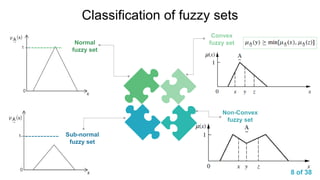
Classification of fuzzy sets
Convex
fuzzy set
Non-Convex
fuzzy set
Normal
fuzzy set
Sub-normal
fuzzy set
9 of 38
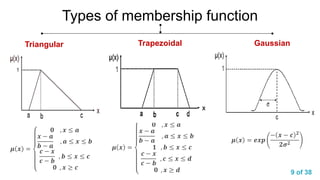
Types of membership function
𝝁 𝒙 =
𝟎 , 𝒙 ≤ 𝒂
𝒙 − 𝒂
𝒃 − 𝒂
, 𝒂 ≤ 𝒙 ≤ 𝒃
𝒄 − 𝒙
𝒄 − 𝒃
, 𝒃 ≤ 𝒙 ≤ 𝒄
𝟎 , 𝒙 ≥ 𝒄
Triangular
𝝁 𝒙 =
𝟎 , 𝒙 ≤ 𝒂
𝒙 − 𝒂
𝒃 − 𝒂
, 𝒂 ≤ 𝒙 ≤ 𝒃
𝟏 , 𝒃 ≤ 𝒙 ≤ 𝒄
𝒄 − 𝒙
𝒄 − 𝒃
, 𝒄 ≤ 𝒙 ≤ 𝒅
𝟎 , 𝒙 ≥ 𝒅
Trapezoidal
𝝁 𝒙 = 𝒆𝒙𝒑
− 𝒙 − 𝒄 𝟐
𝟐𝝈 𝟐
Gaussian
10 of 38
Autonomous driving car
distance
speed
acceleration
13 m
-2.5 m/s
?
Knowledge
Rule base
Distance to next car [ m ]
v.small small perfect big v.big
Speed
Change
[ 𝒎 𝟐
]
declining -ve small zero +ve small +ve big +ve big
constant -ve big -ve small zero +ve small +ve big
growing -ve big -ve big -ve small zero +ve small
speed [m/s]
11 of 38
speed [m/s]
Knowledge
Rule base
Distance to next car [ m ]
v.small small perfect big v.big
Speed
Change
[ 𝒎 𝟐
]
declining -ve small zero +ve small +ve big +ve big
constant -ve big -ve small zero +ve small +ve big
growing -ve big -ve big -ve small zero +ve small
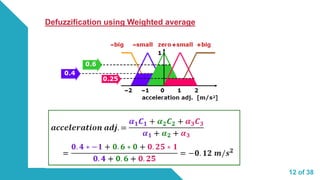
0.4 0.25
0.4
0.6
0.6
0.75
0.75
0.25
0.25
0.4
0.25
0.6
Rule 1: IF distance is small AND speed is declining
THEN acceleration zero
Rule 2: IF distance is small AND speed is constant
THEN acceleration negative small
Rule 3: IF distance is perfect AND speed is declining
THEN acceleration positive small
Rule 4: IF distance is perfect AND speed is constant
THEN acceleration zero
max
Take
min
12 of 38
Defuzzification using Weighted average
13 of 38
Fuzzification Methods
Genetic Algorithm
Angular fuzzy sets
Rank ordering
Inductive
Reasoning
Intuition Neural Networks
Inference
14 of 38
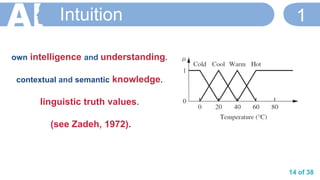
Intuition
own intelligence and understanding.
contextual and semantic knowledge.
linguistic truth values.
(see Zadeh, 1972).
1
15 of 38
Inference 2
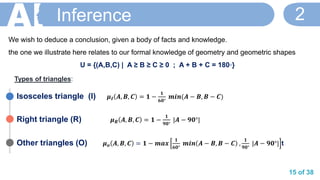
We wish to deduce a conclusion, given a body of facts and knowledge.
the one we illustrate here relates to our formal knowledge of geometry and geometric shapes
U = {(A,B,C) | A ≥ B ≥ C ≥ 0 ; A + B + C = 180◦}
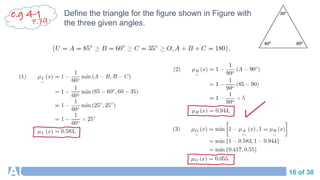
Isosceles triangle (I) 𝝁 𝑰 𝑨, 𝑩, 𝑪 = 𝟏 −
𝟏
𝟔𝟎°
𝒎𝒊𝒏(𝑨 − 𝑩, 𝑩 − 𝑪)
Right triangle (R) 𝝁 𝑹 𝑨, 𝑩, 𝑪 = 𝟏 −
𝟏
𝟗𝟎°
|𝑨 − 𝟗𝟎°|
Other triangles (O) 𝝁 𝒐 𝑨, 𝑩, 𝑪 = 𝟏 − 𝒎𝒂𝒙
𝟏
𝟔𝟎°
𝒎𝒊𝒏 𝑨 − 𝑩, 𝑩 − 𝑪 ,
𝟏
𝟗𝟎°
|𝑨 − 𝟗𝟎°| t
Types of triangles:
16 of 38
e.g 4-1 Define the triangle for the figure shown in Figure with
the three given angles.
17 of 38
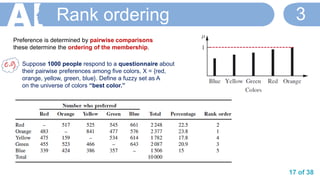
Rank ordering 3
Preference is determined by pairwise comparisons
these determine the ordering of the membership.
Suppose 1000 people respond to a questionnaire about
their pairwise preferences among five colors, X = {red,
orange, yellow, green, blue}. Define a fuzzy set as A
on the universe of colors “best color.”
18 of 38
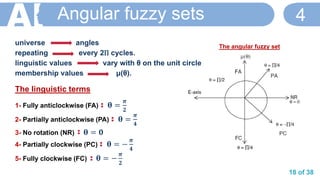
Angular fuzzy sets 4
The linguistic terms
1- Fully anticlockwise (FA) 𝛉 =
𝝅
𝟐
2- Partially anticlockwise (PA) 𝛉 =
𝝅
𝟒
3- No rotation (NR) 𝛉 = 𝟎
4- Partially clockwise (PC) 𝛉 = −
𝝅
𝟒
5- Fully clockwise (FC) 𝛉 = −
𝝅
𝟐
The angular fuzzy set
universe angles
repeating every 2Π cycles.
linguistic values vary with θ on the unit circle
membership values μ(θ).
19 of 38
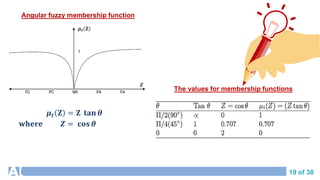
𝝁 𝒕 𝐙 = 𝐙 𝐭𝐚𝐧 𝜽
𝐰𝐡𝐞𝐫𝐞 𝒁 = 𝐜𝐨𝐬 𝜽
Angular fuzzy membership function
𝝁 𝒕 𝐙
𝒁
The values for membership functions
20 of 38
Neural networks 5
A neural network is a technique
that seeks to build an intelligent
program using models that simulate
the working network of the
neurons in the human brain
21 of 38
Genetic Algorithm 6
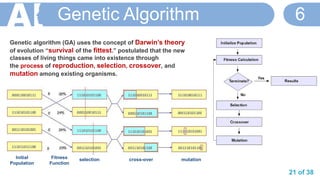
Genetic algorithm (GA) uses the concept of Darwin’s theory
of evolution “survival of the fittest.” postulated that the new
classes of living things came into existence through
the process of reproduction, selection, crossover, and
mutation among existing organisms.
selection cross-over mutationFitness
Function
Initial
Population
22 of 38
Inductive Reasoning 7
23 of 38
EntropyInduction
24 of 38
Inductive Reasoning 7
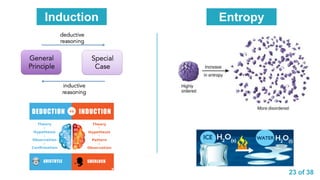
The induction is performed by the entropy
minimization principle, which clusters most
optimally the parameters corresponding to
the output classes [De Luca and Termini,
1972].
Particular General
useful for complex static systems
not useful for dynamic systems
1- subdivide our data set into membership functions
2- determine a threshold line with an entropy
minimization
3- start the segmentation process by moving an
imaginary threshold value x between x1 and x2
4-calculate entropy for each value of x.
25 of 38
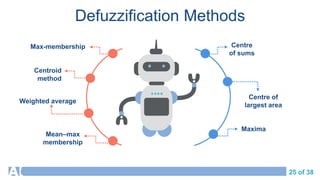
Defuzzification Methods
Centre of
largest area
Mean–max
membership
Weighted average
Maxima
Max-membership Centre
of sums
Centroid
method
26 of 38
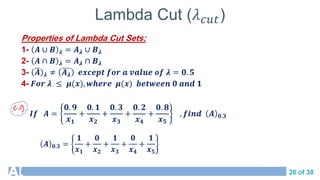
Lambda Cut (𝜆 𝑐𝑢𝑡)
Properties of Lambda Cut Sets:
1- 𝑨 ∪ 𝑩 𝝀 = 𝑨 𝝀 ∪ 𝑩 𝝀
2- 𝑨 ∩ 𝑩 𝝀 = 𝑨 𝝀 ∩ 𝑩 𝝀
3- ഥ𝑨 𝝀 ≠ 𝑨 𝝀 𝒆𝒙𝒄𝒆𝒑𝒕 𝒇𝒐𝒓 𝒂 𝒗𝒂𝒍𝒖𝒆 𝒐𝒇 𝝀 = 𝟎. 𝟓
4- 𝑭𝒐𝒓 𝝀 ≤ 𝝁(𝒙), 𝒘𝒉𝒆𝒓𝒆 𝝁(𝒙) 𝒃𝒆𝒕𝒘𝒆𝒆𝒏 𝟎 𝒂𝒏𝒅 𝟏
𝑰𝒇 𝑨 =
𝟎. 𝟗
𝒙 𝟏
+
𝟎. 𝟏
𝒙 𝟐
+
𝟎. 𝟑
𝒙 𝟑
+
𝟎. 𝟐
𝒙 𝟒
+
𝟎. 𝟖
𝒙 𝟓
, 𝒇𝒊𝒏𝒅 𝑨 𝟎.𝟑
𝑨 𝟎.𝟑 =
𝟏
𝒙 𝟏
+
𝟎
𝒙 𝟐
+
𝟏
𝒙 𝟑
+
𝟎
𝒙 𝟒
+
𝟏
𝒙 𝟓
27 of 38
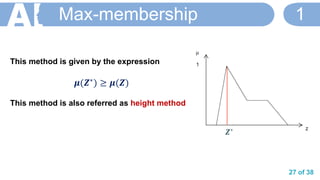
Max-membership 1
𝒁∗
This method is given by the expression
𝝁(𝒁∗
) ≥ 𝝁(𝒁)
This method is also referred as height method
28 of 38
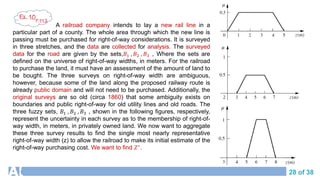
A railroad company intends to lay a new rail line in a
particular part of a county. The whole area through which the new line is
passing must be purchased for right-of-way considerations. It is surveyed
in three stretches, and the data are collected for analysis. The surveyed
data for the road are given by the sets,𝐵1 , 𝐵2 , 𝐵3 , Where the sets are
defined on the universe of right-of-way widths, in meters. For the railroad
to purchase the land, it must have an assessment of the amount of land to
be bought. The three surveys on right-of-way width are ambiguous,
however, because some of the land along the proposed railway route is
already public domain and will not need to be purchased. Additionally, the
original surveys are so old (circa 1860) that some ambiguity exists on
boundaries and public right-of-way for old utility lines and old roads. The
three fuzzy sets, 𝐵1 , 𝐵2 , 𝐵3 , shown in the following figures, respectively,
represent the uncertainty in each survey as to the membership of right-of-
way width, in meters, in privately owned land. We now want to aggregate
these three survey results to find the single most nearly representative
right-of-way width (z) to allow the railroad to make its initial estimate of the
right-of-way purchasing cost. We want to find 𝑍∗.
Ex. 10
P.112
29 of 38
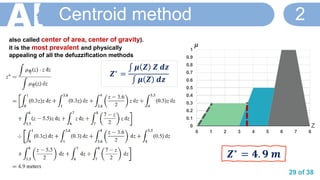
Centroid method 2
also called center of area, center of gravity).
it is the most prevalent and physically
appealing of all the defuzzification methods
𝒁∗ =
‫׬‬ 𝝁 𝒁 𝒁 𝒅𝒛
‫׬‬ 𝝁 𝒁 𝒅𝒛
0
0.1
0.2
0.3
0.4
0.5
0.6
0.7
0.8
0.9
1
0 1 2 3 4 5 6 7 8
𝞵
Z
𝒁∗
= 𝟒. 𝟗 𝒎
30 of 38
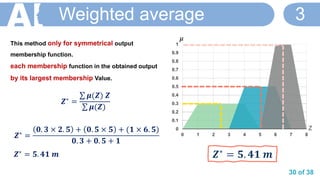
Weighted average 3
This method only for symmetrical output
membership function.
each membership function in the obtained output
by its largest membership Value.
𝒁∗ =
σ 𝝁(𝒁) 𝒁
σ 𝝁(𝒁)
𝒁∗ =
𝟎. 𝟑 × 𝟐. 𝟓 + 𝟎. 𝟓 × 𝟓 + (𝟏 × 𝟔. 𝟓)
𝟎. 𝟑 + 𝟎. 𝟓 + 𝟏
𝒁∗ = 𝟓. 𝟒𝟏 𝒎
0
0.1
0.2
0.3
0.4
0.5
0.6
0.7
0.8
0.9
1
0 1 2 3 4 5 6 7 8
𝞵
Z
𝒁∗
= 𝟓. 𝟒𝟏 𝒎
31 of 38
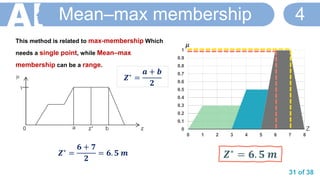
Mean–max membership 4
This method is related to max-membership Which
needs a single point, while Mean–max
membership can be a range.
𝒁∗ =
𝟔 + 𝟕
𝟐
= 𝟔. 𝟓 𝒎
0
0.1
0.2
0.3
0.4
0.5
0.6
0.7
0.8
0.9
1
0 1 2 3 4 5 6 7 8
𝞵
Z
𝒁∗
= 𝟔. 𝟓 𝒎
𝒁∗ =
𝒂 + 𝒃
𝟐
32 of 38
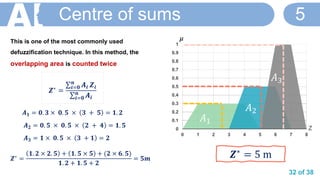
Centre of sums 5
This is one of the most commonly used
defuzzification technique. In this method, the
overlapping area is counted twice
𝑨 𝟏 = 𝟎. 𝟑 × 𝟎. 𝟓 × 𝟑 + 𝟓 = 𝟏. 𝟐
𝑨 𝟐 = 𝟎. 𝟓 × 𝟎. 𝟓 × 𝟐 + 𝟒 = 𝟏. 𝟓
𝑨 𝟑 = 𝟏 × 𝟎. 𝟓 × 𝟑 + 𝟏 = 𝟐
𝒁∗ =
𝟏. 𝟐 × 𝟐. 𝟓 + 𝟏. 𝟓 × 𝟓 + (𝟐 × 𝟔. 𝟓)
𝟏. 𝟐 + 𝟏. 𝟓 + 𝟐
= 𝟓𝒎
𝒁∗ =
σ𝒊=𝟎
𝒏
𝑨𝒊 𝒁𝒊
σ𝒊=𝟎
𝒏
𝑨𝒊
0
0.1
0.2
0.3
0.4
0.5
0.6
0.7
0.8
0.9
1
0 1 2 3 4 5 6 7 8
𝞵
Z
𝒁∗
= 5 m
𝐴1
𝐴2
𝐴3
33 of 38
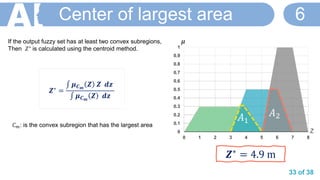
Center of largest area 6
𝒁∗ =
‫׬‬ 𝝁 𝑪 𝒎
𝒁 𝒁 𝒅𝒛
‫׬‬ 𝝁 𝑪 𝒎
𝒁 𝒅𝒛
0
0.1
0.2
0.3
0.4
0.5
0.6
0.7
0.8
0.9
1
0 1 2 3 4 5 6 7 8
𝞵
Z
𝒁∗
= 4.9 m
𝐴1
𝐴2
If the output fuzzy set has at least two convex subregions,
Then 𝑍∗ is calculated using the centroid method.
𝐶 𝑚: is the convex subregion that has the largest area
34 of 38
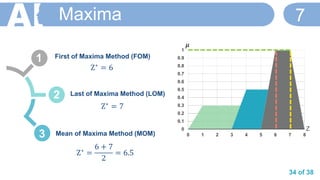
Maxima 7
0
0.1
0.2
0.3
0.4
0.5
0.6
0.7
0.8
0.9
1
0 1 2 3 4 5 6 7 8
𝞵
Z
Z∗ = 6
First of Maxima Method (FOM)1
2
Z∗ = 7
Last of Maxima Method (LOM)
3
Z∗
=
6 + 7
2
= 6.5
Mean of Maxima Method (MOM)
35 of 38
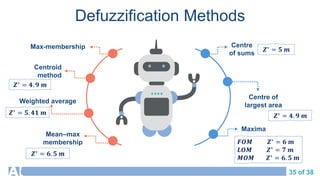
Defuzzification Methods
Centre of
largest area
Mean–max
membership
Weighted average
Maxima
Max-membership Centre
of sums
Centroid
method
𝒁∗
= 𝟒. 𝟗 𝒎
𝒁∗ = 𝟓. 𝟒𝟏 𝒎
𝒁∗ = 𝟔. 𝟓 𝒎
𝒁∗
= 𝟓 𝒎
𝒁∗ = 𝟒. 𝟗 𝒎
𝑭𝑶𝑴 𝒁∗ = 𝟔 𝒎
𝑳𝑶𝑴 𝒁∗ = 𝟕 𝒎
𝑴𝑶𝑴 𝒁∗ = 𝟔. 𝟓 𝒎
36 of 38
References
[1] L.-X. Wang, A Course in Fuzzy Systems and Control. Prentice Hall PTR, 1997.
[2] S. N. Sivanandam, S. Sumathi, and S. N. Deepa, Introduction to Fuzzy Logic
using MATLAB. Springer, 2006.
[3] T. J. Ross, Fuzzy Logic with Engineering Applications, 2nd ed. Wiley, 2004.
[4] Essam Nabil, “Autonomous driving car,” March,2019, pp. 1–13.[presentation].
37 of 38
Slide 1 : [1] man thinking [2] working man
Slide 6 : [2] subway
Slide 7 : [1] sensor [2] system to be controlled
Slide 10 : [1] car
Slide 21 : [1] block diagram of genetic algorithm [2] Steps in Genetic Algorithms
Slide 23 : [1] deductive & inductive reasoning [2] entropy [3] ice and water
Sources of images
38 of 38
Thank You
Nourhan Selem Salm

fuzzy fuzzification and defuzzification

  • 1.
    1 of 38 FUZZYLOGIC Menoufia University Faculty of Electronic Engineering 11/2019
  • 2.
    2 of 38 Agenda Introductionto Fuzzy01 Fuzzification Methods02 Defuzzification Methods03 References04
  • 3.
    3 of 38 WhatFuzzy Systems? Confused vague blurred
  • 4.
    4 of 38 Human knowledge-based Rule-based Fuzzy IFAND THEN distance speed acceleration small speed is declining maintain IF distance perfect AND speed is declining THEN increase acceleration speed [m/s]
  • 5.
    5 of 38 Typesof fuzzy systems Fuzzy systems with fuzzifier and defuzzifier pure fuzzy system its inputs and outputs are fuzzy sets (natural languages) in engineering systems the inputs and outputs are real- valued variables. problem Takagi-Sugeno-Kang (TSK) fuzzy systems problem 1-mathematical formula may not provide a natural framework of human knowledge. 2- there is not much freedom left to apply different principles in fuzzy
  • 6.
    6 of 38 aself-parking car in 1983 Nissan has a patent saves fuel F U Z Z Y App. The fuzzy washing machines were the first major consumer products in Japan around 1990 the most advanced subway system on earth in 1987
  • 7.
    7 of 38 FuzzyLogic Controller Sensor Fuzzification Fuzzy Inference System to be controlled Defuzzification Membership function of input fuzzy set Rule Base Membership function of output fuzzy set Feedback
  • 8.
    8 of 38 Classificationof fuzzy sets Convex fuzzy set Non-Convex fuzzy set Normal fuzzy set Sub-normal fuzzy set
  • 9.
    9 of 38 Typesof membership function 𝝁 𝒙 = 𝟎 , 𝒙 ≤ 𝒂 𝒙 − 𝒂 𝒃 − 𝒂 , 𝒂 ≤ 𝒙 ≤ 𝒃 𝒄 − 𝒙 𝒄 − 𝒃 , 𝒃 ≤ 𝒙 ≤ 𝒄 𝟎 , 𝒙 ≥ 𝒄 Triangular 𝝁 𝒙 = 𝟎 , 𝒙 ≤ 𝒂 𝒙 − 𝒂 𝒃 − 𝒂 , 𝒂 ≤ 𝒙 ≤ 𝒃 𝟏 , 𝒃 ≤ 𝒙 ≤ 𝒄 𝒄 − 𝒙 𝒄 − 𝒃 , 𝒄 ≤ 𝒙 ≤ 𝒅 𝟎 , 𝒙 ≥ 𝒅 Trapezoidal 𝝁 𝒙 = 𝒆𝒙𝒑 − 𝒙 − 𝒄 𝟐 𝟐𝝈 𝟐 Gaussian
  • 10.
    10 of 38 Autonomousdriving car distance speed acceleration 13 m -2.5 m/s ? Knowledge Rule base Distance to next car [ m ] v.small small perfect big v.big Speed Change [ 𝒎 𝟐 ] declining -ve small zero +ve small +ve big +ve big constant -ve big -ve small zero +ve small +ve big growing -ve big -ve big -ve small zero +ve small speed [m/s]
  • 11.
    11 of 38 speed[m/s] Knowledge Rule base Distance to next car [ m ] v.small small perfect big v.big Speed Change [ 𝒎 𝟐 ] declining -ve small zero +ve small +ve big +ve big constant -ve big -ve small zero +ve small +ve big growing -ve big -ve big -ve small zero +ve small 0.4 0.25 0.4 0.6 0.6 0.75 0.75 0.25 0.25 0.4 0.25 0.6 Rule 1: IF distance is small AND speed is declining THEN acceleration zero Rule 2: IF distance is small AND speed is constant THEN acceleration negative small Rule 3: IF distance is perfect AND speed is declining THEN acceleration positive small Rule 4: IF distance is perfect AND speed is constant THEN acceleration zero max Take min
  • 12.
    12 of 38 Defuzzificationusing Weighted average
  • 13.
    13 of 38 FuzzificationMethods Genetic Algorithm Angular fuzzy sets Rank ordering Inductive Reasoning Intuition Neural Networks Inference
  • 14.
    14 of 38 Intuition ownintelligence and understanding. contextual and semantic knowledge. linguistic truth values. (see Zadeh, 1972). 1
  • 15.
    15 of 38 Inference2 We wish to deduce a conclusion, given a body of facts and knowledge. the one we illustrate here relates to our formal knowledge of geometry and geometric shapes U = {(A,B,C) | A ≥ B ≥ C ≥ 0 ; A + B + C = 180◦} Isosceles triangle (I) 𝝁 𝑰 𝑨, 𝑩, 𝑪 = 𝟏 − 𝟏 𝟔𝟎° 𝒎𝒊𝒏(𝑨 − 𝑩, 𝑩 − 𝑪) Right triangle (R) 𝝁 𝑹 𝑨, 𝑩, 𝑪 = 𝟏 − 𝟏 𝟗𝟎° |𝑨 − 𝟗𝟎°| Other triangles (O) 𝝁 𝒐 𝑨, 𝑩, 𝑪 = 𝟏 − 𝒎𝒂𝒙 𝟏 𝟔𝟎° 𝒎𝒊𝒏 𝑨 − 𝑩, 𝑩 − 𝑪 , 𝟏 𝟗𝟎° |𝑨 − 𝟗𝟎°| t Types of triangles:
  • 16.
    16 of 38 e.g4-1 Define the triangle for the figure shown in Figure with the three given angles.
  • 17.
    17 of 38 Rankordering 3 Preference is determined by pairwise comparisons these determine the ordering of the membership. Suppose 1000 people respond to a questionnaire about their pairwise preferences among five colors, X = {red, orange, yellow, green, blue}. Define a fuzzy set as A on the universe of colors “best color.”
  • 18.
    18 of 38 Angularfuzzy sets 4 The linguistic terms 1- Fully anticlockwise (FA) 𝛉 = 𝝅 𝟐 2- Partially anticlockwise (PA) 𝛉 = 𝝅 𝟒 3- No rotation (NR) 𝛉 = 𝟎 4- Partially clockwise (PC) 𝛉 = − 𝝅 𝟒 5- Fully clockwise (FC) 𝛉 = − 𝝅 𝟐 The angular fuzzy set universe angles repeating every 2Π cycles. linguistic values vary with θ on the unit circle membership values μ(θ).
  • 19.
    19 of 38 𝝁𝒕 𝐙 = 𝐙 𝐭𝐚𝐧 𝜽 𝐰𝐡𝐞𝐫𝐞 𝒁 = 𝐜𝐨𝐬 𝜽 Angular fuzzy membership function 𝝁 𝒕 𝐙 𝒁 The values for membership functions
  • 20.
    20 of 38 Neuralnetworks 5 A neural network is a technique that seeks to build an intelligent program using models that simulate the working network of the neurons in the human brain
  • 21.
    21 of 38 GeneticAlgorithm 6 Genetic algorithm (GA) uses the concept of Darwin’s theory of evolution “survival of the fittest.” postulated that the new classes of living things came into existence through the process of reproduction, selection, crossover, and mutation among existing organisms. selection cross-over mutationFitness Function Initial Population
  • 22.
    22 of 38 InductiveReasoning 7
  • 23.
  • 24.
    24 of 38 InductiveReasoning 7 The induction is performed by the entropy minimization principle, which clusters most optimally the parameters corresponding to the output classes [De Luca and Termini, 1972]. Particular General useful for complex static systems not useful for dynamic systems 1- subdivide our data set into membership functions 2- determine a threshold line with an entropy minimization 3- start the segmentation process by moving an imaginary threshold value x between x1 and x2 4-calculate entropy for each value of x.
  • 25.
    25 of 38 DefuzzificationMethods Centre of largest area Mean–max membership Weighted average Maxima Max-membership Centre of sums Centroid method
  • 26.
    26 of 38 LambdaCut (𝜆 𝑐𝑢𝑡) Properties of Lambda Cut Sets: 1- 𝑨 ∪ 𝑩 𝝀 = 𝑨 𝝀 ∪ 𝑩 𝝀 2- 𝑨 ∩ 𝑩 𝝀 = 𝑨 𝝀 ∩ 𝑩 𝝀 3- ഥ𝑨 𝝀 ≠ 𝑨 𝝀 𝒆𝒙𝒄𝒆𝒑𝒕 𝒇𝒐𝒓 𝒂 𝒗𝒂𝒍𝒖𝒆 𝒐𝒇 𝝀 = 𝟎. 𝟓 4- 𝑭𝒐𝒓 𝝀 ≤ 𝝁(𝒙), 𝒘𝒉𝒆𝒓𝒆 𝝁(𝒙) 𝒃𝒆𝒕𝒘𝒆𝒆𝒏 𝟎 𝒂𝒏𝒅 𝟏 𝑰𝒇 𝑨 = 𝟎. 𝟗 𝒙 𝟏 + 𝟎. 𝟏 𝒙 𝟐 + 𝟎. 𝟑 𝒙 𝟑 + 𝟎. 𝟐 𝒙 𝟒 + 𝟎. 𝟖 𝒙 𝟓 , 𝒇𝒊𝒏𝒅 𝑨 𝟎.𝟑 𝑨 𝟎.𝟑 = 𝟏 𝒙 𝟏 + 𝟎 𝒙 𝟐 + 𝟏 𝒙 𝟑 + 𝟎 𝒙 𝟒 + 𝟏 𝒙 𝟓
  • 27.
    27 of 38 Max-membership1 𝒁∗ This method is given by the expression 𝝁(𝒁∗ ) ≥ 𝝁(𝒁) This method is also referred as height method
  • 28.
    28 of 38 Arailroad company intends to lay a new rail line in a particular part of a county. The whole area through which the new line is passing must be purchased for right-of-way considerations. It is surveyed in three stretches, and the data are collected for analysis. The surveyed data for the road are given by the sets,𝐵1 , 𝐵2 , 𝐵3 , Where the sets are defined on the universe of right-of-way widths, in meters. For the railroad to purchase the land, it must have an assessment of the amount of land to be bought. The three surveys on right-of-way width are ambiguous, however, because some of the land along the proposed railway route is already public domain and will not need to be purchased. Additionally, the original surveys are so old (circa 1860) that some ambiguity exists on boundaries and public right-of-way for old utility lines and old roads. The three fuzzy sets, 𝐵1 , 𝐵2 , 𝐵3 , shown in the following figures, respectively, represent the uncertainty in each survey as to the membership of right-of- way width, in meters, in privately owned land. We now want to aggregate these three survey results to find the single most nearly representative right-of-way width (z) to allow the railroad to make its initial estimate of the right-of-way purchasing cost. We want to find 𝑍∗. Ex. 10 P.112
  • 29.
    29 of 38 Centroidmethod 2 also called center of area, center of gravity). it is the most prevalent and physically appealing of all the defuzzification methods 𝒁∗ = ‫׬‬ 𝝁 𝒁 𝒁 𝒅𝒛 ‫׬‬ 𝝁 𝒁 𝒅𝒛 0 0.1 0.2 0.3 0.4 0.5 0.6 0.7 0.8 0.9 1 0 1 2 3 4 5 6 7 8 𝞵 Z 𝒁∗ = 𝟒. 𝟗 𝒎
  • 30.
    30 of 38 Weightedaverage 3 This method only for symmetrical output membership function. each membership function in the obtained output by its largest membership Value. 𝒁∗ = σ 𝝁(𝒁) 𝒁 σ 𝝁(𝒁) 𝒁∗ = 𝟎. 𝟑 × 𝟐. 𝟓 + 𝟎. 𝟓 × 𝟓 + (𝟏 × 𝟔. 𝟓) 𝟎. 𝟑 + 𝟎. 𝟓 + 𝟏 𝒁∗ = 𝟓. 𝟒𝟏 𝒎 0 0.1 0.2 0.3 0.4 0.5 0.6 0.7 0.8 0.9 1 0 1 2 3 4 5 6 7 8 𝞵 Z 𝒁∗ = 𝟓. 𝟒𝟏 𝒎
  • 31.
    31 of 38 Mean–maxmembership 4 This method is related to max-membership Which needs a single point, while Mean–max membership can be a range. 𝒁∗ = 𝟔 + 𝟕 𝟐 = 𝟔. 𝟓 𝒎 0 0.1 0.2 0.3 0.4 0.5 0.6 0.7 0.8 0.9 1 0 1 2 3 4 5 6 7 8 𝞵 Z 𝒁∗ = 𝟔. 𝟓 𝒎 𝒁∗ = 𝒂 + 𝒃 𝟐
  • 32.
    32 of 38 Centreof sums 5 This is one of the most commonly used defuzzification technique. In this method, the overlapping area is counted twice 𝑨 𝟏 = 𝟎. 𝟑 × 𝟎. 𝟓 × 𝟑 + 𝟓 = 𝟏. 𝟐 𝑨 𝟐 = 𝟎. 𝟓 × 𝟎. 𝟓 × 𝟐 + 𝟒 = 𝟏. 𝟓 𝑨 𝟑 = 𝟏 × 𝟎. 𝟓 × 𝟑 + 𝟏 = 𝟐 𝒁∗ = 𝟏. 𝟐 × 𝟐. 𝟓 + 𝟏. 𝟓 × 𝟓 + (𝟐 × 𝟔. 𝟓) 𝟏. 𝟐 + 𝟏. 𝟓 + 𝟐 = 𝟓𝒎 𝒁∗ = σ𝒊=𝟎 𝒏 𝑨𝒊 𝒁𝒊 σ𝒊=𝟎 𝒏 𝑨𝒊 0 0.1 0.2 0.3 0.4 0.5 0.6 0.7 0.8 0.9 1 0 1 2 3 4 5 6 7 8 𝞵 Z 𝒁∗ = 5 m 𝐴1 𝐴2 𝐴3
  • 33.
    33 of 38 Centerof largest area 6 𝒁∗ = ‫׬‬ 𝝁 𝑪 𝒎 𝒁 𝒁 𝒅𝒛 ‫׬‬ 𝝁 𝑪 𝒎 𝒁 𝒅𝒛 0 0.1 0.2 0.3 0.4 0.5 0.6 0.7 0.8 0.9 1 0 1 2 3 4 5 6 7 8 𝞵 Z 𝒁∗ = 4.9 m 𝐴1 𝐴2 If the output fuzzy set has at least two convex subregions, Then 𝑍∗ is calculated using the centroid method. 𝐶 𝑚: is the convex subregion that has the largest area
  • 34.
    34 of 38 Maxima7 0 0.1 0.2 0.3 0.4 0.5 0.6 0.7 0.8 0.9 1 0 1 2 3 4 5 6 7 8 𝞵 Z Z∗ = 6 First of Maxima Method (FOM)1 2 Z∗ = 7 Last of Maxima Method (LOM) 3 Z∗ = 6 + 7 2 = 6.5 Mean of Maxima Method (MOM)
  • 35.
    35 of 38 DefuzzificationMethods Centre of largest area Mean–max membership Weighted average Maxima Max-membership Centre of sums Centroid method 𝒁∗ = 𝟒. 𝟗 𝒎 𝒁∗ = 𝟓. 𝟒𝟏 𝒎 𝒁∗ = 𝟔. 𝟓 𝒎 𝒁∗ = 𝟓 𝒎 𝒁∗ = 𝟒. 𝟗 𝒎 𝑭𝑶𝑴 𝒁∗ = 𝟔 𝒎 𝑳𝑶𝑴 𝒁∗ = 𝟕 𝒎 𝑴𝑶𝑴 𝒁∗ = 𝟔. 𝟓 𝒎
  • 36.
    36 of 38 References [1]L.-X. Wang, A Course in Fuzzy Systems and Control. Prentice Hall PTR, 1997. [2] S. N. Sivanandam, S. Sumathi, and S. N. Deepa, Introduction to Fuzzy Logic using MATLAB. Springer, 2006. [3] T. J. Ross, Fuzzy Logic with Engineering Applications, 2nd ed. Wiley, 2004. [4] Essam Nabil, “Autonomous driving car,” March,2019, pp. 1–13.[presentation].
  • 37.
    37 of 38 Slide1 : [1] man thinking [2] working man Slide 6 : [2] subway Slide 7 : [1] sensor [2] system to be controlled Slide 10 : [1] car Slide 21 : [1] block diagram of genetic algorithm [2] Steps in Genetic Algorithms Slide 23 : [1] deductive & inductive reasoning [2] entropy [3] ice and water Sources of images
  • 38.
    38 of 38 ThankYou Nourhan Selem Salm