

4/3/2020 1
INTRODUCTION TO FUZZY
LOGIC CONTROL
BY
Mr.A.Arulkumar,
Assistant Professor
Dept. of Mechatronics Engg
Kamaraj College of Engg &Technology
Email :
arulkumarmtr@kamarajengg.edu.in
FUZZY LOGIC
 Fuzzy logic is the logic underlying approximate, rather than
exact, modes of reasoning.
 It is an extension of multivalued logic: Everything, including
truth, is a matter of degree.
 It contains as special cases not only the classical two-value
logic and multivalue logic systems, but also probabilistic
logic.
 A proposition p has a truth value
• 0 or 1 in two-value system,
• element of a set T in multivalue system,
• Range over the fuzzy subsets of T in fuzzy logic.
4/3/2020 2
FUZZY LOGIC
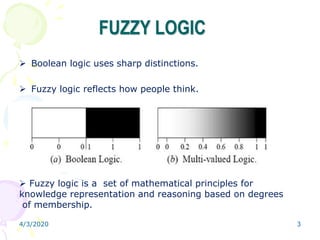
 Boolean logic uses sharp distinctions.
 Fuzzy logic reflects how people think.
• Fuzzy logic is a set of mathematical principles for
4/3/2020 3
 Fuzzy logic is a set of mathematical principles for
knowledge representation and reasoning based on degrees
of membership.
4/3/2020 4
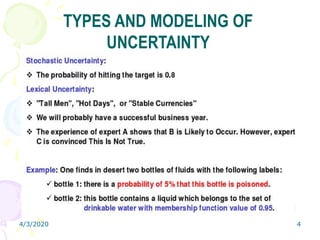
TYPES AND MODELING OF
UNCERTAINTY
4/3/2020 5
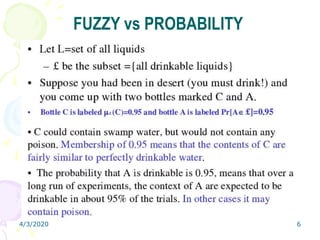
FUZZY vs PROBABILITY
 Fuzzy ≠ Probability
 Probability deals with uncertainty an
likelihood
 Fuzzy logic deals with ambiguity an
vagueness
4/3/2020 6
FUZZY vs PROBABILITY
4/3/2020 7
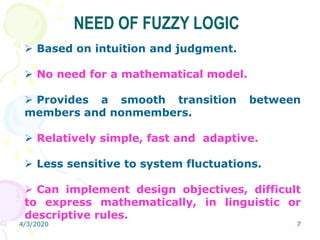
NEED OF FUZZY LOGIC
 Based on intuition and judgment.
 No need for a mathematical model.
 Provides a smooth transition between
members and nonmembers.
 Relatively simple, fast and adaptive.
 Less sensitive to system fluctuations.
 Can implement design objectives, difficult
to express mathematically, in linguistic or
descriptive rules.
4/3/2020 8
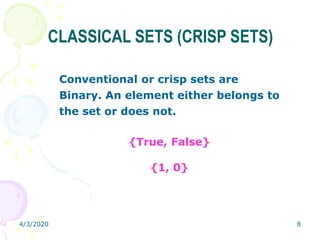
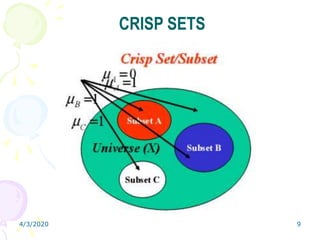
CLASSICAL SETS (CRISP SETS)
Conventional or crisp sets are
Binary. An element either belongs to
the set or does not.
{True, False}
{1, 0}
4/3/2020 9
CRISP SETS
4/3/2020 10
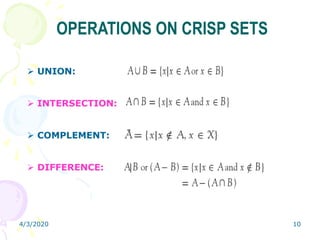
OPERATIONS ON CRISP SETS
 UNION:
 INTERSECTION:
 COMPLEMENT:
 DIFFERENCE:
4/3/2020 11
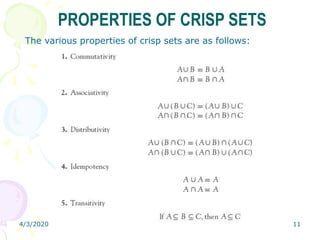
PROPERTIES OF CRISP SETS
The various properties of crisp sets are as follows:
4/3/2020 12
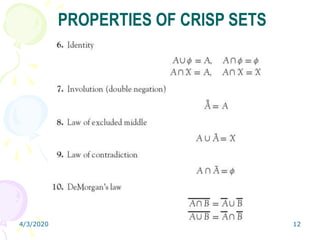
PROPERTIES OF CRISP SETS
4/3/2020 13
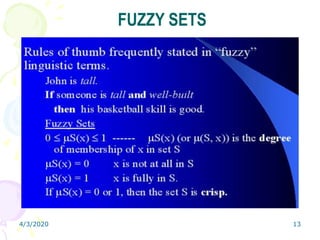
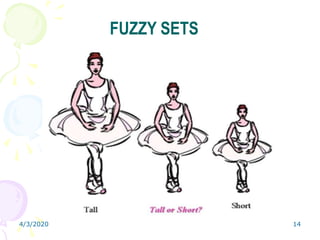
FUZZY SETS
4/3/2020 14
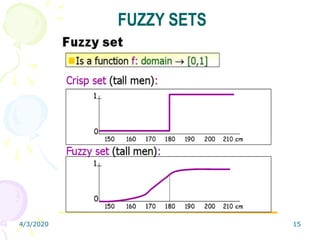
FUZZY SETS
4/3/2020 15
FUZZY SETS
4/3/2020 16
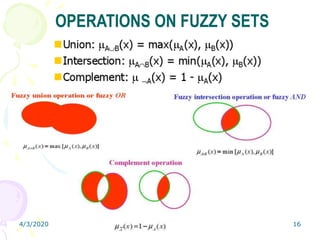
OPERATIONS ON FUZZY SETS
4/3/2020 17
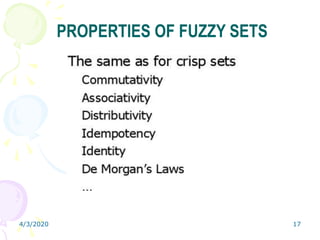
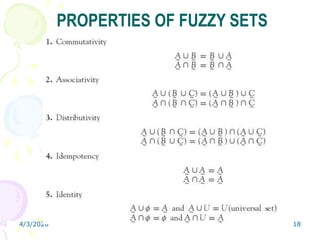
PROPERTIES OF FUZZY SETS
4/3/2020 18
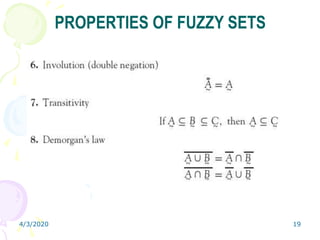
PROPERTIES OF FUZZY SETS
4/3/2020 19
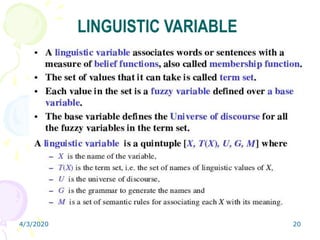
PROPERTIES OF FUZZY SETS
4/3/2020 20
LINGUISTIC VARIABLE
4/3/2020 21
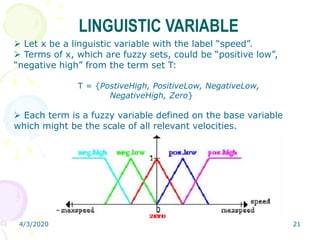
LINGUISTIC VARIABLE
 Let x be a linguistic variable with the label “speed”.
 Terms of x, which are fuzzy sets, could be “positive low”,
“negative high” from the term set T:
T = {PostiveHigh, PositiveLow, NegativeLow,
NegativeHigh, Zero}
 Each term is a fuzzy variable defined on the base variable
which might be the scale of all relevant velocities.
4/3/2020 22
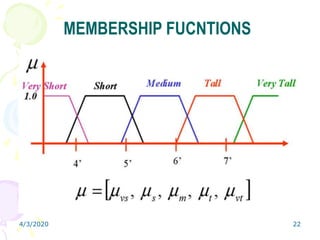
MEMBERSHIP FUCNTIONS
4/3/2020 23
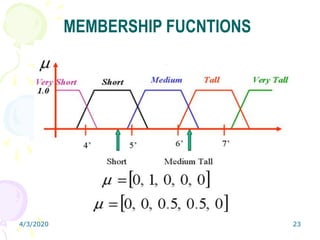
MEMBERSHIP FUCNTIONS
4/3/2020 24
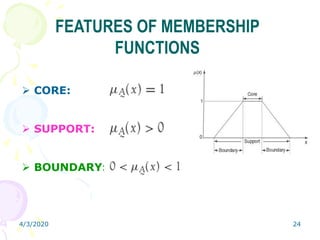
FEATURES OF MEMBERSHIP
FUNCTIONS
 CORE:
 SUPPORT:
 BOUNDARY:
4/3/2020 25
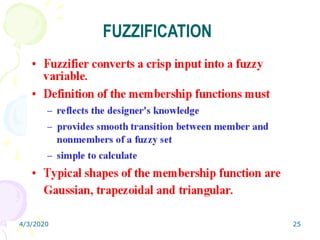
FUZZIFICATION
4/3/2020 26
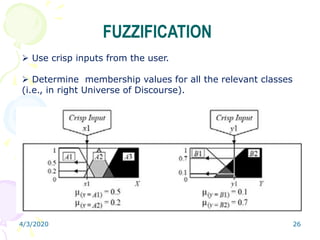
FUZZIFICATION
 Use crisp inputs from the user.
 Determine membership values for all the relevant classes
(i.e., in right Universe of Discourse).
4/3/2020 27
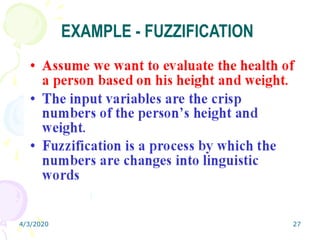
EXAMPLE - FUZZIFICATION
4/3/2020 28
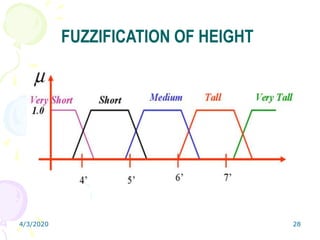
FUZZIFICATION OF HEIGHT
4/3/2020 29
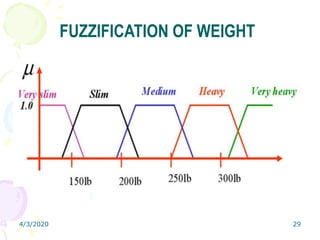
FUZZIFICATION OF WEIGHT
4/3/2020 30
METHODS OF MEMBERSHIP VALUE
ASSIGNMENT
The various methods of assigning membership values are:
 Intuition,
 Inference,
 Rank ordering,
 Angular fuzzy sets,
 Neural networks,
 Genetic algorithm,
 Inductive reasoning.
4/3/2020 31
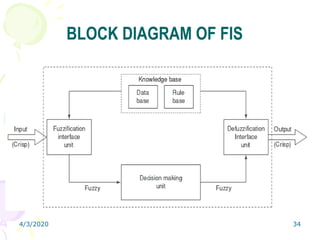
FUZZY INFERENCE SYSTEMS (FIS)
 Fuzzy rule based systems, fuzzy models, and
fuzzy expert systems are also known as fuzzy
inference systems.
 The key unit of a fuzzy logic system is FIS.
 The primary work of this system is decision-
making.
 FIS uses “IF...THEN” rules along with connectors
“OR” or “AND” for making necessary decision rules.
4/3/2020 32
 The input to FIS may be fuzzy or crisp, but the
output from FIS is always a fuzzy set.
 When FIS is used as a controller, it is
necessary to have crisp output.
 Hence, there should be a defuzzification unit
for converting fuzzy variables into crisp variables
along FIS.
FUZZY INFERENCE SYSTEMS
4/3/2020 33
FUZZIFICATION
4/3/2020 34
BLOCK DIAGRAM OF FIS
4/3/2020 35
TYPES OF FIS
There are two types of Fuzzy Inference
Systems:
 Mamdani FIS(1975)
 Sugeno FIS(1985)
4/3/2020 36
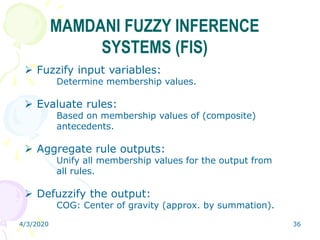
MAMDANI FUZZY INFERENCE
SYSTEMS (FIS)
 Fuzzify input variables:
Determine membership values.
 Evaluate rules:
Based on membership values of (composite)
antecedents.
 Aggregate rule outputs:
Unify all membership values for the output from
all rules.
 Defuzzify the output:
COG: Center of gravity (approx. by summation).
4/3/2020 37
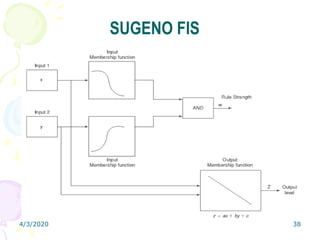
SUGENO FUZZY INFERENCE
SYSTEMS (FIS)
The main steps of the fuzzy inference process namely,
1. fuzzifying the inputs and
2. applying the fuzzy operator
are exactly the same as in MAMDANI FIS.
The main difference between Mamdani’s and Sugeno’s methods
is that Sugeno output membership functions are either linear or
constant.
4/3/2020 38
SUGENO FIS
4/3/2020 39
DEFUZZIFICATION
 Defuzzification is a mapping process from a space of
fuzzy control actions defined over an output universe of
discourse into a space of crisp (nonfuzzy) control
actions.
 Defuzzification is a process of converting output fuzzy
variable into a unique number .
 Defuzzification process has the capability to reduce a
fuzzy set into a crisp single-valued quantity or into a
crisp set; to convert a fuzzy matrix into a crisp matrix;
or to convert a fuzzy number into a crisp number.
4/3/2020 40
FUZZY EXPERT SYSTEMS
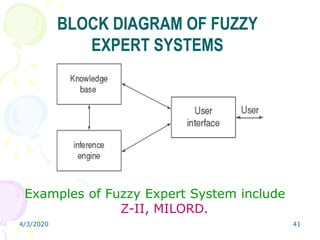
An expert system contains three major blocks:
 Knowledge base that contains the knowledge
specific to the domain of application.
 Inference engine that uses the knowledge in the
knowledge base for performing suitable reasoning
for user’s queries.
 User interface that provides a smooth
communication between the user and the system.
4/3/2020 41
BLOCK DIAGRAM OF FUZZY
EXPERT SYSTEMS
Examples of Fuzzy Expert System include
Z-II, MILORD.
4/3/2020 42
SUMMARY
Defuzzification process is essential because some
engineering applications need exact values for
performing the operation.
Example: If speed of a motor has to be varied, we
cannot instruct to raise it “slightly”, “high”, etc.,
using linguistic variables; rather, it should be
specified as raise it by 200 rpm or so, i.e., a
specific amount of raise should be mentioned.
The method of defuzzification should be assessed
on the basis of the output in the context of data
available.

Fuzzy logic control

  • 1.
    4/3/2020 1 INTRODUCTION TOFUZZY LOGIC CONTROL BY Mr.A.Arulkumar, Assistant Professor Dept. of Mechatronics Engg Kamaraj College of Engg &Technology Email : arulkumarmtr@kamarajengg.edu.in
  • 2.
    FUZZY LOGIC  Fuzzylogic is the logic underlying approximate, rather than exact, modes of reasoning.  It is an extension of multivalued logic: Everything, including truth, is a matter of degree.  It contains as special cases not only the classical two-value logic and multivalue logic systems, but also probabilistic logic.  A proposition p has a truth value • 0 or 1 in two-value system, • element of a set T in multivalue system, • Range over the fuzzy subsets of T in fuzzy logic. 4/3/2020 2
  • 3.
    FUZZY LOGIC  Booleanlogic uses sharp distinctions.  Fuzzy logic reflects how people think. • Fuzzy logic is a set of mathematical principles for 4/3/2020 3  Fuzzy logic is a set of mathematical principles for knowledge representation and reasoning based on degrees of membership.
  • 4.
    4/3/2020 4 TYPES ANDMODELING OF UNCERTAINTY
  • 5.
    4/3/2020 5 FUZZY vsPROBABILITY  Fuzzy ≠ Probability  Probability deals with uncertainty an likelihood  Fuzzy logic deals with ambiguity an vagueness
  • 6.
  • 7.
    4/3/2020 7 NEED OFFUZZY LOGIC  Based on intuition and judgment.  No need for a mathematical model.  Provides a smooth transition between members and nonmembers.  Relatively simple, fast and adaptive.  Less sensitive to system fluctuations.  Can implement design objectives, difficult to express mathematically, in linguistic or descriptive rules.
  • 8.
    4/3/2020 8 CLASSICAL SETS(CRISP SETS) Conventional or crisp sets are Binary. An element either belongs to the set or does not. {True, False} {1, 0}
  • 9.
  • 10.
    4/3/2020 10 OPERATIONS ONCRISP SETS  UNION:  INTERSECTION:  COMPLEMENT:  DIFFERENCE:
  • 11.
    4/3/2020 11 PROPERTIES OFCRISP SETS The various properties of crisp sets are as follows:
  • 12.
  • 13.
  • 14.
  • 15.
  • 16.
  • 17.
  • 18.
  • 19.
  • 20.
  • 21.
    4/3/2020 21 LINGUISTIC VARIABLE Let x be a linguistic variable with the label “speed”.  Terms of x, which are fuzzy sets, could be “positive low”, “negative high” from the term set T: T = {PostiveHigh, PositiveLow, NegativeLow, NegativeHigh, Zero}  Each term is a fuzzy variable defined on the base variable which might be the scale of all relevant velocities.
  • 22.
  • 23.
  • 24.
    4/3/2020 24 FEATURES OFMEMBERSHIP FUNCTIONS  CORE:  SUPPORT:  BOUNDARY:
  • 25.
  • 26.
    4/3/2020 26 FUZZIFICATION  Usecrisp inputs from the user.  Determine membership values for all the relevant classes (i.e., in right Universe of Discourse).
  • 27.
    4/3/2020 27 EXAMPLE -FUZZIFICATION
  • 28.
  • 29.
  • 30.
    4/3/2020 30 METHODS OFMEMBERSHIP VALUE ASSIGNMENT The various methods of assigning membership values are:  Intuition,  Inference,  Rank ordering,  Angular fuzzy sets,  Neural networks,  Genetic algorithm,  Inductive reasoning.
  • 31.
    4/3/2020 31 FUZZY INFERENCESYSTEMS (FIS)  Fuzzy rule based systems, fuzzy models, and fuzzy expert systems are also known as fuzzy inference systems.  The key unit of a fuzzy logic system is FIS.  The primary work of this system is decision- making.  FIS uses “IF...THEN” rules along with connectors “OR” or “AND” for making necessary decision rules.
  • 32.
    4/3/2020 32  Theinput to FIS may be fuzzy or crisp, but the output from FIS is always a fuzzy set.  When FIS is used as a controller, it is necessary to have crisp output.  Hence, there should be a defuzzification unit for converting fuzzy variables into crisp variables along FIS. FUZZY INFERENCE SYSTEMS
  • 33.
  • 34.
  • 35.
    4/3/2020 35 TYPES OFFIS There are two types of Fuzzy Inference Systems:  Mamdani FIS(1975)  Sugeno FIS(1985)
  • 36.
    4/3/2020 36 MAMDANI FUZZYINFERENCE SYSTEMS (FIS)  Fuzzify input variables: Determine membership values.  Evaluate rules: Based on membership values of (composite) antecedents.  Aggregate rule outputs: Unify all membership values for the output from all rules.  Defuzzify the output: COG: Center of gravity (approx. by summation).
  • 37.
    4/3/2020 37 SUGENO FUZZYINFERENCE SYSTEMS (FIS) The main steps of the fuzzy inference process namely, 1. fuzzifying the inputs and 2. applying the fuzzy operator are exactly the same as in MAMDANI FIS. The main difference between Mamdani’s and Sugeno’s methods is that Sugeno output membership functions are either linear or constant.
  • 38.
  • 39.
    4/3/2020 39 DEFUZZIFICATION  Defuzzificationis a mapping process from a space of fuzzy control actions defined over an output universe of discourse into a space of crisp (nonfuzzy) control actions.  Defuzzification is a process of converting output fuzzy variable into a unique number .  Defuzzification process has the capability to reduce a fuzzy set into a crisp single-valued quantity or into a crisp set; to convert a fuzzy matrix into a crisp matrix; or to convert a fuzzy number into a crisp number.
  • 40.
    4/3/2020 40 FUZZY EXPERTSYSTEMS An expert system contains three major blocks:  Knowledge base that contains the knowledge specific to the domain of application.  Inference engine that uses the knowledge in the knowledge base for performing suitable reasoning for user’s queries.  User interface that provides a smooth communication between the user and the system.
  • 41.
    4/3/2020 41 BLOCK DIAGRAMOF FUZZY EXPERT SYSTEMS Examples of Fuzzy Expert System include Z-II, MILORD.
  • 42.
    4/3/2020 42 SUMMARY Defuzzification processis essential because some engineering applications need exact values for performing the operation. Example: If speed of a motor has to be varied, we cannot instruct to raise it “slightly”, “high”, etc., using linguistic variables; rather, it should be specified as raise it by 200 rpm or so, i.e., a specific amount of raise should be mentioned. The method of defuzzification should be assessed on the basis of the output in the context of data available.