FTP
File Transfer Protocol
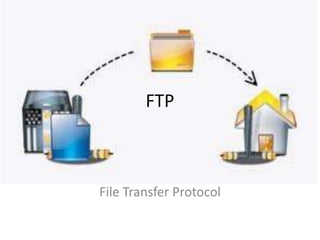
• FTP (File Transfer Protocol) is a protocol for
transferring a file from one host to another host.
Compare & Contrast FTP with HTTP
• They both:
–run on top of TCP,
–the Internet's connection-oriented,
–transport-layer,
–reliable data transfer protocol.
FTP
• uses two parallel TCP connections to transfer a
file, a control connection and a data
connection.
• The control connection is used for sending
control information between the two hosts --
information such as user identification,
password, commands to change remote
directory, and commands to "put" and "get"
files.
• The data connection is used to actually send a
file.
• Because FTP uses a separate control
connection, FTP is said to send its control
information out-of-band.
FTP
FTP
•two parallel
TCP
connections
•FTP is said to
send its control
information
out-of-band.
•Maintain State
HTTP
•One TCP
connection
•HTTP is said to
send its control
information in-
band.
•Stateless
FTP…
• FTP first sets up a control TCP connection on
server port number 21.
• The client side of FTP sends the user
identification and password over this control
connection.
• The client side of FTP also sends, over the control
connection, commands to change the remote
directory.
• When the user requests a file transfer (either to,
or from, the remote host), FTP opens a TCP data
connection on server port number 20.
FTP…
• FTP sends exactly one file over the data
connection and then closes the data
connection.
• If, during the same session, the user wants to
transfer another file, FTP opens another data
TCP connection.
• Throughout a session, the FTP server must
maintain state about the user.
FTP Commands and Replies
• The commands, from client to server, and replies,
from server to client, are sent across the control
TCP connection in 7-bit ASCII format.
• In order to delineate successive commands, a
carriage return and line feed end each command
(and reply).
• Each command consists of four uppercase ASCII
characters, some with optional arguments.
FTP Commands and Replies…
• Some of the more common commands are:
– USER username : Used to send the user identification
to server.
– PASS password : Used to send the user password to
the server.
– LIST : Used to ask the server to send back a list of all
the files in the current remote directory. The list of
files is sent over a (new and non-persistent) data TCP
connection and not over the control TCP connection.
– RETR filename : Used to retrieve (i.e., get) a file from
the current directory of the remote host.
– STOR filename : Used to store (i.e., put) a file into the
current directory of the remote host.
FTP Commands and Replies…
• Some typical replies:
– 331 Username OK, password required
– 125 Data connection already open; transfer
starting
– 425 Can't open data connection
– 452 Error writing file

FTP

  • 1.
  • 2.
    • FTP (FileTransfer Protocol) is a protocol for transferring a file from one host to another host.
  • 3.
    Compare & ContrastFTP with HTTP • They both: –run on top of TCP, –the Internet's connection-oriented, –transport-layer, –reliable data transfer protocol.
  • 4.
    FTP • uses twoparallel TCP connections to transfer a file, a control connection and a data connection.
  • 5.
    • The controlconnection is used for sending control information between the two hosts -- information such as user identification, password, commands to change remote directory, and commands to "put" and "get" files. • The data connection is used to actually send a file. • Because FTP uses a separate control connection, FTP is said to send its control information out-of-band. FTP
  • 6.
    FTP •two parallel TCP connections •FTP issaid to send its control information out-of-band. •Maintain State HTTP •One TCP connection •HTTP is said to send its control information in- band. •Stateless
  • 7.
    FTP… • FTP firstsets up a control TCP connection on server port number 21. • The client side of FTP sends the user identification and password over this control connection. • The client side of FTP also sends, over the control connection, commands to change the remote directory. • When the user requests a file transfer (either to, or from, the remote host), FTP opens a TCP data connection on server port number 20.
  • 8.
    FTP… • FTP sendsexactly one file over the data connection and then closes the data connection. • If, during the same session, the user wants to transfer another file, FTP opens another data TCP connection. • Throughout a session, the FTP server must maintain state about the user.
  • 9.
    FTP Commands andReplies • The commands, from client to server, and replies, from server to client, are sent across the control TCP connection in 7-bit ASCII format. • In order to delineate successive commands, a carriage return and line feed end each command (and reply). • Each command consists of four uppercase ASCII characters, some with optional arguments.
  • 10.
    FTP Commands andReplies… • Some of the more common commands are: – USER username : Used to send the user identification to server. – PASS password : Used to send the user password to the server. – LIST : Used to ask the server to send back a list of all the files in the current remote directory. The list of files is sent over a (new and non-persistent) data TCP connection and not over the control TCP connection. – RETR filename : Used to retrieve (i.e., get) a file from the current directory of the remote host. – STOR filename : Used to store (i.e., put) a file into the current directory of the remote host.
  • 11.
    FTP Commands andReplies… • Some typical replies: – 331 Username OK, password required – 125 Data connection already open; transfer starting – 425 Can't open data connection – 452 Error writing file