SUBMITTED BY:
RAJAN PANDEY
0505CS081036
Simple Mail Transfer
Protocol
INTRODUCTION
SMTP clients and servers have
two main components
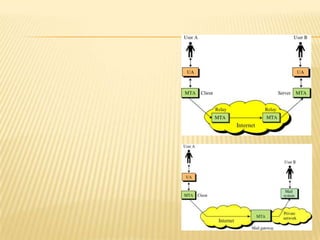
User Agents – Prepares the
message, encloses it in an
envelope. (ex. Thunderbird, Eudora)
Mail Transfer Agent – Transfers the
mail across the internet (ex.
Sendmail, Exim)
Analogous to the postal system in
many ways
HOW MESSAGES ARE SENT TO SMTP SERVER?
 E-mail communication using Relaying
 Used during initial days of SMTP.
 SMTP routing information is included along with E-mail address.
 Problem with this method.
 Using DNS
 This method is used at present.
 The senders SMTP server makes the use of DNS to find MX record of
the domain to which the E-mail is to be sent.
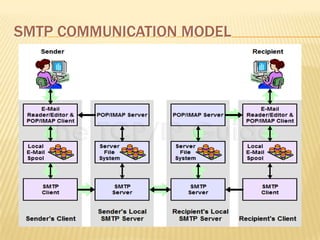
SMTP COMMUNICATION MODEL
MAIL PROCESSING MODEL
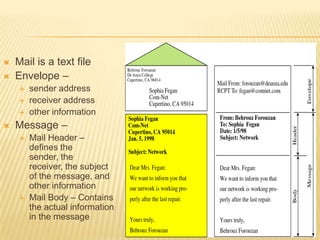
 Mail is a text file
 Envelope –
 sender address
 receiver address
 other information
 Message –
 Mail Header –
defines the
sender, the
receiver, the subject
of the message, and
other information
 Mail Body – Contains
the actual information
in the message
 Status Codes
The Server responds with a 3 digit code that may
be followed by text info
2## - Success
3## - Command can be accepted with
more information
4## - Command was rejected, but error
condition is temporary
5## - Command rejected, Bad User!
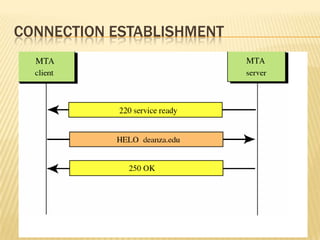
CONNECTION ESTABLISHMENT
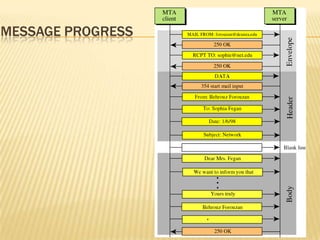
MESSAGE PROGRESS
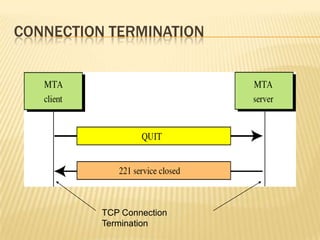
CONNECTION TERMINATION
TCP Connection
Termination
SPECIAL FEATURES
 Mail Forwarding: SMTP server may agree to accept e-mail for
non-local mailbox and forward it to the appropriate
destination.
 Mail Gatewaying: SMTP servers can be implemented as e-
mail gateways which can translate TCP/IP email in a suitable
form for some another e-mail system and vice-versa.
 Mail Relaying: SMTP includes the ability to relay mail from
one server to another, as explained earlier, provided certain
conditions are met.
 Address Debugging: VRFY command allows the client to ask
the sender to verify address of recipient without sending
mail to recipient.
 Mailing List Expansion: EXPN command allows to expand
mailing list.
LIMITATIONS
• Security matters for SMTP are worse.
• Its usefulness is limited by its simplicity.
• Transmission of executable files and binary files using SMTP is not
possible without converting into text files. Use MIME to send mail in
other format.
• It cannot transmit text data that contains national language characters.
These national language characters use 8-bit codes with values of 128
decimal or more.
• It is limited to 7-bit ASCII characters only.
• SMTP servers may reject mail messages beyond some specific length.
THANK YOU
“Wish you have a Great Time
Ahead”
RAJAN PANDEY

Simple Mail Transfer Protocol

  • 1.
  • 2.
    INTRODUCTION SMTP clients andservers have two main components User Agents – Prepares the message, encloses it in an envelope. (ex. Thunderbird, Eudora) Mail Transfer Agent – Transfers the mail across the internet (ex. Sendmail, Exim) Analogous to the postal system in many ways
  • 3.
    HOW MESSAGES ARESENT TO SMTP SERVER?  E-mail communication using Relaying  Used during initial days of SMTP.  SMTP routing information is included along with E-mail address.  Problem with this method.  Using DNS  This method is used at present.  The senders SMTP server makes the use of DNS to find MX record of the domain to which the E-mail is to be sent.
  • 4.
  • 6.
  • 7.
     Mail isa text file  Envelope –  sender address  receiver address  other information  Message –  Mail Header – defines the sender, the receiver, the subject of the message, and other information  Mail Body – Contains the actual information in the message
  • 8.
     Status Codes TheServer responds with a 3 digit code that may be followed by text info 2## - Success 3## - Command can be accepted with more information 4## - Command was rejected, but error condition is temporary 5## - Command rejected, Bad User!
  • 9.
  • 10.
  • 11.
  • 12.
    SPECIAL FEATURES  MailForwarding: SMTP server may agree to accept e-mail for non-local mailbox and forward it to the appropriate destination.  Mail Gatewaying: SMTP servers can be implemented as e- mail gateways which can translate TCP/IP email in a suitable form for some another e-mail system and vice-versa.  Mail Relaying: SMTP includes the ability to relay mail from one server to another, as explained earlier, provided certain conditions are met.  Address Debugging: VRFY command allows the client to ask the sender to verify address of recipient without sending mail to recipient.  Mailing List Expansion: EXPN command allows to expand mailing list.
  • 13.
    LIMITATIONS • Security mattersfor SMTP are worse. • Its usefulness is limited by its simplicity. • Transmission of executable files and binary files using SMTP is not possible without converting into text files. Use MIME to send mail in other format. • It cannot transmit text data that contains national language characters. These national language characters use 8-bit codes with values of 128 decimal or more. • It is limited to 7-bit ASCII characters only. • SMTP servers may reject mail messages beyond some specific length.
  • 14.
    THANK YOU “Wish youhave a Great Time Ahead” RAJAN PANDEY