TCP/IP MODEL
Submitted by:
Name:--ALOK KUMAR
Class:--M.Tech(C.T.) 2nd sem
Roll:-- 04
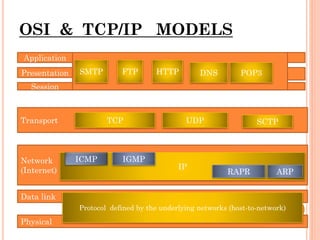
OSI & TCP/IP MODELS
Application
Presentation
Session
SMTP FTP HTTP DNS POP3
Transport TCP UDP
Network
(Internet) IP
ICMP IGMP
RAPR ARP
Data link
Physical
Protocol defined by the underlying networks (host-to-network)
SCTP
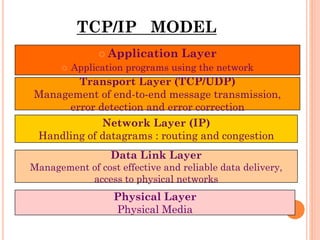
TCP/IP MODEL
 Application Layer
 Application programs using the network
Transport Layer (TCP/UDP)
Management of end-to-end message transmission,
error detection and error correction
Network Layer (IP)
Handling of datagrams : routing and congestion
Data Link Layer
Management of cost effective and reliable data delivery,
access to physical networks
Physical Layer
Physical Media
TCP/IP
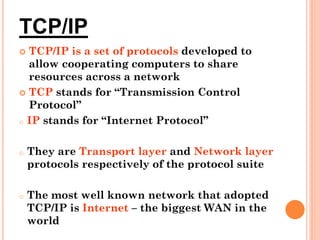
 TCP/IP is a set of protocols developed to
allow cooperating computers to share
resources across a network
 TCP stands for “Transmission Control
Protocol”
o IP stands for “Internet Protocol”
o They are Transport layer and Network layer
protocols respectively of the protocol suite
o The most well known network that adopted
TCP/IP is Internet – the biggest WAN in the
world
PROTOCOL
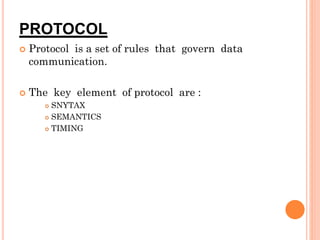
 Protocol is a set of rules that govern data
communication.
 The key element of protocol are :
 SNYTAX
 SEMANTICS
 TIMING
APPLICATION LAYER PROTOCOLS
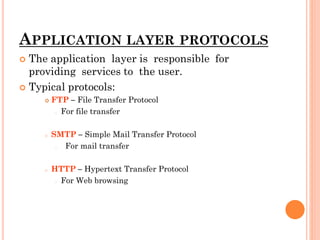
 The application layer is responsible for
providing services to the user.
 Typical protocols:
 FTP – File Transfer Protocol
o For file transfer
o SMTP – Simple Mail Transfer Protocol
o For mail transfer
o HTTP – Hypertext Transfer Protocol
o For Web browsing
TRANSPORT LAYER PROTOCOL
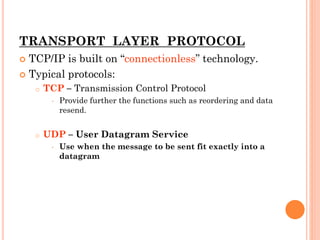
 TCP/IP is built on “connectionless” technology.
 Typical protocols:
o TCP – Transmission Control Protocol
• Provide further the functions such as reordering and data
resend.
o UDP – User Datagram Service
• Use when the message to be sent fit exactly into a
datagram
NETWORK LAYER
 Network layer protocols define the rules of how to
find the routes for a packet to the destination.
 Typical protocols:
o IP – Internet Protocol
• Provide packet delivery
o ARP – Address Resolution Protocol
• Define the procedures of network address / MAC address
translation.
o ICMP – Internet Control Message Protocol
• Define the procedures of error message transfer
PHYSICAL AND DATA LINK LAYER
 TCP/IP does not define any specific protocol .
 It support all the standard and proprietary
protocols.A network in a TCP/IP internetwork
can be a local-area network or a wide-area
network.
REFERENCE
 Data communications and networking
 BEHROUZ A FOROUZAN
 Computer Networks
 Andrew S. Tanenbaum
THANK YOU

Tcp/ip model

  • 1.
    TCP/IP MODEL Submitted by: Name:--ALOKKUMAR Class:--M.Tech(C.T.) 2nd sem Roll:-- 04
  • 2.
    OSI & TCP/IPMODELS Application Presentation Session SMTP FTP HTTP DNS POP3 Transport TCP UDP Network (Internet) IP ICMP IGMP RAPR ARP Data link Physical Protocol defined by the underlying networks (host-to-network) SCTP
  • 3.
    TCP/IP MODEL  ApplicationLayer  Application programs using the network Transport Layer (TCP/UDP) Management of end-to-end message transmission, error detection and error correction Network Layer (IP) Handling of datagrams : routing and congestion Data Link Layer Management of cost effective and reliable data delivery, access to physical networks Physical Layer Physical Media
  • 4.
    TCP/IP  TCP/IP isa set of protocols developed to allow cooperating computers to share resources across a network  TCP stands for “Transmission Control Protocol” o IP stands for “Internet Protocol” o They are Transport layer and Network layer protocols respectively of the protocol suite o The most well known network that adopted TCP/IP is Internet – the biggest WAN in the world
  • 5.
    PROTOCOL  Protocol isa set of rules that govern data communication.  The key element of protocol are :  SNYTAX  SEMANTICS  TIMING
  • 6.
    APPLICATION LAYER PROTOCOLS The application layer is responsible for providing services to the user.  Typical protocols:  FTP – File Transfer Protocol o For file transfer o SMTP – Simple Mail Transfer Protocol o For mail transfer o HTTP – Hypertext Transfer Protocol o For Web browsing
  • 7.
    TRANSPORT LAYER PROTOCOL TCP/IP is built on “connectionless” technology.  Typical protocols: o TCP – Transmission Control Protocol • Provide further the functions such as reordering and data resend. o UDP – User Datagram Service • Use when the message to be sent fit exactly into a datagram
  • 8.
    NETWORK LAYER  Networklayer protocols define the rules of how to find the routes for a packet to the destination.  Typical protocols: o IP – Internet Protocol • Provide packet delivery o ARP – Address Resolution Protocol • Define the procedures of network address / MAC address translation. o ICMP – Internet Control Message Protocol • Define the procedures of error message transfer
  • 9.
    PHYSICAL AND DATALINK LAYER  TCP/IP does not define any specific protocol .  It support all the standard and proprietary protocols.A network in a TCP/IP internetwork can be a local-area network or a wide-area network.
  • 10.
    REFERENCE  Data communicationsand networking  BEHROUZ A FOROUZAN  Computer Networks  Andrew S. Tanenbaum
  • 11.