FTP - File Transfer Protocol
TFTP – Trivial FTP
CISC 856 – Fall 2007
Brian Lucas
University of Delaware
(some/most slides courtesy of
Umakanth Puppala, William Boyer
Vikram Rajan, Michael Haggerty, and Prof Amer)
lucasb@capsl.udel.edu
Overview
File Transfer Protocol (RFC 959)
• Why FTP?
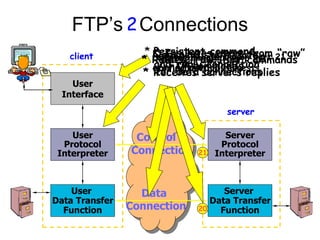
• FTP’s connections
• FTP in action
• FTP commands/responses
Trivial File Transfer Protocol (RFC 1350)
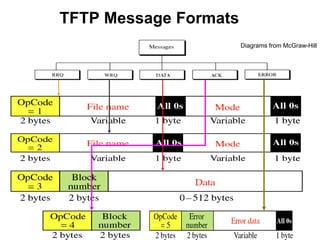
• TFTP and TFTP’s message formats
• FTP and TFTP compared
Why do we need a FTP
Service?
Purpose: To Transfer files between two computers
Goals of FTP Service
• Promote sharing of files (programs and/or data)
• Encourage indirect/implicit use of remote computers
• Shield users from variations in file storage among hosts
• Transfer data reliably and efficiently
Problems of File Transfer
• At first, file transfer may seem simple
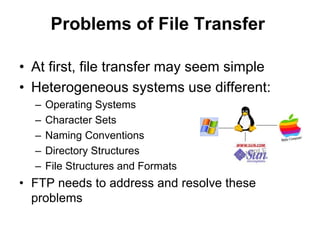
• Heterogeneous systems use different:
– Operating Systems
– Character Sets
– Naming Conventions
– Directory Structures
– File Structures and Formats
• FTP needs to address and resolve these
problems
FTP’s Connections
User
Interface
User
Data Transfer
Function
User
Protocol
Interpreter
Server
Protocol
Interpreter
Server
Data Transfer
Function
client
server
Control
Connection
Data
Connection
* Insulates users from “raw”
FTP commands
Server is listening on port 21
for connection requests
2
* Routes “raw” FTP commands
* Receives server’s replies
* Persistent command
and reply connection
Non-persistent data
connection
21
20
*Server uses port 20
for data connections
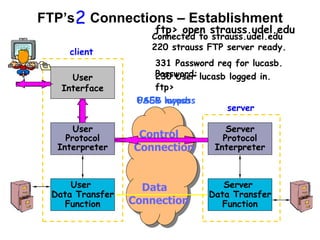
FTP’s Connections – Establishment
User
Interface
User
Data Transfer
Function
User
Protocol
Interpreter
Server
Protocol
Interpreter
Server
Data Transfer
Function
client
server
Control
Connection
Data
Connection
2
ftp> open strauss.udel.edu
Connected to strauss.udel.edu
220 strauss FTP server ready.
USER lucasb
331 Password req for lucasb.
Password:
PASS mypass
230 User lucasb logged in.
ftp>
128.4.40.17 (19×256)+137
128.4.40.17:5001
User
Data Transfer
Function
Server
Data Transfer
Function
User
Interface
User
Protocol
Interpreter
Server
Protocol
Interpreter
client
server
Control
Connection
Data
Connection
2
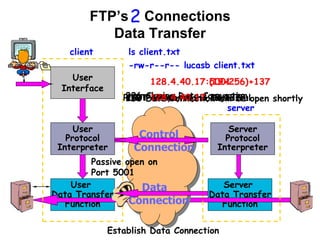
ls client.txt
Passive open on
Port 5001
PORT 128,4,40,17,19,137
200 Port Command Sucessful
LIST client.txt
150 Data Connection will be open shortly
226 Closing Data Connection
-rw-r--r-- lucasb client.txt
Establish Data Connection
User
Protocol
Interpreter
Server
Protocol
Interpreter
FTP’s Connections
Data Transfer
128.4.40.17 19,137
User
Interface
User
Protocol
Interpreter
Server
Protocol
Interpreter
client
server
Control
Connection
Data
Connection
2
User
Data Transfer
Function
Server
Data Transfer
Function
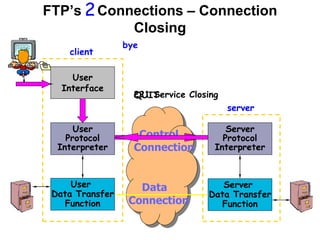
bye
QUIT
221 Service Closing
FTP’s Connections – Connection
Closing
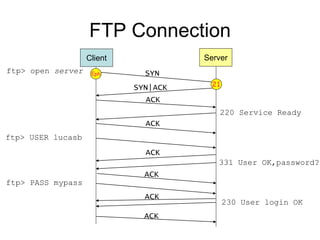
FTP Connection
ftp> open server SYN
SYN|ACK
ACK
220 Service Ready
ftp> USER lucasb
ACK
ACK
331 User OK,password?
ACK
ftp> PASS mypass
ACK
230 User login OK
ACK
Client Server
21
Eph
FTP Data Transfer
PORT 128,4,40,17,19,137
200 Command Successful
LIST client.txt
ACK 150 Data Connection
will be open shortly
226 Closing Data
Connection
ACK
ACK
Control connection
Data Connection
Client Server
Eph
Eph
21
21
5001
20
5001 20
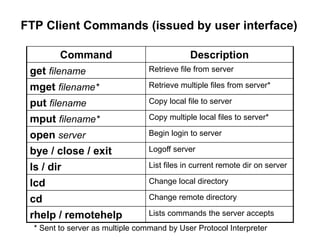
FTP Client Commands (issued by user interface)
Command Description
get filename Retrieve file from server
mget filename* Retrieve multiple files from server*
put filename Copy local file to server
mput filename* Copy multiple local files to server*
open server Begin login to server
bye / close / exit Logoff server
ls / dir List files in current remote dir on server
lcd Change local directory
cd Change remote directory
rhelp / remotehelp Lists commands the server accepts
* Sent to server as multiple command by User Protocol Interpreter
A-PDU FTP Commands
Command Description
LIST [filelist ] List files or directories (ls / dir)
USER username Send username to server
PASS password Password on server
PORT h1,h2,h3,h4,p1,p2 Client IP and port number
RETR filename Retrieve (get) filename
STOR filename Store (put) filename
TYPE (A, I, E, N or T) Defines the file type or print format
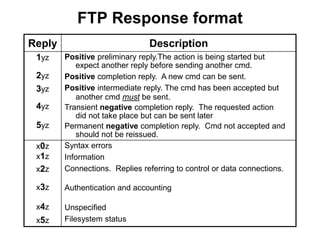
FTP Response format
Reply Description
1yz
2yz
3yz
4yz
5yz
Positive preliminary reply.The action is being started but
expect another reply before sending another cmd.
Positive completion reply. A new cmd can be sent.
Positive intermediate reply. The cmd has been accepted but
another cmd must be sent.
Transient negative completion reply. The requested action
did not take place but can be sent later
Permanent negative completion reply. Cmd not accepted and
should not be reissued.
x0z
x1z
x2z
x3z
x4z
x5z
Syntax errors
Information
Connections. Replies referring to control or data connections.
Authentication and accounting
Unspecified
Filesystem status
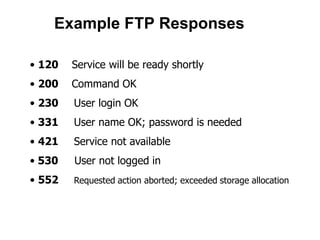
Example FTP Responses
• 120 Service will be ready shortly
• 200 Command OK
• 230 User login OK
• 331 User name OK; password is needed
• 421 Service not available
• 530 User not logged in
• 552 Requested action aborted; exceeded storage allocation
Summary of FTP connections
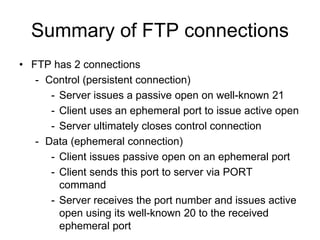
• FTP has 2 connections
- Control (persistent connection)
- Server issues a passive open on well-known 21
- Client uses an ephemeral port to issue active open
- Server ultimately closes control connection
- Data (ephemeral connection)
- Client issues passive open on an ephemeral port
- Client sends this port to server via PORT
command
- Server receives the port number and issues active
open using its well-known 20 to the received
ephemeral port
Data Connection
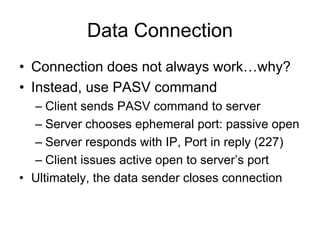
• Connection does not always work…why?
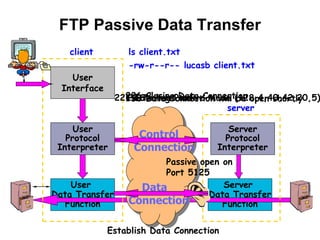
• Instead, use PASV command
– Client sends PASV command to server
– Server chooses ephemeral port: passive open
– Server responds with IP, Port in reply (227)
– Client issues active open to server’s port
• Ultimately, the data sender closes connection
FTP Passive Data Transfer
User
Data Transfer
Function
Server
Data Transfer
Function
User
Interface
User
Protocol
Interpreter
Server
Protocol
Interpreter
client
server
Control
Connection
Data
Connection
ls client.txt
Passive open on
Port 5125
PASV
227 Entering Passive Mode (128,4,40,42,20,5)
LIST client.txt
150 Data Connection will be open shortly
226 Closing Data Connection
-rw-r--r-- lucasb client.txt
Establish Data Connection
User
Protocol
Interpreter
Server
Protocol
Interpreter
Trivial FTP (TFTP)
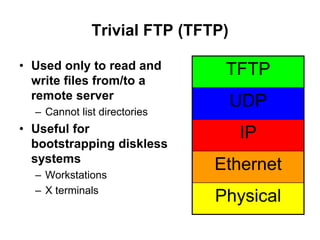
• Used only to read and
write files from/to a
remote server
– Cannot list directories
• Useful for
bootstrapping diskless
systems
– Workstations
– X terminals
TFTP
UDP
IP
Ethernet
Physical
TFTP Message Formats
Diagrams from McGraw-Hill
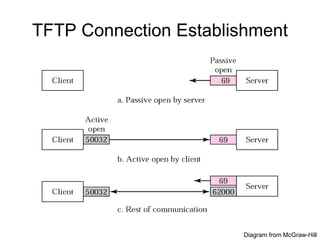
TFTP Connection Establishment
Diagram from McGraw-Hill
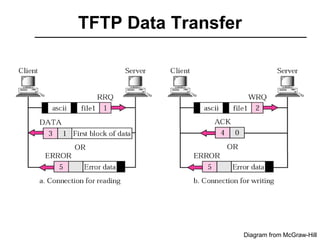
TFTP Data Transfer
Diagram from McGraw-Hill
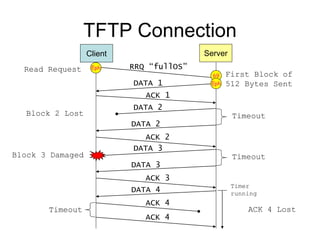
TFTP Connection
Read Request RRQ “fullOS”
DATA 1
ACK 1
Timeout
ACK 2
Client Server
DATA 2
DATA 2
Timeout
ACK 3
DATA 3
DATA 3
First Block of
512 Bytes Sent
Block 2 Lost
Block 3 Damaged
ACK 4
DATA 4
Timeout
ACK 4
ACK 4 Lost
Eph
69
Eph
Timer
running
TFTP Connection (cont’d)
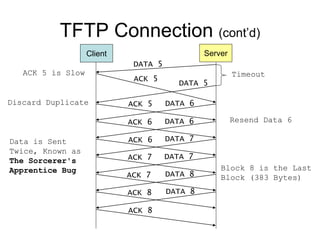
DATA 5
ACK 5
Timeout
Client Server
DATA 5
ACK 5 DATA 6
ACK 6 DATA 6
ACK 6 DATA 7
ACK 7 DATA 7
ACK 7 DATA 8
ACK 8 DATA 8
ACK 8
Block 8 is the Last
Block (383 Bytes)
ACK 5 is Slow
Discard Duplicate
Resend Data 6
Data is Sent
Twice, Known as
The Sorcerer's
Apprentice Bug
FTP vs. TFTP
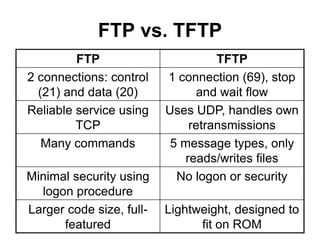
FTP TFTP
2 connections: control
(21) and data (20)
1 connection (69), stop
and wait flow
Reliable service using
TCP
Uses UDP, handles own
retransmissions
Many commands 5 message types, only
reads/writes files
Minimal security using
logon procedure
No logon or security
Larger code size, full-
featured
Lightweight, designed to
fit on ROM

ftp.07f.ppt

  • 1.
    FTP - FileTransfer Protocol TFTP – Trivial FTP CISC 856 – Fall 2007 Brian Lucas University of Delaware (some/most slides courtesy of Umakanth Puppala, William Boyer Vikram Rajan, Michael Haggerty, and Prof Amer) lucasb@capsl.udel.edu
  • 2.
    Overview File Transfer Protocol(RFC 959) • Why FTP? • FTP’s connections • FTP in action • FTP commands/responses Trivial File Transfer Protocol (RFC 1350) • TFTP and TFTP’s message formats • FTP and TFTP compared
  • 3.
    Why do weneed a FTP Service? Purpose: To Transfer files between two computers Goals of FTP Service • Promote sharing of files (programs and/or data) • Encourage indirect/implicit use of remote computers • Shield users from variations in file storage among hosts • Transfer data reliably and efficiently
  • 4.
    Problems of FileTransfer • At first, file transfer may seem simple • Heterogeneous systems use different: – Operating Systems – Character Sets – Naming Conventions – Directory Structures – File Structures and Formats • FTP needs to address and resolve these problems
  • 5.
    FTP’s Connections User Interface User Data Transfer Function User Protocol Interpreter Server Protocol Interpreter Server DataTransfer Function client server Control Connection Data Connection * Insulates users from “raw” FTP commands Server is listening on port 21 for connection requests 2 * Routes “raw” FTP commands * Receives server’s replies * Persistent command and reply connection Non-persistent data connection 21 20 *Server uses port 20 for data connections
  • 6.
    FTP’s Connections –Establishment User Interface User Data Transfer Function User Protocol Interpreter Server Protocol Interpreter Server Data Transfer Function client server Control Connection Data Connection 2 ftp> open strauss.udel.edu Connected to strauss.udel.edu 220 strauss FTP server ready. USER lucasb 331 Password req for lucasb. Password: PASS mypass 230 User lucasb logged in. ftp>
  • 7.
    128.4.40.17 (19×256)+137 128.4.40.17:5001 User Data Transfer Function Server DataTransfer Function User Interface User Protocol Interpreter Server Protocol Interpreter client server Control Connection Data Connection 2 ls client.txt Passive open on Port 5001 PORT 128,4,40,17,19,137 200 Port Command Sucessful LIST client.txt 150 Data Connection will be open shortly 226 Closing Data Connection -rw-r--r-- lucasb client.txt Establish Data Connection User Protocol Interpreter Server Protocol Interpreter FTP’s Connections Data Transfer 128.4.40.17 19,137
  • 8.
  • 9.
    FTP Connection ftp> openserver SYN SYN|ACK ACK 220 Service Ready ftp> USER lucasb ACK ACK 331 User OK,password? ACK ftp> PASS mypass ACK 230 User login OK ACK Client Server 21 Eph
  • 10.
    FTP Data Transfer PORT128,4,40,17,19,137 200 Command Successful LIST client.txt ACK 150 Data Connection will be open shortly 226 Closing Data Connection ACK ACK Control connection Data Connection Client Server Eph Eph 21 21 5001 20 5001 20
  • 11.
    FTP Client Commands(issued by user interface) Command Description get filename Retrieve file from server mget filename* Retrieve multiple files from server* put filename Copy local file to server mput filename* Copy multiple local files to server* open server Begin login to server bye / close / exit Logoff server ls / dir List files in current remote dir on server lcd Change local directory cd Change remote directory rhelp / remotehelp Lists commands the server accepts * Sent to server as multiple command by User Protocol Interpreter
  • 12.
    A-PDU FTP Commands CommandDescription LIST [filelist ] List files or directories (ls / dir) USER username Send username to server PASS password Password on server PORT h1,h2,h3,h4,p1,p2 Client IP and port number RETR filename Retrieve (get) filename STOR filename Store (put) filename TYPE (A, I, E, N or T) Defines the file type or print format
  • 13.
    FTP Response format ReplyDescription 1yz 2yz 3yz 4yz 5yz Positive preliminary reply.The action is being started but expect another reply before sending another cmd. Positive completion reply. A new cmd can be sent. Positive intermediate reply. The cmd has been accepted but another cmd must be sent. Transient negative completion reply. The requested action did not take place but can be sent later Permanent negative completion reply. Cmd not accepted and should not be reissued. x0z x1z x2z x3z x4z x5z Syntax errors Information Connections. Replies referring to control or data connections. Authentication and accounting Unspecified Filesystem status
  • 14.
    Example FTP Responses •120 Service will be ready shortly • 200 Command OK • 230 User login OK • 331 User name OK; password is needed • 421 Service not available • 530 User not logged in • 552 Requested action aborted; exceeded storage allocation
  • 15.
    Summary of FTPconnections • FTP has 2 connections - Control (persistent connection) - Server issues a passive open on well-known 21 - Client uses an ephemeral port to issue active open - Server ultimately closes control connection - Data (ephemeral connection) - Client issues passive open on an ephemeral port - Client sends this port to server via PORT command - Server receives the port number and issues active open using its well-known 20 to the received ephemeral port
  • 16.
    Data Connection • Connectiondoes not always work…why? • Instead, use PASV command – Client sends PASV command to server – Server chooses ephemeral port: passive open – Server responds with IP, Port in reply (227) – Client issues active open to server’s port • Ultimately, the data sender closes connection
  • 17.
    FTP Passive DataTransfer User Data Transfer Function Server Data Transfer Function User Interface User Protocol Interpreter Server Protocol Interpreter client server Control Connection Data Connection ls client.txt Passive open on Port 5125 PASV 227 Entering Passive Mode (128,4,40,42,20,5) LIST client.txt 150 Data Connection will be open shortly 226 Closing Data Connection -rw-r--r-- lucasb client.txt Establish Data Connection User Protocol Interpreter Server Protocol Interpreter
  • 18.
    Trivial FTP (TFTP) •Used only to read and write files from/to a remote server – Cannot list directories • Useful for bootstrapping diskless systems – Workstations – X terminals TFTP UDP IP Ethernet Physical
  • 19.
  • 20.
  • 21.
  • 22.
    TFTP Connection Read RequestRRQ “fullOS” DATA 1 ACK 1 Timeout ACK 2 Client Server DATA 2 DATA 2 Timeout ACK 3 DATA 3 DATA 3 First Block of 512 Bytes Sent Block 2 Lost Block 3 Damaged ACK 4 DATA 4 Timeout ACK 4 ACK 4 Lost Eph 69 Eph Timer running
  • 23.
    TFTP Connection (cont’d) DATA5 ACK 5 Timeout Client Server DATA 5 ACK 5 DATA 6 ACK 6 DATA 6 ACK 6 DATA 7 ACK 7 DATA 7 ACK 7 DATA 8 ACK 8 DATA 8 ACK 8 Block 8 is the Last Block (383 Bytes) ACK 5 is Slow Discard Duplicate Resend Data 6 Data is Sent Twice, Known as The Sorcerer's Apprentice Bug
  • 24.
    FTP vs. TFTP FTPTFTP 2 connections: control (21) and data (20) 1 connection (69), stop and wait flow Reliable service using TCP Uses UDP, handles own retransmissions Many commands 5 message types, only reads/writes files Minimal security using logon procedure No logon or security Larger code size, full- featured Lightweight, designed to fit on ROM