Downloaded 18 times

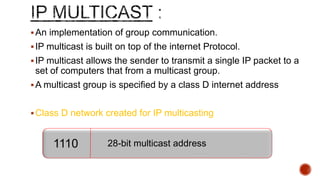



Group communication allows a process to send a single message to multiple recipients through multicast operations. It provides features like fault tolerance through replicated services, where client requests are multicast to all servers performing the same operation. While multicast has no guarantees about delivery or ordering, it enables applications like discovery of servers in spontaneous networks or propagation of event notifications. IP multicast implements group communication by allowing a sender to transmit a single packet to a multicast group specified by a class D address. Membership in multicast groups is dynamic and packets may be lost or arrive out of order.


