Neurological Examination Physical Diagnosis III Steve Sager, MPAS, PA-C
Learning Objectives Upon satisfactory completion of this lecture, and in conjunction with textbooks, lecture handouts, WebCT, and recommended internet web sites, the student will be able to:  Select appropriate questions to elicit from the patient with a neurological complaint during a patient interview Differentiate “normal” from “abnormal” findings on neurological examination Identify common causes of various cranial nerve palsies Differentiate conductive hearing loss from sensorineural hearing loss Determine location of neurological lesion Differentiate amongst the various movement disorders
Learning Objectives Differentiate between the following: atrophy hypertrophy pseudohypertrophy Differentiate between the following: spasticity rigidity flaccidity Differentiate CNS disorders from PNS disorders, and identify location of the lesion & common causes Compare and contrast the five clinical levels of consciousness Given a case study perform the appropriate focused history and physical examination and formulate a differential diagnosis
Purpose of the Neurological Exam Determine if there is a neurological deficit sensory motor behavioral coordinative Localize the site of the problem Determine the etiology of the problem
Focuses Mental status Cranial nerves Motor function Reflexes Sensory status Coordination and balance
 
Sensory Pathways Ascending tracts Register sensation Posterior root to spinal cord Synapses: secondary neurons to motor neurons = DTRs brainstem or spinal cord Impulses reach brain via: spinothalamic tract posterior columns
Motor Pathways Originating in the cerebral cortex: Corticospinal tracts originate in the cerebral cortex lateral synapse with alpha motor neurons & interneurons anterior Cross at the cervical level primarily modulates motor neurons that innervate neck and arm muscles anterolateral Originating in the brain stem Tectospinal tract mediate reflex postural movements in response to visual (+/- auditory) stimuli  Rubrospinal tract control muscle tone of flexor muscle groups Vestibulospinal tracts facilitate spinal cord reflexes and muscle tone
Spinothalamic Tract Fibers cross in the spinal cord & pass up to thalamus Neurons are located primarily in the dorsal horn Lateral: pain, temperature, & crude touch   Anterior light touch also transmitted by the posterior column when lesioned, little or no disturbance in function is produced
Posterior Columns convey 3 different types of sensation: Proprioception sensory receptors are the muscle spindles and Golgi tendon organs vibratory sense sensory receptor is the Pacinian corpuscle discriminative touch sensory receptor is the Meissner corpuscle   Synapse in medulla, cross & continue to thalamus
Sensory Pathways Thalamic level  general sensation - No fine distinctions  Neurons from thalamus to  sensory cortex   here stimuli localized & discrimination  ? Causative lesion patterns of sensory loss + motor findings
Terminology Paresis slight or incomplete paralysis Paralysis (plegia) loss or impairment of motor function Hemiparesis Hemiplegia Paraplegia Quadriplegia
Terminology Atrophy Hypertrophy enlargement of an organ or part due to an increase in size of its constituent cells Pseudohypertrophy increase in size without true hypertrophy Spasticity hypertonicity with increased DTRs Rigidity stiffness or inflexibility Flaccidity loss of tone with diminished DTRs
Abnormal Movements
Abnormal Movements
Abnormal Movements
Abnormal Movements
History Chief complaint PQRST Headache? Vertigo? Visual disturbance? Tremors or dyskinesias? Weakness? Dysesthesias/Paresthesias? Loss of consciousness?
Key components of H&P Complaint Hx P.E. Altered mental status Associated seizure activity; recent trauma or infection; illicit drug use; exposure to toxic substances Mental status exam; pupillary reaction; corneal reflexes; gag reflexes; posturing/motor asymmetry; Babinski Vertigo Differentiate between true vertigo and lightheadedness! Present at rest; affected by positional changes CN VIII function; Dix-Hallpike maneuver; nystagmus Headache Thorough hx; “worst headache ever?”; associated sx’s; neck pain/stiffness CN function; pupillary reaction; fundoscopic exam; palpate temporal artery; Marcus-Gunn Seizures Previous hx; frequency; motor activity; aura; LOC; post-ictal confusion; external etiology Search for focal deficits; signs of trauma; hyperreflexia Weakness Generalized or focal; loss of strength; pain; progressive or recurrent fatigue Asymmetry7; atrophy; sensory deficits; fasciculations; DTRs
Mental Status Alertness Orientation Person, Place, Time, & Situation Appearance & behavior Cognitive function Attention Perception Illusions =  misinterpretations of real external stimuli Hallucinations =  subjective sensory perceptions  in the absence of stimuli Judgment Memory Short-term & long-term Speech Rate & rhythm Spontaneity Fluency Simple vs. complex
Mini Mental Status Exam (MMSE) Screening test for cognitive dysfunction Assesses: orientation attention immediate and short-term memory language/speech ability to follow simple verbal and written commands
Attention Depends on the integrity of the dominant hemisphere as well as patient’s intelligence Spell W-O-R-L-D backwards Recite the months forwards and backwards Digit span recite a series of digits of increasing length Serial 7s (or 5s): ask patient to start with 100 subtract 7 (or5) then subtract 7 (or 5) from the result and continue doing so
Memory Immediate recall, recent & remote memory Immediate memory: name 3 objects - have pt immediately repeat  Recent memory: ask patient to recall previous 3 objects after 5 minutes Remote memory: ask patient regarding well-known events in past  be sure information asked is verifiable
Thought content and perceptions Generally assessed throughout the interview Thought process logic, relevance, organization and coherence Thought content delusions, obsessions, compulsions, phobias Perceptions hallucinations  Insight Ask questions such as: "Do you ever hear things that other people don't hear or see things that other people don't see?“ "Do you feel that someone is watching you or trying to hurt you?“ "Do you have any special abilities or powers?"
Judgment Requires higher cerebral function Ask the patient to interpret a simple problem: What would you do if you noticed an addressed envelope with an un-cancelled stamp on it on the street near a mailbox? What would you do if you suddenly lost your job? What would you do if you were in a crowded movie theater and a fire started?
Abstraction Higher cerebral function that requires comprehension and judgment Proverbs are commonly used Ask patient to interpret following sayings: “ People who live in glass houses should not throw stones” “ A rolling stone gathers no moss”
Speech Quantity spontaneity Rate fast slow Rhythm hesitant Volume
Language Can the patient understand simple questions and commands? Ask the patient to read single words or a brief passage. Ask the patient to write their name and write a sentence.  Ask the patient to name some easy (pen, watch, tie, etc.) and some more difficult (fingernail, belt buckle, stethoscope, etc.) objects. naming parts of objects is often more difficult Comprehension of grammatical structure should be tested as well "Mike was shot by John. Is John dead?"
Speech Assess articulation and fluency: Ask patient to recite “no ifs, ands, or buts” Aphasia = difficulty producing or understanding language lesion in dominant cerebral hemisphere Broca’s or Wernicke’s Dysarthria = difficulty in articulation lesions of tongue & palate Dysphonia = difficulty in phonation lesions of palate & vocal cords Dysphasia = difficulty comprehending or speaking cerebral dysfunction
Neurological changes with aging Altered mental status forgetfulness dementia Ocular changes: presbyopia alterations in EOMs, pupil size/shape/reactivity Presbycusis Vertigo Motor dysfunction/weakness Tremors Diminished reflexes
Levels of Consciousness Alert and Oriented Disoriented Lethargic Obtunded Drowsy/somnolent Clouded consciousness Slow thought, movement, and speech Stuporous Marked reduction in mental and physical activity Vigorous stimuli needed to provoke a response Comatose Completely unconscious Cannot be aroused by painful stimuli Absence of voluntary movement +/- reflexes
The Mini-Mental State Exam Patient____________________________ Examiner ___________________ Date____________ Maximum Score  Orientation 5 (  )  What is the (year) (season) (date) (day) (month)? 5 (  )  Where are we (state) (country) (town) (hospital) (floor)? Registration 3 (  )  Name 3 objects: 1 second to say each. Then ask the patient all 3 after you have said them. Give 1 point for each correct answer.  Then repeat them until he/she learns all 3. Count trials and record. ___________ Attention and Calculation 5 (  )  Serial 7’s. 1 point for each correct answer. Stop after 5 answers. Alternatively spell “W-O-R-L-D” backward. Recall 3 (  )  Ask for the 3 objects repeated above. Give 1 point for each correct answer. Language 2 (  )  Name a pencil and watch 1 (  )  Repeat the following “No ifs, ands, or buts” 3 (  )  Follow a 3-stage command:  “Take a paper in your hand, fold it in half, and put it on the table.” 1 (  )  Read and obey the following: CLOSE YOUR EYES 1 (  )  Write a sentence. 1 (  )  Copy the design shown. ____ Total Score (30 points possible) ASSESS level of consciousness along a continuum ____________  (Alert, Drowsy, obtundedStupor, Coma)
Glasgow Coma Scale
The Neurological Exam on a Stuporous or Comatose Patient VS respirations Pupils Ocular movement observe position of eyes Oculocephalic Reflex (“Doll’s eyes”) assesses brainstem function hold open upper eyelids, turn head quickly, first to one side & then to other
 
The Neurological Exam on a Stuporous or Comatose Patient Oculovestibular reflex (calorics): if oculocephalic reflex is absent provides further assessment of brainstem  rarely performed in a conscious patient insure intact eardrums and clear canals elevate patient’s head to 30 °   place kidney basin under ear & inject ice water through small catheter into ear canal watch for deviation of eyes in horizontal plane
The Neurological Exam on a Stuporous or Comatose Patient Posture & Muscle Tone: observe patient’s posture if no spontaneous movement, apply a painful stimulus and classify the resulting movement: normal = avoidant  stereotypic (decorticate or decerebrate) flaccid paralysis or no response test muscle tone
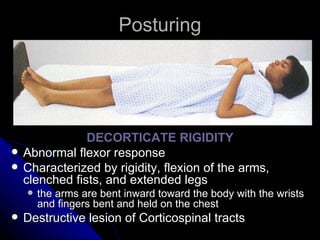
Posturing DECORTICATE RIGIDITY Abnormal flexor response Characterized by rigidity, flexion of the arms, clenched fists, and extended legs the arms are bent inward toward the body with the wrists and fingers bent and held on the chest Destructive lesion of Corticospinal tracts
Posturing DECEREBRATE  RIGIDITY Abnormal Extensor Response Characterized by rigid extension of the arms and legs, downward pointing of the toes, and backward arching of the head Typicall caused by deterioration of the structures of the nervous system, particularly the upper brain stem lesion in diencephalon, midbrain, pons metabolic disorders
The Neurological Exam on a Stuporous or Comatose Patient General physical examination: ? unusual odors ? skin abnormalities  ? trauma scalp & skull  inspection for facial asymmetry corneal reflexes & fundi ears, nose, mouth & throat heart, lungs, & abdomen motor, sensory, & reflex function meningeal signs
Malingering (Nonorganic) “ Willful faking of symptoms” Commonly present in a glove-and-stocking distribution Examples: hand drop blindness EOM/I unilateral diplopia ammonia reaction Test for: absence of pain or weakness in different positions Hoover test
Organic Disease Suggested by signs that cannot be faked: asymmetric pupillary response abnormal fundoscopic exam ocular divergence marked nystagmus muscle atrophy fasciculation multiple complex signs and symptoms
The “Difficult” Patient Observation is key! Use ingenuity! Be patient!  Agitated may be threatening or violent Unresponsive fail to participate Unreliable inattentive, preoccupied, inconsistent information Hysterical uncooperative
Testing Cognitive Function Information & vocabulary common Calculating simple math word problems Abstract thinking proverbs similarities/differences Construction copy figures of increasing difficulty (i.e. circle, clock)
Abnormalities of Thought Processes Circumstaniality Indirection and delay in reaching a point because of unnecessary detail. Loose Associations Person shifts from one unrelated subject to another. Flight of Ideas Almost continuous flow of accelerated speech with abrupt topic changes. Incoherence Incomprehensible because of illogic, lack of meaningful connections, abrupt topic changes, or disordered word use/grammar. Confabulation Fabrication of facts or events to fill in gaps in impaired memory. Perseveration Persistent repetition of words or ideas. Echolalia Repetition of the words or phrases of others. Neologisms Invented or distorted words. Blocking Sudden interruption in mid-sentence or before completion of an idea. Clanging Person chooses a word based on sound instead of meaning.
Abnormalities of Thought Content Obsessions Recurrent, uncontrollable thoughts, images, or impulses that a persons considers unacceptable or strange Compulsions Repetitive acts that a person feels driven to perform to prevent or produce some unrealistic future state of affairs. Delusions False, fixed, personal beliefs that are not shared by other members of the person’s culture. Phobias Persistent, irrational fears; accompanied by a compelling desire to avoid the stimulus. Anxieties Apprehensions, fears, or tensions that may be free-floating or focused (i.e. phobia). Feelings of Unreality A sense that things in the environment are strange, unreal, or remote. Feelings of Depersonalization A sense that one’s self is different, changed, or unreal.  Identity is lost.
Delirium vs. Dementia Although confusion and/or disorientation are signs of both Delirium and Dementia, they are different Delirium is an  acute  confusional state potentially reversible usually occurs over a period of days to months Dementia is slow and insidious progresses slowly over months to years not reversible  Condition Onset Pattern Orientation Attention Memory Duration Delirium Acute Fluctuating Usually impaired Impaired/ Fluctuating Impaired Hours or days Dementia Insidious Progressive Normal or impaired ~Normal Impaired Months or years Psychosis Variable Variable ~Normal Normal or impaired Normal or impaired Variable
Mnemonics: DELIRIUM D = drugs, ethanol E = electrolyte imbalance L = low PO2 (hypoxia) I = injury to brain R = relapsing fever (malaria) I = infection U = uremia M = metabolic (liver damage)
Mnemonics: DEMENTIA D = drugs & toxins  E = endocrine M = metabolic & mechanical E = epilepsy N = nutritional & nervous system T = tumor & trauma I = infection A = arterial compromise
Visual disturbance Onset? acute ~ vascular Monocular vs. binocular? Constant vs. intermittent? Improved with glasses = refractive error Progression? retinal detachments = minutes to hours tumors = months retinal degeneration = years
Visual disturbance TIA = brief, intermittent visual loss Migraine = “wavy” Retinal detachment = “drawn curtain” Acute glaucoma = “rainbows” or “halos” Digitalis toxicity = yellow hue
Vertigo A sense of spinning person environment Suggests dysfunction of: vestibular apparatus vestibular nerve Differentiate from “lightheadedness” and “faintness” results from impairment of brain oxygenation cardiac arrhythmia hypotension psychological factors
Dix-Hallpike maneuver
Nystagmus Involuntary eye movements usually triggered by inner ear stimulation It usually begins as a slow pursuit movement followed by a fast, rapid resetting phase. Named by the direction of the fast phase right or left beating up- or down-beating direction changing rotational movements are not purely horizontal or vertical Nystagmus associated with BPPV is usually provoked with the head turned to one side
Nystagmus Etiologies: congenital EOM spasms MS cerebellar vestibular disease drug toxicity
Testing for Aphasia Word Comprehension Comprehension of spoken language through recognition (“point to your nose”) or understanding (“Can dogs fly?”). Repetition Repeat items of increasing complexity.  Note the fluency and accuracy of the responses. Naming Name a series of objects or colors.  Gradually increase difficulty.  Note the fluency and accuracy of the responses. Reading Comprehension Have the patient follow several simple written commands. Writing Ask the patient to make up and write a sentence.
Localization CNS vs. PNS brain/brain stem spinal cord peripheral nerves Difficult when evaluating: radicular pain dysesthesia/paresthesia tremors incoordination
Localization Cerebrum impaired intellect, memory, higher brain function Brain stem unconsciousness LMN paralysis with loss of DTRs muscle atrophy with fasciculation LMN + anesthesia peripheral nerve or spinal root UMN involves whole muscle groups increased or spastic muscle tone +/- paralysis with DTR accentuation positive Babinski
Organic Disease Asymmetric pupillary light reflex Abnormal fundus Ocular divergence Nystagmus Muscular atrophy Fasciculations Multiple complex signs/symptoms explained by a single lesion
Headache 5 th  most common reason for OP visit International Classification of Headache Disorders, 2 nd  edition published by IHS Symptom! (not a disease) Most important diagnostic clue  is a steady, bilateral, nonthrobbing pain that is worse in the a.m. may awaken patient worse with VALSALVA
Headache History Location Unilateral ~ migraine Periorbital (+/- visual disturbance) ~ glaucoma/uveitis Parietal/Occipital ~ tension Neck ~ meningitis or Subarachnoid hemorrhage Quality “ Throbbing” ~ vascular “ Intermittent jabbing” ~ Trigeminal neuralgia “ Pressure” ~ sinus Radiation? Severity Timing Constant vs. intermittent Worse in a.m. or p.m. Worst headache ever?????
Headache History Palliative or provocative measures? Pressure ETOH Associated Sx’s Visual disturbance Vertigo N/V Dysesthesias Aura Past medical history Family history Current medication/drug use Suspect an extracranial etiology if pain is the only symptom
Physical Examination Appearance Behavior/Mannerisms Gait and Posture Motor behavior Facial expressions Mood vs. Affect MMSE “ FOGS”
Physical Examination Test Cranial Nerves II through XII Test motor nerve function Station and gait –  ambulate, turn, toes, heels, heel-to-toe, knee bend Grip/SAR Romberg Test sensory nerve function Pain +/- Light touch Two point discrimination Proprioception/Stereognosis/Vibration Test deep tendon reflexes
Physical Examination Fundoscopic examination  Test for meningeal irritation Straight leg raise Test Coordination Finger-to-nose Rapid alternating movements of hands & feet
Physical Examination – Neck/Spine Look for pertinent positives and negatives: edema, ecchymosis, erythema  deformity spinal step off (spondylolisthesis, spina bifida)  lordosis/scoliosis  tenderness (where?)  positive SLR/ crossover SLR  diminished range of motion (ROM) diminished muscle strength spasms (where)  VALSALVA (intrathecal pressure)  Rectal Exam
Physical Examination Patrick’s test Hoover test Brudzinski’s test  Kernigs test  Gaenslen's sign (Sacroiliac) Trendelenburg test (hip)  Babinski
Neuro Exam - Shoulder Nerve Motor Sensory Reflex C5 abduct arm, flex biceps lateral arm (axillary n.) biceps C6 extend wrist, flex biceps lateral forearm, 1 st  & 2 nd  digits  (musculocutaneous n.) brachioradialis C7 flex wrist, extend fingers, extend forearm middle finger triceps C8 hand instrinsics, finger flexors Medial forearm/ 4 th  & 5 th  digits  (medial antebrachial cutaneous n.)
Neuro Exam - Spine Nerve Motor Sensory Reflex T1 hand intrinsics, finger abduction finger adduction medial Arm (medial antebrachial cutaneous n.) L1 inversion of foot medial aspect of foot/calf Patellar L5 dorsiflexion of big toe dorsum of foot and lateral calf S1 eversion of foot lateral aspect foot and sole Achilles S5 anal sphincter tone
Reflexes Corneal Pharyngeal Biceps Triceps Brachioradialis Abdominal Patellar (knee jerk) Achilles (ankle jerk) Babinski
Test Cranial Nerve function I - Olfactory II - Optic III - Oculomotor IV - Trochlear V - Trigeminal VI - Abducens VII - Facial VIII - Vestibulocochlear (Acoustic) IX - Glossopharyngeal X - Vagus XI - Accessory XII - Hypoglossal
Cranial Nerves Olfactory Nerve (CN I) - many causes for loss of smell: Nasal disease Head trauma Smoking Use of cocaine Congenital causes Avoid noxious odors when testing
Cranial Nerves Optic Nerve (CN II)  disorders of optic disc: optic atrophy
Cranial Nerves Papilledema Disorders of visual fields by confrontation: Visual extinction = lesion in parietal cortex
CN II Injury: Clinical correlation Damage to the optic nerve will also result in a monocular visual defect due to loss of input from the ipsilateral eye. The patient will complain of blindness in that eye.
CN II Injury: Clinical correlation Damage to the medial aspect of the optic chiasm, as is often seen with a pituitary gland tumor, may compromise the decussating fibers from both nasal hemiretinas. The loss of peripheral vision in both eyes is called bitemporal hemianopia.     Damage to the lateral aspect of the optic chiasm, as may occur in the case of an aneurysm of the internal carotid artery, will affect the fibers of the ipsilateral temporal hemiretina (nasal visual field).
Pupil Abnormalities Motor or sensory injury results in a contralateral defect Pupillary reflex is consensual brain-stem mediated reflex Asymmetry of pupil size of >1mm suggests CN III compression
Pupil Abnormalities Bilateral dilation   anoxia drug affect Unilateral constriction   sympathetic dysfunction (Horner syndrome) carotid artery dissection Bilateral constriction pontine hemorrhage drugs (opiates, Clonidine) toxins (organophosphates)
Pupil Abnormalities Anisocoria >2mm difference in size Adie’s (Tonic) pupil sluggish response Argyll Robertson pupil irregular/unequal pupils weak/absent reaction to light (poor dilation) exaggerated contraction to accommodation ? neurosyphilis
Pupil Abnormalities Horner’s syndrome central, preganglionic, or postganglionic characterized by: ptosis due to oculosympathetic palsy miosis facial anhydrosis
Pupil Abnormalities Marcus-Gunn pupil results from reduced afferent input in the affected eye** pupil fails to constrict fully rapidly stimulate each eye in succession and observe the direct and consensual light response in each stimulation of the normal eye produces full constriction in both pupils. immediate subsequent stimulus of the affected eye produces an apparent dilation in both pupils since the stimulus carried through that optic nerve is weaker
EOM Innervations Muscle Innervation Primary action Secondary action Tertiary action Medial rectus CN III Adduction Superior rectus CN III Elevation Intortion Adduction Inferior rectus CN III Depression Extortion Adduction Inferior oblique CN III Extorsion Elevation Abduction Superior oblique CN IV Intorsion Depression Abduction Lateral rectus CN VI Abduction
CN III: Clinical correlation
CN III: Clinical correlation Marcus-Gunn pupil Adie’s tonic pupil Argyll-Robertson pupil caused by damage to cells in the pretectal region of the midbrain signals carried by CN II from the retina are not relayed via the pretectal nucleus on the affected side  results in a loss of both the direct and consensual pupillary light reflex when light is shined in the eye on the affected side because the accommodation reflex pathway is distinct from the light reflex pathway the  accommodation reflex is unaffected
 
Left Trochlear (CN IV) palsy
CN VI: Clinical correlation Inability to abduct the affected eye beyond the midline of gaze Strabismus inability to direct both eyes to the same object when asked to look at an object located laterally to the side of the lesion, the patient's affected eye will be unable to be abducted beyond the midline of gaze. The opposite normal eye will be adducted to effectively fixate on the object. causes horizontal diplopia (double vision) patients may compensate by turning their head so that the affected eye is focused on an object and then moving the normal eye so as to fixate on the object.
Abducens Nerve (CN VI) Palsy
Trigeminal nerve (CN V) palsy Weak or absent contraction of temporal & masseter muscles  Difficult to interpret without teeth Decrease or loss of facial sensation   if loss of sharp/dull - confirm w/ temp   Corneal reflex   contacts may abolish reflex sensory = CN V motor = CN VII
Facial nerve (CN VII) palsy Differentiate UMN vs. LMN Cerebral lesions cause contralateral paralysis to lower half of face Palsies can occur secondary to: Bell’s palsy Lyme disease Guillain-Barré Syndrome MS ALS Tumors, syphilis, Polio
UMN vs. LMN Characteristic indications of an UMN lesion of CN VII include the following:  Facial asymmetry   Weakness of muscles of  lower  portion of the face on affected side*   No eyebrow droop *   Intact folds on forehead*   Smoothing of nasolabial folds on affected side   Intact conjunctival reflex (orbicularis oculi innervation is intact)   Lips cannot be held tightly together or pursed   Difficulty keeping food in mouth while chewing on affected side Characteristic indications of a LMN lesion of CN VII include the following: Marked facial asymmetry Weakness of all facial muscles on the ipsilateral side Eyebrow droop Smoothing out of forehead and nasolabial folds Drooping of the corners of the mouth Loss of efferent limb of conjunctival reflex (cannot close eye) Lips cannot be held tightly together or pursed Diificulty keeping food in mouth while chewing on the affected side Uncontrolled tearing
Vestibulocochlear (CN VIII) nerve Responsible for sense of hearing and balance Composed of the cochlear and vestibular nerves Sensory Test hearing Conductive loss Sensorineural loss Distortion of sound Minor Present with loss of upper tones Noisy environment Hearing may seem to improve Hearing typically worsens Patient’s voice Generally normal* Loud Ear canal/TM Visible abnormality Normal Weber Lateralizes to the impaired ear Lateralizes to the normal ear Rinne BC > AC AC > BC
Vagus nerve (CN X) palsy Results in diminished motor, autonomic, and sensory functions Branches to:  http://www.med.yale.edu/caim/cnerves/cn10/cn10_13.html pharynx larynx esophagus heart bronchioles stomach liver celiac Perform indirect examination of the vocal cords lesions of CN X may cause: hoarseness aphonia dyspnea (stridor)
Disorders of Speech 3 groups: voice problems articulation problems production of language comprehension of language Aphonia Aphasia
Aphasia Disorder of comprehension or use of words or symbolic language lesion in dominant hemisphere  Test: word comprehension word repetition object naming reading comprehension writing
Wernicke’s Aphasia Spontaneous speech  fluent, often rapid, voluble & effortless good inflection & articulation sentences lack meaning +  incomprehensible paraphasia & neologisms Impaired word comprehension Impaired naming & repetition Impaired reading comprehension & writing Lesion = posterior superior temporal lobe
Broca’s Aphasia Spontaneous speech   Non-fluent, slow, few words & laborious effort Impaired inflection & articulation Words are meaningful Fair to good word comprehension Impaired naming but pt recognizes objects Impaired repetition Fair to good reading comprehension  Impaired writing Lesion = posterior inferior frontal lobe
Aphasia Broca’s Wernicke’s Word comprehension Fair Impaired Repetition Impaired Impaired Naming Impaired Impaired Reading comprehension Fair Impaired Writing Impaired Impaired
Spinal Accessory nerve (CN XI) Bilateral weakness of sternocleidomastoid difficulty raising head off pillow Paralysis of trapezius drooping shoulder displaced scapula (down & lateral)
Hypoglossal Nerve (CN XII) Check for dysarthria  Atrophy + fasciculations ALS Polio Unilateral cortical lesions causes the protruded tongue to deviate toward the  affected  side
Integration of Motor Activity Praxis = ability to perform a motor activity Apraxia = inability to perform voluntary movement in the absence of deficits  Dyspraxia = difficulty performing an activity Test by: ask the patient to pour water from a pitcher into a glass and drink the water patients with dyspraxia will either drink water from pitcher or try to drink from the empty glass
Motor Function Inspection symmetry muscle bulk size and contours flat or concave; unilateral or bilateral; proximal or distal atrophy Palpation muscle tone Percussion ? fasciculations
Motor Function Check motor strength Body position during movement and at rest Involuntary movements location, quality, rate, rhythm, amplitude relation to posture, activity, fatigue, or emotions If an abnormality exists:  identify muscle(s) involved determine central vs. peripheral learn muscle innervations
Motor Function Muscle tone slight residual tension in normal relaxed muscle feel muscle’s resistance to passive stretch cogwheel rigidity = jerky, released in degrees UMN paralysis = spasticity (increased tone) LMN paralysis = hypotonia Muscle strength wide variance - stronger dominant side test by asking patient to actively resist movement if muscles too weak - test against gravity only or eliminate gravity if patient fails to move, watch or feel for weak contraction Suspect decreased resistance? hold forearm and shake hand loosely  Resistance increased? varies or persists throughout movement
The Motor System Causes of atrophy motor neuron diseases disuse of muscles rheumatoid arthritis protein-calorie malnutrition Causes of decreased muscle tone disease of PNS cerebellum dysfunction acute spinal cord injury
Coordination Cerebellar disease incoordination is worse with eyes closed dysmetria point-to-point movements are clumsy, unsteady,  inappropriately varying in speed, force, & direction may initially overshoot mark but finally reaches it
The Motor System Gait tandem walking - uncover unobvious ataxic gait  inability to heel walk  corticospinal weakness difficulty hopping  weakness, lack of position sense, or cerebellar dysfunction difficulty with shallow knee bend  proximal weakness. weak quads, or both difficulty rising from sitting position or stepping up on sturdy stool  proximal weakness involving pelvic girdle & legs
Common Gait Abnormalities
Function and Innervations Muscle(s) Function Primary Nerve Origin DELTOID Shoulder abduction Axillary C5-C6 BICEPS Elbow flexion Musculocutaneous C5, C6 TRICEPS Elbow extension Radial C6, C7, C8 WRIST EXTENSORS Radial C6, C7, C8 WRIST FLEXION Median C6, C7 HAND GRIP Grasp Fingers Median C7, C8, T1 FINGER ADDUCTION Median C7-T1 FINGER ABDUCTION Ulnar C8, T1 THUMB OPPOSITION Median C8, T1 HIP FLEXION Iliopsoas L2, L3, L4 HIP EXTENSION Gluteus maximus S1
Function and Innervations Motor Function Muscles Primary Nerve Origin KNEE EXTENSION Quadriceps L2, L3, L4 KNEE FLEXION Hamstrings L4, L5, S1, S2 FOOT DORSIFLEXION Tibialis Anterior Deep peroneal  L4, L5 ANKLE PLANTAR FLEXION Gastrocnemius mainly S1 EXTENSION OF GREAT TOE Extensor hallicus longus L5
Grading Muscular Response Grade Muscular Response 0 No contraction detected 1 Barely detectable flicker or trace of contraction 2 Active movement with gravity eliminated 3 Active movement against gravity 4 Active movement against gravity and some resistance 5 Active movement against resistance without evident fatigue -  “Normal”
Causes of Generalized Weakness Alcoholism Anemia Brain mass/tumor Botulism Cachexia Cancer Cervical myelopathies Chronic fatigue syndrome Collagen vascular disease Congenital disorders Diabetes Diphtheria Drug overdoses Drug reaction Endocrinopathies Guillain-Barré syndrome HIV Hysteria Infections Lyme disease Lumbar stenosis Metabolic myopathies Muscular dystrophies Myasthenia gravis Myotonic dystrophy Neurasthenia Neuritis Neurosyphilis Parkinson disease Periodic paralyses Peroneal muscular atrophy Polymyositis Porphyrias Postictal states Radiation myelopathies Spinal cord compression Spinal cord injuries Tick paralysis Toxic myopathies Transverse myelitis Tropical myeloneuropathies Vertebral collapse
Causes of  Focal or Asymmetrical weakness Arthritis Brachial neuritis Cerebral palsies Cerebrovascular disease ischemic hemorrhagic Cervical radiculopathies Cervical ribs Entrapment neuropathies Intervertebral disc disorders Mononeuropathies Diabetes Polyarteritis Motor neuron disease Multiple myeloma Multiple sclerosis Poliomyelitis Sciatica Scoliosis Space-occupying mass Intracranial Intraspinal Spinal vascular disease Ischemic Hemorrhagic Syringomyelia Systemic disease Trauma
Peripheral Nerve Injuries Nerve Motor function impaired Radial (C5-C8) Elbow & wrist extension (wrist drop); extension of the fingers at the MCP joints; triceps reflex Median (C6-T1) Wrist flexion and radial deviation; flexion of thumb and index/middle fingers; thumb opposition; forearm pronation Ulnar (C8-T1) Wrist flexion and ulnar deviation; flexion of the ring & little fingers; abduction/adduction of the fingers Musculocutaneous (C5-6) Elbow flexion; forearm supination; biceps reflex Axillary (C5-6) Abduction, flexion and extension of the shoulder Femoral (L2-L4) Hip flexion; knee extension; patellar reflex Obturator (L2-L4) Hip adduction Sciatic (L4-S3) Knee flexion Tibial (L4-S3) Foot inversion; ankle plantarflexion; Achilles reflex Common peroneal (L4-S2) Foot eversion; ankle & toe dorsiflexion (foot drop)
Sensory Function Fatigues quickly Efficiency  Special attention to areas of: symptomology motor or reflex abnormalities trophic changes  Confirm with repeat testing!!   Patterns of testing: Symmetrical Distal vs. proximal: scattered stimuli Vary the pace
The Sensory System Meticulous mapping important Compare distal & proximal Stocking & glove sensory loss  polyneurpathy Vibration sense  peripheral neuropathy   posterior column disease
The Sensory System Lesions of sensory cortex astereognosis inability to recognize numbers decreased two-point discrimination decreased point localization extinction
Deep Tendon Reflexes Hyperactive reflexes suggest CNS disease sustained clonus (confirms) Diminished or absent reflexes loss of sensation damage to spinal segments damage to peripheral nerves diseases of muscles diseases of the neuromuscular junctions
Testing the nerves of the upper extremity
 
Sensory distribution of the hand
Testing the nerves of the upper extremity
Sensory Function Testing Look for abnormalities Map out boundaries in detail Distribution of sensory abnormalities and kinds of sensations affected +/- motor/reflex abnormality  Demonstrate to patient before testing
Sensory specific testing Temperature Vibration Proprioception Tactile localization Discriminative sensations
Proprioception Conscious: connects with the thalamus and cerebral cortex lesions produce contralateral defects able to “describe” the position of a limb Unconscious: connects with the cerebellum via the spinocerebellar tract lesions produce ipsilateral malfunction perform complex acts without “thinking” about them
Discriminative Sensations Stereognosis Graphesthesia Two-point discrimination Test ability of sensory cortex to correlate, analyze, & interpret sensations Dependent on touch & position sense Screen first with stereognosis - proceed to other methods if indicated
Spinal Reflexes: DTRs Segmental levels of DTRs: Biceps reflex C5, 6 Brachioradialis reflex C5, 6 Triceps reflex C6, 7 Abdominal reflexes - upper  T8, 9, 10 - lower T 10, 11, 12 Knee (Patellar) L2, 3, 4 Achilles reflex S1 primarily Plantar responses L5, S1
Deep Tendon Reflexes: Grading Grade DTR Response 4+ Very brisk, hyperactive, with  clonus 3 Brisker than average, slightly  hyperreflexic 2    Average, expected response; normal 1    Somewhat diminished, low normal 0  No response, absent
Jendrassik’s Maneuver Reinforcement technique Upper extremities clench teeth squeeze thigh Lower extremities lock fingers and pull one against the other


Anal Reflex Superficial reflex Loss of anal reflex suggests lesion of S2 - S4 reflex arc Possible lesion of cauda equina
Clonus Rhythmic Oscillation  Flexion/Extension UMN Lesion
 
Cerebellar Function Requires integration of: Motor system Cerebellar system  Vestibular system Sensory system
Cerebellar Function Assessed by: Rapid alternating movements Finger-to-Nose Heel-to-Knee Test Romberg’s Test Gait
 
Cerebellar vs. Basal Ganglia lesions Cerebellar awkwardness of intended movements intention tremor ataxia Basal Ganglia involuntary movements resting tremor chorea athetosis hemiballismus
Meningeal Irritation Occur with meningitis & subarachnoid hemorrhage Two of the physically demonstrable symptoms of meningitis are Kernig's sign and Brudzinski’s sign.
Lab/X-ray CBC, CMP, U/A Specific drug levels Plain films of the spine CT of the brain & head MRI of the brain & spine greater resolution then CT for soft tissue/plaques Angiography CSF exam EEG EMG & NCS PET/SPECT
CSF Obtained through lumbar puncture Indications: suspected CNS infection (i.e. syphilis) suspected subarachnoid hemorrhage Contraindicated if cerebral mass/lesion is suspected Measure opening pressure Obtain samples for cell counts, glucose, protein level, and cultures
Computed Tomography (CT) Gives adequate information about brain anatomy Used primarily to detect hemorrhage & tumors Can be performed with/without contrast Indications: focal neurologic deficits altered mental status head trauma new-onset seizure increased ICP suspected mass lesion suspected subarachnoid hemorrhage (with contrast) abscess, intracranial tumor (with contrast) chronic subdural hematoma, infarct, vascular malformation
Review of Neurological Exam Six categories :  Mental status & speech Cranial nerves Motor function Sensory function Reflexes Cerebellar function Carefully evaluate the hx of the CC CN assessment is essential!
Summary Select appropriate questions to elicit from the patient with a neurological complaint during a patient interview Compare and contrast the five clinical levels of consciousness. Determine location of neurological lesion Differentiate upper motor neuron lesions from lower motor neuron lesions Differentiate CNS disorders from PNS disorders, and identify location of the lesion & common causes.
Summary Differentiate “normal” from “abnormal” findings on neurological examination Identify common causes of various cranial nerve palsies Differentiate conductive hearing loss from sensorineural hearing loss Differentiate amongst the various movement disorders Differentiate atrophy, hypertrophy, and pseudohypertrophy Differentiate between spasticity, rigidity, and flaccidity, and identify common causes of each
References Bickley, L.S.,  Bates’ Guide to Physical Examination and History Taking, 8 th  Ed. , Lippencott, Williams & Wilkins, 2003. Goldberg, S.,  The Four-minute Neurologic Exam . Merck, MedMaster, 1999. DeGowin, R.L.,  Diagnostic Examination, 6 th  Ed ., McGraw-Hill: New York, 1994.

Neuro Exam Portfolio

  • 1.
    Neurological Examination PhysicalDiagnosis III Steve Sager, MPAS, PA-C
  • 2.
    Learning Objectives Uponsatisfactory completion of this lecture, and in conjunction with textbooks, lecture handouts, WebCT, and recommended internet web sites, the student will be able to: Select appropriate questions to elicit from the patient with a neurological complaint during a patient interview Differentiate “normal” from “abnormal” findings on neurological examination Identify common causes of various cranial nerve palsies Differentiate conductive hearing loss from sensorineural hearing loss Determine location of neurological lesion Differentiate amongst the various movement disorders
  • 3.
    Learning Objectives Differentiatebetween the following: atrophy hypertrophy pseudohypertrophy Differentiate between the following: spasticity rigidity flaccidity Differentiate CNS disorders from PNS disorders, and identify location of the lesion & common causes Compare and contrast the five clinical levels of consciousness Given a case study perform the appropriate focused history and physical examination and formulate a differential diagnosis
  • 4.
    Purpose of theNeurological Exam Determine if there is a neurological deficit sensory motor behavioral coordinative Localize the site of the problem Determine the etiology of the problem
  • 5.
    Focuses Mental statusCranial nerves Motor function Reflexes Sensory status Coordination and balance
  • 6.
  • 7.
    Sensory Pathways Ascendingtracts Register sensation Posterior root to spinal cord Synapses: secondary neurons to motor neurons = DTRs brainstem or spinal cord Impulses reach brain via: spinothalamic tract posterior columns
  • 8.
    Motor Pathways Originatingin the cerebral cortex: Corticospinal tracts originate in the cerebral cortex lateral synapse with alpha motor neurons & interneurons anterior Cross at the cervical level primarily modulates motor neurons that innervate neck and arm muscles anterolateral Originating in the brain stem Tectospinal tract mediate reflex postural movements in response to visual (+/- auditory) stimuli Rubrospinal tract control muscle tone of flexor muscle groups Vestibulospinal tracts facilitate spinal cord reflexes and muscle tone
  • 9.
    Spinothalamic Tract Fiberscross in the spinal cord & pass up to thalamus Neurons are located primarily in the dorsal horn Lateral: pain, temperature, & crude touch Anterior light touch also transmitted by the posterior column when lesioned, little or no disturbance in function is produced
  • 10.
    Posterior Columns convey3 different types of sensation: Proprioception sensory receptors are the muscle spindles and Golgi tendon organs vibratory sense sensory receptor is the Pacinian corpuscle discriminative touch sensory receptor is the Meissner corpuscle Synapse in medulla, cross & continue to thalamus
  • 11.
    Sensory Pathways Thalamiclevel general sensation - No fine distinctions Neurons from thalamus to sensory cortex here stimuli localized & discrimination ? Causative lesion patterns of sensory loss + motor findings
  • 12.
    Terminology Paresis slightor incomplete paralysis Paralysis (plegia) loss or impairment of motor function Hemiparesis Hemiplegia Paraplegia Quadriplegia
  • 13.
    Terminology Atrophy Hypertrophyenlargement of an organ or part due to an increase in size of its constituent cells Pseudohypertrophy increase in size without true hypertrophy Spasticity hypertonicity with increased DTRs Rigidity stiffness or inflexibility Flaccidity loss of tone with diminished DTRs
  • 14.
  • 15.
  • 16.
  • 17.
  • 18.
    History Chief complaintPQRST Headache? Vertigo? Visual disturbance? Tremors or dyskinesias? Weakness? Dysesthesias/Paresthesias? Loss of consciousness?
  • 19.
    Key components ofH&P Complaint Hx P.E. Altered mental status Associated seizure activity; recent trauma or infection; illicit drug use; exposure to toxic substances Mental status exam; pupillary reaction; corneal reflexes; gag reflexes; posturing/motor asymmetry; Babinski Vertigo Differentiate between true vertigo and lightheadedness! Present at rest; affected by positional changes CN VIII function; Dix-Hallpike maneuver; nystagmus Headache Thorough hx; “worst headache ever?”; associated sx’s; neck pain/stiffness CN function; pupillary reaction; fundoscopic exam; palpate temporal artery; Marcus-Gunn Seizures Previous hx; frequency; motor activity; aura; LOC; post-ictal confusion; external etiology Search for focal deficits; signs of trauma; hyperreflexia Weakness Generalized or focal; loss of strength; pain; progressive or recurrent fatigue Asymmetry7; atrophy; sensory deficits; fasciculations; DTRs
  • 20.
    Mental Status AlertnessOrientation Person, Place, Time, & Situation Appearance & behavior Cognitive function Attention Perception Illusions = misinterpretations of real external stimuli Hallucinations = subjective sensory perceptions in the absence of stimuli Judgment Memory Short-term & long-term Speech Rate & rhythm Spontaneity Fluency Simple vs. complex
  • 21.
    Mini Mental StatusExam (MMSE) Screening test for cognitive dysfunction Assesses: orientation attention immediate and short-term memory language/speech ability to follow simple verbal and written commands
  • 22.
    Attention Depends onthe integrity of the dominant hemisphere as well as patient’s intelligence Spell W-O-R-L-D backwards Recite the months forwards and backwards Digit span recite a series of digits of increasing length Serial 7s (or 5s): ask patient to start with 100 subtract 7 (or5) then subtract 7 (or 5) from the result and continue doing so
  • 23.
    Memory Immediate recall,recent & remote memory Immediate memory: name 3 objects - have pt immediately repeat Recent memory: ask patient to recall previous 3 objects after 5 minutes Remote memory: ask patient regarding well-known events in past be sure information asked is verifiable
  • 24.
    Thought content andperceptions Generally assessed throughout the interview Thought process logic, relevance, organization and coherence Thought content delusions, obsessions, compulsions, phobias Perceptions hallucinations Insight Ask questions such as: "Do you ever hear things that other people don't hear or see things that other people don't see?“ "Do you feel that someone is watching you or trying to hurt you?“ "Do you have any special abilities or powers?"
  • 25.
    Judgment Requires highercerebral function Ask the patient to interpret a simple problem: What would you do if you noticed an addressed envelope with an un-cancelled stamp on it on the street near a mailbox? What would you do if you suddenly lost your job? What would you do if you were in a crowded movie theater and a fire started?
  • 26.
    Abstraction Higher cerebralfunction that requires comprehension and judgment Proverbs are commonly used Ask patient to interpret following sayings: “ People who live in glass houses should not throw stones” “ A rolling stone gathers no moss”
  • 27.
    Speech Quantity spontaneityRate fast slow Rhythm hesitant Volume
  • 28.
    Language Can thepatient understand simple questions and commands? Ask the patient to read single words or a brief passage. Ask the patient to write their name and write a sentence. Ask the patient to name some easy (pen, watch, tie, etc.) and some more difficult (fingernail, belt buckle, stethoscope, etc.) objects. naming parts of objects is often more difficult Comprehension of grammatical structure should be tested as well "Mike was shot by John. Is John dead?"
  • 29.
    Speech Assess articulationand fluency: Ask patient to recite “no ifs, ands, or buts” Aphasia = difficulty producing or understanding language lesion in dominant cerebral hemisphere Broca’s or Wernicke’s Dysarthria = difficulty in articulation lesions of tongue & palate Dysphonia = difficulty in phonation lesions of palate & vocal cords Dysphasia = difficulty comprehending or speaking cerebral dysfunction
  • 30.
    Neurological changes withaging Altered mental status forgetfulness dementia Ocular changes: presbyopia alterations in EOMs, pupil size/shape/reactivity Presbycusis Vertigo Motor dysfunction/weakness Tremors Diminished reflexes
  • 31.
    Levels of ConsciousnessAlert and Oriented Disoriented Lethargic Obtunded Drowsy/somnolent Clouded consciousness Slow thought, movement, and speech Stuporous Marked reduction in mental and physical activity Vigorous stimuli needed to provoke a response Comatose Completely unconscious Cannot be aroused by painful stimuli Absence of voluntary movement +/- reflexes
  • 32.
    The Mini-Mental StateExam Patient____________________________ Examiner ___________________ Date____________ Maximum Score Orientation 5 ( ) What is the (year) (season) (date) (day) (month)? 5 ( ) Where are we (state) (country) (town) (hospital) (floor)? Registration 3 ( ) Name 3 objects: 1 second to say each. Then ask the patient all 3 after you have said them. Give 1 point for each correct answer. Then repeat them until he/she learns all 3. Count trials and record. ___________ Attention and Calculation 5 ( ) Serial 7’s. 1 point for each correct answer. Stop after 5 answers. Alternatively spell “W-O-R-L-D” backward. Recall 3 ( ) Ask for the 3 objects repeated above. Give 1 point for each correct answer. Language 2 ( ) Name a pencil and watch 1 ( ) Repeat the following “No ifs, ands, or buts” 3 ( ) Follow a 3-stage command: “Take a paper in your hand, fold it in half, and put it on the table.” 1 ( ) Read and obey the following: CLOSE YOUR EYES 1 ( ) Write a sentence. 1 ( ) Copy the design shown. ____ Total Score (30 points possible) ASSESS level of consciousness along a continuum ____________ (Alert, Drowsy, obtundedStupor, Coma)
  • 33.
  • 34.
    The Neurological Examon a Stuporous or Comatose Patient VS respirations Pupils Ocular movement observe position of eyes Oculocephalic Reflex (“Doll’s eyes”) assesses brainstem function hold open upper eyelids, turn head quickly, first to one side & then to other
  • 35.
  • 36.
    The Neurological Examon a Stuporous or Comatose Patient Oculovestibular reflex (calorics): if oculocephalic reflex is absent provides further assessment of brainstem rarely performed in a conscious patient insure intact eardrums and clear canals elevate patient’s head to 30 ° place kidney basin under ear & inject ice water through small catheter into ear canal watch for deviation of eyes in horizontal plane
  • 37.
    The Neurological Examon a Stuporous or Comatose Patient Posture & Muscle Tone: observe patient’s posture if no spontaneous movement, apply a painful stimulus and classify the resulting movement: normal = avoidant stereotypic (decorticate or decerebrate) flaccid paralysis or no response test muscle tone
  • 38.
    Posturing DECORTICATE RIGIDITYAbnormal flexor response Characterized by rigidity, flexion of the arms, clenched fists, and extended legs the arms are bent inward toward the body with the wrists and fingers bent and held on the chest Destructive lesion of Corticospinal tracts
  • 39.
    Posturing DECEREBRATE RIGIDITY Abnormal Extensor Response Characterized by rigid extension of the arms and legs, downward pointing of the toes, and backward arching of the head Typicall caused by deterioration of the structures of the nervous system, particularly the upper brain stem lesion in diencephalon, midbrain, pons metabolic disorders
  • 40.
    The Neurological Examon a Stuporous or Comatose Patient General physical examination: ? unusual odors ? skin abnormalities ? trauma scalp & skull inspection for facial asymmetry corneal reflexes & fundi ears, nose, mouth & throat heart, lungs, & abdomen motor, sensory, & reflex function meningeal signs
  • 41.
    Malingering (Nonorganic) “Willful faking of symptoms” Commonly present in a glove-and-stocking distribution Examples: hand drop blindness EOM/I unilateral diplopia ammonia reaction Test for: absence of pain or weakness in different positions Hoover test
  • 42.
    Organic Disease Suggestedby signs that cannot be faked: asymmetric pupillary response abnormal fundoscopic exam ocular divergence marked nystagmus muscle atrophy fasciculation multiple complex signs and symptoms
  • 43.
    The “Difficult” PatientObservation is key! Use ingenuity! Be patient! Agitated may be threatening or violent Unresponsive fail to participate Unreliable inattentive, preoccupied, inconsistent information Hysterical uncooperative
  • 44.
    Testing Cognitive FunctionInformation & vocabulary common Calculating simple math word problems Abstract thinking proverbs similarities/differences Construction copy figures of increasing difficulty (i.e. circle, clock)
  • 45.
    Abnormalities of ThoughtProcesses Circumstaniality Indirection and delay in reaching a point because of unnecessary detail. Loose Associations Person shifts from one unrelated subject to another. Flight of Ideas Almost continuous flow of accelerated speech with abrupt topic changes. Incoherence Incomprehensible because of illogic, lack of meaningful connections, abrupt topic changes, or disordered word use/grammar. Confabulation Fabrication of facts or events to fill in gaps in impaired memory. Perseveration Persistent repetition of words or ideas. Echolalia Repetition of the words or phrases of others. Neologisms Invented or distorted words. Blocking Sudden interruption in mid-sentence or before completion of an idea. Clanging Person chooses a word based on sound instead of meaning.
  • 46.
    Abnormalities of ThoughtContent Obsessions Recurrent, uncontrollable thoughts, images, or impulses that a persons considers unacceptable or strange Compulsions Repetitive acts that a person feels driven to perform to prevent or produce some unrealistic future state of affairs. Delusions False, fixed, personal beliefs that are not shared by other members of the person’s culture. Phobias Persistent, irrational fears; accompanied by a compelling desire to avoid the stimulus. Anxieties Apprehensions, fears, or tensions that may be free-floating or focused (i.e. phobia). Feelings of Unreality A sense that things in the environment are strange, unreal, or remote. Feelings of Depersonalization A sense that one’s self is different, changed, or unreal. Identity is lost.
  • 47.
    Delirium vs. DementiaAlthough confusion and/or disorientation are signs of both Delirium and Dementia, they are different Delirium is an acute confusional state potentially reversible usually occurs over a period of days to months Dementia is slow and insidious progresses slowly over months to years not reversible Condition Onset Pattern Orientation Attention Memory Duration Delirium Acute Fluctuating Usually impaired Impaired/ Fluctuating Impaired Hours or days Dementia Insidious Progressive Normal or impaired ~Normal Impaired Months or years Psychosis Variable Variable ~Normal Normal or impaired Normal or impaired Variable
  • 48.
    Mnemonics: DELIRIUM D= drugs, ethanol E = electrolyte imbalance L = low PO2 (hypoxia) I = injury to brain R = relapsing fever (malaria) I = infection U = uremia M = metabolic (liver damage)
  • 49.
    Mnemonics: DEMENTIA D= drugs & toxins E = endocrine M = metabolic & mechanical E = epilepsy N = nutritional & nervous system T = tumor & trauma I = infection A = arterial compromise
  • 50.
    Visual disturbance Onset?acute ~ vascular Monocular vs. binocular? Constant vs. intermittent? Improved with glasses = refractive error Progression? retinal detachments = minutes to hours tumors = months retinal degeneration = years
  • 51.
    Visual disturbance TIA= brief, intermittent visual loss Migraine = “wavy” Retinal detachment = “drawn curtain” Acute glaucoma = “rainbows” or “halos” Digitalis toxicity = yellow hue
  • 52.
    Vertigo A senseof spinning person environment Suggests dysfunction of: vestibular apparatus vestibular nerve Differentiate from “lightheadedness” and “faintness” results from impairment of brain oxygenation cardiac arrhythmia hypotension psychological factors
  • 53.
  • 54.
    Nystagmus Involuntary eyemovements usually triggered by inner ear stimulation It usually begins as a slow pursuit movement followed by a fast, rapid resetting phase. Named by the direction of the fast phase right or left beating up- or down-beating direction changing rotational movements are not purely horizontal or vertical Nystagmus associated with BPPV is usually provoked with the head turned to one side
  • 55.
    Nystagmus Etiologies: congenitalEOM spasms MS cerebellar vestibular disease drug toxicity
  • 56.
    Testing for AphasiaWord Comprehension Comprehension of spoken language through recognition (“point to your nose”) or understanding (“Can dogs fly?”). Repetition Repeat items of increasing complexity. Note the fluency and accuracy of the responses. Naming Name a series of objects or colors. Gradually increase difficulty. Note the fluency and accuracy of the responses. Reading Comprehension Have the patient follow several simple written commands. Writing Ask the patient to make up and write a sentence.
  • 57.
    Localization CNS vs.PNS brain/brain stem spinal cord peripheral nerves Difficult when evaluating: radicular pain dysesthesia/paresthesia tremors incoordination
  • 58.
    Localization Cerebrum impairedintellect, memory, higher brain function Brain stem unconsciousness LMN paralysis with loss of DTRs muscle atrophy with fasciculation LMN + anesthesia peripheral nerve or spinal root UMN involves whole muscle groups increased or spastic muscle tone +/- paralysis with DTR accentuation positive Babinski
  • 59.
    Organic Disease Asymmetricpupillary light reflex Abnormal fundus Ocular divergence Nystagmus Muscular atrophy Fasciculations Multiple complex signs/symptoms explained by a single lesion
  • 60.
    Headache 5 th most common reason for OP visit International Classification of Headache Disorders, 2 nd edition published by IHS Symptom! (not a disease) Most important diagnostic clue is a steady, bilateral, nonthrobbing pain that is worse in the a.m. may awaken patient worse with VALSALVA
  • 61.
    Headache History LocationUnilateral ~ migraine Periorbital (+/- visual disturbance) ~ glaucoma/uveitis Parietal/Occipital ~ tension Neck ~ meningitis or Subarachnoid hemorrhage Quality “ Throbbing” ~ vascular “ Intermittent jabbing” ~ Trigeminal neuralgia “ Pressure” ~ sinus Radiation? Severity Timing Constant vs. intermittent Worse in a.m. or p.m. Worst headache ever?????
  • 62.
    Headache History Palliativeor provocative measures? Pressure ETOH Associated Sx’s Visual disturbance Vertigo N/V Dysesthesias Aura Past medical history Family history Current medication/drug use Suspect an extracranial etiology if pain is the only symptom
  • 63.
    Physical Examination AppearanceBehavior/Mannerisms Gait and Posture Motor behavior Facial expressions Mood vs. Affect MMSE “ FOGS”
  • 64.
    Physical Examination TestCranial Nerves II through XII Test motor nerve function Station and gait – ambulate, turn, toes, heels, heel-to-toe, knee bend Grip/SAR Romberg Test sensory nerve function Pain +/- Light touch Two point discrimination Proprioception/Stereognosis/Vibration Test deep tendon reflexes
  • 65.
    Physical Examination Fundoscopicexamination Test for meningeal irritation Straight leg raise Test Coordination Finger-to-nose Rapid alternating movements of hands & feet
  • 66.
    Physical Examination –Neck/Spine Look for pertinent positives and negatives: edema, ecchymosis, erythema deformity spinal step off (spondylolisthesis, spina bifida) lordosis/scoliosis tenderness (where?) positive SLR/ crossover SLR diminished range of motion (ROM) diminished muscle strength spasms (where) VALSALVA (intrathecal pressure) Rectal Exam
  • 67.
    Physical Examination Patrick’stest Hoover test Brudzinski’s test Kernigs test Gaenslen's sign (Sacroiliac) Trendelenburg test (hip) Babinski
  • 68.
    Neuro Exam -Shoulder Nerve Motor Sensory Reflex C5 abduct arm, flex biceps lateral arm (axillary n.) biceps C6 extend wrist, flex biceps lateral forearm, 1 st & 2 nd digits (musculocutaneous n.) brachioradialis C7 flex wrist, extend fingers, extend forearm middle finger triceps C8 hand instrinsics, finger flexors Medial forearm/ 4 th & 5 th digits (medial antebrachial cutaneous n.)
  • 69.
    Neuro Exam -Spine Nerve Motor Sensory Reflex T1 hand intrinsics, finger abduction finger adduction medial Arm (medial antebrachial cutaneous n.) L1 inversion of foot medial aspect of foot/calf Patellar L5 dorsiflexion of big toe dorsum of foot and lateral calf S1 eversion of foot lateral aspect foot and sole Achilles S5 anal sphincter tone
  • 70.
    Reflexes Corneal PharyngealBiceps Triceps Brachioradialis Abdominal Patellar (knee jerk) Achilles (ankle jerk) Babinski
  • 71.
    Test Cranial Nervefunction I - Olfactory II - Optic III - Oculomotor IV - Trochlear V - Trigeminal VI - Abducens VII - Facial VIII - Vestibulocochlear (Acoustic) IX - Glossopharyngeal X - Vagus XI - Accessory XII - Hypoglossal
  • 72.
    Cranial Nerves OlfactoryNerve (CN I) - many causes for loss of smell: Nasal disease Head trauma Smoking Use of cocaine Congenital causes Avoid noxious odors when testing
  • 73.
    Cranial Nerves OpticNerve (CN II) disorders of optic disc: optic atrophy
  • 74.
    Cranial Nerves PapilledemaDisorders of visual fields by confrontation: Visual extinction = lesion in parietal cortex
  • 75.
    CN II Injury:Clinical correlation Damage to the optic nerve will also result in a monocular visual defect due to loss of input from the ipsilateral eye. The patient will complain of blindness in that eye.
  • 76.
    CN II Injury:Clinical correlation Damage to the medial aspect of the optic chiasm, as is often seen with a pituitary gland tumor, may compromise the decussating fibers from both nasal hemiretinas. The loss of peripheral vision in both eyes is called bitemporal hemianopia. Damage to the lateral aspect of the optic chiasm, as may occur in the case of an aneurysm of the internal carotid artery, will affect the fibers of the ipsilateral temporal hemiretina (nasal visual field).
  • 77.
    Pupil Abnormalities Motoror sensory injury results in a contralateral defect Pupillary reflex is consensual brain-stem mediated reflex Asymmetry of pupil size of >1mm suggests CN III compression
  • 78.
    Pupil Abnormalities Bilateraldilation anoxia drug affect Unilateral constriction sympathetic dysfunction (Horner syndrome) carotid artery dissection Bilateral constriction pontine hemorrhage drugs (opiates, Clonidine) toxins (organophosphates)
  • 79.
    Pupil Abnormalities Anisocoria>2mm difference in size Adie’s (Tonic) pupil sluggish response Argyll Robertson pupil irregular/unequal pupils weak/absent reaction to light (poor dilation) exaggerated contraction to accommodation ? neurosyphilis
  • 80.
    Pupil Abnormalities Horner’ssyndrome central, preganglionic, or postganglionic characterized by: ptosis due to oculosympathetic palsy miosis facial anhydrosis
  • 81.
    Pupil Abnormalities Marcus-Gunnpupil results from reduced afferent input in the affected eye** pupil fails to constrict fully rapidly stimulate each eye in succession and observe the direct and consensual light response in each stimulation of the normal eye produces full constriction in both pupils. immediate subsequent stimulus of the affected eye produces an apparent dilation in both pupils since the stimulus carried through that optic nerve is weaker
  • 82.
    EOM Innervations MuscleInnervation Primary action Secondary action Tertiary action Medial rectus CN III Adduction Superior rectus CN III Elevation Intortion Adduction Inferior rectus CN III Depression Extortion Adduction Inferior oblique CN III Extorsion Elevation Abduction Superior oblique CN IV Intorsion Depression Abduction Lateral rectus CN VI Abduction
  • 83.
    CN III: Clinicalcorrelation
  • 84.
    CN III: Clinicalcorrelation Marcus-Gunn pupil Adie’s tonic pupil Argyll-Robertson pupil caused by damage to cells in the pretectal region of the midbrain signals carried by CN II from the retina are not relayed via the pretectal nucleus on the affected side results in a loss of both the direct and consensual pupillary light reflex when light is shined in the eye on the affected side because the accommodation reflex pathway is distinct from the light reflex pathway the accommodation reflex is unaffected
  • 85.
  • 86.
  • 87.
    CN VI: Clinicalcorrelation Inability to abduct the affected eye beyond the midline of gaze Strabismus inability to direct both eyes to the same object when asked to look at an object located laterally to the side of the lesion, the patient's affected eye will be unable to be abducted beyond the midline of gaze. The opposite normal eye will be adducted to effectively fixate on the object. causes horizontal diplopia (double vision) patients may compensate by turning their head so that the affected eye is focused on an object and then moving the normal eye so as to fixate on the object.
  • 88.
  • 89.
    Trigeminal nerve (CNV) palsy Weak or absent contraction of temporal & masseter muscles Difficult to interpret without teeth Decrease or loss of facial sensation if loss of sharp/dull - confirm w/ temp Corneal reflex contacts may abolish reflex sensory = CN V motor = CN VII
  • 90.
    Facial nerve (CNVII) palsy Differentiate UMN vs. LMN Cerebral lesions cause contralateral paralysis to lower half of face Palsies can occur secondary to: Bell’s palsy Lyme disease Guillain-Barré Syndrome MS ALS Tumors, syphilis, Polio
  • 91.
    UMN vs. LMNCharacteristic indications of an UMN lesion of CN VII include the following: Facial asymmetry Weakness of muscles of lower portion of the face on affected side* No eyebrow droop * Intact folds on forehead* Smoothing of nasolabial folds on affected side Intact conjunctival reflex (orbicularis oculi innervation is intact) Lips cannot be held tightly together or pursed Difficulty keeping food in mouth while chewing on affected side Characteristic indications of a LMN lesion of CN VII include the following: Marked facial asymmetry Weakness of all facial muscles on the ipsilateral side Eyebrow droop Smoothing out of forehead and nasolabial folds Drooping of the corners of the mouth Loss of efferent limb of conjunctival reflex (cannot close eye) Lips cannot be held tightly together or pursed Diificulty keeping food in mouth while chewing on the affected side Uncontrolled tearing
  • 92.
    Vestibulocochlear (CN VIII)nerve Responsible for sense of hearing and balance Composed of the cochlear and vestibular nerves Sensory Test hearing Conductive loss Sensorineural loss Distortion of sound Minor Present with loss of upper tones Noisy environment Hearing may seem to improve Hearing typically worsens Patient’s voice Generally normal* Loud Ear canal/TM Visible abnormality Normal Weber Lateralizes to the impaired ear Lateralizes to the normal ear Rinne BC > AC AC > BC
  • 93.
    Vagus nerve (CNX) palsy Results in diminished motor, autonomic, and sensory functions Branches to: http://www.med.yale.edu/caim/cnerves/cn10/cn10_13.html pharynx larynx esophagus heart bronchioles stomach liver celiac Perform indirect examination of the vocal cords lesions of CN X may cause: hoarseness aphonia dyspnea (stridor)
  • 94.
    Disorders of Speech3 groups: voice problems articulation problems production of language comprehension of language Aphonia Aphasia
  • 95.
    Aphasia Disorder ofcomprehension or use of words or symbolic language lesion in dominant hemisphere Test: word comprehension word repetition object naming reading comprehension writing
  • 96.
    Wernicke’s Aphasia Spontaneousspeech fluent, often rapid, voluble & effortless good inflection & articulation sentences lack meaning + incomprehensible paraphasia & neologisms Impaired word comprehension Impaired naming & repetition Impaired reading comprehension & writing Lesion = posterior superior temporal lobe
  • 97.
    Broca’s Aphasia Spontaneousspeech Non-fluent, slow, few words & laborious effort Impaired inflection & articulation Words are meaningful Fair to good word comprehension Impaired naming but pt recognizes objects Impaired repetition Fair to good reading comprehension Impaired writing Lesion = posterior inferior frontal lobe
  • 98.
    Aphasia Broca’s Wernicke’sWord comprehension Fair Impaired Repetition Impaired Impaired Naming Impaired Impaired Reading comprehension Fair Impaired Writing Impaired Impaired
  • 99.
    Spinal Accessory nerve(CN XI) Bilateral weakness of sternocleidomastoid difficulty raising head off pillow Paralysis of trapezius drooping shoulder displaced scapula (down & lateral)
  • 100.
    Hypoglossal Nerve (CNXII) Check for dysarthria Atrophy + fasciculations ALS Polio Unilateral cortical lesions causes the protruded tongue to deviate toward the affected side
  • 101.
    Integration of MotorActivity Praxis = ability to perform a motor activity Apraxia = inability to perform voluntary movement in the absence of deficits Dyspraxia = difficulty performing an activity Test by: ask the patient to pour water from a pitcher into a glass and drink the water patients with dyspraxia will either drink water from pitcher or try to drink from the empty glass
  • 102.
    Motor Function Inspectionsymmetry muscle bulk size and contours flat or concave; unilateral or bilateral; proximal or distal atrophy Palpation muscle tone Percussion ? fasciculations
  • 103.
    Motor Function Checkmotor strength Body position during movement and at rest Involuntary movements location, quality, rate, rhythm, amplitude relation to posture, activity, fatigue, or emotions If an abnormality exists: identify muscle(s) involved determine central vs. peripheral learn muscle innervations
  • 104.
    Motor Function Muscletone slight residual tension in normal relaxed muscle feel muscle’s resistance to passive stretch cogwheel rigidity = jerky, released in degrees UMN paralysis = spasticity (increased tone) LMN paralysis = hypotonia Muscle strength wide variance - stronger dominant side test by asking patient to actively resist movement if muscles too weak - test against gravity only or eliminate gravity if patient fails to move, watch or feel for weak contraction Suspect decreased resistance? hold forearm and shake hand loosely Resistance increased? varies or persists throughout movement
  • 105.
    The Motor SystemCauses of atrophy motor neuron diseases disuse of muscles rheumatoid arthritis protein-calorie malnutrition Causes of decreased muscle tone disease of PNS cerebellum dysfunction acute spinal cord injury
  • 106.
    Coordination Cerebellar diseaseincoordination is worse with eyes closed dysmetria point-to-point movements are clumsy, unsteady, inappropriately varying in speed, force, & direction may initially overshoot mark but finally reaches it
  • 107.
    The Motor SystemGait tandem walking - uncover unobvious ataxic gait inability to heel walk corticospinal weakness difficulty hopping weakness, lack of position sense, or cerebellar dysfunction difficulty with shallow knee bend proximal weakness. weak quads, or both difficulty rising from sitting position or stepping up on sturdy stool proximal weakness involving pelvic girdle & legs
  • 108.
  • 109.
    Function and InnervationsMuscle(s) Function Primary Nerve Origin DELTOID Shoulder abduction Axillary C5-C6 BICEPS Elbow flexion Musculocutaneous C5, C6 TRICEPS Elbow extension Radial C6, C7, C8 WRIST EXTENSORS Radial C6, C7, C8 WRIST FLEXION Median C6, C7 HAND GRIP Grasp Fingers Median C7, C8, T1 FINGER ADDUCTION Median C7-T1 FINGER ABDUCTION Ulnar C8, T1 THUMB OPPOSITION Median C8, T1 HIP FLEXION Iliopsoas L2, L3, L4 HIP EXTENSION Gluteus maximus S1
  • 110.
    Function and InnervationsMotor Function Muscles Primary Nerve Origin KNEE EXTENSION Quadriceps L2, L3, L4 KNEE FLEXION Hamstrings L4, L5, S1, S2 FOOT DORSIFLEXION Tibialis Anterior Deep peroneal L4, L5 ANKLE PLANTAR FLEXION Gastrocnemius mainly S1 EXTENSION OF GREAT TOE Extensor hallicus longus L5
  • 111.
    Grading Muscular ResponseGrade Muscular Response 0 No contraction detected 1 Barely detectable flicker or trace of contraction 2 Active movement with gravity eliminated 3 Active movement against gravity 4 Active movement against gravity and some resistance 5 Active movement against resistance without evident fatigue - “Normal”
  • 112.
    Causes of GeneralizedWeakness Alcoholism Anemia Brain mass/tumor Botulism Cachexia Cancer Cervical myelopathies Chronic fatigue syndrome Collagen vascular disease Congenital disorders Diabetes Diphtheria Drug overdoses Drug reaction Endocrinopathies Guillain-Barré syndrome HIV Hysteria Infections Lyme disease Lumbar stenosis Metabolic myopathies Muscular dystrophies Myasthenia gravis Myotonic dystrophy Neurasthenia Neuritis Neurosyphilis Parkinson disease Periodic paralyses Peroneal muscular atrophy Polymyositis Porphyrias Postictal states Radiation myelopathies Spinal cord compression Spinal cord injuries Tick paralysis Toxic myopathies Transverse myelitis Tropical myeloneuropathies Vertebral collapse
  • 113.
    Causes of Focal or Asymmetrical weakness Arthritis Brachial neuritis Cerebral palsies Cerebrovascular disease ischemic hemorrhagic Cervical radiculopathies Cervical ribs Entrapment neuropathies Intervertebral disc disorders Mononeuropathies Diabetes Polyarteritis Motor neuron disease Multiple myeloma Multiple sclerosis Poliomyelitis Sciatica Scoliosis Space-occupying mass Intracranial Intraspinal Spinal vascular disease Ischemic Hemorrhagic Syringomyelia Systemic disease Trauma
  • 114.
    Peripheral Nerve InjuriesNerve Motor function impaired Radial (C5-C8) Elbow & wrist extension (wrist drop); extension of the fingers at the MCP joints; triceps reflex Median (C6-T1) Wrist flexion and radial deviation; flexion of thumb and index/middle fingers; thumb opposition; forearm pronation Ulnar (C8-T1) Wrist flexion and ulnar deviation; flexion of the ring & little fingers; abduction/adduction of the fingers Musculocutaneous (C5-6) Elbow flexion; forearm supination; biceps reflex Axillary (C5-6) Abduction, flexion and extension of the shoulder Femoral (L2-L4) Hip flexion; knee extension; patellar reflex Obturator (L2-L4) Hip adduction Sciatic (L4-S3) Knee flexion Tibial (L4-S3) Foot inversion; ankle plantarflexion; Achilles reflex Common peroneal (L4-S2) Foot eversion; ankle & toe dorsiflexion (foot drop)
  • 115.
    Sensory Function Fatiguesquickly Efficiency Special attention to areas of: symptomology motor or reflex abnormalities trophic changes Confirm with repeat testing!! Patterns of testing: Symmetrical Distal vs. proximal: scattered stimuli Vary the pace
  • 116.
    The Sensory SystemMeticulous mapping important Compare distal & proximal Stocking & glove sensory loss polyneurpathy Vibration sense peripheral neuropathy posterior column disease
  • 117.
    The Sensory SystemLesions of sensory cortex astereognosis inability to recognize numbers decreased two-point discrimination decreased point localization extinction
  • 118.
    Deep Tendon ReflexesHyperactive reflexes suggest CNS disease sustained clonus (confirms) Diminished or absent reflexes loss of sensation damage to spinal segments damage to peripheral nerves diseases of muscles diseases of the neuromuscular junctions
  • 119.
    Testing the nervesof the upper extremity
  • 120.
  • 121.
  • 122.
    Testing the nervesof the upper extremity
  • 123.
    Sensory Function TestingLook for abnormalities Map out boundaries in detail Distribution of sensory abnormalities and kinds of sensations affected +/- motor/reflex abnormality Demonstrate to patient before testing
  • 124.
    Sensory specific testingTemperature Vibration Proprioception Tactile localization Discriminative sensations
  • 125.
    Proprioception Conscious: connectswith the thalamus and cerebral cortex lesions produce contralateral defects able to “describe” the position of a limb Unconscious: connects with the cerebellum via the spinocerebellar tract lesions produce ipsilateral malfunction perform complex acts without “thinking” about them
  • 126.
    Discriminative Sensations StereognosisGraphesthesia Two-point discrimination Test ability of sensory cortex to correlate, analyze, & interpret sensations Dependent on touch & position sense Screen first with stereognosis - proceed to other methods if indicated
  • 127.
    Spinal Reflexes: DTRsSegmental levels of DTRs: Biceps reflex C5, 6 Brachioradialis reflex C5, 6 Triceps reflex C6, 7 Abdominal reflexes - upper T8, 9, 10 - lower T 10, 11, 12 Knee (Patellar) L2, 3, 4 Achilles reflex S1 primarily Plantar responses L5, S1
  • 128.
    Deep Tendon Reflexes:Grading Grade DTR Response 4+ Very brisk, hyperactive, with clonus 3 Brisker than average, slightly hyperreflexic 2 Average, expected response; normal 1 Somewhat diminished, low normal 0 No response, absent
  • 129.
    Jendrassik’s Maneuver Reinforcementtechnique Upper extremities clench teeth squeeze thigh Lower extremities lock fingers and pull one against the other
  • 130.
  • 131.
  • 132.
  • 133.
  • 134.
  • 135.
  • 136.
  • 137.
  • 138.
  • 139.
  • 140.
    Anal Reflex Superficialreflex Loss of anal reflex suggests lesion of S2 - S4 reflex arc Possible lesion of cauda equina
  • 141.
    Clonus Rhythmic Oscillation Flexion/Extension UMN Lesion
  • 142.
  • 143.
    Cerebellar Function Requiresintegration of: Motor system Cerebellar system Vestibular system Sensory system
  • 144.
    Cerebellar Function Assessedby: Rapid alternating movements Finger-to-Nose Heel-to-Knee Test Romberg’s Test Gait
  • 145.
  • 146.
    Cerebellar vs. BasalGanglia lesions Cerebellar awkwardness of intended movements intention tremor ataxia Basal Ganglia involuntary movements resting tremor chorea athetosis hemiballismus
  • 147.
    Meningeal Irritation Occurwith meningitis & subarachnoid hemorrhage Two of the physically demonstrable symptoms of meningitis are Kernig's sign and Brudzinski’s sign.
  • 148.
    Lab/X-ray CBC, CMP,U/A Specific drug levels Plain films of the spine CT of the brain & head MRI of the brain & spine greater resolution then CT for soft tissue/plaques Angiography CSF exam EEG EMG & NCS PET/SPECT
  • 149.
    CSF Obtained throughlumbar puncture Indications: suspected CNS infection (i.e. syphilis) suspected subarachnoid hemorrhage Contraindicated if cerebral mass/lesion is suspected Measure opening pressure Obtain samples for cell counts, glucose, protein level, and cultures
  • 150.
    Computed Tomography (CT)Gives adequate information about brain anatomy Used primarily to detect hemorrhage & tumors Can be performed with/without contrast Indications: focal neurologic deficits altered mental status head trauma new-onset seizure increased ICP suspected mass lesion suspected subarachnoid hemorrhage (with contrast) abscess, intracranial tumor (with contrast) chronic subdural hematoma, infarct, vascular malformation
  • 151.
    Review of NeurologicalExam Six categories : Mental status & speech Cranial nerves Motor function Sensory function Reflexes Cerebellar function Carefully evaluate the hx of the CC CN assessment is essential!
  • 152.
    Summary Select appropriatequestions to elicit from the patient with a neurological complaint during a patient interview Compare and contrast the five clinical levels of consciousness. Determine location of neurological lesion Differentiate upper motor neuron lesions from lower motor neuron lesions Differentiate CNS disorders from PNS disorders, and identify location of the lesion & common causes.
  • 153.
    Summary Differentiate “normal”from “abnormal” findings on neurological examination Identify common causes of various cranial nerve palsies Differentiate conductive hearing loss from sensorineural hearing loss Differentiate amongst the various movement disorders Differentiate atrophy, hypertrophy, and pseudohypertrophy Differentiate between spasticity, rigidity, and flaccidity, and identify common causes of each
  • 154.
    References Bickley, L.S., Bates’ Guide to Physical Examination and History Taking, 8 th Ed. , Lippencott, Williams & Wilkins, 2003. Goldberg, S., The Four-minute Neurologic Exam . Merck, MedMaster, 1999. DeGowin, R.L., Diagnostic Examination, 6 th Ed ., McGraw-Hill: New York, 1994.