Practice Guideline Update: Mild Cognitive Impairment
Ronald C. Petersen, Oscar Lopez, et al; Neurology Jan 2018, 90 (3) 126-13
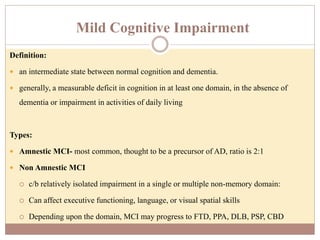
Mild Cognitive Impairment
Definition:
 an intermediate state between normal cognition and dementia.
 generally, a measurable deficit in cognition in at least one domain, in the absence of
dementia or impairment in activities of daily living
Types:
 Amnestic MCI- most common, thought to be a precursor of AD, ratio is 2:1
 Non Amnestic MCI
 c/b relatively isolated impairment in a single or multiple non-memory domain:
 Can affect executive functioning, language, or visual spatial skills
 Depending upon the domain, MCI may progress to FTD, PPA, DLB, PSP, CBD
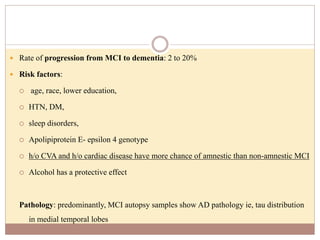
 Rate of progression from MCI to dementia: 2 to 20%
 Risk factors:
 age, race, lower education,
 HTN, DM,
 sleep disorders,
 Apolipiprotein E- epsilon 4 genotype
 h/o CVA and h/o cardiac disease have more chance of amnestic than non-amnestic MCI
 Alcohol has a protective effect
Pathology: predominantly, MCI autopsy samples show AD pathology ie, tau distribution
in medial temporal lobes
 Clinical features:
 Cognitive
 Neuropsychiatric:
 depression, irritability, anxiety, aggression, apathy, dysphoria
 Olfactory changes
 Gait slowing: motoric cognitive risk
 Evaluation
 Imaging: medial temporal lobe atrophy, s/cortical WM-HI, or a combination of these
 CT, MRI, fMRI, FDG PET, amyloid PET, Tau PET
 Blood tests: B12, thyroid
 CSF biomarkers-
 elevated tau, tau protein phosphorylated at Thr 181, Aß 42,
 Plasma biomarkers: not well defined
 Formal tests: MMSE, MoCA, Kokmen short test of mental status
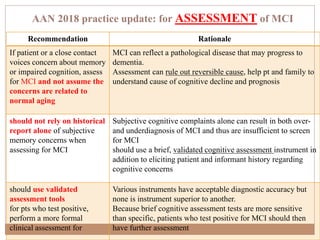
AAN 2018 practice update: for ASSESSMENT of MCI
Recommendation Rationale
If patient or a close contact
voices concern about memory
or impaired cognition, assess
for MCI and not assume the
concerns are related to
normal aging
MCI can reflect a pathological disease that may progress to
dementia.
Assessment can rule out reversible cause, help pt and family to
understand cause of cognitive decline and prognosis
should not rely on historical
report alone of subjective
memory concerns when
assessing for MCI
Subjective cognitive complaints alone can result in both over-
and underdiagnosis of MCI and thus are insufficient to screen
for MCI
should use a brief, validated cognitive assessment instrument in
addition to eliciting patient and informant history regarding
cognitive concerns
should use validated
assessment tools
for pts who test positive,
perform a more formal
clinical assessment for
Various instruments have acceptable diagnostic accuracy but
none is instrument superior to another.
Because brief cognitive assessment tests are more sensitive
than specific, patients who test positive for MCI should then
have further assessment
Recommendation Rationale
assess for the presence of
functional impairment
related to cognition before
diagnosing of dementia.
Diagnosing dementia prematurely can lead to negative
consequences for patients and families.
assess for evidence of functional impairment limiting
independence in daily activities a requirement for all dementia
diagnoses, to help distinguish between MCI
and dementia
clinicians who themselves
lack the necessary
experience should refer
these patients to a specialist
with experience in cognition.
Appropriate diagnosis is important for informing evaluation for
underlying causes, counseling on long-term prognosis, and
recommending therapeutic strategies
perform a medical
evaluation for MCI risk
factors that are potentially
modifiable
Some cases of MCI are a/w reversible causes of cognitive
impairment, including medication adverse events, sleep apnea,
depression etc
Recommendation Rationale
should counsel that there are no
accepted biomarkers available at
present interested patients, should be
informed of biomarker research or be
referred or both, if feasible, to centers or
organizations that can connect patients to
this research
Because patients with MCI can improve, remain
stable, or progress cognitively, identifying
biomarkers that can stratify risk is expected to be
particularly important for prognosis.
clinicians should perform serial
assessments over time to monitor for
changes in cognitive status
MCI can improve, remain stable, or progress
cognitively over time which can change diagnosis
and approach
Recommendation Rationale
clinicians should wean patients from
medications that can contribute to
cognitive impairment and treat
modifiable risk factors
It is important to treat reversible causes
should counsel the patients and
families that there are no
pharmacologic or dietary agents
currently shown to have symptomatic
cognitive benefit in MCI and no FDA-
approved medications
----------------------------
clinicians may choose not to offer
cholinesterase inhibitor
If being used, discuss that this s an of
label use without empirical data
In addition to lacking efficacy, side effects of
cholinesterase inhibitors are common, including
gastrointestinal symptoms and cardiac concerns
AAN 2017-18 practice update: for MANAGEMENT of MCI
Recommendation Rationale
Those who are interested in
pharmacologic treatment,
clinicians may inform these
patients of centers or
organizations that can
connect patients to clinical
trials
an opportunity for interested patients to participate in
identifying or testing new treatment options,
should recommend regular
exercise (twice per week)
6- month studies suggest a possible benefit of twice-weekly
exercise for cognition in MCI.
Exercise also has general health benefits and generally
limited risk.
discuss diagnosis and
uncertainties regarding
prognosis.
counsel pt & families to
discuss long-term
planning
Because of the possibility of progression to a dementia state
where pts may no longer be able to participate in decision
making, they should be encouraged to participate in long-term
planning on topics such as advance directives, driving safety,
finances, and estate planning
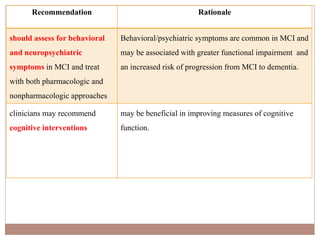
Recommendation Rationale
should assess for behavioral
and neuropsychiatric
symptoms in MCI and treat
with both pharmacologic and
nonpharmacologic approaches
Behavioral/psychiatric symptoms are common in MCI and
may be associated with greater functional impairment and
an increased risk of progression from MCI to dementia.
clinicians may recommend
cognitive interventions
may be beneficial in improving measures of cognitive
function.
THANK YOU

MCI practice update 2018

  • 1.
    Practice Guideline Update:Mild Cognitive Impairment Ronald C. Petersen, Oscar Lopez, et al; Neurology Jan 2018, 90 (3) 126-13
  • 2.
    Mild Cognitive Impairment Definition: an intermediate state between normal cognition and dementia.  generally, a measurable deficit in cognition in at least one domain, in the absence of dementia or impairment in activities of daily living Types:  Amnestic MCI- most common, thought to be a precursor of AD, ratio is 2:1  Non Amnestic MCI  c/b relatively isolated impairment in a single or multiple non-memory domain:  Can affect executive functioning, language, or visual spatial skills  Depending upon the domain, MCI may progress to FTD, PPA, DLB, PSP, CBD
  • 3.
     Rate ofprogression from MCI to dementia: 2 to 20%  Risk factors:  age, race, lower education,  HTN, DM,  sleep disorders,  Apolipiprotein E- epsilon 4 genotype  h/o CVA and h/o cardiac disease have more chance of amnestic than non-amnestic MCI  Alcohol has a protective effect Pathology: predominantly, MCI autopsy samples show AD pathology ie, tau distribution in medial temporal lobes
  • 4.
     Clinical features: Cognitive  Neuropsychiatric:  depression, irritability, anxiety, aggression, apathy, dysphoria  Olfactory changes  Gait slowing: motoric cognitive risk  Evaluation  Imaging: medial temporal lobe atrophy, s/cortical WM-HI, or a combination of these  CT, MRI, fMRI, FDG PET, amyloid PET, Tau PET  Blood tests: B12, thyroid  CSF biomarkers-  elevated tau, tau protein phosphorylated at Thr 181, Aß 42,  Plasma biomarkers: not well defined  Formal tests: MMSE, MoCA, Kokmen short test of mental status
  • 5.
    AAN 2018 practiceupdate: for ASSESSMENT of MCI Recommendation Rationale If patient or a close contact voices concern about memory or impaired cognition, assess for MCI and not assume the concerns are related to normal aging MCI can reflect a pathological disease that may progress to dementia. Assessment can rule out reversible cause, help pt and family to understand cause of cognitive decline and prognosis should not rely on historical report alone of subjective memory concerns when assessing for MCI Subjective cognitive complaints alone can result in both over- and underdiagnosis of MCI and thus are insufficient to screen for MCI should use a brief, validated cognitive assessment instrument in addition to eliciting patient and informant history regarding cognitive concerns should use validated assessment tools for pts who test positive, perform a more formal clinical assessment for Various instruments have acceptable diagnostic accuracy but none is instrument superior to another. Because brief cognitive assessment tests are more sensitive than specific, patients who test positive for MCI should then have further assessment
  • 6.
    Recommendation Rationale assess forthe presence of functional impairment related to cognition before diagnosing of dementia. Diagnosing dementia prematurely can lead to negative consequences for patients and families. assess for evidence of functional impairment limiting independence in daily activities a requirement for all dementia diagnoses, to help distinguish between MCI and dementia clinicians who themselves lack the necessary experience should refer these patients to a specialist with experience in cognition. Appropriate diagnosis is important for informing evaluation for underlying causes, counseling on long-term prognosis, and recommending therapeutic strategies perform a medical evaluation for MCI risk factors that are potentially modifiable Some cases of MCI are a/w reversible causes of cognitive impairment, including medication adverse events, sleep apnea, depression etc
  • 7.
    Recommendation Rationale should counselthat there are no accepted biomarkers available at present interested patients, should be informed of biomarker research or be referred or both, if feasible, to centers or organizations that can connect patients to this research Because patients with MCI can improve, remain stable, or progress cognitively, identifying biomarkers that can stratify risk is expected to be particularly important for prognosis. clinicians should perform serial assessments over time to monitor for changes in cognitive status MCI can improve, remain stable, or progress cognitively over time which can change diagnosis and approach
  • 8.
    Recommendation Rationale clinicians shouldwean patients from medications that can contribute to cognitive impairment and treat modifiable risk factors It is important to treat reversible causes should counsel the patients and families that there are no pharmacologic or dietary agents currently shown to have symptomatic cognitive benefit in MCI and no FDA- approved medications ---------------------------- clinicians may choose not to offer cholinesterase inhibitor If being used, discuss that this s an of label use without empirical data In addition to lacking efficacy, side effects of cholinesterase inhibitors are common, including gastrointestinal symptoms and cardiac concerns AAN 2017-18 practice update: for MANAGEMENT of MCI
  • 9.
    Recommendation Rationale Those whoare interested in pharmacologic treatment, clinicians may inform these patients of centers or organizations that can connect patients to clinical trials an opportunity for interested patients to participate in identifying or testing new treatment options, should recommend regular exercise (twice per week) 6- month studies suggest a possible benefit of twice-weekly exercise for cognition in MCI. Exercise also has general health benefits and generally limited risk. discuss diagnosis and uncertainties regarding prognosis. counsel pt & families to discuss long-term planning Because of the possibility of progression to a dementia state where pts may no longer be able to participate in decision making, they should be encouraged to participate in long-term planning on topics such as advance directives, driving safety, finances, and estate planning
  • 10.
    Recommendation Rationale should assessfor behavioral and neuropsychiatric symptoms in MCI and treat with both pharmacologic and nonpharmacologic approaches Behavioral/psychiatric symptoms are common in MCI and may be associated with greater functional impairment and an increased risk of progression from MCI to dementia. clinicians may recommend cognitive interventions may be beneficial in improving measures of cognitive function.
  • 11.