Facial Nerve Paralysis
By
Ahmed Shawky Ali
Outlines
 Anatomy
 Causes of facial nerve paralysis
 Evaluation
 Management
 Bell’s palsy
Anatomy of Facial nerve
 The facial nerve a mixed nerve, as it contains
motor, sensory and autonomic fibers.
 The motor part innervate the muscles of facial
expression as well as 4 other muscles:
(stapedius muscle, Stylohyoid muscles, posterior
belly of digastric muscle, platysma)
 The sensory part receives taste sensation
from the anterior 2/3 of the tongue.
 The autonomic (parasympathetic) part
supplies the lacrimal gland as well as the
submandibular, sublingual salivary glands.
Anatomy of Facial nerve
Anatomy of the sensory and autonomic parts:
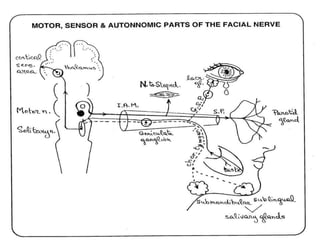
In the facial canal lies the geniculate ganglion , which contains
unipolar cells. The process of these cells divides in a T- shaped
manner into a peripheral branch and central branch.
1. The peripheral branch runs laterally and divides into :
 The greater superficial petrosal nerve which passses
forward to relay in the pterygopalatine ganglion where a
new set of fibers gives autonomic supply to lacrimal
gland.
 The chorda tympani which supply the submandibular &
sublingual salivary glands & carry taste sensation from
the anterior 2/3 of the tongue
Anatomy of Facial nerve
Anatomy of the sensory and autonomic parts:
2. The central branch of the unipolar cells pass
centrally, joins the motor part , then enter the
cranial cavity through the I.A.M as the nervus
intermedius.
 The nervus intermedius enter the brain stem at the
pontomedullary junction to terminate in solitary
neucleus in the medulla.
 Anew set of fibers pass from the nucleus to the
opposite side and run upward to terminate in the
lower part of the cortical sensory area, where tast
sensation from the anterior 2/3 of the tongue is
perceived.
Anatomy of Facial nerve
Anatomy of the motor part:
 The motor nucleus of the facial nerve is located in
pons, medial to the trigeminal nucleus & anterior to
6th nerve nucleus.
 Its upper part is bilaterally supplied from pyramidal
tracts of both sides, while the lower part is
unilaterally supplied from the pyramidal tract of the
opposite side only.
Anatomy of Facial nerve
Anatomy of the motor part:
 From the neucleus, the motor fibers form a loop
around the 6th nerve nucleus, then pass laterally to
merge at the lower part of the pons.
 The nerve runs laterally between the 6th &8th cr.n,
in the subarachnoid space of the cerebello-pontine
angle to enter,through the intenal auditory meatus
(I.A.M), into facial canal.
 In facial canal, the motor part becomes adherent to
the sensory and autonomic parts.
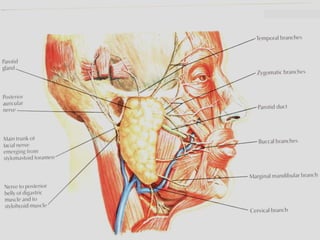
 It then leaves the canal through the stylomastoid
foramen, passes through the parotid gland to divide
into its terminal branches.
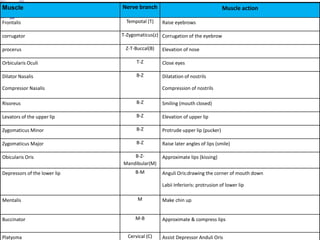
Muscle Nerve branch Muscle action
Frontalis Tempotal (T) Raise eyebrows
corrugator T-Zygomaticus(z) Corrugation of the eyebrow
procerus Z-T-Buccal(B) Elevation of nose
Orbicularis Oculi T-Z Close eyes
Dilator Nasalis
Compressor Nasalis
B-Z Dilatation of nostrils
Compression of nostrils
Risoreus B-Z Smiling (mouth closed)
Levators of the upper lip B-Z Elevation of upper lip
Zygomaticus Minor B-Z Protrude upper lip (pucker)
Zygomaticus Major B-Z Raise later angles of lips (smile)
Obicularis Oris B-Z-
Mandibular(M)
Approximate lips (kissing)
Depressors of the lower lip B-M Anguli Oris:drawing the corner of mouth down
Labii Inferioris: protrusion of lower lip
Mentalis M Make chin up
Buccinator M-B Approximate & compress lips
Platysma Cervical (C) Assist Depressor Anduli Oris
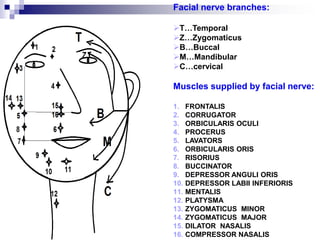
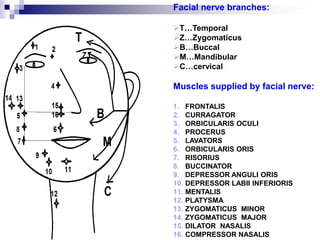
Facial nerve branches:
T…Temporal
Z…Zygomaticus
B…Buccal
M…Mandibular
C…cervical
Muscles supplied by facial nerve:
1. FRONTALIS
2. CORRUGATOR
3. ORBICULARIS OCULI
4. PROCERUS
5. LAVATORS
6. ORBICULARIS ORIS
7. RISORIUS
8. BUCCINATOR
9. DEPRESSOR ANGULI ORIS
10. DEPRESSOR LABII INFERIORIS
11. MENTALIS
12. PLATYSMA
13. ZYGOMATICUS MINOR
14. ZYGOMATICUS MAJOR
15. DILATOR NASALIS
16. COMPRESSOR NASALIS
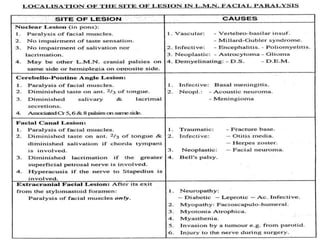
Causes of facial nerve paralysis
1.Causes of LMN facial paralysis : (table below)
2.Causes of UMN facial paralysis :same causes of
hemiplegia, above the level of the pones.
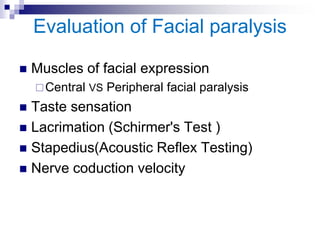
Evaluation of Facial paralysis
 Muscles of facial expression
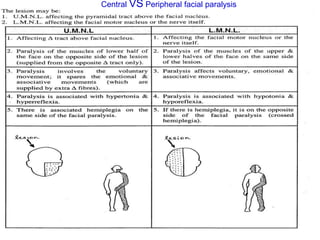
Central VS Peripheral facial paralysis
 Taste sensation
 Lacrimation (Schirmer's Test )
 Stapedius(Acoustic Reflex Testing)
 Nerve coduction velocity
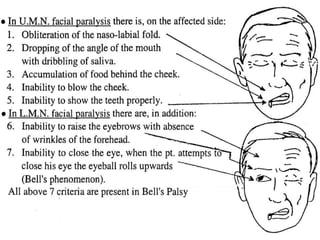
Central VS Peripheral facial paralysis
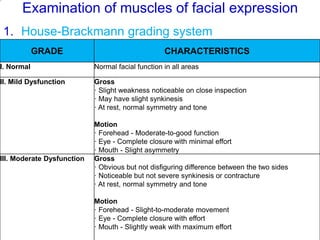
Examination of muscles of facial expression
GRADE CHARACTERISTICS
I. Normal Normal facial function in all areas
II. Mild Dysfunction Gross
· Slight weakness noticeable on close inspection
· May have slight synkinesis
· At rest, normal symmetry and tone
Motion
· Forehead - Moderate-to-good function
· Eye - Complete closure with minimal effort
· Mouth - Slight asymmetry
III. Moderate Dysfunction Gross
· Obvious but not disfiguring difference between the two sides
· Noticeable but not severe synkinesis or contracture
· At rest, normal symmetry and tone
Motion
· Forehead - Slight-to-moderate movement
· Eye - Complete closure with effort
· Mouth - Slightly weak with maximum effort
1. House-Brackmann grading system
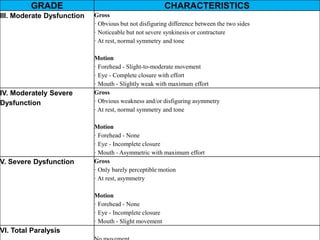
GRADE CHARACTERISTICS
III. Moderate Dysfunction Gross
· Obvious but not disfiguring difference between the two sides
· Noticeable but not severe synkinesis or contracture
· At rest, normal symmetry and tone
Motion
· Forehead - Slight-to-moderate movement
· Eye - Complete closure with effort
· Mouth - Slightly weak with maximum effort
IV. Moderately Severe
Dysfunction
Gross
· Obvious weakness and/or disfiguring asymmetry
· At rest, normal symmetry and tone
Motion
· Forehead - None
· Eye - Incomplete closure
· Mouth - Asymmetric with maximum effort
V. Severe Dysfunction Gross
· Only barely perceptible motion
· At rest, asymmetry
Motion
· Forehead - None
· Eye - Incomplete closure
· Mouth - Slight movement
VI. Total Paralysis
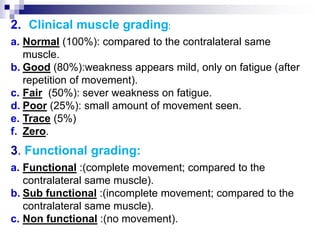
2. Clinical muscle grading:
a. Normal (100%): compared to the contralateral same
muscle.
b. Good (80%):weakness appears mild, only on fatigue (after
repetition of movement).
c. Fair (50%): sever weakness on fatigue.
d. Poor (25%): small amount of movement seen.
e. Trace (5%)
f. Zero.
3. Functional grading:
a. Functional :(complete movement; compared to the
contralateral same muscle).
b. Sub functional :(incomplete movement; compared to the
contralateral same muscle).
c. Non functional :(no movement).
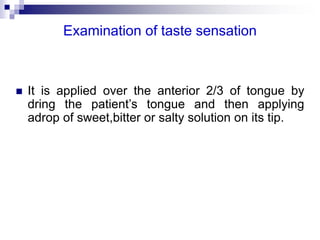
Examination of taste sensation
 It is applied over the anterior 2/3 of tongue by
dring the patient’s tongue and then applying
adrop of sweet,bitter or salty solution on its tip.
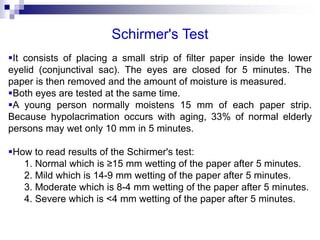
Schirmer's Test
It consists of placing a small strip of filter paper inside the lower
eyelid (conjunctival sac). The eyes are closed for 5 minutes. The
paper is then removed and the amount of moisture is measured.
Both eyes are tested at the same time.
A young person normally moistens 15 mm of each paper strip.
Because hypolacrimation occurs with aging, 33% of normal elderly
persons may wet only 10 mm in 5 minutes.
How to read results of the Schirmer's test:
1. Normal which is ≥15 mm wetting of the paper after 5 minutes.
2. Mild which is 14-9 mm wetting of the paper after 5 minutes.
3. Moderate which is 8-4 mm wetting of the paper after 5 minutes.
4. Severe which is <4 mm wetting of the paper after 5 minutes.
Acoustic Reflex Testing
 The Acoustic Reflex: A bilateral contraction of the
stapedius muscles in response to loud sounds (80
dB or above for people with normal hearing)
 Testing is conducted using a 226 Hz probe tone to
measure changes in contraction
Purposes of the Acoustic Reflex:
 protection from loud sounds
Nerve coduction velocity
Procedure
1.Stimulating electrodes: on nerve trunk using
surface electrodes the –ve one is put anterior to
the tragus of ear lobe, +ve electrode is put inferior
to the tragus of ear lobe
2.Recording electrodes : the active electrode is
put on the motor point of the examined muscle,
the reference electrode is put on the motor point
of the opposite muscle.
3.Ground electrode: on chin.
Nerve coduction velocity
Prognostic value of facial nerve conduction velocity:
Amplitude value 30-100% compared to nonaffected side
complete recovery within 1-2 months.
Amplitude value 10-30% compared to nonaffected side
good recovery (may be incomplete after 2-6 months).
Amplitude value <10% compared to nonaffected side
Abnormal regeneration (e.g:crocodilt tear or synkinesie),
satisfactory function after 6-12 months. few patients have no
functional recovery.
Physical therapy treatment for UMNL facial
palsy
Graduated strengthening exercises of the affected
muscles in front of mirror (through general or local
facilitatory techniques).
Hook splint rarely used
Physical therapy treatment for LMNL facial
palsy
All procedures start together at the first session in acute
lesions (e.g: Bell’s palsy) the program starts in the third
day after the onset.
1. Sourse of deep heat: to decrease the inflammation and
applied behind the ear; for 6 sessions.
In the form of SWD (20 minutes),US (5 minutes & 1.5
watt/ cubic cm) or laser.
2. Electrotherapy : (faradic stimmulation)
The +ve electrode is put on the nerve trunk, while the
–ve electrode is applied on the motor point of the desired
muscle. The intensity is raised till appearance of visible
Facial nerve branches:
T…Temporal
Z…Zygomaticus
B…Buccal
M…Mandibular
C…cervical
Muscles supplied by facial nerve:
1. FRONTALIS
2. CURRAGATOR
3. ORBICULARIS OCULI
4. PROCERUS
5. LAVATORS
6. ORBICULARIS ORIS
7. RISORIUS
8. BUCCINATOR
9. DEPRESSOR ANGULI ORIS
10. DEPRESSOR LABII INFERIORIS
11. MENTALIS
12. PLATYSMA
13. ZYGOMATICUS MINOR
14. ZYGOMATICUS MAJOR
15. DILATOR NASALIS
16. COMPRESSOR NASALIS
3. Exercices : (in front of mirror)
Mainly active (or passive if needed). General and/
or local facilitatory techniques (e.g: by using
resistance of the same contralateral muscle).
All the affected muscles must be trained.
4. Splints :
Hook splints can be used for adults, starting from
just below the lower lip; raising the cheek and
reaching the earlobe. In children, adhesive plaster
can be used in the same direction of the splint.
5. Massage :
In chronic cases, deep friction massage can be used to
break down adhesions.
6. EMG Biofeedback:
Used to manage synkinetic movements, by asking the
patient to increase gradually the activity of the weak
muscle while maintaining the activity of synkinetic one
(and not increase it).This is done to decrease synkinesis
gradually.
7. Advises:
Eye hygiene (manual closure of eye before
sleep- using eye drops and ointment as a local
decongestant and antibiotics respectively).
Home exercises
Avoid air draft and covering the affected area
behind the ear.
Continuous checking the blood glucose level in
diabetic patients.
Use ballon , o&c letters are spoken by the patient
in order to facilitate the affected muscles.
Prognosis of LMNL facial nerve lesion:
very good, complete recovery is expected within 1-2
months in more than 50% of cases. Complete
recovery is expected when some return of motor
function appear in the first 3 weeks.
Factors associated with poor prognosis:
1.DM
2.Hypertension
3.Decreased lacrimation
4.Age above 60 years
Incomplete recovery:
it is characterized by one or more of the followings:
1.Contractures: e.g corneal ulcer-down eyebrow-
deeper nasolabial fold.
2.Synkinetic movements: mean involuntary
movements associated with voluntary movements
and occur due to abnormal regeneration.
3.Corocodile tears: appear during eating and occur
due to abnormal regeneration of the facial nerve
that reaches lacrimal gland.
Bell's palsy
Bell's palsy is defined as an idiopathic unilateral
facial nerve paralysis.
The hallmark of this condition is a rapid onset
of partial or complete paralysis that often occurs
overnight. In rare cases (<1%), it can occur
bilaterally resulting in total facial paralysis.
It is the most common acute mononeuropathy
(disease involving only one nerve) and is the
most common cause of acute facial nerve
paralysis (>80%).
It is thought that an inflammatory
condition leads to swelling of the facial
nerve. The nerve travels through the skull
in a narrow bone canal beneath the ear.
Nerve swelling and compression in the
narrow bone canal are thought to lead to
nerve inhibition, damage or death.
Aetiology
Many causes have been suggested:
1. Exposure to air drafts.
2. Neurotropic virus.e.g: herpes zoster.
3. It may be autoimmune
Signs and symptoms
The onset is usually acute with pain behind the
ear.
Complete paralysis of the facial muscles on the
affected side of LMN nature within 72 hours.
Patients with Bell's palsy may present with
hyperacusis or loss of taste sensation in the
anterior 2/3 of the tongue.
Prognosis
Most people with Bell's palsy start to regain normal
facial function within 3 weeks—even those who do
not receive treatment.
incomplete palsies disappear entirely, nearly
always in the course of one month. The patients
who regain movement within the first two weeks
nearly always remit entirely. When remission does
not occur until the third week or later, a significantly
greater part of the patients develop sequelae.
 better prognosis for young patients, aged below
10 years old, while the patients over 61 years old
presented a worse prognosis.
Complications
Around 9% of patients have some sort of sequelae after Bell's
palsy
Synkinesis. For example, when the person closes the
eye, the corner of the mouth lifts involuntarily.
Chronic loss of taste (ageusia)
 chronic facial spasm
 facial pain
 corneal infections.
 contracture
 tinnitus and/or hearing loss during facial movement
 crocodile tear syndrome.

Facial palsy

  • 1.
  • 2.
    Outlines  Anatomy  Causesof facial nerve paralysis  Evaluation  Management  Bell’s palsy
  • 3.
    Anatomy of Facialnerve  The facial nerve a mixed nerve, as it contains motor, sensory and autonomic fibers.  The motor part innervate the muscles of facial expression as well as 4 other muscles: (stapedius muscle, Stylohyoid muscles, posterior belly of digastric muscle, platysma)  The sensory part receives taste sensation from the anterior 2/3 of the tongue.  The autonomic (parasympathetic) part supplies the lacrimal gland as well as the submandibular, sublingual salivary glands.
  • 4.
    Anatomy of Facialnerve Anatomy of the sensory and autonomic parts: In the facial canal lies the geniculate ganglion , which contains unipolar cells. The process of these cells divides in a T- shaped manner into a peripheral branch and central branch. 1. The peripheral branch runs laterally and divides into :  The greater superficial petrosal nerve which passses forward to relay in the pterygopalatine ganglion where a new set of fibers gives autonomic supply to lacrimal gland.  The chorda tympani which supply the submandibular & sublingual salivary glands & carry taste sensation from the anterior 2/3 of the tongue
  • 5.
    Anatomy of Facialnerve Anatomy of the sensory and autonomic parts: 2. The central branch of the unipolar cells pass centrally, joins the motor part , then enter the cranial cavity through the I.A.M as the nervus intermedius.  The nervus intermedius enter the brain stem at the pontomedullary junction to terminate in solitary neucleus in the medulla.  Anew set of fibers pass from the nucleus to the opposite side and run upward to terminate in the lower part of the cortical sensory area, where tast sensation from the anterior 2/3 of the tongue is perceived.
  • 7.
    Anatomy of Facialnerve Anatomy of the motor part:  The motor nucleus of the facial nerve is located in pons, medial to the trigeminal nucleus & anterior to 6th nerve nucleus.  Its upper part is bilaterally supplied from pyramidal tracts of both sides, while the lower part is unilaterally supplied from the pyramidal tract of the opposite side only.
  • 9.
    Anatomy of Facialnerve Anatomy of the motor part:  From the neucleus, the motor fibers form a loop around the 6th nerve nucleus, then pass laterally to merge at the lower part of the pons.  The nerve runs laterally between the 6th &8th cr.n, in the subarachnoid space of the cerebello-pontine angle to enter,through the intenal auditory meatus (I.A.M), into facial canal.  In facial canal, the motor part becomes adherent to the sensory and autonomic parts.  It then leaves the canal through the stylomastoid foramen, passes through the parotid gland to divide into its terminal branches.
  • 11.
    Muscle Nerve branchMuscle action Frontalis Tempotal (T) Raise eyebrows corrugator T-Zygomaticus(z) Corrugation of the eyebrow procerus Z-T-Buccal(B) Elevation of nose Orbicularis Oculi T-Z Close eyes Dilator Nasalis Compressor Nasalis B-Z Dilatation of nostrils Compression of nostrils Risoreus B-Z Smiling (mouth closed) Levators of the upper lip B-Z Elevation of upper lip Zygomaticus Minor B-Z Protrude upper lip (pucker) Zygomaticus Major B-Z Raise later angles of lips (smile) Obicularis Oris B-Z- Mandibular(M) Approximate lips (kissing) Depressors of the lower lip B-M Anguli Oris:drawing the corner of mouth down Labii Inferioris: protrusion of lower lip Mentalis M Make chin up Buccinator M-B Approximate & compress lips Platysma Cervical (C) Assist Depressor Anduli Oris
  • 12.
    Facial nerve branches: T…Temporal Z…Zygomaticus B…Buccal M…Mandibular C…cervical Musclessupplied by facial nerve: 1. FRONTALIS 2. CORRUGATOR 3. ORBICULARIS OCULI 4. PROCERUS 5. LAVATORS 6. ORBICULARIS ORIS 7. RISORIUS 8. BUCCINATOR 9. DEPRESSOR ANGULI ORIS 10. DEPRESSOR LABII INFERIORIS 11. MENTALIS 12. PLATYSMA 13. ZYGOMATICUS MINOR 14. ZYGOMATICUS MAJOR 15. DILATOR NASALIS 16. COMPRESSOR NASALIS
  • 13.
    Causes of facialnerve paralysis 1.Causes of LMN facial paralysis : (table below) 2.Causes of UMN facial paralysis :same causes of hemiplegia, above the level of the pones.
  • 15.
    Evaluation of Facialparalysis  Muscles of facial expression Central VS Peripheral facial paralysis  Taste sensation  Lacrimation (Schirmer's Test )  Stapedius(Acoustic Reflex Testing)  Nerve coduction velocity
  • 16.
    Central VS Peripheralfacial paralysis
  • 18.
    Examination of musclesof facial expression GRADE CHARACTERISTICS I. Normal Normal facial function in all areas II. Mild Dysfunction Gross · Slight weakness noticeable on close inspection · May have slight synkinesis · At rest, normal symmetry and tone Motion · Forehead - Moderate-to-good function · Eye - Complete closure with minimal effort · Mouth - Slight asymmetry III. Moderate Dysfunction Gross · Obvious but not disfiguring difference between the two sides · Noticeable but not severe synkinesis or contracture · At rest, normal symmetry and tone Motion · Forehead - Slight-to-moderate movement · Eye - Complete closure with effort · Mouth - Slightly weak with maximum effort 1. House-Brackmann grading system
  • 19.
    GRADE CHARACTERISTICS III. ModerateDysfunction Gross · Obvious but not disfiguring difference between the two sides · Noticeable but not severe synkinesis or contracture · At rest, normal symmetry and tone Motion · Forehead - Slight-to-moderate movement · Eye - Complete closure with effort · Mouth - Slightly weak with maximum effort IV. Moderately Severe Dysfunction Gross · Obvious weakness and/or disfiguring asymmetry · At rest, normal symmetry and tone Motion · Forehead - None · Eye - Incomplete closure · Mouth - Asymmetric with maximum effort V. Severe Dysfunction Gross · Only barely perceptible motion · At rest, asymmetry Motion · Forehead - None · Eye - Incomplete closure · Mouth - Slight movement VI. Total Paralysis
  • 20.
    2. Clinical musclegrading: a. Normal (100%): compared to the contralateral same muscle. b. Good (80%):weakness appears mild, only on fatigue (after repetition of movement). c. Fair (50%): sever weakness on fatigue. d. Poor (25%): small amount of movement seen. e. Trace (5%) f. Zero. 3. Functional grading: a. Functional :(complete movement; compared to the contralateral same muscle). b. Sub functional :(incomplete movement; compared to the contralateral same muscle). c. Non functional :(no movement).
  • 21.
    Examination of tastesensation  It is applied over the anterior 2/3 of tongue by dring the patient’s tongue and then applying adrop of sweet,bitter or salty solution on its tip.
  • 22.
    Schirmer's Test It consistsof placing a small strip of filter paper inside the lower eyelid (conjunctival sac). The eyes are closed for 5 minutes. The paper is then removed and the amount of moisture is measured. Both eyes are tested at the same time. A young person normally moistens 15 mm of each paper strip. Because hypolacrimation occurs with aging, 33% of normal elderly persons may wet only 10 mm in 5 minutes. How to read results of the Schirmer's test: 1. Normal which is ≥15 mm wetting of the paper after 5 minutes. 2. Mild which is 14-9 mm wetting of the paper after 5 minutes. 3. Moderate which is 8-4 mm wetting of the paper after 5 minutes. 4. Severe which is <4 mm wetting of the paper after 5 minutes.
  • 23.
    Acoustic Reflex Testing The Acoustic Reflex: A bilateral contraction of the stapedius muscles in response to loud sounds (80 dB or above for people with normal hearing)  Testing is conducted using a 226 Hz probe tone to measure changes in contraction Purposes of the Acoustic Reflex:  protection from loud sounds
  • 24.
    Nerve coduction velocity Procedure 1.Stimulatingelectrodes: on nerve trunk using surface electrodes the –ve one is put anterior to the tragus of ear lobe, +ve electrode is put inferior to the tragus of ear lobe 2.Recording electrodes : the active electrode is put on the motor point of the examined muscle, the reference electrode is put on the motor point of the opposite muscle. 3.Ground electrode: on chin.
  • 25.
    Nerve coduction velocity Prognosticvalue of facial nerve conduction velocity: Amplitude value 30-100% compared to nonaffected side complete recovery within 1-2 months. Amplitude value 10-30% compared to nonaffected side good recovery (may be incomplete after 2-6 months). Amplitude value <10% compared to nonaffected side Abnormal regeneration (e.g:crocodilt tear or synkinesie), satisfactory function after 6-12 months. few patients have no functional recovery.
  • 26.
    Physical therapy treatmentfor UMNL facial palsy Graduated strengthening exercises of the affected muscles in front of mirror (through general or local facilitatory techniques). Hook splint rarely used
  • 27.
    Physical therapy treatmentfor LMNL facial palsy All procedures start together at the first session in acute lesions (e.g: Bell’s palsy) the program starts in the third day after the onset. 1. Sourse of deep heat: to decrease the inflammation and applied behind the ear; for 6 sessions. In the form of SWD (20 minutes),US (5 minutes & 1.5 watt/ cubic cm) or laser. 2. Electrotherapy : (faradic stimmulation) The +ve electrode is put on the nerve trunk, while the –ve electrode is applied on the motor point of the desired muscle. The intensity is raised till appearance of visible
  • 28.
    Facial nerve branches: T…Temporal Z…Zygomaticus B…Buccal M…Mandibular C…cervical Musclessupplied by facial nerve: 1. FRONTALIS 2. CURRAGATOR 3. ORBICULARIS OCULI 4. PROCERUS 5. LAVATORS 6. ORBICULARIS ORIS 7. RISORIUS 8. BUCCINATOR 9. DEPRESSOR ANGULI ORIS 10. DEPRESSOR LABII INFERIORIS 11. MENTALIS 12. PLATYSMA 13. ZYGOMATICUS MINOR 14. ZYGOMATICUS MAJOR 15. DILATOR NASALIS 16. COMPRESSOR NASALIS
  • 29.
    3. Exercices :(in front of mirror) Mainly active (or passive if needed). General and/ or local facilitatory techniques (e.g: by using resistance of the same contralateral muscle). All the affected muscles must be trained. 4. Splints : Hook splints can be used for adults, starting from just below the lower lip; raising the cheek and reaching the earlobe. In children, adhesive plaster can be used in the same direction of the splint.
  • 30.
    5. Massage : Inchronic cases, deep friction massage can be used to break down adhesions. 6. EMG Biofeedback: Used to manage synkinetic movements, by asking the patient to increase gradually the activity of the weak muscle while maintaining the activity of synkinetic one (and not increase it).This is done to decrease synkinesis gradually.
  • 31.
    7. Advises: Eye hygiene(manual closure of eye before sleep- using eye drops and ointment as a local decongestant and antibiotics respectively). Home exercises Avoid air draft and covering the affected area behind the ear. Continuous checking the blood glucose level in diabetic patients. Use ballon , o&c letters are spoken by the patient in order to facilitate the affected muscles.
  • 32.
    Prognosis of LMNLfacial nerve lesion: very good, complete recovery is expected within 1-2 months in more than 50% of cases. Complete recovery is expected when some return of motor function appear in the first 3 weeks. Factors associated with poor prognosis: 1.DM 2.Hypertension 3.Decreased lacrimation 4.Age above 60 years
  • 33.
    Incomplete recovery: it ischaracterized by one or more of the followings: 1.Contractures: e.g corneal ulcer-down eyebrow- deeper nasolabial fold. 2.Synkinetic movements: mean involuntary movements associated with voluntary movements and occur due to abnormal regeneration. 3.Corocodile tears: appear during eating and occur due to abnormal regeneration of the facial nerve that reaches lacrimal gland.
  • 34.
    Bell's palsy Bell's palsyis defined as an idiopathic unilateral facial nerve paralysis. The hallmark of this condition is a rapid onset of partial or complete paralysis that often occurs overnight. In rare cases (<1%), it can occur bilaterally resulting in total facial paralysis. It is the most common acute mononeuropathy (disease involving only one nerve) and is the most common cause of acute facial nerve paralysis (>80%).
  • 35.
    It is thoughtthat an inflammatory condition leads to swelling of the facial nerve. The nerve travels through the skull in a narrow bone canal beneath the ear. Nerve swelling and compression in the narrow bone canal are thought to lead to nerve inhibition, damage or death.
  • 37.
    Aetiology Many causes havebeen suggested: 1. Exposure to air drafts. 2. Neurotropic virus.e.g: herpes zoster. 3. It may be autoimmune
  • 38.
    Signs and symptoms Theonset is usually acute with pain behind the ear. Complete paralysis of the facial muscles on the affected side of LMN nature within 72 hours. Patients with Bell's palsy may present with hyperacusis or loss of taste sensation in the anterior 2/3 of the tongue.
  • 39.
    Prognosis Most people withBell's palsy start to regain normal facial function within 3 weeks—even those who do not receive treatment. incomplete palsies disappear entirely, nearly always in the course of one month. The patients who regain movement within the first two weeks nearly always remit entirely. When remission does not occur until the third week or later, a significantly greater part of the patients develop sequelae.  better prognosis for young patients, aged below 10 years old, while the patients over 61 years old presented a worse prognosis.
  • 40.
    Complications Around 9% ofpatients have some sort of sequelae after Bell's palsy Synkinesis. For example, when the person closes the eye, the corner of the mouth lifts involuntarily. Chronic loss of taste (ageusia)  chronic facial spasm  facial pain  corneal infections.  contracture  tinnitus and/or hearing loss during facial movement  crocodile tear syndrome.