PARIETAL  LOBE DR ARUN S
IntroductionNo independent existence as     anatomical / physiological unitOperates in conjunction  with brain     as a wholeStrategically situated  b/w  other lobesGreater variety of clinical manifestations than  rest of the hemisphereDysfunction likely to be overlooked unless special  techniques used
HistoryIn 1874 Bartholow recorded odd sensation  from legs on stimulating post central gyrus through  skull woundsCushing in 1909 --- Electrical stimulation in conscious human beings under LA –– mainly tactile hallucinations
Critchley(1953) –   monograph on “ The Parietal Lobes” Djerine– alexia , agraphia -- angular  gyrus  lesion Liepmann--- ideomotor & ideational apraxia in (L) sided lesion
NeuroanatomyOccupies  middle third of cerebral hemispheresSituated b/w frontal ,temporal ,occipital lobes with anatomical & functional continuity
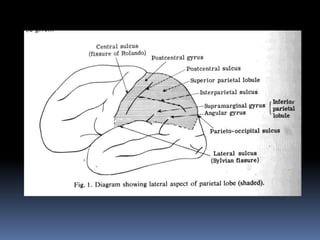
BoundariesAnterior –Central sulcus & its imaginary  continuation  over inner paracentral  lobule medially Posterior- parieto occipital sulcus on mesial aspect  & its continuation (imaginary) to join pre occipital notch  inferolaterallyLower- Sylvian fissure  & its imaginary extension backwards
Lateral surface 2 well defined sulciPost central sulcus –parellel to Fissure of RolandoInter parietal sulcus- runs  AP  from post central sulcus to occipital lobe
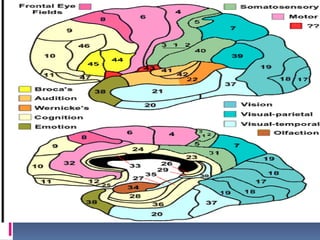
Lateral surfaceGyri Post central gyrus- primary sensory           area(3,1,2) Superior parietal lobule(5,7) Inferior parietal lobule ( Ecker’s lobule )Supramarginalgyrus (area 40) arches over Sylvian  fissure Angular gyrus (area 39 ) - arches over the superior temporal sulcus
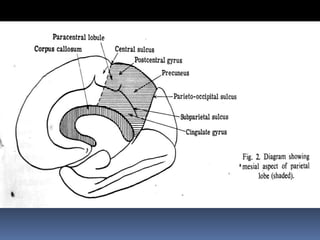
Mesial surfaceParacentral lobule- mesial part of post central gyrusPrecuneus- behind post central gyrusSubjacent part of cingulategyrus- below sub parietal sulcus
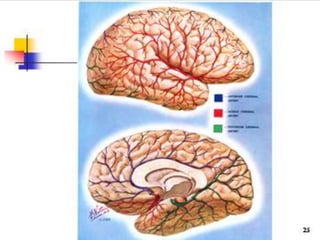
Vascular supplyLateral  -  MCA  Artery of Rolandic fissureArtery of inter parietal fissure Artery of post parietal fissureInter opercular parietal arteryArtery to angular gyrusMesial  -  ACA  mainly &  PCA to a slight extent
Venous drainage Superficial middle cerebral vein –lies in lateral fissure Vein of Trolard (superior anastomotic vein) - connects sup middle cerebral  vein to SSSVein  of  Labbe’ ( inferior anastomotic vein ) - connects sup middle cerebral vein to Transverse sinus
Post central gyrusGranular cortexReceives most of its afferents from VPL nucleus of thalamusProjects to somatosensory association cortex (area 5)Some parts (except hand & foot ) connected to opposite somatosensory cortex  via corpus callosumRepresentation of  C/L  side of body
Postcentral gyrusSuperior part  represent the LL Middle part -- the trunk & UL  and Lower part  --the faceAmount of cortex devoted to any particular body area – proportional to sensory acuity Tips of fingers &  lips larger area of representation
Posterior parietal regionSuperior & inferior Parietal lobuleConnections Post central gyrus
Superior parietal areaArea 5b- occupies large portion of Sup parietal lobule Extends  over medial surface to include pre cuneusNo large pyramidal cells in layer VGranular layer – great depth & density
Inferior parietal areaSupra marginal & angular gyrus No pyramidal cells Granular cortex well developedClose proximity to occipital & temporal lobe
Parietal lobe functionsDifficult to describe due to bewildering  range of symptoms  Simple functional division Anterior region- post central gyrus / sensory stripPosterior region – lies behind post central gyrus & is composed of tertiary cortex
Functions of anterior regionSomato sensory perceptionTactile perception Body senseVisual object recognition
Functions of posterior regionLanguage           Reception of spoken language         Reading Spatial orientation & attentionRoute following L- R discrimination Calculation
Intentional movement
Praxis
Constructional ability DrawingShort term auditory memoryOptic radiation passes to Occipital Lobe via deep region . Lesion  ---VF defectsAngular & supramarginal gyri of dominant hemisphere – imp in language & related functions
           APRAXIA        Definition Difficulty in performing skilled motor acts which can not be explained by an elementary sensory or motor deficit or language comprehension disorder
ApraxiaLimb apraxia–Limb kinetic / melokineticIdeomotorIdeationalDisassociation ConductionConceptual Constructional & dressing –often associated with neglect & visual perceptual disorders
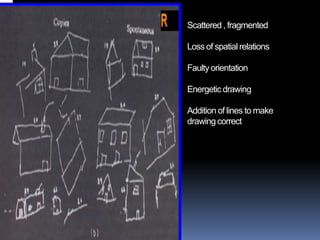
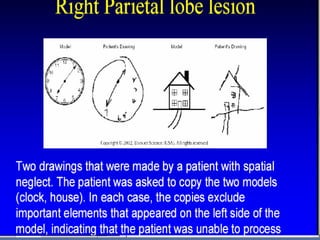
Scattered , fragmentedLoss of spatial relationsFaulty orientation Energetic drawing Addition of lines to make drawing correct
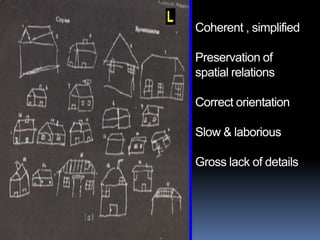
Coherent , simplifiedPreservation of spatial relationsCorrect orientation Slow & laborious Gross lack of details
TestsPressure sensitivityTwo point discriminationPoint localisation Position senseTactual object recognition
Two point discriminationUse a compass / calibrated  2 point esthesiometer1mm tip of tongue  2-4 mm finger tips  4-6 mm dorsum of fingers  8-12 mm on palm20-30 mm on dorsum of palm
AmorphosynthesisInability  to synthesize  separate tactile sensations into perception of form Lack of recognition of C/L body & of spaceAstereognosisLoss of ability to recognize object by touch Unable to name objects, describe or demonstrate their usePrimary sensations intact
Asomatognosia Agnosia relates to patient’s  own body TypesAnosognosiaAutotopagnosia
AnosognosiaIgnorance  of existence of disease More with (R )  PL lesions U/L neglect may co existDeny weakness /sensory loss of affected limbExtreme cases- disowns limb
AutotopagnosiaImpairment in localization / naming of  parts of  own bodyPatient unable to point to body parts named by examiner / move them May not be able to identify them on examiner’s body / on diagram
Finger agnosiaInability to recognize , name & point to individualized fingers on self & others – usually middle 3 fingersForm of autotopagnosia B/L  lesionCentral feature of Gerstmann syndrome
Language dysfunctionDominant PL lesionDefect in reception of spoken language & readingConduction aphasia
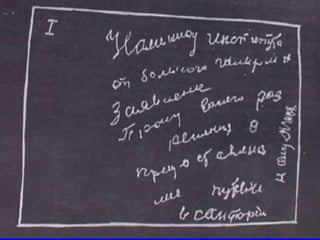
AgraphiaSpontaneous writing & writing on command more  affected than copy rightingIrregular & tremulous script, misspelling , semantic & syntactial errorsSite – inferior parietal lobule
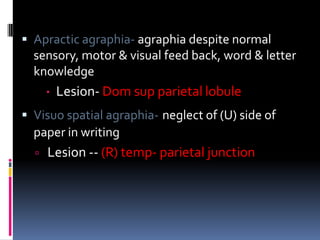
Apractic agraphia- agraphia despite normal  sensory, motor & visual feed back, word & letter knowledgeLesion- Dom sup parietal lobuleVisuo spatial agraphia-neglect of (U) side of paper in writingLesion -- (R) temp- parietal junction
Effects of unilateral disease of the parietal lobe, right or leftA. Corticosensory syndrome and sensory extinction B. Mild hemiparesis (variable), unilateral muscular atrophyin children, hypotonia, poverty of movement, hemiataxiaC. Homonymous hemianopia or inferior quadrantanopia(incongruent or congruent) or visual inattentionD. Abolition of optokineticnystagmus with target movingtoward side of the lesionE. Neglect of the opposite side of external space
Effects of unilateral disease of the dominant (left) parietallobeA. Disorders of language (especially alexia)B. Gerstmann syndrome (dysgraphia, dyscalculia, finger agnosia, right-left confusion)C. Tactile agnosia (bimanual astereognosis)D. Bilateral ideomotor and ideational apraxia
Effects of unilateral disease of the nondominant (right) parietal lobeA. Visuospatial disordersB. Topographic memory lossC. Anosognosia, dressing and constructional apraxiasD. ConfusionE. Tendency to keep the eyes closed, resist lid opening,and blepharospasm

Parietal lobe

  • 1.
    PARIETAL LOBEDR ARUN S
  • 2.
    IntroductionNo independent existenceas anatomical / physiological unitOperates in conjunction with brain as a wholeStrategically situated b/w other lobesGreater variety of clinical manifestations than rest of the hemisphereDysfunction likely to be overlooked unless special techniques used
  • 3.
    HistoryIn 1874 Bartholowrecorded odd sensation from legs on stimulating post central gyrus through skull woundsCushing in 1909 --- Electrical stimulation in conscious human beings under LA –– mainly tactile hallucinations
  • 4.
    Critchley(1953) – monograph on “ The Parietal Lobes” Djerine– alexia , agraphia -- angular gyrus lesion Liepmann--- ideomotor & ideational apraxia in (L) sided lesion
  • 5.
    NeuroanatomyOccupies middlethird of cerebral hemispheresSituated b/w frontal ,temporal ,occipital lobes with anatomical & functional continuity
  • 6.
    BoundariesAnterior –Central sulcus& its imaginary continuation over inner paracentral lobule medially Posterior- parieto occipital sulcus on mesial aspect & its continuation (imaginary) to join pre occipital notch inferolaterallyLower- Sylvian fissure & its imaginary extension backwards
  • 8.
    Lateral surface 2well defined sulciPost central sulcus –parellel to Fissure of RolandoInter parietal sulcus- runs AP from post central sulcus to occipital lobe
  • 9.
    Lateral surfaceGyri Postcentral gyrus- primary sensory area(3,1,2) Superior parietal lobule(5,7) Inferior parietal lobule ( Ecker’s lobule )Supramarginalgyrus (area 40) arches over Sylvian fissure Angular gyrus (area 39 ) - arches over the superior temporal sulcus
  • 10.
    Mesial surfaceParacentral lobule-mesial part of post central gyrusPrecuneus- behind post central gyrusSubjacent part of cingulategyrus- below sub parietal sulcus
  • 12.
    Vascular supplyLateral - MCA Artery of Rolandic fissureArtery of inter parietal fissure Artery of post parietal fissureInter opercular parietal arteryArtery to angular gyrusMesial - ACA mainly & PCA to a slight extent
  • 14.
    Venous drainage Superficialmiddle cerebral vein –lies in lateral fissure Vein of Trolard (superior anastomotic vein) - connects sup middle cerebral vein to SSSVein of Labbe’ ( inferior anastomotic vein ) - connects sup middle cerebral vein to Transverse sinus
  • 15.
    Post central gyrusGranularcortexReceives most of its afferents from VPL nucleus of thalamusProjects to somatosensory association cortex (area 5)Some parts (except hand & foot ) connected to opposite somatosensory cortex via corpus callosumRepresentation of C/L side of body
  • 17.
    Postcentral gyrusSuperior part represent the LL Middle part -- the trunk & UL and Lower part --the faceAmount of cortex devoted to any particular body area – proportional to sensory acuity Tips of fingers & lips larger area of representation
  • 18.
    Posterior parietal regionSuperior& inferior Parietal lobuleConnections Post central gyrus
  • 19.
    Superior parietal areaArea5b- occupies large portion of Sup parietal lobule Extends over medial surface to include pre cuneusNo large pyramidal cells in layer VGranular layer – great depth & density
  • 20.
    Inferior parietal areaSupramarginal & angular gyrus No pyramidal cells Granular cortex well developedClose proximity to occipital & temporal lobe
  • 21.
    Parietal lobe functionsDifficultto describe due to bewildering range of symptoms Simple functional division Anterior region- post central gyrus / sensory stripPosterior region – lies behind post central gyrus & is composed of tertiary cortex
  • 22.
    Functions of anteriorregionSomato sensory perceptionTactile perception Body senseVisual object recognition
  • 23.
    Functions of posteriorregionLanguage Reception of spoken language Reading Spatial orientation & attentionRoute following L- R discrimination Calculation
  • 24.
  • 25.
  • 26.
    Constructional ability DrawingShortterm auditory memoryOptic radiation passes to Occipital Lobe via deep region . Lesion ---VF defectsAngular & supramarginal gyri of dominant hemisphere – imp in language & related functions
  • 27.
    APRAXIA Definition Difficulty in performing skilled motor acts which can not be explained by an elementary sensory or motor deficit or language comprehension disorder
  • 28.
    ApraxiaLimb apraxia–Limb kinetic/ melokineticIdeomotorIdeationalDisassociation ConductionConceptual Constructional & dressing –often associated with neglect & visual perceptual disorders
  • 29.
    Scattered , fragmentedLossof spatial relationsFaulty orientation Energetic drawing Addition of lines to make drawing correct
  • 30.
    Coherent , simplifiedPreservationof spatial relationsCorrect orientation Slow & laborious Gross lack of details
  • 31.
    TestsPressure sensitivityTwo pointdiscriminationPoint localisation Position senseTactual object recognition
  • 32.
    Two point discriminationUsea compass / calibrated 2 point esthesiometer1mm tip of tongue 2-4 mm finger tips 4-6 mm dorsum of fingers 8-12 mm on palm20-30 mm on dorsum of palm
  • 33.
    AmorphosynthesisInability tosynthesize separate tactile sensations into perception of form Lack of recognition of C/L body & of spaceAstereognosisLoss of ability to recognize object by touch Unable to name objects, describe or demonstrate their usePrimary sensations intact
  • 34.
    Asomatognosia Agnosia relatesto patient’s own body TypesAnosognosiaAutotopagnosia
  • 35.
    AnosognosiaIgnorance ofexistence of disease More with (R ) PL lesions U/L neglect may co existDeny weakness /sensory loss of affected limbExtreme cases- disowns limb
  • 36.
    AutotopagnosiaImpairment in localization/ naming of parts of own bodyPatient unable to point to body parts named by examiner / move them May not be able to identify them on examiner’s body / on diagram
  • 37.
    Finger agnosiaInability torecognize , name & point to individualized fingers on self & others – usually middle 3 fingersForm of autotopagnosia B/L lesionCentral feature of Gerstmann syndrome
  • 38.
    Language dysfunctionDominant PLlesionDefect in reception of spoken language & readingConduction aphasia
  • 39.
    AgraphiaSpontaneous writing &writing on command more affected than copy rightingIrregular & tremulous script, misspelling , semantic & syntactial errorsSite – inferior parietal lobule
  • 40.
    Apractic agraphia- agraphiadespite normal sensory, motor & visual feed back, word & letter knowledgeLesion- Dom sup parietal lobuleVisuo spatial agraphia-neglect of (U) side of paper in writingLesion -- (R) temp- parietal junction
  • 43.
    Effects of unilateraldisease of the parietal lobe, right or leftA. Corticosensory syndrome and sensory extinction B. Mild hemiparesis (variable), unilateral muscular atrophyin children, hypotonia, poverty of movement, hemiataxiaC. Homonymous hemianopia or inferior quadrantanopia(incongruent or congruent) or visual inattentionD. Abolition of optokineticnystagmus with target movingtoward side of the lesionE. Neglect of the opposite side of external space
  • 44.
    Effects of unilateraldisease of the dominant (left) parietallobeA. Disorders of language (especially alexia)B. Gerstmann syndrome (dysgraphia, dyscalculia, finger agnosia, right-left confusion)C. Tactile agnosia (bimanual astereognosis)D. Bilateral ideomotor and ideational apraxia
  • 45.
    Effects of unilateraldisease of the nondominant (right) parietal lobeA. Visuospatial disordersB. Topographic memory lossC. Anosognosia, dressing and constructional apraxiasD. ConfusionE. Tendency to keep the eyes closed, resist lid opening,and blepharospasm