The document discusses the anatomy and functional areas of the frontal lobes, including the motor cortex, premotor cortex, dorsolateral prefrontal cortex, orbitofrontal cortex, and their connections. It also examines frontal lobe circuits and the neurotransmitters that project to the frontal lobes. Common frontal lobe syndromes and deficits associated with lesions to different frontal areas are described.
Presenter
Dr. Anusa AM
First year MD PG
1st August 2012
Hon. Chairperson
Dr. KUMANAN MD DPM,
Professor
Dr. KARTHIKEYAN MD, DPM,
Assistant Professor
2.
ďĄ Anatomy &Functional anatomy of frontal lobes
ďĄ Neurotransmitters in the frontal lobes
ďĄ Circuits of the frontal lobe and deficits
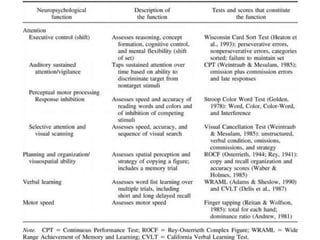
ďĄ Testing prefrontal cortical function
ďĄ Common causes of frontal lobe syndromes
ďĄ References
4.
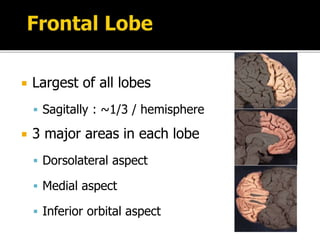
ďĄ Largest ofall lobes
ď§ Sagitally : ~1/3 / hemisphere
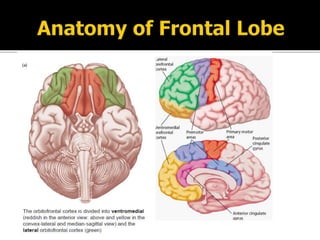
ďĄ 3 major areas in each lobe
ď§ Dorsolateral aspect
ď§ Medial aspect
ď§ Inferior orbital aspect
5.
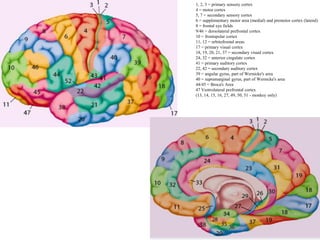
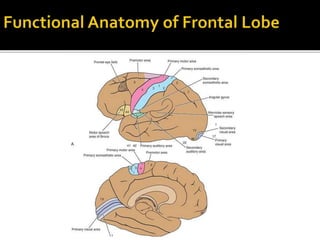
1, 2, 3= primary sensory cortex
4 = motor cortex
5, 7 = secondary sensory cortex
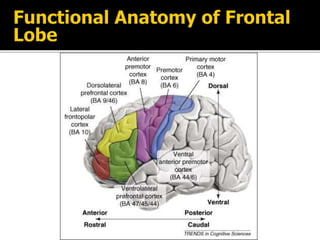
6 = supplementary motor area (medial) and premotor cortex (lateral)
8 = frontal eye fields
9/46 = dorsolateral prefrontal cortex
10 = frontopolar cortex
11, 12 = orbitofrontal areas
17 = primary visual cortex
18, 19, 20, 21, 37 = secondary visual cortex
24, 32 = anterior cingulate cortex
41 = primary auditory cortex
22, 42 = secondary auditory cortex
39 = angular gyrus, part of Wernicke's area
40 = supramarginal gyrus, part of Wernicke's area
44/45 = Broca's Area
47 Ventrolateral prefrontal cortex
(13, 14, 15, 16, 27, 49, 50, 51 - monkey only)
6.
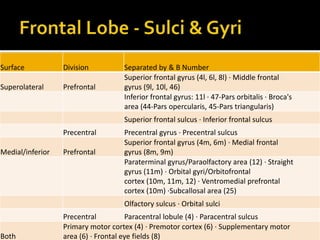
Surface Division Separatedby & B Number
Superolateral Prefrontal
Superior frontal gyrus (4l, 6l, 8l) ¡ Middle frontal
gyrus (9l, 10l, 46)
Inferior frontal gyrus: 11l ¡ 47-Pars orbitalis ¡ Broca's
area (44-Pars opercularis, 45-Pars triangularis)
Superior frontal sulcus ¡ Inferior frontal sulcus
Precentral Precentral gyrus ¡ Precentral sulcus
Medial/inferior Prefrontal
Superior frontal gyrus (4m, 6m) ¡ Medial frontal
gyrus (8m, 9m)
Paraterminal gyrus/Paraolfactory area (12) ¡ Straight
gyrus (11m) ¡ Orbital gyri/Orbitofrontal
cortex (10m, 11m, 12) ¡ Ventromedial prefrontal
cortex (10m) ¡Subcallosal area (25)
Olfactory sulcus ¡ Orbital sulci
Precentral Paracentral lobule (4) ¡ Paracentral sulcus
Both
Primary motor cortex (4) ¡ Premotor cortex (6) ¡ Supplementary motor
area (6) ¡ Frontal eye fields (8)
8.
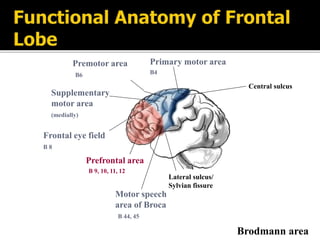
Lateral sulcus/
Sylvian fissure
Centralsulcus
Motor speech
area of Broca
Frontal eye field
B 44, 45
B 9, 10, 11, 12
B 8
Primary motor areaPremotor area
Prefrontal area
B6 B4
Supplementary
motor area
(medially)
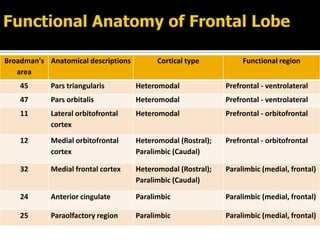
Brodmann area
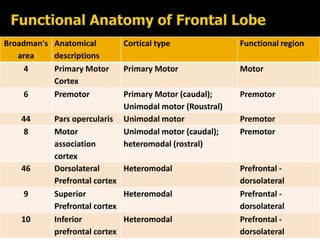
Broadman's
area
Anatomical
descriptions
Cortical type Functionalregion
4 Primary Motor
Cortex
Primary Motor Motor
6 Premotor Primary Motor (caudal);
Unimodal motor (Roustral)
Premotor
44 Pars opercularis Unimodal motor Premotor
8 Motor
association
cortex
Unimodal motor (caudal);
heteromodal (rostral)
Premotor
46 Dorsolateral
Prefrontal cortex
Heteromodal Prefrontal -
dorsolateral
9 Superior
Prefrontal cortex
Heteromodal Prefrontal -
dorsolateral
10 Inferior
prefrontal cortex
Heteromodal Prefrontal -
dorsolateral
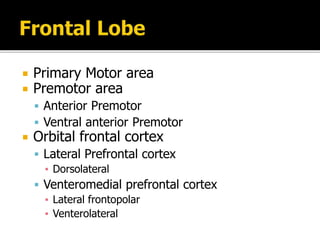
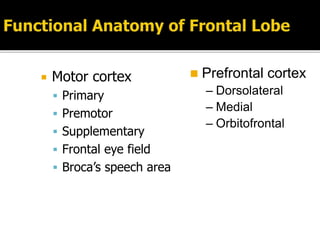
ďĄ Motor cortex
ď§Primary
ď§ Premotor
ď§ Supplementary
ď§ Frontal eye field
ď§ Brocaâs speech area
ďŽ Prefrontal cortex
â Dorsolateral
â Medial
â Orbitofrontal
15.
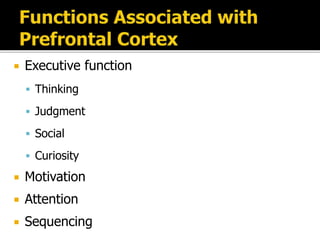
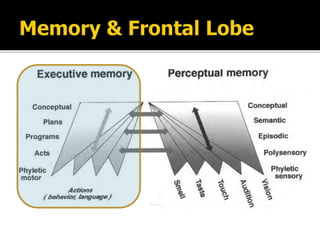
ďĄ Executive function
ď§Thinking
ď§ Judgment
ď§ Social
ď§ Curiosity
ďĄ Motivation
ďĄ Attention
ďĄ Sequencing
16.
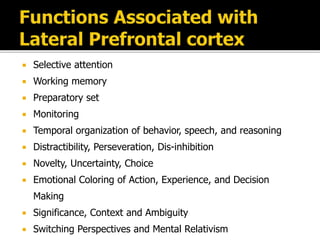
ďĄ Selective attention
ďĄWorking memory
ďĄ Preparatory set
ďĄ Monitoring
ďĄ Temporal organization of behavior, speech, and reasoning
ďĄ Distractibility, Perseveration, Dis-inhibition
ďĄ Novelty, Uncertainty, Choice
ďĄ Emotional Coloring of Action, Experience, and Decision
Making
ďĄ Significance, Context and Ambiguity
ďĄ Switching Perspectives and Mental Relativism
18.
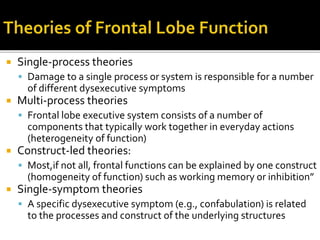
ďĄ Single-process theories
ď§Damage to a single process or system is responsible for a number
of different dysexecutive symptoms
ďĄ Multi-process theories
ď§ Frontal lobe executive system consists of a number of
components that typically work together in everyday actions
(heterogeneity of function)
ďĄ Construct-led theories:
ď§ Most,if not all, frontal functions can be explained by one construct
(homogeneity of function) such as working memory or inhibitionâ
ďĄ Single-symptom theories
ď§ A specific dysexecutive symptom (e.g., confabulation) is related
to the processes and construct of the underlying structures
19.
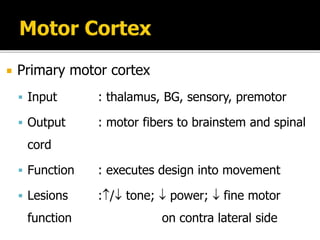
ďĄ Primary motorcortex
ď§ Input : thalamus, BG, sensory, premotor
ď§ Output : motor fibers to brainstem and spinal
cord
ď§ Function : executes design into movement
ď§ Lesions :ď/ďŻ tone; ďŻ power; ďŻ fine motor
function on contra lateral side
20.
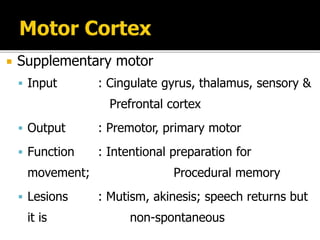
ďĄ Supplementary motor
ď§Input : Cingulate gyrus, thalamus, sensory &
Prefrontal cortex
ď§ Output : Premotor, primary motor
ď§ Function : Intentional preparation for
movement; Procedural memory
ď§ Lesions : Mutism, akinesis; speech returns but
it is non-spontaneous
21.
ďĄ Premotor cortex
ď§Input : Thalamus, BG, sensory cortex
ď§ Output : Primary motor cortex
ď§ Function : Stores motor programs; controls
coarse postural movements
ď§ Lesions : Moderate weakness in proximal
muscles on contralateral side
22.
ďĄ Frontal eyefields
ď§ Input : Parietal / temporal (what is target);
posterior / parietal cortex (where is target)
ď§ Output : Caudate; superior colliculus; paramedian
pontine reticular formation
ď§ Function : Executive: selects target & commands
movement (saccades)
ď§ Lesion : Eyes deviate ipsilaterally with destructive
lesion & contralaterally with irritating lesions
23.
ďĄ Brocaâs speecharea
ď§ Input : Wernickeâs
ď§ Output : Primary motor cortex
ď§ Function : Speech production (dominant
hemisphere); emotional, melodic
component of speech (non-dominant)
ď§ Lesions: motor aphasia; monotone speech
24.
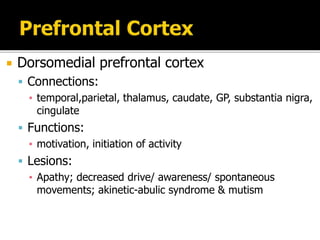
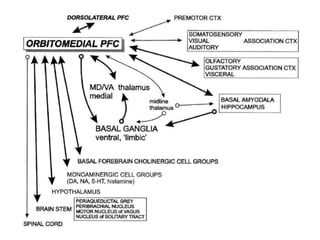
ďĄ Orbital prefrontalcortex
ď§ Connections:
⪠temporal,parietal, thalamus, GP, caudate, SN, insula,
amygdala
⪠Part of limbic system
ď§ Function
⪠Emotional imput, arousal, suppression of distracting signals
ď§ Lesions
⪠emotional lability, disinhibition, distractibility, âhyperkinesisâ
25.
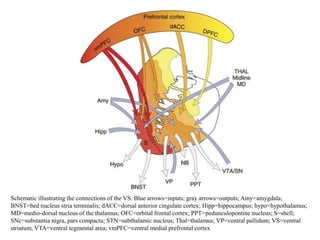
Schematic illustrating theconnections of the VS. Blue arrows=inputs; gray arrows=outputs; Amy=amygdala;
BNST=bed nucleus stria terminalis; dACC=dorsal anterior cingulate cortex; Hipp=hippocampus; hypo=hypothalamus;
MD=medio-dorsal nucleus of the thalamus; OFC=orbital frontal cortex; PPT=pedunculopontine nucleus; S=shell;
SNc=substantia nigra, pars compacta; STN=subthalamic nucleus; Thal=thalamus; VP=ventral pallidum; VS=ventral
striatum; VTA=ventral tegmental area; vmPFC=ventral medial prefrontal cortex
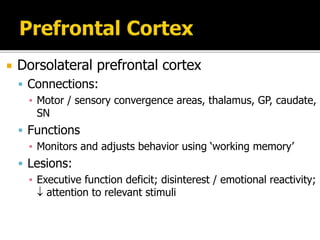
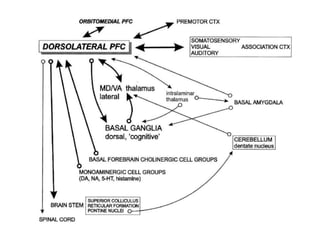
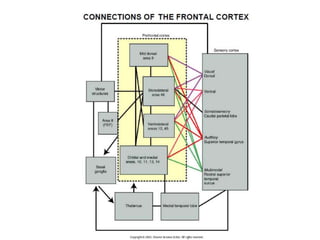
ďĄ Dorsolateral prefrontalcortex
ď§ Connections:
⪠Motor / sensory convergence areas, thalamus, GP, caudate,
SN
ď§ Functions
⪠Monitors and adjusts behavior using âworking memoryâ
ď§ Lesions:
⪠Executive function deficit; disinterest / emotional reactivity;
ďŻ attention to relevant stimuli
30.
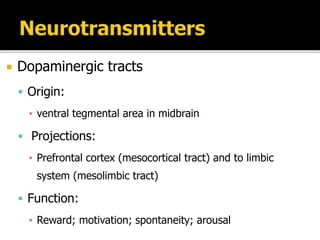
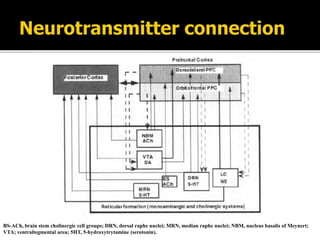
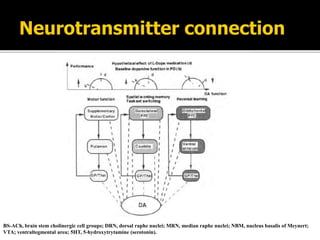
ďĄ Dopaminergic tracts
ď§Origin:
⪠ventral tegmental area in midbrain
ď§ Projections:
⪠Prefrontal cortex (mesocortical tract) and to limbic
system (mesolimbic tract)
ď§ Function:
⪠Reward; motivation; spontaneity; arousal
31.
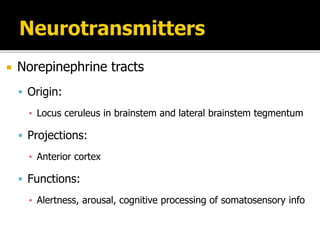
ďĄ Norepinephrine tracts
ď§Origin:
⪠Locus ceruleus in brainstem and lateral brainstem tegmentum
ď§ Projections:
⪠Anterior cortex
ď§ Functions:
⪠Alertness, arousal, cognitive processing of somatosensory info
32.
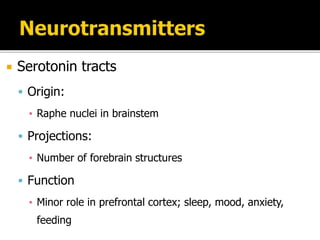
ďĄ Serotonin tracts
ď§Origin:
⪠Raphe nuclei in brainstem
ď§ Projections:
⪠Number of forebrain structures
ď§ Function
⪠Minor role in prefrontal cortex; sleep, mood, anxiety,
feeding
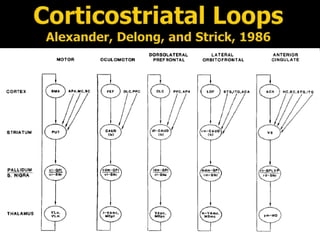
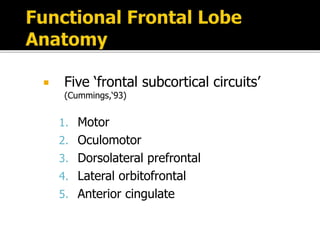
ďĄ Five âfrontalsubcortical circuitsâ
(Cummings,â93)
1. Motor
2. Oculomotor
3. Dorsolateral prefrontal
4. Lateral orbitofrontal
5. Anterior cingulate
37.
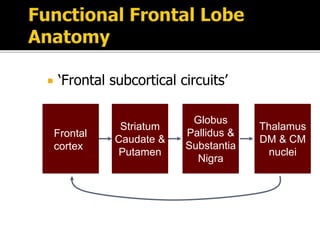
ďĄ âFrontal subcorticalcircuitsâ
Thalamus
DM & CM
nuclei
Frontal
cortex
Striatum
Caudate &
Putamen
Globus
Pallidus &
Substantia
Nigra
38.
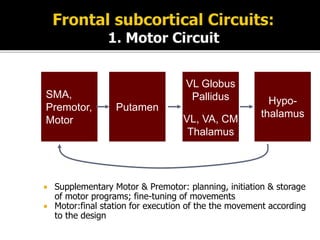
ďĄ Supplementary Motor& Premotor: planning, initiation & storage
of motor programs; fine-tuning of movements
ďĄ Motor:final station for execution of the the movement according
to the design
SMA,
Premotor,
Motor
Putamen
VL Globus
Pallidus
VL, VA, CM
Thalamus
Hypo-
thalamus
39.
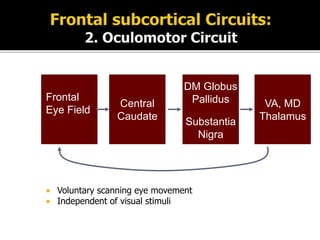
ďĄ Voluntary scanningeye movement
ďĄ Independent of visual stimuli
Frontal
Eye Field
Central
Caudate
DM Globus
Pallidus
Substantia
Nigra
VA, MD
Thalamus
40.
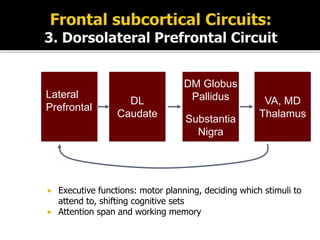
ďĄ Executive functions:motor planning, deciding which stimuli to
attend to, shifting cognitive sets
ďĄ Attention span and working memory
Lateral
Prefrontal
DL
Caudate
DM Globus
Pallidus
Substantia
Nigra
VA, MD
Thalamus
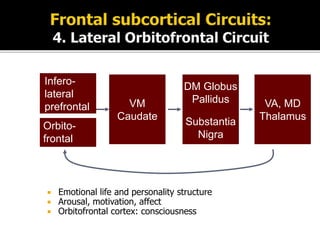
41.
ďĄ Emotional lifeand personality structure
ďĄ Arousal, motivation, affect
ďĄ Orbitofrontal cortex: consciousness
VM
Caudate
DM Globus
Pallidus
Substantia
Nigra
VA, MD
Thalamus
Infero-
lateral
prefrontal
Orbito-
frontal
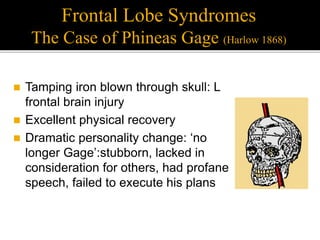
Frontal Lobe Syndromes
TheCase of Phineas Gage (Harlow 1868)
ďŽ Tamping iron blown through skull: L
frontal brain injury
ďŽ Excellent physical recovery
ďŽ Dramatic personality change: âno
longer Gageâ:stubborn, lacked in
consideration for others, had profane
speech, failed to execute his plans
45.
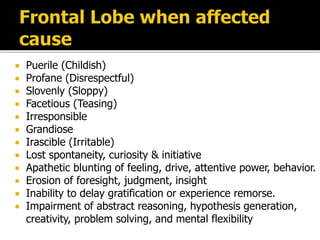
ďĄ Puerile (Childish)
ďĄProfane (Disrespectful)
ďĄ Slovenly (Sloppy)
ďĄ Facetious (Teasing)
ďĄ Irresponsible
ďĄ Grandiose
ďĄ Irascible (Irritable)
ďĄ Lost spontaneity, curiosity & initiative
ďĄ Apathetic blunting of feeling, drive, attentive power, behavior.
ďĄ Erosion of foresight, judgment, insight
ďĄ Inability to delay gratification or experience remorse.
ďĄ Impairment of abstract reasoning, hypothesis generation,
creativity, problem solving, and mental flexibility
46.
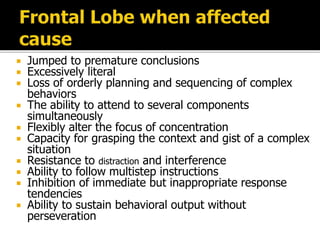
ďĄ Jumped topremature conclusions
ďĄ Excessively literal
ďĄ Loss of orderly planning and sequencing of complex
behaviors
ďĄ The ability to attend to several components
simultaneously
ďĄ Flexibly alter the focus of concentration
ďĄ Capacity for grasping the context and gist of a complex
situation
ďĄ Resistance to distraction and interference
ďĄ Ability to follow multistep instructions
ďĄ Inhibition of immediate but inappropriate response
tendencies
ďĄ Ability to sustain behavioral output without
perseveration
47.
Frontal Lobe Syndromes
ďŽEmotional make-up and personality
ďŽ Abstraction and judgment
ďŽ Attention and memory
ďŽ Language
48.
Frontal Lobe Syndromes
ďŽEmotional make-up and personality
â May be the only manifestation
â Apathy / euphoria / labile mood
â Decreased drive / poor impulse control
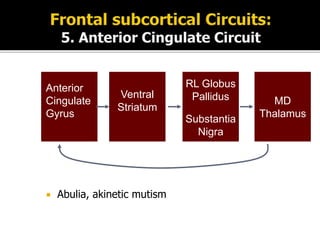
â Abulia; akinetic mutism
â Pseudobulbar palsy; Opercular syndrome
â Best assessed with Hx from family / friends &
observation
49.
Frontal Lobe Syndromes
ďŽAbstraction and judgment
â Cognitive functions undisturbed
â Concrete thinking
â Diminished insight
â Defect in planning / executive control
50.
ďŽ Tests ofabstraction and judgment
â Interpret proverbs (e.g.âthe golden hammer opens
iron doorsâ)
â Explain why conceptually linked words are the
same (e.g. coat & skirt)
â Plan & structure a sequential set of activities (âhow
would you bake a cake?â)
â Insight / reaction to own illness
51.
ďŽ Attention andmemory
â Inattentiveness
â Defect in working memory
â Defect in sequencing, perseverance
53.
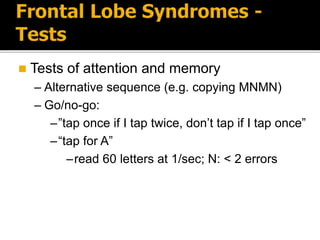
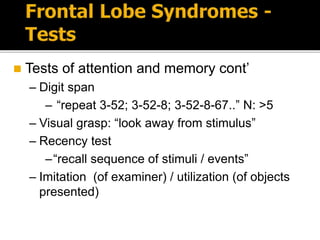
ďŽ Tests ofattention and memory
â Alternative sequence (e.g. copying MNMN)
â Go/no-go:
ââtap once if I tap twice, donât tap if I tap onceâ
ââtap for Aâ
âread 60 letters at 1/sec; N: < 2 errors
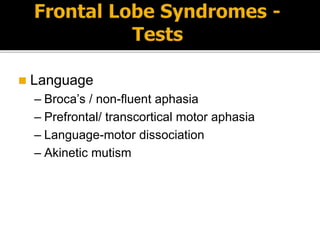
ďŽ Language
â Brocaâs/ non-fluent aphasia
â Prefrontal/ transcortical motor aphasia
â Language-motor dissociation
â Akinetic mutism
56.
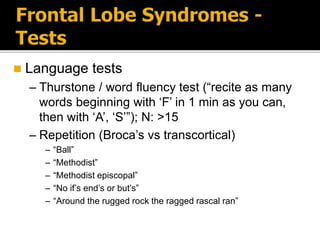
ďŽ Language tests
âThurstone / word fluency test (ârecite as many
words beginning with âFâ in 1 min as you can,
then with âAâ, âSââ); N: >15
â Repetition (Brocaâs vs transcortical)
â âBallâ
â âMethodistâ
â âMethodist episcopalâ
â âNo ifâs endâs or butâsâ
â âAround the rugged rock the ragged rascal ranâ
57.
Frontal Lobe Syndromes- Tests
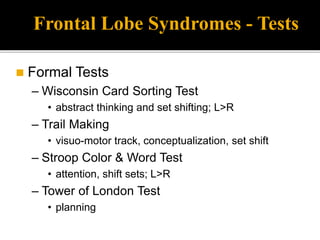
ďŽ Formal Tests
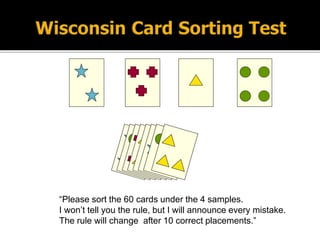
â Wisconsin Card Sorting Test
⢠abstract thinking and set shifting; L>R
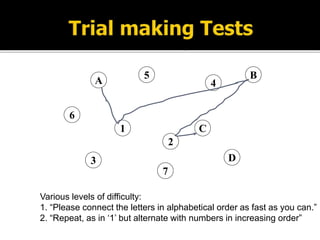
â Trail Making
⢠visuo-motor track, conceptualization, set shift
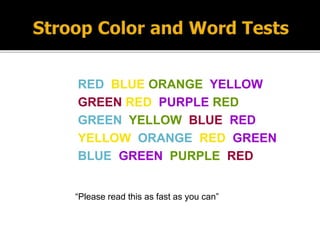
â Stroop Color & Word Test
⢠attention, shift sets; L>R
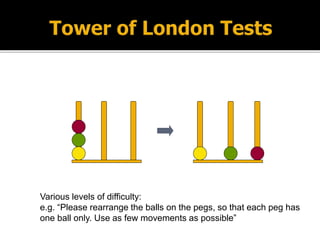
â Tower of London Test
⢠planning
58.
âPlease sort the60 cards under the 4 samples.
I wonât tell you the rule, but I will announce every mistake.
The rule will change after 10 correct placements.â
59.
Trail Making Test
A
C1
2
7
3D
5 B
4
6
Various levels of difficulty:
1. âPlease connect the letters in alphabetical order as fast as you can.â
2. âRepeat, as in â1â but alternate with numbers in increasing orderâ
60.
RED BLUE ORANGEYELLOW
GREEN RED PURPLE RED
GREEN YELLOW BLUE RED
YELLOW ORANGE RED GREEN
BLUE GREEN PURPLE RED
âPlease read this as fast as you canâ
61.
Various levels ofdifficulty:
e.g. âPlease rearrange the balls on the pegs, so that each peg has
one ball only. Use as few movements as possibleâ
62.
Diseases Commonly Associated
WithFrontal Lobe Lesions
ďŽ Traumatic brain injury
â Gunshot wound
â Closed head injury
⢠Widespread stretching and shearing of fibers
throughout
⢠Frontal lobe more vulnerable
â Contusions and intracerebral hematomas
63.
ďŽ Frontal Lobeseizures
â Usually secondary to trauma
â Difficult to diagnose: can be odd (laughter, crying,
verbal automatism, complex gestures)
Diseases Commonly Associated
With Frontal Lobe Lesions
64.
ďŽ Vascular disease
âCommon cause especially in elderly
â ACA territory infarction
⢠Damage to medial frontal area
â MCA territory
⢠Dorsolateral frontal lobe
â ACom aneurysm rupture
⢠Personality change, emotional disturbance
65.
ďŽ Tumors
â Gliomas,meningiomas
â subfrontal and olfactory groove meningiomas:
profound personality changes and dementia
ďŽ Multiple Sclerosis
â Frontal lobes 2nd highest number of plaques
â euphoric/depressed mood, Memory problems,
cognitive and behavioral effects
Diseases Commonly Associated
With Frontal Lobe Lesions