 To define data.
 To enumerate various types of data with examples.
 To know about the various scales of measurement.
 To enumerate the various sources for collection of data.
 To explain various methods of presentation of data.
 To select appropriate method of presentation depending upon the type
of data.
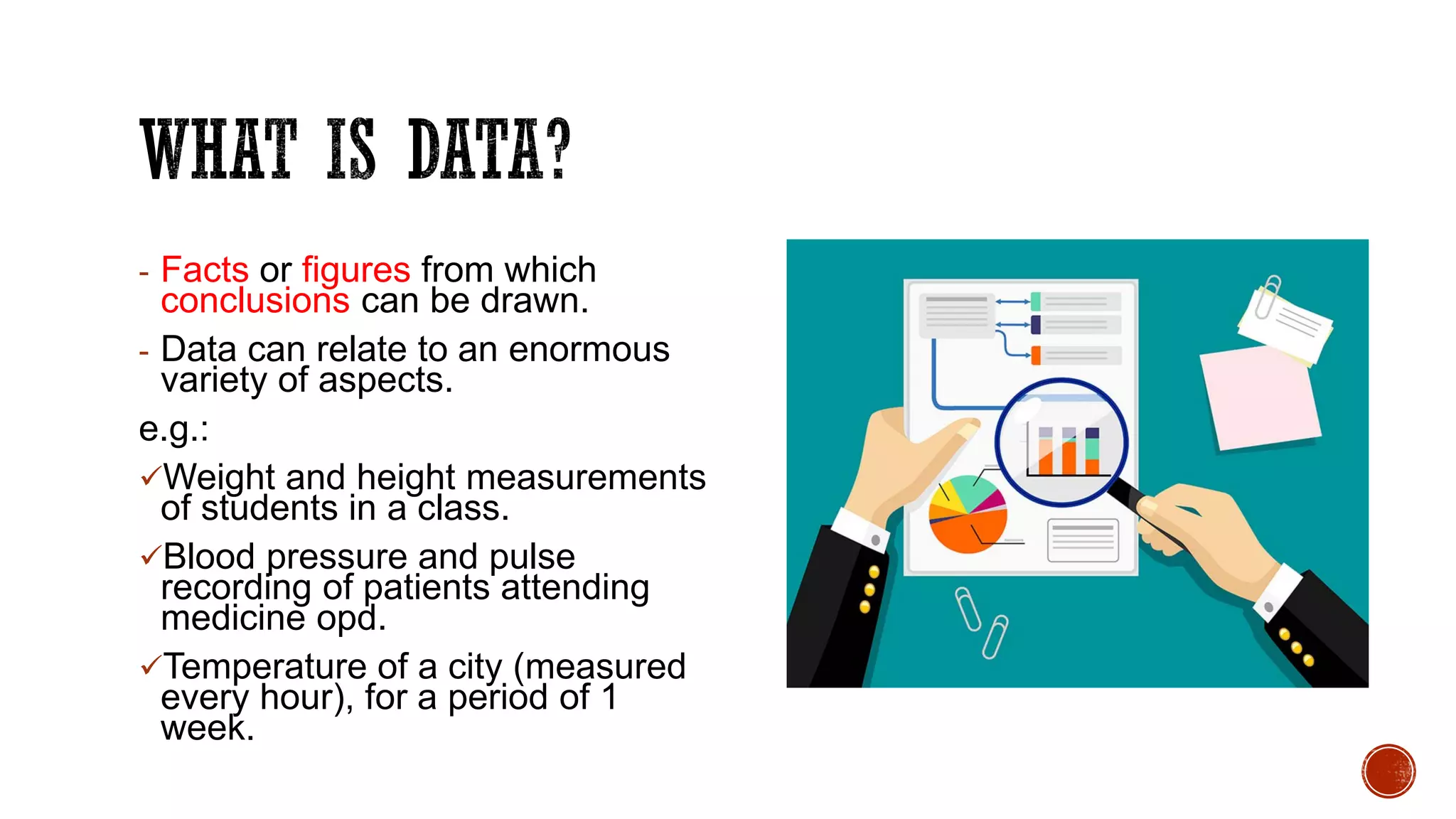
- Facts or figures from which
conclusions can be drawn.
- Data can relate to an enormous
variety of aspects.
e.g.:
Weight and height measurements
of students in a class.
Blood pressure and pulse
recording of patients attending
medicine opd.
Temperature of a city (measured
every hour), for a period of 1
week.
 QUALITATIVE DATA and QUANTITATIVE DATA
 PRIMARY DATA and SECONDARY DATA
 GROUPED DATA and UNGROUPED DATA
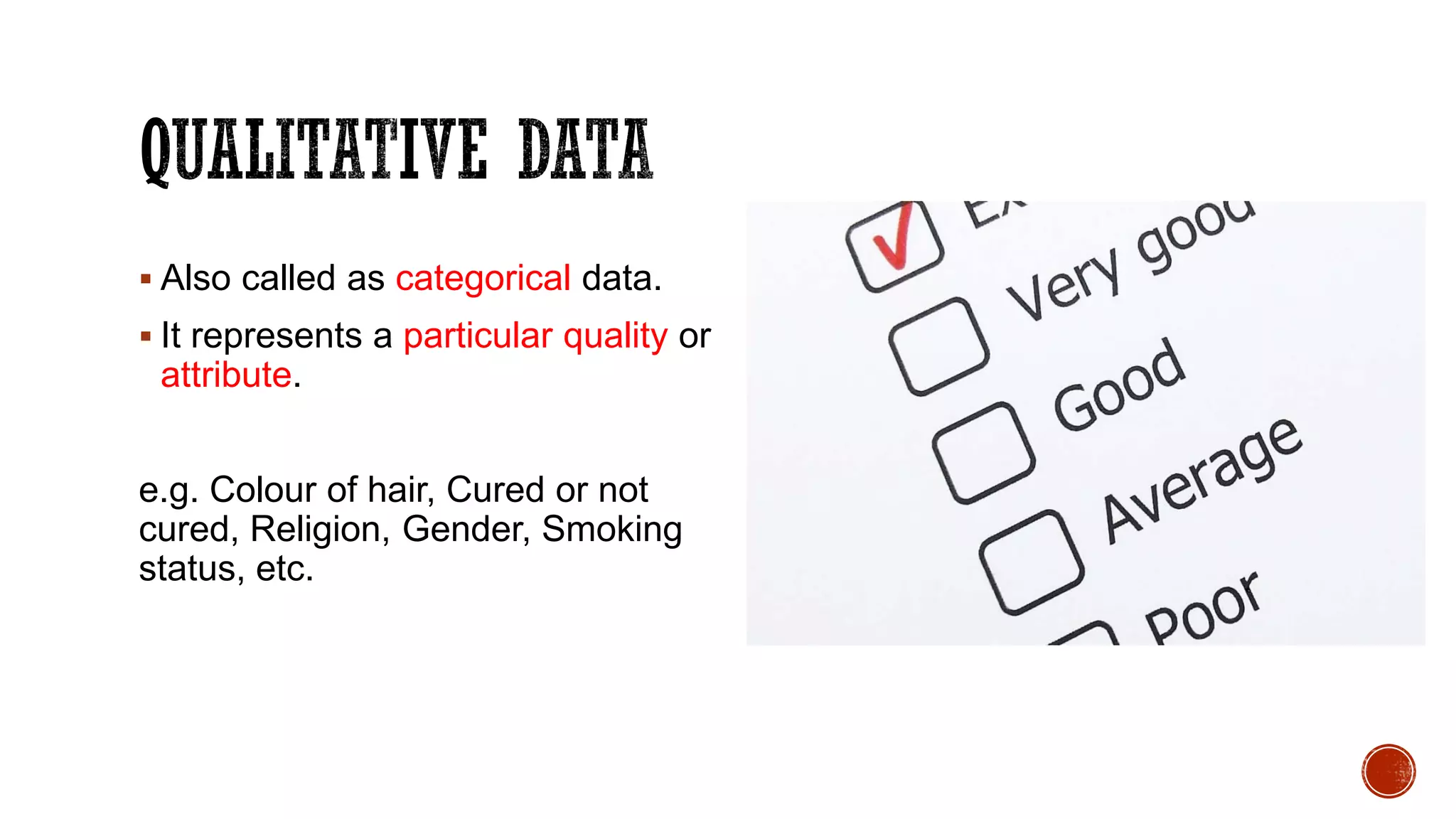
 Also called as categorical data.
 It represents a particular quality or
attribute.
e.g. Colour of hair, Cured or not
cured, Religion, Gender, Smoking
status, etc.
 It represents Numerical Data.
 E.g.
Height in cms, Weight in kgs, Hb in
gm%, Serum Bilirubin in gm/dl, BP in
mm/hg etc.
 It may be Continuous or Discrete
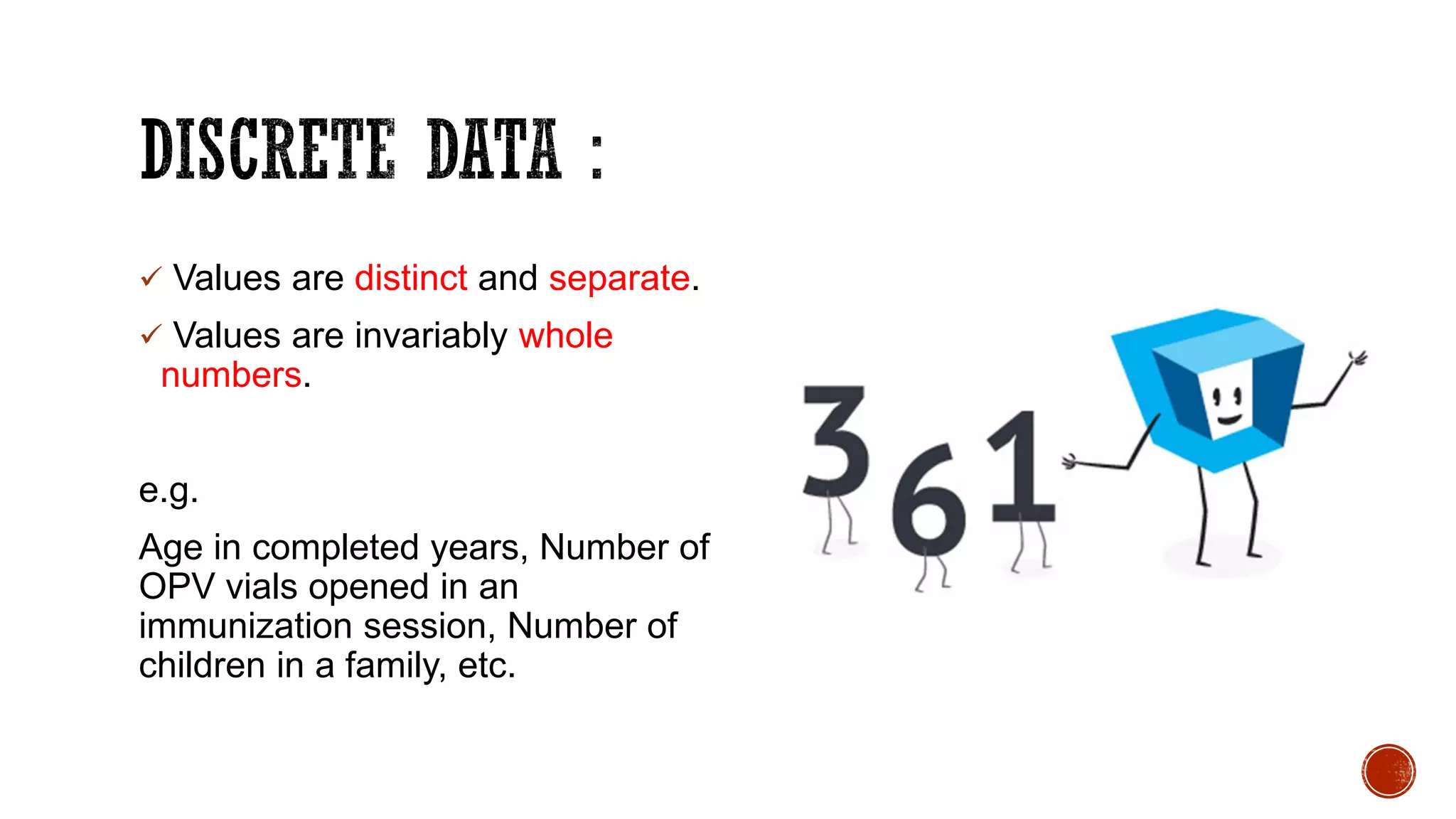
 Values are distinct and separate.
 Values are invariably whole
numbers.
e.g.
Age in completed years, Number of
OPV vials opened in an
immunization session, Number of
children in a family, etc.
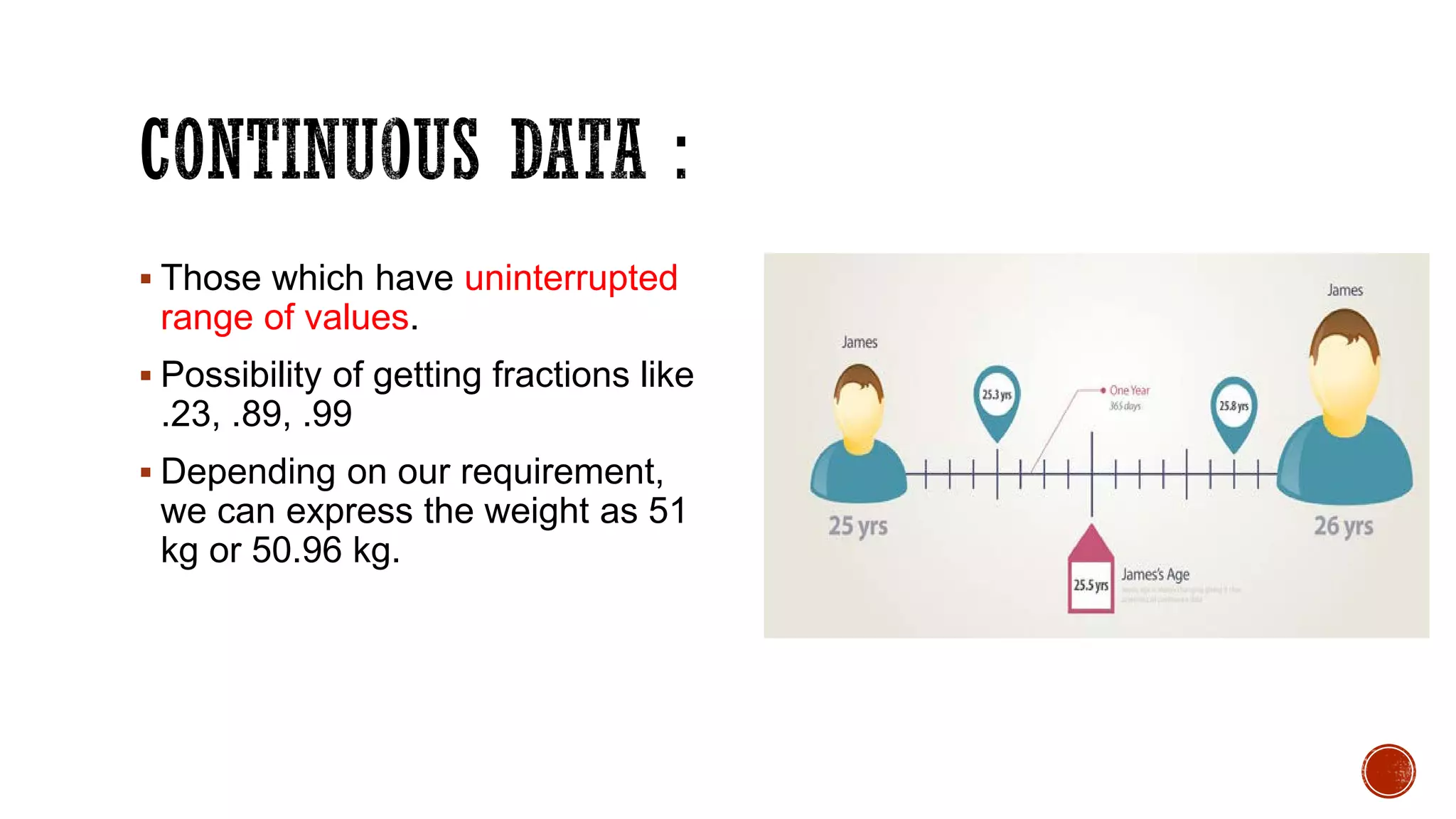
 Those which have uninterrupted
range of values.
 Possibility of getting fractions like
.23, .89, .99
 Depending on our requirement,
we can express the weight as 51
kg or 50.96 kg.
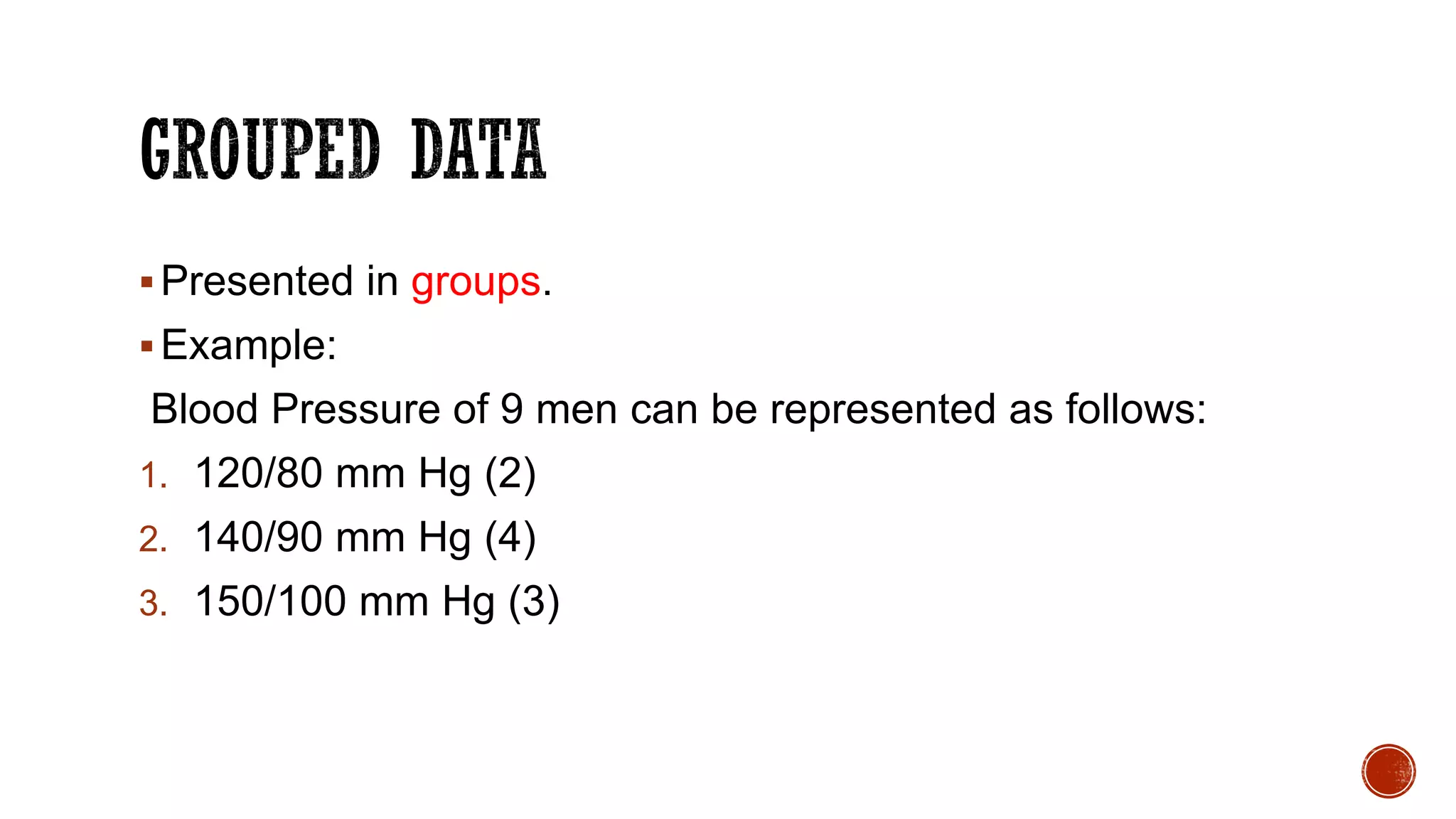
Presented in groups.
Example:
Blood Pressure of 9 men can be represented as follows:
1. 120/80 mm Hg (2)
2. 140/90 mm Hg (4)
3. 150/100 mm Hg (3)
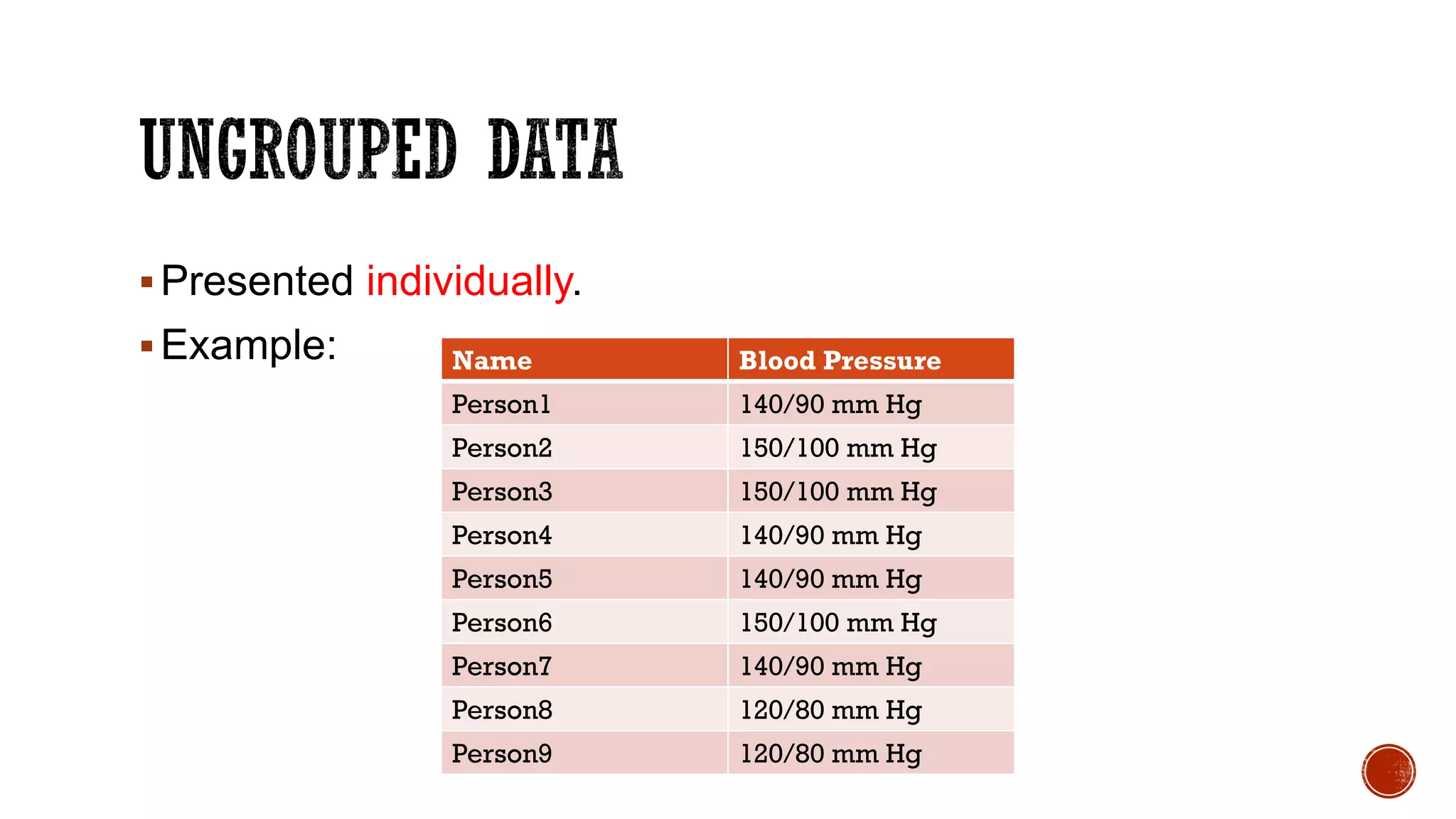
Presented individually.
Example: Name Blood Pressure
Person1 140/90 mm Hg
Person2 150/100 mm Hg
Person3 150/100 mm Hg
Person4 140/90 mm Hg
Person5 140/90 mm Hg
Person6 150/100 mm Hg
Person7 140/90 mm Hg
Person8 120/80 mm Hg
Person9 120/80 mm Hg
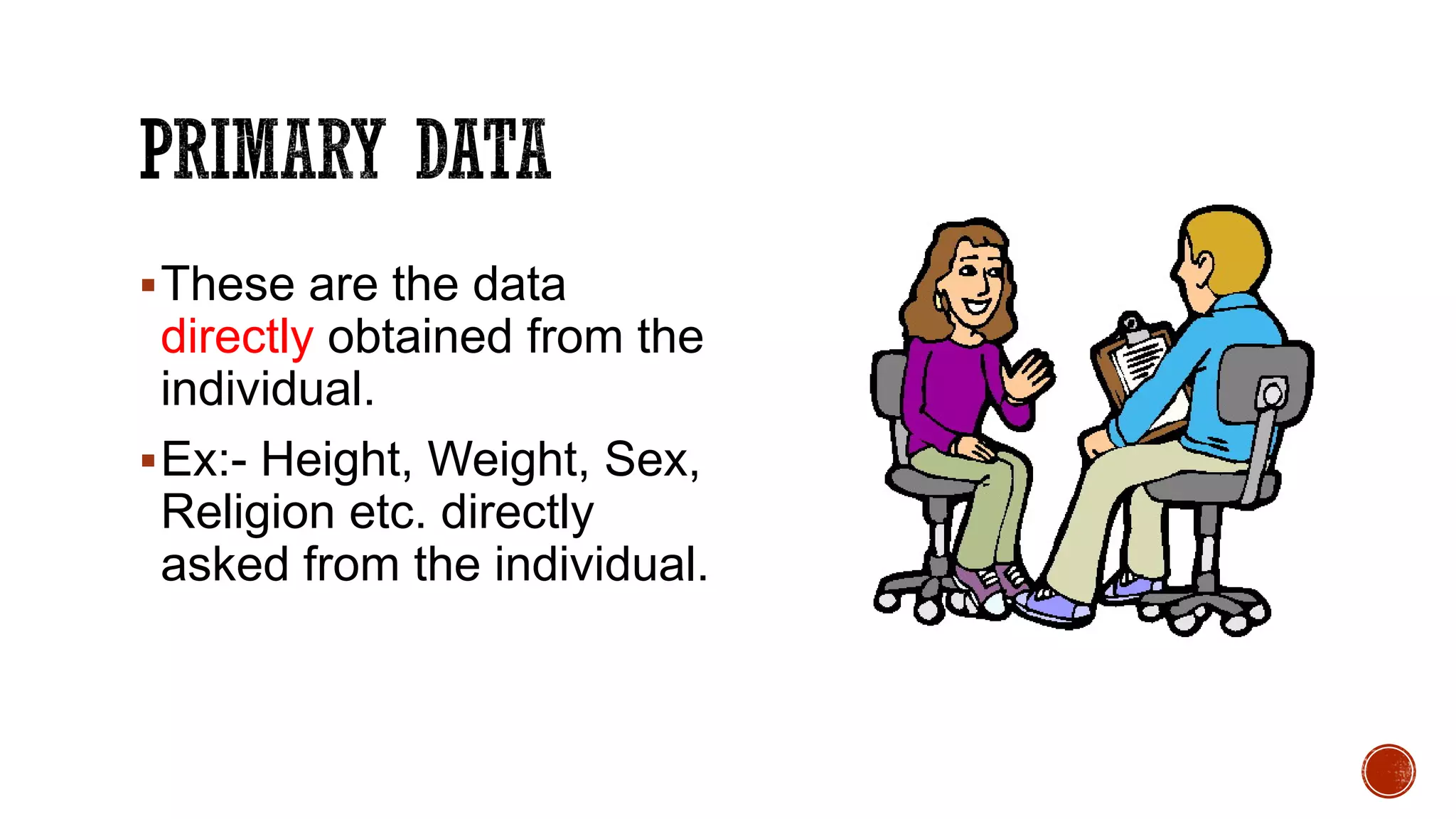
These are the data
directly obtained from the
individual.
Ex:- Height, Weight, Sex,
Religion etc. directly
asked from the individual.
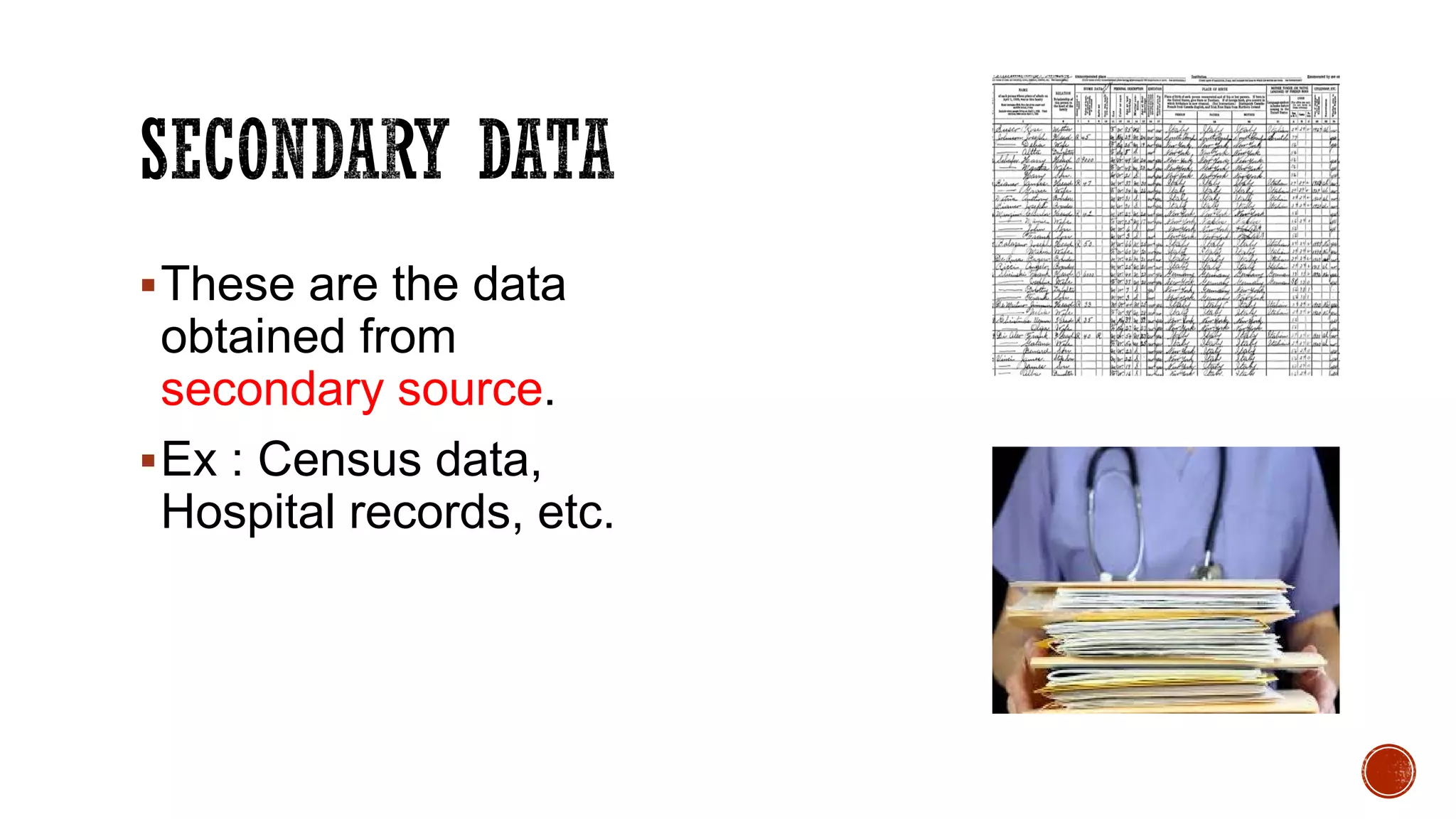
These are the data
obtained from
secondary source.
Ex : Census data,
Hospital records, etc.
Defined as the application of
rules to assign numbers to
objects (or attributes).
 Values made meaningful by
quantifying into specific units.
Measurements act as labels
which make those values
more useful in terms of
details.
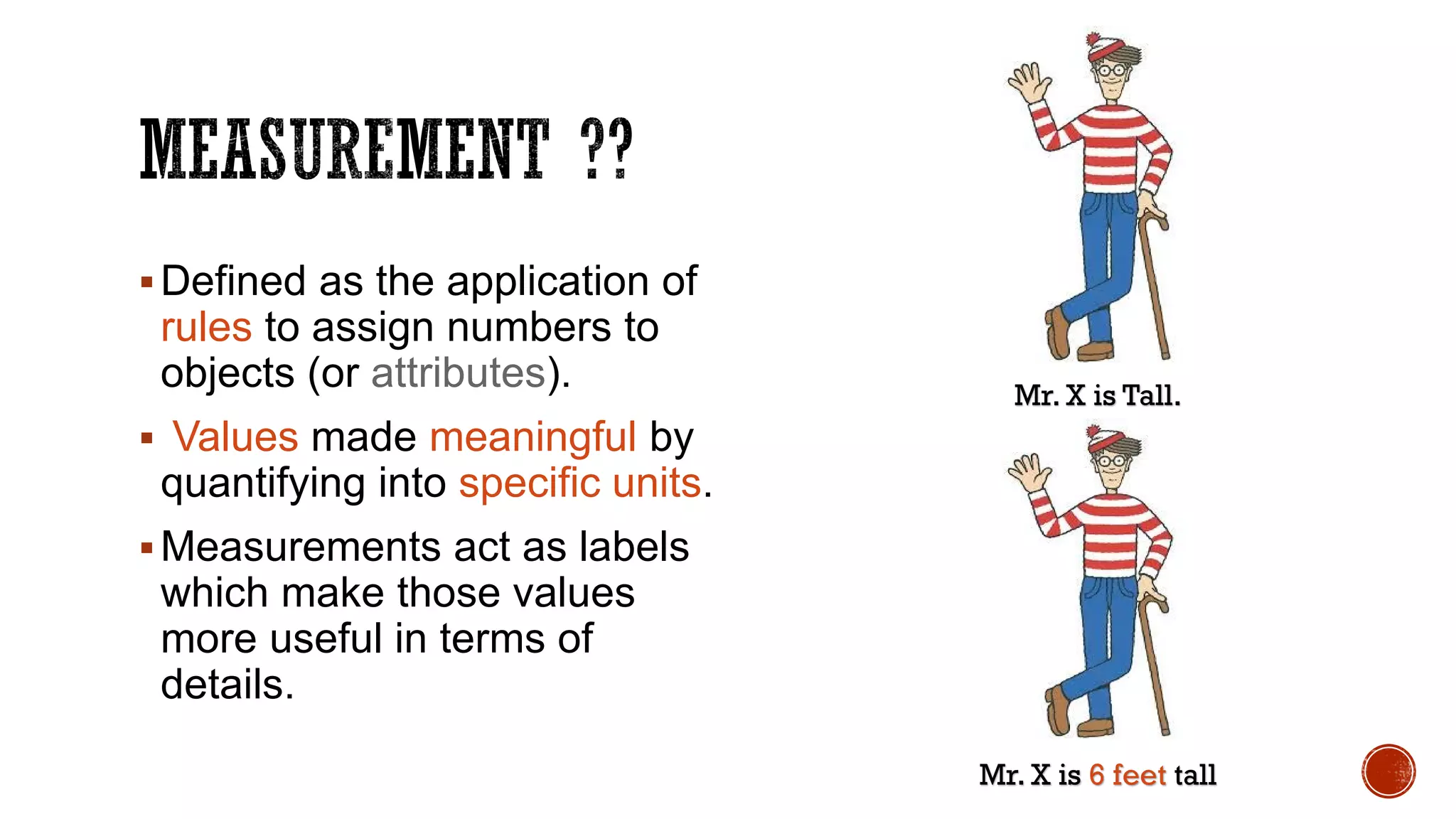
Mr. X is Tall.
Mr. X is 6 feet tall
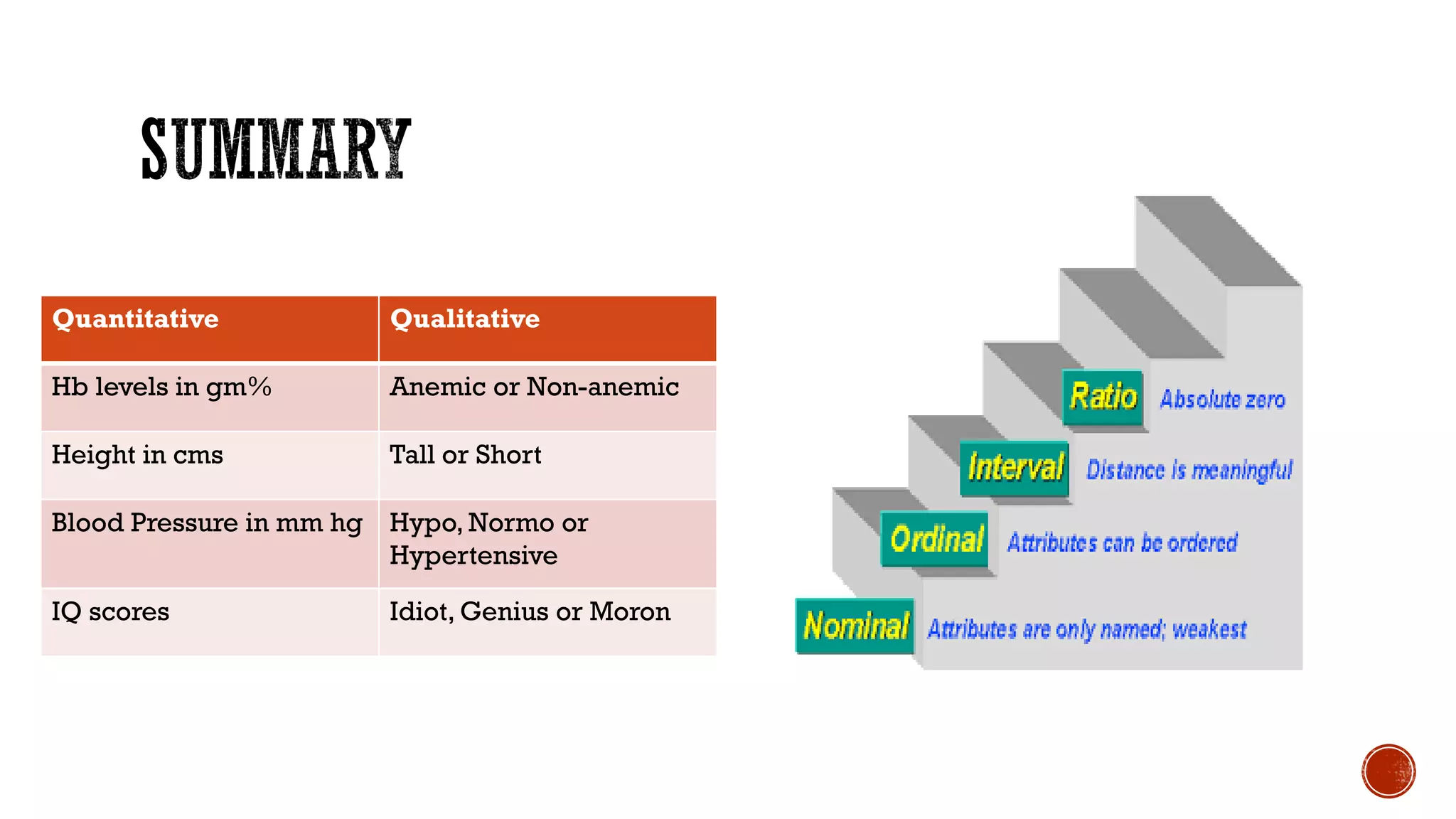
NOMINAL
ORDINAL
INTERVAL
RATIO
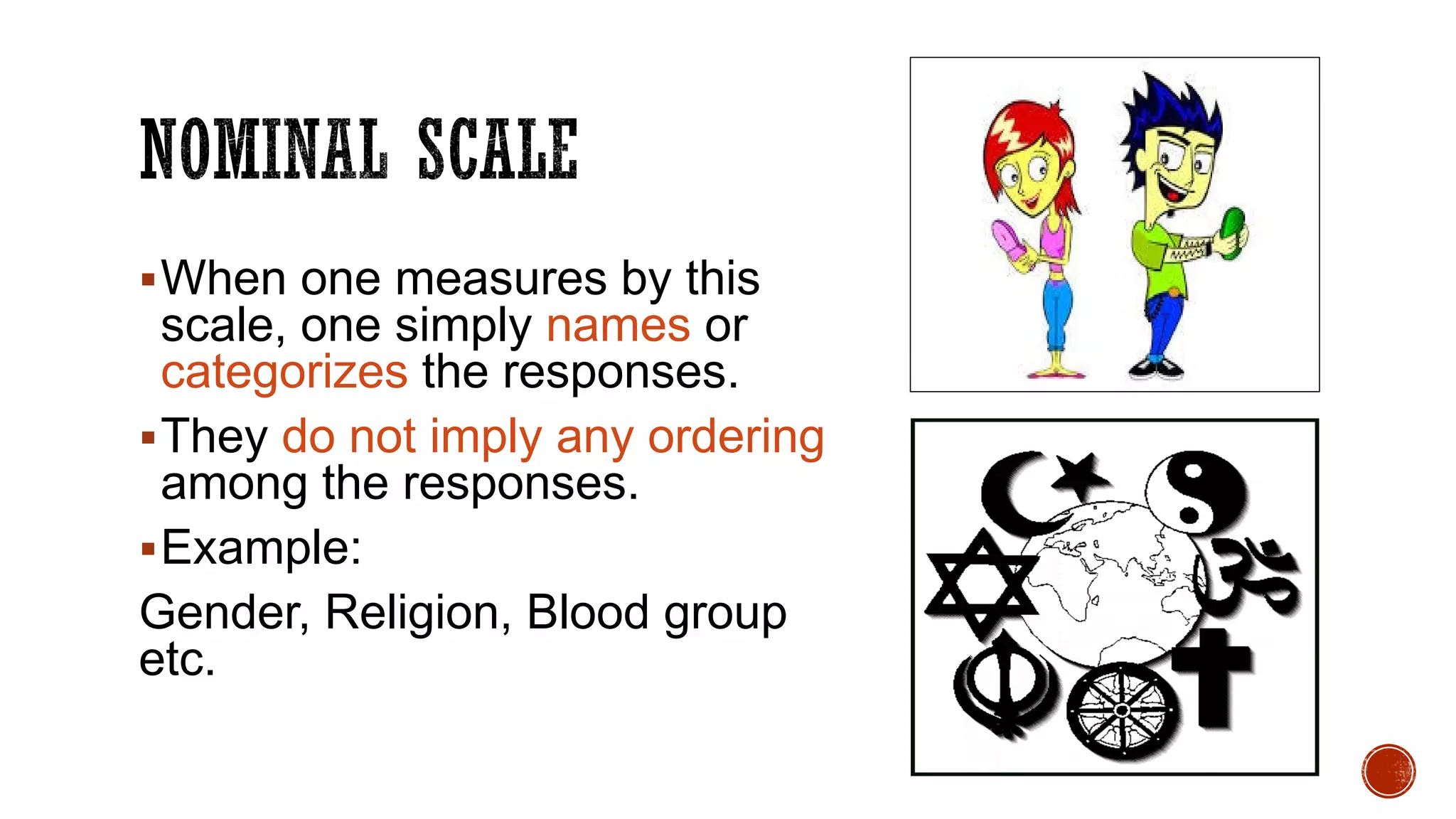
When one measures by this
scale, one simply names or
categorizes the responses.
They do not imply any ordering
among the responses.
Example:
Gender, Religion, Blood group
etc.
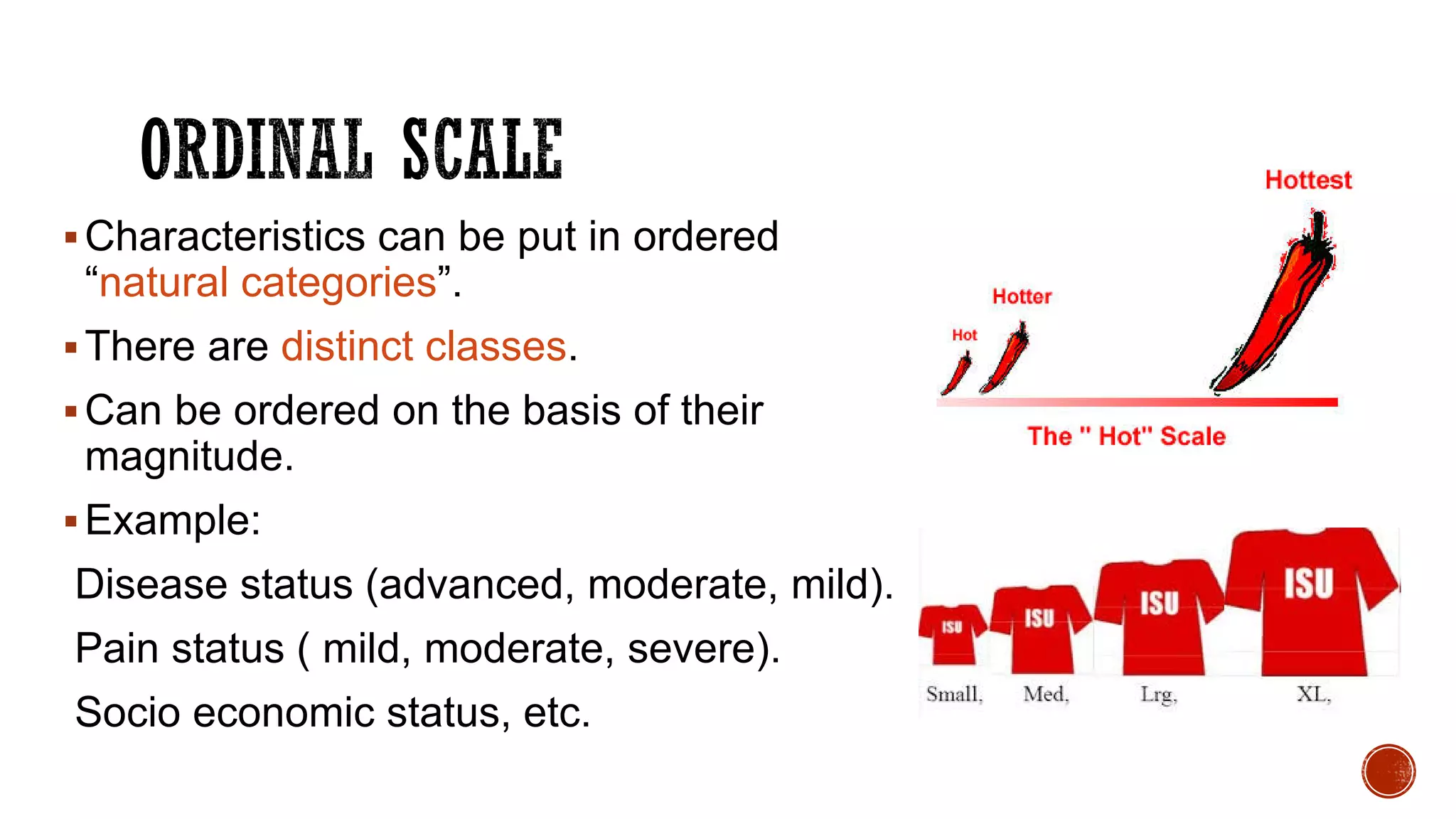
Characteristics can be put in ordered
“natural categories”.
There are distinct classes.
Can be ordered on the basis of their
magnitude.
Example:
Disease status (advanced, moderate, mild).
Pain status ( mild, moderate, severe).
Socio economic status, etc.
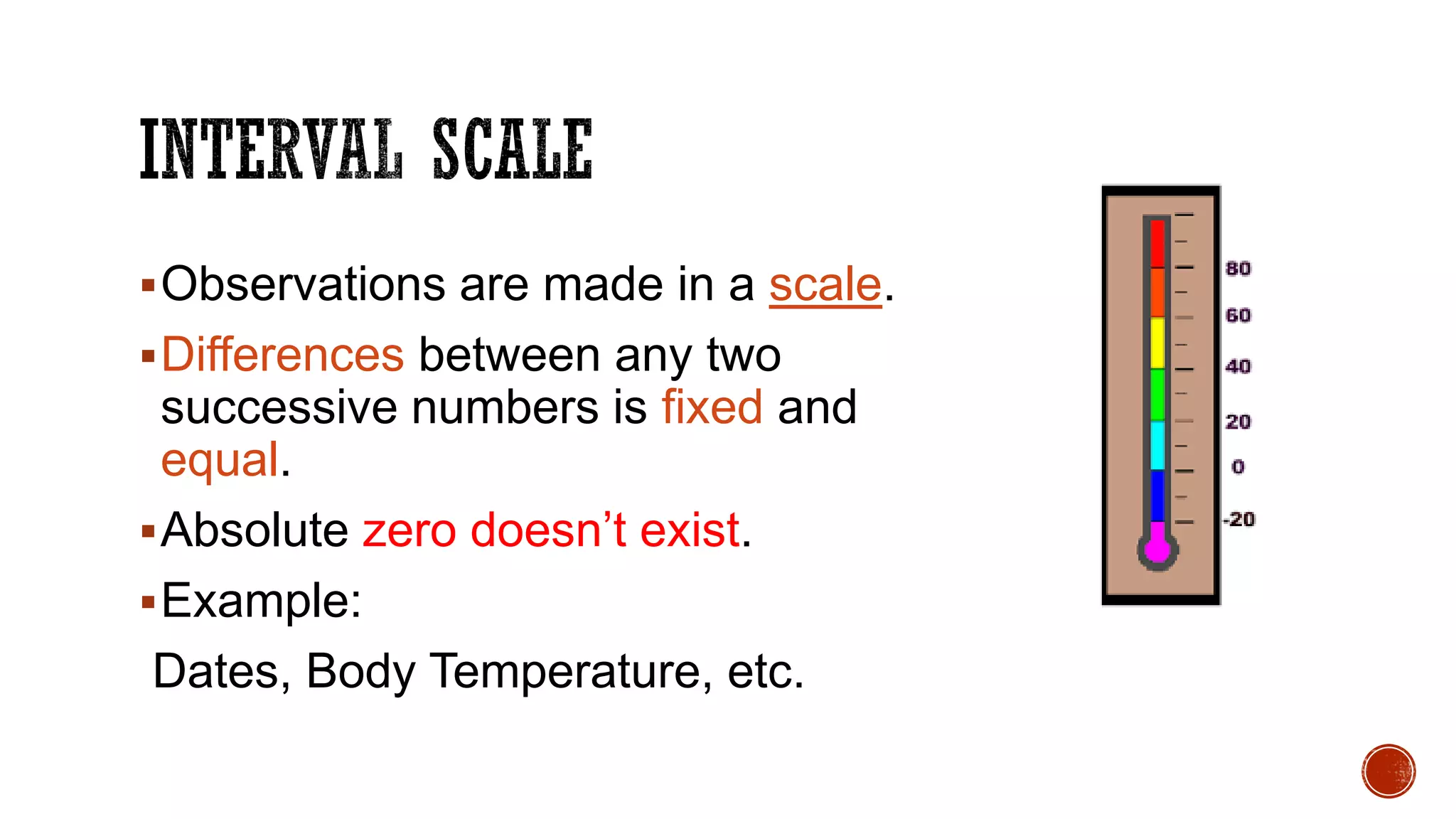
Observations are made in a scale.
Differences between any two
successive numbers is fixed and
equal.
Absolute zero doesn’t exist.
Example:
Dates, Body Temperature, etc.
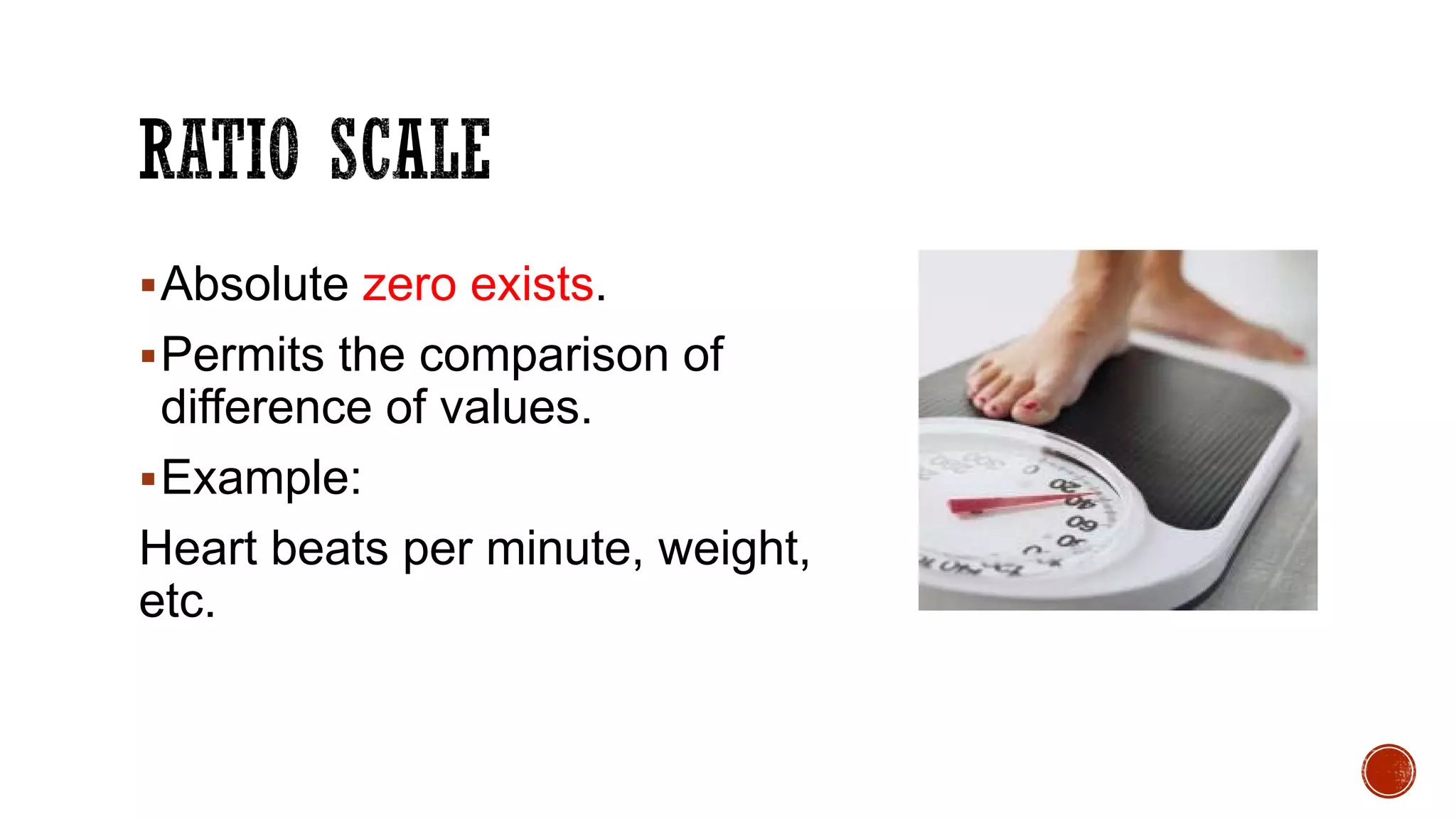
Absolute zero exists.
Permits the comparison of
difference of values.
Example:
Heart beats per minute, weight,
etc.
Quantitative Qualitative
Hb levels in gm% Anemic or Non-anemic
Height in cms Tall or Short
Blood Pressure in mm hg Hypo, Normo or
Hypertensive
IQ scores Idiot, Genius or Moron
1. Census
2. Registration of vital events
3. Sample Registration system
4. Notification of diseases
5. Hospital records
6. Epidemiological Surveillance
7. Surveys
8. Research Findings
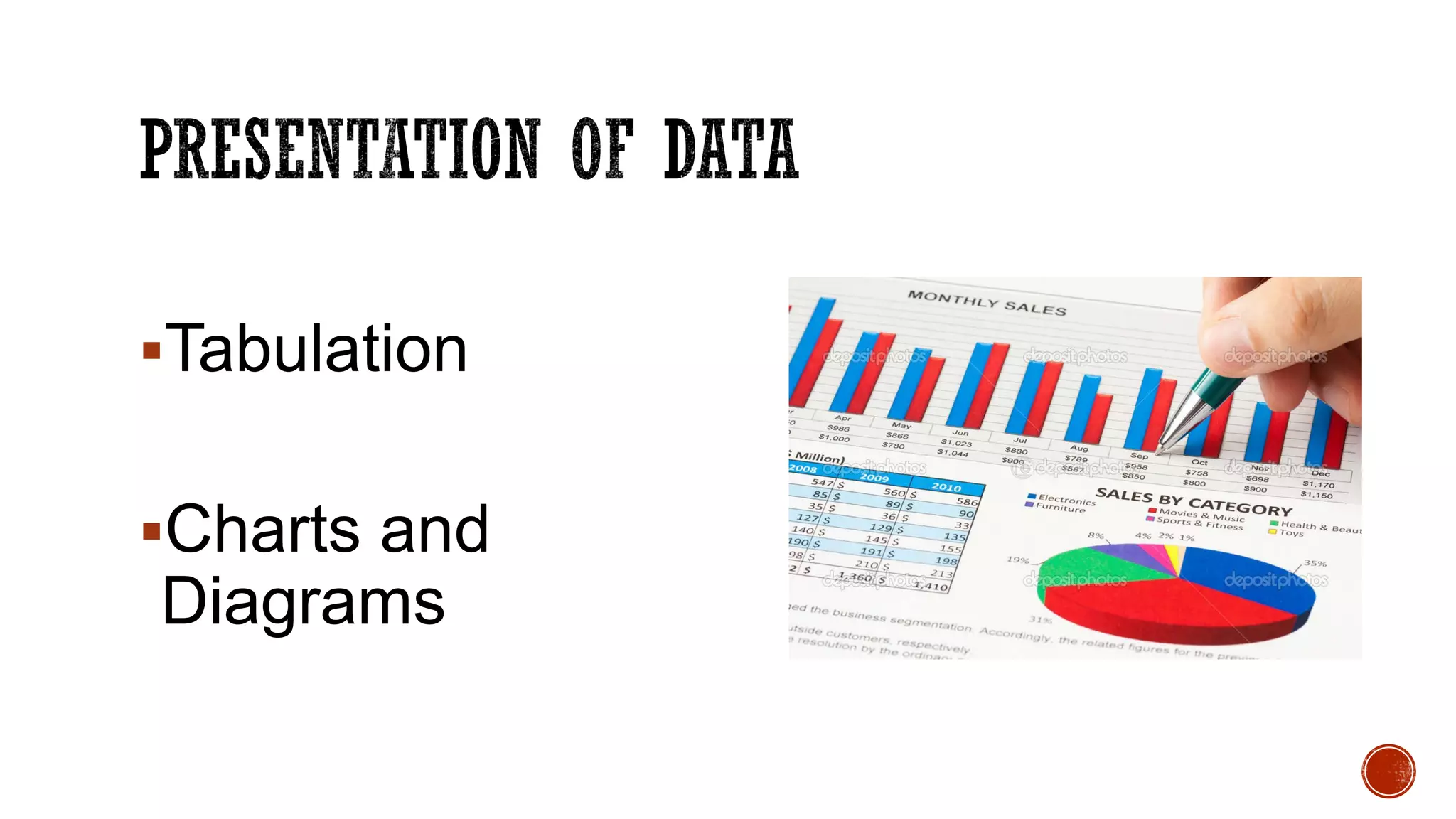
Tabulation
Charts and
Diagrams
Usually the first step of
presentation and analysis of data.
Can be :
1. Simple
2. Complex
(depending on the number of
measurements of a single set or
multiple sets of items)
 Table must be numbered.
 Brief and self explanatory title.
 Headings of columns and rows : clear, concise, sufficient and fully
defined.
 Presentation of data : acc. to size of importance, chronologically,
alphabetically and geographically.
 Mention the number of observations from which proportions are
derived.
 Details of deliberate exclusions must be given.
 Shouldn’t be too large.
 Figures needing comparison must be placed as close as possible.
 Arrangement to be vertical.
 Footnotes to be given wherever possible.
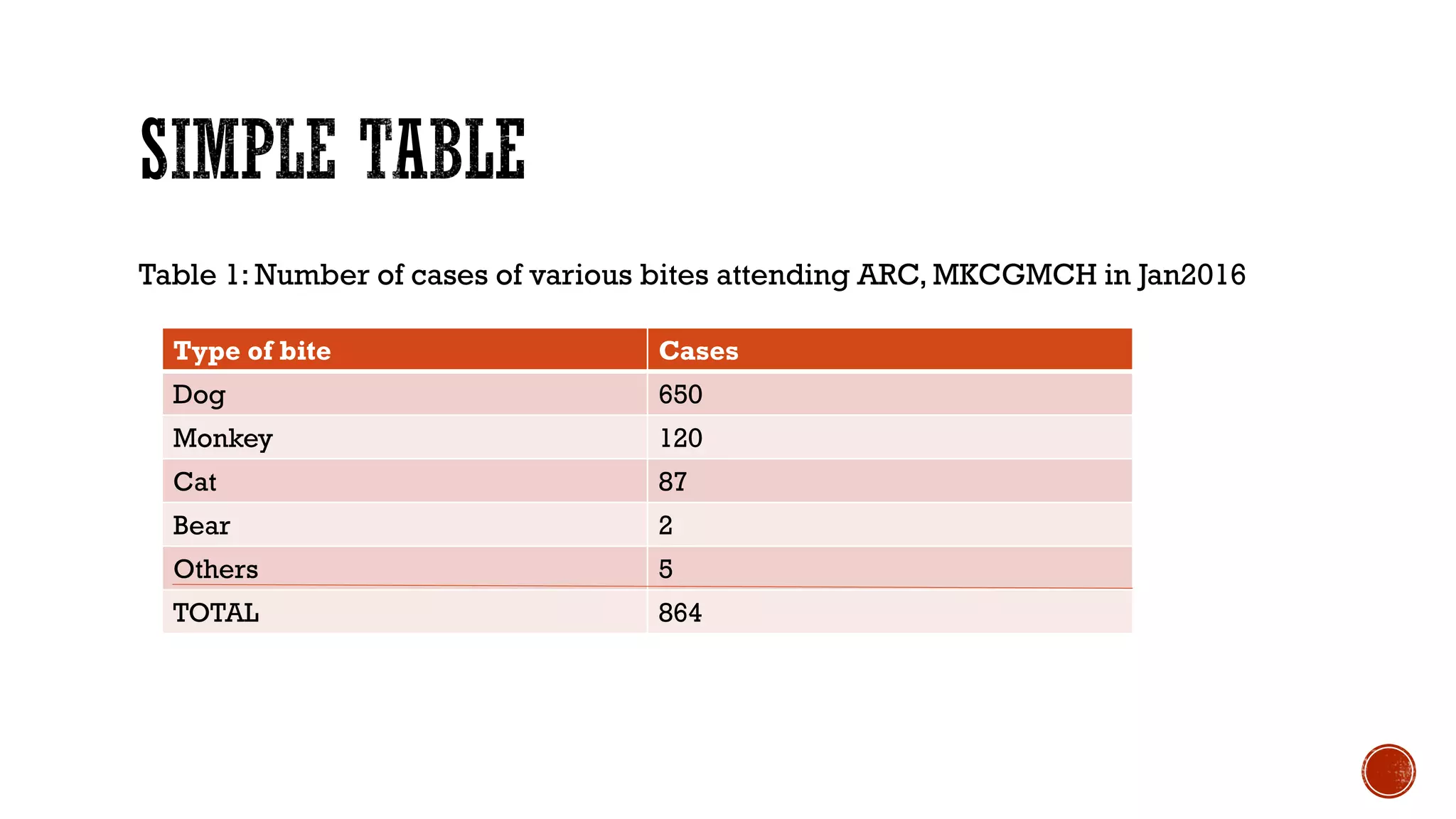
Table 1: Number of cases of various bites attending ARC, MKCGMCH in Jan2016
Type of bite Cases
Dog 650
Monkey 120
Cat 87
Bear 2
Others 5
TOTAL 864
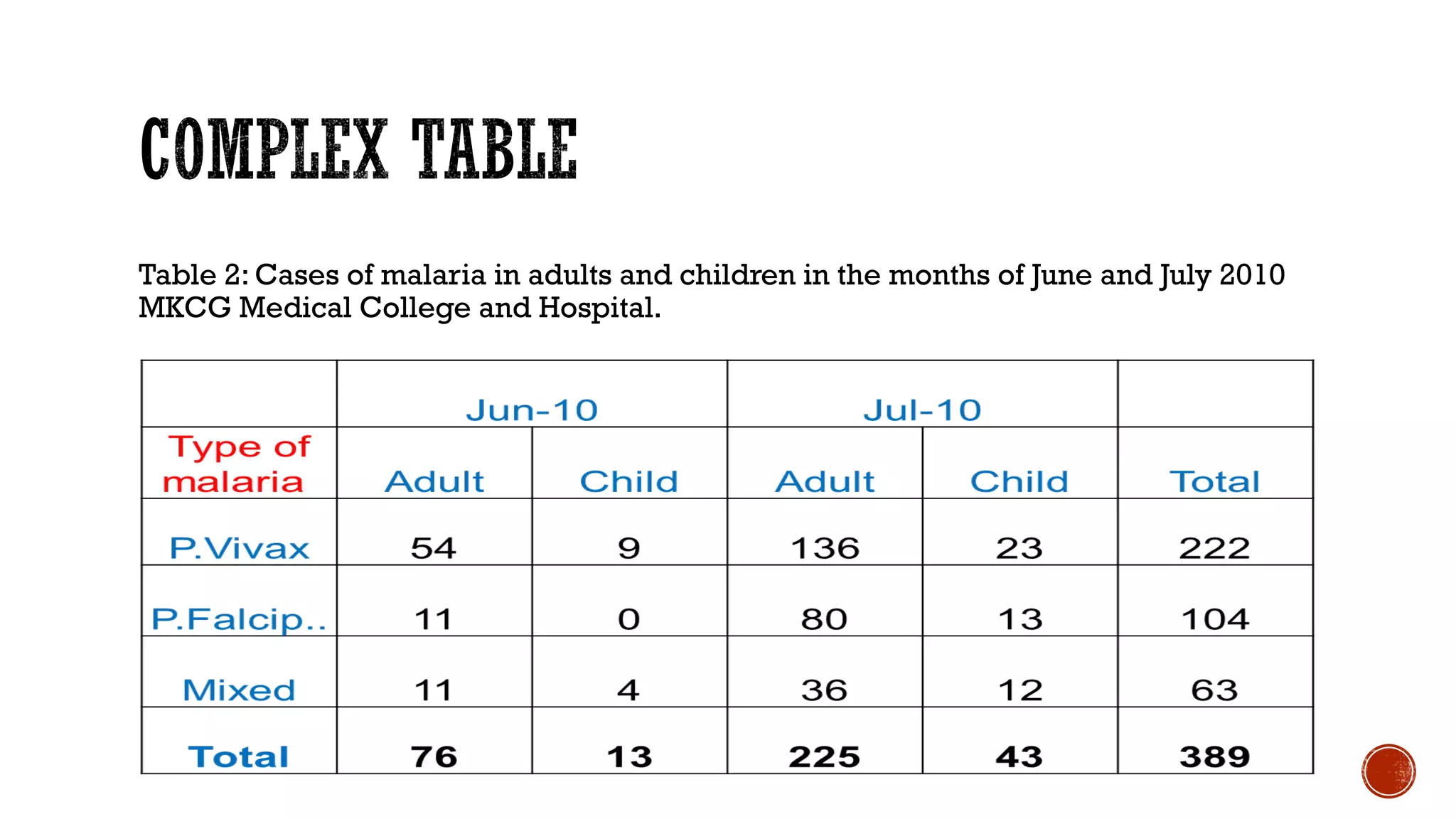
Table 2: Cases of malaria in adults and children in the months of June and July 2010
MKCG Medical College and Hospital.
ADVANTAGES:
 Simple
 Easy to understand
 Save a lot of words
 Self explanatory
 Has a clear title indicating its content
 Fully labeled
PRINCIPLES :
 Simple (consistent with the purpose)
 Self explanatory.
 Title of graph should be written below the graph.
 Scale Lines should be drawn heavier than coordinate lines.
 Frequency- Vertical scale.
 Classification – Horizontal scale.
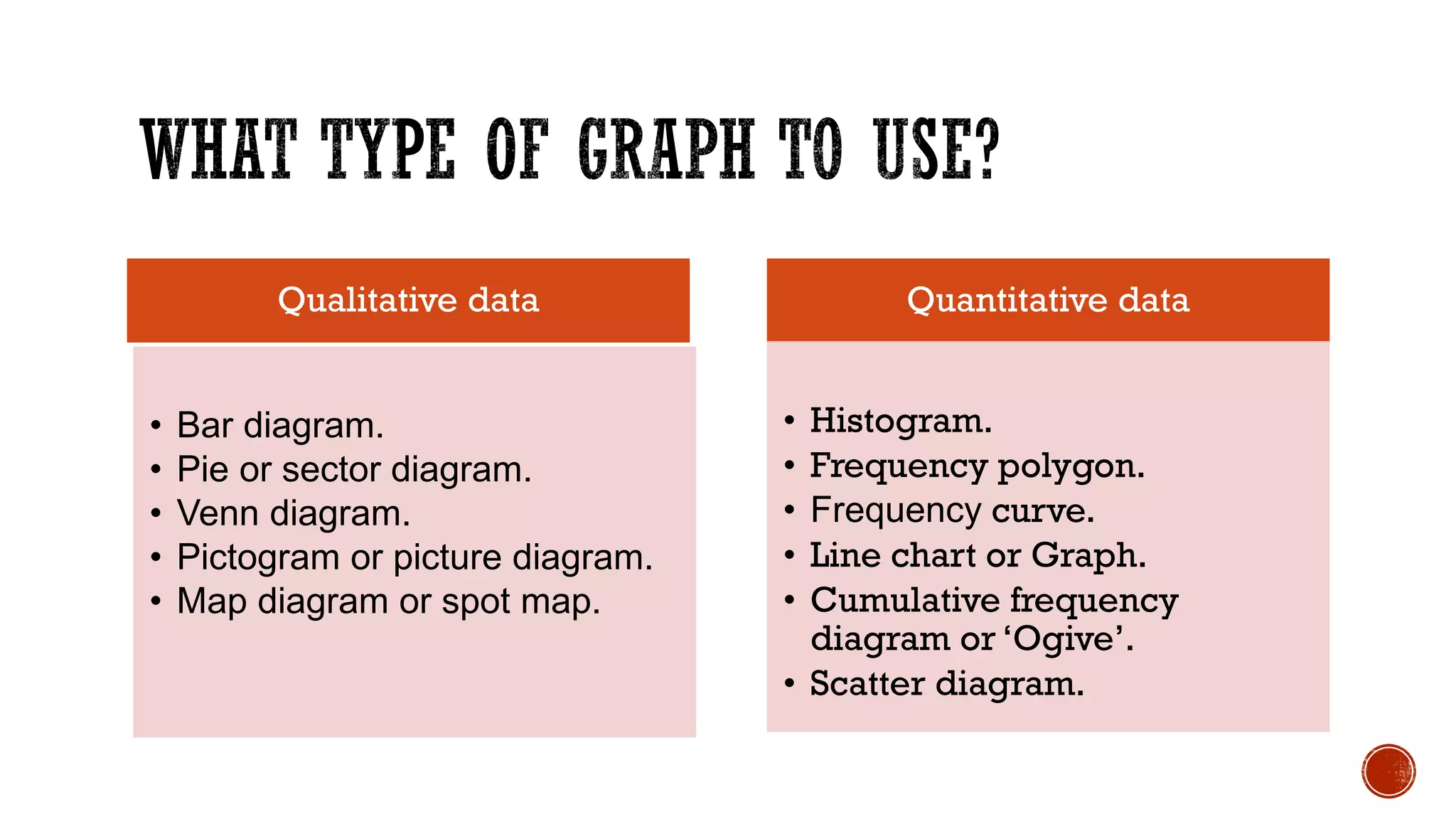
Qualitative data
• Bar diagram.
• Pie or sector diagram.
• Venn diagram.
• Pictogram or picture diagram.
• Map diagram or spot map.
Quantitative data
• Histogram.
• Frequency polygon.
• Frequency curve.
• Line chart or Graph.
• Cumulative frequency
diagram or ‘Ogive’.
• Scatter diagram.
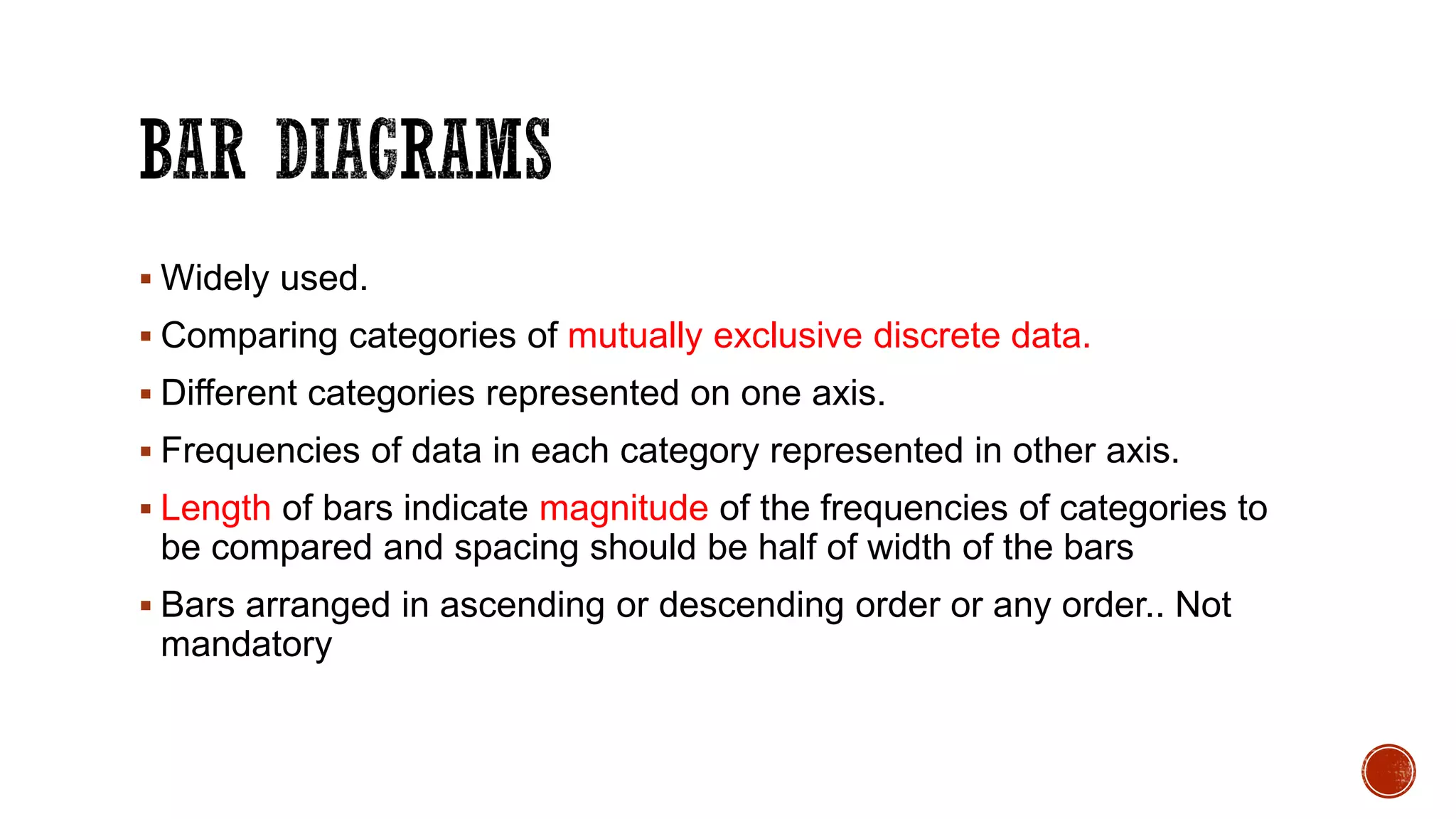
 Widely used.
 Comparing categories of mutually exclusive discrete data.
 Different categories represented on one axis.
 Frequencies of data in each category represented in other axis.
 Length of bars indicate magnitude of the frequencies of categories to
be compared and spacing should be half of width of the bars
 Bars arranged in ascending or descending order or any order.. Not
mandatory
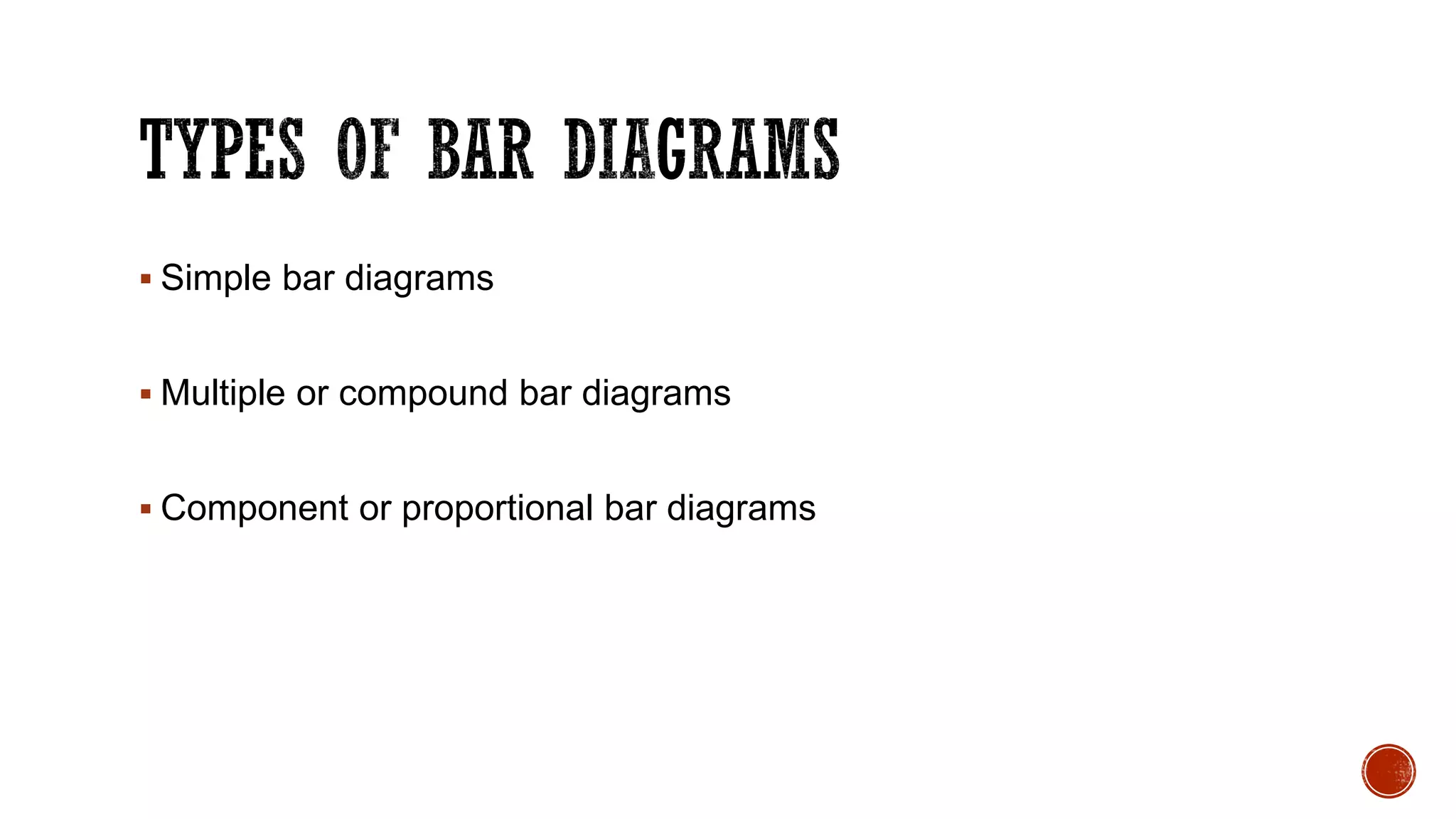
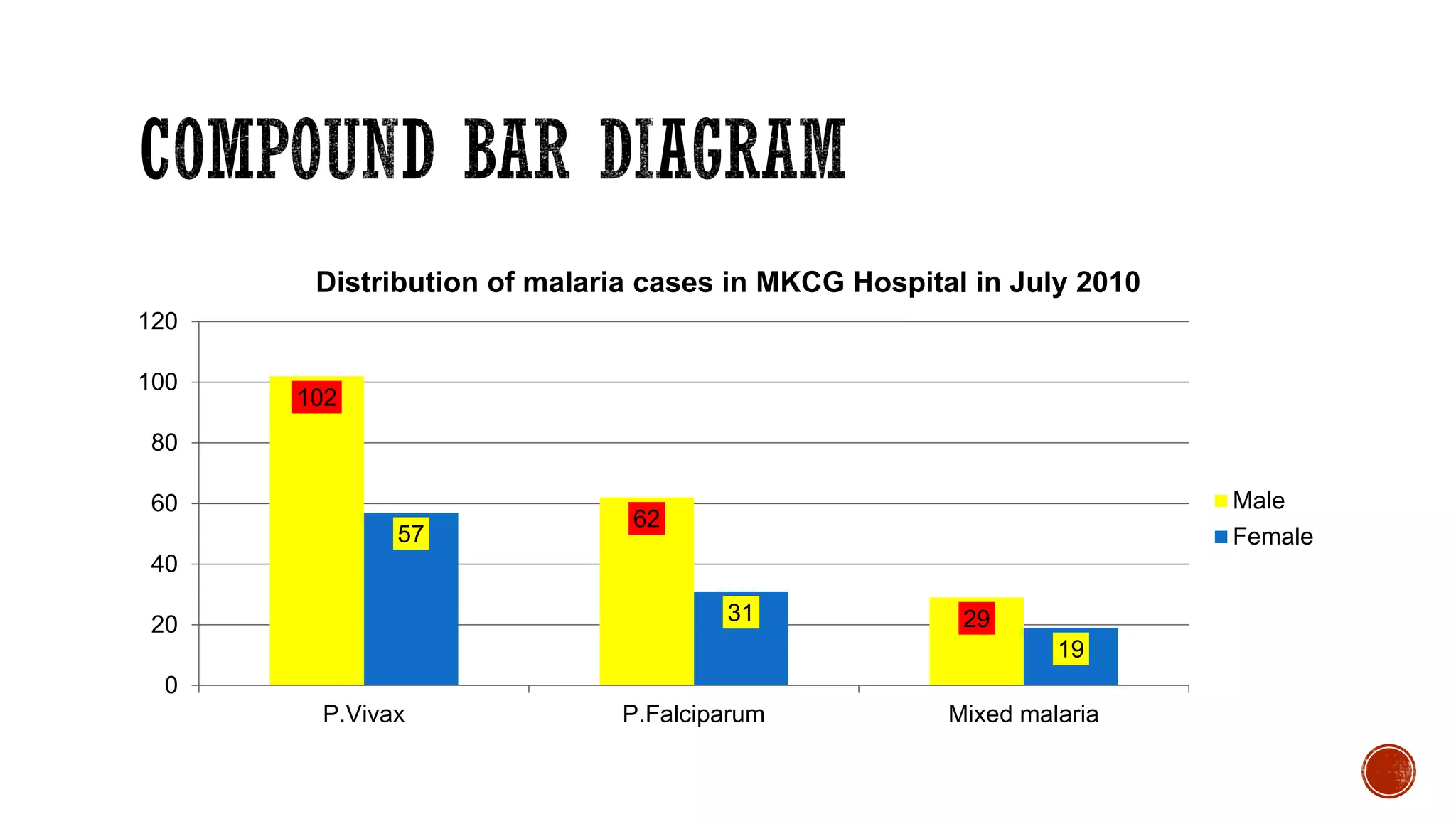
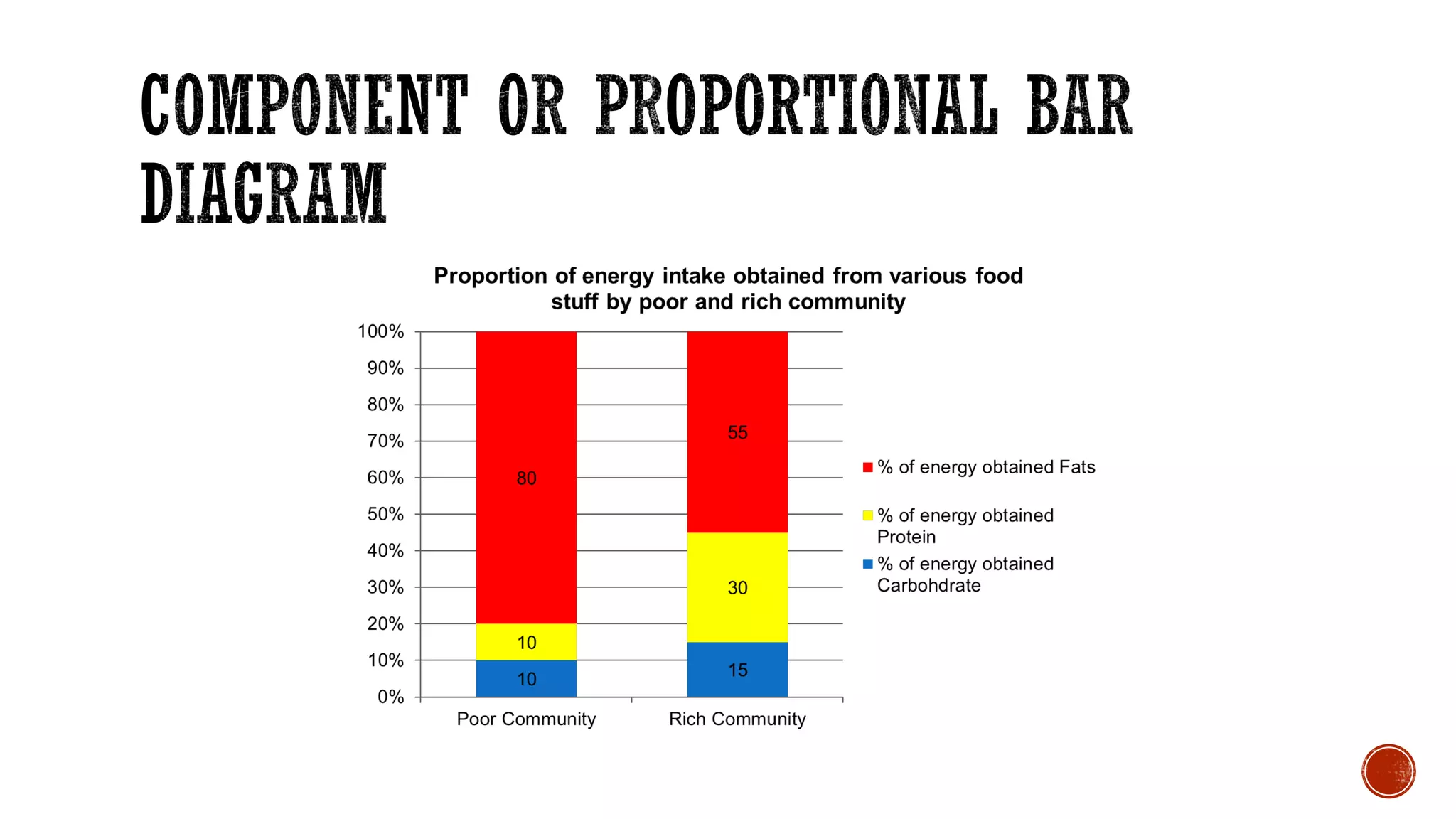
 Simple bar diagrams
 Multiple or compound bar diagrams
 Component or proportional bar diagrams
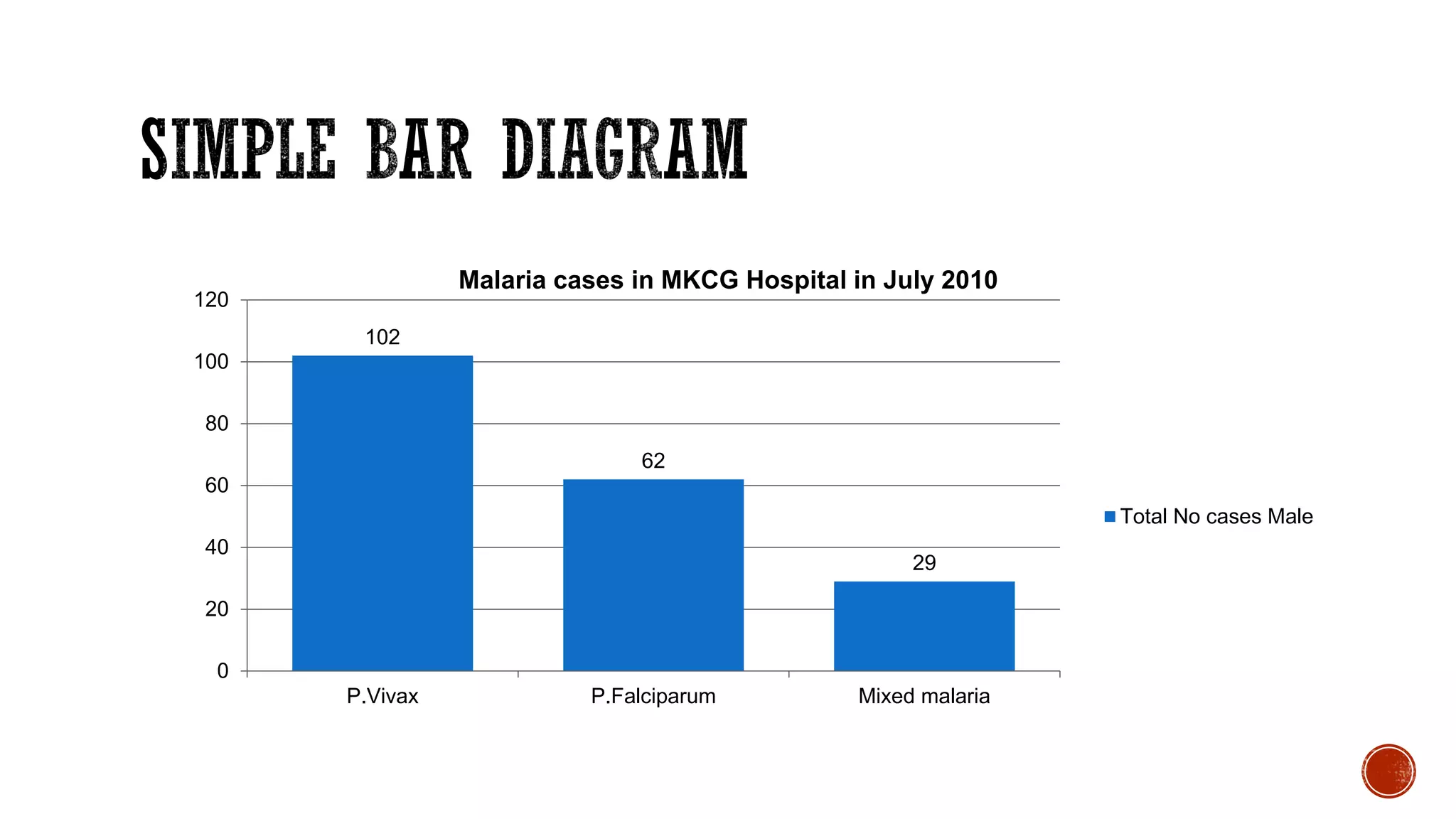
102
62
29
0
20
40
60
80
100
120
P.Vivax P.Falciparum Mixed malaria
Malaria cases in MKCG Hospital in July 2010
Total No cases Male
102
62
29
57
31
19
0
20
40
60
80
100
120
P.Vivax P.Falciparum Mixed malaria
Distribution of malaria cases in MKCG Hospital in July 2010
Male
Female
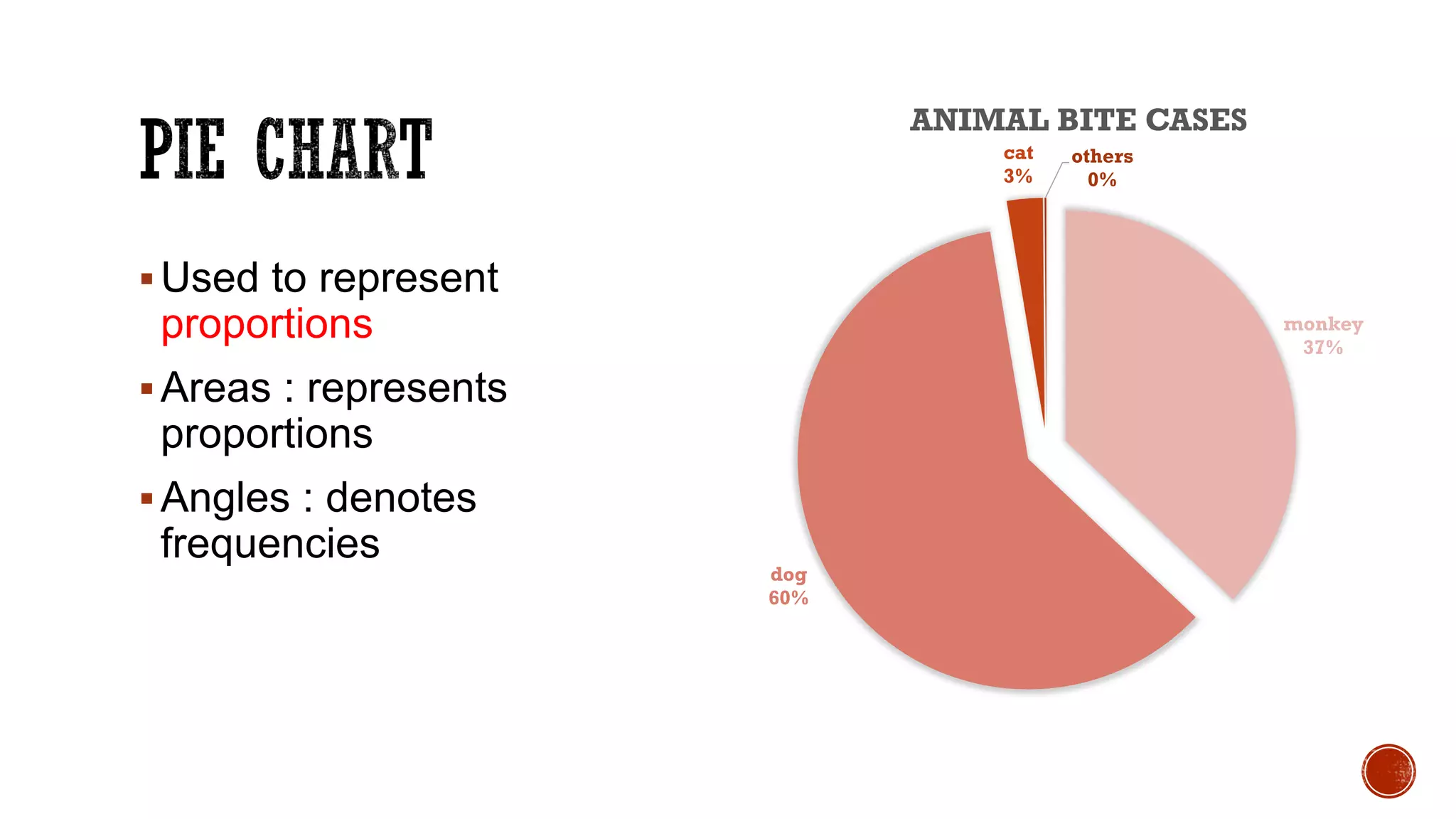
Used to represent
proportions
Areas : represents
proportions
Angles : denotes
frequencies
monkey
37%
dog
60%
cat
3%
others
0%
ANIMAL BITE CASES
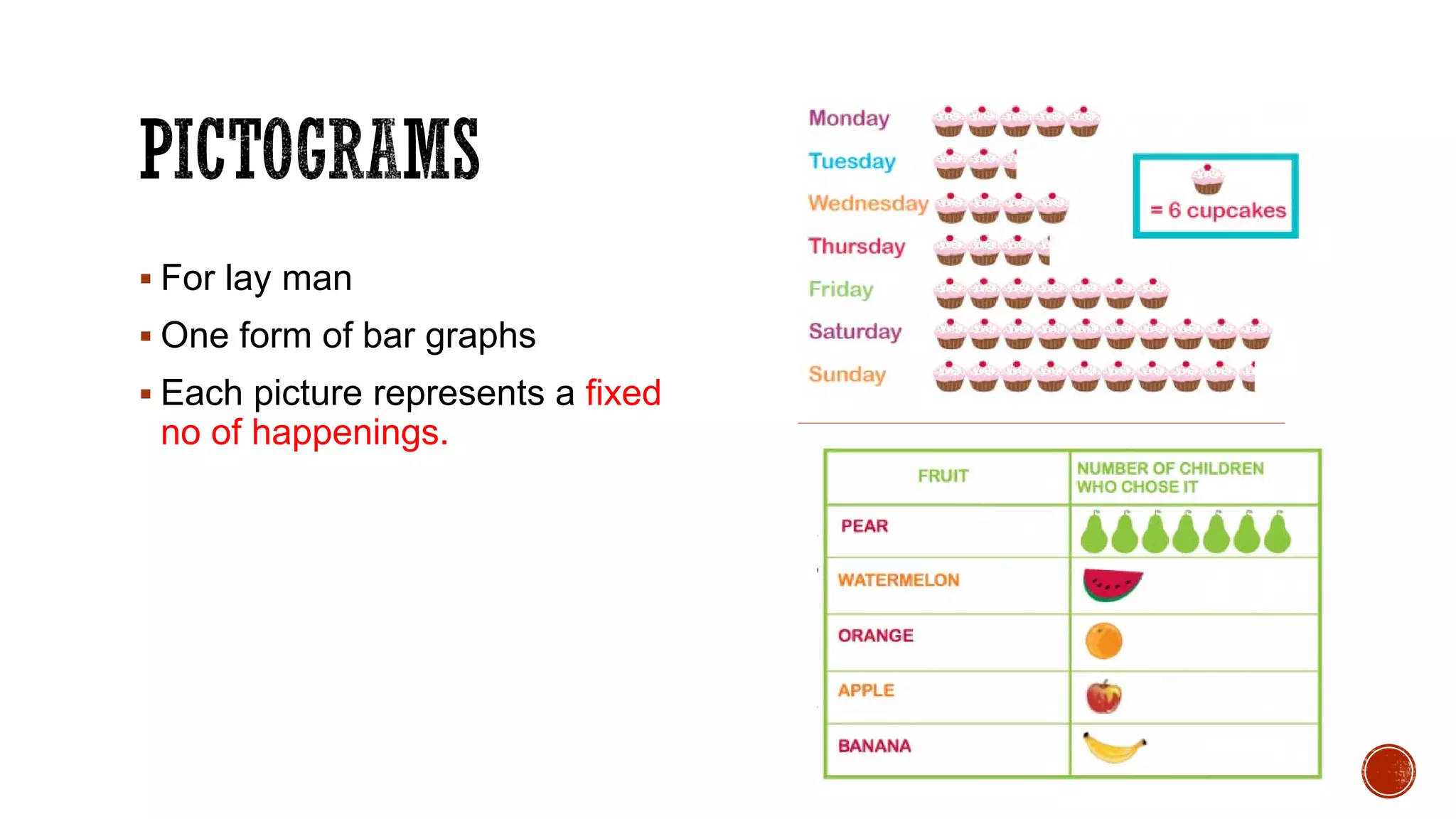
 For lay man
 One form of bar graphs
 Each picture represents a fixed
no of happenings.
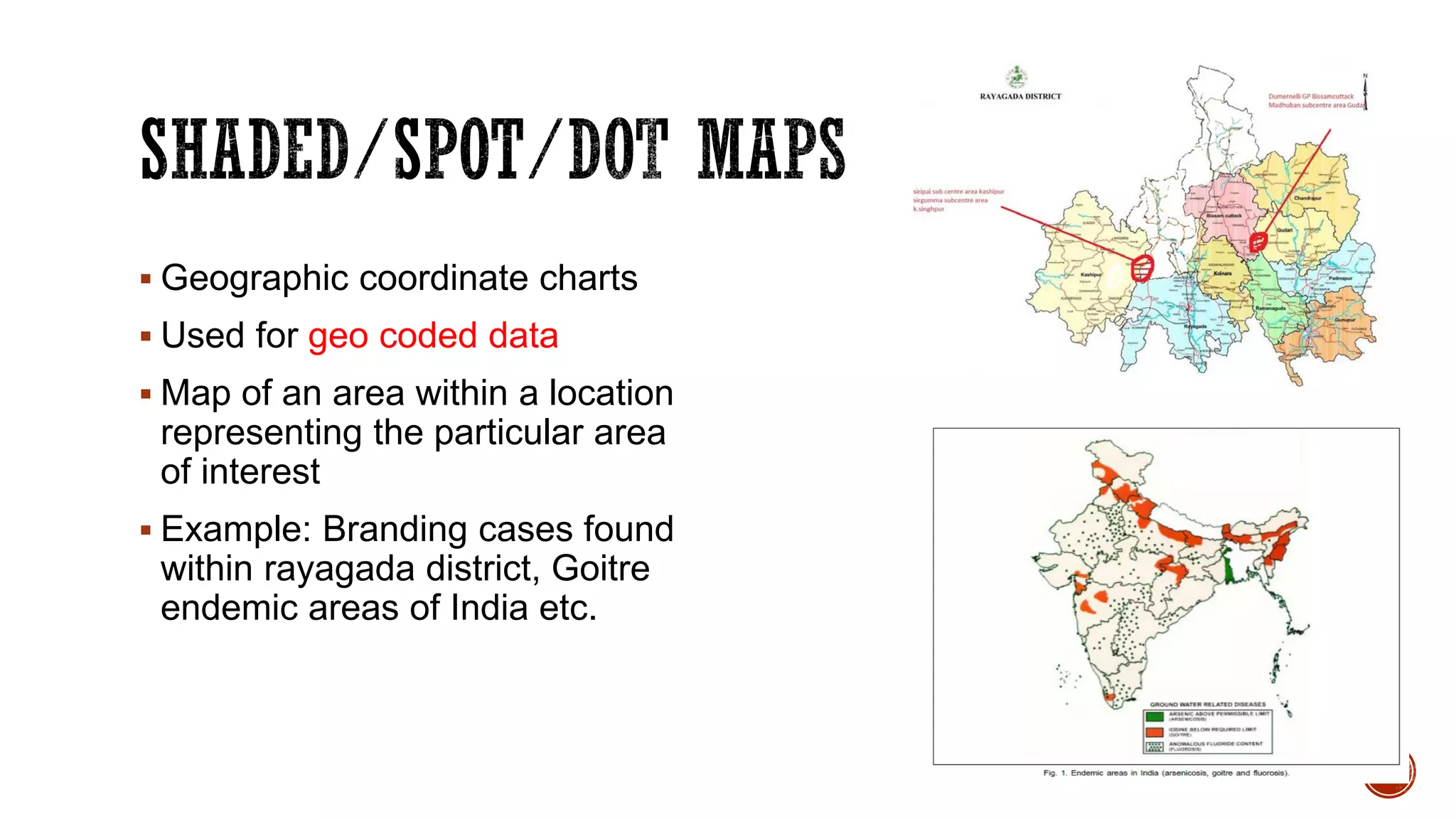
 Geographic coordinate charts
 Used for geo coded data
 Map of an area within a location
representing the particular area
of interest
 Example: Branding cases found
within rayagada district, Goitre
endemic areas of India etc.
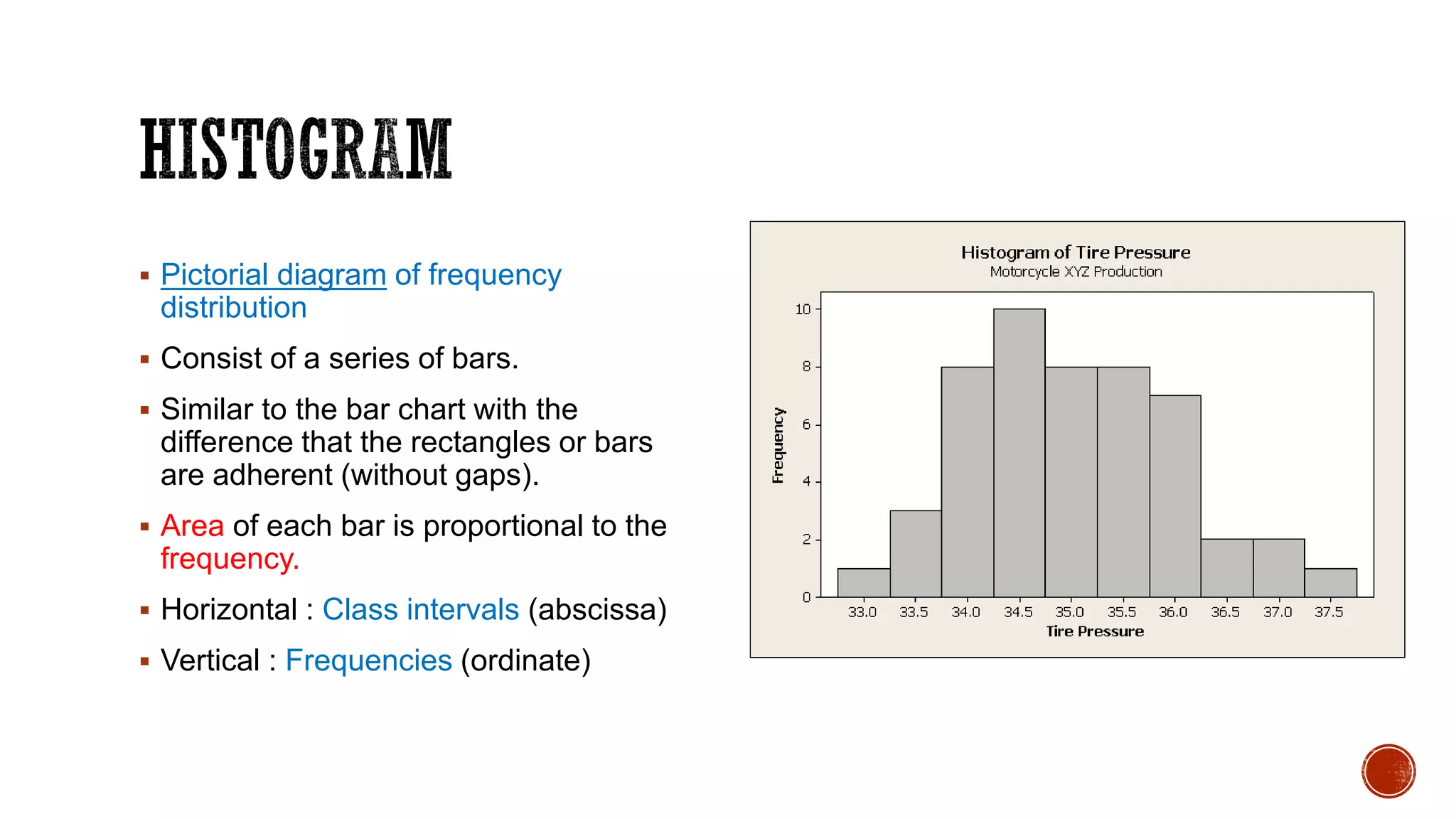
 Pictorial diagram of frequency
distribution
 Consist of a series of bars.
 Similar to the bar chart with the
difference that the rectangles or bars
are adherent (without gaps).
 Area of each bar is proportional to the
frequency.
 Horizontal : Class intervals (abscissa)
 Vertical : Frequencies (ordinate)
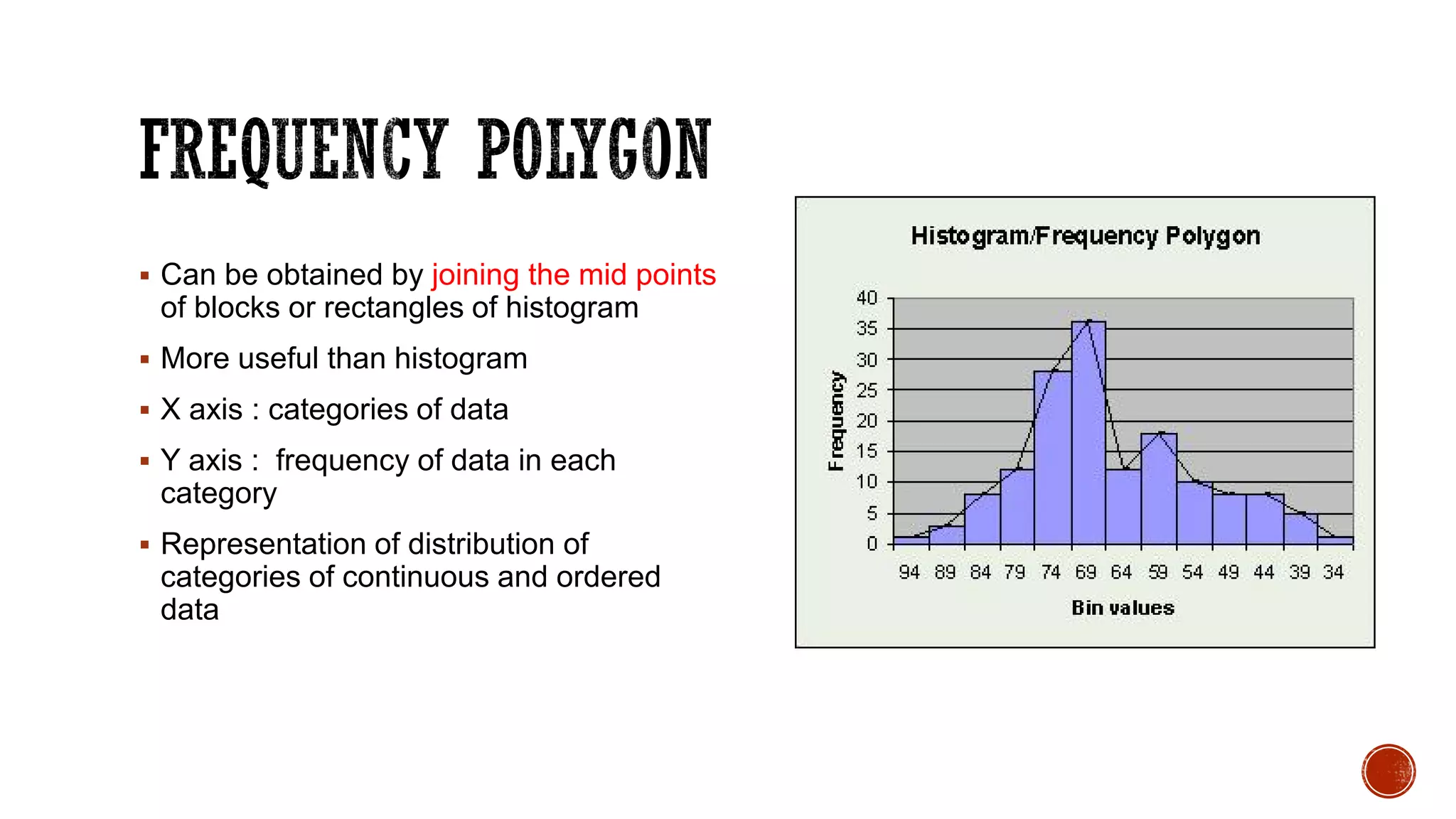
 Can be obtained by joining the mid points
of blocks or rectangles of histogram
 More useful than histogram
 X axis : categories of data
 Y axis : frequency of data in each
category
 Representation of distribution of
categories of continuous and ordered
data
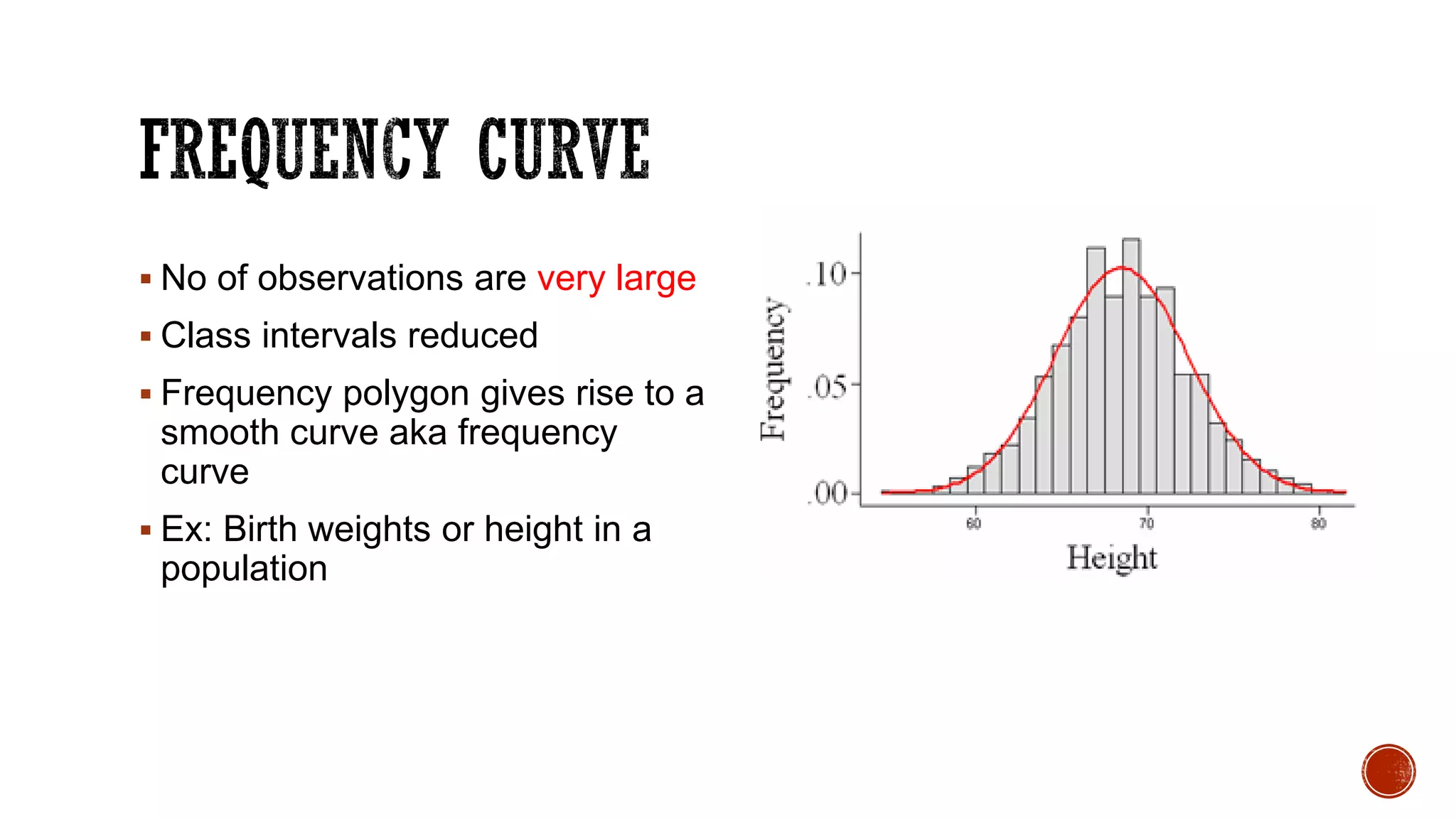
 No of observations are very large
 Class intervals reduced
 Frequency polygon gives rise to a
smooth curve aka frequency
curve
 Ex: Birth weights or height in a
population
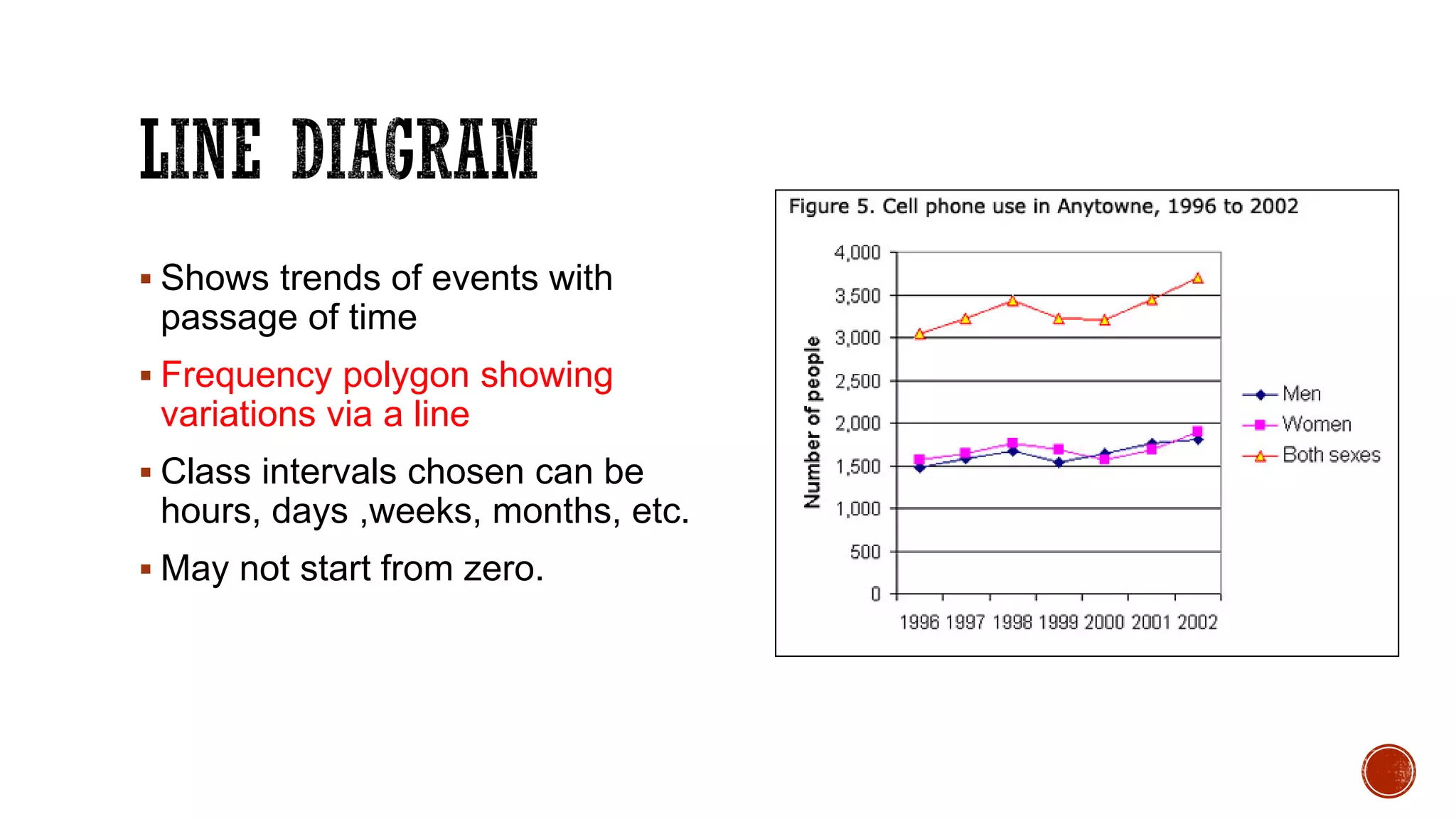
 Shows trends of events with
passage of time
 Frequency polygon showing
variations via a line
 Class intervals chosen can be
hours, days ,weeks, months, etc.
 May not start from zero.
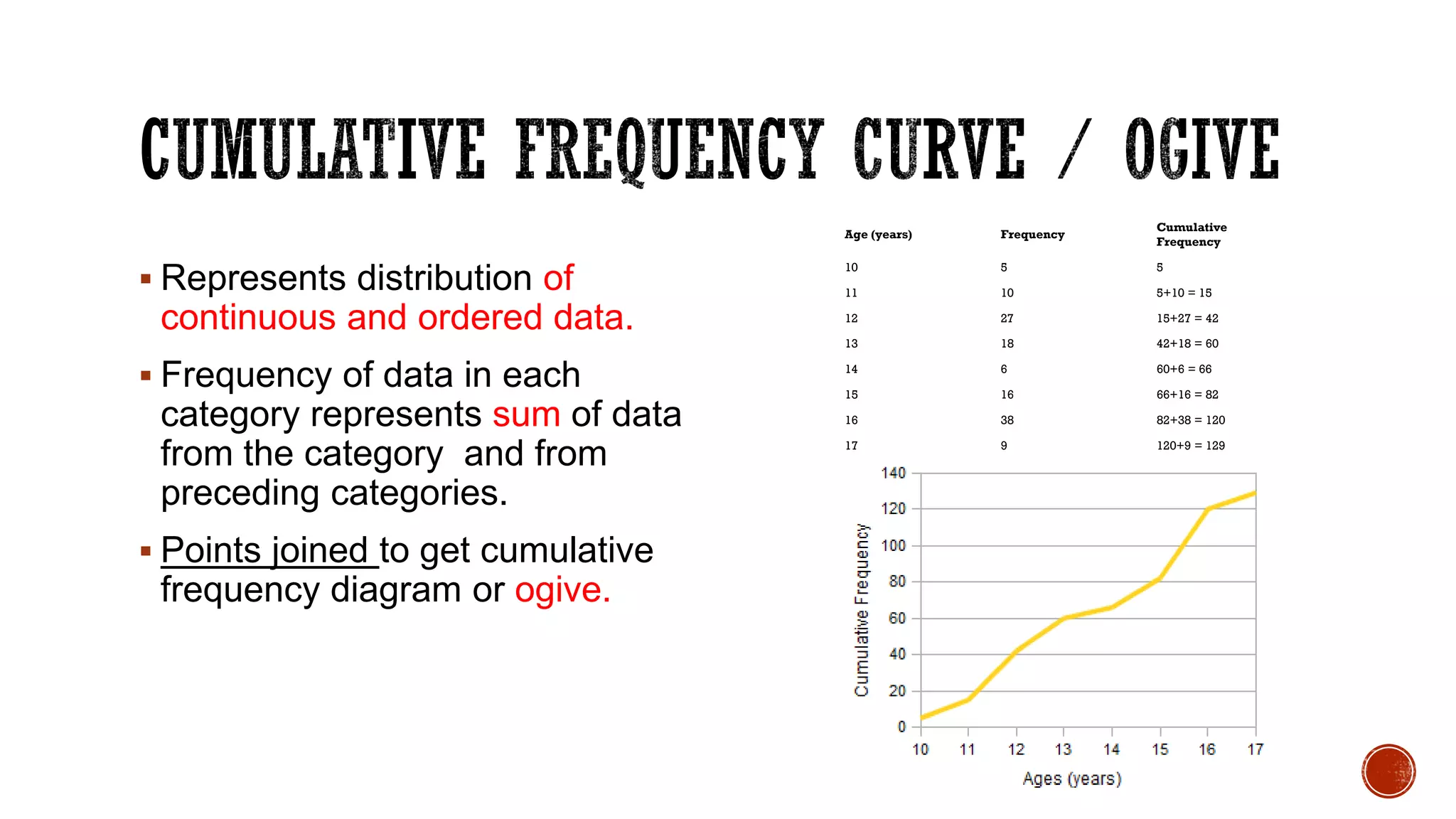
 Represents distribution of
continuous and ordered data.
 Frequency of data in each
category represents sum of data
from the category and from
preceding categories.
 Points joined to get cumulative
frequency diagram or ogive.
Age (years) Frequency
Cumulative
Frequency
10 5 5
11 10 5+10 = 15
12 27 15+27 = 42
13 18 42+18 = 60
14 6 60+6 = 66
15 16 66+16 = 82
16 38 82+38 = 120
17 9 120+9 = 129
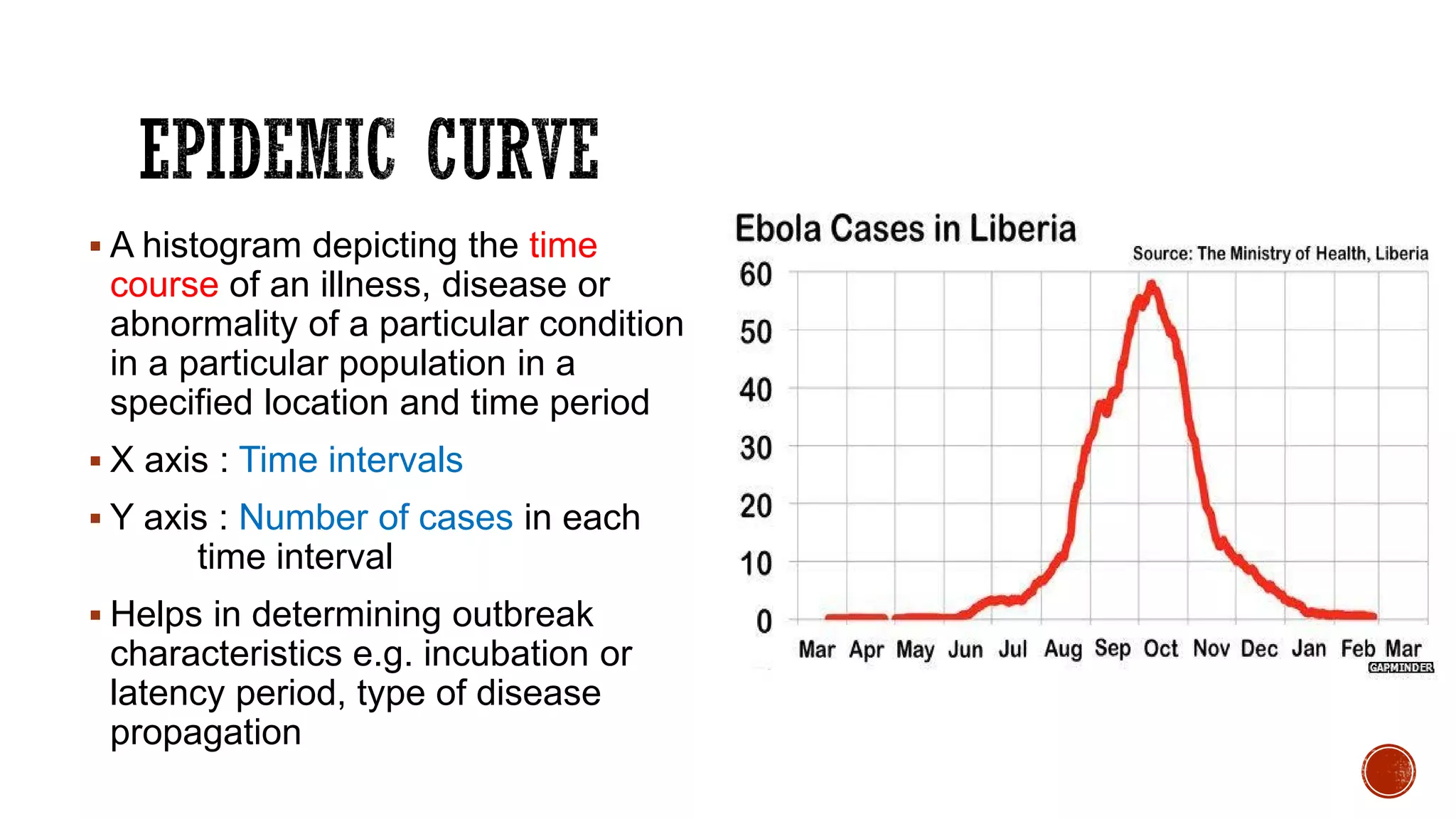
 A histogram depicting the time
course of an illness, disease or
abnormality of a particular condition
in a particular population in a
specified location and time period
 X axis : Time intervals
 Y axis : Number of cases in each
time interval
 Helps in determining outbreak
characteristics e.g. incubation or
latency period, type of disease
propagation
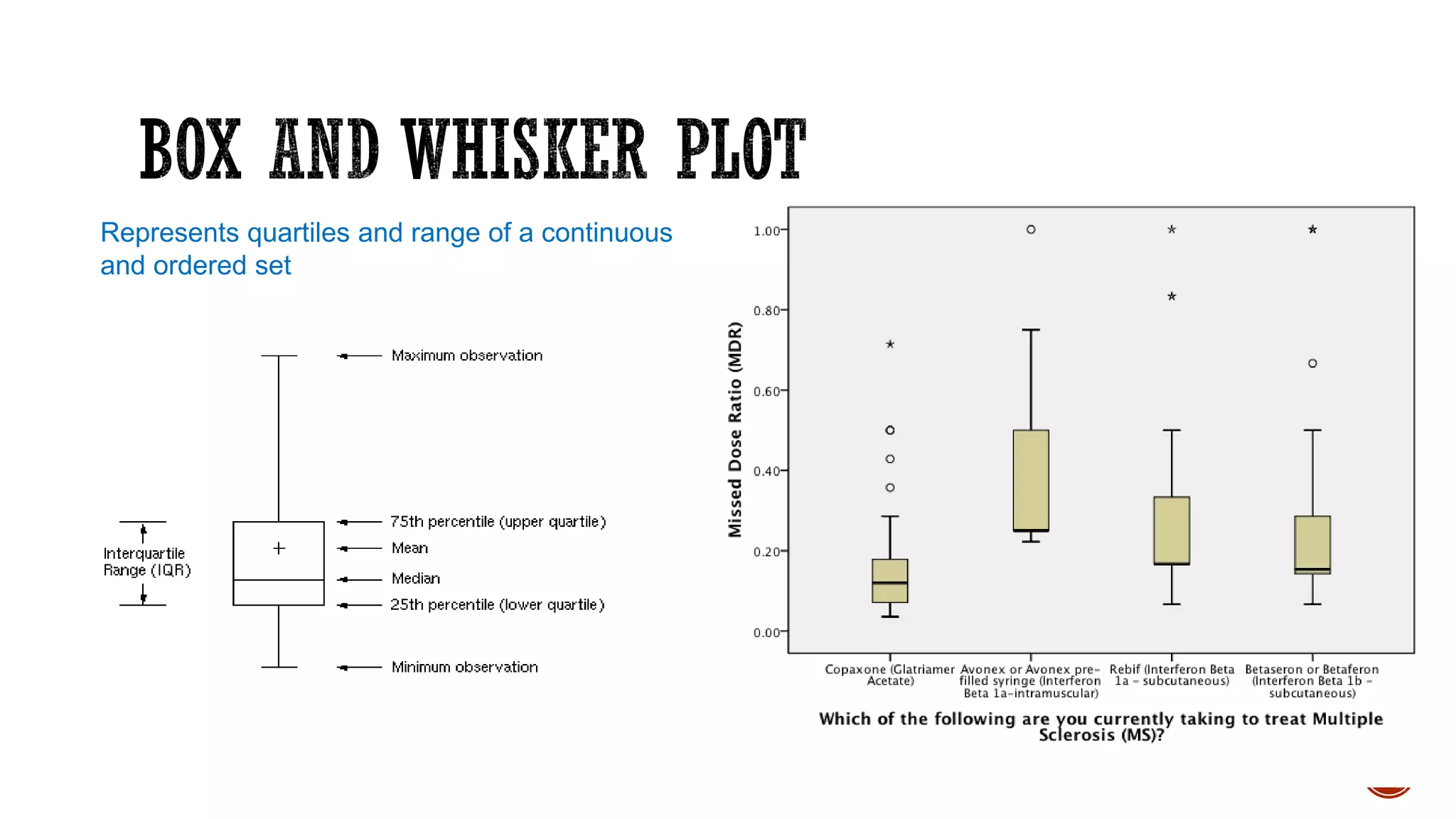
Represents quartiles and range of a continuous
and ordered set
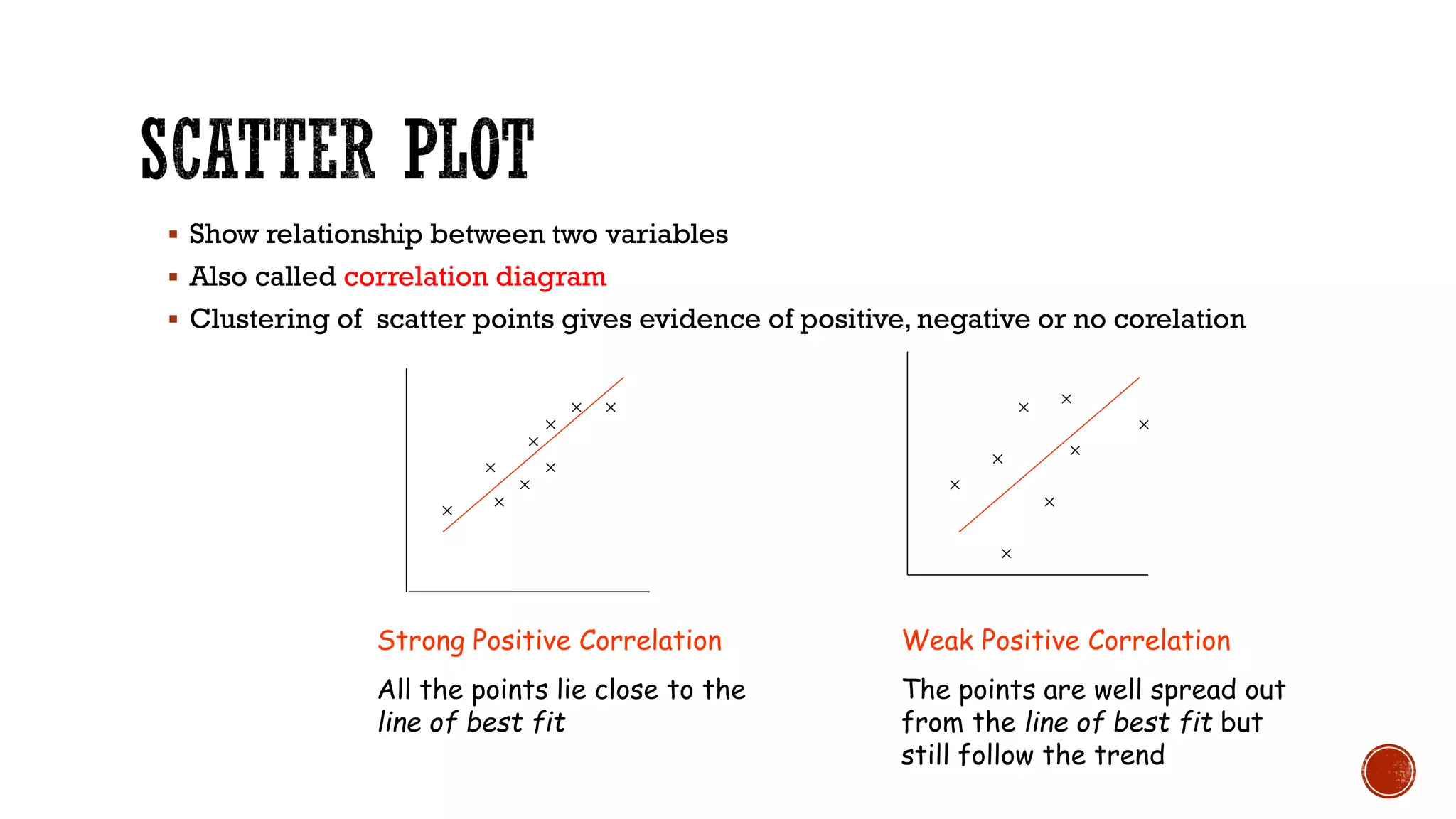
 Show relationship between two variables
 Also called correlation diagram
 Clustering of scatter points gives evidence of positive, negative or no corelation
Strong Positive Correlation
All the points lie close to the
line of best fit
Weak Positive Correlation
The points are well spread out
from the line of best fit but
still follow the trend
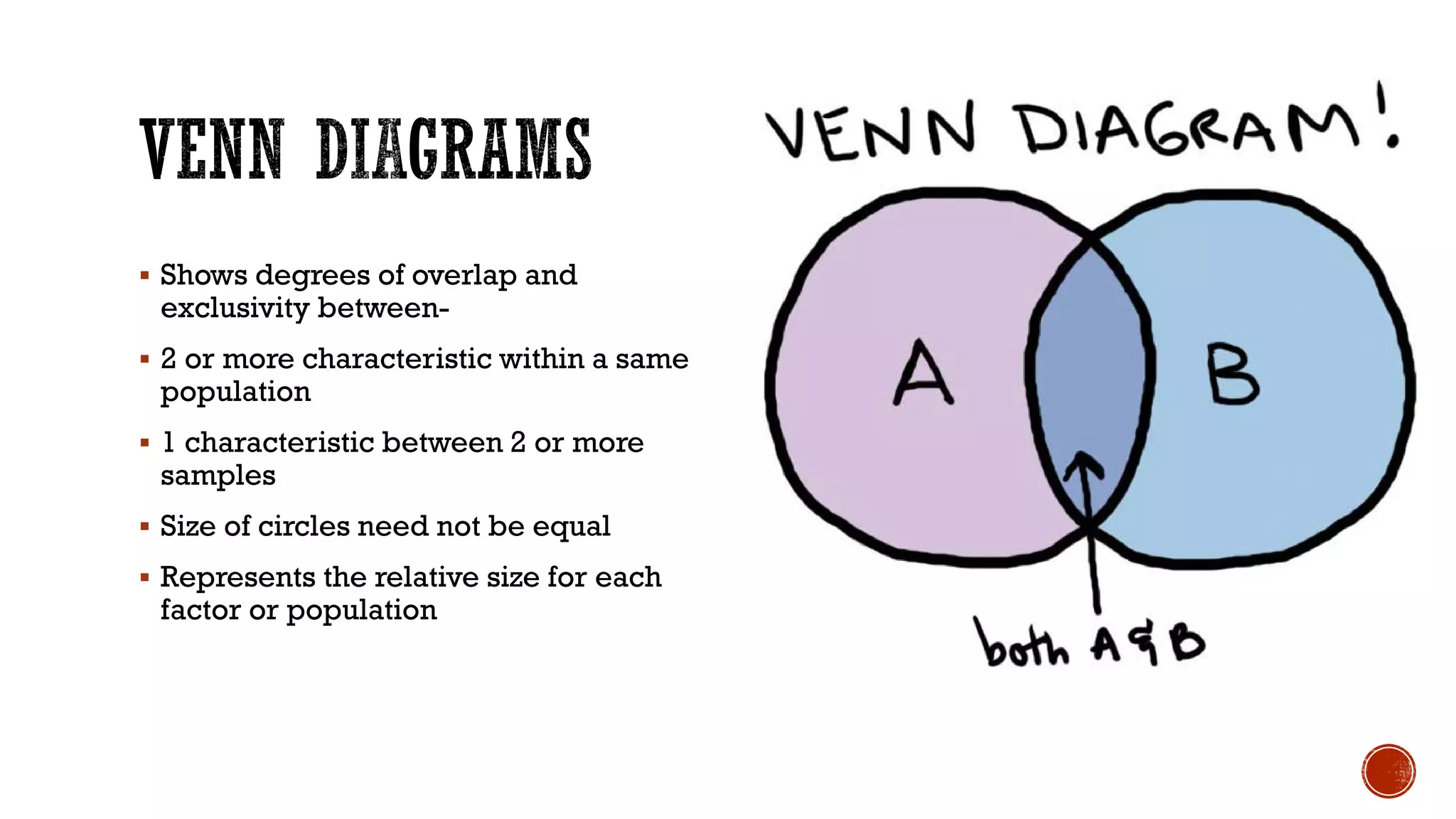
 Shows degrees of overlap and
exclusivity between-
 2 or more characteristic within a same
population
 1 characteristic between 2 or more
samples
 Size of circles need not be equal
 Represents the relative size for each
factor or population
Scales of measurement and presentation of data

Scales of measurement and presentation of data

  • 2.
     To definedata.  To enumerate various types of data with examples.  To know about the various scales of measurement.  To enumerate the various sources for collection of data.  To explain various methods of presentation of data.  To select appropriate method of presentation depending upon the type of data.
  • 3.
    - Facts orfigures from which conclusions can be drawn. - Data can relate to an enormous variety of aspects. e.g.: Weight and height measurements of students in a class. Blood pressure and pulse recording of patients attending medicine opd. Temperature of a city (measured every hour), for a period of 1 week.
  • 4.
     QUALITATIVE DATAand QUANTITATIVE DATA  PRIMARY DATA and SECONDARY DATA  GROUPED DATA and UNGROUPED DATA
  • 5.
     Also calledas categorical data.  It represents a particular quality or attribute. e.g. Colour of hair, Cured or not cured, Religion, Gender, Smoking status, etc.
  • 6.
     It representsNumerical Data.  E.g. Height in cms, Weight in kgs, Hb in gm%, Serum Bilirubin in gm/dl, BP in mm/hg etc.  It may be Continuous or Discrete
  • 7.
     Values aredistinct and separate.  Values are invariably whole numbers. e.g. Age in completed years, Number of OPV vials opened in an immunization session, Number of children in a family, etc.
  • 8.
     Those whichhave uninterrupted range of values.  Possibility of getting fractions like .23, .89, .99  Depending on our requirement, we can express the weight as 51 kg or 50.96 kg.
  • 9.
    Presented in groups. Example: BloodPressure of 9 men can be represented as follows: 1. 120/80 mm Hg (2) 2. 140/90 mm Hg (4) 3. 150/100 mm Hg (3)
  • 10.
    Presented individually. Example: NameBlood Pressure Person1 140/90 mm Hg Person2 150/100 mm Hg Person3 150/100 mm Hg Person4 140/90 mm Hg Person5 140/90 mm Hg Person6 150/100 mm Hg Person7 140/90 mm Hg Person8 120/80 mm Hg Person9 120/80 mm Hg
  • 11.
    These are thedata directly obtained from the individual. Ex:- Height, Weight, Sex, Religion etc. directly asked from the individual.
  • 12.
    These are thedata obtained from secondary source. Ex : Census data, Hospital records, etc.
  • 13.
    Defined as theapplication of rules to assign numbers to objects (or attributes).  Values made meaningful by quantifying into specific units. Measurements act as labels which make those values more useful in terms of details. Mr. X is Tall. Mr. X is 6 feet tall
  • 14.
  • 15.
    When one measuresby this scale, one simply names or categorizes the responses. They do not imply any ordering among the responses. Example: Gender, Religion, Blood group etc.
  • 16.
    Characteristics can beput in ordered “natural categories”. There are distinct classes. Can be ordered on the basis of their magnitude. Example: Disease status (advanced, moderate, mild). Pain status ( mild, moderate, severe). Socio economic status, etc.
  • 17.
    Observations are madein a scale. Differences between any two successive numbers is fixed and equal. Absolute zero doesn’t exist. Example: Dates, Body Temperature, etc.
  • 18.
    Absolute zero exists. Permitsthe comparison of difference of values. Example: Heart beats per minute, weight, etc.
  • 19.
    Quantitative Qualitative Hb levelsin gm% Anemic or Non-anemic Height in cms Tall or Short Blood Pressure in mm hg Hypo, Normo or Hypertensive IQ scores Idiot, Genius or Moron
  • 20.
    1. Census 2. Registrationof vital events 3. Sample Registration system 4. Notification of diseases 5. Hospital records 6. Epidemiological Surveillance 7. Surveys 8. Research Findings
  • 21.
  • 22.
    Usually the firststep of presentation and analysis of data. Can be : 1. Simple 2. Complex (depending on the number of measurements of a single set or multiple sets of items)
  • 23.
     Table mustbe numbered.  Brief and self explanatory title.  Headings of columns and rows : clear, concise, sufficient and fully defined.  Presentation of data : acc. to size of importance, chronologically, alphabetically and geographically.  Mention the number of observations from which proportions are derived.
  • 24.
     Details ofdeliberate exclusions must be given.  Shouldn’t be too large.  Figures needing comparison must be placed as close as possible.  Arrangement to be vertical.  Footnotes to be given wherever possible.
  • 25.
    Table 1: Numberof cases of various bites attending ARC, MKCGMCH in Jan2016 Type of bite Cases Dog 650 Monkey 120 Cat 87 Bear 2 Others 5 TOTAL 864
  • 26.
    Table 2: Casesof malaria in adults and children in the months of June and July 2010 MKCG Medical College and Hospital.
  • 27.
    ADVANTAGES:  Simple  Easyto understand  Save a lot of words  Self explanatory  Has a clear title indicating its content  Fully labeled
  • 28.
    PRINCIPLES :  Simple(consistent with the purpose)  Self explanatory.  Title of graph should be written below the graph.  Scale Lines should be drawn heavier than coordinate lines.  Frequency- Vertical scale.  Classification – Horizontal scale.
  • 29.
    Qualitative data • Bardiagram. • Pie or sector diagram. • Venn diagram. • Pictogram or picture diagram. • Map diagram or spot map. Quantitative data • Histogram. • Frequency polygon. • Frequency curve. • Line chart or Graph. • Cumulative frequency diagram or ‘Ogive’. • Scatter diagram.
  • 30.
     Widely used. Comparing categories of mutually exclusive discrete data.  Different categories represented on one axis.  Frequencies of data in each category represented in other axis.  Length of bars indicate magnitude of the frequencies of categories to be compared and spacing should be half of width of the bars  Bars arranged in ascending or descending order or any order.. Not mandatory
  • 31.
     Simple bardiagrams  Multiple or compound bar diagrams  Component or proportional bar diagrams
  • 32.
    102 62 29 0 20 40 60 80 100 120 P.Vivax P.Falciparum Mixedmalaria Malaria cases in MKCG Hospital in July 2010 Total No cases Male
  • 33.
    102 62 29 57 31 19 0 20 40 60 80 100 120 P.Vivax P.Falciparum Mixedmalaria Distribution of malaria cases in MKCG Hospital in July 2010 Male Female
  • 35.
    Used to represent proportions Areas: represents proportions Angles : denotes frequencies monkey 37% dog 60% cat 3% others 0% ANIMAL BITE CASES
  • 36.
     For layman  One form of bar graphs  Each picture represents a fixed no of happenings.
  • 37.
     Geographic coordinatecharts  Used for geo coded data  Map of an area within a location representing the particular area of interest  Example: Branding cases found within rayagada district, Goitre endemic areas of India etc.
  • 38.
     Pictorial diagramof frequency distribution  Consist of a series of bars.  Similar to the bar chart with the difference that the rectangles or bars are adherent (without gaps).  Area of each bar is proportional to the frequency.  Horizontal : Class intervals (abscissa)  Vertical : Frequencies (ordinate)
  • 39.
     Can beobtained by joining the mid points of blocks or rectangles of histogram  More useful than histogram  X axis : categories of data  Y axis : frequency of data in each category  Representation of distribution of categories of continuous and ordered data
  • 40.
     No ofobservations are very large  Class intervals reduced  Frequency polygon gives rise to a smooth curve aka frequency curve  Ex: Birth weights or height in a population
  • 41.
     Shows trendsof events with passage of time  Frequency polygon showing variations via a line  Class intervals chosen can be hours, days ,weeks, months, etc.  May not start from zero.
  • 42.
     Represents distributionof continuous and ordered data.  Frequency of data in each category represents sum of data from the category and from preceding categories.  Points joined to get cumulative frequency diagram or ogive. Age (years) Frequency Cumulative Frequency 10 5 5 11 10 5+10 = 15 12 27 15+27 = 42 13 18 42+18 = 60 14 6 60+6 = 66 15 16 66+16 = 82 16 38 82+38 = 120 17 9 120+9 = 129
  • 43.
     A histogramdepicting the time course of an illness, disease or abnormality of a particular condition in a particular population in a specified location and time period  X axis : Time intervals  Y axis : Number of cases in each time interval  Helps in determining outbreak characteristics e.g. incubation or latency period, type of disease propagation
  • 45.
    Represents quartiles andrange of a continuous and ordered set
  • 46.
     Show relationshipbetween two variables  Also called correlation diagram  Clustering of scatter points gives evidence of positive, negative or no corelation Strong Positive Correlation All the points lie close to the line of best fit Weak Positive Correlation The points are well spread out from the line of best fit but still follow the trend
  • 47.
     Shows degreesof overlap and exclusivity between-  2 or more characteristic within a same population  1 characteristic between 2 or more samples  Size of circles need not be equal  Represents the relative size for each factor or population