Descriptive Statistics
Dr. A.P. Kulkarni
Necessity
Required for inference
Meaningful reduction
Raw data reduced
Depends on variable
Availability of software
What descriptive stats?
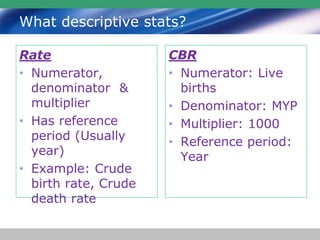
Rate
• Numerator,
denominator &
multiplier
• Has reference
period (Usually
year)
• Example: Crude
birth rate, Crude
death rate
CBR
• Numerator: Live
births
• Denominator: MYP
• Multiplier: 1000
• Reference period:
Year
What descriptive stats?
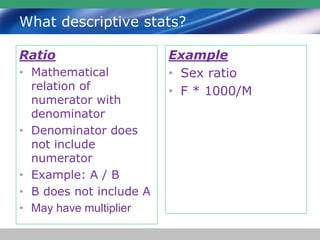
Ratio
• Mathematical
relation of
numerator with
denominator
• Denominator does
not include
numerator
• Example: A / B
• B does not include A
• May have multiplier
Example
• Sex ratio
• F * 1000/M
What descriptive stats?
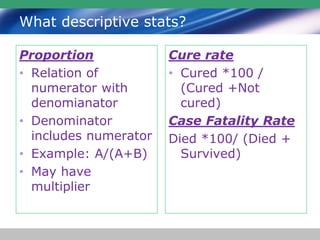
Proportion
• Relation of
numerator with
denomianator
• Denominator
includes numerator
• Example: A/(A+B)
• May have
multiplier
Cure rate
• Cured *100 /
(Cured +Not
cured)
Case Fatality Rate
Died *100/ (Died +
Survived)
What descriptive stats?
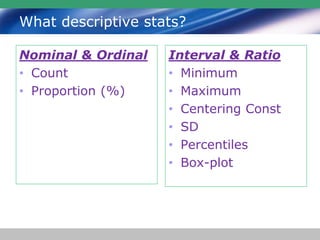
Nominal & Ordinal
• Count
• Proportion (%)
Interval & Ratio
• Minimum
• Maximum
• Centering Const
• SD
• Percentiles
• Box-plot
What descriptive stats?
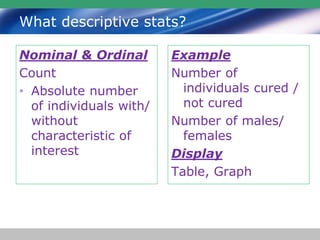
Nominal & Ordinal
Count
• Absolute number
of individuals with/
without
characteristic of
interest
Example
Number of
individuals cured /
not cured
Number of males/
females
Display
Table, Graph
What descriptive stats?
Interval / ratio scale
Minimum & Maximum
• Minimum / Maximum value
Example
• Minimum & maximum height in the group
• Used to ascertain that inclusion / exclusion
criteria are followed
What descriptive stats?
Interval / ratio scale
Centering constants: Mean, Median, Mode
• Mean: Arithmetic mean.
• Median: Middle value when arranged in
ascending / descending order
• Mode: Most common value
• Used to compare groups
• Mean is most commonly used statistics
• Limitations of Mean
What descriptive stats?
Interval / ratio scale
Standard deviation:
• Measure of variation.
• Has the same unit of measurement as mean
• Higher the SD higher is the variation in the
data
• Can compare two groups
• Required for further statistics
• Variance is square of SD
What descriptive stats?
Interval / ratio scale
Quartiles
• Measure of variation.
• Observations arranged in ascending order
• If there are 500 observations,
125th observation indicates 1st quartile (Q-1)
250th observation indicates 2nd quartile (Q-2)
375th observation indicates 3rd quartile (Q-3)
What descriptive stats?
Interval / ratio scale
Percentile:
• Measure of variation.
• Observations arranged
in ascending order
• If there are 500
observations, 5th
observation indicates
1st percentile,
• 475th observation is 95th
percentile
• Used in studies
related to
nutrition,
education,
psychiatry
• 50th percentile is
median
What descriptive stats?
Interval / ratio scale
Coefficient of Variation:
• SD divided by mean.
• May be expressed as %
• Useful to compare variables with different
units of measurement
• Example:
 Is height more variable or weight?
 Is Hb% more variable or ESR?
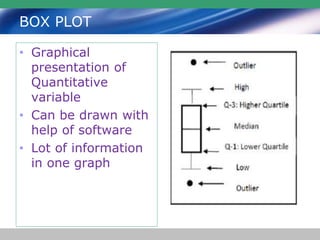
BOX PLOT
• Graphical
presentation of
Quantitative
variable
• Can be drawn with
help of software
• Lot of information
in one graph
What descriptive stats?
Interval / ratio scale
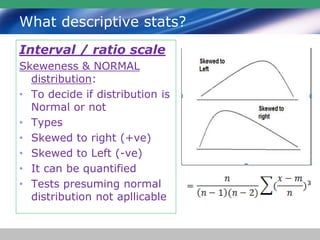
Skeweness & NORMAL
distribution:
• To decide if distribution is
Normal or not
• Types
• Skewed to right (+ve)
• Skewed to Left (-ve)
• It can be quantified
• Tests presuming normal
distribution not apllicable
Tables & Descriptive Statistics
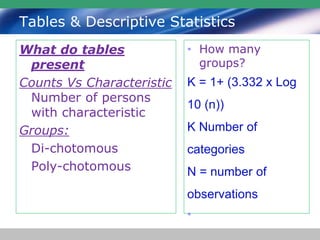
What do tables
present
Counts Vs Characteristic
Number of persons
with characteristic
Groups:
Di-chotomous
Poly-chotomous
• How many
groups?
K = 1+ (3.332 x Log
10 (n))
K Number of
categories
N = number of
observations
•
Tables & Descriptive Statistics
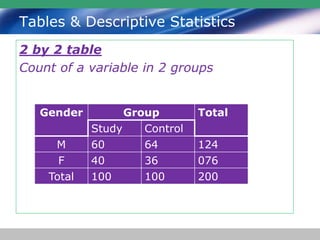
2 by 2 table
Count of a variable in 2 groups
Gender Group Total
Study Control
M 60 64 124
F 40 36 076
Total 100 100 200
Tables & Descriptive Statistics
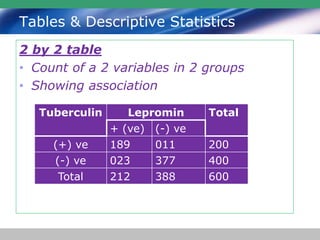
2 by 2 table
• Count of a 2 variables in 2 groups
• Showing association
Tuberculin Lepromin Total
+ (ve) (-) ve
(+) ve 189 011 200
(-) ve 023 377 400
Total 212 388 600
Tables & Descriptive Statistics
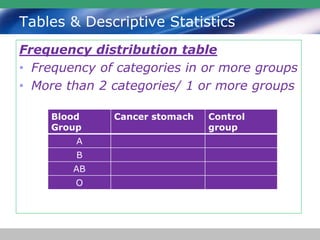
Frequency distribution table
• Frequency of categories in or more groups
• More than 2 categories/ 1 or more groups
Blood
Group
Cancer stomach Control
group
A
B
AB
O
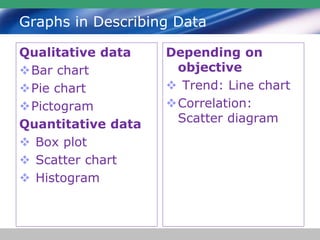
Graphs in Describing Data
Qualitative data
Bar chart
Pie chart
Pictogram
Quantitative data
 Box plot
 Scatter chart
 Histogram
Depending on
objective
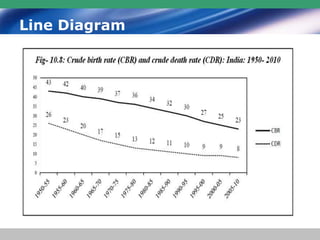
 Trend: Line chart
Correlation:
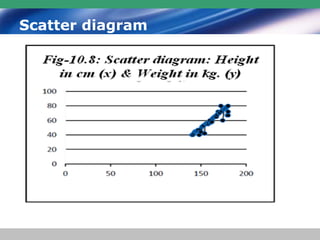
Scatter diagram
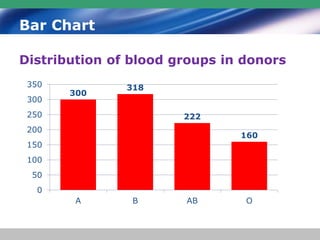
Bar Chart
Distribution of blood groups in donors
300
318
222
160
0
50
100
150
200
250
300
350
A B AB O
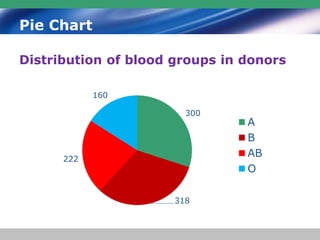
Pie Chart
Distribution of blood groups in donors
300
318
222
160
A
B
AB
O
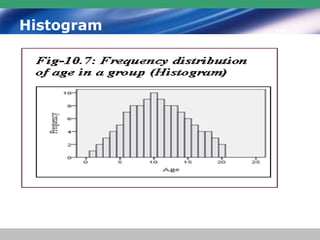
Histogram
Scatter diagram
Line Diagram
Soft ware in descriptive statistics
MS-EXCEL
Master chart
Rows: Records
Columns: Variable
Coding the Qualitative variables
Use of functions
Export to other software like SPPSS
15. descriptive statistics

15. descriptive statistics

  • 1.
  • 2.
    Necessity Required for inference Meaningfulreduction Raw data reduced Depends on variable Availability of software
  • 3.
    What descriptive stats? Rate •Numerator, denominator & multiplier • Has reference period (Usually year) • Example: Crude birth rate, Crude death rate CBR • Numerator: Live births • Denominator: MYP • Multiplier: 1000 • Reference period: Year
  • 4.
    What descriptive stats? Ratio •Mathematical relation of numerator with denominator • Denominator does not include numerator • Example: A / B • B does not include A • May have multiplier Example • Sex ratio • F * 1000/M
  • 5.
    What descriptive stats? Proportion •Relation of numerator with denomianator • Denominator includes numerator • Example: A/(A+B) • May have multiplier Cure rate • Cured *100 / (Cured +Not cured) Case Fatality Rate Died *100/ (Died + Survived)
  • 6.
    What descriptive stats? Nominal& Ordinal • Count • Proportion (%) Interval & Ratio • Minimum • Maximum • Centering Const • SD • Percentiles • Box-plot
  • 7.
    What descriptive stats? Nominal& Ordinal Count • Absolute number of individuals with/ without characteristic of interest Example Number of individuals cured / not cured Number of males/ females Display Table, Graph
  • 8.
    What descriptive stats? Interval/ ratio scale Minimum & Maximum • Minimum / Maximum value Example • Minimum & maximum height in the group • Used to ascertain that inclusion / exclusion criteria are followed
  • 9.
    What descriptive stats? Interval/ ratio scale Centering constants: Mean, Median, Mode • Mean: Arithmetic mean. • Median: Middle value when arranged in ascending / descending order • Mode: Most common value • Used to compare groups • Mean is most commonly used statistics • Limitations of Mean
  • 10.
    What descriptive stats? Interval/ ratio scale Standard deviation: • Measure of variation. • Has the same unit of measurement as mean • Higher the SD higher is the variation in the data • Can compare two groups • Required for further statistics • Variance is square of SD
  • 11.
    What descriptive stats? Interval/ ratio scale Quartiles • Measure of variation. • Observations arranged in ascending order • If there are 500 observations, 125th observation indicates 1st quartile (Q-1) 250th observation indicates 2nd quartile (Q-2) 375th observation indicates 3rd quartile (Q-3)
  • 12.
    What descriptive stats? Interval/ ratio scale Percentile: • Measure of variation. • Observations arranged in ascending order • If there are 500 observations, 5th observation indicates 1st percentile, • 475th observation is 95th percentile • Used in studies related to nutrition, education, psychiatry • 50th percentile is median
  • 13.
    What descriptive stats? Interval/ ratio scale Coefficient of Variation: • SD divided by mean. • May be expressed as % • Useful to compare variables with different units of measurement • Example:  Is height more variable or weight?  Is Hb% more variable or ESR?
  • 14.
    BOX PLOT • Graphical presentationof Quantitative variable • Can be drawn with help of software • Lot of information in one graph
  • 15.
    What descriptive stats? Interval/ ratio scale Skeweness & NORMAL distribution: • To decide if distribution is Normal or not • Types • Skewed to right (+ve) • Skewed to Left (-ve) • It can be quantified • Tests presuming normal distribution not apllicable
  • 16.
    Tables & DescriptiveStatistics What do tables present Counts Vs Characteristic Number of persons with characteristic Groups: Di-chotomous Poly-chotomous • How many groups? K = 1+ (3.332 x Log 10 (n)) K Number of categories N = number of observations •
  • 17.
    Tables & DescriptiveStatistics 2 by 2 table Count of a variable in 2 groups Gender Group Total Study Control M 60 64 124 F 40 36 076 Total 100 100 200
  • 18.
    Tables & DescriptiveStatistics 2 by 2 table • Count of a 2 variables in 2 groups • Showing association Tuberculin Lepromin Total + (ve) (-) ve (+) ve 189 011 200 (-) ve 023 377 400 Total 212 388 600
  • 19.
    Tables & DescriptiveStatistics Frequency distribution table • Frequency of categories in or more groups • More than 2 categories/ 1 or more groups Blood Group Cancer stomach Control group A B AB O
  • 20.
    Graphs in DescribingData Qualitative data Bar chart Pie chart Pictogram Quantitative data  Box plot  Scatter chart  Histogram Depending on objective  Trend: Line chart Correlation: Scatter diagram
  • 21.
    Bar Chart Distribution ofblood groups in donors 300 318 222 160 0 50 100 150 200 250 300 350 A B AB O
  • 22.
    Pie Chart Distribution ofblood groups in donors 300 318 222 160 A B AB O
  • 23.
  • 24.
  • 25.
  • 26.
    Soft ware indescriptive statistics MS-EXCEL Master chart Rows: Records Columns: Variable Coding the Qualitative variables Use of functions Export to other software like SPPSS