Experimental design techniques
• The design of fundamental relationship under
controlled situation is called experimental
design.
• Controlling is nothing but holding one variable
constant while other variables are free to vary
within the experiment.
• Independent variables are manipulated in
order to measure their effect on dependent
variable.
• An experiment is an observation under
controlled conditions.
• It is a design in which some of the variables
being studied are manipulated to control the
conditions.
Types
• Pre –experimental designs
• Quasi-experimental design
• Observational or true experimental
design
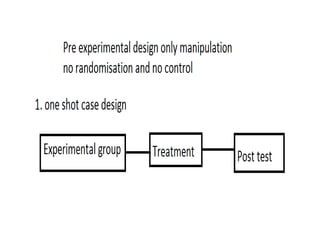
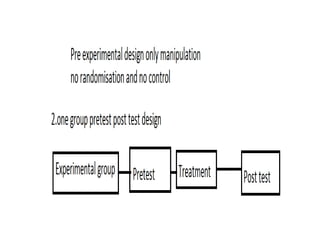
Pre- experimental designs
• It is the design in which the basic
experimental steps are followed without
assigning any control group.
• The researcher studies a single group with no
any comparison within this group.
• It is a preparatory to true experimental design.
• It is the simplest form of research design.
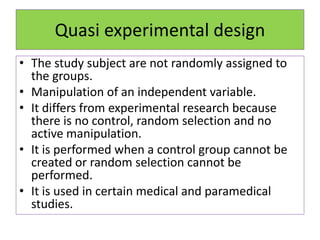
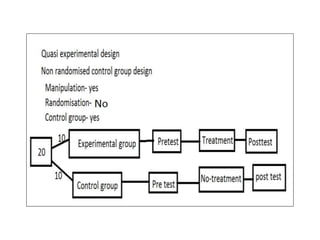
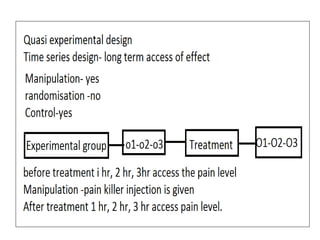
Quasi experimental design
• The study subject are not randomly assigned to
the groups.
• Manipulation of an independent variable.
• It differs from experimental research because
there is no control, random selection and no
active manipulation.
• It is performed when a control group cannot be
created or random selection cannot be
performed.
• It is used in certain medical and paramedical
studies.
True experimental design
• It employs statistical analysis to support or
reject a hypothesis.
• It has control group.
• It is the most accurate type of experimental
research it supports or disproves the
hypothesis using statistical analysis
• It is the only design where it cause and effect
the relationship between the variables.
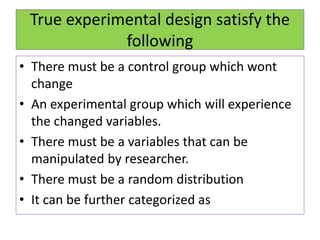
True experimental design satisfy the
following
• There must be a control group which wont
change
• An experimental group which will experience
the changed variables.
• There must be a variables that can be
manipulated by researcher.
• There must be a random distribution
• It can be further categorized as
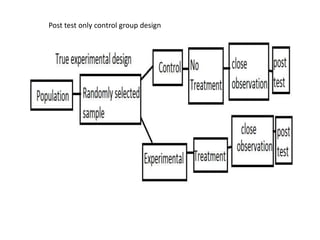
Post test only control group design
After-only design
• Experimental and control group are similar.
• Uncontrolled factors affect both the groups
casually.
• The experimental group is exposed to
assumed variable but the control group
remains unexposed.
• After experimentation both the groups are
compared there is some effect produced in
the experimental group
• The control group assumed to e exactly same
but it is not true.
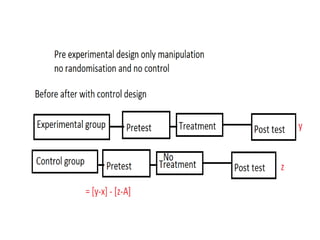
Before after desi
• Dependent variables is measured both before
and after the exposure of groups to
experiment.
• It use several group.
• It has one or more control group.
• Major weakness is a group is influenced by the
external factors .
• It is more reliable than after- only d
Ex-post design
• Researcher depend on historical background t,
because sometimes it is not possible to divide
the population into two clear and similar
group.
• It is necessary to study the entire historical
background.
• The past is studied through the present.
Panel study designs
• Method of study of a particular subject over time
by using different kinds of data.
• The researcher secure direct evidences of time
dependent relationship among variables.
• It involves repeated observations on the same
subject at different period of time is known as
time-series study.
• It is continuous , deep and reliable design
• It has limitation such as loss of panel member
absenteeism and rigid attitude of members.
Post -test only design
• It has two randomly assigned groups.
• Experimental group and control group.
• The treatment is applied to experimental
group.
• The post-test is conducted on both the group
to measure the effects of the treatment.
• When pretesting is not possible or not
required this design is commonly used.
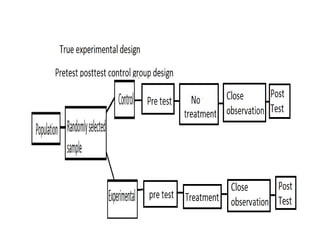
Pre test post test only design
• In this design experimental and control group
are formed
• They are pretested for independent variable.
• During experiment only experimental group
receives the treatment.
• Finally both the groups are post tested to
investigate the effects of the independent
variable on the dependent one.
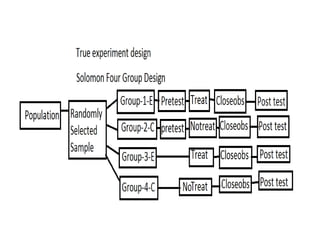
Solomon four group design
• Four groups randomly formed.
• Two experimental and two control group.
• One pre tested and one un pretested group
receives the treatment.
• All four group receives the post test.
• Post test result demonstrate the effect of the
dependent variable comparing to the effect of
the independent variable on the dependent
variable.
• It is used to eliminate potential source of error.
Factorial design
• In this design two or more independent
variable are simultaneously manipulated to
observe their effects on the dependent
variable.
• It is useful to the researcher to test two or
more hypothesis in a single experiment.
• The independent variables in this design are
called as factors.
• Subdivision of factors is called a levels.
• It helps the researcher to investigate the
individual effect of each treatment on the
dependent variables as well as their joint
effect.
Randomised block design
• Subject population is grouped into relatively
homogenous subgroups [ blocks] within which
the experiment is replicated
• It is used when there is inherent difference
between subjects and possible differences in
experimental conditions.
• If there are a large number of experimental group
the randomised block design is used because this
design make the group homogenous.
• It is used when need to reduce the noise or
variance in data.
• The noise may be attributed to the differences
between the blocks .
• This design helps to detect and examine actual
effects of interest much more accurately.
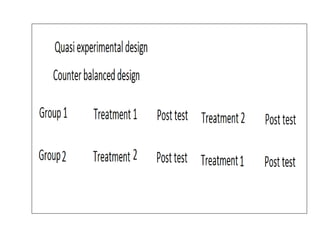
Cross over design
• Different orders of treatment is randomly
assigned to the subjects.
• It is also known as repeat measures design.
• The groups for comparison need to have an
equal distribution as well as there should be
high level of similarity among the subjects.
• The subject in this design serve as their own
control
• Limitation is subjects exposed to first treatment
may effect their responses to second treatment.
• Experimental research is aimed to draw
conclusions by controlling the external factors in
order to provide definite conclusions about the
effect of the independent variables on the
dependent variables.
• The purpose of experimental research design is to
test the hypotheses of a fundamental relationship
between variables.

Experimental design techniques

  • 1.
  • 2.
    • The designof fundamental relationship under controlled situation is called experimental design. • Controlling is nothing but holding one variable constant while other variables are free to vary within the experiment. • Independent variables are manipulated in order to measure their effect on dependent variable.
  • 3.
    • An experimentis an observation under controlled conditions. • It is a design in which some of the variables being studied are manipulated to control the conditions.
  • 4.
    Types • Pre –experimentaldesigns • Quasi-experimental design • Observational or true experimental design
  • 5.
    Pre- experimental designs •It is the design in which the basic experimental steps are followed without assigning any control group. • The researcher studies a single group with no any comparison within this group. • It is a preparatory to true experimental design. • It is the simplest form of research design.
  • 9.
    Quasi experimental design •The study subject are not randomly assigned to the groups. • Manipulation of an independent variable. • It differs from experimental research because there is no control, random selection and no active manipulation. • It is performed when a control group cannot be created or random selection cannot be performed. • It is used in certain medical and paramedical studies.
  • 13.
    True experimental design •It employs statistical analysis to support or reject a hypothesis. • It has control group. • It is the most accurate type of experimental research it supports or disproves the hypothesis using statistical analysis • It is the only design where it cause and effect the relationship between the variables.
  • 14.
    True experimental designsatisfy the following • There must be a control group which wont change • An experimental group which will experience the changed variables. • There must be a variables that can be manipulated by researcher. • There must be a random distribution • It can be further categorized as
  • 15.
    Post test onlycontrol group design
  • 18.
    After-only design • Experimentaland control group are similar. • Uncontrolled factors affect both the groups casually. • The experimental group is exposed to assumed variable but the control group remains unexposed. • After experimentation both the groups are compared there is some effect produced in the experimental group
  • 19.
    • The controlgroup assumed to e exactly same but it is not true.
  • 20.
    Before after desi •Dependent variables is measured both before and after the exposure of groups to experiment. • It use several group. • It has one or more control group. • Major weakness is a group is influenced by the external factors . • It is more reliable than after- only d
  • 21.
    Ex-post design • Researcherdepend on historical background t, because sometimes it is not possible to divide the population into two clear and similar group. • It is necessary to study the entire historical background. • The past is studied through the present.
  • 22.
    Panel study designs •Method of study of a particular subject over time by using different kinds of data. • The researcher secure direct evidences of time dependent relationship among variables. • It involves repeated observations on the same subject at different period of time is known as time-series study. • It is continuous , deep and reliable design • It has limitation such as loss of panel member absenteeism and rigid attitude of members.
  • 23.
    Post -test onlydesign • It has two randomly assigned groups. • Experimental group and control group. • The treatment is applied to experimental group. • The post-test is conducted on both the group to measure the effects of the treatment. • When pretesting is not possible or not required this design is commonly used.
  • 24.
    Pre test posttest only design • In this design experimental and control group are formed • They are pretested for independent variable. • During experiment only experimental group receives the treatment. • Finally both the groups are post tested to investigate the effects of the independent variable on the dependent one.
  • 25.
    Solomon four groupdesign • Four groups randomly formed. • Two experimental and two control group. • One pre tested and one un pretested group receives the treatment. • All four group receives the post test. • Post test result demonstrate the effect of the dependent variable comparing to the effect of the independent variable on the dependent variable. • It is used to eliminate potential source of error.
  • 26.
    Factorial design • Inthis design two or more independent variable are simultaneously manipulated to observe their effects on the dependent variable. • It is useful to the researcher to test two or more hypothesis in a single experiment. • The independent variables in this design are called as factors.
  • 27.
    • Subdivision offactors is called a levels. • It helps the researcher to investigate the individual effect of each treatment on the dependent variables as well as their joint effect.
  • 28.
    Randomised block design •Subject population is grouped into relatively homogenous subgroups [ blocks] within which the experiment is replicated • It is used when there is inherent difference between subjects and possible differences in experimental conditions. • If there are a large number of experimental group the randomised block design is used because this design make the group homogenous.
  • 29.
    • It isused when need to reduce the noise or variance in data. • The noise may be attributed to the differences between the blocks . • This design helps to detect and examine actual effects of interest much more accurately.
  • 30.
    Cross over design •Different orders of treatment is randomly assigned to the subjects. • It is also known as repeat measures design. • The groups for comparison need to have an equal distribution as well as there should be high level of similarity among the subjects. • The subject in this design serve as their own control
  • 31.
    • Limitation issubjects exposed to first treatment may effect their responses to second treatment. • Experimental research is aimed to draw conclusions by controlling the external factors in order to provide definite conclusions about the effect of the independent variables on the dependent variables. • The purpose of experimental research design is to test the hypotheses of a fundamental relationship between variables.