Noise Pollution
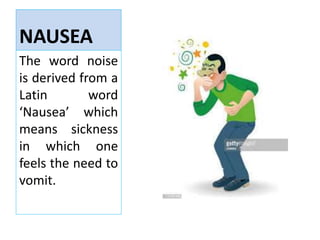
NAUSEA
The word noise
is derived from a
Latin word
‘Nausea’ which
means sickness
in which one
feels the need to
vomit.
Noise
https://noises.online/
Noise is the
unpleasant
and
undesirable
sound which
leads to
discomfort in
human
beings.
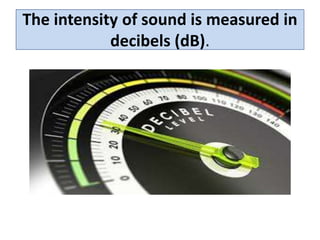
The intensity of sound is measured in
decibels (dB).
Noise
• Noise may not seem as harmful as the
contamination of air or water but it is a pollution
problem that affects human health and can
contribute to a general deterioration of
environmental quality.
• Not all sound is noise. What may be considered
as music to one person may be noise to another.
• It is not a substance that can accumulate in the
environment like most other pollutants.
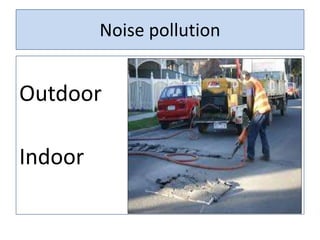
Noise pollution
Outdoor
Indoor
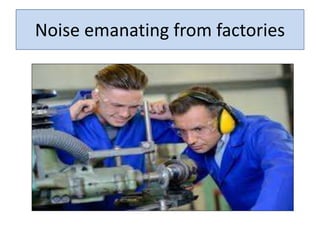
Noise emanating from factories
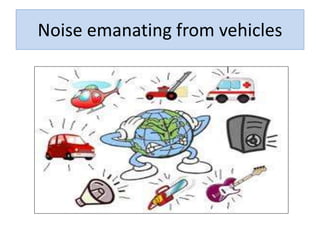
Noise emanating from vehicles
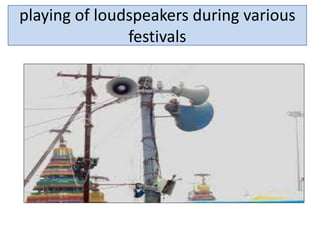
playing of loudspeakers during various
festivals
Outdoor noise pollution
Noise emanating from factories,
vehicles, playing of loudspeakers
during various festivals can
contribute to outdoor noise
pollution
Effects of Noise Pollution on Human
Health
• Hypertension: It is a direct result of noise
pollution which is caused due to elevated
blood levels for a longer duration.
• Hearing loss: Constant exposure of human
ears to loud noise that are beyond the range
of sound that human ears can withstand
damages the eardrums, resulting in loss of
hearing.
Effects of Noise Pollution on Human
Health
• Sleeping disorders: Lack of sleep might result in
fatigue and low energy level throughout the day
affecting everyday activities. Noise pollution
hampers the sleep cycles leading to irritation and
an uncomfortable state of mind.
• Cardiovascular issues: Heart-related problems
such as blood pressure level, stress and
cardiovascular diseases might come up in a
normal person and a person suffering from any of
these diseases might feel a sudden shoot up in
the level.
Electronic Gadgets
Indoor noise pollution
Loudly played radio or
music systems, and other
electronic gadgets can
contribute to indoor
noise pollution.
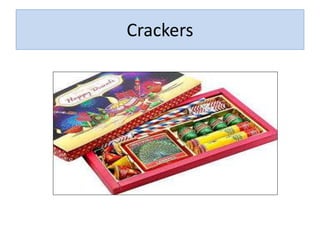
Crackers
Fire crackers
A study conducted by researchers from the New
Delhi based National Physical Laboratory show
that noise generated by firecrackers (presently
available in the market) is much higher than the
prescribed levels.
The permitted noise level is 125 decibels, as per
the Environment (Protection) (second
amendment) Rules, 1999.
NOISE POLLUTION EXAMPLES
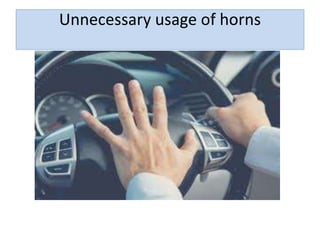
Unnecessary usage of horns
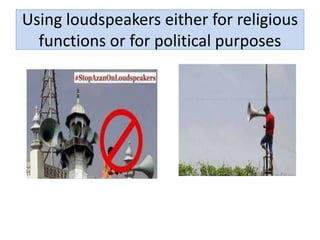
Using loudspeakers either for religious
functions or for political purposes
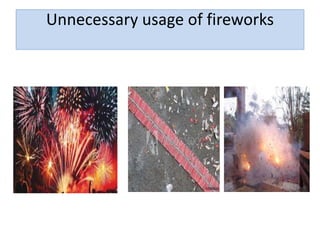
Unnecessary usage of fireworks
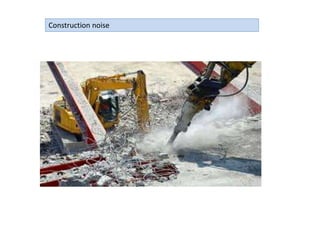
Construction noise
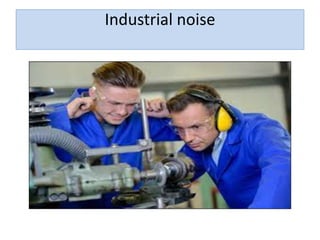
Industrial noise
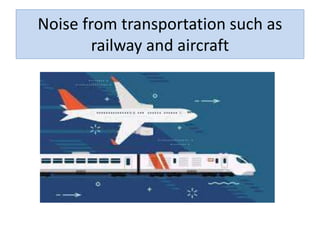
Noise from transportation such as
railway and aircraft
Temporary Threshold Shift
The most direct harmful effect of excessive noise
is physical damage to the ear and the temporary
or permanent hearing loss often called a
temporary threshold shift (TTS).
People suffering from this condition are unable
to detect weak sounds. However hearing ability
is usually recovered within a month of exposure.
Permanent Threshold Shift
Maharashtra people living in close vicinity of
Ganesh mandals that play blaring music for ten
days of the Ganesh festival are usually known to
suffer from this phenomenon.
Permanent loss, usually called noise induced
permanent threshold shift (NIPTS) represents a
loss of hearing ability from which there is no
recovery.
Effects of noise pollution on mental
health:
Lack of concentration and mental fatigue
are significant health effects of noise.
It has been observed that the performance
of school children is poor in
comprehension tasks when schools are
situated in busy areas of a city and suffer
from noise pollution.
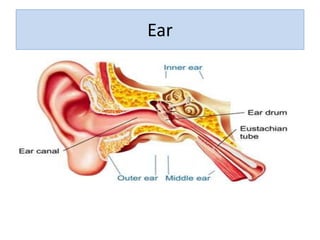
Ear
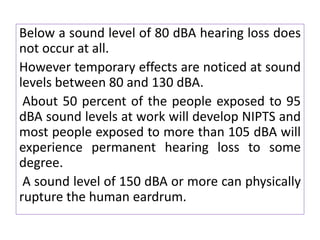
Below a sound level of 80 dBA hearing loss does
not occur at all.
However temporary effects are noticed at sound
levels between 80 and 130 dBA.
About 50 percent of the people exposed to 95
dBA sound levels at work will develop NIPTS and
most people exposed to more than 105 dBA will
experience permanent hearing loss to some
degree.
A sound level of 150 dBA or more can physically
rupture the human eardrum.
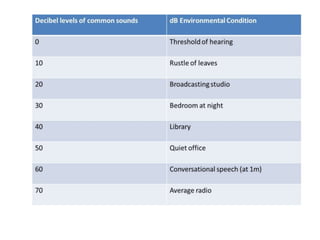
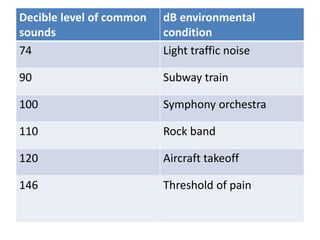
Decible level of common
sounds
dB environmental
condition
74 Light traffic noise
90 Subway train
100 Symphony orchestra
110 Rock band
120 Aircraft takeoff
146 Threshold of pain
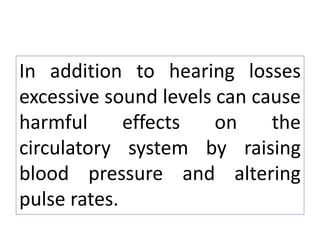
In addition to hearing losses
excessive sound levels can cause
harmful effects on the
circulatory system by raising
blood pressure and altering
pulse rates.
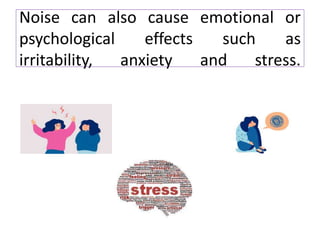
Noise can also cause emotional or
psychological effects such as
irritability, anxiety and stress.
Noise can also lead to lowered worker
efficiency and productivity and higher
accident rates on the job.
Noise is just more than a mere nuisance or
annoyance.
It definitely affects the quality of life.
It is thus important to ensure mitigation or
control of noise pollution.
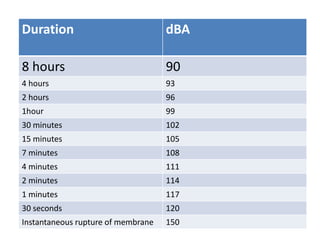
Duration dBA
8 hours 90
4 hours 93
2 hours 96
1hour 99
30 minutes 102
15 minutes 105
7 minutes 108
4 minutes 111
2 minutes 114
1 minutes 117
30 seconds 120
Instantaneous rupture of membrane 150
Noise control techniques
• Reduce noise at the source
• Block the path of noise
• Increase the path length and
• Protect the recipient.
In general, the best control method is to reduce
noise levels at the source.
CONTROLLING MEASURE
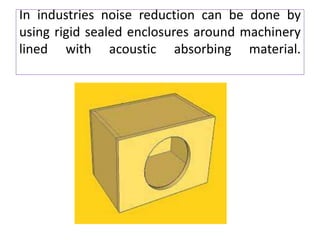
In industries noise reduction can be done by
using rigid sealed enclosures around machinery
lined with acoustic absorbing material.
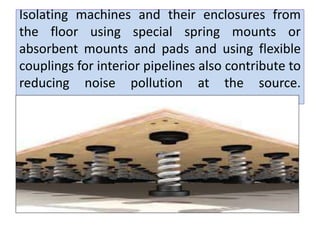
Isolating machines and their enclosures from
the floor using special spring mounts or
absorbent mounts and pads and using flexible
couplings for interior pipelines also contribute to
reducing noise pollution at the source.
The best methods of noise source
reduction is regular and thorough
maintenance of operating machinery.
Construction area
Noise levels at construction sites can be
controlled using proper construction planning
and scheduling techniques.
Locating noisy air compressors and other
equipment away from the site boundary along
with creation of temporary barriers to physically
block the noise can help contribute to reducing
noise pollution.
Control in vehicles
Most of the vehicular noise comes from movement of the
vehicle tires on the pavement and wind resistance.
However poorly maintained vehicles can add to the noise
levels.
Traffic volume and speed also have significant effects on the
overall sound.
For example doubling the speed increases the sound levels
by about 9 dBA and doubling the traffic volume (number of
vehicles per hour) increases sound levels by about 3 dBA.
A smooth flow of traffic also causes less noise than does a stop-
and-go traffic pattern.
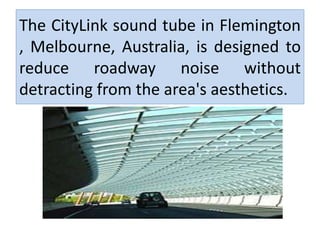
The CityLink sound tube in Flemington
, Melbourne, Australia, is designed to
reduce roadway noise without
detracting from the area's aesthetics.
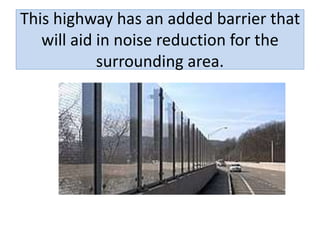
This highway has an added barrier that
will aid in noise reduction for the
surrounding area.
Control in highways
Proper highway planning and design are essential
for controlling traffic noise.
Establishing lower speed limits for highways that
pass through residential areas, limiting traffic
volume and providing alternative routes for truck
traffic are effective noise control measures.
The path of traffic noise can also be blocked by
construction of vertical barriers alongside the
highway.
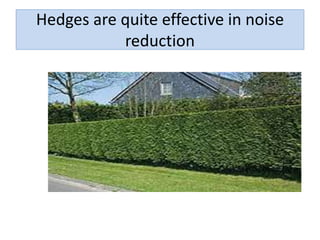
Hedges are quite effective in noise
reduction
Control by planting trees
Planting of trees around houses can also act as
effective noise barriers.
In industries different types of absorptive
material can be used to control interior noise.
Highly absorptive interior finish material for
walls, ceilings and floors can decrease indoor
noise levels significantly.
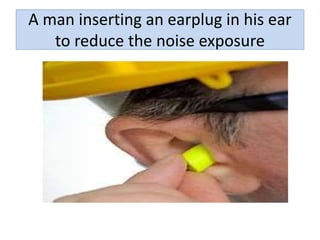
A man inserting an earplug in his ear
to reduce the noise exposure
Prevention from noise pollution
Use of earplugs and earmuffs can protect
individuals effectively from excessive noise
levels.
Specially designed earmuffs can reduce the
sound level reaching the eardrum by as much as
40 dBA.
However very often workers tend not to wear
them on a regular basis despite company
requirements for their use.
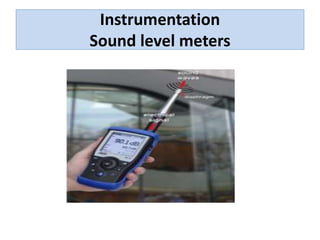
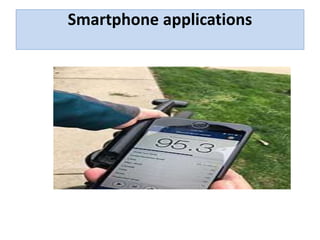
Instrumentation
Sound level meters
Smartphone applications

Noise pollution

  • 1.
  • 2.
    NAUSEA The word noise isderived from a Latin word ‘Nausea’ which means sickness in which one feels the need to vomit.
  • 3.
  • 4.
    The intensity ofsound is measured in decibels (dB).
  • 5.
    Noise • Noise maynot seem as harmful as the contamination of air or water but it is a pollution problem that affects human health and can contribute to a general deterioration of environmental quality. • Not all sound is noise. What may be considered as music to one person may be noise to another. • It is not a substance that can accumulate in the environment like most other pollutants.
  • 6.
  • 7.
  • 8.
  • 9.
    playing of loudspeakersduring various festivals
  • 10.
    Outdoor noise pollution Noiseemanating from factories, vehicles, playing of loudspeakers during various festivals can contribute to outdoor noise pollution
  • 11.
    Effects of NoisePollution on Human Health • Hypertension: It is a direct result of noise pollution which is caused due to elevated blood levels for a longer duration. • Hearing loss: Constant exposure of human ears to loud noise that are beyond the range of sound that human ears can withstand damages the eardrums, resulting in loss of hearing.
  • 12.
    Effects of NoisePollution on Human Health • Sleeping disorders: Lack of sleep might result in fatigue and low energy level throughout the day affecting everyday activities. Noise pollution hampers the sleep cycles leading to irritation and an uncomfortable state of mind. • Cardiovascular issues: Heart-related problems such as blood pressure level, stress and cardiovascular diseases might come up in a normal person and a person suffering from any of these diseases might feel a sudden shoot up in the level.
  • 13.
  • 14.
    Indoor noise pollution Loudlyplayed radio or music systems, and other electronic gadgets can contribute to indoor noise pollution.
  • 15.
  • 16.
    Fire crackers A studyconducted by researchers from the New Delhi based National Physical Laboratory show that noise generated by firecrackers (presently available in the market) is much higher than the prescribed levels. The permitted noise level is 125 decibels, as per the Environment (Protection) (second amendment) Rules, 1999.
  • 17.
  • 18.
  • 19.
    Using loudspeakers eitherfor religious functions or for political purposes
  • 20.
  • 21.
  • 22.
  • 25.
    Noise from transportationsuch as railway and aircraft
  • 26.
    Temporary Threshold Shift Themost direct harmful effect of excessive noise is physical damage to the ear and the temporary or permanent hearing loss often called a temporary threshold shift (TTS). People suffering from this condition are unable to detect weak sounds. However hearing ability is usually recovered within a month of exposure.
  • 27.
    Permanent Threshold Shift Maharashtrapeople living in close vicinity of Ganesh mandals that play blaring music for ten days of the Ganesh festival are usually known to suffer from this phenomenon. Permanent loss, usually called noise induced permanent threshold shift (NIPTS) represents a loss of hearing ability from which there is no recovery.
  • 28.
    Effects of noisepollution on mental health: Lack of concentration and mental fatigue are significant health effects of noise. It has been observed that the performance of school children is poor in comprehension tasks when schools are situated in busy areas of a city and suffer from noise pollution.
  • 29.
  • 30.
    Below a soundlevel of 80 dBA hearing loss does not occur at all. However temporary effects are noticed at sound levels between 80 and 130 dBA. About 50 percent of the people exposed to 95 dBA sound levels at work will develop NIPTS and most people exposed to more than 105 dBA will experience permanent hearing loss to some degree. A sound level of 150 dBA or more can physically rupture the human eardrum.
  • 32.
    Decible level ofcommon sounds dB environmental condition 74 Light traffic noise 90 Subway train 100 Symphony orchestra 110 Rock band 120 Aircraft takeoff 146 Threshold of pain
  • 33.
    In addition tohearing losses excessive sound levels can cause harmful effects on the circulatory system by raising blood pressure and altering pulse rates.
  • 34.
    Noise can alsocause emotional or psychological effects such as irritability, anxiety and stress.
  • 35.
    Noise can alsolead to lowered worker efficiency and productivity and higher accident rates on the job. Noise is just more than a mere nuisance or annoyance. It definitely affects the quality of life. It is thus important to ensure mitigation or control of noise pollution.
  • 36.
    Duration dBA 8 hours90 4 hours 93 2 hours 96 1hour 99 30 minutes 102 15 minutes 105 7 minutes 108 4 minutes 111 2 minutes 114 1 minutes 117 30 seconds 120 Instantaneous rupture of membrane 150
  • 37.
    Noise control techniques •Reduce noise at the source • Block the path of noise • Increase the path length and • Protect the recipient. In general, the best control method is to reduce noise levels at the source.
  • 38.
  • 39.
    In industries noisereduction can be done by using rigid sealed enclosures around machinery lined with acoustic absorbing material.
  • 40.
    Isolating machines andtheir enclosures from the floor using special spring mounts or absorbent mounts and pads and using flexible couplings for interior pipelines also contribute to reducing noise pollution at the source.
  • 41.
    The best methodsof noise source reduction is regular and thorough maintenance of operating machinery.
  • 42.
    Construction area Noise levelsat construction sites can be controlled using proper construction planning and scheduling techniques. Locating noisy air compressors and other equipment away from the site boundary along with creation of temporary barriers to physically block the noise can help contribute to reducing noise pollution.
  • 43.
    Control in vehicles Mostof the vehicular noise comes from movement of the vehicle tires on the pavement and wind resistance. However poorly maintained vehicles can add to the noise levels. Traffic volume and speed also have significant effects on the overall sound. For example doubling the speed increases the sound levels by about 9 dBA and doubling the traffic volume (number of vehicles per hour) increases sound levels by about 3 dBA. A smooth flow of traffic also causes less noise than does a stop- and-go traffic pattern.
  • 44.
    The CityLink soundtube in Flemington , Melbourne, Australia, is designed to reduce roadway noise without detracting from the area's aesthetics.
  • 45.
    This highway hasan added barrier that will aid in noise reduction for the surrounding area.
  • 46.
    Control in highways Properhighway planning and design are essential for controlling traffic noise. Establishing lower speed limits for highways that pass through residential areas, limiting traffic volume and providing alternative routes for truck traffic are effective noise control measures. The path of traffic noise can also be blocked by construction of vertical barriers alongside the highway.
  • 47.
    Hedges are quiteeffective in noise reduction
  • 48.
    Control by plantingtrees Planting of trees around houses can also act as effective noise barriers. In industries different types of absorptive material can be used to control interior noise. Highly absorptive interior finish material for walls, ceilings and floors can decrease indoor noise levels significantly.
  • 49.
    A man insertingan earplug in his ear to reduce the noise exposure
  • 50.
    Prevention from noisepollution Use of earplugs and earmuffs can protect individuals effectively from excessive noise levels. Specially designed earmuffs can reduce the sound level reaching the eardrum by as much as 40 dBA. However very often workers tend not to wear them on a regular basis despite company requirements for their use.
  • 51.
  • 52.